A 0% APR credit card vs personal loan for back to school expenses comparison comes down to one number: how much of the balance will still be unpaid on the day the promotional period ends. If you can clear the full amount in time, a true 0% card can cost less than any loan. If you can’t, the card’s regular rate takes over, and a fixed-rate personal loan may have been the cheaper choice.
That makes this a different question from the general card-versus-loan debate. A 0% offer is a time-limited deal with a cliff at the end. Back-to-school costs, which arrive in a late-summer cluster and sometimes keep arriving through the fall, fit that shape well for some households and badly for others.
This guide focuses only on the promotional-rate angle: how those offers work, the break-even math, the fine print that turns a bargain into an expense and who should skip the card entirely. For a broader side-by-side that includes standard-rate cards, see credit card vs. personal loan for back-to-school expenses. For the same promotional-rate question outside of school season, see 0% APR credit card vs. personal loan: which is cheaper, or the furniture version of the same comparison for a bigger one-time purchase.
- A true 0% APR purchase offer charges no interest during the promotional period. After it ends, interest applies at the card’s regular rate to whatever balance remains.
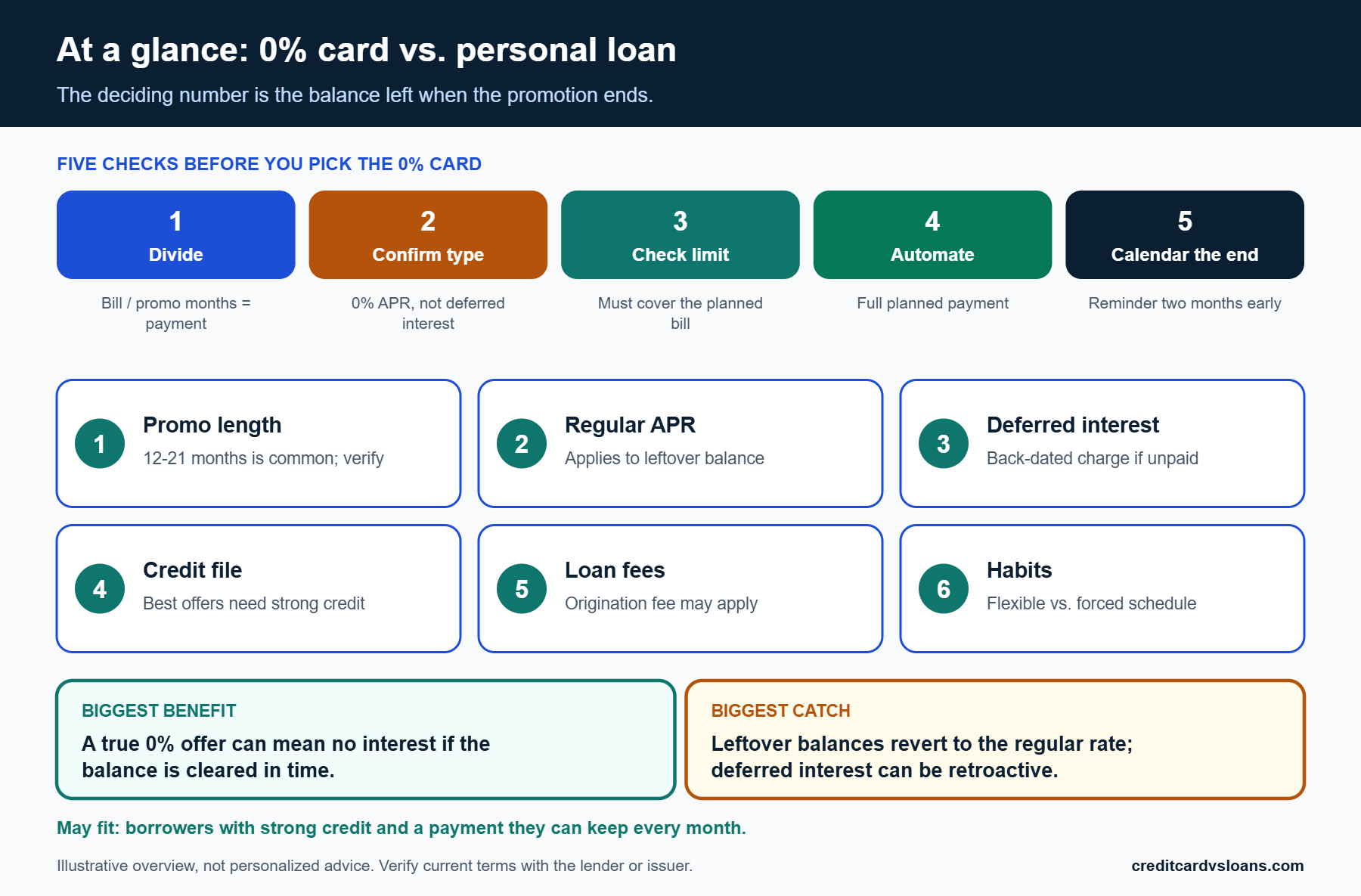
- Dividing the purchase by the number of promotional months gives the monthly payment needed to finish in time. If that number is too high for your budget, the promotion isn’t a fit.
- Deferred-interest offers can look similar but charge back-dated interest on the original purchase if any balance remains. The CFPB has flagged this risk repeatedly.
- Qualifying for the best promotional offers typically requires good credit, and nothing guarantees you’ll be approved or given a long promotional period.
- A personal loan trades the possibility of zero interest for certainty: a fixed payment, a fixed end date and no cliff.
Rate averages are from the Federal Reserve’s G.19 release (second-quarter 2026 data). The regulatory points come from 12 CFR 1026.55 as published on eCFR. Promotional terms vary by issuer and change often, so verify the exact length, rate and conditions in the card’s terms before applying.
The Short Answer: When 0% Beats a Loan and When It Doesn’t
Start with a simple test. Divide the amount you need to finance by the number of promotional months. If you can comfortably make that payment every month, the card has a real chance of winning. If you can’t, the loan likely does.
When the 0% Card Comes Out Ahead
You can clear the balance inside the promotion
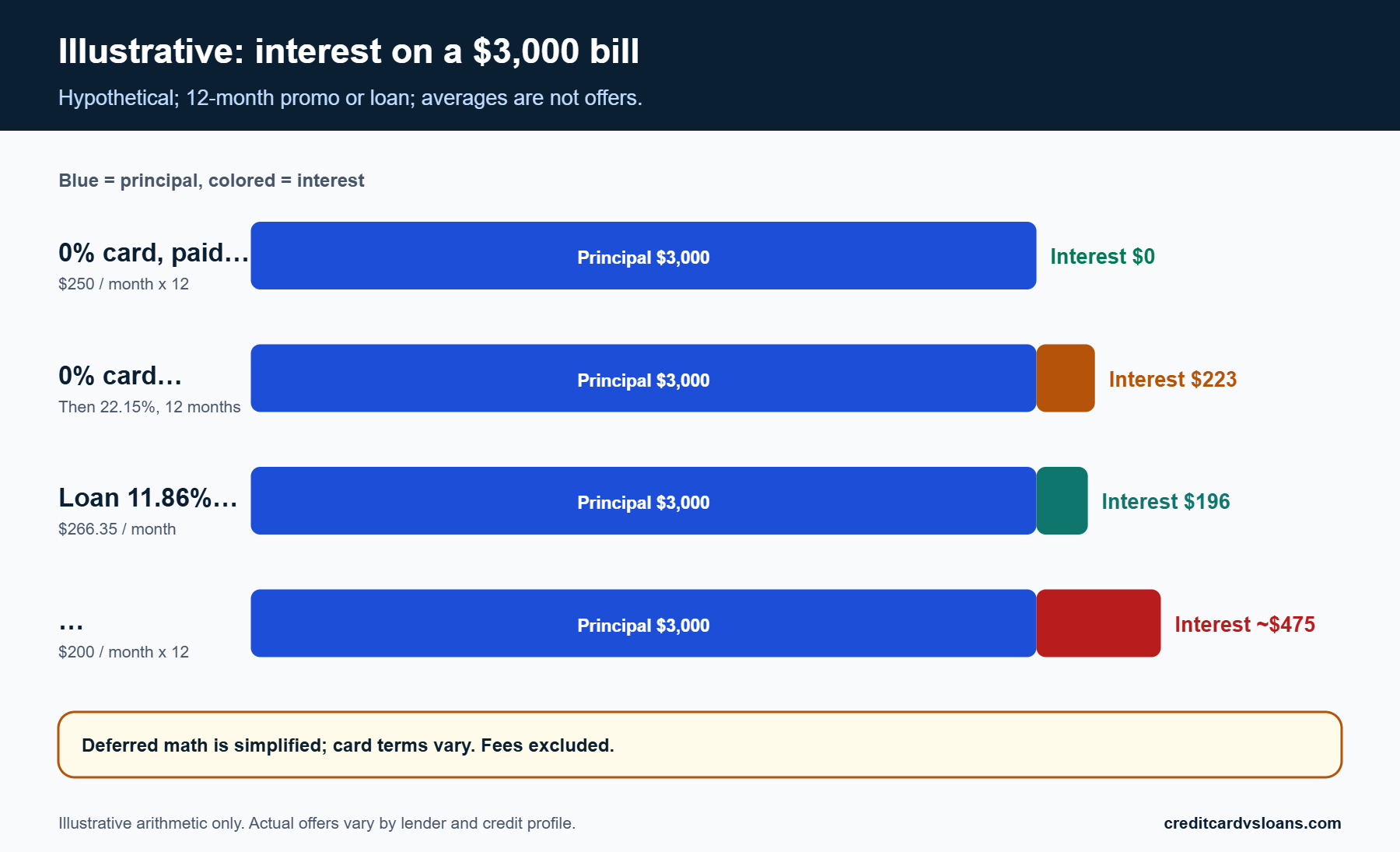
The card wins when you borrow a modest amount and pay it off before the promotion ends. Suppose, hypothetically, you put $3,000 of school costs on a card with a 12-month 0% purchase APR. Paying $250 a month for 12 months retires the balance with no interest. The same $3,000 on a 12-month personal loan at the Federal Reserve’s second-quarter 2026 average of 11.86% would cost about $196 in interest, assuming no fees.
The savings are real, but they depend on finishing on time, and that depends on behavior rather than math. Autopay for the full planned amount is the single most useful safeguard.
You have strong credit and no urgency about a lump sum
Promotional offers go mostly to borrowers with strong credit. A card also doesn’t require you to take the whole amount at once, so you can spread purchases through the season. If your credit file is solid and your income is stable, a 0% card is worth comparing, though approval and terms are never certain.
If you aren’t sure you would qualify, a prequalification tool on the issuer’s site can show whether you are likely to receive an offer without a hard pull, though a prequalified result isn’t final approval.
When a Personal Loan Comes Out Ahead
The balance won’t be gone when the promotion ends
If your realistic payoff stretches past the promotional period, the card’s regular rate applies. The Federal Reserve’s G.19 data for the second quarter of 2026 put the average rate for card accounts assessed interest at 22.15%. A fixed-rate personal loan, with a Federal Reserve average of 11.86% for 24-month loans, can cost less on the unpaid part, though your offer will vary.
The comparison is closer than it looks if the unpaid part is small. We quantify that in the break-even section below.
You need certainty, not flexibility
A loan locks in one payment and one end date. A card lets you pay whatever you want above the minimum, which sounds like a benefit but can erode discipline. If you know that a flexible schedule tends to slide, a loan’s rigidity is a feature.
The CFPB describes personal installment loans as closed-end loans where payments are usually the same throughout, which is precisely what makes budgeting easier.
How 0% Promotions Actually Work
Not every low-rate or no-interest offer is the same, and the differences matter more here than in almost any other part of the comparison.
Three Offers That Look Alike
0% intro APR on purchases
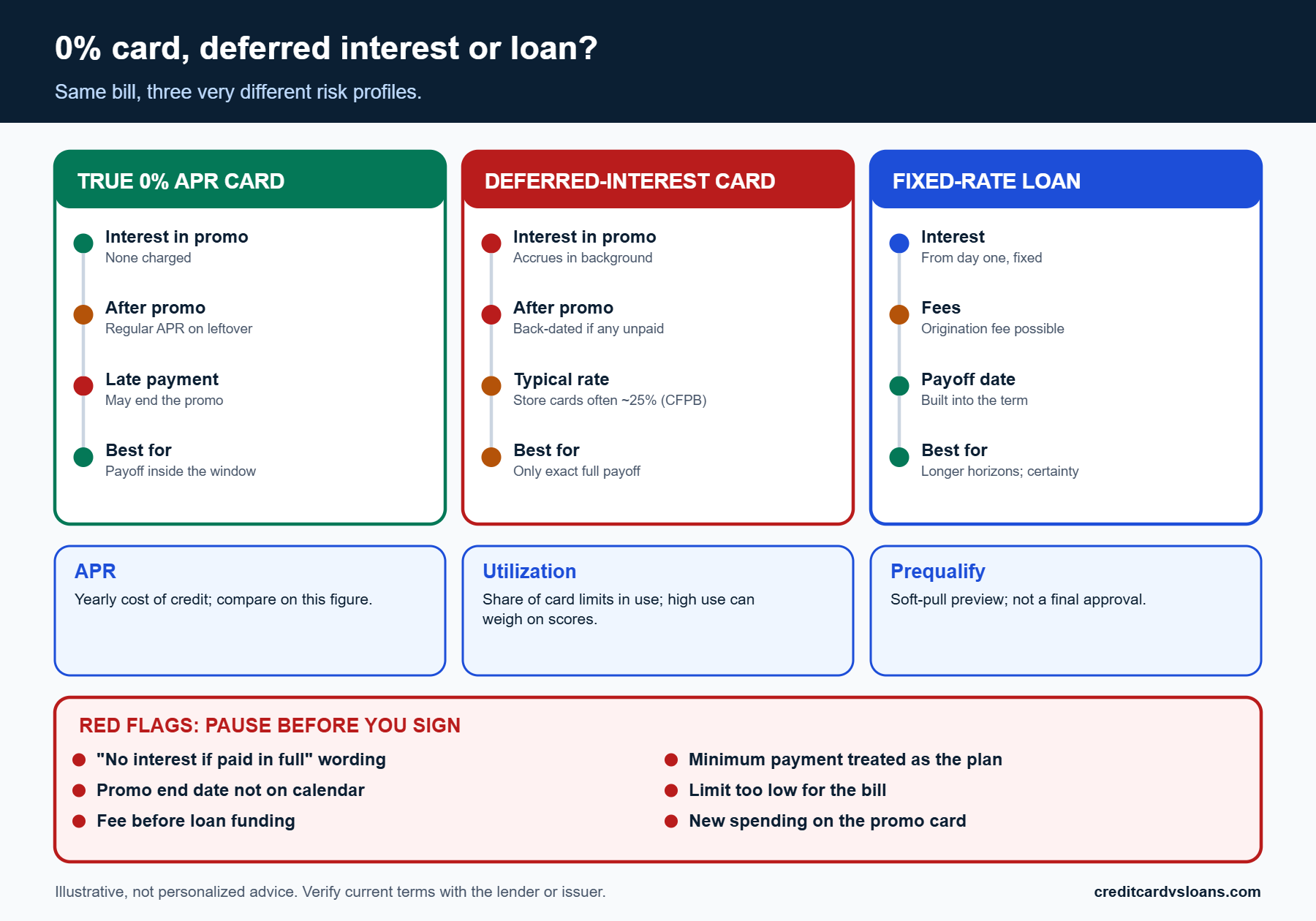
A 0% intro APR on purchases means no interest is charged on new purchases for a stated period, such as 12 or 15 months. The CFPB explains that with a zero-interest promotion, if you have a balance left at the end, you pay interest only on the remaining balance, starting when the promotion ends. That is the offer this guide has in mind.
Note that other terms may apply, such as a requirement to make on-time minimum payments, and the promotional rate can be lost if you fall seriously behind.
Balance transfer and deferred-interest offers
A 0% balance transfer offer applies to debt moved from another card, usually for a transfer fee, and isn’t designed for new purchases; see what credit score you may need for a balance transfer card and whether a balance transfer hurts your credit score if that is your situation. Deferred interest, often advertised as no interest if paid in full, is a different mechanism entirely.
The CFPB explains that with deferred interest, interest builds in the background during the promotion and is charged only if the full promotional balance isn’t paid in time; the back-dated interest is then added to your balance. In its example, a $400 purchase with $25 monthly payments left $100 unpaid after 12 months, which meant owing $100 on a zero-interest card but $165 on a deferred-interest card.
The Rules Around Promotional Rates
What federal rules say about the promotional period
Under 12 CFR 1026.55(b)(1), an issuer may raise a rate when a temporary rate period of at least six months ends, provided it disclosed the period’s length and the post-period rate clearly and in writing before the period began. The issuer can’t apply the higher rate to transactions made before the promotional period, and can’t charge more than the disclosed increased rate for transactions made during it.
In practice, this is why the card’s disclosure box matters. The length of the promotion and the rate that follows are required to be disclosed up front, so find them before you apply.
How a missed payment can end the deal
Under 12 CFR 1026.55(b)(4), an issuer may raise a rate if it hasn’t received the required minimum payment within 60 days after the due date, and must explain the reason in the notice. The higher rate must end if you then make six consecutive on-time minimum payments starting with the first payment due after the increase takes effect.
Card agreements may add their own conditions on top of the federal baseline, and a late fee can apply for even a one-day delay. Read the agreement’s promotional section for what triggers a loss of the rate.
The Break-Even Math for a 0% APR Credit Card vs a Personal Loan
All figures in this section are hypothetical and illustrative. They use the Federal Reserve’s second-quarter 2026 averages as stand-ins: 22.15% for a card’s regular rate after a promotion and 11.86% for a 24-month personal loan. Your offers will differ.
The Payment Needed to Finish in Time
Divide the bill by the promotional months
The first calculation is the simplest. Take the total you plan to finance and divide it by the number of months in the promotion. For a $3,000 balance, that works out to $250 a month on a 12-month promotion, $200 on a 15-month promotion and about $167 on an 18-month promotion.
If the number is more than you can reliably pay, consider financing less, paying part of the bill from savings or choosing a different tool. The goal is not the longest promotion; it’s a payment you can make every month, including the lean ones.
| Promotional length | Payment to finish on time | Interest if you finish on time | Fit for a tight budget? |
|---|---|---|---|
| 12 months | $250.00 | $0 | Harder |
| 15 months | $200.00 | $0 | Moderate |
| 18 months | $166.67 | $0 | Easier |
| 21 months | $142.86 | $0 | Easier |
Why the minimum payment won’t get you there
The CFPB points out that the minimum payment on a promotional balance is usually not enough to clear it before the promotion ends, so you need to calculate a higher monthly amount yourself. It also notes that payments above the minimum generally go to the balance with the higher interest rate by default, so if you have more than one balance on the card, ask how extra payments are applied.
Set the payment you calculated as an automatic recurring payment, not a manual one. A forgotten month can push you past the line.
What Happens to the Leftover Balance
Regular-rate interest on what remains
Suppose you pay $200 a month on that same $3,000 over a 12-month 0% promotion. You would have paid $2,400 and still owe $600 when the promotion ends. If you repay the remaining $600 over six months at a 22.15% regular rate, the payment would be about $106.56 and the interest about $39. That is small, which shows that a short miss is not catastrophic on a true 0% offer.
The picture changes if a large share of the balance is left over. The table shows how the leftover amount drives the cost, assuming it is repaid over 12 months after the promotion.
| Balance left when promotion ends | Monthly payment | Interest cost | Compare: 12-month loan on the full $3,000 at 11.86% |
|---|---|---|---|
| $600 (20%) | $56.20 | $74.40 | $196.20 interest |
| $1,200 (40%) | $112.40 | $148.80 | $196.20 interest |
| $1,800 (60%) | $168.60 | $223.20 | $196.20 interest |
| $3,000 (100%) | $281.00 | $372.00 | $196.20 interest |
Reading the break-even point
On these assumptions, the card still comes out ahead even when 40% of the balance is left over, because the 0% period saved a year of interest on the rest. Somewhere around half the balance, roughly 53% in this example, interest on the card equals what the loan would have cost. When nothing was paid during the promotion, the card costs about $176 more than the loan.
One caveat: the card path in Table 2 takes up to 24 months in total while the loan path takes 12, so the tables compare interest dollars, not speed. The conclusion is that a 0% card is forgiving if you make real progress during the promotion, and punishing if you don’t. Check your own offers, because a loan with an origination fee, for example, changes the loan side of the comparison.
Adding Fees to Both Sides
Loan origination fees and card fees
Some personal loans deduct an origination fee, which is a charge for processing the loan, from the proceeds. Hypothetically, to receive $3,000 after a 5% fee you would borrow about $3,158, and over 12 months at 11.86% you’d repay about $3,364, a finance cost of about $364 instead of $196.
A card may carry an annual fee that reduces the value of the offer, and a balance transfer offer typically carries a transfer fee, which doesn’t apply to ordinary purchases. Always add all fees to the comparison and use APR or total dollars repaid, not the interest rate alone.
The cost of a missed or late payment
A late fee on a card is a direct cost. A missed payment can also trigger the loss of a promotional rate depending on the agreement, and serious delinquency can lead to a penalty rate under the federal rules described earlier. A loan’s late fee and credit reporting consequences are similar in kind.
Because the penalty for a mistake is larger on a 0% card than on a loan, the importance of autopay is greater too.
Qualifying and Credit Effects
A 0% offer is only useful if you receive it. Issuers decide who qualifies, and nothing in this guide should be read as a prediction of your approval.
Who Tends to Receive Promotional Offers
Credit profile and income
Card issuers consider your credit reports and scores, your income and your existing debt. Generally, the most competitive promotional terms go to applicants with strong credit histories, and applicants with thin or damaged files may be offered no promotional rate, a shorter one or a lower limit. Our guide on credit scores for balance transfer cards discusses the scoring side in more detail, and much of it applies to purchase offers as well.
Don’t apply for a card just to see what you’d get. Use prequalification tools where available, since they typically use a soft pull.
Credit limit and the size of your bill
A 0% card is only helpful if the limit covers the planned purchases. A new card might come with a limit lower than your bill, in which case you would need to split the spending or use a different tool. A limit that is mostly used also pushes your utilization up, which can weigh on scores.
If your bill is larger than the likely limit, a personal loan, or a combination of savings and a smaller card balance, may be more realistic.
Effects on Your Credit File
Applications, new accounts and utilization
Applying for a card typically triggers a hard pull and adds a new account, which can lower the average age of your accounts. Charging a large share of the limit raises utilization while the balance is reported. These effects tend to be temporary and modest for borrowers with established files, and larger for those with thin files.
The same is true for a loan application, though a loan adds an installment account rather than revolving credit. Neither is a reason to choose one product over the other; rate and fit should drive that decision.
What happens when you pay it off
Paying the card off on schedule leaves you with a lower balance and an open account. Paying a loan off on schedule closes the account, which is normal and expected. Closing or keeping the card after the promotion is a separate decision, and our discussion of balance transfers in whether a balance transfer hurts your credit score explains how account age and utilization factor in.
The healthiest approach is to treat a promotional card as a short project: borrow, pay, finish, and decide afterward whether the account still serves a purpose.
Risks and Red Flags With Promotional Offers
Most of the money lost on promotional offers is lost to a small number of avoidable mistakes. They are easier to prevent than to repair.
Deferred Interest Disguised as a Bargain
How the back-dated charge works
Retail and store cards sometimes offer no interest if paid in full within a period. The CFPB has said that these deferred-interest promotions charge interest retroactively from the purchase date if any balance remains, and that store cards offering them often carry rates around 25 percent. A 2015 CFPB report found that deferred-interest purchases rose 21 percent from 2010 to 2013 and that many cardholders paid more than their promotional balance.
The CFPB suggests zero-percent promotions instead, where interest accrues only on any balance left after the period. When you see a promotion, ask which one it is.
A hypothetical deferred-interest example
Imagine a $3,000 purchase on a deferred-interest store card at a hypothetical 25% APR, paid at $200 a month for 12 months. That leaves $600 unpaid. The deferred interest accrued on the declining balance over the year would be about $475 under a simple monthly calculation, so the balance after the promotion would be roughly $1,075 before any new interest. On a true 0% card, the same payments would leave $600.
That roughly $475 gap is the price of misreading the offer. Real card agreements differ in how they compute deferred interest, so use this only as an illustration.
Cliff Effects and Behavior Risks
The promotion expires and the balance resets to a high rate
A promotional period ends on a date, whether or not you remember it. After that, the regular rate applies to whatever is left. The Federal Reserve’s second-quarter 2026 data show an average of 22.15% for accounts assessed interest, so the post-promotion rate can be steep.
Put the end date in your calendar the day you open the account, and set a reminder two months before it. If you’re going to miss the deadline, a lower-rate loan or another transfer may help, but that decision needs lead time.
New spending that sneaks onto the promotion
If you keep using the card for everyday spending, new purchases may not follow the same promotion, and payments may be applied in a way that leaves the higher-rate balance untouched. The CFPB notes that payments above the minimum generally go to the higher-rate balance by default.
The cleanest approach is to use the card only for the planned back-to-school costs, or to dedicate a card to the project and keep other spending elsewhere.
If an offer says no interest if paid in full, treat it as deferred interest until the terms prove otherwise. If you can’t explain what happens to the interest on day 366, don’t sign.
The Personal Loan Side of the Comparison
A fair comparison treats the loan as more than a fallback. For some households it is the right tool even when a 0% offer is available.
What a Loan Does Better
Certainty of payment and payoff
A fixed-rate personal loan gives you the payment amount and the end date on day one. There’s no cliff, no deferred charge and no temptation to put new spending on the same account. The CFPB describes these loans as repaid in installments that are usually the same throughout the loan.
For a household that has been burned by a revolving balance, that structure can be worth a modest interest cost. Peace of mind has a value, even if it doesn’t appear in the APR.
Larger sums and longer horizons
Many 0% offers last 12 to 21 months, and credit limits on new cards can be modest. If the bill is large or the payoff will take two or three years, a loan can offer a longer fixed horizon at a rate that may be lower than a card’s regular rate. In the Federal Reserve’s second-quarter 2026 data, the average 24-month personal loan rate was 11.86%.
For a hypothetical $6,000 balance, the 24-month interest at 11.86% would be about $769 with no fee, and a 36-month loan would cost about $1,160, which is why shortening the term matters as much as the rate.
Where Loans Fall Short
Origination fees, rate tiers and no grace period
Loan interest begins to accrue as soon as funds are disbursed, so there is no interest-free window as there can be on a card. Some lenders charge an origination fee, and rates vary by credit tier, so a borrower with a modest score may see a rate that is much higher than the average. If the loan rate approaches a card’s regular rate, the case for the loan weakens.
Always check the APR, which is designed to fold required fees into one comparable figure, and ask whether there are any prepayment charges.
A weaker fit for small, quick bills
For a bill of a few hundred dollars that you can clear in a couple of months, a loan’s fee and paperwork can outweigh the benefit. A 0% card or an existing card paid on time is usually simpler.
The break-even comparison is in the earlier tables. Run it with your own rates, and don’t let convenience override the arithmetic.
Timing a Promotion Around the School Calendar
Back-to-school spending has a seasonal shape that interacts with a promotional clock. Good planning lines the two up.
K-12 Households
Clustered purchases in late summer
K-12 costs tend to bunch in July and August: supplies, clothing, fees and sometimes a device. A promotion that starts in August and runs 12 months ends in August of the next year, just as the next round of costs begins. If you’re not paid off by then, the new round lands on top of the old balance.
That is the strongest argument for choosing a payoff payment you can sustain before you apply. Aim to be done by early summer, so you start the next school year with a clean slate and a choice of tools.
When a promotion is overkill
If your total is under a few hundred dollars and you can pay it within two statements, you don’t need a promotional card at all. A card you already own, paid in full by the due date, may charge no interest on new purchases, though you should confirm this in your agreement. Opening a new card for a small bill adds an inquiry and a new account for little gain.
A promotion pays off when the bill is large enough that a year of interest would matter and when you can commit to the payoff schedule.
College Households
Bridging an aid gap
College costs sometimes arrive before financial aid is disbursed. A 0% card can bridge a gap of a few weeks or months if you know exactly when money is coming. The CFPB, however, advises against using credit cards to pay for college generally, noting they are usually a much more expensive way to finance education and lack the flexible repayment terms and borrower protections of federal student loans.
A short, planned bridge with a confirmed repayment source is different from financing a semester on a card. Be honest about which one you are doing.
Federal aid comes before either product
For college students, the order of borrowing recommended by the CFPB puts federal Direct loans first, then PLUS loans for parents or graduate students, and private loans last. For Direct Loans first disbursed July 1, 2026 through June 30, 2027, the undergraduate fixed rate is 6.52%, which is far below the average card regular rate cited earlier, though a loan has its own limits and long-term obligations.
The full ladder is in our guide to how to finance back-to-school costs. Use that ladder first, then compare a 0% card or a loan for whatever gap remains.
Mistakes to Avoid After You Get the Card
Winning approval is the easy part. What you do in the first 60 days usually determines whether the promotion saves money.
Setting Up the Account
Read the promotional terms before the first purchase
When the card arrives, find the section of the agreement that describes the promotional rate: which transactions it covers, how long it lasts, the rate that follows and the conditions that can end it. Some offers apply only to purchases made within a certain window after account opening, so waiting a month to spend could shorten or void the benefit.
If something in the terms doesn’t match what you were told, ask the issuer in writing before you use the card. Keep a screenshot or a copy of the offer page as you saw it at the time of application.
Automate the planned payment and a backup
Set an automatic payment equal to the amount you calculated in Table 1, not the minimum. If your bank allows it, add a calendar alert a few days before each due date to confirm the funds are there. One missed payment can bring a late fee and, depending on the agreement, can put the promotional rate at risk.
It also helps to keep one month of the planned payment in a separate buffer. That small cushion turns a surprise car repair into a nuisance rather than a missed payment.
Using the Card Wisely
Keep a ledger of the promotional balance
Track the promotional balance separately from any other balances. A simple spreadsheet or note listing the starting balance, each payment and the remaining balance lets you see at a glance whether you’re on track. Review it monthly, and compare it with the statement, since the statement is the official record.
If you’re ahead, don’t relax by spending more; send the surplus to the balance. If you’re behind, adjust early, since a larger payment later is harder to find than a slightly larger payment now.
Plan the exit before the clock runs out
Two or three months before the promotion ends, check the remaining balance. If it will be cleared, nothing more is needed. If a balance will remain, compare your options while you still have time: pay more from savings, move the balance to another low-rate option if one is available to you, or take a fixed-rate loan to pay it off.
Any of those moves has its own fees and credit effects, so run the numbers before acting. Waiting until the final week narrows your choices.
Which Wins? A Decision Path for Your Situation
The scenarios below are hypothetical. They illustrate how the answer shifts with the size of the bill, the payoff speed and the credit file.
Matching the Offer to the Household
Scenarios and likely fits
| Situation | Often fits | Why | Watch out for |
|---|---|---|---|
| $2,000 bill, strong credit, can pay $170 a month | 0% card with 12+ month promotion | Payment clears the balance in time | Missing the end date; new spending on the card |
| $5,000 bill, payoff will take 2+ years | Fixed-rate personal loan | Fixed horizon beyond most promotions | Origination fee; rate tier |
| $1,000 bill, can pay in 2 months | Existing card paid in full | No new account needed | Carrying a balance past the due date |
| Fair credit, unsure of approval | Prequalify for both | Offers vary widely by credit | Applying blindly; stacking hard pulls |
| Store card with no interest if paid in full | Treat as deferred interest | Back-dated interest if any balance remains | High regular rate, often around 25% per CFPB |
| College costs while aid is pending | Federal aid and school plans first | Lower, fixed federal rates and flexible repayment | Financing a semester on a card |
The honesty test
Before choosing the card, ask whether you have ever paid off a balance on schedule when the deadline was a year away. If the answer is yes and your income is stable, the card is a reasonable candidate. If the answer is mixed, the loan’s forced schedule may protect you better than the card’s flexibility.
There is no shame in picking the structure that fits your habits. A slightly higher interest cost can be cheaper than a missed promotion.
Questions to Ask Before You Apply
For the card issuer
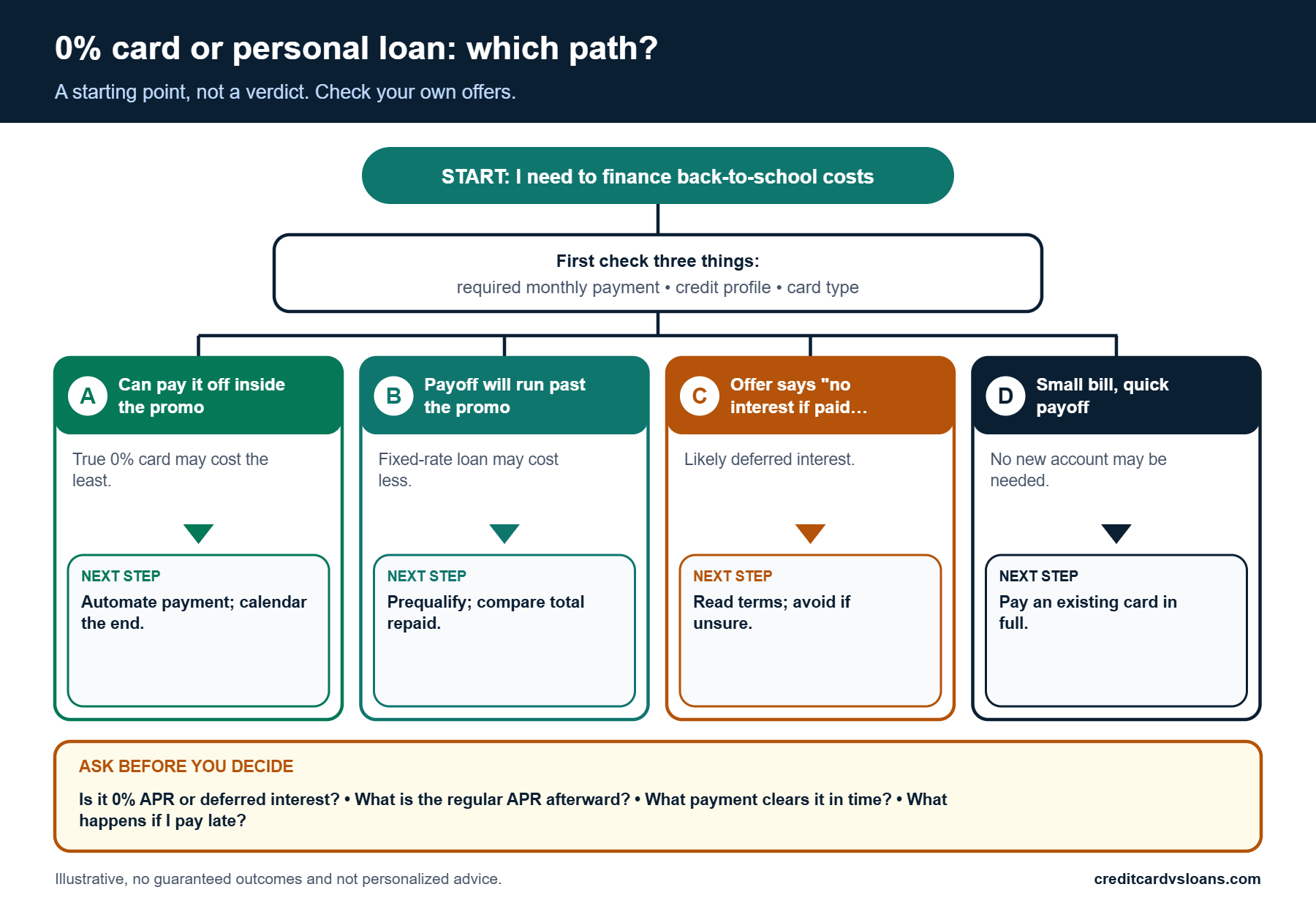
Is the promotion a zero-interest offer or a deferred-interest offer? How long does it last, and what is the regular APR afterward? What exactly triggers the loss of the promotional rate? Is there an annual fee or any other fee? How are payments above the minimum applied?
Ask for the answers in the card’s written terms, and keep a copy. The disclosure box that issuers are required to provide is where these details live.
For a loan lender
What is the APR, and is it fixed? Is there an origination fee, and is it deducted from the funds I receive? Are there any prepayment penalties? What is the total I will repay over the full term? What happens if I miss a payment?
The CFPB recommends comparing offers from multiple providers, and when shopping for private loans, doing so within a short window, about two weeks in the CFPB’s student loan guidance, to limit the credit score effect.
Your Decision Checklist and Next Steps
This section condenses the guide into a path you can follow this week.
Making the Call
The three-part test
First, can you pay the full balance within the promotion at a payment you can sustain in your leanest month? Second, do you have a credit profile that makes a 0% offer plausible, and have you confirmed it is true zero-interest rather than deferred interest? Third, if you miss the deadline, would the regular rate on the leftover balance still leave you better off than the loan?
If you can answer yes to all three, the 0% card is worth pursuing. If any answer is no, price the personal loan carefully and compare the totals. For a more general comparison, our credit card vs. personal loan guide for back-to-school expenses gives the same math without the promotional element.
A 0% APR card can beat a personal loan when you finish paying within the promotion, and it can lose when a large part of the balance is left over or when the offer turns out to be deferred interest. Divide the bill by the promotional months, confirm the payment fits your leanest month and put the end date on your calendar before you spend a dollar.
When to skip the promotion entirely
Skip it if you haven’t read the terms, if the monthly payment needed to finish in time stretches your budget, if the credit limit is too low to cover the bill or if you tend to add new spending to the same card. In those cases, the discipline of a fixed loan, or a smaller bill financed from savings, is usually the better path.
A Concrete Next-Step List
Before you apply
- Total the real bill and subtract what you can pay from savings or cash flow.
- Divide the remainder by the promotional months you’d be offered to find the required payment.
- Prequalify for a card and a loan using soft-pull tools, and note each offer’s APR, fees and promotional length.
- Confirm in writing that a card promotion is zero-interest and not deferred interest.
After you commit
- Set autopay for the full planned payment, not the minimum.
- Calendar the promotion end date and a reminder two months earlier.
- Avoid new spending on the promotional card.
- If you fall behind, contact the issuer or lender before the due date and ask about options.
This guide is general education, not personalized advice. Your offers, fees and eligibility will differ, and a nonprofit credit counselor can review your specific numbers.
- CFPB: How to understand special promotional financing offers on credit cards
- CFPB: CFPB encourages retail credit card companies to consider more transparent promotions (Deferred-interest promotions (June 2017))
- eCFR: 12 CFR 1026.55 Limitations on increasing annual percentage rates, fees, and charges
- Federal Reserve: Federal Reserve G.19 Consumer Credit release (Q2 2026 interest rates)
- CFPB: What is a personal installment loan?
- CFPB: Choosing a loan that’s right for you (Credit cards for college; order of borrowing)
- U.S. Department of Education: Interest rates for Federal Direct Loans first disbursed July 1, 2026 to June 30, 2027 (GENERAL-26-33)
Last updated: October 22, 2026. Rates, fees and lender rules change; verify current terms before acting.
The information on creditcardvsloans.com is provided for general educational and informational purposes only. It is not financial, legal, tax, credit, accounting or investment advice, and reading it does not create an advisor-client, fiduciary or any other professional relationship. Nothing here is an offer, solicitation or recommendation to borrow, lend or apply for any product.
Credit scores, interest rates, fees, eligibility rules, lender policies and laws change frequently and vary by lender, location and individual circumstances. Examples, figures and scenarios are illustrative only, do not predict your results and do not guarantee approval, savings, a particular rate or a credit-score outcome. Always confirm current terms directly with the lender or issuer and read the full agreement before you apply or sign.
Although we aim for accuracy and use reputable sources, we make no representations or warranties, express or implied, about the completeness, accuracy, reliability or timeliness of the content. Content may be drafted with the assistance of automated tools, so errors or omissions may still occur. Links to third-party sites are provided for convenience; we don’t control and aren’t responsible for their content.
To the fullest extent permitted by law, creditcardvsloans.com and its owners, editors, authors, contributors and affiliates disclaim all liability for any loss, damage or expense arising directly or indirectly from your use of, or reliance on, this content. Before making financial decisions, consult a licensed professional, such as a qualified financial advisor, attorney, tax professional or nonprofit credit counselor, who can consider your complete situation.