There is no single credit score that unlocks every offer, but the credit score for a 0% APR credit card that issuers tend to look for sits in the stronger tiers of the scoring range, and the score is only one of several things that decide whether you are approved. Issuers set their own criteria, rarely publish a cutoff, and weigh your income, your existing debts, your payment record and your recent applications alongside the number itself.
That is why two people with the same score can get different answers on the same card. This guide focuses on the approval factors behind the score: what an issuer is allowed and required to consider, which parts of your credit report carry the most weight, and what you can realistically do about each one before you apply. If you are also weighing a balance transfer, the score guidance for balance transfer cards is a closely related read, and this comparison of consolidation loans and transfer cards covers the alternatives.
A 0% APR card (also called a 0% intro APR or promotional APR card) charges no interest on purchases, balance transfers or both for a set promotional period. After that, the regular rate applies to whatever you still owe. That regular rate is where the real risk lives, and it is part of why issuers look closely at who they approve.
- No official minimum score exists for 0% APR cards. Each issuer sets its own standards and terms vary by lender, so treat any published “recommended score” as a rule of thumb, not a promise.
- Federal rules require card issuers to consider your ability to make the minimum payments, based on your income or assets and your current obligations. A strong score does not replace that review.
- Payment history and the share of your credit limits you are using together make up roughly two-thirds of a FICO Score, so they are the best places to look first.
- Each application can add a hard inquiry. FICO Scores consider inquiries from the last 12 months, though they stay on your report for two years.
- Approval is not the finish line. The regular APR after the promotion matters as much as the 0% period, and you should know the payoff plan before you apply.
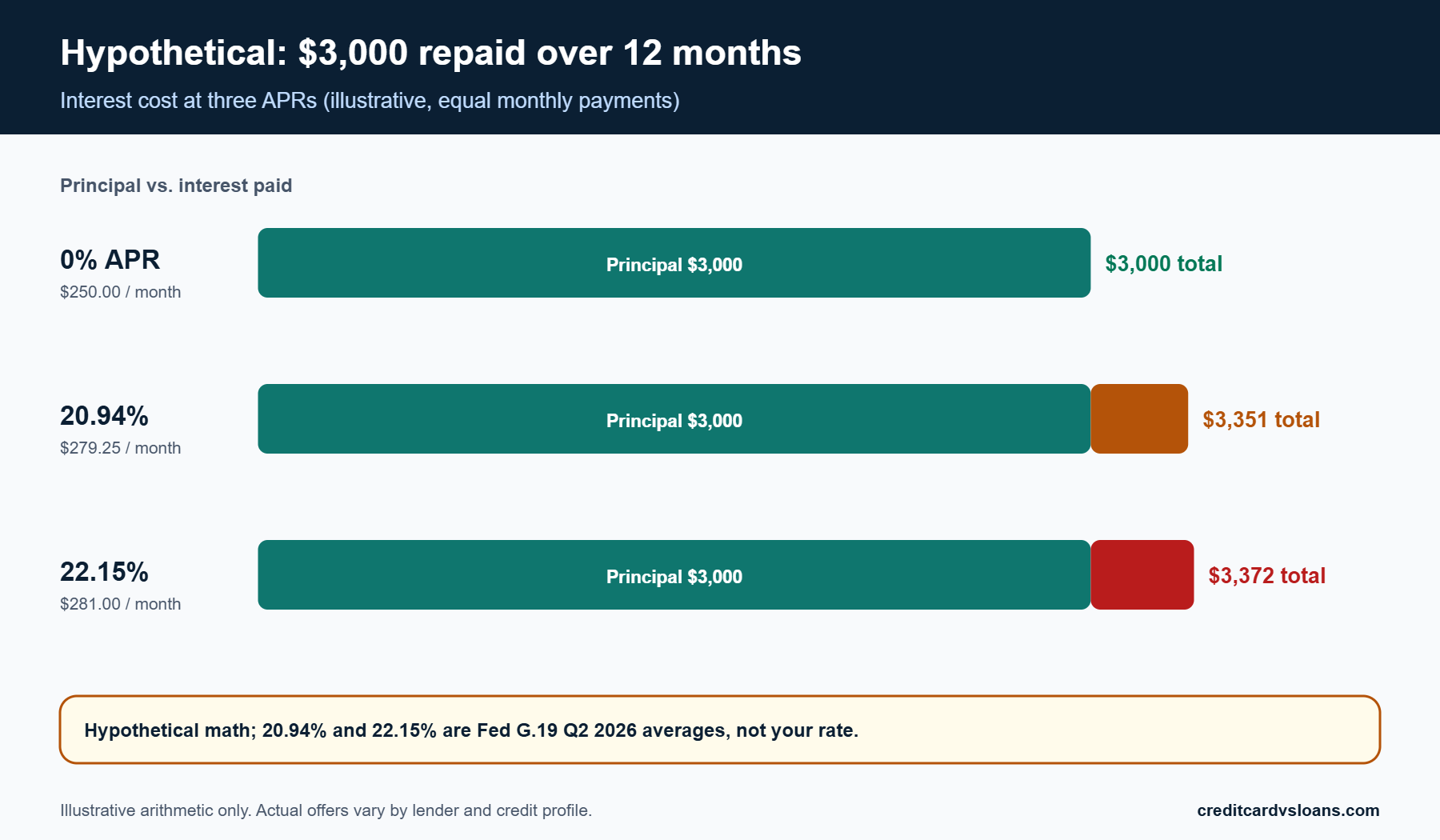
Figures here are dated as of October 2026. The Federal Reserve’s G.19 consumer credit release of October 7, 2026 reported that commercial banks charged an average of 22.15% on credit card accounts assessed interest in the second quarter of 2026 (20.94% across all accounts). Your own offer will differ, so use these only as context.
What Credit Score Do You Need for a 0% APR Credit Card? The Short Answer
What a score range tells you and what it leaves out
Score tiers as a rough map
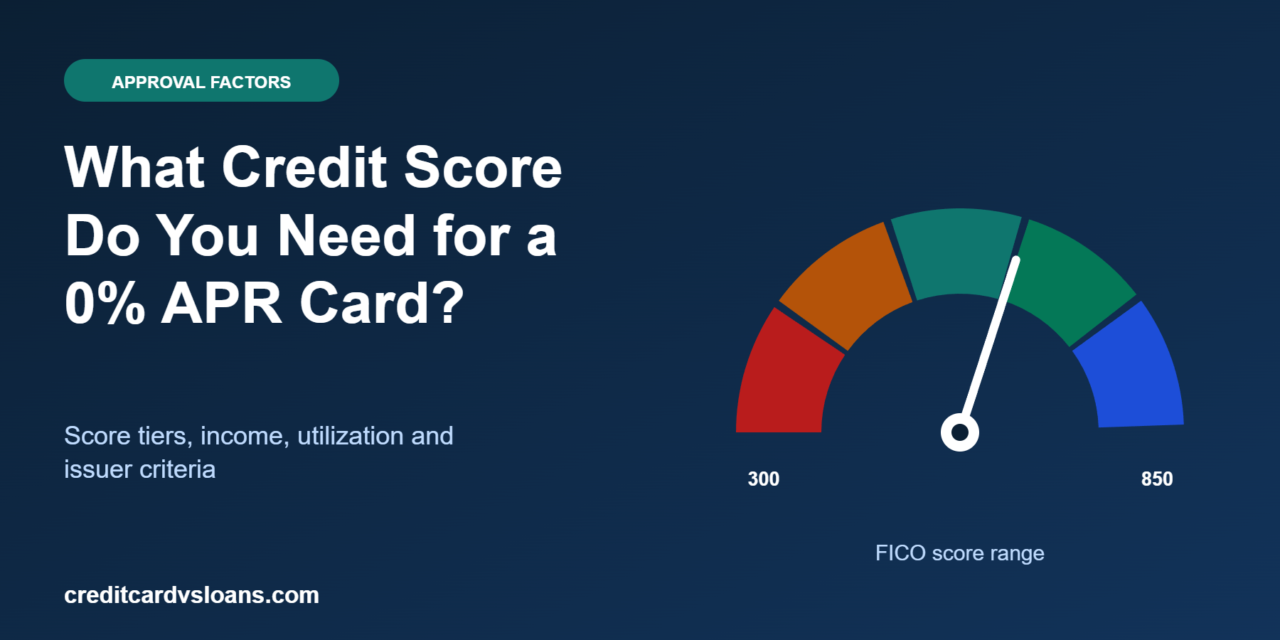
FICO describes its scores as running from 300 to 850, and labels the tiers this way: below 580 is Poor, 580 to 669 is Fair, 670 to 739 is Good, 740 to 799 is Very Good, and 800 and above is Exceptional. The CFPB likewise notes that most scores fall between 300 and 850. These labels are a convenient map, not a set of gates that issuers have agreed to use.
In practice, promotional-rate offers are a premium feature, because the issuer is giving up interest income for a while. So it is reasonable to expect the most generous 0% offers to be aimed at applicants with stronger credit profiles, and weaker profiles to see fewer or shorter promotions. That is an expectation, not a published rule, and it is the reason this article keeps pointing you to the factors underneath the number.
Why issuers rarely publish a hard cutoff
Issuers decide using their own models and policies, and they use more than your score. Some publish a loose guideline such as “good credit recommended” in marketing, which is a signal about who the product is built for rather than a floor. Others say nothing at all.
The practical consequence is that you cannot reverse-engineer approval from the number alone. Someone with a high score and a very high ratio of debt to income might be declined, while someone just below a marketed range with a long clean history and steady income might be approved at a lower limit. Check the terms on the specific offer, and read what the issuer says about the credit profile it expects.
A five-minute self-check before you look at any offer
Know which score you are looking at
The CFPB points out that you have many scores, and they can differ by scoring model, by loan type, by data source and by the date they were calculated. FICO adds that your lender may use a different FICO Score than the version you can see yourself, and that it has industry-specific scores because credit card issuers and auto lenders assess risk differently. VantageScore is also widely used by lenders.
So the number in your banking app is a good indicator, not the exact figure the issuer will see. If your score sits right on the edge of a tier, assume the issuer’s version could land a little higher or lower, and prepare accordingly.
Read your reports before the issuer does
Your score is built from your credit reports, and reports contain mistakes. The FTC says you can get a free report from each of the three nationwide bureaus (Equifax, Experian and TransUnion) every week at AnnualCreditReport.com. Pull all three and look for accounts you do not recognize, late payments you believe were on time, and balances that look wrong.
If you find an error, the FTC advises contacting both the credit bureau and the business that supplied the information. Fixing a real error before you apply is one of the few moves that can help your odds without costing a cent.
| Approval factor | What the issuer is trying to learn | Where you have some control | Typical drawback if weak |
|---|---|---|---|
| Credit score tier | Overall repayment risk | Improves slowly over months | Fewer or shorter promotions |
| Income and obligations | Can you cover minimum payments? | Report all eligible income accurately | Decline or a low limit |
| Payment history | Do you pay as agreed? | Only going forward | Strongest negative signal |
| Utilization | Are you stretched on existing cards? | Pay balances down before applying | Lower score, lower limit |
| Credit history length | How much track record is there? | Time is the only fix | Thin file, cautious offer |
| Recent applications | Are you seeking a lot of new credit? | Space applications out | Extra hard inquiries |
The rows with a green cell are the ones where a few weeks of preparation can matter. The rows marked blue are mostly about time.
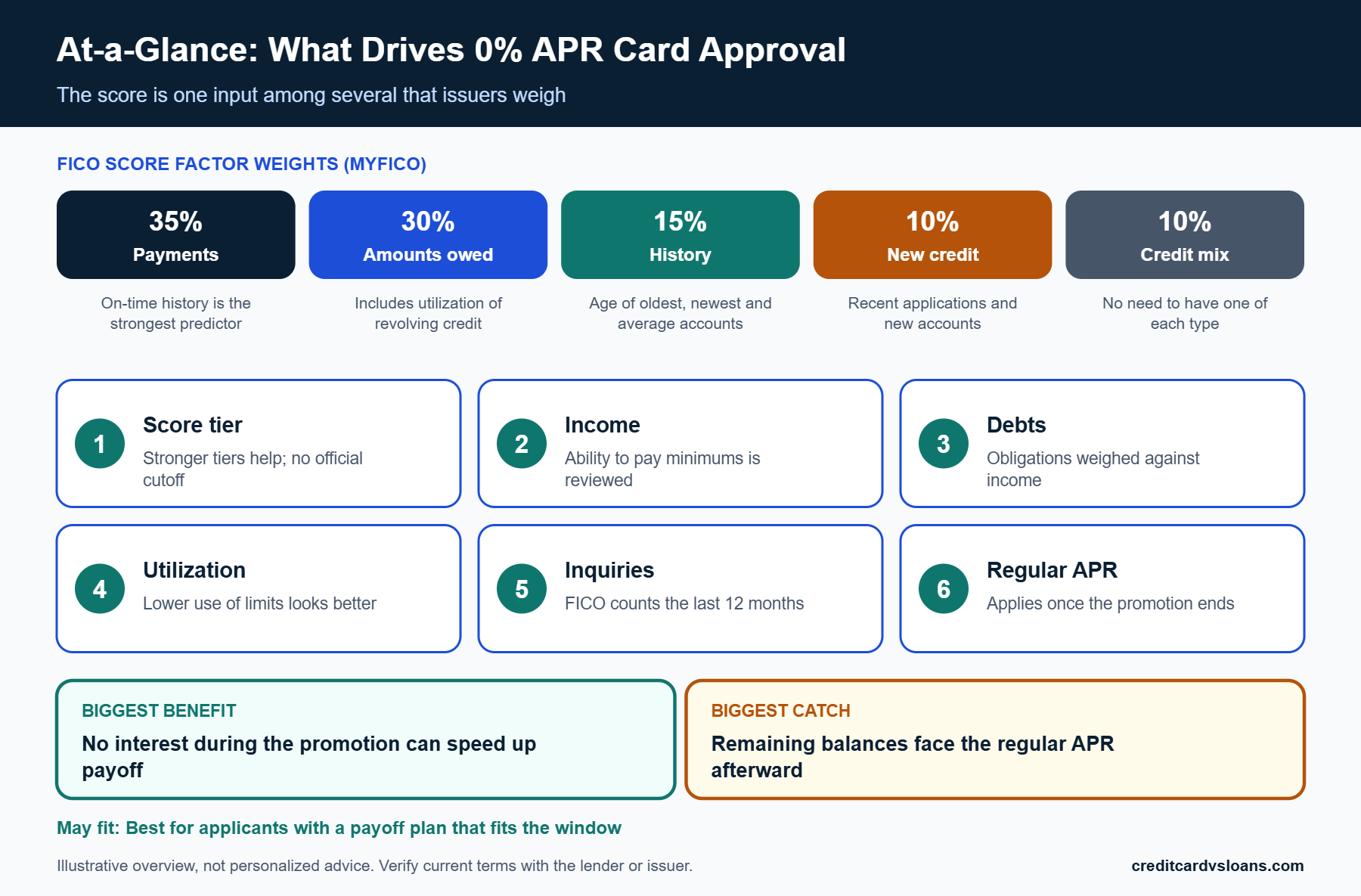
What Issuers Look at Besides Your Credit Score
Income, assets and ability to pay
What federal rules require issuers to consider
Under Regulation Z, 12 CFR 1026.51(a), a card issuer must consider whether you can make the required minimum periodic payments before it opens an account or raises a limit. That consideration has to be based on your income or assets and your current obligations. Issuers must also keep reasonable written policies for how they do this, and those policies must include at least one measure: the ratio of debt obligations to income, the ratio of debt obligations to assets, or the income left after debt obligations.
The rule also says that reviewing no income, asset or obligation information is unreasonable, and so is issuing a card to someone with no income or assets. In plain terms, a high score cannot by itself satisfy the ability-to-pay requirement.
Which income counts on an application
The regulation allows an issuer’s procedures to count income or assets you reasonably expect to be able to access, or to limit the review to your own independent income and assets. For applicants under 21 the rules are stricter: the issuer needs a written application and either financial information showing you can make the payments independently, or a signed agreement from a cosigner, guarantor or joint applicant who is 21 or older and has the ability to pay.
What this means for you is practical. Read the application’s income question carefully, report what the form asks for accurately, and do not guess. Income that you cannot document may not help, and overstating income on an application creates its own problems. If you are under 21, ask the issuer how it handles independent income versus a cosigner before you apply.
Existing debts and the debt-to-income picture
How obligations enter the decision
Your obligations are the payments you already owe: rent or a mortgage, car loans, student loans, personal loans and the minimums on your cards. When an issuer measures obligations against income, a heavier load makes it harder to justify a new line, whatever the score says. The regulation names ratios like debt to income as acceptable methods precisely because the same score can sit on top of very different budgets.
If you are applying for a 0% card to move debt, note that the new card’s own minimum payment is also part of the picture, because the rule asks the issuer to estimate the minimum payments on the account it is considering.
Why a high score can still meet a decline
A score summarizes credit behavior, not your cash flow. You can have flawless payment history and still be declined or given a small limit because your income is modest relative to your debts, because you are applying for several cards at once, or because the issuer has capped how much total credit it will extend to someone in your position.
If you are declined, the notice you receive should explain the main reasons, which is useful information for deciding what to fix. Treat it as a to-do list rather than a verdict, and avoid firing off more applications until you understand the reason.
The Credit History Factors That Move Your Odds
Payment history and negative marks
Why on-time payments carry the most weight
According to myFICO, payment history makes up 35% of a FICO Score and is the strongest predictor of whether you will pay debts as agreed. The same page notes that a few late payments are not an automatic score-killer, especially if the rest of your history is good. For an issuer weighing a 0% offer, a clean recent record is the clearest evidence that you will make the minimum payments during the promotional period, which matters because some card agreements let a late payment end a promotional rate early.
If your record is clean, protect it: set up autopay for at least the minimum on every account before you apply. If it is not, the newest months matter most, so a streak of on-time payments is the practical goal.
Collections, bankruptcies and how recent they are
The CFPB lists collections, foreclosures and bankruptcies, along with how recent they are, among the information scoring models use. Recent serious negatives tend to affect both approval and the terms offered, and they can limit which promotional offers are open to you even when the rest of your profile looks reasonable.
Ask the issuer, or read the offer’s disclosures, about how it treats these items. If you have a collection account, confirm that it is accurate and appears only as many times as it should. Do not pay a debt just to chase a score bump without first understanding how that particular account is being reported.
Credit utilization and amounts owed
How utilization is read
Amounts owed account for 30% of a FICO Score, according to myFICO, and credit utilization sits inside that category. Utilization is the percentage of your revolving credit that you are using. A high percentage can hurt a score and a low one can help, and myFICO notes that carrying debt is not automatically negative, but heavy use of available credit can suggest you are overextended.
Because the scoring models look at the balances on your report, paying down revolving balances before an issuer pulls your credit is one of the more direct levers you have. As a hypothetical, a $1,500 balance against a $3,000 combined limit is 50% utilization, while the same balance against a $10,000 limit is 15%.
The 0% card paradox for people carrying balances
Many people look for a 0% APR card because they already carry balances, which means their utilization is often high at the moment they apply. That is the awkward part: the situation that makes a 0% card attractive can also be the situation that weakens the application.
If you can, make a meaningful payment on the highest-utilization card first, wait for the lower balance to appear on your report, and then apply. If you cannot, expect that a lower limit or a shorter promotion is a realistic outcome, and plan the payoff around the limit you might actually receive rather than the limit you hope for.
Age of accounts, credit mix and recent applications
Thin files and young accounts
Length of credit history is 15% of a FICO Score and considers the age of your oldest and newest accounts, the average age and how long it has been since certain accounts were used. myFICO notes that a longer history generally helps but is not required for a good score. If you have a thin credit file, there is simply less evidence for an issuer to work with, and cautious offers are common.
The CFPB describes three starting points for building a record: a secured card, a credit builder loan, and a retail or store card, all of which report to the three nationwide bureaus. Paying on time helps build credit, while debit cards, prepaid cards and payday loans generally do not.
New credit and credit mix
New credit is 10% of the score. myFICO says opening several new accounts in a short period is seen as riskier, especially for people with short histories. Credit mix is another 10%, and the same source says you do not need one of each type of account.
The takeaway is not to open accounts to improve your mix. If your history is thin, one well-managed account that you can actually pay is more valuable than three applications in a month.
How Issuer Criteria Shape Your Odds, Costs and Terms
Why two issuers can answer the same applicant differently
Different models, different questions
FICO says that credit card issuers and auto lenders assess creditworthiness in different ways, so industry-specific scores exist. An issuer may run a card-focused score, a different scoring family, or its own model layered on top of your report. That is why a person can be approved by one issuer and declined by another with the same visible score.
It also explains why a decline is not a statement about your overall credit. It may reflect one issuer’s internal policy about, say, how many recent inquiries or how much total revolving debt it is comfortable with. Terms and criteria vary by lender, and you only learn them by reading the specific offer.
Relationship and total exposure
If you already hold accounts with an issuer, it can see how you handle them, which can help or hurt. Likewise, an issuer will think about how much credit it has already extended to you. Asking whether the issuer offers a soft-pull preview of your likelihood of approval, and reading its terms, tells you more than any outside guess about its internal rules.
Avoid paying for any service that claims to guarantee approval at a given issuer. Issuers make their own decisions, and nobody outside the issuer can promise one.
What approval can look like: limit, promotional period and regular rate
The limit you receive caps what a 0% card can do
An approval is not all-or-nothing. The CFPB notes that a credit score affects the interest rate and credit limit you may receive, and a limit that is smaller than the debt you hoped to move changes the plan. A balance transfer, if the card allows one, is normally limited by your credit line, and fees are usually charged on the amount moved.
Before you apply, decide what you will do if you receive a limit well below what you need. Having a fallback, such as splitting the balance across two sources or choosing a different tool entirely, keeps you from forcing a bad fit. For that comparison, see this breakdown of a 0% card versus a personal loan.
The regular APR after the promotion
The Federal Reserve’s G.19 release of October 7, 2026 shows commercial banks charging an average of 22.15% on credit card accounts assessed interest in the second quarter of 2026, and 20.94% across all accounts. Your own regular APR may be higher or lower, and it can depend on your credit profile. The point is that when the promotion ends, any balance remaining typically starts accruing interest at a rate in that general neighborhood.
The simplest test of whether you can use a 0% offer well is whether you can pay the full balance inside the promotional window. The chart below puts that in dollars.
Fees and promotion types that interact with approval
Balance transfer fee and intro APR terms
Many cards charge a fee on each balance transfer, often a percentage of the amount moved, and that fee is added to what you owe. Because the fee varies by card, read the Schumer box (the standardized table of rates and fees on card offers) rather than relying on headlines. The promotional APR may apply to purchases, transfers or both, and for different lengths of time.
When you compare, put the fee, the promotional length and the regular APR side by side. An apples-to-apples comparison often reveals that a longer promotion with a fee beats a shorter one without, or the reverse, depending on how fast you can pay.
True 0% versus deferred interest
The CFPB explains the difference: with a true 0% intro APR, no interest accrues during the promotion and interest starts only on the remaining balance afterward. With deferred interest, interest builds in the background from the purchase date, and if you do not pay the full promotional balance in time, that accrued interest is added to your balance. The CFPB’s own example uses a $400 purchase paid at $25 a month: after 12 months, $100 is unpaid, and under deferred interest you could owe roughly $165 instead of $100 (the example assumes a 25% rate).
The wording to watch for is “if paid in full.” That conditional phrase signals deferred interest. Always confirm which structure your offer uses.
| Feature | True 0% intro APR | Deferred interest promotion | Regular APR after promotion |
|---|---|---|---|
| Interest during the promotion | None accrues | Accrues in the background | Applies to remaining balance |
| If balance remains at the end | Interest on the remaining amount only | Interest may be charged back to purchase date | Rate depends on your offer |
| Fees to check | Balance transfer fee, annual fee | Late-payment terms that can end the promotion | Late and returned-payment fees |
| Credit inquiry | Hard inquiry on application | Hard inquiry on application | Not applicable |
| Utilization effect | New limit can lower overall utilization; transferred balance raises that card’s | Same | Same |
| Key red flag | Promotion ends before payoff | Missing a payment or the deadline | Higher than you expected |
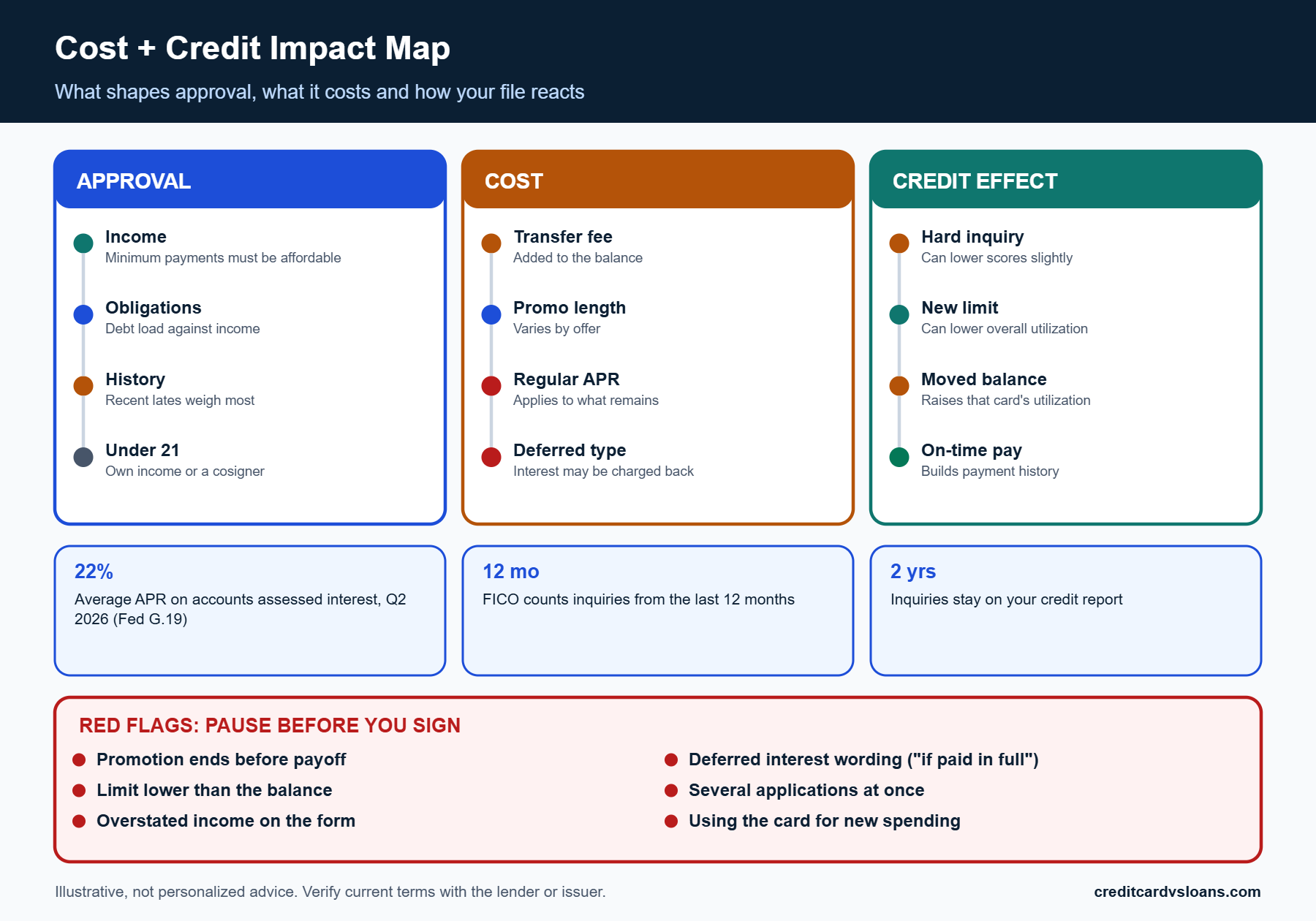
How Applying Affects Your Odds and Your Score
Hard inquiries, soft inquiries and timing
What the CFPB says about inquiries
The CFPB explains that hard inquiries usually happen when a lender reviews your credit after you apply, and they can affect your score because scoring models consider how recently and how often you apply for credit. Soft inquiries, such as checking your own reports, prescreened offers and some account reviews by existing lenders, do not affect your scores. FICO adds that its scores consider inquiries from the last 12 months, though inquiries remain on your report for two years.
The size of the effect varies by profile, so expect an application to matter more when your file is thin or your score is already near a tier boundary. Do not assume a particular point drop.
Soft-pull previews
Some issuers let you check whether you might qualify without a hard inquiry. Where that is offered, a preview typically gives an indication, not a commitment, and the final decision can still differ once the full application is processed. Use it to avoid wasted applications, not as a promise of approval.
If an issuer does not offer a preview, think twice before applying to see what happens. Each rejection that comes with a hard inquiry costs you something and tells you little you could not have learned from the offer terms.
Stacking applications and the 12-month window
Why several applications in a short span hurt more than one
Because new credit is weighed as a sign of risk, several applications close together tell scoring models you may be seeking credit under pressure. That can reduce your score slightly and also lower the odds on the next application, since issuers see the recent inquiries.
If you must apply for more than one account, ask whether it makes sense to wait for the first decision, and avoid applying for a 0% card in the same few weeks as a mortgage, auto loan or other large credit application.
A realistic pacing plan
A practical pace is one application at a time, with a gap that lets you see how the first one is reported. Between applications, keep utilization low and payments on time. If you are declined, read the notice, address the stated reasons and then decide whether to apply elsewhere or wait.
The aim is to apply once, for an offer you have read carefully, when your profile is as strong as you can make it.
Red Flags: When a 0% APR Card Is a Poor Fit Even If You Qualify
Payoff math that does not work
The promotion is shorter than your payoff timeline
The most common mismatch is a balance that cannot be cleared before the promotional period ends. As a hypothetical, a $3,000 balance paid off in 12 equal payments costs $250 a month at 0%. If the promotion is shorter than your realistic timeline, the leftover balance starts accruing interest at the regular rate, and a transfer fee may have added to what you owe in the first place.
Work backward from the end date: divide the balance, including any fee, by the number of full statement cycles in the promotion. If the monthly figure is more than your budget can carry, the offer may be the wrong tool, or you may need a smaller balance on the card.
New spending on the same card
If the card has a 0% purchase period as well as a transfer period, it is tempting to keep using it. The CFPB warns that extra payments usually go to the higher-rate balance by default, and that you can ask the issuer to apply them differently. Mixed balances at different rates make it harder to see what you actually owe at each rate.
A simple discipline helps: use the 0% card for the single purpose you applied for, and keep everyday spending on a different account you pay in full each month.
Behavioral and cash-flow warning signs
When you are using credit to cover a recurring shortfall
A 0% offer works best as a bridge for a one-time cost or a known payoff plan. If you are moving balances because the monthly budget does not cover essentials, a new card buys breathing room but not a fix, and the same debt can reappear next year on top of what you moved.
That is a red flag worth taking seriously. A nonprofit credit counseling agency, which the CFPB suggests as one place to get help choosing products, can help you look at the whole budget.
Applying under pressure
People often apply right after a bill arrives or a card is maxed out. Under pressure, it is easy to skip the fine print on fees, the deferred-interest wording or the regular APR. Slowing down by even a few days to read the Schumer box tends to prevent the costliest surprises.
If you are on the edge of missing payments, contact your existing lenders about what options they have before opening anything new. Missed payments are the factor that does the most damage to your record.
Alternatives If Approval Looks Uncertain
Other tools for the same job
Loans and consolidation options
If a 0% card looks out of reach, a fixed-rate personal or consolidation loan can serve the same purpose of replacing high-interest balances with a predictable payment. Loans bring their own approval criteria, rates and origination fees, and the trade-off is that interest typically starts on day one. Compare them directly in the consolidation loan versus balance transfer card guide and in the 0% card versus personal loan comparison.
For purchase-specific financing, see how the same tools stack up for a furniture purchase or back-to-school costs, where the promotion length and your payoff plan decide which tool is cheaper.
Starting or rebuilding a record
If a thin file or recent mistakes are the obstacle, the CFPB’s starting points are a secured card, a credit builder loan or a small retail card, with on-time payments reported to the bureaus. These are slower than a promotional offer, but they target the cause of the decline instead of working around it.
Whichever route you choose, confirm that the lender reports to all three nationwide bureaus, because a product that does not report will not help your record.
Improving your profile before a second try
High-impact preparation steps
The steps with the most direct effect are paying down revolving balances, making every payment on time, correcting errors on your reports, and holding off on other applications. Each one maps to a factor in the scoring models: amounts owed, payment history, accuracy of the data, and new credit.
These steps do not come with a promised result, and timing varies. A reasonable approach is to set a review date a few months out, check your reports again and reassess then.
When waiting is the cheaper option
Sometimes the best decision is to not apply. If you would be approved only for a low limit, a short promotion or a high regular APR, the offer may not solve your problem and the inquiry still counts. Waiting until the file is stronger costs time but no fees.
Also consider whether the debt could be reduced with a more modest step, such as directing extra payments at the highest-rate balance while you build the case for a better offer.
| Situation | Option to investigate | Why | What to verify | When to avoid it |
|---|---|---|---|---|
| Steady income, low utilization, clean record | 0% intro APR card | Strong match for typical issuer criteria | Fee, promotion length, regular APR | Payoff would exceed the promotion |
| High utilization, otherwise on-time | Pay down first, then apply | Utilization is correctable | Balances as reported on your files | You need the funds immediately |
| Recent late payments or a collection | Rebuild, or a fixed-rate loan | Recent negatives limit promotional offers | Accuracy of the reports | Applying to many issuers at once |
| Thin file, new to credit | Secured or small starter card | Builds history the issuer can see | Reports to all three bureaus | Cards with high fees and no reporting |
| Under 21 | Independent income or a cosigner | Regulation Z limits on approvals | Issuer cosigner rules | Overstating income |
Which Path Fits? Hypothetical Profiles and Next Steps
Four illustrative situations
Profile A: strong history, one balance to clear
Imagine a hypothetical applicant with a long record, consistent payments, and one card balance they can clear in under a year. Their approval factors line up with what an issuer looks for, so the question becomes comparison: which promotional length and fee fit the payoff schedule. The risk here is complacency about the regular APR.
Next step for this profile: read the Schumer box on two or three offers, calculate the monthly payment needed to finish inside the promotion and apply once.
Profile B: decent score, heavy utilization
Consider a hypothetical applicant with a mid-range score whose cards are close to their limits. The score is not the main obstacle, the utilization is. They may be approved, but with a small limit that cannot absorb the balance they want to move.
Next step for this profile: pay the highest-utilization card down first if possible, then recheck. If not possible, compare against a loan that does not depend on a card limit.
Two more situations and what to ask
Profile C: recent late payment, otherwise stable
A hypothetical applicant with one recent late payment and a stable income may see mixed results. myFICO says a few late payments do not automatically destroy a score when the overall history is good, but recent ones weigh more. They should expect that some issuers will decline and some may offer a smaller promotion.
Next step for this profile: build a run of on-time payments, check the reports for accuracy and avoid multiple applications in the meantime.
Profile D: new to credit
A hypothetical applicant with a very short history may find that a 0% card is not the first product they qualify for. The cleaner path is a starter product that reports to the bureaus, and a review of options after a period of on-time payments.
Next step for this profile: use a starter account lightly, pay it in full and revisit promotional cards later.
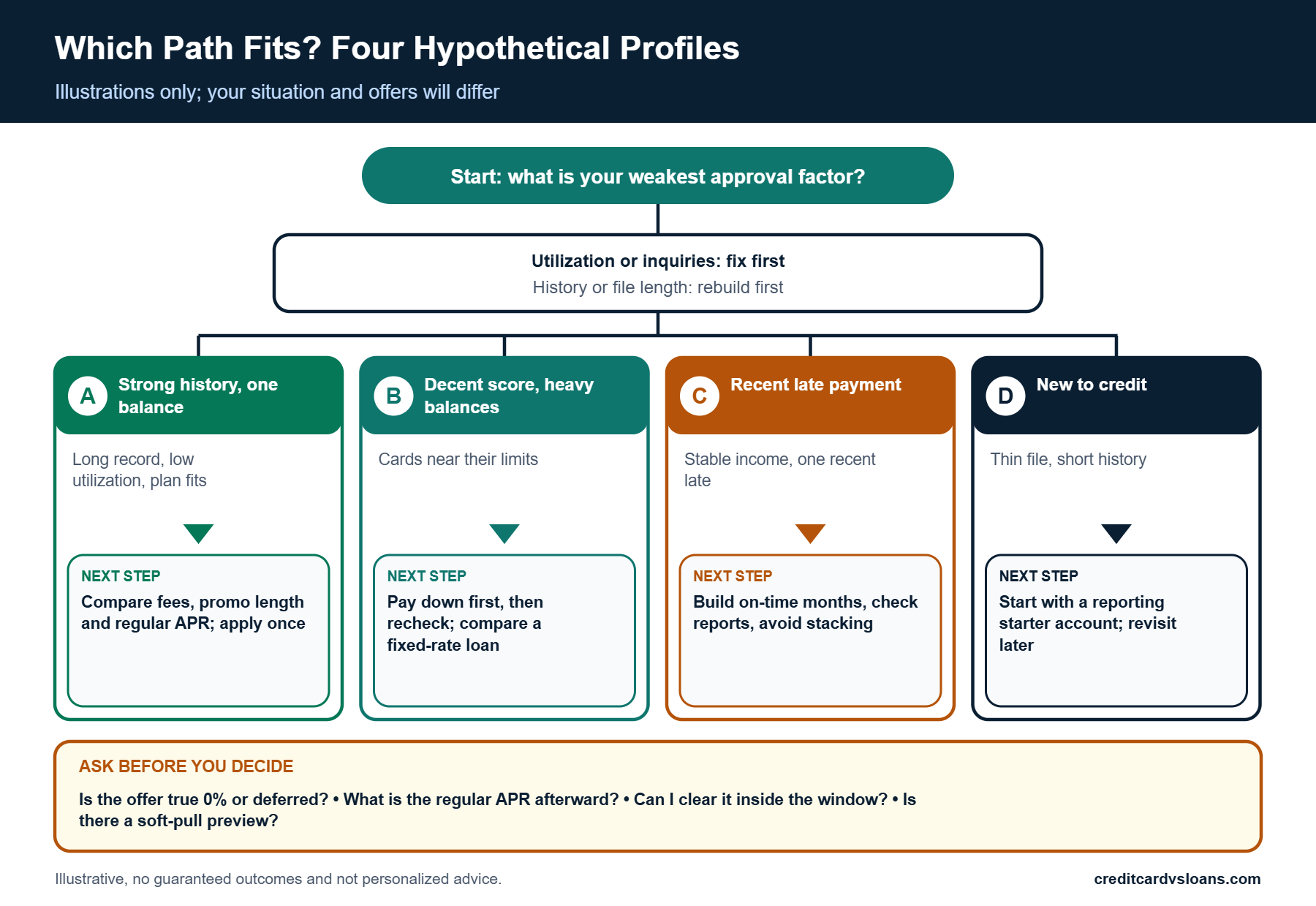
Bottom Line and Your Checklist Before You Apply
The decision in plain terms
What to remember about the score
For a 0% APR card, treat the score as an entry ticket and the approval factors as the real decision. Aim for the strongest profile you can reasonably present, compare offers on fees and regular APR, and apply only when you have a payoff plan that finishes inside the promotion.
There is no universal minimum, so the most useful question is not “is my score high enough” but “which of my approval factors is weakest, and can I improve it before I apply.” For most people that means utilization, payment history or a recent application cluster.
What to remember about the card
A 0% card is a tool for paying a balance without interest for a limited time. It is not free money, and the details of the fee, the deferred-interest wording and the regular APR decide whether it saves you anything. If those details do not fit your payoff plan, the answer may be a different product, or no new product at all.
Your pre-application checklist
Steps to complete this week
- Pull your three free reports at AnnualCreditReport.com and dispute errors with both the bureau and the data furnisher.
- Write down your income, monthly obligations and current card balances so your application answers are accurate.
- Pay down the highest-utilization card if you can, and set autopay for the minimums.
- Look for a soft-pull preview from the issuer before applying.
- Read the Schumer box: promotional length, transfer fee, regular APR, and whether the offer is true 0% or deferred interest.
- Calculate the monthly payment that clears the balance, including any fee, before the promotion ends.
If you are declined
Read the notice for the stated reasons, pull the matching report to check them, and hold off on new applications until you understand the cause. If the reason is correctable, such as high utilization or an error, fix it and try again later. If it is not, the alternatives above may fit better. For the balance-transfer-specific version of the score question, see this guide to credit scores for balance transfer cards.
Questions worth settling before you apply
Does checking my own credit hurt my score?
No. The CFPB lists your own requests for your reports among soft inquiries, which do not affect your scores and are visible only to you. That means pulling your free reports and looking at your own score is the safest way to prepare, and there is no good reason to avoid it. The thing to avoid is applying for several products just to see what happens, since each application can add a hard inquiry that other lenders can see.
It is also worth checking more than one score if you can. Because scoring models, data sources and calculation dates differ, a number from a free monitoring tool and the number an issuer uses may not match exactly, and a gap between them is not unusual to see.
Can I still apply if my score sits in the fair range?
You can apply, but the more useful question is whether the offer is likely to fit you. FICO labels 580 to 669 as Fair and 670 to 739 as Good, and issuers are free to treat those bands differently. A fair-range applicant with low utilization, steady income and a clean recent record may be a better candidate than a higher-score applicant with several recent applications and heavy balances.
If you are in that range, lean on a soft-pull preview where one is offered, keep expectations modest about the limit, and have a backup plan for the balance in case the limit or promotion falls short. A secured or starter product is a legitimate way to strengthen the record first.
What happens if I cannot pay it all off in time?
It depends on the structure of the offer. With a true 0% intro APR, interest starts on what remains after the promotion ends, at the regular rate. With deferred interest, the CFPB explains, interest accrued since the purchase date can be added to the balance, which can make the unpaid remainder much more expensive than it looked.
Either way, you can reduce the damage by making extra payments in the last few months, asking the issuer how payments are applied across balances, and checking what the regular APR will be. If you are heading toward a shortfall, contacting the issuer early and exploring a lower-rate loan are better than waiting for the first interest charge to arrive.
Should the card replace a budget?
A promotional card does not change how much you owe, it only changes how much interest you pay while you pay it down. If your plan depends on the new card making the monthly payment feel smaller without a real payoff schedule, the balance can linger past the promotion. Treat the end date as a deadline and the monthly payment as a fixed bill.
When the numbers do not work even at 0%, that is useful information. It points toward a broader conversation about the budget, which a nonprofit credit counselor can help with, rather than toward another application.
- 0% APR Credit Card vs. Personal Loan for Furniture: Which Wins?
- 0% APR Credit Card vs. Personal Loan for Back-to-School Spending: Which Wins?
- What Credit Score Do You Need for a Balance Transfer Card?
- 0% APR Credit Card vs. Personal Loan: Which Is Cheaper?
- Debt Consolidation Loan vs. Balance Transfer Card: Which Saves More?
- CFPB: What is a credit score?
- CFPB: What is a hard inquiry? (CFPB)
- eCFR: 12 CFR 1026.51 Ability to pay
- CFPB: How to understand special promotional financing offers on credit cards
- CFPB: What are some ways to start or rebuild a good credit history?
- Federal Reserve: Consumer credit – G.19 (Release of October 7, 2026)
- FTC: Free credit reports
- myFICO: What’s in my FICO Scores?
- myFICO: What is a FICO Score?
Last updated: October 22, 2026. Rates, fees and lender rules change; verify current terms before acting.
The information on creditcardvsloans.com is provided for general educational and informational purposes only. It is not financial, legal, tax, credit, accounting or investment advice, and reading it does not create an advisor-client, fiduciary or any other professional relationship. Nothing here is an offer, solicitation or recommendation to borrow, lend or apply for any product.
Credit scores, interest rates, fees, eligibility rules, lender policies and laws change frequently and vary by lender, location and individual circumstances. Examples, figures and scenarios are illustrative only, do not predict your results and do not guarantee approval, savings, a particular rate or a credit-score outcome. Always confirm current terms directly with the lender or issuer and read the full agreement before you apply or sign.
Although we aim for accuracy and use reputable sources, we make no representations or warranties, express or implied, about the completeness, accuracy, reliability or timeliness of the content. Content may be drafted with the assistance of automated tools, so errors or omissions may still occur. Links to third-party sites are provided for convenience; we don’t control and aren’t responsible for their content.
To the fullest extent permitted by law, creditcardvsloans.com and its owners, editors, authors, contributors and affiliates disclaim all liability for any loss, damage or expense arising directly or indirectly from your use of, or reliance on, this content. Before making financial decisions, consult a licensed professional, such as a qualified financial advisor, attorney, tax professional or nonprofit credit counselor, who can consider your complete situation.