Your credit score after balance transfer usually follows a pattern: a small, temporary dip while the new account and the lender’s credit check show up, then a gradual shift that depends mostly on how fast you pay the moved balance down and whether you leave the old cards alone. Nobody can promise the size or direction of the change, because it depends on the rest of your credit file and on the scoring model a lender uses.
This guide is a timeline. Instead of listing every factor in the abstract, it walks through what tends to happen on day one, in the first two months, across the first year and into year two, so you can tell which movements are normal and which are warning signs. If you want the pass/fail question of whether a transfer card will approve you, see what credit score a balance transfer card typically asks for; if you want the one-line verdict on harm, see whether a balance transfer hurts your credit.
Everything below is general education, not advice for your specific file. Lenders, scoring models and card terms differ, so treat the examples as illustrations and check your own offer.
- The first visible effect is usually the hard inquiry and the new account, both of which can lower a score slightly at first.
- Utilization (how much of your limits you are using) is where a transfer can help or hurt most, and it depends on the new card’s limit as much as on the balance.
- On-time payments carry the most weight in FICO scoring (35%), so a missed due date during the promotional period can outweigh any utilization benefit.
- Inquiries stay on a report for two years, but FICO scores only count those from the last 12 months.
- Closing the old cards after a transfer can raise utilization and, over time, change your account mix, so decide that deliberately.
- Your actual result depends on your whole file; no timeline here is a prediction.
Card-rate context in this guide comes from the Federal Reserve’s G.19 consumer credit release of October 7, 2026 (August 2026 data). Individual card offers change often, so confirm fees and promotional periods in the issuer’s own terms.
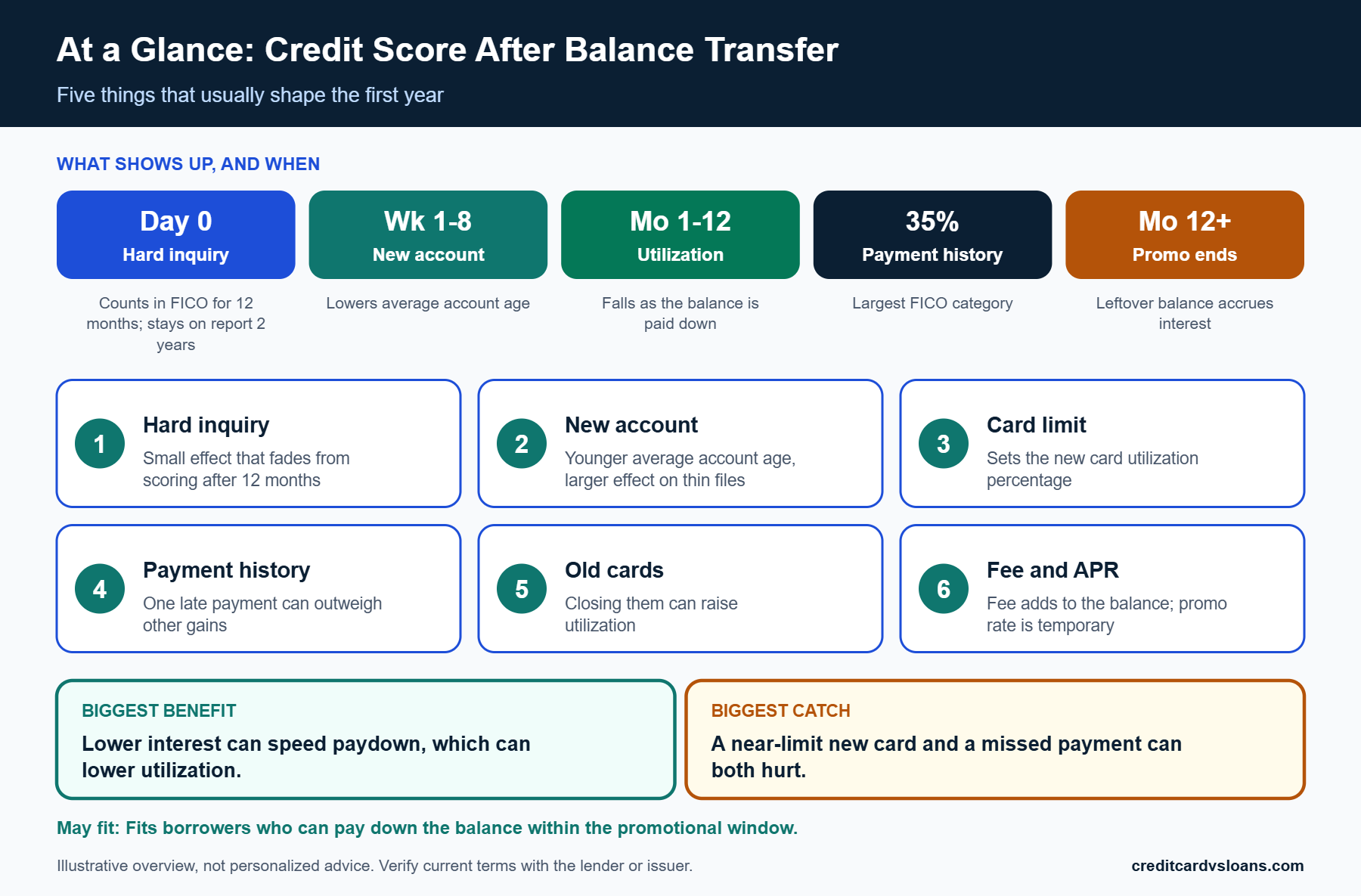
Credit score after balance transfer: the timeline at a glance
What usually moves and what usually does not
The two-step pattern: a small dip, then a path that depends on you
Most people who ask about their credit score after balance transfer are really asking two questions: will it drop right away, and when does it come back? The usual shape is a short-term dip tied to new credit, followed by a longer stretch where your payment behavior and utilization decide the direction.
The dip is generally modest because the pieces that change right away, the inquiry and the new account, sit in the smallest slice of a FICO score. FICO describes new credit as 10% of a score and says inquiries usually have a small impact. The longer stretch is driven by categories that carry far more weight: payment history at 35% and amounts owed at 30%.
Why no one can promise a number
Score changes are not uniform. Someone with a long, clean history and low balances can see a different effect than someone with a thin credit file, because one new account matters more when there are few accounts to average against. The CFPB also points out that you do not have just one credit score: scores vary by scoring model, data source and the date they are calculated.
For that reason, you will not find a points-lost figure in this guide. Any article that quotes a precise drop for everyone is describing a hypothetical borrower, not you.
How to read the rest of this guide
The timeline in plain terms
Think of the transfer as four phases. The application phase covers the first two weeks and the hard pull. The reporting phase covers roughly the first two months, when balances and the new account appear on your credit reports. The paydown phase runs through the promotional period. The aftermath phase begins when the promotional rate ends and the inquiry ages off.
Table 1 summarizes each phase, what usually changes, and what is in your control.
| Phase | What usually changes | Mostly in your control? | Main risk |
|---|---|---|---|
| Application (days 0-14) | Hard inquiry; account may be approved or declined | Partly: you choose whether to apply and whether to prequalify first | Several hard pulls in a short span if you apply to multiple lenders |
| Reporting (weeks 2-8) | New account and new balances appear; utilization shifts | Yes: payment timing and spending on the new card | A new card near its limit can show high utilization on that account |
| Paydown (months 2-12+) | Balances fall if you pay more than the minimum | Yes: payment size and on-time habits | A missed due date can hurt more than any utilization gain helps |
| Aftermath (months 12-24) | Promotional rate ends; inquiry fades from scoring; old-card decisions matter | Mostly: payoff plan and whether to close or keep old cards | Leftover balance starts accruing interest at the regular APR |
Related questions this guide hands off
Questions about qualifying are covered in the balance transfer approval guide. If you are weighing a fixed-payment loan instead of a card, what happens to your score after a personal loan and how a personal loan can affect your credit score cover that path, and how a debt management plan affects your credit covers a nonprofit counseling route.
Utilization comes up throughout this timeline, but only in its transfer-specific form.
Days 0 to 14: the application, the hard inquiry and the new account
The hard inquiry
What a hard inquiry is
When you formally apply for a card, the issuer typically pulls your credit report so it can decide whether to approve you. The CFPB describes these as hard inquiries and says they can lower your scores because scoring models weigh how recently and how often you apply for credit. A soft inquiry, such as checking your own report or a prescreened offer, does not affect your scores.
Many issuers let you prequalify with a soft pull first. A prequalification is not an approval and the final terms can change, but it lets you see whether an offer is realistic before a hard pull happens.
How long the inquiry counts
An inquiry stays on your credit report for two years, according to FICO, but FICO scores only consider inquiries from the last 12 months. The impact usually fades well before the entry disappears. FICO also notes that inquiries usually have a small effect and that its scores allow for rate shopping, though the details of that window depend on the scoring version.
The practical takeaway is to avoid stacking several card applications in one week. One well-chosen application is easier on your file than three speculative ones.
The new account
New credit and average account age
Once approved, the new card shows up on your report as a new account. FICO says opening an account lowers the average age of your accounts, which is part of length of credit history (15% of a score). The effect is bigger when your file is short, since a brand-new account is a larger share of a small total.
FICO also says that a new account you do not use can help utilization over time, because it adds available credit. A transfer is the opposite situation, since you are putting a large balance on it right away, which is why the next phase matters.
What happens if you are declined
A decline can still leave a hard inquiry on your report. The CFPB says a hard inquiry can affect your scores when you apply, and that does not depend on approval. If you are declined, a better move than reapplying elsewhere immediately is to look at the reason the lender gives and decide whether your file needs work first. The balance transfer score guide covers common approval hurdles.
Weeks 2 to 8: when balances move and reports catch up
Reporting lag and statement dates
Why your score may not change right away
Lenders generally report account information to the credit bureaus on a schedule tied to your billing cycle, so balance changes can show up weeks after the transfer. That means the score you see a few days after a transfer may not yet reflect the new balances. Checking too early can make it look as if nothing happened.
Your own credit report and score pulls through authorized sources do not affect your FICO scores, according to FICO, so checking is safe. Just compare like with like: the same score type from the same source.
Transfers are not instant
A balance transfer can take days or longer to complete, and until the old creditor gets paid, the old card can keep showing its balance. Keep making at least the minimum payment on every old card until you can see a zero balance, because a missed payment on the card you thought was paid off still counts as a late payment.
The CFPB notes that more than 60 days late on a payment can allow the issuer to raise the rate on all balances. Treat the in-between weeks as the highest-risk time for an accidental miss.
A hypothetical utilization shift
Per-card utilization
Here is an illustrative example, not a real borrower. Imagine three cards with limits of $5,000, $4,000 and $6,000 ($15,000 total) and balances of $4,200, $3,100 and $2,700 ($10,000 total). That is about 67% overall utilization, with the first two cards at 84% and 78%.
Now imagine a new card with an $8,000 limit takes the first two balances ($7,300) plus a 3% transfer fee ($219), leaving $7,519 on the new card. That card would show about 94% utilization, while the first two cards would show 0% and the third stays at 45%.
Overall utilization
Across all four cards, the same example has $10,219 owed against $23,000 in total limits, or about 44%, down from about 67%. Scoring models can look at both per-card and overall utilization, so the improvement is real but not complete: one card near its limit may still look strong or weak depending on the model.
If the new limit were $10,000 instead of $8,000, the new card would sit near 75% and overall utilization would be about 41%. The lesson is that the limit you receive matters nearly as much as the amount you move. Your limit is set by the lender and is not something you can count on in advance.
What a transfer costs and how those costs interact with your score
Fees and the promotional period
The transfer fee
The CFPB says you will probably owe a balance transfer fee, typically a percentage of the amount transferred or a flat amount, whichever is greater. The fee is usually added to the new card balance, which is why the example above moved $7,300 but left $7,519 on the new card. Fee levels vary by issuer and offer, so read the terms before you apply.
From a score standpoint, the fee matters in one quiet way: it makes the new card balance a little larger relative to the limit. It rarely changes the picture on its own, but on a small limit it can push utilization higher than you expected.
What the promotional rate really is
The CFPB notes that the low rate usually lasts only a limited time and that your rate may rise afterward, which raises your payment. A promotional APR is a temporary price, not a new debt plan. The credit-score relevance is indirect: the lower interest means more of each payment can reduce principal, and falling balances are what improve utilization over the months that follow.
Whether that happens depends on whether you actually pay the card down. A promotional rate with only minimum payments can leave a large balance at the end of the window.
Interest cost versus score effect
A hypothetical cost comparison
Context first: in the Federal Reserve’s G.19 release of October 7, 2026, the average interest rate on credit card accounts assessed interest was 22.36% for August 2026 (21.19% across all accounts). That is an average across the market, not what you would be offered.
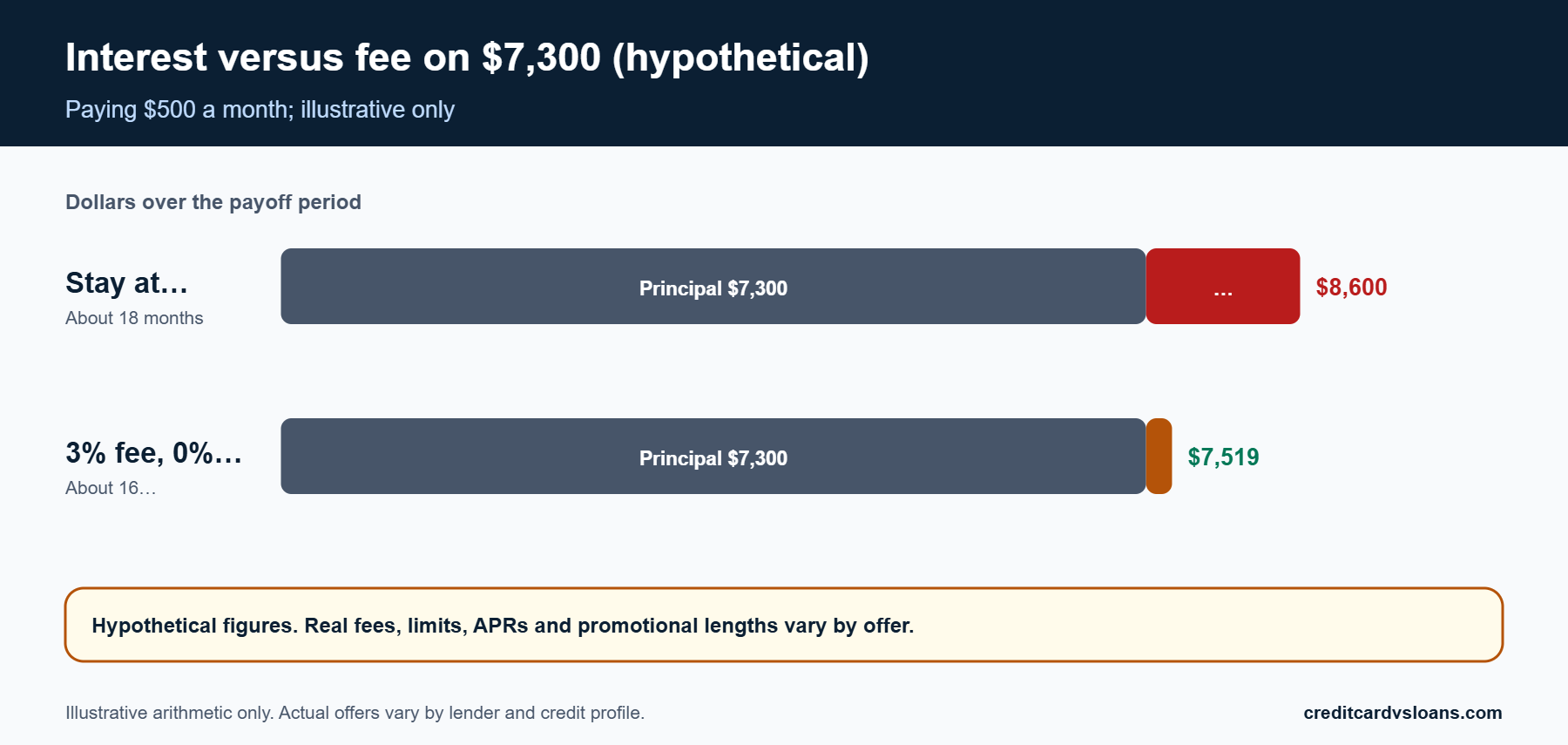
Suppose, hypothetically, you moved $7,300 and paid $500 a month. At a 22.36% APR that balance would take about 18 months to clear and cost roughly $1,300 in interest. With a 3% fee ($219) and a 0% promotional rate, the same payments would clear $7,519 in about 16 months, with no interest if the promotional period lasted that long. Table 2 sets the two side by side.
| Item | Stay on existing cards at 22.36% APR | Transfer with 3% fee and 0% promotional APR (15 months assumed) |
|---|---|---|
| Starting balance | $7,300 | $7,519 (includes $219 fee) |
| Interest during payoff | About $1,300 | $0 if paid off inside the promotional window |
| Months to payoff at $500 | 18 | 16 (inside a 15-month window you would owe a remainder of about $19 at the end of month 15, then the regular APR applies) |
| New hard inquiry | None | Yes, one for the new card |
| Per-card utilization | Stays high on old cards | High on the new card until balances fall |
| Main risk | Slow paydown, ongoing interest | Missed payment or leftover balance after the promotion ends |
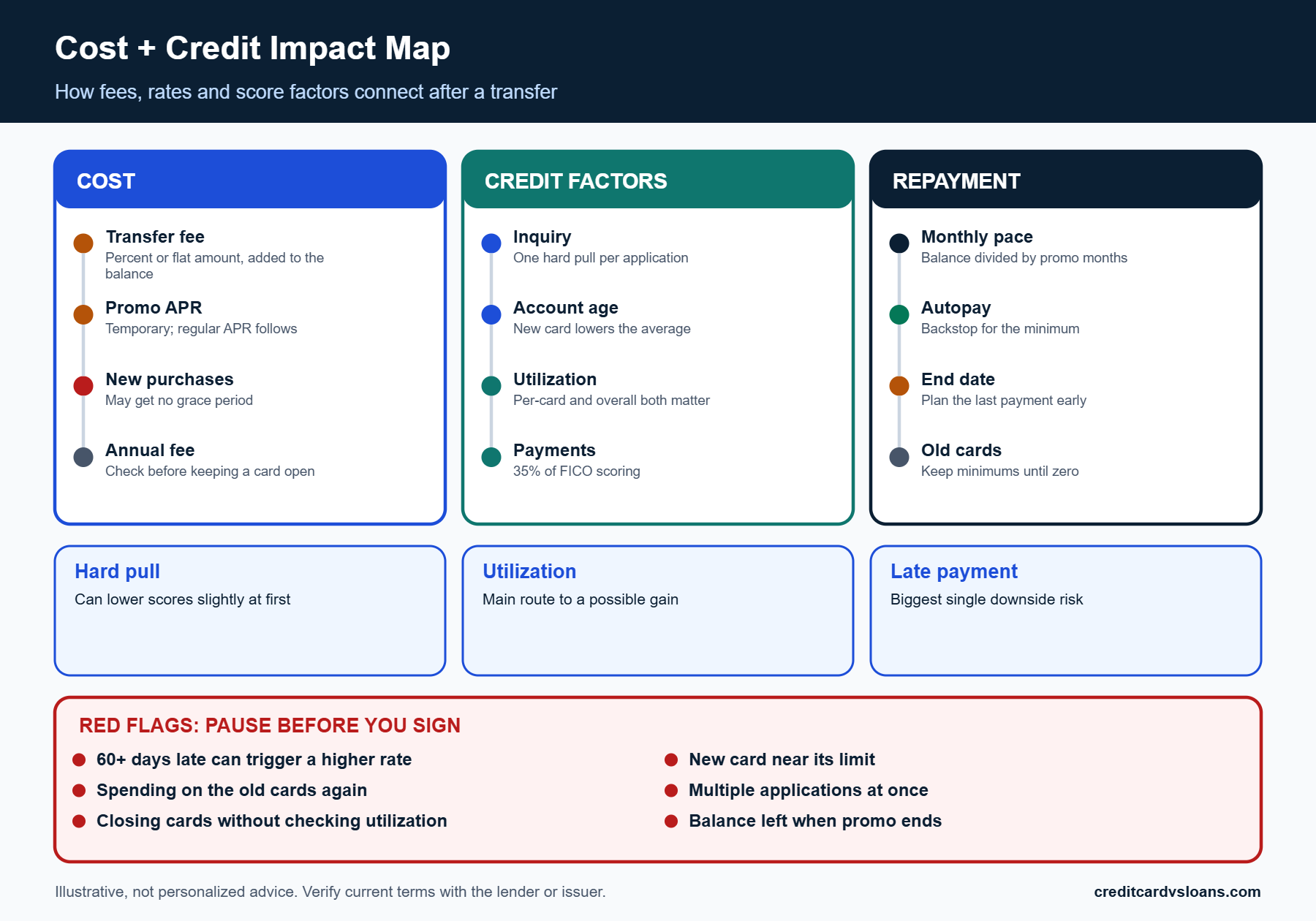
How cost and score connect
Cheaper debt tends to produce faster paydown, and faster paydown improves the amounts-owed picture. That is the main way a balance transfer can end up helping a score. The reverse also holds: if you pay the same $500 a month either way, the transfer saves interest but does not by itself change your utilization faster than the balance falls.
So the honest framing is that the transfer’s benefit is mostly financial, and any score benefit is a side effect of paying down what you owe.
The 60-day late-payment risk and grace periods
The penalty rate trigger
The CFPB warns that if you are more than 60 days late on a payment, the issuer can raise the interest rate on all balances, including the transferred amount. That is a cost risk, and a late payment of that size is also a serious scoring event, since payment history is the largest FICO category at 35%.
Set up automatic minimum payments on every card involved as a backstop, then add extra payments on top by hand.
New purchases and grace periods
The CFPB says purchases made on the same card after a transfer may not get a grace period, meaning interest can apply until the full balance, including the transferred amount, is paid off. Putting new spending on the transfer card can therefore raise your cost and your balance at the same time.
A simple way to avoid mixed signals is to use the transfer card only for the transfer and keep everyday spending on a card that you pay in full each month.
Months 3 to 12: payments, paydown and what the file looks like
Payment history during the promotional period
On-time payments are the main lever
FICO says payment history is 35% of a score and calls it the strongest predictor of whether you will pay debts as agreed. After a transfer, you now have at least one more account to pay on time, and possibly several old cards that still need minimums until their balances hit zero.
Each on-time month adds to your history. That is slow, unexciting progress, but it is where lasting score movement comes from.
What one late payment can do
FICO says a few late payments are not an automatic score killer and that a generally strong credit history can outweigh one or two late credit card payments. It also says recent and large delinquencies count more than old or small ones, and that scores can improve as time passes with on-time payments after a late one.
That is reassuring but not a license to be casual. If your file is thin, a single missed payment can stand out much more. And the CFPB notes that most negative information can be reported for seven years.
Utilization in stages
How paydown shows up
In the earlier example, paying $500 a month shrinks the $7,519 new card balance, and each reporting cycle shows a lower figure. Using hypothetical numbers, the new card would move from about 94% utilization to roughly 70% after about four payments, then to roughly 44% after about eight, if nothing new is charged.
Scoring models differ on how much they reward each step, so treat these as direction, not a forecast. The value of watching the percentages is that you can see paydown working even when your score barely moves month to month.
The trap of re-running old cards
The most common way a transfer backfires is not a technical credit mistake; it is spending again on cards you just cleared. Total debt then rises back above where it started, and utilization goes with it. The CFPB suggests checking whether your spending habits, not just your debt structure, need to change, since a transfer alone may not fix the underlying problem.
If the old cards are a temptation, consider asking whether leaving them open but out of your wallet works for you, a point we return to in the next section.
Months 12 to 24: the promotional rate ends, the inquiry ages and old cards decide the rest
The inquiry ages out of scoring
Twelve months and two years
FICO scores consider inquiries from the last 12 months, though inquiries remain on the report for two years. By the one-year mark, the hard pull from your transfer application is no longer part of the calculation for FICO scores, according to FICO’s published guidance. Other scoring models may treat inquiries a little differently, so a lender’s number can still vary.
The new account itself remains, and its age starts ticking up. Over time it becomes part of your average account age rather than a drag on it.
What the aftermath looks like if the card is paid off
If you clear the transferred balance within the promotional window, the new card can end up with a zero balance and a solid payment record. That is generally a favorable profile for utilization and payment history. Keeping the account open is usually helpful to utilization because the limit stays available, though you should check whether the card carries an annual fee before deciding.
If you do not clear it, the remaining balance begins accruing interest at the card’s regular rate, and the card becomes just another revolving balance to pay down.
Closing or keeping the old cards
The effect of closing
Experian explains that closing a card reduces your total available credit, which can raise your utilization. Its example: a $1,500 balance on $10,000 of limits is 15%, and closing a $3,000-limit card raises that to 21%. Closed accounts in good standing can stay on your reports for up to 10 years and keep counting toward account age until they fall off.
Closing a card is not automatically wrong, but it is a decision with a utilization cost, so make it deliberately, not as a reflex after the transfer.
Keeping them open without the temptation
If a card has no annual fee, leaving it open with a zero balance preserves its limit and its history. Some people put one small recurring bill on it and set autopay to keep it active, since issuers may close accounts that go unused for a long time. Whether that fits you depends on your self-control and your issuer’s rules.
A card with a fee, or a card you cannot trust yourself with, is a different case. Choose the option you will actually follow.
How your starting point changes the timeline
Your file before the transfer
A thin credit file
Someone with only a few accounts has less history to absorb a new one. FICO says opening an account lowers average account age, and the effect is larger on a short history, so the early dip can be more noticeable. That does not make a transfer wrong; it means the first months deserve more patience and a closer eye on every due date.
If you are early in building credit, the qualification guide for transfer cards and the other credit-building basics may matter more than the transfer itself.
A long file with low balances
A long history with mostly paid-off accounts usually shrinks the relative weight of one new inquiry and one new account. For these borrowers the transfer is often a cost question more than a score question. The score effect, if any, tends to be small and short-lived, though that is a general tendency and not a rule.
If your balances are already low, ask whether a transfer is needed at all. A shorter payoff on the existing card might cost little extra.
Your balance level and payment behavior
High utilization before the transfer
If your cards are near their limits, moving the balance to a roomier new limit can reduce your overall utilization noticeably, which is the scenario in the hypothetical example earlier. Scoring models weigh amounts owed heavily (30% of a FICO score), so lowering utilization is where the largest potential gain sits.
The gain is not automatic. It depends on the new limit, the fee, your paydown pace and the model that computes the score.
A recent late payment
If you have recent late payments, a lender may decline or offer weaker terms, and a transfer will not erase the late payment from your report. The CFPB says most negative information can be reported for seven years, with more recent items usually weighing more heavily in scoring, as FICO explains.
Focusing first on getting current and staying current is often a better foundation than adding a new account on top of recent delinquencies.
When the timeline goes the other way
Patterns that can pull a score down after a transfer
Running balances back up
If the old cards fill up again while the new card still carries the transferred balance, total revolving debt can end up higher than before, and so can overall utilization. This is the single most common reason a transfer fails as a credit move. The Federal Reserve’s G.19 release of October 7, 2026 reported total revolving credit outstanding of about $1,352.4 billion (seasonally adjusted, August 2026), a reminder of how many households carry card balances month to month.
The pattern is usually gradual: a few convenience purchases, a seasonal expense, an emergency. Build a small cash buffer, even a modest one, so the next surprise does not land on a card.
Serial transfers and repeated applications
Applying for a new transfer card every time a promotional period ends can create repeated hard inquiries and a string of young accounts. FICO says opening several new accounts in a short period is viewed as riskier, especially with a short credit history. Each new card also resets the clock on fees, since each transfer typically carries its own fee.
Serial transfers are not always wrong, and some people use them sensibly, but they work against the new-credit and account-age categories of a score. If you find yourself planning a second transfer before the first is paid down, treat it as a sign that the plan needs a different structure, such as the fixed schedule a loan provides.
Warning signs to catch early
A new card near its limit
A card that sits at 90% or more of its limit can look risky to a scoring model even when your overall utilization improved. If your new limit is small relative to the amount you moved, consider transferring only part of the balance, or paying the new card down quickly in the first statements.
You do not control the limit you are given, so it is worth reading the offer before you accept the transfer. If the limit is lower than you hoped, a partial transfer is a valid choice.
A missed or late payment
A late payment is the one event that can quickly overwhelm everything else in this timeline. If you realize you missed a due date, pay as soon as you can and contact the issuer to ask how it will be reported. Do not assume the outcome; policies differ.
The FICO payment history page notes that recency, amount and severity affect how much a late payment counts. Catching it early is the best protection.
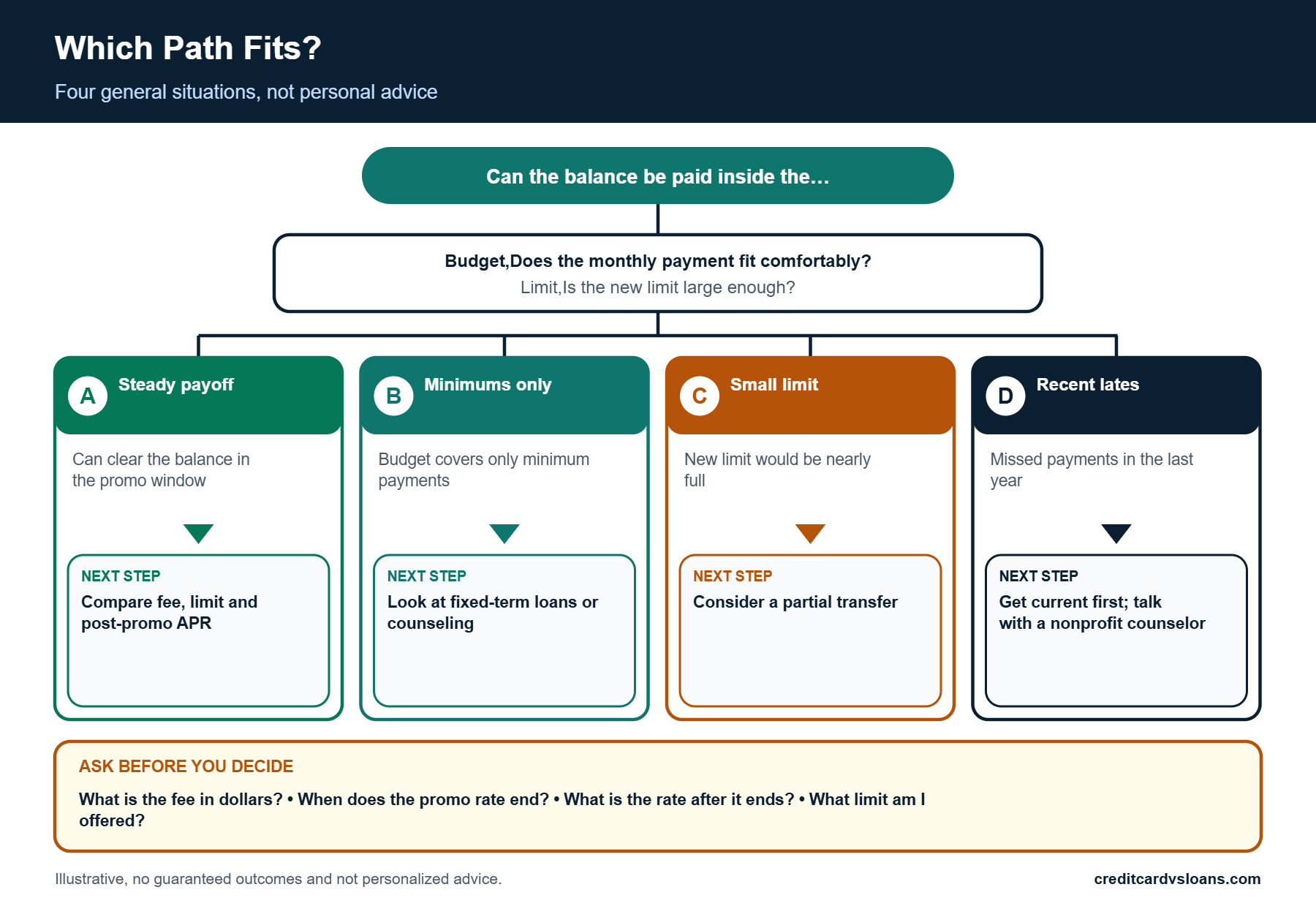
Which path fits? Scenarios and choices after a transfer
Matching situations to next steps
If you can pay off the transferred balance inside the promotional window
This is the setting where a balance transfer is most likely to behave well for both cost and score. You pay a one-time fee, avoid the card’s regular interest, reduce revolving balances on a schedule you control, and the inquiry fades from scoring after 12 months.
The catch is discipline: the plan only works if the monthly payment that clears the balance on time fits comfortably in your budget, and if you leave the old cards alone.
If you can only make minimum payments
If the budget cannot support payments that clear the balance in the promotional window, the transfer may only delay interest. In that case, a fixed-payment product with a set end date, or a nonprofit credit counselor’s help, may deserve a look. The debt management plan guide explains how counseling-based repayment is reported, and the personal loan credit impact guide covers installment loans.
Neither is a sure fix; both have their own trade-offs, and eligibility varies.
Comparing alternatives by what they do to your score
Personal loan versus balance transfer
A personal loan also involves a hard inquiry and a new account, but it adds an installment account instead of a revolving one and comes with a fixed payment and end date. Moving card balances onto a loan can lower card utilization, though the loan balance still counts as debt owed. The personal loan score timeline walks through that experience.
For many people the choice comes down to cash flow: whether a fixed monthly payment is easier than a flexible card payment.
Debt management plan versus balance transfer
A debt management plan is arranged through a nonprofit credit counseling agency and usually involves closing or restricting the enrolled cards. The plan’s credit effects depend on how the creditors report the accounts and are described in that guide. A transfer keeps you in control of your cards but also keeps the temptation.
Table 3 gives a quick matrix. It describes situations, not a recommendation for your file.
| Situation | Option to look at | Why | What to verify | When to avoid it |
|---|---|---|---|---|
| Can clear the debt in 12-18 months with steady income | Balance transfer card | Lower interest speeds principal paydown | Fee, promotional period, limit, rate after the promotion | If you will keep charging on the old cards |
| Payments only cover minimums | Fixed-term personal loan or counseling-based plan | A set schedule and end date | APR, origination fee, how the account will be reported | If the monthly payment strains your budget |
| New card limit is too small for the full balance | Partial transfer plus a paydown plan | Keeps per-card utilization lower | Whether the remaining card rate is acceptable | If the remaining balance still carries a very high APR |
| Already missed payments recently | Talk with a nonprofit counselor first | A late-payment pattern changes lender decisions | Agency accreditation and fees | If you would apply for several cards at once |
| Thin file or recent new accounts | Pause and build history before adding another account | New accounts weigh more on a short file | Your own report accuracy | If you need the debt relief urgently |
Questions people ask while watching their score
Checking and expectations
Does checking my own score hurt it?
No. FICO says that checking your own credit report directly from a credit reporting agency or an authorized provider does not affect your FICO scores, and the CFPB lists your own requests for your reports among soft inquiries. Watching the number is safe; reacting to every small move is usually unproductive.
A better habit is to look at the same score from the same source once a month, then write down your utilization percentages and payment dates next to it. That gives you something concrete to compare.
Why did my score move in the opposite direction from what I expected?
Different lenders and services use different scoring models and may pull from different bureaus on different days. The CFPB notes that there is no single credit score, and that scores vary by model, data source and the day they are calculated. A balance may also have been reported on a statement date before your payment posted.
If a movement looks odd, check your report itself for balance, limit and account-status entries, and dispute anything that is wrong through the bureaus.
Planning the next move
How soon can I do another transfer?
There is no universal waiting period that applies to every issuer and file, so this is a question for the card terms. From a score perspective, spacing out applications gives each inquiry time to age and keeps the number of new accounts low, which FICO treats as a risk signal when several accounts open close together.
Before a second transfer, compare it with the other routes: if the first card is not paid down, a different structure may serve you better than a repeat of the same one.
Should I move the whole balance or only part?
Moving the whole balance can be tidy, but a partial transfer may keep the new card from sitting near its limit. In the earlier hypothetical, a $7,519 balance on an $8,000 limit produced about 94% utilization on that card even though overall utilization fell.
Whether a partial transfer helps depends on the rate you would pay on what stays behind. If the remaining balance would sit on a high-APR card, the interest saved by moving more may outweigh the utilization effect, and a short paydown plan matters either way.
Conclusion and next steps for your credit score after a balance transfer
The bottom line in three parts
The first months
Expect a short-lived dip tied to the hard inquiry and the new account, followed by changes that depend on payments and balances. Do not read much into your score the first week; reports lag.
A balance transfer can nudge your score down briefly and then possibly up, but the lasting effect depends on on-time payments, falling balances and whether you resist re-running the old cards. No timeline here is a promise.
Year one and beyond
By the end of the promotional period, you want either a paid-off balance or a clear plan for what is left. After 12 months the inquiry no longer counts in FICO scoring, and the new account becomes part of your history. Whether to close the old cards is a utilization question worth answering before you act.
A concrete next-step list
Before you apply
Use these steps as a checklist.
- Check your own credit reports for errors, which does not affect your FICO scores.
- Prequalify with a soft pull where offered, and compare the fee, promotional period and rate after it ends.
- Decide how much you can pay each month and divide the fee-inclusive balance by the promotional months.
- Keep paying minimums on old cards until they show a zero balance.
After the transfer
- Set autopay for at least the minimum, then add manual extra payments.
- Keep new purchases off the transfer card.
- Check your score once a month from the same source to see the trend, not the daily noise.
- Calendar the date the promotional rate ends, and plan the final payment before it.
- Decide, with the utilization effect in mind, whether to keep or close each old card.
- CFPB: What is a credit score?
- CFPB: What is a hard inquiry?
- CFPB: What is a balance transfer?
- CFPB: How long does negative information remain on my credit report?
- myFICO: What is in your credit score?
- myFICO: New credit and your FICO Score
- myFICO: Payment history and your FICO Score
- Federal Reserve: Consumer Credit – G.19 (Release of October 7, 2026 (August 2026 data))
- Experian: How long do closed accounts stay on your credit report?
Last updated: October 22, 2026. Rates, fees and lender rules change; verify current terms before acting.
The information on creditcardvsloans.com is provided for general educational and informational purposes only. It is not financial, legal, tax, credit, accounting or investment advice, and reading it does not create an advisor-client, fiduciary or any other professional relationship. Nothing here is an offer, solicitation or recommendation to borrow, lend or apply for any product.
Credit scores, interest rates, fees, eligibility rules, lender policies and laws change frequently and vary by lender, location and individual circumstances. Examples, figures and scenarios are illustrative only, do not predict your results and do not guarantee approval, savings, a particular rate or a credit-score outcome. Always confirm current terms directly with the lender or issuer and read the full agreement before you apply or sign.
Although we aim for accuracy and use reputable sources, we make no representations or warranties, express or implied, about the completeness, accuracy, reliability or timeliness of the content. Content may be drafted with the assistance of automated tools, so errors or omissions may still occur. Links to third-party sites are provided for convenience; we don’t control and aren’t responsible for their content.
To the fullest extent permitted by law, creditcardvsloans.com and its owners, editors, authors, contributors and affiliates disclaim all liability for any loss, damage or expense arising directly or indirectly from your use of, or reliance on, this content. Before making financial decisions, consult a licensed professional, such as a qualified financial advisor, attorney, tax professional or nonprofit credit counselor, who can consider your complete situation.