A debt management plan’s effect on your credit score isn’t fixed, and no source we reviewed puts a number on it. What the Federal Trade Commission (FTC) does say is that a plan depends on regular, on-time payments, may ask you to stop using new credit, and cannot erase accurate negative information. So the honest answer to “debt management plan credit score” is: it depends on where your credit stands today, how the plan treats your accounts, and whether you finish it.
That answer is less satisfying than a promise, but promises are the problem. Some debt relief companies guarantee outcomes they can’t control, and the FTC lists “promises no negative credit impact” among the warning signs of a bad counselor. A plan may help you stay on track, which matters for payment history, the largest factor in the FICO scoring model. It may also change your accounts in ways that can move a score in either direction.
This guide explains how a debt management plan (DMP) works, which credit-scoring factors it can touch, what it costs, how it compares with other routes, and how to avoid scams. It uses FTC guidance and myFICO’s published score factors, plus clearly labeled hypothetical math. It’s general education, not financial or legal advice, and it can’t predict your score.
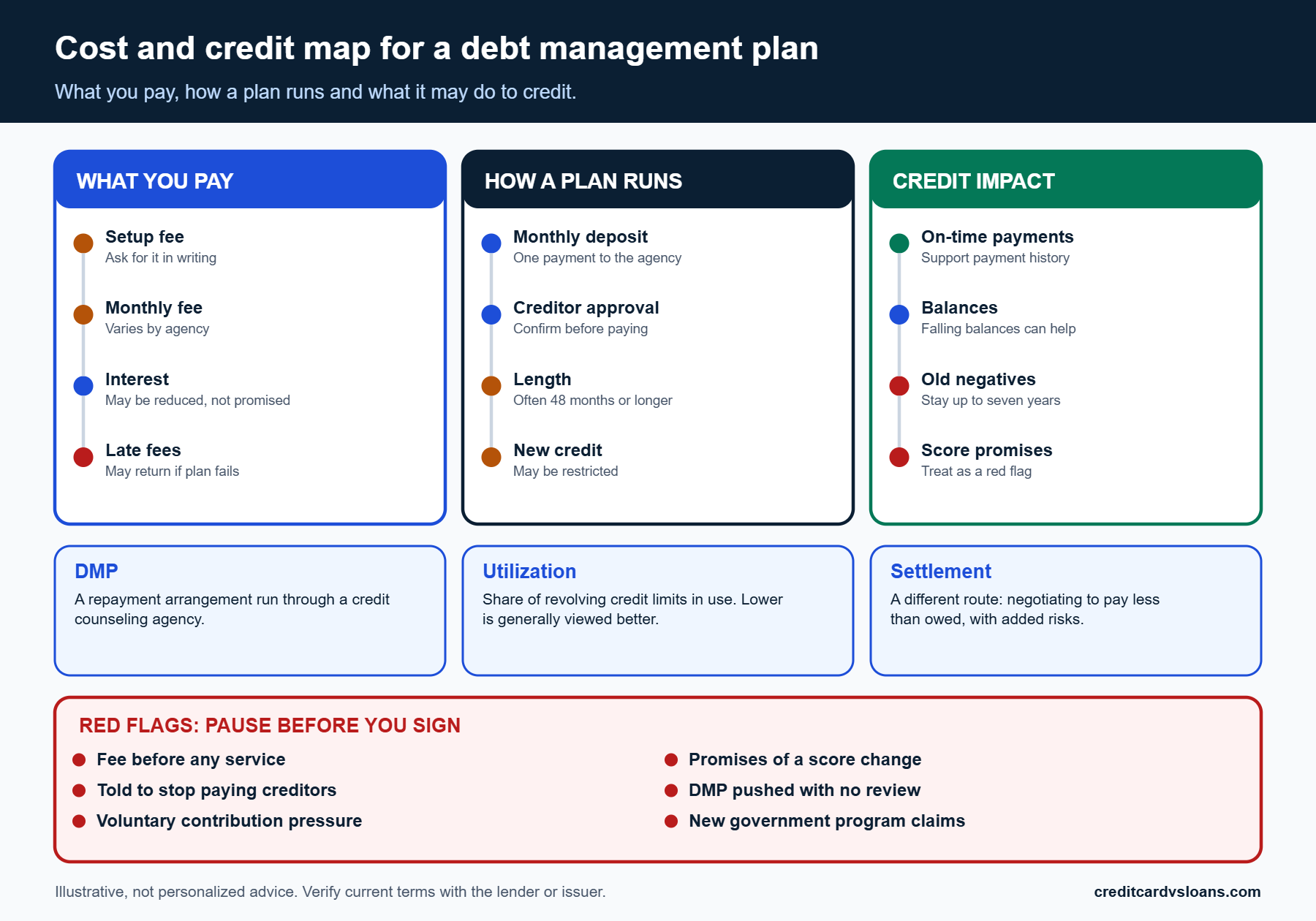
- A DMP is a repayment arrangement run through a credit counseling agency: you make one monthly deposit and the agency pays your unsecured creditors on a schedule set with them.
- Creditors may lower interest rates or waive some fees, but the FTC says to confirm every concession with each creditor. Nothing requires them to agree.
- The FTC says a plan requires regular, timely payments, can take 48 months or longer, and may require you to agree not to apply for or use new credit while enrolled.
- Accurate negative information generally stays on credit reports for seven years. A plan does not remove it.
- Be wary of anyone who promises a score outcome, charges fees before doing any work, or tells you to stop talking to your creditors.
The FTC pages cited here include a 2011 consumer publication and a more recent FTC booklet. The core guidance has been stable, but fees, creditor practices, and scoring models change. Confirm current terms with any agency and each creditor before you enroll.
The short answer: what a debt management plan can and cannot do to your credit
What a plan can plausibly change
Payment behavior going forward
The FTC says a successful DMP requires you to make regular, timely payments. If a plan helps you pay every month on time, you’re building the single behavior that the myFICO site describes as the heaviest factor in its scoring model: whether you’ve paid past accounts on time, which it puts at 35%. The plan itself doesn’t change your past, but it can change what the next months look like.
That is a contingent benefit, not a promise. If you miss DMP payments, the FTC warns that you can lose the plan’s benefits and face fees and higher interest. A plan you can’t keep up with may leave you worse off than before.
Account use and balances
The FTC notes that you may have to agree not to apply for or use new credit during the plan. That limits new inquiries and new accounts, which myFICO groups under “new credit” at 10%. It also means the cards you enrolled can’t be used for fresh spending, which is the point of the arrangement.
As balances fall, the share of available revolving credit you use (utilization) can fall too. myFICO describes this under amounts owed, at 30%, and says high utilization can signal overextension. Whether the plan’s account treatment affects your available credit depends on how each creditor handles enrolled accounts, so ask each creditor and the agency.
What a plan cannot do
Remove accurate negative information
The FTC’s guidance is blunt: accurate negative information may stay on your credit report for up to seven years, and no one can legally remove it. A DMP doesn’t alter that. A late payment that happened before the plan stays on your report for its normal period, and a debt-relief firm that says otherwise is a red flag.
The FTC also warns against promising that creditors will never sue and against claims of “no negative credit impact.” Those promises are outside any counselor’s power. For a deeper look at the lawsuit side of old debts, see our guide to the credit card debt statute of limitations.
Guarantee a score change in either direction
None of the primary sources reviewed for this article state how a DMP changes scores, and the FTC publication we read does not address whether a plan itself appears on credit reports. The effect also depends on the scoring model and on how lenders read the entries. So any claim that enrolling “will raise your score” or “will hurt your score” is a guess.
The practical response is to plan around behaviors you control: pay on time, keep balances falling, avoid new debt, and check your reports. Our overview of how a personal loan can affect your credit score shows the same factors from the loan side.
| Question | Short answer | Basis |
|---|---|---|
| Can it lower my interest rate? | Creditors may, but are not required to; confirm each one | FTC |
| Can it remove past late payments? | No; accurate negatives generally stay up to seven years | FTC |
| Does it require on-time payments? | Yes; missed payments can end its benefits | FTC |
| Can I keep using my cards? | You may have to agree not to use or apply for new credit | FTC |
| Will it raise my score? | No one can promise this | FTC warning signs; no primary source gives a number |
| How long does it take? | Often 48 months or longer | FTC |
How a debt management plan works
The mechanics
One deposit, several payments
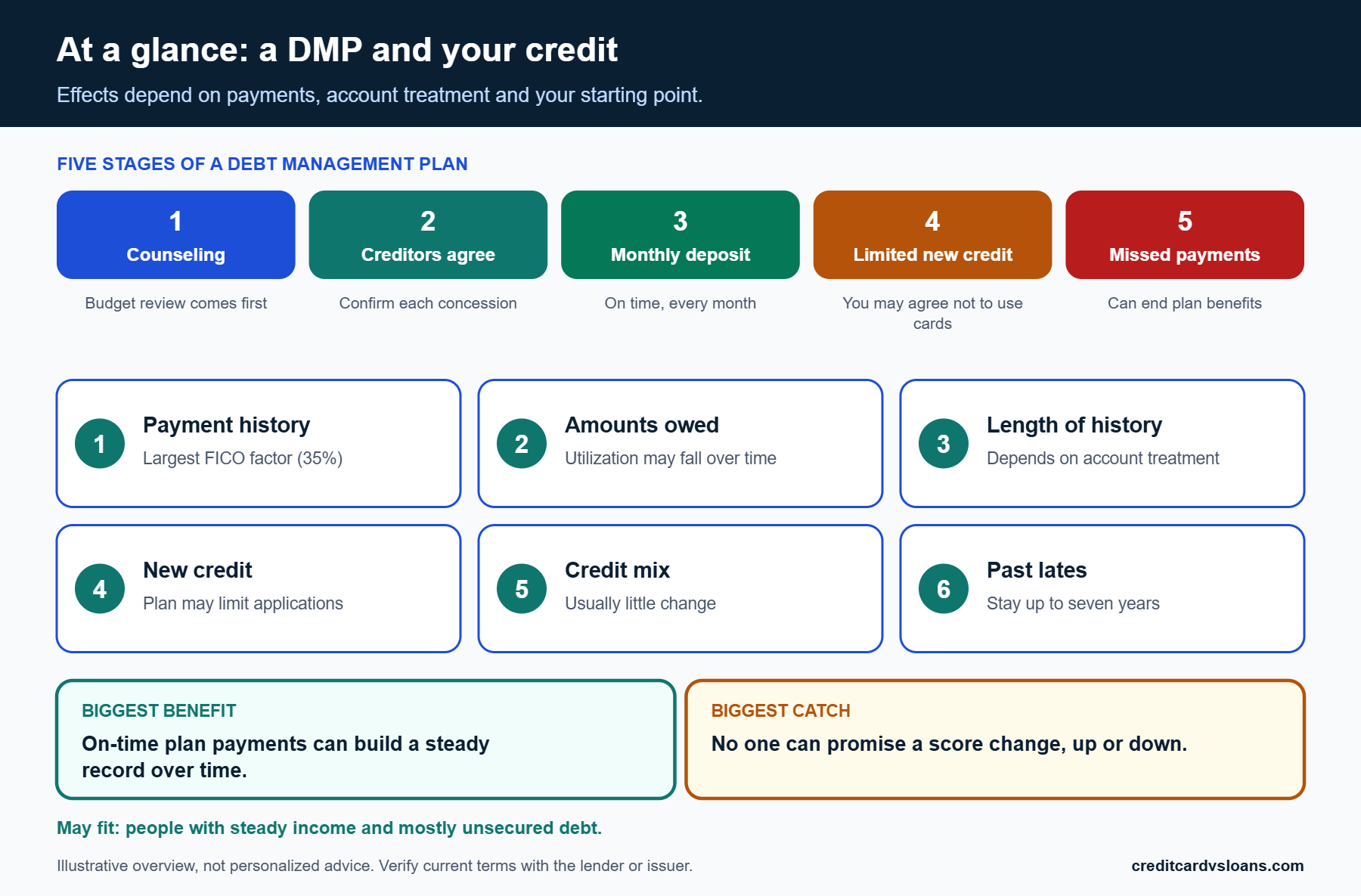
Under a DMP, you deposit money each month with a credit counseling organization, and it pays your unsecured debts, such as credit cards, student loans, and medical bills, on a schedule set with you and your creditors. The FTC adds that some creditors require a payment to the counselor first, and advises you to verify with creditors before sending money, and to confirm that creditors have accepted the proposed plan before you send payments.
The setup matters because a counselor’s proposal is not the same as creditor acceptance. Until each creditor agrees, there is no plan, and missed payments to creditors in the meantime can add late fees and negative entries.
Concessions and their limits
The FTC says creditors may lower interest rates and waive some fees, but that you should confirm this with each creditor. It also notes that a plan can take 48 months or longer. Because concessions vary, two people with the same balances can end up with very different plans.
Ask for the concessions in writing: the new interest rate on each account, any waived fees, and the monthly amount. A hypothetical illustration appears later in this guide, but treat any number there as a teaching example, not an expectation.
Counseling versus a plan
A counseling session is not a plan
The FTC states that a DMP is not the same as credit counseling and is not suitable for everyone. Counseling is a review of your finances and budget, typically a session of about an hour according to the FTC, with optional follow-up. A DMP is one possible outcome, and a good counselor will explain your alternatives too.
The FTC flags counselors who push a DMP as the only option before analyzing your finances, or who won’t send free information without details about your situation. Reputable counselors, it says, are certified and trained in consumer credit, debt management, and budgeting.
Questions to ask before enrolling
The FTC suggests asking what services are offered even if you don’t enroll, what the fees are and whether you can get them in writing, whether you’ll receive a written agreement, whether the organization is licensed in your state, what the counselors’ qualifications are, how your personal information is protected, how employees are paid, and which debts are excluded from the plan.
It also recommends checking the organization with your state attorney general, consumer protection agency, and the Better Business Bureau. Nonprofit status doesn’t guarantee low cost, so the fee question is fair regardless. For related choices when you are weighing a loan route, see our guide to credit score requirements for a debt consolidation loan.
The credit factors a plan can touch
Debt management plan credit score: payment history and amounts owed
Payment history, the largest factor
myFICO publishes the general weights in its FICO score: payment history 35%, amounts owed 30%, length of credit history 15%, credit mix 10%, and new credit 10%. These are the company’s general descriptions, and individual files can be affected differently. Payment history covers whether you’ve paid past accounts on time, and myFICO notes that one or two late payments don’t automatically sink a score.
For someone who is already behind, a plan that gets every payment out the door on time starts a new run of positive history. For someone who is current but stretched, the plan changes little about the past and depends on the future. Either way, the plan’s benefit comes from the payments, not from enrollment.
Amounts owed and utilization
Amounts owed, per myFICO, covers total debt and credit utilization, the share of your available revolving credit that you’re using. High utilization can signal overextension. A plan that steadily reduces balances can reduce utilization over time, if the accounts stay open with their limits.
The catch is that account treatment isn’t uniform. Some creditors may reduce or close lines for enrolled accounts, and the FTC sources we reviewed don’t address closed accounts. Ask each creditor whether the account stays open and whether the limit changes. If a limit drops while a balance remains, utilization on that card can look worse even as you pay.
Age, mix, and new credit
Length of history
myFICO describes length of credit history as the age of your oldest and newest accounts, the average age, how long specific accounts have been open, and how long since you used certain accounts. A plan itself doesn’t set an account’s age. What matters is whether the account remains open and reporting. Because the myFICO page doesn’t directly address closed accounts, we do not make claims about how closing one affects a score.
If you are considering closing accounts as part of the arrangement, ask the counselor what the creditor requires and how the account will be reported. Then decide with the facts in hand.
New credit and credit mix
New credit, per myFICO, looks at recent applications, including inquiries from the last 12 months, and views opening several new accounts in a short period as riskier. A plan that restricts new credit prevents that kind of activity, though it also limits your options if you need credit for an emergency.
Credit mix, at 10%, covers the types of credit you hold. A plan doesn’t add a new account type, so mix is usually the least affected factor. If you are weighing a consolidation loan instead of a plan, a new installment account changes the mix and adds an inquiry, as our guide on credit scores for personal loans explains.
| Factor (myFICO weight) | How a plan may touch it | What to confirm |
|---|---|---|
| Payment history (35%) | On-time plan payments can build a positive record | That every creditor reports your payments as expected |
| Amounts owed (30%) | Falling balances can lower utilization over time | Whether accounts stay open and whether limits change |
| Length of history (15%) | Depends on whether accounts stay open and reporting | Whether any account will be closed under the plan |
| Credit mix (10%) | Usually little direct change | Nothing special unless you add a loan |
| New credit (10%) | Plan may limit new applications and use | How you would handle an emergency without new credit |
What a plan costs and how it compares
Fees and interest
Ask for every fee in writing
The FTC advises asking about setup and monthly fees and getting a specific price quote in writing. It cautions against organizations that charge for information, that urge “voluntary” contributions that can deepen your debt, or whose employees earn more when you sign up, pay a fee, or contribute. It also notes that for-profit debt relief sellers are barred from charging fees before they settle or reduce your debt under telemarketing rules.
Fees for a DMP are not set in the sources we reviewed. They vary by agency and sometimes by state, so don’t assume that “nonprofit” means free. Compare the total fees across the length of the plan against the interest you expect to save.
A hypothetical illustration of the interest effect
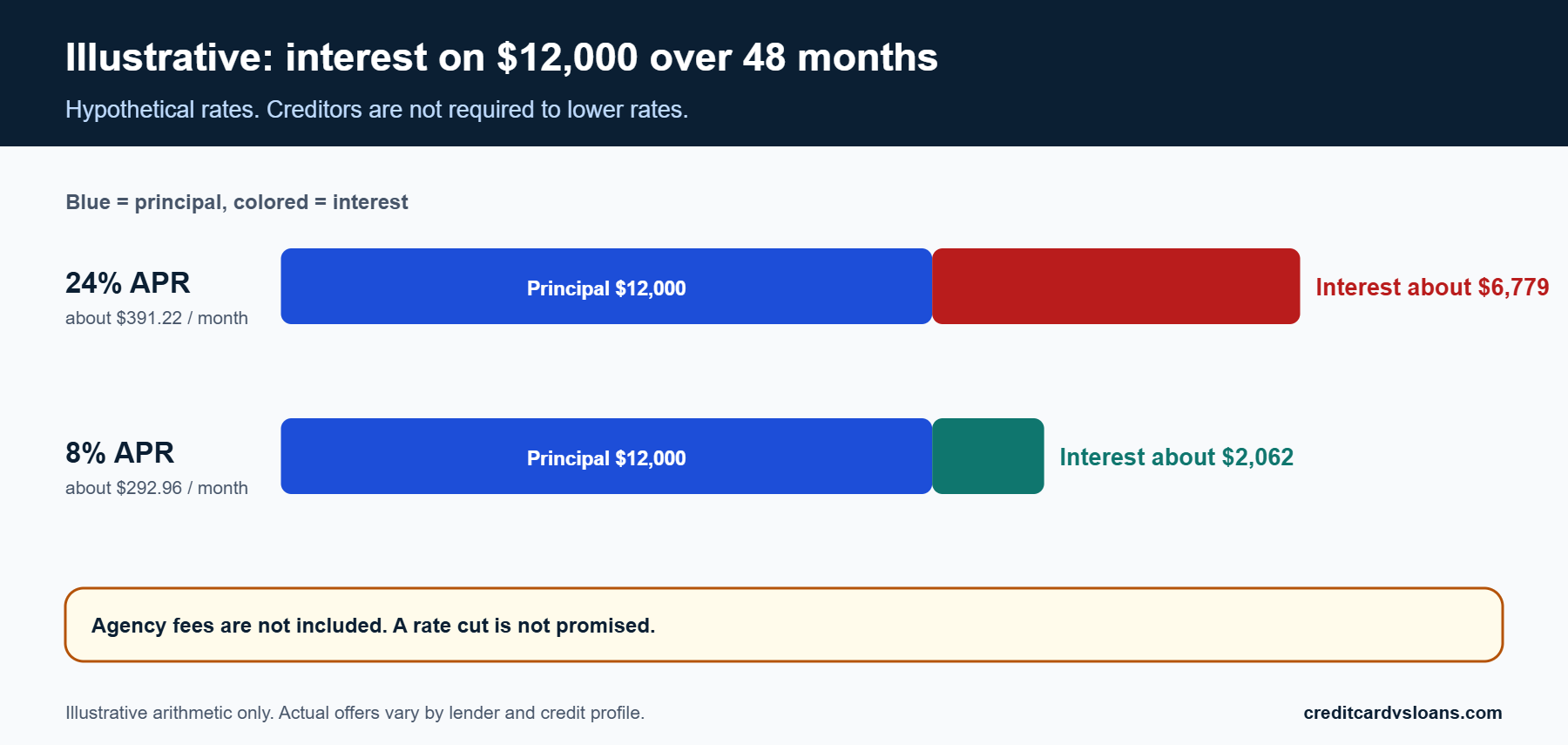
Take a hypothetical $12,000 spread across cards at 24% APR, paid off over 48 months. The payment would be about $391.22 a month and total interest about $6,779. If a creditor lowered the rate to a hypothetical 8% on the same balance and term, the payment would be about $292.96 and interest about $2,062. Those rates are invented for illustration and creditors aren’t required to offer them, so this isn’t a prediction.
The point of the example is arithmetic, not promise. A lower rate shrinks interest sharply, but whether you get one depends on your creditors, and fees can offset some of the gain. Our guide to consolidation loan credit requirements covers the alternative of borrowing to pay off cards.
Comparing the routes
Plan, loan, settlement, or bankruptcy
The FTC describes several paths: credit counseling and a DMP, debt settlement (usually offered by for-profit companies that negotiate a lump-sum payment for less than the full balance), and bankruptcy. Each has trade-offs. Settlement can involve stopping payments, which the FTC warns can lead to late fees, collection calls, lawsuits, wage garnishment, or liens, and creditors aren’t obligated to negotiate. Bankruptcy filing and discharge dates stay on your report for 10 years, says the FTC.
A consolidation loan is a different structure: you borrow new money, pay off the cards, and make one loan payment. Whether that’s cheaper depends on the loan’s APR and fees. Compare it with the plan’s effective cost, not just the monthly payment.
| Route | How it works | Main risk | Credit angle |
|---|---|---|---|
| Debt management plan | Monthly deposit to an agency that pays unsecured creditors | Missed payments can end benefits; fees vary | Needs on-time payments; accurate negatives stay up to seven years |
| Consolidation loan | New loan pays off cards | New debt, possible fees and a new inquiry | Adds an installment account; see lender terms |
| Debt settlement | For-profit firm negotiates a lump sum | Creditors need not negotiate; stopped payments can mean lawsuits | Stopped payments produce late fees and negative entries |
| Bankruptcy | Court process that can discharge many debts | Serious, with legal costs and limits | Dates stay on the report for 10 years |
| Paying on your own | You pay down cards yourself | Needs discipline; no negotiated concessions | Depends on your payments and balances |
When a plan can be a worse fit than it looks
If you can’t afford the monthly deposit, the FTC says not to enroll. A plan also leaves out debts that aren’t unsecured, and you may need to handle those separately. If you expect to need new credit soon, perhaps for a car or a home, ask how the plan’s restrictions and timelines line up with that.
A short plan with modest fees may still beat doing nothing, and a long plan with high fees may not. The only way to tell is to compare totals, which means getting numbers from the agency and your own creditors.
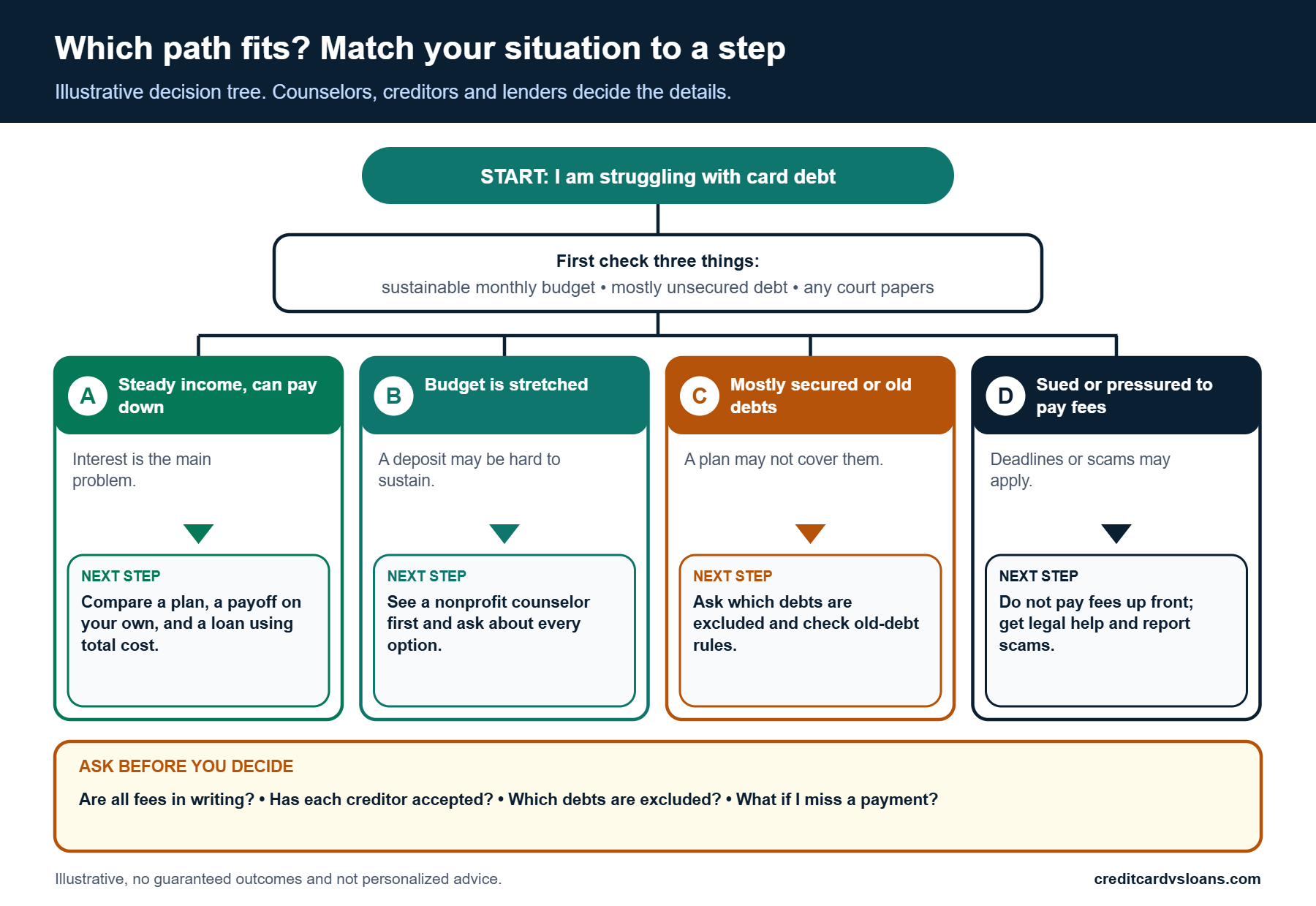
Four hypothetical households and what each might weigh
Households with a manageable payment
Hypothetical A: steady income, several cards
Picture a hypothetical household with a steady paycheck, three credit cards, and monthly minimums that are affordable but barely reduce the balances. The main problem is interest. For this household, a plan could convert three minimums into one fixed deposit with a payoff date, and any rate reduction would speed the payoff.
The questions to ask are about total cost: the agency’s fees over the full term, the rate on each card under the plan, and whether the cards would be closed. The household should also compare a plan with paying the cards down on its own using the same total monthly amount. If the numbers are close, the structure may be the deciding factor.
Hypothetical B: one card carries most of the debt
Now picture a household where one card holds most of the balance and two others are small. A plan covers all enrolled accounts, but the benefit may be concentrated in the large one. Here it is worth asking whether the smaller accounts need to be in the plan at all, and what the creditor on the large card will actually offer.
The FTC says counselors can discuss which debts are excluded. A focused conversation may show that a leaner approach fits better, and that the agency has no reason to push for the maximum number of accounts.
Households under more pressure
Hypothetical C: uneven income
A hypothetical household with variable income, such as seasonal or commission work, has a harder case. A fixed monthly deposit can be a strain in a slow month, and the FTC warns that missed DMP payments can cost you the plan’s benefits. The better questions are about flexibility: what happens in a slow month, how quickly the agency can adjust, and whether a lower deposit is possible.
For this household, building a cash cushion, or discussing a different structure with a nonprofit counselor, may come before enrolling. A plan that fits the average month but fails in the worst month isn’t a good fit.
Hypothetical D: old debts and collector calls
Last, picture a household facing calls about an old account that might be time-barred. Here the first question isn’t a plan at all. It is whether the debt can still be collected through a lawsuit, whether a payment could revive it in their state, and whether the collector has validated it.
Including an old account in a plan means payments, and payments on a time-barred debt can carry consequences in some states. A counselor or attorney should look at that before the account is enrolled. Our guide to the credit card debt statute of limitations sets out the questions to ask.
Who a plan may fit, and who it may not
Signs a plan may be worth a serious look
You can afford the deposit but not the current interest
A DMP tends to make sense for someone with steady income, mostly unsecured debt, and a payment they can sustain, but who is losing ground to interest. The FTC says a counselor may recommend a plan when debt is excessive or repayment isn’t feasible, and that you should enroll only after a certified counselor reviews your finances and gives personalized advice.
Notice the order: review first, plan second. If the plan is proposed in the first five minutes, before anyone has looked at your budget, that is worth questioning.
You want structure and can live without new credit
Some people do better with a fixed schedule than with a self-managed payoff. A plan gives you one deposit date, a payoff horizon, and a third party watching the payments. In exchange, you may have to agree not to use or apply for new credit, as the FTC notes, so you need another way to handle surprises. Building a small cash cushion first, even a modest one, can make the commitment easier to keep.
If your debts are mostly old and the main question is whether you can be sued, start with our guide on the credit card debt statute of limitations before you choose a route, because a payment on an old balance can have legal consequences in some states.
Signs a plan may not fit
The deposit would strain your budget
The FTC says not to enroll if you can’t afford the monthly payment. A plan that collapses after four months can leave you with fees, higher interest and no progress. If the arithmetic only works with overtime or a side job that might not continue, discuss a lower payment or another route with the counselor.
Ask the counselor to show you the budget line by line. If they can’t or won’t, treat that as information about the agency.
Your debts are mostly secured, or you need credit soon
The FTC describes DMPs as paying unsecured debts such as credit cards, student loans, and medical bills. Secured debts, like a mortgage or auto loan, are handled differently, and the FTC suggests asking which debts are excluded from a plan. If you expect to apply for a mortgage or a car loan soon, ask how the plan’s timeline and restrictions interact with that goal, and consider asking a prospective lender how it views plan participation. Lender practices vary, so ask the lender directly.
Risks, scams, and mistakes to avoid
When a plan goes wrong
Missed payments and lost concessions
The FTC warns that missing DMP payments can cost you the plan’s benefits and lead to fees and higher interest. A concession negotiated by an agency may last only as long as you stay on schedule. If your income drops, call the agency immediately rather than letting payments lapse.
Also check your credit reports after the plan begins. Ask the counselor how each creditor will report the account, and compare the reports with the plan’s schedule so a payment sent by the agency but posted late doesn’t surprise you.
If the agency fails
The FTC notes that if your counselor goes out of business, you may need to contact your bank, pay creditors directly, and notify creditors. That is the reason to keep your own records of every deposit and to know each creditor’s contact details and account numbers. Do not assume the agency’s records are complete.
If you stop the plan for any reason, ask each creditor whether the old interest rate and fees return. This is one of the reasons the FTC suggests verifying everything with creditors directly.
Scams that borrow the plan’s good name
Warning signs the FTC lists
The FTC’s lists of warning signs include: charging fees before settling debts or enrolling you in a DMP, pressuring for voluntary contributions, promoting a “new government program” for credit card debt, guaranteeing that unsecured debt can be eliminated or paid for pennies on the dollar, telling you to stop contacting creditors without explaining the consequences, promising to stop all collection calls and lawsuits, and enrolling you without reviewing your finances.
It also warns about credit repair companies that charge for services you can do yourself or claim to remove accurate negative information. Only time and consistent repayment improve credit, in its words. For more on how deceptive offers are structured, see our guide to predatory lending signs.
Plan versus settlement: know which one you are being sold
A DMP pays your debts in full, often with reduced interest. Debt settlement aims to pay less than you owe, and the FTC cautions that it usually involves stopping payments to creditors, saving in a dedicated account for 36 months or more, and facing the risk of lawsuits and garnishment if creditors don’t agree. A CFPB notice describes the Telemarketing Sales Rule as barring telemarketed debt-relief sellers from requesting or receiving fees before the debt is settled or altered and you have made a payment under the new terms.
If a salesperson mixes the two or won’t say which one you are buying, slow down. The FTC also notes that forgiven or settled debt may be taxable income unless you are insolvent, so ask a tax professional about any settlement.
Before, during, and after a plan
Check your credit file
Before you enroll
Pull your credit reports and list every account, balance, limit, and status. That gives you a baseline, shows which debts could be in the plan, and lets you catch errors before they cause trouble. Compare the list to the debts the agency proposes to include.
Write down your current monthly minimums and what you could afford. The comparison between what you pay now and what the plan would require is the clearest test of whether it adds breathing room or just rearranges the squeeze.
After the plan ends
The FTC advises checking all three credit reports for unexpected “late” notations after the counselor closes the plan. If you find an error, dispute it with the credit bureau and the creditor in writing and keep copies.
Check, too, that accounts paid off through the plan show a zero balance and the correct status. Errors left uncorrected can drag on lending decisions for years.
Rebuilding afterward
Habits that matter more than the plan
After the plan, the habits that count are the ones the scoring factors reward: paying every bill on time, keeping balances low relative to limits, and being selective about new accounts. None of that is a trick, and none of it works quickly. The FTC’s reminder that only time and consistent repayment improve credit is the honest summary.
Set a small emergency fund goal early, because the thing most likely to push people back into card debt is an unplanned expense. Even a modest cushion can help.
When to consider borrowing again
Once a plan is done and your reports look accurate, you can decide whether you need new credit. If you do, compare offers apples-to-apples using the APR, and check lenders’ stated requirements. Our guides on what credit score you need for a personal loan and debt consolidation loan requirements explain how lenders think about eligibility, though each lender sets its own rules and no source here can predict your result.
Conclusion: deciding whether a debt management plan is worth it
A way to decide
When a plan is worth pursuing
A plan is worth pursuing when a certified counselor has reviewed your whole budget, you can sustain the deposit for the length of the plan, the fees are written down and reasonable against the interest you expect to save, and each creditor has confirmed the concessions. If the plan also gives you a structure that you would not build on your own, that can be a meaningful advantage.
Notice that none of those conditions mention your score. That is deliberate. The score is a result of behavior and reporting, and a plan is a vehicle for the behavior. If the vehicle fits, the score follows its own course.
When to keep looking
Keep looking if the agency promises a credit outcome, charges fees before doing any work, won’t put fees in writing, or insists you stop speaking with creditors. The FTC lists each of these among its warning signs. Also keep looking if the deposit would leave you no breathing room, because a plan you can’t keep may cost more than it saves.
If you are unsure, a second opinion from another nonprofit counselor is cheap insurance. Different agencies can propose different plans for the same debts, and comparing them shows what is negotiable.
One more point on timing. People often ask how fast a plan will “fix” their credit, and the honest answer is that a plan changes cash flow first and credit reports slowly. The FTC’s reminder that accurate negative information can remain for up to seven years means that the past entries age out on their own schedule, whatever you do. What you can control is the record you add on top of them, one on-time payment at a time. That is why consistency matters more than the label on the program, and why the question to ask any agency is not “what will happen to my score?” but “what will happen to my payments, my accounts, and my total cost?” Those answers you can verify, and they are the ones that drive the rest.
Questions people ask next
Should I keep my cards open or close them?
There is no one answer, and the sources reviewed for this guide don’t settle it. Creditors often have their own rules for enrolled accounts, and some may close or restrict them. What you can do is ask each creditor in advance whether the account stays open, whether the limit changes, and how the account will be reported while you are on the plan. Then compare that against how you tend to use credit, because an open card with no spending discipline can be a risk of its own.
Can I leave a plan if my situation changes?
Usually you can stop making deposits, but the consequences matter. The FTC warns that late or missed payments can end the plan’s benefits and bring fees and higher interest, so leaving without a plan for each creditor can be costly. If your circumstances change, such as a job loss or a medical bill, tell the agency early. Ask what the written agreement says about withdrawal, whether fees are refundable, and what each creditor will do with the account if you leave. Write the answers down before you enroll, not after you need them.
Your checklist
Before you enroll
- Pull your credit reports and list every account, balance, limit, and status.
- Write down your income, expenses, and the largest deposit you can sustain for the whole plan.
- Check the agency with your state attorney general or consumer protection agency.
- Ask for all fees, the plan length, and the concessions from each creditor in writing.
- Confirm with each creditor that it has accepted the plan before you send money.
- Ask which debts are excluded and what happens if you leave the plan early.
If anything is unclear, ask again. A good agency expects questions.
While you are in the plan
- Keep your own record of each deposit and each creditor’s balance.
- Check your reports periodically for errors or unexpected late entries.
- Call the agency right away if your income changes, rather than missing a payment.
- Avoid new credit if the plan requires it, and build a small cash cushion for emergencies.
- After the plan ends, review all three reports and dispute any errors in writing.
None of this requires special tools, only attention. For more on how a personal loan could change your file if you borrow later, see our guide to how a personal loan can affect your credit score, and for lender requirements see debt consolidation loan credit scores. If the debts in question are old, the statute of limitations guide explains what to check before paying anything.
The bottom line is simple. A plan is a tool, not a verdict on your finances and not a score fix. Use it if it solves your cash-flow problem at a fair cost, and judge it by what you can verify in writing.
- What Credit Score Do You Need for a Debt Consolidation Loan?
- Credit Card Debt Statute of Limitations: What It Means and What It Doesn’t
- Predatory Lending: Warning Signs in Personal Loans and Debt Relief Offers
- How a Personal Loan Can Affect Your Credit Score
- What Credit Score Do You Need for a Personal Loan?
- FTC: Coping with Debt (Credit counseling, debt management plans, settlement, bankruptcy, scam warning signs)
- FTC: Fiscal Fitness: Choosing a Credit Counselor (FTC Facts for Consumers, Feb. 2011) (DMP mechanics, questions to ask a counselor, effects on credit reports)
- FTC: Debt Collection FAQs (Credit report timing for negative information)
- myFICO: What’s in your credit score? (FICO score factors and general weights)
- CFPB: CFPB takes action against debt relief business taking illegal advance fees (Telemarketing Sales Rule advance-fee ban; allegations only)
Last updated: October 22, 2026. Rates, fees and lender rules change; verify current terms before acting.
The information on creditcardvsloans.com is provided for general educational and informational purposes only. It is not financial, legal, tax, credit, accounting or investment advice, and reading it does not create an advisor-client, fiduciary or any other professional relationship. Nothing here is an offer, solicitation or recommendation to borrow, lend or apply for any product.
Credit scores, interest rates, fees, eligibility rules, lender policies and laws change frequently and vary by lender, location and individual circumstances. Examples, figures and scenarios are illustrative only, do not predict your results and do not guarantee approval, savings, a particular rate or a credit-score outcome. Always confirm current terms directly with the lender or issuer and read the full agreement before you apply or sign.
Although we aim for accuracy and use reputable sources, we make no representations or warranties, express or implied, about the completeness, accuracy, reliability or timeliness of the content. Content may be drafted with the assistance of automated tools, so errors or omissions may still occur. Links to third-party sites are provided for convenience; we don’t control and aren’t responsible for their content.
To the fullest extent permitted by law, creditcardvsloans.com and its owners, editors, authors, contributors and affiliates disclaim all liability for any loss, damage or expense arising directly or indirectly from your use of, or reliance on, this content. Before making financial decisions, consult a licensed professional, such as a qualified financial advisor, attorney, tax professional or nonprofit credit counselor, who can consider your complete situation.