
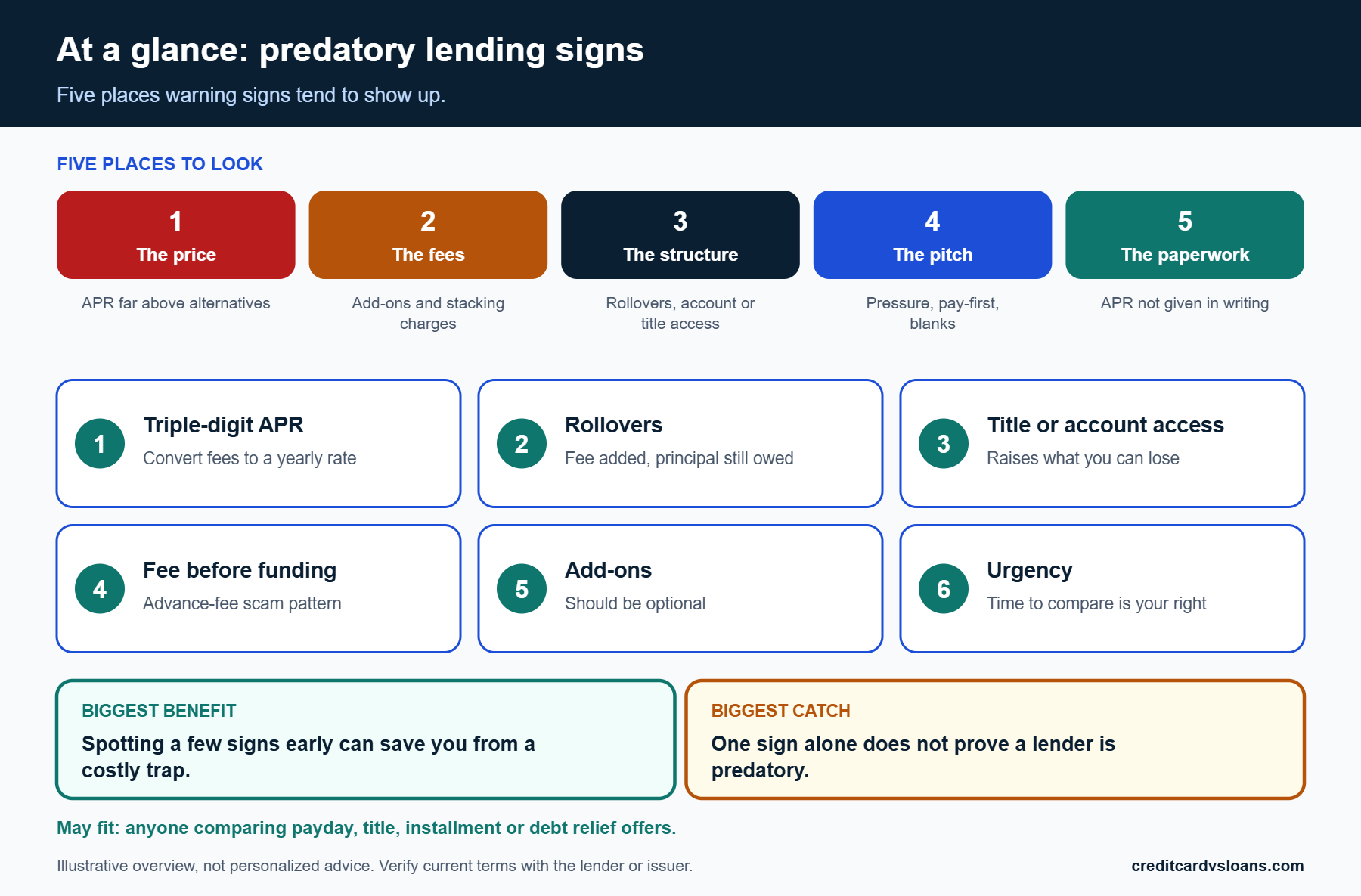
The clearest predatory lending signs are a price that dwarfs the alternatives, fees or add-ons that keep stacking, a structure built around rollovers, access to your bank account or car title as security, and a sales process that rushes you, hides the APR, or asks for money before you are funded. No single sign proves a lender is predatory, but several together are a reason to stop.
“Predatory lending” isn’t a single legal term with one definition that applies everywhere, and state laws differ on caps, licensing, and what counts as unfair. In this guide it means lending practices that profit from a borrower’s urgency, confusion, or limited options rather than from a fair exchange. The signs below come from Federal Trade Commission (FTC) and Consumer Financial Protection Bureau (CFPB) consumer guidance, and they are written for personal loans, payday and car title loans, and debt relief offers.
The goal isn’t to scare you away from borrowing. Many people need credit, and many lenders are legitimate even when their products are expensive. The goal is to help you recognize the moment when an offer stops being a price you can compare and becomes a trap you can’t easily leave. This is general education, not legal advice. For a specific contract, a nonprofit credit counselor, a legal aid office, or your state regulator can look at the details.
- The FTC describes payday loans as usually $500 or less, due in about two to four weeks, with fees of $10 to $30 per $100 borrowed. A $15-per-$100 fee on a two-week loan works out to roughly a 391% APR.
- Rollovers are a core warning sign: the CFPB’s example shows a $300 loan with a $45 fee costing $90 after one rollover, while the full principal is still owed.
- A fee demanded before you receive any money, or approval promised before any review, matches the advance-fee scam pattern the FTC warns about.
- Active-duty servicemembers and covered dependents have a federal 36% Military APR cap on covered credit, per the CFPB.
- Cheaper options exist, including credit union loans, extensions from creditors, and nonprofit counseling. Ask about them before you sign anything.
Dollar figures from the FTC page on payday and car title loans reflect the agency’s examples, which compare payday pricing with credit card APRs from early 2023. Rates, state laws, and lender products change, so treat every figure here as an example and check the rules in your state.
The short answer: the signs that matter most
Signs in the price
A cost far above the alternatives
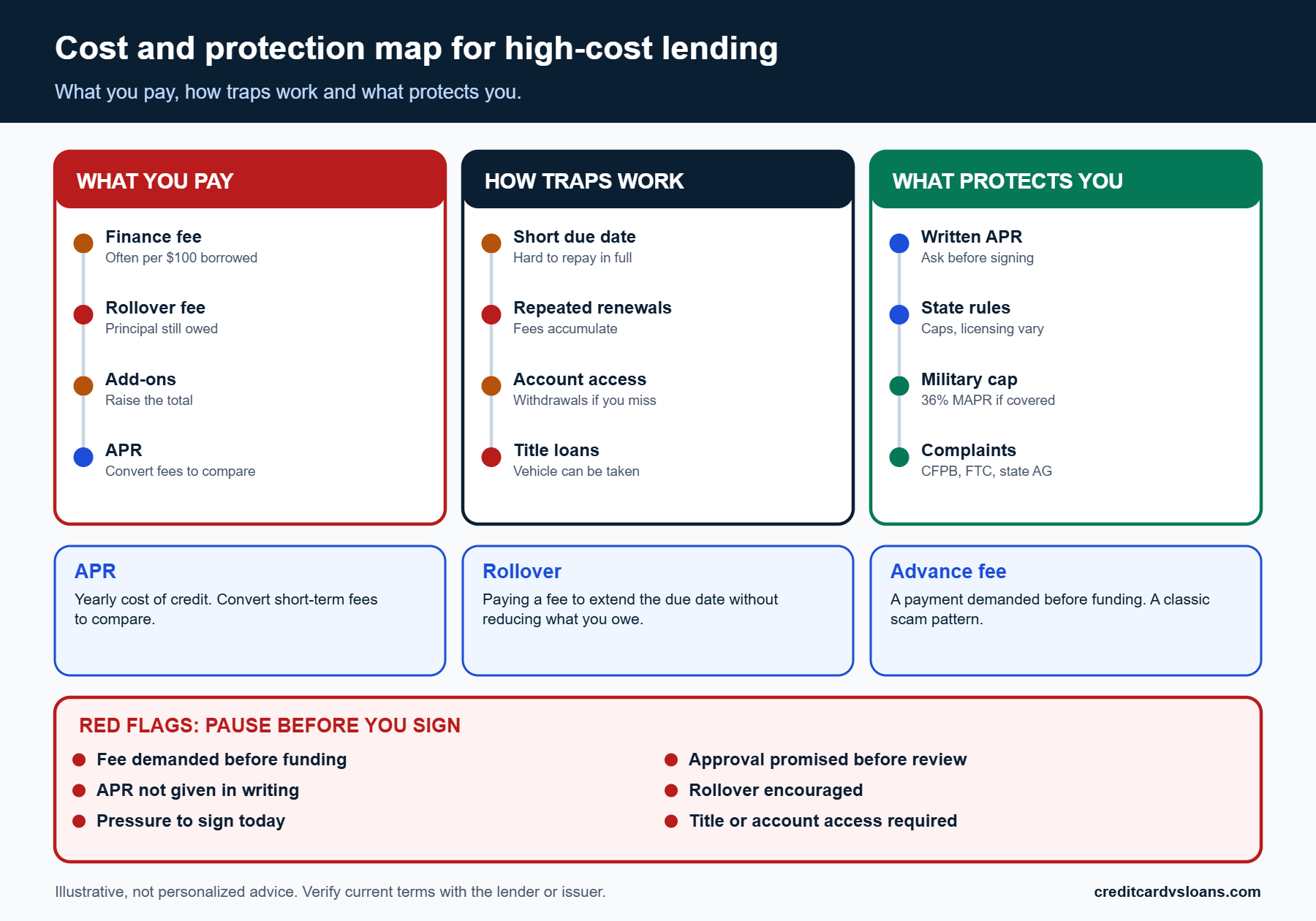
The most reliable sign is the APR once you convert the fee into a yearly rate. The FTC gives the example directly: a payday fee of $15 per $100 on a two-week loan equals about a 391% APR, compared with an average credit card APR that the agency says was just under 21% in early 2023. For car title loans, it says monthly finance fees can reach 25%, about 300% APR.
The lender may not quote an APR in ads, and the fee may look small in dollars. That is why the conversion matters. A $75 fee on a $500 loan sounds manageable until you notice it buys you two weeks. The FTC also notes that lenders must disclose the finance charge and APR in writing before you sign payday and similar loans, so ask to see them.
Fees and add-ons that keep stacking
The FTC lists extra charges, such as late or returned-check fees, rollover fees, and add-ons like roadside plans, as ways that costs climb. In title loans, it adds, there may be processing, document, and origination fees on top of the monthly finance fee.
A hypothetical shows the effect. Finance a $400 optional add-on into a $5,000, 12%, 36-month loan and the payment rises from about $166.07 to about $179.36, which means you repay roughly $478 more over the term. Optional should mean optional, and an add-on should be priced and described separately. Our guide to loan agreement red flags shows how to find these items in a contract.
Signs in the structure
Rollovers and repeated renewals
The CFPB explains that a rollover extends a payday loan’s due date in exchange for a fee, and the fee does not reduce what you owe. In its example, a $300 loan with a $45 finance charge due in 14 days costs $90 after one rollover, with the full $300 still owed. Multiple rollovers can add several hundred dollars in fees.
The FTC states the same pattern for a $500 loan with a $75 fee: one rollover doubles the cost to $150. Many states limit or ban rollovers, according to the CFPB, so availability depends on where you live. If a lender nudges you to renew instead of repay, the business model depends on your staying in debt.
Access to your account or your car title as security
The FTC lists lenders who can cash your check or withdraw money from your account if you miss the repayment date, and title lenders who may take your vehicle if you can’t repay, even if you’ve made partial payments. Some title lenders also require GPS and starter-interrupt devices that let them locate your vehicle and disable its ignition, and in some states lenders can keep sale proceeds even when they exceed what you owed.
These features aren’t just fine print. They determine what is at risk if a month goes wrong. A loan secured by your transportation or tied to your paycheck account should be priced as if the lender has little risk, and it rarely is.
| Sign | Why it matters | What to do |
|---|---|---|
| Triple-digit APR | Cost far above credit cards and credit union options | Convert fees to an APR and compare alternatives |
| Rollover offered or encouraged | Fee added, principal still owed | Ask for an extended repayment plan instead |
| Access to your bank account | Lender can withdraw if you miss a date | Understand the authorization before you give it |
| Car title as security | Vehicle can be repossessed | Weigh the risk to your transportation |
| Add-ons you didn’t choose | Raise total cost | Ask to remove them; get new papers |
| Fee before funding | Advance-fee scam pattern | Stop; verify the lender; report to the FTC |
| APR not in writing | Hides the real cost | Insist on written APR and finance charge |
Signs in the sales process
Pressure and promises
Approval promised, then a fee demanded
The FTC describes advance-fee loan scams: ads promise credit regardless of your history, the approval comes before any application review, and then a fee is demanded, labeled as processing, insurance, or an application fee. After you pay, the loan never arrives. Legitimate lenders may charge an application or appraisal fee, the agency says, but they don’t promise a loan in exchange for a fee.
Scammers often ask for payment by wire transfer, gift cards, or cryptocurrency, which are hard to recover. If you paid, act quickly and report it at ReportFraud.ftc.gov.
Urgency, blanks, and “sign now” tactics
Time pressure is a sales tool. A limited-time rate, a closing countdown, or a refusal to let you take the documents home are all reasons to slow down. So are blank spaces in the agreement and requests to leave out or inflate information on your application.
Lenders that want to be compared give you the numbers and a day to think. Our companion guide on personal loan agreement red flags covers the line-by-line checks to run before you sign.
Lack of transparency
A missing or shifting APR
If a lender won’t state the APR, the finance charge, and the total of payments in writing for your specific offer, assume you can’t compare it. The FTC’s page on payday and title loans advises reviewing the agreement for late, returned-check, and rollover fees and checking state laws, because some states cap rates or require licensing.
Mismatches between the offer and the final paper are another sign. If the amount you receive, the payment, or the term changes between documents, ask in writing why.
Unsolicited offers and targeting
The FTC notes that scammers target people with bad credit and some buy lists of people who searched for or applied for payday or other loans. Unsolicited calls offering loans are a warning sign, and robocalls with recorded sales pitches are illegal, according to the agency.
Being offered credit right after a rough month isn’t proof of anything. It is a reason to verify who is calling, check state registration, and look up complaints before you share any account details.
Where the signs show up: product by product
Payday and car title loans
How payday loans work
The FTC describes payday loans as small, short-term loans, usually $500 or less, due in about two to four weeks. You provide a personal check or authorize an electronic debit for the loan plus fees. Fees run $10 to $30 per $100 borrowed.
The trap isn’t the first fee, it is the second and third. If you can’t repay in full on the due date and the lender rolls the loan over, you pay another fee while still owing the principal. The CFPB suggests asking the lender for an extended repayment plan if you struggle to repay, and says you can submit a complaint to the bureau about a payday loan problem.
How car title loans work
Title loans are short-term loans, usually for 15 or 30 days, secured by your vehicle, and usually for 25% to 50% of its value, the FTC says. You hand over the title, and the lender may require a spare key and tracking or ignition devices. In the FTC’s example, a $1,000 loan costs $250 in fees for 30 days, and one rollover brings the 60-day cost to at least $500.
Repossession is the risk that sets title loans apart. The FTC says a lender can take the vehicle if you can’t repay, even after partial payments. For many households the car is how they get to work, so losing it can worsen the original problem.
High-cost installment loans and debt relief offers
Long-term loans with high cost
Not every expensive loan is a payday loan. Some installment loans spread a high cost over many months, and the monthly payment may look low. The FTC and CFPB pages we reviewed don’t give figures for these products, so this section doesn’t either. The check is the same as for any loan: find the APR, the amount you receive, the total of payments, and any add-ons, and compare them with alternatives.
A longer term lowers the payment and raises the total interest, a trade-off shown in our guide to reading a loan agreement before you sign. If the only way the loan “fits” is by stretching it far beyond what you borrowed, ask yourself what you’re really paying for.
Debt relief that charges up front
People who are already behind are a target for debt relief pitches. The FTC lists warning signs: fees before settling debts or enrolling you in a plan, pressure for “voluntary contributions,” a “new government program,” guarantees that unsecured debt will be eliminated or paid for pennies on the dollar, telling you to stop contacting creditors without explaining the consequences, and promises to stop all collection calls and lawsuits.
A CFPB notice explains that under the Telemarketing Sales Rule, a company that sells debt relief by telemarketing may not request or receive fees before the consumer’s debt terms have been altered or settled and the consumer has made at least one payment under the new terms. Our guide on how a debt management plan affects your credit explains the legitimate version of a plan and how to vet an agency.
| Product | Typical features (per FTC/CFPB) | Main risk |
|---|---|---|
| Payday loan | Usually $500 or less, due in 2 to 4 weeks, fees of $10 to $30 per $100 | Rollovers add fees while principal stays due |
| Car title loan | Usually 15 or 30 days, 25% to 50% of the vehicle’s value | Vehicle can be repossessed; some states let lenders keep surplus |
| Advance-fee loan offer | Fee demanded before funds arrive; approval promised | No loan may exist |
| Debt relief with up-front fees | Fees before any debt is settled or changed | Telemarketing rule bars this for telemarketed sales; scam warning |
| Credit union or bank small loan | Alternatives such as federal payday alternative loans (PAL) | Generally lower cost; check eligibility and terms |
How to measure cost and eligibility
Comparing the real price
Turn fees into an APR
If a lender quotes a fee per $100, you can approximate the APR yourself. Multiply the fee rate by the number of periods in a year. For a $15-per-$100 fee on a two-week loan, 15% times about 26 two-week periods is about 390%, in line with the FTC’s 391% figure. Then compare that with credit card APRs, which the FTC says were just under 21% on average in early 2023, and with credit union loan options.
The conversion isn’t a lender’s disclosure and it assumes no rollover. But it gives you a way to see the scale of the difference. A high-cost loan used for a short emergency may cost less in dollars than a long loan at a lower rate, which is why total dollars matter too.
Illustrative cost of a longer high-rate loan
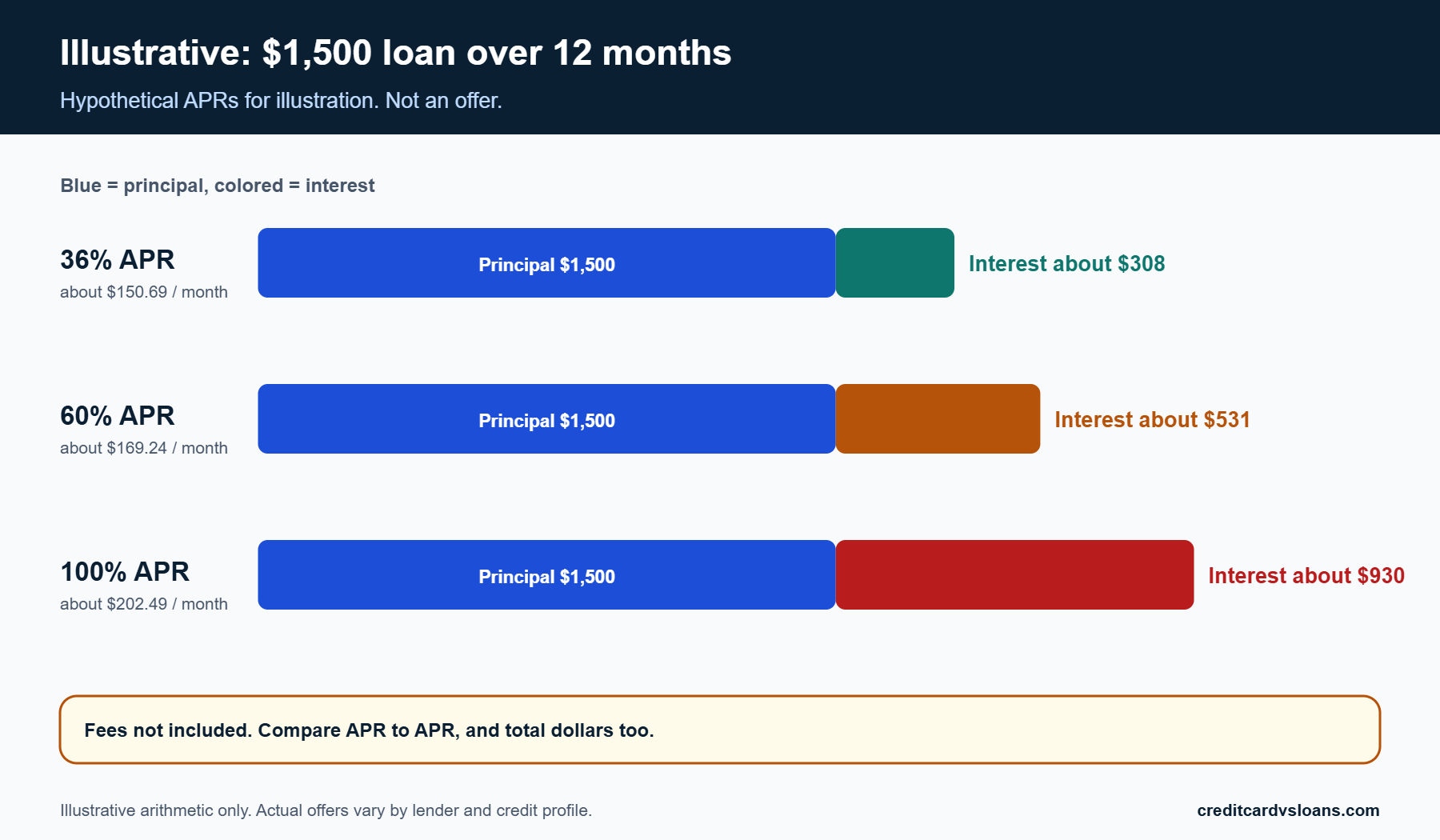
Here is a hypothetical $1,500 installment loan over 12 months with level payments, shown at three invented APRs. At 36%, the payment is about $150.69 and total interest about $308. At 60%, about $169.24 and $531. At 100%, about $202.49 and $930. These APRs are chosen for illustration only and do not describe any real lender or legal limit.
The payments differ by about $52 a month between the lowest and highest rate, which can look affordable. The total interest differs by more than $600, which is large relative to a $1,500 loan. Looking only at the monthly payment hides that gap.
| Hypothetical APR | Monthly payment | Total interest | Total repaid |
|---|---|---|---|
| 36% | about $150.69 | about $308 | about $1,808 |
| 60% | about $169.24 | about $531 | about $2,031 |
| 100% | about $202.49 | about $930 | about $2,430 |
Eligibility and “easy approval”
When approval is easy, the price is the catch
A product marketed on easy approval often earns its money from price, fees, or rollovers rather than from careful underwriting. That is a general observation, not a rule, but it explains why “bad credit, no problem” is something the FTC lists among advance-fee scam ads. If a lender is willing to lend to nearly anyone, ask what it is charging to cover the risk.
It’s fair to wonder what lenders with stricter rules require. Our guides to debt consolidation loan credit scores and financing a veterinary emergency describe lower-cost routes and how requirements differ.
Ability to repay is the real test
Before accepting any loan, write down the payment, the due dates, and the income you can count on. If the loan only works when everything goes right, or when you roll it over, it fails the basic test. Responsible lenders want to know you can repay. Lenders who profit when you can’t will often skip that conversation.
If the answer is “I can’t repay without borrowing again,” pause and look for alternatives first. The next section lists several the FTC suggests.
Four hypothetical situations and how the signs apply
Short-term cash needs
Hypothetical A: a $300 shortfall before payday
A hypothetical borrower needs $300 for a car repair and is offered a two-week loan with a $45 finance charge. That is the example the CFPB uses to explain rollovers. If the borrower repays on time, the cost is $45. If the borrower pays only the fee and rolls over, the borrower still owes the $300 and pays another $45, so the cost of the original loan rises from $45 to $90, and each additional rollover adds another fee.
The decision point is the due date. Before the loan, the borrower should ask whether the full amount will actually be available in two weeks. If not, the question is whether a lower-cost alternative, such as a repair payment plan, a credit union small loan, or more time from a creditor, is possible first.
Hypothetical B: a title loan against the only car
A second hypothetical borrower considers a 30-day title loan for $1,000 on a car they need for work. Using the FTC’s example, the fees for the first 30 days could be $250, and one rollover could bring the 60-day cost to at least $500. If the borrower falls behind, the vehicle could be repossessed even after partial payments.
The key question isn’t only the cost. It is what happens to the borrower’s income if the car is gone. A loan secured by something the borrower can’t do without is a different kind of risk from an unsecured loan, and it should be weighed that way.
Offers that arrive unasked
Hypothetical C: a text promising approval
A third borrower, recently turned down for a card, receives a text promising approval for a personal loan regardless of credit and asking for a processing fee through a gift card. This matches the pattern the FTC describes in its guidance on advance-fee loans: approval before review, a fee in a hard-to-recover form, and an unsolicited contact. The sensible response is not to pay, to verify the sender through a state regulator, and to report it at ReportFraud.ftc.gov.
If the borrower has already paid, the FTC says to act quickly, contact the payment provider, and report. Do not pay again to “release” the first payment.
Hypothetical D: a debt relief call that wants money first
A fourth borrower is called by a company that promises to cut credit card debt dramatically, asks for a fee to begin, and tells them to stop speaking with creditors. Each of these is on the FTC’s list of warning signs, and the up-front fee, if the sale is by telemarketing, runs into the Telemarketing Sales Rule described in the CFPB notice.
A better first call is to a nonprofit credit counselor, who can review the whole budget. Our guide on how a debt management plan affects your credit shows what a legitimate plan looks like by comparison.
Protections and rules that may apply
Federal protections
The Military Lending Act
The CFPB summarizes the Military Lending Act this way: for active-duty servicemembers, including those on active Guard or Reserve duty, and their covered dependents, a covered loan cannot carry a Military Annual Percentage Rate above 36%. The MAPR counts finance charges, credit insurance, add-on products, and certain fees. Lenders also cannot require mandatory arbitration, mandatory allotments, or prepayment penalties on covered credit.
Covered products include payday loans, deposit advance products, and vehicle title loans, plus overdraft lines of credit and most installment loans with exceptions, such as loans secured by the property being purchased. Credit cards had to comply starting October 3, 2017. If you’re covered and an offer exceeds the cap or includes those terms, treat it as a serious red flag. The FTC adds that Military OneSource and Personal Financial Managers can help with alternatives.
Advance-fee and telemarketing rules
Two rules matter for the scam end of this topic. The FTC says that telemarketers may not promise a loan and require payment up front, and that robocalls with recorded sales pitches are illegal. Separately, a CFPB notice describes the Telemarketing Sales Rule as barring telemarketed debt relief sellers from charging before they settle or change the debt and you’ve made a payment under the new terms.
Those rules give you leverage if you’re targeted. A CFPB notice on one case describes allegations, not findings, but it illustrates how regulators treat the pattern. If you think a company broke the rules, report it. The FTC points to ReportFraud.ftc.gov, and the CFPB takes complaints online.
State rules
Licensing, caps, and rollover limits
The FTC says some states cap rates or require licensing, and the CFPB says many states limit or ban rollovers. The details differ widely, and this guide does not state any state’s rules. Whether a lender may charge a particular rate in your state, and whether it must hold a license, is a question for your state attorney general, banking regulator, or consumer protection office.
A practical check: search for your state’s regulator, look up the lender’s name on its license lookup if one exists, and read any complaint history. The FTC also advises searching the company name with words like “review,” “complaint,” and “scam.”
Where to report a lender
The FTC says to report lender fraud to your state attorney general or consumer protection office and to the FTC at ReportFraud.ftc.gov. The CFPB accepts complaints about payday loans online or by phone. Keep copies of your agreement, payment records, and communications, because complaints and legal help both work better with documentation.
A complaint doesn’t guarantee a particular result, but it creates a record and may prompt a response. If you have lost money to a scam, also contact your bank or payment provider right away.
Lower-cost options to check first
Alternatives the FTC lists
Credit unions and community banks
The FTC points to credit unions, including federal “payday alternative loans” (PAL loans), which it describes as much cheaper than payday loans, and to community banks and local branches of large banks that may offer small loans of up to about $1,000. Eligibility, membership rules, and timing vary, so call and ask. Being a member before an emergency helps, if you have a chance to plan ahead.
If you’re borrowing for a vet bill, car repair, or medical expense, our guide on financing a veterinary emergency walks through card, loan, and payment-plan options and their costs.
Time, taxes, family, and charities
The FTC also suggests asking creditors for more time to pay (while checking whether they charge for it), filing your taxes early and requesting direct deposit of your refund, borrowing from family or friends, and asking local charities and churches about assistance. None of these is perfect. Informal loans can strain relationships and extensions can carry fees. But each can cost less than a rollover.
Write down the cost of each option in dollars. A comparison of actual totals is easier to act on than a general sense that one option seems safer.
Counseling and consolidation
Nonprofit credit counseling
If you’re juggling several debts, the FTC suggests nonprofit or low-cost credit counseling. It cautions that nonprofit status does not guarantee that services are free, affordable, or legitimate, so ask for fees in writing. A counselor may recommend a debt management plan, which the FTC says requires regular, timely payments and may take 48 months or longer.
See our guide on debt management plans and credit for how those plans work, and be wary of any provider that charges before doing work.
Consolidation loans: when they help and when they do not
A consolidation loan can replace high-cost debts with a single lower-cost payment, if the new APR is lower and fees are small. It can also be a way to stretch the same debt over a longer period at a higher total cost. The only way to know is to compare the total of payments under each path.
Eligibility depends on the lender’s requirements, which our guide on credit scores for debt consolidation loans discusses. Nothing here can promise approval, and a thin or damaged file can limit options.
If you are already in a high-cost loan
Immediate steps
Know exactly what you owe and what you agreed to
Gather the agreement, receipts, bank statements, and messages. Find the amount borrowed, the fees, the due dates, and any rollover or auto-debit terms. If something doesn’t match what you were told, write it down with dates. The more precise your records, the easier it is to explain your situation to a lender, counselor or regulator.
If you’re struggling to pay, call the lender before the due date. The CFPB suggests asking for an extended repayment plan, and if you ask in writing you have a record.
Understand account access and what you can change
If the lender has authorization to withdraw from your account, find out how that authorization works and what your bank can do about it. Bank policies and your legal rights differ, so ask your bank and consider talking to a legal aid office or attorney before you take steps that affect the lender’s access. Don’t close accounts or stop payments in a hurry without understanding the consequences.
Make sure essentials like rent and utilities are covered first. A lender’s pressure can feel urgent, but losing housing or transportation is typically worse.
Getting help and holding lenders accountable
Complaints and counseling
Submit a complaint to the CFPB if you believe a payday or similar lender acted improperly, report fraud to your state attorney general and the FTC, and consider a nonprofit credit counselor for the larger picture. A counselor can review all of your debts and tell you which problem to tackle first.
If the loan has gone to collections, the rules in our guide to the credit card debt statute of limitations on validation notices and disputes apply to many kinds of debt. The FTC says a written dispute within 30 days of receiving validation information requires the collector to stop collection until it mails verification.
Legal help
If you’re sued, respond by the deadline on the papers. The FTC says ignoring a lawsuit can cost you the chance to contest it. Legal aid offices and consumer attorneys can often assess whether a loan violated state or federal rules, including rate caps, licensing rules, and the Military Lending Act.
This guide cannot say whether your particular loan is unlawful. That depends on your state, the lender, the contract, and the facts, and it’s what a qualified adviser is for.
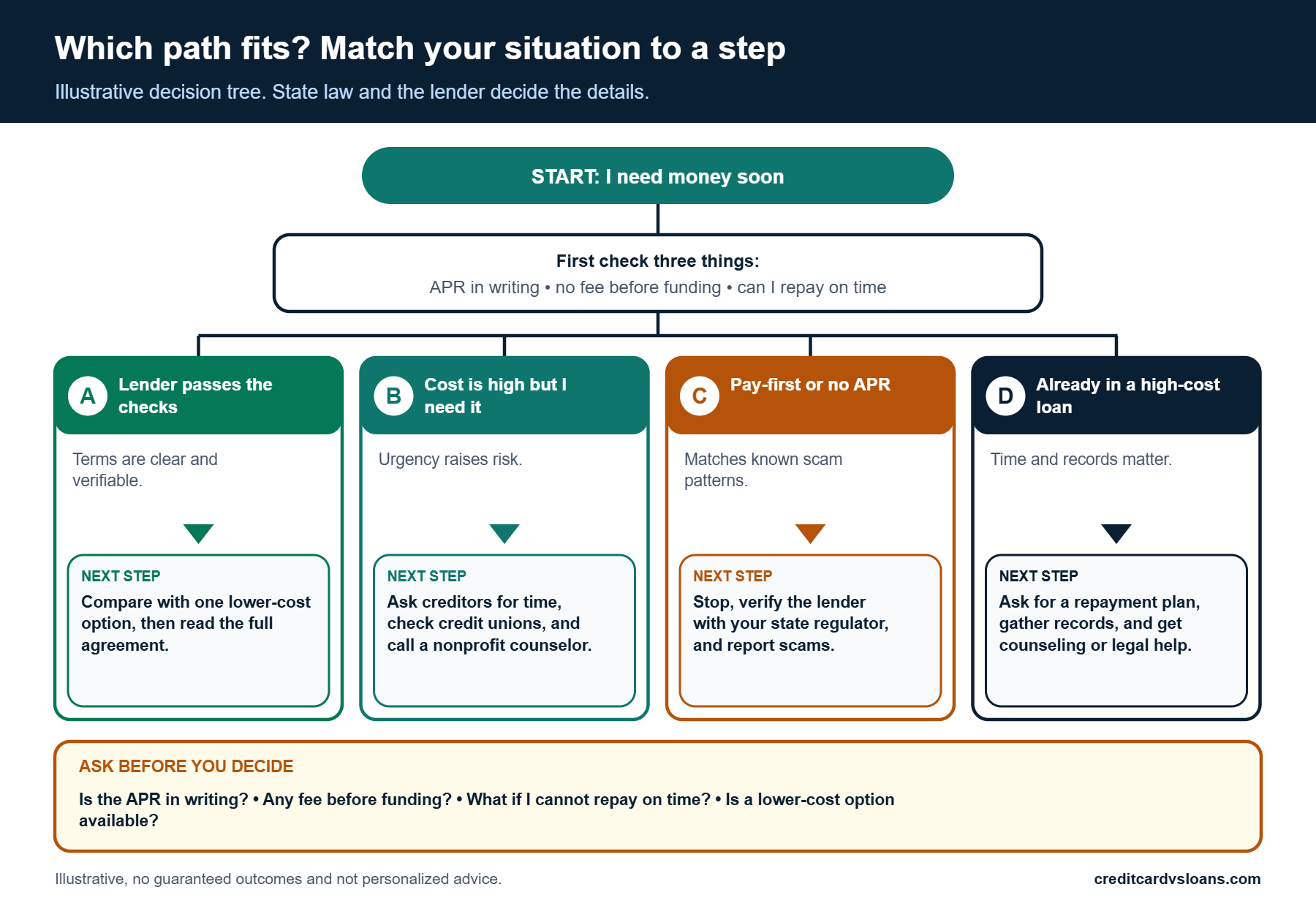
Conclusion: a decision path and your next steps
How to decide
Accept an offer only if it passes these tests
An offer is worth serious comparison when the lender is verifiable and registered where required, the APR, finance charge and total of payments are in writing, there is no fee before funding, add-ons are optional and priced separately, and you can repay on the due date without borrowing again. If you’re covered by the Military Lending Act, the APR must also stay within the cap.
That still doesn’t make it the lowest-cost choice. Compare it with at least one alternative from the list above, even if it takes an extra day.
Walk away when the pattern shows up
Walk away if the lender demands money before funding, promises approval before review, won’t state the APR, pushes rollovers, takes your car title or account access without a clear explanation, or hands you incomplete documents. Any one of those is a reason to pause. Several together mean the offer is built to profit from your urgency.
If you’re short on time, remember that the FTC lists asking creditors for more time, credit union small loans, and nonprofit counseling as alternatives. A phone call can be faster than it sounds.
It also helps to decide in advance what would make you say no. Write down two or three personal deal-breakers before you start comparing, such as any fee before funding, any loan secured by the car you need to get to work, or any lender who will not put the APR in writing. Deciding ahead of time keeps a hurried moment from rewriting your own rules, and it makes the conversation with a salesperson shorter and calmer.
Finally, tell someone you trust what you’re considering. A second person reading the same paperwork often notices what the person under pressure does not, and the FTC’s own advice to search for reviews and complaints, and to check state registration, is easier to carry out with a partner who isn’t under the same stress. If no one is available, a nonprofit credit counselor can be that second set of eyes, and the first conversation is usually just a review of your situation rather than a commitment to anything.
Questions people ask next
Is a very high APR always illegal?
Not necessarily. Rate caps and licensing rules vary by state, as the FTC and CFPB indicate, and some states allow products that others restrict. A high APR can be lawful and still be a poor deal. Whether a specific loan violates your state’s rules is a question for the state attorney general, the banking regulator, or a legal aid office.
Can I just stop paying a loan I think is predatory?
Stopping payments has consequences. The FTC notes in its debt guidance that stopping payments to creditors can lead to late fees, collection calls, lawsuits, wage garnishment, or liens. If you believe a loan is unlawful, document the problem, make a complaint, and get advice from a legal aid office or attorney before you change how you pay. In the meantime, protect your essential expenses first.
Your checklist
Before you borrow
- Write down exactly how much you need and the payment you could sustain.
- Ask for the APR, finance charge, fees, and total of payments in writing.
- Check the lender with your state attorney general or banking regulator, and search for complaints.
- Ask about add-ons and decline any you don’t want.
- Compare against a credit union loan, an extension from the creditor, or nonprofit counseling.
- If you’re covered by the Military Lending Act, confirm the cap and protections.
If a lender asks for a fee before funding, stop and verify first.
If you are already in trouble
- Collect your agreement, receipts, and messages.
- Call the lender before the due date and ask for an extended repayment plan.
- Cover housing, utilities, and food before discretionary debts.
- Report fraud to the FTC and your state attorney general; file a CFPB complaint for payday loan issues.
- Talk to a nonprofit credit counselor or legal aid office about the full picture.
For related reading, see our guides on loan agreement red flags, debt management plans, and the statute of limitations on card debt.
The bottom line: a loan is predatory in practice when it is designed to be hard to leave. Your best protection is time to compare, the APR in writing, and a willingness to say no.
- Personal Loan Agreement Red Flags to Check Before Signing
- Credit Card Debt Statute of Limitations: What It Means and What It Doesn’t
- How a Debt Management Plan Affects Your Credit
- What Credit Score Do You Need for a Debt Consolidation Loan?
- How to Finance a Veterinary Emergency: Credit Cards, Loans and Lower-Cost Options
- FTC: What To Know About Payday and Car Title Loans (Costs, warning signs, alternatives, and the Military Lending Act cap)
- FTC: What to Know About Advance-Fee Loans (Warning signs of advance-fee loan scams and how to verify a lender)
- FTC: Coping with Debt (Credit counseling, debt management plans, and debt relief scam warning signs)
- FTC: Debt Collection FAQs (Validation notices, the 30-day dispute window, and responding to lawsuits)
- CFPB: What does it mean to renew or roll over a payday loan? (Rollover fees and extended repayment plans)
- CFPB: What is covered under the Military Lending Act? (36% MAPR cap and other protections for covered borrowers)
- CFPB: CFPB takes action against debt relief business taking illegal advance fees (Telemarketing Sales Rule advance-fee ban; allegations only)
Last updated: October 22, 2026. Rates, fees and lender rules change; verify current terms before acting.
The information on creditcardvsloans.com is provided for general educational and informational purposes only. It is not financial, legal, tax, credit, accounting or investment advice, and reading it does not create an advisor-client, fiduciary or any other professional relationship. Nothing here is an offer, solicitation or recommendation to borrow, lend or apply for any product.
Credit scores, interest rates, fees, eligibility rules, lender policies and laws change frequently and vary by lender, location and individual circumstances. Examples, figures and scenarios are illustrative only, do not predict your results and do not guarantee approval, savings, a particular rate or a credit-score outcome. Always confirm current terms directly with the lender or issuer and read the full agreement before you apply or sign.
Although we aim for accuracy and use reputable sources, we make no representations or warranties, express or implied, about the completeness, accuracy, reliability or timeliness of the content. Content may be drafted with the assistance of automated tools, so errors or omissions may still occur. Links to third-party sites are provided for convenience; we don’t control and aren’t responsible for their content.
To the fullest extent permitted by law, creditcardvsloans.com and its owners, editors, authors, contributors and affiliates disclaim all liability for any loss, damage or expense arising directly or indirectly from your use of, or reliance on, this content. Before making financial decisions, consult a licensed professional, such as a qualified financial advisor, attorney, tax professional or nonprofit credit counselor, who can consider your complete situation.

