

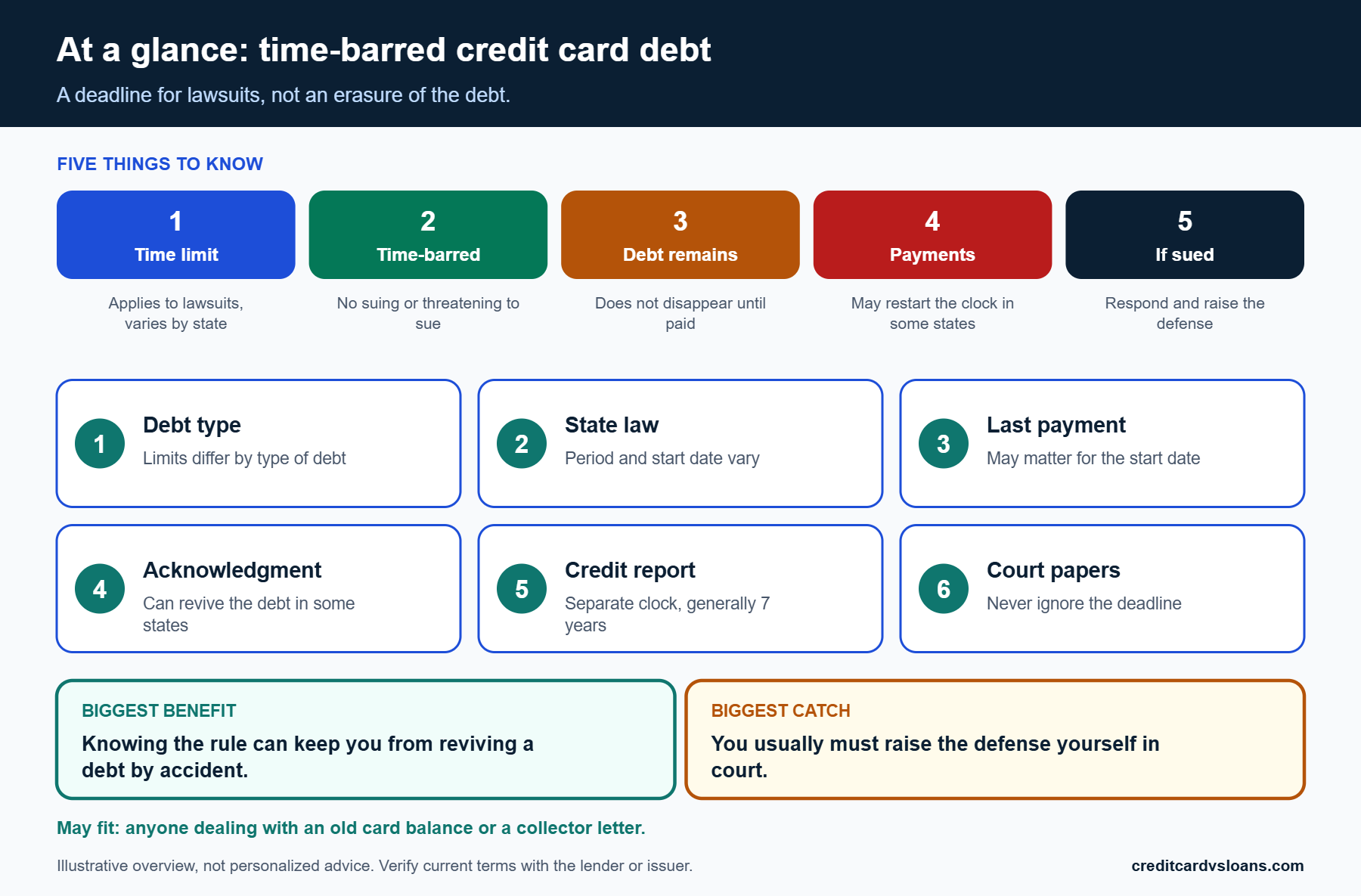
The credit card debt statute of limitations is a deadline for filing a lawsuit over a debt, not an expiration date for the debt itself. When the period runs out, the debt is called time-barred, which generally means a collector cannot sue you or threaten to sue you over it. It does not mean the balance vanishes, that collectors must stop contacting you in every state, or that it leaves your credit report.
That gap between what people hope the rule does and what it actually does is where most of the damage happens. A hopeful borrower makes a small payment to “show good faith,” and in some states that single payment can restart the clock. Another ignores a court summons because the debt “is too old,” and a judge enters a judgment by default. Neither person was careless in the usual sense. They were working from a half-true rule of thumb.
This guide explains the concept using primary-source guidance from the Consumer Financial Protection Bureau (CFPB) and the Federal Trade Commission (FTC). Important: the length of the limit and the way it is counted vary by state and by the type of debt, and this article does not state any state’s period. It is general education, not legal advice. If you have a specific old debt, a collector’s letter, or a lawsuit in front of you, a legal aid office, a consumer attorney, or your state attorney general can look at your facts.
- A statute of limitations limits how long a creditor or collector can use the courts to collect. The CFPB says a debt generally does not disappear until it is paid.
- The CFPB says most states set limits between three and six years, and some are longer. The exact period depends on the debt type, your state, and sometimes the state law named in your credit agreement.
- Collectors cannot sue or threaten to sue on a time-barred debt, but if you are sued and don’t show up to raise the defense, a court may still enter a judgment.
- In some states, a partial payment or a written acknowledgment can restart the clock. Before you pay anything on an old debt, find out how your state treats it.
- Credit reporting runs on a separate clock: the FTC says negative information can generally remain on a credit report for seven years.
The rules summarized here come from CFPB and FTC consumer pages and the text of the CFPB’s debt collection regulation (Regulation F) as of this writing. State laws change, courts interpret them differently, and details such as the start date and revival rules vary. Use this as a map, not a ruling.
The short answer: what the statute of limitations does and does not do
What it does
It sets a time limit on using the courts
The CFPB describes a statute of limitations as a time limit on how long creditors or debt collectors can use legal action to collect a debt. After the period expires, the debt is considered time-barred. In practical terms, a creditor that waited too long loses the ability to win a lawsuit, provided you raise the defense.
The period is not the same for every kind of debt. The CFPB notes it depends on the type of debt, the state where you live, and the state law named in your credit agreement. A credit card account, a medical bill, and a personal loan can each follow different rules. That’s why a friend’s “it’s seven years” is not a safe guide.
It bars suing or threatening to sue
Under the CFPB’s Regulation F, a debt collector must not bring or threaten to bring a legal action against a consumer to collect a time-barred debt, with an exception for proofs of claim filed in a bankruptcy proceeding. The CFPB adds that suing on a time-barred debt violates the Fair Debt Collection Practices Act (FDCPA), so you may have a claim against the collector.
The word to notice is threaten. A letter saying “we will take legal action” about a time-barred debt is a problem even if no lawsuit is ever filed. If you receive one, keep it. It may matter, and the CFPB suggests you can consult an attorney or submit a complaint to the bureau.
What it does not do
The debt does not disappear
The CFPB states plainly that a debt doesn’t generally expire or disappear until it is paid. Time-barred does not mean erased, forgiven, or unenforceable by every means. It means the legal tool of a lawsuit is, in principle, off the table.
The CFPB adds that in most states, collectors can still try to collect after the period expires, for example by letters or calls, as long as they follow the law. The FTC puts it more cautiously: whether a collector can still contact you about a time-barred debt depends on your state, though in any state they cannot sue or threaten you. When two authoritative pages differ in emphasis, the safe reading is that contact rules vary and you should check your state’s.
It does not control your credit report
The statute of limitations and credit reporting run on separate clocks. The FTC says negative information, including time-barred debts, can generally stay on a credit report for seven years, and it notes that bankruptcy filing and discharge dates stay for ten years. Paying an old debt may not remove it from your credit history, and a settlement may be reported as a partial payment.
So the debt can be time-barred and still on your report, or off your report and still collectable by letter. Our guide on rebuilding credit after bankruptcy shows how people approach the reporting side when the legal side has settled.
| Question | Short answer | Source note |
|---|---|---|
| Can a collector sue on a time-barred debt? | Generally no; suing or threatening to sue violates the FDCPA | CFPB and Regulation F |
| Does the debt go away? | No; it generally remains until paid | CFPB |
| Can a collector still call or write? | Varies by state; collectors must follow the law | CFPB and FTC differ in emphasis |
| Is the defense automatic if I am sued? | No; you usually must raise it yourself | CFPB |
| Can a payment restart the clock? | In some states, yes | CFPB and FTC |
| Does it remove the debt from my credit report? | No; reporting is on a separate clock | FTC |
How the clock works: which law, which start date
Which law and which period apply
Debt type, state, and contract terms
The CFPB says most states set limits between three and six years, and some are longer, with the length depending on the type of debt, where you live, and the state law named in the credit agreement. It also notes that some debts, such as federal student loans, have no statute of limitations. That is the extent of what this article will say about numbers. Whether your card debt is covered by a shorter or longer period under your state’s rules is exactly the kind of question to put to your state’s attorney general or to a consumer attorney.
One trap is assuming the state you live in now is the state that matters. The CFPB notes that contract terms or moving to a state with different laws may affect the period. If you’ve moved, or your card agreement names another state’s law, don’t guess.
When the clock starts
According to the CFPB, some states start the clock when a required payment is missed, while others measure from the most recent payment, even one made during collection. The FTC similarly says the period usually starts from the missed payment. The difference matters because a small payment in a collection phase could, in a state that counts from the last payment, push the end date further out.
Because the start date turns on records, the first useful task is to establish your last payment date and the date of your first missed payment. The FTC suggests asking the collector for its records of your last payment and then checking your state’s statute.
What can restart or complicate it
Partial payments and acknowledgments
The CFPB says making a partial payment, even after the period has expired, may restart it, and that acknowledging that you owe the old debt may also restart it. The FTC adds that in some states a written acknowledgment restarts the clock, and that paying any amount or even promising to pay can revive a time-barred debt. A collector may then sue for the full balance, including interest and fees.
That is why the casual phone call matters. Saying “I’ll send you something this month” can have legal weight in some states. If you’re unsure, don’t pay, promise, or sign anything on an old debt until you know your state’s rule.
Why “it depends” is the right answer
Courts and states disagree about what counts as an acknowledgment, whether it must be written, and whether a partial payment revives the whole debt or just part of it. This article cannot resolve that for you, and nobody can resolve it from a general guide. What you can do is slow the interaction down: ask for written validation, keep records, and talk to someone qualified before you act.
If the debt is small and the collector is persistent, it can feel easier to pay and be done. Be careful. A debt that is out of reach of a lawsuit and in the hands of a collector is a different thing from a debt that is back in play. For loans that went bad before you borrowed again, see our guide to personal loan agreement red flags on what to check next time.
Old debt, collectors, and your rights
How collectors are allowed to behave
Contact, tone, and what they cannot say
Debt collectors are covered by the Fair Debt Collection Practices Act, and the CFPB’s Regulation F is the rulebook that implements it. As noted above, a collector cannot bring or threaten to bring a lawsuit on a time-barred debt. Beyond that, the contact rules depend on your state, as the FTC points out, and on the collector’s compliance with the law generally.
A practical signal: if a letter about an old debt uses language like “legal action,” “pending suit,” or “final notice before court,” and you believe the debt is past the limit in your state, save the letter and consider getting advice before you reply. You don’t have to argue with the collector. Writing down dates, amounts and what was said is a stronger move than a phone argument.
Validation notices and the 30-day dispute window
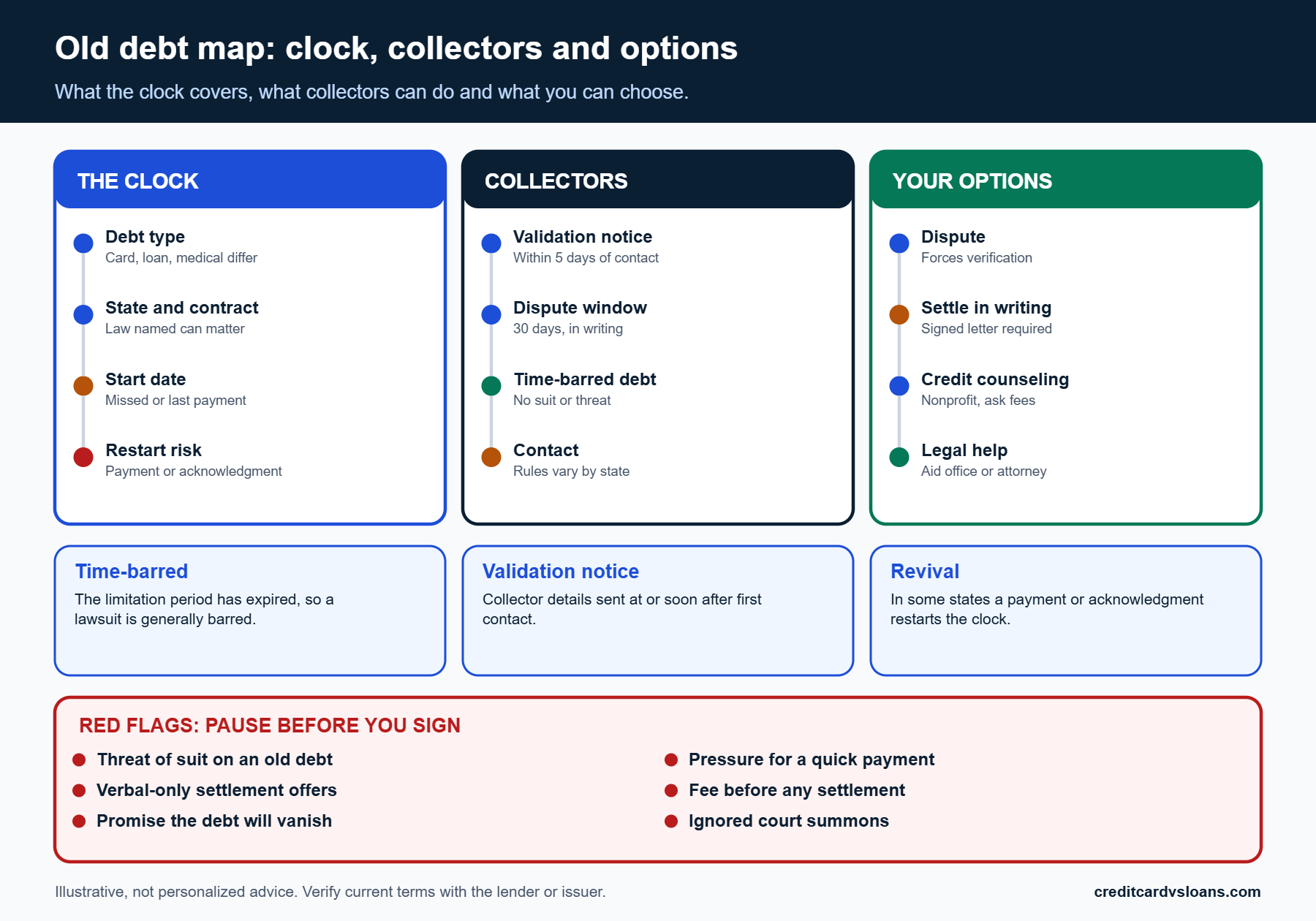
The FTC explains that a collector must send validation information at first contact or within five days of it. The notice should include the collector’s name and address, the original creditor’s name, an itemized amount owed, and an explanation of what to do if you think the debt isn’t yours. If you dispute in writing within 30 days of receiving it, the collector must stop collection until it mails verification, such as a copy of the original bill.
The FTC suggests sending your dispute by certified mail with a return receipt and keeping a copy. If you don’t dispute within 30 days, the collector will assume the debt is valid. That is an assumption for the collector’s purposes, not an admission, but don’t count on it helping you later.
Old debt and your credit file
The seven-year reporting window
The FTC says negative information can generally stay on your credit report for seven years, with bankruptcy filing and discharge dates remaining for ten. The statute of limitations does not control that window, and the reporting clock isn’t restarted by a payment in the way a limitations period might be in some states. Reporting rules are federal and are governed by the Fair Credit Reporting Act. For the exact dates for your accounts, use your credit reports.
You can get your reports from the three nationwide bureaus through the official site, annualcreditreport.com, which the federal government directs consumers to. Reading the dates in your own reports beats trusting a collector’s account of them.
Paying an old debt and what it does to your report
The FTC cautions that paying off an old debt may not remove it from your credit history, and that a settlement may be reported as a partial payment. That means a payment made to “clean up” a report may not clean it up. If the payment would also revive the debt in your state, you’ve potentially spent money to make things worse.
If your goal is better credit, our guide on credit score requirements for a debt consolidation loan explains what lenders look at, and why recent payment behavior often matters more than an old collection to some decisions. That varies by scoring model and lender, and nothing here guarantees a score outcome.
What it costs to pay, settle, or wait
The money and credit trade-offs
Why a payment is not always a harmless gesture
The FTC warns that in some states paying any amount, or even promising to pay, on a time-barred debt can revive it, and that the collector may then sue for the full balance, including interest and fees. A $25 goodwill payment on a $3,000 old balance could therefore carry a legal cost far above $25, in the states where it works that way.
This does not mean paying an old debt is wrong. Many people choose to pay for personal or practical reasons, such as wanting to be done or needing a clean record for a mortgage or job. It means do it with open eyes, after confirming your state’s rule and the collector’s authority, and with a written agreement.
Settling in writing
If you settle, the FTC says to get a signed letter from the collector stating that your payment settles the entire debt, and to keep the letter and payment records. Don’t pay on a verbal promise. Ask who owns the debt now, because debts are often sold, and you don’t want to settle with one party while another still claims the balance.
Settled or forgiven amounts may also be taxable. The FTC notes that forgiven or settled debt may be taxable income unless you are insolvent, which it defines as total debts exceeding the fair market value of total assets. Tax rules have other details, so confirm with the IRS or a tax professional before you rely on that exception.
Comparing the paths
Pay, negotiate, dispute, or wait
There isn’t one right move. Paying in full ends the account but may revive a time-barred debt in some states and may not remove the entry from your report. Negotiating a settlement can reduce what you pay but may carry tax and credit-reporting consequences. Disputing the debt in writing within 30 days forces verification but doesn’t make a valid debt go away. Waiting may be reasonable if the debt is time-barred and you understand the risks, but it doesn’t stop letters or credit-report entries and it can leave you exposed if a suit is filed and you miss it.
The table below puts the trade-offs in one place. It is a summary of the sources cited here, not a recommendation.
| Option | What it can do | What to watch for |
|---|---|---|
| Pay in full | Ends the collection effort for that balance | May revive a time-barred debt in some states; entry may stay on the report |
| Make a small partial payment | Shows effort to the collector | May restart the clock in some states |
| Negotiate a settlement | May lower the amount you pay | Get a signed letter; settled amounts may be taxable; may be reported as partial payment |
| Dispute in writing within 30 days | Collector must stop collecting until it mails verification | Does not erase a valid debt |
| Do nothing | Avoids reviving a time-barred debt | Letters continue; a suit you ignore can end in judgment |
| Talk to a nonprofit credit counselor or attorney | Gets advice based on your state and facts | Check fees; ask for them in writing |
An illustration of how settlement math works
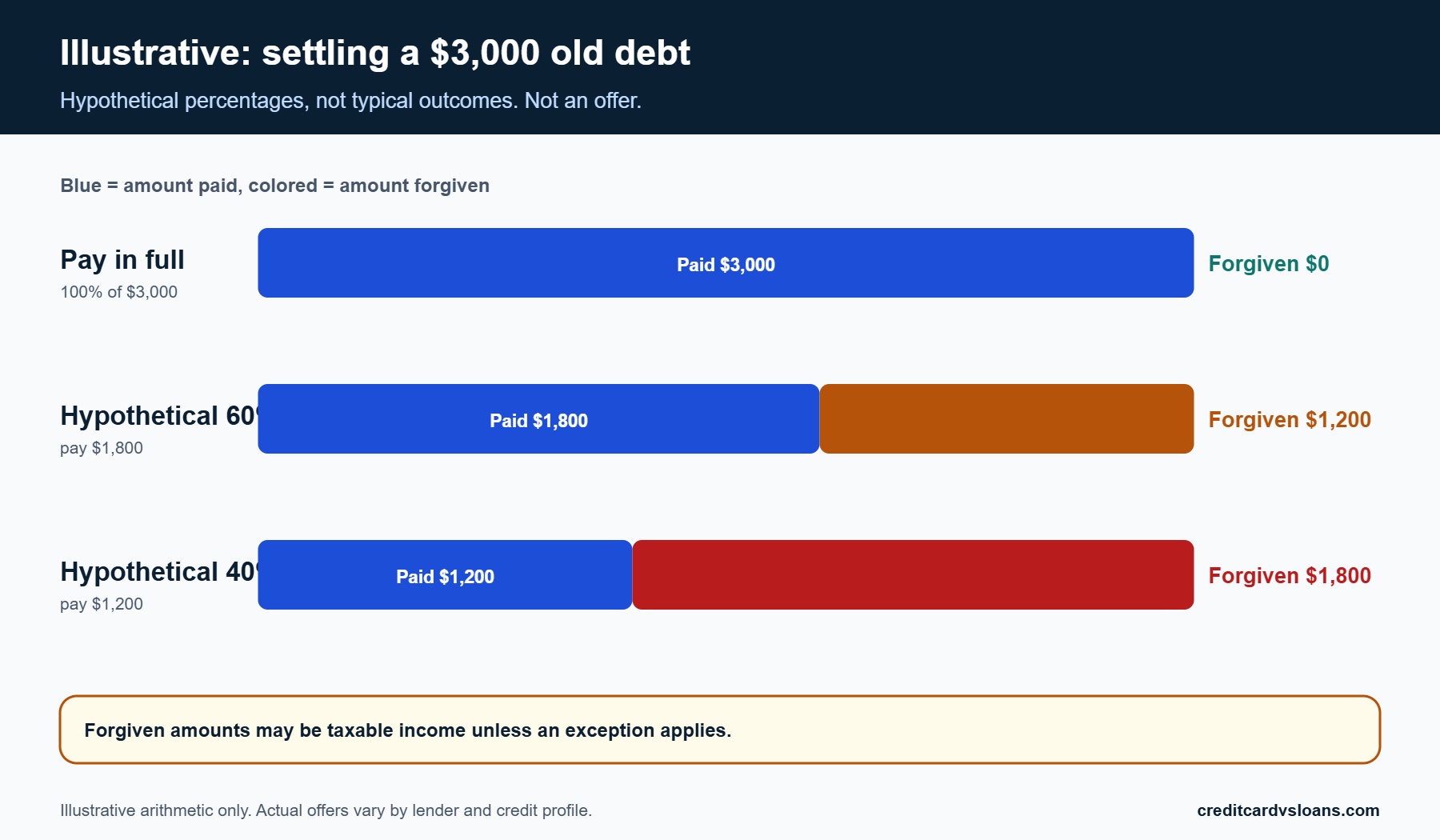
Suppose you owe a hypothetical $3,000 and a collector offers to settle. At full payment you pay $3,000. A hypothetical 60% settlement costs $1,800 and leaves $1,200 forgiven. A hypothetical 40% settlement costs $1,200 and leaves $1,800 forgiven. Those percentages are invented for illustration and are not typical outcomes. Creditors are not obligated to negotiate, as the FTC notes in discussing settlement programs.
The arithmetic is simple. The decision isn’t, because the forgiven amount might be taxable, the report may show a partial payment, and the payment may revive the debt in some states. That’s the reason the signed letter and a short conversation with a qualified adviser come before the check.
Common myths about old credit card debt
Myths about the clock
“After seven years it is gone”
Seven years is the figure the FTC gives for how long negative information can generally stay on a credit report. It is a reporting rule, not a lawsuit deadline. The limit on suing is set by state law and the debt type, and the CFPB says most states fall between three and six years, with some longer. The two numbers are unrelated, and the second can be shorter or longer than the first.
Mixing them up causes real harm in both directions. Someone assumes the debt is “off the books” because it dropped from the report, while a collector may still be able to sue if the state’s period hasn’t run. Someone else assumes they are protected from a suit because it has been seven years, when their state’s period could be longer.
“A small payment shows good faith and helps me”
A small payment can look like a harmless gesture. But the CFPB and the FTC both say that in some states a partial payment, or even a promise to pay, can restart the clock on a time-barred debt. The collector may then sue for the full balance, including interest and fees. A payment that was meant to calm the situation can end up reviving it.
If you want to pay, you can still do it safely: learn your state’s rule, get the settlement terms in writing, and make sure the payment resolves the whole debt. The FTC’s advice to get a signed letter stating that payment settles the entire debt is the standard to aim for.
Myths about collectors and courts
“They cannot contact me anymore”
On this point the sources differ in emphasis. The CFPB says collectors can generally still contact you by letter or phone after the period expires, as long as they follow the law, while the FTC says whether they can contact you about a time-barred debt depends on your state. Either way, a collector cannot sue or threaten to sue on it. Don’t assume the calls must stop, and don’t assume every call is lawful. If contact becomes abusive, document it and consider a complaint to the CFPB.
It also helps to know that a collector contacting you is not the same as a collector winning in court. The first is a nuisance and sometimes a violation; the second needs a judge.
“A judge will check the date for me”
The CFPB says you generally must raise the expired statute of limitations yourself, and a court may still enter a judgment if you do not appear and raise it. The system relies on the defendant to speak. A date that would have defeated the case on paper does nothing if the defendant never shows up.
That is why an unanswered summons is the costliest mistake in this area, and why the checklist in this guide puts court papers first. Our overview of predatory lending signs and the sections on debt relief scams above also explain why you should be skeptical of anyone who promises that the problem will quietly go away.
If you are sued over an old credit card debt
Do not ignore court papers
Respond by the date on the papers
The FTC’s guidance is direct: respond by the date in the court papers, either personally or through an attorney, because ignoring the lawsuit can cost you the chance to contest it. The CFPB explains the same risk from the other side: you generally must raise an expired statute of limitations yourself, and a court may still enter a judgment if you don’t appear and raise it.
This is the single most expensive misunderstanding in the whole topic. A debt can be genuinely time-barred and still produce a judgment if nobody tells the judge. The deadline to respond is short and varies by court, so read the papers the day they arrive and look for the date and the court’s contact information.
Raising the defense and bringing evidence
If you believe the debt is time-barred, the FTC says to attend your court date, tell the court that the debt is time-barred, and bring evidence such as the collector’s records or proof of your last payment. The CFPB notes that showing the defense may involve showing years of account inactivity.
That is where the records you gathered earlier pay off: statements, payment confirmations, and the dates you can document. If you can’t afford an attorney, ask the court clerk about self-help resources, and look for a local legal aid office or a bar association referral line. Rules and resources differ by court, so this article cannot give you a script.
After a judgment
Garnishment and court orders
The FTC notes that a collector generally needs a court order to garnish your wages or bank account, and that you can contest the order in court. That means the stage at which people feel most helpless, when money is taken from a paycheck, usually comes after a judgment, which in turn usually comes after a lawsuit that someone didn’t answer.
State and federal rules limit what can be garnished and which funds are exempt. Those limits vary, so check with your state’s court resources or a legal aid office. If you already have a judgment, ask whether it can be challenged or set aside; that depends on timing and state procedure.
Getting help and filing complaints
The CFPB says you can consult an attorney or submit a complaint to the bureau if a collector is breaking the rules. If a collector sued or threatened to sue on a time-barred debt, you may have a claim under the FDCPA, but whether and how to pursue it is a legal question. Consumer attorneys and legal aid offices can often review a case quickly.
Keep a simple file of everything: letters, envelopes, call logs with dates and times, court papers, and your own notes. Organized records tend to make every later step cheaper, from a dispute letter to a consultation.
Paperwork that protects you
Gather the facts first
Dates that determine the clock
Pull together the date of your last payment, the date of your first missed payment, and any dates when you acknowledged the debt in writing, if you did. The FTC suggests asking the collector for its records of your last payment. Your own bank and card statements can confirm or contradict those records.
If the account was sold, write down who owned it when and in what order. Different owners may have different documents, and mismatched dates are worth noting. A consumer attorney may use them, and the CFPB may take a complaint about them.
Request validation and verify who owns the debt
If a collector contacts you about an old debt, the validation notice described by the FTC is your first tool. Compare the original creditor’s name and the itemized amount to what you remember and what your records show. If the numbers or names look wrong, dispute in writing within the 30-day window.
Don’t give a collector your bank account number, a post-dated check, or authority to debit your account while you’re still sorting this out. Those steps can be hard to reverse and can amount to a payment, with the consequences already described.
Communicate carefully
Keep it in writing
The FTC recommends certified mail with a return receipt for dispute letters. Keep a copy of every letter you send, and date everything. Written communication gives you a record, and it lets you think before you respond. You can also tell a collector in writing that you want communication only by mail, though rules about contact preferences should be confirmed with the CFPB or an attorney.
Avoid long explanations of your finances or your hardship in writing to a collector. That information doesn’t help you at this stage and can complicate matters. Stick to dates, requests and disputes.
What not to say or sign
Don’t say “I owe this,” “I’ll pay,” or “I’ll send something” on a call until you’ve checked your state’s rule on acknowledgments. Don’t sign a payment plan, a settlement agreement, or an acknowledgment of the debt without reading it and understanding how it affects the limitation period.
If a collector gets angry, stay calm and end the call. You aren’t required to settle a dispute on the phone. Our guide to reading a loan agreement before you sign covers how to evaluate paperwork put in front of you, which applies to settlement papers too.
| Record | Why it matters | Where to find it |
|---|---|---|
| Date of last payment | May determine when the clock runs from | Bank or card statements; collector records |
| Date of first missed payment | Starting point in some states | Old statements; credit reports |
| Validation notice | Shows who claims the debt and the itemized amount | Mail from the collector |
| Your written disputes | Proof of timely dispute | Your copies; certified-mail receipts |
| Court papers | Contain the deadline to respond | Served on you or mailed |
| Credit reports | Show reporting dates and the account status | The three nationwide bureaus |
Options beyond paying or ignoring
Getting a plan that fits your whole budget
Nonprofit credit counseling and debt management plans
If an old debt is one of several, the problem may be bigger than the statute of limitations. The FTC says reputable credit counselors should be certified and trained in consumer credit, debt management, and budgeting, and that most are nonprofits. It also says nonprofit status doesn’t guarantee that services are free, affordable, or even legitimate, so ask about fees up front.
A counselor may recommend a debt management plan, in which you make monthly deposits to the agency and it pays unsecured debts on a schedule set with you and your creditors. Creditors may lower interest rates or waive certain fees, and the FTC says to confirm each concession with each creditor. Our overview of how a debt management plan affects your credit covers how those plans work and what they do to your file.
Bankruptcy as a last resort to understand, not to fear
The FTC describes bankruptcy as a court process that can discharge many unsecured debts and halt collection activity, with filing and discharge dates staying on your credit report for ten years, and with a credit-counseling requirement before you file. It is serious and not right for everyone. Mentioning it is not a recommendation; it is part of understanding the full range of options.
If you’ve been through one, or you’re weighing it, see our guide on rebuilding credit after bankruptcy. A bankruptcy attorney or a legal aid office can tell you whether it makes sense in your state and situation.
Spotting debt relief scams
Warning signs the FTC lists
People with old debts are a target. The FTC lists warning signs of debt relief scams: charging fees before settling debts or enrolling you in a plan, pressuring for “voluntary contributions,” touting a “new government program” for credit card debt, promising to eliminate unsecured debt or pay it for pennies on the dollar, telling you to stop contacting creditors without explaining the consequences, promising to stop all collection calls and lawsuits, and demanding your account numbers before sending free information.
A CFPB notice explains that under the Telemarketing Sales Rule, a company selling debt-relief services by telemarketing may not request or receive fees before the consumer’s debt terms have been altered or settled and the consumer has made at least one payment under the new terms. If someone asks for money first, that’s the red flag.
Tell-tale promises about old debts
Be wary of anyone who says they can make an old debt “legally disappear,” delete accurate negative information, or stop a lawsuit with a single letter. The FTC cautions that credit repair companies claiming to remove accurate negative information should be avoided, and that only time and consistent repayment improve credit.
Report suspected scams at ReportFraud.ftc.gov and check any firm with your state attorney general before paying. For more on how deceptive offers are structured, see our guide to predatory lending signs.
Conclusion: how to decide what to do about an old credit card debt
A decision path you can follow
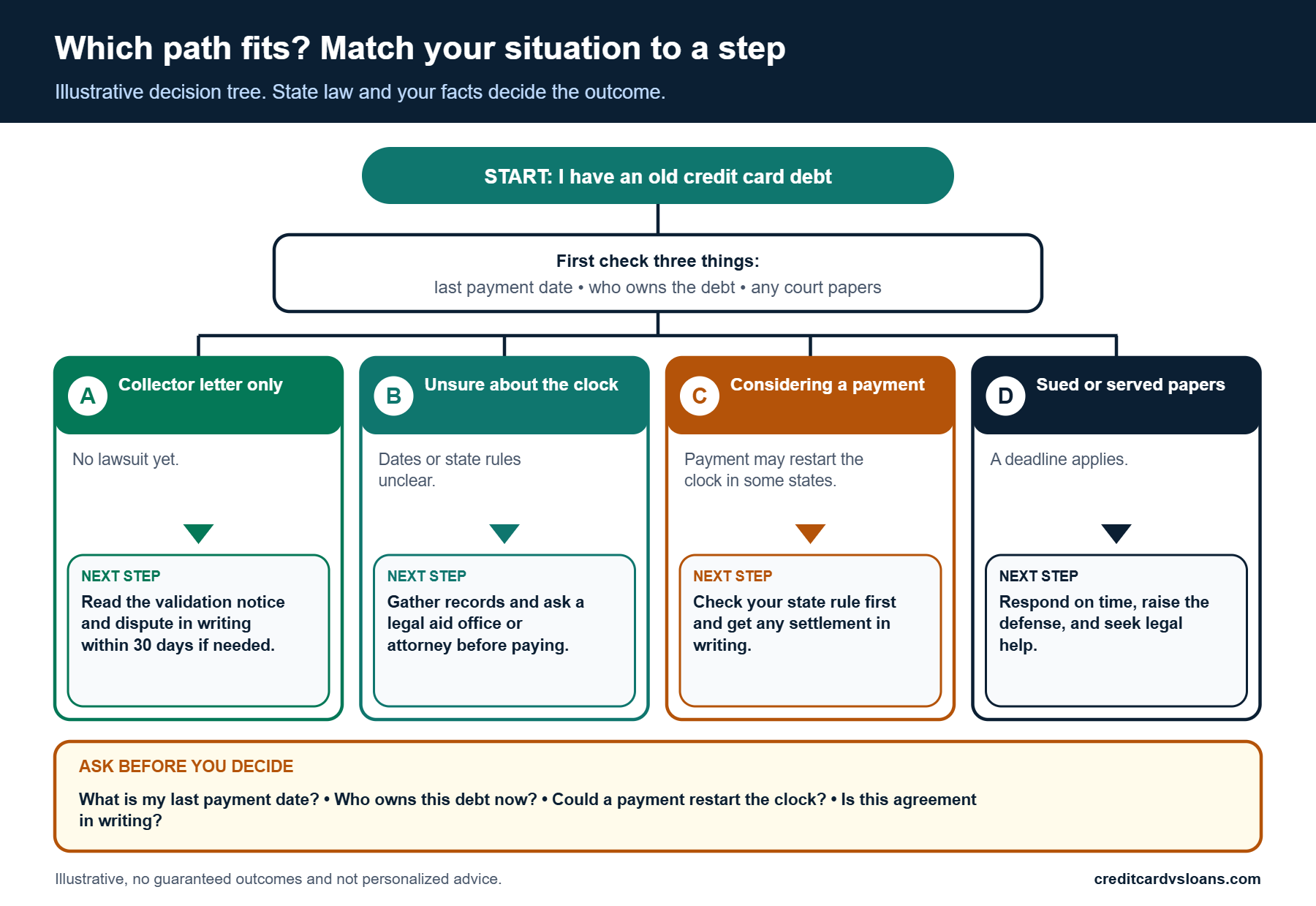
If you have only heard from a collector
Start with information, not payment. Read the validation notice, compare it to your records, and decide within the 30-day window whether to dispute in writing. Establish your last payment date and the date you first fell behind. Then find out how your state handles the limitation period, whether it is counted from the missed payment or the last payment, and whether a payment or written acknowledgment can restart it.
If you can’t get clear answers, a nonprofit credit counselor, a legal aid office, or your state attorney general’s consumer office is a reasonable next call. Their job is to answer exactly this kind of question, and many do it at no or low cost. Ask about fees before you start.
If you have been sued
Treat the court date as the most important date in the file. Respond by the deadline on the papers, bring evidence of your last payment and account history, and tell the court if you believe the debt is time-barred. Do not assume the court will notice on its own. If you can reach a legal aid office or consumer attorney before the deadline, do so.
If a judgment has already been entered, ask what options exist to challenge it in your state. Garnishment generally needs a court order, which means there is a stage at which you can contest. Time matters, so don’t wait.
Whatever path you choose, keep the goal in view. For most people the goal is not to win an argument with a collector but to end up with a debt that is resolved on paper, a credit file that reflects reality, and no surprises in the mailbox. That usually takes a mix of patience and paperwork rather than speed. Write down the next three actions, the dates they are due, and who you will call if you hit a snag. Small, documented steps tend to hold up better than a single dramatic move, and they leave you in a stronger position if you do end up talking to an attorney.
Your checklist
Before you pay or promise anything
- Write down your last payment date and the date of your first missed payment.
- Pull your credit reports and note how the account is listed and what dates appear.
- Ask the collector for written validation, and dispute in writing within 30 days if anything looks wrong.
- Confirm who owns the debt today.
- Check your state’s rule on partial payments and acknowledgments before you pay or promise.
- If you settle, get a signed letter stating the payment settles the entire debt.
Hold off on any payment that you do not understand the consequences of. Waiting a week to get advice rarely hurts, and a hasty payment can.
If a collector or company crosses a line
- Keep the letters, envelopes, call logs, and any court papers.
- Submit a complaint to the CFPB if you believe the collector broke the rules.
- Report suspected debt relief scams at ReportFraud.ftc.gov.
- Talk to a consumer attorney or legal aid office about a possible FDCPA claim.
- Consider a nonprofit credit counselor for the wider budget and any other debts.
A final reminder: this article cannot say how long the limit is in your state, when your clock started, or whether a particular payment would restart it. Those answers depend on your facts, and getting them right is worth a short consultation. If you are building your credit back up in the meantime, our guide on debt consolidation loan credit score requirements is a sensible next read, and the one on debt management plans and credit explains an option that can bring several accounts into one structured plan.
- CFPB: What is a statute of limitations on a debt? (Time limits, start dates, revival, and the need to raise the defense)
- CFPB: What is time-barred debt? (State variation, collector limits, and partial payments)
- CFPB: 12 CFR 1006.26 (Regulation F), collection of time-barred debts (Definition of time-barred debt and the ban on suing or threatening to sue)
- FTC: Debt Collection FAQs (Validation notices, disputes, revival risk, being sued, garnishment)
- FTC: Coping with Debt (Credit counseling, debt management plans, settlement, bankruptcy, scam warning signs)
- CFPB: CFPB takes action against debt relief business taking illegal advance fees (Telemarketing Sales Rule advance-fee ban; allegations only)
Last updated: October 22, 2026. Rates, fees and lender rules change; verify current terms before acting.
The information on creditcardvsloans.com is provided for general educational and informational purposes only. It is not financial, legal, tax, credit, accounting or investment advice, and reading it does not create an advisor-client, fiduciary or any other professional relationship. Nothing here is an offer, solicitation or recommendation to borrow, lend or apply for any product.
Credit scores, interest rates, fees, eligibility rules, lender policies and laws change frequently and vary by lender, location and individual circumstances. Examples, figures and scenarios are illustrative only, do not predict your results and do not guarantee approval, savings, a particular rate or a credit-score outcome. Always confirm current terms directly with the lender or issuer and read the full agreement before you apply or sign.
Although we aim for accuracy and use reputable sources, we make no representations or warranties, express or implied, about the completeness, accuracy, reliability or timeliness of the content. Content may be drafted with the assistance of automated tools, so errors or omissions may still occur. Links to third-party sites are provided for convenience; we don’t control and aren’t responsible for their content.
To the fullest extent permitted by law, creditcardvsloans.com and its owners, editors, authors, contributors and affiliates disclaim all liability for any loss, damage or expense arising directly or indirectly from your use of, or reliance on, this content. Before making financial decisions, consult a licensed professional, such as a qualified financial advisor, attorney, tax professional or nonprofit credit counselor, who can consider your complete situation.

