The trouble with debt settlement vs balance transfer is that the two are answers to different questions. A balance transfer asks a card issuer to lend you money at a lower promotional rate so you can repay what you owe in full, and it generally requires good credit. Debt settlement asks creditors to accept less than what you owe, and it is usually considered when you cannot pay in full.
Because both show up in search results for “get out of credit card debt,” they get treated like rival products on a shelf. They are not. One is a borrowing tool that rewards people who are current and creditworthy; the other is a negotiation tool that people reach for after a hardship has already damaged their finances, and it carries penalties, fees and tax consequences that a transfer does not.
This guide explains why the comparison breaks down, how to tell which problem you actually have, and what to do instead of forcing a choice between two tools built for different situations. It is general education and not personal advice, and the right answer depends on your numbers.
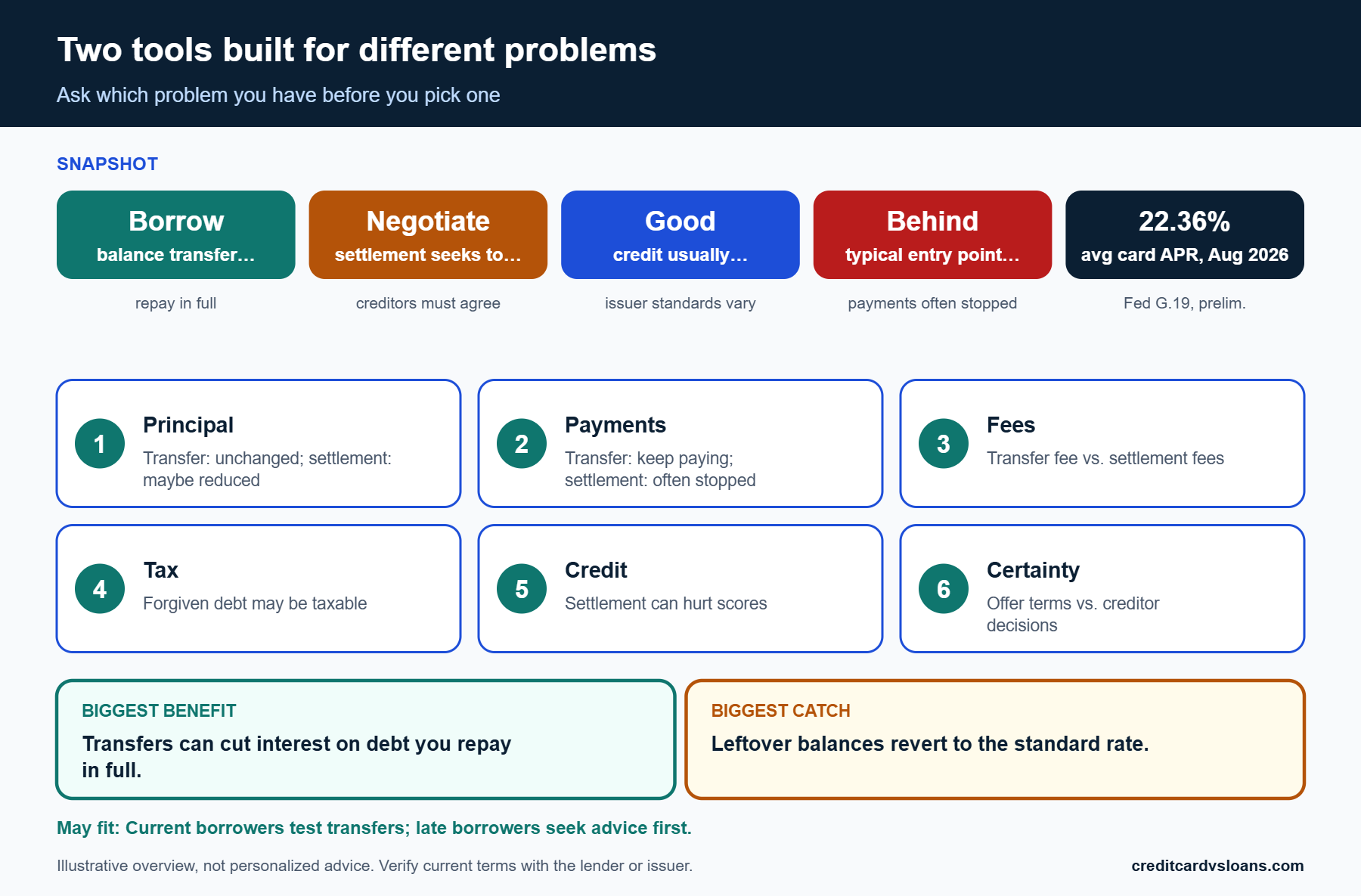
- A balance transfer is a loan you repay in full. The CFPB notes that a transfer can carry a fee even when the promotional rate is 0 percent.
- Settlement tries to reduce the amount owed. It typically means stopping payments, which the CFPB says can bring late fees, penalty interest, collection activity and lawsuits.
- The gatekeepers are opposite. Transfers reward strong credit and on-time payments; settlement is usually discussed when accounts are already in trouble.
- The real question is which problem you have. Interest cost points toward lower-rate tools; inability to repay points toward counseling, negotiation or legal advice.
- Neither is risk-free. A missed payment can end a promotional rate, and forgiven debt may be taxable.
Rate context comes from the Federal Reserve’s G.19 release of October 7, 2026, which reports an August 2026 preliminary average of 22.36 percent on credit card accounts assessed interest. Promotional terms, fees and approval standards vary by issuer, so the numbers in the examples are hypothetical.
Table of contents
Debt Settlement vs Balance Transfer: A Category Mismatch
Two tools for two different problems
What a balance transfer does
A balance transfer moves debt from one card to another, usually to take advantage of a promotional interest rate for a set period. You still owe the entire balance, plus any transfer fee. The CFPB says a balance transfer fee can apply even when a transfer comes with a 0 percent promotional rate, so the headline rate is not the whole cost.
The card works best for someone who can make steady payments and wants more of each payment to go toward principal. For a full walkthrough, see how 0% balance transfer cards work without becoming a debt trap.
What settlement does
Debt settlement seeks to resolve a debt for less than the full balance. The CFPB describes debt relief companies as businesses that claim they can renegotiate, settle or change the terms of your debts, and warns that using one can hurt your credit and may leave you deeper in debt. The FTC says creditors are not required to settle.
That makes it a negotiation with uncertain results, not a product you apply for. The risks are laid out in credit card debt settlement risks, taxes and credit damage.
Why a head-to-head ranking misleads
Different entry requirements
To get a balance transfer, you generally need to be approved for a new card or have room on an existing one, and issuers set their own standards. If recent missed payments or high utilization limit your approval, the offer may not be available at all. Prequalification, where offered, can show likely eligibility with a soft pull, though final terms depend on the application.
Settlement has no application in that sense, but it usually becomes relevant when a borrower is already behind. The two options therefore tend to apply to different people, which is why comparing their “best case” outcomes tells you little about your own.
Different definitions of success
For a transfer, success means paying the balance off within or near the promotional window and paying less interest than you would have otherwise. For settlement, success means a creditor agrees to accept less, you complete the payments, and the costs of fees, taxes and credit damage do not outweigh the savings.
One tool succeeds by preserving good standing; the other accepts damage to good standing in exchange for a smaller balance. Debt consolidation versus debt settlement explores that distinction from the risk angle.
How to Tell Which Problem You Actually Have
An interest problem or a repayment problem?
Signs you have an interest-cost problem
You are paying on time, your income covers more than the minimums, and the balance barely moves because most of each payment goes to interest. With the Federal Reserve reporting an average of 22.36 percent on accounts assessed interest in August 2026 (preliminary), a lower rate could change the arithmetic substantially. This is the profile where transfers and consolidation loans are worth testing.
The question is whether you can qualify and whether the fee and the timeline fit your budget. Run the total cost, not just the monthly payment.
Signs you have a repayment problem
Your income no longer covers the minimums, accounts are 60 or 90 days late, or you are borrowing on one card to pay another. A transfer card is unlikely to fix that, and may not be available. The options to examine instead are an issuer hardship plan, a nonprofit credit counselor, a negotiated settlement and, with an attorney, bankruptcy.
The CFPB lists nonprofit credit counseling, direct negotiation with creditors and a bankruptcy attorney consultation as alternatives to debt settlement companies. A counseling session can sort which problem you have before you commit to a tool.
Using a counseling session to sort it out
What a counselor looks at
A nonprofit credit counselor reviews income, expenses, balances, rates and payment history, then lays out the realistic routes. The CFPB says credit counselors give guidance on managing money and debt, help build budgets and set up debt management plans, and that most are nonprofits. A reputable provider sends free information without demanding personal details first.
The session does not commit you to a plan. It is a way to find out whether a transfer is realistic, whether a debt management plan fits, or whether you should speak with a bankruptcy attorney, before you choose a tool.
Checking the counselor before you share details
The CFPB suggests starting with the National Foundation for Credit Counseling, the Financial Counseling Association of America or the Justice Department’s list of approved agencies, then checking with your state attorney general. Warning signs include pushing a debt management plan as your only option and charging for basic information.
The FTC cautions that nonprofit status does not guarantee low fees, so ask for the fee schedule in writing and compare at least two agencies. The comparison between settlement and a transfer is much easier once you know your real options.
| Dimension | Balance transfer | Debt settlement |
|---|---|---|
| What it is | A new or existing credit line used to move debt | A negotiation to resolve debt for less than owed |
| Typical borrower | Current on payments, credit good enough to qualify | Often already behind or unable to repay in full |
| Principal owed | Unchanged, plus any transfer fee | May be reduced if creditors agree |
| Your payments meanwhile | Continue on schedule | Often stopped, per CFPB description |
| Main cost | Transfer fee; post-promo interest on what remains | Fees, penalties, interest, possible tax on forgiven amount |
| Outcome certainty | Terms stated in the offer | Creditors decide; results vary |
How a Balance Transfer Can Go Wrong
The risks inside a promotional rate
Fees and the post-promotion rate
A promotional rate is a clock. The CFPB’s 2014 warning to card issuers about marketing promotional offers says consumers often pay a fee up front to move a balance and then get a reduced or zero rate for a set period. It adds that surprise interest can make a transfer cost more than keeping the balance on the original card. When the promotion ends, whatever remains typically moves to the card’s standard rate, which varies by issuer and applicant.
Put the standard rate in context: the Federal Reserve’s G.19 shows 22.36 percent as the August 2026 preliminary average on accounts assessed interest. A leftover balance at a rate near that level can restart the very cost you were trying to escape.
Losing the grace period and mixing in new purchases
The CFPB also warns that if a promotional balance is not paid by the due date, the interest-free grace period on new purchases can be lost, so new purchases may accrue interest immediately. To avoid that, it says to pay the whole statement balance, including the promotional balance and new purchases, by the due date. Its tips include avoiding new purchases on the promotional card until the transferred balance is fully paid.
These rules are not obscure fine print so much as the central mechanics. Read the card’s terms before moving anything, and set automatic payments so you do not miss one.
Making the transfer work for you
Paying it off inside the window
The simple test is whether the monthly payment that clears the balance (plus the fee) before the promotion ends fits your budget. If it does not, a transfer may still reduce interest, but it will not eliminate the balance in time, and you should plan for the standard rate on whatever remains.
The detailed playbook is in 0% balance transfer cards: how to use them without a debt trap. For comparing a transfer with a loan, see how debt consolidation works.
When a transfer is the wrong tool
A transfer is the wrong tool if you are unlikely to qualify, if the fee would absorb most of the savings, or if the balance is so large relative to income that payoff within the window is unrealistic. It is also a poor fit when the underlying problem is spending that outpaces income, since a lower rate does not fix a deficit.
In those cases, a counseling session or a hardship conversation with your issuer is often a better first step than another credit application.
How Debt Settlement Can Go Wrong
Where settlement programs run into trouble
Stopped payments and rising balances
The CFPB says settlement companies typically tell you to stop paying your credit card bills, which can mean late fees, penalty interest and more collection activity. It also says they often cannot settle all of your debts, and penalties on unsettled debts can cancel out the savings on the debts that were settled. The FTC adds that firms often settle smaller debts first while interest grows on larger ones.
A balance transfer never asks you to stop paying anyone. That one difference is why a comparison that focuses only on the headline savings is misleading.
Fees and the advance-fee rule
For telemarketed debt relief, the FTC’s Telemarketing Sales Rule bars fees until a debt has been settled and you have made a payment under the agreement. The details are in 16 CFR 310.4(a)(5), and the FTC says it is illegal for a debt relief company to charge you a fee before it does anything to relieve your debt. If a company asks for money first, treat that as a warning sign.
Fees after a result can still be significant, as the CFPB notes, so compare the net outcome after fees, taxes and credit effects, not the gross reduction.
Tax and credit aftershocks
Forgiven debt can be taxable
The IRS says debt forgiven or discharged for less than the full amount is generally taxable income, and a creditor may send a Form 1099-C. Exclusions exist for insolvency and bankruptcy, claimed on Form 982, but whether they apply depends on your balance sheet.
A balance transfer creates no canceled debt, so this issue does not arise. That makes the tax line one more reason the two strategies cannot be compared on savings alone.
Credit and future borrowing
The CFPB says settlement can hurt your credit scores and your ability to get credit later. A balance transfer involves a hard pull and a new account, and utilization changes can move your scores either way depending on your situation. Neither effect can be predicted for you, and no source can promise a score change.
The difference is direction of risk: a transfer’s credit effect is mostly a modest, usually temporary shift from applying and opening an account, while settlement risks come from missed payments and the settlement itself being reported. See the consolidation versus settlement comparison for more.
What Each Strategy Costs: A Hypothetical Walk-Through
One $9,000 balance, three paths
The assumptions
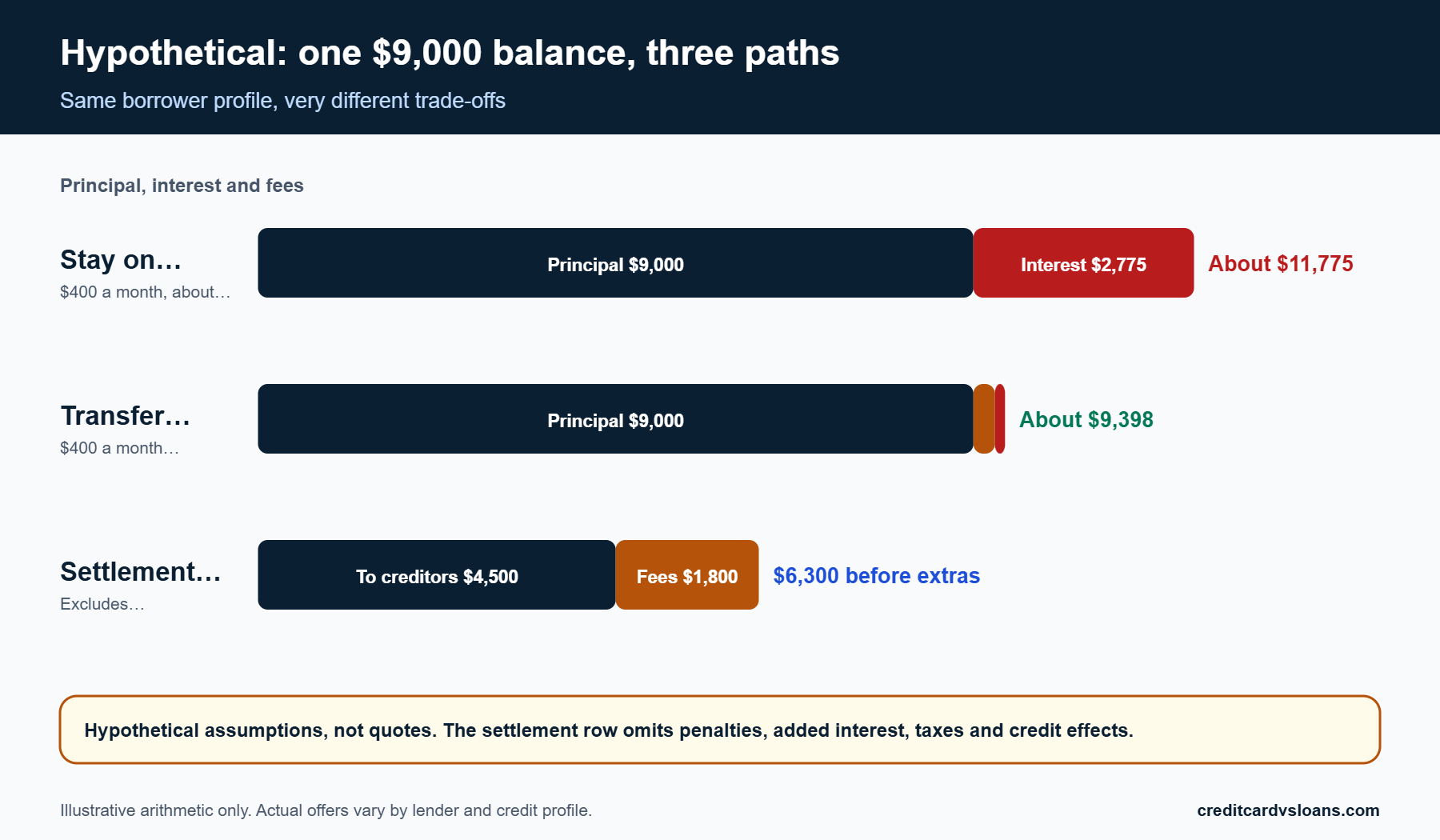
To show why the strategies resist comparison, consider a purely hypothetical $9,000 balance. Assume the card’s rate is 22.36 percent (the Federal Reserve’s August 2026 preliminary average for accounts assessed interest) and the borrower pays $400 a month. Assume the transfer carries a 3 percent fee and a 0 percent promotional rate for 18 months, with the leftover balance moving to 22.36 percent. Assume settlement at 50 percent of the balance with a 20 percent fee on enrolled debt.
These are assumptions, not offers. Your fee, promotional length, post-promotion rate and any settlement percentage will differ, and every row ignores new purchases.
What the numbers show
Staying on the card at $400 a month clears the balance in about 30 months and costs about $2,775 in interest, for roughly $11,775 in total. The transfer adds a $270 fee, so the balance becomes $9,270. After 18 payments of $400, about $2,070 remains, and clearing it at 22.36 percent takes six more months and about $128 of interest, for roughly $9,398 in total over 24 months. A payment of about $515 a month would clear the transferred balance within the 18-month window.
Settlement at 50 percent would involve $4,500 to creditors and a $1,800 fee, or $6,300, before tax on the forgiven amount, penalties and interest that built while payments stopped, and credit effects. The numbers look smaller, but they describe a different outcome for a different borrower.
| Path (assumptions) | Total paid | Time | Costs the total leaves out |
|---|---|---|---|
| Stay on card at 22.36%, $400 a month | About $11,775 | About 30 months | New purchases, rate changes |
| Balance transfer, 3% fee, 0% for 18 months, then 22.36%, $400 a month | About $9,398 | About 24 months | Hard pull; lost grace period if a payment is missed |
| Settlement at 50% with a 20% fee on enrolled debt | $6,300 | Often 3 years or more (FTC) | Penalties, extra interest, tax on forgiven amount, credit harm, creditor refusals |
What the totals do not capture
Eligibility, risk and behavior
The transfer row assumes you were approved, kept paying, and added no purchases. The settlement row assumes creditors accepted and you completed the payments. Each assumption hides the real risk: a missed payment can forfeit a promotional rate, and a refusal can leave a balance growing.
Ask which assumption is least certain for you. That uncertainty, not the lower total, should guide the choice.
Income and timing
Total paid is not the only constraint; monthly cash flow matters. The transfer example needs about $515 a month to clear within the window, while the settlement example requires saving money for months while accounts age. Timing also affects interest, fees and credit reporting.
If the monthly figure in the transfer row exceeds what you can reliably pay, a longer plan at a fixed rate or a nonprofit plan may fit better. See debt consolidation options explained.
Who Each Strategy Realistically Fits
Profiles that point toward a balance transfer
On-time payer with a high-rate balance
Picture a borrower who has never missed a payment, whose balance sits on one or two high-rate cards, and who can commit a fixed amount each month. This is a hypothetical profile, but it is the situation a promotional offer is designed for. The main tasks are checking approval odds with a soft-pull prequalification where available, calculating the payment that clears the balance plus fee before the promotion ends, and not adding new charges.
If an offer’s fee and timeline fit, the transfer can reduce interest without touching credit standing the way delinquency does. Nothing is guaranteed, and terms vary by issuer.
Someone with a plan and a buffer
A transfer is more resilient when the borrower has a small cash cushion, a stable paycheck and no pending large expenses. A missed payment can turn a promotional offer into a standard-rate balance, so the less likely a disruption, the better the fit. Setting automatic payments and calendar alerts reduces the risk.
If your income is irregular, build the plan around the lowest month, not the average one, and consider a fixed-payment product instead. See how debt consolidation works for the alternatives.
Profiles that point away from a transfer
Behind on several accounts
If accounts are already 60 or 90 days late, a new credit line is likely to be harder to obtain, and the balance may already be accumulating penalties. At that point the question shifts from “how do I lower my rate?” to “how do I stop the damage?” The CFPB and FTC both point to counseling, direct negotiation and legal advice before sales pitches.
A counselor can review your whole picture and tell you whether a plan, a negotiation, or a bankruptcy consultation is the next step. The first session is typically about an hour, according to the FTC.
When settlement enters the picture
Settlement enters when the balance is beyond reach and a creditor may accept less than the full amount. It is a high-risk path, and the CFPB’s list of risks applies: fees, refusals, penalties, lawsuits, credit damage and possible tax. If you consider it, ask whether you can negotiate yourself first; our guide to settlement risks explains what to expect.
It also helps to know there are red flags in the sales process. A company that guarantees results, asks for fees before settling any debt or tells you to stop talking to creditors is giving you reasons to leave.
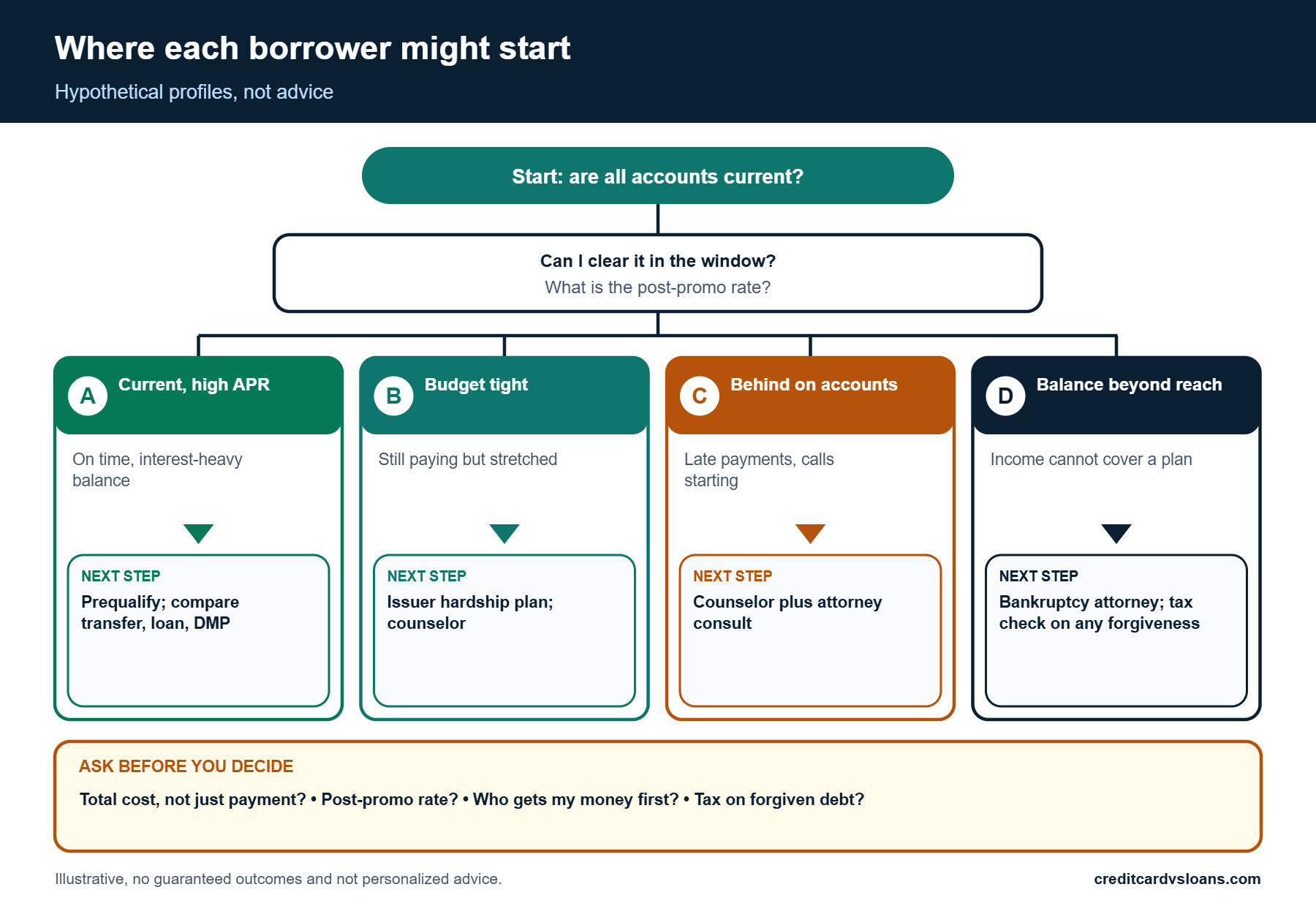
| Your situation | Often worth exploring first | What to avoid |
|---|---|---|
| Current, good credit, high APR | Balance transfer or fixed-rate loan, with total-cost math | Adding new purchases to the promotional card |
| Current but budget tight | Issuer hardship plan or nonprofit debt management plan | Fees you cannot compare in writing |
| Behind on some accounts | Counselor consult; creditor conversation | Stopping payments on a salesperson’s advice |
| Balance beyond repayment | Bankruptcy attorney consult alongside counseling | Paying fees before any settlement |
| Old account with a collector | Written negotiation; check time limits and tax | Assuming forgiven debt is tax-free |
Options That Sit Between the Two
Plans that keep you in good standing
Issuer hardship and payment plans
The FTC suggests contacting your credit card company using the customer service number on the back of your card and asking for a payment plan you can afford. Many issuers will discuss modified terms for customers who explain a hardship, though availability and terms vary and nothing is guaranteed. Get any agreement in writing and ask how it will be reported to the credit bureaus.
This path costs nothing to try and sits between the two strategies: it does not require approval for a new account, and it does not require you to stop paying.
Nonprofit debt management plans
A debt management plan combines unsecured payments into one monthly deposit with a credit counseling organization. The CFPB says it can lower monthly payments and reduce interest and fees. The FTC notes that plans often take 48 months or more and may require avoiding new credit.
You still repay the principal, so a DMP is closer to consolidation than to settlement. Confirm with creditors that they accept the plan before you pay, and ask for fee details in writing. The consolidation-versus-settlement guide covers how the risk differs.
Court-supervised and professional help
When a bankruptcy consultation makes sense
If your balances exceed what you could realistically repay, a bankruptcy attorney can explain the court route. According to the U.S. Courts, individual Chapter 7 debtors are released from personal liability for most debts, with means testing, exemptions and non-dischargeable categories. Chapter 13 involves a court-approved repayment plan, which the FTC says runs three to five years.
Both carry credit consequences, which the FTC says can last for years. The CFPB notes that some bankruptcy attorneys offer a free first consultation, a low-cost way to compare it with settlement.
Tax professionals for forgiven balances
If any plan involves a forgiven balance, a tax professional can tell you whether Form 1099-C will arrive and whether an insolvency or bankruptcy exclusion applies. The IRS says you must report the correct taxable amount even if the form is inaccurate. Asking before you settle is far cheaper than asking after you receive a bill.
This step has no counterpart in a balance transfer, which again shows how different the outcomes are.
Marketing Traps That Blur the Line
Language to treat with caution
“Forgiveness” and “relief” labels
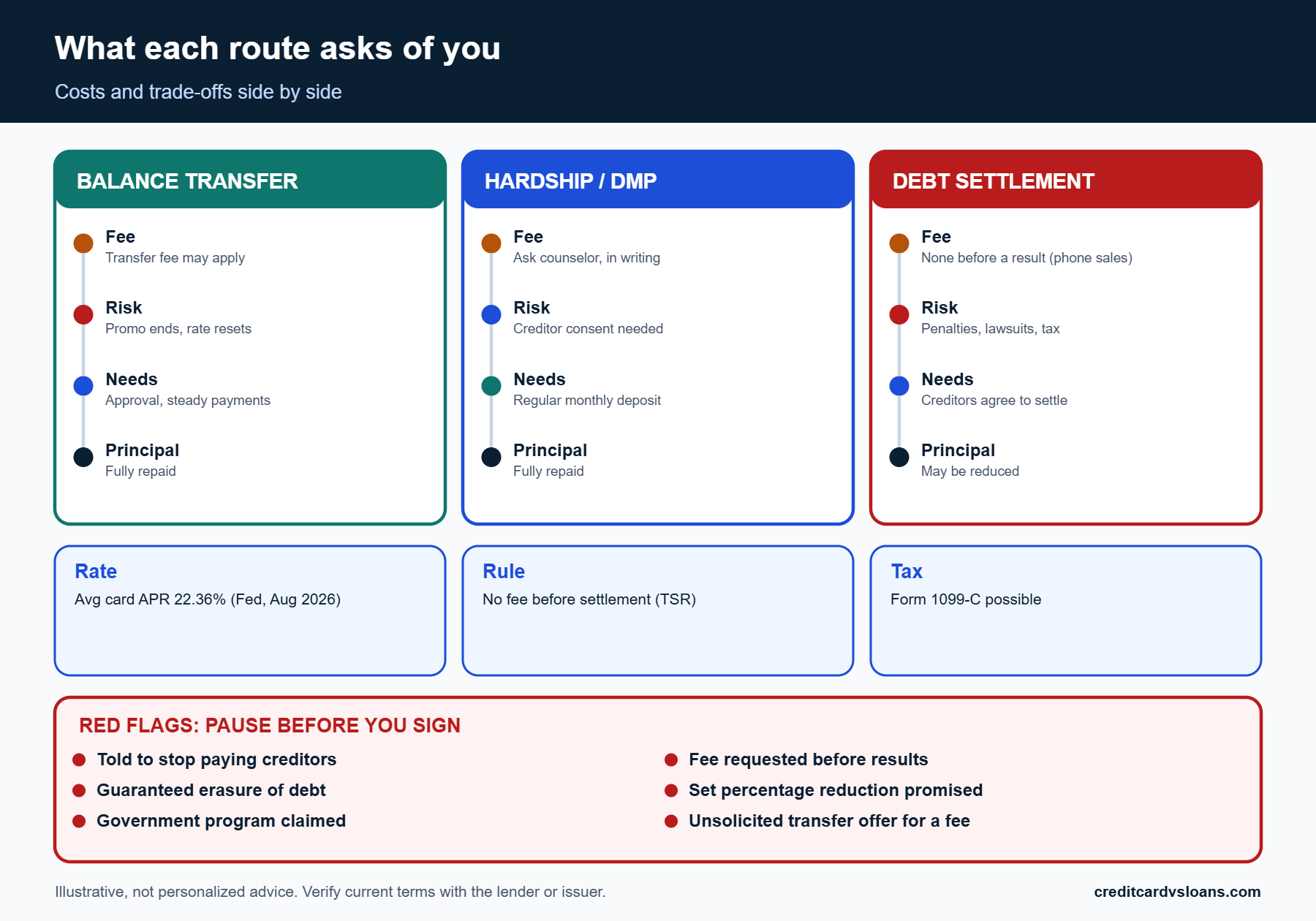
Ads often use “forgiveness,” “relief,” “one low payment” and “stop the calls” for programs that are in fact settlement. The CFPB’s red flags include a promised percentage reduction, a guarantee to erase debt, a new government program, advice to stop communicating with creditors and fees charged before debts are settled. For a closer read of the language, see credit card debt forgiveness: what is real and what is a scam.
When you read an offer, translate the label into mechanics: does it lend money, change terms with creditors, or ask you to stop paying?
“Transfer” offers that are not what they seem
Promotional balance transfer offers from issuers are disclosed credit products with terms in writing. Be cautious about unsolicited calls or messages that offer to “transfer” or “move” your debt for a fee, since a company that arranges something for you before anything has changed raises the same advance-fee question described in the FTC’s rule on telemarketed debt relief.
Check with the card issuer directly using a number you looked up, and never give card numbers to an unsolicited caller.
Combining tools without compounding risk
Sequencing matters
Some borrowers use more than one tool, such as moving part of a balance to a promotional card while negotiating a payment plan on another account. That can make sense, but sequencing matters because each step affects the next. A new account and hard pull can affect approval for later offers, and missed payments on one account can affect all of them.
Write out the order, the dates and the payment amounts, then ask a counselor to review it. A plan on paper reveals gaps that are easy to miss in your head.
Guardrails
Set automatic payments, avoid new purchases on promotional cards, keep a small emergency fund, and track every promotional end date. These simple habits protect a transfer from the most common failure modes.
If you are using a negotiated plan, keep copies of every agreement and confirmation. Documentation is your protection if balances or reporting look wrong later.
Questions for an issuer before you move a balance
Terms to confirm in writing
Ask for the transfer fee, the length of the promotional period, the rate that applies after it ends, whether the promotion applies to purchases, and how payments are allocated across balances with different rates. The CFPB’s guidance emphasizes that surprise interest can make a transfer cost more than leaving the balance where it is, so every term matters.
Also ask whether the promotional rate can be lost if you pay late, and what the penalty rate would be. Card agreements describe these terms, and reading them before you apply costs only time.
A pre-transfer test
Write down the transfer amount plus fee, divide by the number of promotional months, and compare the result with a payment you could make even in a tight month. If the figure is out of reach, plan for the leftover balance at the standard rate, or consider a lower fixed-rate alternative.
This ten-minute test prevents the most common surprise: assuming the promotion will end with a zero balance when the math says otherwise.
Hard pulls and prequalification
Many issuers offer prequalification that uses a soft pull, which lets you see whether you are likely to be approved without a hard inquiry. A full application usually involves a hard pull, and the final terms depend on the application. Treat prequalified terms as indications, not guarantees.
Apply only when the math works, since each application is a step you cannot undo. If you plan to compare several products, see how debt consolidation works for how the alternatives line up.
Checklist: Choosing the Right Tool for Your Problem
Decision checklist
Six questions that sort the options
- Am I current on every account? If yes, test a transfer, loan or plan. If not, get counseling first.
- Can I clear the balance plus fee in the window? Compute the monthly payment before applying.
- What happens at the standard rate? Know the rate on any leftover balance.
- Am I being told to stop paying? That is a settlement mechanic, with the risks the CFPB lists.
- Is a fee requested before any result? For telemarketed relief, that conflicts with the FTC rule.
- Have I priced the tax on forgiven debt? Ask a tax professional.
If you cannot answer a question, you are missing information, not out of options.
What to gather first
List each account’s balance, rate, minimum payment and whether it is current. Add your monthly income and fixed expenses. Note any collection letters. With that page in hand, a counselor or an issuer can respond to your actual situation rather than a generic one.
Keep the sheet updated as you act. It becomes your record of what you were told and when.
Questions people still ask
Can I do a balance transfer after a settlement?
Possibly, but it depends on your credit file and issuer standards. Settled or delinquent accounts can affect approvals and pricing, and the CFPB warns that settlement can hurt your ability to get credit later. Prequalification tools that use soft pulls can show whether offers are available before a hard pull.
Waiting and rebuilding payment history may improve options, though no source can promise how much or how quickly.
Is a transfer cheaper than settlement?
Not necessarily comparable. A transfer can have a smaller total cost than staying on a high-rate card, as the hypothetical showed, while settlement can show a smaller headline payment but carry penalties, tax and credit costs. Compare net cost for your own situation, and check which of the two you are even eligible for.
When in doubt, a nonprofit counselor can compare them with your real numbers at little or no cost; ask for fees in writing.
If you have already started down one path
Already in a settlement program
Request a written accounting of fees and the status of each negotiation, and compare it with your own statements. Under the FTC’s rule, a dedicated account must be held at an insured institution, owned by you and administered independently of the company, and you can leave without penalty with funds returned within seven business days other than amounts properly earned. If fees were charged before any settlement on a telemarketed program, ask for the legal basis and consider reporting it.
Before you exit, look at the state of your accounts. If several are well past due, a counselor or attorney can help weigh a plan against other options.
Already holding a promotional balance
If you have moved a balance already, the priorities are simple: pay on time every month, keep new purchases off the card, and mark the date the promotion ends. The CFPB advises paying the whole statement balance if you also use the card for purchases, so interest on new purchases does not start immediately.
If the math shows a remainder at the end, you have time to act. Look for a lower-rate option, ask your issuer about a payment plan, or speak to a counselor before the promotional period expires.
Does settlement hurt credit more than a transfer?
The CFPB says settlement can hurt your credit scores and your ability to get credit later, while a transfer involves a new account and usually a hard inquiry. The comparison is not clean because the starting points differ: people who consider settlement are often already behind. No source can tell you the exact change for your file.
The more useful question is which path gets you back to on-time payments with the lowest all-in cost. A plan that keeps accounts current generally avoids the added damage of new delinquencies.
What if I am not sure which problem I have?
Start with the cheapest information. Check your credit reports for free, list your balances and rates, and compare your monthly income with your minimums. If income covers more than the minimums, treat it as an interest problem; if it does not, treat it as a repayment problem and seek counseling.
If the answer is still unclear, a nonprofit counselor can review your numbers, usually in a session of about an hour according to the FTC, without obligating you to buy anything.
Conclusion and next steps
The bottom line
Debt settlement and balance transfers are not rival answers to the same question. A transfer lowers the cost of repaying everything and suits people who are current and can qualify; settlement tries to shrink what you owe and suits few people because of its penalties, fees, tax and credit risks.
Start by naming your problem, interest cost or inability to repay, then pick tools built for it.
Your next steps
- Sort your accounts: current or late, balance, rate, minimum payment.
- If current, compare a transfer, a fixed-rate loan and a nonprofit plan on total cost, using soft-pull prequalification where offered.
- If behind, call your issuer about a hardship plan and book a nonprofit counseling session.
- Consult a bankruptcy attorney if the balance is out of reach, and a tax professional before accepting any forgiven amount.
- Report any company that demands money before results at ReportFraud.ftc.gov.
For deeper reading, see 0% balance transfer cards without the debt trap and debt consolidation versus debt settlement.
- Debt Consolidation vs. Debt Settlement: Very Different Risks
- Credit Card Debt Settlement: Risks, Taxes and Credit Damage
- 0% Balance Transfer Credit Cards: How to Use Them Without a Debt Trap
- How Debt Consolidation Works: Loans, Balance Transfers and Other Options
- Credit Card Debt Forgiveness: What Is Real and What Is a Scam?
- CFPB: What is a debt relief program and how do I know if I should use one?
- CFPB: What is credit counseling?
- CFPB: What is a credit card interest rate? What does APR mean?
- CFPB: CFPB warns credit card companies against deceptively marketing promotional offers (Published Sept. 3, 2014)
- FTC: Debt Relief Service and Credit Repair Scams
- FTC: Credit card debt relief isn’t
- FTC: Coping with Debt
- eCFR: 16 CFR 310.4 Abusive telemarketing acts or practices
- IRS: Topic no. 431, Canceled debt: Is it taxable or not?
- U.S. Courts: Chapter 7 Bankruptcy Basics
- Federal Reserve: Consumer Credit – G.19 (Release of Oct. 7, 2026)
Last updated: October 22, 2026. Rates, fees and lender rules change; verify current terms before acting.
The information on creditcardvsloans.com is provided for general educational and informational purposes only. It is not financial, legal, tax, credit, accounting or investment advice, and reading it does not create an advisor-client, fiduciary or any other professional relationship. Nothing here is an offer, solicitation or recommendation to borrow, lend or apply for any product.
Credit scores, interest rates, fees, eligibility rules, lender policies and laws change frequently and vary by lender, location and individual circumstances. Examples, figures and scenarios are illustrative only, do not predict your results and do not guarantee approval, savings, a particular rate or a credit-score outcome. Always confirm current terms directly with the lender or issuer and read the full agreement before you apply or sign.
Although we aim for accuracy and use reputable sources, we make no representations or warranties, express or implied, about the completeness, accuracy, reliability or timeliness of the content. Content may be drafted with the assistance of automated tools, so errors or omissions may still occur. Links to third-party sites are provided for convenience; we don’t control and aren’t responsible for their content.
To the fullest extent permitted by law, creditcardvsloans.com and its owners, editors, authors, contributors and affiliates disclaim all liability for any loss, damage or expense arising directly or indirectly from your use of, or reliance on, this content. Before making financial decisions, consult a licensed professional, such as a qualified financial advisor, attorney, tax professional or nonprofit credit counselor, who can consider your complete situation.