A 0 apr balance transfer credit card can save real money on card interest, but only if you treat the promotional window as a payoff deadline instead of a pause button. The offer works when the fee is smaller than the interest you would otherwise pay and when you can retire the transferred balance before the promotional APR ends.
The debt trap usually isn’t the card itself. It’s what happens around it: a fee that gets added to the balance, new purchases that start accruing interest right away, a payment plan that quietly assumes the promotional rate will last longer than it does, and an old card that fills back up after you pay it down. Each of those problems is avoidable, but only if you spot it before you apply.
This guide is a working plan, not a sales pitch. It shows how to size a transfer, build a payoff schedule that actually ends at zero, keep purchases from undermining the deal, and decide what to do if the plan slips. For the broader pros-and-cons view, see our companion piece on when 0% APR helps and when it doesn’t. Everything here is general information, not personal advice, and offers vary by issuer and by applicant.
- A transfer only pays off when fee plus any remaining interest is lower than what you would pay by staying put. The fee is real money on day one.
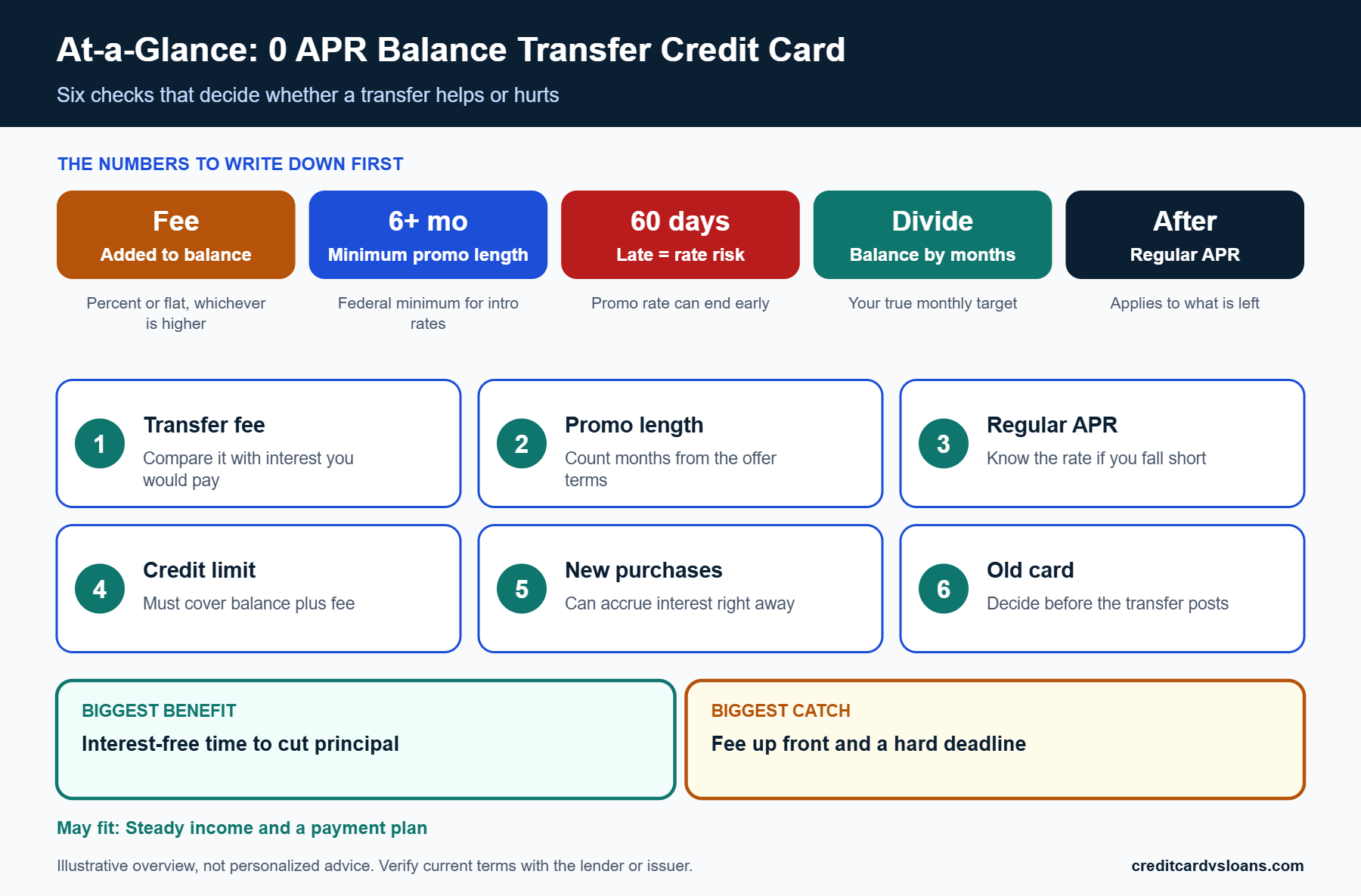
- Divide the transferred balance (fee included) by the number of promotional months. That monthly figure is your real minimum, not the issuer’s minimum payment.
- On many cards, new purchases can accrue interest from the transaction date while the transferred balance sits at 0%, so a transfer card is usually a poor everyday card.
- The promotional rate must last at least six months by federal rule, but it can end early if you pay more than 60 days late.
- If you can’t clear the balance in time, the leftover is charged at the card’s regular APR, which is often higher than the rate you started with.
Rate figures in this article come from the Federal Reserve’s G.19 consumer credit release of October 7, 2026, and the rules cited are Regulation Z provisions and CFPB consumer guidance as of October 2026. Card terms change often, so always read the offer’s own terms before applying.
Table of contents
Quick Answer: Is a 0 APR Balance Transfer Credit Card Worth It?
The short version of the decision
You are swapping interest for a fee
A 0 apr balance transfer credit card replaces your current interest charges with a one-time transfer fee and a deadline. The CFPB notes that a balance transfer fee is a charge for moving an outstanding balance to a different card, and that issuers are permitted to charge it even on a zero percent offer. So the first question is simple: is that fee smaller than the interest you would pay on the old card over the same stretch of time?
For a balance that you can pay off within the promotional window, the answer is often yes, because interest at card-level APRs adds up quickly. The Federal Reserve’s G.19 release of October 7, 2026 reported an average rate of 22.15% for credit card accounts assessed interest in the second quarter of 2026. Your own rate may be higher or lower, but at that level a few months of interest can exceed a typical percentage-based fee.
The deadline is the product
What you are really buying is time without interest. That time has value only if you use it to cut principal. A transfer that you pay down by a few dollars a month and then forget about doesn’t remove the debt, it postpones the interest and often adds a fee on top.
Think of the promotional period as a countdown with a known end date. Before you apply, write down the month the promotional rate ends, the regular APR that follows, and the monthly payment that would bring the balance to zero by then. If that payment doesn’t fit your budget, the card probably isn’t the right first move.
Who this tends to fit, and who it doesn’t
Profiles where the math often works
The offer tends to fit people who have a defined card balance, steady income, and a payment they can sustain for the full promotional period. It also helps when the current APR is high, the balance isn’t enormous relative to the new credit limit, and the person has stopped adding to the old card.
It can also work well alongside a budget reset. If a household has just trimmed spending and freed up a fixed amount each month, a transfer converts that amount from interest payments into principal payments. That’s the cleanest use case, and it’s the one the rest of this guide is built around.
Profiles where it tends to backfire
Trouble shows up when the underlying problem is cash flow, not interest. If you’re using cards to cover groceries or rent, a lower rate on the old balance won’t stop new balances from forming. Once the old card is cleared, the temptation to use it again is real, and the household ends up with both balances.
It also tends to disappoint when the credit limit on the new card is smaller than the balance, when the transfer fee is high relative to the interest saved, or when the borrower can’t realistically qualify. If your credit profile is thin or damaged, look first at what credit score a 0% APR card usually calls for and at consolidation options when credit is bad before you apply and take a hard pull for nothing.
How a 0 APR Balance Transfer Credit Card Works
The moving parts of an offer
The transfer fee
Most offers charge a fee for the transfer. According to the CFPB’s glossary, the fee is typically a percentage of the transferred amount or a fixed amount, whichever is higher. The fee is usually added to the new balance, which means you owe it immediately and, in many cases, it’s included in the amount you must repay before the promotional period ends.
Federal rules require the fee to be disclosed in the account-opening table, with the fee amount or maximum shown in bold. Use that table to see the exact formula for your offer, including whether a lower fee applies if you complete the transfer within a certain window after opening the account. Terms like that differ by issuer.
The promotional window and what follows it
The promotional rate is temporary. The CFPB explains that an introductory rate on a new card or a balance transfer must last at least six months, and the issuer has to tell you how long it lasts and what rate applies afterward. Some offers run well past the six-month minimum; the length is a feature of the specific card.
The rate after the window is the number that decides how bad a miss can get. Check whether it is fixed or variable, because a variable rate follows an index such as the prime rate. The CFPB notes that if an introductory rate is variable, it can change during the first six months as the index moves.
What federal rules say about your balance
Protections for the promotional rate
Under Regulation Z, an issuer may raise a rate when a specified period of six months or longer ends, as long as it disclosed the length of that period and the post-period rate before the period began. The same rule lets an issuer raise a rate if the required minimum payment arrives more than 60 days after the due date.
In practical terms, a payment that is a few days late is not the same as one that is 60 days late, but late payments can still bring late fees and credit report damage. The safest approach is to set up automatic payments for at least the minimum, then add your planned extra payment manually or on a schedule.
Payments, purchases and the order they are applied
If you pay more than the minimum on a card with several balances, federal rules generally require the extra amount to go first to the balance with the highest APR, then to the others in descending order. The issuer generally chooses how to apply the minimum portion. That matters when a card has a 0% transferred balance and a purchase balance at a higher rate.
The CFPB also warns that on most cards, if you carry a balance from month to month, new purchases accrue interest from the transaction date, even when another balance on the card is at 0% because of a transfer. We cover that mechanism in more depth in our guide to how balance transfer APR differs from purchase APR.
| Feature | What to expect | Why it matters |
|---|---|---|
| Key terms | Transfer fee, promotional window, post-promo APR | All three appear in the account-opening table |
| May fit | Steady earners with a defined card balance and a payoff plan | The fee is easier to recoup on larger, higher-rate balances |
| Main advantage | Interest-free time to cut principal | Every payment can go to the balance, not to interest |
| Main drawback | Upfront fee, deadline, possible new hard pull | Cost arrives before the savings do |
| Primary cost drivers | Fee percentage, balance size, how fast you pay, rate after the window | A missed deadline can erase much of the benefit |
The Real Cost of a 0 APR Balance Transfer Credit Card
A hypothetical $6,000 transfer, step by step
Fee, new balance and the payment that clears it
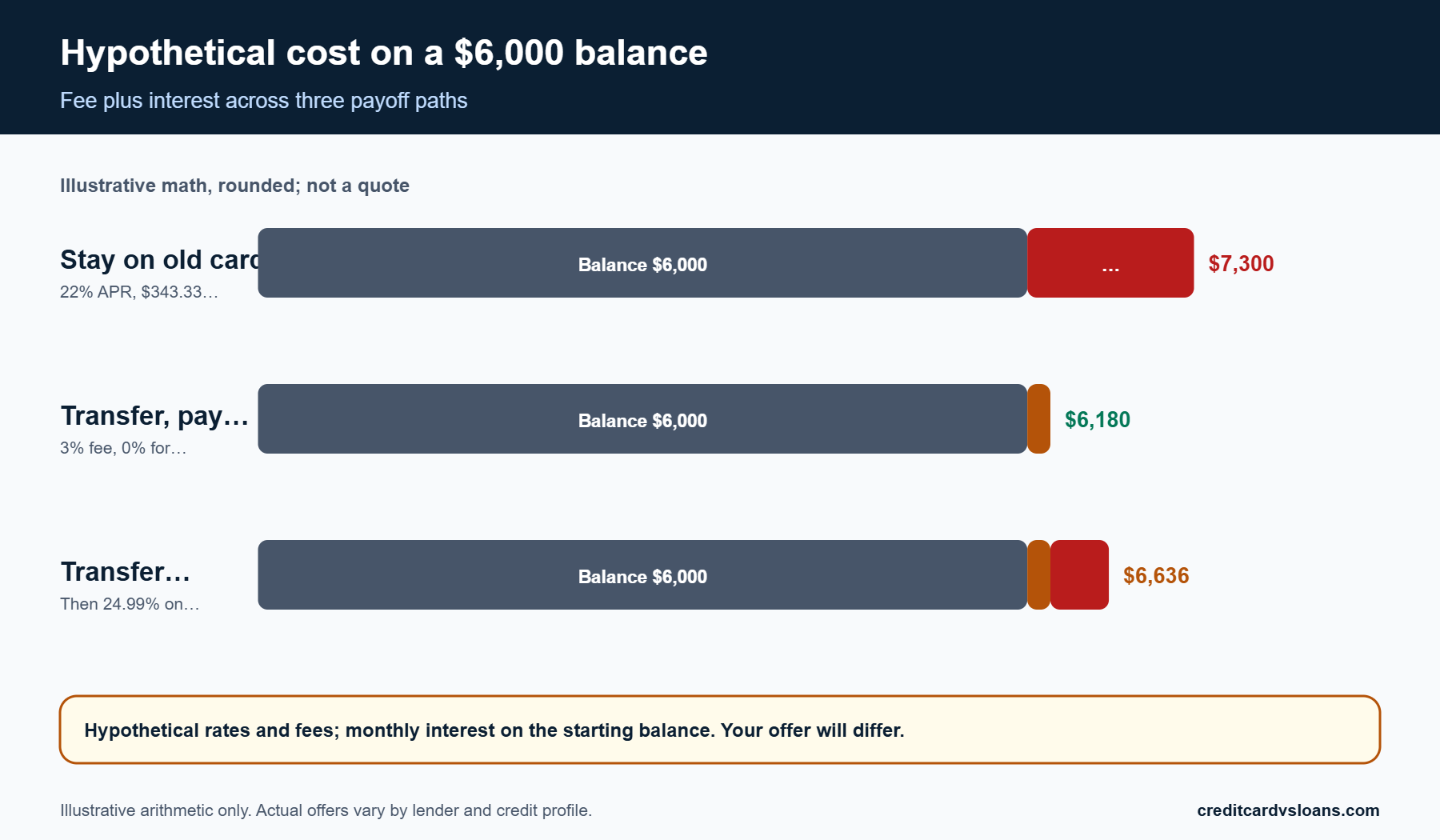
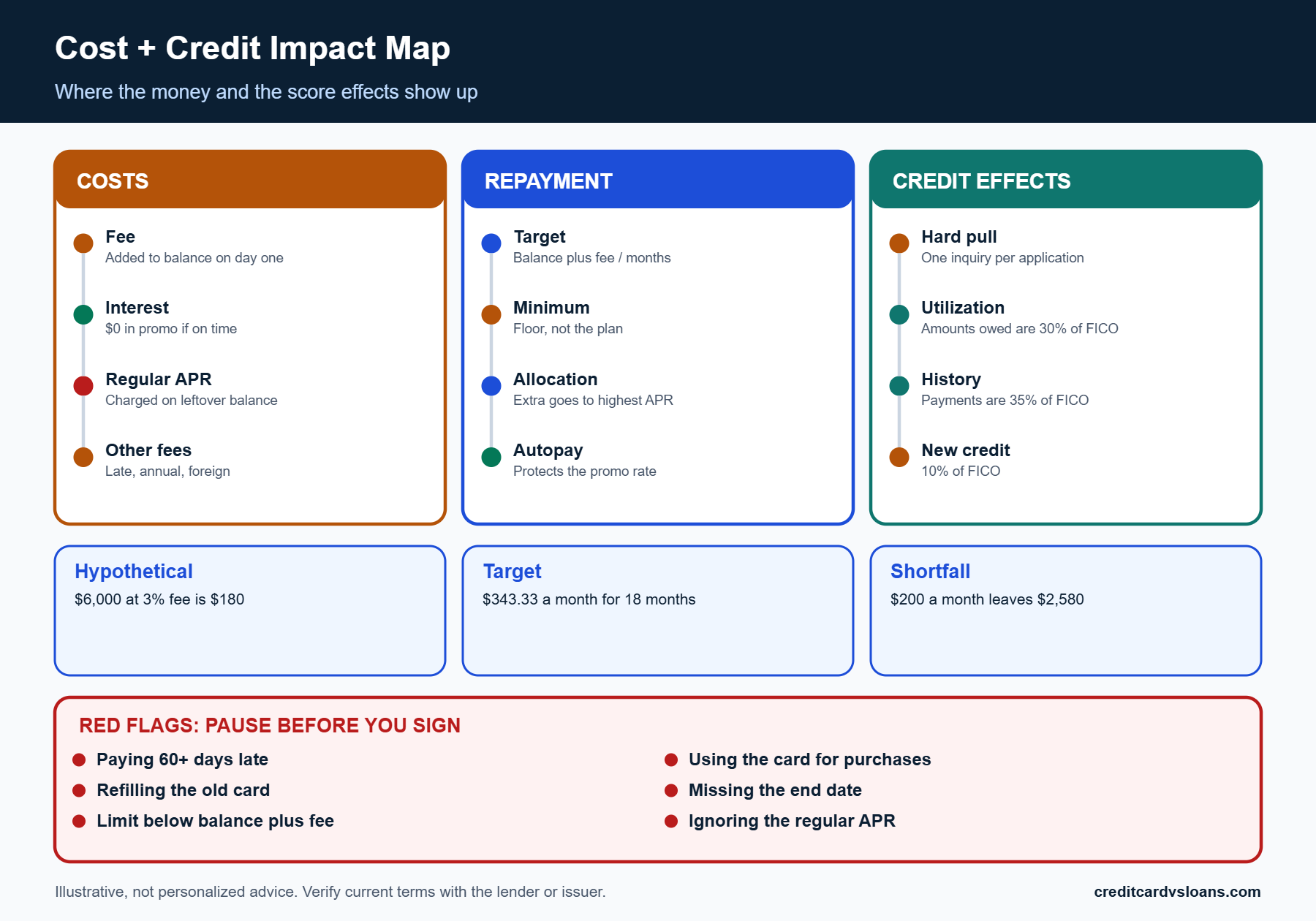
Here is an illustration, not a quote. Suppose you move $6,000 from an old card to a new one that charges a 3% fee and offers 0% for 18 months. The fee is $180, so the new balance is $6,180. Dividing $6,180 by 18 gives $343.33 a month. That payment, not the issuer’s minimum, is what ends the balance on time.
Now compare the do-nothing path. If the old card charged a hypothetical 22% APR and you paid the same $343.33 each month, it would take about 22 months to clear the debt and cost roughly $1,300 in interest. Moving the balance would cost $180 instead. The approximate difference is $1,120, and it exists only because the full payment actually gets made. All figures here are hypothetical, rounded, and use monthly interest on the starting balance.
Why the issuer’s minimum payment is the wrong target
Minimum payments on a card are typically set to keep the account current, not to retire the balance in the promotional window. Federal rules require statements to carry a minimum payment warning and to show how long minimum-only payments would take. For accounts where it applies, the statement also shows the payment that would clear the balance in 36 months.
That 36-month figure is useful, but it isn’t tailored to your promotional deadline. If your window is 12 or 18 months, your required monthly amount is higher than the 36-month number. Calculate your own target by dividing the balance by the months remaining, and treat the issuer’s minimum as a floor.
What happens when the payoff falls short
The half-payment example
Take the same hypothetical $6,180 balance and suppose you pay only $200 a month. After 18 months you would have paid $3,600 and still owe $2,580. If the card’s regular APR is a hypothetical 24.99%, continuing at $200 a month would take about 16 more months and add roughly $456 in interest, which brings the all-in cost of the strategy to about $636 in fee plus interest.
That is still lower than the $1,300 the do-nothing path would have cost in this example, so a partial payoff isn’t a disaster. But the gap between the full-payoff result ($180) and this result ($636) is the cost of drifting. The bigger the leftover balance on the day the window closes, the more of the benefit you hand back.
The rate after the promotional window
The regular APR is the number to know before you apply. The CFPB explains that once a temporary rate expires, the issuer can charge the regular rate on the remaining balance. The Federal Reserve’s G.19 release of October 7, 2026 shows average rates around 21% across all accounts and 22.15% for accounts assessed interest in the second quarter of 2026, so a post-promo rate in the 20s would not be unusual, though yours depends on the offer.
If the leftover balance is small relative to your income, a post-promo rate is a modest problem. If it’s large, consider setting a checkpoint at the halfway mark: if your remaining balance divided by remaining months is higher than what you can pay, look at a second transfer, a personal loan, or a hardship conversation with the issuer before the deadline, not after.
| Path | Rate and fee | Payment pattern | Fee plus interest | Risk flag |
|---|---|---|---|---|
| Stay on old card | 22% APR, no fee | $343.33 a month for about 22 months | About $1,300 | Interest compounds against you |
| Transfer and pay in full | 0% for 18 months, 3% fee | $343.33 a month for 18 months | $180 | Requires steady payments with no slips |
| Transfer and pay $200 | 0% for 18 months, 3% fee, then 24.99% | $200 a month for about 34 months | About $636 | $2,580 left when the window ends |
| Transfer, pay late 60+ days | Promo rate can end early | Rate may rise on all balances | Varies by terms | CFPB: more than 60 days late can end the rate |
The pattern is straightforward. The transfer is cheapest when you pay the full amount, still beats staying put when you pay part of it, and loses its edge as the leftover grows. Remember that a hard pull, fees on new purchases, or a smaller-than-needed credit limit can change the picture for your specific offer.
Credit Score Impact: What a Balance Transfer May Do
How the main score factors can respond
Credit utilization and amounts owed
According to myFICO, amounts owed make up 30% of a FICO Score, and utilization (the share of your available revolving credit that you’re using) falls inside that factor. A new card adds available credit, which can lower your overall utilization if the balance moves from one card to another without new borrowing. But if the transfer fills most of the new card’s limit, utilization on that individual card can look high.
Scoring models vary, and nobody can promise a specific change. The reasonable takeaway is that a transfer that keeps total balances flat and adds a new limit can look different on paper than one that is paid down quickly, and that paying the balance down is what changes the numbers over time.
New credit, inquiries and account age
Applying for a card usually produces a hard inquiry. FICO notes that new credit is 10% of a score, that opening several accounts in a short time can be treated as riskier, and that FICO Scores consider inquiries from the past 12 months even though inquiries remain on the report for two years. One application is typically a small factor; a cluster of applications is not.
A new card also lowers the average age of your accounts at first. Leaving the old card open after you pay it off can help keep your overall available credit up, but that only makes sense if you can leave it unused. For readers building or repairing a profile, our overview on credit scores and 0% APR eligibility explains how issuers tend to think about approval.
Protecting your score during the payoff
Payment history comes first
Payment history is the largest factor, at 35% of a FICO Score according to myFICO. A single missed payment on the new account can hurt more than the utilization effect helps, and a payment more than 60 days late can also end the promotional rate. For that reason, automatic payments for the minimum are close to non-negotiable.
Many issuers also let you schedule payments a few days before the due date and set alerts. Use both. Federal rules require card statements to be mailed at least 21 days before the payment due date, so you have time to review and pay, but only if you actually open the statement.
What to do with the old card
Closing the old card can reduce your total available credit and raise utilization on remaining cards. Keeping it open carries a different risk: balances can creep back. A middle path is to remove the card from your wallet and from saved payment profiles, keep one small recurring charge on autopay if the issuer requires activity, and check the account monthly.
If you know the pattern of overspending is the reason the balance grew, closing the account may be the better choice despite the utilization effect, because avoiding a second debt is worth more than a marginal score difference. That’s a personal call, and either way the plan should be written down.
Requirements: Approval, Credit Limits and Transfer Rules
What issuers look at before approving
Score, income and existing debt
Issuers decide approval using their own criteria, and offers marketed as 0% typically go to applicants with stronger credit histories. The exact cutoffs aren’t published, and no score guarantees approval. Income, existing debt, recent applications and payment history all play a role, and so does the issuer’s own relationship with you.
Federal rules also require card issuers to consider your ability to make the required payments. The CFPB explains that issuers must check your ability to pay before approving a card. If approval is uncertain, many issuers offer a prequalify tool that uses a soft pull; read what it does and doesn’t tell you before relying on it.
Why a soft pull check is worth doing first
A soft pull doesn’t affect your credit the way a hard pull can. Prequalification tools can show whether an offer is likely to be available to you without the inquiry showing up on lenders’ views of your report. A prequalified result isn’t an approval and the final terms can differ, but it narrows the field before you commit to an application.
If you apply and get declined, wait and fix the cause rather than applying to a string of other cards. Several applications in a short time can look riskier, as FICO’s description of the new credit factor makes clear. A decline letter also lists the reasons, which can be a practical to-do list.
The limit problem and other fine print
Will the new limit cover your balance?
Approval for a card doesn’t mean approval for the amount you want to move. The new limit might be well below your balance, and the fee counts against it too. If you transfer $6,000 and pay a 3% fee, you need at least $6,180 in available credit. Ask yourself what happens if the issuer lets you move only part of the balance.
A partial transfer isn’t useless. It can cover the most expensive card first, and you can chip away at the rest. But it changes your plan, because the leftover balance stays at its old APR. Prioritize the highest-APR balance for the transfer, and write a separate payment line for what remains.
Same-issuer limits, timing windows and other conditions
Many issuers don’t accept transfers from their own cards, so a balance on one bank’s card may need to move to another bank’s. Some offers also set a time window after account opening for the promotional rate to apply to transfers, and some count a lower fee only during an initial period. These conditions vary by card, so look for them in the offer terms and the cardmember agreement.
Also check how the transfer is executed. Some issuers pay the old creditor directly, which can take several days, and the old card may still show a balance and a due date in the meantime. Keep paying at least the minimum on the old card until it shows a zero balance, because a missed payment there is still a missed payment.
A Payoff Plan That Avoids the Debt Trap
Before you apply
Write down your numbers
Start with four numbers: the balance you want to move, the transfer fee, the promotional length in months, and the regular APR after it ends. Add the fee to the balance, divide by the number of months, and compare that monthly figure with what you can really spare. If you can’t afford the payment at least on paper, shorten the plan by transferring less or look at a longer promotional window.
Then add a cushion. A plan that depends on every month going perfectly will fail the first time the car needs a repair. Build your target payment at about the promotional months minus two or three, so that you finish with a buffer rather than a deadline sprint.
Decide what happens to the old card
Before the transfer completes, decide whether the old card will be closed, frozen or kept. Be honest about your habits. If the balance on it grew because of regular spending that exceeds your income, the new card only postpones that problem. In that case, pair the transfer with a spending plan that has real numbers in each category.
Also decide where the freed-up payment comes from. The strongest plans name specific cuts, side income, or a windfall like a tax refund, instead of assuming the money will appear. For readers weighing broader consolidation, see consolidation options by credit profile for how other tools compare.
After the transfer posts
Automate, then add the extra payment
Set autopay for at least the minimum, and set a calendar reminder for the extra payment that gets you to your target. Some people prefer to schedule the full target amount as a fixed payment, which is simpler and harder to forget. Check the statement monthly to confirm that the payment posted and that the balance is dropping by the amount you expect.
Federal rules require statements to list each balance category with its own APR and balance, so you can see the transferred balance and any purchase balance separately. If something looks different from what you were told, contact the issuer promptly. The statement is also where you can confirm the exact date your promotional rate ends.
Keep purchases from undercutting the deal
The CFPB states that for most cards, if you carry a balance, purchases accrue interest from the date of the transaction, even when another balance is at 0% through a transfer. To get a grace period back on purchases, you generally need to pay the whole balance, including the transferred balance, by the due date. That is usually impractical, so the sensible rule is to put everyday spending on a different card or on debit while the transfer is being paid down.
There’s also the allocation effect. Because payments above the minimum go to the highest-rate balance first, a purchase balance at a standard APR can absorb your extra payment while the 0% balance sits untouched. That sounds fine until you realize the 0% balance is the one with a deadline. Keeping purchases off the card avoids the problem entirely.
Do not assume a 0% transferred balance is protected from a higher rate forever. Regulation Z allows an issuer to raise a rate on an existing balance when a promotional period ends, when a variable index rises, or when a payment is more than 60 days late. Read the terms for your specific card.
Risks, Red Flags and Alternatives
The most common ways a transfer turns into a trap
Refilling the old card
The classic trap is paying off a card with a transfer, then using the empty card again. Within a year or two, the household has the transferred balance and a new balance, and the available credit that looked like breathing room is gone. The numbers feel different when you see them across two statements, but the debt is simply double-counted.
Guard against this with a rule you can follow: no new charges on the old card, and a deliberate decision about whether to close it. If you keep it open, set a low balance alert and look at it monthly. Treat any balance that appears as a signal to revisit the budget, not as a sign the plan worked well enough to loosen up.
Treating the promotional rate as permanent
It is easy to start thinking of the card as having a low rate. It doesn’t; it has a temporary rate and a regular one, and the regular one shows up on the date the offer ends. Put that date on your calendar with a reminder 60 days earlier, and another 30 days earlier. At the 60-day reminder, check the balance against your payoff line and decide whether you need to adjust.
Fees are another place where the temporary feeling misleads. A late fee, an annual fee or a foreign transaction fee can add cost to a card you thought of as free. Read the full fee schedule in the account-opening table, not only the transfer fee line. The CFPB also notes that the issuer must give 45 days’ notice before significant changes to account terms, so watch your mail and email.
Alternatives worth comparing
Consolidation loans and payment programs
A fixed-rate personal loan converts card balances into an installment loan with a set payoff date. That structure removes the temptation to pay minimums only, though loans come with their own APR and sometimes an origination fee. Compare the total cost and the monthly payment against a transfer, not just the headline rate. Our guide to credit card debt consolidation by credit profile lays out how those options tend to line up.
If your credit is limited, consolidation with bad credit covers the more realistic options, including nonprofit credit counseling programs. Those programs vary in cost and effect on your accounts, so ask for the fee schedule and what happens to your cards before enrolling.
Negotiating directly and avoiding scams
Some issuers will lower an APR, waive fees or set up a hardship plan if you call before you fall behind. Terms vary and approval isn’t guaranteed, but the question costs nothing. Ask about any effect on your credit and on your account’s availability, and get the agreement in writing before you rely on it.
Be careful about outfits that promise to erase balances for an upfront fee. Our explainer on what is real and what is a scam in credit card debt forgiveness describes the warning signs. If a company asks you to stop paying your lenders or charges before it has done anything, treat that as a red flag.
Which Option Fits Your Situation
Side-by-side decision matrix
Matching the tool to the problem
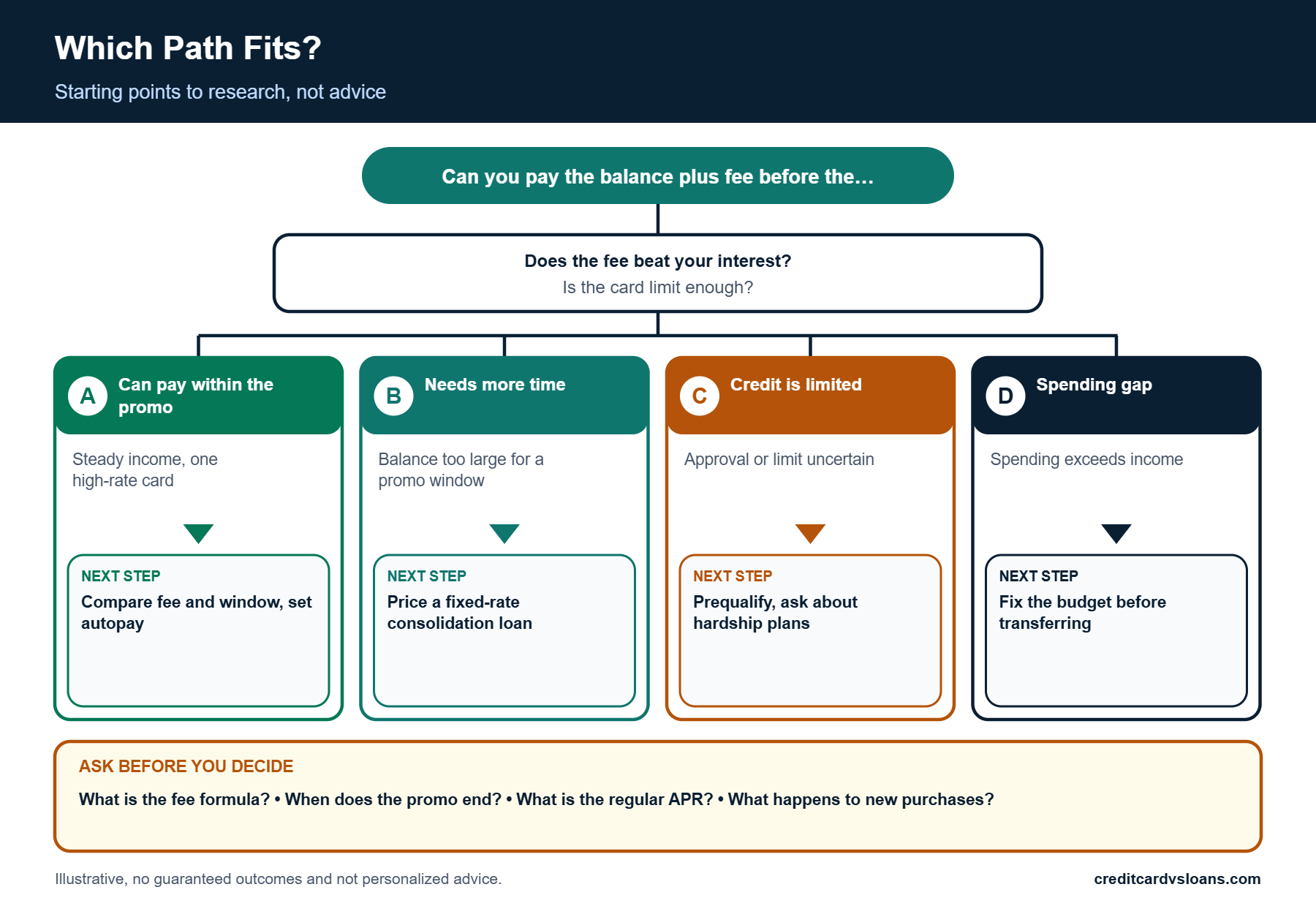
No single product fits every borrower. The table below summarizes which route to investigate for several common situations. It’s a starting point for your own research, not a recommendation, and each row has caveats worth reading in the offer terms.
| Scenario | Option to investigate | Why | What to verify | When to avoid it |
|---|---|---|---|---|
| Steady income, one high-rate card, can pay in 12-18 months | 0% balance transfer card | Interest drops to zero while you pay principal | Fee, window, post-promo APR, new limit | If you can’t cover the monthly target |
| Balance too large to clear in a promo window | Fixed-rate consolidation loan | Set payoff date and payment | APR, origination fee, term | If the loan rate isn’t below your card rates |
| Credit limited or damaged | Credit counseling or a lender hardship plan | May lower rate or fees without a new card | Fees, effect on accounts, accreditation | If a company demands large upfront fees |
| Spending exceeds income | Budget repair first, then revisit | A transfer doesn’t fix the cash flow gap | What triggered the balance | If the old card will be reused |
| Small balance you can clear in a few months | Pay it down directly | A fee may cost more than the interest saved | Fee versus months of interest | If a fee would be most of the saving |
The fee-versus-interest check
For small balances or quick payoffs, a fee can cost more than the interest you would pay anyway. Estimate your interest by multiplying the balance by the APR, dividing by 12, and multiplying by the number of months you expect to carry it. If that number is close to or below the fee, skip the transfer. Our companion article on balance transfer fees goes through that comparison in detail.
For larger balances, the same check usually points the other way, which is why transfers are popular. The point is to do the arithmetic with your own numbers, not to assume the answer. Where the answer is close, the stress of a deadline may be a tie-breaker against transferring.
Reading your own offer
Questions to ask before you click apply
Look at the offer terms for five things: the fee formula, the promotional period and when it starts, the regular APR and whether it is fixed or variable, the rules on new purchases, and any penalty that ends the promotional rate early. Copy the numbers into your own notes so that you can compare them with your statement later.
It also helps to know where the numbers live. The account-opening table summarizes rates and fees, while the cardmember agreement contains the detailed rules. If there is a conflict between marketing copy and the agreement, the agreement controls what you owe.
Comparing with a low ongoing rate
If you expect to carry a balance for longer than a promotional window, a lower permanent rate may beat a short zero. Our cornerstone comparison of 0% intro APR versus a low ongoing APR covers that trade-off. The breakeven depends on how fast you pay, so the decision is personal, not universal.
A long promotional period with a larger fee can beat a short one with a small fee if you really need the time, but costs more if you could pay faster. In the hypothetical $6,000 example above, each additional month of a payoff plan lowers the required payment, and each additional fee percentage point adds $60.
Edge Cases to Plan For Before You Transfer
When the plan hits a bump
Income drops or an emergency arrives
Life interrupts payoff plans, and the better approach is to decide ahead of time what you’d do. If income drops, the first call should be to the issuer, before a payment is missed. Some issuers have hardship programs that adjust payments or rates, though availability and terms vary and nothing is guaranteed.
It also helps to hold a small cash cushion, even a modest one, so that a car repair doesn’t land on the card. If you must choose between a minimum payment on the transfer card and an essential bill, pay the essentials and contact the issuer. The goal is to avoid sliding past 60 days late, which is the line that matters most for the promotional rate.
What a missed payment can trigger
A late payment can bring a late fee and can be reported to credit bureaus once it is far enough past due. Under Regulation Z, an issuer may raise a rate when the required minimum payment hasn’t arrived within 60 days of the due date, and the notice must explain that the higher rate can end after six consecutive on-time minimum payments. If you make those six payments, the issuer must generally reduce the rate on the balance that existed before the increase.
That rule is a safety net, but it isn’t a reason to be casual. Six clean payments is a long road, and in the meantime interest can accrue at the higher rate. Treat a missed payment as an urgent item to fix the same day.
Managing more than one transfer
Rolling the balance to a second offer
If the window is closing and a balance remains, some borrowers consider moving it to another promotional offer. Whether that is possible depends on your credit profile, the new limit, and the issuer’s rules, and you would pay another fee. The arithmetic is the same as the first time: the second fee must be lower than the interest you’d pay otherwise.
The risk is habit. Serial transfers can feel like progress while the principal barely moves, especially if each fee is added to the balance. If you consider a second transfer, require yourself to name the specific change that will let you pay the balance off this time.
Splitting a balance across cards
When your balance is larger than any single new limit, you might split it. That can work, but it means two deadlines, two fees and two sets of terms. Put both on one calendar, add the fees, and calculate the target payment for each card separately. Pay down the card with the earlier deadline or higher post-promo APR first.
Also remember that each application is another inquiry. A staggered approach, where you apply for one card, complete the transfer, and then evaluate, is usually easier to manage than two applications at once.
Checklist and Next Steps
A pre-transfer checklist
The numbers and the terms
- Write down the balance, the APR on the old card and what you pay each month now.
- Find the transfer fee formula and add the fee to the balance.
- Note the promotional months, the date they end and the regular APR that follows.
- Divide the new balance by promotional months minus two or three to set your target payment.
- Confirm the new credit limit will cover the balance plus the fee.
- Check whether the issuer allows transfers from your current card and whether a time window applies.
Those six lines take about twenty minutes and answer most of what could go wrong. If any line doesn’t work, you have learned that before paying a fee or taking a hard pull.
The habits that make it work
- Autopay at least the minimum, then schedule the full target payment.
- Keep purchases off the card and off the old card.
- Calendar reminders 60 and 30 days before the promotional rate ends.
- Check each statement for the promotional balance, its APR and the posted payment.
- Decide what happens to the old card before the transfer posts.
None of these steps is complicated, but skipping any of them is how most of the trouble starts. Together they turn the offer into a short, finite project with an end date.
Conclusion: make the call with your own numbers
When to move forward
A 0 apr balance transfer credit card is worth a closer look when your balance is meaningful, your current APR is high, you have a payment you can sustain through the promotional window, and the fee is clearly smaller than the interest you would otherwise pay. If those boxes are checked and the offer terms match your plan, the transfer can be a practical way to put payments toward principal.
If the boxes aren’t checked, you’ve lost nothing by running the numbers. Slow down, consider the alternatives above, and come back to the decision when your plan is ready. No one can promise approval, savings or a particular credit result, so treat every figure as an estimate until you see your own offer.
Your next steps
- Pull your latest statement and note the balance, APR and minimum payment.
- Run the fee-versus-interest check, using the hypothetical $6,000 example as a template.
- Prequalify where available, and compare at least two offers on fee, window and regular APR.
- Set the payment schedule and automation before you apply.
- Read the pros and cons of balance transfers if you want a second look at the trade-offs.
- Balance Transfer Pros and Cons: When 0% APR Helps and When It Doesn’t
- Credit Card Debt Consolidation With Bad Credit: Realistic Options
- What Credit Score Do You Need for a 0% APR Credit Card?
- Credit Card Debt Forgiveness: What Is Real and What Is a Scam?
- Credit Card Debt Consolidation: Best Options by Credit Profile
- CFPB: What is a balance transfer fee?
- CFPB: How long can I keep a low rate on a balance transfer or other introductory rate?
- CFPB: Do I pay interest on new purchases after I get a zero or low rate balance transfer?
- CFPB: When can my credit card company increase my interest rate?
- CFPB: Credit card key terms
- eCFR: 12 CFR 1026.53 Allocation of payments
- eCFR: 12 CFR 1026.55 Limitations on increasing annual percentage rates, fees, and charges
- eCFR: 12 CFR 1026.7 Periodic statement
- Federal Reserve: Consumer Credit – G.19 (release of October 7, 2026)
- myFICO: What is in my FICO Score?
Last updated: October 22, 2026. Rates, fees and lender rules change; verify current terms before acting.
The information on creditcardvsloans.com is provided for general educational and informational purposes only. It is not financial, legal, tax, credit, accounting or investment advice, and reading it does not create an advisor-client, fiduciary or any other professional relationship. Nothing here is an offer, solicitation or recommendation to borrow, lend or apply for any product.
Credit scores, interest rates, fees, eligibility rules, lender policies and laws change frequently and vary by lender, location and individual circumstances. Examples, figures and scenarios are illustrative only, do not predict your results and do not guarantee approval, savings, a particular rate or a credit-score outcome. Always confirm current terms directly with the lender or issuer and read the full agreement before you apply or sign.
Although we aim for accuracy and use reputable sources, we make no representations or warranties, express or implied, about the completeness, accuracy, reliability or timeliness of the content. Content may be drafted with the assistance of automated tools, so errors or omissions may still occur. Links to third-party sites are provided for convenience; we don’t control and aren’t responsible for their content.
To the fullest extent permitted by law, creditcardvsloans.com and its owners, editors, authors, contributors and affiliates disclaim all liability for any loss, damage or expense arising directly or indirectly from your use of, or reliance on, this content. Before making financial decisions, consult a licensed professional, such as a qualified financial advisor, attorney, tax professional or nonprofit credit counselor, who can consider your complete situation.