The core balance transfer pros and cons come down to a simple exchange: you pay a one-time fee and accept a deadline, and in return you may get months of 0% interest on the balance you move. When you can pay the balance off inside that window, the savings can be large. When you can’t, or when a late payment or new spending upsets the plan, the same card can cost more than the one you left.
A balance transfer moves debt from one credit card to another, usually to take advantage of a promotional APR, the temporary introductory rate. The CFPB describes it as moving an outstanding balance to a different card, sometimes for a fee, and warns that the promotional rate typically lasts a limited time before the rate may rise. Everything good and bad about the strategy flows from those two facts.
This guide lays out the real advantages and drawbacks, then tests them with hypothetical math on a $5,000 balance so you can see when 0% helps and when it doesn’t. We keep this article focused on the pros and cons themselves. If you want to compare a transfer with a loan, see our guide to the credit score you may need for a 0% APR card for the approval side, and our separate loan comparisons linked below.
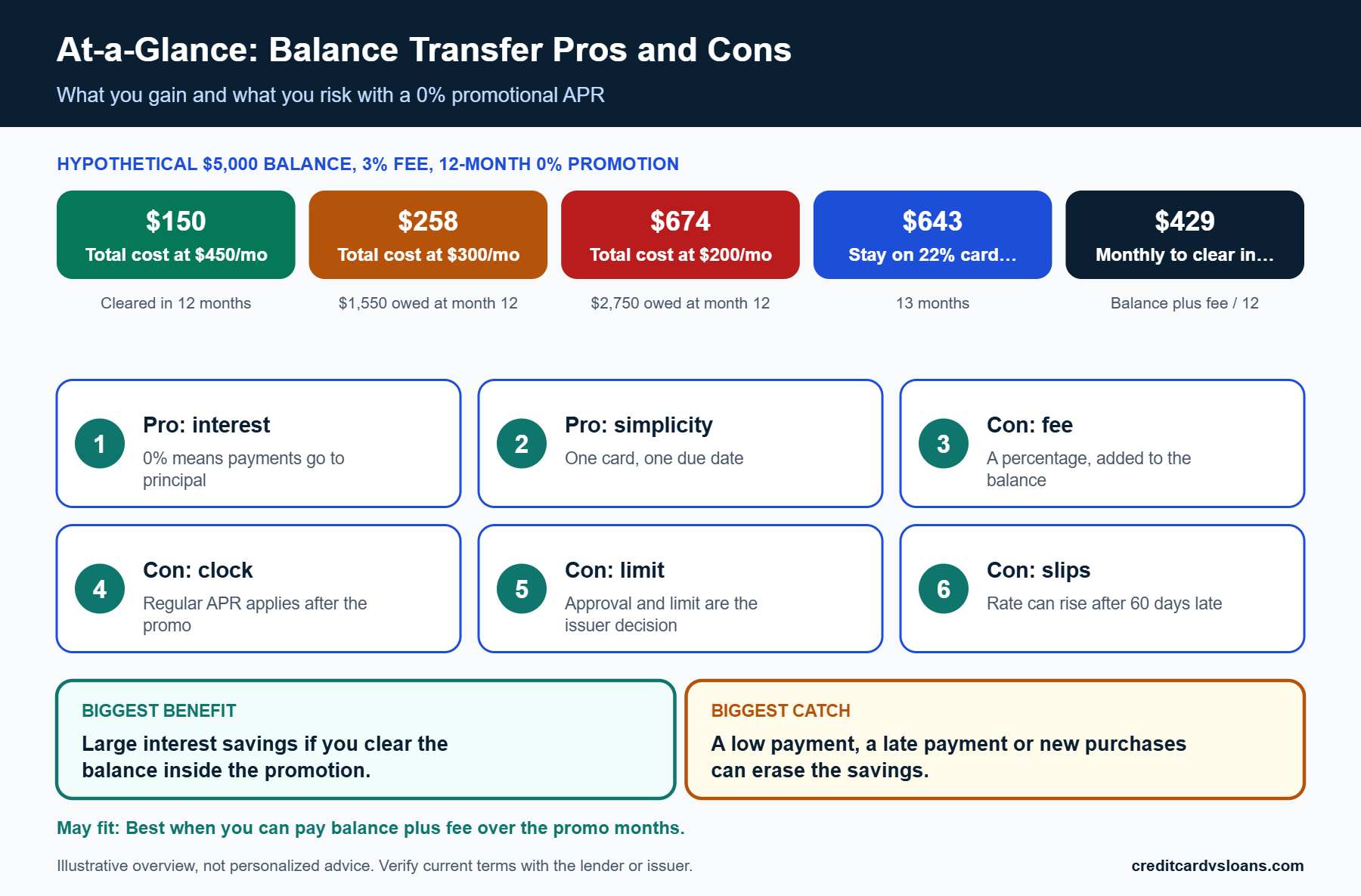
- The biggest advantage of a balance transfer is that payments can go to principal instead of interest during the promotional period; the biggest drawback is that the period ends.
- The CFPB says a balance transfer fee, typically a percentage or flat amount whichever is greater, can be charged even on a zero percent offer. In the $5,000 example, a 3% fee costs $150.
- In the hypothetical example, paying about $429 a month cleared a 12-month 0% transfer, while paying $200 left $2,750 owed when the promotion ended.
- If you are more than 60 days late, the CFPB says the issuer can raise the rate on all balances, including a transferred one.
- New purchases on the same card can lose their grace period, so interest may accrue on them from day one.
Rate context comes from the Federal Reserve’s G.19 Consumer Credit release of October 7, 2026 (preliminary August 2026 data). Dollar examples are hypothetical and computed for illustration. Fees, promotional lengths and APRs vary by issuer and change over time.
Balance Transfer Pros and Cons at a Glance
The case for a balance transfer
Payments go to principal during the promotion
At 0%, no interest is added to the balance, so each payment reduces what you owe. On a $5,000 balance at a hypothetical 22% APR, the first month of card interest alone is about $92. Move the debt to a 0% card and that $92 goes toward principal instead, apart from the transfer fee.
Over a full payoff, the difference compounds. Paying $450 a month on the old card takes about 13 months and costs roughly $643 in interest. The same payment on a 0% transfer with a 3% fee finishes in about 12 months and costs the $150 fee. These are illustrations, but they show why borrowers look at transfers.
A simpler structure for several balances
A transfer can consolidate more than one card into a single payment, which reduces the chance of a missed due date. The CFPB notes that many issuers offer zero-percent or low-interest transfers to move balances onto one card. That can make a payoff plan easier to track, particularly if your old cards carry different APRs and due dates.
It’s also not a loan with collateral: a transfer card is unsecured credit. The flip side is that your credit limit, not your need, caps how much can move. Our guide to the government debt relief programs that do and don’t exist for card debt covers what to know if your balance is beyond a transfer’s reach.
The case against a balance transfer
The fee, the limit and the approval hurdle
The fee is usually added to your balance, so you start in a hole of 3% or 5% or whatever the issuer charges. The CFPB notes that the fee is typically a percentage of the amount transferred or a flat amount, whichever is greater. You also have to be approved, and the limit you get may not cover your balance. The CFPB cautions that damaged credit may prevent you from getting low-rate transfers.
A hard pull usually accompanies the application. According to the CFPB, hard inquiries affect scores because most models consider how recently and frequently you apply for credit. A declined application can leave you with the inquiry and no card.
The clock, the snap-back and the temptation
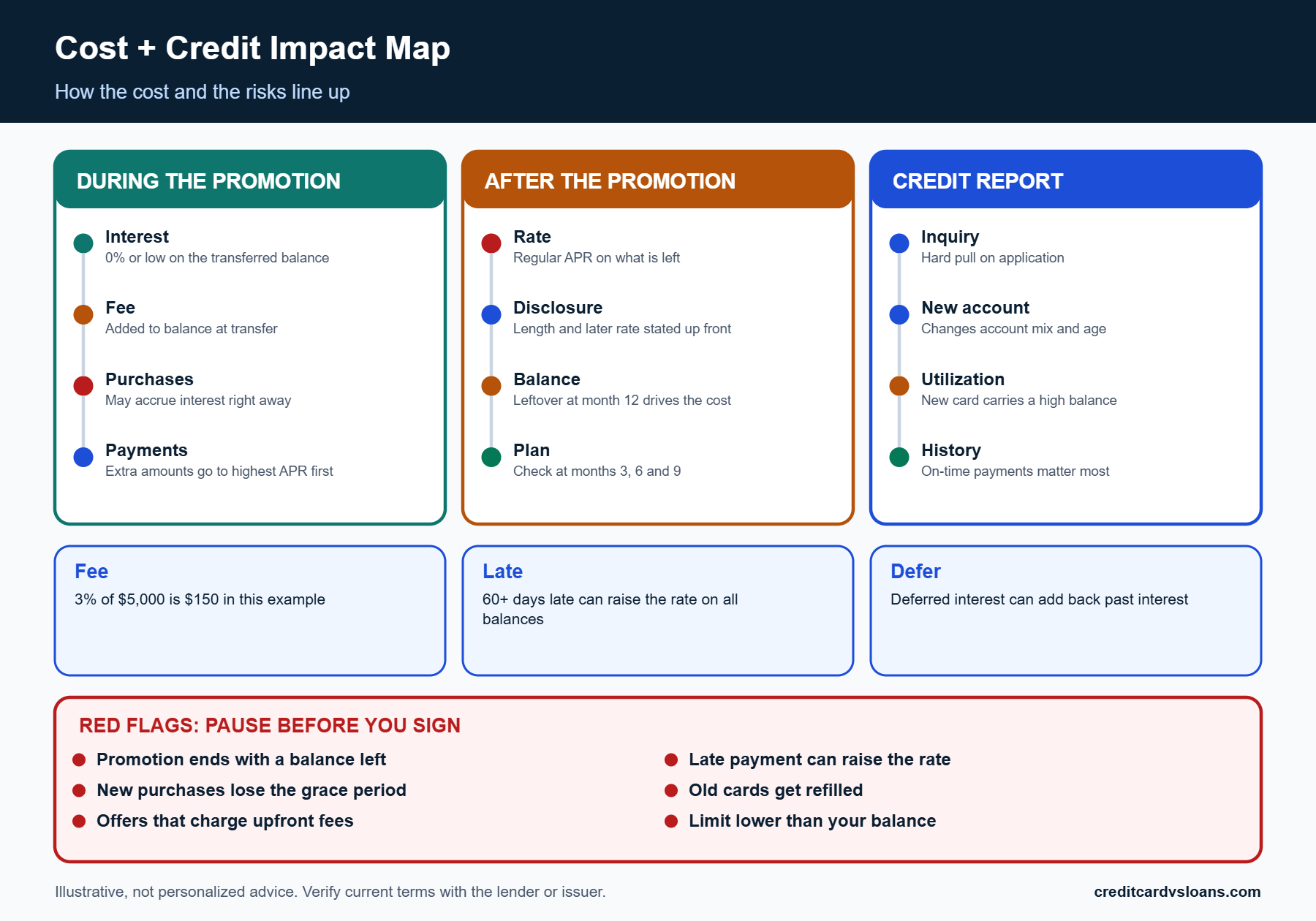
The promotional clock is the main hazard. When it ends, what remains is charged the regular APR, which in this example is 24.99%. The CFPB also warns that if you pay more than 60 days late, the issuer can raise the rate on all balances. And if you use the card for new purchases, you may lose the grace period.
The behavioral risk is just as real: once your old cards read zero, it’s easy to charge them again. Consolidating without addressing the spending that created the balance can leave you with more debt than before. The CFPB says as much, noting that taking on new debt to pay old debt may only postpone the problem.
| Factor | Potential advantage | Potential drawback | Main cost driver |
|---|---|---|---|
| Interest | 0% or low APR during the promotion | Regular APR applies to what remains afterward | Balance left on the promotion end date |
| Fee | Known, one-time cost | Usually a percentage added to your balance | Transfer amount and fee percentage |
| Payment flexibility | You choose the payment above the minimum | No built-in payoff date | Your monthly payment |
| Consolidation | One card, one payment | Limited by the new credit limit | Approved limit vs. total debt |
| Credit report | May change how balances are spread across accounts | Hard inquiry; new account | Your credit profile |
| Risk if you slip | Smaller balance if you pay on time | Rate can rise after 60 days late | Payment history |
How a 0% Balance Transfer Actually Works
Moving the balance
Requesting the transfer and what the fee does
Once approved, you typically give the new issuer the account details of the cards you want to pay off and the amounts. The new issuer pays them, and those amounts plus the fee appear on your new card. The balance transfer fee is added on top, so a $5,000 transfer with a 3% fee starts you at $5,150.
The offer’s disclosures state the promotional APR, how long it lasts and the regular APR afterward. Under federal rules, a promotional period of six months or longer can end and be followed by a higher rate if the length and the later rate were disclosed up front. Read that part of the offer before applying.
Timing, due dates and keeping old payments current
Transfers take time to post, so don’t skip a payment on the old card while you wait. A missed minimum can mean a late fee and a negative mark even if the transfer arrives a few days later. Check the old statement until it shows a zero balance.
If the old cards had accrued interest since the last statement, a small residual balance can remain after the transfer. Pay it or ask the old issuer for a payoff figure. Closing the old account is optional and has credit consequences, so think it through first.
0% interest versus deferred interest
What a true 0% offer means
On a standard 0% offer, no interest accrues on the promotional balance during the promotion, and interest starts only on whatever remains afterward. The CFPB illustrates this with a $400 purchase: if $300 is paid within the promotion and $100 remains, a zero-interest offer means interest applies only to that $100.
Most balance transfer offers work this way, but the terms differ by issuer, so look for the words in the disclosure that tell you whether interest is waived or merely postponed.
Why deferred interest offers are different
Deferred-interest promotions, more common for store financing, can add back all the interest that accumulated during the promotion if the full balance isn’t paid in time. In the CFPB’s example, the same $100 leftover would grow to about $165, because roughly $65 of interest accrued from the purchase date comes due.
If you see wording like “no interest if paid in full in 12 months,” treat it as deferred interest and plan to pay the entire balance early. Regulation Z has a specific rule for the last two billing cycles of a deferred interest period, directing excess payments to that balance first, but you shouldn’t rely on it as a safety net.
What a Balance Transfer Really Costs: Fee vs. Interest Saved
A hypothetical $5,000 example
The assumptions
Consider a hypothetical borrower, not a real person, with a $5,000 card balance at a 22% APR. The Federal Reserve’s G.19 release of October 7, 2026 reported a preliminary August 2026 average of 22.36% on card accounts assessed interest, so 22% is a plausible round figure for illustration. The transfer card charges a 3% fee ($150), offers 0% for 12 months, and then charges 24.99%.
We compare four monthly payments, each applied entirely to the balance. All numbers were computed in Python with monthly compounding. Real terms differ, and your own offer’s disclosures are the numbers that count.
What each payment level produces
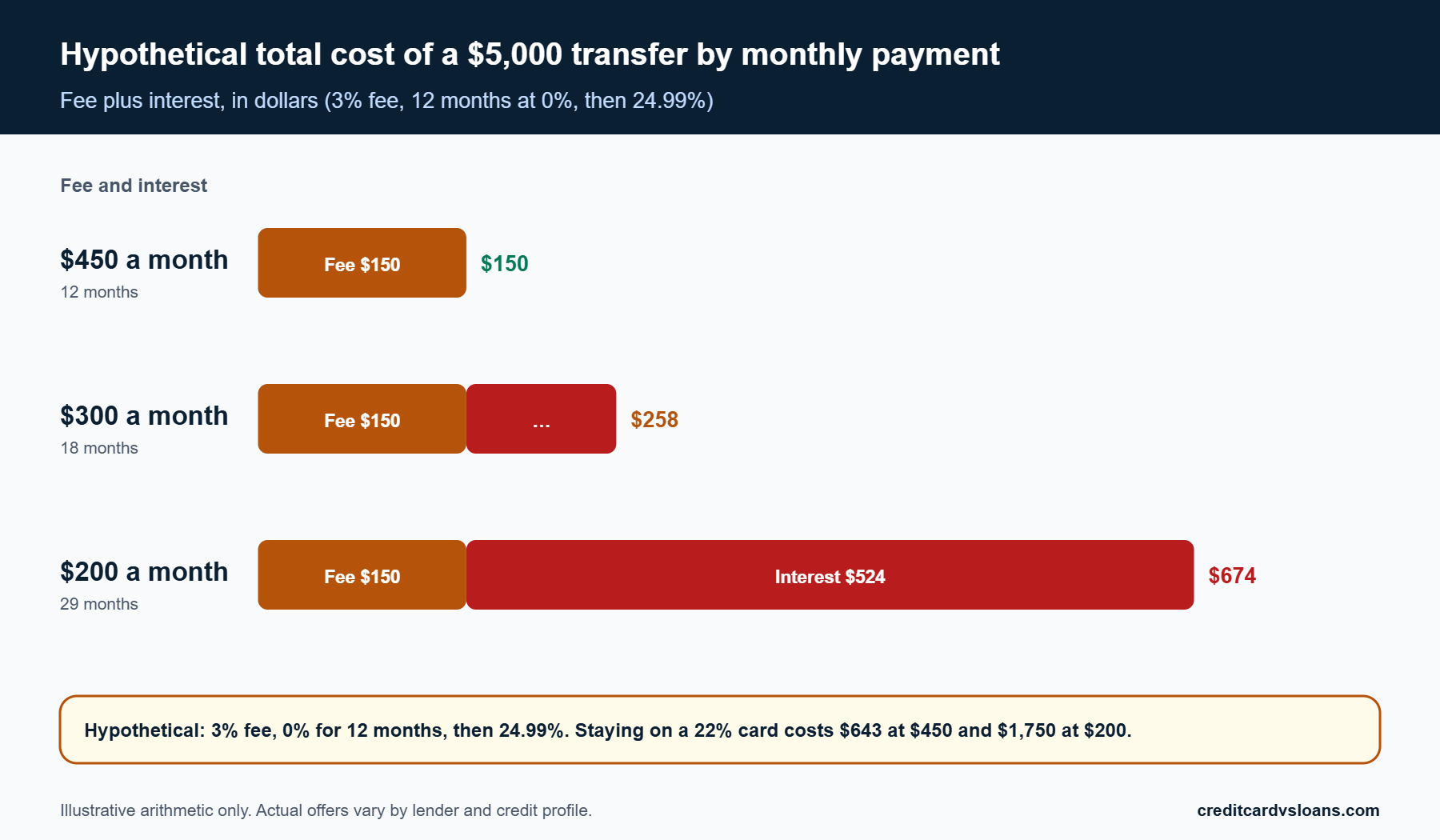
At $450 a month, the transfer clears in 12 months at a total cost of $150, while staying on the 22% card takes about 13 months and costs about $643. At $300 a month, the transfer costs about $258 in total, but $1,550 is still owed when the 0% period ends. Staying on the card at that payment costs about $1,022 over 21 months.
At $200 a month, the picture is less rosy: $2,750 is left after 12 months, and the full payoff takes about 29 months with a total cost of about $674. That is still less than the card’s roughly $1,750, but the margin is thinner and the 24.99% rate does more damage the longer the balance lingers.
| Monthly payment | Stay on 22% card | Balance transfer total cost (fee + interest) | Months to pay off (transfer) | Owed when 0% ends |
|---|---|---|---|---|
| $200 | 34 months, $1,750 interest | $674 | 29 | $2,750 |
| $300 | 21 months, $1,022 interest | $258 | 18 | $1,550 |
| $417.50 | 14 months, $698 interest | $153 | 13 | $140 |
| $450 | 13 months, $643 interest | $150 | 12 | $0 |
What changes the answer
Longer promotions versus larger fees
A longer promotion with a bigger fee can be a good or bad trade depending on your payment. With 15 months at a 3% fee and a $300 payment, $650 is owed at the end and the total cost is about $173. With 18 months at a 5% fee ($250), the same payment clears the balance with no interest and a total cost of $250.
At a $200 payment, the two come out close: about $460 for 15 months at 3% and about $429 for 18 months at 5%, with $2,150 and $1,650 still owed at the end of their windows. The fee is certain, while the interest saved depends on your payments. See our guide to credit scores and 0% APR cards for how approval and offer quality tend to relate.
The payment you need to finish on time
To clear $5,150 within 12 months takes about $429 a month. To clear $5,250 within 18 months (a 5% fee) takes about $292 a month. Dividing balance plus fee by the promotional months is a simple, honest check on whether a plan is realistic.
If that number is higher than what you can afford without charging more to credit, you might still choose a transfer, but treat the leftover balance as the real cost. A good habit is to compute the leftover balance at month six and again at month nine so you can adjust while time remains.
Fees, APRs and the Regular Rate After the Promotion
Reading the fee and the rate
The balance transfer fee
The CFPB defines a balance transfer fee as a fee charged to transfer an outstanding balance to a different credit card, and says it can be charged even on a zero percent offer. It typically is a percentage of the amount transferred or a flat amount, whichever is greater. On small transfers, the flat minimum may exceed the percentage.
Because the fee is added to your balance, it also affects how much of your credit limit remains. A $5,000 transfer with a 3% fee uses $5,150 of the limit.
The promotional APR versus the regular APR
The promotional APR applies only for the stated period. Regulation Z permits a rate to rise when a promotional period of six months or longer ends if the issuer disclosed the length of the period and the later rate in advance, and it limits the increase to certain balances. The regular APR is disclosed in the card’s pricing table.
Read both numbers, plus any note about when the promotional clock starts. The terms differ by issuer, and some offers require that the transfer be requested within a certain window to get the promotional rate.
Market context from the Federal Reserve
What the G.19 data says about card rates
The G.19 Consumer Credit release of October 7, 2026 shows commercial bank card rates for accounts assessed interest at 21.52% in the first quarter of 2026, 22.15% in the second quarter (revised) and a preliminary 22.36% for August 2026. For all accounts, including those that don’t pay interest, the August figure was 21.19%.
These are averages, not what any one borrower is charged. They do give a baseline for the interest a 0% promotion might avoid: at 22%, a $5,000 balance costs about $92 in interest in the first month.
Why a regular APR still matters even if you plan to pay on time
You may never pay the regular APR, but you should still know it. A late payment, a smaller payment than planned or an emergency expense can leave a balance. The difference between a regular APR of 19.99% and 29.99% on a few thousand dollars is real money over a year.
It also matters for how long new purchases will cost you interest if you lose the grace period. The CFPB notes that carrying a promotional balance can cause you to lose the grace period or make it harder to regain, so know what a purchase would cost before you make one.
Credit Score Impact and Approval Requirements
Getting approved
What issuers look at
Issuers decide who gets a transfer card and how large the limit is, and they set their own standards. Credit reports, income and existing debts commonly figure in the decision, and the CFPB advises that damaged credit may prevent you from getting low-rate balance transfers. Card issuers can use a hard pull to review your credit when you apply.
Our article on what credit score you may need for a 0% APR credit card goes through typical approval factors in more detail. Remember that no source can promise approval, a limit or a promotional length before you apply.
Prequalifying and avoiding repeated hard pulls
Some issuers let you check whether you’re likely to qualify with a soft pull, which the CFPB says does not affect your credit scores. If a prequalification tool shows an offer, you can compare terms before submitting a formal application. If you’re declined, avoid immediately applying elsewhere, since each hard pull is recorded.
Before applying, check your credit reports for errors, because inaccurate information can affect the offers you see. The CFPB and the credit bureaus describe how to dispute errors.
How a transfer can show up on your credit reports
Inquiries, new accounts and utilization
A formal application typically produces a hard inquiry, and the CFPB notes that most scoring models look at how recently and frequently you apply for credit. A new account can also change the average age of your accounts. Neither effect is guaranteed to be large, and both can fade over time as the account ages.
Utilization, the share of available revolving credit that you’re using, is another typical scoring input. A transfer can spread a balance differently across accounts: you may lower utilization on the old cards while the new card carries a high balance against its limit. Whether this helps or hurts depends on the specifics.
Payment history and closing accounts
Payment history is usually the most consequential factor over the long run, so the most reliable way to protect your credit is to pay every account on time throughout the transfer. Autopay for at least the minimum is a straightforward safeguard.
Closing the old cards can reduce your total available credit and shorten your credit history over time. If you’re worried about temptation, there are alternatives to closing, such as removing saved card numbers from shopping accounts or keeping a single card for small recurring charges that you pay in full.
When 0% Doesn’t Help: Risks and Red Flags
When a plan snaps back
A late payment can end the promotion’s benefit
The CFPB says that if you are more than 60 days late, the issuer can raise the interest rate on all balances, including the transferred one. Under Regulation Z, the issuer generally must first send the required notice, and it must reduce the rate back after six consecutive on-time payments following the increase.
To see what that can cost, take a hypothetical borrower paying $250 a month on a $5,150 transfer. After four payments the balance is $4,150. If the rate then jumped to a hypothetical 29.99%, paying $250 a month would take about 22 months and cost about $1,278 in interest. On plan, with 0% for eight more months and then 24.99%, the same payments would finish in about 18 months and cost about $244. Real penalty rates vary by issuer.
New purchases, payment allocation and the lost grace period
The CFPB cautions that new purchases on a card with a promotional balance can start accruing interest right away, because you may lose the grace period unless you pay the full balance, including the promotional amount, by the due date. For most people carrying a transfer balance, that means no grace period on new purchases.
Payment allocation adds a wrinkle. Under Regulation Z, payments above the minimum generally go first to the balance with the highest APR. A new purchase balance at the regular APR would receive your extra payment before the 0% balance does, which is helpful for interest but can leave the promotional balance larger than you expected at the deadline.
When behavior undercuts the math
Refilling the old cards
If the old cards read zero and your budget hasn’t changed, the temptation to use them is strong. The CFPB warns that if you borrow because you spend more than you earn, consolidation alone may not fix the problem. A transfer that is followed by new balances on the old cards leaves you with more total debt and a deadline.
Before you move a balance, decide what you will do with the cleared accounts and how you’ll cover surprises. A small emergency cushion, even a modest one, can keep a car repair from landing on a card.
Offers that promise too much
The CFPB cautions that some companies advertising debt consolidation are actually debt settlement companies, which often charge upfront fees and may tell you to stop paying creditors. A genuine transfer comes from a card issuer with standard disclosures, and you shouldn’t need to pay anyone to obtain one. See how to tell real card-debt forgiveness from a scam for warning signs.
If an offer guarantees approval or a rate before reviewing your credit, treat it as a red flag. Real offers depend on your credit and the issuer’s underwriting, and the terms are in the application disclosures.
Alternatives to a Balance Transfer
Other ways to lower the cost of card debt
Negotiating with your issuer and using credit counseling
The CFPB suggests asking creditors whether they will lower minimum payments, waive fees, reduce your interest rate or move the due date. It also suggests nonprofit credit counselors as a way to build a plan. Neither requires opening an account or taking a hard inquiry.
These steps can be particularly useful if your credit isn’t strong enough for a good transfer offer. For broader context on assistance programs, including which ones are real, see our overview of government debt relief programs for credit card debt.
A personal loan or targeted payoff
A personal loan converts revolving debt into an installment with a fixed payment. It charges interest from the start but gives a firm payoff date. Another option is the debt avalanche approach: pay minimums on all cards and put every extra dollar on the one with the highest APR.
The right choice depends on your payment capacity and your discipline. Our comparison of a 0% APR card versus a personal loan for a large purchase and the companion piece on 0% APR cards versus loans for back-to-school costs show how the same trade-off plays out when the debt is new spending rather than an existing balance.
When a transfer is the stronger tool
Signs the math is on your side
A transfer tends to be a stronger tool when your balance is within the likely credit limit, when you can pay the balance plus fee divided by the promotional months, when you can stop using the card for new purchases, and when your payment history is clean. In the hypothetical, those conditions produced the largest savings.
It also helps to have a plan for the first month: confirm that the old account is paid, that the new balance matches the offer, and that autopay is working.
Signs to look at another tool
If your realistic payment is far below the amount needed, if you expect irregular income, or if your credit is damaged, a transfer may be the wrong first step. In the $5,000 example, a $200 payment left $2,750 on the regular APR after a year.
In those cases, a smaller transfer paired with a payoff plan, a fixed-term loan, or counseling may be better. Compare options using total dollars paid and the month you would be debt-free.
Who a Balance Transfer Tends to Fit
Matching the pros and cons to your situation
Questions that sort the pros from the cons
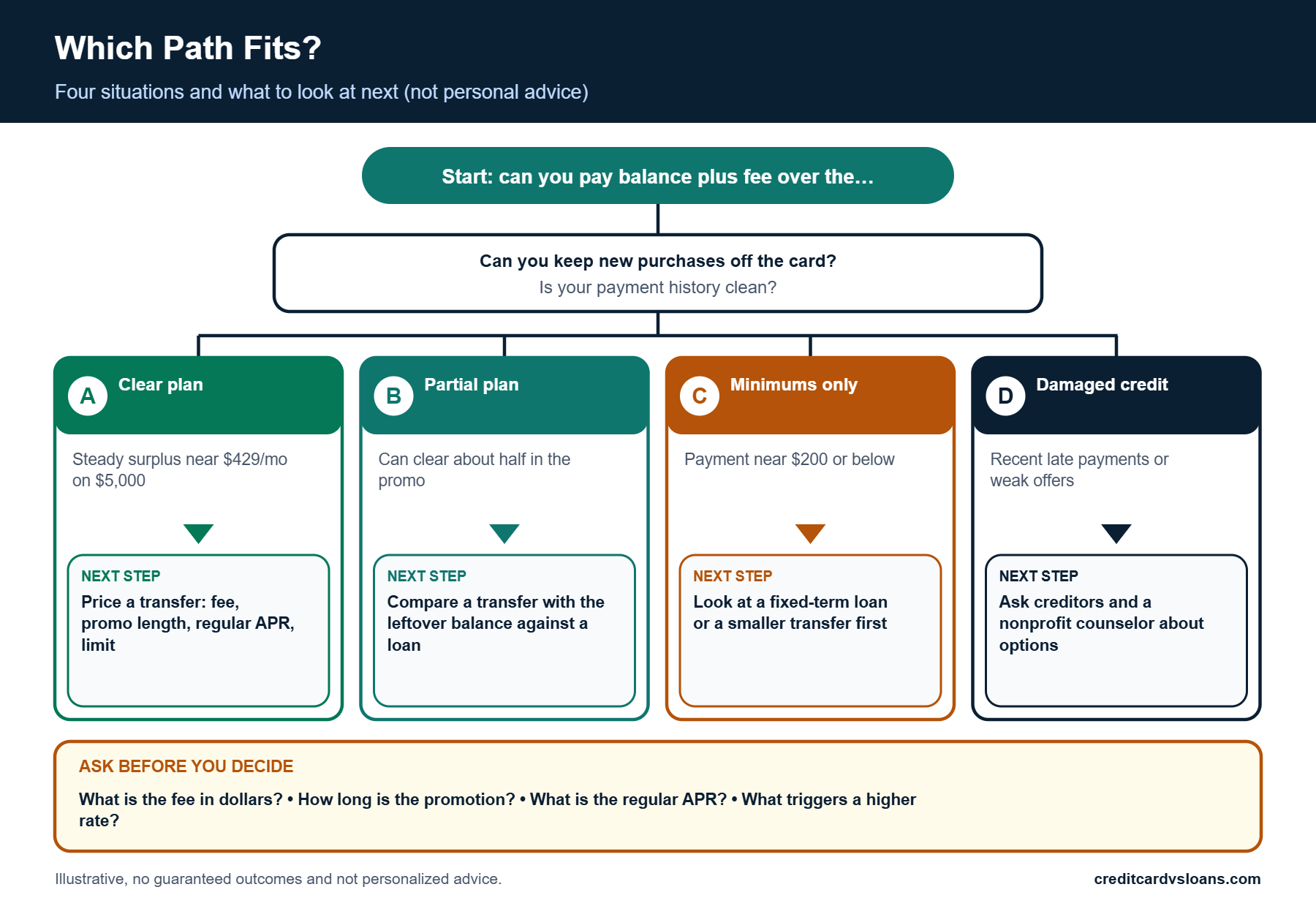
Start with four questions. Can you pay the transferred balance, fee included, within the promotional months? Can you stop using the card for new purchases until it is paid? Is your payment history clean enough that a single slip is unlikely? Would the credit limit you’re likely to receive cover the balance you want to move?
If the answer to all four is yes, the pros weigh heavily in this balance transfer pros and cons analysis. If two or more are no, the cons weigh more, and a different tool may suit you better. A conversation with a nonprofit credit counselor can help if the picture is unclear.
Weighing the fee against interest you would pay anyway
The fee is a known cost, while interest you avoid depends on your payments. In the $5,000 example at a $450 payment, the fee of $150 replaced about $643 in card interest. At a $200 payment, the transfer still cost less than the card, but $2,750 remained on the regular APR after a year.
A practical rule of thumb: if you can clear most of the balance during the promotion, the fee tends to pay for itself. If you can clear only a small share, the fee mostly buys you a short pause.
| Scenario | Likely fit | Why | What to verify | When to avoid it |
|---|---|---|---|---|
| Can pay balance plus fee within the promotion | Strong fit for a transfer | Most payments go to principal | Fee, promo length, limit, regular APR | If you will keep using the card |
| Can pay about half within the promotion | Possible fit | Savings are real but the remainder faces the regular APR | Regular APR and leftover balance at month 12 | If a late payment is plausible |
| Can pay only minimums | Weak fit | Promotion may end with most of the balance intact | Total cost versus a fixed-term loan | If the plan relies on the minimum |
| Several cards with different APRs and due dates | Possible fit | One card and one due date | Whether the limit covers all balances | If the limit covers only part |
| Damaged credit or recent late payments | Look at other steps first | Approval and rates may be unfavorable | Counseling and creditor options | Offers that charge upfront fees to fix debt |
Three hypothetical profiles
A borrower with a clear payoff plan
Imagine a hypothetical borrower with $5,000 on one card, a steady paycheck, and a monthly surplus of about $450. The transfer clears in a year for roughly the $150 fee. The main tasks are to confirm approval, automate the payment and avoid new charges on the card.
For this profile, the pros dominate. The risk is mostly behavioral: a skipped payment or a surprise expense can unravel the savings.
A borrower who needs a different tool
Now imagine a hypothetical borrower with $5,000 across three cards, a monthly surplus of about $200, and variable income. A single transfer may not be approved at a limit that covers all three. If it is, $2,750 would remain after 12 months, and a missed payment would raise costs.
This borrower might compare a fixed-term loan, ask creditors about lower rates, or talk to a credit counselor. A transfer may still be part of the plan, but not necessarily the whole plan.
Checklist, Conclusion and Next Steps
A checklist before you apply
Terms to confirm in the offer
Record the promotional APR and how long it lasts, the regular APR, the balance transfer fee in dollars and the minimum fee, the credit limit, and any requirement about when you must request the transfer. Ask whether new purchases receive a grace period and what events can trigger a higher rate.
Then write the payoff plan: the monthly payment, the month it reaches zero, and the total in dollars. If the plan relies on a payment you can’t maintain, revise it before you apply.
Habits that make the pros stick
Automate payments, calendar the promotional end date and a reminder three months before it, and keep another payment method for everyday spending. Check the first statement against the offer. If you’re also evaluating a loan, our guide to the 0% APR card versus personal loan decision lays out the comparison.
Mistakes that turn the pros into cons
Treating 0% as free
The fee is real, the promotion is temporary and the leftover balance is expensive. A 0% label doesn’t change the arithmetic, and even a short delay in payments can reduce the benefit. Compare the dollars you’ll pay with and without the transfer, using your actual offer.
Also keep in mind that the CFPB’s guidance on promotional offers advises paying off promotional balances before the promotion ends and making every payment on time, which are the habits that decide whether the pros show up in practice.
Using the same card for everything
Putting groceries and gas on the transfer card makes it harder to know your payoff date and can cost you the grace period. If you usually pay your full statement balance each month, the CFPB advises holding off on new purchases with the promotional card until the promotional balance is paid off and using another method instead.
If you usually carry a balance, compare rates across your cards and choose the cheapest for new purchases, or pay with cash or debit. The goal is to keep two kinds of debt from mixing.
The bottom line
When 0% helps and when it doesn’t
A balance transfer helps most when you can pay the balance plus fee within the promotion and keep new spending off the card. It helps least when your payment is low, your income is uncertain, or the clock runs out with most of the debt still owed. The decision is about your payment and your habits at least as much as the rate.
In the $5,000 example, the same card cost $150 at a $450 payment and $674 at a $200 payment. That swing came entirely from the payment, which is the one number you control.
Next steps you can take this week
- List each card balance, APR and minimum payment.
- Compute balance plus fee, divided by the promotional months, and compare it with what you can pay.
- Check your credit reports, then look for prequalification tools that use soft pulls.
- Read the offer’s pricing table for the regular APR, the fee and what triggers a higher rate.
- Decide how you’ll handle everyday spending without using the transfer card.
- If the math doesn’t work, ask your creditors about options or contact a nonprofit credit counselor.
Tracking the plan after the transfer posts
A month-by-month check that keeps the promotion on track
Once the transfer posts, set a simple tracking habit. After each payment, note the remaining balance and divide it by the promotional months left. If that monthly figure rises above what you’re paying, you’re falling behind; if it falls below, you have room to finish early. In the $5,000 example, a $429 payment clears the balance in a year, while $300 leaves $1,550 at month 12.
Checking at months three, six and nine gives you time to adjust, whether that means redirecting a bonus, trimming a bill or deciding that a different product would fit better for the remainder.
What to do if you will not finish in time
If you see the promotion ending with a balance left, consider your options early. You might pay the remainder from savings, move to a fixed-term loan with a lower rate, or contact the issuer and a nonprofit credit counselor about a plan. The CFPB’s guidance on consolidation suggests asking creditors whether they will lower payments, waive fees or reduce rates before problems grow.
Avoid a last-minute scramble. The regular APR begins when the promotion ends, so each month of delay adds interest on whatever balance remains. The earlier you decide, the more choices you have.
Questions readers ask next
Can you transfer a balance more than once?
Some borrowers move a balance again when a promotion ends, but each transfer adds a new fee and a new application, and approval is never certain. The CFPB’s warning that promotional rates usually expire is a reminder that a plan built on repeated transfers depends on offers you can’t control.
Does a transfer make sense for a small balance?
For a small balance, a modest payment can clear the debt quickly, which favors a transfer. But the CFPB notes that the fee can be a percentage or a flat amount, whichever is greater, so check the minimum fee in the offer before assuming the percentage applies.
- What Credit Score Do You Need for a 0% APR Credit Card?
- Government Debt Relief Programs for Credit Card Debt: What Exists and What Doesn’t
- 0% APR Credit Card vs. Personal Loan for Furniture: Which Wins?
- Credit Card Debt Forgiveness: What Is Real and What Is a Scam?
- 0% APR Credit Card vs. Personal Loan for Back-to-School Spending: Which Wins?
- CFPB: What do I need to know about consolidating my credit card debt?
- CFPB: What is a balance transfer fee? Can it be charged on a zero percent offer?
- CFPB: Credit cards key terms
- CFPB: You could still end up paying interest on a zero percent interest credit card offer (2014 archived post)
- CFPB: How to understand special promotional financing offers on credit cards (archived post)
- CFPB: When can my credit card company increase my interest rate?
- CFPB: What is a credit inquiry?
- CFPB (Regulation Z): 12 CFR 1026.55 Limitations on increasing APRs, fees, and charges
- CFPB (Regulation Z): 12 CFR 1026.53 Allocation of payments
- Federal Reserve: Consumer Credit – G.19 (release of October 7, 2026)
Last updated: October 22, 2026. Rates, fees and lender rules change; verify current terms before acting.
The information on creditcardvsloans.com is provided for general educational and informational purposes only. It is not financial, legal, tax, credit, accounting or investment advice, and reading it does not create an advisor-client, fiduciary or any other professional relationship. Nothing here is an offer, solicitation or recommendation to borrow, lend or apply for any product.
Credit scores, interest rates, fees, eligibility rules, lender policies and laws change frequently and vary by lender, location and individual circumstances. Examples, figures and scenarios are illustrative only, do not predict your results and do not guarantee approval, savings, a particular rate or a credit-score outcome. Always confirm current terms directly with the lender or issuer and read the full agreement before you apply or sign.
Although we aim for accuracy and use reputable sources, we make no representations or warranties, express or implied, about the completeness, accuracy, reliability or timeliness of the content. Content may be drafted with the assistance of automated tools, so errors or omissions may still occur. Links to third-party sites are provided for convenience; we don’t control and aren’t responsible for their content.
To the fullest extent permitted by law, creditcardvsloans.com and its owners, editors, authors, contributors and affiliates disclaim all liability for any loss, damage or expense arising directly or indirectly from your use of, or reliance on, this content. Before making financial decisions, consult a licensed professional, such as a qualified financial advisor, attorney, tax professional or nonprofit credit counselor, who can consider your complete situation.