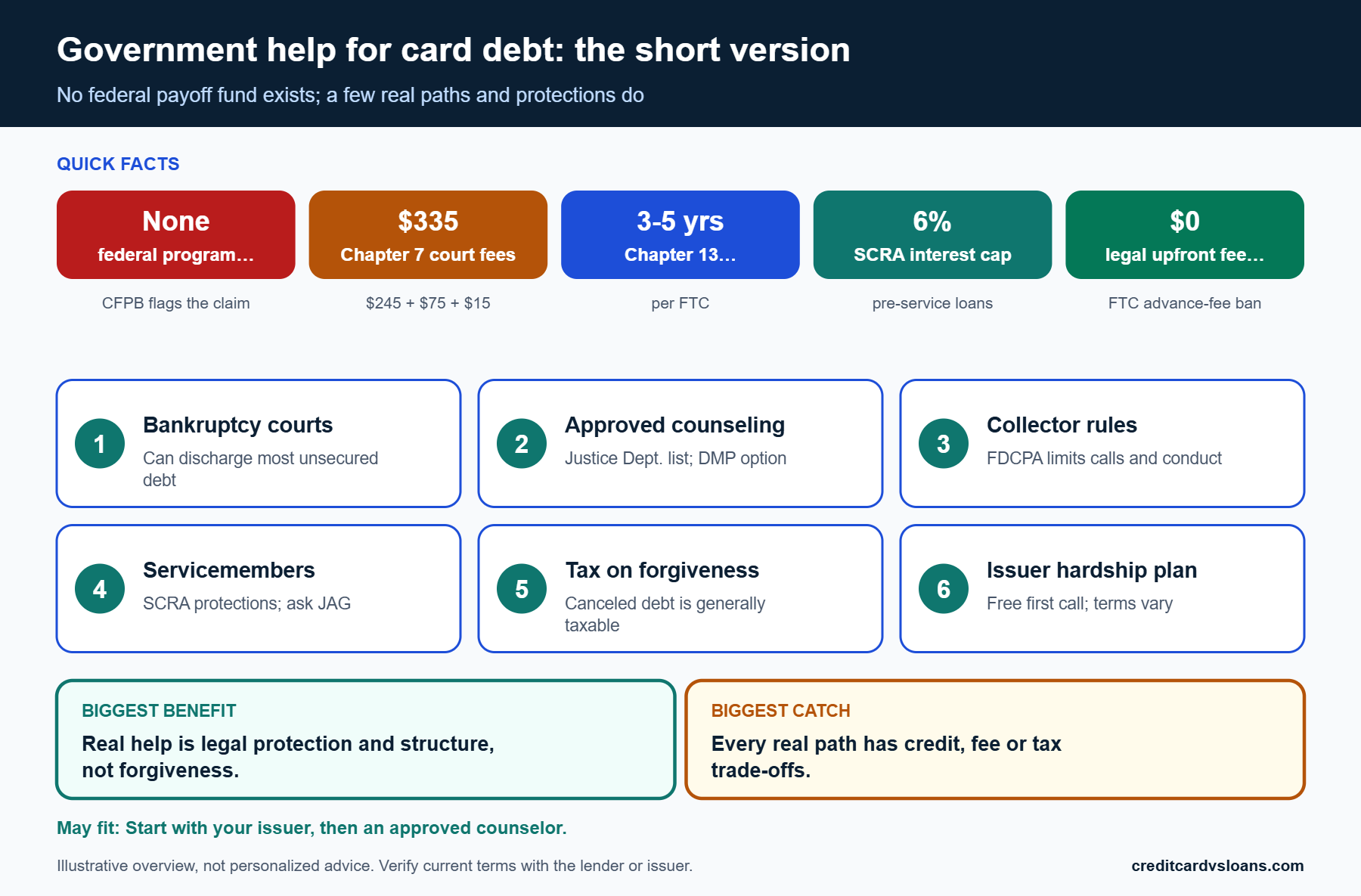
There is no federal government program that pays off, erases or forgives ordinary credit card balances. That is the plain answer to the search for government debt relief programs: what does exist is a short list of legal protections, court processes and approved counseling channels that can make a card balance more manageable, and none of them is a handout.
The confusion is understandable. Social media ads, text messages and cold calls regularly describe a “new government program” that supposedly wipes out card debt for a fee, and the language borrows just enough from real student loan and disaster-relief headlines to sound plausible. The Consumer Financial Protection Bureau (CFPB) lists a pitch about a “new government program” as one of the warning signs to avoid when you are evaluating a debt settlement company.
This guide sorts the real from the invented. You will see which government-linked options genuinely apply to credit card debt, what each one costs and requires, which claims to walk away from, and how to match your own situation to a sensible next call. It is general education, not personal financial or legal advice, and your details will change what makes sense.
- No bailout exists for card balances. The CFPB and the Federal Trade Commission (FTC) both treat “government program” credit card offers as a red flag, not a benefit.
- Real government-connected help is narrow: federal bankruptcy courts, Department of Justice-approved credit counseling agencies, and legal protections such as the Servicemembers Civil Relief Act (SCRA) interest cap and collection rules.
- Cost and credit trade-offs are real. Bankruptcy carries court fees and can stay on your credit report for years; a debt management plan may charge setup or monthly fees; forgiven debt can be taxable.
- Nobody legitimate asks for money first. The FTC says it is illegal for a debt relief company to charge you before it does anything to relieve your debt.
- Your own issuer is the cheapest first call. Free, direct, and the FTC suggests asking for a payment plan you can afford.
Court fee amounts come from the U.S. Courts’ Chapter 7 basics page, and average card interest rates come from the Federal Reserve’s G.19 release of October 7, 2026 (August 2026 data, preliminary). Fees, rules and rates change, so confirm the current figure with the agency before you act.
Government Debt Relief Programs for Credit Card Debt: The Short Answer
Is there a government program that covers credit card debt?
What the federal agencies actually say
The CFPB’s guidance on debt relief programs describes settlement and relief companies as businesses that claim they can renegotiate or change the terms of your debts. Its list of red flags includes any company that mentions a “new government program” for credit card debt. When the federal consumer finance regulator tells you to be wary of a claim, that is about as clear as guidance gets.
The FTC says the same thing from the enforcement side. In a consumer alert on credit card debt relief, the agency describes settling with operators of a scheme that took tens of millions of dollars through false promises, charging victims thousands in fees and often telling them to stop paying their card companies. The result, according to the FTC, was damaged credit and larger balances than before.
Why the “program” claim keeps circulating
Scam pitches work because real government relief does exist in other corners of lending. Federal student loan programs, mortgage assistance, and disaster-related relief are real, so a caller who mentions “a federal program” borrows credibility from those. Credit cards, however, are private contracts between you and a bank, and no federal program exists to pay that bank on your behalf.
A second reason is that real government-linked options (bankruptcy, approved counseling) sound like programs when a salesperson describes them loosely. A call that begins with “the government has approved your hardship plan” is selling you something. Genuine help never begins with an unsolicited promise of forgiveness.
What “government-related” can honestly mean
Rules versus programs
It helps to separate two things that sound alike. A program gives you money or cancels a balance. A rule limits what lenders, collectors and debt relief companies may do to you. Almost everything government does on credit card debt falls into the second category: collection conduct rules, advance-fee bans on debt relief sellers, interest-rate caps for certain servicemembers, and court procedures.
Rules are valuable, but they do not reduce what you owe by themselves. They protect you while you pursue a payoff plan, a negotiated settlement or a court process. Keep that distinction in mind whenever someone describes a “federal” solution, because the useful question is always what the rule or process actually requires from you.
Who runs what
Different agencies handle different pieces. The CFPB supervises consumer financial products and publishes plain-language guidance. The FTC enforces the Telemarketing Sales Rule against deceptive debt relief sales. The federal courts administer bankruptcy, and the Department of Justice’s U.S. Trustee Program approves the credit counseling agencies that bankruptcy filers must use first.
None of these bodies operates a card payoff fund. If a caller claims to represent one of them and asks for payment, hang up and look up the agency’s number yourself. You can report suspicious offers to the FTC at ReportFraud.ftc.gov.
| Claim you may hear | What is actually true | Your move |
|---|---|---|
| “A new government program will forgive your cards” | CFPB lists this as a red flag; no such program is described in its guidance | End the conversation; report it to the FTC |
| “Pay a fee now and we will settle your debt” | The FTC says charging before relieving debt is illegal for telemarketed debt relief | Do not pay anything upfront |
| “Courts can discharge unsecured debt” | True through bankruptcy, with eligibility rules, fees and credit consequences | Talk to a bankruptcy attorney or approved counselor |
| “A nonprofit can set up one monthly payment” | True for debt management plans, though fees and creditor acceptance vary | Check approved lists and ask for written fees |
| “Military loans can be capped at 6%” | The CFPB describes an SCRA 6% cap for loans taken out before active duty | Contact a JAG legal assistance office |
What Does Exist: Real Government-Connected Paths for Card Debt
The federal bankruptcy system
How Chapter 7 handles unsecured balances
Bankruptcy is the one government-run process that can legally eliminate unsecured debt such as credit cards. According to the U.S. Courts’ Chapter 7 basics page, individual debtors are released from personal liability for most debts, and over 99 percent of individual Chapter 7 cases that are not dismissed or converted end in a discharge. Certain debts are not dischargeable, including alimony, child support, certain taxes and certain education loans.
Chapter 7 also comes with gatekeeping. A means test applies when your current monthly income exceeds your state median, and non-exempt property can be sold by the trustee, with exemptions that vary by state. It is a legal process with lasting credit consequences, not a relief program, so a consultation with a bankruptcy attorney is the right first step. Some attorneys offer a free initial consultation, as the CFPB notes.
Chapter 13 and the repayment-plan alternative
Chapter 13 works differently: the FTC describes a court-approved repayment plan lasting three to five years, in which you generally keep property such as a house or car if you keep up payments. It suits people who have regular income and do not qualify for, or do not want, liquidation.
Both chapters can discharge many unsecured debts, and neither typically erases child support, alimony, most taxes, fines or some student loans. The FTC also notes that bankruptcy can stay on your credit report for 10 years. That is a long shadow, which is one reason to weigh it against the settlement route described in our guide to debt settlement risks, taxes and credit damage, and to use a licensed attorney for the filing decision itself.
Approved credit counseling and debt management plans
The Department of Justice approved-agency list
Anyone filing for bankruptcy must complete credit counseling first, and the U.S. Trustee Program approves the agencies that can provide it. The Department of Justice page on credit counseling explains that if the course is not completed before filing, the case could be dismissed, and that a separate debtor education course comes after filing. The CFPB also points consumers to that Justice Department list, along with the National Foundation for Credit Counseling and the Financial Counseling Association of America, as starting places when looking for a counselor.
Being on an approved list does not make an agency free or perfect. Still, it is a far better starting point than a phone call you did not ask for, and you should still check any agency with your state attorney general and consumer protection office.
What a debt management plan does and does not do
A debt management plan (DMP) bundles your unsecured payments into one monthly deposit to a credit counseling organization, which pays your creditors on a schedule. The CFPB says this can lower monthly payments and reduce interest and fees. The FTC adds that creditors may lower interest rates or waive fees, that plans often take 48 months or more, and that you may need to avoid new credit while on the plan.
A DMP is not forgiveness: you repay the principal. Confirm with each creditor that it accepts the proposed plan before you send money, because the CFPB warns that the FTC has found some DMP providers defrauded people. See how a debt management plan affects your credit for the credit side of the trade-off.
What the Real Options Cost and Who Qualifies
Costs you can actually put numbers on
Court fees for a Chapter 7 filing
The U.S. Courts’ Chapter 7 basics page lists a $245 case filing fee, a $75 administrative fee and a $15 trustee surcharge, which adds up to $335 in court charges before any attorney fees. Individuals may ask the court to pay in up to four installments, with the final payment due within 120 days, and the court can extend that for cause. Fees may be waived if income is below 150 percent of the poverty level and the debtor cannot pay even in installments.
Attorney fees are separate and vary by location and case, so ask for a written quote. The point of the numbers is scale: court fees are modest compared with what the same balance can cost in interest, but the credit, property and legal consequences are what drive the decision.
What a debt management plan may charge
The CFPB says it does not publish a single DMP price, and instead tells consumers to ask about setup and monthly fees and to get a written price quote. It also says to avoid any organization that charges for educational materials, and to look elsewhere if an organization refuses to help you because you cannot afford its fees.
That means the fee is a real line item you can negotiate around. Ask each prospective agency for its fee schedule, whether it differs by state, and whether any fee comes out of your first payment, then compare against the interest you would save.
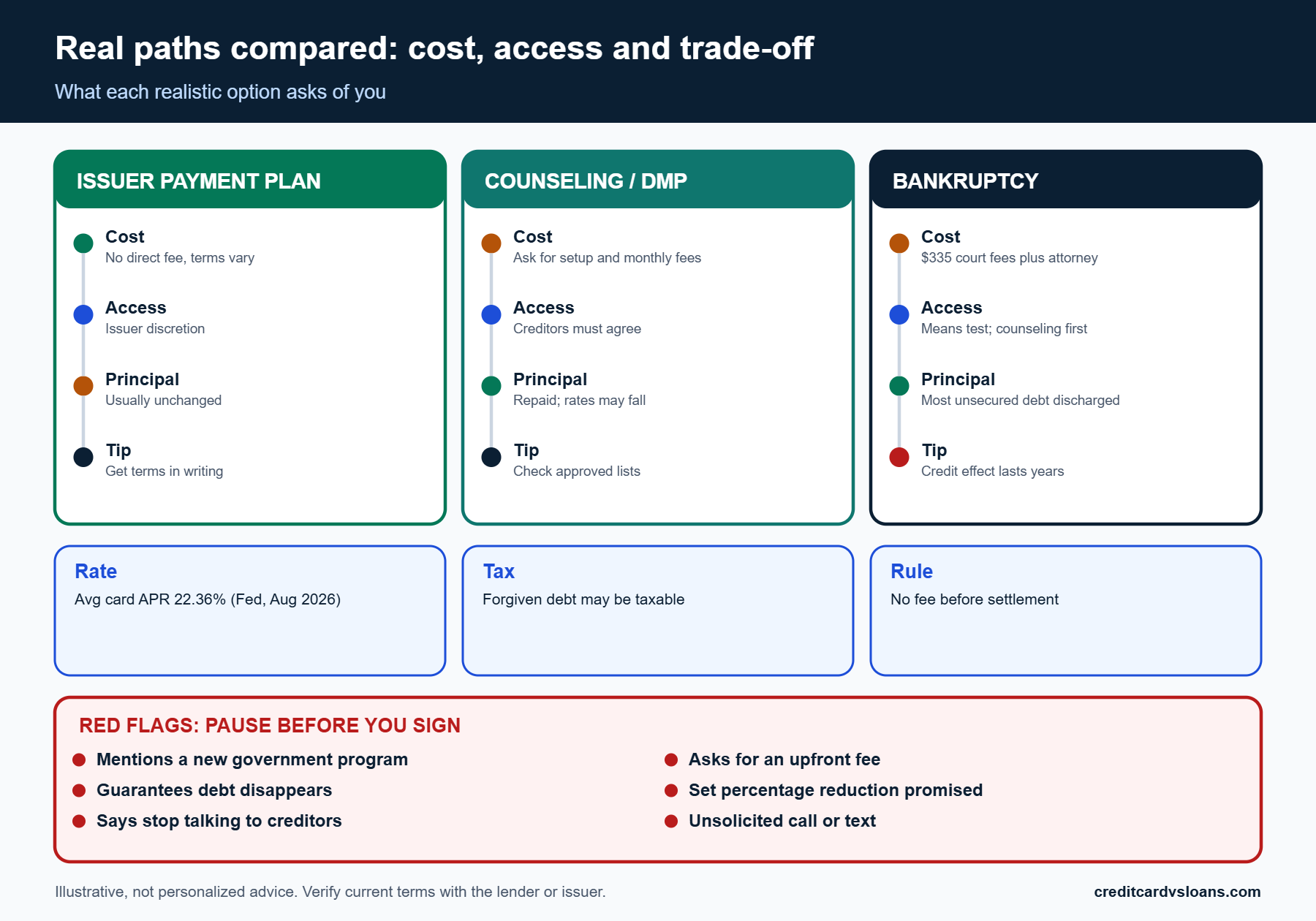
| Path | Who runs it | Typical cost signal | Main eligibility rule | Does it reduce principal? |
|---|---|---|---|---|
| Ask your issuer for a payment plan | Your card issuer | No direct fee; terms vary by issuer | Issuer discretion | Usually not |
| Nonprofit debt management plan | Credit counseling agency, with creditor consent | Setup or monthly fees may apply | Unsecured debt; creditors must agree | No; interest and fees may fall |
| Chapter 7 bankruptcy | Federal bankruptcy court | $335 court fees plus attorney fees | Means test applies above state median income | Discharges most unsecured debt |
| Chapter 13 bankruptcy | Federal bankruptcy court | Court fees plus attorney fees; plan payments | Regular income to fund a 3-5 year plan | Some debt may be discharged at plan end |
| For-profit debt settlement | Private company | Fees often high; none allowed before settlement for telemarketed offers | Creditors must agree to settle | Possibly, with credit and tax consequences |
Credit and tax consequences
How each path can touch your credit
No route here is credit-neutral. The CFPB warns that debt settlement can hurt your credit scores and your ability to get credit later. The FTC says a bankruptcy can stay on your credit report for 10 years. A DMP may require you to avoid new credit while the plan runs, which limits borrowing even if the plan itself is not described as a negative mark on its own.
What this means for you depends on where your credit starts. A person with a thin credit file and several missed payments may see a smaller relative change than someone with a long clean history, but outcomes are individual and no source can promise a specific change. See how a debt management plan can affect your credit for a closer look.
Where taxes enter
Forgiven balances are the tax trap. Under IRS guidance, canceled debt is generally taxable income, with insolvency and bankruptcy exclusions, and creditors may issue Form 1099-C. A DMP generally repays principal, so it does not create canceled debt in the same way, whereas a negotiated settlement does.
Plan for the possibility of a tax bill before you accept a settlement. If you may qualify for an exclusion, you would report it on Form 982, and a tax professional can check whether the facts support that.
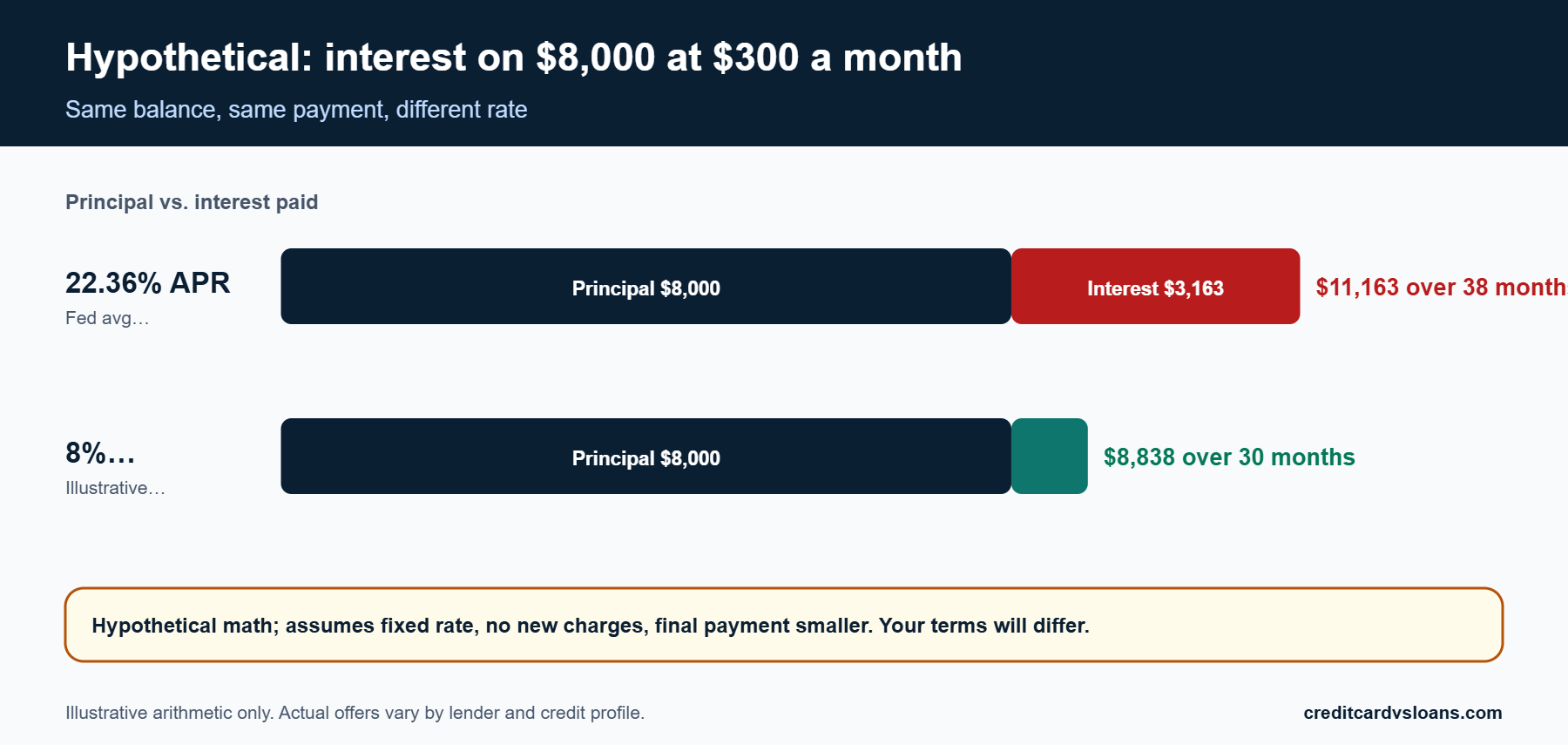
As of the Federal Reserve’s G.19 release of October 7, 2026, the average interest rate on credit card accounts assessed interest was 22.36 percent in August 2026 (preliminary), and 22.15 percent in the second quarter of 2026. Your own rate may be higher or lower, and the plan rate you could negotiate is not guaranteed.
Eligibility checkpoints before you pick a path
Income, asset and creditor tests
Bankruptcy has the most formal tests: the means test for Chapter 7, regular income for Chapter 13, and credit counseling within 180 days before filing. A DMP has softer tests but depends on creditor cooperation, and the FTC cautions that creditors may lower rates or waive fees but you should confirm each concession directly.
Settlement depends on creditors agreeing to take less. The CFPB notes that some creditors refuse to work with settlement companies, and that firms often cannot settle all of your debts, so a partial result can leave other balances growing with penalties.
Questions to ask before enrolling in anything
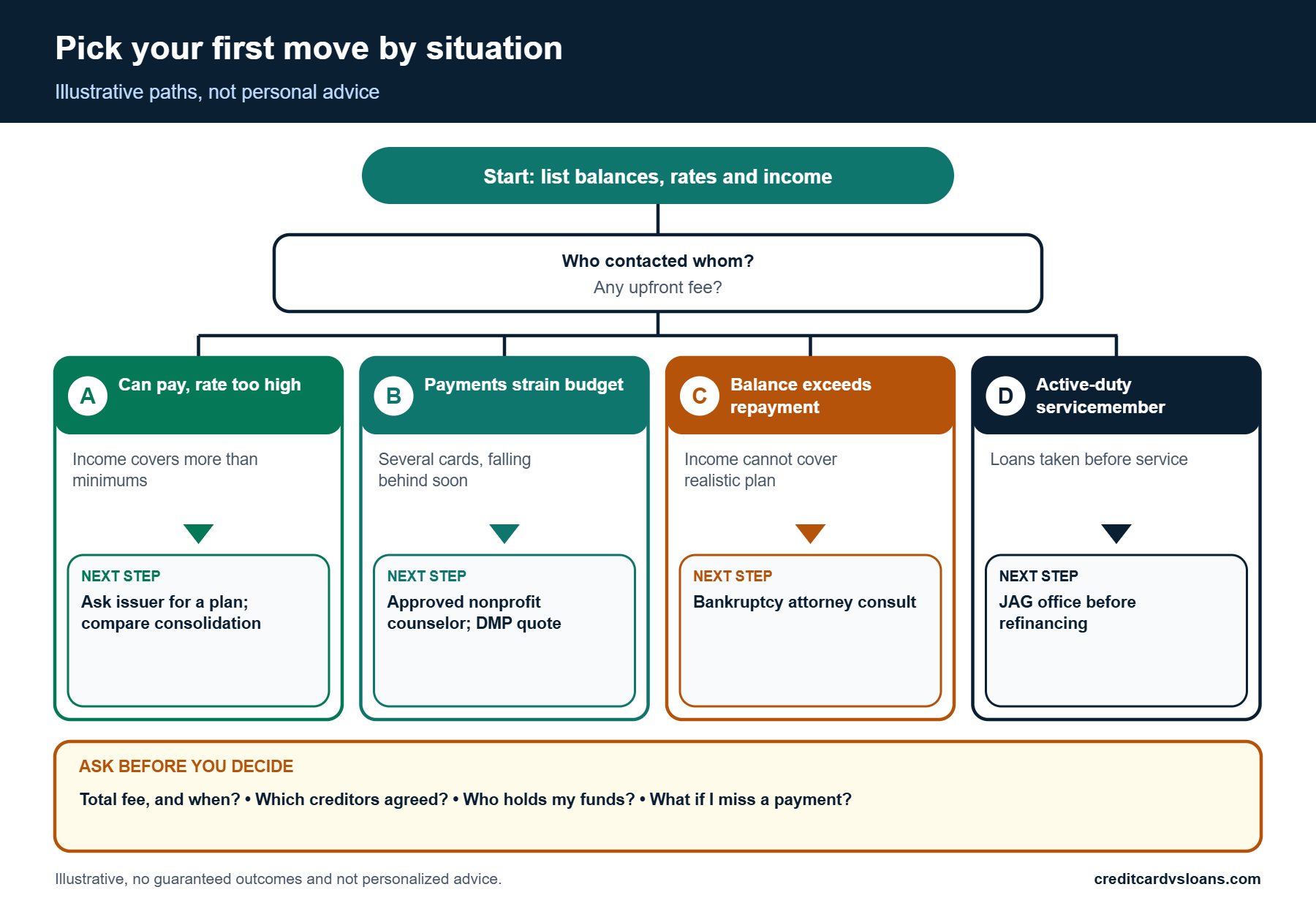
Before you commit, get answers in writing to a few questions: What is the total fee and when is it charged? Which of my creditors have agreed? What happens if I miss a payment during the plan? Who holds any account I fund, and can I withdraw funds without penalty?
These are the same disclosure topics the FTC requires of debt relief sellers under the Telemarketing Sales Rule: how long the relief will take, what consequences follow if you stop paying creditors, and the ownership and withdrawal terms of any dedicated account. A seller who dodges them is telling you something.
Legal Protections That Help (But Do Not Erase the Balance)
Collection and sales rules that apply to you
What debt collectors may and may not do
If your account has moved to a collector, the Fair Debt Collection Practices Act (FDCPA) governs how it may behave. The CFPB explains that when a collector contacts you, it must tell you the creditor’s name, the amount owed and how to dispute the debt, and that if it will not or cannot, that may signal a scam. The FTC adds that federal law bars calls before 8 a.m. or after 9 p.m., and that collectors must stop contact after a written request.
These rules do not cancel the debt, and a collector can still sue where the law allows. What they do give you is a footing for a calm conversation: ask what the debt is, confirm that you owe it, and dispute anything that looks wrong. Ignoring collectors rarely makes them go away, as the CFPB notes.
The Telemarketing Sales Rule and debt relief sellers
The FTC’s Telemarketing Sales Rule limits how companies that sell debt relief by phone may operate. Under 16 CFR 310.4(a)(5), a seller or telemarketer cannot request or receive a fee for debt relief services until it has actually renegotiated, settled or otherwise altered the terms of at least one of your debts under a valid agreement you signed, and you have made at least one payment under it. The FTC’s debt relief scams page describes the same advance-fee bar, adopted through a 2010 amendment.
This is a consumer protection, not a payoff. Its practical value is as a test: if a company that contacted you by phone wants money before it has settled anything, it is outside the rule. Our deeper dive on credit card debt settlement risks covers what happens when you do use a legitimate settlement firm.
Special protections and tax rules
The servicemember interest cap
The CFPB notes that servicemembers may have protections under the Servicemembers Civil Relief Act for loans taken out before active duty, including a 6 percent interest rate cap and foreclosure protections. It also warns that refinancing or consolidating during active duty may cause those protections to be lost, which is a practical reason to talk to a legal assistance office before restructuring anything.
The CFPB says servicemembers can contact a JAG legal assistance office or their state attorney general for help. Eligibility and the exact scope of the cap depend on the facts of your debt and service dates, so treat this as a prompt to ask, not as a promise of what you will receive.
How canceled debt is taxed
Any time part of a balance is forgiven, a tax question follows. The IRS says debt forgiven or discharged for less than the full amount is generally taxable as ordinary income, and a creditor may send Form 1099-C showing the canceled amount. You must report the correct taxable amount even if the form is inaccurate.
The IRS also describes exclusions: debt canceled to the extent you are insolvent, or debt canceled in a bankruptcy case, can be excluded from income, with reporting on Form 982 and a reduction of certain tax attributes. Whether you qualify depends on your assets and liabilities, so ask a tax professional before assuming an exclusion applies.
What Does Not Exist: Claims to Walk Away From
Offers dressed up as government help
“New government program” pitches
The CFPB specifically names a company that touts a “new government program” to bail out personal credit card debt among the signs to avoid when considering a settlement firm. The same list warns about fees charged before settlement, promises of a set percentage reduction, guarantees that debt will disappear, instructions to stop communicating with creditors, and promises to stop all collection calls and lawsuits.
If an offer has even one of these features, treat it as a red flag, not a feature. Legitimate counselors will send free information without demanding personal details first, and they will not push a single product before reviewing your finances.
Fee-for-eligibility schemes
A common variation says you need to pay an “application,” “processing” or “enrollment” fee to qualify for a government hardship program. The FTC’s consumer alert puts the rule bluntly: it is illegal for a debt relief company to charge you a fee before they do anything to relieve your debt. Telemarketed offers that ask for money before a signed settlement exists run directly against the advance-fee ban.
The better path costs nothing to start. The FTC suggests calling the number on the back of your card and asking for a payment plan you can afford, and considering a reputable credit counselor. Report any scheme at ReportFraud.ftc.gov.
Look-alike programs that do not cover cards
Federal student loan relief
Federal student loan repayment and forgiveness rules are real, and they are the likeliest source of the “government forgave my debt” stories you hear. They apply to federal student loans only. They do not touch credit cards, personal loans or store accounts, and no application for one turns into the other.
If a message mixes student loan terms with credit card balances, that mismatch itself is a warning sign. Use studentaid.gov for student loan questions and keep card questions with your issuer or a counselor you chose.
Settlement firms that borrow government language
Some for-profit settlement companies use names, logos or phrases that imply a federal tie. The rule against misrepresenting a provider’s status or success rates is part of the Telemarketing Sales Rule, which prohibits misrepresentations about material aspects of debt relief services. The 2010 rulemaking record describes practices such as claims of government affiliation.
A quick check: does the company have a street address, a state license where one is required, and a written contract that lists fees and timelines? Even then, the CFPB advises that settlement can hurt your credit and leave you deeper in debt, so being legitimate is not the same as being a good fit.
Matching Your Situation to a Realistic Path
If you can still pay, but interest is the problem
Start with your issuer and a written budget
If your income covers more than the minimums but the rate keeps the balance flat, the cheapest first step is a conversation with your own issuer. The FTC suggests asking for a payment plan you can afford, and notes that creditors are easier to work with before an account lands with a collector. Prepare by listing income, fixed expenses and variable expenses so that the number you propose is one you can keep.
Write down what the issuer agrees to, including the rate, the payment and the length. Verbal promises should be put in writing, which echoes the CFPB’s advice on counseling agreements.
When a consolidation loan or transfer is an alternative
If your credit is strong enough, moving balances to a lower-rate product can accomplish what a government program cannot. How debt consolidation works explains loans, transfers and other options, and balance transfer card versus personal loan compares the two main routes. Both involve fees and qualification, and neither is guaranteed.
The illustrative chart earlier in this guide shows the stakes. On the same $300 monthly payment, the interest cost of an $8,000 balance depends heavily on the rate, which is why rate reduction is the first lever to test.
If the balance has outgrown your income
Counseling first, then legal advice
When payments no longer fit your budget, a nonprofit counselor can review the whole picture and may propose a DMP. The CFPB says a reputable counselor will send free information without demanding personal details, and will not push a DMP before analyzing your finances. If the numbers still do not work, a bankruptcy attorney can explain the court route.
Because counseling is also a prerequisite to filing, a session with an approved agency keeps both doors open. It is not a commitment to either one.
When to be most careful about settlement
Settlement offers surge when people are behind. The CFPB and FTC both warn that stopping payments, which many settlement firms recommend, can bring late fees, penalty interest, collections and lawsuits, and may leave you deeper in debt. If you are weighing it, read what settlement can do to taxes and credit first.
If you do pursue it, insist on the disclosures the rule requires and on terms that put no fee before an actual settlement. That is both your protection and a quick filter for who is worth talking to.
Related Questions: Old Debts, Consolidation and Hardship
Old accounts and time limits
What a statute of limitations does and does not do
A statute of limitations sets a time limit on how long a creditor or collector can sue to collect a debt, and the period depends on state law and the type of debt. It does not make the debt vanish, and it does not by itself remove the account from your credit report. The CFPB debt collection page lists “statute of limitations” as a key term, and our guide to the credit card debt statute of limitations explains what it means and what it does not.
The reason it belongs in a conversation about government help is that it is a real legal protection, but a narrow one. It limits lawsuits in some situations; it is not a program you apply for, and a “debt relief” caller who cites it as a reason to pay a fee is mixing up concepts.
Why you should check before paying on an old balance
Whether a payment, an acknowledgment or a settlement offer affects the limitations period varies by state, so check your state’s rules or ask a consumer attorney before sending money on a very old account. The CFPB tells consumers to find out whether they owe the debt and to dispute it if they do not.
Ask any collector for the creditor’s name, the amount and how to dispute it, all of which the CFPB says the collector must provide. A reluctance to answer may mean you are not talking to a legitimate collector.
Choosing between consolidation and relief offers
What consolidation can and cannot do
Debt consolidation combines several balances into one payment, usually through a loan or a balance transfer. It changes the structure, not the amount you owe, which is why it is a different category from forgiveness. If your credit and income qualify, it can lower interest, but fees such as origination or transfer fees may apply and terms vary by lender.
For a plain-language walkthrough, read how debt consolidation works. The CFPB also warns that moving a balance to another card can carry a fee even when the transfer comes with a 0 percent promotional rate, so the headline rate is not the whole price.
Why hardship plans are usually the first conversation
Many issuers will discuss modified payments or reduced interest for customers who explain a genuine hardship, though terms vary and nothing is guaranteed. The FTC advises contacting creditors early, before accounts are turned over to a collector, and asking for a plan you can afford.
Take notes during the call, ask for the agreement in writing, and check whether the plan will be reported to the credit bureaus differently than regular payments. Those details can matter more than the monthly figure.
| Feature | Legitimate route | Warning-sign offer |
|---|---|---|
| First contact | You called an issuer, approved counselor or attorney | Unsolicited call, text or social ad promising forgiveness |
| Fees | Written fee schedule; no charge before settlement on telemarketed relief | Upfront “enrollment” or “eligibility” fee |
| Promises | Explains risks and that outcomes vary | Guarantees, set percentage reductions, “pennies on the dollar” |
| Advice on payments | Explains consequences of missed payments | Tells you to stop talking to creditors or stop paying |
| Government claims | Points you to a court, the Justice Department list, or a statute | Mentions a “new government program” |
Getting the most from official sources
Where to find answers without paying anyone
The CFPB publishes plain-language answers on debt settlement, credit counseling and debt collection at consumerfinance.gov, and the FTC maintains guidance on debt relief and credit repair scams at consumer.ftc.gov. The Department of Justice lists approved credit counseling agencies and debtor education providers. All of this is free.
If you only read two pages before making a decision, make them the CFPB’s explanation of what a debt relief program is and how you know whether to use one, and the FTC’s consumer alert on credit card debt relief.
Reporting what you see
If you receive a call, text or ad that claims a government program will forgive your cards, report it at ReportFraud.ftc.gov. Reports help enforcement, and the FTC has used them to bring cases against operators who took large sums through false promises.
You can also contact your state attorney general or consumer protection office, which the CFPB recommends for checking credit counselors. Keep any paperwork, screenshots and call logs.
Checklist: How to Vet a Government-Sounding Offer and What to Do Next
A five-minute vetting routine
Five checks before you share any information
- Who called whom? If they contacted you about card debt relief, treat it as a sales pitch until proven otherwise.
- Is money requested first? If yes, stop. The FTC calls this illegal for debt relief companies.
- Does it name a “government program”? The CFPB lists this as a red flag.
- Is a guarantee offered? Guaranteed erasure or set percentage cuts are on the CFPB’s warning list.
- Can you verify the entity independently? Look up the agency or counselor yourself through the Justice Department list or your state attorney general.
If an offer fails two or more checks, end the conversation. You can always call back later through a number you looked up yourself.
If you have already paid or shared information
Stop sending money and gather your contract, receipts and any account statements. Contact your card issuers to learn the current status of each account, because the FTC found that people who followed the advice to stop paying often ended up owing more.
Report the company to the FTC and your state attorney general, and consider asking your bank about disputing recent charges. Placing a fraud alert or checking your credit reports is a sensible precaution if you gave out identifying details. Results are not guaranteed, but documentation helps.
Questions people still ask
Are Social Security or VA benefits at risk from card debt?
The CFPB’s debt collection page says collectors can take Social Security or VA benefits only in rare cases. That is a general statement, not a guarantee for your account, because court judgments, specific benefit types and state rules can change the answer. If you receive benefits and a collector threatens to take them, ask for the threat in writing and speak with a legal aid office or consumer attorney.
It also matters how benefits are deposited and whether other funds are mixed into the same account. Do not assume protection applies automatically; ask a professional who can read your paperwork.
Does “nonprofit” or “approved” mean the fees are low?
No. The FTC cautions that nonprofit status does not guarantee low fees or legitimacy, and that some groups charge high fees or push voluntary contributions that can add to debt. The CFPB likewise says organizations that push a debt management plan as your only option, or that pay staff more for signing people up, are red flags.
Ask for the fee schedule in writing, compare at least two agencies, and check each with your state attorney general. An approved list is a starting point for research, not a substitute for it.
Conclusion and next steps
The bottom line
Government debt relief programs that erase card balances do not exist. The legitimate options are an issuer payment plan, an approved nonprofit counseling agency and debt management plan, or a bankruptcy filing through the courts, each with real trade-offs for cost and credit.
The right answer depends on your income, your balance, how far behind you are and what you own. Treat anything that sounds free, fast and federal with suspicion, and rely on the agencies that publish their guidance in the open.
Your concrete next steps
- List every card balance, interest rate and minimum payment, along with your monthly income and fixed expenses.
- Call your largest-rate issuer and ask for a payment plan or hardship arrangement; write down what you are offered.
- If the numbers still do not fit, contact a Justice Department-approved or nonprofit credit counseling agency and ask for a written fee schedule.
- If the balance exceeds what you can realistically repay, talk to a bankruptcy attorney, many of whom offer a free first consultation.
- Before accepting any forgiven amount, ask a tax professional about Form 1099-C and the insolvency exclusion.
- Report any “government program” pitch at ReportFraud.ftc.gov and move on.
For a wider look at how settlement stacks up against other choices, see credit card debt settlement risks, taxes and credit damage, and for a structured way to lower interest, compare consolidation options in balance transfer card versus personal loan.
- Credit Card Debt Statute of Limitations: What It Means and What It Doesn’t
- How Debt Consolidation Works: Loans, Balance Transfers and Other Options
- Balance Transfer Card vs. Personal Loan: Best Way to Pay Off Debt?
- How a Debt Management Plan Affects Your Credit
- Credit Card Debt Settlement: Risks, Taxes and Credit Damage
- CFPB: What is a debt relief program and how do I know if I should use one?
- CFPB: What is credit counseling?
- CFPB: Debt collection
- FTC: Debt Relief Service and Credit Repair Scams
- FTC: Credit card debt relief isn’t
- FTC: Coping with Debt
- eCFR: 16 CFR 310.4 Abusive telemarketing acts or practices
- IRS: Topic no. 431, Canceled debt: Is it taxable or not?
- U.S. Courts: Chapter 7 Bankruptcy Basics
- U.S. Department of Justice: Credit Counseling and Debtor Education Information
- Federal Reserve: Consumer Credit – G.19 (Release of Oct. 7, 2026)
Last updated: October 22, 2026. Rates, fees and lender rules change; verify current terms before acting.
The information on creditcardvsloans.com is provided for general educational and informational purposes only. It is not financial, legal, tax, credit, accounting or investment advice, and reading it does not create an advisor-client, fiduciary or any other professional relationship. Nothing here is an offer, solicitation or recommendation to borrow, lend or apply for any product.
Credit scores, interest rates, fees, eligibility rules, lender policies and laws change frequently and vary by lender, location and individual circumstances. Examples, figures and scenarios are illustrative only, do not predict your results and do not guarantee approval, savings, a particular rate or a credit-score outcome. Always confirm current terms directly with the lender or issuer and read the full agreement before you apply or sign.
Although we aim for accuracy and use reputable sources, we make no representations or warranties, express or implied, about the completeness, accuracy, reliability or timeliness of the content. Content may be drafted with the assistance of automated tools, so errors or omissions may still occur. Links to third-party sites are provided for convenience; we don’t control and aren’t responsible for their content.
To the fullest extent permitted by law, creditcardvsloans.com and its owners, editors, authors, contributors and affiliates disclaim all liability for any loss, damage or expense arising directly or indirectly from your use of, or reliance on, this content. Before making financial decisions, consult a licensed professional, such as a qualified financial advisor, attorney, tax professional or nonprofit credit counselor, who can consider your complete situation.