A 0% intro APR usually wins when you can pay the balance off before the promotion ends, and a low ongoing APR usually wins when you expect to carry a balance for years. That is the core of the 0 apr vs low interest credit card decision, and the rest of this guide shows how fees, payment size, credit effects and fine print can flip the answer.
Both offers lower what borrowing costs you, but they do it in different ways. A 0% intro APR (annual percentage rate, the yearly cost of borrowing expressed as a percentage) removes interest for a fixed window, often at the price of a balance transfer fee and a much higher rate afterward. A low ongoing APR trims the interest rate every month for as long as you hold the card, with no cliff date.
The trap is comparing the headline numbers instead of the full cost. A 0% offer with a 5% fee can lose to a modest ongoing rate if you pay slowly, and a low-rate card can lose badly if you could have cleared the debt in a year. Below, you will see worked examples, a decision matrix and a checklist so you can run an apples-to-apples comparison on your own offers.
- Payoff speed decides most cases. If your payment plan clears the balance inside the promotional window, 0% tends to cost less. If it will not, the rate you pay afterward matters more than the zero.
- The fee is real money. The CFPB confirms a card company is permitted to charge a balance transfer fee even on a zero percent offer, so add it to the total before you compare.
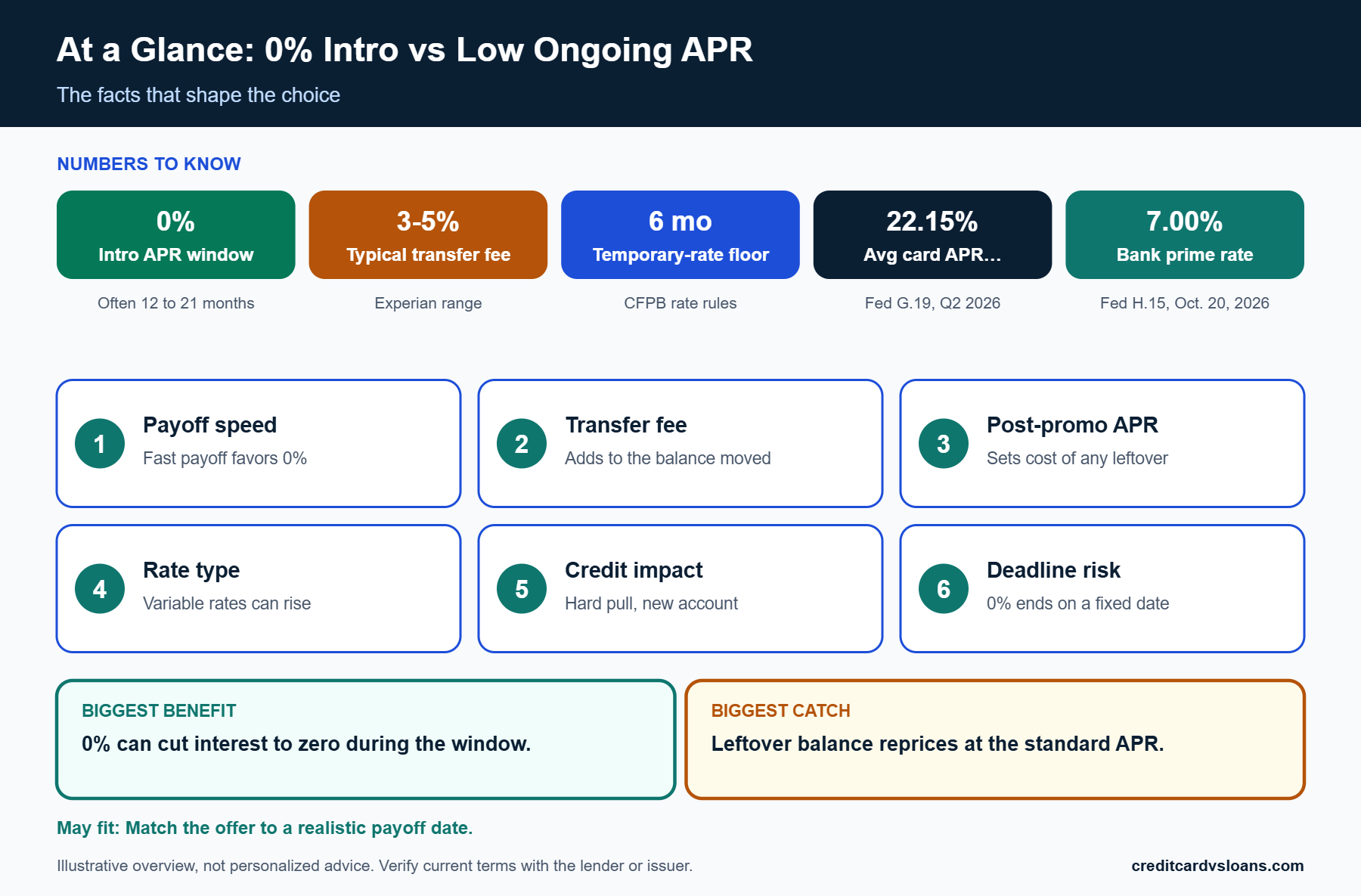
- Promotions expire; ongoing rates stay. Under federal rules a temporary rate generally must last at least six months, and the rate that follows is usually the standard purchase or transfer APR on the card.
- Both options involve a credit application. A new card can mean a hard pull, a new account and a change in your available credit, all of which can move your credit profile in either direction.
- Offers vary by lender and by borrower. Your approval, limit, fee and rate depend on your credit file, so use prequalification tools and the issuer’s pricing table before you apply.
Market figures below are dated to the Federal Reserve’s G.19 consumer credit release of Oct. 7, 2026 and the H.15 interest rate release of Oct. 21, 2026. Card terms change often, so treat every dollar example as an illustration and read the current terms on any offer you are weighing.
Table of contents
0 APR vs Low Interest Credit Card: The Short Answer
The rule of thumb that covers most cases
Start with how fast you can pay
The simplest rule of thumb is this: if you can realistically retire the balance before the promotional period ends, a 0% intro APR card is usually the cheaper tool, even after a transfer fee. You are paying a one-time cost, often a few percent of the amount moved, to avoid interest altogether for a year or more.
If your honest payoff timeline runs well past the promotion, the math shifts. Whatever balance remains when the zero period ends starts accruing interest at the card’s standard rate, and standard rates on promotional cards are often not low. A card built around a durable low rate may cost less over the full stretch, even though it never shows a zero.
The test is a number, not a feeling. Divide the balance (plus any fee) by the months in the promotion. If you cannot comfortably make that monthly payment on top of your other bills, plan as if the promotion will expire with a balance still attached.
Why the average card rate matters as a yardstick
It helps to know what you are escaping. The Federal Reserve’s G.19 release of Oct. 7, 2026 reports that commercial banks charged an average of 20.94% on all credit card accounts in the second quarter of 2026, and 22.15% on accounts that were assessed interest. Those are averages across the market, not offers, and your own rate may be higher or lower.
Against that yardstick, a low ongoing APR means a rate meaningfully below what many cardholders pay. A 0% promotion means a temporary rate of zero. Either can save real money compared with leaving a balance on a card charging an average or above-average rate, which is why the question is almost never whether to act but which tool matches your timeline.
Keep in mind that the average includes everyone from top-tier credit files to thin credit file borrowers, so your personal comparison point is your own current APR, found on your statement.
What each offer is really selling
The 0% intro APR: time at a price
A 0% intro APR sells you time. For a defined number of months, the interest meter is off for the balances the promotion covers, which may be new purchases, transferred balances, or both. Experian notes that common promotional lengths are 12, 15, 18 and 21 months, and that the length can differ between purchases and balance transfers on the same card.
The price of that time is usually a balance transfer fee on moved debt, a hard deadline, and a standard APR waiting at the end. You are also betting on your own discipline: the offer only works as intended if payments are on time and large enough to clear the balance.
Think of it as a bridge. It is excellent when there is a landing on the other side, which means a payoff date you can name. It is a poor bridge when the other side is another balance and another bridge.
The low ongoing APR: a smaller price for a longer time
A low-interest card sells predictability. There is no cliff date, usually no promotional deadline to track, and the savings accrue slowly every month. The trade-off is that the savings per month are smaller than zero, and the card often asks for stronger credit to qualify for the lowest tier of pricing.
Low ongoing rates are frequently variable, meaning they move with an index such as the U.S. prime rate. As of the Federal Reserve’s H.15 release of Oct. 21, 2026, the bank prime loan rate was 7.00%, and card agreements commonly price variable APRs as that index plus a margin. Your rate can rise if the index rises, which the CFPB lists among the situations in which an issuer can increase the rate on an existing balance.
That makes the low-rate card a better fit for people who expect to carry some balance for a long time, or who want a safety net for the months after a promotion would have ended.
At a glance: the two options side by side
Key terms, fit and cost drivers
Table 1 lays out the core differences before we dig into the math. Use it to place yourself, then read the later sections for the numbers that apply to your situation.
| Feature | 0% intro APR card | Low ongoing APR card |
|---|---|---|
| Core idea | No interest for a set window on covered balances | A smaller interest rate for as long as you keep the card |
| May fit | Borrowers with a payoff plan shorter than the promotion | Borrowers who expect to revolve a balance for a long time |
| Major advantage | Every payment can go to principal during the window | No deadline and no rate cliff to manage |
| Major drawback | Standard APR applies to what is left when the window closes | Interest accrues from day one on any balance |
| Typical fee exposure | Balance transfer fee on moved debt (Experian cites 3% to 5%) | Often no transfer promotion, so usually no transfer fee, but check each fee line |
| Primary cost drivers | Fee size, payoff pace, post-promotion APR, missed-payment terms | The APR itself, whether it is variable, and how long the balance lasts |
| Biggest risk | Treating the promotion end date as a suggestion | Assuming the rate will stay low if it is variable |
How to read the table without overfitting it
These are tendencies, not rules. Some low-rate cards also carry promotional offers, and some 0% cards have reasonable standard rates. The only way to know is to read the pricing disclosure on the specific offer, usually a table near the application that lists the APRs and fees for purchases, balance transfers and cash advances.
When you compare, convert everything into one question: how many dollars will I have paid in fees and interest by the day this debt is gone? Later sections show how to build that number for your own case, and the guide on balance transfer pros and cons covers the broader trade-offs of moving debt at all.
Who should slow down before choosing either
When neither card solves the real problem
If your spending regularly outruns your income, a lower rate shrinks the symptom without treating the cause. Moving $6,000 of debt to a 0% card feels like progress, but if the freed-up card limit on the old account refills, the total debt can grow instead of shrink.
That is not a moral judgment. It is a pattern lenders and counselors see often, and it is the reason this guide keeps returning to a written payoff plan. If you suspect the pattern applies to you, a nonprofit credit counselor can look at the whole budget, and the guide on credit card debt consolidation with bad credit covers realistic paths when approval for a good offer is unlikely.
When timing, not rate, is the constraint
Sometimes the issue is a cash crunch: a large bill is due now and income arrives later. In that case a 0% purchase promotion can function as short-term breathing room, provided you have a specific date by which the money arrives and a plan to pay before the zero period ends.
The reverse also happens. A person with steady income and a big balance may care less about breathing room and more about the monthly interest drain, which points toward whichever option produces the lowest total cost over the realistic life of the debt. The next sections show how to tell the difference with numbers instead of instinct.
How 0% Intro APR Offers Work
Purchases, transfers and the promotional clock
What the promotion actually covers
A 0% intro offer is not a single product. Some cards apply the zero rate to new purchases, some to balance transfers, and some to both, often with different lengths. Experian notes that the introductory rate usually applies to purchases, balance transfers or both, but usually not to cash advances, which commonly carry their own higher rate and fee.
Read the offer line by line. A card advertising 0% for 18 months on balance transfers may offer a shorter window on purchases, and a transfer may need to be completed within a set period after account opening. Experian cites a window such as 60 days as an example, and notes that processing a transfer can take up to 21 days, so a transfer you start late may not land in time to count.
That means the real promotional clock for a transferred balance can start earlier than your first payment. Build in a margin, and keep paying the old card’s minimum until the new card confirms the transfer posted, because a missed payment on the old account is its own problem.
The six-month floor and the common lengths
Federal rules set a floor on how short a temporary rate can be. The CFPB states that when an issuer raises a rate after a temporary rate expires, that temporary rate must have lasted at least six months. In practice most advertised promotions run longer, and Experian lists 12, 15, 18 and 21 months as common lengths.
Longer is not automatically better. A 21-month window with a 5% transfer fee can cost more up front than a 15-month window with a 3% fee, and which is cheaper depends on how quickly you pay. The window only has value up to the month your balance reaches zero, so any months beyond your payoff date are unused.
A practical shortcut: take the balance plus the fee, divide by the number of promotional months, and compare the result to what you can pay each month without borrowing again. That figure is the minimum payment you effectively need to make on your own, because the card’s required minimum is usually much smaller.
What happens when the clock runs out
The remaining balance is repriced, not forgiven
When the promotion ends, any balance left starts accruing interest at the standard rate for that type of balance. The CFPB’s explanation of promotional offers describes the zero-interest version this way: no interest accrues during the promotional period, and any balance left at the end begins accruing interest from that date, only on the remaining amount.
That is the friendly version, and it matters because not every promotion works this way. Deferred interest offers, covered in detail later, can charge interest back to the original purchase date if you do not clear the full amount in time. Always confirm which type you have before you rely on it.
The standard rate that applies is often a variable range, and Experian gives an example range of 18.99% to 28.99% for illustration. Where you land in the range depends on your credit profile at approval, which is why two people can apply for the same card and end up with very different post-promotion costs.
How your payments are applied matters
If you carry a promotional balance and also use the card for new purchases, the order in which payments are applied can quietly cost you money. The CFPB notes that payments above the minimum typically go to the higher-rate balance first. That helps when a high-rate balance is eating your payments, but it can slow down progress on a promotional balance that you are trying to clear before its deadline.
The cleanest way to avoid confusion is to keep new spending off a card you are using for a transfer, or to pay new purchases in full each month so they never accrue interest. If you do mix them, read the card’s disclosures to see how payments are allocated and what the grace period rules are for the purchase balance.
Set an alert for the last statement before the promotion ends. A balance you can see coming is easier to handle than one that reprices without warning.
How Low Ongoing APR Cards Work
Fixed, variable and what the index does
Why most card rates move
Many credit cards carry a variable APR, which is tied to an index. The CFPB lists a rise in the index, with the U.S. prime rate as its example, among the situations in which an issuer can increase the rate on an existing balance. That is an important distinction: a variable-rate increase is allowed on balances you already owe, while a discretionary increase generally applies only going forward.
As of the Federal Reserve’s H.15 release of Oct. 21, 2026, the bank prime loan rate stood at 7.00% and the effective federal funds rate was 3.88% (October 20 data). Card agreements typically add a margin to the prime rate to set your APR, so when prime changes, a variable card rate can change with it, subject to the notice terms in your agreement.
For a long-term borrower, this is the central risk of a low-rate card. The rate you see today is a snapshot. If you expect to hold the debt for several years, think about what a payment would look like if the rate were a few points higher.
Why a fixed rate is rarer than it sounds, and what to check
Some issuers offer fixed-rate cards, and some lenders market low fixed rates on closed-end products such as personal loans, which behave differently from revolving credit. For a card, the disclosure will state whether the APR is variable. If it says fixed, the agreement should also explain under what circumstances the rate can change, such as the temporary-rate expiration or a long delinquency described in the CFPB rules.
Do not assume a card with a low advertised rate is fixed. Look for the words variable, index, prime or margin in the pricing table. If you want certainty of payments rather than a lower revolving rate, a fixed-rate installment product may fit better, and the comparison of a 0% card vs a personal loan shows how that choice plays out for a specific purchase.
Also look at how the APR is quoted. A range like 17% to 27% means your assigned rate depends on your credit, and only the issuer’s offer to you tells you where you fall.
What counts as low, and for whom
Using the market average as a benchmark
The most useful definition of low is relative to your current rate. The Federal Reserve’s G.19 release of Oct. 7, 2026 reports an average of 22.15% for commercial bank card accounts assessed interest in the second quarter of 2026, and 20.94% across all accounts. A rate several points below your present card is a real improvement; a rate a point or two lower may not cover the cost of switching.
The G.19 figures describe the market, not what is on offer to a particular reader, and they cover bank-issued cards only. Credit unions, community banks and online lenders can price differently, so the average is a reference point and not a promise of what you can get.
When you compare, use the same rate type on both sides. A purchase APR is not the same as a transfer APR, and a rate that requires autopay or a deposit relationship is not the same as an unconditional rate.
Why the lowest rates tend to be hardest to qualify for
Pricing on cards is risk-based. Issuers set the lowest APRs for applicants whose files suggest the lowest risk, and the advertised range usually spans a wide gap between the low and high ends. Applicants with a thin credit file, recent late payments or high utilization often see the upper end of a range, which can erase the advantage of a low-rate product.
For a deeper look at how scores and profiles affect 0% approvals specifically, see what credit score you may need for a 0% APR card. The same logic applies to low-rate cards, with less emphasis on a single score cutoff and more on the whole file: payment history, utilization, income and existing debt.
If you already carry high balances, a prequalification check that uses a soft pull, meaning an inquiry that does not affect your credit scores, can show whether a low rate is realistic before you commit to a hard pull.
Fees and Fine Print That Change the Math
The balance transfer fee
How the fee is calculated and when it is charged
A balance transfer fee is a charge for moving debt from one card to another. The CFPB defines it as a fee charged to transfer an outstanding balance to a different credit card, and confirms that a card company is permitted to charge it on a zero percent rate offer. Experian reports that balance transfer fees usually range from 3% to 5% of the amount transferred.
At those percentages, moving a hypothetical $6,000 balance costs $180 at 3% and $300 at 5%. The fee is typically added to the new balance, so you pay interest on it too once the promotion ends, and you need to repay it as part of the total.
The fee is a cost you incur on day one, regardless of how quickly you pay. That is why a fee-bearing 0% offer is not free money, and why a short payoff plan on a low-rate card can sometimes beat a long one on a 0% card.
The transfer limit and what fits on the new card
The fee also reduces how much debt you can move. Experian notes that the maximum transfer equals the credit limit minus the fee, giving an example in which a $3,000 limit with a 3% fee ($90) allows a $2,910 transfer. Issuers may also set a transfer limit lower than the credit limit.
If the new limit is smaller than your balance, you will move only part of the debt and keep paying the old rate on the rest. Plan for that by deciding in advance which balance to move first, typically the one with the highest rate or the one you can clear within the window.
The guide to balance transfer fees vs interest works through when paying a fee still makes sense, including break-even timing, so use it alongside the examples in this article.
Penalty terms and other charges
Late payments can end the promotion
Experian notes that some cards impose a penalty APR for a missed payment, or even a payment made one day late, which can end the intro rate. It also notes that the penalty rate may apply to the existing balance if the account is not brought current within 60 days, a point that lines up with the CFPB’s list of exceptions to the general ban on raising rates on existing balances.
That 60-day rule is not an invitation to pay late. A late payment can bring a late fee, a possible rate change on future balances after notice, and damage to your credit file. The practical lesson is to set autopay for at least the minimum so the promotion cannot be derailed by a forgotten due date.
The CFPB adds that if a rate was raised after a payment more than 60 days late, the issuer must reinstate the old rate after six consecutive on-time minimum payments following the effective date of the increase, so the damage is not necessarily permanent.
Other lines in the fee table
Beyond the transfer fee, check the annual fee, the late payment fee, the cash advance fee and any foreign transaction fee. Many 0% and low-rate cards charge no annual fee, but not all, and an annual fee is a cost to add to your comparison if the card is one you plan to keep.
Be cautious with convenience checks that arrive with a promotion. They can be treated as cash advances or balance transfers depending on the issuer, with different rates and fees. If the terms are not clear on the offer itself, ask the issuer before you use one, and get the answer in writing if you can.
Finally, note whether the introductory rate applies only if you stay current. A good offer with strict conditions can behave like a bad one if you are not ready to meet them.
Total Cost Compared: Worked Examples
Ground rules for the illustrations
What the hypothetical numbers assume
Every figure in this section is a hypothetical illustration, not a quote, a rate you can expect or a forecast. The starting balance is $6,000. Interest is calculated monthly at one-twelfth of the APR on the running balance, payments are the same fixed amount each month, and no new purchases are added. Real cards compute interest on daily balances and add rules about minimum payments, so your actual numbers will differ.
The rates are placeholders chosen to show how the structure behaves. A hypothetical 24% APR stands in for a current card, 15% and 12% stand in for low ongoing offers, and 24% or 29.99% stand in for the standard rate that follows a promotion. None of these is a claim about what any issuer charges.
Fees are applied the way many offers are described: the balance transfer fee is added to the balance moved, so the new card starts at $6,180 with a 3% fee or $6,300 with a 5% fee, and interest after the promotion applies to what remains.
Why the same payment is the fair test
To compare options apples-to-apples, the examples hold your monthly payment constant. The point is to answer a question you can actually face: given what I can pay each month, which option leaves me with less cost and a faster finish?
If you used each card’s minimum payment instead, the comparison would mostly measure the issuer’s minimum formula, and low-interest cards would look better or worse for reasons unrelated to price. Using one fixed amount isolates the effect of the APR and the fee.
The same fixed payment also exposes something the minimum hides. When your payment is only slightly larger than the monthly interest, the balance falls slowly and the total cost balloons, a pattern that shows up in the second scenario below.
Scenario one: a payoff plan that fits the promotion
When the 0% offer has room to finish
Table 2 compares three paths for the $6,000 balance: staying on a hypothetical 24% card, moving to a hypothetical 15% low-rate card, or moving to a card with 0% for 15 months, a 3% fee and a 24% standard rate afterward. Costs are total interest plus any fee until the balance reaches zero.
| Monthly payment | Stay at 24% APR | Low ongoing 15% APR | 0% for 15 months, 3% fee, then 24% |
|---|---|---|---|
| $200 | $3,254.63 interest, 47 months | $1,567.13 interest, 38 months | $180 fee + $685.84 interest = $865.84, 35 months |
| $300 | $1,739.24 interest, 26 months | $947.68 interest, 24 months | $180 fee + $119.52 interest = $299.52, 21 months |
| $400 | $1,204.64 interest, 19 months | $686.41 interest, 17 months | $180 fee + $3.60 interest = $183.60, 16 months |
In this setup, the 0% path is cheapest at every payment level shown. At $400 a month, the balance plus fee is cleared just as the promotion ends, so nearly the entire cost is the $180 fee. At $200 a month, the promotion ends with a balance of $3,180 still owed, but the lack of interest in the first 15 months still leaves the total well below the low-rate alternative.
How to read the result without overreading it
The lesson is not that 0% always wins. It is that a fee of $180 is small relative to the interest saved when the starting rate is high and the zero period is long. The first month’s interest on $6,000 at 24% is $120, versus $75 at 15%, so a 3% fee equals about four months of the 24% to 15% interest gap on the opening balance.
That break-even logic is useful for any offer. Divide the fee by the monthly interest you would otherwise pay to see roughly how many months of zero it takes to recover the cost. Recovery gets faster the higher your current APR and the larger the balance, and slower if you plan to pay down the balance quickly anyway, since interest falls with the principal.
The guide on paying a balance transfer fee vs paying interest extends this approach to a range of fee sizes and timelines.
Scenario two: slower payments and a steep standard rate
When the low ongoing rate pulls ahead
Now change the facts. Suppose you can only afford $150 or $180 a month on the same $6,000. The comparison below uses a hypothetical 12% low ongoing card, a 12-month 0% card with a 3% fee and a 29.99% standard rate, and an 18-month 0% card with a 5% fee and the same 29.99% standard rate.
| Monthly payment | Low ongoing 12% APR | 0% for 12 months, 3% fee, then 29.99% | 0% for 18 months, 5% fee, then 29.99% |
|---|---|---|---|
| $150 | $1,700.80 interest, 52 months | $180 fee + $3,570.95 interest = $3,750.95, 66 months | $300 fee + $1,965.15 interest = $2,265.15, 56 months |
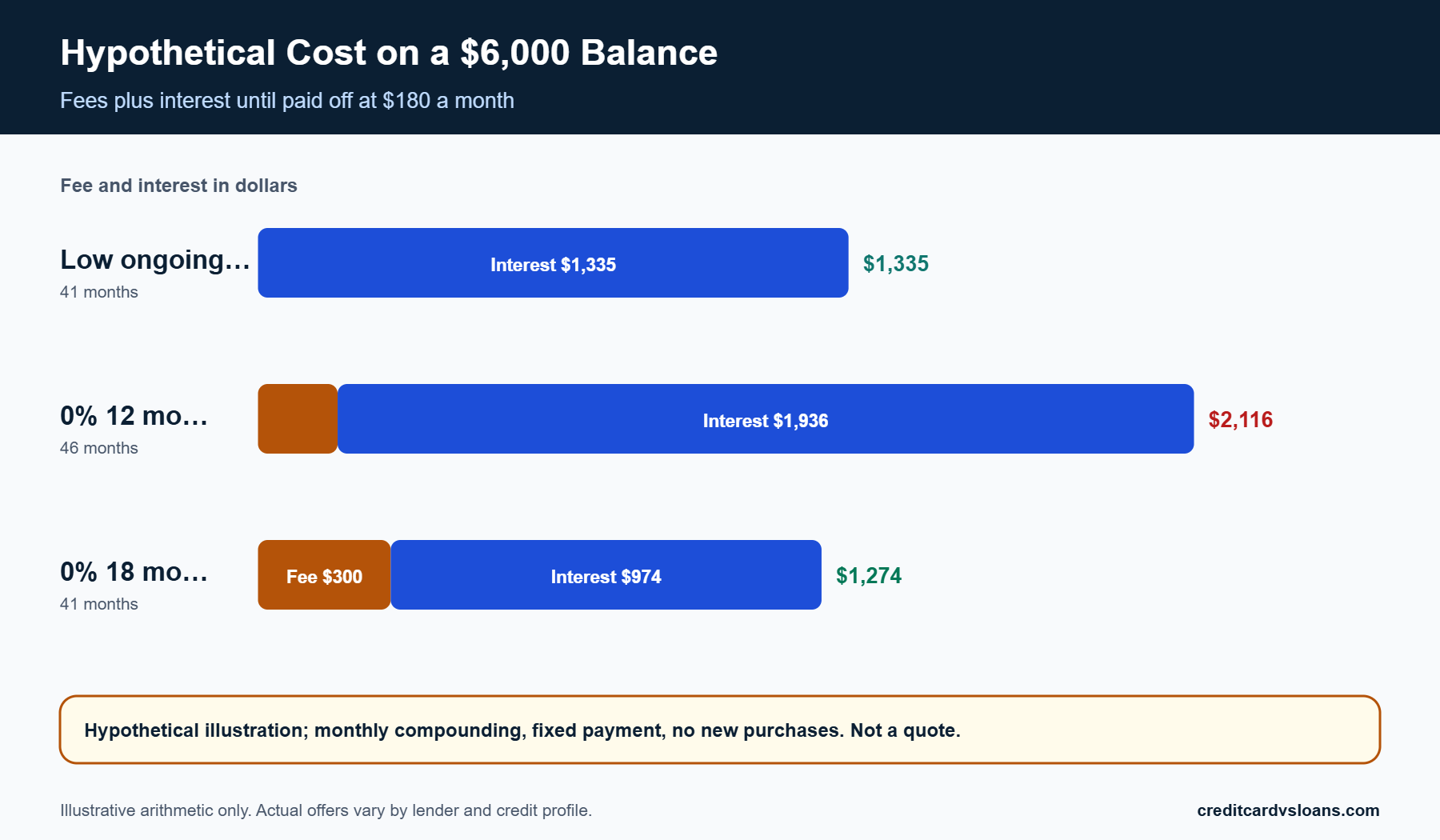
| $180 | $1,334.97 interest, 41 months | $180 fee + $1,936.15 interest = $2,116.15, 46 months | $300 fee + $974.04 interest = $1,274.04, 41 months |
At $150 a month, the low-rate card is cheapest. The 12-month promotion ends with most of the balance still owed, and the 29.99% standard rate does the damage. At $180 a month, the low-rate card and the 18-month, 5%-fee card finish in similar territory, with the 0% card slightly ahead on total cost in this setup.
The cliff effect at very low payments
The sensitivity gets more dramatic as payments shrink. At $120 a month, the same low 12% card is paid off in 70 months with $2,359.42 in interest in this illustration. The 12-month, 3%-fee, 29.99% path takes 189 months and generates $16,436.59 in interest, because after the promotion ends the monthly payment barely exceeds the monthly interest charge.
That extreme is not a prediction. It is a warning about what happens when a high post-promotion rate meets a payment that is too small to make real progress. If your realistic payment is near the interest on the balance at the standard rate, a low ongoing APR or a different structure may serve you better than a 0% promotion.
A supporting chart below shows the $180-a-month case, where fees and interest are split by color so you can see which part of the cost each option puts first.
The cost and credit comparison in one table
Rate type, fees, repayment pattern and credit effects
Numbers aside, the two options differ in structure. Table 4 summarizes what to compare on the disclosure and how each option tends to interact with your credit profile. It uses general tendencies; your offer will specify exact terms.
| Factor | 0% intro APR card | Low ongoing APR card |
|---|---|---|
| APR or rate type | Temporary 0%, then a standard purchase or transfer APR, often a variable range | One ongoing APR, often variable and tied to an index such as prime |
| Fees | Balance transfer fee on moved debt; check annual and late fees too | Check annual, late and cash advance fees; transfer fee only if you move debt |
| Repayment pattern | Front-loaded: best when most of the balance is cleared during the promotion | Steady: savings accrue gradually and do not depend on a deadline |
| Credit inquiry | A new application normally means a hard pull | A new application normally means a hard pull; existing-card rate review may differ |
| Utilization and DTI effect | A new limit can lower utilization; transferred debt still counts toward what you owe | Same logic if opening a new account; no change if you keep your current card |
| Risk flags | Deadline, penalty APR, high standard rate, deferred-interest wording | Variable-rate increases, conditions attached to the rate, long payoff |
Turning the table into a decision
Work down the table with your own numbers. Start with the standard APR on each offer, then the fee, then the payment you can sustain. If a 0% offer’s standard rate is much higher than the low-rate card, the zero period has to be long enough and your payments large enough to make up for that gap.
If the answer is still close, favor the option with fewer ways to fail. A low-rate card with no deadline is more forgiving of a lost job or an unexpected expense than a promotion that reprices on a fixed date. A 0% card is more rewarding if your income is stable and you can name the month your debt will be gone.
Who Qualifies: Requirements for Each Option
What issuers weigh when you apply
Credit history, score ranges and the rest of the file
Promotional 0% cards tend to be marketed to applicants with strong credit. Experian says good to excellent credit is generally needed and lists FICO Score ranges of 670 to 739 as good, 740 to 799 as very good and 800 to 850 as exceptional. Those labels are a guide to how lenders may view a score, not a cutoff that an issuer publishes or a promise of approval.
Low-rate cards often use the same file-based underwriting, but pricing varies across a range. A borrower on the edge of approval might be offered the card at the top of its APR range, or a lower limit, and that changes the comparison. A 0% offer you can only get with a small limit may not hold your balance at all.
The deeper discussion of score thresholds is in the guide to credit scores for 0% APR cards. The short version is that no single number settles it, since payment history, utilization, recent inquiries and existing debt all feed the decision.
Income and ability to pay
Card issuers must also consider your ability to make payments. The CFPB notes that if you are at least 21, an issuer can assess your ability to pay as an individual or as part of a couple using your own income or assets or your combined household income, while applicants under 21 are assessed on their individual income and assets only, or with a co-signer who is 21 or older.
In practice, issuers also look at how much debt you already carry relative to income. A person with a large balance and a modest income may find that the credit limit offered is lower than the balance they hoped to move, which limits the benefit of either option.
Because every lender sets its own standards, the same applicant can receive different answers from different issuers. A decline from one does not predict the result with another, though each application does have its own credit effects, discussed below.
Check your odds before you apply
Soft pulls, hard pulls and prequalification
A soft pull is a credit check that does not affect your scores, while a hard pull is a formal application inquiry that can. Many issuers offer prequalification tools that use a soft pull to show whether you may qualify for particular cards, usually with indicative terms. These tools can narrow your options without adding hard inquiries.
Prequalification is not approval. The issuer will usually confirm your information and run a full credit check when you formally apply, and the final terms can differ from what the tool showed. Treat a prequalified result as a sign that applying may be worthwhile, not as the offer itself.
If you do apply, rate shopping across several cards in a short stretch can add several inquiries to your file, so it is worth narrowing to one or two offers in advance and then reading the pricing table before submitting.
Asking your current issuer first
Before opening a new account, it can be worth contacting the issuer of the card you already have to ask about lower-rate options or hardship programs. Some issuers will consider a review, others will not, and there is no assurance of a result, so view the call as a low-cost check and not a plan.
If you do get an offer from your current issuer, evaluate it exactly as you would a new card. Compare the rate, the duration, any fee and the standard rate that follows. An offer that sounds generous on a phone call should still be checked against the written terms.
For cases where your approval odds are limited, the guide to consolidating card debt with bad credit covers options such as nonprofit credit counseling and secured or credit-builder approaches.
Credit Score and Utilization Effects
How applying and opening an account show up
The hard inquiry and the new-credit factor
Applying for a card typically produces a hard inquiry, and Experian notes that it can hurt your credit score. According to myFICO, new credit makes up 10% of a FICO Score, inquiries fall under that category, and FICO Scores consider only inquiries from the last 12 months, although inquiries remain on your credit report for two years.
The effect varies by borrower and is generally modest for a single inquiry compared with the effects of late payments or high utilization. Nobody can tell you how many points it will cost, and this guide will not try, since the result depends on the rest of your file.
The practical point is timing. If you plan to apply for a mortgage or auto loan soon, think about whether a new card application is worth adding to your file now.
New account age and what changes in your file
A new account lowers the average age of your accounts, and myFICO lists length of credit history as 15% of a FICO Score. A new card also adds a new line of revolving credit to your report. Over time, as you make on-time payments and the account ages, these effects typically fade.
The reverse is true if you apply for no new card. A low ongoing APR obtained by calling your current issuer may not add an inquiry or a new account, which is a possible credit advantage over a transfer card, if such an offer is available to you.
In either path, payment history is the factor with the largest weight. myFICO lists payment history as 35% of a FICO Score, so the most important credit habit during any payoff plan is paying on time every month.
Utilization before and after the move
A hypothetical utilization example
Credit utilization is the share of your available revolving credit that you are using. myFICO places it under amounts owed, which makes up 30% of a FICO Score, and notes that using a high share of your available revolving credit can hurt your score, while keeping it low can help.
Consider a hypothetical borrower with a $6,000 balance on a card with a $10,000 limit, which is 60% utilization on that card. They move the balance to a new card with an $8,000 limit and a 3% fee, so the new card carries $6,180, or 77.25% of its limit. Across both cards, with the old $10,000 limit still open and now at zero balance, total balances are $6,180 against $18,000 in limits, about 34%.
The illustration shows why the answer depends on which view of utilization a scoring model emphasizes. Per-card and overall utilization can move in different directions after a transfer, and the net effect depends on the model and on the rest of your file.
Closing the old card is a separate decision
Experian notes that closing old cards after a transfer may hurt a score by reducing available credit. In the example above, closing the old $10,000 card would drop total limits to $8,000, putting overall utilization at 77.25% instead of about 34%.
Keeping the old account open is not free of risk if you are tempted to spend on it again, and it may carry an annual fee that you should weigh. If neither applies, leaving it open with a zero balance is often the credit-friendlier choice. Whether to close it is your call, and the answer depends on the fee, the account’s age and your discipline.
If utilization is the part of your file you most want to understand, the Related reading list at the end of this guide points to companion articles on it.
| Credit factor | New 0% transfer card | Low-rate card (new account) | Rate reduction on current card |
|---|---|---|---|
| Payment history (35% of a FICO Score per myFICO) | On-time payments help; a missed payment can end the promotion and hurt your file | On-time payments help | Same account history continues |
| Amounts owed (30%) | Per-card utilization may be high; overall utilization depends on old limits | Similar if debt is moved; unchanged if you keep the old card | No new limit, so utilization stays tied to the existing line |
| Length of history (15%) | New account can lower average age | New account can lower average age | No new account |
| New credit (10%) | Hard inquiry and a new account | Hard inquiry and a new account | Often no new inquiry, depending on the issuer |
Risks and Red Flags to Check Before You Choose
What can change a promotion or a rate
The short list of events federal rules allow
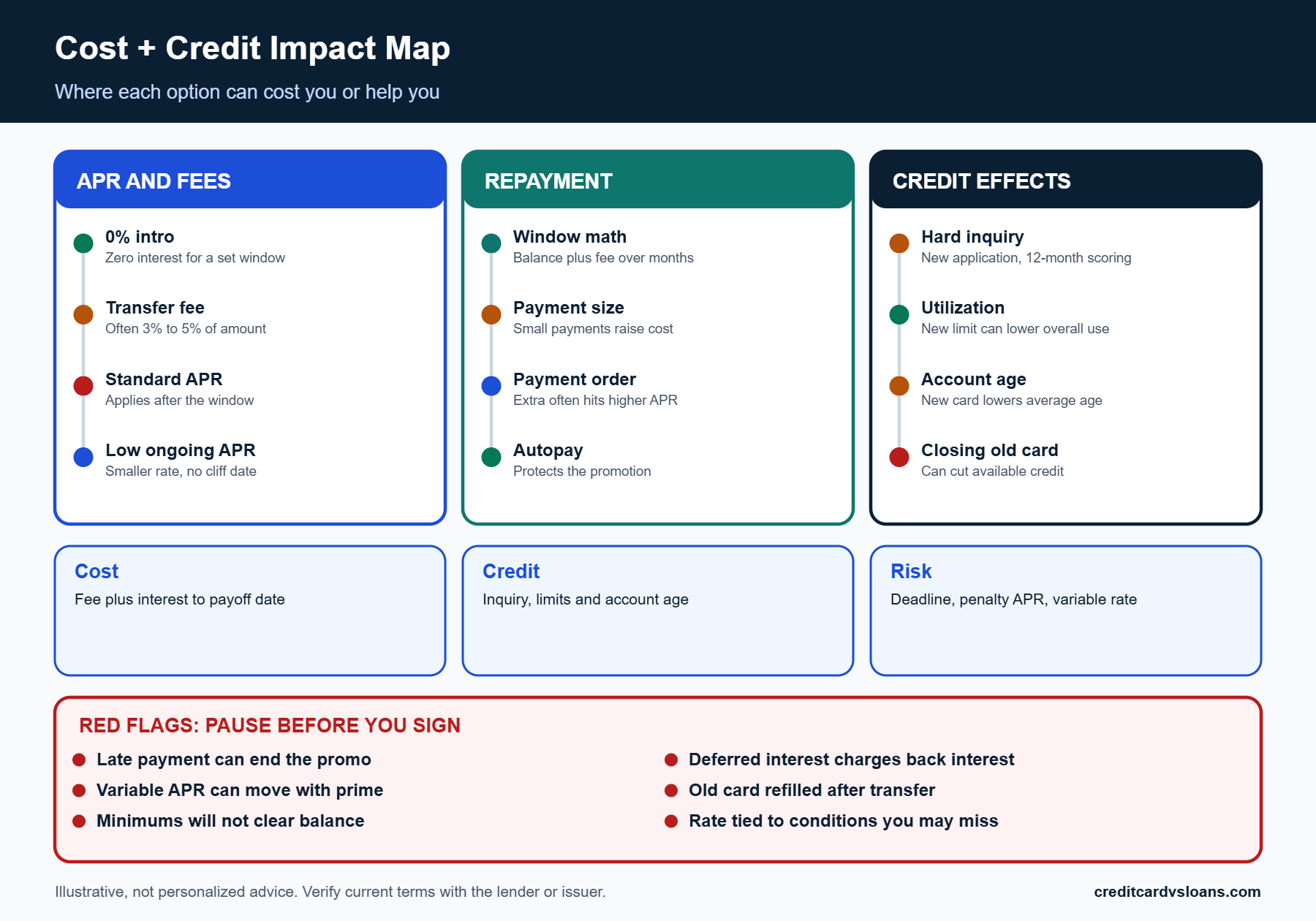
Federal rules limit when an issuer can raise the rate on money you already owe, which is part of why promotions are reasonably safe when you follow the terms. The CFPB explains that issuers generally cannot raise the rate on existing balances except in a short list of situations, and Table 6 translates that list into plain language for this comparison.
| Situation | What it means for a 0% card | What it means for a low-rate card |
|---|---|---|
| A temporary rate expires | The rate on the remaining balance moves to the standard rate; the temporary rate must have lasted at least six months | Applies only if your low rate was itself a temporary rate |
| A variable rate’s index rises | Applies once the standard variable rate is in effect | Your APR can rise with an index such as the prime rate |
| Minimum payment not received within 60 days of the due date | The promotional rate can be lost | A higher rate can apply to the balance |
| You fail to follow a workout arrangement | Relevant if you agreed to a reduced rate with your issuer | Relevant if you agreed to a reduced rate with your issuer |
| Servicemembers Civil Relief Act protections expire | Applies to eligible servicemembers | Applies to eligible servicemembers |
The CFPB page also notes that issuers generally must give 45 days of advance notice before raising the rate on new purchases, and generally cannot raise the rate on new transactions during the first year of the account. Check the agreement for your own card, since the details of how and when a rate can change are spelled out there.
Notice, review and how rates can come back down
Rate increases are not always permanent. The CFPB says that after an increase made on 45 days of notice, the issuer generally must review the rate at least every six months, and it may need to compare your rate with what it would charge a new applicant. If yours is higher, the issuer must reduce it, though not necessarily to your original rate.
That protection matters for a low-rate card whose rate rose on a penalty. It does not mean you should plan on a rate cut, but it does mean a single mistake is not necessarily a lifetime sentence. Keep records of your on-time payments, since the CFPB notes that after a payment more than 60 days late, the issuer must reinstate your old rate after six consecutive on-time minimum payments following the increase’s effective date.
If you believe a rate increase was made in error, the CFPB advises contacting your card issuer.
Risks that come from behavior, not terms
The refill problem
The most common failure of a balance transfer is not a hidden clause. It is the old card filling back up. If a transfer frees $6,000 of limit and you spend it again, the debt can double, and the next promotion may be harder to qualify for. The structure of the plan should make spending on the old card difficult, for example by removing it from digital wallets and leaving it at home.
A zero rate also makes carrying a balance feel painless, and the end date can sneak up. Build a written schedule with the month the promotion ends, the monthly payment needed to hit zero by then, and one extra month of margin.
If you cannot make a plan that works on paper, the problem is likely affordability rather than interest, and the debt may need a different kind of help, such as a nonprofit credit counseling session.
The minimum payment illusion
Required minimums on a 0% balance are often small, and paying only the minimum is a common way to arrive at the end of the promotion with most of the debt intact. The CFPB’s guidance on promotions warns that minimum payments usually will not pay off the balance in time and recommends calculating the monthly amount needed to clear it before the promotion ends.
The illustration in Table 3 shows the cost of a small payment on a longer horizon. A person who pays $120 a month on a $6,000 balance with a 29.99% standard rate may be paying for years. Treat the minimum as the lowest payment you are allowed to make, not the one you should plan around.
Automating a payment above the minimum, on a day shortly after your paycheck lands, is a simple habit that removes the temptation to skip a month.
The risks that attach to a low-rate card
Variable rates and long timelines
A low-rate card’s main risk is time. The longer the balance lasts, the more the rate can change, and the more a small improvement in the APR gets diluted by other costs. If a low-rate card is variable and you expect a ten-year payoff, you are making a long bet on the direction of rates.
It also leaves the decision open each month. With a 0% deadline, you are forced to confront the balance. Without one, it is easy to treat the payment as part of the budget forever, and the debt never ends.
A hybrid approach helps: set a self-imposed payoff date on a low-rate card, then compare your actual progress to that date each quarter. If you fall behind, revisit the choice instead of letting the balance drift.
Conditions attached to the low rate
Some low advertised rates depend on conditions such as autopay enrollment, direct deposit or a banking relationship, and they can be removed if you stop meeting them. Read the footnotes on the offer, because the rate in the headline may be the best case.
Confirm whether the rate applies to existing balances or only to new purchases. A card that offers a low rate on purchases but a higher rate on transfers will not solve a debt-consolidation need, and a card that offers a low transfer rate may price purchases differently.
Compare the full set of APRs in the pricing table, not just the first line, and confirm what the issuer calls a promotional rate versus a permanent one.
Deferred Interest and Other Look-Alike Offers
Why deferred interest is a different animal
The wording that tells you which one you have
A 0% interest offer and a deferred-interest offer can sound the same in an advertisement, but they behave very differently when the promotion ends. The CFPB notes that zero-interest offers use wording like 0% intro APR on purchases for 12 months, while deferred-interest offers use wording like no interest if paid in full within 12 months, and calls the word if the key signal.
With a true 0% offer, only the remaining balance starts accruing interest when the promotion ends. With deferred interest, the lender tracks interest from the purchase date and, if you do not clear the full promotional balance in time, adds all of that deferred interest to the remaining balance.
These offers appear often with store and retail cards, and Experian notes that deferred-interest cards are most often used with store cards. Treat every no-interest-if offer as a different product from a 0% intro APR card and read it twice.
The CFPB’s television example, with the numbers
The CFPB illustrates the difference with a $400 television, $25 monthly payments, $300 paid during 12 months and a 25% APR after the promotion. With a zero-interest offer, the buyer owes $100 after the promotion, and interest is charged only on that $100 going forward. With a deferred-interest offer, the buyer owes $165, made up of the $100 balance plus $65 in deferred interest, and interest also begins accruing on that $65.
The gap of $65 in a small purchase becomes much larger on a bigger one. For a $6,000 balance, the added interest on a deferred-interest product could be substantial, which is why this guide treats the two types as separate categories in every comparison.
The CFPB adds that you can ask your issuer to apply extra payments to the deferred-interest balance, since payments above the minimum typically go to the higher-rate balance first.
Other offers that look similar but are not
Low-rate transfer offers and promotional personal loans
Some offers present a low, not zero, introductory rate on transfers, such as 2.99% for a number of months. These can be competitive when the fee is low or absent, but they follow the same logic as 0% offers: the question is the total cost over your payoff period, including the standard rate that follows.
Fixed-rate personal loans are a separate category. They have a fixed payment and a fixed end date, which can protect you from the post-promotion rate shock, but they come with their own origination fee and approval standards. The comparison of a 0% card vs a personal loan for furniture and of the same choice for back-to-school spending shows how those trade-offs play out for planned purchases.
When in doubt, put each offer in the same format: total fees, the rate during the main period, the rate afterward, and the date everything is due.
Introductory offers on purchases only
A 0% purchase APR helps if you are about to buy something and can pay it down within the promotion, but it does not help with existing debt. Because the card is for new purchases, a balance you already carry on another card keeps its rate.
That distinction is easy to miss when you compare marketing lines. A card advertising 0% on purchases and a higher rate on transfers is a different product from one advertising 0% on both. Match the offer to the job you need done.
If you are comparing a purchase offer with a loan for a specific item, the loan comparison guides linked above cover the costs and timelines in detail.
Alternatives Worth Comparing
Other ways to lower the cost of existing debt
Debt consolidation loan vs a transfer card
A consolidation loan replaces revolving card debt with a fixed-rate installment loan. That gives you a defined payment and end date, which can be helpful if you worry that a promotion deadline will pass without enough progress. The trade-off is that loan pricing can include an origination fee and depends on your credit profile.
The broader comparison is in balance transfer pros and cons, which sets out when moving debt helps and when it does not. A loan is not automatically better or worse than a card; the question is the total cost at your payment level and the risk you are willing to carry.
Whichever route you choose, compare the all-in cost: fees plus interest plus the time it takes to be debt-free.
Credit counseling and hardship options
If you cannot make payments that reduce the debt in a realistic time, a nonprofit credit counseling agency may help you evaluate a debt management plan, a hardship arrangement with your issuer or a combination of steps. Use agencies that disclose their fees up front, and be wary of any company that asks for large payments before doing anything.
Lower-rate products do not fix a budget that does not balance. If your income can cover the payment, a plan built around the right card is a legitimate tool. If it cannot, early help usually costs less than waiting.
The CFPB and the FTC publish consumer guidance on choosing a credit counselor and on spotting debt relief scams; start there before you pay anyone.
Staying put and paying smarter
Targeted payoff on the card you have
Sometimes the best change is not a new product. Paying more than the minimum, directing extra payments to the highest-rate balance, and cutting new charges can reduce the cost of debt without an application or a fee.
The earlier illustration shows how powerful a larger payment can be: at $300 a month instead of $200 on the $6,000 balance, the hypothetical 24% card cost $1,739.24 in interest instead of $3,254.63. That is a difference created entirely by the payment, with no new account.
If you can increase your payment through a temporary budget change, such as pausing nonessential spending for a few months, that can sometimes beat a product switch.
Asking for a lower rate
You can ask your current issuer whether a lower rate is available, especially if you have a record of on-time payments. Issuers are not obliged to agree, and a request does not carry any assurance, but it costs nothing and may not involve a hard inquiry.
Keep notes on who you spoke to, what they offered and the date, and ask for any offer in writing. If the new rate is not lower than what a transfer card would give you after all costs, compare them side by side.
Whether the result is a modest cut or a refusal, you will have learned what your current issuer can and cannot do, which informs the rest of the decision.
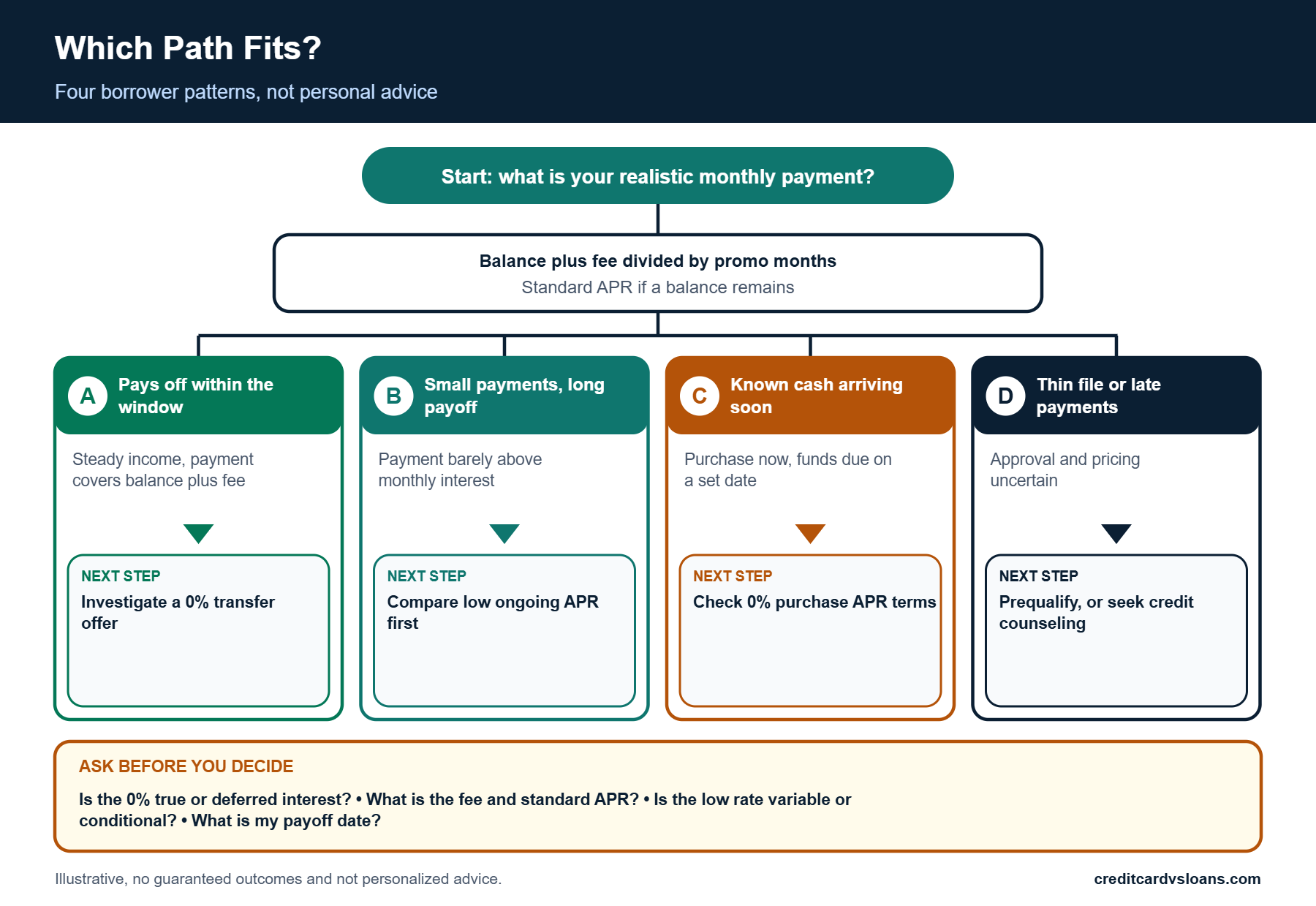
Which Path Fits? Scenarios and a Decision Matrix
Situations where a 0% intro APR tends to fit
You can name the month the balance reaches zero
A 0% intro APR fits best when your numbers already work. You have a balance, you know the fee, and when you divide the total by the promotional months, the monthly amount is something you can pay without new borrowing. In the first worked example, that was the pattern: the larger the share of the balance cleared during the promotion, the more the structure favored 0%.
It also fits when your current rate is high. The higher the APR you are escaping, the faster a one-time fee pays for itself, since each month of zero interest avoids a larger charge. If your current card sits at or above the market averages from the Federal Reserve’s G.19 release, a fee-bearing 0% offer has more room to save than it would against a modest rate.
Finally, it fits when your income is steady. A fixed deadline is easier to manage if you can predict your cash flow over the promotion.
You have a short-term cash crunch with a known end
A 0% purchase offer can serve as a short bridge when money is tight now and a known amount arrives later, such as a tax refund, a bonus or a payment from a client. Used that way, the promotion buys time without interest, and the plan has a natural payoff date.
The discipline is to treat the bridge as a loan with a due date. Write down the date the money should arrive, the amount you will pay, and what you will do if it comes late. If the plan relies on an uncertain event, shorten the borrowing or choose a different tool.
Be careful not to confuse a bridge with a habit. If the same gap appears every few months, the issue is a budget shortfall, and a series of promotional offers will not close it.
Situations where a low ongoing APR tends to fit
Your payment is small relative to the balance
When your realistic payment barely exceeds the interest that would accrue, the standard rate after a promotion is the number that matters most. The second worked example showed it: at $150 and $180 a month, the low 12% card matched or beat 12-month promotions with a high standard rate, and at $120 the gap became extreme.
If you can only pay a small amount, ask which option leaves you with the smallest rate when the promotion ends. A low ongoing APR sets that rate from the start and does not change with a calendar date, which makes the plan easier to follow.
It is still worth considering whether a longer 0% window, even with a higher fee, covers more of your payoff time. The table in the next subsection helps with that choice.
You expect to use the card and carry a balance over time
Some borrowers use a card for ongoing expenses and carry a balance from month to month. For them, a promotion that ends in 15 months does not address the long-run cost, but a lower ongoing rate on purchases does. This is also a case where a low-rate card with a clear fee table and no deadline can be easier to live with.
If your income is variable, the flexibility is valuable. A low rate with no cliff date is less likely to put you in a bind in a slow month than a promotion that reprices on a fixed date.
Keep the variable-rate risk in mind. If you expect to carry a balance for years, run a quick stress test: what would your payment look like if the APR were several points higher?
The decision matrix
Scenario, option to investigate, why and what to verify
Table 7 gathers the scenarios above into a single reference. It is not personalized advice; it shows which option may be worth investigating first for a given pattern, with the checks that would change the answer.
| Borrower scenario | Option to investigate | Why | What to verify | When to avoid it |
|---|---|---|---|---|
| Can clear the balance within 12 to 18 months | 0% intro APR transfer card | Interest savings can outweigh the fee | Fee size, window length, transfer deadline, limit | If you will spend on the old card again |
| Can pay only a small amount each month | Low ongoing APR, or a longer 0% window | The post-promotion rate drives total cost | Variable or fixed, margin, standard APR range | If the low rate has conditions you may not meet |
| Large purchase now, income arriving on a known date | 0% intro APR on purchases | Time without interest, with a natural payoff date | Purchase APR length, true 0% vs deferred interest | If the payoff date is uncertain |
| Carrying a balance for years on ongoing spending | Low ongoing APR | No cliff date and steadier cost | Annual fee, rate type, how the rate may change | If a short payoff plan could use 0% instead |
| Thin credit file or recent late payments | Prequalify first, or credit counseling | Approval and pricing may not match the advertised best case | Soft-pull tools, written terms, nonprofit counseling options | If an offer needs fees paid before you receive anything |
| Need a fixed payment and a firm end date | Fixed-rate installment loan | Predictable schedule that does not reprice | Origination fee, APR, term, prepayment rules | If a loan fee outweighs the interest saved |
Using the matrix when your case is mixed
Real situations are rarely clean. You might have a payment that can clear half the balance during a promotion but not the rest. In that case, test the outcome both ways: calculate the cost if the remaining balance reprices at the standard rate, and compare it with the cost of the low-rate card over the same period.
Another mixed case is a household with several balances. You may find that moving the highest-rate balance to a 0% card while keeping the others where they are is more practical than moving everything, especially when the new limit is limited. Targeting the debt that costs the most per dollar usually gives the largest saving.
For the credit and approval side of this decision, the guides on credit score needs for 0% APR cards and consolidation with bad credit offer more detail, and the balance transfer pros and cons guide covers how to weigh the move itself.
Checklist: What to Verify Before You Apply
The numbers to gather first
Your current debt, line by line
Start with your own statements. For each card you might move or pay down, write the current balance, the APR shown on the statement, the minimum payment and the due date. These four numbers are the baseline against which every offer is measured, and they are often more different than people expect.
Add the credit limit on each card so you can compute utilization before and after any move. Then total the monthly amount you can put toward debt without borrowing again. That last figure, not the minimum payment, is the one that decides which option fits.
If you are comparing a transfer against staying put, include the interest you would pay on the old card over the same period. A comparison that leaves out the cost of doing nothing makes every offer look better than it is.
A simple payoff test for any offer
For a 0% offer, use this test. Take the balance, add the transfer fee, and divide by the number of promotional months. If the result is more than you can pay each month, expect to carry a balance past the promotion and compare the standard APR carefully.
For a low-rate offer, estimate the monthly interest at the stated APR and check that your payment is meaningfully larger. A payment that barely exceeds the interest does very little to reduce the balance, as the $120 example showed.
Whichever test you use, add a margin. Life produces surprises, and a plan with one month of buffer survives more of them than a plan that is exact on paper.
The questions to ask or confirm about an offer
Terms to find in the disclosure
Before you apply, find the pricing table and confirm: the promotional APR and its exact length, which balances it covers, the transfer deadline after account opening, the transfer fee as a percentage and a minimum dollar amount, the standard APR range and whether it is variable, and the penalty terms for late payments.
Also confirm whether the promotion is a true 0% offer or a deferred-interest offer, whether there is an annual fee, and how payments above the minimum are applied across balances. If any of these is unclear, ask the issuer in writing and keep the answer.
If an offer is hard to understand, that is itself a signal. Straightforward products usually have straightforward disclosures.
Habits that protect you after you start
Once the plan starts, set autopay for at least the minimum, add a calendar reminder for the final statement before the promotion ends, and track progress monthly. Keep the transferred card out of daily use unless you pay new purchases in full each month.
Decide in advance what you will do with the old card. If it has no annual fee and you will not use it, keeping it open can help your available credit; if it tempts you to spend, a locked or hidden card is a safer plan, and closing it is a decision to make with its credit effects in mind.
If your situation changes, such as a job loss or an unexpected bill, contact the issuer early. Options are usually better before a missed payment than after.
Questions Readers Often Ask After the Comparison
Rolling the balance again
Can I move the balance to another 0% card when the promotion ends?
Sometimes, but it is not something to plan on. A new transfer requires a new application, so it brings another hard inquiry, another fee and the need to be approved again. Whether you qualify depends on your credit file at that time, and whether the next offer is as good as the first depends on the market.
A strategy that depends on repeated approval is fragile. If your income, credit or the lending environment changes, the chain can break and leave you with a balance at a standard rate. A payoff plan that works without a second transfer is safer.
If you do consider a second transfer, treat it as a new decision and run the same cost comparison, including the new fee on the remaining balance.
Does repeating transfers change the math on fees?
Yes. Each transfer adds a fee on the amount moved, and fees on repeated transfers can add up to more than the interest you saved. In the first worked example, a 3% fee on $6,000 was $180. If you pay that again on a still-large balance, you may spend more on fees than a steady low-rate payoff would cost.
The guide to balance transfer fees vs interest covers break-even timing for these cases, and it is worth reading before a second move.
The cleanest approach is to use the first promotion to clear as much as possible, then switch to a plan for the remainder that does not depend on another offer.
Using the card for more than the transfer
Should I put new purchases on a card with a transferred balance?
It depends on how the card treats purchases. Some cards give the same 0% rate on purchases, some do not, and some apply a grace period only when the full statement balance is paid. Because the rules vary by issuer, read the agreement before mixing the two.
The CFPB notes that payments above the minimum typically go to the higher-rate balance first, which means new purchases at a higher rate can attract your extra payments while a promotional balance waits. That can be fine if the promotional balance has a long runway and a poor fit if it is close to expiring.
A clean approach is to use a different card, or cash, for everyday spending while the transfer card has a balance.
Should my everyday card be the low-rate card?
If you tend to carry a balance, a low-rate card is a reasonable choice for ongoing use, because the rate matters more than the promotional timing. If you pay in full every month, the APR matters much less, and rewards, fees and other features may matter more.
The question to ask is how you actually use credit, not how you intend to. If your statement shows you revolving a balance most months, plan around that reality.
If you pay in full most months and carry a balance only occasionally, a low-rate card is a safety net, and a 0% card is a tool you reach for when a specific plan calls for it.
The Bottom Line and Your Next Steps
How to decide in three moves
Move one: price the real total
For each offer, add up the fee and the interest you would pay by the date your debt would be gone at your actual payment. Use the same payment for every option. The cheapest total is a starting answer, not the final one.
In the illustrations here, the 0% path won clearly when payments were large enough to clear most of the balance in the promotional window, and the low ongoing rate won when payments were small and the standard rate afterward was high. Your numbers will fall somewhere on that spectrum.
The structure matters more than the headline: fee, window, standard rate and payment size, in that order.
Move two: stress test the plan
Ask what happens if you miss a payment, if your income dips for a month, or if a variable rate rises. A good plan survives one of these without wrecking the result. If a single slip would send you into a penalty rate or a steep standard APR, build in more margin or choose the more forgiving option.
Check your credit side too. A new account means an inquiry and a new line of credit, and the effects depend on your file. If you are close to a major loan application, timing may matter more than a few months of interest savings.
When both options look close, favor the one with fewer ways to fail.
Choose a 0% intro APR if you can name the month your balance will reach zero and your payment supports it, fees included. Choose a low ongoing APR if your payoff will run past any promotion, if your payments are small, or if you want the least deadline risk. If you cannot make either plan work on paper, the answer may be a different kind of help.
A concrete next-step list
What to do this week
- List every card balance, APR, limit and due date from your latest statements.
- Decide the monthly amount you can put toward debt without borrowing again.
- Run the payoff test for any 0% offer and the interest test for any low-rate offer.
- Use soft-pull prequalification where available before any formal application.
- Read the pricing table for the fee, window, standard APR, penalty terms and deferred-interest wording.
- Set autopay, a promotion-end reminder and a plan for the old card before you transfer anything.
- If the numbers do not work, speak with a nonprofit credit counselor or your issuer about hardship options.
None of these steps requires a commitment to apply. They simply put you in a position to compare offers on the facts.
When to revisit the decision
Check your plan every quarter. Rates, offers and your own finances change. If the Federal Reserve’s prime rate moves, if your income shifts, or if a better-fitting offer appears, rerun the numbers with your current balance.
Set a hard reminder about two months before any promotion ends. That gives you time to pay down more, arrange a different plan or talk to your issuer without a rush.
The goal is not the perfect card. It is a plan that gets the debt to zero at the lowest realistic total cost, with a margin for the unexpected.
- What Credit Score Do You Need for a 0% APR Credit Card?
- Balance Transfer Pros and Cons: When 0% APR Helps and When It Doesn’t
- 0% APR Credit Card vs. Personal Loan for Back-to-School Spending: Which Wins?
- 0% APR Credit Card vs. Personal Loan for Furniture: Which Wins?
- Credit Card Debt Consolidation With Bad Credit: Realistic Options
- Balance Transfer Fee vs. Interest: When Paying a Fee Can Still Save Money
- CFPB: Can my credit card company increase my interest rate? (Rate-increase limits, 45-day notice, six-month temporary-rate floor)
- CFPB: How to understand special promotional financing offers on credit cards (Zero-interest vs deferred-interest offers)
- CFPB: What is a balance transfer fee? (Balance transfer fees on zero percent offers)
- Federal Reserve: Consumer Credit – G.19 (Oct. 7, 2026 release) (Q2 2026 commercial bank credit card interest rates)
- Federal Reserve: Selected Interest Rates – H.15 (Oct. 21, 2026 release) (Bank prime loan rate and federal funds rate)
- myFICO: What is in your credit score (FICO score factors, utilization and inquiries)
- Experian: How Do 0% Intro APR Credit Cards Work? (Independent corroboration on intro lengths, transfer fees and penalty APRs)
Last updated: October 22, 2026. Rates, fees and lender rules change; verify current terms before acting.
The information on creditcardvsloans.com is provided for general educational and informational purposes only. It is not financial, legal, tax, credit, accounting or investment advice, and reading it does not create an advisor-client, fiduciary or any other professional relationship. Nothing here is an offer, solicitation or recommendation to borrow, lend or apply for any product.
Credit scores, interest rates, fees, eligibility rules, lender policies and laws change frequently and vary by lender, location and individual circumstances. Examples, figures and scenarios are illustrative only, do not predict your results and do not guarantee approval, savings, a particular rate or a credit-score outcome. Always confirm current terms directly with the lender or issuer and read the full agreement before you apply or sign.
Although we aim for accuracy and use reputable sources, we make no representations or warranties, express or implied, about the completeness, accuracy, reliability or timeliness of the content. Content may be drafted with the assistance of automated tools, so errors or omissions may still occur. Links to third-party sites are provided for convenience; we don’t control and aren’t responsible for their content.
To the fullest extent permitted by law, creditcardvsloans.com and its owners, editors, authors, contributors and affiliates disclaim all liability for any loss, damage or expense arising directly or indirectly from your use of, or reliance on, this content. Before making financial decisions, consult a licensed professional, such as a qualified financial advisor, attorney, tax professional or nonprofit credit counselor, who can consider your complete situation.