Balance transfer fee vs interest is a trade between a cost you know and a cost you can only estimate. The fee is charged once, usually as a percentage of the amount you move, and it is added to the balance. The interest is what the old card would have charged every month you kept the debt there. When the interest you avoid during a 0% promotion is larger than the fee, paying the fee can still save money.
That sounds simple, but it hides the questions that decide whether the trade is worth it. How many months of interest does the fee equal? How much of the balance will you clear before the promotion ends? What happens to what’s left? This article answers those with hypothetical numbers computed in Python, then shows where a fee stops making sense.
We stay on the fee-versus-interest question here. For how a transfer can change your credit reports, see what happens to your credit score after a balance transfer, and for the broader question of consolidating several debts, our guide to choosing between a debt consolidation loan and a balance transfer card covers it.
- The CFPB says a balance transfer fee is charged to move a balance to a different card and can apply even on a zero percent offer; it is typically a percentage of the amount transferred or a flat amount, whichever is greater.
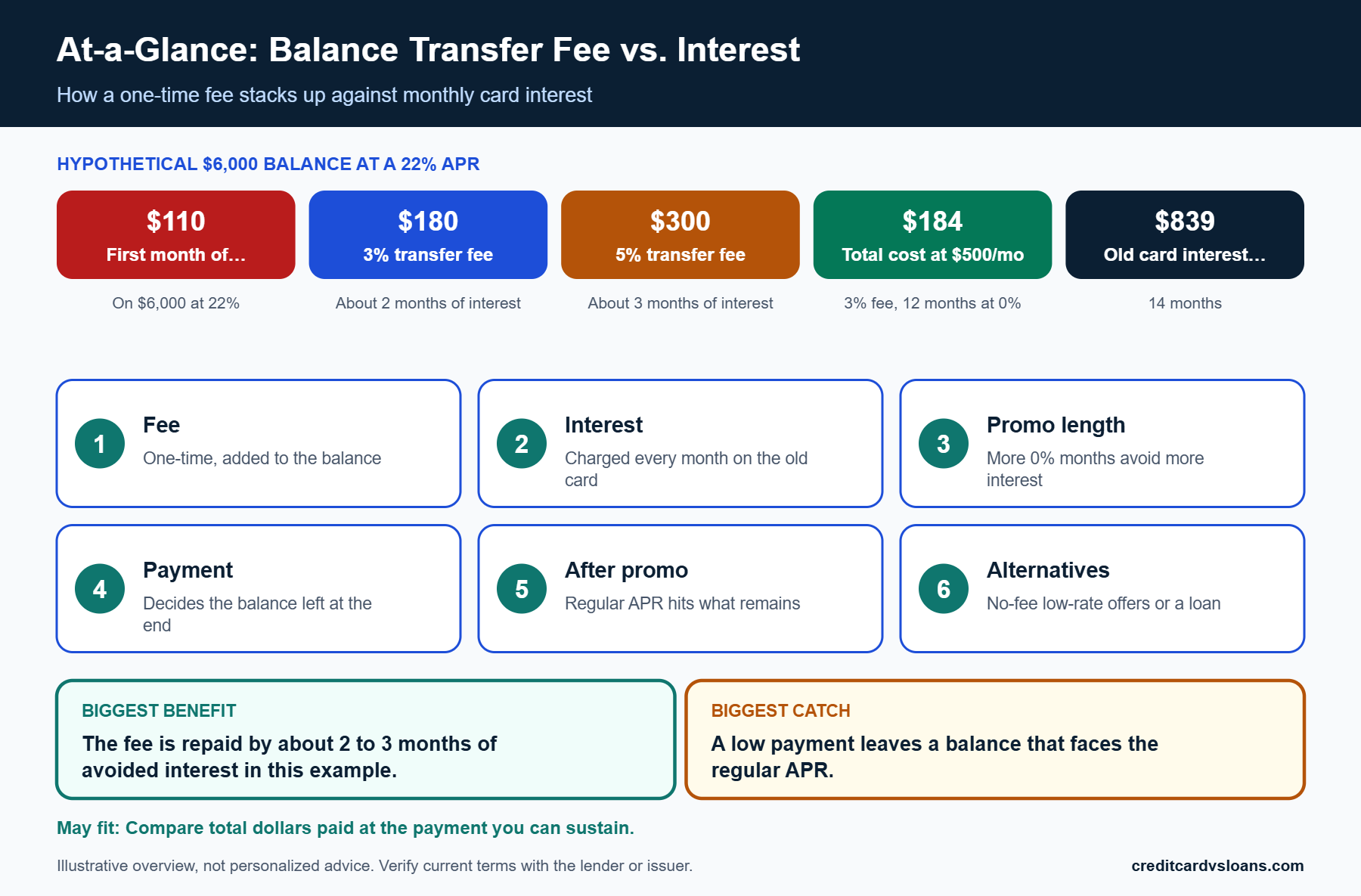
- On a hypothetical $6,000 balance at 22%, the first month of card interest is about $110. A 3% fee ($180) equals roughly two months of interest, and a 5% fee ($300) roughly three.
- In the example, a 3% fee and 12 months at 0% cost about $184 in total at a $500 payment, versus about $839 in interest on the old card.
- At low payments the fee still beats the interest, but a large balance rolls onto the regular APR, so the savings depend on how much is left at the end of the promotion.
- A low introductory rate with no fee can beat a fee-charging 0% offer at higher payments, because the fee is a fixed cost.
Rate context is from the Federal Reserve’s G.19 Consumer Credit release of October 7, 2026 (preliminary August 2026 data). All dollar examples are hypothetical and calculated for illustration; fees and promotional terms vary by issuer.
Balance Transfer Fee vs. Interest: The Short Answer
What you are really comparing
A known fee against interest you would otherwise pay
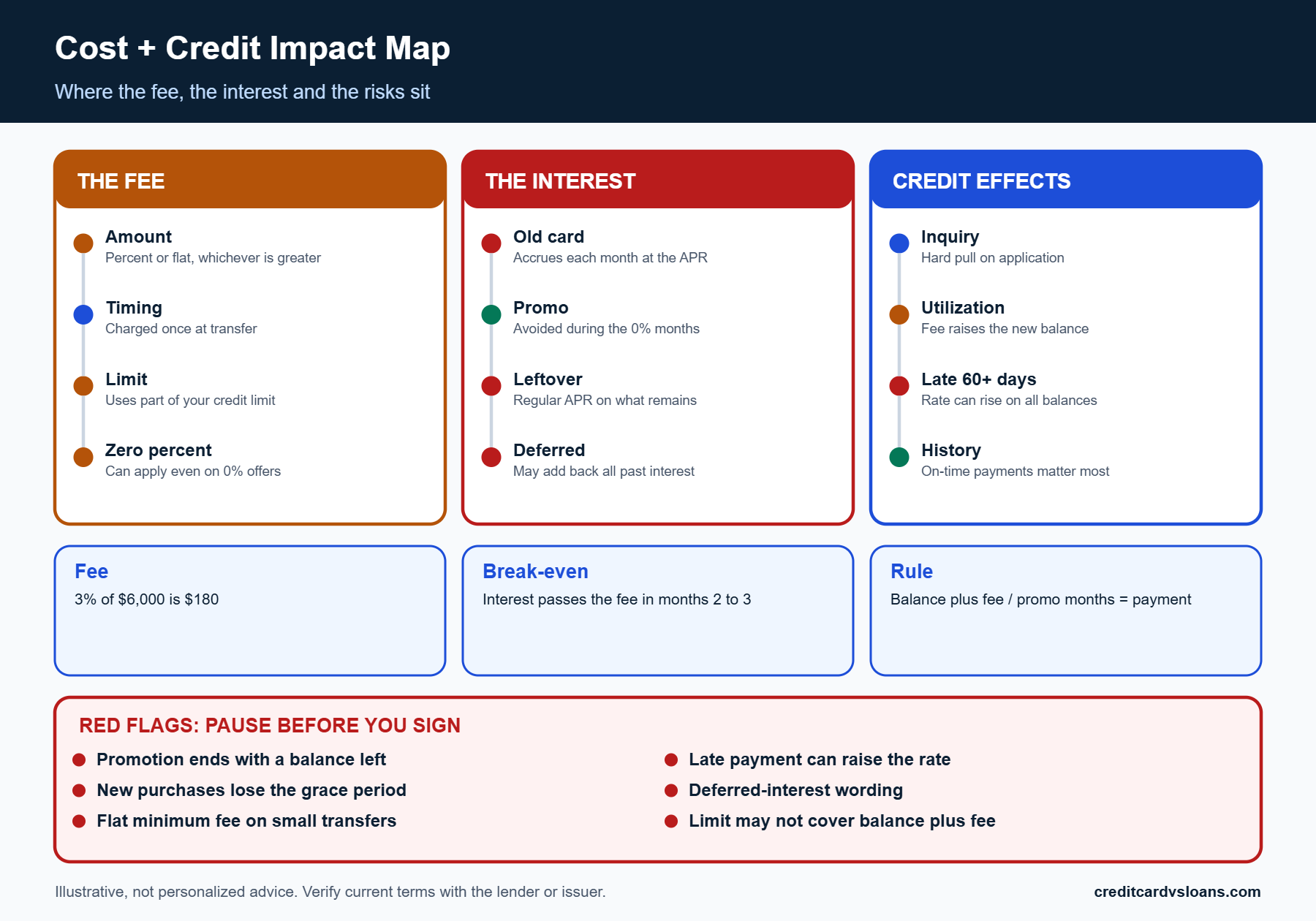
The fee is certain: on a $6,000 transfer, a 3% fee is $180 and a 5% fee is $300, and the issuer adds it to the balance. The interest on the old card is uncertain because it depends on how fast you pay. At a hypothetical 22% APR, the first month alone costs about $110 on $6,000, and total interest over the payoff can run well into four figures if payments are modest.
The right comparison is therefore not fee against rate, but fee against the dollars of interest you would pay during the same months. Done that way, a fee that sounds painful often turns out to be small. In this example, the card interest in a single quarter exceeds the 3% fee.
When the fee tends to win, and when it does not
In a balance transfer fee vs interest comparison, paying the fee tends to win when you pay enough to clear most of the balance during the promotional period, because then the interest avoided is large relative to the fee. It tends to lose when you pay so little that most of the balance remains when the promotion ends, or when you take a transfer for a tiny balance where a flat minimum fee dominates.
It can also lose when a cheaper way to avoid interest exists, such as a card with a low introductory rate and no transfer fee. The CFPB notes that you may pay a balance transfer fee even on a zero percent offer, so always ask what is charged and compare it with other routes.
Two quick tests before you run any numbers
The months-of-interest test
Divide the fee by one month of interest on the balance. A 3% fee on a 22% APR equals roughly 1.6 months of interest at the starting balance; a 5% fee equals roughly 2.7 months. As the balance falls, the effective number of months rises a little, but the logic holds: if the promotion lasts much longer than two or three months and you keep paying down the balance, the interest avoided will typically exceed the fee.
The test fails when the promotion is short or the balance won’t fall. If you won’t pay it down, the fee buys time rather than savings.
The payment test
Add the fee to the balance and divide by the promotional months. That is the payment needed to finish on time. In the hypothetical, $6,000 plus a 3% fee is $6,180; over 12 months that is about $515 a month, and over 18 months about $343.
If that number is more than you can pay, the fee may still be worth paying, but the remainder will face the regular APR. The CFPB notes that the promotional rate usually expires and the rate may then rise, so the size of the leftover balance matters.
| Item | Balance transfer fee | Interest on the old card |
|---|---|---|
| When it is charged | Once, when the balance is transferred | Every billing cycle while a balance remains |
| How it is set | Percentage of the amount, or a flat amount if greater (CFPB) | APR applied to the balance |
| Predictability | Known up front | Depends on your payments |
| Main advantage | Buys months with no interest on the transferred balance | No fee for staying put |
| Main drawback | Cost is paid even if you slip | Compounds on a large balance |
| Primary cost driver | Fee percentage and amount moved | APR and how fast you pay |
How the Fee Is Charged and How Interest Accrues
How the fee works
Definition and where it shows up
The CFPB defines a balance transfer fee as a fee charged to transfer an outstanding balance to a different credit card. It adds that a card company may charge the fee even on a zero percent interest rate offer. The fee usually appears as a separate line on your first statement and is added to the new card’s balance.
Because it is added to the balance, it also uses part of your credit limit. A $6,000 transfer with a 3% fee uses $6,180 of the limit. Check the card’s pricing table, which lists the fee alongside the promotional and regular APRs.
Percentage fees and flat minimums
The CFPB says the fee is typically a percentage of the amount transferred or a flat amount, whichever is greater. On a large balance, the percentage usually controls. On a small balance, the flat minimum can take over, which raises the effective percentage.
That matters for the fee-versus-interest comparison. On a hypothetical $100 transfer, a 3% fee would be $3, but a $5 flat minimum would apply instead, an effective 5%. A higher flat floor can make small transfers poor value. Always convert the fee to dollars before you decide.
How interest accrues on the old card
APR, balances and the grace period
The CFPB explains that the APR is the interest rate plus additional fees charged by the lender, and that comparing APR to APR is the right way to shop. On a card where you carry a balance, interest typically builds on the balance each billing cycle, and the CFPB notes that the grace period, the time in which you can avoid interest by paying in full, generally doesn’t help if you are carrying a balance forward.
So the cost of staying put is not a one-time charge but a stream. Each month of delay adds another month of interest, and the stream shrinks only as fast as principal falls.
Zero percent versus deferred interest
With a true 0% offer, no interest accrues on the promotional balance during the promotion. With deferred interest, the CFPB explains, interest can be added back for the whole promotional period if you don’t pay in full in time. In its example, a $100 balance left on a $400 purchase would owe about $165 under a deferred-interest offer, versus $100 under a zero-interest offer.
This difference changes the fee-versus-interest math completely. A fee-free deferred-interest offer can cost far more than a 0% offer with a fee if you miss the deadline. Read the wording closely: “no interest if paid in full” signals deferred interest.
How Many Months of Interest Does the Fee Equal?
A hypothetical $6,000 balance
The assumptions
Picture a hypothetical borrower, not a real person, carrying $6,000 on a card at a 22% APR. For context, the Federal Reserve’s G.19 release of October 7, 2026 reported preliminary August 2026 averages of 22.36% for credit card accounts assessed interest and 21.19% across all accounts. The transfer card charges a fee of 3% ($180) or 5% ($300), offers 0% for 12 months, and then charges 24.99%.
We test three monthly payments, $200, $300 and $500, and put every dollar toward the balance. All figures were computed in Python with monthly compounding. They illustrate the mechanics and are not predictions of any real offer.
When the interest has paid for the fee
On the old card at 22%, cumulative interest passes the 3% fee ($180) during month two at every payment level tested, and passes the 5% fee ($300) during month three. By month six, the cumulative interest is about $635 at a $200 payment, $606 at $300 and $550 at $500. By month twelve it reaches about $1,204, $1,075 and $818.
That is the main point of the balance transfer fee vs interest question. Because card interest is charged every month, a one-time fee of a few percent is repaid quickly, provided the promotion lasts long enough and you keep paying principal. The break-even is measured in months, not years.
Interest avoided across the promotion
How promotion length changes the saving
At a $300 payment, the interest the old card would charge over 6 months is about $606, over 12 months about $1,075, over 15 months about $1,254 and over 18 months about $1,391. Compare those figures with the $180 and $300 fees. Even a six-month 0% window would cover either fee in this example.
The saving flattens when the balance is cleared. At a $500 payment, the card balance is gone in about 14 months, so the interest avoided stops growing at about $839 whether the promotion is 15 months or 21. Longer promotions are most valuable to people who pay slowly.
Why a longer promotion can be worth a bigger fee
A 5% fee with an 18-month promotion can beat a 3% fee with a 12-month promotion if you pay slowly enough for the extra six months to matter. At a $200 payment on $6,000, the 18-month, 5% version cost about $803 in total in this example, versus about $1,254 for the 12-month, 3% version. At $500, both finish in about 13 months, and the 3% fee wins at about $184 versus $300.
This shows why the fee percentage can’t be read in isolation. Pair it with the promotion length and your realistic payment, as in the next section.
Total Cost: The Fee Plus Whatever Interest Remains
Reading the full-cost comparison
Fee, leftover interest and payoff time
In any balance transfer fee vs interest comparison, the fee is only part of the cost of a transfer. If a balance remains when the promotion ends, it starts accruing interest at the regular APR. Table 2 adds the fee and the later interest to get a total cost, and compares it with staying on the 22% card at the same payment.
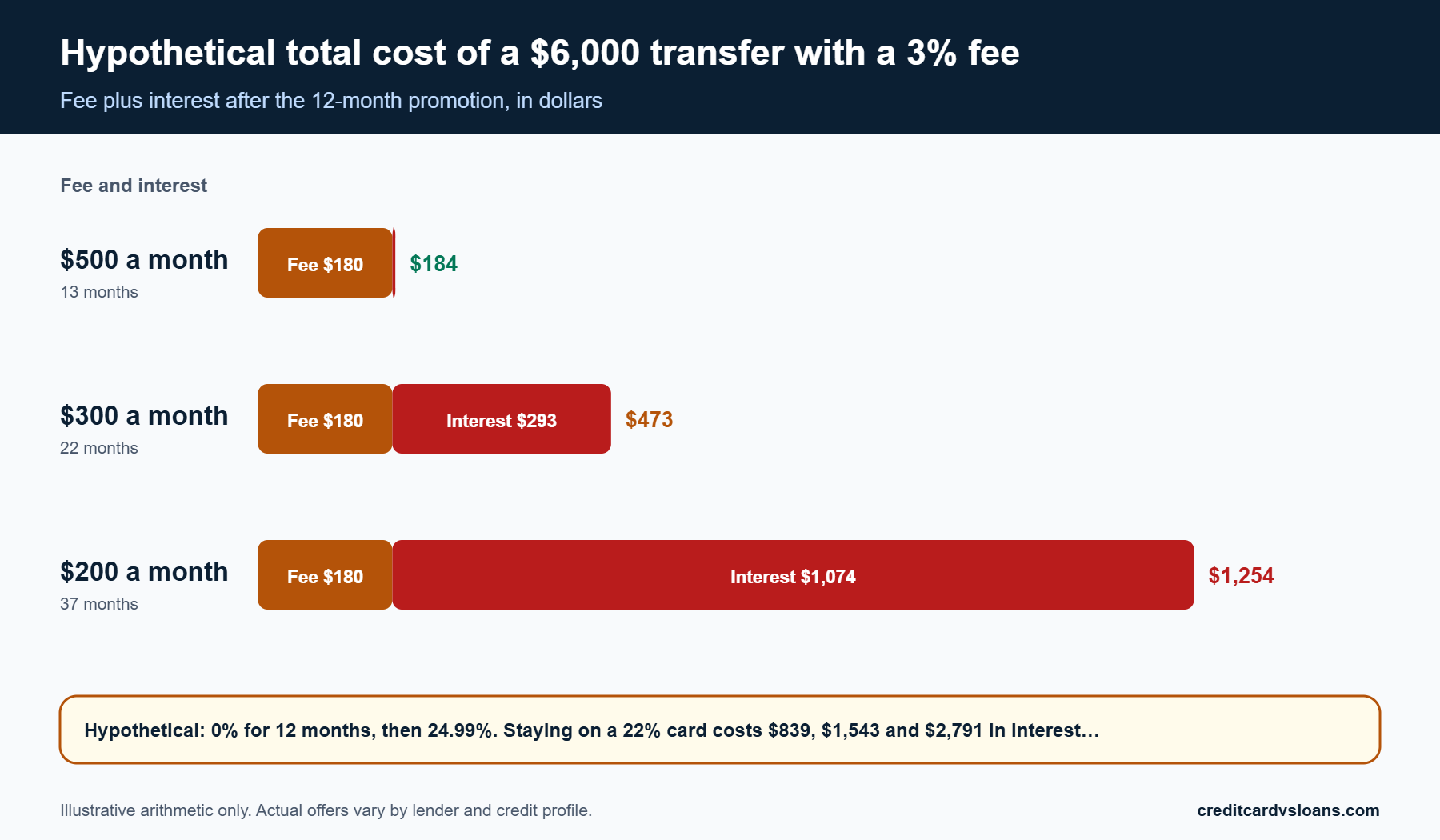
At $500 a month, a 3% fee and 12 months at 0% cost about $184 in total, because the balance is nearly gone when the promotion ends. At $300 a month, the total is about $473. At $200 a month, it is about $1,254. In each case, staying on the old card cost more: about $839, $1,543 and $2,791 in interest.
| Monthly payment | Stay on 22% card (interest) | 3% fee: total cost | 5% fee: total cost | Months to pay off (3% fee) |
|---|---|---|---|---|
| $200 | $2,791 (44 months) | $1,254 | $1,456 | 37 |
| $300 | $1,543 (26 months) | $473 | $621 | 22 |
| $500 | $839 (14 months) | $184 | $306 | 13 |
The role of the regular APR
At a $200 payment, about $1,074 of the $1,254 total cost is interest charged after the promotion, not the fee. That is the real price of paying slowly, and it explains why the same card feels like a bargain at $500 a month and a mixed result at $200. The fee is the smaller number in the slow case.
The regular APR is therefore part of the fee-versus-interest decision. Compare it with the APR on your current card, and read the issuer’s pricing table. The CFPB notes that the promotional rate usually expires and the rate may rise, which is why the leftover balance is the number to plan around.
How high would the fee have to go?
Breaking even against the old card
Searching for the fee at which a transfer would stop saving money against staying on the 22% card, the hypothetical break-even fee is about 13.6% at a $500 payment, about 17.0% at $300 and about 17.2% at $200, all with a 12-month promotion. With an 18-month promotion it is about 14.0%, 22.9% and 26.3%.
The takeaway is not that high fees are acceptable. It’s that a typical single-digit fee is small compared with the interest a 22% card charges, so the fee alone is rarely the deciding factor when you’re comparing a transfer with staying put.
Why the better comparison is often another offer
The relevant comparison is often not the old card but another transfer offer, a loan or a different payoff plan. An offer with a lower fee and a shorter promotion can beat a higher-fee, longer one if your payment is high. An installment loan has its own origination fee and interest; our guide to credit card debt consolidation options by credit profile compares the main structures.
When you compare, convert every offer into total dollars paid and the month you’d be debt-free, using the payment you can sustain.
Fee-Free Alternatives: When a Low Rate Beats a 0% Offer With a Fee
A low introductory rate with no fee
The comparison
Suppose a hypothetical card offers 4.99% for 15 months with no transfer fee, while another offers 0% for 15 months with a 3% fee. Both charge 24.99% afterward. On the $6,000 balance, which is cheaper depends on your payment, because the fee is a fixed cost and the interest is not.
At a $300 payment, the low-rate, no-fee offer costs about $388 in interest over 22 months. The 0% offer costs about $305 ($125 interest plus the $180 fee). The fee-charging offer wins by roughly $83.
Where the advantage flips
At a $500 payment, the order reverses. The low-rate, no-fee offer costs about $168 over 13 months, while the 0% offer costs the $180 fee and no interest. Higher payments reduce the balance fast enough that the small interest charge is cheaper than the fixed fee.
The lesson is that the break-even depends on your payment. Offers with no fee are worth checking, and you can read about how approval standards for introductory offers vary in our guide to credit scores for 0% APR cards.
The fee as an annual cost
A yardstick for the fee
One way to put a fee in context is to spread it over the time you hold the balance. If you pay $6,000 down evenly over 12 months, the average balance is about $3,250. A 3% fee ($180) is then about 5.5% of the average balance per year; a 5% fee ($300) is about 9.2%. Over 18 months, those fall to about 3.8% and 6.3% a year.
These yardsticks are our illustration, not an APR on your offer. They show why a fee that looks large as a lump can be modest as an annual cost, compared with a 22% card rate, and why slow payers get more value from longer promotions.
Why a short promotion can make the fee costly
The same arithmetic works in reverse. With a six-month promotion and a 5% fee, the fee is spread over fewer months of avoided interest, and the effective annual cost is higher. If you can’t clear the balance quickly, a short promotion with a high fee leaves you paying the fee and then interest too.
Check the length of the promotion first. The CFPB says a promotional rate must last at least six months under federal rules; many are longer, but confirm yours.
Credit Score Impact and Approval Requirements
Qualifying for a transfer offer
What the issuer decides
Whether you receive a transfer offer, how large the limit is, how long the promotion runs and what fee applies are the issuer’s decisions. The CFPB cautions that damaged credit may prevent you from getting low-rate balance transfers, consolidation loans or home equity loans. So the balance transfer fee vs interest comparison only matters if you’re approved on terms that make it worthwhile.
Our guide to what credit score you may need for a 0% APR credit card explains the approval factors that tend to come up. Remember that the limit must cover the balance plus the fee, or only part of the balance can move.
Soft pulls, hard pulls and shopping carefully
The CFPB explains that hard inquiries usually occur when you apply for credit and can affect your scores, because most scoring models consider how recently and frequently you apply. Soft inquiries, such as prescreening or checking your own report, do not affect your scores. Where a prequalification tool is available, use it to compare terms before a formal application.
Applying to several cards in a short window can multiply hard inquiries while leaving you without a better offer. If one application is declined, review the reasons before applying elsewhere.
What the transfer can do to your credit reports
New account, utilization and the fee
A transfer opens a new account and typically moves a balance onto it. The fee increases the amount owed, which can raise utilization on that card. Utilization, the share of available revolving credit you use, is a factor many scoring models consider. The effect depends on your whole profile and can’t be predicted in advance.
For a deeper look at timing and typical patterns, read our guide to what happens to your credit score after a balance transfer. No honest source can promise a particular score change.
Why on-time payments matter more than the fee
Payment history is usually the most consequential factor over time, and a missed payment can cost far more than a fee. The CFPB notes that if you’re more than 60 days late, the issuer can raise the rate on all balances, including the transferred one.
That makes autopay for at least the minimum the cheapest insurance in the process. Add a calendar reminder for the promotional end date, three months ahead.
When Paying the Fee Does Not Help
Situations where the fee buys little
A balance you will not pay down
If your budget won’t reduce the balance, a transfer mostly delays interest. At a $200 payment on $6,000, the 12-month transfer left about $3,780 at the end of the promotion in this example and cost about $1,254 in total. That’s still lower than staying on the card, but the fee bought only a year-long pause on interest, not a payoff.
In that situation, consider whether a different structure would be better, such as a fixed-term loan, a smaller transfer or a plan to cut the balance first. Our guide to debt consolidation loans versus balance transfer cards compares the options for larger piles of debt.
New purchases on the transfer card
The CFPB cautions that new purchases on a card with a promotional balance can start accruing interest right away, because carrying a promotional balance can cost you the grace period. The only way to avoid that is paying the full balance, including the promotional balance, by the due date.
That can undo the savings from avoiding interest on the transferred balance. If you use the card for purchases, a high-APR purchase balance can absorb your extra payments first, since payments above the minimum generally go to the highest-APR balance under Regulation Z.
Penalties and reversals
When a late payment raises the rate
Under Regulation Z, a card issuer can generally raise a rate if it hasn’t received the required minimum payment within 60 days after the due date, after sending the required notice. The earlier rate must be restored only after six consecutive on-time payments following the increase. One serious lapse can turn a cheap promotion into an expensive one.
Issuers may also change terms in other permitted ways, and the details of each offer are in the cardmember agreement. Read the sections on promotional rates and default rates before you accept.
Deferred interest and fee-free offers with a catch
Some offers advertise no fee but use deferred interest. If you don’t pay the balance in full in time, the interest that accrued during the promotion can be added back. The CFPB’s example shows a $100 remaining balance becoming about $165 under such an offer.
That can cost far more than a visible fee on a standard 0% offer. When a deal appears to have no cost, look for the wording that explains what happens at the deadline.
Alternatives and How to Decide
Other ways to lower the cost of carrying a balance
Asking your issuer and credit counselors
The CFPB suggests contacting creditors to ask whether they will lower your minimum payments, waive fees, reduce your interest rate or move your due date, and notes that nonprofit credit counselors can help you manage money and pay down debt. These approaches don’t involve a transfer fee or a hard inquiry.
They can be especially useful when your credit makes a good transfer offer unlikely, or when your budget is the real constraint rather than the rate.
Fixed-term loans and rate outlook
A personal loan trades a 0% window for a fixed schedule. The Federal Reserve’s G.19 release of October 7, 2026 reported a preliminary August 2026 average of 11.90% for 24-month personal loans at commercial banks, compared with 22.36% for card accounts assessed interest. Averages are not offers, and loans may carry origination fees.
For a view of how card and loan rates have moved, see our credit card and personal loan rate outlook for September 2026. Whichever tool you choose, compare total dollars paid, not just rates.
Making the call
A short decision framework
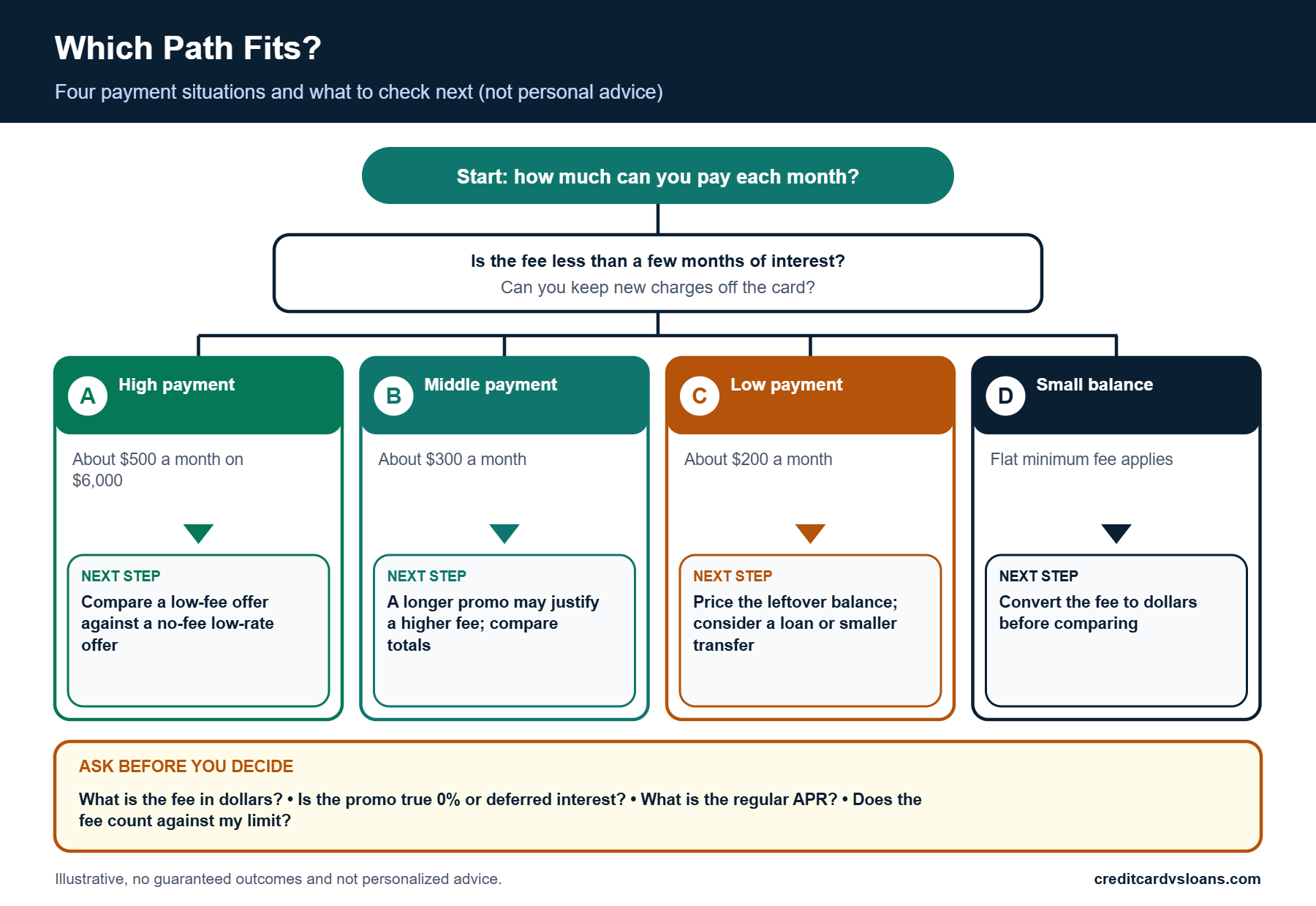
First, compute the payment needed to finish in the promotion: balance plus fee, divided by the months. Second, estimate what you will actually pay. Third, calculate the fee and the leftover balance’s interest. Fourth, compare with the next-best alternative, whether that is a fee-free offer, a loan or the old card.
If the fee is a small share of the interest you avoid and the leftover balance is modest, paying the fee tends to be sensible. If the leftover balance is large or you’d be tempted to spend on the card, think twice.
| Scenario | Option to investigate | Why | What to verify | When to avoid it |
|---|---|---|---|---|
| Can pay most of the balance within the promotion | 0% offer with a fee | Interest avoided far exceeds the fee | Fee in dollars, promo length, regular APR | If you will keep charging the card |
| Can pay a high amount quickly | Low-rate offer with no fee | A fixed fee costs more than a little interest | Intro rate, length, regular APR | If the intro rate is high or short |
| Can pay very little each month | Fixed-term loan or counseling | Leftover balance faces the regular APR | Total repayment, origination fee | If the loan’s fee and rate erase the saving |
| Small balance with a flat minimum fee | Compare against paying the old card down | The flat minimum raises the effective percentage | The minimum fee in dollars | If the fee is a large share of the balance |
| Offer says no interest if paid in full | Read for deferred interest | Missing the deadline can add back all the interest | Exact wording and payoff date | If you cannot pay in full in time |
Stress-testing the decision
Before you accept an offer, test the fee-versus-interest math against three bumps. What if you can only pay the minimum for two months? What if a surprise bill lands on the transfer card? What if the transfer takes two extra weeks to post and the first payment is due on the old card?
A sound plan survives at least one of these. If it only works when everything goes right, the fee is buying less protection than it appears to, and a smaller transfer or a different structure may be wiser.
Checklist, Conclusion and Next Steps
Before you pay a transfer fee
Numbers to write down for each offer
Record the fee percentage and the minimum fee, then convert both to dollars on your balance. Write down the promotional APR and its length, the regular APR, the credit limit, and whether new purchases get a grace period. Ask what events trigger a higher rate.
Next, compute your own numbers: balance plus fee divided by the promotional months, your sustainable payment, and the estimated leftover balance at the end of the promotion. Multiply the leftover by the regular APR and divide by 12 to see the first month’s interest.
Questions that expose hidden costs
Ask whether the promotional rate applies to balances transferred after a certain window, whether the fee is charged per transfer, and whether the offer is a true 0% or a deferred-interest program. Ask also whether the rate on the transferred balance can change for reasons other than a late payment.
Get the answers from the written disclosures. If a representative can’t point to the number in the documents, treat it as unconfirmed and decide accordingly.
Mistakes that make the fee costlier than it looks
Comparing fee percentages without a payment plan
A 3% fee and a 5% fee look different, but their cost relative to the interest you avoid depends on your payment and the promotion length. At a $500 payment on the $6,000 example, the fee difference is $120. At a $200 payment, the longer promotion that may come with the higher fee could save more than that difference.
Build the comparison with your payment. A table of two or three scenarios, as we did above, makes the better choice clearer than a rule of thumb.
Forgetting the promotion’s end date
It is easy to pay on time for months and still miss the deadline. The balance moves to the regular APR, and the savings shrink with each month of delay. A calendar reminder three months before the end gives you time to pay down the balance, switch to another product or talk to a counselor.
The CFPB’s guidance on promotional offers advises paying off promotional balances before the promotion ends and making every payment on time. Those two habits matter more than the fee percentage. For credit-side effects, our guide on the credit score after a balance transfer explains what to watch.
The bottom line on balance transfer fee vs interest
When paying the fee can still save money
Paying a balance transfer fee tends to save money when the interest you avoid during the promotion is larger than the fee, which in the hypothetical happened within two to three months of card interest. It tends to disappoint when you pay slowly, spend on the card, or miss a payment. Run your own offer through the payment test and compare it with at least one alternative.
In the $6,000 example, the 3% fee cost $180 and the old card would have charged $839 to $2,791 in interest depending on the payment. The fee was small next to that, but the leftover interest at a $200 payment was bigger than the fee. The fee is rarely the part to worry about; the leftover balance is.
Next steps you can take this week
- Write down each card’s balance and APR, and the interest charged on your last statement.
- Convert any offered fee into dollars and compare it with two to three months of that interest.
- Compute balance plus fee, divided by the promotional months, and compare it with what you can pay.
- Check your credit reports, then use soft-pull prequalification where offered.
- Compare against a no-fee offer, a fixed-term loan and your current card using total dollars paid.
- If the numbers don’t work, ask your issuer about lower rates or contact a nonprofit credit counselor.
If your debt is spread across several accounts, our guide to debt consolidation loans versus balance transfers looks at covering more than one balance, and the credit card debt consolidation guide by credit profile covers options when approval is the obstacle.
A worked comparison of two offers
Offer A and Offer B on the same $6,000
Suppose a hypothetical Offer A charges a 3% fee with 12 months at 0%, and Offer B charges a 5% fee with 18 months at 0%. Both revert to 24.99%. At a $300 monthly payment, Offer A costs about $473 in total and Offer B about $339, so the longer promotion more than covers the higher fee. Both take about 22 months to finish.
At a $200 payment, the gap widens: about $1,254 for Offer A versus about $803 for Offer B, because the extra six interest-free months matter more when you pay slowly.
Where the cheaper fee wins
At a $500 payment, the order flips. Offer A costs about $184 and Offer B about $300, because the balance is nearly gone before either promotion matters and the extra 2 points of fee just cost money. Offer A wins by about $116.
The same two offers can therefore rank differently for two borrowers. That is why a percentage fee, quoted alone, can’t tell you which offer is better, and why your payment belongs at the center of the comparison.
Questions readers ask next
Is a lower fee always better?
Not always. A lower fee on a shorter promotion can cost more than a higher fee on a longer one if you pay slowly, and a lower fee paired with a higher regular APR can cost more if a balance remains. Compare total dollars paid at your own payment.
Can the fee be negotiated or avoided?
Fees are set by the issuer, and the CFPB says they can apply even on zero percent offers. Some cards advertise reduced or no fees during limited windows, and you can ask. If you receive an offer with no fee, check the promotional rate and whether it is a deferred-interest program before comparing.
Does paying the fee up front change how much I can transfer?
It can. The fee is added to the balance, so it uses part of your credit limit. On a card with a $6,000 limit, a 3% fee means a $6,000 transfer wouldn’t fit. Ask the issuer how the limit applies and whether the fee counts against it before you request the transfer.
- What Happens to Your Credit Score After a Balance Transfer?
- What Credit Score Do You Need for a 0% APR Credit Card?
- Debt Consolidation Loan vs. Balance Transfer Card: Which Saves More?
- Credit Card and Personal Loan Rate Outlook: September 2026 Borrower Brief
- Credit Card Debt Consolidation: Best Options by Credit Profile
- CFPB: What is a balance transfer fee? Can it be charged on a zero percent offer?
- CFPB: What do I need to know about consolidating my credit card debt?
- CFPB: What is the difference between a loan interest rate and the APR?
- CFPB: Credit cards key terms
- CFPB: How to understand special promotional financing offers on credit cards (archived post)
- CFPB: You could still end up paying interest on a zero percent interest credit card offer (2014 archived post)
- CFPB: When can my credit card company increase my interest rate?
- CFPB: What is a credit inquiry?
- CFPB (Regulation Z): 12 CFR 1026.55 Limitations on increasing APRs, fees, and charges
- CFPB (Regulation Z): 12 CFR 1026.53 Allocation of payments
- Federal Reserve: Consumer Credit – G.19 (release of October 7, 2026)
Last updated: October 22, 2026. Rates, fees and lender rules change; verify current terms before acting.
The information on creditcardvsloans.com is provided for general educational and informational purposes only. It is not financial, legal, tax, credit, accounting or investment advice, and reading it does not create an advisor-client, fiduciary or any other professional relationship. Nothing here is an offer, solicitation or recommendation to borrow, lend or apply for any product.
Credit scores, interest rates, fees, eligibility rules, lender policies and laws change frequently and vary by lender, location and individual circumstances. Examples, figures and scenarios are illustrative only, do not predict your results and do not guarantee approval, savings, a particular rate or a credit-score outcome. Always confirm current terms directly with the lender or issuer and read the full agreement before you apply or sign.
Although we aim for accuracy and use reputable sources, we make no representations or warranties, express or implied, about the completeness, accuracy, reliability or timeliness of the content. Content may be drafted with the assistance of automated tools, so errors or omissions may still occur. Links to third-party sites are provided for convenience; we don’t control and aren’t responsible for their content.
To the fullest extent permitted by law, creditcardvsloans.com and its owners, editors, authors, contributors and affiliates disclaim all liability for any loss, damage or expense arising directly or indirectly from your use of, or reliance on, this content. Before making financial decisions, consult a licensed professional, such as a qualified financial advisor, attorney, tax professional or nonprofit credit counselor, who can consider your complete situation.