
Judging annual fee vs rewards value is a subtraction problem with three honest inputs: what the rewards are really worth to you, which perks you will actually use, and what a no-fee card would have paid you for the same spending. If the first two exceed the fee by a comfortable margin after you subtract the third, the fee is earning its place; if not, it is a cost you can skip.
Most mistakes happen in the inputs, not the subtraction. Points are valued at their best-case redemption, credits are counted at face value whether or not they are used, and the comparison card quietly disappears. This guide shows how to set each input conservatively, then run the math with clearly labeled hypothetical numbers computed for illustration.
It is written for people who already know they might pay an annual fee and want a method for deciding. If you are still choosing between the two card types at a high level, start with the annual-fee versus no-annual-fee comparison, then come back here for the valuation work.
- Net value = rewards earned (at a conservative value) + perks you would have paid for anyway – the annual fee – the rewards a no-fee card would have earned.
- Cents-per-point is a range, not a constant. Test the card at a low, middle and high value and trust the low one.
- A credit is worth its face value only if you would have bought the thing anyway. Partial use cuts the value proportionally.
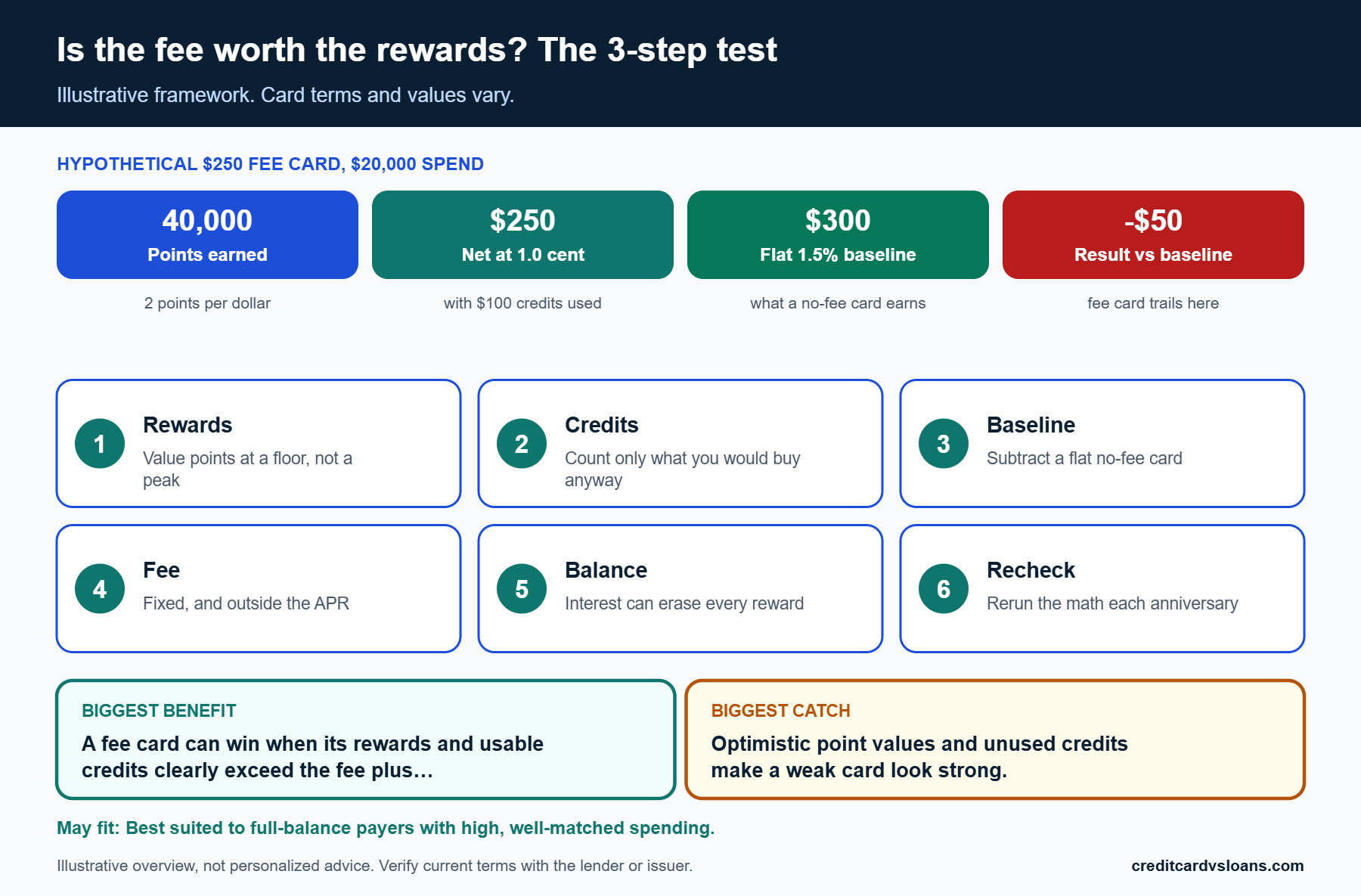
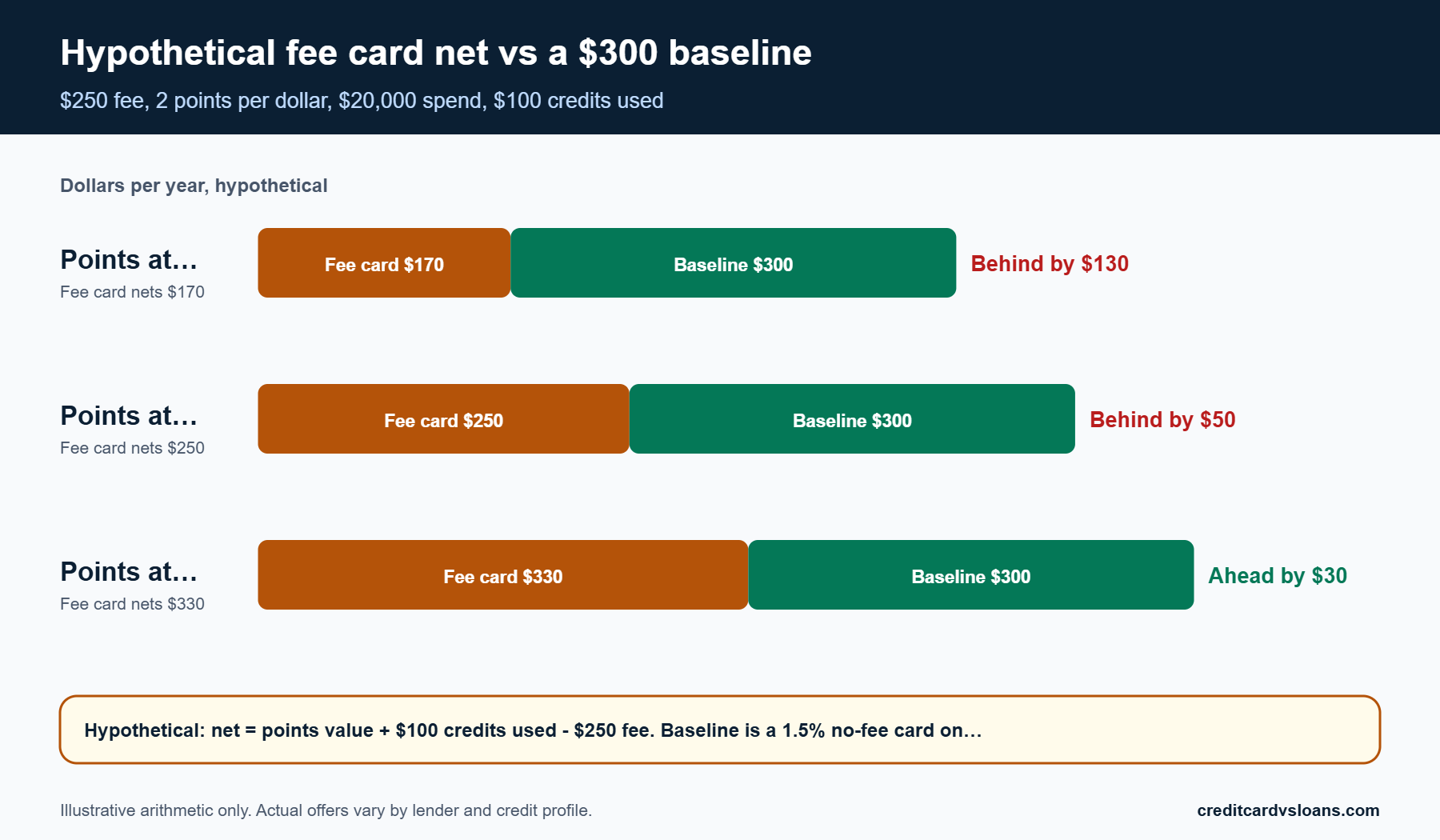
- In the hypothetical example, a $250 fee card with 2 points per dollar on $20,000 of spending nets $250 at 1 cent per point with $100 of credits used, which still trails a 1.5% flat card’s $300.
- Interest on a carried balance can erase all of this. The annual fee is also left out of the APR, so you must add it yourself.
Illustrative dollar figures here were computed for this article and are not offers. Federal Reserve data cited were published in the G.19 release of Oct. 7, 2026. Card terms, reward values and fees change, so confirm anything you rely on with the issuer’s current disclosures.
Table of contents
Annual Fee vs Rewards Value: A Three-Step Test
The formula behind the decision
What “net value” means
Net value is the dollars you keep after the card has paid its way. Add the rewards you earn, valued conservatively, add the perks you would have bought anyway, subtract the annual fee, and then subtract what your best no-fee alternative would have earned on the same spending. A positive result means the fee card is ahead of your fallback. A negative one means you are paying for the privilege of a worse outcome.
The last subtraction is the one people skip. Without it, a card earning $350 and costing $250 looks like a $100 win, but if a no-fee card would have earned $300 on that spending, the real gain is negative. Always keep an honest baseline in view.
Why a rewards headline is not a result
A “5x” or “3x” multiplier describes a rate on a subset of purchases. It does not describe your outcome. Your outcome depends on how much of your spending falls into each category, what each point is worth when you redeem it, and what you give up elsewhere. A card that pays 3% on groceries is irrelevant if your grocery spending is small.
That is why the test starts with your own statements. The same card can be a clear win for one household and a clear loss for the next, even at identical incomes. For a plain-language tour of how points, miles and cash back work, see how rewards credit cards work.
Where the test can go wrong
Optimistic point values
Points are not dollars until you redeem them, and different redemptions return different amounts. A point used for statement credit or cash back may be worth one cent, while a point used for a particular travel booking can be worth more or less depending on the price at that time. Using the highest value you have ever seen turns a marginal card into an apparent winner.
Use the value you reliably realize, not the one you occasionally hit. If you have never redeemed points for travel, do not assume you will start.
Uncounted behavior change
The other failure is spending more because the card rewards it. Rewards are a discount on spending you planned, and extra spending to earn them is a cost, not a gain. If a 3% category tempts you to buy $400 of things you would have skipped, you have spent $388 more than you saved.
The test below only uses spending you would have done anyway. If you cannot honestly say that, shrink the spending figure until you can.
Step One: Put a Dollar Value on the Rewards
Cash back, points and miles
Cash back is the simplest to value
Cash back is worth its face value when you redeem it as a statement credit, deposit or check. A card paying 2% on everything returns $20 per $1,000 spent, no conversion needed. That clarity is why many people anchor their comparisons on a flat cash-back card.
Be careful with caps. Some cards pay a higher rate on a category only up to a spending limit each quarter or year, after which the rate drops. Add up the capped portion separately from the base rate when you estimate yearly earnings.
Points and miles need a conversion assumption
For points and miles, pick a cents-per-point figure for your intended redemption and test a range. A common approach is three values: a floor, a middle and a ceiling. If the card clears the fee at the floor, it is a confident choice. If it only works at the ceiling, treat it as speculative.
Also consider how easy the redemption is. A high-value redemption that requires hours of searching, flexible dates and transferring between programs has a cost in time. If that time is not worth it to you, use the simpler redemption value.
Bonuses and category structures
Sign-up bonuses are real but one-time
A bonus can be worth several hundred dollars, and it can cover the first one or two annual fees. Because it is a one-time event, evaluate the card two ways: first-year value including the bonus, and ongoing value without it. A card that only wins in year one should be treated as a one-year trial, with a plan to downgrade or close before the second fee posts.
The minimum-spend requirement must match planned purchases. Chasing a bonus with unneeded spending turns a win into a loss, especially if it leads to a balance you cannot pay in full.
Blend category rates by your real budget
To estimate yearly rewards, multiply each category’s annual spending by its rate and sum them, adding the base rate on everything else. Use actual statement totals. A household spending $5,000 on groceries and $3,000 on dining, with the rest on a base rate, can build an accurate picture in minutes.
Then divide total rewards by total spending to get your blended earn rate. That single number is what you compare against the flat rate of a no-fee card.
| Reward type | How to value it | Common error |
|---|---|---|
| Flat cash back | Face value of the percentage | Ignoring category caps or redemption minimums |
| Category cash back | Annual spend per category times its rate, plus base rate on the rest | Applying the top rate to all spending |
| Points | Test floor, middle and ceiling cents-per-point | Using the best redemption you have ever seen |
| Miles | Value by the trips you would realistically book | Assuming a redemption you have never made |
| Sign-up bonus | Count in year one only | Spending extra to hit the threshold |
Step Two: Count Credits and Perks Honestly
The credit-realization problem
Face value is not your value
A statement credit is a coupon. It is worth its face value only if you would have spent the money on that item anyway and you will remember to claim it. A $200 airline credit used in full replaces $200 of travel you were planning, so it genuinely offsets the fee. The same credit left unclaimed is worth nothing, and the fee still posts.
Many credits also come with conditions: enrolling first, paying through a specific merchant, or splitting the amount across the year. Count a credit at the dollars you have a clear plan to use.
Apply a realization rate
A simple method is to multiply each credit by the share you expect to use. If you have used similar credits fully in the past, 100% is reasonable. If you tend to forget, use 50% or less. The table below shows how quickly the fee comes back when credits go unused, before any rewards are counted.
For a hypothetical $250 fee with $200 of credits, full use cuts the net cost to $50. At half use it is $150, and with none used it stays at $250. For a $550 fee with $300 of credits, the same three cases leave $250, $400 and $550 of net fee. Credits shrink the fee but rarely remove it, which is why the rewards must carry the rest.
| Scenario | Credits fully used | Half used | None used |
|---|---|---|---|
| $250 fee, $200 of credits | $50 | $150 | $250 |
| $550 fee, $300 of credits | $250 | $400 | $550 |
Protections, access and convenience
Coverage you already have
Cards advertise purchase protection, extended warranty, trip delay coverage and rental-car coverage. These have value only if the coverage is new to you. If your existing card, home policy or travel plan already covers the same risk, the incremental value is small. Check what you hold before assigning a number.
Read the fine print on each benefit. Coverage often has limits, exclusions and claim procedures, and eligibility may depend on how you paid. A benefit you could not realistically claim should count at zero.
Convenience benefits and soft value
Lounge access, concierge services and priority lines can feel valuable, and for frequent travelers they may be. Assign a dollar value only to what you would pay for separately, and be wary of “soft” benefits that you value in the moment but would never buy. If you would not pay $50 out of pocket for it, it should not offset $50 of fee.
This discipline protects you from a common pattern: a long list of small benefits, each plausible, that adds up on paper to a number you will never realize.
Step Three: Run the Math Against a Baseline
A worked example with hypothetical numbers
Setting up the card and the baseline
Suppose a hypothetical card charges a $250 annual fee and pays 2 points per dollar on all purchases, with $200 of annual credits. Suppose your spending is $20,000 a year, all of it ordinary spending you would do anyway. That earns 40,000 points. The baseline is a no-fee card paying 1.5% flat, which would return $300 on the same spending.
Next, value the points at a floor of 0.8 cents, a middle of 1.0 cent and a ceiling of 1.2 cents, and consider credits used at $0, $100 or $200. Every figure in the next two tables is illustrative and was computed for this article.
Reading the results
The first table shows net value before the baseline: points times value, plus credits used, minus the $250 fee. The second subtracts the $300 the no-fee card would have returned. Only the second table answers the real question.
In the second table, the fee card wins in just three of nine cells: the middle value with all credits used ($50 ahead), and the ceiling value with $100 or $200 of credits used ($30 and $130 ahead). At the floor value it never wins. This is the pattern to expect when a fee card’s rate advantage is only half a point.
| Point value | $0 credits used | $100 used | $200 used |
|---|---|---|---|
| 0.8 cent | $70 | $170 | $270 |
| 1.0 cent | $150 | $250 | $350 |
| 1.2 cents | $230 | $330 | $430 |
| Point value | $0 credits used | $100 used | $200 used |
|---|---|---|---|
| 0.8 cent | -$230 | -$130 | -$30 |
| 1.0 cent | -$150 | -$50 | +$50 |
| 1.2 cents | -$70 | +$30 | +$130 |
Break-even spending
How much you must spend before the fee pays off
Another angle is to ask how much spending is needed for the rewards alone to cover the fee. Divide the fee by the net reward rate your card earns over the baseline. A $250 fee with a one-point edge (for example, 2.5% against 1.5%) needs $25,000 of yearly spending. With a two-point edge it needs $12,500.
The sensitivity to the fee level is steep. At a half-point edge, a $95 fee needs $19,000, a $250 fee needs $50,000 and a $550 fee needs $110,000. Premium fees almost always depend on credits and perks to make the case.
What to do when it is close
When the result is within a few tens of dollars either way, choose the option with less risk. The no-fee card keeps your downside at zero, while the fee card relies on assumptions about usage and valuation. Close calls are rarely worth the monitoring they require.
If you still want the fee card for its features, set a calendar reminder to recheck the math before the anniversary, and write down the assumptions you used. See the broader fee-versus-no-fee comparison for how profiles map to card types.
| Annual fee | 0.5-pt edge | 1.0-pt edge | 2.0-pt edge |
|---|---|---|---|
| $95 | $19,000 | $9,500 | $4,750 |
| $250 | $50,000 | $25,000 | $12,500 |
| $550 | $110,000 | $55,000 | $27,500 |
Interest, APR and the Costs That Distort the Tradeoff
How the annual fee relates to APR
The fee is outside the APR
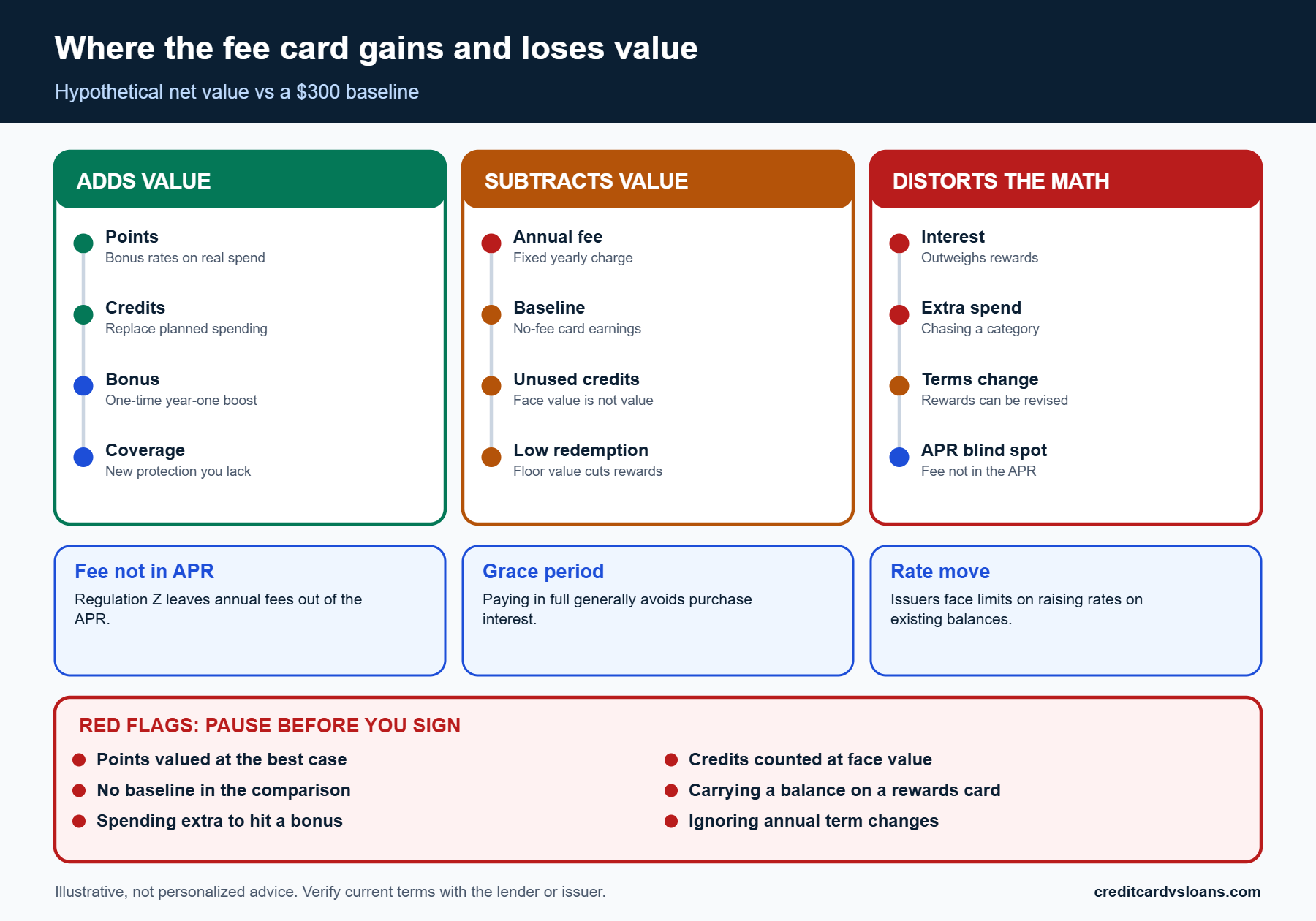
Under Regulation Z, an annual or membership fee for an open-end credit plan is a participation charge excluded from the finance charge, and the official commentary on the APR rules leaves out charges tied to opening, renewing or continuing an account. In practice that means the APR printed on a card offer does not reflect the annual fee at all. Two cards with the same APR and different fees have the same stated rate and very different yearly costs.
This is the main reason rewards-versus-fee comparisons feel slippery: the fee lives in one column and the interest rate in another. Put both into a single yearly cost line so the trade-off is visible. You can read the underlying rules at 12 CFR 1026.14.
Why a lower APR rarely offsets a fee
Some people hope a fee card will make up for its cost with a lower rate. There is no rule that links them, and many fee cards carry rates in line with or above the market average. The Federal Reserve’s G.19 release of Oct. 7, 2026 reported an average of 22.36% on credit card accounts assessed interest at commercial banks in August 2026 (preliminary), and 21.19% across all accounts. Your own rate will depend on your credit and the lender.
If you are comparing the cost of borrowing instead of rewards, the question changes entirely. A balance transfer, for instance, can involve a one-time fee that still beats ongoing interest, a trade-off discussed in balance transfer fees versus interest. Annual fees on rewards cards work differently: they buy features, not savings on borrowing.
Why carrying a balance changes everything
Interest dwarfs a rewards edge
A $2,000 average balance at an illustrative 22% APR costs about $440 over a year using simple annual math, more than the full $300 a 1.5% flat card earns on $20,000 of spending. A rewards edge of $50 or $100 cannot compete with that. If you carry a balance, the right comparison is between interest rates and fees, not between rewards programs.
Federal Reserve data in the same G.19 release show how high card rates run relative to other consumer borrowing. The release reported 11.90% for 24-month personal loans at commercial banks in August 2026 (preliminary), which is why a payoff plan may beat any rewards strategy. Your offered rate may be higher or lower.
The grace period depends on paying in full
The CFPB explains that a grace period is the span between the end of a billing cycle and the payment due date, during which you generally owe no interest on purchases if you paid the previous balance in full. Issuers are not required to provide one, though most do for purchases. Paying in full only some months can cost you the grace period for the month you did not pay in full and the next one.
For a rewards strategy, this makes consistency essential. One month of carrying a balance can create interest on new purchases from the day they are made, which erodes the rewards you worked to earn.
When the Value Changes: Terms, Limits and Life Events
Terms can change after you open the card
Reward programs and fees can be revised
Issuers can change reward rates, redemption values, credits and fees over time, usually with advance notice. A card that clears the bar this year might not next year. That is a reason to rerun the math at each anniversary instead of treating the decision as permanent.
When a program is cut, the net-value test you have already built gives you a quick way to respond. Plug in the new numbers and decide whether to keep, change product or close.
What the rules limit
Regulation Z restricts when a card issuer can raise the APR or certain fees on existing balances. Allowed situations include the end of a promotional period of at least six months that was disclosed in advance, a variable rate moving with a public index, and a delinquency of more than 60 days on a required payment. In many other cases an increase applies only to new transactions after advance notice. The rules are summarized by the CFPB at 12 CFR 1026.55.
Notice that this concerns rates and fees, not the value of your points. How rewards are valued is largely a matter of the card agreement and the issuer’s program rules, so read those documents and keep a copy.
Spending and account history
Spending that no longer fits
A change in spending can flip the result. A new commute, a move to a cheaper city or a shift to working from home can lower your fuel or dining spending and strip a category card of its edge. A baby, a wedding or a home renovation can briefly increase spending, but do not build a long-term plan on a temporary spike.
Review twelve months of statements, not the last busy month, and base your next decision on the typical year.
Credit file effects of closing or changing a card
Closing a card removes its limit from your available credit, which can raise your utilization if you carry balances on other cards. The closed account can remain on your report for a period, but it stops adding new activity. Applying for a replacement card typically involves a hard pull, which is a credit inquiry that can have a small, temporary effect on some people’s scores.
Asking the issuer for a product change to a no-fee card avoids a new application and may preserve the account, although availability and terms vary. Compare that option to closing before you decide, and read the 0% APR credit score guide if a different type of card is on your list.
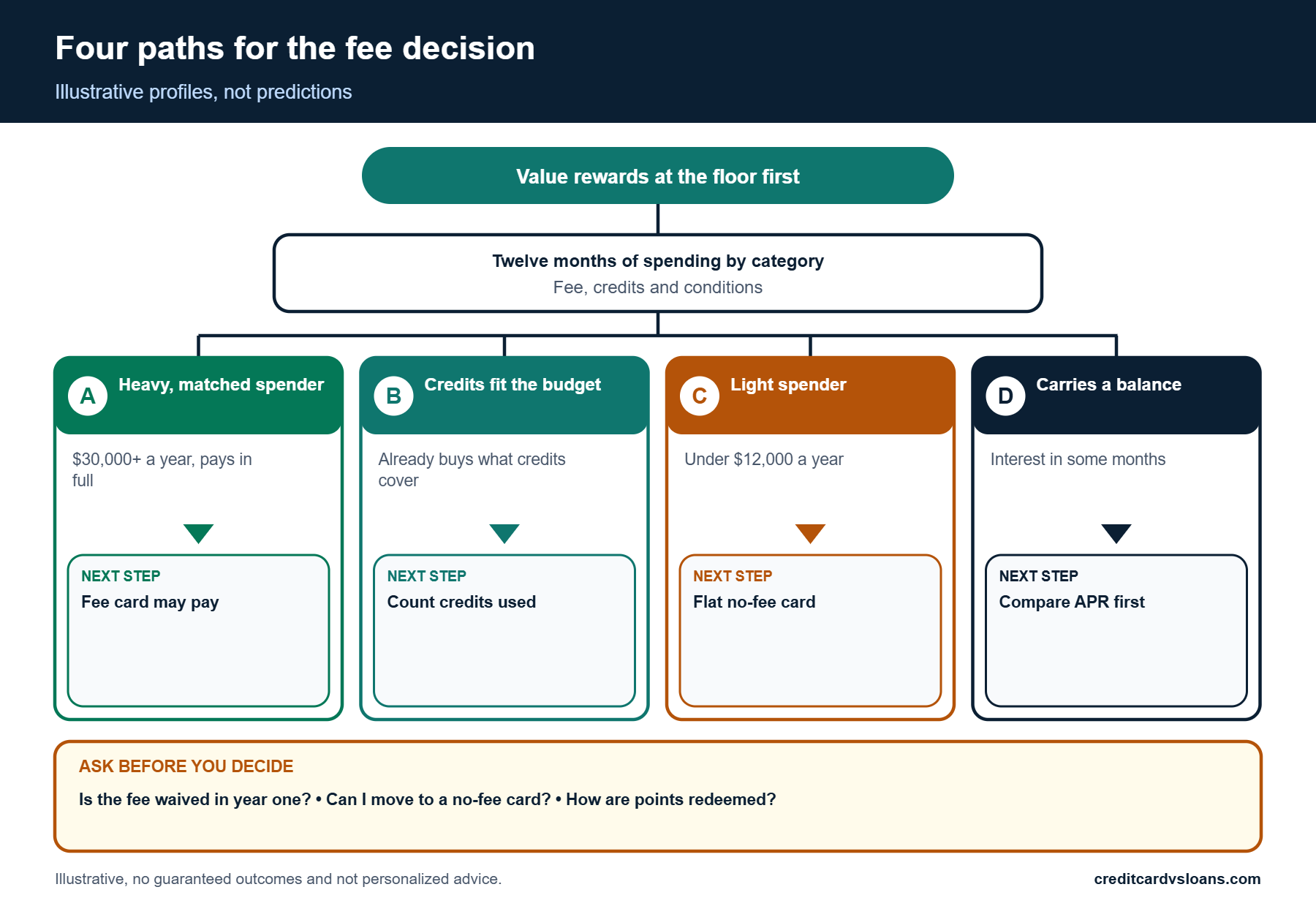
Who Should Pay an Annual Fee? Four Profiles
Profiles where the fee can make sense
The heavy, well-matched spender
A household that spends $30,000 or more a year, pays in full, and concentrates that spending where a card pays elevated rewards can clear a fee comfortably. In the break-even table, a $250 fee with a one-point edge needs $25,000, so $30,000 yields a modest surplus. The surplus grows only if the edge is large and the points are redeemed at a reasonable value.
The key is to confirm the edge using your own category totals, not the card’s marketing. If it holds up, the fee is a reasonable price for the surplus.
The planned user of credits
A person who already buys what a card’s credits cover, such as regular travel or a recurring subscription the card offsets, can capture most of the credit’s face value. In that case the credit acts like a discount on a planned purchase. The fee is effectively smaller than it appears.
The test is whether you would have bought the thing without the credit. If yes, count it. If you are buying it only because the credit exists, do not.
Profiles where the fee rarely pays
The light or inconsistent spender
Under about $12,000 a year, most fees above $95 are hard to justify on rewards alone. For this group, a flat-rate no-fee card tends to be the better fit, and a card that pays elevated rewards in categories can still be worth considering if it has no fee. The numbers rarely favor paying for a perk you use occasionally.
If your spending varies a lot from month to month, base the plan on the lower end of your range. A fee is fixed, but your rewards are not.
The balance-carrier
Anyone who regularly carries a balance should treat annual fees and rewards as secondary to the cost of interest. A lower-rate card, a promotional 0% offer or a fixed-rate loan may serve better. See the September 2026 rate outlook for context on what borrowing costs looked like then, and compare current offers directly.
Once the balance is cleared and you reliably pay in full, return to the net-value test.
| Profile | Typical yearly spending | Fee likely to pay? | Main watch-out |
|---|---|---|---|
| Heavy, well-matched spender who pays in full | $30,000+ | Possibly | Points valued optimistically |
| Credits already part of the budget | Varies | Possibly | Counting credits you will not use |
| Light spender | Under $12,000 | Rarely | Paying a fixed fee for variable use |
| Carries a balance | Any | Rarely | Interest exceeds rewards |
Edge Cases and Arithmetic Traps
Edge cases that bend the math
Two cards in one household
When two adults each hold cards, spending can be split to take advantage of different categories, but each fee card carries its own fee. Count both fees in the total, and compare the pair against a single flat-rate card used by both partners. Splitting spending across two fee cards can leave each below its break-even point even when the combined total looks healthy.
If one partner’s spending is much larger, it may make sense to put the fee card there and keep a no-fee card for the other. Check the issuer’s terms on additional cardholders, since fees and benefits for them vary by card.
One large purchase in the year
A single big purchase, such as a major appliance or a trip, can push a year’s spending far above normal and make a fee card look better than it is. Strip out one-time items when you total your yearly spending, or treat them separately and ask whether you would have bought them on this card anyway. Basing next year’s plan on an outlier invites disappointment.
The reverse also holds. If you expect a large purchase, you can use it to meet a bonus requirement, but only if you would be paying that bill regardless and can pay the card in full.
Arithmetic mistakes to avoid
Mixing annual and monthly figures
It is easy to compare a monthly rewards number with an annual fee, or the reverse. Convert everything to a yearly figure before comparing. If your statements show rewards of $28 a month, that is $336 a year, and it should be set against the full fee and the full baseline for the same twelve months.
The same applies to credits that are paid monthly or semiannually. Add them up over the year and apply your realization rate to the total, not to a single month’s number.
Forgetting taxes and offsets in your head
If a reward is large or unusual, check the issuer’s disclosures, because tax treatment can vary with the type of reward and your situation, and consider asking a tax professional rather than assuming. Do not fold a tax question into the net-value math without evidence.
Also avoid double counting. A credit that reimburses a purchase you would have made counts once, as the dollars you did not spend, not again as a reward on that purchase.
Your Worksheet: Evaluating an Annual Fee Step by Step
Collect the inputs
From your statements
Open twelve months of card and bank statements and total spending by category. Separate the categories the card rewards from everything else. Note which months you paid in full, which you did not, and any interest or late fees you were charged. These facts are the foundation of every number that follows.
If your spending is seasonal, use the full year. A card that looks good in November may look very different over twelve months.
From the card’s disclosures
Write down the annual fee, the first-year fee if different, the base reward rate, each bonus rate and any cap, the list of credits with their conditions, and the purchase APR. If a figure is a range, use the less favorable end until you know your actual offer. Note whether the issuer allows a later product change to a no-fee card.
Also note the effective date and source of what you recorded, since card terms change. A screenshot of the current terms is a useful record for later comparison.
Run and record the test
The five lines
Fill in five lines: rewards earned at your floor value, credits you will actually use, the annual fee, the baseline rewards a no-fee card would earn, and the net. The net is the first two lines minus the last two lines. If the net is negative at the floor value, the card fails the conservative test.
Then repeat at the middle value to see how sensitive the answer is. A card that only passes at the ceiling is a speculative bet, and a bet should not carry a fixed annual cost.
Set a recheck date
Put a reminder on your calendar one month before the fee’s anniversary. At that point, plug in the year’s actual numbers: the rewards you earned, the credits you used and any changes to the card’s terms. This turns the decision into an annual habit with a clear rule for exiting.
If the net is positive, keep going. If it is close to zero, ask the issuer about a product change. If it is clearly negative, close or downgrade before the fee posts.
Questions Readers Ask After Running the Numbers
About the result
My result is positive but small. Should I still pay the fee?
Possibly, if you are confident in the inputs and the card suits you. A small positive result depends on every assumption holding, though, and the fee is certain while the rewards are not. Many people prefer the no-fee option when the margin is under about the fee’s own size, because it reduces risk and effort.
There is no rule that makes either choice wrong. Decide how much monitoring you are willing to do for the margin you expect.
What if I cannot decide how to value points?
Use the lowest redemption value you would reliably use, which is often cash back at one cent per point or less. If the card works at that value, the question is settled. If it only works at a higher value, either commit to learning the redemption or pick a simpler card.
Comparing the card with a flat cash-back option makes the choice concrete, since cash back needs no valuation.
About changing course
When is the best time to downgrade?
Before the fee posts, so you are not relying on a refund. Contact the issuer, ask about a product change to a no-fee card, and confirm in writing. Availability and terms vary, and the issuer is not obliged to agree, so have a fallback.
If you are within the first year, remember the first-year fee cap in Regulation Z limits covered fees to 25% of the credit limit at opening, but that cap does not make a fee refundable on cancellation. Read the agreement for refund terms.
Does a fee card make a credit file look better?
There is no reason to expect it to. Scoring models look at payment history, amounts owed, length of history, new credit and credit mix, not whether a card has a fee. A fee card you use well and a no-fee card you use well are generally treated alike. Choose on cost and fit, not on an assumption about scores.
Results vary by person, and no card choice guarantees a particular score outcome.
Conclusion: Pay the Fee Only When the Test Says So
What to remember
Three rules that cover most cases
First, never accept a rewards headline without converting it to dollars on your own spending. Second, count points at a conservative value and credits only at the dollars you will really use. Third, always subtract what a no-fee card would have earned. A fee card that passes all three is paying its way; one that fails any of them is probably a cost you can avoid.
In the hypothetical example, a $250 fee card with 2 points per dollar looked like it returned $350 at a middle value with all credits used, yet it beat a 1.5% flat card by only $50. At the floor value it never won. That gap between the headline and the result is the whole lesson.
When the answer should flip
Revisit your decision if your spending changes, if the card’s terms change, or if you begin to carry a balance. Carrying a balance moves the whole question from rewards to interest, and the cost of interest at typical card rates can overwhelm every number above. Federal Reserve data from the Oct. 7, 2026 G.19 release showed 22.36% on card accounts assessed interest in August 2026 (preliminary).
For the profile-based view of the same question, see annual-fee versus no-annual-fee credit cards.
Next steps
A checklist you can finish this week
- Total twelve months of spending by category from your statements.
- Note every month you carried a balance. If any, resolve that first.
- List the fee, rates, credits and conditions for each card you are weighing.
- Value points at a floor, middle and ceiling, and credits at the share you expect to use.
- Subtract the baseline from a flat-rate no-fee card to get the true net.
- If the net is under the fee’s own size, pick the simpler card.
- Set a reminder before any fee anniversary and recheck.
Where to read next
To understand the mechanics behind points and cash back, read how rewards credit cards work. To compare promotional offers and the credit profile they tend to require, see the credit score guide for 0% APR cards. For a broader view of rates and fees on borrowing, balance transfer fees versus interest shows how a one-time fee can sometimes beat ongoing interest.
The CFPB’s credit card pages at consumerfinance.gov explain cardholder rights and the terms you should see before you accept an offer.
- Balance Transfer Fee vs. Interest: When Paying a Fee Can Still Save Money
- Annual-Fee vs. No-Annual-Fee Credit Card: Which Is Worth It?
- Rewards Credit Cards: How Points, Miles and Cash Back Really Work
- What Credit Score Do You Need for a 0% APR Card?
- Credit Card and Personal Loan Rate Outlook: September 2026 Borrower Brief
- CFPB: 12 CFR 1026.14 Determination of annual percentage rate
- CFPB: 12 CFR 1026.4 Finance charge
- CFPB: 12 CFR 1026.52 Limitations on fees
- CFPB: 12 CFR 1026.55 Limitations on increasing annual percentage rates, fees and charges
- CFPB: What is a grace period for a credit card?
- Federal Reserve: Federal Reserve G.19 Consumer Credit (Oct. 7, 2026 release)
Last updated: October 22, 2026. Rates, fees and lender rules change; verify current terms before acting.
The information on creditcardvsloans.com is provided for general educational and informational purposes only. It is not financial, legal, tax, credit, accounting or investment advice, and reading it does not create an advisor-client, fiduciary or any other professional relationship. Nothing here is an offer, solicitation or recommendation to borrow, lend or apply for any product.
Credit scores, interest rates, fees, eligibility rules, lender policies and laws change frequently and vary by lender, location and individual circumstances. Examples, figures and scenarios are illustrative only, do not predict your results and do not guarantee approval, savings, a particular rate or a credit-score outcome. Always confirm current terms directly with the lender or issuer and read the full agreement before you apply or sign.
Although we aim for accuracy and use reputable sources, we make no representations or warranties, express or implied, about the completeness, accuracy, reliability or timeliness of the content. Content may be drafted with the assistance of automated tools, so errors or omissions may still occur. Links to third-party sites are provided for convenience; we don’t control and aren’t responsible for their content.
To the fullest extent permitted by law, creditcardvsloans.com and its owners, editors, authors, contributors and affiliates disclaim all liability for any loss, damage or expense arising directly or indirectly from your use of, or reliance on, this content. Before making financial decisions, consult a licensed professional, such as a qualified financial advisor, attorney, tax professional or nonprofit credit counselor, who can consider your complete situation.