The credit utilization 30 percent rule is a popular guideline, not a published scoring rule: the scoring companies do not publish a cutoff at 30%, and your score does not fall off a cliff when your balances cross that line. What the documentation does say is that using a large share of your available revolving credit tends to hurt, and using a smaller share tends to help.
If you have ever been told to “keep your balances under 30% of your limit,” you were hearing a rule of thumb. It is easy to remember and it points in a useful direction, which is why it spread. The catch is that a memorable number can quietly turn into a false deadline, and people end up either panicking at 31% or feeling safe at 29% when neither reaction matches how scoring works.
This guide separates what is documented from what is folklore. You will see what the major scoring company and the federal consumer agencies actually say, how reporting dates change the number a lender sees, what carrying a balance costs in interest, and when a different target makes more sense for your situation. Nothing here predicts your score, because scoring models and credit files differ from person to person.
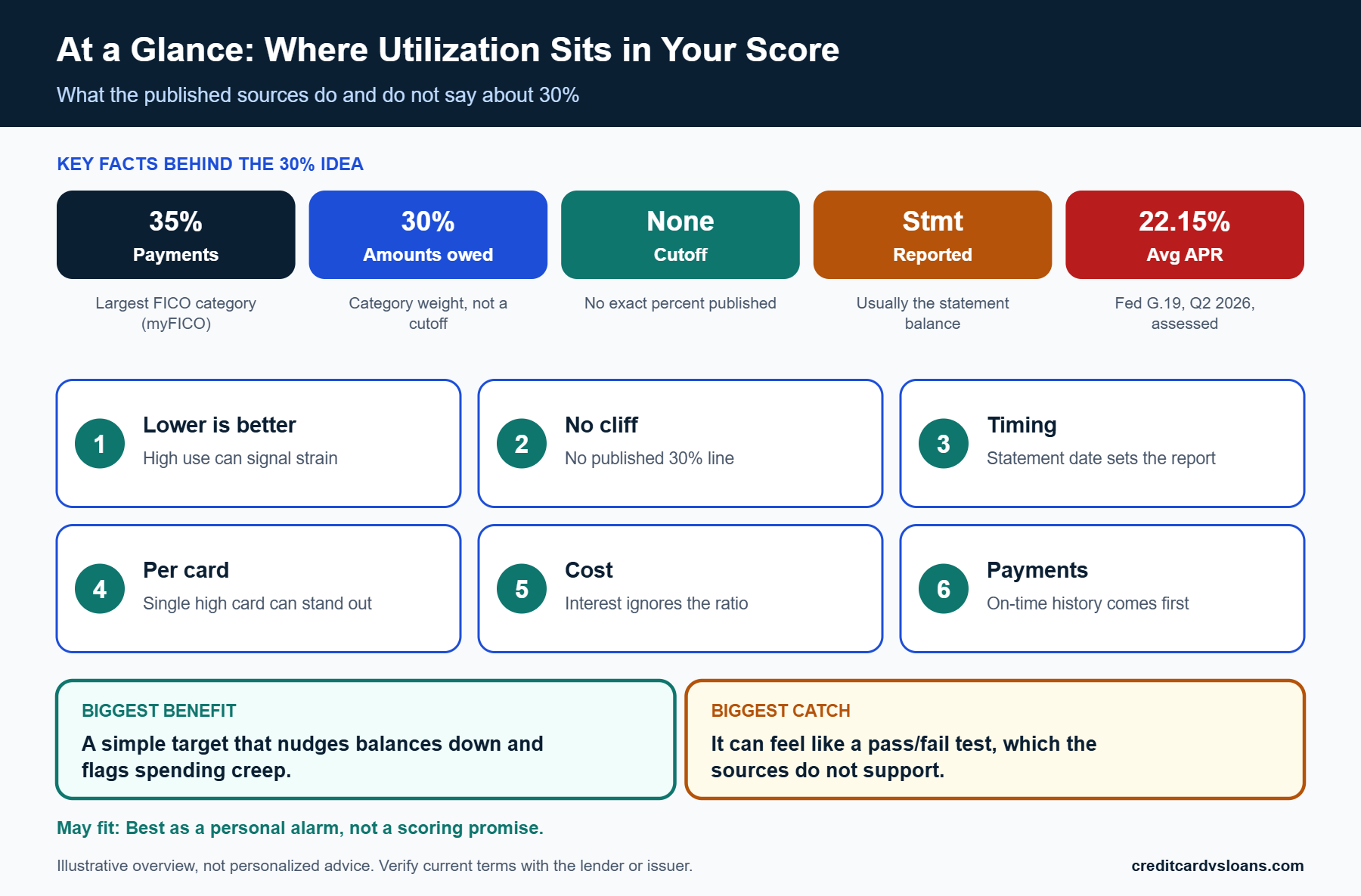
- 30% is a guideline, not a rule. The myFICO site describes utilization as part of the “amounts owed” category and does not name a percentage cutoff.
- Lower generally looks better than higher. myFICO says a low ratio can help more than using none of your credit, so a very small reported balance is not a problem.
- The number a lender sees is usually your statement balance. Paying a card down after the statement closes may not change what gets reported that month.
- You can be under 30% and still pay a lot. Utilization measures how much of your limit you use, not whether you are paying interest.
- Per-card and overall ratios can both matter. One maxed-out card can look different from a low overall ratio.
Score-factor weights and descriptions reflect the myFICO “What’s in my FICO Score” pages as of October 2026. Average card interest figures come from the Federal Reserve’s G.19 consumer credit release of October 7, 2026. Scoring companies can change their models, so treat any percentage as illustrative.
Table of contents
Is the 30% rule a real rule? The short answer
What people mean by the 30% guideline
The rule of thumb in plain English
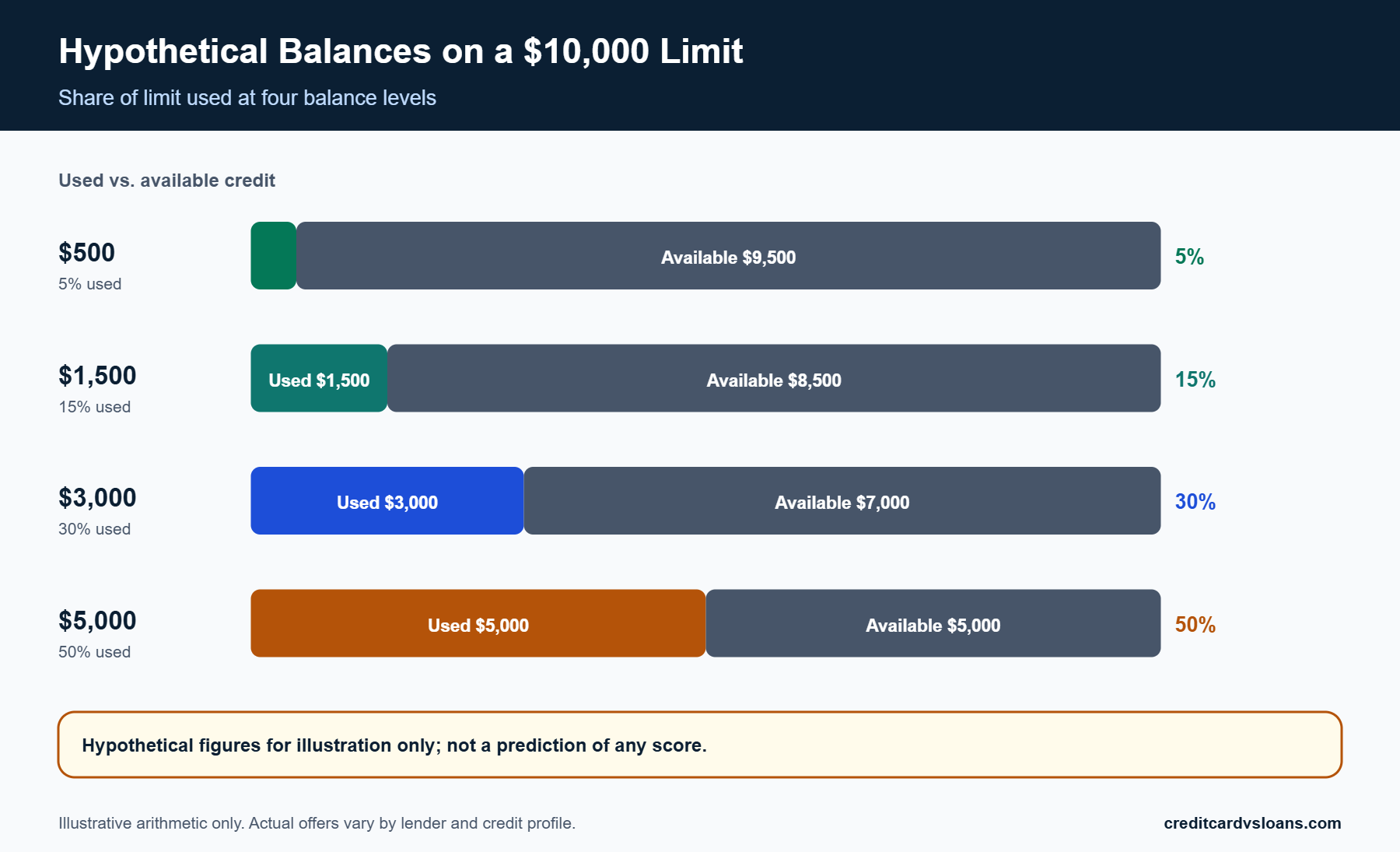
Utilization (sometimes called the utilization ratio) is the share of your revolving credit limits that you are using. If your cards have a combined limit of $10,000 and you owe $3,000, your utilization is 30%. The rule of thumb says to stay at or below that level.
The appeal is simplicity. One number, one target, and a quick mental check each month. For someone who has never thought about utilization, it is a reasonable starting nudge away from balances that sit close to the limit.
Why it feels like a rule
Repeated advice hardens into “fact.” The 30% figure shows up in bank blogs, budgeting apps and social posts, usually stated with total confidence. Because the advice is directionally sound, nobody pushes back, and the number gets treated as if it came from a scoring manual.
The trouble is that a guideline has no penalty line in it. If you treat 30% as a pass/fail test, you may stop paying down a balance at 29%, when more room might serve you better, or you may feel like you have failed at 33% when the real picture is far less binary.
What the primary sources actually say
myFICO: no percentage cutoff
According to myFICO, the “amounts owed” category makes up about 30% of a FICO Score. Payment history is 35%, length of credit history 15%, new credit 10% and credit mix 10%. Notice that the 30% weight of the category is a different 30% from the utilization guideline, and mixing them up is one common source of confusion.
The myFICO pages describe utilization in terms of high and low shares of available credit and note that a high share can suggest you are overextended. They do not publish a specific percentage at which the score changes. That is the clearest evidence that 30% is not an official threshold.
CFPB: one factor among several
The Consumer Financial Protection Bureau (CFPB) lists “how much of your available credit you use” among the things scoring models typically consider, alongside bill-paying history, unpaid debt, account types and age, and new applications. It also stresses that you do not have just one score; results vary by scoring model, data source, loan type and the date of calculation.
That last point matters here. If different models can produce different scores from the same report, no single utilization number can be a universal cliff for all of them.
| Question | Common claim | What the sources support |
|---|---|---|
| Is 30% an official cutoff? | Yes, going over 30% hurts | No published percentage cutoff at myFICO |
| Is lower better? | Under 30% is good enough | A low ratio generally helps; high ratios can signal strain |
| Is 0% best? | Never carry any balance | myFICO says low use can help more than none at all |
| Which balance counts? | What you owe today | Usually the balance on your latest statement |
| Is there one score? | My score is my score | CFPB: scores vary by model, data and date |
How scoring models treat utilization
Where utilization sits inside your score
Amounts owed is a category, not a ratio
The “amounts owed” category looks at more than a single percentage. According to myFICO, it considers how much you owe in total and how much of your available credit you are using. Installment debts, such as car loans, are viewed differently from revolving balances, and paying an installment loan down is generally seen as positive.
So when someone says utilization is “30% of your score,” they are rounding two ideas into one. Utilization is a piece of a category that carries roughly 30% of the FICO weighting. Your other 70% rides on payment history, age of accounts, new applications and mix.
Why payment history still outweighs it
Payment history is the largest category at 35%. A person with low utilization and a recent missed payment may find the missed payment matters more than the tidy balances. If you are deciding where to focus first, paying every account on time comes before optimizing a ratio.
The reverse also holds. A spotless payment record does not guarantee a perfect score, since myFICO notes that payment history is only one input. Utilization is one of the places where an otherwise strong file can still lose ground.
Overall versus individual card ratios
Two ratios, one report
Your overall utilization adds up every revolving limit and every revolving balance. Per-card utilization looks at each account alone. Because these can differ sharply, a person might show 15% overall while one card sits at 90%.
The published descriptions do not spell out the exact weight models place on each version, so the safest reading is that both can matter. If one card is near its limit, it is worth addressing even when the overall figure looks comfortable.
A simple illustration
Hypothetical example: you have three cards with limits of $5,000, $3,000 and $2,000, a combined $10,000. Balances are $2,700, $100 and $200, totaling $3,000. Overall utilization is 30%, yet the first card sits at 54% (2,700 divided by 5,000).
A rule that only counts the total would call this fine. A reader who understands the per-card view would at least notice the single heavy balance. Moving $1,000 of spending onto the other cards (if their limits and your budget allow) would change the per-card picture without changing your total debt at all.
What the evidence supports: tiers, not a cliff
Why a sharp threshold is unlikely to be the whole story
Scores are built from ranges and patterns
Scoring models compare your file with patterns in large sets of past credit files. That kind of comparison tends to work in bands: files with very low utilization look one way, files with moderate utilization look another, and files near the limit look different again. The published materials describe high versus low shares, not a switch that flips at one exact percentage.
That is why two people at 29% and 31% can see no meaningful difference, while someone at 9% and someone at 89% almost certainly will. Treat the guideline as a gentle boundary on the way to something safer, not as a wall.
What “lower is generally better” looks like
The most defensible summary is a gradient. Very high utilization suggests you may be stretched, which is how myFICO frames it. Moderate utilization is neutral to mildly helpful. Low utilization is usually viewed well, as long as you are actually using the account and paying it on time.
Because the exact curve belongs to each scoring model, the practical advice is to move in the right direction rather than to chase a number. Paying a balance from 60% down to 35% is a better improvement than the difference between 31% and 29%.
Where 30% can still be useful
A budgeting alarm, not a scoring target
Even if 30% is not official, it can work as a personal warning light. If your balances regularly climb past a third of your limits, that often means your spending is running ahead of your income, and that is worth noticing regardless of any score.
Used that way, the number does what a good rule of thumb should do: it prompts a check-in. You ask whether this month’s balance is a one-time bump or a pattern, and whether you can clear it before interest builds.
A ceiling for people who feel lost
If you are new to credit or just coming off a rough stretch, “stay under 30%” is a workable first goal because it is concrete. Plenty of people hold balances well above that level, and for them getting under 30% is a real step forward. You can always aim lower once you have the habit.
The key is to hold the number loosely. If you reach it, keep going down where practical, and do not stop caring about on-time payments, which carry more weight.
Cost and credit impact: what a “safe” balance can still cost
Utilization measures limits, not interest
You can be under 30% and still pay a lot
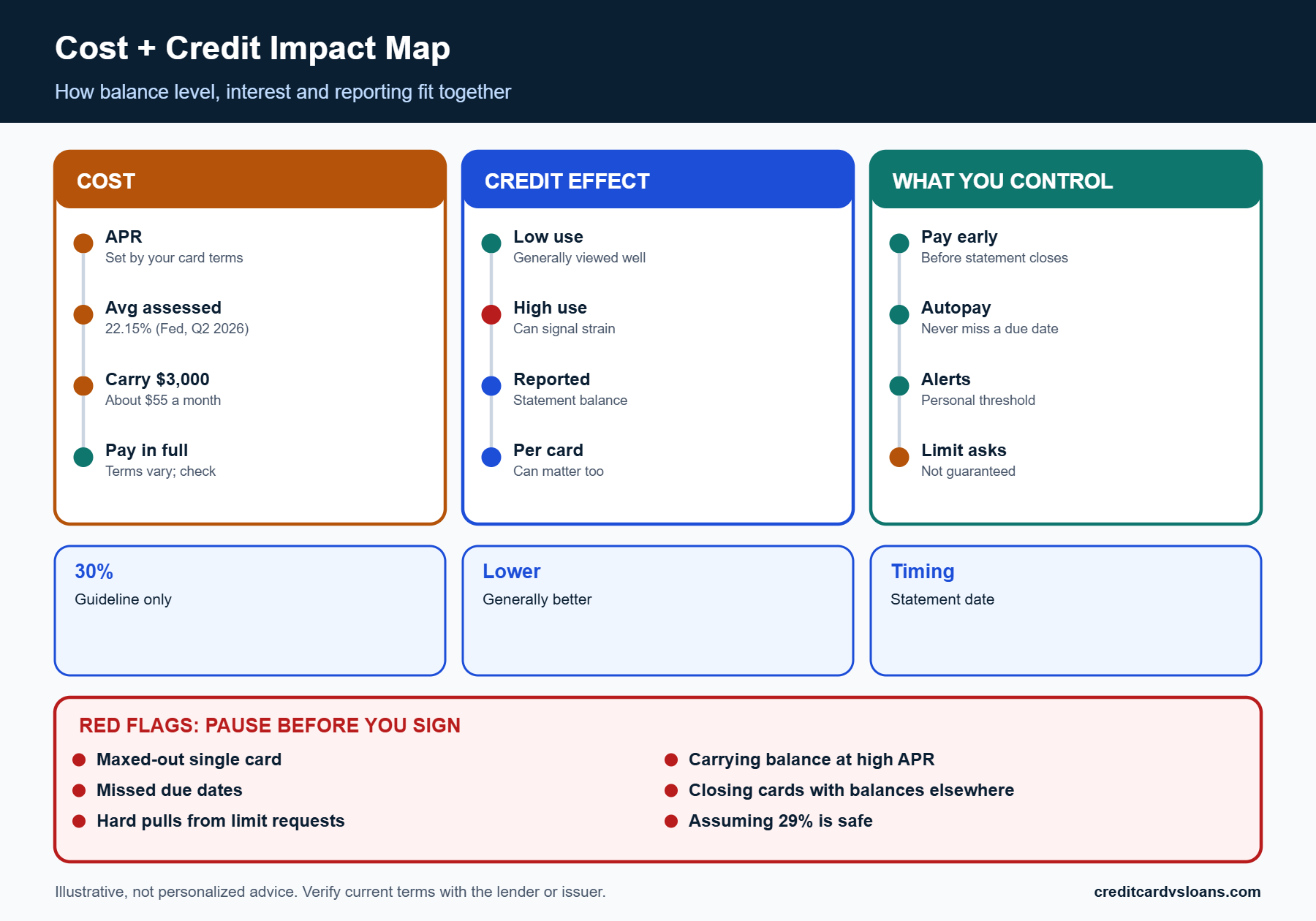
Utilization says nothing about the price of the debt. According to the Federal Reserve’s G.19 consumer credit release of October 7, 2026, the average interest rate on credit card plans at commercial banks was 20.94% across all accounts and 22.15% on accounts assessed interest in the second quarter of 2026. Your own APR may be higher or lower, and the real figure is on your statement.
At those averages, a balance that keeps you under 30% can still be expensive to carry. The table below uses the 22.15% figure for illustration only.
| Reported balance | Utilization | Approx. interest per month | Approx. interest per year | Read-through |
|---|---|---|---|---|
| $500 | 5% | $9.23 | $110.75 | Low use, small cost |
| $1,500 | 15% | $27.69 | $332.25 | Comfortable on the ratio |
| $3,000 | 30% | $55.38 | $664.50 | At the guideline, still costly |
| $5,000 | 50% | $92.29 | $1,107.50 | Above guideline and pricey |
| $9,000 | 90% | $166.13 | $1,993.50 | Near the limit, a red flag |
These figures are illustrative: they divide the annual rate by 12 and assume the balance is carried unchanged without new purchases or payments. Real interest depends on your daily balances, the card’s terms and any grace period.
Paying in full changes the cost, not the report
Many cards let you avoid interest on new purchases if you pay the full statement balance by the due date, but the terms vary, so check your cardholder agreement. Importantly, paying in full by the due date does not necessarily mean a zero balance gets reported. myFICO notes that lenders typically report the balance from your most recent monthly statement.
So a person who pays everything off every month can still show a meaningful utilization ratio, simply because the statement closed before the payment arrived. That is not a sign of trouble, and it does not mean you owe interest.
Impact on approval and pricing
How lenders may read your ratio
The CFPB describes a credit report as a record of your credit activity that lenders use to decide whether to lend and at what rates. Balances and limits are part of that record. A lender looking at a report with several cards close to their limits may see more risk than one with the same debt spread over higher limits.
That does not mean any specific outcome. Approvals depend on the lender, the product and the rest of your file, including income and payment history. What you can say is that lower reported balances tend to give you a stronger-looking application.
Timing matters before big applications
If you plan to apply for a mortgage, auto loan or new card soon, it can help to look at your statement dates rather than your due dates. Paying a balance down a few days before the statement closes can lower the number that gets reported. Doing this does not guarantee a better outcome, but it is a low-cost step if you were going to pay anyway.
If you are planning a promotional-rate move, see how scores often shift in our guides on how a balance transfer can affect your credit score and what happens to your score after a balance transfer.
Check the data behind the ratio
Verify limits and balances on your reports
The CFPB says a credit report includes, for each account, the credit limit or amount, the balance, payment history and open and close dates. Utilization is calculated from those fields, so a wrong limit or a stale balance can distort your ratio. A card showing a limit lower than the real one, for example, would make the same balance look heavier.
Review each revolving account on all three of your reports, because creditors are not required to report to every bureau, and your files can differ. Look at the limit, the reported balance and the status line before you worry about any percentage.
If something looks wrong
The CFPB outlines two parallel steps: dispute the error with the credit reporting company and with the company that supplied the information. Explain in writing what is wrong, include copies of supporting documents and keep your own copies. According to the CFPB, furnishers generally must investigate and respond within 30 days of receiving your dispute.
A correction will not guarantee a score change, but an accurate report is the foundation for every other step in this guide.
Statement dates and card-by-card detail
Which balance gets counted
Statement balance versus current balance
Your current balance changes with every purchase and payment. Your statement balance is a snapshot taken when the billing cycle closes. According to myFICO, lenders typically report the statement balance to the bureaus, and that is the number that shows on your report.
The practical takeaway: the balance you see in your app today may not be the balance a lender sees next week. Both numbers are real, but they answer different questions.
Why your score may move month to month
Because utilization reflects whatever was reported most recently, your score can shift when your reported balance changes, even if nothing else about you did. A large December statement can lower a score that rebounds once the balance is paid and the next statement reports lower.
That kind of movement is normal and usually temporary. It is a good reason not to read too much into a single month’s change, and a reason to avoid decisions based on one number.
Per-card strategy
Spreading versus concentrating spending
If you carry no balance beyond your monthly spending, you can choose which cards absorb purchases. Spreading charges so no single card runs unusually high is one way to keep per-card ratios lower. Whether it actually helps depends on the scoring model, which the published materials do not break down.
There is also a convenience trade-off. More cards means more due dates to track, and a missed due date costs more than a slightly lopsided ratio.
| Action | What it changes | When it shows up | The catch |
|---|---|---|---|
| Pay before statement closes | Lowers the balance that gets reported | Next report from the issuer | Needs cash on hand earlier in the cycle |
| Pay by the due date only | Avoids interest on new purchases (terms vary) | Reported balance may still be high | Does not necessarily lower the reported figure |
| Request a higher limit | Lowers ratio if balances stay flat | After the issuer approves | May involve a hard pull; not guaranteed |
| Open a new card | Adds limit but adds inquiry and new account | After approval | Can cut average age of accounts |
Closing cards and the ratio
Closing a card removes its limit from your total, which can raise your overall utilization if you carry balances elsewhere. The effect depends on your other limits and the balances you hold. It is worth thinking through before you close an old account just to simplify your wallet.
If you are consolidating, the same logic applies in reverse: moving balances changes both your total debt picture and your per-account ratios, which is covered in how debt consolidation can affect your credit score over time.
When 30% is the wrong target
When the credit utilization 30 percent rule is too loose
Applying for a big loan or a promotional card
If you are about to apply for something where approval and pricing both matter, a ratio just under 30% may leave room to improve. Lenders look at the whole report, and lower reported balances generally read as lower risk. In that window, paying balances down before statement dates is a more useful goal than meeting a generic guideline.
The same thinking applies to promotional offers. If you are weighing a card for its introductory rate, the credit requirements and your current balances both matter, as our guide to the credit score you may need for a 0% APR card explains.
Carrying balances you can’t afford
A 25% ratio can still be a problem if the payments strain your budget or the APR is high. A debt that costs more each month than your income can comfortably support does not become safe because the percentage looks acceptable. The Table 2 figures above show how much interest a modest ratio can still produce.
In that case the goal is cost and cash flow first, score second. Paying more than the minimum, or moving to a lower-rate structure where it truly saves money, can matter more than a ratio.
When it is too strict
Seasonal spikes you pay off right away
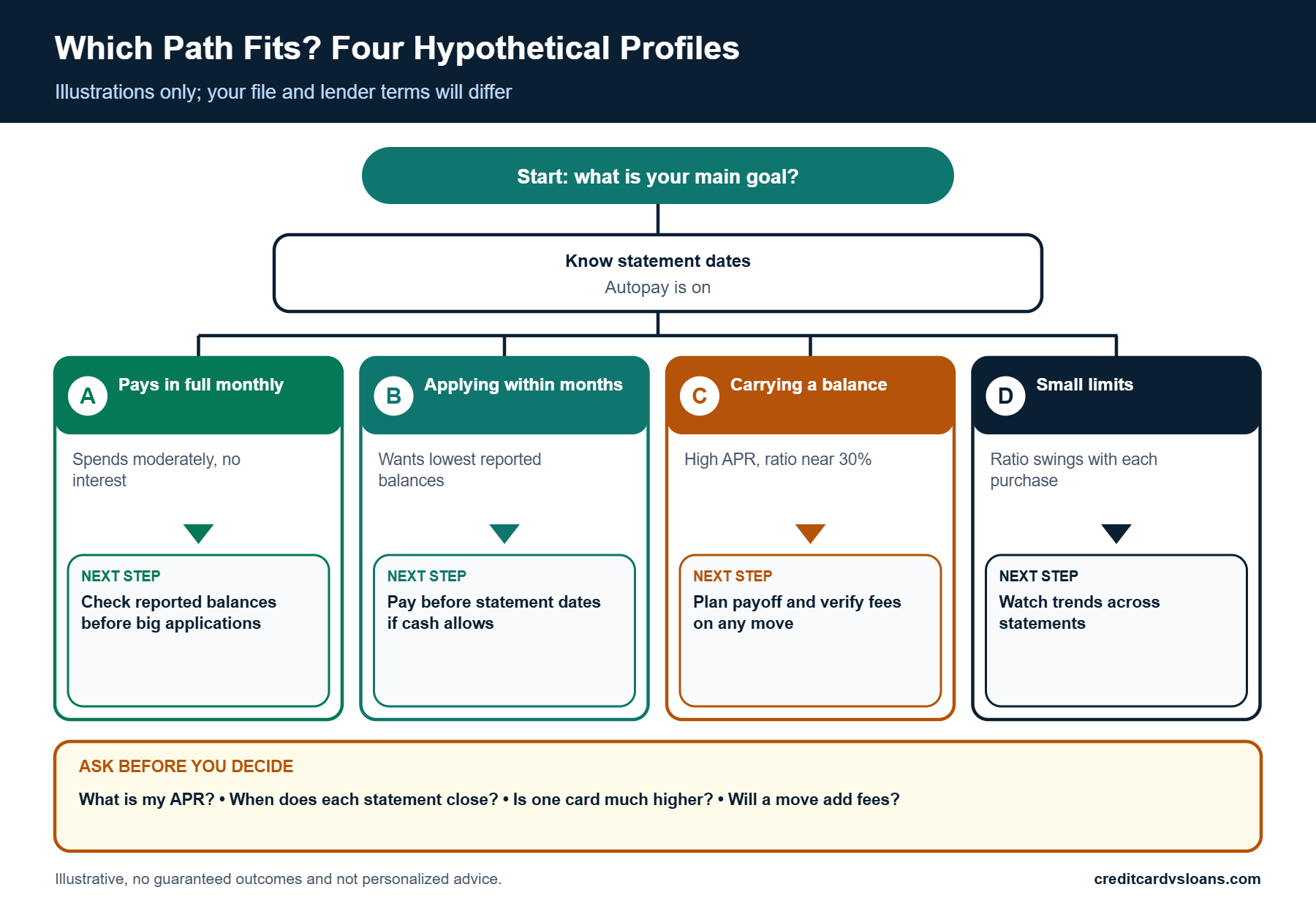
Holiday spending, annual insurance premiums or a one-time repair can push a statement balance over 30% for a month. If you pay it in full soon after, the spike is temporary. A single high statement is not the same as a pattern of carrying high balances, and the next statement can report lower.
Unless you are about to apply for credit, there is usually no reason to take on stress or move money in awkward ways to dodge a one-month bump.
Small limits, big swings
On a card with a $500 limit, a $200 purchase is 40% utilization. Small-limit cards make the ratio jumpy, and one ordinary grocery run can shift it noticeably. If that describes your file, checking the ratio after each purchase will drive you in circles.
It is more useful to look at your overall pattern across statements, and, when practical, to ask the issuer about a limit review. Be aware that an increase request may or may not involve a hard pull, and approval is never certain.
Practical ways to manage utilization without chasing a number
Low-cost habits
Check your statement dates once
Look up the closing date for each card and put them in your calendar. Then decide, card by card, whether you want to make a mid-cycle payment before the statement closes. If you pay in full each month anyway, a payment shortly before closing is simply the same money moved a little earlier.
This works only if you have the cash at that time, so it is not for everyone. If it would leave you short for rent or bills, skip it.
Set alerts instead of mental math
Most issuers let you set balance alerts. Choose a threshold that matches your own comfort level, perhaps a share of the limit or a dollar amount, and let the app tell you when you cross it. That turns the 30% idea into a personal early warning rather than a pass/fail grade.
An alert is also easier to follow than a rule you have to compute. You act when it fires, and you ignore the number the rest of the time.
Bigger moves and their trade-offs
Consolidation and transfers
Moving revolving balances to an installment loan or a new card changes both your ratios and your costs. It can lower your card utilization, but it may also add a new account and an inquiry, and it can carry fees. Read the fee and rate terms closely before you assume it’s a net gain. Our guide on what happens to your credit score after debt consolidation walks through the typical score effects.
No move is guaranteed to improve your score. What matters is whether the total cost of the debt falls and whether you can keep the new structure from drifting back to the old balances.
Paying down versus asking for more limit
Reducing balances lowers your ratio and your interest cost together, which makes it the most reliable lever. A higher limit lowers the ratio only if your spending stays flat, and it does nothing about interest. If you ask, ask because you want the breathing room, not because you plan to spend into it.
| Situation | A reasonable target to consider | Why | When to be careful |
|---|---|---|---|
| Building credit from scratch | Under 30% as a first step, lower when you can | Concrete and achievable | Do not stop caring about on-time payments |
| Applying for a loan within months | As low as practical on statement dates | Lower reported balances read as lower risk | Do not open new accounts just to add limit |
| Pays in full monthly | No fixed target needed | No interest; ratio is a reporting artifact | Check reported balances before big applications |
| Carrying a balance with high APR | Cost and payoff plan first | Interest drives the real damage | Verify fees on any transfer or consolidation |
| Tiny limits on all cards | Watch the pattern across statements | Small purchases swing the ratio | Limit increases are not guaranteed |
Myths and mistakes around the 30% idea
Myths that cost people money
“I have to carry a balance to build credit”
This one is false, and it can be expensive. Using a card and paying it off lets you build a payment record without paying interest. myFICO notes that a low ratio can help more than using none at all, but that refers to what is reported, not to whether you owe interest.
Carrying a balance to “show activity” means paying interest at rates like those in the Fed’s G.19 data for no benefit you can count on.
“Going over 30% will tank my score”
Going over 30% does not trigger a documented penalty. It does tend to move you toward a worse part of the range as the share climbs. How much your score reacts depends on your whole file and the scoring model, so any promise of a specific number of points should be treated with suspicion.
If you see a score dip after a high statement, it usually recovers when a lower balance reports, provided you keep paying on time.
Mistakes that undermine good habits
Ignoring payment history
Since payment history carries the largest share of a FICO Score, a missed payment can outweigh weeks of careful ratio management. Autopay for at least the minimum is a safety net worth setting up on every card. You can then pay more manually when you choose.
Closing old cards impulsively
Closing a card takes its limit away and can push your overall ratio up if you carry balances elsewhere. It also can affect the age of your accounts over time. If you want to close an account, look at both effects first and consider whether keeping it open with a small recurring charge fits your habits.
Worked examples: how the numbers play out
Same debt, different ratios
Hypothetical: two people owing $4,000
Imagine two cardholders, each with $10,000 in total limits and $4,000 in total balances. Overall, both sit at 40%. These are illustrative profiles, not real people, and the point is how little the headline number reveals.
Cardholder A has one $5,000 card carrying the full $4,000 (80% on that card) and a second $5,000 card at zero. Cardholder B holds $2,000 on each card (40% on each). If per-card ratios matter to a scoring model, as the published descriptions leave open, B’s file looks more even than A’s.
What each could reasonably do
A could move part of the balance or direct new spending to the empty card if the second card’s APR and A’s budget allow. Moving a balance between cards does not reduce the debt, and balance transfer fees can apply, so A should read the terms before acting. Paying $1,000 toward the first card, by contrast, cuts the debt itself and drops that card to 60%.
B has less to fix on ratios and more to gain by attacking the interest cost, because $4,000 at the 22.15% G.19 average would cost roughly $73.83 per month in simplified interest (4,000 times 0.2215, divided by 12).
Same ratio, different cost
Hypothetical: timing a payment
A cardholder has a single $8,000 limit and spends about $2,400 each month. If the statement closes with the full $2,400 showing, the reported utilization is 30%. If they pay $1,500 before the statement closes, the reported balance is $900, or 11.25% of the limit.
Nothing about the person’s finances changed. They spent the same amount and paid the same total. Only the reporting snapshot differs, which is why checking statement dates can matter more than hitting a round percentage.
Hypothetical: the rate matters more than the ratio
Suppose someone carries $3,000, which is 30% of a $10,000 limit. At 22.15% the simplified interest is about $55.38 per month. If they could move that balance to a hypothetical fixed 12% installment loan with no fees, simplified interest would be $30.00 per month, a difference of $25.38.
That is a hypothetical, and real loans carry origination fees, credit checks and qualification rules, so you must apples-to-apples compare the full cost. The point is that two files with identical 30% ratios can have very different monthly bills.
Decision checklist and next steps
A practical checklist
Questions to answer before you change anything
- Do I know each card’s statement closing date and due date?
- Is my current balance a one-month spike or a recurring pattern?
- What is my actual APR on any balance I carry, and what does it cost per month?
- Am I planning to apply for a loan or card in the next few months?
- Is any single card much closer to its limit than the others?
- Would a limit increase, transfer or consolidation add fees or an inquiry?
What to do this week
- Pull your free credit reports and check that every limit and balance is correct. Errors can be disputed, and the CFPB explains the steps.
- Write down closing and due dates for each card.
- Turn on autopay for at least the minimum on every account.
- Set a balance alert at a level that suits your budget.
- If you carry a balance, plan to pay down the highest-APR card first where that fits your cash flow.
A 90-day rhythm
Month one: set up and observe
Spend the first month collecting information rather than changing behavior. Note each card’s limit, statement closing date, due date and APR. Watch how your reported balances move across one full cycle so you can see where spikes come from, whether that’s groceries, travel or a recurring bill.
Make sure autopay covers at least the minimum on every card. That single step protects your payment history, which carries the most weight of any category.
Months two and three: adjust what actually helps
Now decide what your data suggests. If you pay in full but statements run high, try a mid-cycle payment on the busiest card. If you carry a balance, build a payoff plan around the highest APR first, and compare any consolidation or transfer by total cost, not just the monthly payment.
Recheck your reports at the end of the period. If balances and limits look right and your habits are steady, you do not need to keep tinkering. Consistency does more than constant optimization.
The bottom line
How to use the rule without being ruled by it
The 30% figure is a fair starting guardrail and a poor description of how scoring works. Use it as a prompt to keep balances moderate, then focus on what is documented: pay on time, keep reported balances low where practical, and watch the interest you pay.
If you are close to an application, look at your statement dates and per-card balances. If you are not, spend your energy on payment history and on paying down costly debt, which helps your budget whatever the score does.
When to seek more help
If you are struggling to keep up with payments, contact your issuer early to ask about hardship options, and consider a nonprofit credit counselor. Terms differ by issuer, and nothing here predicts what any lender will offer or how any score will change.
For the official explanations, the myFICO site describes the score categories, and the CFPB explains credit reports and scores in plain language.
Frequently asked questions
Quick answers
Is a tiny balance better than none?
Not necessarily better, and not worse. myFICO says a low ratio can help more than using none of your credit, but it also says paying a card in full does not guarantee a zero balance on your report. That means you do not need to carry interest-bearing debt to look active. A small purchase paid off in full each month already gives lenders recent activity to report.
Does the 30% rule apply to loans too?
The guideline is about revolving accounts such as credit cards. Installment loans are treated differently within the amounts-owed category, and myFICO notes that paying down an installment balance is viewed positively. A car loan at 90% of its original balance is not the same situation as a card at 90% of its limit.
Edge cases
What if my limit is very high?
A high limit makes percentages small even when the dollar balance is large. A $6,000 balance on a $60,000 limit is 10%, but it is still $6,000 of debt that costs interest if you carry it. Ratios are a reporting tool; your budget is what decides whether a balance is manageable.
What if my card has no preset limit?
Some charge cards do not publish a fixed limit, and how they appear in utilization calculations varies by issuer and scoring model. Check how the account is shown on your credit reports and ask the issuer if you are unsure.
- myFICO: What’s in my FICO Scores? (Score factor weights and amounts owed)
- myFICO: Amount of Debt: Credit Utilization (Utilization and reported statement balances)
- myFICO: Payment History (Payment history as the largest factor)
- CFPB: What is a credit score? (Factors and why scores differ)
- CFPB: What is a credit report? (Contents and uses of credit reports)
- Federal Reserve: Consumer Credit – G.19 (Release of Oct. 7, 2026: card interest rates, Q2 2026)
- FTC: Credit Scores (Payment history and scoring basics)
Last updated: October 22, 2026. Rates, fees and lender rules change; verify current terms before acting.
The information on creditcardvsloans.com is provided for general educational and informational purposes only. It is not financial, legal, tax, credit, accounting or investment advice, and reading it does not create an advisor-client, fiduciary or any other professional relationship. Nothing here is an offer, solicitation or recommendation to borrow, lend or apply for any product.
Credit scores, interest rates, fees, eligibility rules, lender policies and laws change frequently and vary by lender, location and individual circumstances. Examples, figures and scenarios are illustrative only, do not predict your results and do not guarantee approval, savings, a particular rate or a credit-score outcome. Always confirm current terms directly with the lender or issuer and read the full agreement before you apply or sign.
Although we aim for accuracy and use reputable sources, we make no representations or warranties, express or implied, about the completeness, accuracy, reliability or timeliness of the content. Content may be drafted with the assistance of automated tools, so errors or omissions may still occur. Links to third-party sites are provided for convenience; we don’t control and aren’t responsible for their content.
To the fullest extent permitted by law, creditcardvsloans.com and its owners, editors, authors, contributors and affiliates disclaim all liability for any loss, damage or expense arising directly or indirectly from your use of, or reliance on, this content. Before making financial decisions, consult a licensed professional, such as a qualified financial advisor, attorney, tax professional or nonprofit credit counselor, who can consider your complete situation.