A credit utilization zero balance, meaning 0% of your card limits reported as used, is not bad for your score, but it is not clearly the best result either. myFICO says keeping your use of credit low can help more than not using your credit at all, so a very small reported balance can be at least as good as none.
That sentence surprises people who were told the perfect move is never to show a balance. It does not mean you should carry debt or pay interest to look active. It means a reported zero and a reported small balance are two different snapshots, and neither one is a problem if you pay every bill on time.
This article explains what a 0% ratio really represents on your credit report, why paying in full does not always produce a reported zero, and what it can cost to chase a “perfect” number. It stays on the zero-balance question; for the broader ratio guidance, our look at whether the 30% utilization rule is really a rule covers the other end of the spectrum.
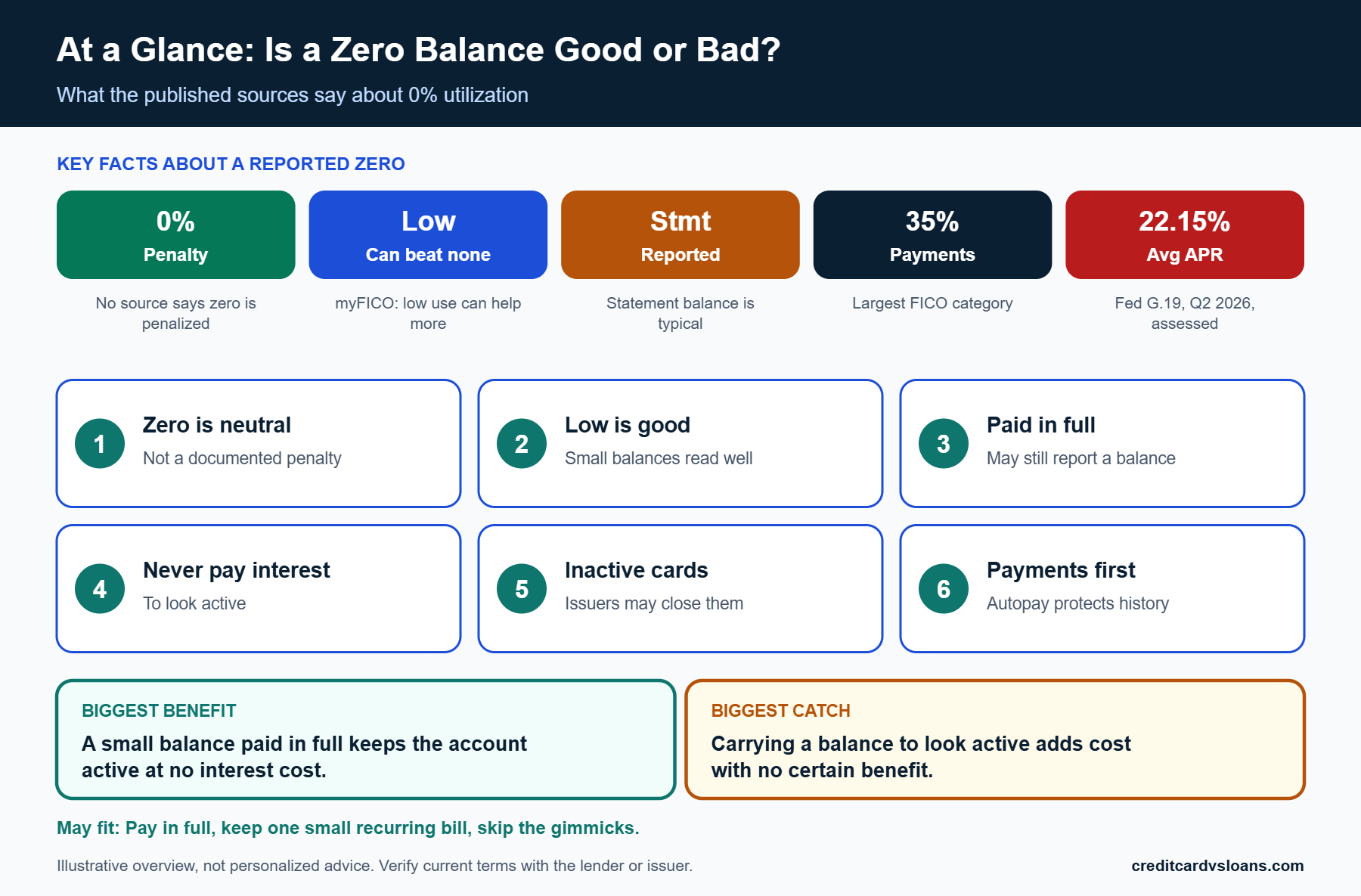
- 0% is not a penalty. Nothing in the myFICO or CFPB descriptions says a zero ratio hurts you.
- Low can beat none. myFICO says a low ratio can help more than using none of your available credit.
- Zero reported is not the same as zero owed. Lenders typically report the statement balance, so a card you pay in full can still show a balance.
- Never pay interest to look active. A small balance paid in full by the due date typically costs nothing; one that is carried does.
- Payment history comes first. It is 35% of a FICO Score, so autopay protects more than any ratio tweak.
Score-factor descriptions reflect the myFICO pages as of October 2026. Interest-rate averages come from the Federal Reserve’s G.19 release of October 7, 2026. Scoring models differ, so the examples below are illustrations, not predictions.
Table of contents
Is 0% credit utilization good or bad? The short answer
What a zero ratio actually means
Zero used out of your total available credit
Utilization is the share of your revolving credit limits that you are using. A zero ratio means every credit card and other revolving line on your report shows a balance of zero. If you hold two cards with a combined limit of $8,000 and both statements report $0, your utilization is 0% (0 divided by 8,000).
That can happen for good reasons: you paid before the statement closed, you were not using the cards that month, or you pay in full and your timing lined up. It can also happen because the accounts are dormant, which raises different questions covered later.
Why people worry about it
The worry comes from a half-remembered idea that scoring models like to see some activity. That idea has a kernel of support, since myFICO says a low ratio can help more than none. But “can help more” is not the same as “hurts.” The documented message is that low usage is good, not that zero usage is bad.
Most of the fear grows from comparing scores across apps and noticing a few points of movement after a month with no reported balance. Small swings like that can come from many causes, and scoring models differ, so a single month’s change says very little.
What the primary sources say
myFICO on amounts owed
According to myFICO, amounts owed makes up about 30% of a FICO Score, compared with 35% for payment history, 15% for length of credit history, 10% for new credit and 10% for credit mix. Within amounts owed, myFICO describes a high share of available credit as a signal you may be overextended and says keeping that share low can help.
The same page notes that a low ratio can help more than using none of your credit, and that paying your card in full each month does not guarantee a zero balance on your report, because lenders typically report the balance from your most recent statement.
CFPB on how scores work
The Consumer Financial Protection Bureau (CFPB) lists how much of your available credit you use as one of several things scoring models typically consider. It also explains that you have many credit scores, which can differ by scoring model, data source, loan type and the date of calculation.
That is a reason for humility. Because models differ, no single treatment of a zero balance applies everywhere, and anyone claiming an exact point effect is going beyond the published descriptions.
| Claim you may hear | What it implies | What the sources support |
|---|---|---|
| “0% utilization is perfect” | No balance ever reported is ideal | myFICO: low can help more than none |
| “0% utilization hurts your score” | You must carry debt | No source says zero is a penalty |
| “Pay in full and you’ll show $0” | Paying clears the report | Statement balance is usually what is reported |
| “You need a balance to build credit” | Interest is the price of credit | On-time payments build history without interest |
| “All cards at zero is safe long term” | Dormant is harmless | Issuers may close inactive accounts; check your agreement |
Zero reported versus zero owed
How the reported number gets set
Statement date is the snapshot
Card issuers report account information, including balance and credit limit, to the bureaus on a regular schedule. American Express, for example, says it sends account information each month on the billing period’s closing date. Other issuers have their own schedules, so check yours.
If your balance on the closing date is $0, that is what gets reported. If you charged $400 after you paid the previous bill, your statement will show $400 and that is what a lender sees, even if you clear it in full a week later.
Why paying in full still shows a balance
Paying by the due date is separate from the closing date. The due date typically falls a few weeks after the statement closes, so the balance reported at closing has not yet been paid. That is why myFICO warns that paying in full does not guarantee a zero on your report.
It also explains why a person with no debt can show 10% or 20% utilization. It is a reporting artifact rather than a sign of trouble, and it does not mean you owe interest.
Zero on purpose or zero by accident
Planned zero before a big application
Some people pay their cards before the statement closes in the month before applying for a mortgage or auto loan, aiming to show low balances. This is a legitimate timing step if you have the cash. It is not guaranteed to change an approval, since lenders consider income, payment history and more.
Be careful with the cash trade-off. Draining savings to show a lower reported balance can leave you short on rent or emergencies, which costs more than any scoring benefit.
Accidental zero from unused cards
If you rarely use a card, it may report $0 month after month. That is harmless on its own, but it leaves the account with little recent activity, and the issuer may have its own policies about inactive accounts. See the section below on inactive cards before you let one sit for years.
A small recurring charge that you pay in full is a common way to keep a card in use without paying interest, as long as you do not forget the bill.
Cost and credit impact: what chasing a small balance really costs
The price of showing a balance
Paid in full versus carried
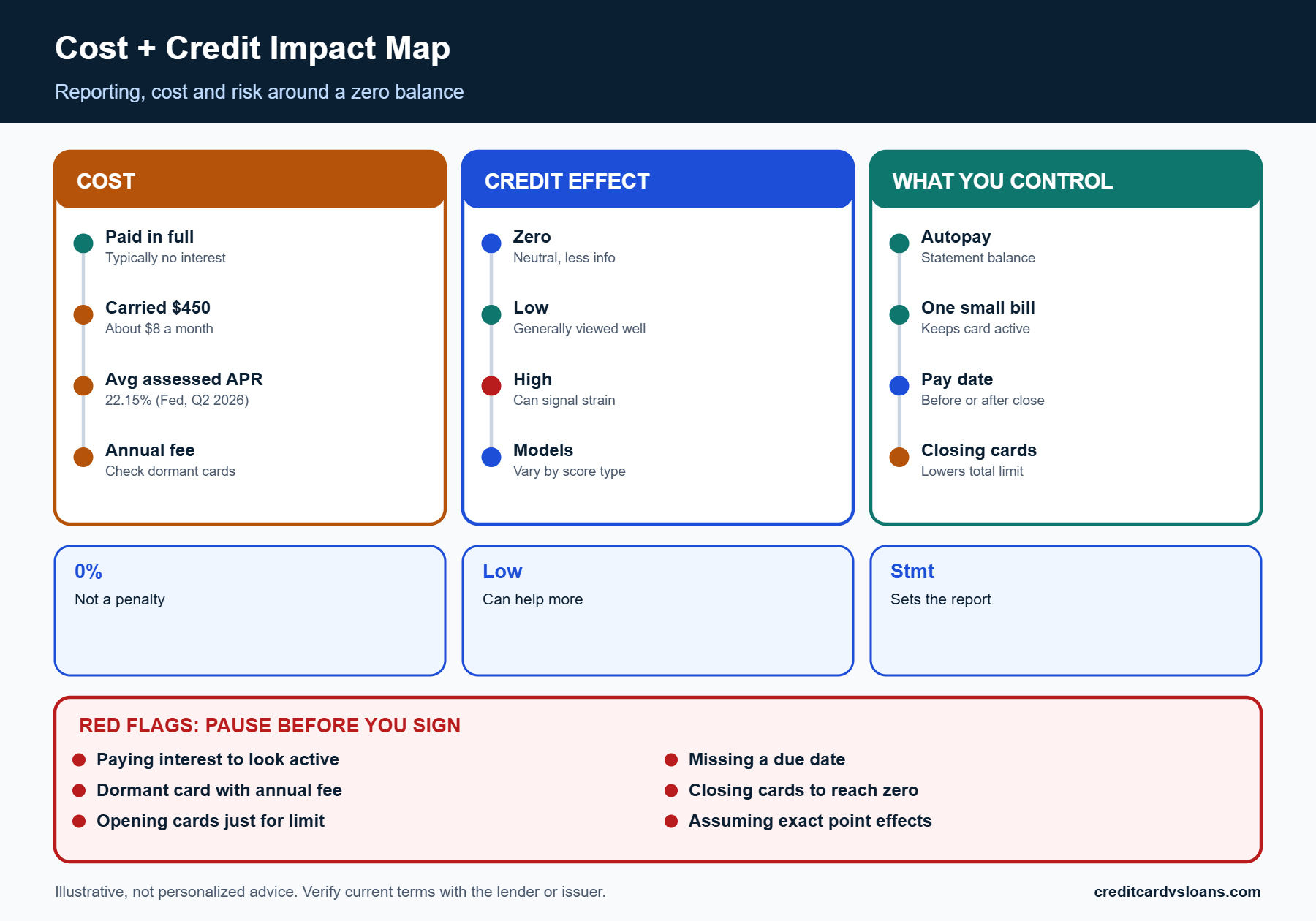
The credit benefit of a small reported balance only makes sense if you can show it without paying for it. A balance that you pay in full by the due date generally costs no interest on purchases, although terms vary, so confirm the grace period in your cardholder agreement. A balance that you carry month to month does cost interest.
According to the Federal Reserve’s G.19 consumer credit release of October 7, 2026, the average interest rate on credit card plans at commercial banks in the second quarter of 2026 was 20.94% for all accounts and 22.15% for accounts assessed interest. Your own APR is on your statement and may differ.
How small the cost is, and why it still isn’t worth it
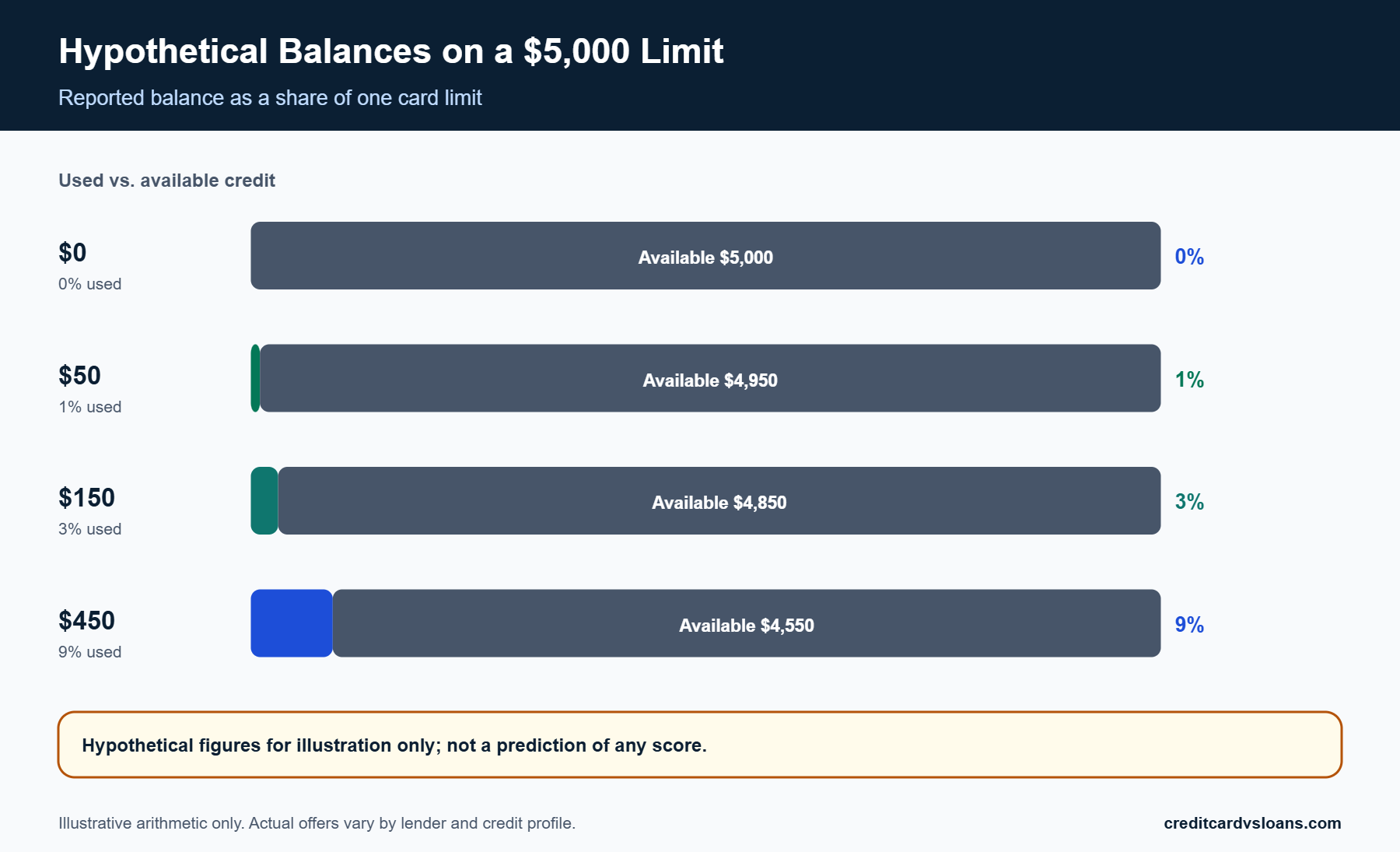
The dollars on a tiny balance are small, which is exactly why people shrug and carry it. But the interest buys you nothing you could not get by paying in full. The table uses the 22.15% average to show the simplified cost of carrying various balances on a hypothetical $5,000 limit.
| Reported balance | Utilization | Interest if carried (about, per month) | Interest if paid in full by the due date | Read-through |
|---|---|---|---|---|
| $0 | 0% | $0.00 | $0.00 | Zero reported; no cost |
| $50 | 1% | $0.92 | Typically $0 (terms vary) | Low and nearly free |
| $150 | 3% | $2.77 | Typically $0 (terms vary) | Low and cheap |
| $450 | 9% | $8.31 | Typically $0 (terms vary) | Still low; carrying adds cost |
These amounts are illustrative. They divide the annual rate by 12 and assume the balance sits unpaid for a month. Actual interest depends on your daily balance, your card’s terms and any grace period.
Where the credit effect is uncertain
No published scorecard for zero
The sources do not give point values for 0% versus 1% versus 9%. Anyone offering exact numbers is relying on testing of particular models, not on a published rule. Because the CFPB confirms that scores vary by model, data source and date, you should expect different results from different scores and different lenders.
That uncertainty is a reason to avoid making your finances worse for a theoretical gain. If paying a few dollars of interest is the only way to show a balance, skip it.
What the safer reading is
The safer reading of the evidence has three parts. A high ratio is a risk signal. A low ratio is a good signal. A zero ratio is neutral to slightly less informative than a low one, and that is all. If you pay your cards in full and your report occasionally shows $0, you are not doing anything wrong.
If you are thinking of a promotional transfer, the ratio issues change, as explained in how a balance transfer can affect your credit score and in our guide to your score after a balance transfer.
Reading the numbers on your own statement
Where to find the figures that matter
Your monthly statement shows the closing date, the statement balance, the minimum payment, the due date and the APR. Those five items tell you almost everything you need to manage a reported balance. If your issuer’s app shows a “current balance” that differs from the statement balance, remember that the statement figure is the one typically reported.
The statement also lists any interest charged. If you see interest on a card you thought you paid in full, check whether a payment was short or posted after the due date, then ask the issuer how to avoid a repeat.
Turning the numbers into a plan
Write down your limits and the balances that typically print on each statement. Divide each balance by its limit for the per-card figure, and add them up for the overall figure. If every result is low and you are paying in full, you have nothing to fix. If one card prints high each month, shift a recurring bill to a card with room or pay mid-cycle.
That small bit of arithmetic does more than any rule of thumb because it uses your actual accounts and your actual dates.
When zero happens: common situations
Situations that produce a zero
Paid before the statement closed
If you make a payment that clears the balance before the closing date, the statement shows $0 and that is what is reported. This is the cleanest way to see 0%, and it costs nothing. It does leave the account with no reported activity for that month, which is fine.
No charges at all
A card you did not use will report $0 until you do. The account still shows its limit, open date and payment record. Dormancy is common on backup or older cards. Just be aware that some issuers reserve the right to close or reduce inactive accounts, which you should read in your agreement.
How each situation reads on a report
A quick comparison
The table below puts the common zero-balance situations side by side, and the last column suggests what to check. It does not predict a score effect.
| Situation | What your report shows | Cost | What to check |
|---|---|---|---|
| Paid in full before statement closes | $0 reported | None | That the payment posted on time |
| Paid in full after statement, before due date | Statement balance reported | No interest on purchases (terms vary) | Grace period in your agreement |
| Card unused for months | $0, limit still listed | Possible annual fee if the card has one | Issuer inactivity policy |
| All cards paid off after a debt payoff | Low or zero revolving use | Interest ends | Keep accounts open if there is no fee |
| Zero because you closed cards | Fewer or no open revolving lines | None | Lost limit, shorter active history |
When to ask questions
If an account is reporting something you do not expect, such as a balance when you paid it or a limit that looks wrong, check it against your statement. The CFPB explains that you can dispute errors with both the reporting company and the company that provided the information, and that furnishers generally must investigate within 30 days of your dispute.
Different accounts, different zeros
Revolving versus installment accounts
A zero balance means different things on different account types. On a revolving card, zero means no current use of the limit. On an installment loan, such as an auto loan, a zero balance means the loan has been paid off and closed. myFICO notes that paying down installment balances is viewed positively, so a paid-off loan is a good outcome and not a problem to fix.
Because the two are treated differently in the amounts-owed category, a paid-off car loan does not mean you must create a card balance to compensate.
Store cards and low-limit cards
Store cards often have small limits, so a modest purchase can move the ratio sharply. If one of those cards reports $0 most months, that’s fine; if it reports a high percentage because of a single purchase, you can pay it down before the statement closes. Always read the card’s terms, since store cards often carry high APRs.
Inactive cards, closures and the long game
Leaving a card unused
Issuer policies on inactivity
Some issuers close accounts that have had no activity for an extended period, and the rules differ by issuer and product. Your cardholder agreement or issuer’s help pages should say what applies. If the card has no annual fee, a small charge you pay in full every few months is a low-cost way to keep it active.
An account that is closed by the issuer stops contributing its limit to your totals. If you carry balances elsewhere, that can raise your overall ratio, even though nothing about your spending changed.
Annual fees and the cost of keeping a card open
Keeping a card open is only a good plan if it costs little or nothing. A card with an annual fee that you never use is a drain, and cancelling it may make sense even if it lowers your total available credit. Compare the fee with the benefit and, if you want to keep a no-fee version, ask the issuer whether a product change is possible.
Closing cards and the zero-balance goal
Closing to reach 0% is rarely the right move
Some people think they can “make utilization zero” by closing cards. Closing a card removes its limit and, if balances remain elsewhere, raises your ratio. When all revolving accounts are closed, you may have no active revolving lines to report, which can make your file thinner for lenders who want to see recent use. Hypothetically, a person with three cards of $4,000 each ($12,000 in total) who closes two keeps a $4,000 limit, so a $1,000 balance would jump from 8.3% to 25%.
Closing may still make sense
There are good reasons to close a card, such as a fee you won’t pay or spending you can’t control. If so, close it with eyes open and understand the effects on limits and average age. Our guide to the credit score you may need for a 0% APR card can help if you’re considering a replacement with a promotional offer.
When 0% is fine and when to adjust
Cases where you can leave it alone
You pay in full and your file is established
If you’ve held accounts for years, pay everything on time and sometimes show $0, there is no documented reason to change anything. Payment history is the largest FICO category, and you’re already doing the most important thing. The extra effort of manufacturing a small reported balance rarely justifies itself.
You may also be keeping cards open and using one or two for routine bills. That pattern already gives lenders recent activity to report, with no interest.
You use credit rarely and prefer simplicity
Some people use a card once a quarter and want little to manage. That’s a reasonable choice. Just confirm the card is not at risk of closure for inactivity and that no annual fee is eating the benefit. Set the autopay to the statement balance so a forgotten bill does not turn into a late payment.
Cases worth a second look
A major application is coming
Before a big loan or a premium card, it is worth looking at what your report will show. A zero on every card, with no recent activity at all, might be less informative to a lender than one or two accounts with low, recent, on-time balances. Whether that matters depends on the lender and the scoring model, and the sources do not quantify it.
If you are comparing products, see how requirements differ in our guides on the score needed for a 0% APR card and the score needed for a rewards card.
Your file is thin
If you have only one or two accounts, or the accounts are new, the activity on your report can matter more because there is little else to read. A thin credit file means fewer data points, so a lapse in activity can leave a lender with less to go on. Using one card for a small bill and paying in full is the simplest remedy.
Do not take on a payment plan, a store card or a loan just to create activity. A new account brings a hard pull and a new account on your report, and the cost of interest or fees can outrun any scoring benefit.
A practical routine for keeping accounts active without paying interest
Set-and-forget habits
Put one small recurring bill on one card
Pick a bill you already pay each month, such as a streaming subscription or phone plan, and put it on a card you want to keep active. Set autopay to pay the full statement balance. The card reports a small balance, you pay no interest on purchases if you pay in full (terms vary), and the account stays used.
Check the first two statements to make sure the charge and the payment line up. After that, a quick monthly glance at your banking app is enough.
Choose the right autopay amount
Autopay offers usually include the minimum, the statement balance or a fixed amount. The minimum protects your payment history but lets interest accrue on what’s left. The statement balance clears the bill and typically avoids interest on purchases. If cash is tight in a given month, you can still make a bigger manual payment after autopay runs.
Timing around statement dates
Know your closing dates
Look at your statement and note when each cycle closes. If you want a low reported balance, pay down before that date. If you want zero, pay in full before it. If you want a small balance reported, leave a modest charge and then pay in full by the due date.
These are options, not requirements. They only matter if you have a reason to shape the number, such as an upcoming application.
Avoid the temptation to over-engineer
Some online communities describe elaborate patterns of which cards to leave at zero and which to leave with a small balance. The published sources do not endorse a specific pattern, and complex schedules raise the risk of a missed due date. A simple routine you can keep up will beat a clever one you forget.
If you are tempted to pay interest to experiment, resist. The cost is certain; the benefit is not.
Mistakes to avoid
Paying a late fee to protect a ratio
Missing a due date to keep cash on hand for a statement-date payment is a trade that rarely works. Payment history is the largest FICO category at 35%, and a late payment reported at 30 days past due can do far more harm than any small shift in a ratio. If you must choose, pay on time.
Late fees and penalty terms also vary by card, so a missed date can cost money immediately even before any credit-report effect.
Opening cards to spread balances
Adding accounts can lower a ratio in theory, but each application can mean a hard pull, a new account and a lower average age of accounts. Unless you need the card for its own features, open it for a reason that would hold up without the scoring angle. Your guide to the 30% guideline shows why chasing a number can backfire.
Worked examples (hypothetical)
Three illustrative cardholders
Hypothetical example: all cards at zero for a year
Consider a hypothetical cardholder who pays every bill before each statement closes and shows $0 on both cards for months. This person has no interest cost and no late payments. The sources suggest the file looks fine on payment history, and the ratio is low. If this person is about to apply for a loan, letting one small charge report is an option, but it is not required.
The real risk is not the score; it is a card closed for inactivity, which can be addressed with a small recurring bill.
Cardholder who carries $450 to look active
Another hypothetical person, with a $5,000 limit, keeps $450 carried month to month because someone said zero is bad. At 22.15% the simplified interest is about $8.31 per month, roughly $99.68 a year (450 times 0.2215). The balance reports at 9%, which is low, but the same reported figure could come from charging $450 and paying it in full each month.
The better move is to pay the $450 down and use the card for a bill that would be paid anyway: the activity stays and the interest goes.
Comparing the paths
A decision matrix
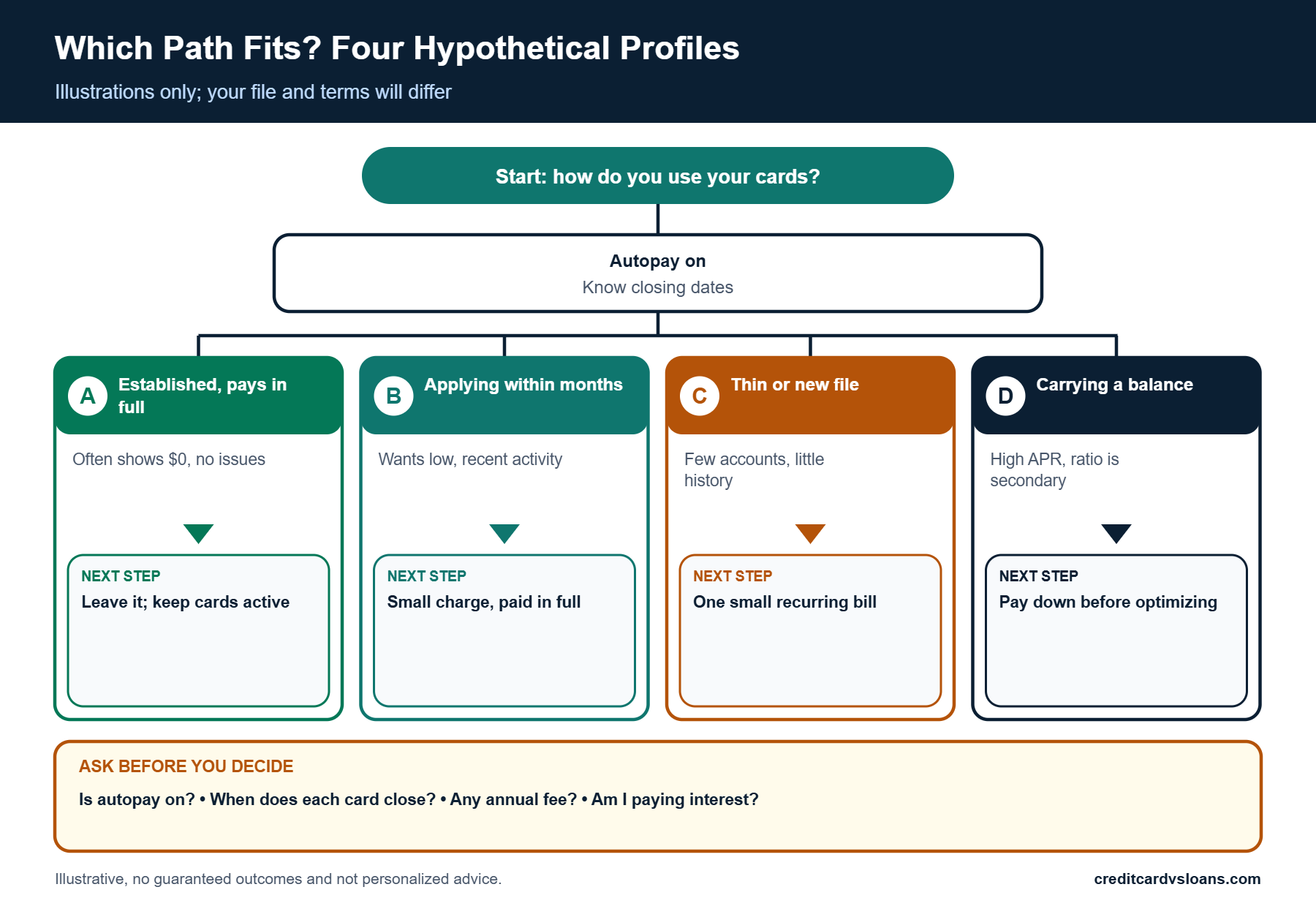
The table maps a few borrower situations to a reasonable zero-balance approach, what to verify and when to avoid it. It is a thinking aid, not personal advice.
| Borrower scenario | Approach to consider | Why | When to avoid it |
|---|---|---|---|
| Established file, pays in full | Leave it; let $0 happen | Payment history already strong | Never an issue unless the card is at closure risk |
| Applying within months | Aim for low reported balances, paid in full | Shows recent use with little risk | If the cash is needed for bills |
| Thin or new file | One small recurring bill, paid in full | Builds activity and history | If you’ll miss due dates |
| Carrying a balance at high APR | Pay down first; ratio is secondary | Interest is the real cost | Don’t borrow more to look active |
| Dormant card with annual fee | Decide whether to keep, downgrade or close | Fee may outweigh the benefit | If closing would leave you with no open lines |
What the matrix leaves out
The matrix cannot know your income, your debts or your lender’s rules. Use it to frame questions, then check your own statements and agreements. Not all issuers treat inactive accounts alike, and not all lenders weigh a reported zero the same way.
How lenders and scoring models may read a zero
The scoring side
Models differ, so the answer differs
The CFPB points out that your score can vary with the scoring model, the data used, the loan product and the date it is calculated. A model designed for credit card decisions may weigh revolving use differently from one used for mortgages or auto loans. Without a published scorecard for each, no one can say with certainty how a reported zero compares with a reported 2%.
What you can say is directional. A high ratio carries risk, a low ratio carries comfort, and zero sits on the comfortable side. Differences among low values are small enough that they should not drive spending decisions.
What recent activity tells a model
A report with active accounts that show recent on-time payments gives a model more information than a report with every revolving account dormant. That is a general principle about data, not a quoted rule, but it helps explain why myFICO says low use can help more than none. Activity gives the model something to evaluate.
A small, regularly paid bill supplies that information at no interest cost, which is why it comes up so often as the practical middle path.
The underwriting side
Lenders look past the score
According to the CFPB, lenders use credit reports to decide whether to lend and what interest rates to offer. They also look at income, existing debts and the purpose of the loan. A zero revolving balance may even help in those parts of the review, because it signals that your monthly obligations are lower.
For a mortgage or auto loan, the details of your report, including how recently accounts were opened and whether any payments were missed, often matter more than whether one card reports $0 or $40.
Soft pulls and prequalification
Many lenders let you prequalify with a soft pull, which does not affect your credit scores in the way a hard pull can. If you are unsure how your file looks, a prequalification can show likely terms without commitment. Offers are not guaranteed, and final terms depend on a full application.
Decision checklist and next steps
Questions to settle first
Your own checklist
- Is autopay on for at least the minimum on every account?
- Do I know each card’s statement closing date, due date and grace period?
- Does any card carry an annual fee I’m not benefiting from?
- Are any cards at risk of closing for inactivity under the issuer’s terms?
- Am I carrying a balance only to show activity? If yes, can I pay it down?
- Do my reports show the right limits and balances on every account?
Steps to take this month
- Pull your credit reports and confirm the limits, balances and statuses.
- Put one small recurring bill on each card you want to keep active, with autopay set to the statement balance.
- If a major application is coming, note the statement dates and decide whether to pay down before closing.
- If you are carrying a balance, make a payoff plan before worrying about the ratio.
Keeping a simple system
Monthly five-minute review
Once a month, open each card’s app and confirm three things: the statement closed with the amount you expected, autopay is still on, and no unfamiliar charges appear. This catches fraud and billing errors early and keeps due dates from slipping.
If you see a charge you don’t recognize, contact the issuer promptly. Quick action usually makes disputes simpler.
Twice-a-year report check
Twice a year, review your credit reports for accuracy. Look at each account’s status, limit and balance, and watch for accounts you don’t recognize. Fixing an error early prevents confusion later when you apply for credit.
When to get outside help
Signs a ratio is the wrong problem
If you are using cards to cover basics, making only minimum payments or juggling due dates, the issue is cash flow, not utilization. Chasing a reported zero will not fix that. Contact your issuers early about hardship options, since many have programs, and consider a nonprofit credit counselor for a full review.
Where to find reliable help
The CFPB’s consumer tools explain how to dispute errors and what rights you have as a borrower. For personal guidance, look for nonprofit credit counseling and be cautious about anyone who promises to fix your credit for a fee. Nothing here predicts a lender’s decision, and terms differ by issuer.
The bottom line
What to remember about zero
A 0% reported ratio is not a mistake, and it’s not a goal worth paying interest for. Low use can help more than none, but the cheap way to get there is to charge something small and pay it in full, not to carry debt.
Keep your focus on paying every account on time, keeping balances low when they report and matching your approach to your next real financial step. If you are unsure about a specific lender’s view, ask the lender or a nonprofit credit counselor, since nothing here can predict a score or a decision.
Where to read more
The myFICO site describes the score categories and utilization in plain terms, and the CFPB explains credit reports and scores. For the other end of the ratio spectrum, read why 30% is a guideline rather than a rule.
Frequently asked questions
Quick answers
Will my score go up if I pay everything to zero?
It might, if your balances were high, since high use is described by myFICO as a risk signal. If your balances were already low, the change may be small or even slightly negative on some models. No source promises a direction, so treat any app’s score movement as one data point.
Should I leave a $1 balance?
There’s no need to engineer one. If you use your card normally and pay in full, the statement balance will usually be reported at some level. Paying interest on a leftover dollar is a cost with no documented upside.
Special cases
What about a 0% promotional APR balance?
A balance on a promotional-rate card still counts as a balance on your report. It is not the same as a zero balance, even though you’re paying no interest right now. Plan the payoff before the promotional period ends, and see our guide on how a balance transfer can affect your credit score for the score side.
Does a zero balance help me qualify for a new card?
Lenders consider many things besides your current balance, including income, payment history and the product’s own rules. A zero or low balance can make your report look less stretched, but approval isn’t guaranteed. Prequalify where it is offered with a soft pull before applying.
- myFICO: What’s in my FICO Scores? (Score factor weights)
- myFICO: Amount of Debt: Credit Utilization (Low use versus no use; reported statement balances)
- myFICO: Payment History (Payment history as the largest factor)
- CFPB: What is a credit score? (Factors and why scores differ)
- CFPB: What is a credit report? (What reports contain and how lenders use them)
- CFPB: How do I dispute an error on my credit report? (Dispute steps and 30-day furnisher timeline)
- Federal Reserve: Consumer Credit – G.19 (Release of Oct. 7, 2026: card interest rates, Q2 2026)
- American Express: Consumer Credit Bureau Reporting FAQs (Example of issuer monthly reporting on the closing date)
Last updated: October 22, 2026. Rates, fees and lender rules change; verify current terms before acting.
The information on creditcardvsloans.com is provided for general educational and informational purposes only. It is not financial, legal, tax, credit, accounting or investment advice, and reading it does not create an advisor-client, fiduciary or any other professional relationship. Nothing here is an offer, solicitation or recommendation to borrow, lend or apply for any product.
Credit scores, interest rates, fees, eligibility rules, lender policies and laws change frequently and vary by lender, location and individual circumstances. Examples, figures and scenarios are illustrative only, do not predict your results and do not guarantee approval, savings, a particular rate or a credit-score outcome. Always confirm current terms directly with the lender or issuer and read the full agreement before you apply or sign.
Although we aim for accuracy and use reputable sources, we make no representations or warranties, express or implied, about the completeness, accuracy, reliability or timeliness of the content. Content may be drafted with the assistance of automated tools, so errors or omissions may still occur. Links to third-party sites are provided for convenience; we don’t control and aren’t responsible for their content.
To the fullest extent permitted by law, creditcardvsloans.com and its owners, editors, authors, contributors and affiliates disclaim all liability for any loss, damage or expense arising directly or indirectly from your use of, or reliance on, this content. Before making financial decisions, consult a licensed professional, such as a qualified financial advisor, attorney, tax professional or nonprofit credit counselor, who can consider your complete situation.