Your credit score after debt consolidation depends less on the consolidation itself than on what you do in the months that follow. The same loan can leave one borrower with a steadier score and another with a lower one, because the outcome turns on payments, card balances and account decisions. Nobody can promise a direction or a number.
This guide is built around scenarios. Instead of a month-by-month timeline, it follows five hypothetical borrowers who take the same consolidation loan and then behave differently, so you can see which habits tend to help and which tend to hurt. If you are still deciding whether you would qualify, the debt consolidation loan credit score guide covers approval; for the experience of a personal loan in general, see what happens to your score after a personal loan.
The borrowers are illustrations, not real people, and the math is simple arithmetic. Your own result depends on your full credit file and the scoring model that is used.
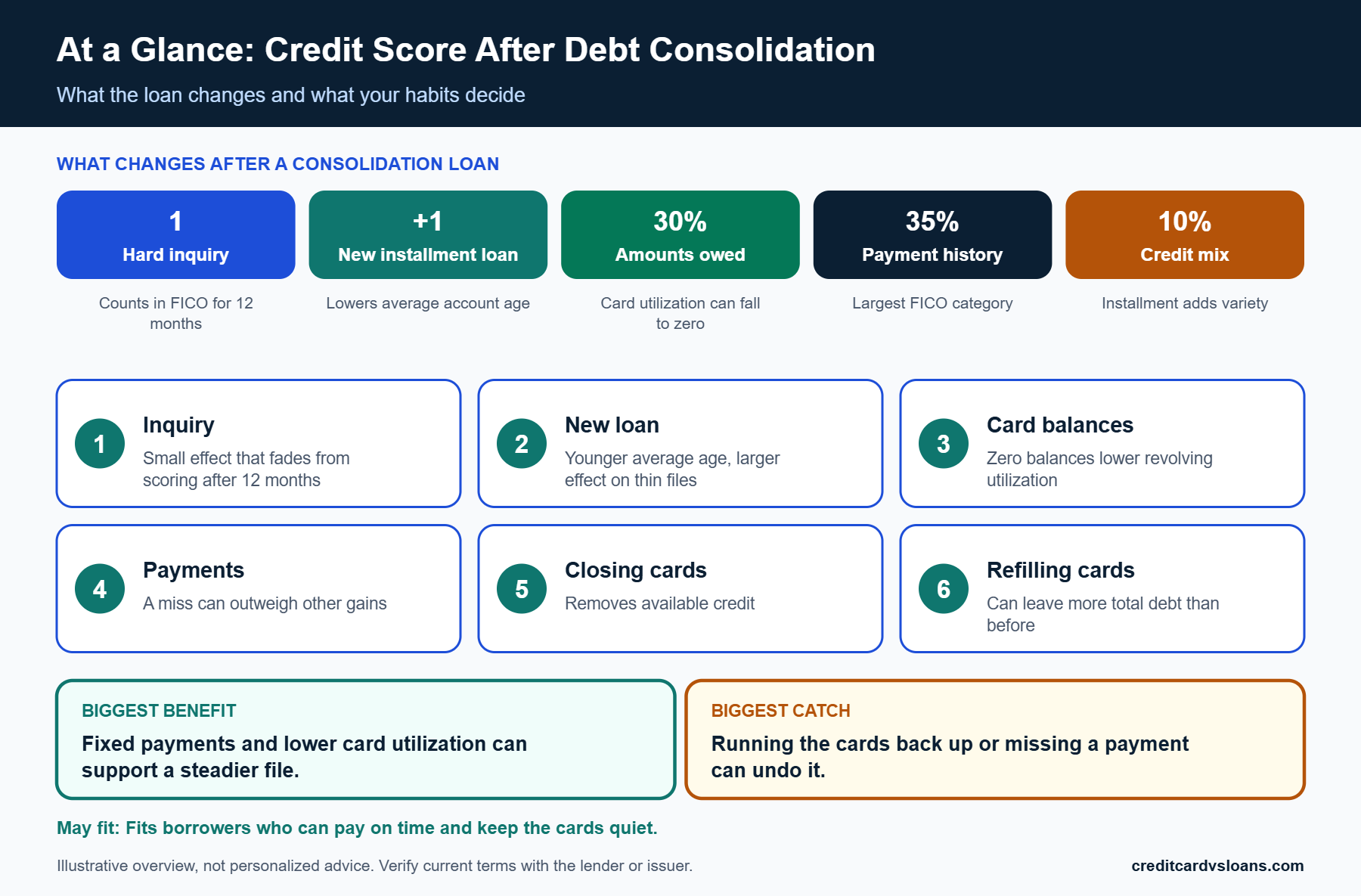
- Consolidating card debt with a loan adds a hard inquiry and a new installment account, which can lower a score slightly at first.
- Paying card balances to zero can lower credit card utilization, a part of the amounts-owed category that FICO weights at 30%.
- Payment history (35% of a FICO score) is the factor most likely to decide whether the net result is good or bad.
- Running the cleared cards back up can leave you with more total debt than before, even if the score looked better for a while.
- Closing the paid-off cards can raise utilization and, over time, change your account history.
- The five scenarios below are hypothetical; they show direction, not a forecast.
Rate context comes from the Federal Reserve G.19 consumer credit release of October 7, 2026 (August 2026 data). Loan offers vary by lender and borrower, so confirm your own APR, fees and terms.
Credit score after debt consolidation: five scenarios at a glance
The shared starting point
The hypothetical borrower and loan
All five scenarios start the same way. Imagine $10,000 spread across three credit cards with $15,000 in combined limits (balances of $4,200, $3,100 and $2,700 against limits of $5,000, $4,000 and $6,000), which is about 67% utilization overall. The borrower takes a $10,000 fixed-rate loan at a hypothetical 12% APR over 36 months and uses it to pay all three cards to zero.
At those terms the monthly payment would be about $332, with roughly $1,957 in total interest. For market context, the Federal Reserve’s G.19 release of October 7, 2026 reported an average 24-month personal loan rate of 11.90% at commercial banks for August 2026, though your offer could be higher or lower.
What changes on day one in every scenario
Whatever happens later, the first changes are the same: a hard inquiry from the loan application, a new installment account, three card balances that fall to zero, and a new loan balance of $10,000. The CFPB says hard inquiries can lower your scores, and myFICO says opening a new account lowers the average age of your accounts.
On the other side, card utilization falls from about 67% to 0%. FICO says amounts owed is 30% of a score, but also that carrying debt is not automatically negative.
How the scenarios differ
Five behaviors
The five scenarios are: on-time payments with the cards left alone; on-time payments with the cards run up again; a missed payment; closing the paid-off cards; and paying the loan off early. Each one changes a different part of the picture.
You may recognize yourself in one of them, or in a mix of two.
What this guide leaves to other pages
How a debt management plan reports to the bureaus is covered in the debt management plan credit guide. How a lender-by-lender approval decision works is covered in the qualification guide. For a balance transfer card, see the credit score after a balance transfer guide. Here, the focus is behavior after you already have the loan.
Table 1 gives a one-glance summary.
| Scenario | What the borrower does | Likely credit direction (not a prediction) | Main risk |
|---|---|---|---|
| 1. Steady payments, cards untouched | Pays $332 on time, keeps cards open at zero | Utilization stays low, payment record builds | Early dip from inquiry and new account |
| 2. Steady payments, cards run up again | Pays the loan but charges $5,000 on the cards | Utilization climbs and total debt rises to $15,000 | Debt larger than at the start |
| 3. A missed loan payment | Pays late 30+ days once | Payment history takes the hit | Late fees and a negative mark |
| 4. Closes the paid-off cards | Closes all three cards after payoff | Available credit falls; older accounts stay on file for a time | Higher utilization later if the cards are used again |
| 5. Pays the loan off early | Clears the balance in about 24 months | Installment account closes in good standing | Fewer open accounts, less mix |
What every scenario shares: the first weeks
The inquiry and the new account
The hard inquiry
When you apply for a loan, the lender usually pulls your credit report. The CFPB describes this as a hard inquiry that can affect your scores, in contrast to a soft inquiry, which does not. Many lenders offer a prequalification step with a soft pull, which shows likely terms without the hard inquiry, though the final offer can differ.
myFICO says inquiries stay on your report for two years, but FICO scores only consider those from the last 12 months, and that their impact is usually small.
The new installment account
The loan appears as a new account with a $10,000 balance. myFICO says new accounts lower the average age of your accounts, which is part of length of credit history (15% of a score). Because the loan is an installment account, it can also add variety to your credit mix (10% of a score), especially if you have only had credit cards.
The newness effect fades with time and with on-time payments, which is where the five scenarios begin to diverge.
The utilization drop
Why paying cards to zero can matter
FICO describes amounts owed as 30% of a score and includes how much of your available credit you use. When the three cards go to zero, their utilization falls from 84%, 78% and 45% on the individual cards to nothing. Lower revolving utilization is often associated with better scores, though the size of the effect depends on the model and your file.
Your loan balance still counts as debt owed; it is just a different kind of debt.
The part that depends on reporting
The drop shows up only after the issuers report the new zero balances, which can take weeks. Meanwhile, the loan balance may be reported quickly. If you check your score in the first days, the picture may be incomplete.
Wait for a full reporting cycle before judging the result, and use the same score source each time.
Reading your credit reports after you consolidate
What to confirm on each account
The loan tradeline
Within a billing cycle or two, the new loan should appear as an installment account with its original amount, current balance, monthly payment and status. Check that the open date and the balance are right and that the status shows current. If you took the loan to pay your creditors directly, confirm that the funds actually reached each card and that the card balances posted as zero.
An error in the original amount or limit can distort what a scoring model sees, so catching it early is useful.
The paid-off cards
Each card should show a zero or very small balance, with the account still open unless you closed it. Check for leftover interest or fees that can post after the payoff, since a small residual balance that goes unpaid can turn into a late payment. This is a common trap: you think the card is finished, and one more statement arrives.
Keep paying any minimum due until the card clearly shows a zero balance with nothing pending.
If something looks wrong
Disputing errors
If a balance, a limit or an account status is wrong, you can dispute it with the credit bureau that issued the report, and with the lender that furnished the information. Keep copies of statements and payment confirmations. The CFPB’s credit-report pages describe consumer rights and how to start a dispute.
Corrections can take time, so start early if you are about to apply for something else, such as a mortgage or a car loan.
Don’t judge by one number
A single score on a single day is a weak signal. The CFPB notes that you do not have just one credit score; scores vary by scoring model, data source and the date they are calculated. If a lender-provided score and a bank-provided score differ, that does not by itself mean something is wrong.
Instead, look at the underlying data: balances, limits, payment status and inquiries.
The cost of consolidating, and how it connects to your score
Fees, APR and payments
The APR and the monthly payment
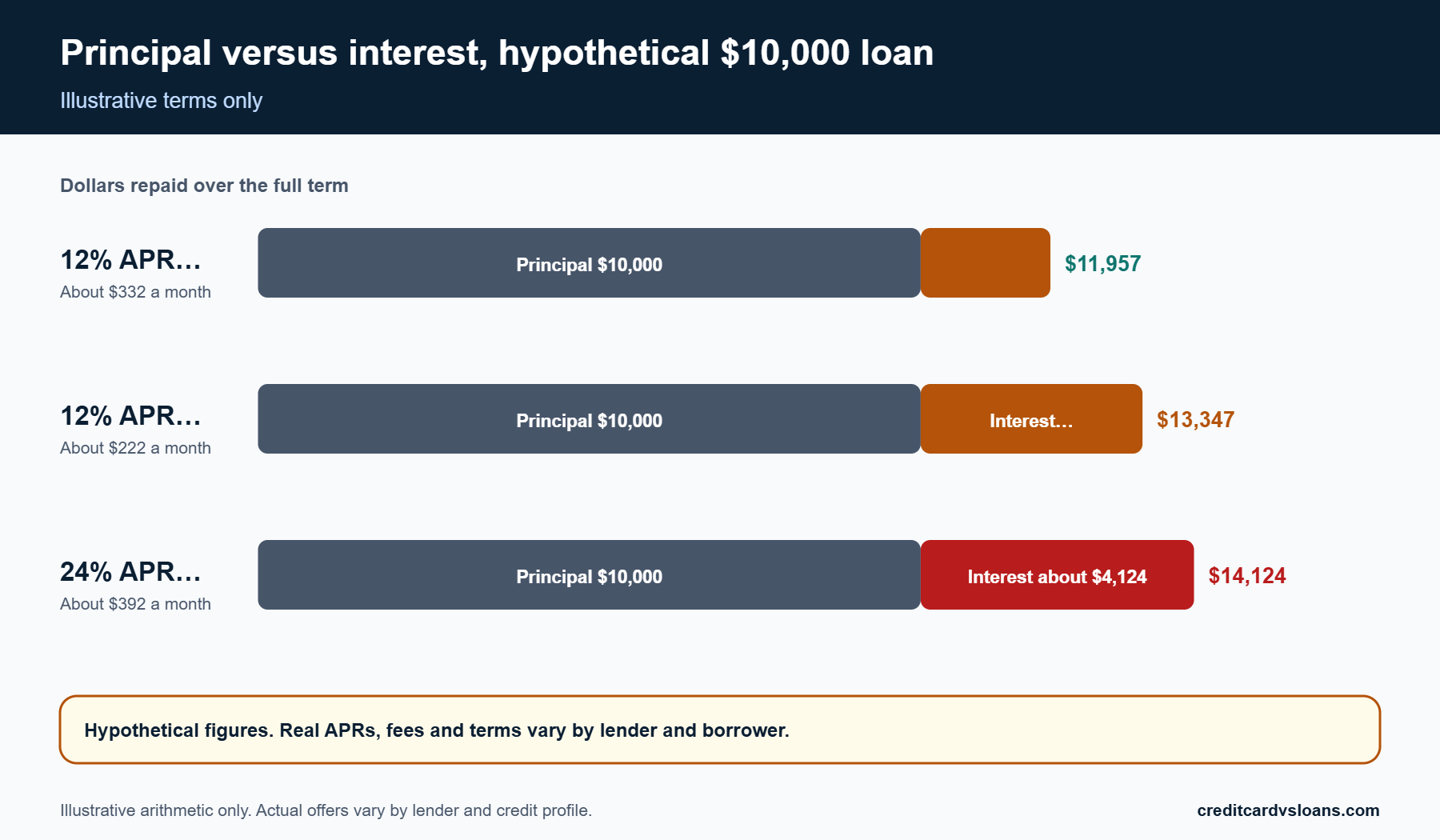
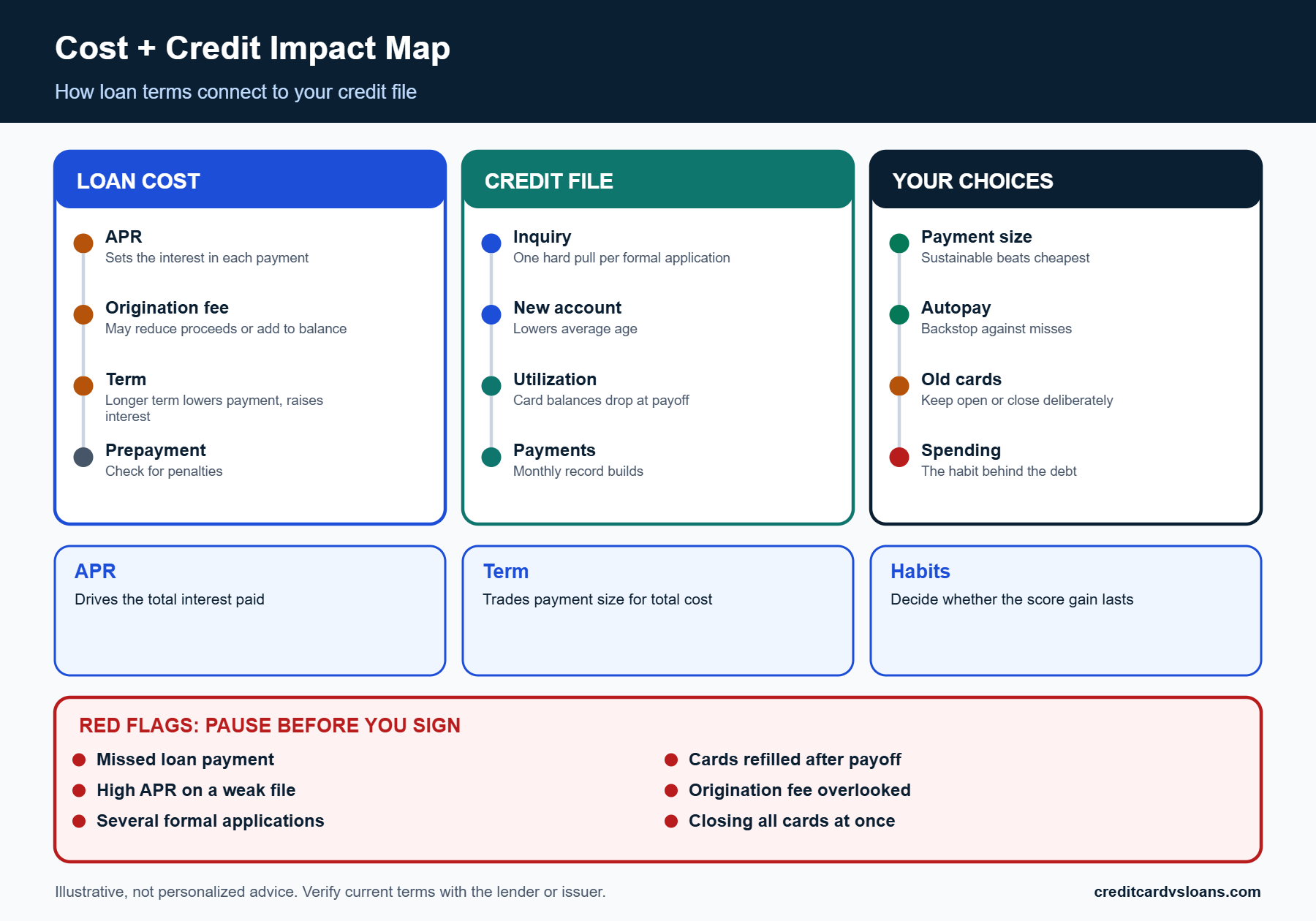
The loan’s APR sets how much of each payment is interest. In the hypothetical, $332 a month at 12% for 36 months pays off $10,000 with about $1,957 of interest. At a hypothetical 24% over the same term, the payment would be about $392 and the interest about $4,124. Offers vary by lender and borrower, and your own APR could be higher or lower.
A longer term lowers the payment but raises total interest. At 12% over 60 months, the payment is about $222 and total interest about $3,347.
The origination fee
Some lenders charge an origination fee, taken from the loan proceeds or added to the balance. If a hypothetical 5% fee is deducted, a $10,000 loan would send only $9,500 to your creditors. To receive the full $10,000, you would need to borrow about $10,526, and the payment at 12% over 36 months would be about $350.
Because terms vary by lender, read the loan agreement for the exact fee before you sign. The credit-score effect of a fee is indirect: it increases the loan balance you need to repay.
Where the cost meets the credit file
Cost and payment capacity
A lower payment is easier to make on time, which protects payment history. A higher payment pays off the loan faster and reduces interest. Choosing a payment you can sustain through a rough month matters more for your score than picking the cheapest loan on paper.
Table 2: how the choices compare
Table 2 sets the hypothetical loan terms side by side.
| Terms | Monthly payment | Total interest | Credit-file note |
|---|---|---|---|
| 12% APR, 36 months | About $332 | About $1,957 | Shorter term, faster balance decline |
| 12% APR, 60 months | About $222 | About $3,347 | Lower payment, more interest, longer to pay off |
| 24% APR, 36 months | About $392 | About $4,124 | Higher cost; payment may be harder to sustain |
| 12% APR, 36 months, 5% fee deducted (borrow about $10,526) | About $350 | About $2,060 on the larger balance | Fee adds to the amount you repay |
Consolidating versus leaving the cards as they are
A hypothetical cost comparison
The cards at an average rate
The Federal Reserve’s G.19 release of October 7, 2026 reported an average rate of 22.36% on credit card accounts assessed interest for August 2026. It is a market average and not what any individual pays. Using it as a hypothetical, a $10,000 card balance paid at $332 a month would take about 45 months and cost roughly $4,812 in interest.
The same $332 payment on the 12% loan clears the debt in 36 months for about $1,957 in interest. In this hypothetical, the loan finishes nine months sooner and costs about $2,855 less, before any fee.
Why the comparison can flip
If your cards carry a much lower rate than the average, or if the loan carries a high APR or a large origination fee, the comparison can reverse. The loan also lengthens the commitment if you were on track to pay the cards off sooner. Your own APRs, fees and payment capacity decide the answer, so compare apples-to-apples using the total cost of each path.
What the cost gap means for your score
Interest is not a score factor, but it affects the paydown
FICO scores are built from credit report data, and the interest you pay is not itself a scoring input. The link is indirect: lower interest means more of each payment reduces principal, so balances fall faster and the payment record builds on a fixed schedule.
That is why a lower-cost structure can support a healthier file over time, provided you keep making the payments.
The risk of a longer term
Stretching the term lowers the payment, which can make on-time payment easier, but it increases total interest and keeps you in debt longer. A 60-month term at 12% costs about $3,347 in interest versus about $1,957 over 36 months in the hypothetical. A middle path may be to choose the shorter term if your budget supports it, with a cushion for emergencies.
Scenario 1: steady payments and the cards left alone
What the loan does month by month
The balance falls on a schedule
With a $10,000 loan at a hypothetical 12% over 36 months, the balance would be about $8,572 after six payments, $7,056 after twelve, $3,738 after twenty-four and zero after thirty-six. Each on-time payment adds to the payment record, which myFICO says is 35% of a FICO Score.
Installment loans work differently from cards: the balance is meant to shrink on a schedule, and the lender reports your payment status each month.
Utilization stays low while the cards stay quiet
If the three cards remain open with zero or very small balances, revolving utilization stays near 0% for as long as that holds. The available credit of $15,000 remains in the calculation, which is part of why leaving paid-off cards open often matters. There is nothing to promise here: scoring models vary, and your file may include other factors.
The risk in this scenario is boredom. Zero balances can feel like free room.
Why this scenario is the favorable one, and its limits
What goes right
This borrower gets the benefits that consolidation can offer on paper: a fixed payment, a defined end date and lower card utilization, with a clean payment record building. The early dip from the inquiry and new account fades as months of on-time payments accumulate, according to the general logic of FICO’s categories.
The personal loan score guide describes the same pattern in more general terms for a loan taken for any purpose.
What does not change
The $10,000 of debt still exists, and it now has to be repaid on a set schedule. Total interest in this example is about $1,957, which may be more or less than what the cards would have cost, depending on the cards’ APRs and how fast the borrower would have paid them down. And the closing of the loan at the end will also change the mix of open accounts.
Even in the best case, consolidation is a repayment structure and not a debt reduction.
Scenario 2: steady payments, but the cards fill up again
How the numbers change
A hypothetical $5,000 of new charges
Suppose that after consolidation the borrower charges $5,000 on the three cards over the next year while keeping up with the $332 loan payment. The cards now carry $5,000 against $15,000 in limits, or about 33% utilization. On top of that, the loan balance is about $7,056 after twelve payments.
Total debt is about $12,056 at that point, versus $10,000 at the start. The borrower has paid down the loan by roughly $2,944 and added $5,000 on the cards.
Why the score may mislead
Utilization at 33% is much lower than the original 67%, so a score could still look better than before. But the debt picture is worse, and any month with a missed card payment would hurt the payment history record. The score can lag the underlying problem.
The CFPB suggests asking whether spending habits, and not only debt structure, need to change, which is the central issue in this scenario.
Guardrails that help
A small emergency buffer
Many people refill their cards because of one unexpected bill. A modest cash buffer, even a few hundred dollars, can make the difference between using a card and using savings. The amount that is realistic depends on your budget.
Taking the cards out of daily use
Some borrowers remove saved card details from shopping accounts, switch to a debit card for daily spending or set a low alert threshold. These are behavioral tools, not credit tools, and they are optional. The goal is to keep the zero balances you just created.
How your starting profile changes the scenarios
Different files, different sensitivity
A thin credit file
With few accounts, one new loan and one inquiry make up a larger share of the file, so the early dip may be more visible. myFICO notes that opening accounts lowers average account age, and the effect is larger when the history is short. A thin file also means a single late payment can stand out.
If your file is thin, a smaller loan, a steady payment routine and patience matter more than speed.
A long, clean file with moderate balances
A long history with no late payments gives the scoring model more evidence to weigh. The new inquiry and account tend to be a smaller share of the whole. The change in utilization may be the most visible effect, and the early dip may be shallow and short. This is a general tendency, not a promise.
Different problems the loan is solving
High utilization with on-time payments
This is the profile where consolidation looks best on paper: the borrower pays reliably but carries high balances, and the loan moves them into a fixed structure. The amounts-owed category has the most room to improve.
The risk is the refill pattern described in Scenario 2.
Existing late payments or collections
If a file already has late payments, a lender may offer a high APR or decline. A loan does not erase past delinquencies, and the CFPB says most negative information can be reported for seven years. In that situation, a nonprofit counselor can help weigh options, and the qualification guide explains what lenders look at.
Taking on a high-APR loan to fix a past problem can raise the cost without fixing the habit that caused it.
Scenario 3: a missed loan payment
What a late payment does
Severity, recency and size
myFICO says payment history is 35% of a score and that a few late payments are not an automatic score killer: a generally strong history can outweigh one or two late payments. It also says newer negative items count more than older ones, and that how overdue the account is, and how much is owed, affect how much the delinquency counts.
So the same missed payment can mean different things for different files, and it can be worse on a thin file or when it follows other recent problems.
How long it can stay
The CFPB says a company generally can report most negative information for seven years. myFICO adds that scores can improve as time passes and on-time payments accumulate after a late payment. The mark does not vanish quickly, but its weight tends to fade.
If a payment is missed, paying as soon as possible and calling the lender to ask how it will be reported is generally better than waiting.
Preventing the miss
Match the payment date to your income
If the loan’s due date lands before your paycheck, ask the lender whether it can be moved. Many lenders allow a date change, though policies differ. Autopay for the full monthly amount is the standard backstop, with a small cushion in the account.
What to do when money gets tight
If you foresee trouble, contact the lender before the due date. Some offer hardship options, and a conversation before a miss is easier than a conversation after. If you are struggling with several debts, a nonprofit credit counselor can explain options such as a debt management plan and how it affects your credit.
Scenario 4: closing the paid-off cards
The available-credit effect
What closing removes
If the borrower closes all three cards after paying them to zero, the $15,000 in available credit goes away. Experian explains that closing a card reduces your total available credit, which can raise utilization, and gives a simple example: a $1,500 balance on $10,000 of total limits is 15%, and closing a $3,000-limit card raises that to 21%.
With no cards open at all, the borrower has no revolving accounts, and any future card balance will show against a much smaller limit.
What stays on the report
Experian says closed accounts in good standing can remain on your reports for up to 10 years and continue to count toward account age until they fall off. So closing the cards does not immediately shorten your credit history. The bigger consequence comes later, when the accounts age off and when you eventually need credit and have little available.
When closing can still make sense
Annual fees and temptation
If a card carries an annual fee you do not want to pay, or if you know you will spend on it, closing may be sensible. The cost is the utilization and history trade-off described above. Keeping one or two no-fee cards open with a zero balance and a small recurring charge on autopay is a common middle path, if the issuer allows it.
How to decide
List each card, its limit, its annual fee and your honest risk of using it. Close the ones that cost you money or tempt you; keep the ones that do neither. This is a personal decision with no single right answer.
Scenario 5: paying the loan off early
What an early payoff changes
Lower interest, one fewer installment account
Paying the loan off in, say, 24 months instead of 36 would cut the total interest. When the account closes in good standing, it is an installment account with a good payment history, and as Experian notes, closed accounts in good standing can remain on your reports for up to 10 years. Some lenders charge a prepayment penalty, so check the loan terms.
The score effect of closing the loan is generally modest, and Experian notes that closing your only installment loan can reduce the benefit of your credit mix.
Why not to over-optimize
There is no reason to avoid paying off a loan early to protect credit mix. Mix is 10% of a FICO score, myFICO describes it as usually less influential, and the savings in interest are real. If you want to keep a record of installment payments for a future mortgage or car loan, the history from this loan remains on your report for years.
The same logic applies to other consolidation routes
Balance transfers and counseling plans
A balance transfer card works on the revolving side, not the installment side, as the timeline for a balance transfer explains. A debt management plan is arranged through a counseling agency and has its own reporting effects, covered in the debt management plan guide. Each route puts the five scenarios into a different frame.
Choosing by risk, not just by rate
Which route fits depends on your cash flow, your ability to resist spending, and whether you qualify at a reasonable rate. The qualification guide covers the approval side. A lower payment is not always better if it stretches the repayment period and increases the total cost.
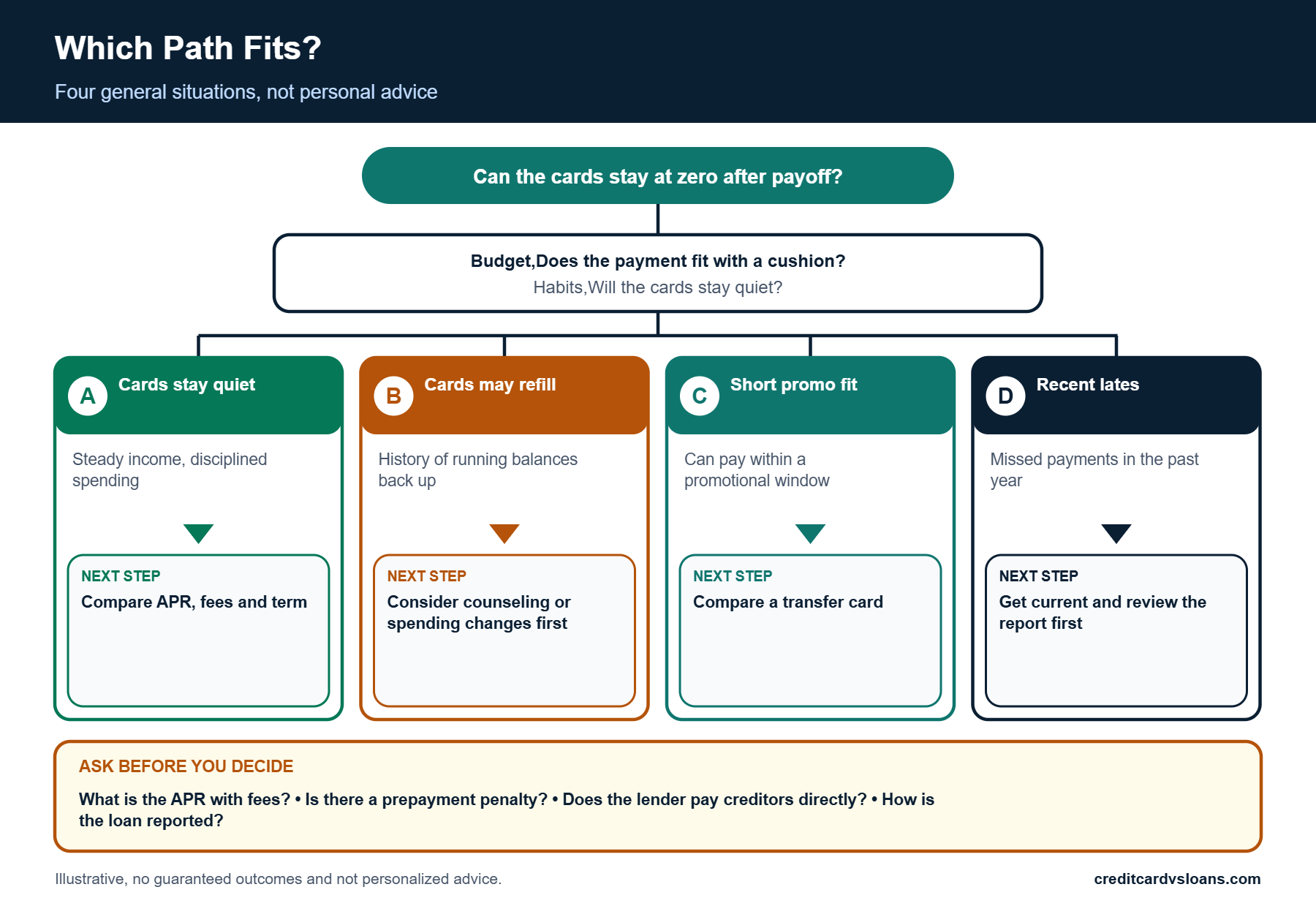
Which path fits? A decision matrix
Matching behavior to outcome
If you can keep the cards quiet
Consolidation tends to fit best for borrowers who can pay on time, keep the cards at zero and live within their budget. For them, the loan is a tool to replace variable, high-APR card debt with a fixed schedule.
If you cannot
If past patterns suggest the cards will refill, consider whether a structure that restricts card use, such as a counseling-based plan, fits better. Or consider removing the temptation in practical ways before you borrow. Table 3 puts this in a matrix.
| Situation | Option to look at | Why | What to verify | When to avoid it |
|---|---|---|---|---|
| Steady income, cards can stay at zero | Fixed-term consolidation loan | Fixed payment, defined end date | APR, fees, term, prepayment rules | If the payment would strain your budget |
| Likely to run cards up again | Counseling-based plan or spending changes first | Limits card use and sets a schedule | Agency accreditation, fees, how accounts are reported | If you need to keep cards open for work expenses |
| Can pay within a promotional window | Balance transfer card | Low-cost interest for a limited time | Fee, limit, rate after promotion | If the balance cannot be paid before the rate rises |
| Recent missed payments | Fix payments before adding credit | A new account will not fix a late-payment pattern | Your report for errors | If you would apply to many lenders at once |
| Few cards, small balances | Pay down directly | No fee, no inquiry | Interest cost over time | A loan may add little |
Questions to ask before you sign
About the cost
Ask for the APR, not only the interest rate, and for any origination fee, late fee or prepayment penalty. Ask whether the loan is fixed-rate, whether the payment is the same every month, and what the total repayment would be over the term. Compare offers on total cost, not just the monthly payment.
If a lender will not give clear numbers before you apply, that is a red flag worth taking seriously.
About the credit reporting
Ask whether the application involves a hard inquiry, whether the lender reports payments to all three credit bureaus, and whether the funds go directly to your creditors. Reporting practices vary by lender, and you cannot assume every account appears on every report.
You can confirm afterward by checking your own reports for the new loan.
Common questions about your score after debt consolidation
Timing and expectations
How soon will my score change?
Credit scores update when new information is reported, usually monthly for each account. The inquiry and new account may show first, with the balance changes following. Allow a full billing cycle or two before judging the result, and compare scores from the same source.
Why did my score drop right after I paid off the cards?
A drop after paying off cards can come from the new account, the inquiry, a closed card or a change in the mix of accounts. The CFPB notes that scores vary by model, data source and date, so two scores can differ even on the same day. Review your report to see what changed.
Choosing and following through
Will the consolidation loan hurt if I applied to several lenders?
Several hard inquiries in a short time can matter, but myFICO says its scores allow for rate shopping without specifying a window. Prequalification with a soft pull can narrow the field. Keep your applications close together if you do compare formal offers, and ask each lender whether the application involves a hard pull.
Should I keep making extra payments?
Extra payments reduce interest and the balance faster, if the loan has no prepayment penalty. Balance that against your emergency buffer. Pulling cash from savings to pay a loan early, then using a card for the next surprise, can undo the benefit.
Special cases
What if I consolidate only part of my debt?
Partial consolidation is a legitimate choice. You might pay off the highest-APR card and leave a small balance on another. The utilization effect then depends on which balances remain and on their limits. A partial approach can keep the loan smaller, with a lower payment, but it leaves you managing more accounts.
The key is to know which debts you are moving and why. Moving a low-APR balance into a higher-APR loan can raise your cost with little credit benefit.
Does it matter which creditors the loan pays?
Some lenders pay your creditors directly, and others deposit the funds in your account. Direct payment reduces the temptation to spend the money, and confirms the card balances go to zero. If funds arrive in your account, pay the cards immediately and keep the confirmation numbers.
Either way, verify afterward that each balance posted as zero on your reports.
Loan type and timing
Is a consolidation loan the same as debt settlement?
No. A consolidation loan pays your creditors in full with new borrowing, and the debts are replaced by a loan you repay. Settlement involves negotiating to pay less than you owe and can carry serious credit and cost consequences. This guide covers consolidation by loan only, so read the terms of any debt relief offer carefully before you engage with a company.
Be cautious with any company that asks for large fees up front or promises to erase your debt.
When is the best time to consolidate relative to a big purchase?
If you plan to apply for a mortgage or auto loan soon, think about timing. A new inquiry and a new account can affect scores around the time of an application, and lenders will also look at your total debt and payment history. There is no universal waiting period, and the right timing depends on your situation.
Ask the future lender what they look for, and avoid opening unrelated accounts in the months before a major application.
Conclusion and next steps
What the scenarios teach
Behavior beats the loan itself
The scenarios share the same loan, and their outcomes differ because of habits: on-time payments, quiet cards, deliberate closing decisions and whether spending changes.
Your credit score after debt consolidation depends mostly on whether you pay on time and keep card balances low. The loan can help structure repayment, but it cannot change spending habits, and no outcome is certain.
What to expect early
Expect a small dip from the inquiry and new account, a drop in card utilization once the balances are reported at zero, and a payment record that builds slowly. Give it a few months before judging.
A concrete next-step list
Before you borrow
- Check your credit reports for errors and note your current balances, limits and APRs.
- Prequalify with soft pulls where possible, and compare APR, fees, term and prepayment rules.
- Confirm the monthly payment fits your budget with a cushion.
- Decide in advance what happens to each card after it is paid off.
After you consolidate
- Turn on autopay, and keep a small buffer in the account.
- Keep card balances at or near zero and avoid new charges you cannot pay in full.
- Review your reports after a cycle to confirm the card balances and the loan show correctly.
- Revisit your plan if payments become hard; call the lender before a missed date.
- CFPB: What is a credit score?
- CFPB: What is a hard inquiry?
- CFPB: How long does negative information remain on my credit report?
- CFPB: What is a balance transfer?
- myFICO: What is in your credit score?
- myFICO: New credit and your FICO Score
- myFICO: Payment history and your FICO Score
- Federal Reserve: Consumer Credit – G.19 (Release of October 7, 2026 (August 2026 data))
- Experian: How long do closed accounts stay on your credit report?
Last updated: October 22, 2026. Rates, fees and lender rules change; verify current terms before acting.
The information on creditcardvsloans.com is provided for general educational and informational purposes only. It is not financial, legal, tax, credit, accounting or investment advice, and reading it does not create an advisor-client, fiduciary or any other professional relationship. Nothing here is an offer, solicitation or recommendation to borrow, lend or apply for any product.
Credit scores, interest rates, fees, eligibility rules, lender policies and laws change frequently and vary by lender, location and individual circumstances. Examples, figures and scenarios are illustrative only, do not predict your results and do not guarantee approval, savings, a particular rate or a credit-score outcome. Always confirm current terms directly with the lender or issuer and read the full agreement before you apply or sign.
Although we aim for accuracy and use reputable sources, we make no representations or warranties, express or implied, about the completeness, accuracy, reliability or timeliness of the content. Content may be drafted with the assistance of automated tools, so errors or omissions may still occur. Links to third-party sites are provided for convenience; we don’t control and aren’t responsible for their content.
To the fullest extent permitted by law, creditcardvsloans.com and its owners, editors, authors, contributors and affiliates disclaim all liability for any loss, damage or expense arising directly or indirectly from your use of, or reliance on, this content. Before making financial decisions, consult a licensed professional, such as a qualified financial advisor, attorney, tax professional or nonprofit credit counselor, who can consider your complete situation.