Your credit score after a personal loan usually follows a pattern: a small dip when you apply and the account opens, a flat or gently changing stretch over the first few months, and then a trend that depends mainly on whether you pay on time and what happens to your card balances. It is a pattern, not a prediction. Your own result depends on your starting file, the scoring model, and the bureau that supplied the data.
This article follows the calendar. We walk from the day you apply, through the first statements, the first year, and the payoff, and we point out what you can see on your reports at each stage and what is worth doing. For the factor-by-factor mechanics behind these changes, see our guide to the credit score impact of a personal loan. If you are still deciding whether to borrow for the sake of your file, our article on using a personal loan to build credit covers that choice.
One note on expectations. Every number you see on a free app or a bank dashboard is a score calculated by some model on some date from some bureau's data. The Consumer Financial Protection Bureau (CFPB) says a score can vary based on the credit reporting company, the scoring model, the type of loan product and the date it was calculated. So a change of a few points between two apps may mean nothing at all.
- The first change is usually the smallest and the most visible. A hard inquiry and a new account appear first; myFICO says one extra hard inquiry lowers a FICO Score by fewer than five points for most people.
- Timing depends on reporting dates. Lenders report on their own schedules, so changes can show up weeks after funding.
- Month-to-month movement is mostly noise. Judge progress by whether the account, balance and status are accurate on your reports.
- Payoff can be flat or slightly negative for the score. That is not a reason to keep a loan open longer than it is useful.
- A late payment is the event that matters most. Payment history is about 35% of the FICO Score, per myFICO.
Factor weights come from myFICO's description of the FICO Score. Inquiry details come from the CFPB and myFICO. The market rate reference comes from the Federal Reserve's G.19 release of October 7, 2026. Your lender and score provider may use different versions of scoring models than those described here.
The short answer: your credit score after a personal loan, in order
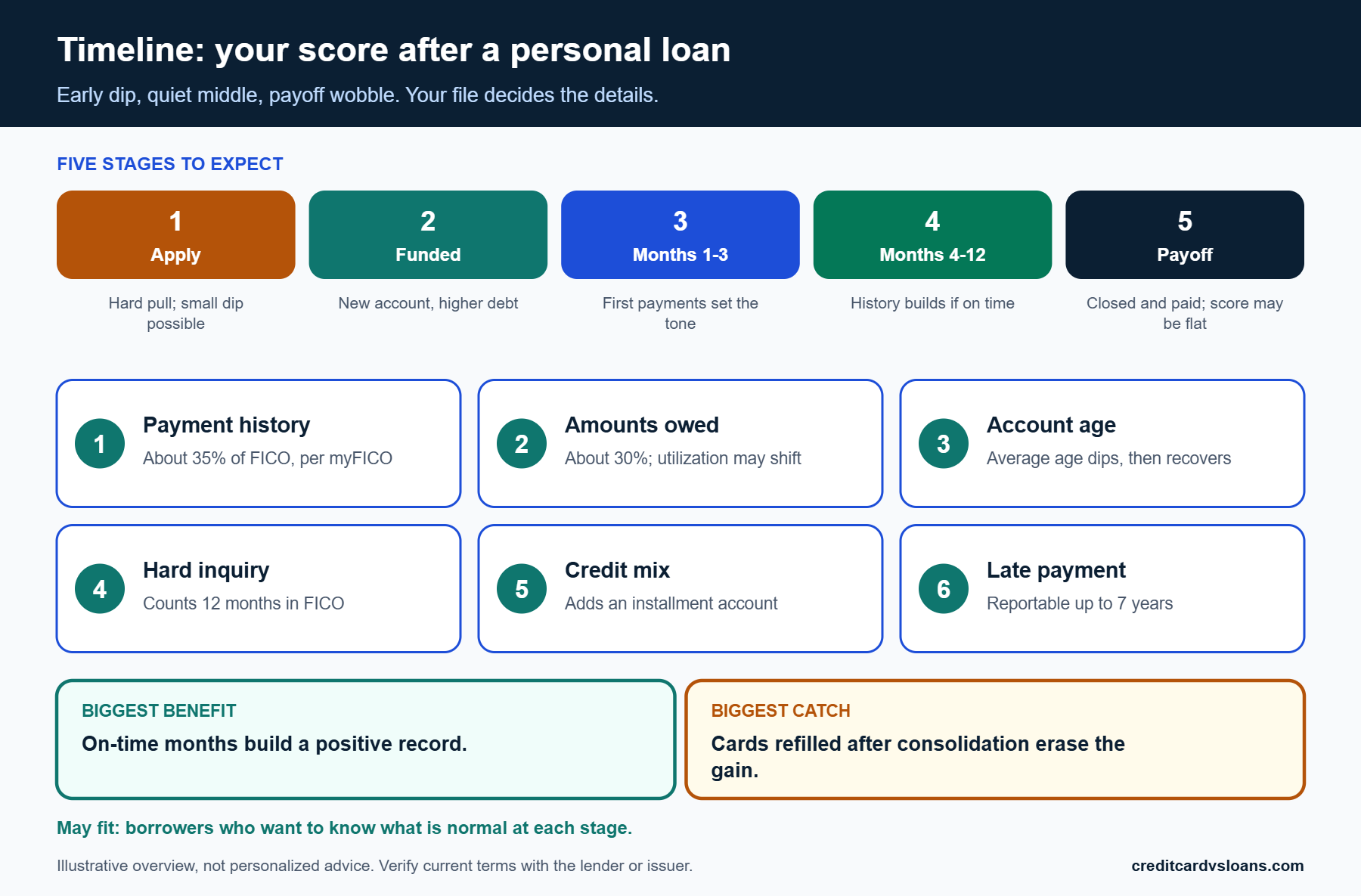
A timeline at a glance
From application to first payment
When you formally apply, the lender typically requests your credit report. The CFPB describes this as a hard inquiry, which can lower your score because most models consider how recently and how often you apply. If you only prequalified with a soft pull, the CFPB says that kind of inquiry does not affect your scores.
After approval and funding, the lender opens a new installment account. That account typically appears on your reports after the lender's next reporting cycle, which may be a few weeks. Until then, your reports may show only the inquiry.
From the first year to payoff
Over the next months, the account accumulates payment history. If you pay on time, each month adds a positive entry. If you used the proceeds to pay off cards, your utilization may have dropped, which can influence the amounts-owed category. At payoff, the account is typically reported as closed and paid, and the score effect can be neutral, slightly lower, or slightly higher, depending on the rest of your file.
That sequence is the backbone of this article. The rest explains each stage so that you know what is normal and what deserves attention.
What changes the picture
Your starting file
A thin credit file reacts more strongly to a new account than a long, deep one. Someone with a decade of cards and an auto loan may barely notice a new account; someone with two accounts will see the average age of accounts move. That is why identical loans can have different short-term effects on different people.
Your existing card balances matter too. If you used the loan to pay down revolving balances, the shift in utilization can dominate everything else. We explain how in our utilization guide.
Your behavior after funding
The biggest swing factor is what you do next. On-time autopay, steady card balances and no flurry of new applications create a quiet file. Missed payments, new card applications and fresh balances create the opposite. According to myFICO, payment history makes up about 35% of the FICO Score, and amounts owed about 30%, so the first-year behavior carries real weight.
The timeline below is generic. It does not replace the actual data on your reports, which you can check for free.
| Stage | What may happen to the file | What to do |
|---|---|---|
| Prequalifying | Often a soft pull; no score impact | Confirm the lender says so before submitting |
| Formal application | Hard inquiry; small dip possible | Apply to one or two lenders at most |
| Funding and first report | New account, higher total debt, lower average age | Set autopay immediately |
| Months 1 to 12 | Payment history builds; utilization may change | Check reports once or twice |
| Payoff | Account closed and paid; score can be flat or dip | Decide based on interest saved |
The first 90 days: what you may see, and what is just noise
Weeks 0 to 4
The inquiry and the waiting period
Right after you apply, the only change on your reports may be the inquiry. Hard inquiries can remain on a report for up to two years, but myFICO says FICO Scores consider only those from the last 12 months. Most of the effect is early, and it fades.
If you were shopping for better terms, remember that myFICO describes rate-shopping treatment for mortgage, auto and student loan inquiries, not personal loans. So several formal personal loan applications could count as several inquiries. That is one reason to compare with soft pulls first.
Funding day and the first reported balance
Once the loan funds, you owe the full principal and the first payment is due on a date set in your agreement. The first time the lender reports, the account will likely show the full balance, which is the largest it will ever be. Do not be alarmed by a high balance on a brand-new installment loan; that is the natural starting point.
Check that the opening amount, the term and the account type are right. Mistakes at this stage are easiest to fix early. The CFPB explains that you can dispute an error with the credit reporting company and with the furnisher, the business that supplied the information.
Weeks 5 to 13
The first payments
Your first two or three payments are the most important behavior to get right. Many late payments on new loans occur because the due date was not on the borrower's radar or because the autopay account was not funded. Confirm each payment posted, and keep a small buffer.
If you realize you missed a due date, pay as soon as possible and contact the lender. The CFPB's guidance for keeping a good score is to get current quickly if you fall behind.
Why scores jump around by a few points
You may see your score move a few points up or down with no apparent cause. That can come from card balances reporting on different days, a different score model, or a different bureau. It is not a signal about the loan.
A rule of thumb: do not react to movements smaller than a handful of points, and do not compare scores from two providers as if they were the same measurement. Compare your accounts and balances instead, because those are the facts underlying every score.
Months 3 to 12: when the record starts to matter
What accumulates
Payment history, one month at a time
By the third or fourth reported payment, the account has a visible pattern. The scoring models give heavy weight to payment history, so a clean sequence is the most useful thing the loan can add. A single month with a late mark can overshadow many on-time months, which is why the early habit of autopay and buffer cash pays off.
Under the Fair Credit Reporting Act (15 U.S.C. 1681c), most adverse items can be reported for up to seven years, measured from dates the statute defines. That is a long shadow for one missed payment, and the reason to treat the first year as the period to protect.
Account age and the slow dilution
Length of credit history is about 15% of the FICO Score, per myFICO, and it considers the age of your oldest, newest and average accounts. A new loan lowers the average at first. As months pass, the account ages and the dilution fades. You do not need to do anything for this to happen except avoid closing your older accounts.
If you were thinking of closing an old card during this period, consider waiting. The loan's newness is already a mild negative for age, and removing an old account could compound it.
If the loan paid off cards
Watching utilization
If you used the loan to clear credit card balances, your reported utilization may be much lower after the next statement closing dates. That is the effect many borrowers notice first, because utilization is calculated from current balances relative to limits. The CFPB suggests keeping credit use under 30% of your total limit.
Utilization can move fast in both directions. If balances creep up in month three, the benefit shrinks accordingly. Our guide to credit card utilization explains how reporting dates affect what the model sees.
The temptation to reuse the cards
With cards at zero, it is tempting to treat them as available cash. If that spending rebuilds balances, you now have the original problem plus a loan payment. A simple control is to move card spending to an amount you can pay in full each month, and to keep a log of any month you carry a balance.
Debt consolidation specifics, such as approval standards and rate comparisons, are covered in our debt consolidation loan guide. The point here is behavioral: the score improvement from consolidation lasts only as long as the card balances do.
A score that improves in month two after a consolidation can reverse by month eight if cards refill. The report reflects balances at the time they are reported, not your intentions.
What the loan costs over its life, and why that belongs in a score article
Interest and term
Why the term you choose shapes the whole experience
A longer term lowers the monthly payment but increases the interest you pay and the number of months you carry the balance. A shorter term costs less in total interest but needs more room in the budget. That affects your credit because a payment that is too large for your budget is the most common path to a late mark.
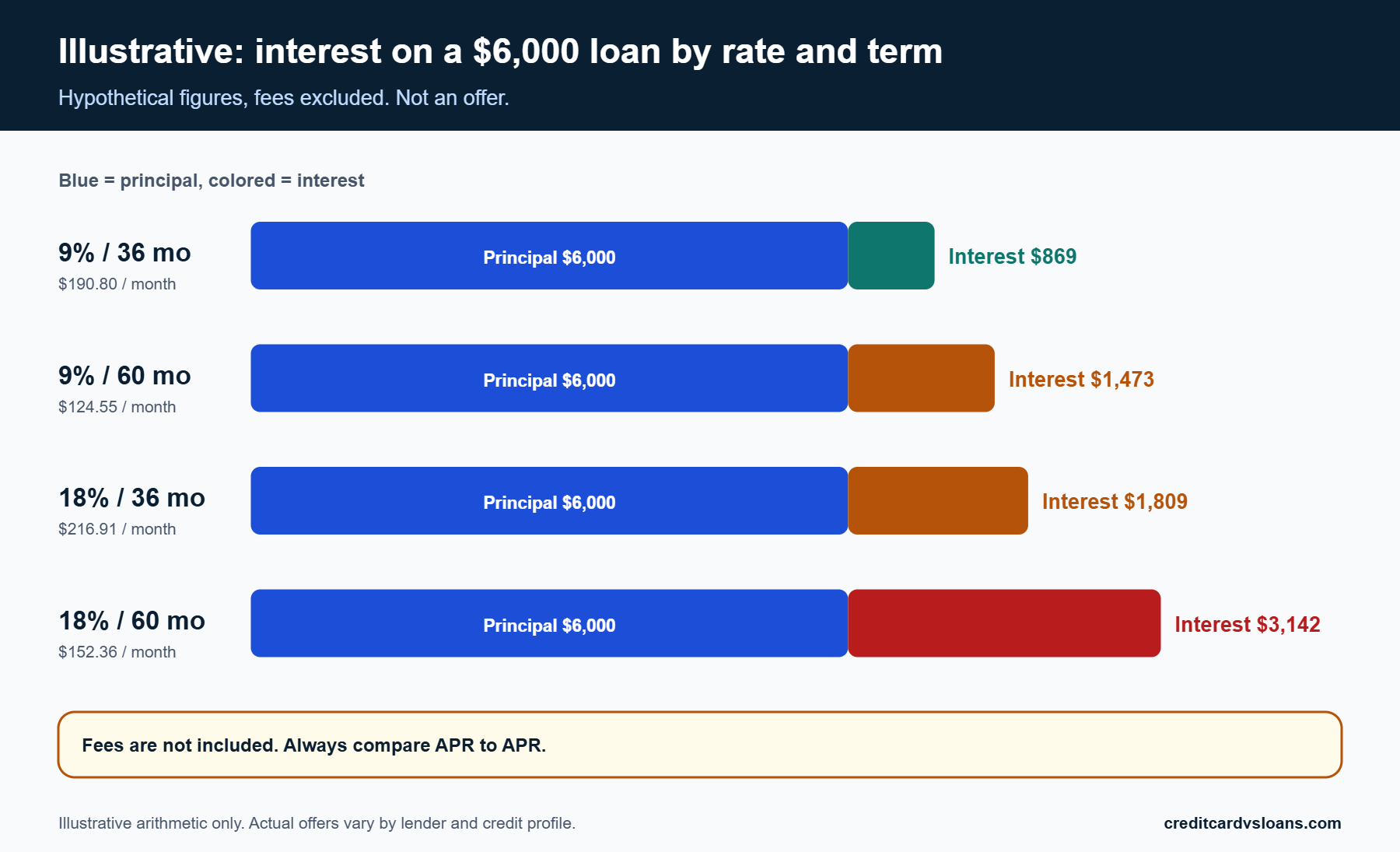
The chart below uses a hypothetical $6,000 loan to show how rate and term interact. The numbers are illustrations, computed with standard amortization and excluding fees. They are not offers.
Where average rates sit
The Federal Reserve's G.19 release of October 7, 2026 reported a 24-month personal loan rate at commercial banks of 11.90 percent for August 2026 (preliminary, not seasonally adjusted). That is an average at commercial banks, not a quote you will receive. Individual offers vary with credit, income and lender, so use the figure only as context.
If an offer is far above that benchmark, ask why, compare other lenders, and review the fees. Higher cost raises the stakes of every payment.
Fees and fine print
Origination fees and net proceeds
An origination fee, a one-time charge that some lenders subtract from the loan amount, reduces the cash you receive but not the amount you owe. On your credit report, the loan shows the full amount, which is why a fee does not appear as a separate line. Ask for the net proceeds and the APR, which folds certain fees into the annual cost.
Fee structures differ by lender, so always compare APR to APR rather than looking only at the advertised interest rate.
Prepayment and late-fee terms
Before signing, confirm whether early payoff carries a penalty and what the late fee and grace period are. These terms matter to the timeline because paying early is often the cheapest way to cut the cost, and a hard late-fee policy raises the cost of any slip.
Get the answers in writing. Verbal assurances do not help you if the agreement says otherwise.
| Scenario | Monthly payment | Total interest | What it means for risk |
|---|---|---|---|
| 9% APR, 36 months | $190.80 | $868.74 | Higher payment, lowest interest here |
| 9% APR, 60 months | $124.55 | $1,473.01 | Lower payment, more months of exposure |
| 18% APR, 36 months | $216.91 | $1,808.92 | Higher rate doubles the interest |
| 18% APR, 60 months | $152.36 | $3,141.63 | Lowest payment, highest total cost |
These figures are hypothetical and exclude fees. They show direction: both a higher rate and a longer term raise total cost, and both together raise it a lot.
Payoff and afterward: why a finished loan does not always lift your score
What a paid-off loan looks like
Closed, paid, and still on your report
When you make the final payment, the lender reports the account as paid and closed. It does not vanish. Accounts in good standing generally remain on your reports as a positive history for years, and the payment record you built continues to count. The exact length is set by bureau practice, so check your own reports rather than assuming a number.
The closed account still contributes to your history, but it no longer contributes a current balance, and it no longer produces new monthly on-time entries. That is the mechanism behind a payoff-time wobble.
Why the score can dip or stay flat at payoff
Scoring models look at the mix of open accounts, balances and the recency of activity. If the installment loan was your only open installment account, closing it may reduce your credit mix at the margin. If it was your newest account, closing it can change the age picture. If the payoff reduces your total debt, that works in your favor. The net effect varies.
A small dip at payoff is not a sign you did something wrong. It is mostly a model reacting to a changed account profile. The financial result, no more payments and no more interest, is the actual gain.
Decisions around payoff
Paying early versus on schedule
If there is no prepayment penalty, paying early saves interest. If you have a cushion and the rate is meaningful, early payoff is usually sensible. If the rate is low and your cushion is thin, keeping the cash may be wiser. That is a cash-flow decision and not a credit-score decision.
It is also fine to pay on schedule. The score effect of one choice versus the other is small and uncertain; the interest difference is concrete and visible in your loan statement.
What to do after the last payment
After payoff, confirm the lender sends a paid-in-full letter, and keep it. Check your reports one to two months later to confirm the account shows a zero balance and the right status. If anything is wrong, dispute it with the credit reporting company and the lender, as the CFPB describes.
Then keep the rest of the file steady: pay cards on time, keep utilization low, and do not rush to replace the loan with new credit just to keep activity going. If you are weighing another loan, our guide to personal loan credit score requirements describes what lenders tend to consider.
| What changes | Possible score effect | Your move |
|---|---|---|
| Balance goes to zero | Lower total debt can help | Keep the paid-in-full letter |
| Installment account closes | Mix or age picture may shift | Do not borrow again just for mix |
| Monthly on-time entries stop | Fewer new positive entries | Keep other accounts active and current |
| Interest stops | Real savings in dollars | Redirect the payment to savings |
When things go off track: late payments and hardship
A missed payment
What happens on the report
Lenders commonly report a payment as late once it is a certain number of days past due, with the specifics set by the lender and the reporting rules. A late mark can lower your score meaningfully, and under the Fair Credit Reporting Act most adverse items can be reported for up to seven years. Payment history is about 35% of the FICO Score, per myFICO, so this is the single most damaging event in the whole timeline.
If a payment slips, pay as soon as you can and call the lender. Ask whether a late mark has been or will be reported. Some lenders have discretion in early cases; do not assume one does.
If you suspect it was reported in error
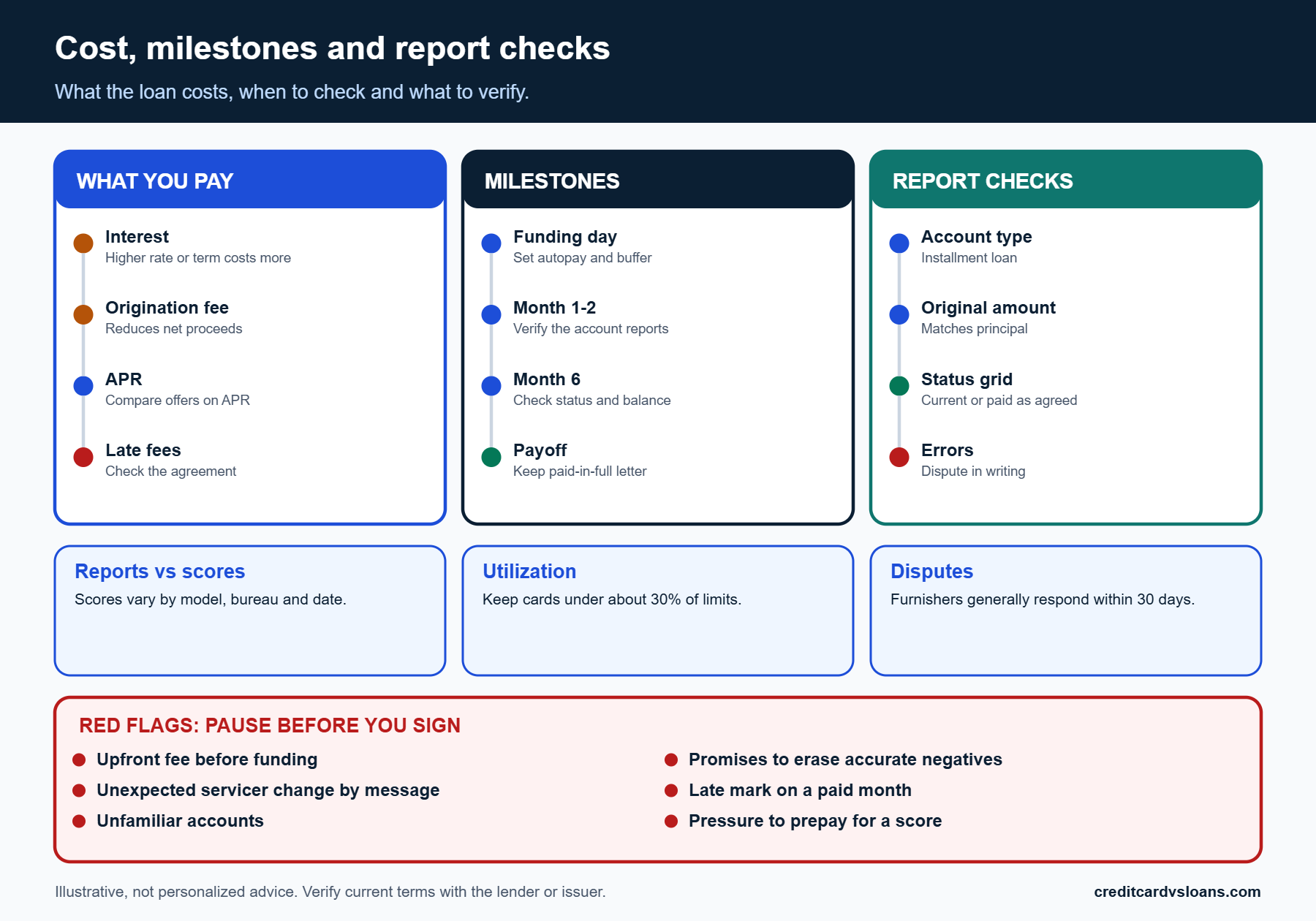
If you paid on time but the report says otherwise, gather your bank records and dispute in writing. The CFPB says the furnisher generally must investigate and respond within 30 days of receiving your dispute, and that you should include supporting documents, not originals, and keep copies of everything.
Disputes work best with specifics: the date, the amount, the account number and a copy of the confirmation.
Trouble paying going forward
Talk to the lender early
If you see trouble coming, contact the lender before the due date. Ask what options exist, such as a modified due date or a temporary plan, and get any agreement in writing. Options vary by lender, and a lender is under no obligation to offer them, so do not count on any one outcome.
Do not borrow from a high-cost source to make this payment. That can turn one problem into two.
Nonprofit help and scam avoidance
The FTC suggests asking your credit union, university or military personal financial manager about nonprofit credit counseling programs. It also warns that credit repair companies cannot legally remove correct and up-to-date negative information, may not charge you before they have helped you, and may not ask you to misstate information on applications.
Treat any firm that promises to erase an accurate late mark as a red flag. For more on the patterns to avoid, see our look at borrowing to build credit, which includes a section on credit-building pitches.
Never pay an upfront fee to have accurate negative items "removed." The FTC says that is a warning sign of a scam, because correct information cannot legally be removed on request.
Reading the loan entry on your credit report
The fields that matter
Account type, opened date and original amount
A personal loan typically appears as an installment account with an opened date, an original amount, a current balance, a scheduled payment and a status. Check that the opened date matches your funding date and that the original amount matches the principal, not the net proceeds after fees. A mismatch is worth asking the lender about.
The account type matters because scoring models treat installment accounts differently from revolving ones. If your loan is listed as a revolving account by mistake, utilization math can go wrong, so it is a good reason to dispute promptly.
Status and payment history grid
Most reports show a payment history grid or a list of monthly statuses. Each month should read as current or paid as agreed. If you see a late marker for a month you paid on time, collect your bank statement and the lender's payment confirmation and dispute with both the bureau and the lender.
The CFPB's dispute guidance suggests including your full name, address, the account number, a clear explanation of why the information is wrong, and copies of supporting documents. Keep your own copies and send disputes in a way that gives you a record of delivery.
Reports versus scores
Why the report is the better truth source
A report is a record of your credit activity; a score is calculated from it. As the CFPB explains, scores vary by model, bureau and date. Two people with identical reports can see different numbers, and so can the same person on two days.
For that reason, treat the report as the thing you verify and the score as the weather report: useful, imprecise, and changing. If the report is accurate, you have done what you can do.
When bureaus disagree
Occasionally one bureau lists your loan and another does not, or the balances differ because of reporting dates. That is a reporting difference and not necessarily an error. Ask the lender which bureaus it reports to and when, then compare.
If one bureau consistently lacks an account that the lender says it reports, raise it with the lender. If the lender does not report to a bureau at all, the loan simply will not influence scores based on that bureau's data.
| Field | What you want to see | If it is wrong |
|---|---|---|
| Account type | Installment loan | Dispute with bureau and lender |
| Opened date | Matches funding date | Ask the lender to correct it |
| Original amount | Matches principal borrowed | Compare with your loan agreement |
| Balance | Falls as you pay | Check payment postings |
| Status history | Current or paid as agreed | Dispute with bank records |
Monitoring your file without chasing numbers
What to check and when
The three-point report check
You do not need to watch your score daily. A three-point check at set times is enough: one to two months after funding, around the six-month mark, and one to two months after payoff. Each time, look at the same things: is the loan listed once, is the balance and status right, and are there any late marks or accounts you do not recognize.
The CFPB says to check your reports at least once a year and notes that requesting your own reports will not hurt your score. The FTC points consumers to AnnualCreditReport.com for free reports. Because you are entitled to free reports, there is no reason to pay for a report review.
Reading a score change responsibly
When a score changes, ask what changed on the report before asking what the number means. A balance on a card may have been reported on a different day, an inquiry may have aged, or a new account may have been added. The score is a summary; the report is the source.
The CFPB cautions that there are many different credit scores and that the score a lender sees can differ from yours. Compare only like with like: the same provider, the same model, similar timing.
Protecting the file during the loan
Keep new credit applications to a minimum
During the first year, every new application adds an inquiry and a possible new account. The CFPB notes that applying for a lot of credit in a short period can signal financial trouble to lenders. If you must apply for something, such as a car loan, space it out and ask the lender about recent new accounts.
If you are wondering whether a card application would hurt, see our article on applying for a credit card and your credit.
Watch for identity problems
A new loan is also a moment when identity theft shows up as unfamiliar accounts. The CFPB advises watching old, unused accounts for signs of identity theft, and recommends IdentityTheft.gov if you suspect it. If something unfamiliar appears, act quickly: dispute it and consider freezing your credit.
Keep loan documents and statements in one place. If you ever need to dispute something, the documents are your evidence.
Common situations that change what you see
Different starting points
If you have a thin file
If you have only a couple of accounts, the loan will be a large part of your file. That magnifies both directions: an on-time record is a bigger share of your history, and an early dip from the inquiry and age is more visible. Patience matters here, since the record is built over many months.
For people just starting out, lower-cost builder products may be worth comparing, which we cover in the personal-loan-to-build-credit guide.
If you have a long file with several loans
If you already have an auto loan, a student loan or a mortgage, a personal loan is one more installment account, and the mix and age effects are smaller. The utilization effect, if you consolidated cards, is likely the most noticeable piece. Total debt and DTI matter if you plan to apply for another loan soon.
The CFPB defines DTI as total monthly debt payments divided by gross monthly income. A new payment raises it, and lenders may weigh it when you apply next.
Special timing situations
If a mortgage or auto loan is coming
If you plan a major loan in the next few months, ask that lender how it will view a recent personal loan. They may care about the new payment, the inquiry and the account age more than the score itself. Waiting until after closing for non-essential borrowing is a common precaution.
If the loan is necessary, tell the future lender about it up front and keep payments flawless.
If you refinance or take a second loan
A second personal loan adds another inquiry, another new account and more debt. If the goal is a lower rate, the interest savings should be clear on paper. If the goal is to borrow more, think about whether the first loan's payment history has had time to build.
Because the rate-shopping window myFICO describes applies to mortgage, auto and student loans and not personal loans, plan on each formal application counting as its own inquiry.
Mistakes that distort the first year
Reacting to the wrong signal
Panicking over a small dip
A drop of a few points in the first weeks is common and is usually the inquiry and the new account. Reacting by closing cards, applying for new credit to "fix" it, or paying for a score-boosting service can cause far more damage than the dip itself. Waiting a couple of months while keeping payments clean is almost always the better response.
If the drop is large, look at the report. A big move usually has a specific cause, such as a late mark, a sharply higher card balance or an account you do not recognize.
Chasing a score target with prepayment
Some borrowers rush to pay off a loan early because they believe it will raise their score by a certain date. Early payoff saves interest, but the score outcome is uncertain, as discussed above. If you need a score by a particular date for a mortgage or auto application, ask the lender what they will look at, and talk through timing with them instead of guessing.
Do not drain your emergency savings to hit a target. A cash crunch after payoff can force you onto cards, which pushes utilization up, the opposite of the goal.
Neglecting the basics
Letting autopay fail silently
Autopay is reliable until the bank account changes, a card expires, or the balance runs short. Check once a month that the payment posted. Many lenders send a confirmation email or text; turn those on and read them.
If you change banks, update the lender before the old account closes. A payment that fails because an account was closed is still a missed payment.
Ignoring mail and email from the lender
Lenders send notices about changes of servicer, due-date changes and fee updates. If you miss them, you can end up paying the wrong party or on the wrong date. Keep your contact information current, and save every notice with your loan documents.
If a servicer change occurs, confirm the new payment address through the lender's official channels, not through an unsolicited message. Scammers sometimes imitate lenders, so use contact details from your agreement or your official online account.
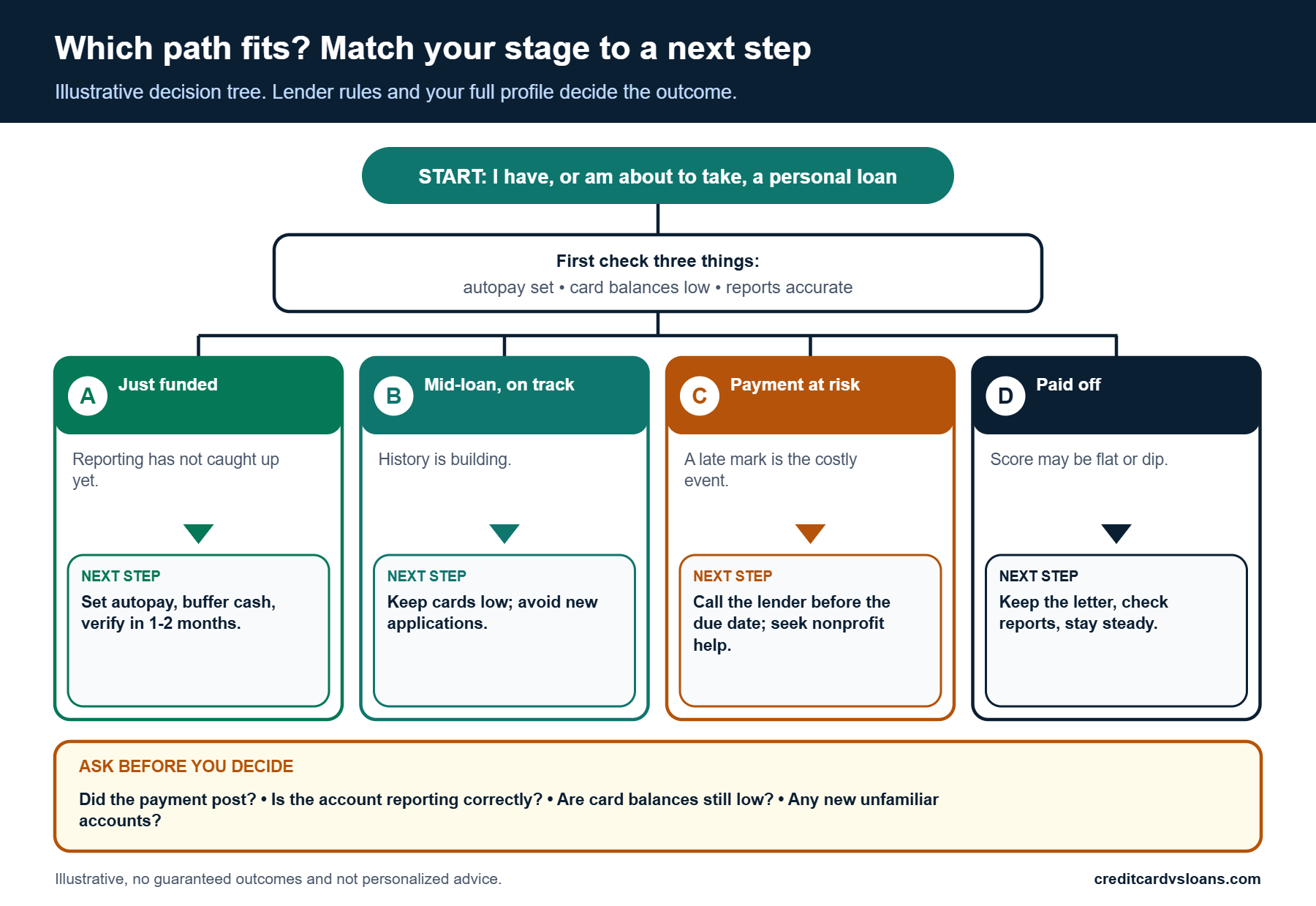
Decision checklist and next steps
What to take from the timeline
The pattern, restated as actions
The pattern of your credit score after a personal loan is mostly about the first year. Protect the first payments, keep card balances low, avoid new applications, and verify the reporting. Everything else is noise or a consequence of those four habits.
If you do these things, the account tends to become a positive part of your record. If you do not, the account becomes a liability. There is no neutral path that depends on the loan alone.
What not to do
Do not keep a loan longer than you need it to protect a score. Do not take a new loan to replace the old one for the sake of activity. Do not pay anyone to fix your credit before they have done any work. And do not judge your progress by one app's number on one day.
The decision to borrow, to prepay or to hold belongs to your budget. The credit file will follow.
Expect a small early dip, a quiet middle and a payoff that may not move the score at all. The thing to protect is the payment record. Everything else is secondary.
Your next steps
A short list by stage
- Before applying: prequalify with soft pulls and write down APR, fees and net proceeds.
- On funding day: set autopay and calendar the due date, with a buffer in the account.
- One to two months in: pull your reports and verify the account, balance and status.
- During the loan: keep card balances low and avoid non-essential applications.
- At payoff: save the paid-in-full letter and check that the account closes correctly.
- If anything looks wrong: dispute in writing with the credit reporting company and the lender, and keep copies.
If you are still comparing lenders, our credit score impact explainer covers the factor-by-factor mechanics.
When to get help
If a payment is at risk, call the lender before the due date. If you are juggling several debts, a nonprofit credit counselor can look at the whole picture. The CFPB and your state regulator are places to turn if a lender mishandles your account or reports it incorrectly.
Acting early costs little. Waiting until an account is delinquent costs a lot more, in both dollars and score.
- CFPB: What is a credit inquiry?
- myFICO: What is in your FICO Score
- myFICO: How long do hard inquiries stay on your credit report?
- myFICO: How to rate shop and minimize the impact to your FICO Scores
- CFPB: How do I get and keep a good credit score?
- CFPB: What is the difference between a credit report and a credit score?
- CFPB: How do I dispute an error on my credit report?
- CFPB: What is a debt-to-income ratio?
- Federal Reserve: Consumer Credit – G.19 (Oct. 7, 2026 release)
- FTC: Spot the scams when fixing your credit (Jan. 7, 2026)
- Fair Credit Reporting Act: 15 U.S.C. 1681c – Requirements relating to information contained in consumer reports
Last updated: October 22, 2026. Rates, fees and lender rules change; verify current terms before acting.
The information on creditcardvsloans.com is provided for general educational and informational purposes only. It is not financial, legal, tax, credit, accounting or investment advice, and reading it does not create an advisor-client, fiduciary or any other professional relationship. Nothing here is an offer, solicitation or recommendation to borrow, lend or apply for any product.
Credit scores, interest rates, fees, eligibility rules, lender policies and laws change frequently and vary by lender, location and individual circumstances. Examples, figures and scenarios are illustrative only, do not predict your results and do not guarantee approval, savings, a particular rate or a credit-score outcome. Always confirm current terms directly with the lender or issuer and read the full agreement before you apply or sign.
Although we aim for accuracy and use reputable sources, we make no representations or warranties, express or implied, about the completeness, accuracy, reliability or timeliness of the content. Content may be drafted with the assistance of automated tools, so errors or omissions may still occur. Links to third-party sites are provided for convenience; we don’t control and aren’t responsible for their content.
To the fullest extent permitted by law, creditcardvsloans.com and its owners, editors, authors, contributors and affiliates disclaim all liability for any loss, damage or expense arising directly or indirectly from your use of, or reliance on, this content. Before making financial decisions, consult a licensed professional, such as a qualified financial advisor, attorney, tax professional or nonprofit credit counselor, who can consider your complete situation.