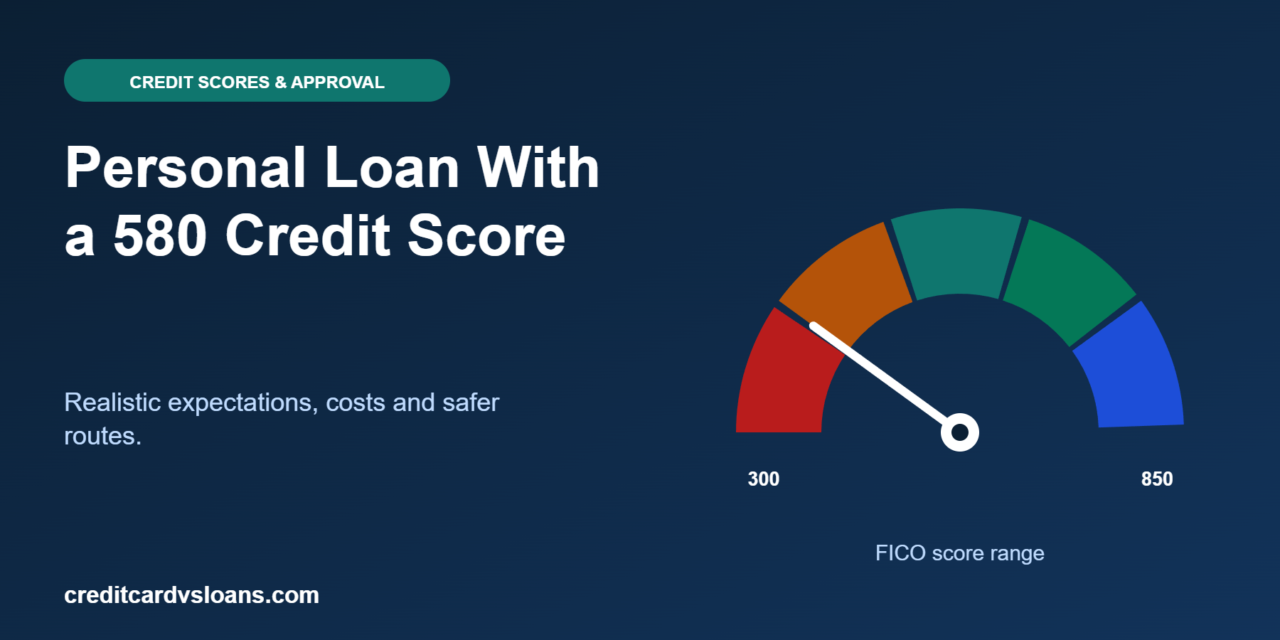
A personal loan with 580 credit score is not impossible, but it is the point on the scale where realistic expectations matter most. At 580 you sit right at the bottom edge of the “fair” FICO range, where fewer lenders will approve an unsecured loan, the offers you do get tend to be small or expensive, and the most important decision is often whether to borrow at all.
This article is deliberately candid. We will explain what a 580 means, which kinds of lenders may still say yes, what the costs can look like in a clearly labeled hypothetical, which alternatives deserve a look first and how to spot the offers that target people in exactly your position. Nothing here is a guarantee of approval or of any rate.
If your score is higher, our articles on a 600 score and a 620 score cover the more flexible end of the fair range, and our overview of score requirements for personal loans covers the whole ladder.
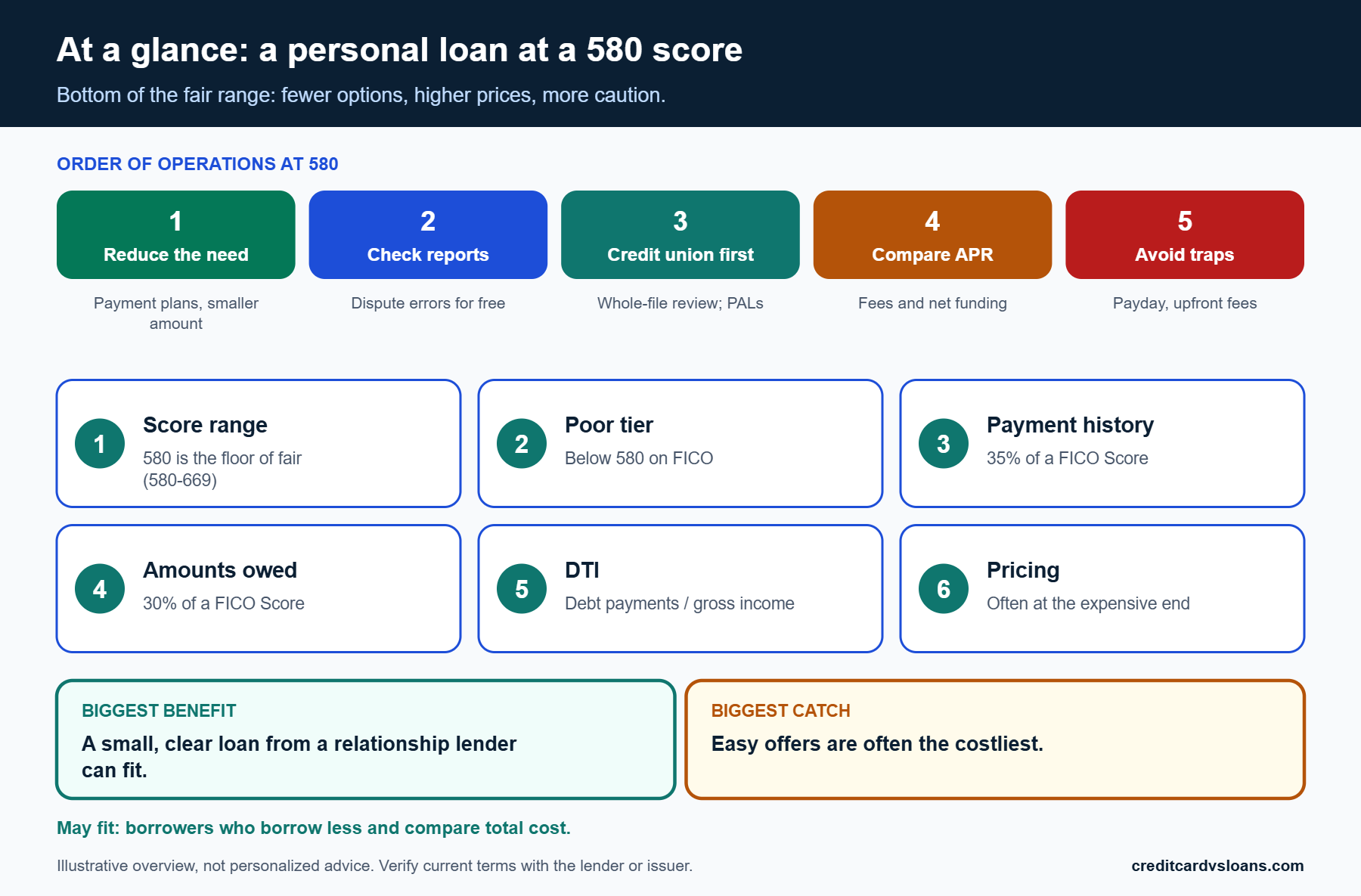
- A 580 FICO Score is the bottom of the “fair” range (580 to 669); one point lower is “poor.” Lenders do not all use the same scoring model, so the exact line is fuzzy.
- Unsecured personal loan options narrow at this level; credit unions, smaller loans, secured structures and co-borrowers deserve a look before high-cost products.
- Your debt-to-income ratio, income stability and the recency of any negatives can decide the answer as much as the score.
- Payday-style and upfront-fee offers are the most dangerous options at this score; compare them with every alternative first.
- Sometimes the cheapest move is to fix the file for a few months, negotiate with the biller or borrow less.
Market context comes from the Federal Reserve’s G.19 release of October 7, 2026. Lender policies change, so use this as a framework for questions rather than a price list.
The short answer: what a 580 score means for a personal loan
Where 580 sits
The bottom of the fair range
According to myFICO, FICO Scores range from 300 to 850. A score below 580 is “poor,” and 580 to 669 is “fair.” A 580 is the first point in the fair band, so a small change in either direction can move you across the label. Many lenders use their own cutoffs that do not line up with these labels.
The label matters less than the lender’s view of risk. A 580 with a clean last year may look better to a human underwriter than a 600 with a recent collection. That is why it helps to look at what is behind the number.
Why your 580 may not be your lender’s 580
The Consumer Financial Protection Bureau (CFPB) notes that you have many credit scores, which can differ by scoring model, data source, loan type and timing. A lender might see 570 where an app shows 580, or 595. When you are this close to a boundary, a lender that pulls a different version may place you in a different tier.
That is not a reason to panic; it is a reason to prequalify with a soft pull rather than guess. A soft-pull estimate shows how that lender sees you, without a hard inquiry.
Realistic expectations
Approval odds are lender-specific
No rule says a 580 will be approved or declined. Lenders set their own thresholds, which they rarely publish. Some online lenders and credit unions work with borrowers in this range, while many mainstream banks do not offer unsecured personal loans below a certain internal standard.
Expect your income, DTI and the details of your report to carry more weight than they would at a higher score. If a lender approves you, the offer may be smaller than you hoped, may carry a higher APR and may include fees.
Pricing sits at the expensive end
As of the Federal Reserve’s G.19 release of October 7, 2026, the average interest rate on 24-month personal loans at commercial banks was 11.86 percent in the second quarter of 2026 (revised, not seasonally adjusted). That is a bank-wide average and not a rate for borrowers at 580. We cannot cite a sourced rate for this score band, so we do not give one.
What we can say is that lenders who accept lower scores tend to charge more for the added risk, and that the spread between offers can be wide. Always compare APR, fees and total repaid.
At 580, the easiest offers to get are often the most expensive. Being approved quickly is not evidence that a loan is a good deal.
Who may still lend at 580
Mission-driven and relationship lenders
Credit unions
Credit unions are member-owned and often more willing to look at the whole picture, including your deposit history and the story behind a past problem. If you already have an account, ask whether a loan officer can review your application manually. Eligibility rules vary by credit union.
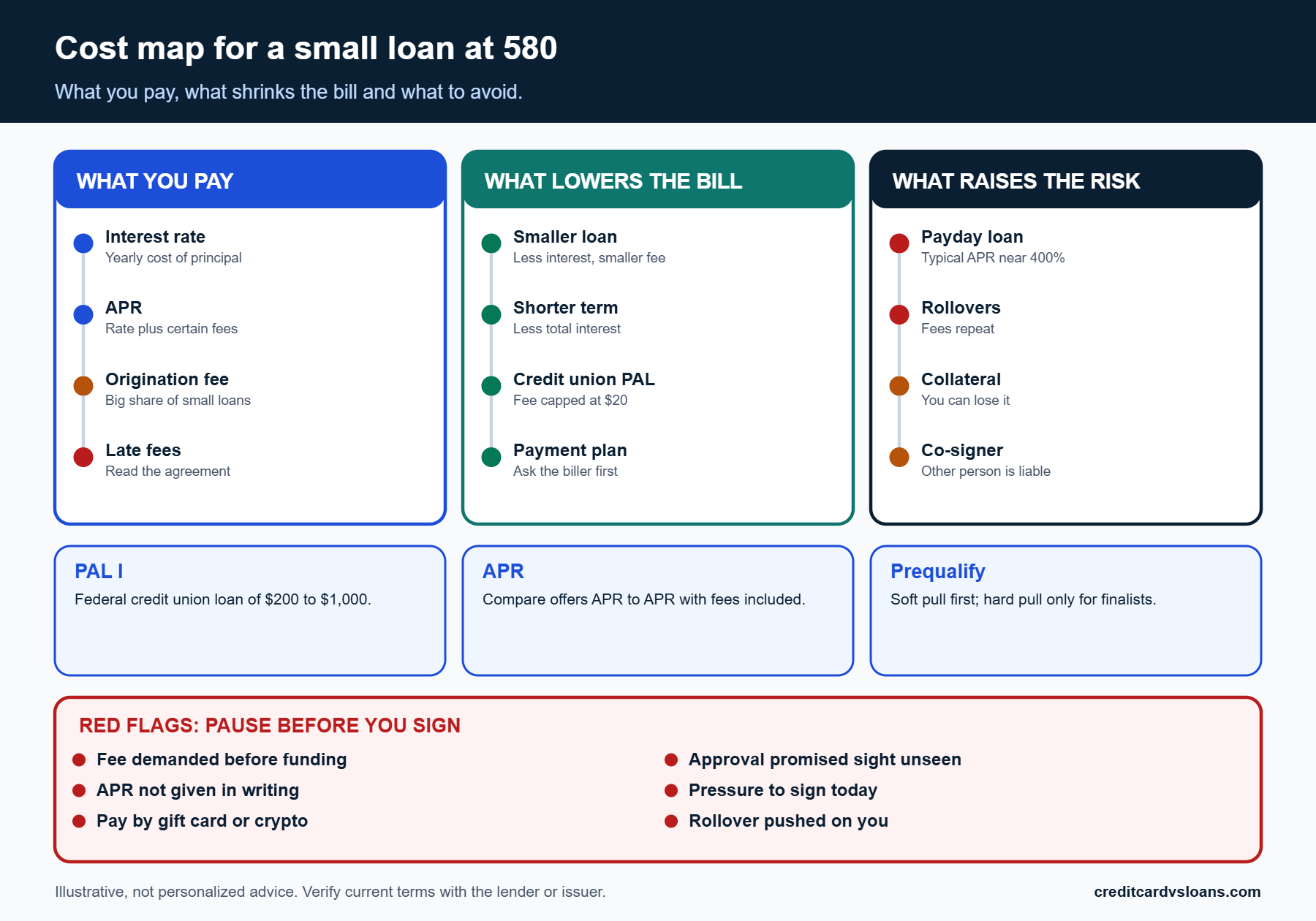
Some federal credit unions offer Payday Alternative Loans (PALs). Under the NCUA rule at 12 CFR 701.21, a PAL I is closed-end credit of $200 to $1,000, with a term of one to six months, an application fee capped at $20, and membership of at least one month before the loan. It must fully amortize, and rollovers are prohibited.
Community development lenders and small banks
Community development financial institutions and small local banks sometimes serve borrowers whom larger institutions turn away. We cannot list specific institutions or claim their terms, so use the CFPB or your state regulator to find reputable local options and ask about their products directly.
Ask whether they offer small-dollar installment loans and how they report to the credit bureaus. A loan that is reported and paid on time can help your file over time, though we cannot promise any score change.
Online lenders and secured structures
Online lenders that serve fair credit
Some online lenders advertise to borrowers with lower scores. Their models may weigh income and other factors in addition to the bureau score, but how any particular lender decides is proprietary. The practical benefit is speed and prequalification without a hard pull.
The cost is often a high APR and an origination fee deducted from proceeds. Ask for the APR, the net funding amount and the total repaid in writing.
Secured loans and other collateral-backed options
A secured loan is backed by something you own, such as a savings balance or a vehicle, which can reduce the lender’s risk and sometimes improve availability. The trade-off is that you can lose the collateral if you do not repay, and the structure varies by lender. Confirm what is pledged, what happens in default and whether the lender reports to the bureaus.
Never pledge an asset you cannot afford to lose for a loan you are not confident you can repay. Compare the secured offer with an unsecured one on APR and on risk.
| Option | Where it can help | Where it can hurt | Ask first |
|---|---|---|---|
| Credit union loan | Whole-file review; relationship matters | Membership and smaller amounts | Can a loan officer review manually? |
| Federal credit union PAL | Small amounts with capped fees | Only $200 to $1,000 for PAL I | Do you offer PAL I or PAL II? |
| Online fair-credit lender | Fast prequalification | High APRs and fees are common | What is the APR after fees? |
| Secured loan | May improve availability | You can lose the collateral | What is pledged, and what if I default? |
| Co-signed loan | May widen options | Co-signer is legally liable | Can the co-signer be released? |
| Payday or title loan | Easy to qualify | Extremely high APR and rollover risk | Have I truly exhausted cheaper options? |
What a personal loan with 580 credit score can cost
Reading the price
Rate versus APR
The interest rate is the yearly price of borrowing the principal, and the APR is a broader measure that includes certain fees, as the CFPB explains. At a score where fees are common, the APR is the number that tells the truth. A low-looking rate paired with a large fee can cost more than a higher rate with no fee.
Ask for the APR, the monthly payment, the total of payments and the net funding amount. If a lender will not put those in writing before you apply formally, treat that as a red flag.
Fees that reduce what you receive
An origination fee is a processing charge that many lenders deduct from the loan proceeds. On a small loan, even a modest fee is a large share of what you receive. For example, hypothetically, a 6 percent fee on a $1,000 loan means $60 comes off the top, so you would receive $940 while repaying the full $1,000 plus interest.
This is an illustration and not a typical fee. The point is that a smaller loan magnifies the effect of fixed charges, so ask what the fees are before you decide how much to borrow.
Illustrative math on a small loan
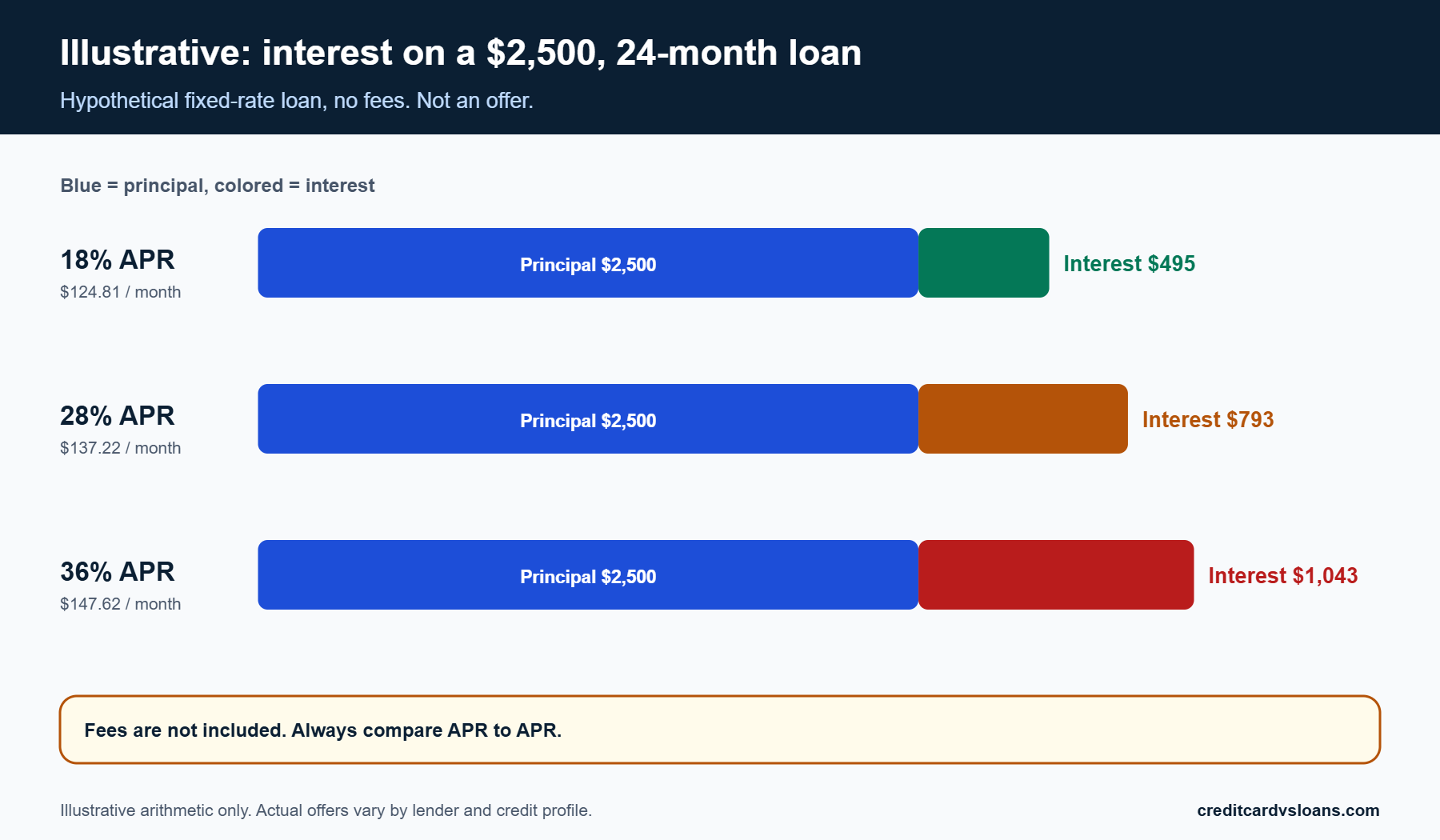
A hypothetical $2,500 loan over 24 months
These figures are hypothetical, with a fixed rate, full amortization and no fees. At 18 percent APR, a $2,500 loan over 24 months would have a payment of about $124.81 and total interest of about $495. At 28 percent, the payment would be about $137.22 and interest about $793. At 36 percent, the payment would be about $147.62 and interest about $1,043.
On a small loan, the dollar gap between rates is smaller than on a big one, which is why fees and terms deserve as much attention as APR. A loan with a lower rate and a large origination fee can come out equal to or worse than one with a higher rate and no fee.
| APR | Monthly payment | Total interest | Total repaid |
|---|---|---|---|
| 18% | about $124.81 | about $495 | about $2,995 |
| 28% | about $137.22 | about $793 | about $3,293 |
| 36% | about $147.62 | about $1,043 | about $3,543 |
Term can swamp rate
Holding the APR at a hypothetical 36 percent on $2,500, a 24-month term costs about $147.62 per month and about $1,043 in interest, while a 36-month term costs about $114.51 per month and about $1,622. The lower payment feels easier but costs about $579 more in interest.
Choose the shortest term you can pay comfortably. If only the longest term makes the payment fit, consider borrowing less or finding another source of funds.
If the payment fits only at the longest term and the highest APR, the loan is probably too big for your budget right now. Borrow less, or look at cheaper alternatives first.
Cheaper moves to try before borrowing
Reduce or reshape the need
Ask the biller for a plan
If your goal is to pay a medical bill, utility, tax bill or rent arrears, ask about payment plans, hardship programs or assistance before you borrow. Many providers would rather arrange a plan than send an account to collections. Get any agreement in writing.
A payment plan with little or no interest can be much cheaper than a fair-credit loan, and it does not require a hard inquiry. The cost is the time and effort to ask.
Borrow less
At a score near 580, smaller amounts are often easier to get approved and cheaper in total interest. Split the need: cover the urgent part with a small loan or savings and handle the rest through negotiation or time.
It can also help to reduce the amount by selling something you no longer use or by delaying a purchase. Each dollar you do not borrow costs nothing in interest.
Strengthen the file for later
Secured cards and credit-builder tools
The CFPB suggests secured credit cards and credit-builder loans for people with new or rebuilding credit. These products work differently from regular personal loans, and fees vary, so confirm that the issuer reports to all three bureaus and read the fee schedule before you apply.
If you are wondering whether to take a loan solely to build credit, our article on using a personal loan to build credit weighs the costs against cheaper tools.
Dispute errors and reduce utilization
The FTC says AnnualCreditReport.com is the only authorized site for free annual reports, with one free report from each bureau every 12 months and free weekly reports also offered there. Review all three and dispute inaccurate items with both the bureau and the company that supplied them.
FICO says amounts owed are 30 percent of a score and payment history is 35 percent. The CFPB suggests using no more than 30 percent of your card limits. We cannot promise a score change, but these are the factors in the model.
Stress-testing the payment before you commit
Build a realistic monthly picture
Start with the money that must go out
List the payments you cannot skip: housing, utilities, food, transportation, insurance, minimum debt payments and any court-ordered obligations. Subtract that total from your take-home pay, not your gross income. What remains is the real room for a new payment, and for many fair-credit borrowers it is smaller than the lender’s math suggests.
Lenders use gross income to compute DTI, but your bank account lives on net income. Both numbers matter, and the second one decides whether the payment is sustainable.
Test the bad month
Imagine a month with a reduced paycheck, a surprise bill or a few days of missed work. Could you still make the loan payment without borrowing again? If the honest answer is no, the loan is too large or the term too tight for now.
One practical approach is to set the maximum payment at an amount you could make even in a lean month. It may mean borrowing less than you hoped, but it lowers the odds of a missed payment, which carries fees and can seriously damage your report.
Plan for the unexpected
A small buffer matters
If possible, keep even a modest cushion in your checking account before the first payment date. Overdrafts and returned payments can cost extra, and some lenders charge fees for failed autopay attempts. A cushion also gives you room to react if the first statement surprises you.
If you cannot build a cushion before the payment starts, consider choosing a due date that follows your payday, if the lender allows it.
What to do if you see trouble early
Contact the lender before you miss a payment and ask about options such as changing the due date or a short deferral. Lenders are not required to offer these, but asking early gives you more choices than silence does. Get any agreement in writing.
The FTC says credit counseling agencies, often free or low cost, can help with debt. A nonprofit counselor can also help you review the whole budget and consider other solutions.
Using a small loan to build, or not
What reporting means for your file
Ask if the lender reports
If one reason to borrow is to improve your credit file, check whether the lender reports to all three bureaus. A loan that is paid on time and reported may add positive history, but a loan that is not reported adds nothing to your file even though it still costs interest.
Also remember that the first months of a new account can lower the average age of your accounts and add an inquiry, so any benefit builds slowly if it appears at all. We cannot promise an effect on your score.
Know when borrowing for credit is expensive
Interest and fees are a high price for a credit-building exercise, especially at fair-credit APRs. Secured cards and credit-builder products mentioned by the CFPB may serve that goal more cheaply for some borrowers, depending on their terms.
Our article on borrowing to build credit walks through the trade-offs in detail, including when a loan can still make sense for other reasons.
Setting a rebuild timeline
Short-term moves
Over the next few months, the controllable items are paying every bill on time, keeping revolving balances down and avoiding unnecessary applications. These match the factors FICO describes, with payment history at 35 percent and amounts owed at 30 percent.
Write down your starting point: score, balances, number of recent inquiries. Check back in a few months and see what moved.
Longer-term habits
Credit history length is 15 percent of a FICO Score, so keeping old accounts open and in good standing can help over time. Credit mix and new credit are each 10 percent. There is no need to chase variety for its own sake.
The main message is patience. The file you want to show lenders next year is built by what you do every month starting now.
Questions to ask a lender before you accept an offer
Questions about price
What exactly will I pay?
Ask for the APR, the finance charge, the total of payments and the net amount funded, and ask whether any fee is charged upfront or taken from proceeds. If the lender answers only with a monthly payment, ask again. A monthly payment alone cannot tell you whether the loan is good.
It also helps to ask whether the quoted APR is fixed for the life of the loan and whether anything could change it. Write the answers down, with the date and the name of the person who gave them.
Can I pay it off early, and does it count?
Ask whether there is a prepayment penalty and whether extra payments go toward principal. Paying a small loan off early can save interest, but only if the lender does not charge to do so. Also ask whether the lender reports payments to the credit bureaus, and to which ones.
If the lender does not report, the loan will not help your file even if you pay on time. That does not make it a bad loan, but it should change how you weigh the cost.
Questions about risk
What happens if I miss a payment?
Ask about the late fee, the grace period, how soon a late payment is reported to the bureaus, and whether the lender can take money directly from your account. Know whether the lender can call the full balance due after a missed payment.
For a borrower at 580, these answers are important because a missed payment can compound quickly. A lender that is clear about the consequences is easier to trust than one that skips over them.
Who is on the hook, and for what?
If the loan has a co-signer or collateral, ask in plain terms who is liable, what happens in default and how any pledged property would be handled. Ask whether disputes are handled in court or by arbitration, and where to file complaints.
If you feel pushed to decide quickly, treat it as a warning. The FTC advises checking that the lender is registered in your state and searching for complaints before you go further.
Why a decline or a thin offer is not the end of the road
Reading what the lender is telling you
Match the reason to the fix
If the stated reason is DTI, the fix is a smaller request or less debt. If it is recent late payments, the fix is time and a clean run of payments. If it is a thin file, the fix is building history through products designed for that. If it is an error, the fix is a dispute. Each reason points to a different action, so do not treat every decline as the same problem.
Keep a simple log of each decline: date, lender, stated reason and what you will change. After a couple of entries, a pattern usually appears, and the pattern tells you where to put your effort.
Avoid the repeat-application trap
Submitting formal applications to many lenders in quick succession adds inquiries, which the CFPB says typically have a small negative effect on scores. It also tends to produce the same answer. Prequalification with a soft pull is the better way to test whether a change in your file has changed the outcome.
Give yourself a rule: no new formal application until something in the file or the request has changed.
Building toward a better position
Choose one or two changes at a time
Trying to fix everything at once is hard to sustain. Pick the changes with the best payoff for your situation: perhaps paying down the card with the highest utilization, setting up autopay for every bill or disputing a specific error.
Track progress monthly. Seeing the numbers move, even a little, helps you stay with it.
Keep the goal in perspective
The aim is not a particular score but a loan you can afford, at a price that makes sense, from a lender you can trust. For some borrowers at 580, the best outcome is a small credit union loan; for others, it is no loan at all and a plan to pay down what they have.
Whichever applies, you will make a better decision with your reports in hand, your budget tested and several written offers on the table.
Offers that target a 580 score, and why to be careful
High-cost short-term loans
What the numbers look like
The CFPB reports that a typical two-week payday loan with a $15-per-$100 fee has an APR of almost 400 percent, compared with credit card APRs that generally range from about 12 to 30 percent. In a hypothetical case, borrowing $500 at that fee costs $75 for two weeks. If the loan is renewed or rolled over six times in a row, as some states allow, the fees alone would be $450 without reducing the original $500.
That is an illustration and the rules vary by state. The takeaway is that these loans are priced for short use but are often used repeatedly, and the repeat is where the cost grows.
How repayment is secured
The CFPB says payday lenders typically take a post-dated check or authorization for electronic withdrawals, and that lenders generally do not check whether you can afford the loan alongside your other obligations. If the money is not there, you can face overdraft fees and a cycle of new borrowing.
If you must consider a short-term loan, compare it first with a credit union PAL, a payment plan or a small loan with an installment schedule. Active-duty servicemembers and their dependents have additional federal protections, including a 36 percent cap on the Military Annual Percentage Rate.
Scams and predatory patterns
Advance-fee loan scams
The FTC says legitimate lenders do not promise a loan before reviewing your credit report and application, and that a demand for an upfront fee for “insurance,” “processing” or “paperwork” is a reason to walk away. Scammers often request cryptocurrency, wire transfers or gift cards, which are hard to recover.
Ads that say “bad credit, no problem” belong in the same category of caution. If you have paid a scammer, follow the FTC’s steps and report it at ReportFraud.ftc.gov.
Predatory terms in the paperwork
Predatory lending can also appear in loans from licensed lenders: unclear fees, packed-in add-on products, pressure to sign immediately or terms that differ from what you were told. We cover these patterns in detail in our guide to predatory lending warning signs.
The simplest defense is a slow read. If you cannot get a clear written answer on APR, fees, total repaid and the consequences of missing a payment, do not sign.
| Route | Cost profile | Main risk | Verdict |
|---|---|---|---|
| Payment plan with the biller | Often low or no interest | May not be available | Try first |
| Credit union PAL I | Fee capped; rate capped by NCUA rule | Small amounts; membership | Strong fit for small needs |
| Fair-credit installment loan | Higher APR; fees possible | Payment strain over time | Compare carefully |
| Payday loan | APR can approach 400% on a typical two-week loan | Rollovers and repeat borrowing | Last resort at best |
| Upfront-fee “guaranteed” offer | Fee paid, no loan | Scam | Avoid and report |
Applying at 580 without making things worse
Preparation
Know your DTI and your budget
The CFPB explains DTI as total monthly debt payments divided by gross monthly income, for example $2,000 of debt against $6,000 of income for 33 percent, and says that limits differ by lender and loan product. At 580, a lender will want to see that a new payment fits, so know your number before you apply.
Build a bare-bones monthly budget that shows the payment you can afford under stress, not just on a good month. That figure is your upper limit, whatever a lender is willing to offer.
Documents and an honest explanation
Have proof of income, ID and address ready. If your file has a clear blemish, like a medical collection or a job loss, write a short, factual explanation. A human underwriter at a credit union or community bank may consider it; an automated model will not.
Do not overstate income or leave out debts. Misstatements can lead to denial or legal trouble, and they can leave you with a loan you cannot afford.
The process
Prequalify, then apply deliberately
Prequalification generally uses a soft pull and does not affect your score; a formal application is a hard pull, recorded as an inquiry that the CFPB says typically has a small negative effect. Because the final offer can differ from the estimate, treat prequalification as a screening tool.
Apply formally only where the estimated terms would actually be worth accepting, and keep applications within a short window. Repeated denials add inquiries without improving your position.
If you are declined
The FTC notes that after an adverse action notice you may qualify for a free credit report if you request it within 60 days. Read the stated reasons, check the report for errors and decide whether a smaller request, a co-borrower or a different lender type fits better.
A decline is information. Our article on score requirements across personal loans can help you think about which tier of lender is realistic for you now.
Co-signers and collateral: extra support with real risk
Co-signers and joint applicants
How a co-signer helps
A co-signer or joint applicant with stronger credit may improve your odds or your pricing because the lender considers their finances as well. For borrowers at 580, this is one of the few levers that can change the answer quickly.
Ask the lender how the co-signer is treated: whether they receive statements, whether late payments are reported on both files and whether they can be released after a period of on-time payments.
How it can go wrong
The co-signer is legally responsible for the debt. If you miss payments, their credit takes the damage and the lender may pursue them. Relationships can be strained and finances entangled.
Only ask someone who understands the risk, and only if you are confident in your plan. If you are not, a smaller loan or a different solution protects both of you.
Collateral-backed loans
Savings-secured and similar structures
Some lenders offer loans secured by a deposit or other assets, which can make approval easier and may lower the price. The structure varies, and we cannot give typical terms. Check whether your pledged funds are locked, whether you keep earning interest on them and how the loan is reported.
The benefit is a lower risk for the lender; the cost is that you cannot use the pledged funds while the loan is open.
Vehicle and other asset pledges
Pledging a car or other property can expose you to repossession if you miss payments. That risk is serious, especially if the vehicle gets you to work. Read the default and repossession terms carefully, and compare the total cost with unsecured alternatives.
If the loan would only be approved with collateral and the payment already feels tight, that is a strong signal to rethink the amount or the plan.
How 580 compares with nearby scores
A little higher
At 600
At 600 you have a few more points of cushion and, with a clean file, possibly a few more lenders. Our guide to a personal loan with a 600 credit score covers who tends to lend there and how to compare offers.
The key is that the gap is small and score models vary, so work on the file, not the number.
At 620
Closer to the middle of the fair band, lender appetite can widen, though never by rule. Our overview of a personal loan with a 620 credit score describes the application path and what a counteroffer looks like.
Moving from 580 toward 620 is mostly about steady, on-time payments and lower revolving balances. There is no shortcut, and anyone selling one deserves skepticism.
A little lower
Below 580
Below 580, FICO labels the range “poor,” and unsecured options narrow further. The same rules apply: compare alternatives, avoid upfront fees and focus on what you can change. A nonprofit credit counselor can help with a plan.
Borrowing at this level should be a deliberate choice, not a default. If the loan only helps for a few weeks and then leaves you with a heavy payment, consider whether another route would serve you better.
Using time as a tool
If your need is not urgent, a few months of focused repair can change the picture more than repeated applications. Pay on time, reduce card balances, dispute errors and avoid new credit.
Ask lenders again later with a soft-pull prequalification. If the offers improve, you will know the work paid off; if they do not, you will have a clearer view of what else to address.
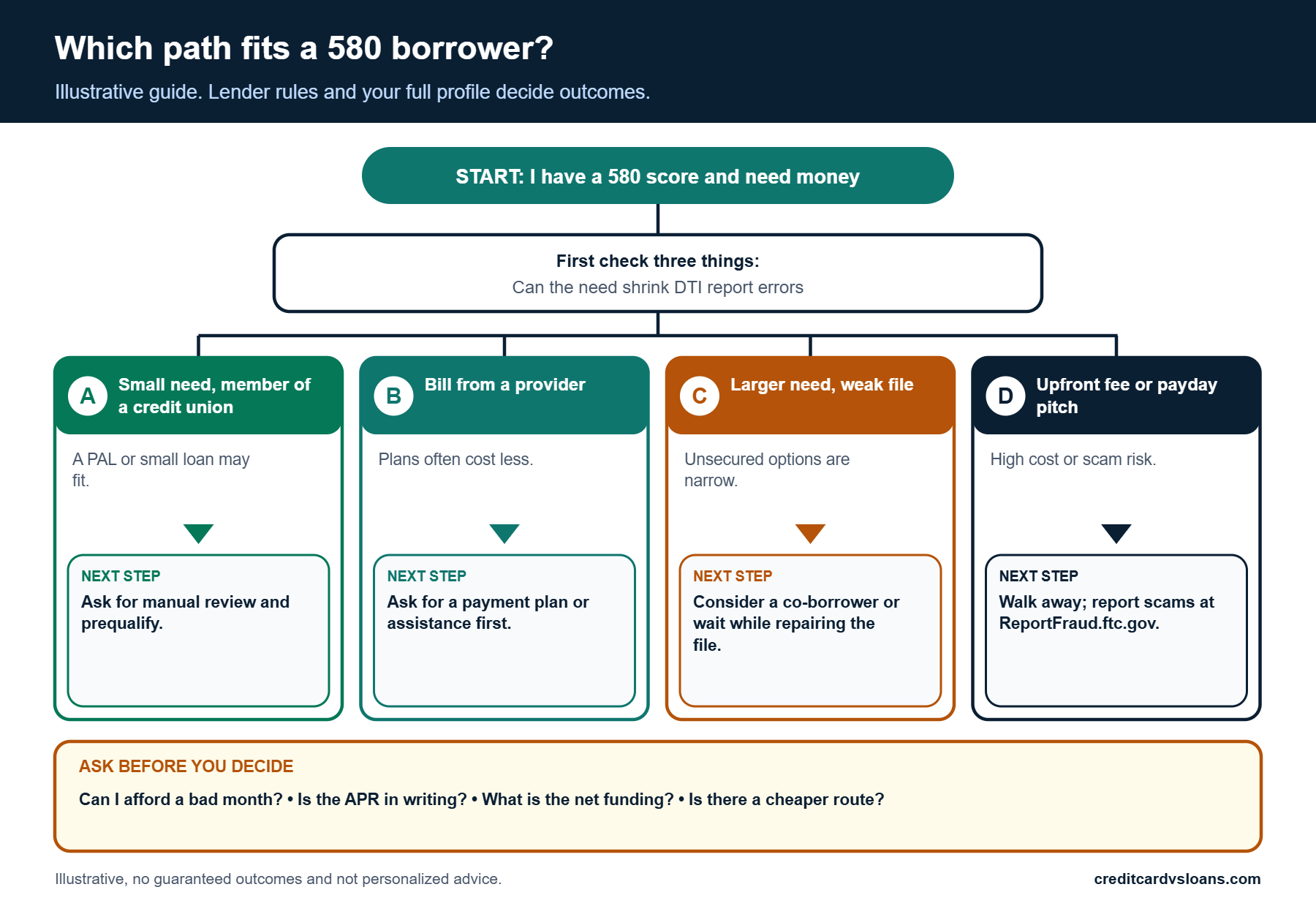
Your checklist and next steps
Decision checklist for a 580 borrower
Before you apply
Ask whether you can solve the problem without borrowing: a payment plan, assistance programs, selling an item or a smaller amount. Pull your free reports and dispute errors. Calculate DTI and decide the payment you can make in a bad month.
Then identify three or four prequalification options: at least one credit union, one community or local lender and one online lender. Avoid any that promise approval or ask for fees upfront.
Before you sign
Check the APR, net funding, total repaid, fees and prepayment terms in writing. Confirm whether the lender reports to the bureaus. If a co-signer or collateral is involved, make sure everyone understands the consequences.
Ask yourself whether the loan would still be manageable if your income dipped. If it would not, borrow less.
The bottom line
When a loan at 580 can make sense
A personal loan with 580 credit score can make sense when the need is real, the amount is modest, the APR and fees are clear and the payment fits your budget with room to spare. Credit unions, small-dollar installment loans and carefully chosen secured options are often the more reasonable places to start.
It is rarely worth pursuing if the offer is very expensive, requires collateral you cannot afford to lose or arrives with pressure to act at once.
Next steps in order
- Look for ways to reduce or delay the need, including payment plans.
- Pull free credit reports and fix errors.
- Calculate DTI and your stress-month payment limit.
- Prequalify with a credit union, a local lender and one online lender.
- Compare APR, fees, net funding and total repaid.
- Avoid payday-style loans and any upfront-fee request.
- Read every page before signing, and walk away if anything is unclear.
At 580 the most useful skill is saying no to bad offers. Start with the cheapest and safest routes, compare total cost, and borrow only what the budget can carry.
- Personal Loan With a 600 Credit Score: Rates, Approval and Alternatives
- What Credit Score Do You Need for a Personal Loan?
- Personal Loan With a 620 Credit Score: What to Expect
- Should You Take Out a Personal Loan Just to Build Credit?
- Predatory Lending: Warning Signs in Personal Loans and Debt Relief Offers
- myFICO: FICO Score ranges and scoring factors
- Federal Reserve: Federal Reserve G.19 Consumer Credit release (Oct. 7, 2026)
- CFPB: Key terms: credit reports and scores
- CFPB: What is a debt-to-income ratio?
- CFPB: What is a payday loan? (Costs, risks and servicemember MAPR cap)
- FTC: What to know about advance-fee loans
- FTC: Free credit reports
- eCFR / NCUA: 12 CFR 701.21 (Payday Alternative Loans, paragraph (c)(7)(iii))
- CFPB: What is the difference between a mortgage interest rate and the APR?
Last updated: October 22, 2026. Rates, fees and lender rules change; verify current terms before acting.
The information on creditcardvsloans.com is provided for general educational and informational purposes only. It is not financial, legal, tax, credit, accounting or investment advice, and reading it does not create an advisor-client, fiduciary or any other professional relationship. Nothing here is an offer, solicitation or recommendation to borrow, lend or apply for any product.
Credit scores, interest rates, fees, eligibility rules, lender policies and laws change frequently and vary by lender, location and individual circumstances. Examples, figures and scenarios are illustrative only, do not predict your results and do not guarantee approval, savings, a particular rate or a credit-score outcome. Always confirm current terms directly with the lender or issuer and read the full agreement before you apply or sign.
Although we aim for accuracy and use reputable sources, we make no representations or warranties, express or implied, about the completeness, accuracy, reliability or timeliness of the content. Content may be drafted with the assistance of automated tools, so errors or omissions may still occur. Links to third-party sites are provided for convenience; we don’t control and aren’t responsible for their content.
To the fullest extent permitted by law, creditcardvsloans.com and its owners, editors, authors, contributors and affiliates disclaim all liability for any loss, damage or expense arising directly or indirectly from your use of, or reliance on, this content. Before making financial decisions, consult a licensed professional, such as a qualified financial advisor, attorney, tax professional or nonprofit credit counselor, who can consider your complete situation.