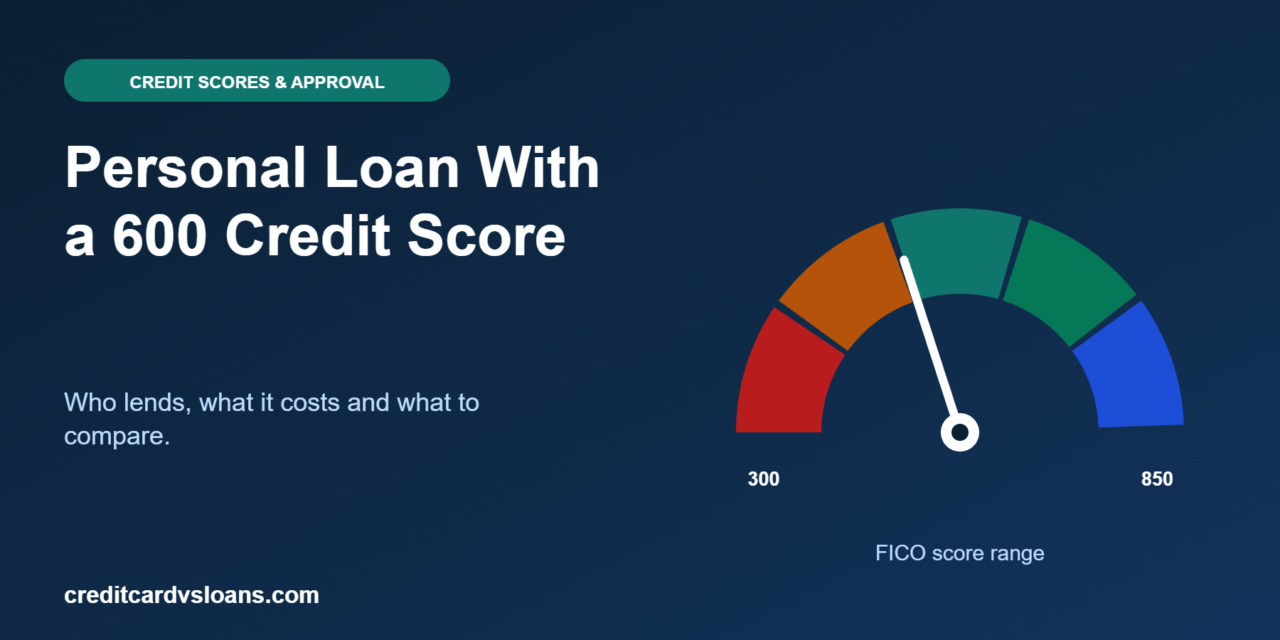
Yes, a personal loan with 600 credit score is often possible, but approval is not automatic and the price is usually higher than what borrowers with good credit see. A 600 sits in the “fair” tier of the FICO range, which is a zone where some lenders say yes, some say no, and the offers that do arrive vary widely in cost.
This article is about that specific middle-of-the-road situation: a score near 600, a loan you may genuinely need, and a lender market that treats you differently depending on who you ask. We’ll cover who tends to lend at this level, what they look at besides the number, how to compare offers without getting burned, and what to consider if the offers on the table are not worth taking.
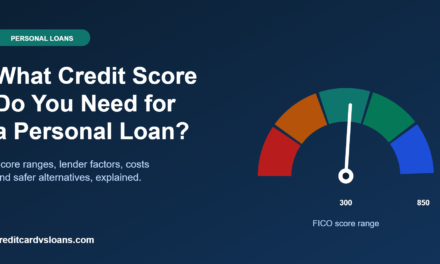
One note on scope. If you want the broader picture of score thresholds across all tiers, start with our guide on what credit score you need for a personal loan. Here we stay focused on the 600 neighborhood and point you to neighboring bands, like a 580 score or a 620 score, when the details change.
- A 600 FICO Score falls in the “fair” range (580 to 669), so a personal loan is possible but not assured, and lenders weigh much more than the score alone.
- Expect pricing to be meaningfully higher than for borrowers with strong credit; the exact rate depends on the lender, your income, your debt load, and your report.
- Credit unions, community banks and some online lenders are the most common places 600-score borrowers look, and each has different trade-offs.
- Always compare offers by APR and total cost, not by the monthly payment alone, and use prequalification (a soft pull) before any hard pull.
- Any lender who promises approval before looking at your application, or asks for a fee before you get the money, is a red flag.
Rate context in this article comes from the Federal Reserve’s G.19 consumer credit release of October 7, 2026. Lender policies and market conditions change, so treat everything here as a framework for questions to ask, not a quote.
The short answer: what a 600 score means for a personal loan
Where a 600 credit score sits
The “fair” tier, and why it’s a gray zone
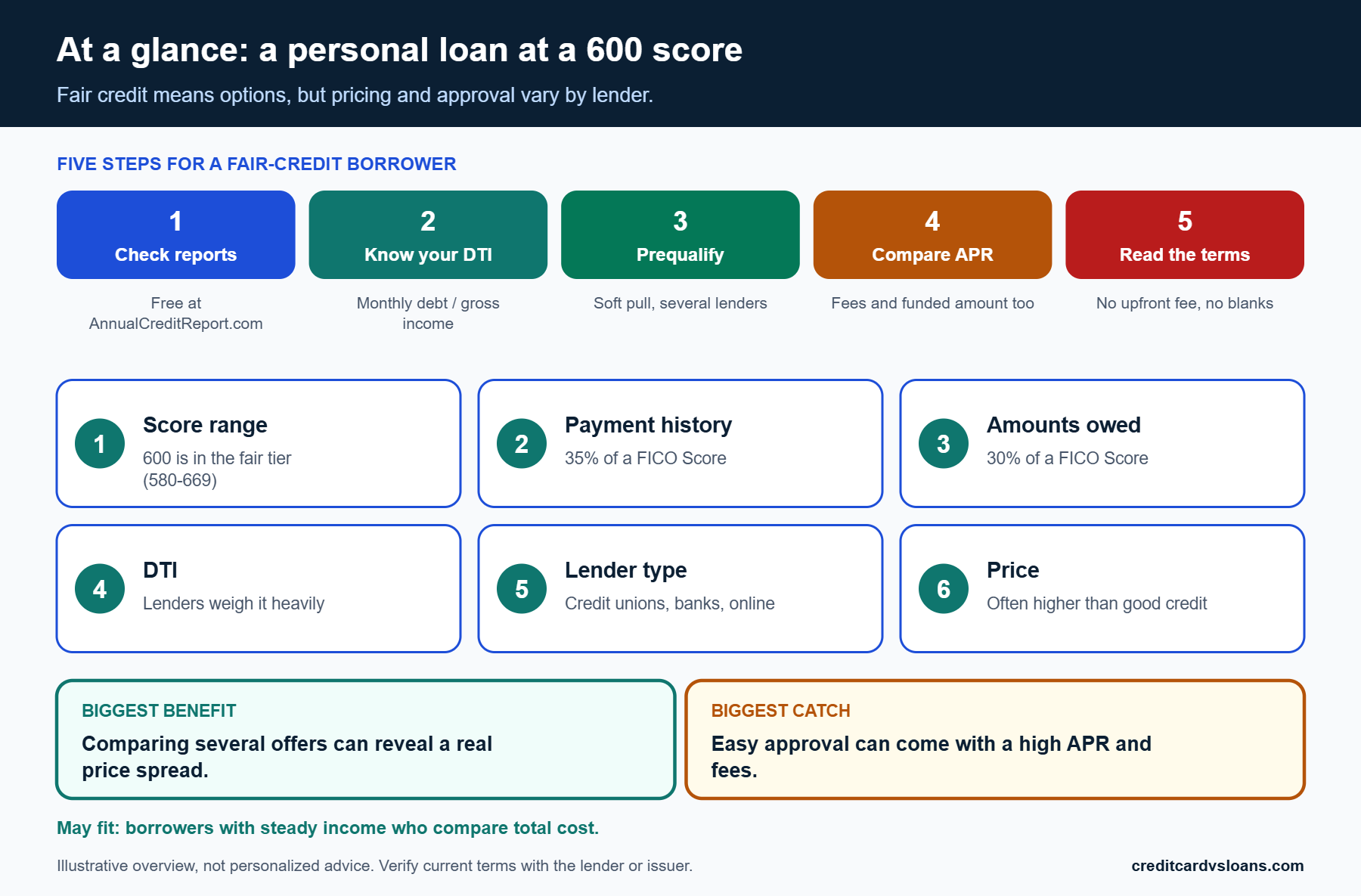
According to myFICO, FICO Scores run from 300 to 850, and the “fair” range is 580 to 669. A 600 is near the lower third of that band, which is below the 670 point where FICO’s “good” range begins. Lenders do not all draw lines in the same places, but many sort applicants into broad tiers, and fair credit often lands you in a tier with fewer choices and higher prices.
The catch is that “fair” covers very different people. One borrower at 600 may have a spotless payment record for three years and a high credit card balance; another may have a long history with a recent collection account. Both show the same three digits, yet a lender may view them quite differently, which is why two people with a 600 can get very different answers.
You have many scores, not one
The Consumer Financial Protection Bureau (CFPB) points out that you have many possible credit scores, and they can differ based on the scoring model, the data source, the type of loan and when the score is calculated. The 600 you see in a free app may not be the number a lender pulls. A lender might use a different version of FICO, an auto- or installment-specific version, or its own internal model.
So treat your 600 as a range, say a handful of points either side. If your app shows 600 and the lender sees 588 or 612, that is normal and not a sign anything is wrong. What matters more is the reasoning behind the score: late payments, high balances, a short history, or recent applications.
What you can realistically expect
Approval is a probability, not a cutoff
There is no federal rule that says a 600 score is approved or denied for a personal loan. Each lender sets its own underwriting standards, and many look at income, debt-to-income ratio (DTI), employment history and the contents of your credit report along with the score. That means a 600 can be approved at one lender and declined at another on the same day.
It also means that a decline is information, not a verdict. If you are turned down, federal law generally requires the lender to tell you why or how to find out, and the notice can point you to the specific factors that hurt. Use it. Our broader walkthrough on score thresholds for personal loans explains how those tiers tend to work across the market.
Pricing is where fair credit usually shows up
Even when you are approved, fair credit tends to show up in the price. As of the Federal Reserve’s G.19 release of October 7, 2026, the average interest rate on a 24-month personal loan at commercial banks was 11.86 percent in the second quarter of 2026 (revised, not seasonally adjusted). That is an average across all borrowers at banks, including people with strong credit, so it is not a prediction for a 600 score.
Think of it as context rather than a target. Borrowers with fair credit often see offers above the market average, and some see offers well above it, particularly from lenders who specialize in credit-challenged borrowers. We do not publish a “typical rate for 600” because no primary source supports one; the only reliable number is the APR on an actual offer addressed to you.
An approval email is not the same as a good deal. At 600, the most important skill is comparing total cost across several offers rather than saying yes to the first one that says yes to you.
Who lends to borrowers with a 600 score
Credit unions and community banks
Membership, relationships and flexibility
Credit unions are member-owned nonprofits, and many are willing to look past a single number when you have a steady paycheck and a record with them. If you already have a checking account, direct deposit, or a prior loan that you paid on time, say so; relationship history can matter in a way that online forms do not capture. Eligibility rules vary, but many credit unions accept members based on where you live, work, worship or study, or through a small association fee.
Community banks work similarly in spirit. A loan officer can sometimes consider context, like a past medical bill that went to collections, in a way that an automated model cannot. That is not a promise of approval, and policies differ a lot from one institution to another, but it is a reason to ask for a human conversation before you apply online.
Small, short loans from federal credit unions
Federal credit unions have access to a special product: Payday Alternative Loans, or PALs. Under the National Credit Union Administration’s rule at 12 CFR 701.21, a PAL I loan is closed-end credit between $200 and $1,000, with a term of one to six months, an application fee capped at $20, and a required membership of at least one month. Interest is capped by NCUA rule; check the credit union for the current maximum.
PALs are small, so they do not replace a standard personal loan for larger needs. But if what you need is a few hundred dollars and the alternative is a high-cost payday loan, a PAL can be a far safer door. Not every credit union offers them, and PAL II rules differ from PAL I, so ask directly and confirm the terms in writing.
Online lenders and large banks
Online lenders that serve fair credit
Many online lenders advertise to borrowers in the fair-credit range. Some use scoring that looks at income, education, employment or cash-flow data in addition to a bureau score, though how any specific lender decides is proprietary and not something we can verify. For you, the practical value is speed: you can often prequalify in minutes without a hard pull.
The trade-off is that lenders who accept more risk generally charge for it, and some add an origination fee that is deducted from your loan proceeds. A loan advertised at a given amount may put less in your account. Always ask what you will actually receive and what the APR is after fees.
Large banks and the “relationship” question
Big national banks vary in how they treat fair credit. Some reserve their lowest-priced personal loans for existing customers with stronger profiles, while others decline personal loan applications below a certain internal standard. We cannot give you a bank’s cutoff because lenders rarely publish them, and what is published can change.
If you already hold deposit accounts at a bank, it can still be worth checking whether they offer prequalification. A soft-pull check costs nothing, and the answer tells you where you stand without adding a hard inquiry to your report.
| Lender type | Where it tends to help | Where it can hurt | Ask before applying |
|---|---|---|---|
| Credit union | Relationship-based review; some offer small PAL loans | Membership rules; slower process | Do you consider payment history and income, not just score? |
| Community bank | Human underwriting is possible | Fewer personal loan products | Is a soft-pull prequalification available? |
| Online lender | Fast prequalification; wider range of offers | Higher APRs and origination fees are common | What is the APR after fees, and how much will I receive? |
| Large national bank | Familiar; possible loyalty considerations | May decline fair credit outright | Do you publish a minimum score, or decide case by case? |
| High-cost short-term lender | Easy approval | Very high cost and repeat-borrowing risk | Is this really cheaper than any other option? |
What lenders look at besides the score
Income and debt-to-income ratio
How DTI is calculated
Your debt-to-income ratio is your total monthly debt payments divided by your gross monthly income, which is your pay before taxes. The CFPB gives a simple example: $1,500 mortgage, $100 auto loan and $400 in other debts equals $2,000 in monthly debt, and with $6,000 in gross monthly income the DTI is 33 percent. The CFPB also notes that different loan products and lenders have different DTI limits.
For a 600-score borrower, DTI can be the swing factor. A moderate DTI shows a lender that a new payment fits; a high DTI suggests the payment would stretch you, which is how many fair-credit applications get declined. Run your own number before you apply so you are not surprised.
Steady income beats a big income
Lenders usually want to see that the income they are relying on is likely to continue. That can mean pay stubs, bank statements, tax returns or, for self-employed applicants, a longer paper trail. A shorter job history is not disqualifying by itself, but it is another variable that a lender may weigh against a fair score.
If your income is irregular, collect documents ahead of time and be ready to explain it plainly. Never overstate income on an application; misstating it can create legal trouble and is on our list of red flags covered in personal loan agreement warning signs.
What’s inside your credit report
Late payments, collections and how recent they are
Two reports with a 600 can tell very different stories. A single 30-day late payment two years ago with everything current since looks different from several recent delinquencies or an account in collections. Payment history is the biggest factor in FICO’s scoring model at 35 percent, and lenders often read the detail beneath the score.
If you can, look at the dates. Older problems matter less to many underwriters than recent ones, and a clear run of on-time payments since a rough patch is a real point in your favor. Be ready to describe what happened, briefly and honestly, if a lender asks.
Utilization, credit age and recent inquiries
Amounts owed make up 30 percent of a FICO Score, and credit card utilization (how much of your revolving limits you are using) is a large piece of it. A 600 driven mostly by maxed-out cards is a different profile from one driven by a thin file. Length of history counts for 15 percent, new credit for 10 percent and credit mix for 10 percent.
Recent applications also matter. The CFPB notes that lender credit checks are recorded as inquiries, which typically have a small negative effect on scores, and that checking your own credit does not. That is one reason to prequalify first rather than formally apply with every lender.
What a personal loan with 600 credit score really costs
Rate, APR and fees: reading the price correctly
Interest rate versus APR
The interest rate is the yearly price of borrowing the principal. The annual percentage rate, or APR, is a broader measure that folds in certain fees and charges, so it is usually higher than the rate alone. The CFPB makes this distinction on its mortgage pages, and the same logic applies to personal loans: the APR is the better tool for an apples-to-apples comparison.
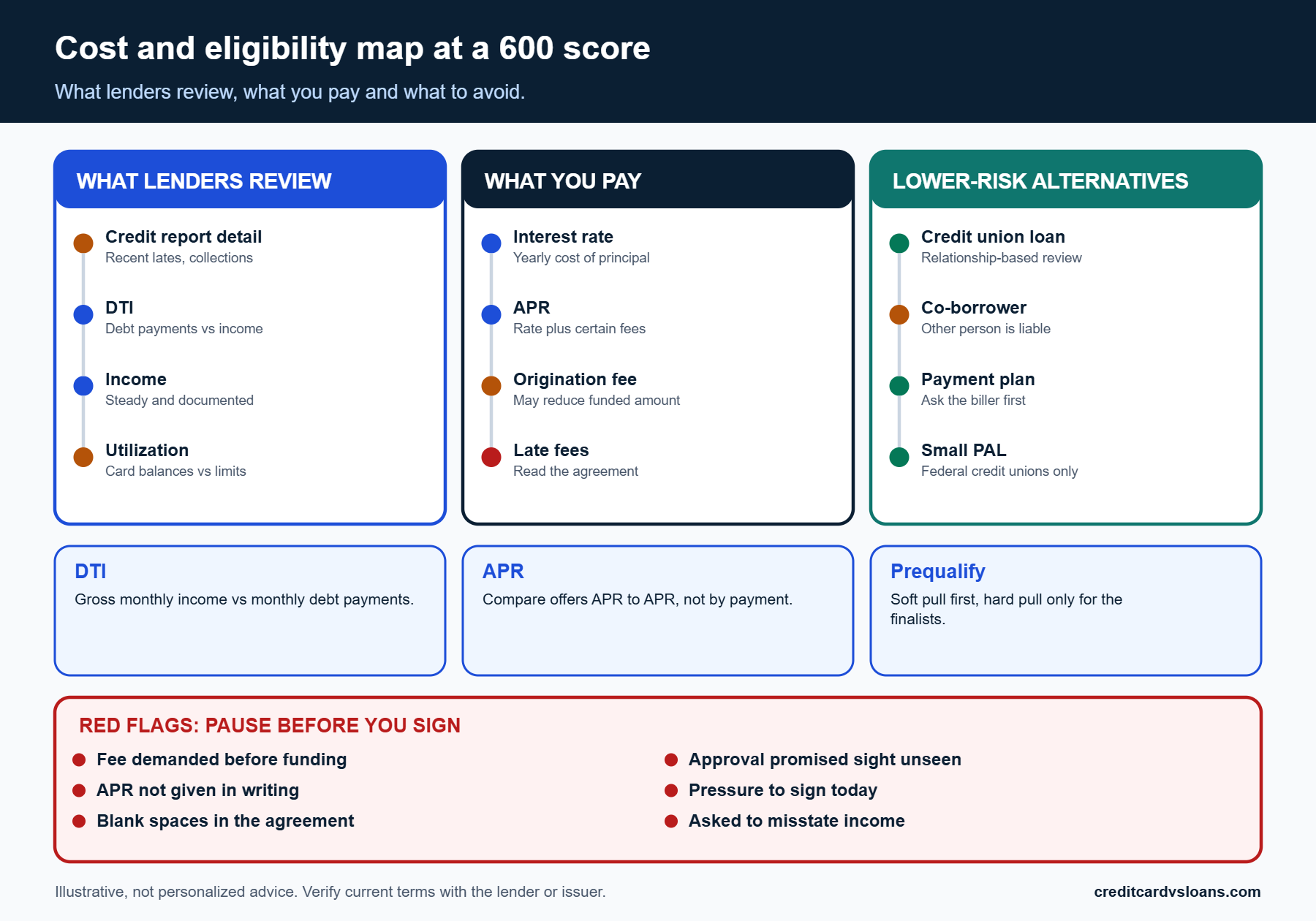
When you review offers for a personal loan with a 600 credit score, line them up by APR and by total dollars repaid. A loan with a slightly lower rate but a large origination fee can cost more than one with a higher rate and no fee. The Truth in Lending disclosures you receive should show the APR, finance charge and total of payments in writing.
Origination fees and what lands in your account
An origination fee is a charge for processing the loan, and many lenders subtract it from the amount you receive. If you borrow $8,000 and the lender takes a percentage off the top, you may see less than $8,000 in your account but still repay the full $8,000 plus interest. We do not quote typical fee levels because they vary by lender and borrower profile.
The practical step is to ask two questions: how much will I actually receive, and what is the APR including all fees? If you need a specific dollar amount for a bill or payoff, you may need to borrow slightly more to cover the fee, and that raises the total cost.
Lenders that accept fair credit often charge more, and some add fees that make the headline rate look lower than it is. Ask for the APR and the net funding amount in writing before you accept.
Illustrative math: what the same loan costs at different APRs
A hypothetical $8,000, 36-month loan
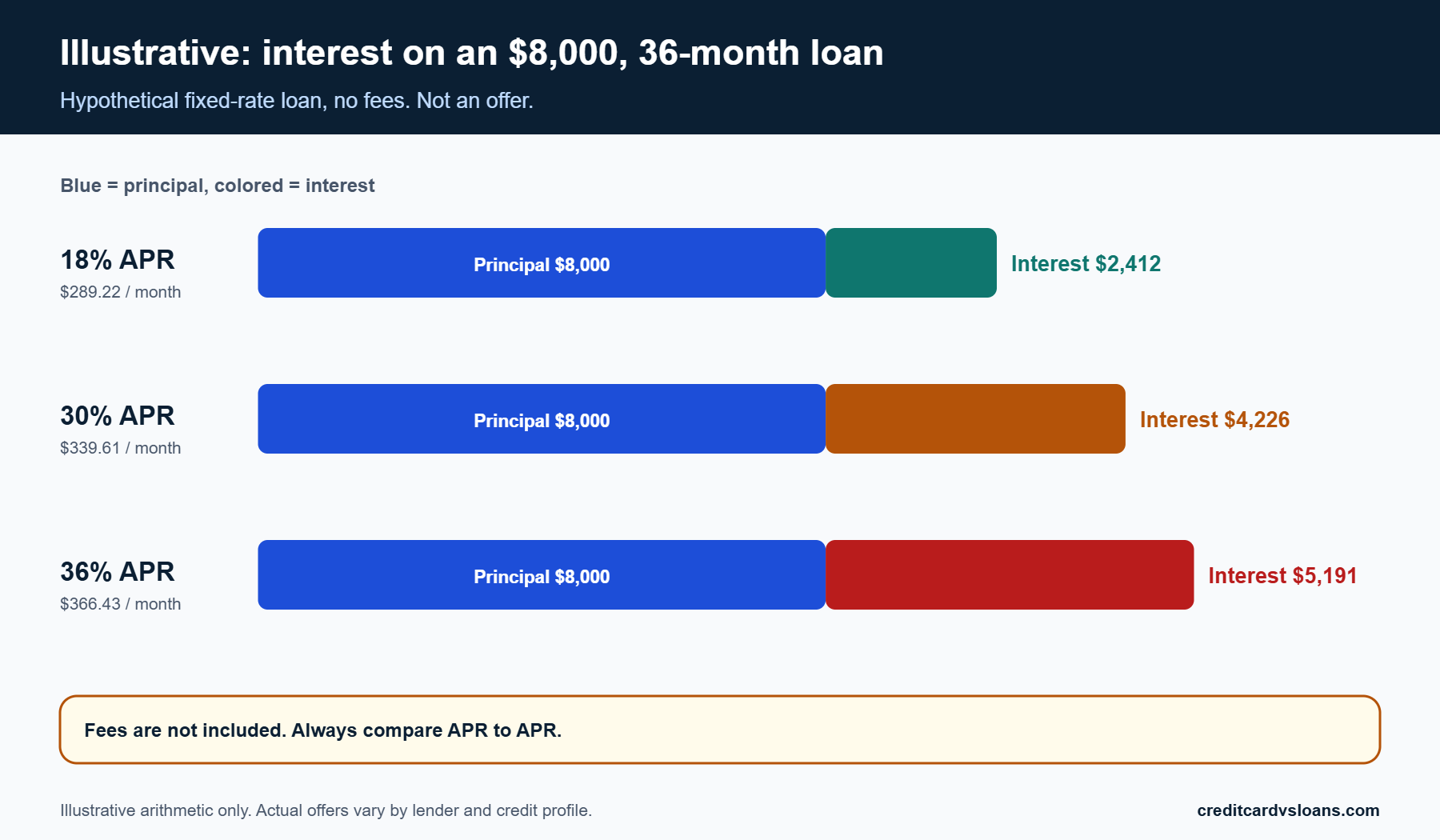
The numbers below are hypothetical and not offers. They assume a fixed-rate, fully amortizing loan with no fees, an $8,000 principal and a 36-month term. At 18 percent APR, the monthly payment is about $289.22 and total interest is about $2,412. At 30 percent, the payment is about $339.61 and interest about $4,226. At 36 percent, the payment is about $366.43 and interest about $5,191.
Notice that moving from 18 to 36 percent adds only about $77 to the monthly payment but roughly $2,779 to the total cost over three years. Monthly payments can make a bad loan look manageable, which is why total cost is the better scoreboard.
| APR | Monthly payment | Total interest | Total repaid |
|---|---|---|---|
| 18% | about $289.22 | about $2,412 | about $10,412 |
| 30% | about $339.61 | about $4,226 | about $12,226 |
| 36% | about $366.43 | about $5,191 | about $13,191 |
The term trade-off
A longer term lowers the monthly payment but increases the total interest, and a shorter term does the opposite. For a hypothetical $6,000 balance at 25 percent APR, a 24-month term runs about $320.23 a month with roughly $1,685 in interest, while a 60-month term runs about $176.11 a month with roughly $4,566 in interest. These are illustrations, not quotes.
The right term is the shortest one you can afford with breathing room in your budget. If the only way to make the payment fit is a very long term at a high APR, that is a signal to look at alternatives, which we cover below, rather than to stretch further.
If a payment fits only when the term is stretched to the maximum, the loan may be bigger than your budget can carry. Check whether a smaller amount, a co-borrower, or a different product would work better.
Prequalify first: how to shop without hurting your score more than necessary
Soft pulls, hard pulls and rate shopping
Prequalification versus a formal application
Many lenders let you prequalify, which typically uses a soft pull that does not affect your score, to see likely terms. A formal application triggers a hard pull, which is recorded as an inquiry and can lower your score slightly. The CFPB says lender credit checks are recorded as inquiries that typically have a small negative effect on scores, and that checking your own credit does not affect your scores.
Prequalified terms are estimates, not commitments, so they can change after the lender verifies your income and reviews your full report. Still, they are the cheapest way to learn who is in the game. Prequalify with several lenders and only submit a full application to the one or two whose estimated terms are worth pursuing.
Does shopping hurt?
The CFPB notes that multiple mortgage inquiries within a 45-day window count as a single inquiry. That page is about mortgages, and scoring treatment for personal loans varies by scoring model and lender, so do not assume the same window applies. A safe approach is to cluster your formal applications within a short stretch of days and avoid opening other credit during that time.
Our guide on how a personal loan can affect your credit score covers inquiries, new-account effects and payment history in more depth, so you know what to expect before and after you borrow.
Comparing offers and reading the agreement
Build a simple comparison sheet
Write down, for each offer: amount funded, amount repaid, APR, monthly payment, term, origination fee, late fee and whether there is a prepayment penalty. Rank by total repaid rather than by payment. If two offers are close, choose the one with clearer terms and a prepayment policy that lets you pay it off early without a charge.
It also helps to ask whether the lender reports to the credit bureaus. A loan that is reported and paid on time can become part of your positive history; one that is not reported helps nothing but your cash flow. Lenders do not all report, so ask.
Read the agreement before you sign
Before you accept, read the full agreement. Check that the APR, term and payment match what you were told and that there are no blank spaces. Pay attention to fees for late payments, returned payments and any automatic debit requirements.
Our checklist on personal loan agreement red flags to check before signing walks through the clauses worth a second look. If something is unclear, ask for an explanation in writing, and walk away if you feel rushed.
| Item to compare | Why it matters | Green flag | Red flag |
|---|---|---|---|
| APR | All-in annual cost including certain fees | Stated clearly in writing | Only a payment amount is quoted |
| Funded amount | Origination fee may reduce it | Net proceeds shown up front | Fee revealed only at signing |
| Prepayment | Lets you cut interest by paying early | No penalty | Penalty or unclear terms |
| Credit reporting | On-time history can matter later | Reports to the bureaus | Not reported |
| Upfront fees | Fees before funding are a classic scam sign | None; fees come out of proceeds | Payment demanded before funding |
Alternatives when a 600-score personal loan isn’t the right fit
Options that may cost less or carry less risk
A co-signer or joint applicant
Adding a co-signer or co-borrower with stronger credit may widen your options or lower your price, because the lender evaluates their finances as well as yours. The trade-off is serious: the other person is legally responsible for the debt if you do not pay, and a missed payment can damage both of your credit reports.
Only consider this if the other person understands the risk and you are confident you can make every payment. Ask the lender whether a co-signer can be released later, and get that in writing, because policies vary.
Secured and credit-builder products
If your main goal is to improve your credit, a loan may not be the cheapest route. Secured credit cards and credit-builder loans were designed for people rebuilding or building credit. The CFPB mentions them as ideas for people with new or rebuilding credit. They work differently from a standard personal loan, so confirm that the product reports to the credit bureaus and read the fee schedule before you sign up.
We cover the question of borrowing to build credit in whether you should take out a personal loan just to build credit. The short version: paying interest and risking a missed payment is a costly way to build history if lower-cost tools fit your situation.
Options to treat with caution
Payday and other very high-cost loans
The CFPB explains that payday loans are usually due in one payment on your next payday, often within two to four weeks, and that a typical two-week loan with a $15-per-$100 fee has an APR of almost 400 percent. Lenders generally do not check whether you can afford the loan next to your other obligations, and some states allow rollovers that let the debt grow.
They are easy to get at any credit score, which is exactly the problem. If you are considering one because the 600-score loan offers feel expensive, price out alternatives such as a payment plan with the biller, a credit union PAL if available, or a smaller loan first.
Advance-fee loan offers
The Federal Trade Commission warns that legitimate lenders do not promise a loan before reviewing your credit report and application, and that a demand for a fee for “insurance,” “processing” or “paperwork” before funding is a reason to walk away. It also advises checking that a lender is registered in your state, searching for complaints, and reporting scams at ReportFraud.ftc.gov.
Fair-credit borrowers are frequent targets of these schemes because they are motivated and may have been declined elsewhere. If an offer sounds too easy, slow down and verify.
| Option | Best used for | Main trade-off |
|---|---|---|
| Credit union loan or PAL | Small to moderate needs, relationship borrowers | Membership rules; PAL amounts are small |
| Co-signed loan | Stronger offer using another person’s credit | Other person is legally liable |
| Payment plan with the biller | Medical, utility or tax bills | May not be offered; terms vary |
| Secured card or credit-builder product | Building history, not large cash needs | Doesn’t deliver a lump sum quickly |
| Payday or title loan | Rarely advisable | Very high APR, repeat borrowing |
Matching the loan to the purpose
Debt consolidation at fair credit
Compare the new APR to what you pay now
Many borrowers at this level are thinking about consolidating credit card balances. The question is simple but easy to skip: is the all-in APR on the new loan lower than the blended rate you are paying now? As of the Federal Reserve’s G.19 release of October 7, 2026, the average rate on credit card accounts assessed interest was 22.15 percent in the second quarter of 2026, with the average across all card accounts at 20.94 percent. Your own cards may be higher or lower.
If the personal loan offer is not meaningfully cheaper once fees are included, consolidating mostly moves the debt around. It can still help if the fixed payment and payoff date keep you disciplined, but make sure you are choosing that for the structure and not mistaking it for savings.
Avoid refilling the cards
The risk with consolidation is the second round of debt. If you pay off cards with the loan and then run the balances back up, you carry both the loan and the new card debt. That can push your DTI higher and your score lower.
Some borrowers find it helpful to keep the paid-off cards open but out of daily use, since closing accounts can change utilization and credit age. This is a judgment call, not a rule, and what works depends on your habits and your fees.
Emergency expenses and planned purchases
When urgency raises the stakes
A car repair, a medical bill or a lapsed rent payment is when people accept the first loan they can get. That is also when costs spiral. Before borrowing, ask whether the biller offers a payment plan, whether a credit union can move faster than you think, and whether a smaller loan covers the most urgent part.
If you have a few days, use them. Prequalification takes minutes, and comparing three to five offers can be the difference between a manageable loan and a costly one. A rushed decision is the situation lenders with the highest prices count on.
Planned purchases can wait for a better score
If the purchase is optional, you have an advantage: time. Waiting while you address the issues holding your score down may produce better offers later, though we cannot promise any score outcome. Even a few months of on-time payments and lower card balances can change a lender’s view of your file.
Compare the cost of waiting with the cost of borrowing now. If paying a higher APR for a discretionary purchase would strain your budget, the cheaper choice may be to wait or to save for a larger down payment.
Moving from a 600 toward better offers
Fixes that tend to matter first
Payment history comes first
FICO says payment history is 35 percent of a score. If you have missed payments, the first priority is getting accounts current and keeping them that way. Automatic payments or reminders help, as the CFPB suggests.
If an account is in collections or charged off, the right move depends on the debt, the state and the age of the account, so check with a nonprofit credit counselor or your state regulator before sending money. Payment arrangements can sometimes affect the account’s status in different ways.
Utilization and report accuracy
Amounts owed are 30 percent of the FICO Score. The CFPB suggests using no more than 30 percent of your card limits, and notes that you do not need to carry a balance to build credit; paying in full each month is best for both scores and interest costs.
Pull your reports at AnnualCreditReport.com, which the Federal Trade Commission says is the only authorized site for free annual reports. The three bureaus offer free weekly reports there as well. If you find errors, dispute them with both the bureau and the business that supplied the information.
How the neighboring score bands compare
If your score is closer to 580
Near the bottom of the fair range, fewer lenders will approve an unsecured loan and more of the offers come with higher prices or conditions. We discuss realistic expectations in the article on a personal loan with a 580 credit score, including which alternatives may be worth considering first.
If you are in that zone, the best use of your time may be fixing the issues on your report and building a bigger buffer in your budget before you apply anywhere.
If your score is closer to 620
A score at 620 or slightly higher puts you a bit closer to the upper half of fair credit, where some lenders start to see a more mainstream profile. That does not guarantee any change in your offers; it only means more lenders may be open to a conversation. Our overview of a personal loan with a 620 credit score covers what the difference can look like.
Remember that a 20-point difference is smaller than the differences between scoring models, so focus on the underlying file rather than chasing a number.
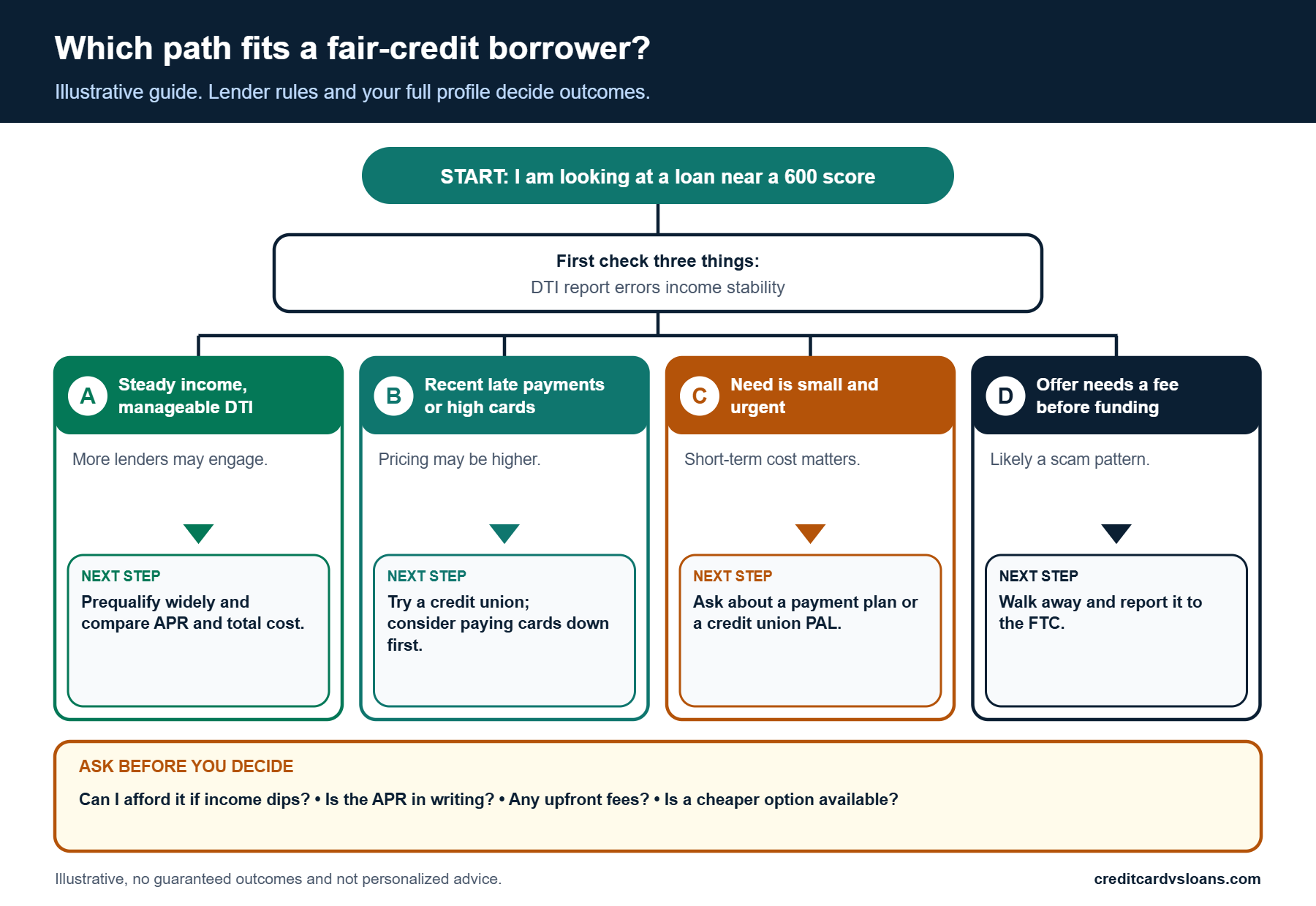
Your checklist and next steps
A decision checklist for borrowers with fair credit
Before you apply
Start with the facts you control. Pull your free reports and look for errors, calculate your DTI from your gross income and monthly debt payments, and decide the smallest amount that solves your problem. Gather proof of income and identification so a lender can process you quickly.
Then prequalify with several lenders, including at least one credit union, and record every offer’s APR, fees, funded amount and payment. Do not apply for new credit elsewhere during this window.
Before you sign
Check that the APR, term and payment match the quote and that you know the net amount you will receive. Look for prepayment penalties, late fees, autopay conditions and any request for money before funding. Read every page and skip anything with blank spaces.
Ask yourself one question: if my income dipped for a month, could I still make this payment? If the answer is no, consider a smaller amount, a longer term at a lower payment with a plan to prepay, or a different approach.
The bottom line for a 600 score
Who may reasonably proceed
If you have steady income, a manageable DTI and an offer whose APR and total cost fit your budget, a personal loan with 600 credit score can be a reasonable tool, especially for consolidating higher-cost debt or covering a necessary expense. The fixed payment and end date are real advantages.
The key is to compare multiple offers, read the agreement and borrow only what you need. Nothing here guarantees approval or a specific rate; your lender decides based on your full profile.
Who should pause
If every offer has a very high APR, if the payment strains your budget or if someone is asking for money before funding, pause. Look at credit union options, a co-borrower, payment plans or a smaller amount first, and consider talking with a nonprofit credit counselor.
Our broader guide on credit score requirements for personal loans can help you place your situation across tiers, and the discussion in borrowing to build credit is a useful read if improving your score is part of the reason you are considering a loan.
A 600 score gives you options but not leverage. Prequalify widely, compare by APR and total cost, avoid upfront fees and high-cost shortcuts, and choose the smallest loan that solves your problem.
Next steps in order
A short action list
- Get your free reports at AnnualCreditReport.com and dispute errors.
- Calculate your DTI using gross monthly income.
- Decide the smallest amount you need and the payment you can afford.
- Prequalify with a credit union, a bank and one or two online lenders.
- Compare APR, funded amount and total repaid across offers.
- Read the full agreement and confirm there is no upfront fee.
- Apply formally to your top one or two choices within a short window.
If none of the offers pass your tests, pausing is a legitimate answer. Rebuilding your file for a few months can change the picture, and you will have a clear list of what to improve.
Questions to ask any lender
Ask whether the quoted terms are firm or estimated, whether the APR includes the origination fee, and what happens if you pay off the loan early. Ask whether the lender reports to all three bureaus and how they handle hardship if your income drops.
Write the answers down. A lender who is happy to answer clearly is usually a better partner than one who deflects.
- myFICO: FICO Score ranges and scoring factors
- Federal Reserve: Federal Reserve G.19 Consumer Credit release (Oct. 7, 2026)
- CFPB: Key terms: credit reports and scores
- CFPB: What is a debt-to-income ratio?
- CFPB: What is a payday loan?
- FTC: What to know about advance-fee loans
- FTC: Free credit reports
- eCFR / NCUA: 12 CFR 701.21 (Payday Alternative Loans, paragraph (c)(7)(iii))
Last updated: October 22, 2026. Rates, fees and lender rules change; verify current terms before acting.
The information on creditcardvsloans.com is provided for general educational and informational purposes only. It is not financial, legal, tax, credit, accounting or investment advice, and reading it does not create an advisor-client, fiduciary or any other professional relationship. Nothing here is an offer, solicitation or recommendation to borrow, lend or apply for any product.
Credit scores, interest rates, fees, eligibility rules, lender policies and laws change frequently and vary by lender, location and individual circumstances. Examples, figures and scenarios are illustrative only, do not predict your results and do not guarantee approval, savings, a particular rate or a credit-score outcome. Always confirm current terms directly with the lender or issuer and read the full agreement before you apply or sign.
Although we aim for accuracy and use reputable sources, we make no representations or warranties, express or implied, about the completeness, accuracy, reliability or timeliness of the content. Content may be drafted with the assistance of automated tools, so errors or omissions may still occur. Links to third-party sites are provided for convenience; we don’t control and aren’t responsible for their content.
To the fullest extent permitted by law, creditcardvsloans.com and its owners, editors, authors, contributors and affiliates disclaim all liability for any loss, damage or expense arising directly or indirectly from your use of, or reliance on, this content. Before making financial decisions, consult a licensed professional, such as a qualified financial advisor, attorney, tax professional or nonprofit credit counselor, who can consider your complete situation.