The personal loan rate shopping credit score question has a reassuring answer for most borrowers: comparing offers usually costs little or nothing, as long as you do it the right way. Prequalifying with a soft pull does not affect your credit scores, and even a hard inquiry typically has a small, temporary effect. The expensive mistake is not shopping at all, because a few points of APR can cost far more over the life of a loan than any inquiry ever will.
The “right way” matters, though. Personal loans are not named in the credit-scoring rules that group shopping inquiries together, so you should not assume a pile of formal applications will be treated as one. This guide explains the difference between soft and hard checks, what the major sources actually say about shopping windows, how to estimate what is at stake in dollars, and how to run a shopping process that keeps your score protected.
If you are comparing offers already, pair this with our guide to a personal loan with a 650 credit score, which shows how the other parts of your file shape the quote you get.
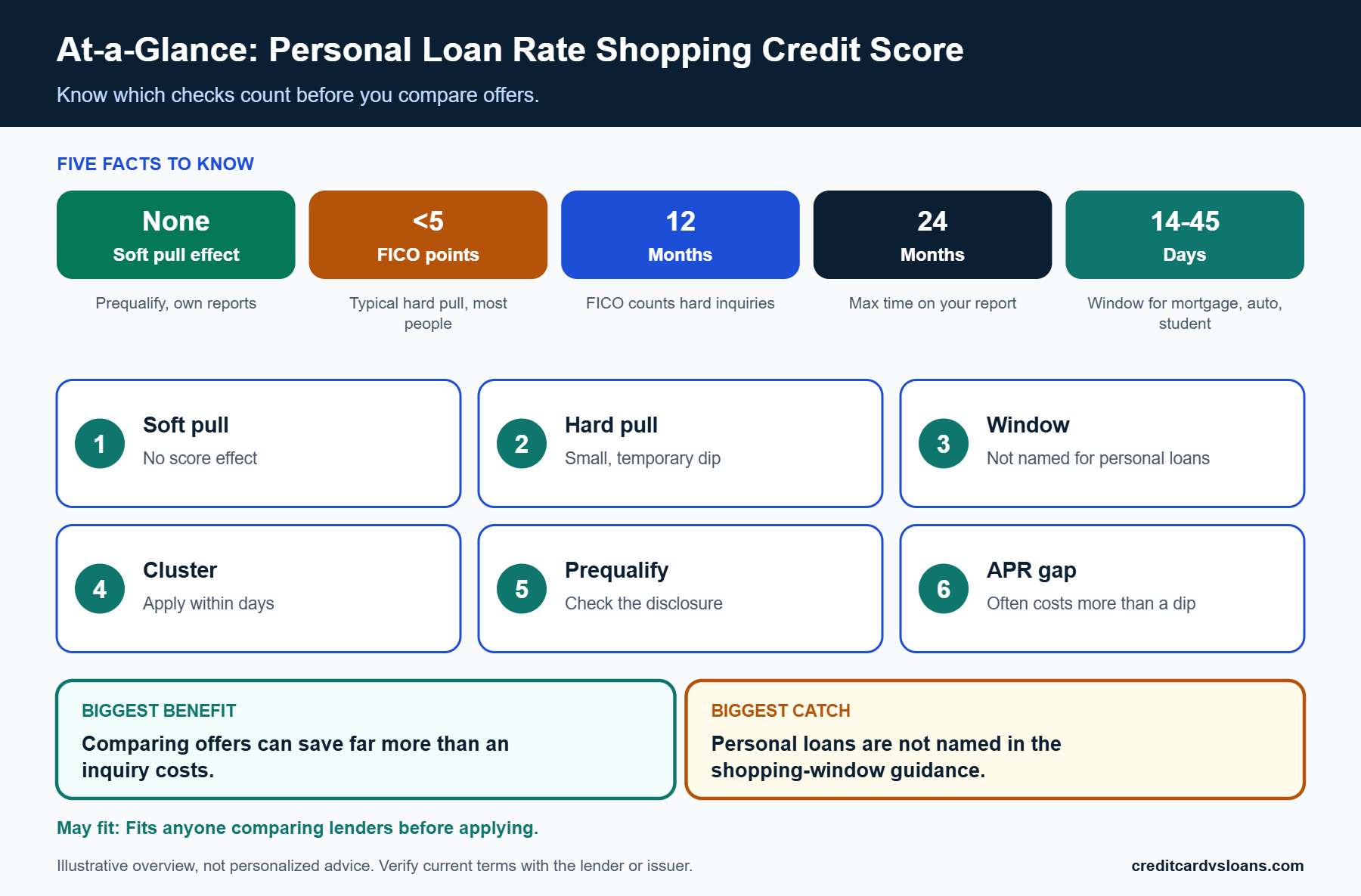
- Soft inquiries, including your own credit report requests and many prequalification checks, do not affect your credit scores, according to the CFPB.
- A hard inquiry usually lowers a FICO Score by fewer than five points for most people, per myFICO, and it affects the score for about 12 months.
- The CFPB and myFICO describe the rate-shopping window for mortgage, auto and student loans. Neither says personal loans get the same treatment, so keep formal applications to a minimum.
- Ask each lender whether prequalification is a soft pull before you enter your details, and read the consent language.
- On a $10,000 loan, the interest gap between a 14% and a 20% APR over 36 months is about $1,075 in this guide’s illustrative math.
Scoring rules and lender practices change, and different scoring models treat inquiries differently. The market figure cited here comes from the Federal Reserve’s G.19 release of October 7, 2026. Confirm each lender’s process before you apply.
Table of contents
Personal Loan Rate Shopping Credit Score: The Short Answer
What Happens When a Lender Checks Your Credit
Soft pulls leave your score alone
The Consumer Financial Protection Bureau (CFPB) explains that soft inquiries include account reviews by existing lenders, prescreening offers, employment screening and your own requests for your credit reports. They do not affect your credit scores, and only you can see them when you review your own report.
That is the foundation of safe shopping. If a lender or comparison site can show you estimated terms using a soft pull, you can see several quotes without any scoring consequence at all.
Hard pulls can cost a few points
A hard inquiry usually happens when you formally apply and the lender requests your credit report to decide on the loan. The CFPB says these inquiries can lower your score because scoring models weigh how recently and how often you apply for credit. Other lenders can see them when they buy your report.
The effect is typically modest. myFICO says that for most people one additional hard inquiry costs less than five points of their FICO Score, and that no set number of points applies to every inquiry.
Why Shopping Is Usually Worth It
The price gap dwarfs the inquiry cost
A temporary dip of a few points can matter if you are about to cross a lender’s threshold, such as a mortgage application next month. For most personal loan decisions, the dollar cost of a higher APR is the bigger risk. A borrower who accepts the first offer without comparing may overpay by hundreds or thousands of dollars.
The hypothetical math later in this guide puts numbers on that gap. The goal is not to avoid inquiries at all costs but to spend them wisely.
Shopping well is a skill, not a gamble
Borrowers who treat shopping as a process, with a defined window, a standard set of questions and a consistent loan amount and term, get cleaner comparisons and fewer surprises. Borrowers who apply impulsively to many lenders over weeks risk more inquiries for the same information.
The step-by-step plan in this article gives you that process. It works whether your score is in the 600s, as covered in the 620 guide, or higher, as in the 700 guide.
Where the myth comes from
The idea that every credit check damages your score has a kernel of truth. Hard inquiries can lower a score slightly, and they are recorded on your report. What the myth leaves out is the size of the effect, the difference between soft and hard checks and the fact that the cost of a poor rate is usually larger and lasts longer.
It also ignores that a lender will not make a decision without looking at your credit. The question is never whether to be checked but how many hard checks you invite and for what reason.
What this guide does and does not cover
This article focuses on the credit effect of comparing personal loan offers and on how to limit it. It does not rank lenders or recommend a particular product, and it does not promise any rate or score outcome. For the full comparison method, including APR, fees, term and funding speed, see the 650 credit score guide for a worked example and the broader overview of personal loan score needs.
If a particular sentence here conflicts with what your lender tells you in writing, trust the lender’s contract for your loan and ask for clarification on anything that differs.
How Credit Inquiries Work: Soft Versus Hard
Soft Pulls and Prequalification
What prequalification usually gives you
Prequalification is a preliminary check that estimates the loan amount, term and rate you might be offered based on information you provide and, often, a soft credit pull. It is not a final approval. The terms can change once you submit documents and the lender runs a hard inquiry.
Many lenders and loan marketplaces offer it, and it is the most efficient way to compare. Use the same loan amount and term across all lenders so the estimates are comparable.
The fine print on soft-pull claims
Not every “check your rate” button is a soft pull in every case, and practices vary by lender. Read the disclosure before you click. Look for language such as “will not affect your credit score” and for any statement that a hard inquiry will be made if you continue.
If the page does not say, ask in writing or choose another lender. You can also request your own credit reports and look at the inquiries section afterward to confirm what was recorded. Hard inquiries are visible to other lenders; soft ones are visible only to you.
Declined applications still leave a mark
A hard inquiry is recorded when the lender requests your report, regardless of whether you are approved. A declined application therefore costs the same inquiry as an approved one and gives you no loan. That is another argument for using prequalification to find out where you stand before you submit a formal application.
If you are declined, the lender is required to tell you, and you can ask for the principal reasons. Those reasons can show you what to fix before trying again.
Marketplaces and one-form comparison sites
Some comparison sites let you fill out one form and see estimates from several lenders. Many of these use a soft pull for the initial estimates, but you should still read the consent language. If you click through to a specific lender and submit a full application, that lender will usually run a hard inquiry.
The convenience is real, but so is the data-sharing. Check how the site uses your information, whether it will contact you by phone or email and whether you can opt out.
Hard Pulls and How Long They Matter
How long an inquiry stays on your report
According to myFICO, hard inquiries can remain on a credit report for up to 24 months, but FICO Scores consider them for only 12 months. The impact usually fades well before it disappears from the report.
Other scoring models may count inquiries differently, so the exact window can vary depending on which score a lender uses. That uncertainty is one more reason to keep formal applications to a minimum.
Why scores treat inquiries as a signal
Scoring models treat a recent application as a possible sign that you are taking on new debt. New credit is about 10% of a FICO Score, and inquiries are only part of that category, which is why one inquiry has a small effect. The pattern becomes more important when you have a thin credit file or several recent applications.
A rate-shopping process that produces one or two hard inquiries, not eight, keeps the signal small and still gets you the information you need.
| Feature | Soft pull | Hard pull |
|---|---|---|
| Typical trigger | Prequalification, your own report check, prescreened offer | Formal loan application |
| Effect on score | None, per the CFPB | Usually under five FICO points for most people |
| Visible to other lenders | No, only to you | Yes |
| Time on report | Not applicable to scoring | Up to 24 months; FICO counts 12 |
| Result you get | Estimated terms, not final | Final approval decision and binding terms |
Checking your own credit is always safe
Requesting your own credit reports does not affect your scores, according to the CFPB. That means you can review your file as often as the bureaus allow without worry. Be careful, though, with services that pull your credit as part of a sign-up for a product, since they may involve a hard inquiry if you apply for something.
The quickest way to see what a lender recorded is to read the inquiries section of your report a few weeks after you apply. Hard inquiries will be listed with the lender’s name and date.
The Rate-Shopping Window: What Is Known and What Is Not
What the CFPB and myFICO Say
Which loan types are named
The CFPB notes that for auto, home and student loans, the credit bureaus and score providers may count multiple hard inquiries within a short window as one. The result is that comparing offers for a few weeks on those loans should have little effect on your score. myFICO describes the same treatment for mortgage, auto and student loan inquiries.
Neither source says the same applies to personal loans or credit cards. That silence is the most important detail in this whole topic, because it means a personal loan borrower cannot rely on the grouping.
How long the window lasts
The CFPB says the window varies from 14 to 45 days. myFICO explains that older FICO Score versions group inquiries made within 14 days and newer versions within 45 days, and that rate-shopping inquiries less than 30 days old are ignored when a score is calculated. Some lenders still use older versions.
Because you cannot know which version a lender will pull, keeping all your shopping inside a short span, ideally 14 days, is the cautious approach if you do decide to submit multiple formal applications.
Other scoring models may differ
FICO is the model most borrowers have heard of, but lenders can use other models, and the CFPB notes that your scores can vary by model, data source and the date they are calculated. Because rules about inquiries are model-specific, a rate-shopping window described for one version may not apply to another.
That variation is the reason this guide recommends the conservative approach. If you assume each formal application counts, you are protected regardless of which model a lender uses.
What That Means for Personal Loans
Do not count on grouping
Some scoring models may treat personal loan inquiries as rate shopping, and some may not. Since the public guidance from the CFPB and myFICO does not address it, a safe working assumption is that each formal application could register as its own inquiry.
That assumption is not alarmist. Even then, the typical effect is small. It simply means the better plan is to minimize hard pulls by relying on prequalification until you are ready to choose.
Practical rule of thumb
Use soft pulls to narrow the field, then submit one or two formal applications, ideally on the same or consecutive days, to the lenders whose estimated terms are best. Doing so limits the number of hard inquiries and keeps them inside even the shortest known window.
If a lender requires a hard pull just to show you a rate, treat that as a cost of the comparison and weigh whether the offer is likely to beat the soft-pull alternatives you already have.
What It Costs: Score Points Versus Dollars
Illustrative Interest Differences
The cost of a few APR points
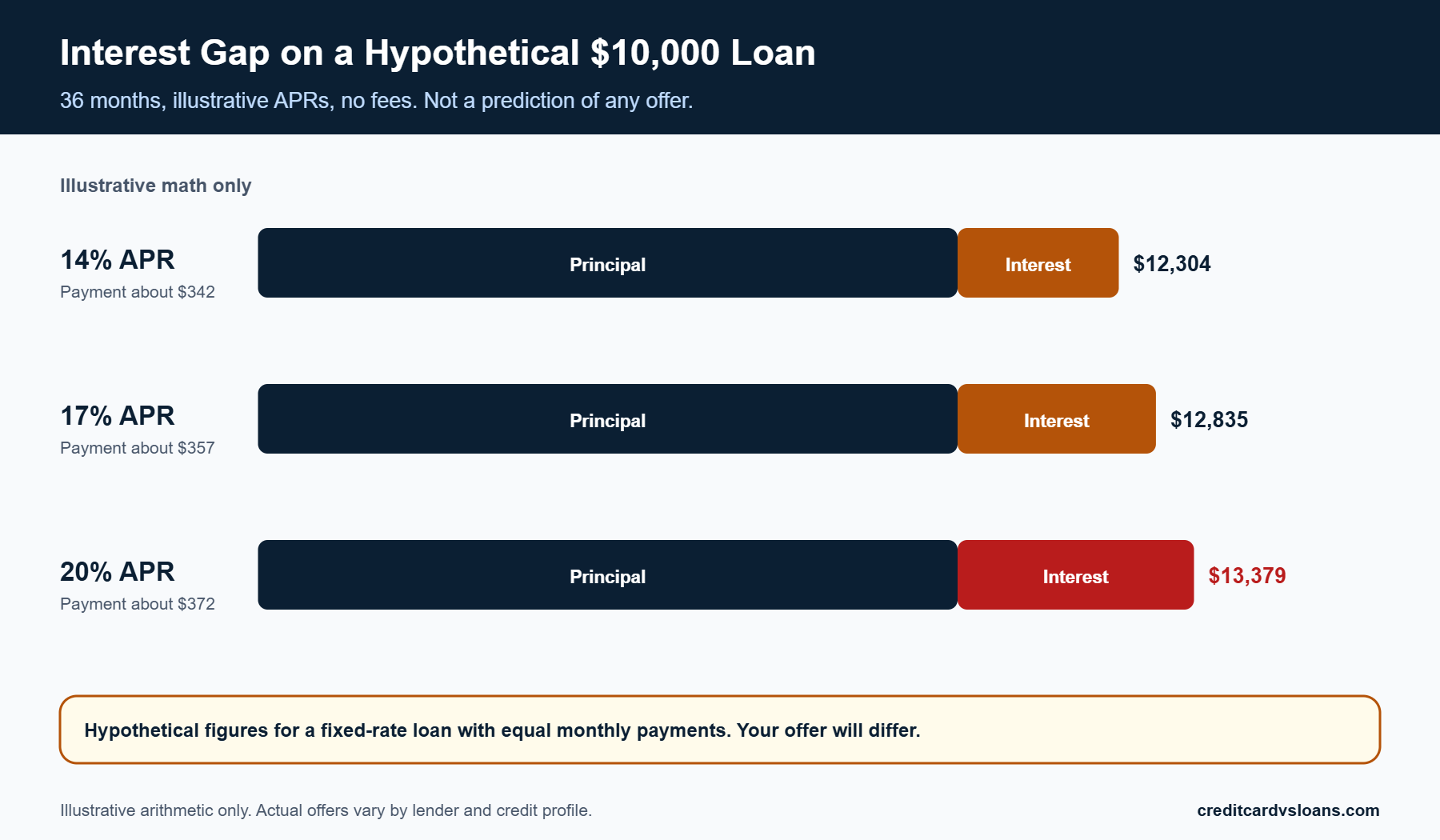
The numbers here are hypothetical and chosen to show scale. They do not predict what any lender will offer you. On a $10,000 fixed-rate loan repaid over 36 months, a 14% APR produces a payment of about $341.78 and total interest of about $2,304. At 17% the payment is about $356.53 and interest about $2,835. At 20% the payment is about $371.64 and interest about $3,379.
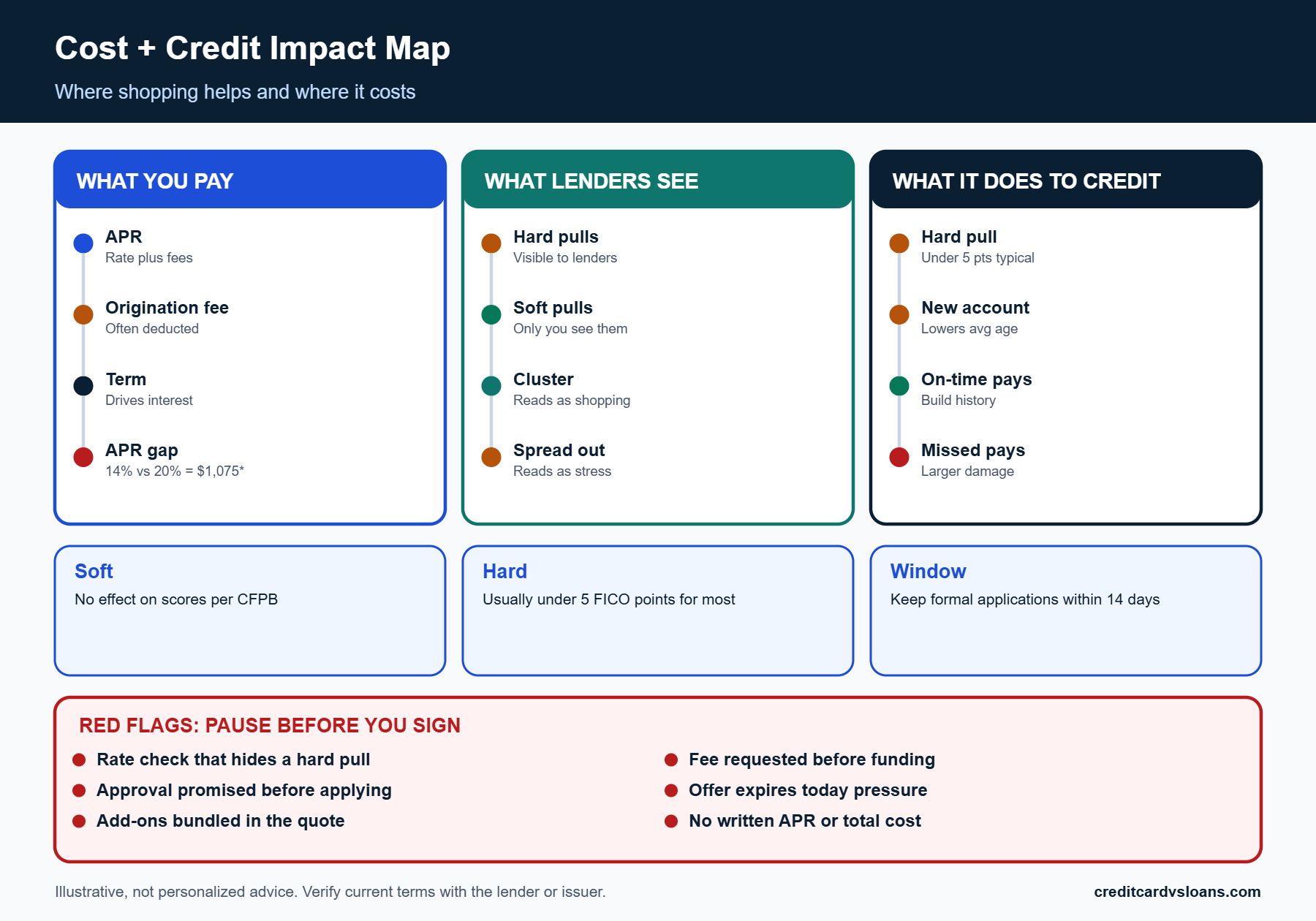
The gap between the 14% and 20% scenarios is about $1,075 in interest, or about $30 a month. That is real money, and it is the gap that rate shopping is designed to find.
Comparing a quote to a few points on your score
A hard inquiry that costs a few points rarely moves a borrower into a different pricing tier by itself, though it can if you are right on a lender’s cutoff. A rate that is 3 to 6 points higher, by contrast, applies to every payment you make for the full term.
That asymmetry is why most borrowers should accept a small, temporary inquiry cost in exchange for a better price. It is not a reason to apply carelessly, but it is a reason not to avoid comparison altogether.
A worked example where the lower rate loses
Consider two hypothetical offers on a $10,000, 36-month loan. Offer A has a 15% rate and no origination fee, so the borrower receives $10,000, pays about $346.65 a month and about $2,480 in interest. Offer B has a 12% rate and a 6% origination fee, so the borrower receives only $9,400, pays about $332.14 a month and about $1,957 in interest, plus the $600 fee.
Offer B looks cheaper on the rate and on the payment, but its total borrowing cost is about $2,557 against $2,480 for Offer A, and its APR works out to roughly 16.4% against 15%. Only a comparison by APR and total cost exposes that. The comparison method is the subject of our companion guide on offers at the 650 level.
Why the monthly payment alone can mislead
Lenders often quote a monthly payment because it is easy to compare, but the payment depends on the term as much as the rate. On a hypothetical $10,000 loan at 18% APR, a 36-month term means a payment of about $361.52 and interest of about $3,015. Stretching it to 60 months drops the payment to about $253.93 but raises interest to about $5,236.
When you collect quotes, compare the same term across lenders, then look at longer and shorter terms separately. Otherwise a lender showing a longer term can look cheaper on the payment while costing you more overall.
| Illustrative APR | Monthly payment | Total interest | Extra interest vs 14% |
|---|---|---|---|
| 14% | $341.78 | $2,304 | Baseline |
| 17% | $356.53 | $2,835 | $531 |
| 20% | $371.64 | $3,379 | $1,075 |
Other Credit Effects of Applying
The new account and your average age
If you take the loan, a new installment account appears on your report. Opening an account can lower the average age of your accounts, and new credit is about 10% of a FICO Score. These effects are usually modest and fade over time as you make on-time payments.
Choosing not to open an account because you fear the inquiry misses the larger issue: the loan itself, not the shopping, is what changes your credit profile. Shop to find the best loan, then evaluate whether the loan is worth taking at all.
How lenders see a crowd of inquiries
Besides the score, a lender may look at the inquiries section of your report directly. Several recent inquiries across unrelated credit types can suggest financial stress, whereas a tight cluster of personal loan inquiries is easier to interpret as shopping.
Keep your applications focused and avoid opening new credit cards or other accounts during the same weeks. A quiet, consistent profile gives underwriting fewer reasons to hesitate.
A Step-by-Step Plan for Shopping Without Wasting Inquiries
Before You Request Any Offers
Check your reports and your own numbers
Start with a look at your credit reports. You can request them once a year without affecting your scores, and the nationwide credit reporting companies currently allow weekly access on request, according to the CFPB. Dispute errors first, because a wrong late payment or a duplicate balance can make every offer worse.
Then work out your debt-to-income ratio, which the CFPB defines as your monthly debt payments divided by your gross monthly income. Lenders use it to judge whether another payment is affordable, so knowing yours helps you interpret the offers you see. Our guide on a personal loan at a 650 score walks through a worked example.
Decide the amount, term and walk-away terms
Pick one loan amount and one or two terms to compare, such as 36 and 60 months. Comparing a $10,000 loan from one lender with an $8,000 loan from another is not an apples-to-apples exercise. Also decide the highest APR and the largest fee you will accept before you see any offers, so you are not anchored by whatever comes back first.
If you need a specific amount in hand, remember that an origination fee may be deducted from the proceeds, so the amount you request may need to be higher than the amount you need.
During the Shopping Window
Prequalify widely, apply narrowly
Request prequalified estimates from a mix of lender types: banks, credit unions and online lenders. Each type prices and underwrites differently, and a broad sample shows you the real spread. Confirm each time that the check is a soft pull. Save or screenshot each estimate with the date, the amount, the term, the APR and any fee.
Then choose the best one or two to take to a formal application. If a hard pull will happen anyway, you want it to be for an offer you would genuinely accept.
Cluster the formal applications
If you decide to submit more than one formal application, do it within the same few days. That keeps the inquiries inside even the shortest rate-shopping window described by FICO, 14 days, in case a lender uses an older scoring version. It also means all the offers you compare are based on the same version of your credit file.
Avoid spreading applications across weeks, opening new accounts in the middle of the process or applying again after a decline without addressing the reason for the decline.
Keep a shopping log
A simple log prevents confusion. For each lender, record the date, whether the check was soft or hard, the amount, the term, the APR, the fee, the monthly payment and the total of payments. A log also gives you evidence if a lender later claims a different quote.
It also helps you resist the pull of the last offer you saw. Comparing a spreadsheet row to a row is easier than comparing memories of conversations.
Special Situations: Debt Payoff, Thin Files and Different Score Bands
When the Loan Is for Debt Payoff
Compare against what you pay today
If you are shopping for a loan to pay off credit cards, the relevant comparison is the APR on the loan against the APRs on your cards, plus any origination fee and the change in your monthly cash flow. Our guide to using a personal loan for debt consolidation covers when this approach can save money and when it cannot.
Shopping rules are the same, but the stakes of a high APR are higher, because a consolidation loan that costs more than the cards defeats its own purpose.
Watch utilization after the payoff
Paying off cards with a loan can lower your revolving utilization, which is part of the amounts-owed factor in FICO Scores. That can help your score, but it is not a promise, and it only lasts if the cards stay low. If the balances creep back, you carry both the loan and the card debt.
Plan how you will use the cards after the payoff, and consider whether a lower credit limit or a pause on card spending would help.
Different Starting Points
Fair credit and a thin file
Borrowers in the middle of the score range, covered in the 620 guide and the 650 guide, often see a wider spread between lenders than borrowers at the top. That makes the shopping step even more valuable. A thin credit file can also cause wide variation, because some lenders weigh income and employment more than others.
If your first round of prequalification returns mostly declines or very high APRs, pause and consider what you can improve before submitting hard-pull applications.
Stronger scores and fewer inquiries needed
Borrowers with higher scores, as described in the 700 guide, may find that offers cluster more tightly and that one or two comparison points are enough. The same discipline applies, but the likely gains from checking a tenth lender are smaller.
Whatever your starting point, stop shopping when the incremental information is no longer worth the added inquiries and time.
Joint applications and co-borrowers
If you apply with a co-borrower or co-signer, the lender will typically check the credit of both people, which can mean an inquiry on each report. The co-borrower is also fully responsible for the debt, so the decision affects two sets of finances and two credit files.
Before bringing someone into the application, make sure they understand that a missed payment can affect their credit as well as yours. Prequalify together where the lender allows it, so you both see the terms before any hard pull is made.
Risks and Red Flags While You Shop
Misleading Rate Offers
When a rate check is not what it seems
Some websites advertise a low rate but collect your information for a different purpose, such as selling it to many lenders who then contact you. Others show an attractive headline rate that depends on conditions you do not meet. Read what happens to your information, and stop if the privacy terms are unclear.
An offer that is only available if you accept add-ons, such as payment protection, or a higher loan amount than you requested, is not the offer you asked for.
Advance fees and promises of approval
The Federal Trade Commission says legitimate lenders will not promise or assure you a loan before you apply, and that being asked to pay for insurance, processing or paperwork before funds are released is a cue to walk away. Real lenders may charge an application or appraisal fee, but no one legitimate will tell you that paying a fee ensures you will get a loan.
Confirm any lender is registered in your state with your state attorney general or banking regulator, and avoid paying with gift cards, wire transfers or cryptocurrency.
Different lenders, different strengths
Banks, credit unions and online lenders each tend to compete on different things. Some emphasize existing-customer relationships, some emphasize member-focused pricing and some emphasize speed of funding. The right mix depends on your priorities, and a broad prequalification sample shows you the trade-offs without a hard pull.
Whichever you pick, get the final terms in writing and compare them against your log before you sign.
Pressure and Timing
Deadlines that cut the comparison short
A lender may say an offer expires today or that the rate will change tomorrow. Some offers do have short validity windows, but a deadline is also a classic way to prevent you from comparing. Ask how long the offer is valid and whether it is firm in writing.
If the clock runs out, you can ask for the offer again. A good lender will not penalize you for taking time to read the contract.
Keep records of everything
Save the offer emails, the disclosures and the screenshots of the terms you were shown. If you later dispute a charge or a mismatch, those records support you. Federal rules call for closed-end loan disclosures to show the amount financed, finance charge, APR, total of payments and payment schedule, so the final paperwork should line up with your records.
What to do if you have already applied too widely
If you have submitted several applications over a long period, do not panic. The effect on your score is usually small and fades. Stop applying, avoid new credit for a while, review your report to see what was recorded and focus on the best offer you have.
If you were declined, the lender is required to tell you, and you can ask for the principal reasons. Use them to fix what you can before another formal application.
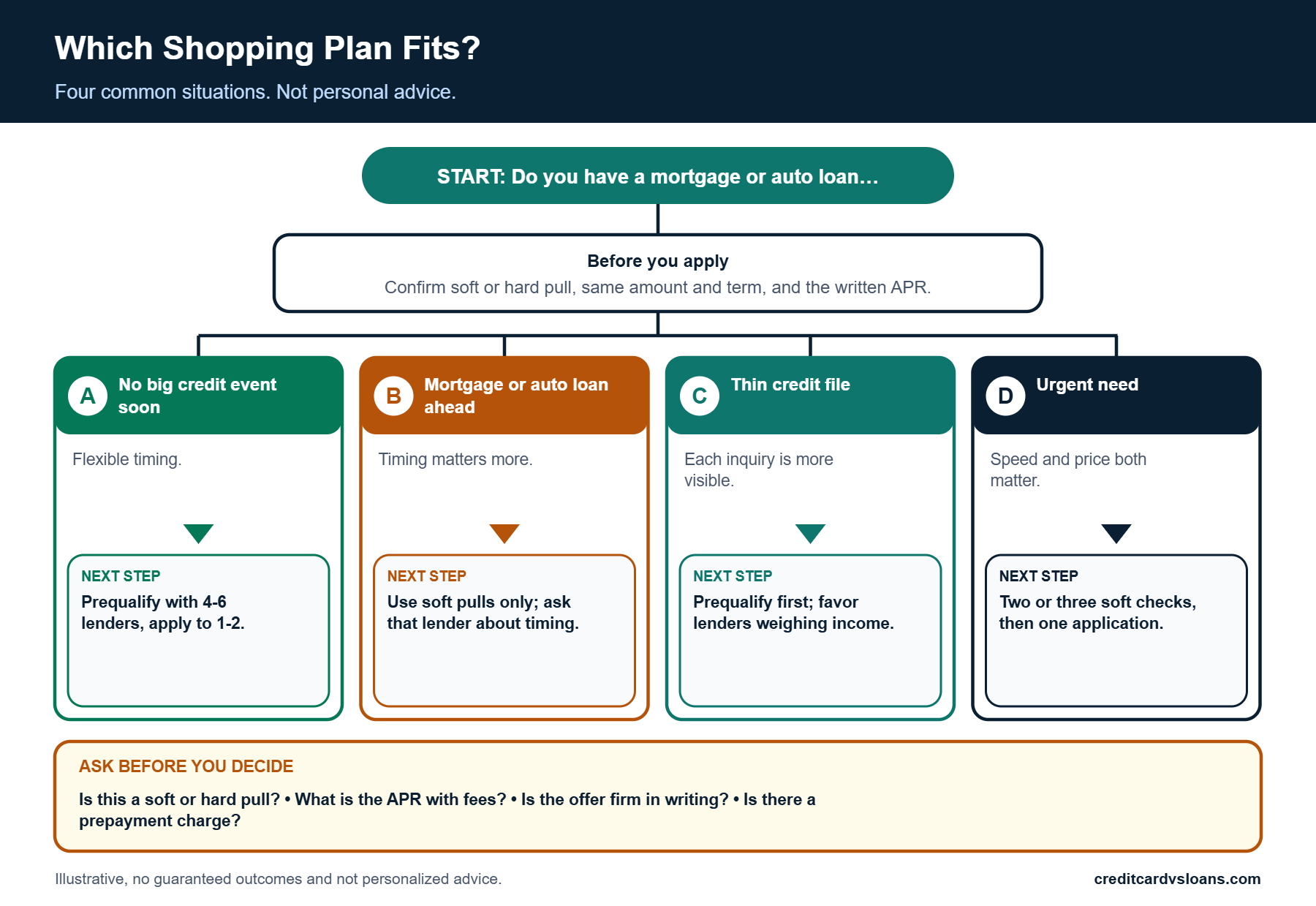
Decision Matrix: How Much Shopping Is Right for You?
Matching Your Situation to a Shopping Plan
How to read the matrix
The matrix below links common situations to a shopping approach. It is a framework for organizing your thinking, not personal advice. The right amount of shopping depends on how much a better rate could save you, how close you are to a major credit event and how stable your file is.
| Situation | Approach to consider | Why | What to verify | When to avoid |
|---|---|---|---|---|
| No big credit event planned | Prequalify with 4-6 lenders, apply to 1-2 | Maximizes information, minimizes hard pulls | Soft-pull wording, same amount and term | If every prequalification requires a hard pull |
| Mortgage or auto loan within months | Soft pulls only until you are ready; time the application | Avoid unneeded inquiries before a larger application | Whether you need the personal loan at all | If a new account would hurt the larger loan |
| Thin credit file | Prequalify first; look at lenders that weigh income | Few accounts make each inquiry more noticeable | Reporting of payments to the bureaus | If offers carry very high APRs or fees |
| Urgent need, little time | Two or three soft-pull checks, then one application | Speed matters but so does price | Funding timeline and fee in writing | If a lender wants money before funding |
| Already applied widely | Stop, review report, pick best offer | More applications add little | Inquiries recorded on your report | If you are tempted to reapply after a decline |
Reading your own risk of a score dip
A temporary dip of a few points matters most when you are close to a cutoff. If you are applying for a mortgage in the next few months, speak to that lender about timing. If your goal is simply to find the best personal loan, the inquiry cost is generally minor compared with the savings.
Timing around a larger purchase
If you plan to apply for a mortgage or an auto loan in the next few months, the timing of a personal loan matters more than the shopping method. A new account and a new payment can change your debt-to-income ratio, which mortgage and auto lenders review closely. Discuss the timing with that lender before taking on new debt.
If the personal loan is not urgent, waiting until after the larger loan closes may be the cleaner path. If it is urgent, keep formal applications to a minimum and tell the larger lender about the new loan when asked.
Before You Click Apply
A short checklist
Confirm that the offer you are applying for matches the amount, term and APR you were quoted. Confirm that the lender will run a hard inquiry and that you have consented knowingly. Confirm that you have the documents ready, such as proof of income and identification, so the process does not drag on and tempt you to apply elsewhere.
If anything in the paperwork does not match what you were told, ask before you submit.
Know when to stop shopping
Shopping has diminishing returns. After you have several comparable estimates, a further estimate rarely changes the decision. Set a target, such as four to six prequalified quotes, and stop when you reach it.
If the best estimate still exceeds your walk-away APR, the better move may be to adjust the amount, change the term or wait while you improve your file, as described in the 650 credit score guide.
Read the final disclosure before you sign
When you choose an offer, the lender must provide the loan’s key disclosures. Compare them line by line against your log: the APR, the amount financed, the total of payments and the payment schedule. Check any statement about charges for late payments or early payoff.
If something differs from what you were quoted, pause and ask for an explanation or a corrected document. It is far easier to fix a discrepancy before signing than after the money has been sent.
Bottom Line and Next Steps
What the Evidence Supports
Shopping is usually a net gain
Prequalification with a soft pull does not affect your scores. A hard inquiry usually has a small, temporary effect. Personal loans are not explicitly covered by the public rate-shopping guidance, so the careful plan is to rely on soft pulls for comparison and to limit and cluster any formal applications.
The money at stake in APR differences is usually larger than the points at stake in an inquiry. For deeper background on the loan itself, see our overview of personal loan credit score needs.
What nobody can promise
No source can tell you exactly how many points a given inquiry will cost you, which scoring model a lender will use or whether your quotes will improve if you wait. Anyone claiming certainty is guessing. Build your plan on what you can control: your reports, your DTI, the number of formal applications and the contract terms you accept.
Your Next-Step List
Before you shop
- Request your credit reports and correct any errors.
- Calculate your debt-to-income ratio.
- Choose a loan amount and a term or two to compare.
- Set your walk-away APR and fee limit.
While you shop and after
- Prequalify with lenders that confirm a soft pull.
- Record APR, fee, term and total of payments for every offer.
- Submit one or two formal applications within the same few days.
- Check your reports a few weeks later to confirm the inquiries recorded match what you did.
- CFPB: What is a hard credit inquiry?
- CFPB: Hit or myth? (credit scores and shopping for credit)
- CFPB: What is a credit score?
- CFPB: What is a debt-to-income ratio?
- CFPB: What is APR?
- myFICO: How to rate shop and minimize the impact to your FICO Scores
- myFICO: What is in my FICO Scores?
- FTC: What To Know About Advance-Fee Loans
- eCFR: 12 CFR 1026.18 Content of disclosures (Regulation Z)
Last updated: October 22, 2026. Rates, fees and lender rules change; verify current terms before acting.
The information on creditcardvsloans.com is provided for general educational and informational purposes only. It is not financial, legal, tax, credit, accounting or investment advice, and reading it does not create an advisor-client, fiduciary or any other professional relationship. Nothing here is an offer, solicitation or recommendation to borrow, lend or apply for any product.
Credit scores, interest rates, fees, eligibility rules, lender policies and laws change frequently and vary by lender, location and individual circumstances. Examples, figures and scenarios are illustrative only, do not predict your results and do not guarantee approval, savings, a particular rate or a credit-score outcome. Always confirm current terms directly with the lender or issuer and read the full agreement before you apply or sign.
Although we aim for accuracy and use reputable sources, we make no representations or warranties, express or implied, about the completeness, accuracy, reliability or timeliness of the content. Content may be drafted with the assistance of automated tools, so errors or omissions may still occur. Links to third-party sites are provided for convenience; we don’t control and aren’t responsible for their content.
To the fullest extent permitted by law, creditcardvsloans.com and its owners, editors, authors, contributors and affiliates disclaim all liability for any loss, damage or expense arising directly or indirectly from your use of, or reliance on, this content. Before making financial decisions, consult a licensed professional, such as a qualified financial advisor, attorney, tax professional or nonprofit credit counselor, who can consider your complete situation.