With a 620 credit score, a personal loan is often within reach, but you should plan for a process that looks different from the one good-credit borrowers experience. A personal loan with 620 credit score typically means more lender screening, a wider range of prices and a real possibility of a counteroffer instead of a clean yes or no.
This guide is about what to expect, step by step, at that specific level: how lenders are likely to read your file, which types of lenders tend to engage, what outcomes you might see at prequalification, and how to protect yourself from the high-cost traps that target fair-credit borrowers. We keep every claim product-neutral and avoid promising any rate or approval, because the number of lenders and models makes that impossible.
For a wider overview of how scores map to eligibility, see our guide to the credit score you need for a personal loan. If your score is closer to 600, the discussion of a 600 score covers that neighborhood, and the article on a 580 score covers what changes below it.
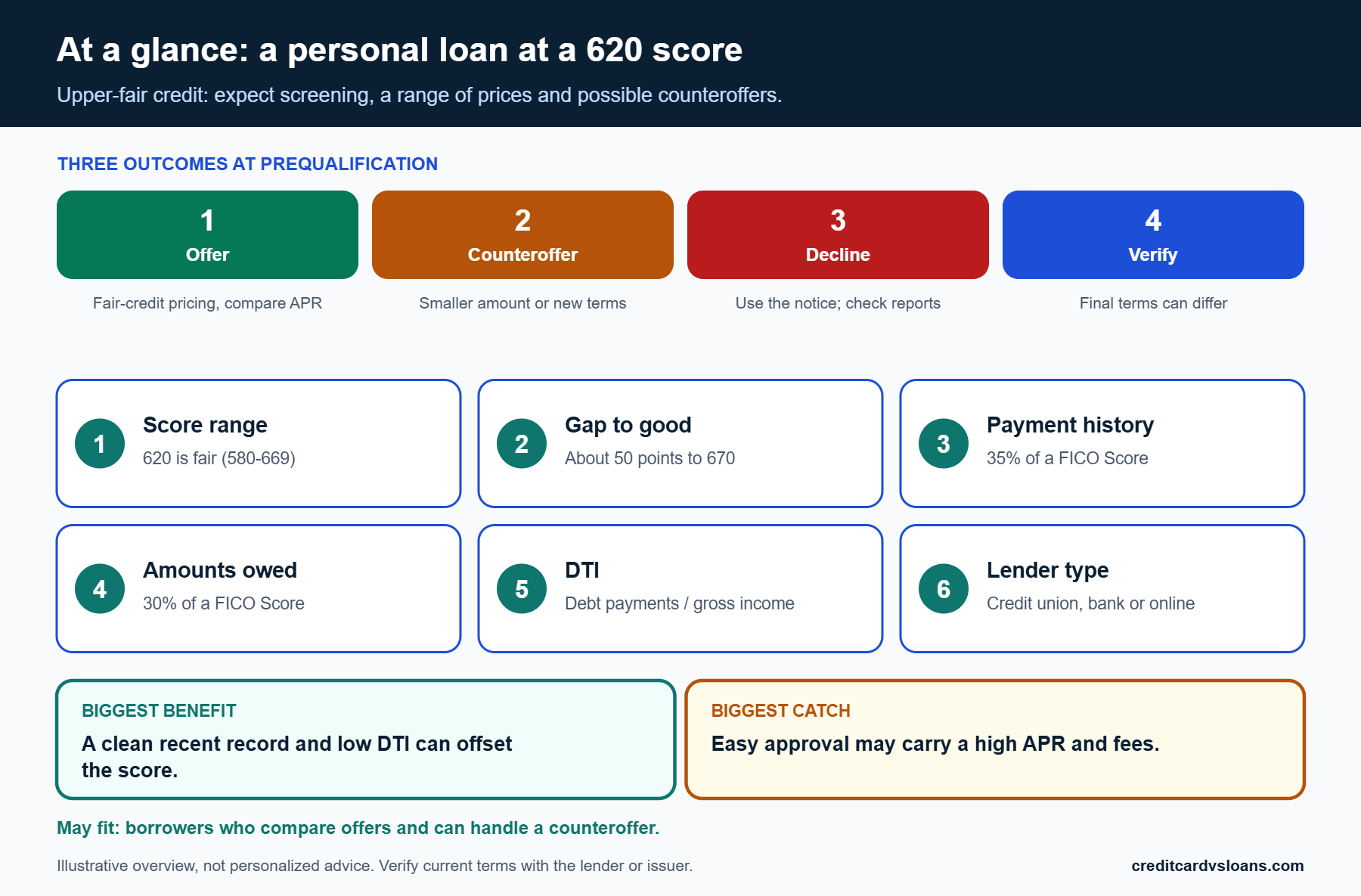
- A 620 FICO Score is in the upper half of the “fair” range (580 to 669), about 50 points below the start of the “good” range at 670.
- Expect one of three outcomes at prequalification: an offer at fair-credit pricing, a counteroffer with a smaller amount or different terms, or a decline.
- Income stability, debt-to-income ratio and what is on your report can matter as much as the score itself.
- Credit unions, community banks and online lenders are common starting points; each has different trade-offs on fees, speed and flexibility.
- Avoid any lender that promises approval before reviewing your file or that asks for a fee before funding the loan.
Market context comes from the Federal Reserve’s G.19 release of October 7, 2026, and all lender behavior is described in general terms. Policies differ, so check each lender’s current terms.
The short answer: what a 620 score means for borrowing
Where a 620 sits
Upper fair, but still fair
According to myFICO, FICO Scores run from 300 to 850. The “fair” range is 580 to 669, and “good” starts at 670. A 620 is more than halfway up the fair band, which can make a difference to some lenders and no difference at all to others. Many lenders do not publish their score thresholds, so the label tells you less than a prequalification does.
The most useful way to think about 620 is that you are probably not in the narrowest part of the market, but you are not yet where the widest range of lenders compete for you. That middle position explains why shopping matters so much.
A small difference from 600, a bigger one from 700
The Consumer Financial Protection Bureau (CFPB) notes that you have many scores that can differ by model, data source, loan type and timing. A gap of 20 points between a 600 and a 620 can be smaller than the variation between two versions of the same score. In practice, the difference between those two borrowers may come down to the factors under the score, such as recent late payments or credit card balances.
The gap between 620 and 700 is larger, and it tends to show up in the range of lenders willing to compete for you. If you want to see how the other end of the market looks, our piece on a 700 score compares offers for borrowers with solid credit.
Three outcomes to expect at prequalification
An offer at fair-credit pricing
The first outcome is a straightforward offer, usually with an APR above what good-credit borrowers see. As of the Federal Reserve’s G.19 release of October 7, 2026, the average rate on 24-month personal loans at commercial banks was 11.86 percent in the second quarter of 2026 (revised, not seasonally adjusted). That is an average across all borrowers, so it is not a predictor for a 620, but it gives you context for judging whether an offer is far above the market.
If you receive offers, compare them by APR, net funding and total repaid. Do not assume the first or the fastest is the cheapest.
A counteroffer or a decline
The second outcome is a counteroffer: a smaller amount, a shorter or longer term, or a higher APR than advertised. A counteroffer is a negotiation you can walk away from. Compare it with other quotes and with the alternatives we outline later in this article.
The third outcome is a decline. Under the Federal Trade Commission’s guidance, you may be able to request a free credit report within 60 days of an adverse action notice. Use the notice to learn which factors mattered and whether any of them are errors you can dispute.
Fair credit makes you a target for offers that look easy. Easy approval is not the same as affordable, and the cost of a quick yes is often paid over years.
How lenders are likely to read a 620 file
Strengths that carry weight
A clean recent payment record
FICO says payment history is 35 percent of a score, the largest factor. A 620 with no late payments in the last couple of years and a long history reads very differently from a 620 with recent delinquencies. If your payment record is clean, you have one of the strongest arguments available.
Mention it where you can. Credit unions and community banks that look at the full file may weigh your recent record heavily, and if you are a member with direct deposit, say so.
Manageable debt-to-income
The CFPB defines debt-to-income (DTI) as total monthly debt payments divided by gross monthly income, with a simple example of $2,000 in monthly debt against $6,000 in income producing a 33 percent DTI. It also says that different loan products and lenders have different DTI limits.
At 620, a lower DTI can offset some of the risk a lender sees in your score. Before applying, add up your payments, divide by your gross monthly income, and decide how much of a new payment your budget can handle without strain.
Weaknesses that can hurt
High card utilization
Amounts owed account for 30 percent of a FICO Score, and credit card utilization is a visible part of it. The CFPB suggests using no more than 30 percent of your limits. A 620 driven by maxed-out cards may respond differently to changes than a 620 driven by a short history.
If a debt consolidation loan is on your mind, utilization is also the reason lenders look at your card balances closely: they want to see whether the loan will change behavior or just add another payment.
Recent negatives and a thin file
Collections, charge-offs or recent late payments can sharply limit options. So can a thin file; the CFPB describes a thin or no credit file as one that lacks enough history to generate a score, and notes that millions of Americans fall into that group. If either describes you, expect more questions and possibly more documentation.
That does not close the door. It does mean that a lender who sees the full context may do better by you than an automated model.
Which lenders tend to engage at 620
Credit unions and community banks
Member-focused underwriting
Credit unions are member-owned, and many consider the whole relationship when they review a loan. If you have a checking account, direct deposit or a history of on-time payments with the institution, that can help. Eligibility rules differ, but many credit unions accept members through a local connection or an association.
Community banks can work similarly, with loan officers who may be willing to consider context. Neither is guaranteed to approve you, and each sets its own limits, but a conversation costs nothing and prequalification may be available.
Small, short loans from federal credit unions
If your need is small, ask whether a federal credit union offers a Payday Alternative Loan. Under the NCUA rule at 12 CFR 701.21, a PAL I loan is closed-end credit of $200 to $1,000 with a term of one to six months, an application fee capped at $20, and at least one month of membership required. It must fully amortize and rollovers are prohibited, and a borrower cannot have more than three PAL loans in a rolling six-month period.
The interest rate is capped under the NCUA’s rule, and the cap can change, so confirm the current maximum with the credit union. PAL II rules differ from PAL I, so ask which one the institution offers.
Online lenders and larger banks
Online lenders and speed
Online lenders are often the fastest to prequalify you, and many show estimated terms without a hard pull. At 620, you may see a wide spread of offers, because lenders using different models rate the same file differently. That is the main reason to apply to more than one.
Watch for origination fees that reduce the amount you receive, and confirm the APR in writing. A quote based on a soft pull is an estimate that can change after verification.
Large banks
Some large banks lend to borrowers with fair credit, particularly existing customers; others set higher internal standards. We cannot give you a bank’s minimum because lenders rarely publish one and policies change. If you hold accounts there, ask whether a prequalification tool exists.
A decline from a large bank at 620 does not predict what a credit union or an online lender will say. Treat each answer as one data point.
| Lender type | Typical strength | Typical drawback | First question to ask |
|---|---|---|---|
| Credit union | Relationship and whole-file review | Membership requirements | Can I prequalify with a soft pull? |
| Community bank | Human review is possible | Fewer products | Do you consider payment history over score? |
| Online lender | Fast and wide range of offers | Fees and higher APRs are common | What is the APR after fees? |
| Large bank | Familiar; existing customers may benefit | May decline fair credit | Is there a minimum score or case-by-case review? |
| Short-term high-cost lender | Easy to qualify | Extreme cost, repeat borrowing | Is there any cheaper route? |
What a personal loan with 620 credit score really costs
Understanding the price
Rate, APR and the funded amount
The interest rate is the yearly price of borrowing principal, while the APR is a broader measure that includes certain fees, which is why it is usually higher than the rate. The CFPB draws that distinction, and it holds for personal loans too. For a fair apples-to-apples comparison, use APR.
Ask three questions: what is the APR, how much will arrive in my account, and what is the total I will repay? A loan that looks cheaper by rate can be costlier after fees.
Fees and what to watch for
An origination fee is a charge for processing the loan, often deducted from proceeds. Late fees, returned-payment fees and prepayment penalties vary by lender. If you can find a loan with no prepayment penalty, you keep the option of saving interest later.
We do not quote typical fee levels because no primary source supports one. Ask each lender to list all charges in writing before you apply formally.
Illustrative math
A hypothetical $12,000 loan over 48 months
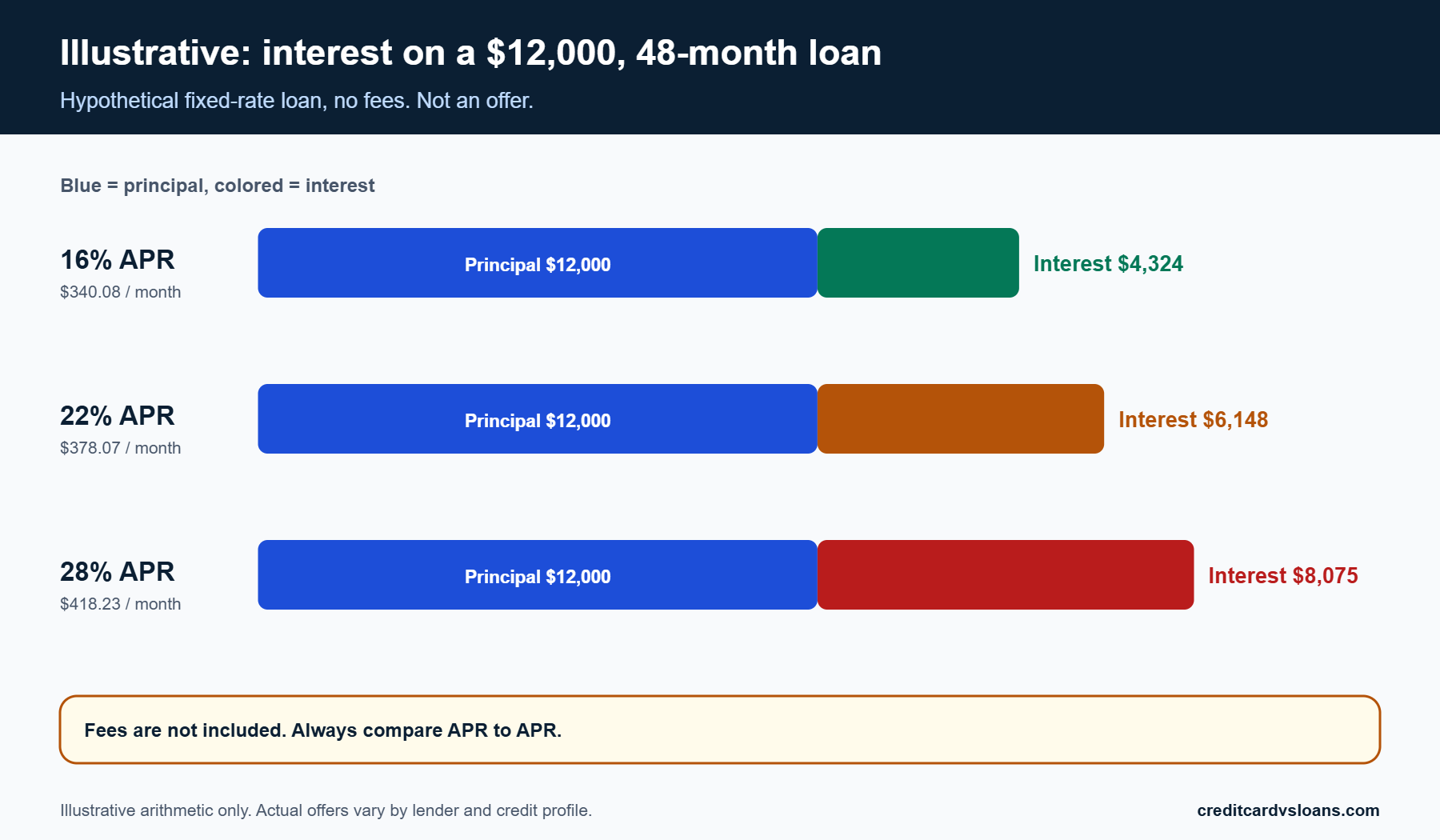
These figures are hypothetical. At 16 percent APR, a $12,000 loan over 48 months would have a payment of about $340.08 and total interest of about $4,324. At 22 percent, the payment would be about $378.07 and interest about $6,148. At 28 percent, the payment would be about $418.23 and interest about $8,075.
The payment rises by about $78 between 16 and 28 percent, which feels small, but the interest rises by about $3,751. That is the kind of difference that comparison shopping can matter for.
| APR | Monthly payment | Total interest | Total repaid |
|---|---|---|---|
| 16% | about $340.08 | about $4,324 | about $16,324 |
| 22% | about $378.07 | about $6,148 | about $18,148 |
| 28% | about $418.23 | about $8,075 | about $20,075 |
Choosing the term
At a hypothetical 22 percent APR on $12,000, a 36-month term would cost about $458.29 per month and about $4,498 in interest. A 48-month term would cost about $378.07 per month and about $6,148. A 60-month term would cost about $331.43 per month and about $7,886.
The longer the term, the easier the monthly payment but the higher the total cost. The best term is usually the shortest one you can pay without risking a missed payment, since a missed payment can damage your credit and add fees.
If the loan only fits your budget at the longest term and the highest APR, consider reducing the amount, adding a co-borrower or choosing another product altogether.
The application journey, step by step
From prequalification to funding
Soft pull first, hard pull later
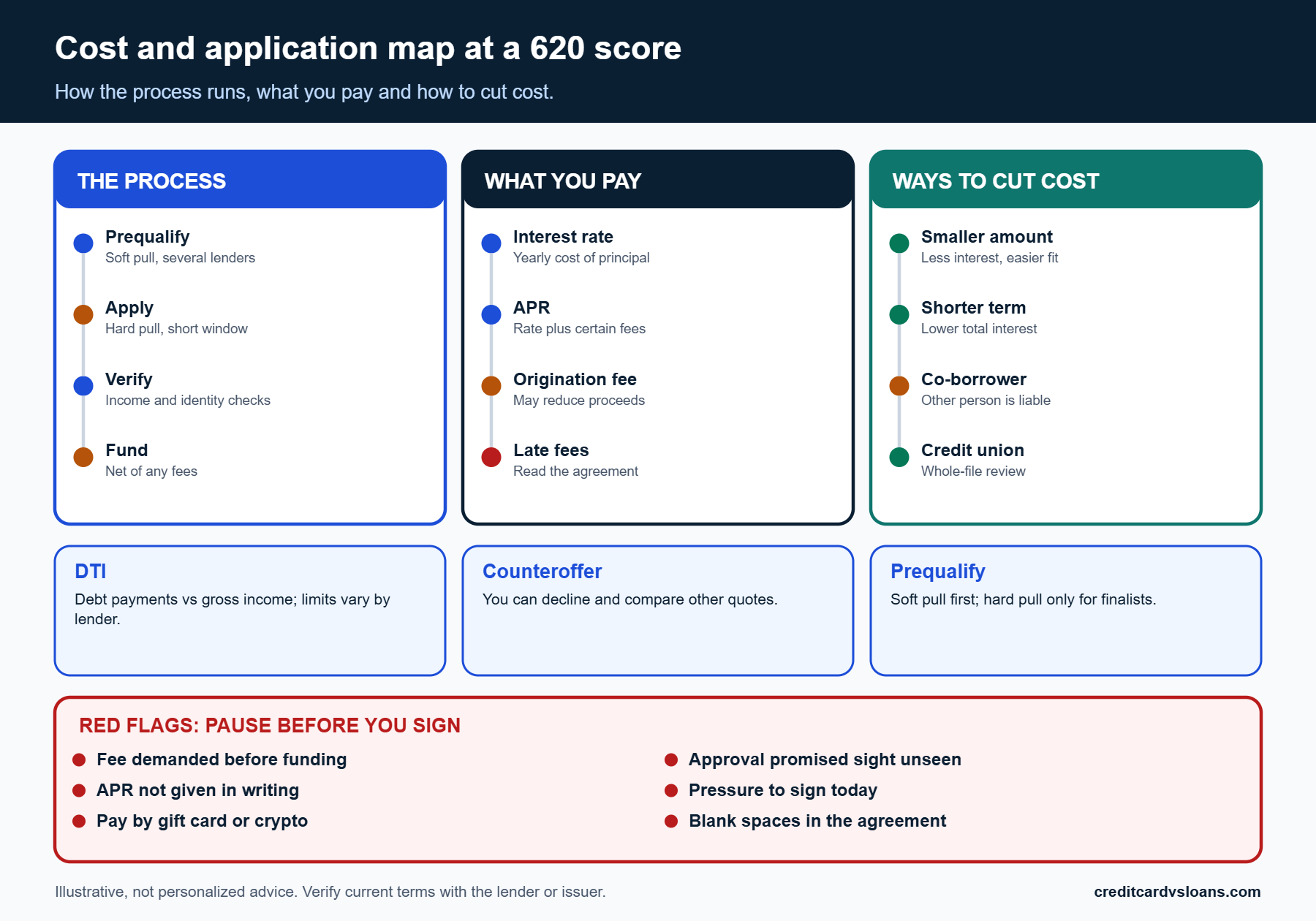
Many lenders let you prequalify using a soft pull, which typically does not affect your score. A formal application triggers a hard pull. The CFPB notes that lender credit checks are recorded as inquiries that typically have a small negative effect on scores, and that checking your own credit does not affect your scores.
Plan to prequalify at several lenders, then formally apply with one or two. Keep formal applications within a short stretch of days and avoid opening other credit at the same time.
Verification and the final offer
After you apply, the lender will verify your identity, income and sometimes employment, and may pull your full report. The final offer may differ from the prequalified estimate. Terms can move up, move down or be withdrawn.
If the final offer is worse than the estimate, you can decline it and use another lender’s quote. Ask the lender why the terms changed so you can fix any errors or misunderstandings.
Handling offers and counteroffers
How to evaluate a counteroffer
If a lender approves a smaller amount, work out whether it still solves your problem. If it approves a higher APR, rerun the numbers and compare with alternatives. A counteroffer that is too expensive is a no, and you are allowed to treat it as one.
It is also fair to ask what would improve the offer, such as a lower requested amount, a co-borrower or a shorter term. The answer helps you decide whether to restructure the request or look elsewhere.
Read the agreement
Check that the APR, term, payment and fees match what you were told. Confirm there are no blank spaces and that you understand late fees, autopay requirements and prepayment terms. Our guide to how a personal loan can affect your credit score explains what happens to your report after you sign, so you are prepared for the first few months.
If you feel rushed or the paperwork is unclear, stop. A legitimate lender will give you time to read.
Common goals at 620: consolidation, repairs and bills
Consolidating card debt
Test the savings honestly
Many borrowers at 620 look at a personal loan to pay off credit cards. The test is simple: is the all-in APR on the new loan lower than what your cards charge now, and will the fixed payment fit? The Federal Reserve’s G.19 release of October 7, 2026 shows the average rate on card accounts assessed interest at 22.15 percent in the second quarter of 2026, but your own cards may differ.
If your loan offer is near your card rates, consolidation mostly changes the structure. That can still be useful for discipline, but do not call it savings if the numbers do not show it.
Prevent a second round of debt
If the cards go back to high balances after consolidation, you have both the loan and the new card debt. That can push your DTI up and make future borrowing harder and costlier.
Some borrowers set a firm spending plan and remove saved card numbers from shopping sites. These are personal choices, not rules, but they tackle the habit that consolidation alone does not solve.
Repairs, medical bills and rent gaps
Ask the biller first
For medical or utility bills, ask about financial assistance and payment plans before borrowing. Billing offices often have options that are not advertised, and a plan with a small monthly payment can cost less than a loan with interest.
Get any agreement in writing, including the due dates and what happens if you miss one. Keep records of the call, the date and the name of the person you spoke with.
Match the loan to the need
For a car repair that gets you to work, a short-term loan might make sense if the alternative is losing income. For a discretionary purchase, waiting a few months to improve the file or save a larger down payment is usually cheaper.
The question is not whether you can get a loan at 620 but whether this loan is the least costly way to meet the need. Write down at least two other ways to meet it before you decide.
After you borrow: protecting your budget and your credit
The first months with the loan
Set up payments you can’t miss
Payment history is the biggest factor in FICO’s model at 35 percent, so on-time payments matter. Autopay can reduce the chance of a miss, and the CFPB suggests automatic payments or reminders. Keep a cushion in the account so a payment does not trigger an overdraft.
Put the due date on your calendar even if you use autopay, and check your first statement to confirm that the payment posted correctly.
Know what the new account does to your report
A new loan adds an inquiry and a new account, which can affect your score in the short term, and it adds a monthly obligation. Over time, on-time payments are what a lender sees. Our overview of a personal loan’s effect on your credit score explains these moving parts without promising any outcome.
Avoid applying for other credit in the months after you borrow unless you need to; each application adds an inquiry and can complicate your DTI.
If money gets tight
Contact the lender early
If you see a shortfall coming, call the lender before you miss a payment. Ask about hardship options, due-date changes or reduced payments, and what each would cost in fees or interest.
Lenders vary in what they offer, and none is required to give you a break, but early contact usually gives you more options than silence does.
Get free, independent help
The FTC notes that credit counseling agencies, often free or low cost, can help with debt. Choose a nonprofit and be cautious of any agency that charges high upfront fees or guarantees to erase debt.
Counseling can help you build a budget and compare options like a payment plan, a different loan structure or a repayment strategy for multiple debts.
Mistakes to avoid at 620
Mistakes in the shopping stage
Applying everywhere at once, over days or weeks
Applying across many lenders with formal applications spread over weeks can add inquiries without giving you better information. Prequalify first, then submit only the few formal applications that make sense, within a short window.
Keep a log of lenders, dates and outcomes so you can see where you stand and avoid duplicate applications.
Choosing by the monthly payment
A low monthly payment can hide a long term and high interest. Always compare the APR and total repaid. In our hypothetical $12,000 example at 22 percent APR, extending the term from 36 to 60 months lowers the payment by about $127 but adds about $3,388 in interest.
That is an illustration only, but the pattern holds in general: lower payments often cost more in total.
Mistakes in the contract stage
Signing with blanks or verbal promises
Never sign an agreement with blank spaces, and do not rely on verbal promises that are not in the written terms. If a lender promises a change, ask for it in writing before you sign.
If you cannot get clarity, walk away. There are other lenders, and a rushed signature is hard to undo.
Misstating income or purpose
Do not overstate income or misreport the purpose of the loan to qualify. Misrepresentation can have legal and financial consequences, and lenders may verify what you tell them.
If your income is irregular, document it accurately and show how you will cover the payment. A truthful, well-supported application is the better path.
Special situations at a 620 score
Income and file quirks
Gig, contract or seasonal income
Lenders usually want evidence that income will continue. If you are paid irregularly, gather bank statements, tax returns or contracts that show a pattern, and be ready to explain slow months. A lender that can see the whole year may react very differently from one that sees a single paycheck.
Because the fair-credit market is already cautious, clear documentation can be the difference between an offer and a decline. Avoid rounding up or estimating on applications; use figures you can support.
A thin or recently rebuilt file
If your 620 reflects a short history or a rebuild after earlier problems, tell the lender what has changed. A recent run of on-time payments is more persuasive than an old explanation. The CFPB defines a thin file as one lacking enough history to generate a score, so if you are near that boundary, expect some lenders to look closer.
It may also help to focus on lenders that look at the whole file rather than a single cutoff, such as credit unions where you already bank.
Protections and limits worth knowing
Servicemember protections
The CFPB notes that active-duty servicemembers and their dependents have federal protections, including a 36 percent cap on the Military Annual Percentage Rate (MAPR). If this applies to you, mention it when comparing offers and ask the lender how the protection applies to the loan in question.
The MAPR includes certain fees, so it can differ from the APR on the disclosure. Ask for both numbers if you are covered.
State rules vary
Interest rate caps, fee limits and licensing requirements for lenders differ by state, and we cannot summarize all of them. The FTC recommends checking whether a lender is registered in your state with your state attorney general or banking regulator.
If you are unsure whether a fee or term is allowed where you live, ask your state regulator or a nonprofit counselor before you sign.
Ways to strengthen a 620 application
Before you apply
Check your reports and fix errors
The FTC says AnnualCreditReport.com is the only authorized site for free annual credit reports, with one free report from each of the three bureaus every 12 months and free weekly reports also available there. Review all three, because the bureaus’ information can differ.
If you find an error, dispute it with both the credit bureau and the business that supplied it. Errors can suppress a score, and fixing one before you apply is often the cheapest improvement available. Do not pay anyone who promises to remove accurate negative information.
Lower the amount or the DTI
If your DTI is high, a smaller request is often easier to approve. Ask yourself whether you need the full amount or whether part of the expense can be covered another way. A smaller loan also means a smaller monthly payment and less interest overall.
Paying down a card or two before applying may help your DTI and utilization, but it takes time and cash. If you cannot do it before you apply, tell the lender what you plan to do, since some lenders can structure a loan to pay creditors directly.
Adding support to the file
A co-borrower with stronger credit
A co-signer or co-borrower with stronger credit can widen your options because the lender evaluates their finances too. The trade-off is serious: that person is responsible for the debt if you do not pay, and any missed payment can hurt both credit reports.
Have an honest conversation about what would happen if your income dropped, and ask the lender whether and how a co-signer can be released later. Do not ask someone to co-sign if you are unsure you can pay.
Relationship and documentation
If you have savings, a long-standing account or direct deposit at an institution, say so; some lenders weigh those facts. Also prepare proof of income and employment so verification goes quickly.
Written explanations for past problems, like a medical event that led to a late payment, can help a human underwriter at a credit union or community bank. Keep them brief, factual and truthful.
| Action | Possible benefit | Trade-off |
|---|---|---|
| Dispute report errors | Removes inaccurate drags on the file | Takes time; only works for real errors |
| Pay down card balances | Improves utilization and DTI | Requires cash; may not be possible quickly |
| Request a smaller amount | Easier payment fit; less interest | May not cover the whole need |
| Add a co-borrower | May widen options or lower price | Other person is legally liable |
| Apply at a credit union | Whole-file review is more likely | Membership and slower process |
Alternatives and warning signs
Lower-risk alternatives
Payment plans and negotiated terms
If the need is a bill from a hospital, utility, landlord or tax authority, ask for a payment plan before borrowing. A plan from the creditor may carry little or no interest, though terms vary and you should get them in writing.
This is often the cheapest route, and it keeps your credit file free of a new inquiry. The cost is that you must ask, and some creditors will say no.
Secured cards and credit-builder products
If your goal is to improve your credit rather than obtain a large amount of cash, the CFPB mentions secured credit cards and credit-builder loans as options for people with new or rebuilding credit. They work differently from standard personal loans, so check fees and confirm that the issuer reports to all three bureaus.
For a closer look at how a new installment loan can show up on your report, see our guide to a personal loan and your credit score. In short, a loan taken just to create history costs interest, so cheaper tools may fit better.
Warning signs at this score level
Payday and title-style loans
The CFPB reports that a typical two-week payday loan with a $15-per-$100 fee has an APR of almost 400 percent, that the loan is usually due in one payment on your next payday, and that lenders generally do not check whether you can afford it. Some states allow rollovers that let the debt grow.
If a 620-score loan quote feels expensive, a payday loan is almost always more so. Price out every alternative first.
Fees before funding, and approval promises
The FTC says legitimate lenders do not promise a loan before reviewing your credit report and application, and that demands for upfront fees labeled as insurance, processing or paperwork are a reason to walk away. It also advises checking that a lender is registered in your state and reporting scams at ReportFraud.ftc.gov.
If anyone asks you to pay with gift cards, cryptocurrency or a wire transfer before you receive a loan, treat it as a scam. Those payment methods are hard to reverse.
How a 620 compares with the scores around it
Below 620
At 600
A score of 600 is only 20 points lower, but borrowers there may notice fewer approvals and more conditions. We cover that situation in our article on a 600 credit score, including how credit union and online lender options differ.
The practical difference between 600 and 620 is often in the details of the file. A 620 with a clean last 24 months may be stronger than a 640 with recent problems.
At 580
At 580 you are at the bottom of the fair range, and unsecured options can narrow considerably. Our guide to a 580 credit score discusses realistic expectations and alternatives to consider before applying.
If you are close to that edge, a few months of on-time payments and lower card balances can help the file more than repeated applications.
Above 620
Toward the good range
The “good” range starts at 670 on the FICO scale. Getting there can change which lenders are open to you, but no lender is obligated to offer a specific rate at any score, and we do not guarantee that any action will raise your score.
The factors in the model are knowable: payment history at 35 percent, amounts owed at 30, length of history at 15, new credit at 10 and credit mix at 10. For most people, timely payments and lower revolving balances are the controllable ones.
What a 700 looks like
If you want to see how borrowers with solid credit can shop, our piece on a personal loan with a 700 credit score compares offers and shows where the real savings come from. It can help you decide whether waiting is worth it.
Remember that waiting has costs too, especially if you are carrying high-interest debt. Compare the cost of waiting with the cost of borrowing now.
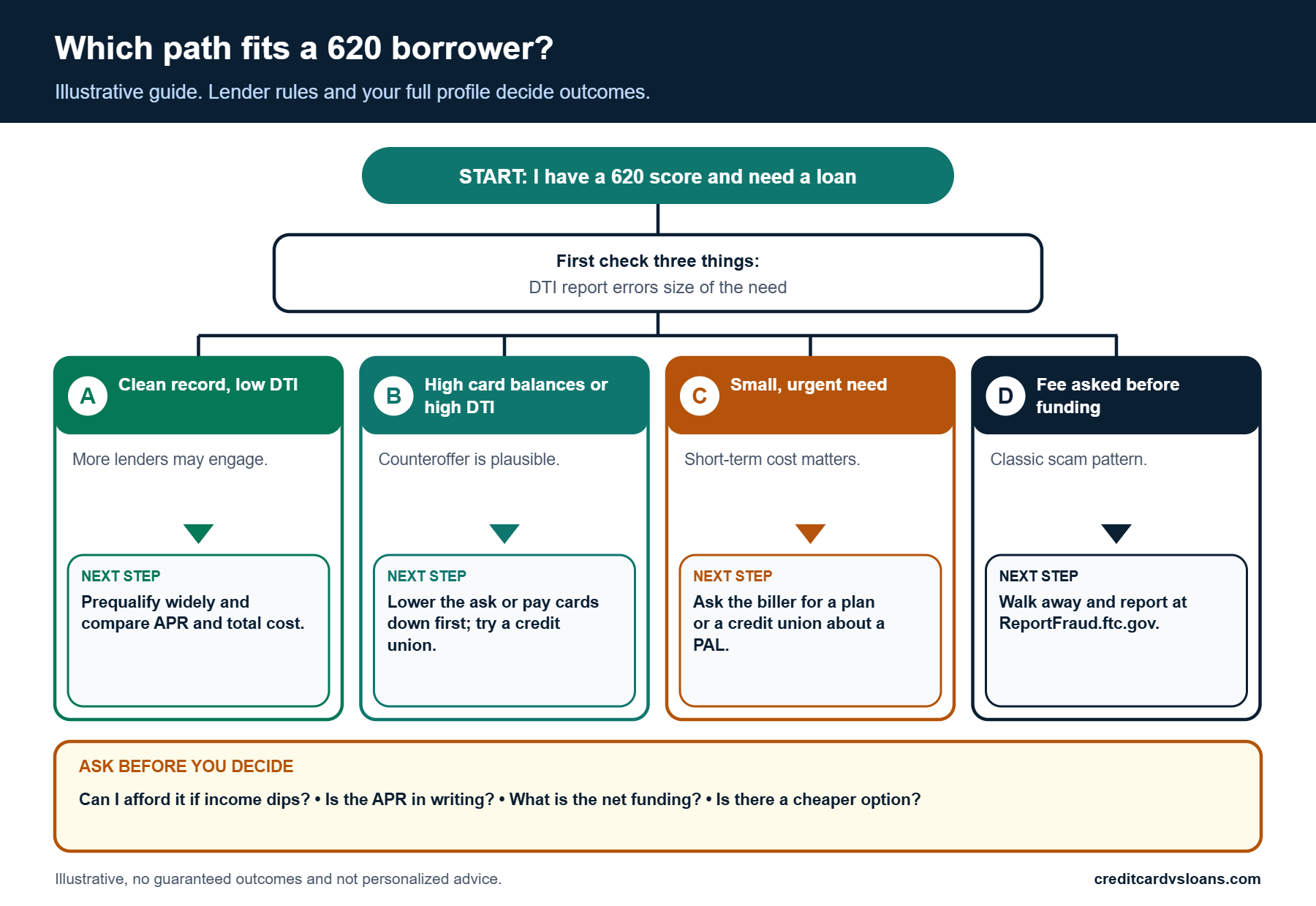
Your checklist and next steps
Decision checklist for a 620 borrower
Before you apply
Decide whether you need the loan, how much, and for how long. Pull your free reports and dispute errors. Calculate your DTI from gross monthly income and monthly debt payments. List your alternatives, including a payment plan, a smaller loan or waiting.
Collect proof of income and identification, and decide which three or four lenders to prequalify with, including at least one credit union.
Before you sign
Verify the APR, net funding and total repaid. Read the late fee, autopay and prepayment terms, and confirm the lender reports to the bureaus. Make sure no one has asked for money before funding.
Ask yourself whether you could still make the payment if your income dropped for a month. If not, adjust the plan.
The bottom line
When to proceed
If you have steady income, a manageable DTI and an offer whose total cost fits your plan, a personal loan with 620 credit score can be a reasonable tool. Fixed payments and a set end date are real advantages over open-ended balances.
The lender, not this article, decides your approval and your rate. Nothing here guarantees any outcome.
Next steps in order
- Pull free credit reports and dispute errors.
- Calculate your DTI.
- Choose the smallest amount that solves the problem.
- Prequalify with a credit union, a bank and one or two online lenders.
- Compare APR, net funding and total repaid.
- Read the agreement and refuse any upfront-fee request.
- Apply formally to the best one or two within a short window.
At 620 you have real options, but not unlimited ones. Prequalify widely, compare by APR and total cost, be ready for a counteroffer, and borrow only if the loan beats your alternatives.
- myFICO: FICO Score ranges and scoring factors
- Federal Reserve: Federal Reserve G.19 Consumer Credit release (Oct. 7, 2026)
- CFPB: Key terms: credit reports and scores
- CFPB: What is a debt-to-income ratio?
- CFPB: What is a payday loan? (Costs, risks and servicemember MAPR cap)
- FTC: What to know about advance-fee loans
- FTC: Free credit reports
- eCFR / NCUA: 12 CFR 701.21 (Payday Alternative Loans, paragraph (c)(7)(iii))
- CFPB: What is the difference between a mortgage interest rate and the APR?
Last updated: October 22, 2026. Rates, fees and lender rules change; verify current terms before acting.
The information on creditcardvsloans.com is provided for general educational and informational purposes only. It is not financial, legal, tax, credit, accounting or investment advice, and reading it does not create an advisor-client, fiduciary or any other professional relationship. Nothing here is an offer, solicitation or recommendation to borrow, lend or apply for any product.
Credit scores, interest rates, fees, eligibility rules, lender policies and laws change frequently and vary by lender, location and individual circumstances. Examples, figures and scenarios are illustrative only, do not predict your results and do not guarantee approval, savings, a particular rate or a credit-score outcome. Always confirm current terms directly with the lender or issuer and read the full agreement before you apply or sign.
Although we aim for accuracy and use reputable sources, we make no representations or warranties, express or implied, about the completeness, accuracy, reliability or timeliness of the content. Content may be drafted with the assistance of automated tools, so errors or omissions may still occur. Links to third-party sites are provided for convenience; we don’t control and aren’t responsible for their content.
To the fullest extent permitted by law, creditcardvsloans.com and its owners, editors, authors, contributors and affiliates disclaim all liability for any loss, damage or expense arising directly or indirectly from your use of, or reliance on, this content. Before making financial decisions, consult a licensed professional, such as a qualified financial advisor, attorney, tax professional or nonprofit credit counselor, who can consider your complete situation.