How to compare personal loan offers comes down to putting every quote on the same footing: the same loan amount, the same term, and a clear view of the APR, the fees, the monthly payment, the total you will repay and how fast the money arrives. Sorting by the lowest monthly payment or the lowest advertised rate is the most common way people end up with a more expensive loan than they needed.
This guide gives you a repeatable method. It starts with the numbers that matter, shows a worked example in which the offer with the lowest rate is not the cheapest, and ends with a decision matrix and a checklist you can use with real offers. It does not recommend any lender, and it cannot predict the rates you will be offered.
If you have not yet gathered quotes, read our guide to rate shopping and your credit first, so you collect offers without piling up hard inquiries. If your score is in the middle range, the 650 credit score guide explains how the rest of your file shapes what lenders put in front of you.
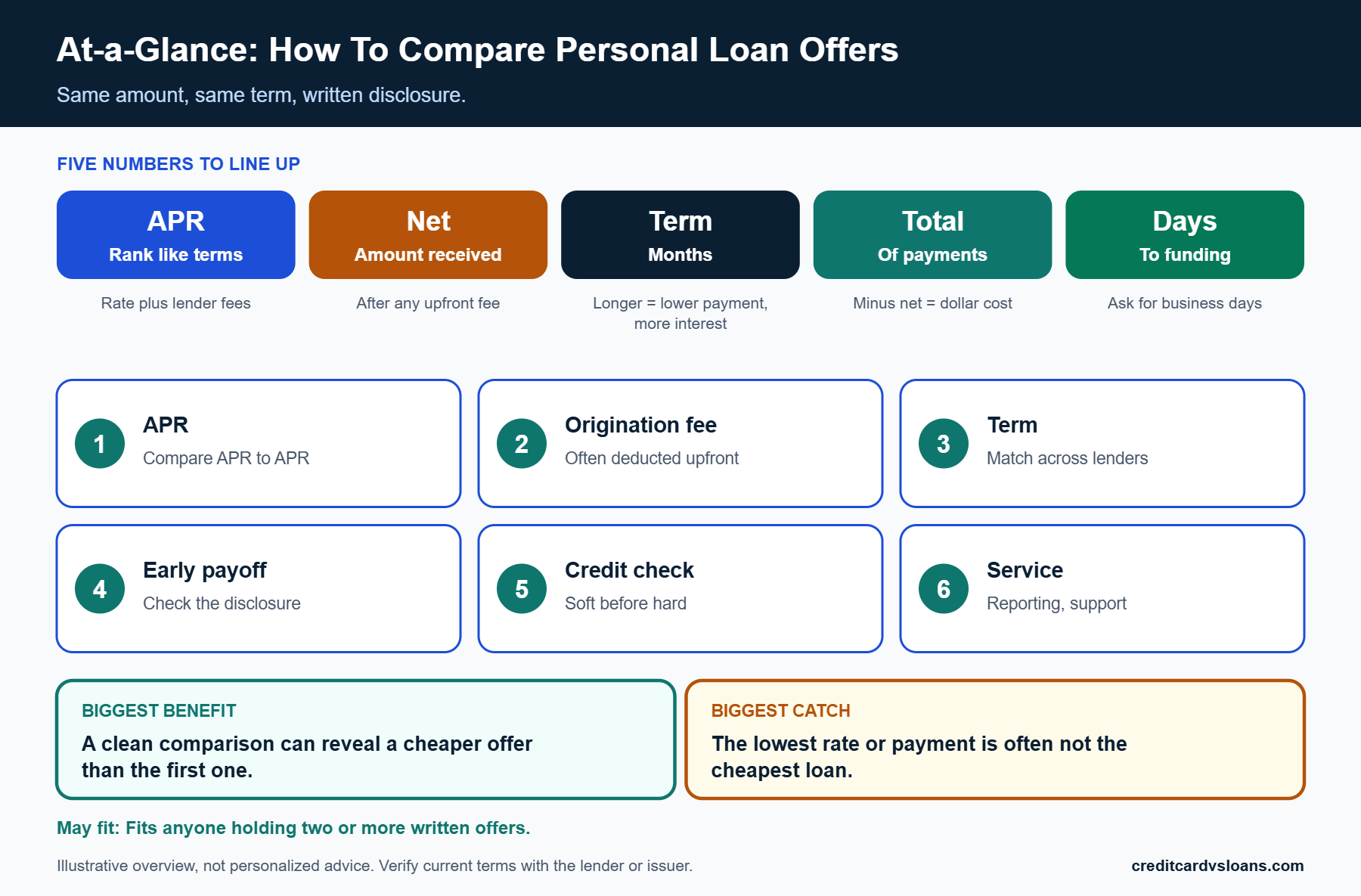
- Compare APR to APR. The CFPB describes APR as the interest rate plus additional lender fees such as origination charges, so it captures cost that a bare interest rate hides.
- APR is most reliable between loans with the same term. When terms differ, compare the dollar cost: total repaid minus the money you actually receive.
- A lower payment usually comes from a longer term, and a longer term usually means more total interest.
- Federal disclosure rules call for the lender to state the amount financed, finance charge, APR, total of payments and payment schedule. Ask for these in writing before you accept.
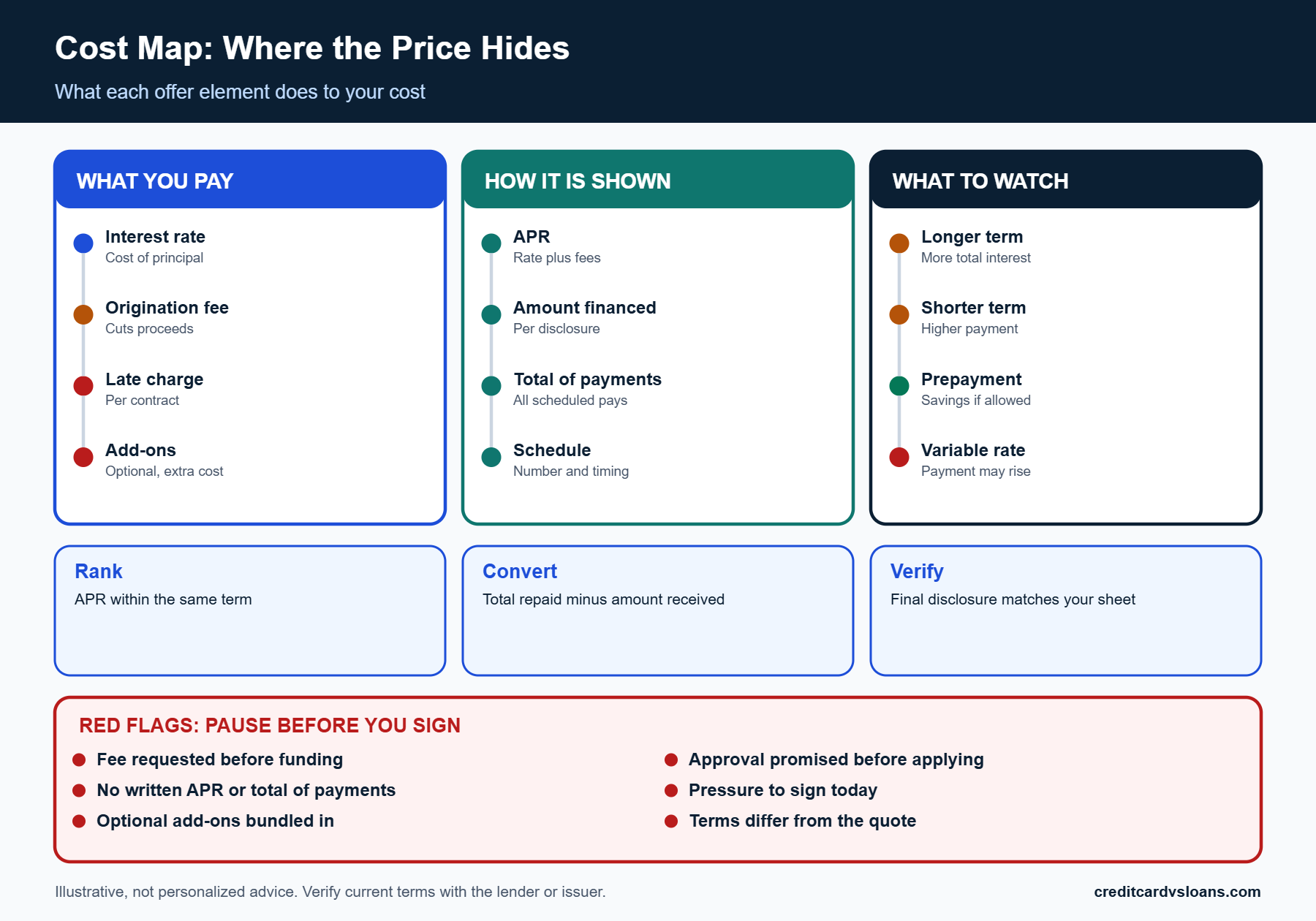
- Any lender that wants a payment before releasing the loan, or promises approval before you apply, is a red flag.
The market benchmark in this guide comes from the Federal Reserve’s G.19 release of October 7, 2026. Lender rates, fees and funding practices change often, so treat the figures as context and rely on your written offers for decisions.
Table of contents
How to Compare Personal Loan Offers: The Short Answer
The Numbers That Decide the Winner
APR first, then total dollars
Start with the APR, because it is the one number that rolls the interest rate and the lender’s fees into a single yearly percentage. The CFPB says to compare APR to APR, not APR to interest rate. Use it to rank offers that share the same term.
Then convert each offer into dollars: the total of all your payments minus the amount you actually receive. That figure shows what the loan costs you, in a form you can compare even when terms differ. An offer with the lowest APR but a much longer term can cost more in dollars, as the worked example below shows.
Net proceeds, not the headline amount
If a lender deducts an origination fee from the loan, you receive less than the amount on the contract while you repay the full amount. A $10,000 loan with a 6% fee puts $9,400 in your account. If you need $10,000 in hand, you must borrow more, and the interest and fee grow with it.
Always ask for the amount you will receive on funding day, and use that number as the base for comparing offers.
Why the advertised rate misleads
Lenders often advertise a range, such as rates starting at a low figure, that applies only to borrowers with the strongest profiles. The rate you receive depends on your credit, income, loan amount and term. Until you have a personalized quote, the headline number is marketing, not a price.
The best protection is to compare only offers made to you, with the APR, fee and term shown in writing. Treat any “as low as” figure as the best case, not the expected case.
Why the Lowest Payment Can Cost the Most
The payment depends on the term as much as the rate
A longer term spreads repayment over more months, which lowers each payment. It also gives interest more time to accumulate. On a hypothetical $10,000 loan at 18% APR with no fees, a 36-month term means a payment of about $361.52 and total interest of about $3,015. A 60-month term lowers the payment to about $253.93 but raises total interest to about $5,236.
Neither choice is wrong. The right one depends on what your budget can sustain. The mistake is to pick the term by accident because one lender led with a lower payment.
When a lower payment is the right call
If a shorter-term payment would strain your budget and risk a missed payment, a longer term can be the responsible choice. A missed payment can cause late fees and damage your credit, which may cost more than the extra interest. If you take a longer term, check that there is no charge for early payoff so you can pay it down faster when cash allows.
Build the decision around your real monthly budget, not around the lender’s default term.
Set Up an Apples-to-Apples Comparison
Standardize What You Ask For
Request the same amount and term everywhere
Quotes only compare cleanly when they describe the same loan. Choose a loan amount, then ask each lender for a quote at one or two terms, such as 36 and 60 months. If one lender returns an offer for a different amount or a different term, ask for a requote or set it aside.
It also helps to request both a fixed-rate quote and, if relevant, a variable-rate quote, but understand that variable rates can change. Ask how often the rate can change, what the limits are and what your payment could be if the rate rises.
Ask how the check is done
Before you enter your information, find out whether the quote uses a soft or hard credit pull. The CFPB says soft inquiries do not affect your credit scores, while hard inquiries made after you apply can lower them. A prequalified estimate is not final. Compare the estimates first, then submit a formal application only to the lender you actually prefer. Our guide on whether rate shopping hurts your credit explains the details and the shopping windows.
Fixed rate or variable rate
A fixed rate keeps your payment the same for the life of the loan, which makes budgeting easy. A variable rate can start lower but may rise, so the payment can change. If a lender offers a variable rate, ask how often it can change, what index or rule it follows, what the limits are and what your payment would be at the maximum.
When comparing a fixed offer with a variable one, use the worst case the contract allows, not the starting rate, as a check on affordability.
Collect the Paperwork You Need
The disclosures that make comparison possible
For a closed-end loan such as a personal loan, federal Truth in Lending rules under Regulation Z call for the lender to disclose the amount financed, the finance charge, the APR, the total of payments and the payment schedule. They also call for a statement about whether a charge may apply for paying early and any charge for a late payment. Those items are the building blocks of a fair comparison.
Ask each lender for its disclosure or offer sheet before you decide. If a lender gives only a monthly payment and a rate, ask for the rest.
Build a simple comparison sheet
A one-page sheet with one row per offer keeps you honest. Include the lender, date, soft or hard pull, amount requested, amount received, rate, APR, origination fee, other fees, term, monthly payment, total of payments, early payoff terms and funding time. Fill in every cell. Blank cells show exactly what you still need to ask.
| Field | What to record | Why it matters |
|---|---|---|
| Amount received | Loan amount minus any upfront fee | Shows what you actually get on funding day |
| APR | Rate plus lender fees, per the disclosure | Best single cost measure between like terms |
| Term and payment | Months and monthly amount | Determines affordability and total interest |
| Total of payments | Sum of all scheduled payments | Lets you compute dollar cost across terms |
| Early payoff and late charges | Any fee stated in the disclosure | Affects flexibility and risk |
| Funding time | Days from signing to money | Matters if the need is urgent |
| Credit check type | Soft or hard pull | Keeps inquiries to a minimum |
APR, Interest Rate and Fees: Reading the Price Tag
What APR Includes and What It Leaves Out
The strengths of APR
The CFPB defines APR as a measure of the interest rate plus additional fees charged with the loan. The interest rate is the cost of borrowing the principal; the APR adds the lender’s fees, such as origination charges. Because lenders must disclose it, the APR gives you a common yardstick across offers that bundle their costs in different ways.
For this reason, a lender that advertises a low interest rate but charges a large fee can have a higher APR than a lender with a higher rate and no fee. Sorting by APR exposes that difference right away.
The limits of APR
APR is a yearly figure, so it does not directly show the dollar cost of loans with different terms. Two loans can have similar APRs but very different total interest if one lasts 24 months and the other 60. APR also assumes you keep the loan to the end; if you pay early, a fee that was spread into the APR is still paid up front, and the effective cost of borrowing over a shorter period rises.
That is why this guide uses a two-step approach: rank by APR within the same term, then check total dollars across terms.
Reading a rate range and a discount
Some offers advertise a rate that includes a discount for autopay or for a direct deposit relationship. Ask what happens if the condition lapses and whether the APR in the disclosure includes the discount. If the discount disappears, the effective cost rises, so compare the offer both with and without it.
The same applies to offers tied to a specific use, such as consolidating debt with direct payment to creditors. Confirm the condition in writing so the rate you were quoted is the rate you receive.
Fees to Watch For
The origination fee
An origination fee is a one-time charge for creating the loan, commonly stated as a percentage of the amount borrowed. It is often subtracted from the proceeds. On a smaller loan, a flat or percentage fee takes a larger bite relative to the money you receive, which raises the APR sharply. Some lenders charge no origination fee and build the cost into the rate.
Neither structure is better in general. Use the APR and the dollar cost to see which is cheaper for your term.
Late, returned-payment and early-payoff charges
The contract should state what happens if you pay late, how much any late charge is and whether a charge may apply if you pay off the loan early. These charges do not appear in the APR, so they are easy to overlook. A loan with no early-payoff charge gives you flexibility to save interest later.
Also look for optional add-ons, such as credit insurance or payment protection. They are not required for most loans and they raise your cost. If you do not want an add-on, ask the lender to remove it and show the revised terms.
Term, Payment and Total Cost: A Worked Example
Four Hypothetical Offers on the Same Need
The setup
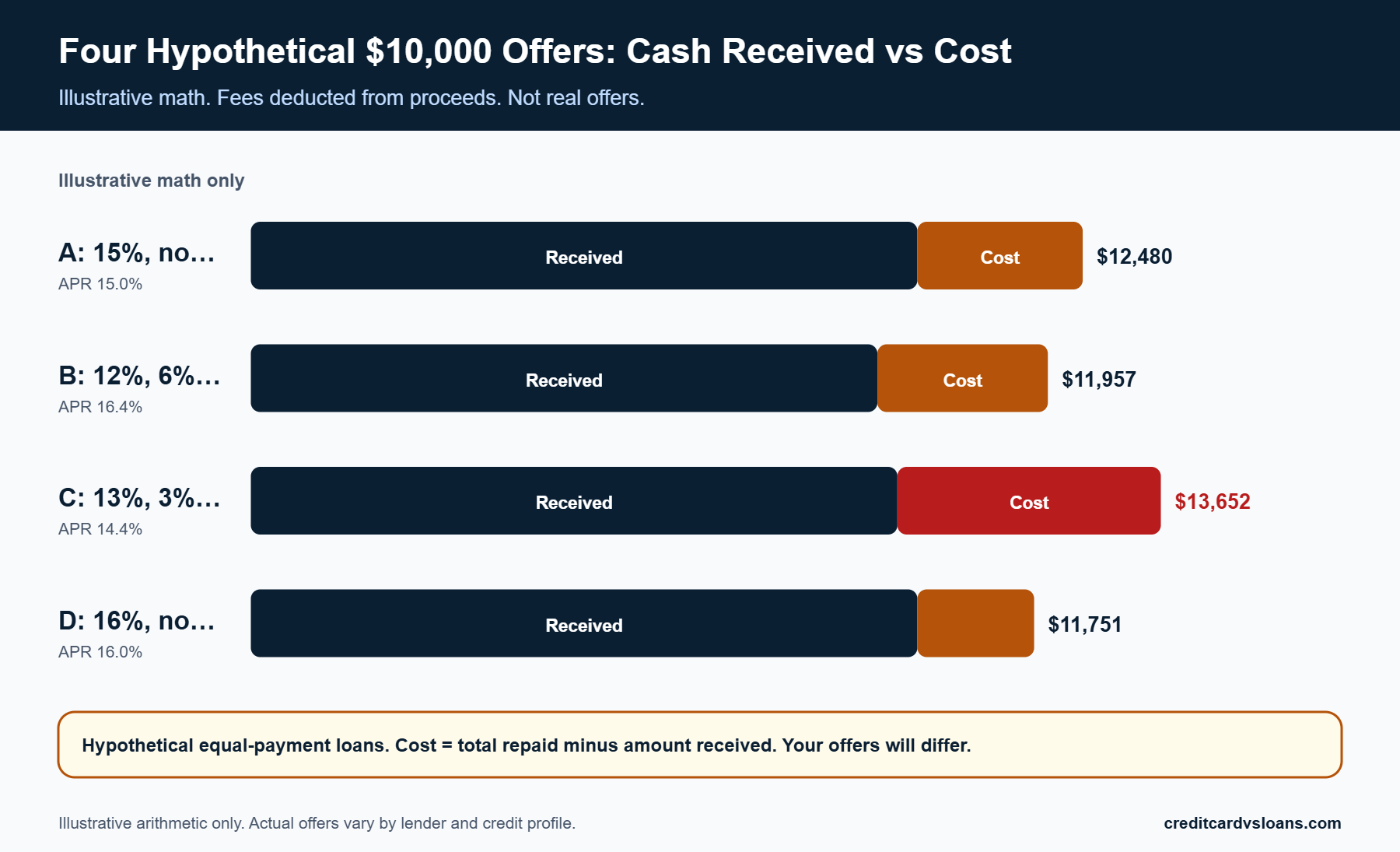
Suppose a hypothetical borrower wants roughly $10,000 and receives four offers. These numbers are invented for illustration and do not represent any real lender. Offer A has a 15% rate, no fee and a 36-month term. Offer B has a 12% rate, a 6% origination fee and a 36-month term. Offer C has a 13% rate, a 3% fee and a 60-month term. Offer D has a 16% rate, no fee and a 24-month term.
Fees are deducted from the proceeds, and payments are equal monthly amounts. The APRs below are computed on the amount actually received, using the standard method of finding the rate that equates the payments to the proceeds.
| Offer | Rate / fee / term | Amount received | Monthly payment | Total repaid | Dollar cost | APR |
|---|---|---|---|---|---|---|
| A | 15% / 0% / 36 mo | $10,000 | $346.65 | $12,480 | $2,480 | 15.0% |
| B | 12% / 6% / 36 mo | $9,400 | $332.14 | $11,957 | $2,557 | 16.4% |
| C | 13% / 3% / 60 mo | $9,700 | $227.53 | $13,652 | $3,952 | 14.4% |
| D | 16% / 0% / 24 mo | $10,000 | $489.63 | $11,751 | $1,751 | 16.0% |
What the table shows
Offer B has the lowest rate among the 36-month offers, yet its APR of about 16.4% is higher than Offer A’s 15%, and its dollar cost is higher too. The fee is the reason. Offer C has the lowest payment and the lowest APR, but it costs about $3,952, the most of the four, because the repayment lasts five years. Offer D has the highest payment and a middling APR, yet it is the cheapest in dollars because it ends soonest.
No offer wins on every measure. The right choice depends on whether your priority is the lowest payment, the lowest cost or a balance between them.
Why total repaid beats the quoted rate
The “total of payments” line in the federal disclosure is the most honest number on the page. It shows everything you will pay if you make every scheduled payment. Subtract the amount you actually receive, and you have the dollar cost of the loan.
Use that figure to break ties between offers with similar APRs. It also protects you from being swayed by a low payment or a low rate that hides a fee or a long term.
Term Trade-Offs
When a shorter term makes sense
A shorter term costs less in interest and clears the debt sooner, which frees up your cash flow later. It suits a borrower whose budget can absorb the higher payment comfortably and who values paying less over time. The risk is a payment that is too tight, since a missed payment can lead to fees and credit damage.
Before choosing the shortest term, stress-test your budget with a modest surprise expense. If the payment would break in a bad month, a slightly longer term may be safer.
When a longer term makes sense
A longer term lowers the payment and reduces the chance of missing it. It suits a borrower with tight monthly cash flow or irregular income. The trade-off is more total interest, and in this example about $2,200 more than Offer D.
If you choose a longer term, confirm that you can prepay without a charge, and consider making extra payments when you can. Extra principal payments reduce interest and shorten the term.
Paying extra to shorten the term
If the contract allows prepayment without a charge, paying extra principal each month reduces interest and ends the loan sooner. That makes a longer-term offer with no early-payoff charge a flexible choice: you can pay the lower required amount in a tight month and extra in a good one.
Before relying on this approach, confirm in writing how extra payments are applied and that no prepayment charge exists.
Funding Speed, Lender Type and Service
How Funding Works
Ask for the timeline in days, not adjectives
Lenders describe funding with phrases such as fast or same-day, but real timelines depend on your verification, the lender’s process and your bank. Ask each lender how many business days it typically takes between signing and the money arriving in your account, and what could slow it down, such as income documents or identity checks.
Speed matters when a deadline is real, such as a repair that cannot wait. It matters much less when you can afford a few more days, and a rush is a poor reason to accept an offer that costs more.
Direct payment to creditors
If you are using the loan to pay off other debts, ask whether the lender can send money directly to your creditors or whether the full amount comes to you. Sending funds to you gives you flexibility but also the temptation to spend them. Some lenders offer direct payment, and the terms vary.
For the full picture on payoff loans, see our guide to personal loans for debt consolidation, which looks at when a consolidation loan can save money and when it cannot.
Autopay discounts and their conditions
Autopay can reduce errors and, with some lenders, comes with a small rate reduction. Check how the discount works, what happens if a payment bounces and whether you can still change the payment date. A discount that disappears after one failed payment is worth less than it looks.
Whether or not a discount exists, autopay protects your payment history, which is the largest single factor in the FICO scoring model according to myFICO.
Comparing Lenders, Not Just Loans
Banks, credit unions and online lenders
Banks, credit unions and online lenders each have different strengths. Banks may reward existing customers. Credit unions are member-owned and may have different eligibility and fee practices. Online lenders often advertise streamlined applications. None of these generalizations guarantees a better deal, which is why a mixed sample of quotes is useful.
Confirm any lender is registered or licensed in your state. The FTC advises checking with your state attorney general or banking regulator, and searching the company name with words like review, complaint or scam.
Servicing, reporting and hardship options
Once you have the loan, you will deal with the lender for years. Ask how payments are made, whether autopay earns any benefit, whether the lender reports your payments to the credit bureaus and what help it offers if you hit a rough patch. On-time reported payments can help your credit history, while a lender that does not report gives you no credit benefit for good behavior.
Read recent customer complaints with caution, since any lender can have unhappy customers, but patterns involving billing errors or poor communication are worth noticing.
Support you can reach
Before you accept, find out how to contact the lender: phone hours, chat, secure messaging and a mailing address for legal notices. A problem with a payment is much easier to fix when you can reach a person. Test the service during the shopping stage by asking a question and noting how quickly and clearly it is answered.
Eligibility, Credit Checks and Offer Quality
Prequalified Versus Final Offers
Why the final offer can differ
A prequalified estimate is based on information you provide and, often, a soft credit check. The final offer follows verification of income, employment and identity and a hard inquiry, and it can differ from the estimate. Treat prequalified numbers as a starting point for comparison, not a commitment.
Ask each lender what could change the final terms. If your estimate came from stated income, find out what documents they will require so you are not surprised.
Keep the number of hard pulls low
Once you narrow down to one or two offers, submit formal applications close together. The CFPB and myFICO describe rate-shopping windows for mortgage, auto and student loans, and neither names personal loans, so the cautious assumption is that each formal application may be counted separately. Our guide on personal loan rate shopping explains the reasoning and the typical size of the effect.
Why the estimate and the final offer can diverge
Prequalification relies on information you enter, and an error or an optimistic income figure can make the estimate look better than the final offer. Enter accurate numbers. If your income is variable, use a conservative figure and have documents ready, because a mismatch at the verification stage can delay or change the offer.
Affordability Checks
Test the payment against your debt-to-income ratio
The CFPB defines debt-to-income ratio as your total monthly debt payments divided by your gross monthly income, and notes that different lenders and products have different limits. For a hypothetical borrower with $4,500 in monthly gross income and $1,200 in debt payments, a new $300 payment lifts the ratio from about 26.7% to about 33.3%.
Run that math for every offer. A loan that looks cheap can still be a poor fit if it pushes your ratio higher than you can handle or higher than the next lender you apply to will accept.
Stress-test the budget
List your fixed expenses, include the new payment and ask what happens if income dips or an expense rises. A payment that fits only when everything goes right is a red flag. Consider an emergency cushion before taking on any new debt.
If the numbers are tight, a smaller loan or a longer term, with no early-payoff charge, may be better than the biggest approved amount. For how your score shapes the offers, see the 650 credit score guide.
Co-borrowers and secured options
A co-borrower with stronger credit may help you qualify for better terms, but that person becomes fully responsible for the debt, and the loan appears on both credit files. A secured loan, backed by collateral, may lower the lender’s risk and your rate, but you can lose the collateral if you stop paying.
Compare these options with the same discipline: APR, fees, total cost and the downside if something goes wrong.
Credit unions and small-dollar alternatives
If you need a smaller amount, ask a credit union or your bank about small-dollar loan programs before you accept a larger personal loan with a fee. Terms vary and eligibility depends on membership and your history, but a smaller, simpler loan can cost less overall than a larger one that includes a percentage fee.
Compare these on the same sheet, with the same fields, so the alternative competes on cost and not on convenience.
Market Context and Red Flags
How Offers Compare With the Market
The Federal Reserve benchmark
The Federal Reserve’s G.19 release of October 7, 2026 reports an average rate of 11.86% for 24-month personal loans at commercial banks in the second quarter of 2026, compared with 11.36% in the first quarter. The Fed notes that these are APRs under Regulation Z and are a simple unweighted average of each bank’s most common rate during the first calendar week of the middle month of the quarter.
This is a benchmark for context, not a quote. It covers banks, one loan length and all borrowers together. Your offers may be higher or lower, depending on your credit profile, the lender type and the loan structure. For a monthly look at borrowing costs, see our October 2026 borrower brief on credit card and personal loan rates.
How to use a benchmark without being misled
If an offer is far above the average, ask why. It may reflect your risk profile, a short history or a high fee. If an offer is far below, check for conditions such as an autopay discount that may disappear, a required add-on or a fee that moves the APR up. Rely on the APR in the written disclosure.
A benchmark helps you ask better questions. It does not tell you whether to accept.
Check the date on any rate you see
Rates move, and published figures age quickly. Look for the date attached to any benchmark or advertised rate, and treat anything without a date as unreliable. The Federal Reserve’s G.19 release notes its release date and the period it covers, which is the kind of dating you should expect from a source you rely on.
When a lender quotes you a rate, ask how long the quote is valid and whether the rate is locked or may change before funding.
Red Flags During Comparison
Predatory features
Watch for very high APRs, balloon payments, rolled-in fees, repeated refinancing offers, pressure to sign immediately and terms that change between the quote and the contract. Our guide to warning signs of predatory lending describes these patterns in more detail.
If a feature of the loan is unclear, ask for an explanation in writing. A lender that cannot or will not explain its own terms is telling you something.
Upfront fees and promises
The FTC warns that legitimate lenders will not promise or assure you a loan before you apply, and that being asked to pay for insurance, processing or paperwork before funds are released is a cue to walk away. The same caution applies to offers of debt help that charge before delivering results, which is covered in our guide to federal rules on debt relief upfront fees.
Avoid paying by gift card, wire transfer or cryptocurrency, which are hard to recover. If you have paid a scammer, report it at ReportFraud.ftc.gov.
What to do if something feels wrong
Stop sending information, save the messages and check the lender’s name with your state regulator. You can file a report at ReportFraud.ftc.gov and, if money has moved, contact your bank right away. Speed matters because payments made by wire, gift card or cryptocurrency are hard to recover.
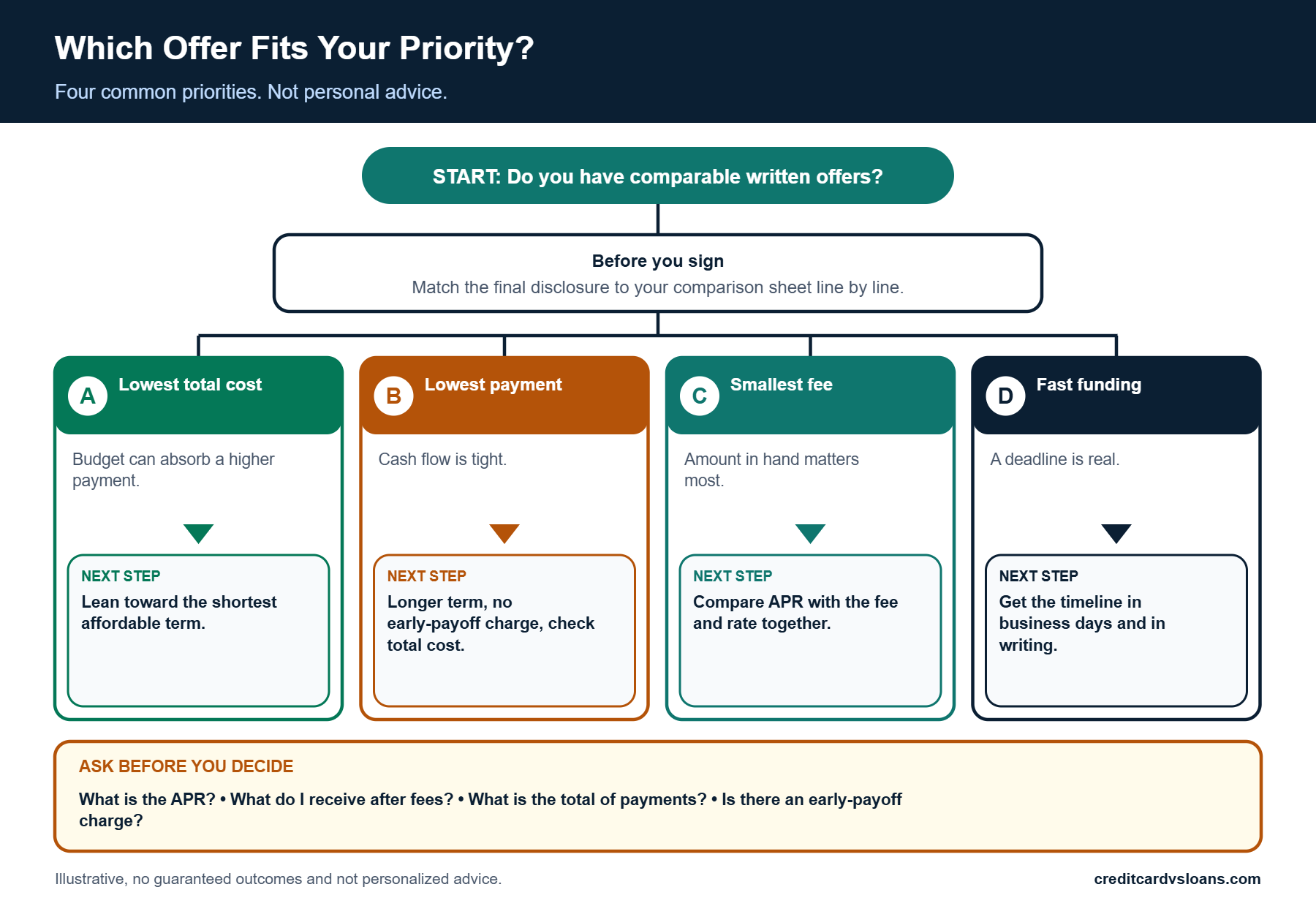
Decision Matrix: Choosing Among Offers
Match the Offer to Your Priority
Using the matrix
No single offer is best for everyone. The matrix below sorts common priorities into a way to rank your offers. It is a framework for your own decision, not personal advice. Run it with real numbers from your comparison sheet.
| Your priority | Lean toward | Why | What to verify | When to avoid |
|---|---|---|---|---|
| Lowest total cost | Shortest term you can afford | Less time for interest to build | Payment fits budget in a bad month | If the payment strains cash flow |
| Lowest monthly payment | Longer term, no early-payoff charge | Eases cash flow | Total interest and ability to prepay | If total cost is far above alternatives |
| Smallest fee | No-origination-fee offer | More money received on funding day | APR with the higher rate included | If the rate offsets the saved fee |
| Fast funding | Lender with a clear, stated timeline | Deadline-driven need | Business-day timeline, document list | If speed comes with high fees |
| Flexibility | Offer with no early-payoff charge | Lets you pay down faster | Disclosure on early payoff and late charges | If key terms are not in writing |
When two offers look equal
If two offers match on APR and cost, break the tie on service: payment reporting to the credit bureaus, hardship options, a payment date that fits your payday and a lender you can reach by phone. The cheaper loan on paper is not always the better one in practice.
If the tie persists, choose the shorter term or the one that lets you prepay without charge.
A simple scoring approach
If you still cannot decide, give each offer a score from one to five on four criteria: total dollar cost, monthly payment fit, flexibility and lender service. Weight them by your priorities and add them up. The scoring will not make the decision for you, but it forces you to state what you value.
If one offer wins clearly on cost but loses badly on payment fit, you have learned that the decision is about trade-offs, not about finding a perfect offer.
Before You Sign
Compare the final disclosure to your sheet
When the lender sends the final loan agreement and disclosures, compare the APR, amount financed, finance charge, total of payments and payment schedule with your comparison sheet. They should match what you were quoted. If anything is different, stop and ask why in writing.
Read the sections on late payments and early payoff, and make sure no optional product was added without your consent.
Know your exit
Decide in advance what you will do if you cannot make a payment. Contact the lender before the due date, ask about options and get any arrangement in writing. Know whether the contract allows you to refinance or pay early without charge, since those options are valuable if your situation improves.
If you still have doubts, take another day. A good offer survives a night’s sleep.
When an offer changes after you accept
If the final terms differ from your quote, you are not obliged to sign. Ask why they changed, ask for the revised disclosure and rerun the comparison with the new numbers. The offers you set aside may now be better. Do not let the effort you already put in push you into a worse deal.
If you were declined, ask for the principal reasons and use them to improve your file. Our guide on personal loans at a 650 credit score shows which parts of a file lenders weigh.
Bottom Line and Next Steps
What Matters Most
A short rule of thumb
Compare like with like. Rank by APR within the same term, then check total dollars across terms, then weigh the payment, funding speed and service. Treat the lowest advertised rate and the lowest monthly payment with suspicion until you have seen the whole disclosure.
The offer you choose should fit your budget in a normal month and a hard month, cost a reasonable amount compared with alternatives and come with terms you understand in writing.
When to walk away
Walk away if a lender asks for money before funding, promises approval before you apply, will not provide the APR and total of payments in writing or pressures you to sign right now. Also walk away if the best offer you can find has a payment you cannot sustain. A different amount, a different term or a pause may serve you better than a bad loan.
How the comparison fits your wider plan
A personal loan is one tool among several. If you are borrowing to pay off cards, compare the loan with the payoff plan you could follow without it, as covered in the consolidation guide. If you are borrowing for a purchase, ask whether waiting and saving would cost less than the interest. The best comparison sometimes includes the option of not borrowing.
Revisit your choice after funding
After the loan is funded, check your first statement against the contract. Confirm the payment amount, the due date, the rate and that no unexpected fee appears. Set a reminder to review your credit reports a few months later to make sure the new account is reported correctly.
Your Next-Step List
Gathering offers
- Choose one loan amount and one or two terms to compare.
- Prequalify with several lenders after confirming each uses a soft pull.
- Record amount received, APR, fees, term, payment and total of payments for each.
- Calculate the dollar cost: total repaid minus the amount received.
Deciding and closing
- Apply formally to the best one or two, close together in time.
- Compare the final disclosure with your sheet before you sign.
- Set up autopay and a small cash buffer for the payment account.
- Keep copies of the contract, the disclosures and your comparison sheet.
- Personal Loan for Debt Consolidation: When It Can Save Money
- Does Rate Shopping for a Personal Loan Hurt Your Credit?
- Personal Loan With a 650 Credit Score: Approval and Rate Factors
- Predatory Lending: Warning Signs in Personal Loans and Debt Relief Offers
- Credit Card and Personal Loan Rate Outlook: October 2026 Borrower Brief
- Debt Relief Upfront Fees: What Federal Rules Say
- CFPB: What is APR?
- CFPB: What is a hard credit inquiry?
- CFPB: What is a debt-to-income ratio?
- eCFR: 12 CFR 1026.18 Content of disclosures (Regulation Z)
- Federal Reserve: Consumer Credit – G.19 (release of October 7, 2026)
- FTC: What To Know About Advance-Fee Loans
- myFICO: How to rate shop and minimize the impact to your FICO Scores
- myFICO: What is in my FICO Scores?
Last updated: October 22, 2026. Rates, fees and lender rules change; verify current terms before acting.
The information on creditcardvsloans.com is provided for general educational and informational purposes only. It is not financial, legal, tax, credit, accounting or investment advice, and reading it does not create an advisor-client, fiduciary or any other professional relationship. Nothing here is an offer, solicitation or recommendation to borrow, lend or apply for any product.
Credit scores, interest rates, fees, eligibility rules, lender policies and laws change frequently and vary by lender, location and individual circumstances. Examples, figures and scenarios are illustrative only, do not predict your results and do not guarantee approval, savings, a particular rate or a credit-score outcome. Always confirm current terms directly with the lender or issuer and read the full agreement before you apply or sign.
Although we aim for accuracy and use reputable sources, we make no representations or warranties, express or implied, about the completeness, accuracy, reliability or timeliness of the content. Content may be drafted with the assistance of automated tools, so errors or omissions may still occur. Links to third-party sites are provided for convenience; we don’t control and aren’t responsible for their content.
To the fullest extent permitted by law, creditcardvsloans.com and its owners, editors, authors, contributors and affiliates disclaim all liability for any loss, damage or expense arising directly or indirectly from your use of, or reliance on, this content. Before making financial decisions, consult a licensed professional, such as a qualified financial advisor, attorney, tax professional or nonprofit credit counselor, who can consider your complete situation.