A personal loan with 650 credit score is a realistic goal for many borrowers, but the offer you receive depends on much more than the three digits. Lenders also look at income, existing debt, recent credit activity and the size of the loan you request, so two people with the same 650 can see very different prices. The score mostly decides which pricing tier you land in; the rest of your file decides whether you land at the top or the bottom of it.
That is why this guide does not promise a rate. No honest article can, because every lender sets its own cutoffs and updates them often. What it can do is show you which levers move your offer, how to read the cost of a loan once it is in front of you, and when it makes sense to walk away or wait.
If you want the broader picture first, start with what credit score you need for a personal loan. If you are weighing a lower or higher score band, the sibling guides for a 580 score, a 600 score, a 620 score and a 700 score cover those cases. This article stays focused on the middle: what a 650 usually means in practice and how to make the most of it.
- A 650 is neither a clear approval nor a clear denial for most personal loans. Lenders weigh it together with income, debt-to-income ratio and your recent credit history.
- Compare offers by APR, not by the headline interest rate. The APR folds in the origination fee, which is often taken out of the money you actually receive.
- A longer term lowers the monthly payment but usually raises the total interest paid, sometimes by thousands of dollars on a $10,000 loan.
- Prequalifying with a soft pull lets you see estimated terms without a hard inquiry in most cases; a formal application normally triggers a hard pull.
- Any lender that promises approval before you apply, or asks for an upfront fee to release a loan, is a red flag.
Market figures in this guide are dated to the Federal Reserve’s G.19 release of October 7, 2026. Lender cutoffs, fees and rates change often, so treat every number here as context and check your own written offer.
Personal Loan With a 650 Credit Score: The Short Answer
What a 650 Score Signals to a Lender
A mid-range score, not a verdict
A credit score is a prediction of how likely you are to repay a loan on time, built from the information in your credit reports. Most scores run from 300 to 850, according to the Consumer Financial Protection Bureau (CFPB). A 650 sits in the middle of that range, which means lenders see some positives and some question marks.
In practice, that often translates into a split outcome. Some lenders will approve you at a price that reflects moderate risk, others will ask for more documentation, and a few will decline outright. The difference usually comes down to what else is in your file.
Why two lenders can read the same 650 differently
You do not have one credit score. The CFPB explains that your score can vary by the scoring model used, the data source and the date it was calculated, and the model may depend on the type of loan. A 650 on a free app may not match the score a lender pulls.
Lenders also build their own approval rules on top of the score. One may focus on income stability, another on how much of your credit limits you use, another on how much debt you already carry. That is the main reason prequalifying with several lenders, a process covered in this guide to rate shopping, tends to be more informative than guessing.
Common misconceptions about a 650
One myth is that a 650 automatically means a subprime or last-resort loan. Lenders use many pricing tiers, and where a 650 falls depends on the lender, not on a universal line. Another myth is that checking prices will wreck your score. Prequalification at many lenders uses a soft pull, and even a hard inquiry usually has a small effect.
A third misconception is that the lowest monthly payment is the best deal. Payments are only one piece of the cost, and the rest of this guide shows how the term and the fees can turn a low payment into an expensive loan.
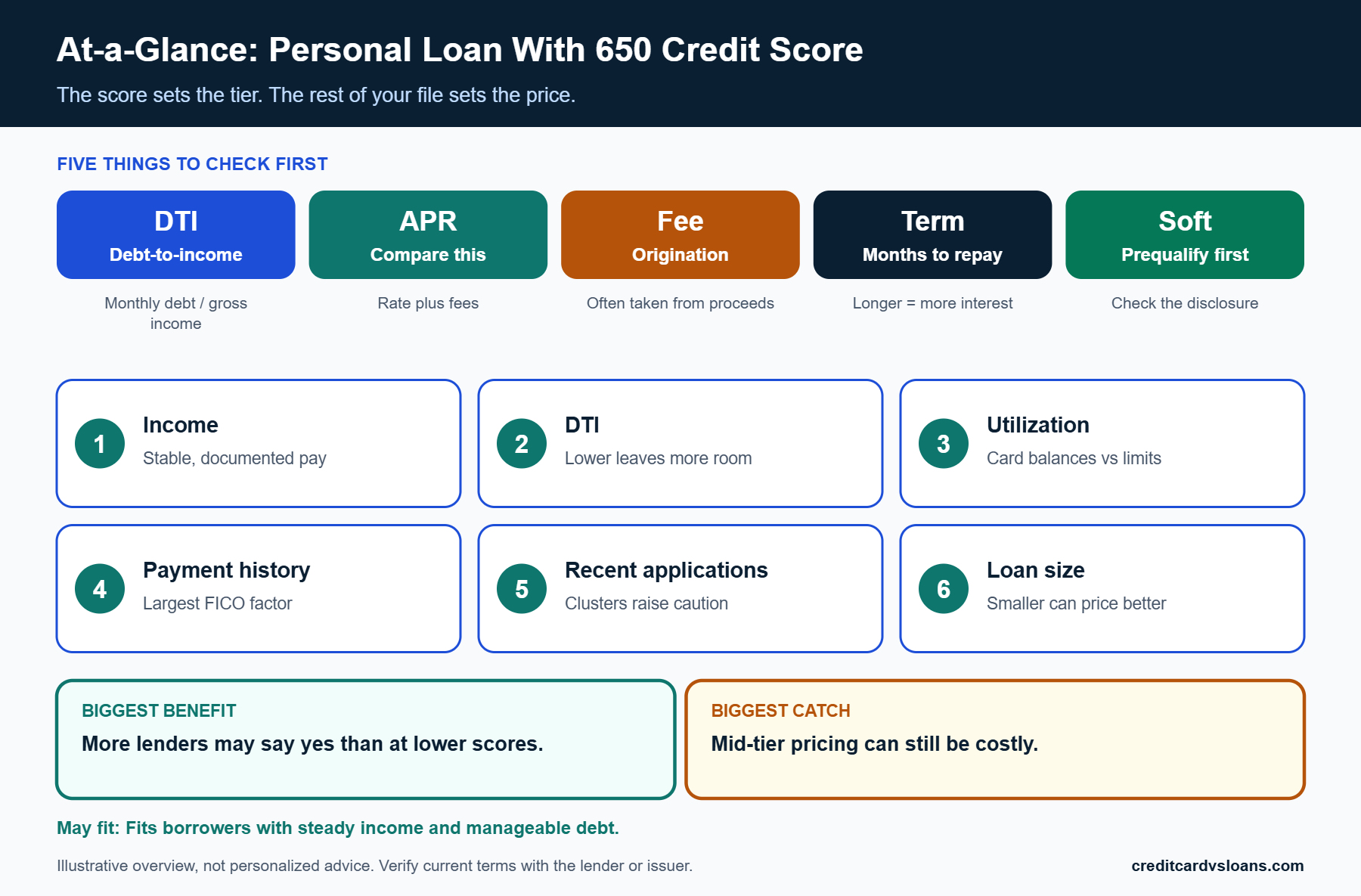
What Decides Your Offer Besides the Score
Income, job stability and existing debt
Lenders need to believe your monthly cash flow can absorb a new payment. They typically ask for proof of income and may ask how long you have been with your employer or in your line of work. A steady paycheck can offset a middling score, while irregular income can make the same score look riskier.
Existing obligations matter just as much. The next section explains the debt-to-income ratio, which is the single number many lenders use to judge whether another payment is affordable for you.
Your recent credit behavior
A 650 built on years of on-time payments and one high credit card balance looks different from a 650 built on a recent missed payment. Scoring models weigh both, but a human underwriter or an automated rule may react differently to the two stories.
Recent applications, new accounts and rising balances all suggest your financial picture is in motion. If your file is stable and your balances are falling, that tends to help. If you have just opened several accounts, expect closer scrutiny.
What Lenders Weigh Besides a 650 Score
Income and Debt-to-Income Ratio
How debt-to-income works
The CFPB defines debt-to-income ratio (DTI) as your total monthly debt payments divided by your gross monthly income, which is your income before taxes and other deductions. Its example: $2,000 in monthly debt payments on $6,000 of gross monthly income is a 33% DTI.
The CFPB also notes that different loan products and lenders have different DTI limits, so there is no universal pass mark. A lower DTI generally gives a lender more comfort, and it also leaves you more room to handle the new payment without strain.
A hypothetical DTI example
Take a hypothetical borrower with $4,500 in gross monthly income and $1,200 in existing monthly debt payments. That is a DTI of about 26.7%. Add a new $300 loan payment and the DTI rises to about 33.3%. If the same borrower already carried $1,800 in monthly debt, the same new payment would push DTI to about 46.7%.
The numbers are illustrative, not a prediction of any lender’s cutoff. The point is that a 650 score with a modest DTI can be a stronger application than a higher score with heavy existing obligations. For a fuller walk-through of what underwriters check, see our guide to personal loan credit score needs.
What Your Credit Report Shows
Payment history and balances carry the most weight
Under the FICO scoring model described by myFICO, payment history accounts for about 35% of a score and amounts owed for about 30%. Length of history is 15%, new credit is 10% and credit mix is 10%. Those weights describe the model in general; they do not tell you exactly how a given lender will use the report.
For a borrower around 650, the practical takeaway is that one or two factors usually hold the score down. Finding out which ones, by reading your own report, tells you what to fix first and what a lender is likely to ask about.
Errors, collections and thin files
Before applying, review your credit reports for mistakes. You are entitled to check your reports once a year without affecting your scores, and the nationwide credit reporting companies currently let you request them weekly, according to the CFPB. A wrong balance or a duplicate account can cost points you do not deserve.
If you have a thin credit file, meaning few accounts or a short history, a 650 may reflect a lack of data rather than a pattern of problems. Lenders that consider other factors, such as income and employment, may treat that profile differently from one that relies mostly on the score.
APR, Fees and Term for a 650 Score Loan
Reading the Price of the Loan
APR versus interest rate
The CFPB describes the annual percentage rate (APR) as the interest rate plus any additional fees charged by the lender, including origination charges. The interest rate is the cost of borrowing the principal; the APR adds the fees on top. That is why you should compare APR to APR and never APR to a plain interest rate.
For a closed-end loan like a personal loan, federal Truth in Lending rules (Regulation Z) require the lender to disclose the amount financed, the finance charge, the APR, the total of payments and the payment schedule. Those disclosures are your apples-to-apples tools, so ask for them before you sign.
The origination fee, in plain English
An origination fee is a one-time charge for processing the loan. Many lenders subtract it from the loan amount, so a $10,000 loan with a 6% fee puts only $9,400 in your account while you still owe the full $10,000. If you need a specific amount in hand, you may have to borrow more to cover the fee.
Not every lender charges one, and fees vary widely. Some lenders build the cost into a higher interest rate instead. Neither approach is automatically better; the APR is what tells you which one is cheaper for your term.
| Term | What it means | Why it matters at 650 |
|---|---|---|
| APR | Interest rate plus lender fees, as a yearly percentage | The cleanest way to compare offers that carry different fees |
| Origination fee | Upfront charge, often deducted from proceeds | Can raise the real cost sharply on a smaller loan |
| Term | Number of months you repay over | Longer terms lower the payment but usually raise total interest |
| Fixed rate | Rate and payment stay the same | Predictable budgeting for most borrowers |
| Prequalification | Estimated offer, typically a soft pull | Lets you compare without a hard inquiry at many lenders |
| Hard inquiry | Credit check tied to a formal application | Usually a small, temporary score effect |
Fixed rates and the payment schedule
Most personal loans are installment loans: you borrow a lump sum and repay it in equal monthly payments over a set term. With a fixed rate, the payment does not change, which makes budgeting simpler. If a lender offers a variable rate, ask how often it can change, what limits apply, and what your payment could be in a less favorable scenario.
Early payments are weighted toward interest and later payments toward principal. That is why paying a loan off early saves interest, and why the first year of a long loan can feel like it barely dents the balance.
Other charges to look for in the contract
Beyond the APR, read the sections on late payments and early payoff. Federal disclosure rules call for the lender to state any late-payment charge and whether a charge may apply for paying the loan off early. Some contracts also add fees for returned payments or optional products such as payment protection.
None of these is a reason to avoid a loan by itself, but each one belongs in your comparison. A loan with a slightly higher APR and no early-payoff charge can be more flexible than a cheaper-looking loan that penalizes you for paying it down.
Benchmarks and Context
What the Federal Reserve data shows
The Federal Reserve’s G.19 consumer credit release of October 7, 2026 reports an average rate of 11.86% for 24-month personal loans at commercial banks in the second quarter of 2026, up from 11.36% in the first quarter. The Fed notes these are APRs under Regulation Z and are a simple unweighted average of each bank’s most common rate during the first calendar week of the middle month of the quarter.
That figure is a market reference, not a quote. It is not broken out by credit score, it covers banks rather than online lenders or credit unions, and it covers one loan length. Treat it as a rough marker of the general rate environment, nothing more.
Why your offer may sit well apart from the average
An average blends borrowers across the whole credit spectrum. A borrower with a strong file and a high score may price below it, while a borrower with a 650, a high DTI or a short history may price above it. Where you land depends on the lender’s risk model and your file.
If you want a current look at how rates are moving, our credit score guide for personal loans explains how lenders tier borrowers, and you can always compare your written offers against the Fed’s published average for context only.
What a Personal Loan With a 650 Credit Score Can Cost
The Same $10,000 at Different APRs
A 36-month comparison
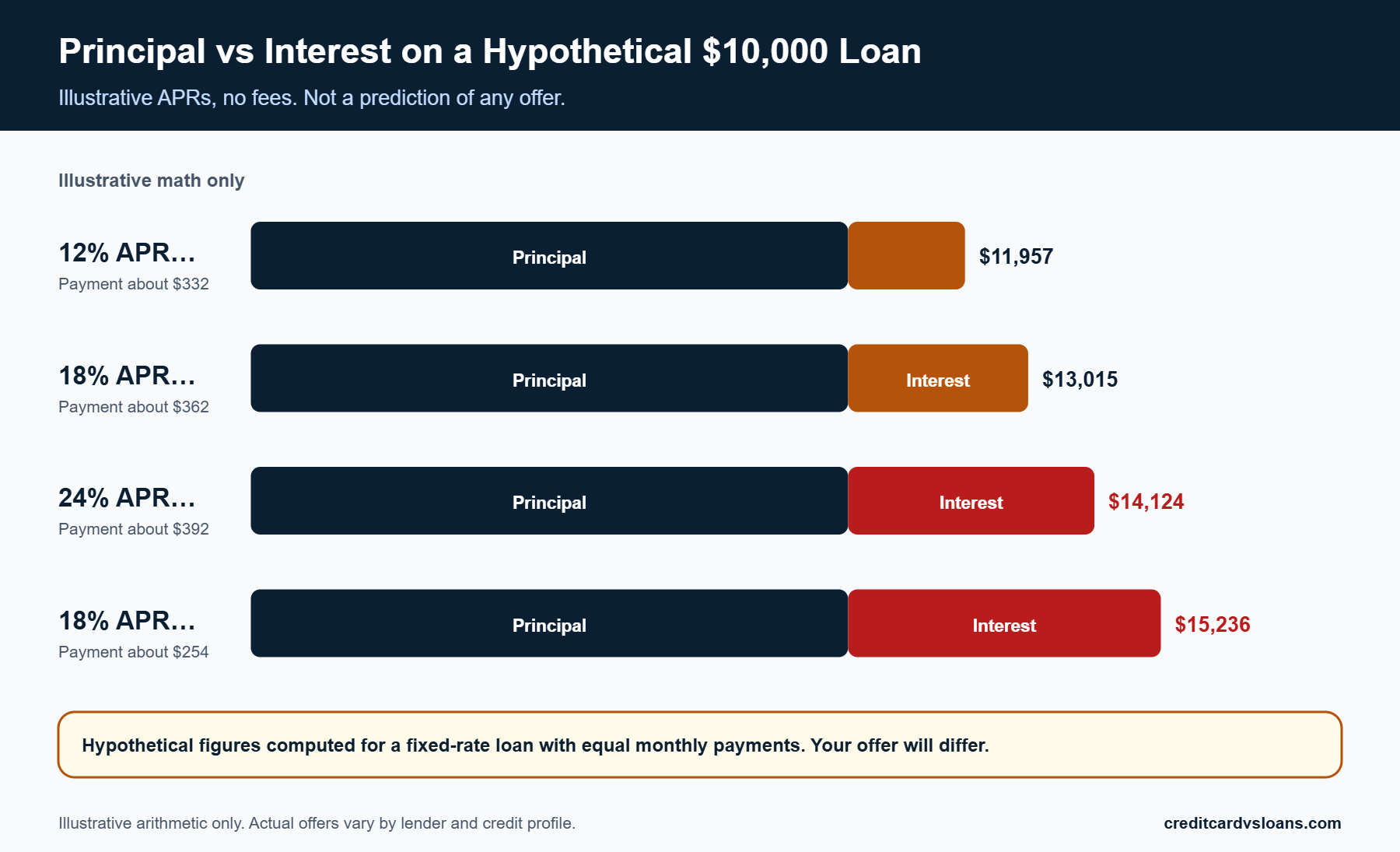
The math below is hypothetical. It does not claim that a 650 score earns any particular rate; the APRs are chosen to show how sensitive the cost is. On a $10,000 fixed-rate loan repaid over 36 months, a 12% APR means a payment of about $332.14 and total interest of about $1,957. At 18% the payment is about $361.52 and interest about $3,015. At 24% the payment is about $392.33 and interest about $4,124. At 30%, it is about $424.52 and $5,283.
Notice how a few points of APR move the payment by $30 to $90 a month. Over three years, that adds up to thousands of dollars. The difference between a mediocre and a good offer is rarely visible in the monthly payment alone.
The 60-month trade-off
Stretching the same $10,000 over 60 months lowers the payment: about $222.44 at 12%, $253.93 at 18%, $287.68 at 24% and $323.53 at 30%. That can look like breathing room in a tight month. The catch is the interest: roughly $3,347 at 12%, $5,236 at 18%, $7,261 at 24% and $9,412 at 30%.
A longer term can still be the right call if the shorter payment is the only way to avoid missing payments. Just make that choice knowingly, and remember that you can usually pay a loan off early, which cuts interest, as long as your loan agreement does not charge for doing so.
| APR | 36-month payment | 36-month interest | 60-month payment | 60-month interest |
|---|---|---|---|---|
| 12% | $332.14 | $1,957 | $222.44 | $3,347 |
| 18% | $361.52 | $3,015 | $253.93 | $5,236 |
| 24% | $392.33 | $4,124 | $287.68 | $7,261 |
| 30% | $424.52 | $5,283 | $323.53 | $9,412 |
How Fees Change the Real Price
A fee can outweigh a lower rate
Suppose a hypothetical lender offers a 12% rate with a 6% origination fee on a $10,000, 36-month loan. You receive $9,400 but repay $11,957, so the borrowing cost is about $2,557 and the effective APR works out to roughly 16.4%. A rival offering 15% with no fee on the same loan costs about $2,480 in interest and has a 15% APR.
The offer with the lower headline rate is the more expensive one. That is the reason APR, not the advertised rate, is the number to sort by. The full method is laid out in our guide to rate shopping and the comparison approach it feeds.
Fit the payment to your budget, not the maximum
Approval for a larger amount is not a reason to borrow it. A smaller loan means less interest and a smaller fee if the fee is a percentage. Borrowers around 650 sometimes see their best pricing on a more modest request, because the lender takes on less risk.
Before accepting, add the payment to your current monthly obligations and ask whether it still leaves room for rent, food, insurance and an emergency cushion. A payment you can make comfortably protects your credit more than a slightly lower rate on a payment that strains you.
How a Personal Loan Affects a 650 Credit Profile
At the Application Stage
Soft pulls, hard pulls and what they do
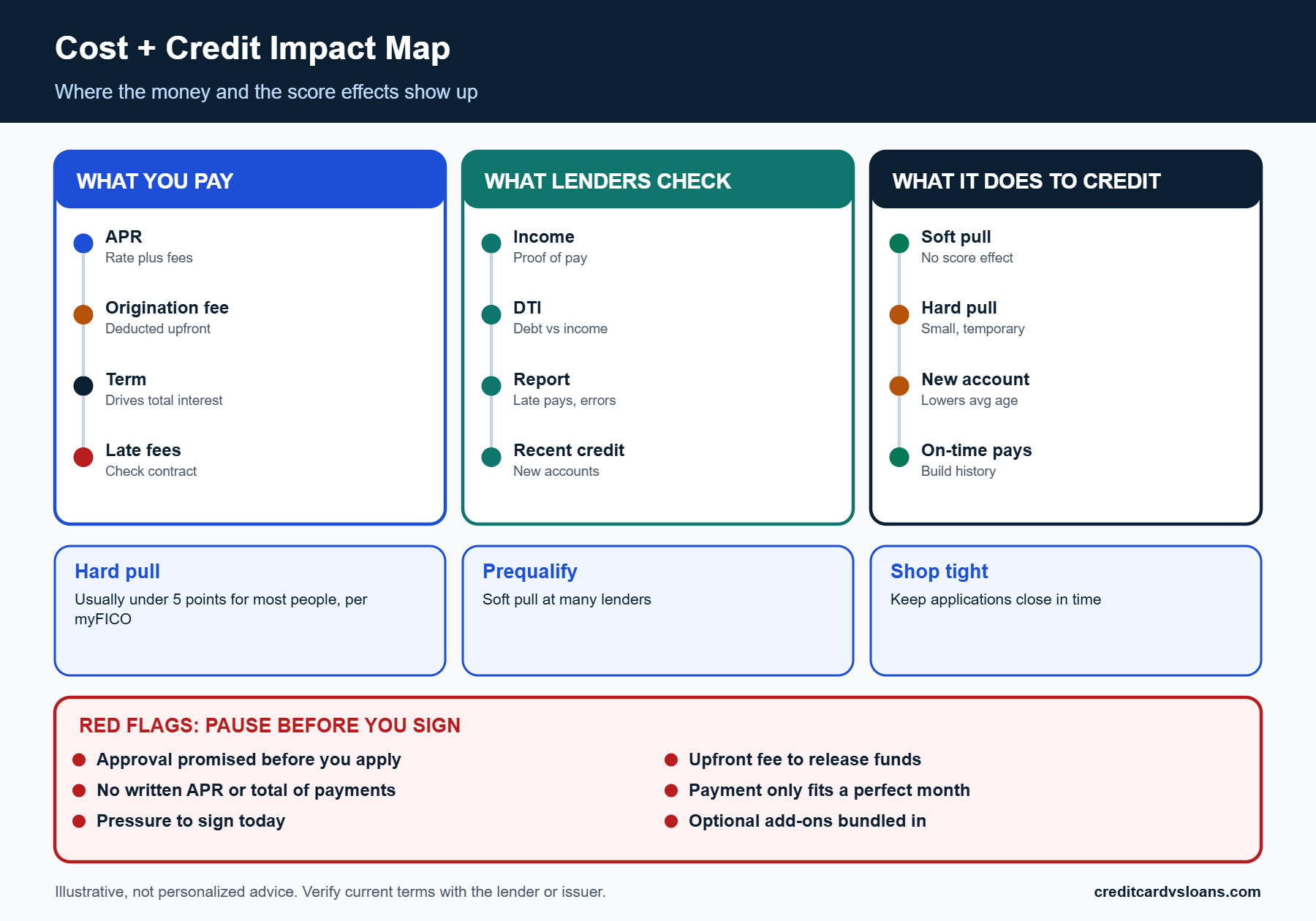
The CFPB explains that a hard inquiry usually happens when a lender checks your credit after you apply, and it can lower your score because scoring models weigh how recently and how often you apply for credit. Soft inquiries, such as checking your own reports or prescreened offers, do not affect your scores.
Many lenders offer prequalification, which gives you estimated terms from a soft pull, and then run a hard pull only when you formally apply. Not every lender works this way, so read the disclosure on the prequalification screen before you enter your details.
How big the score effect usually is
myFICO says a single additional hard inquiry costs most people less than five points of their FICO Score, and that there is no fixed number of points per inquiry. Hard inquiries can remain on a credit report for up to 24 months, but FICO Scores consider them for only 12 months.
For someone sitting at 650, a few points either way rarely changes the outcome on its own, but a cluster of applications can add up and may make a lender wary. Keep your formal applications bunched into a short window and only for offers you would actually accept. The details of shopping safely are in the dedicated rate-shopping guide linked below.
After You Take the Loan
A new account and a new payment
Once funded, the loan shows up as a new installment account. In the short term, a brand-new account can lower the average age of your accounts and add to your total debt. Both effects are usually modest and fade as the account ages and you pay down the balance.
The larger effect comes from what you do next. Every on-time payment adds to a positive payment history, which is the largest single factor in the FICO model. Every missed payment does the reverse, and the damage tends to be much bigger than the effect of the original inquiry.
Using the loan to pay off cards
Some borrowers use a personal loan to pay off credit cards. Because a credit card is revolving credit, paying it down can reduce your utilization, which is part of the amounts-owed factor. That can help, but only if you do not run the cards back up afterward.
Whether this strategy saves money depends on the APR, the fee and the term compared with what you pay on the cards today. The topic has its own treatment in our guide to using a loan for debt payoff; the short version is that a lower payment is not the same as a lower cost.
Protecting your score while you repay
Autopay is the simplest safeguard. A missed payment can do more harm to a score than the inquiry that started the process, because payment history is the largest factor in the FICO model. Set the due date to follow your payday, and keep a small buffer in the account that funds the payment.
If a month looks tight, contact the lender before the due date rather than after. Some lenders offer hardship options, but terms vary and there is no universal right to one, so ask early and get any arrangement in writing.
Loan terms that should make you pause
Several features deserve a second look before you sign: a very high APR paired with a short term, a balloon payment that leaves a large amount due at the end, fees that are rolled into the balance, and pressure to sign the same day. Each can turn an affordable-looking payment into a debt that is hard to escape.
If any term in the contract is unclear, ask the lender to explain it in plain language and wait for the answer in writing. A lender that is confident in its terms will not mind the question.
How a 650 Differs From 580, 600, 620 and 700
Scores Below 650
What tends to change as scores drop
As scores fall, more lenders decline outright, and those that approve often price for higher risk, ask for more documentation or limit the loan size. The pattern is a tendency, not a rule, and every lender draws its lines in different places. Our guides for a 580 score, a 600 score and a 620 score walk through realistic expectations at each step.
A 650 usually has more options than those bands, but the gap is often smaller than borrowers expect. A 650 with a high DTI can face the same obstacles as a 620 with a clean file.
Where a 650 gains and where it does not
The gains tend to show up as a wider choice of lenders and more prequalification results that come back as actual offers instead of declines. The gains do not automatically show up as low rates. If the offers you see look expensive, a co-borrower, a smaller amount or a few months of work on your report could change the picture more than shopping harder.
Before deciding that a high APR is your only route, read the alternatives section below and consider whether you need the loan at all right now.
Scores Above 650
The step toward better pricing
Higher scores are generally associated with easier approval and better terms, which the CFPB notes in its description of how lenders use scores. How much better varies by lender and by loan. Our look at a 700 score explains what changes as borrowers move up, and it is a useful preview of what you might be working toward.
The point is not to chase a number for its own sake. It is to know whether waiting a few months to raise your score is likely to save enough in interest to be worth the delay.
When waiting makes sense and when it does not
Waiting makes sense when your need is flexible, you can identify a specific problem on your report, and the potential savings are large relative to the loan. It makes less sense when the need is urgent, when the cost of delay is high, or when your score is unlikely to change much.
A practical test: ask a few lenders for prequalified offers now, note the APRs, then decide whether the gap between those offers and the better pricing you hope for justifies several more months of waiting. Nobody can promise how a score will move, so build the plan around actions you control.
Alternatives, Risks and Red Flags
Alternatives to Consider
Credit unions, secured options and a co-borrower
Credit unions are member-owned and often publish their loan terms, so they are worth asking, particularly for smaller loans. A secured loan, which is backed by collateral such as a savings balance, can lower the lender’s risk, but you can lose the collateral if you stop paying. A co-signer or co-borrower with stronger credit can improve terms, though that person becomes fully responsible for the debt.
Each of these has costs of its own, and eligibility rules differ. Ask each lender for the APR, any fees and the total of payments in writing.
Borrowing less or not at all
If the need is a one-off expense, it may be possible to negotiate a payment plan with the biller, delay the purchase, or fund part of it from savings and borrow only the remainder. A smaller loan reduces both interest and the damage if something goes wrong.
Nonprofit credit counseling is another route if your debts feel unmanageable. The Federal Trade Commission notes that nonprofit credit counseling is available in every state, often free or low cost.
Questions to ask a credit union or bank
Ask whether membership is required and what it costs, what the APR range is for your profile, whether there is an origination fee, and whether the lender reports payments to the credit bureaus. Reporting matters if you are trying to build credit through on-time payments.
Ask also whether the lender offers a smaller loan with a shorter term, whether there is a charge for early payoff, and how quickly funds are released. Quick funding is convenient, but never a reason to skip reading the terms.
Risks and Red Flags
Payment strain and fee surprises
The most common risk is a payment that is higher than it looks once you account for everything else in your budget. Another is overlooked fees. Federal rules require the lender to state whether a charge may apply for paying early and what late payments cost, so check both before you commit.
If the contract adds credit insurance, an unusual fee or a payment structure you do not understand, ask the lender to explain each item in writing and decline anything optional you do not want.
Advance-fee loan scams
The FTC warns that legitimate lenders will not promise or assure you a loan before you apply, and that anyone asking for payment for insurance, processing or paperwork before releasing funds is a cue to walk away. Be wary of ads that claim approval regardless of credit history.
Confirm that a lender is registered in your state through your state attorney general or banking regulator, search the company name alongside words like complaint or scam, and never pay with gift cards, wire transfers or cryptocurrency. If you have paid a scammer, report it at ReportFraud.ftc.gov as soon as possible.
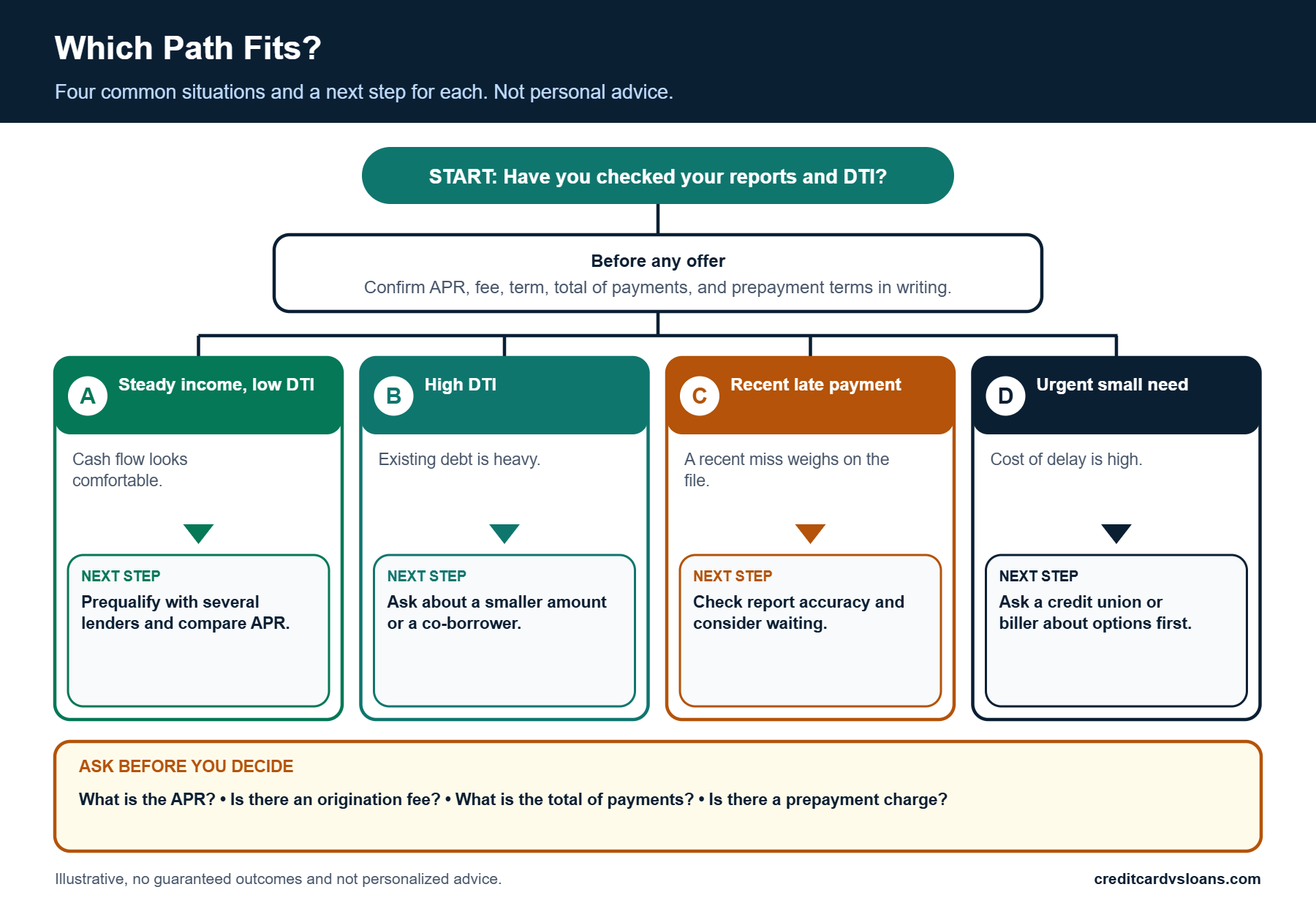
Decision Matrix: Which Path Fits a 650 Score?
Matching Your Situation to a Path
How to use the matrix
The matrix below sorts common borrower situations into paths worth investigating. It is a way to organize your thinking, not a recommendation for your finances, and the scenarios are generic. Your own budget, your credit reports and the written offers you receive should drive the final choice.
Read across the row that sounds most like you, then use the verify column as your checklist when you talk to lenders.
| Situation | Path to investigate | Why | What to verify | When to avoid |
|---|---|---|---|---|
| Steady income, modest existing debt | Prequalify with several lenders | Strong cash flow can offset a middling score | APR, fee, total of payments | If every offer strains your budget |
| High DTI, stable job | Smaller loan or co-borrower | Lower payment eases the DTI problem | Co-borrower’s liability, fee on smaller loan | If the co-borrower cannot afford the risk |
| High card balances, on-time history | Consolidation loan, compared with a payoff plan | May lower interest and simplify payments | APR versus current card APRs, fee, new-card habits | If you would run the cards back up |
| Recent late payments | Wait, repair, then reapply | Recent lates weigh heavily | Report accuracy, months since the late | If you need funds urgently, ask about smaller options |
| Urgent small expense | Credit union or payment plan first | Lower cost and lower risk of a long commitment | Membership rules, fees, repayment terms | If the offer includes upfront fees or fast-cash pressure |
Common patterns among 650-range borrowers
Borrowers in this range often find that one fixable issue shapes their offers. It may be a high credit card balance, a single late payment or a short history. When you can name the issue, you can decide whether to fix it first or accept a higher price now.
If you cannot find any issue and your offers are still expensive, the lender’s model may simply weigh your profile cautiously. In that case, more prequalification attempts with different types of lenders are more useful than repeating the same ones.
Matching the loan to the purpose
A loan for a one-time, necessary expense is easier to justify than one that stretches your budget for something optional. Ask whether the purchase will lose value faster than you can repay the debt. If it will, consider the smaller loan or the wait.
Before You Submit a Full Application
Tighten the file you can control
Check your reports for errors and dispute anything inaccurate. Pay down revolving balances if you can, since utilization is part of the amounts-owed factor. Avoid opening new accounts in the weeks before you apply, and gather proof of income so underwriting moves faster.
These steps are within your control and cost little. Nobody can promise they will change your score or your offer, but they remove avoidable reasons for a lender to hesitate.
Know your walk-away number
Before you apply, decide the highest APR, the largest fee and the longest term you will accept. Write the numbers down. A deadline from a lender, or the relief of being approved, can make a bad offer look better than it is.
If no offer meets your limits, that is useful information. It may point to a smaller loan, a different type of lender, or a pause while you strengthen your file.
Revisit the plan if the answer is no
If a lender declines you, it is required to tell you, and you can ask for the principal reasons. Those reasons are a roadmap: they often point to a utilization level, a recent late payment or an income issue you can address. Use them to prepare a stronger application rather than applying again right away.
Bottom Line and Next Steps
What to Take From This
The score opens the door; the file sets the price
A personal loan with a 650 credit score is often available, and the price is shaped by your income, your debt load, your recent credit activity and the choices you make about amount and term. Those are the levers worth working on. Rate-chasing without them tends to produce disappointing offers.
Treat the APR as the deciding number, compare total cost and not just the monthly payment, and be willing to borrow less than the maximum offered.
When it is smart to stop
Pause if an offer requires an upfront payment before funds arrive, if a lender will not give you the APR and total of payments in writing, or if the payment only fits your budget in a best-case month. Those are signals to step back, not details to rationalize.
If you are comparing score bands as you plan, revisit the 600 guide and the 700 guide to see what the realistic gaps look like and whether a short wait could be worthwhile.
Where this guide fits in the series
This article covers the middle of the score range. If your own number is lower or higher, the guides for 580, 620 and 700 describe how the picture shifts, and the overview of score needs for personal loans ties the bands together.
Whatever your score, the same discipline applies: know your DTI, compare by APR, read the contract and borrow only what the budget can carry.
Your Next-Step List
Before you apply
- Pull your credit reports and fix inaccuracies you find.
- Calculate your DTI using the CFPB’s method: monthly debt payments divided by gross monthly income.
- Decide how much you actually need, then add any origination fee you would have to cover.
- Set your walk-away APR, fee and term before you see any offers.
While you shop and after you choose
- Prequalify with several lenders, confirming each time that the check is a soft pull.
- Compare APR, fee, term and total of payments side by side.
- Apply formally only for the offer you would accept, and within a short window.
- Set up automatic payments after funding so the first payment is not missed.
- Personal Loan With a 600 Credit Score: Rates, Approval and Alternatives
- Personal Loan With a 700 Credit Score: How Much Better Can Rates Get?
- Personal Loan With a 620 Credit Score: What to Expect
- Personal Loan With a 580 Credit Score: Realistic Expectations
- What Credit Score Do You Need for a Personal Loan?
- CFPB: What is a credit score?
- CFPB: What is APR?
- CFPB: What is a hard inquiry?
- CFPB: What is a debt-to-income ratio?
- Federal Reserve: Consumer Credit – G.19 (release of October 7, 2026)
- eCFR: 12 CFR 1026.18 Content of disclosures (Regulation Z)
- FTC: What To Know About Advance-Fee Loans
- myFICO: What is in my FICO Scores?
- myFICO: How to rate shop and minimize the impact to your FICO Scores
Last updated: October 22, 2026. Rates, fees and lender rules change; verify current terms before acting.
The information on creditcardvsloans.com is provided for general educational and informational purposes only. It is not financial, legal, tax, credit, accounting or investment advice, and reading it does not create an advisor-client, fiduciary or any other professional relationship. Nothing here is an offer, solicitation or recommendation to borrow, lend or apply for any product.
Credit scores, interest rates, fees, eligibility rules, lender policies and laws change frequently and vary by lender, location and individual circumstances. Examples, figures and scenarios are illustrative only, do not predict your results and do not guarantee approval, savings, a particular rate or a credit-score outcome. Always confirm current terms directly with the lender or issuer and read the full agreement before you apply or sign.
Although we aim for accuracy and use reputable sources, we make no representations or warranties, express or implied, about the completeness, accuracy, reliability or timeliness of the content. Content may be drafted with the assistance of automated tools, so errors or omissions may still occur. Links to third-party sites are provided for convenience; we don’t control and aren’t responsible for their content.
To the fullest extent permitted by law, creditcardvsloans.com and its owners, editors, authors, contributors and affiliates disclaim all liability for any loss, damage or expense arising directly or indirectly from your use of, or reliance on, this content. Before making financial decisions, consult a licensed professional, such as a qualified financial advisor, attorney, tax professional or nonprofit credit counselor, who can consider your complete situation.