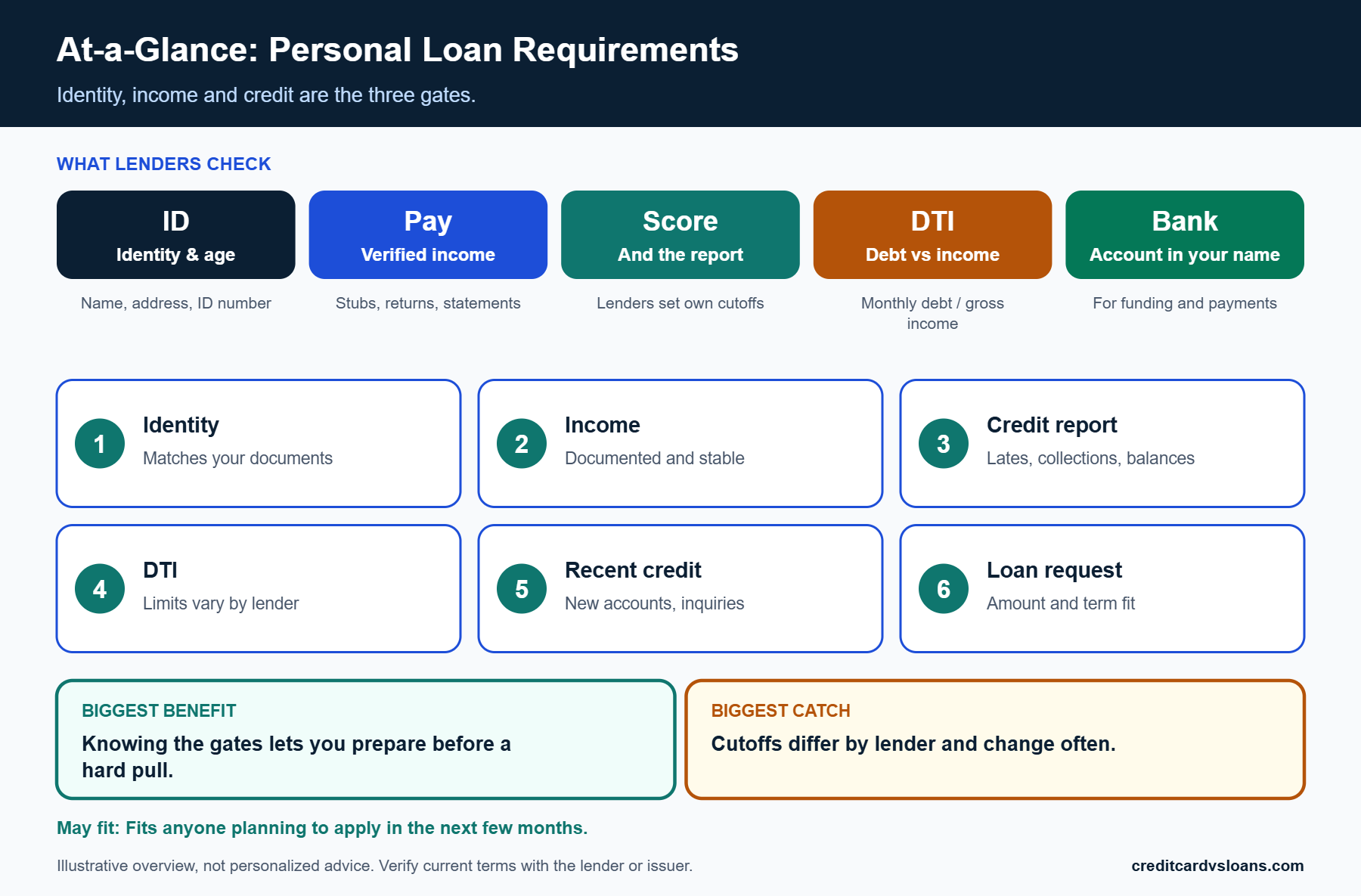
Personal loan requirements fall into three buckets: who you are (identity, age, residency and a bank account), what you earn (verifiable income and a debt load your income can carry) and how you have handled credit (your credit report and score). There is no single national checklist, because each lender sets its own rules and updates them often. What stays constant is the logic: a lender wants to confirm you are who you say you are, that you can afford the payment and that you have a record of repaying debt.
This guide walks through each requirement in plain English, explains how lenders measure it, shows a worked debt-to-income example and tells you what to do if you fall short. It does not promise approval at any lender or predict the rate you will be offered.
If you are comparing score levels, our overview of what credit score you need for a personal loan is the natural companion, and the 650 credit score guide shows how a mid-range file is read. Once you are collecting quotes, the guide to comparing offers explains how to line them up.
- Lenders typically verify identity, contact details, a bank account, income and employment, and then review your credit reports and debt-to-income ratio.
- The CFPB defines debt-to-income ratio as your monthly debt payments divided by your gross monthly income, and notes that different loan products and lenders have different limits.
- Credit scores are one input. The CFPB says your score can vary by model, data source and the date it is calculated, so lenders may see a different number than your app does.
- Lenders cannot discriminate on prohibited bases such as race, religion, sex, marital status, age or source of income, and a denied applicant can ask for the principal reasons.
- Requirements that involve paying a fee to get approved are a red flag, not a requirement.
Lender requirements change often and vary by state and product. The market figure used here comes from the Federal Reserve’s G.19 release of October 7, 2026. Check your lender’s own application page for its current rules.
Table of contents
Personal Loan Requirements: The Short Answer
The Core Requirements
Identity, age, residency and a bank account
Lenders generally need to confirm your identity, so expect to provide your legal name, address, date of birth, phone number, email and a government-issued identification number, as well as proof of address where requested. You must usually be old enough to enter a binding contract in your state, and you will usually need a bank account for receiving the funds and making payments.
Residency and documentation rules differ by lender. Some accept applicants with certain taxpayer identification numbers or visas and others do not. Check the lender’s published eligibility page before you apply, so you do not trigger a hard inquiry for an application that was never going to qualify.
Income and employment
Lenders want to see that you have a reliable source of income large enough to cover the payment. Income can come from wages, self-employment, retirement benefits and other lawful sources, and the lender may ask for documents such as recent pay stubs, tax returns or bank statements. Some lenders set a minimum income; others focus on the ratio between income and debt instead.
How long you have been in your job or line of work can matter as well, because stability reduces the lender’s risk. A recent job change is not automatically disqualifying, but it may prompt more questions or documents.
The Credit Side
Credit score and credit report
The CFPB describes a credit score as a prediction of how likely you are to repay a loan on time, built from information in your credit reports. Lenders use scores to decide whether to approve you and to help set the rate and the loan terms. The CFPB also notes that most scores run from 300 to 850, and that a higher score usually makes it easier to qualify and may lead to better terms.
Beyond the score, lenders review the report itself: late payments, collections, bankruptcies, the number of accounts, balances and recent applications. Two borrowers with the same score can be treated differently on the strength of what is in the report.
Debt-to-income ratio
The CFPB defines debt-to-income ratio (DTI) as your total monthly debt payments divided by your gross monthly income. Its example: $2,000 in monthly debt payments against $6,000 in gross monthly income is a DTI of 33%. The agency adds that different loan products and lenders have different DTI limits.
DTI is one of the most common reasons an otherwise decent applicant is declined or offered a smaller loan. It is also the requirement you can most easily estimate in advance.
Requirements versus preferences
It helps to separate hard requirements from preferences. A hard requirement, such as being old enough to contract or having a bank account, is a yes-or-no gate. A preference, such as a stronger credit score or a lower DTI, affects the price and the odds rather than a strict cutoff.
Many applicants who think they fail a requirement are really facing a pricing issue: they would be approved, but at a rate that is not worth accepting. Knowing which is which helps you decide whether to keep shopping or fix something first.
Identity, Residency and Document Requirements
What Lenders Verify
Identity and contact information
Expect to provide your full legal name, current address, phone number and email, plus an identification number such as a Social Security number or another taxpayer identification number the lender accepts. Lenders may also ask for a copy of an identification document and a way to verify that the account you give for funding is yours.
Make sure the information on your application matches your documents exactly. Small mismatches, like a misspelled name or an old address, can slow the process or trigger a request for additional proof.
Income documents
Typical documents include recent pay stubs, W-2 forms, tax returns, bank statements showing deposits and, for benefits income, award letters. Lenders may also verify your employment by contacting your employer or by using a payroll verification service. Having these ready before you apply makes the process faster.
If you stated income on a prequalification form, remember that the final decision relies on verified income. A figure that cannot be supported by documents may lead to a smaller offer or a decline.
When you have little paperwork
If you are newly employed, recently moved or paid in ways that leave a thin paper trail, start collecting documents before you apply. Bank statements showing regular deposits, offer letters, benefit award letters and tax records can all help. A short written explanation of an unusual item can prevent a misunderstanding.
The more clearly you can document your income, the less a lender has to guess, and guessing tends to work against the applicant.
Irregular and Non-Wage Income
Self-employed and gig income
Self-employed borrowers are usually asked for more documentation, such as tax returns for one or two years, because income may fluctuate. Lenders often look at net income after business expenses, not gross revenue. If your income has grown or shrunk, expect questions about why.
Keeping clean records and separating personal and business accounts can make verification easier.
Retirement, benefits and other income
Retirement income, Social Security and other regular benefits can count as income for many lenders, and federal law prohibits discrimination in credit based on source of income, among other protected characteristics. The Federal Trade Commission lists race, color, religion, national origin, age, sex, marital status and source of income as bases covered by the Equal Credit Opportunity Act and Regulation B.
If you believe you were treated unfairly, you can ask the lender for the principal reasons for the decision and contact the CFPB or the FTC.
| Requirement | What lenders typically check | Why it matters |
|---|---|---|
| Identity and age | Legal name, address, date of birth, ID number | Confirms you can sign a binding contract |
| Bank account | Account in your name for funding and payments | Enables deposit and autopay |
| Income | Pay stubs, tax returns, bank statements, benefit letters | Shows you can afford the payment |
| Employment history | Employer, time on the job, income stability | Signals how reliable income is |
| Credit report and score | Payment history, balances, collections, inquiries | Drives approval and pricing |
| Debt-to-income ratio | Monthly debts divided by gross monthly income | Tests whether another payment fits |
Credit Score and Credit History Requirements
How Lenders Use Scores
There is no single national minimum
You will see published score ranges on lender websites and comparison pages, but they are guides, not rules. Each lender sets its own cutoffs and may price borrowers in tiers. A score that qualifies at one lender can be declined at another, and the same score can lead to very different rates.
The CFPB explains that your score can differ by scoring model, data source and calculation date, and that the model used may depend on the type of loan. So the number on your banking app may not be the number a lender sees. For a broader view of how scores line up with outcomes, read our guide to credit scores for personal loans.
Score bands in practice
As a rule of thumb, higher scores tend to meet more lenders’ requirements and often come with better terms, while lower scores narrow the field and raise the price. The CFPB notes that a higher score usually makes it easier to qualify and may lead to better interest rates. A middle-range score, such as the file described in the 650 guide, can be approved by many lenders at a middling price, depending on the rest of the report.
Treat any minimum-score claim as a starting point for your own research. Prequalification, which typically uses a soft pull, is the best way to see where a particular lender lands for your profile.
Why your score may differ from the lender’s
Free scores shown in apps and bank dashboards often come from a different model or bureau than the one a lender pulls. The CFPB says your scores can vary by model, data source and date. A gap of a few points is normal, and a larger gap may reflect a difference in how recent changes were reported.
Use free scores to track direction and to estimate your range, then let prequalification show you how a specific lender sees your file.
What Else Is in the Report
The factors behind the number
According to myFICO, the FICO score model weighs payment history at about 35%, amounts owed at 30%, length of credit history at 15%, new credit at 10% and credit mix at 10%. A lender that sees a recent late payment, a collection or a high credit card utilization will weigh those facts even if your overall score looks acceptable.
Lenders may also want to know how many hard inquiries you have had recently and how many new accounts you have opened. A burst of applications can look like financial stress.
Thin files, negative items and errors
A thin credit file, meaning few accounts or a short history, can lower scores and make lenders cautious even if you have never missed a payment. Negative items such as collections or bankruptcies are weighed according to how recent and how serious they are. And errors on reports do happen, so check yours.
The CFPB says you can review your credit reports once a year without affecting your scores, and the nationwide credit reporting companies currently allow weekly access on request. Dispute inaccuracies before you apply, because fixing a mistake can be the cheapest way to improve your odds.
How inquiries and new accounts count
Lenders can see your recent hard inquiries and newly opened accounts. New credit makes up about 10% of a FICO Score, according to myFICO, and a cluster of recent applications can suggest that you are taking on debt quickly. A single inquiry rarely matters on its own, but a pattern may.
If you plan to apply for a personal loan, avoid opening other accounts in the weeks beforehand, and keep your formal applications within a short span.
Income, Debt-to-Income Ratio and Affordability
How the Debt-to-Income Ratio Works
The formula
Add up your monthly debt payments, such as rent or a mortgage payment, car loans, student loans, credit card minimums and other loans, then divide by your gross monthly income. The CFPB gives the example of $2,000 in monthly debt and $6,000 in gross monthly income, which is 33%. Lenders usually calculate it both before and after the proposed new loan.
Which debts a lender counts and how it treats items like rent varies. Ask the lender how it computes DTI so your estimate is close to its own.
A hypothetical example
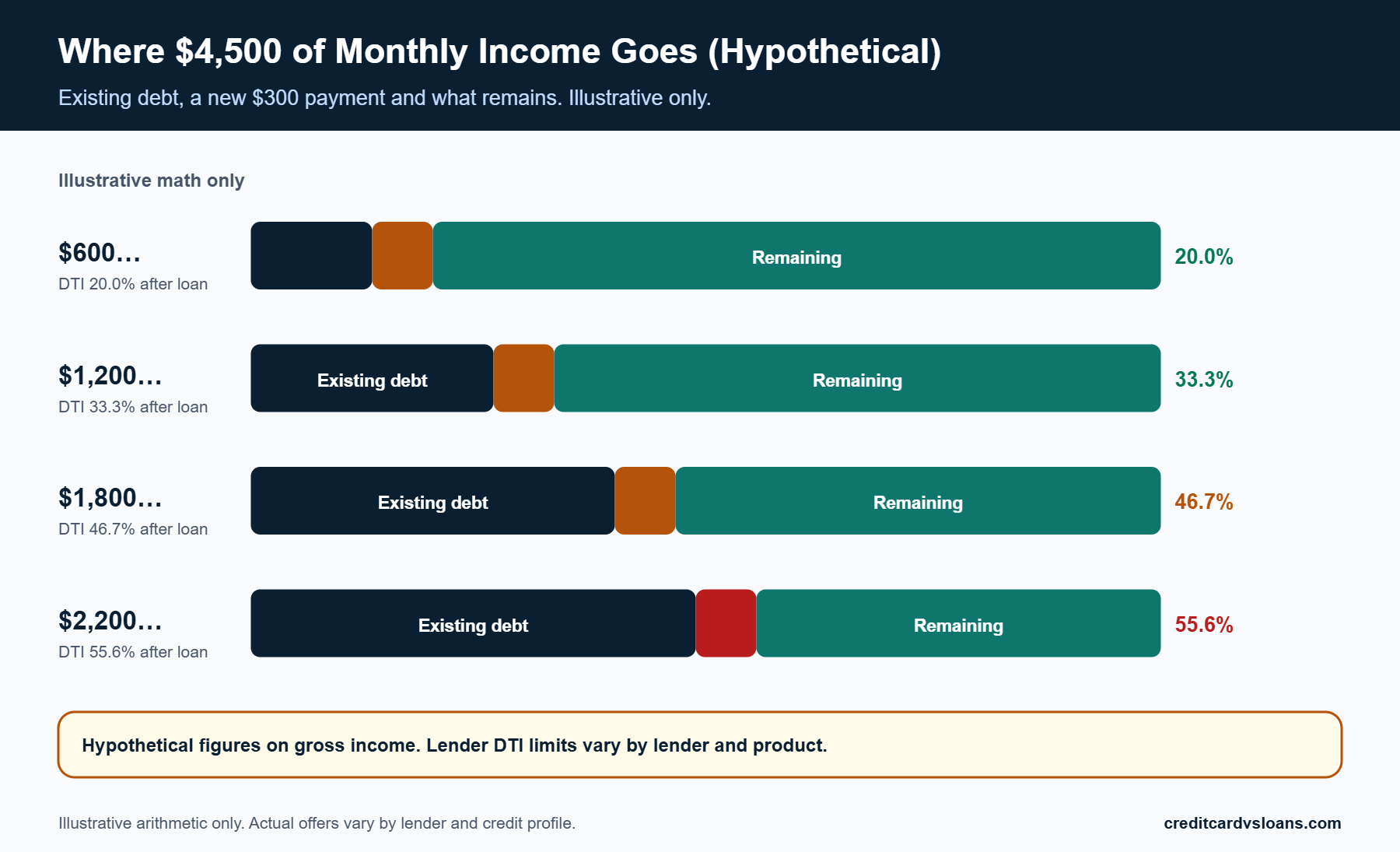
Consider a hypothetical borrower with $4,500 in gross monthly income. With $1,200 in existing monthly debt payments, DTI is about 26.7%. A new $300 loan payment raises it to about 33.3%. If the same borrower already carried $1,800 in monthly debts, DTI would start at 40% and rise to about 46.7% with the new payment.
These figures are illustrative and do not represent any lender’s cutoff. They show that the same loan can be comfortable for one borrower and out of reach for another, even when income is identical.
| Existing monthly debt | DTI before new loan | New payment | DTI after new loan | Lender reaction (varies) |
|---|---|---|---|---|
| $600 | 13.3% | $300 | 20.0% | Often comfortable |
| $1,200 | 26.7% | $300 | 33.3% | Often acceptable |
| $1,800 | 40.0% | $300 | 46.7% | May draw questions or a smaller offer |
| $2,200 | 48.9% | $300 | 55.6% | Higher risk of decline |
Beyond the Ratio
Stability and the cushion in your budget
DTI uses gross income, which ignores taxes, rent, food, insurance and other costs. A borrower with a moderate DTI can still be stretched if living costs are high. Lenders may look at income stability, savings and account balances as signs of resilience.
For your own planning, subtract the new payment from your take-home pay and your regular spending. If the remainder is thin, the loan may be too large, even if a lender would approve it.
Why a smaller loan can change the answer
If DTI is the obstacle, a smaller loan or a longer term lowers the payment and the ratio. A co-borrower with income can also change the math, but the co-borrower takes on full responsibility for the debt. Before changing your request, compare the total cost, as covered in our guide to comparing personal loan offers.
Obligations that never show on a report
Credit reports do not list everything you pay. Rent, utilities, insurance, childcare and support obligations may not appear, yet they claim part of your income. Lenders may ask about housing costs even when they are not reported, and you should count them honestly in your own budget.
A loan that fits the lender’s formula but not your real budget is a problem waiting to happen, so run the numbers both ways.
Loan Purpose, Amount, Term and Collateral
Amount and Term Rules
Minimum and maximum loan sizes
Lenders set their own minimum and maximum amounts and the terms they offer. A smaller loan may carry a higher fee as a share of the proceeds, while a larger loan raises the payment and your debt-to-income ratio. Within those limits, the amount you are approved for depends on your income, DTI and credit history.
Being approved for more than you asked for is not an invitation to borrow it. Larger amounts mean more interest and more risk, and the best move is usually to borrow only what the need requires.
How term affects qualifying
A longer term lowers the monthly payment, which can bring DTI into range, but raises total interest. A shorter term raises the payment and may fail a DTI test even when the loan would be cheaper overall. If one lender declines a request, ask whether a different term would qualify, and compare the total cost with the method in our guide to comparing offers.
Federal disclosure rules call for the lender to state the amount financed, the finance charge, the APR, the total of payments and the payment schedule, so you can see exactly how the term changes the cost.
Market context for the rate you might see
The Federal Reserve’s G.19 release of October 7, 2026 reports an average rate of 11.86% for 24-month personal loans at commercial banks in the second quarter of 2026. The Fed describes these as APRs under Regulation Z and as a simple unweighted average of each bank’s most common rate in the first calendar week of the middle month of the quarter.
That number is a market marker, not a requirement or a quote, and it is not broken out by credit score. Your own offers will differ.
Purpose, Collateral and Co-Signers
What the loan can be used for
Many personal loans can be used for a wide range of purposes, such as debt payoff, home repairs, medical bills or a major purchase. Some lenders restrict certain uses, such as business expenses, education costs or investing. If the purpose affects eligibility, the lender will say so in its terms.
State the purpose honestly on your application. Misrepresenting it can violate the loan agreement and may carry consequences.
Secured loans and co-signers
Most personal loans are unsecured, meaning no collateral backs them. A secured personal loan is backed by an asset, such as a savings account or a vehicle, which can reduce the lender’s risk and may help you qualify. The trade-off is that you can lose the asset if you stop paying.
A co-signer or co-borrower with stronger credit or income can also help you meet the requirements. That person is fully responsible for the debt, and the loan can appear on their credit report. Think carefully before asking someone to take that on, and before agreeing to do it for someone else.
Check eligibility before you apply
Before submitting any application, read the lender’s eligibility page. Look for minimum loan amounts, state availability, age and residency rules, income minimums and accepted documents. A few minutes of reading can spare you a hard inquiry for a loan you could not have received.
Prequalification, Application and Decision Steps
From Prequalification to Approval
Prequalification first
Many lenders let you check estimated terms using a soft inquiry. The CFPB explains that soft inquiries, such as checking your own credit or prescreening offers, do not affect your scores. A prequalified estimate is not a final approval, but it shows whether you are likely to meet the lender’s requirements before you commit to a hard pull.
Read the disclosure before you enter your information. Lenders differ in what they do at this stage. For the strategy of collecting estimates, see our guide on whether rate shopping hurts your credit.
The formal application and the hard inquiry
When you submit a formal application, the lender usually makes a hard inquiry on your credit and asks for documents to verify your identity and income. The CFPB notes that hard inquiries can lower your score because scoring models weigh how recently and how often you apply for credit. myFICO says one additional hard inquiry typically costs most people fewer than five points.
Apply only when you are ready to accept the offer if the terms match your estimate. Several formal applications spread over weeks can add up.
Plan for the paperwork stage
After you apply, the lender may ask for additional documents or clarifications. Respond promptly and keep copies of what you send. Delays in responding can stretch the timeline, and a lender may close the application if it does not get what it needs.
If you are using the loan for a time-sensitive purpose, ask at the start what documents will be needed so you can gather them in advance.
After the Decision
If you are approved
Read the loan agreement and the disclosures before you sign. Check the amount financed, the APR, the payment schedule and the total of payments, plus any statement about late charges and early payoff. If the final terms differ from your estimate, ask why.
Confirm the funding timeline, the payment due date and how to set up autopay. Keep copies of the documents.
If you are declined
If a lender turns you down, it is required to notify you, and you can ask for the principal reasons for the decision. The FTC notes that those reasons can reveal inaccuracies in your credit history or possible discrimination. A decline is also information you can use: it may point to DTI, utilization, a recent late payment or a thin file.
Fix what you can and wait before applying again. A string of applications for the same loan rarely changes the outcome and adds hard inquiries.
Your rights as an applicant
Federal law, through the Equal Credit Opportunity Act and Regulation B, bars credit discrimination on bases including race, color, religion, national origin, age, sex, marital status and source of income, as the FTC describes. A denied applicant is entitled to notice and can ask for the principal reasons. If you think a decision was unfair, you can submit a complaint to the CFPB.
If You Do Not Meet the Requirements
Ways to Strengthen Your Application
Improve what you can control
Check your reports and dispute errors. Pay down revolving balances to lower utilization, which is part of the amounts-owed factor that makes up about 30% of a FICO Score according to myFICO. Make every payment on time. Avoid opening new accounts while you prepare to apply.
No step can promise a particular score change, but each one removes a reason for a lender to hesitate. For a mid-range file, see the 650 credit score guide for a practical walk-through.
Change the request
Consider a smaller amount, a different term or a co-borrower. Each change affects the payment, the DTI and the lender’s risk. A request that matches your finances is more likely to be approved than one that stretches them.
If you are choosing among several approved offers, remember that approval is only the start; the comparison is where you save money.
A realistic improvement timeline
Some fixes are quick, such as disputing an error or paying down a card before the statement date. Others take months, such as building a history of on-time payments or letting a recent inquiry age. Write down a short timeline, with the things you can do this week, this month and this quarter, and revisit it before you apply.
No timeline can promise a particular score, but a plan keeps you from applying before the file is ready.
Alternatives and Red Flags
Other places to look
If the requirements are out of reach for now, consider a credit union, which may have different eligibility rules, a payment plan with the biller, a smaller loan or a secured product. Nonprofit credit counseling is available in every state and is often free or low cost, according to the FTC.
Each option has its own costs and requirements. Ask for the APR, fees and total of payments in writing for any of them.
Scams that exploit weak credit
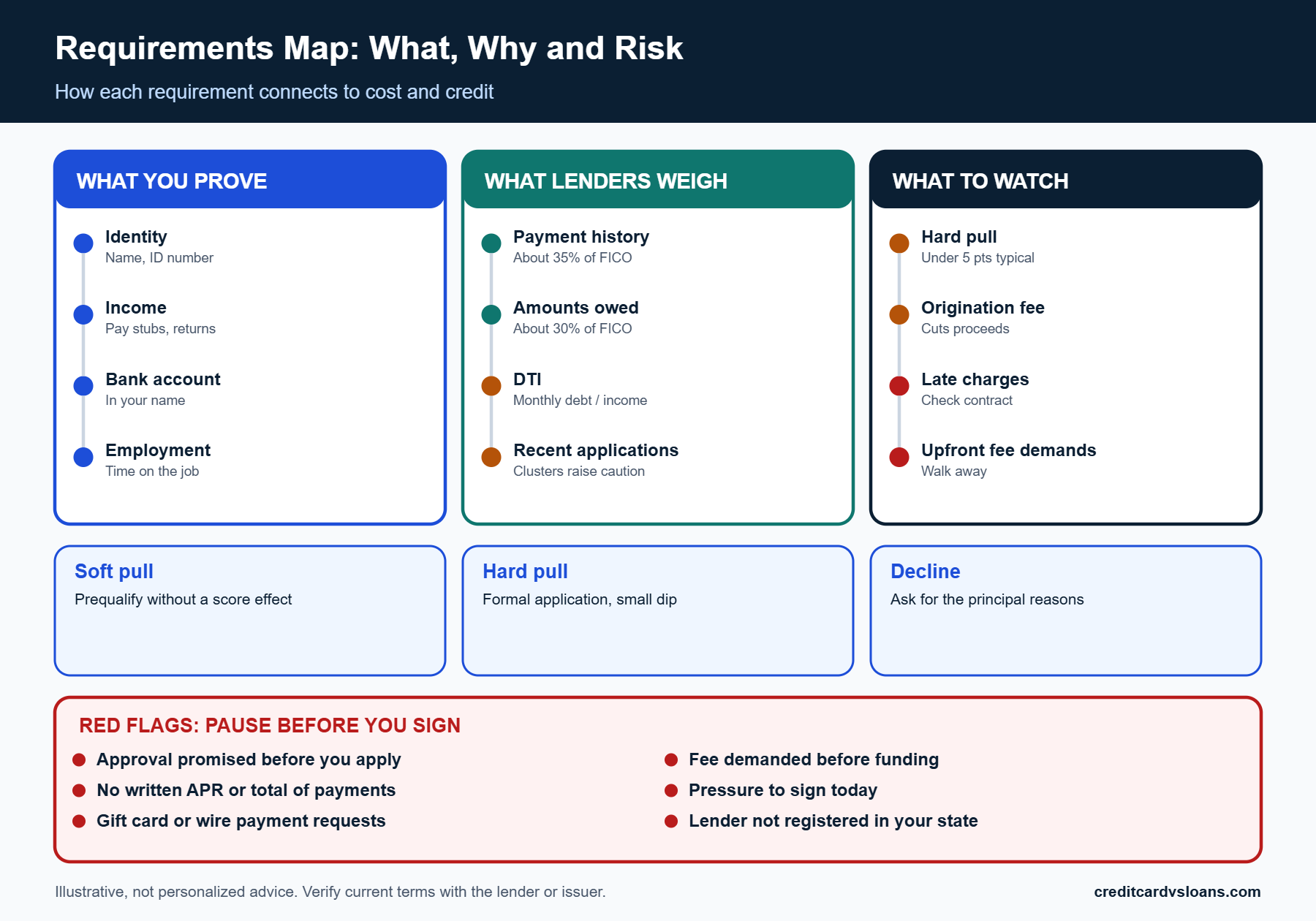
The FTC warns that legitimate lenders will not promise or assure you a loan before you apply, and that being asked to pay for insurance, processing or paperwork before funds are released is a cue to walk away. Ads promising credit regardless of history are a common warning sign.
Confirm the lender is registered in your state and avoid payments by gift card, wire transfer or cryptocurrency. A real requirement never includes paying a stranger to approve your loan.
Checking whether you need the loan at all
If you are struggling to meet the requirements, ask whether the need can be met another way: negotiating a payment plan, trimming the expense, borrowing a smaller amount or waiting until your file is stronger. Every dollar you do not borrow is a dollar you do not pay interest on, and not borrowing never triggers an inquiry.
Being careful with promises of easy qualification
Offers that advertise no credit check, assured approval or instant cash with no requirements deserve extra suspicion. Real lenders have requirements because lending involves risk, and the cost of a loan that skips them is usually passed to you through high fees or rates. Read the full terms, compare the APR and walk away if the numbers do not make sense.
Documenting your plan before you borrow
Write down the purpose of the loan, the amount, the payment you can afford and the date you expect to be debt-free. That one page forces clarity about whether the loan fits your budget and gives you a standard against which to judge each offer. It also helps if you later need to explain your situation to a lender or a counselor.
Include the fallback: what you will do if income drops for a few months. A plan with a fallback is more resilient than one that depends on everything going right, and lenders look for the same resilience when they review your income and expenses.
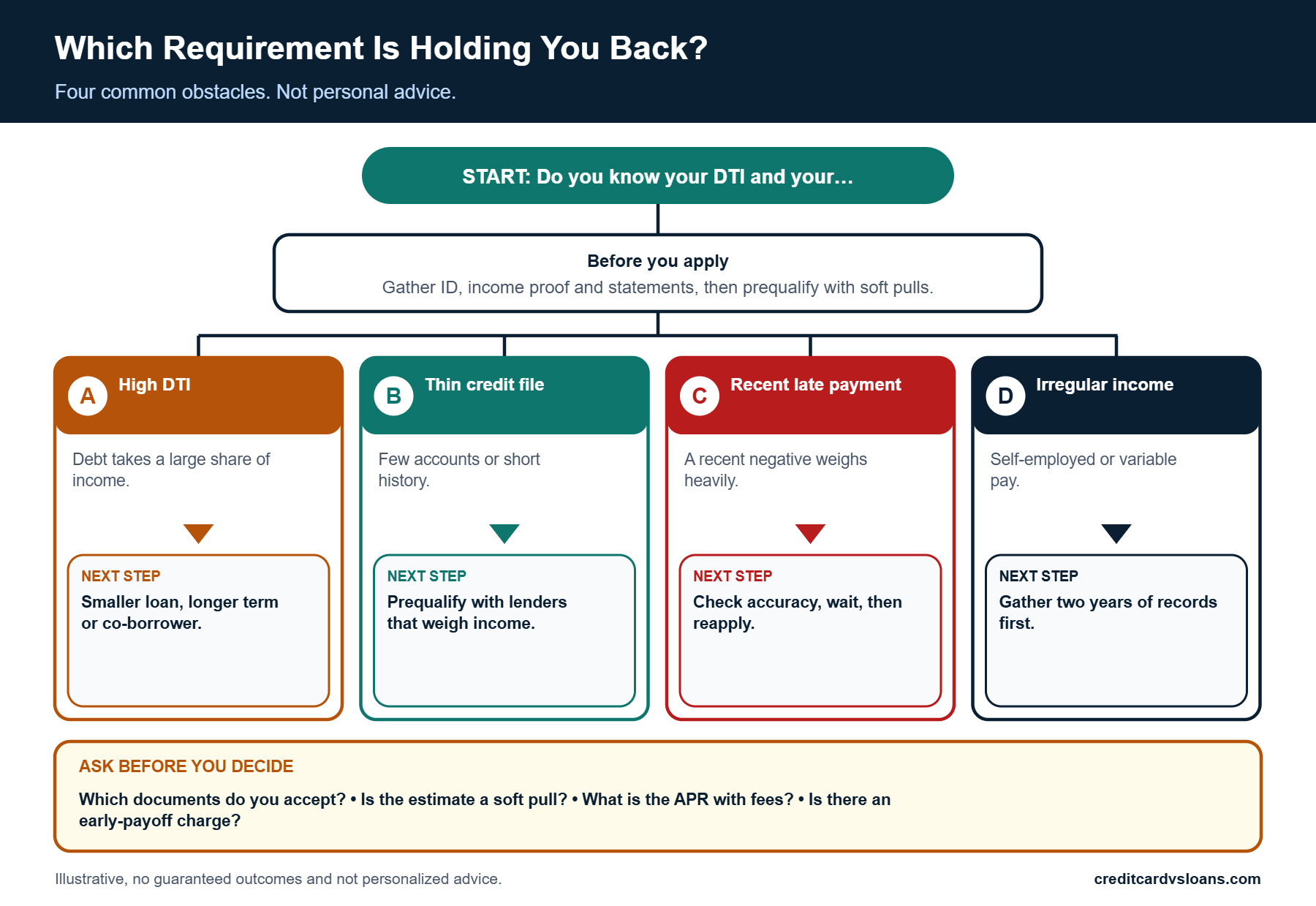
Decision Matrix: Which Requirement Is Holding You Back?
Matching Your Situation to a Next Step
How to use the matrix
Most declines trace to one or two requirements, not all of them. The matrix below pairs common obstacles with a path to consider. It is a way to organize your next move, not personal advice, and the right step depends on your documents, your reports and the lender’s own rules.
| Obstacle | Path to investigate | Why | What to verify | When to avoid |
|---|---|---|---|---|
| High debt-to-income ratio | Smaller loan, longer term or co-borrower | Lowers payment and the ratio | Total cost and the co-borrower’s liability | If total cost balloons |
| Low or mid-range credit score | Prequalify with several lenders; fix report errors | Lenders weigh scores differently | Soft-pull wording, APR and fees | If every offer has an APR you cannot afford |
| Thin credit file | Lenders that weigh income and employment | Few accounts can understate reliability | Whether payments are reported to the bureaus | If the loan carries unusual fees |
| Irregular or self-employed income | Gather two years of records first | Documentation drives verification | Which documents each lender accepts | If you cannot document income |
| Recent late payment or collection | Wait, correct errors, then reapply | Recent negatives weigh heavily | Accuracy and dates on the report | If you are tempted to apply to many lenders |
Reading the matrix honestly
If more than one row applies to you, start with the one you can fix fastest at the lowest cost, which is often correcting a report error or lowering a revolving balance. Changing a credit score takes time and no one can promise the outcome, so build a plan around actions you control.
When requirements differ for debt payoff
If you are applying for a loan to pay off other debts, lenders may look at the same requirements, and you should also compare the cost against your current debts. The trade-offs are covered in our guide to personal loans for debt consolidation, including when a payoff loan can save money and when it cannot.
If the lender asks for more
A request for additional documents is not a decline. It often means the lender is verifying income, employment or identity. Respond with exactly what is asked, keep copies and note the date. If the request seems unusual, such as a demand for payment, verify that the request is from the lender and not from an impersonator.
A Pre-Application Readiness Check
Documents to gather
Collect your identification, recent pay stubs or income records, tax returns if you are self-employed, recent bank statements and a list of your monthly debts with their payments. Having them ready speeds up verification and reduces the chance of an error that leads to a delay or a decline.
Also write down your current balances on credit cards and loans so you can estimate DTI and spot anything that does not match your reports.
Numbers to know
Before applying, know your approximate credit score range, your DTI before and after the new payment, the amount you need, the term you can afford and the highest APR you would accept. When you compare lenders, use the approach in our guide to comparing personal loan offers so you are measuring the same things.
If your DTI after the new payment is above what you are comfortable with, consider adjusting the request before a lender does it for you.
Keep the long view
A single decline is not a permanent judgment. Requirements are snapshots of your file on a given day, and files change as balances fall, errors are fixed and on-time payments accumulate. Treat each application as information.
Bottom Line and Next Steps
What Lenders Really Want
Proof you can repay, not perfection
Personal loan requirements come down to three questions: are you who you say you are, can your income support the payment and do you have a record of repaying debt? Documents answer the first two and your credit reports answer the third. A weakness in one area can sometimes be balanced by strength in another, but not always, and every lender draws the line differently.
That is why a decline at one lender does not predict the outcome at another, and why prequalifying with several is more informative than guessing.
When to wait
If you were recently late on a payment, if your reports contain errors you have not disputed or if your DTI would be very high after the new payment, waiting and fixing may beat applying now. If the need is urgent, ask about smaller loans, credit union options or payment plans first, and be wary of anyone who asks for money before funding.
Questions to ask any lender
Ask which documents are required, whether the estimate uses a soft pull, what the minimum and maximum loan amounts are, whether there is an origination fee, whether early payoff carries a charge and whether payments are reported to the credit bureaus. Get the answers in writing where you can.
A lender that answers clearly and promptly is easier to trust than one that avoids specifics.
Revisit your plan in a few months
If you decide to wait, set a date to review your reports, your DTI and your income documents again. Small improvements add up, and so does time since a past problem. When you return, repeat the prequalification step and compare offers using the comparison method.
Your Next-Step List
Before you apply
- Request your credit reports and dispute any errors.
- Compute your DTI before and after the new payment.
- Gather identification, income documents and bank statements.
- Check each lender’s eligibility page for its published requirements.
While you apply
- Prequalify with lenders that confirm a soft pull.
- Compare APR, fees, term and total of payments side by side.
- Submit formal applications only for offers you would accept.
- If declined, ask for the principal reasons and address them before trying again.
- CFPB: What is a credit score?
- CFPB: What is a debt-to-income ratio?
- CFPB: What is a hard credit inquiry?
- CFPB: What is APR?
- Federal Reserve: Consumer Credit – G.19 (release of October 7, 2026)
- eCFR: 12 CFR 1026.18 Content of disclosures (Regulation Z)
- FTC: What To Know About Advance-Fee Loans
- FTC: FTC press release on Equal Credit Opportunity Act and Regulation B enforcement (October 20, 1997)
- myFICO: What is in my FICO Scores?
- myFICO: How to rate shop and minimize the impact to your FICO Scores
Last updated: October 22, 2026. Rates, fees and lender rules change; verify current terms before acting.
The information on creditcardvsloans.com is provided for general educational and informational purposes only. It is not financial, legal, tax, credit, accounting or investment advice, and reading it does not create an advisor-client, fiduciary or any other professional relationship. Nothing here is an offer, solicitation or recommendation to borrow, lend or apply for any product.
Credit scores, interest rates, fees, eligibility rules, lender policies and laws change frequently and vary by lender, location and individual circumstances. Examples, figures and scenarios are illustrative only, do not predict your results and do not guarantee approval, savings, a particular rate or a credit-score outcome. Always confirm current terms directly with the lender or issuer and read the full agreement before you apply or sign.
Although we aim for accuracy and use reputable sources, we make no representations or warranties, express or implied, about the completeness, accuracy, reliability or timeliness of the content. Content may be drafted with the assistance of automated tools, so errors or omissions may still occur. Links to third-party sites are provided for convenience; we don’t control and aren’t responsible for their content.
To the fullest extent permitted by law, creditcardvsloans.com and its owners, editors, authors, contributors and affiliates disclaim all liability for any loss, damage or expense arising directly or indirectly from your use of, or reliance on, this content. Before making financial decisions, consult a licensed professional, such as a qualified financial advisor, attorney, tax professional or nonprofit credit counselor, who can consider your complete situation.