An annual fee vs no annual fee credit card comes down to one question: will the card put more value in your pocket than the fee takes out, after you account for how you actually pay your bill? For many households a no-fee card is the safer default, and a fee card earns its place only when your spending or your use of its perks clearly outruns the yearly charge.
That sounds simple, but the numbers are easy to get wrong. Issuers advertise sign-up bonuses, statement credits and point multipliers, and those features are real. They are also conditional: you have to spend in the right categories, use the credits, redeem points sensibly and, above all, avoid carrying a balance that costs more in interest than the rewards are worth.
This guide is about the choice between the two card types, not about any one product. It walks through how annual fees are disclosed and capped, what the fee buys, how to run a break-even test with illustrative numbers, what each path does to your credit file, and how to match a card to a spending pattern. Where a rule comes from federal regulation or Federal Reserve data, the source is named so you can read it yourself.
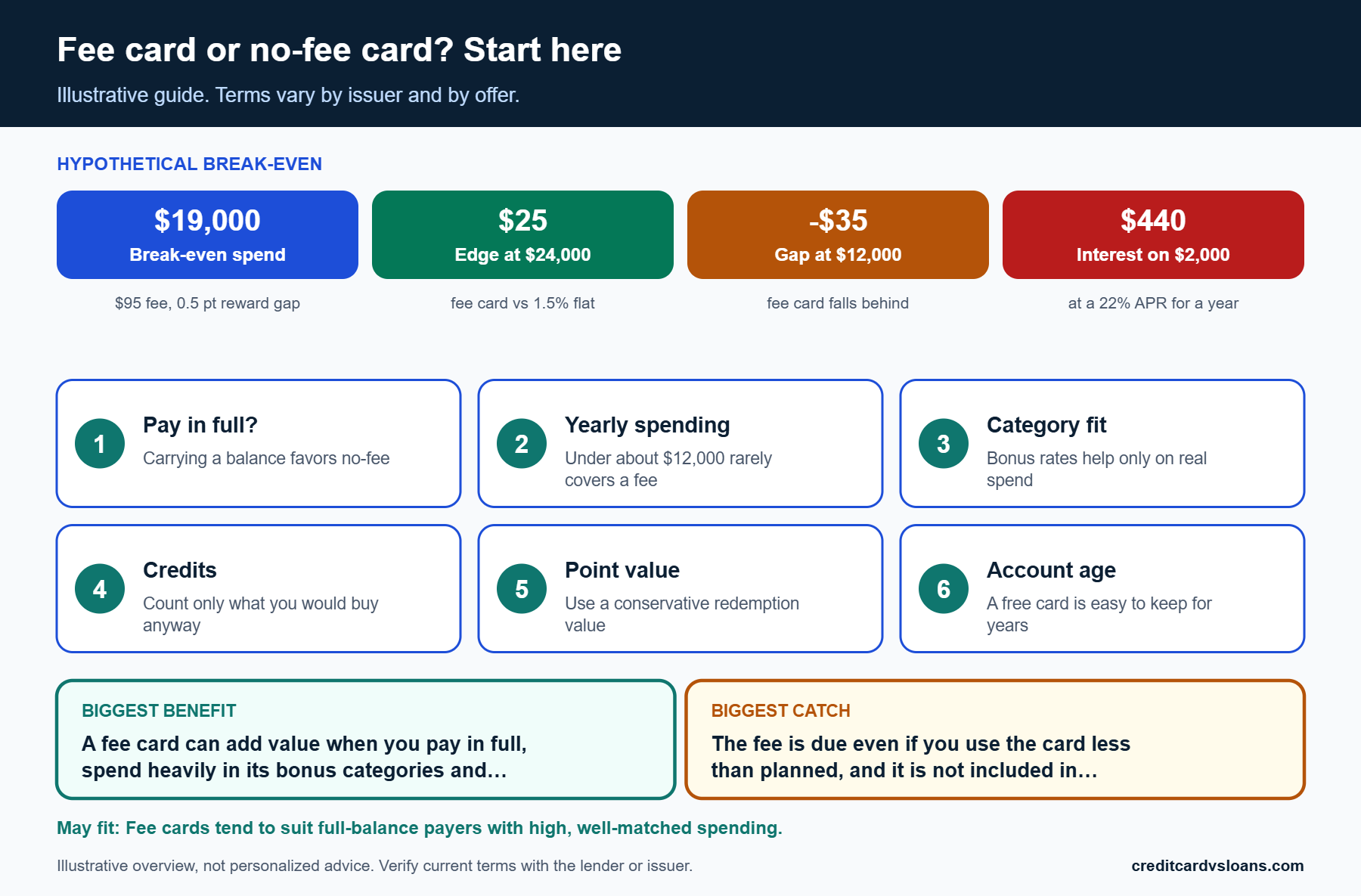
- A fee card wins only when its extra rewards and perks you will really use exceed the fee. In the hypothetical example below, a $95 fee needs roughly $19,000 of yearly spending to beat a 1.5% flat-rate no-fee card.
- Interest dwarfs rewards. A balance of $2,000 carried at a 22% APR costs about $440 a year, which can exceed what a card earns in rewards over the same year.
- The annual fee is not part of the APR. Federal rules treat it as a participation charge, so you must weigh it separately from the interest rate.
- A no-fee card you keep open can quietly help your credit history, while a fee card you cancel after one year may not.
- Credits only count if you would have bought the thing anyway. A $200 credit you ignore is worth $0.
Rate figures in this article are dated. The Federal Reserve’s G.19 release of Oct. 7, 2026 reported an average of 22.36% on credit card accounts assessed interest at commercial banks for August 2026 (preliminary). Individual offers vary widely, so check the terms on any card you are considering. For the wider rate picture, see our October 2026 rate outlook.
Table of contents
Annual Fee vs No Annual Fee Credit Card: The Short Answer
Who usually comes out ahead with a no-fee card
If you sometimes carry a balance
If there is any month when you pay less than the full statement balance, a no-fee card is usually the better fit. Interest on a revolving balance is charged on top of whatever you paid for the card, and card interest rates are high. The Federal Reserve’s G.19 release of Oct. 7, 2026 shows an average of 22.36% for accounts that were assessed interest at commercial banks in August 2026 (preliminary).
At that kind of rate, paying a fee for extra rewards is a lopsided bet. Each $1,000 left on the card for a year adds roughly $220 in interest, so the extra rewards from a premium card are quickly erased. If a balance is already in the picture, a lower rate or a payoff plan matters more than the rewards tier, and the broader card-versus-personal-loan comparison is a better place to start.
If your yearly spending is modest
Fee cards are built around volume. When a household puts only $6,000 to $12,000 a year on a card, there is simply not enough spending to generate rewards that cover a fee, even a modest one. A flat-rate no-fee card that returns the same percentage on everything is hard to beat at that level.
That does not mean modest spenders should ignore rewards. It means the comparison should be made on cents per dollar spent, with no fee in the way. A no-fee card that returns 1% to 2% on everyday purchases often delivers more net value than a fee card used lightly, and it asks nothing of you in return.
Who can justify paying an annual fee
If you pay in full and spend heavily in bonus categories
People who pay the statement balance in full every month, and who concentrate large purchases in categories where a card pays elevated rewards, are the group most likely to net a gain after the fee. The key word is concentrate. A card that pays three times on dining only helps if dining is a big slice of your budget.
Run the arithmetic on your own twelve months of statements, not on a sales page. If the extra rewards over your best no-fee alternative exceed the fee by a comfortable margin, the fee is paying for itself. If it is a near tie, the no-fee card usually wins because it carries less risk and less to keep track of.
If you would use the perks without changing your habits
Some fee cards bundle statement credits, travel protections, lounge access or purchase coverage. These have value only when they replace money you would have spent anyway. A dining credit helps if you already eat out; it is a net loss if it nudges you to spend $200 you would otherwise have saved.
A useful test is to list each benefit and mark it as “would have paid for this anyway” or “would not have”. Only the first group counts toward the fee. We build this into the break-even tables later, and the seasonal spending comparison shows the same discipline applied to a one-time spending spike.
How Annual Fees Work and Where They Hide
How the fee is disclosed, billed and capped
What the card agreement must show
Credit card applications and account-opening documents are required to show the annual fee in a standardized summary table, often called the Schumer box, alongside APRs and other charges. The fee is generally a fixed dollar amount, billed once a year on the account anniversary, though some issuers bill it in monthly installments. Whether it is billed in advance or after the first statement period varies by issuer.
Because terms differ, the safest move is to read the table on the specific offer, not a summary elsewhere. Look for the amount, when it first posts, and whether it is waived for the first year. A waived first-year fee still arrives in year two, which is the moment to decide whether to keep the card.
The first-year fee cap
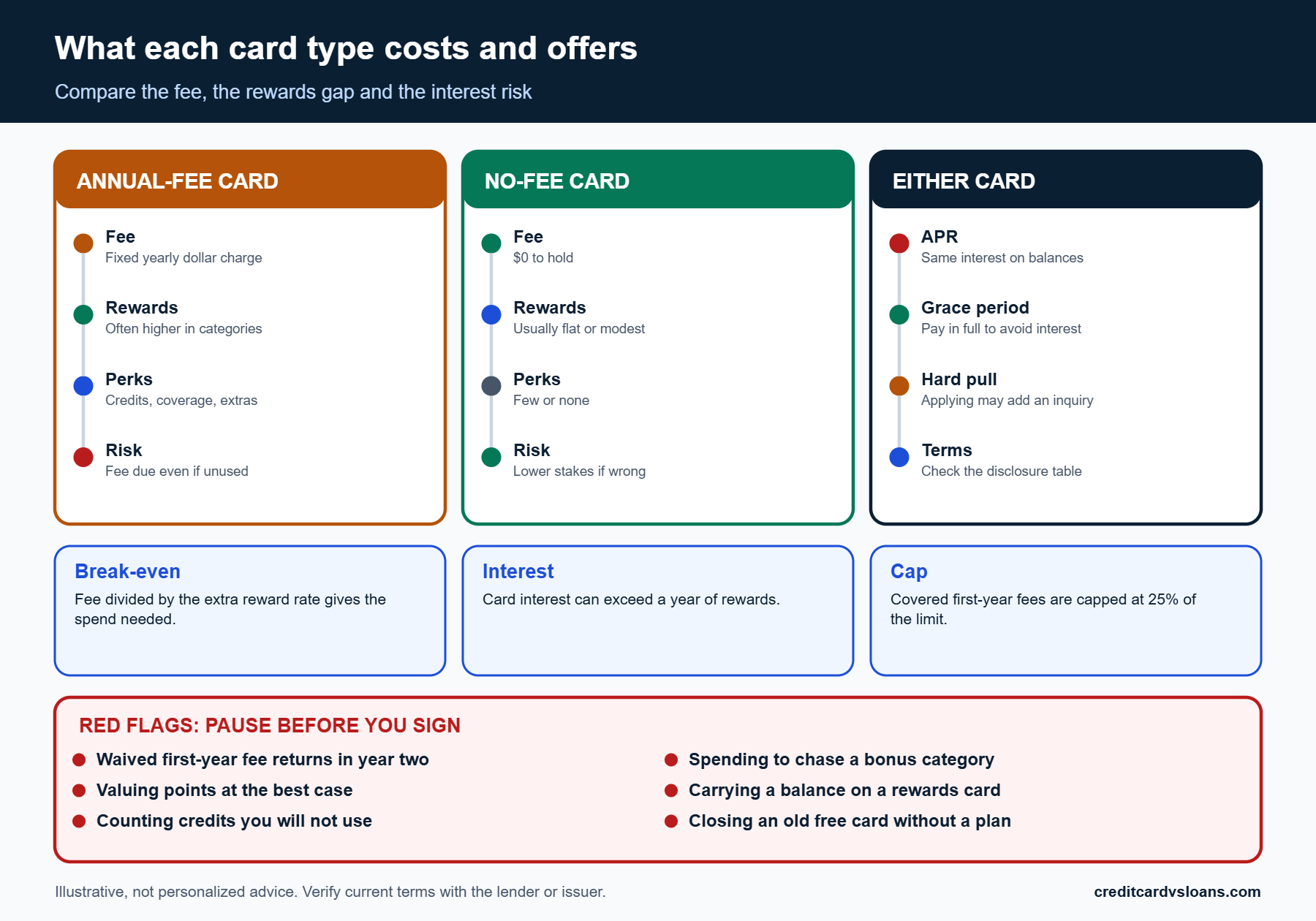
Under Regulation Z, the total of most fees a consumer must pay during the first year after a credit card account is opened generally cannot exceed 25% of the credit limit at opening. That cap covers fees for issuing or making credit available, annual fees included, along with several other charges. Late fees, over-the-limit fees and returned-payment fees fall outside this cap, as do interest charges and optional services you chose.
The practical effect is most visible on cards for people with limited credit, where a low starting limit and a high fee can collide. A $2,000 limit, for example, would cap covered first-year fees at $500. The rule is on the CFPB’s site at 12 CFR 1026.52; it does not make a high fee a good deal, only a bounded one.
What the fee is not
The annual fee is not part of the APR
This catches many shoppers. For open-end credit such as a credit card, Regulation Z treats an annual or membership fee as a participation charge that is excluded from the finance charge, and the official commentary on the APR rules says charges for opening, renewing or continuing an account are left out of the APR calculation. In plain terms, a card with a $95 fee and a 22% APR does not have a “22.5% APR”. It has a 22% APR and a separate $95 charge.
That is why a fee card and a no-fee card cannot be compared on APR alone. You have to add the fee to your cost column yourself, which the break-even tables later in this article do. The related difference with installment loans is covered in our look at 0% APR cards versus personal loans.
The fee is not a prepayment you can offset with interest savings
Some readers assume a fee card may carry a lower rate to compensate. Sometimes it does, but there is no rule linking the two, and many premium cards carry rates at or above the market average. The fee buys access to features; it does not buy cheaper borrowing.
If lower borrowing cost is your goal, compare ongoing APRs directly and consider cards designed for low rates or introductory periods, as discussed in 0% intro APR versus a low ongoing APR. Treat the annual fee as the price of rewards and perks, and treat the APR as the price of borrowing. Mixing the two leads to expensive mistakes.
What the Fee Buys and What You Give Up
Features that can offset a fee
Higher earning rates in categories you really use
The most common reason to pay a fee is a higher rewards rate. A card might pay a larger percentage on groceries, dining, gas or travel than a flat-rate no-fee card pays on everything. The gain is the difference between the two rates multiplied by the dollars you put in those categories, not the headline multiplier.
Be honest about your mix. If half your spending falls outside the bonus categories, that half earns the base rate, which on many fee cards is no better than a no-fee card’s flat rate. Blend the rates by your real budget before you decide the fee card is “earning” more.
Credits, protections and one-time bonuses
Fee cards often add statement credits, extended purchase coverage, travel insurance, rental-car coverage or lounge access. Treat each as a coupon with a price tag: its value to you equals what you would have paid for the same thing yourself, if you would have bought it at all. A sign-up bonus can also cover several years of fees, but it is a one-time event and the minimum spending needed to earn it should not push you into buying things you do not need.
Terms differ by issuer and change over time, so use the current disclosure rather than memory. If a benefit requires enrolling, activating or booking through a particular portal, count it only if you will do that every year.
What a no-fee card offers instead
Simplicity and a low cost of being wrong
A no-fee card has an enviable property: if you misjudge how much you will use it, you lose nothing. There is no fee to recoup, no credit to remember, no category cap to track. For many people the winning strategy is a flat-rate no-fee card used for everything, with autopay set to the full statement balance.
That simplicity also guards against the common failure mode of fee cards: slowly drifting away from the use pattern that justified the fee. When a life change cuts your spending, a no-fee card keeps working and a fee card keeps charging.
A long-lived account that costs nothing to keep
Credit scoring models consider how long your accounts have been open, and the average age of your accounts is part of that picture. A no-fee card that you keep open and use for a small recurring charge can sit in your file for years without cost. A fee card you would only keep if it paid for itself is a harder account to hold long-term, so people sometimes close it, which can shorten the history you carry.
That is one reason an older no-fee card is worth keeping even when a newer card is more rewarding. Another reason is practical: if you ever need a backup card, you already have one. For readers building a file from scratch, the card is also a simple tool, and the card-versus-loan guide explains where it fits next to installment credit.
| Feature | Annual-fee card | No-annual-fee card |
|---|---|---|
| Yearly cost to hold | Fixed dollar fee, due whether or not you use the card | $0 |
| Rewards upside | Often higher in bonus categories | Usually a flat or modest rate |
| Perks and credits | Can add value if you would use them anyway | Few or none |
| Cost of misjudging your spending | You still pay the fee | Nothing lost |
| Fit when you carry a balance | Weak: interest can swamp rewards | Better, though interest is still costly |
| Keeping it open long term | Requires the card to keep paying for itself | Easy to keep at no cost |
The Real Cost: Break-Even Math and Interest
Break-even spending on illustrative numbers
The formula in plain English
The break-even test is short. Divide the annual fee by the extra rewards rate the fee card pays compared with your best no-fee alternative. The result is the yearly spending at which the fee card merely ties. Above it, the fee card pulls ahead; below it, the no-fee card wins.
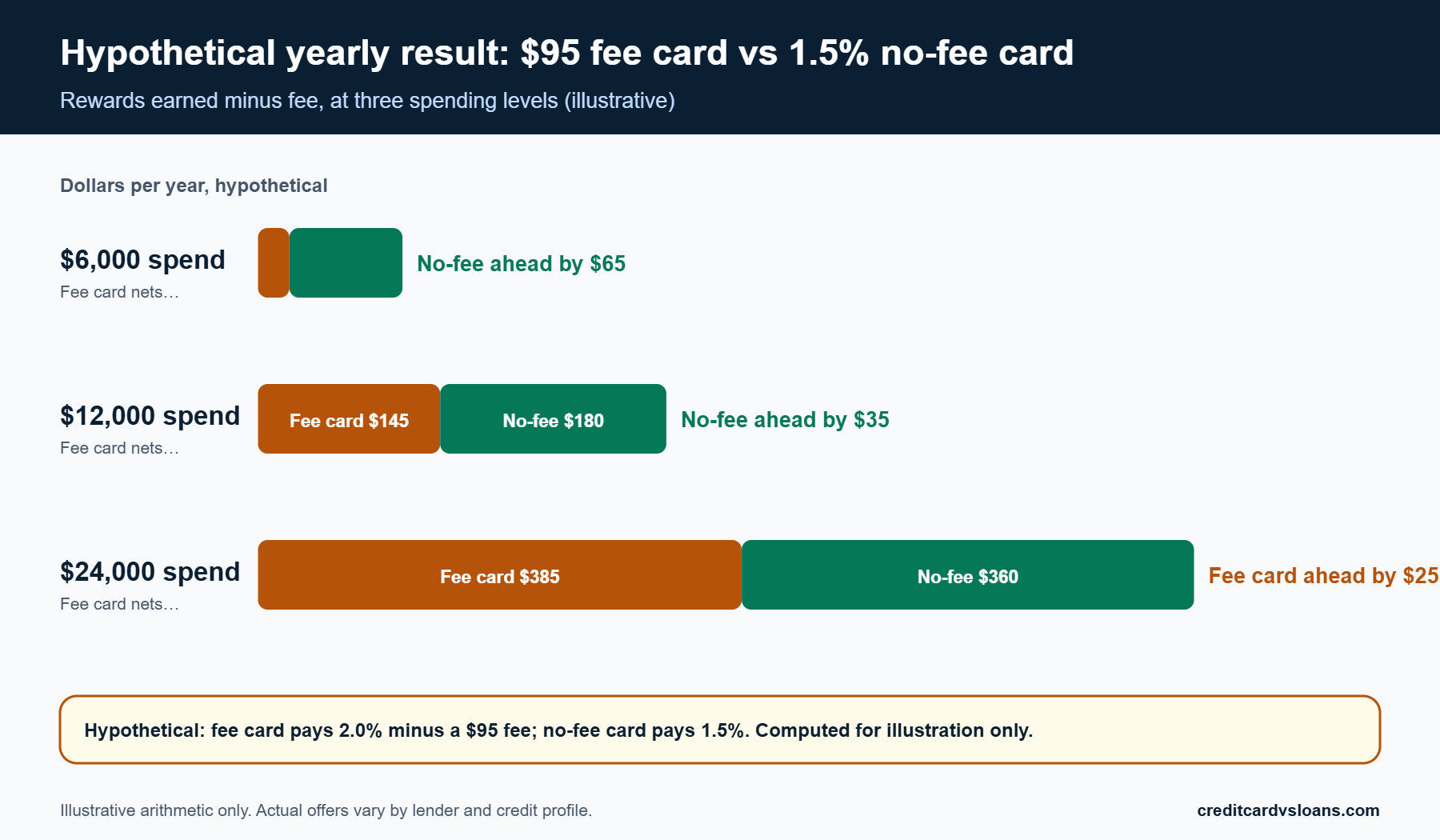
For example, take a hypothetical $95 fee card that pays 2.0% on everything and a hypothetical no-fee card that pays 1.5% on everything. The gap is 0.5 percentage points, so $95 divided by 0.005 equals $19,000. At $24,000 of annual spending the fee card ends up $25 ahead (2.0% of $24,000 is $480, less $95, is $385, against $360 on the no-fee card). At $12,000 it is $35 behind. These figures are illustrative and were computed for this article; they are not offers.
How the break-even moves with the fee and the gap
The table below holds the same logic across three fee levels and three reward gaps. Notice how quickly the required spending grows when the fee rises and the gap stays small. A premium fee card with only a one-point edge needs more than $50,000 of yearly spending to break even on earning alone, which is why such cards lean on credits and perks to justify themselves.
If your actual spending sits well below the figure for your row, the fee must be justified by perks you would have bought anyway. If it sits comfortably above, the fee card is earning its keep.
| Annual fee | Gap of 0.5 pt | Gap of 1.0 pt | Gap of 1.5 pts |
|---|---|---|---|
| $95 | $19,000 | $9,500 | $6,333 |
| $250 | $50,000 | $25,000 | $16,667 |
| $550 | $110,000 | $55,000 | $36,667 |
When interest changes the answer
Interest on a carried balance dwarfs the rewards gap
Everything above assumes you pay in full. Once you carry a balance, the comparison changes because interest accrues on the unpaid amount. At an illustrative 22% APR, an average carried balance of $2,000 costs about $440 a year in interest, using simple annual math. That is far larger than the $25 edge the hypothetical fee card produced at $24,000 of spending.
The lesson is not that rewards cards are bad, but that rewards and revolving balances do not mix. If a balance is the real issue, the right tool is a payoff plan, and options like those compared in the 0% APR card versus personal loan guide address that directly.
| Average balance carried | Approximate yearly interest | Compared with a $25 net rewards edge |
|---|---|---|
| $500 | $110 | About 4 times larger |
| $1,000 | $220 | About 9 times larger |
| $2,000 | $440 | About 18 times larger |
| $3,000 | $660 | About 26 times larger |
Protect the grace period
The CFPB explains that a grace period is the time between the end of a billing cycle and the payment due date, and that paying the full balance by the due date generally means you owe no interest on new purchases. Issuers are not required to offer one, though most do for purchases. If you do not pay in full, interest generally applies to the unpaid amount and new purchases begin accruing interest from the day they are made, and paying in full only some months can cost you the grace period for the following month too.
That is the hidden cost of a rewards habit: one month of carrying a balance can remove the interest-free window for the next cycle. If you are not certain you will pay in full every month, take the no-fee card with the simpler terms.
Credit Score and Account Management
How opening and holding each type can affect your credit
The application and the new account
Applying for either type of card usually triggers a hard pull, which is a credit inquiry that can appear on your report and may have a small, temporary effect on scores for some people. Prequalification tools that use a soft pull do not affect your credit, but they also do not guarantee approval or the terms you will see on a final offer. How much any single inquiry matters depends on the rest of your file, including a thin credit file or a history of recent applications.
A new account also lowers the average age of your accounts at first. That effect is the same for a fee card and a no-fee card, so it should not tip the decision between them. What should tip it is whether you plan to hold the account for many years.
Utilization and limits
Your credit utilization, the share of your available revolving credit that you are using, is one factor scoring models consider. A higher limit on a fee card can lower utilization if you keep spending steady, but the same is true of a no-fee card with an equal limit. The fee itself does not change utilization unless it is billed to the card and left unpaid.
The first-year fee cap discussed earlier matters here. On a low starting limit, covered fees in the first year can only reach 25% of that limit, but a fee billed to a small limit can still consume a large share of it and push your reported utilization up. If you accept a card with a high fee and a low limit, pay the fee promptly and keep an eye on the statement balance date.
Closing, downgrading and product changes
What happens when you cancel a fee card
Closing a card removes its limit from your total available credit, which can raise your utilization if you carry balances elsewhere. The account may stay on your report for years, but its future activity ends. Whether the fee is refunded after you cancel is up to the issuer’s terms, so read the agreement and ask before the next billing date, not after it.
If you only want to stop paying the fee, ask whether the issuer offers a product change to a no-fee version of the same card. A change can preserve the account history and limit, though availability and terms vary and an issuer is not obliged to agree. Do this before the fee posts, not after.
The retention conversation
Some issuers will offer a statement credit, bonus points or a waived fee to keep a customer who calls to cancel. These offers are discretionary and change over time, so do not count on one when you do the math. Treat any retention offer as a small bonus, never as the reason a card earns its place.
If the offer improves the card’s net value above the no-fee alternative, keep it. If not, switch. Pair this decision with a look at your whole card lineup so you do not end up with several fee cards that overlap. The same discipline applies to cards you opened for seasonal spending, a case covered in the back-to-school spending comparison.
Risks and Traps to Watch For
Cost traps in the fine print
Fees that return after a free first year
A waived first-year fee is a promotional feature, and the fee typically begins to apply in the following year. The charge can show up on a statement you are not expecting, and if the card has become a drawer card, you are paying for nothing. Put a reminder on your calendar a month before the anniversary.
It also helps to check how the fee is billed. A fee charged in installments is easy to overlook, and paying it from a checking account by autopay can hide it from your day-to-day budget. Add it to your annual spending sheet.
Rate changes, penalty terms and variable APRs
Regulation Z limits when a card issuer can raise rates or fees on existing balances. Generally an increase is allowed when a promotional period of at least six months ends, when a variable rate rises with its public index, when advance notice is given and the change affects new transactions only, or when you are more than 60 days late on a required payment. Those limits do not stop the rate on new purchases from changing after notice, so a card that looked affordable at opening can become more expensive.
The full rule is at 12 CFR 1026.55. The takeaway for this decision is that the fee is only one of several terms to compare, and a rate that is variable can rise even if the fee does not.
Behavioral traps
Spending more to chase the rewards
A bonus category or a spending threshold can tempt people to buy things they would not otherwise buy. If a card gives 3% back and you spend an extra $500 to earn $15, you have spent $485 more than you needed to. Rewards are a discount on spending you already planned, not a reason to plan more.
The same applies to sign-up bonuses that require a minimum spend within a few months. Set the bonus aside in the math unless the required spending matches purchases you were going to make anyway.
Over-valuing points and miles
Points and miles are worth different amounts depending on how you redeem them. A point redeemed for cash back may be worth one cent, while a point used for a certain travel booking may be worth more or less. The value you assign in your head is often higher than what you realize, so use the lowest realistic redemption value when you test a fee card.
The more conservative your estimate, the more reliable the result. If the card still beats the no-fee option at a low value, it is a strong choice. If it only works at an optimistic value, the no-fee card is the safer decision. If you borrow rather than pay in full, the cost comparison in our 0% APR card versus personal loan guide shows what interest does to any rewards math.
Matching a Card to Your Spending Pattern
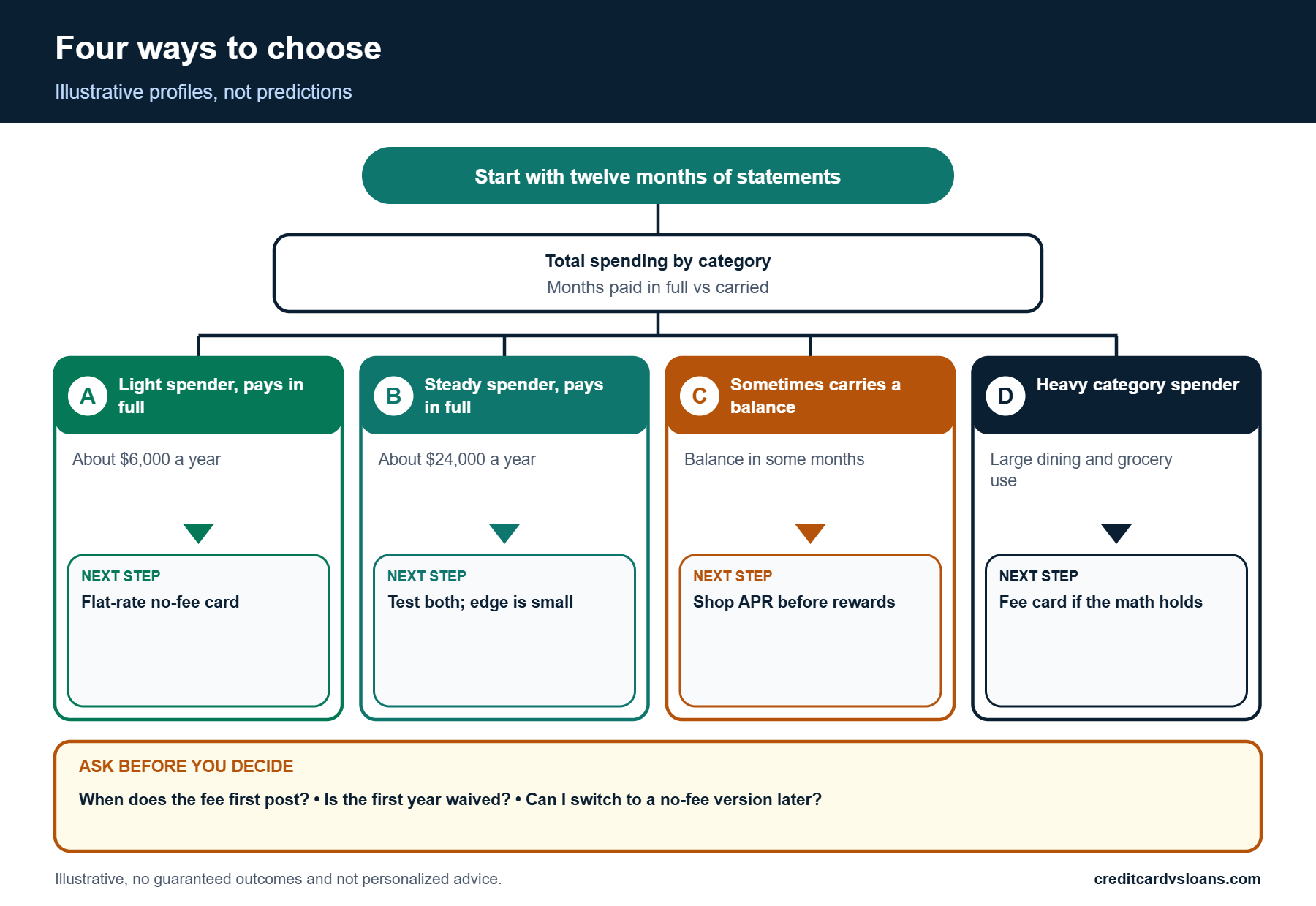
Four illustrative profiles
The occasional user and the steady flat-rate spender
Someone who charges $500 a month on a single card and pays it in full is near the $6,000 line, where even a modest fee needs a large rewards edge. A flat-rate no-fee card is generally the right match. The steady spender who puts $2,000 a month on the card and pays in full is closer to the $24,000 mark, where a low-fee card with a modest edge can show a small gain, but only just.
The gain at that level is small enough that preference matters: some people value one card for everything, and others want the extra few dollars. Both are reasonable.
The category-heavy household and the balance-carrier
A household with large grocery and dining spending can come out ahead on a fee card with strong category rewards, but only if the base rate on the rest of its spending is competitive. Someone who often carries a balance should choose by APR and fees, not rewards, and should read the guide to low ongoing rates and 0% offers before applying.
Both illustrations are hypothetical and meant as thinking aids, not predictions. Your own statements are the data that matter.
A decision table
Using the table
The table sorts common situations into the type of card that tends to fit. It is a starting point for your own math. Terms vary by lender, and no table can tell you what you will be offered.
Use it to decide what to compare, then check real offers against your last twelve months of statements.
| Situation | Tends to fit | Why |
|---|---|---|
| Pays in full; spends under about $12,000 a year | No-fee card | Spending is too low to recoup most fees |
| Pays in full; spends $20,000+ with strong category fit | Either; test a fee card | A rewards edge may exceed the fee, but only slightly |
| Sometimes carries a balance | No-fee card, ideally a low-rate one | Interest outweighs rewards at typical card APRs |
| Thin credit file or low starting limit | No-fee card | A fee on a small limit eats available credit |
| Will use credits that replace planned spending | Fee card may fit | Only credits you would have bought anyway count |
| Wants to keep one account open for years | No-fee card | Costs nothing to hold |
When to revisit the choice
Reassess at each anniversary and after any big life change, such as a new job, a move or a child. A card that suited last year’s spending can be a poor fit when your budget shifts. Treat the decision as annual, not permanent.
Keep a one-page note with the fee date, your actual rewards earned and the credits you used. That record is what makes the next decision easy.
Questions Readers Ask Next
About bonuses and perks
Is a sign-up bonus a good enough reason to take a fee card?
It can be, with limits. A bonus is a one-time payment, so it improves the first year’s math and says nothing about year two. If the bonus covers the first fee and the card is also worth keeping at its ongoing fee, the bonus is a pleasant extra. If the card only works because of the bonus, plan to downgrade or close before the second fee posts.
Check the spending requirement and its deadline. The bonus is only worth taking if the required purchases are ones you were already going to make, and if you will pay the balance in full.
How should I value perks I might use?
Apply a probability. If a $200 credit has a coin-flip chance of being used, it is worth about $100 to you on average. If it requires an action you often forget, such as activating an offer, value it lower. This habit stops a long list of small benefits from making a fee look smaller than it is.
Perks that overlap with coverage you already have, such as travel insurance through another card, are worth little. Count only what is new to you.
About keeping and switching
Should I keep a no-fee card I rarely use?
Often yes, because it costs nothing and its age and limit stay in your file. Put one small recurring charge on it and set autopay so the issuer sees activity. Issuers can close inactive accounts under their own policies, so a light touch every few months helps, and a closure you did not choose can cut your available credit without warning.
If the card has a different fee structure than you remember, such as an inactivity fee, read the agreement. Those terms are uncommon on no-fee cards but not impossible.
What if I forgot and the fee posted?
Contact the issuer promptly and ask whether a refund or product change is possible. Policies vary by issuer and are discretionary, so do not assume a refund. Ask politely, have your account details ready and confirm any outcome in writing. If the card no longer fits, ask to move to a no-fee product rather than closing outright.
For next time, set a calendar reminder a month before the anniversary date and decide before the charge, not after it.
Checklist: Before You Apply, Keep or Cancel
Before you apply
Gather your real numbers first
Pull the last twelve months of card or bank statements and total your spending by category: groceries, dining, gas, travel, bills and everything else. Many issuers let you download this as a spreadsheet. Then note how many months you paid in full and how many you carried a balance, because that one fact decides which card type fits you.
Write down the fee, the base rewards rate, the bonus rates, the credits you would really use and the APR for each card you are considering. Convert every benefit to dollars using a conservative value, and ignore anything you would not buy on your own.
Read the disclosure table, not just the offer page
The standardized table on the application lists the purchase APR, the annual fee, penalty fees and other charges. Confirm when the fee first posts, whether the first year is waived, the regular APR range and what happens if you pay late. If an offer says “up to” or “as low as”, expect your actual terms to depend on your credit and the lender’s decision.
Prequalify with a soft pull when the issuer offers it, which avoids a hard pull while you shop. Remember that a prequalification message is not a guaranteed approval.
At renewal time
Run a one-page audit
Before the fee posts, compare what you earned and used against the fee. Count rewards at a conservative value and credits at the dollars you actually used. If the net result is clearly positive, keep the card. If it is negative or roughly zero, treat the fee as a cost you can avoid.
Note what changed. A new baby, a remote job or a car you no longer drive can move the numbers by hundreds of dollars. Reassessing annually keeps the fee tied to your life as it is now.
Decide: keep, change product or close
If the card still pays, keep it. If it nearly pays, call and ask whether there is a retention offer or a no-fee product change that keeps the account open. If it clearly does not pay, closing is reasonable, but check what the closure does to your total available credit and whether you carry balances elsewhere.
Whichever you choose, do it before the fee posts, keep a record of the conversation and confirm the result in writing or on your next statement.
Conclusion: Choose by Your Own Numbers
The decision rules in short
The default and the exception
The default for most households is a no-fee card, because it asks nothing of you and costs nothing if your life changes. The exception is the household that pays in full, spends heavily in the right categories and will use the perks it would have bought anyway. For that household, a fee card can add a modest amount of value, usually a small multiple of the fee at best.
In the hypothetical example, the fee card’s edge was $25 at $24,000 of spending. That is a reminder that the stakes are usually smaller than the marketing suggests, while the risk of carrying a balance is much larger.
What would change this advice
If you carry a balance, shop by APR and fees instead of rewards. If your spending jumps, rerun the break-even. If a card’s terms change, treat that as a new decision. Terms vary by lender, so the offer in front of you is the only one that matters.
For more on borrowing costs and the choice between cards and installment loans, read Credit Card vs. Personal Loan and the October 2026 rate outlook.
Your next steps
A short list for this week
- Download twelve months of statements and total your spending by category.
- Note how many months you paid in full. If any months were not, favor a no-fee or low-rate card.
- Write the fee, base rate, bonus rates, usable credits and APR for each candidate card.
- Compute the break-even spending by dividing the fee by the extra reward rate, using a conservative value for points.
- Compare that figure with your real spending and decide. When it is close, choose the no-fee card.
- Set a calendar reminder one month before any fee anniversary.
Where to read next
If you are weighing a card against a loan for a specific expense, see 0% APR card vs. personal loan and the spending comparison for back-to-school costs. If you want to compare promotional offers with steady low rates, 0% intro APR vs. low ongoing APR is the next stop.
The CFPB’s consumer tools at consumerfinance.gov are a good place to read about your rights as a cardholder.
- Credit Card and Personal Loan Rate Outlook: October 2026 Borrower Brief
- 0% APR Credit Card vs. Personal Loan: Which Is Cheaper?
- Credit Card vs. Personal Loan for Back-to-School Spending: Which Is Better?
- Credit Card vs. Personal Loan: Which Is Better for Borrowing?
- 0% Intro APR vs. Low Ongoing APR: Which Is Better Long Term?
- CFPB: 12 CFR 1026.52 Limitations on fees
- CFPB: 12 CFR 1026.4 Finance charge
- CFPB: 12 CFR 1026.14 Determination of annual percentage rate
- CFPB: 12 CFR 1026.55 Limitations on increasing annual percentage rates, fees and charges
- CFPB: What is a grace period for a credit card?
- Federal Reserve: Federal Reserve G.19 Consumer Credit (Oct. 7, 2026 release)
Last updated: October 22, 2026. Rates, fees and lender rules change; verify current terms before acting.
The information on creditcardvsloans.com is provided for general educational and informational purposes only. It is not financial, legal, tax, credit, accounting or investment advice, and reading it does not create an advisor-client, fiduciary or any other professional relationship. Nothing here is an offer, solicitation or recommendation to borrow, lend or apply for any product.
Credit scores, interest rates, fees, eligibility rules, lender policies and laws change frequently and vary by lender, location and individual circumstances. Examples, figures and scenarios are illustrative only, do not predict your results and do not guarantee approval, savings, a particular rate or a credit-score outcome. Always confirm current terms directly with the lender or issuer and read the full agreement before you apply or sign.
Although we aim for accuracy and use reputable sources, we make no representations or warranties, express or implied, about the completeness, accuracy, reliability or timeliness of the content. Content may be drafted with the assistance of automated tools, so errors or omissions may still occur. Links to third-party sites are provided for convenience; we don’t control and aren’t responsible for their content.
To the fullest extent permitted by law, creditcardvsloans.com and its owners, editors, authors, contributors and affiliates disclaim all liability for any loss, damage or expense arising directly or indirectly from your use of, or reliance on, this content. Before making financial decisions, consult a licensed professional, such as a qualified financial advisor, attorney, tax professional or nonprofit credit counselor, who can consider your complete situation.