A credit card is usually the better tool when you need flexible, short-term borrowing you can repay quickly, and a personal loan is usually the better tool when you need a fixed amount, a fixed payment and a firm payoff date. That is the core of the credit card vs personal loan decision, and the right pick still depends on the price you are actually offered, how fast you can repay and how much discipline the product demands from you.
Both products let you borrow without pledging a house or car, but they behave very differently after the money is in your hands. A card is a revolving line: you can keep borrowing, the minimum payment shrinks as the balance shrinks, and the interest rate is often high. A personal loan is an installment loan: you get one lump sum, repay it on a schedule, and the balance only goes down.
This guide stays on one question: which structure fits which borrowing job. For narrower questions, it points you to sibling guides, such as how a 0% APR card stacks up against a loan on cost and what credit score a personal loan usually requires. Nothing here is a lender offer, and nothing can promise you approval, a rate or a score change.
- Cards favor flexibility; personal loans favor structure. Neither is cheaper by default.
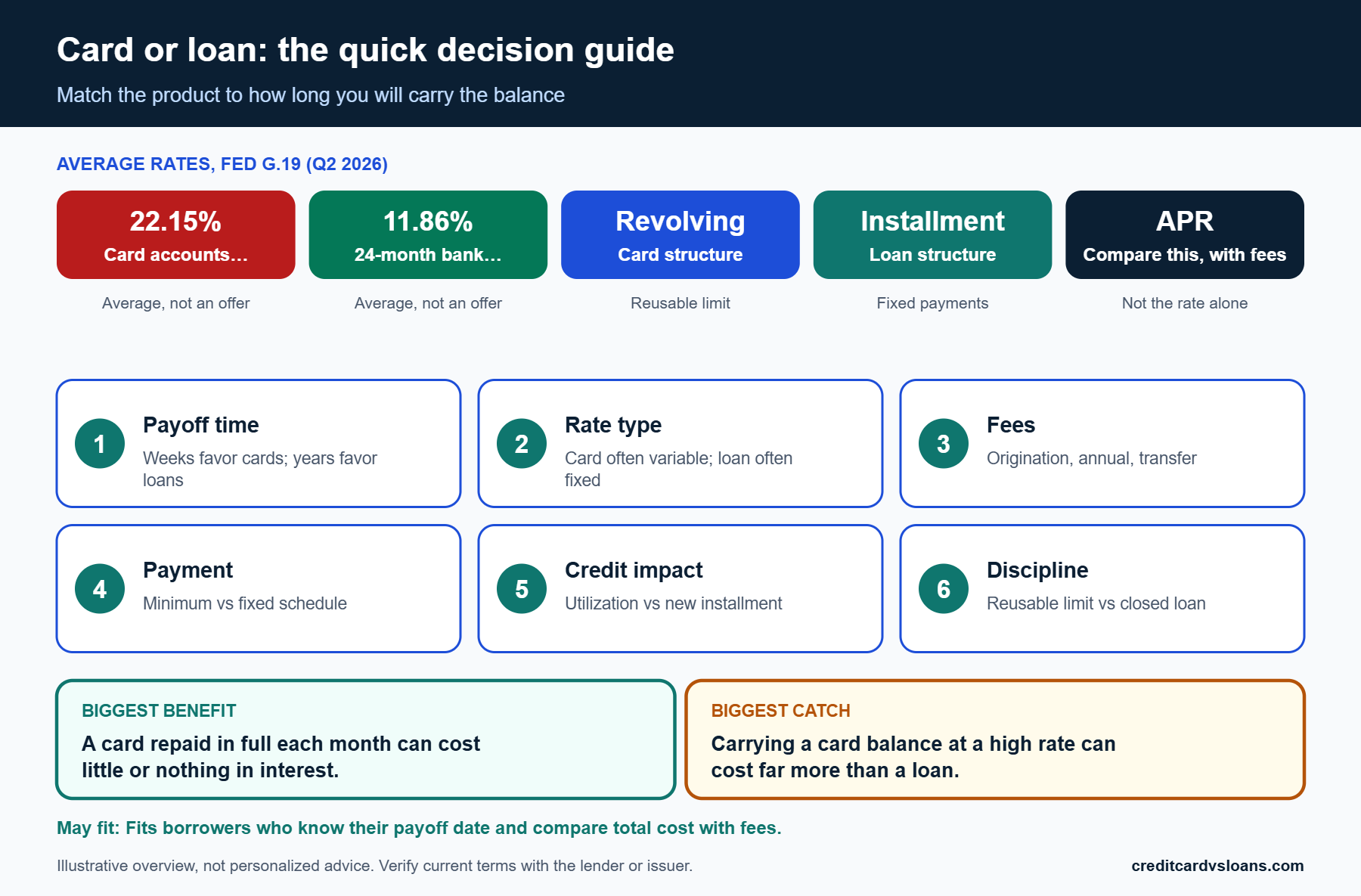
- The Federal Reserve's G.19 release of Sept. 8, 2026 reported an average 22.15% rate on credit card accounts assessed interest and 11.86% on 24-month commercial bank personal loans for Q2 2026. Those are averages, not offers you will see.
- Compare APR to APR, and add fees: origination fees on loans, annual fees and balance transfer fees on cards.
- A card balance that lingers at a high rate can cost far more than an installment loan with the same payment (see the hypothetical math below).
- Missing payments on either product can damage your credit and your options, so pick the one whose payment you can sustain.
Rate figures come from the Federal Reserve's G.19 Consumer Credit release dated Sept. 8, 2026. Individual offers change daily, so treat every number here as context and check live terms from lenders you are considering.
The Short Answer: Which Option Fits Which Borrowing Job
A quick verdict by situation
Choose the card when the balance will be gone soon
If you can pay off the amount within a few billing cycles, a credit card often costs little in interest, especially if you pay the statement balance in full and keep the grace period. In that case the high stated rate rarely matters because you are not carrying a balance long enough for it to bite. Cards also make sense when the spending is uncertain in size or timing, such as a repair that may come in several invoices.
Cards can also be the better fit when a promotional rate applies. A true 0% APR offer can beat any loan on interest if you pay it off before the promotion ends, a trade-off we cover in the 0% APR card vs personal loan comparison. Rewards and purchase protections are a bonus, but they only help if interest is not eating them.
Choose the loan when the debt will take a year or more
A personal loan tends to fit when the amount is large, the payoff will take many months, and you want the interest rate fixed up front. The fixed payment forces progress. Many people who carry a revolving balance for years do so because the minimum payment on a card quietly stretches the timeline, while a loan has an end date written into the contract.
Loans are also easier to budget around. You know the payment, the number of payments and, once the loan is funded, the total you will repay. If a lender charges an origination fee, which is a fee for processing the loan that is often deducted from the proceeds, factor it into the comparison instead of looking only at the monthly payment.
Choose neither if the payment already strains your budget
A hard truth sits underneath this comparison: borrowing more only helps if the payment is sustainable. If your income barely covers current bills, a new loan or a new card balance can turn a cash crunch into a long-term squeeze. In that case the CFPB and the FTC both point toward nonprofit credit counseling and direct talks with creditors before taking on new debt.
That does not mean you are out of options. It means the first question is not which product to use, but whether a smaller amount, a payment plan with the biller or a hardship arrangement would solve the problem without new borrowing. We cover warning signs in predatory lending red flags for the cases where desperation invites bad offers.
Where people go wrong when choosing
Comparing the monthly payment instead of total cost
The most common mistake is picking whichever option produces the lowest monthly payment. A card minimum can look tiny, and a long loan term can look gentle, yet both can raise what you pay in total. The honest apples-to-apples comparison is the total of all payments minus what you borrowed, including fees.
If you only remember one rule of thumb, make it this: ask what you will have paid in total at the end, and how long you will be paying. That one question exposes most expensive choices.
Ignoring how the product changes your behavior
Revolving credit is open-ended. A paid-down card can be used again, which is useful for cash flow and risky for anyone trying to get out of debt. An installment loan is closed-ended: once it funds, the debt has an end date and you cannot re-borrow it without a new application.
Neither behavior is better in the abstract. A disciplined borrower may like the flexibility of a card, while someone rebuilding after overspending may prefer the guardrails of a loan. Be honest about which describes you.
How Credit Cards and Personal Loans Work Differently
Revolving credit versus an installment loan
What revolving means in practice
A credit card gives you a credit limit, and you borrow against it as needed. When you repay, the room comes back. This is called revolving credit, and it is why a card works for ongoing or unpredictable spending but can also let a balance linger for years.
Because the account stays open, your card balance is reported to the credit bureaus every month. The share of your limit you are using, known as utilization, is one of the factors scoring models weigh. We explain how that works in our guide to credit utilization.
What installment means in practice
A personal loan pays out once. You then repay it in equal installments over a set number of months, with part of each payment covering interest and part reducing the balance. Early payments are interest-heavy, and the mix shifts as the balance falls.
Because the loan is closed-ended, it cannot be topped up when you run short. Some borrowers see that as a feature, and others see it as a limitation. If you need cash again in six months, you would apply for a new loan, with a new credit check and possibly new fees.
Why the payment structure changes the outcome
A card minimum is usually a percentage of the balance plus interest, subject to the issuer's floor. Paying only the minimum can stretch repayment for a very long time. Your own statement is the best place to see how long payoff would take at the minimum.
A loan payment is calculated so the debt is fully repaid by the end date if you pay as scheduled. That difference in design, more than the stated rate, explains why identical balances can end in very different totals. The illustrations later in this guide make the gap concrete.
Features, fees and flexibility
Fees to look for on a personal loan
The main loan cost beyond interest is the origination fee, a one-time charge to process the loan. Some lenders charge none, and others charge a percentage of the amount borrowed that is taken out of the proceeds. Check for late fees and whether the lender charges a penalty for paying early, which is uncommon but worth confirming in the contract.
The CFPB explains that the APR folds certain lender fees, such as origination charges, into a single yearly percentage. That is why APR, not the interest rate alone, is the number to compare across loan offers.
Fees to look for on a credit card
Cards can carry an annual fee, a late fee, a cash advance fee and, for moved balances, a balance transfer fee. The CFPB notes that a card company is permitted to charge a balance transfer fee even on a zero percent offer. Cash advances generally cost more and start accruing interest right away, so using a card to pull cash is rarely the cheap path.
Many cards charge no annual fee, and a few return a share of spending as rewards. Rewards only pay off when interest is zero or close to it. A reward worth a couple of percent cannot offset interest charged at an annual rate in the twenties.
A side-by-side view of the structural differences
The table below summarizes how the two products differ before any price is considered. Use it to match the product to the job, then compare real offers for the same job.
| Feature | Credit card | Personal loan |
|---|---|---|
| Borrowing structure | Revolving line you can reuse | One lump sum, repaid on a schedule |
| Payment | Minimum varies with balance | Fixed amount, fixed number of payments |
| Rate type | Often variable, tied to an index | Often fixed for the whole term |
| Payoff date | None unless you set your own | Written into the contract |
| Typical fees | Annual fee, balance transfer fee, late fee | Origination fee, late fee |
| Best for | Short-term, uncertain or promotional borrowing | Larger, planned amounts repaid over time |
Credit Card vs Personal Loan Costs: What You Will Actually Pay
Reading the rate numbers without being misled
What the Federal Reserve averages do and do not tell you
The Federal Reserve's G.19 Consumer Credit release of Sept. 8, 2026 reported an average rate of 22.15% on credit card accounts assessed interest and 11.86% on 24-month personal loans at commercial banks, both for the second quarter of 2026. These are averages across many borrowers, and they are measured differently: the card figure covers accounts that were charged interest, while the loan figure covers one loan type at commercial banks.
Your offer could be well above or below either number depending on your credit file, income, the lender and the term. Use the averages as a rough sense of the gap between revolving and installment pricing, not as a prediction of what you will be quoted.
Why APR is the comparison number
The CFPB explains that a loan's APR includes the lender's fees, such as origination charges, on top of the interest rate, and lenders must disclose APR under the Truth in Lending Act. Comparing one lender's APR with another's interest rate is misleading, because they measure different things.
On a card, the purchase APR applies only to balances you carry past the grace period. If you pay the full statement balance every month, the card's APR may never touch your spending, which is why a card can be cheaper than any loan for money repaid within weeks.
Why a fixed rate and a variable rate behave differently
Many personal loans carry a fixed rate, so the interest rate cannot change during the term. Many credit cards have a variable rate tied to an index such as the U.S. Prime Rate, and the CFPB notes that when the index rises, your card rate can rise too.
That makes a loan more predictable for long payoffs. It also means a card quote today is not a promise about the rate on a balance you will still be carrying next year.
Hypothetical math for the same $6,000
How the payment, not just the rate, drives the total
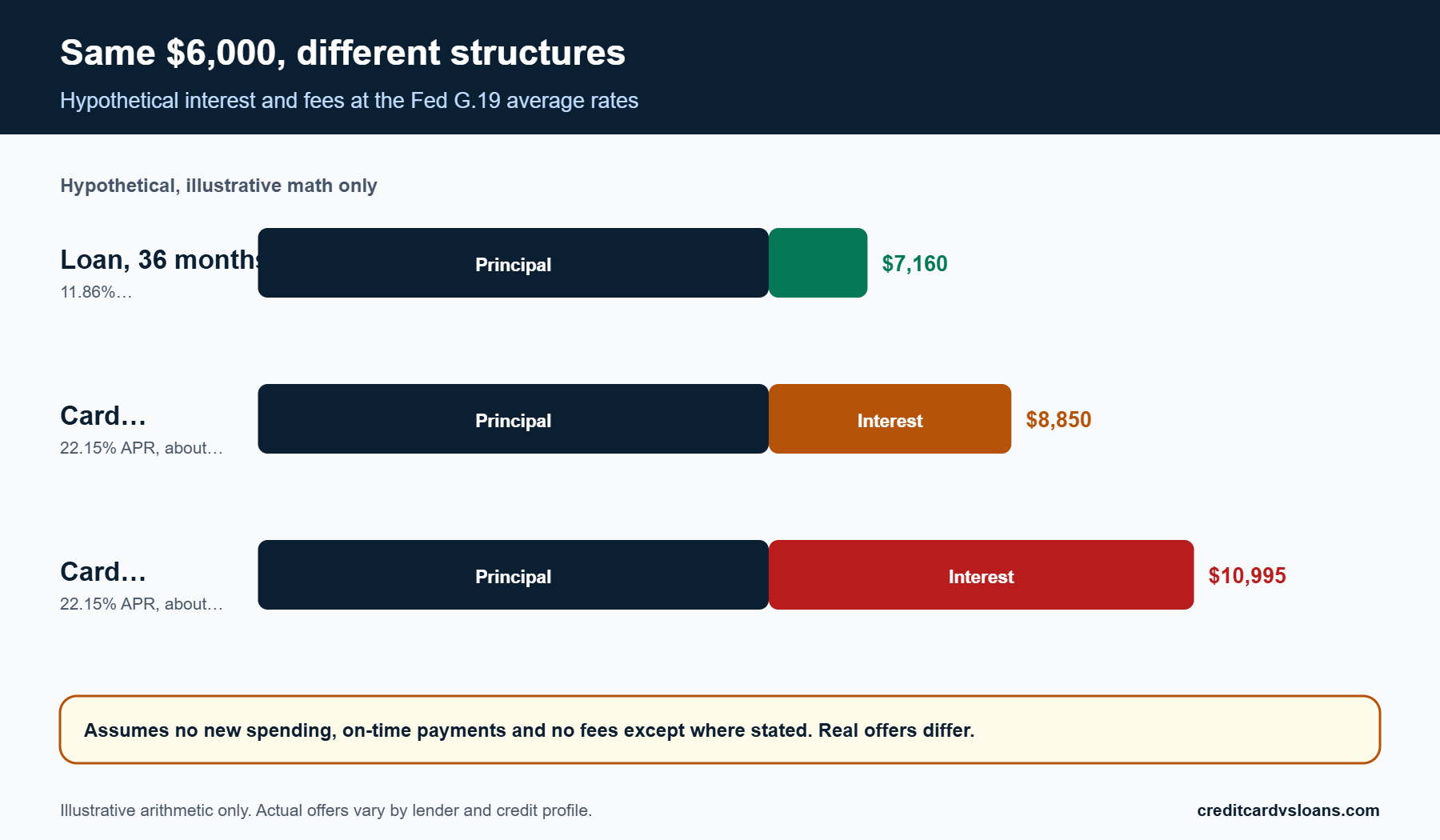
Table 2 is illustrative. It assumes a one-time $6,000 balance, no new spending, on-time payments, and uses the G.19 averages only as stand-in rates. It is not a quote, and real rates will differ.
| Scenario | Assumed rate | Monthly payment | Time to repay | Total interest and fees |
|---|---|---|---|---|
| Personal loan, 36 months | 11.86% APR | $198.88 | 36 months | $1,159.86 |
| Personal loan, 24 months | 11.86% APR | $282.05 | 24 months | $769.17 |
| Loan with 5% origination fee, 36 months | 11.86% interest on $6,315.79 | $209.35 | 36 months | $1,536.69 |
| Card, same $198.88 payment as loan | 22.15% APR | $198.88 | About 45 months | About $2,850 |
| Card, $150 payment | 22.15% APR | $150.00 | About 74 months | About $4,995 |
What the table shows
At the same monthly payment, the loan in this example retires the debt in 36 months while the card balance, at the higher assumed rate, takes about 45 months and costs more than twice as much in interest. The origination fee scenario shows why fees matter: the loan's stated rate is the same as the cheaper loan, yet the total cost is higher because you borrow extra to net the same $6,000.
The last row is the cautionary one. A $150 payment feels comfortable and keeps the balance alive for over six years in this example. That is the revolving trap: low required payments are not the same as low cost.
When the card still wins on cost
The card wins if the balance is paid in full within the grace period, or if a true 0% promotional rate covers the payoff period and any transfer fee is smaller than the loan's interest. In the example, a card repaid in two or three months costs essentially nothing in interest, while a loan would charge interest and might charge an origination fee.
This is why the honest answer to the cost question is conditional. The product that wins depends on how long you will carry the balance, which is a decision you control more than any lender does.
How Approval, Credit Scores and Your Credit File Come Into Play
What lenders and issuers look at
The score is one input, not the whole decision
The CFPB describes a credit score as a number that predicts how likely you are to repay on time, calculated from your credit report. Lenders use scores to decide on approval and to set rates and limits, but they also look at income, existing debt and the details of your report. You do not have just one score, since scores vary by model, data source and date.
That is why we avoid quoting a single cutoff. Credit card issuers and personal loan lenders set their own standards, and they change them. For a closer look at the loan side, see what credit score you need for a personal loan.
Why a thin file or a recent hiccup changes the answer
A thin credit file, meaning few accounts or a short history, can limit your options on both products. Cards may offer low limits, and loans may come at higher rates or smaller amounts. A recent late payment or collection can narrow the field further.
If your file is thin, prequalify where possible. Prequalifying usually uses a soft pull, which does not affect your score, while a full application triggers a hard pull. The CFPB says hard inquiries can lower scores because models consider how often and how recently you apply.
Why shopping smart matters more than shopping fast
Applying to many places in a short burst can leave several hard inquiries. Some scoring models treat clustered inquiries for the same loan type as one, but the details vary by model and by loan type, so do not assume a cushion. Prequalify first, narrow to the best one or two offers, and apply only then.
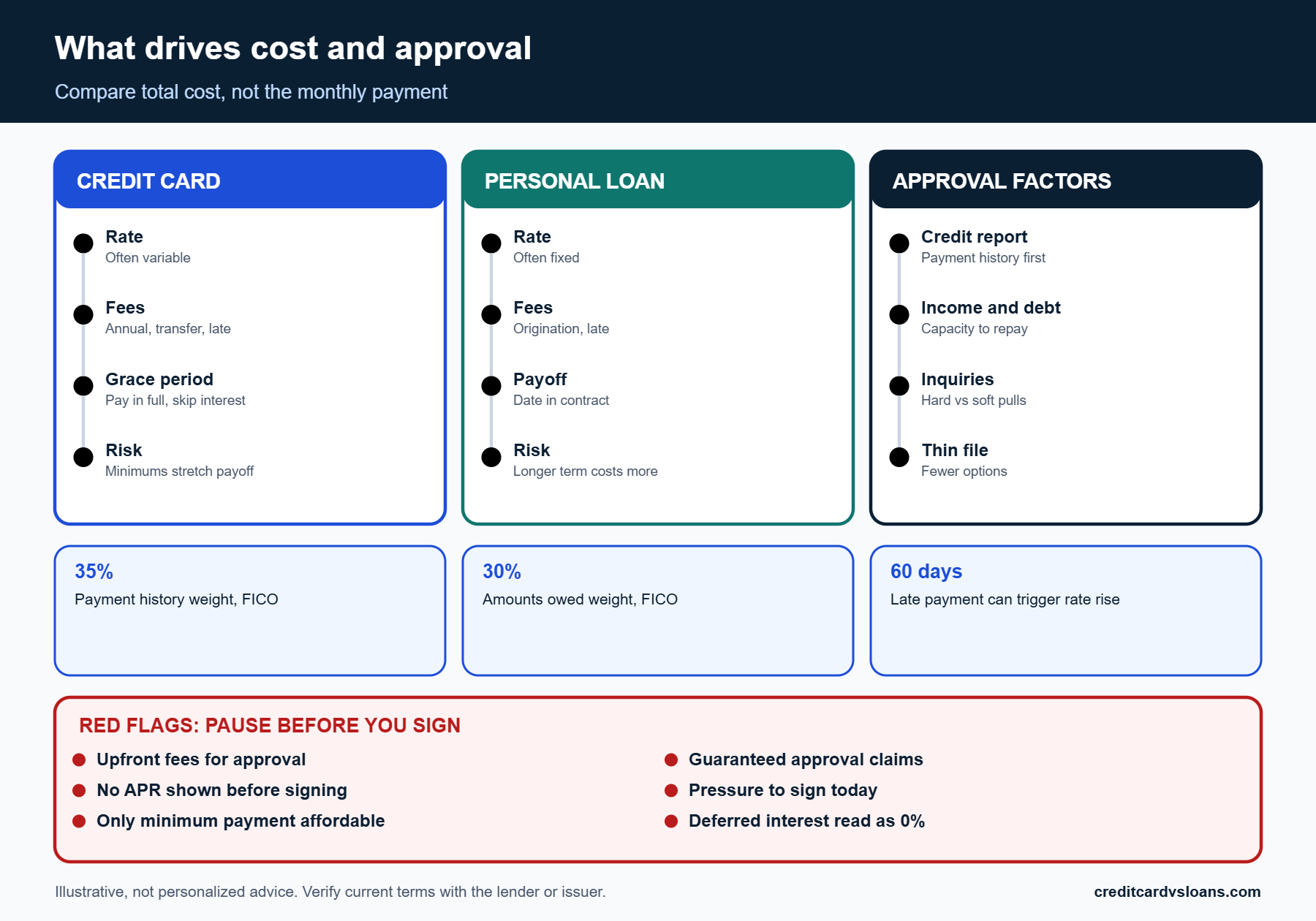
Never pay a fee to be "guaranteed" approval. The FTC warns that upfront fees for credit or debt help are a classic scam pattern.
How each product can move your credit score
What a card does to your score
A card shows up as revolving debt. Your utilization, the share of your limit in use, can matter a lot, and payment history matters most. myFICO lists payment history at 35% and amounts owed at 30% of a FICO Score, which is why a high balance can hurt even if you pay on time.
Opening a card adds a new account and a hard inquiry, then adds available credit. Whether the net result is positive or negative depends on your profile, and no one can promise a direction.
What a loan does to your score
A personal loan adds an installment account and a hard inquiry. It can lower utilization if the proceeds pay off card balances, because installment balances are treated differently from revolving ones. It also adds a payment you must make on time for years.
Our guide to how a personal loan can affect your credit score walks through the common patterns. The pattern is not guaranteed, and a missed payment hurts under either product.
The trap of paying off cards with a loan and running them up again
Using a loan to clear cards can free up credit, which is helpful only if the cards stay low. If balances build again, you can end up with both the loan payment and new card debt. That is the single most common way a consolidation attempt backfires.
If you are weighing that route, read our guides on debt consolidation and how a debt management plan affects your credit for the nonprofit-run alternative.
Risks, Fine Print and Red Flags on Both Sides
Card risks that catch people off guard
Rate increases and the 60-day rule
The CFPB says an issuer generally cannot raise the rate on existing purchases, but there are exceptions. One is that if your minimum payment is not received within 60 days after the due date, the issuer can raise the rate on existing balances. Promotional rates must generally last at least six months, but that protection does not apply if you are more than 60 days late.
A single bad month can therefore turn a cheap balance into an expensive one. Set up autopay for at least the minimum so a missed email does not become a rate change.
Promotional offers that are not what they seem
Not every "no interest" offer is a true 0% APR. The CFPB distinguishes true zero-interest promotions from deferred interest promotions, where interest accrues quietly and is added retroactively if you do not pay the full balance in time. We compare them directly in our 0% APR vs personal loan guide.
Read the wording. "0% intro APR" points to a true zero rate, while "no interest if paid in full" points to deferred interest.
Cash advances and convenience features
Cash advances and convenience checks often carry fees and different rates. The CFPB has warned card companies about deceptive marketing of promotional offers, including convenience checks, deferred interest and balance transfers. Treat any offer in the mail as an invitation to read the terms, not as a pre-approved solution.
If a feature is not clearly in your cardholder agreement, ask the issuer in writing before relying on it.
Loan risks to price in before you sign
Fees, add-ons and the total you repay
Origination fees reduce what you receive while you still repay the full amount. Optional add-ons, such as insurance products, can inflate the cost. Always compare the amount you receive, the APR, the monthly payment and the total of payments.
If a lender will not show you the APR and total cost before you commit, walk away. Those figures are required disclosures for closed-end credit.
Longer terms feel cheaper and cost more
Stretching a loan lowers the payment and raises total interest. The CFPB makes the same point about consolidation loans: a lower monthly payment often means a longer term, which can raise the total cost.
A rule of thumb: pick the shortest term whose payment you can pay comfortably, then keep a small cash buffer so one surprise does not cause a missed payment.
Scams and predatory offers
Be wary of lenders that guarantee approval, ask for payment before funding, or pressure you to sign immediately. See predatory lending warning signs for a detailed list.
Report suspected scams to the FTC at ReportFraud.ftc.gov or to your state attorney general.
Real-World Scenarios: Choosing Between a Card and a Loan
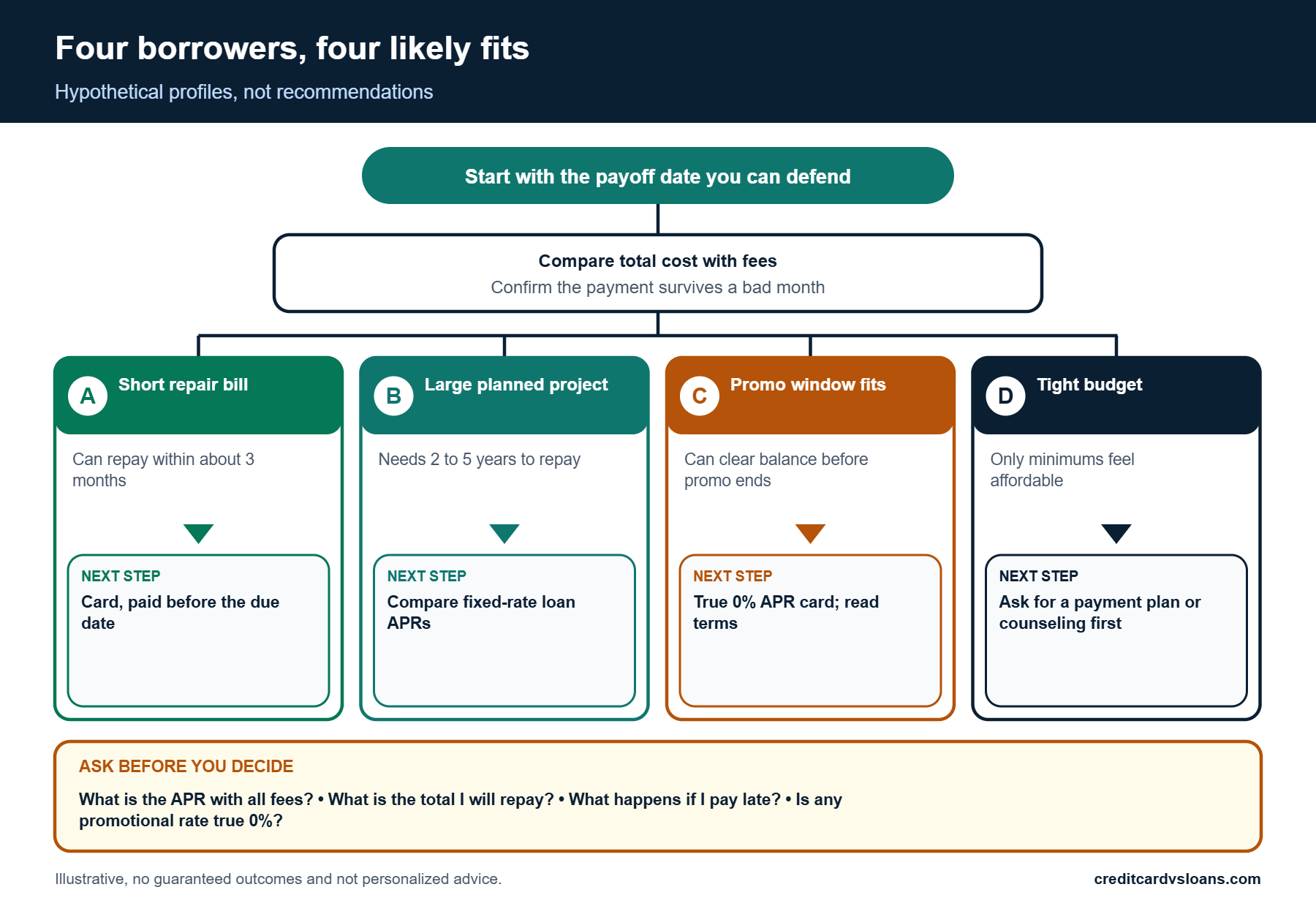
Four hypothetical borrowers
The short-term repair bill
Picture a hypothetical borrower facing a $1,800 car repair who gets paid in two weeks and has room to repay within three months. A card is usually the simpler fit: no application beyond what the borrower already has, and interest on a short balance can be modest. Paying in full before the due date can avoid interest altogether.
A loan would add a hard pull and possibly a fee for a balance that will be gone in a quarter. The exception is a borrower who knows they will not stick to a three-month plan and wants a contract that makes them.
The $9,000 home project
Now picture a hypothetical borrower planning a $9,000 project to be repaid over about three years. On a card at a typical rate, that balance would be expensive if it lingers, as Table 2 suggested at a smaller scale. A fixed-rate installment loan gives a clear payment and end date.
If the borrower qualifies for a true 0% offer long enough to cover most of the payoff, the card can still win. See our furniture-purchase comparison for how that math plays out on a mid-sized purchase.
The business owner mixing personal and company spending
Some readers borrow for a side business. Personal credit products do not always fit the cash-flow pattern of a business, and mixing personal and business spending complicates records. Our guide on business credit cards vs business loans covers the business-side tradeoff.
As a rule of thumb, keep personal borrowing for personal needs and use products designed for the business when the spending is for the business.
A decision table you can reuse
How to read the table
Table 3 summarizes where each tool tends to fit. It is a starting point, not a verdict, because your actual offers determine the outcome. Treat the colors as shorthand: green means the structure lines up with the job, amber means it can work with care, and red means the structure works against you.
| Situation | Card tends to fit when | Loan tends to fit when |
|---|---|---|
| Planned purchase of a few thousand dollars | You can repay in a few months, or a true 0% window covers payoff | You need 1 to 5 years and want a fixed payment |
| Unpredictable expenses | Costs arrive over time and the balance will be cleared quickly | You can estimate the total up front |
| Consolidating existing card debt | A balance transfer fits and you can finish within the promotion | Payoff will take longer than a promotion |
| Tight monthly budget | Only the minimum is affordable | The fixed payment must fit with room to spare |
| Fair or limited credit | Limits may be low and rates high | Rates and fees may be high; compare APR |
Where hybrid solutions fit
Sometimes the best answer is a mix: a true 0% card for the first few months of a purchase, then a small loan if some balance remains, or a loan for the base amount and a card for incidental extras. Mixing adds complexity, so only do it when the savings are clear and you can track each payment date.
Write down each balance, rate and due date in one place. Missing one payment because of a juggling error costs more than the savings from the clever plan.
Alternatives Worth Checking Before You Borrow
Options that may cost less than either product
Payment plans, hardship programs and negotiation
For medical bills, utilities and some repairs, the provider may offer an interest-free payment plan. The FTC advises contacting creditors early to ask for a lower rate or a payment plan you can afford, and notes you can do this for free. Get any agreement in writing.
A zero-interest plan directly with the biller usually beats any credit product, so ask before you borrow.
Credit unions and community lenders
Credit unions and community banks sometimes offer small loans with different pricing than national lenders. Rates and eligibility vary, so ask.
Whichever lender you consider, ask for the APR, fees and total cost in writing before you apply, and prequalify with a soft pull when offered.
Savings and a smaller purchase
The cheapest borrowing is the amount you do not borrow. Even a partial down payment from savings can shrink the loan or let you clear a card balance within the grace period.
Weigh that against keeping an emergency cushion. Draining savings to avoid interest can backfire if a second surprise arrives.
When consolidation or transfers are the real question
If you are replacing existing debt
If your goal is to consolidate cards, the question changes from card vs loan to transfer vs consolidation loan. Our guides on credit scores for debt consolidation loans and balance transfers dig into that choice.
The CFPB says consolidation alone will not help if spending exceeds income, so identify why the balance built up before choosing a tool.
If a nonprofit can help
A nonprofit credit counselor can review your finances and, if appropriate, set up a debt management plan. The FTC advises choosing an accredited counselor who quotes fees in writing and does not charge before doing any work.
This is an option, not a requirement, and it comes with its own effects on new credit that are worth understanding first.
Making the Call: A Decision Path and Your Next Steps
The decision in four questions
How long will you really carry the balance?
Start with time. If the honest answer is under about three months and you can pay in full, a card used carefully is hard to beat. If it is more than a year, the balance of the evidence in Table 2 favors an installment loan, unless a true 0% offer covers most of the payoff.
Write down a payoff date you can defend using your actual budget, not your hopes. If you cannot name one, the product with a built-in end date, usually a loan, protects you from yourself.
What is the total cost, fees included?
Gather at least two offers for each product, including APR, origination or transfer fees, and the length of any promotional period. Compute the total of payments minus the amount you receive. Compare totals, not payments.
If a promotional card offer applies, find the regular APR that kicks in afterward and ask what the total would be if you are still carrying some balance when the promotion ends.
Can the payment survive a bad month?
Take the payment and imagine your income dropping by a few hundred dollars for two months. If the plan breaks, shrink the amount, lengthen the term modestly or look at alternatives. A missed payment can mean fees, a higher rate and a credit report mark.
Autopay, a calendar reminder and a small buffer in checking cost nothing and prevent the most avoidable mistakes.
Does this product change your behavior for better or worse?
Honesty helps here. If a paid-down card tends to refill, a loan may give structure. If a loan feels rigid and you are very disciplined, a card with a clear payoff schedule may be cheaper and more flexible.
Neither answer is a character judgment. The goal is a product whose design works with your habits.
A concrete next-step list
What to do this week
Work through the list below in order. It keeps you from applying before you know what you are comparing.
- Write down the amount you need, the date you need it and a realistic payoff date.
- Pull your free credit reports at AnnualCreditReport.com and fix any errors you find.
- Prequalify with soft pulls for one loan and one card, and save the written terms.
- Compute the total cost of each offer, including fees, using the same payoff date.
- Check the regular APR after any promotion and what happens if you miss a payment.
- Pick one, apply once, and set autopay before the first due date.
If the numbers still look close, choose the option with the smaller fee risk and the clearer payoff date.
If you decide not to borrow
Declining both is a legitimate result. Ask the biller for a payment plan, trim the purchase or wait until savings cover part of it. If you are already struggling with debt, contact a nonprofit credit counselor and read the FTC and CFPB guidance on getting out of debt before taking on more.
For narrower follow-ups, our guides on 0% APR cards vs personal loans and personal loan credit score requirements go deeper on the two decisions that most often decide this comparison.
The bottom line
Use a card for money you will repay fast or at a true 0% rate, and use a personal loan for larger amounts that need a fixed payment and a firm end date. Let the total cost and your ability to pay on schedule make the final call, not the headline rate or the size of the monthly payment.
Compare total cost with fees, match the product to your payoff timeline, and only borrow an amount whose payment still works in a tough month.
Questions that decide close calls
What if you are not approved for the option you wanted?
A denial is information, not a verdict. Lenders must generally tell you the main reasons for an adverse decision, and you can request your free credit reports to see whether errors played a part. Fixing a mistaken late payment or a wrong balance can change the picture, although no one can promise how much or how fast.
Before reapplying, give your file time to change. Repeated applications in a short stretch add hard inquiries and may signal risk. If you need money sooner, ask whether a smaller amount, a co-signer arrangement or a secured option exists, and understand the risk those carry for the other person or for the asset you pledge.
If the need is urgent and credit is out of reach, contact the biller, landlord or utility before the due date. Hardship programs and payment plans are far easier to arrange before an account goes delinquent than after.
Is it ever sensible to use both a card and a loan?
Yes, when each does a different job. A loan might fund the large, predictable piece of a project, while a card with a grace period handles small incidental purchases that you will pay off in full. The danger is treating the card as a second source of long-term borrowing, which quietly doubles your debt.
If you use both, track the combined payment as one monthly number against your income. A rule of thumb many budgeters use is to keep total debt payments comfortably below the share of income you can sustain in a lean month, and your own budget is a better guide than any generic percentage.
How should you compare a promotional offer to a plain loan?
Treat the promotion as a clock. A true 0% APR period is a temporary loan with no interest, usually paired with a transfer or upfront fee, followed by a regular APR on anything left. The CFPB explains the key difference from deferred interest, where interest builds in the background and is added if you do not clear the full balance in time.
Divide the amount, including any fee, by the number of promotional months. If that payment fits your budget with room to spare, the offer may beat a loan. If it does not, a loan with a longer term may be the more honest choice. The step-by-step logic is laid out in our 0% APR vs personal loan comparison.
- 0% APR Credit Card vs. Personal Loan: Which Is Cheaper?
- What Credit Score Do You Need for a Personal Loan?
- 0% APR Credit Card vs. Personal Loan for Back-to-School Spending: Which Wins?
- What Credit Score Do You Need for a Debt Consolidation Loan?
- Credit Utilization: How Card Balances Affect Your Credit Score
- Business Credit Card vs. Business Loan: Which Fits Your Cash Flow?
- Federal Reserve: Consumer Credit – G.19 (release of Sept. 8, 2026) (Average card and 24-month personal loan rates, Q2 2026)
- CFPB: What is the difference between a loan interest rate and the APR?
- CFPB: When can my credit card company increase my interest rate?
- CFPB: What do I need to know about consolidating my credit card debt?
- CFPB: What is a balance transfer fee?
- CFPB: What is a credit score?
- CFPB: What is a credit inquiry?
- CFPB: How to understand special promotional financing offers on credit cards
- FTC: How To Get Out of Debt
- myFICO: What’s in your credit score (Category weights)
Last updated: October 22, 2026. Rates, fees and lender rules change; verify current terms before acting.
The information on creditcardvsloans.com is provided for general educational and informational purposes only. It is not financial, legal, tax, credit, accounting or investment advice, and reading it does not create an advisor-client, fiduciary or any other professional relationship. Nothing here is an offer, solicitation or recommendation to borrow, lend or apply for any product.
Credit scores, interest rates, fees, eligibility rules, lender policies and laws change frequently and vary by lender, location and individual circumstances. Examples, figures and scenarios are illustrative only, do not predict your results and do not guarantee approval, savings, a particular rate or a credit-score outcome. Always confirm current terms directly with the lender or issuer and read the full agreement before you apply or sign.
Although we aim for accuracy and use reputable sources, we make no representations or warranties, express or implied, about the completeness, accuracy, reliability or timeliness of the content. Content may be drafted with the assistance of automated tools, so errors or omissions may still occur. Links to third-party sites are provided for convenience; we don’t control and aren’t responsible for their content.
To the fullest extent permitted by law, creditcardvsloans.com and its owners, editors, authors, contributors and affiliates disclaim all liability for any loss, damage or expense arising directly or indirectly from your use of, or reliance on, this content. Before making financial decisions, consult a licensed professional, such as a qualified financial advisor, attorney, tax professional or nonprofit credit counselor, who can consider your complete situation.