For most families, the right answer on credit card vs personal loan for back to school expenses comes down to one question: can you pay the balance off in a few months, or will it take a year or more? A credit card usually fits a smaller bill you can clear quickly, while a personal loan can fit a larger one that needs a fixed payoff date.
That rule of thumb isn’t the whole story, because back-to-school costs are lumpy. A parent might face school supplies, clothing, fees and a laptop in the same six weeks. A college student might be covering a textbook gap, a security deposit and a meal plan top-up while financial aid is still processing. The two tools handle that lumpiness very differently.
This guide is a head-to-head comparison of the two products, built around the way back-to-school spending actually behaves. If you want the broader menu of options, including federal aid and school payment plans, start with our guide on how to finance back-to-school costs. If you want a general credit card vs. loan comparison that isn’t tied to a season, see credit card vs. personal loan: which is better for borrowing.
- A card is usually the more flexible tool for small, quick-to-repay costs. A personal loan is usually the more predictable tool for larger costs you’ll repay over many months.
- Federal Reserve data show credit card rates for accounts that carry a balance run well above average personal loan rates, but your own offer depends on your credit file and the lender.
- A card with a true 0% promotional APR can beat both, but only if the full balance is paid before the promotion ends. That is a separate decision covered in our 0% APR comparison for back-to-school spending.
- Origination fees, late fees and variable rates can reverse the apparent winner. Compare total dollars repaid, not just the headline rate.
- For college costs, federal student aid and school payment plans usually come before either product.
Rate figures come from the Federal Reserve’s G.19 consumer credit release (second-quarter 2026 data, posted in October 2026) and from U.S. Department of Education announcements for loans first disbursed July 1, 2026 through June 30, 2027. Offers change often, so treat every number here as a reference point, not a quote.
The Short Answer: Which Tool Fits Which Back-to-School Bill
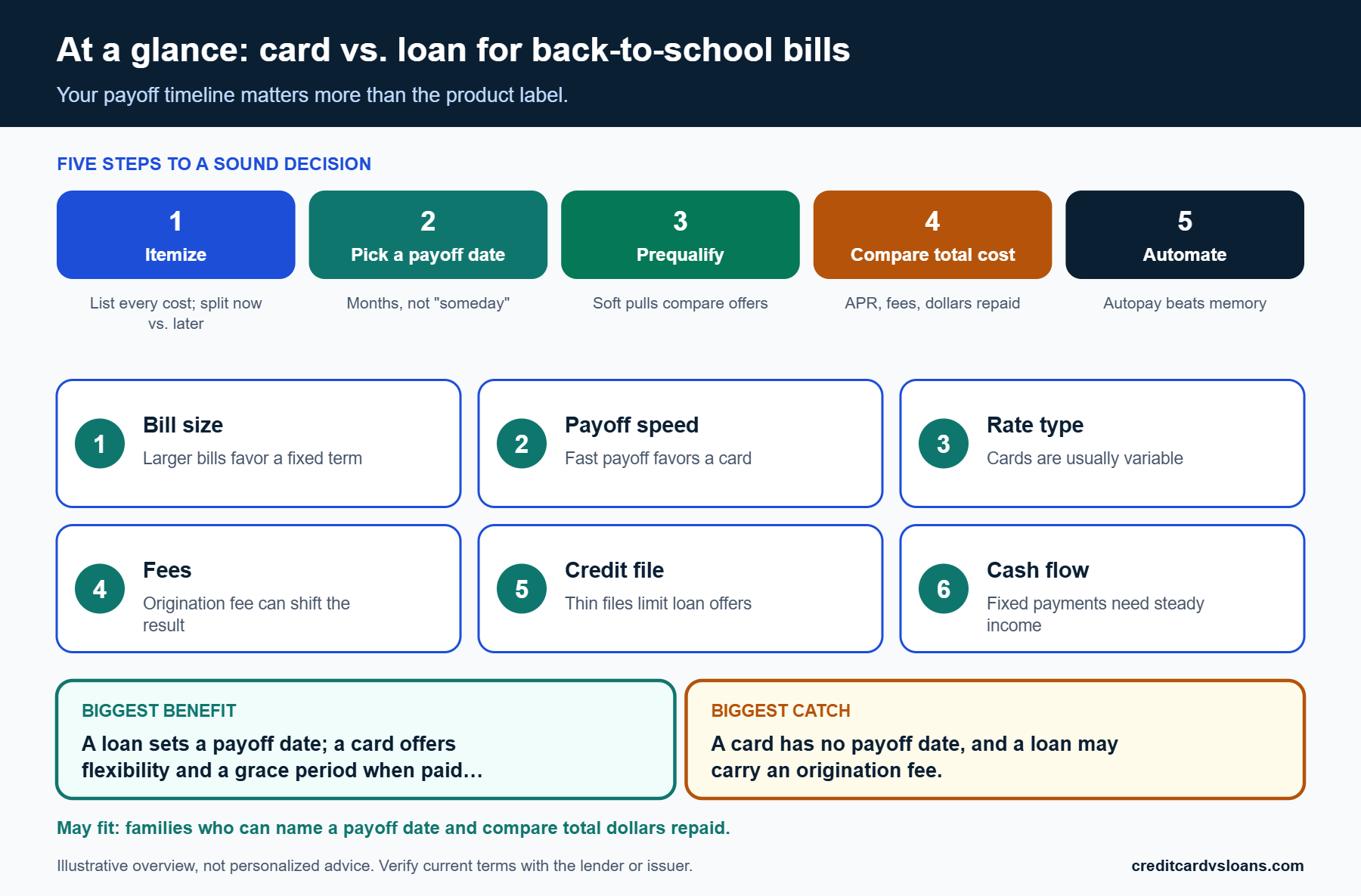
Before the details, here’s the quick sort. Your timeline for repayment matters more than the product label, because the longer you carry a balance, the more a high rate costs you.
When a Credit Card Is the Better Fit
Smaller bills you can clear in one to three statements
If the total is a few hundred dollars and you can pay it off within a month or two, a credit card is hard to beat on convenience. There’s no application for a separate loan, no origination fee, and if you pay the statement balance in full by the due date, most cards charge no interest on new purchases. That grace period is one of the few places where a revolving balance is effectively free.
The catch is discipline. A card has no built-in payoff date, so a balance you meant to clear in September can still be there in March. Federal Reserve G.19 data for the second quarter of 2026 put the average interest rate on credit card accounts that were assessed interest at 22.15%, so the cost of drifting is real.
Purchases where card protections or rewards matter
Cards also offer dispute rights that a lump-sum loan deposit doesn’t. If a retailer sends the wrong laptop or a seller disappears, you can dispute the charge with the card issuer under the federal billing error and dispute rules. The CFPB explains how those disputes work on its website, and the details depend on the type of problem and the timing.
Rewards can offset some cost, but only if you never carry a balance. A one or two percent reward doesn’t come close to covering interest at a rate above 20%. If you expect to revolve, ignore the rewards when you compare.
When a Personal Loan Is the Better Fit
Larger, one-time costs that need a payoff date
A personal loan is an installment loan: you receive a lump sum and repay it in equal payments over a fixed term. The CFPB describes personal installment loans as closed-end loans where the lender provides all the money up front and payments are usually the same throughout the loan. For a $3,000 to $8,000 back-to-school bill that you can’t clear in a few months, that structure forces progress.
The same Federal Reserve release put the average rate on 24-month personal loans at 11.86% for the second quarter of 2026. That is a bank average and not an offer. Still, the gap between a typical card rate and a typical personal loan rate is the main reason loans can cost less on larger balances.
When you want a payment that never changes
Some households budget around fixed monthly numbers. A fixed-rate loan gives you one payment, one end date and no temptation to add new purchases. If your income is steady but tight, that predictability is valuable.
The trade-off is that a loan is rigid. If you receive a tax refund, a scholarship adjustment or a financial aid refund in October, you can usually prepay a personal loan, but you should confirm in the loan agreement that no prepayment fee applies. A card has no such question.
How Each Product Works for Seasonal Spending
The mechanics are simple on paper. Where families get surprised is in how those mechanics interact with a seasonal spending spike.
Revolving Credit vs. Installment Credit
How a card balance behaves after the bill arrives
A credit card is revolving credit. You have a limit, you borrow up to it, and you owe at least a minimum payment each month. Interest is charged on balances you carry past the due date, and the minimum payment is usually set low enough that paying only the minimum stretches repayment out for years.
For back-to-school spending, that flexibility is both the benefit and the risk. You can spread costs across weeks without applying for anything, but nothing in the account forces you to pay down the balance on a schedule. You have to create that schedule yourself.
How a loan balance behaves after funding
With a personal loan, the full amount is typically deposited into your bank account, you pay it back in installments, and the balance falls on a set schedule. Interest is calculated on the declining balance, so each payment pays down more principal over time.
The potential downside is borrowing more than you need. Because a lump sum arrives at once, it can be tempting to round up. Borrow only the amount you’ve itemized, since you’ll pay interest on every dollar for the full term.
What Lenders Look At Before They Say Yes
Credit file, income and existing debt
Both card issuers and personal loan lenders look at your credit reports and scores, your income and your existing debt payments. The CFPB lists credit score and reports, income and existing debts, the loan amount and length, state interest rate limits and other factors as the inputs that set personal installment loan terms. Card issuers weigh similar factors, plus the credit limit they are willing to extend.
If you have a thin credit file, you may qualify for a modest card limit but struggle to get a competitive loan rate. If you have an established file, the reverse can be true: a loan lender may offer a lower rate than a card would charge on the same balance.
Prequalify first, apply second
Many lenders let you prequalify, which typically uses a soft pull that doesn’t affect your credit score, before you commit to a hard pull. Prequalifying with several lenders lets you do real rate shopping without stacking inquiries. The CFPB notes, in the student loan context, that comparing private offers within about two weeks limits the credit score impact of multiple applications, and the same principle is sensible for other loan shopping, though scoring models differ.
A prequalified offer isn’t a final approval, and terms can change after full underwriting. Read the final disclosure before you accept.
Credit Card vs Personal Loan for Back to School Expenses: The Cost Comparison
Cost is where most readers want to start, so this section does the arithmetic. Every dollar figure below is hypothetical and illustrative, built on the Federal Reserve’s average rates rather than on any lender’s actual offer.
Interest Cost on a Hypothetical $3,000 Bill
The assumptions behind the numbers
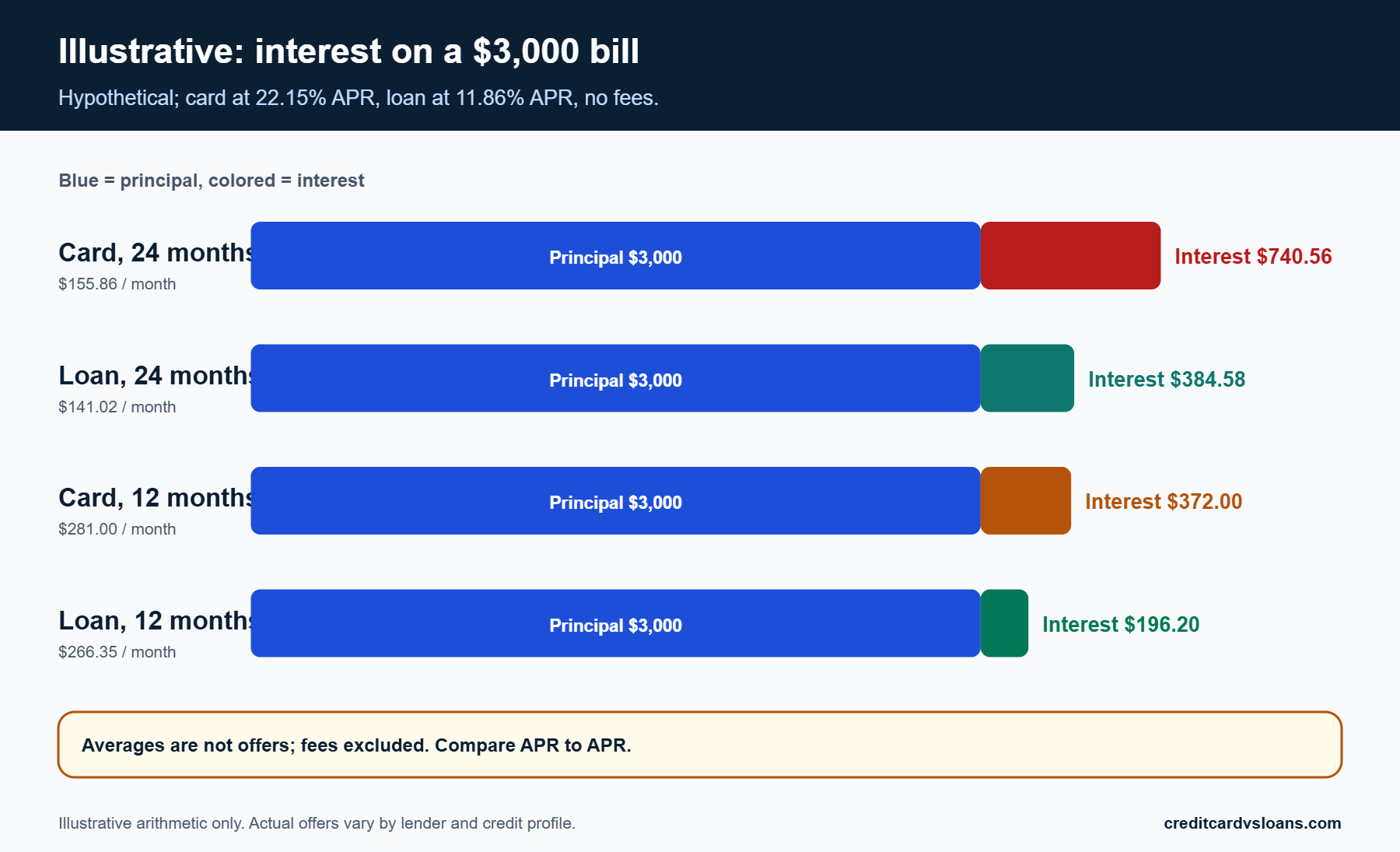
To keep this apples-to-apples, assume a one-time $3,000 back-to-school bill with no new purchases afterward. For the card, assume an APR of 22.15%, the Federal Reserve’s second-quarter 2026 average for accounts assessed interest. For the loan, assume 11.86%, the average for 24-month personal loans in the same release, with no origination fee.
These are averages across many borrowers, not predictions. A borrower with a strong credit file might see lower rates on either product, and a borrower with a thin credit file or past delinquencies might see higher ones. Use the table as a map of how term length and rate interact, then replace the assumptions with your actual offers.
| Product and assumed APR | Payoff period | Monthly payment | Total interest | Total repaid |
|---|---|---|---|---|
| Credit card, 22.15% | 6 months | $532.79 | $196.77 | $3,196.77 |
| Credit card, 22.15% | 12 months | $281.00 | $372.00 | $3,372.00 |
| Credit card, 22.15% | 24 months | $155.86 | $740.56 | $3,740.56 |
| Personal loan, 11.86% | 12 months | $266.35 | $196.20 | $3,196.20 |
| Personal loan, 11.86% | 24 months | $141.02 | $384.58 | $3,384.58 |
| Personal loan, 11.86% | 36 months | $99.44 | $579.93 | $3,579.93 |
What the table shows and doesn’t show
Two patterns stand out. First, a card repaid in six months costs about the same in interest as a loan repaid in twelve, because speed is doing the work, not the product. Second, stretching either product out raises the total cost, and stretching the card out raises it fastest.
The table also hides something important: the card figures assume you make a fixed payment and stop spending. Paying only about $100 a month on the same $3,000 at 22.15% would take 45 months and cost roughly $1,412 in interest, according to the same hypothetical math. A fixed-term loan removes that drift by design.
Fees and Fine Print That Change the Winner
Origination fees and the true cost of a loan
Some personal loans charge an origination fee, a one-time charge for processing the loan that is commonly deducted from the amount you receive. If a fee is deducted, you need to borrow more than you need to end up with the same cash, and the effective cost rises. For example, hypothetically, to net $3,000 after a 5% fee you would borrow about $3,158, and over 24 months at 11.86% you would repay roughly $3,563, about $563 more than you received. That is more than the $385 shown for the no-fee loan in Table 1.
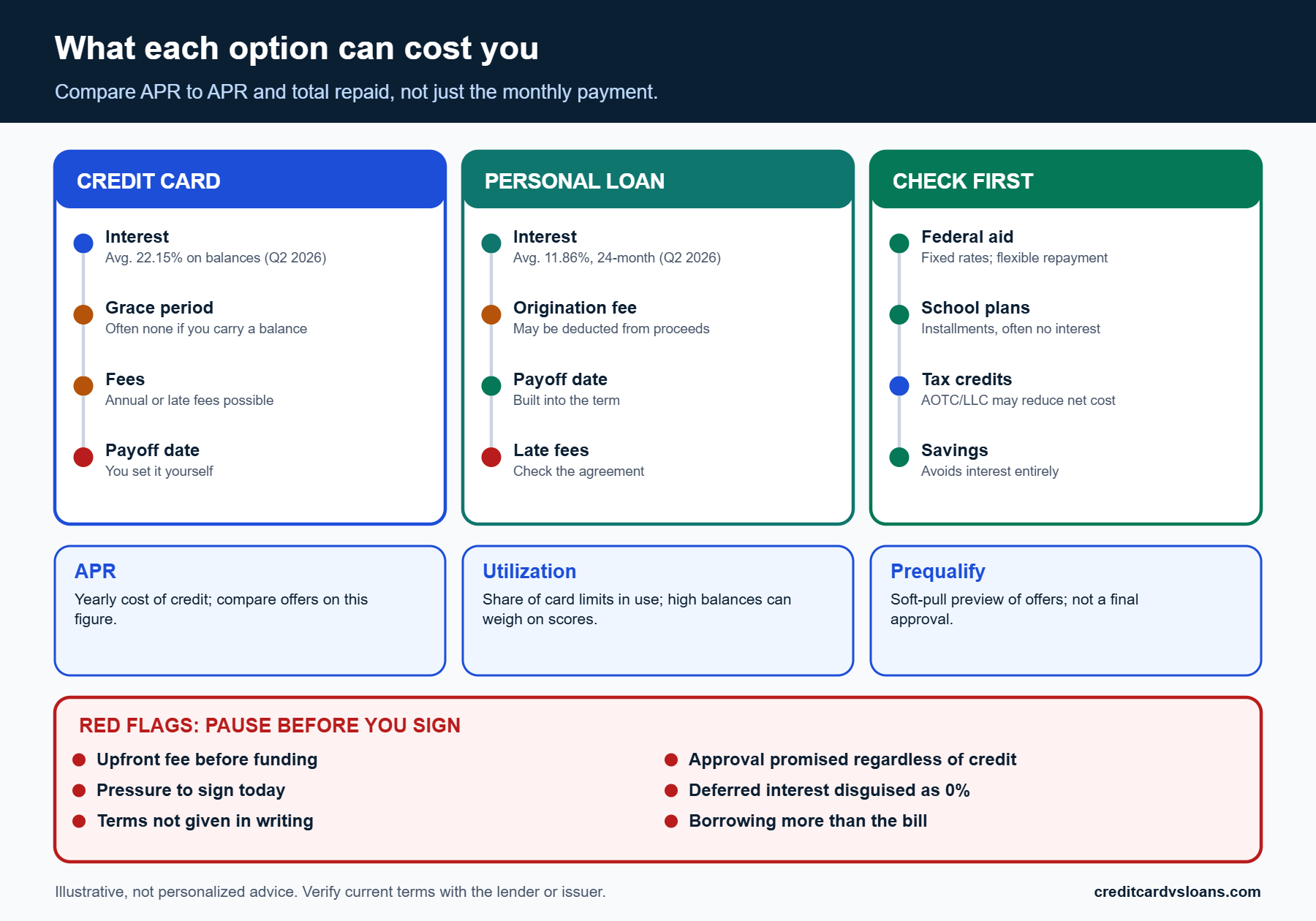
Fee levels vary by lender and by borrower, and some lenders charge none. Ask for the annual percentage rate, which is designed to fold required fees into a single comparable figure, and compare APR to APR.
Card fees, variable rates and penalty pricing
Credit card rates are usually variable, which means the rate can move when the underlying benchmark moves. Cards can also carry annual fees, late fees and, in some cases, higher penalty rates after serious delinquency. Under the federal rules at 12 CFR 1026.55, an issuer may raise the rate on an existing balance if the minimum payment is not received within 60 days after the due date, and the issuer must restore the prior rate after six consecutive on-time minimum payments.
Those protections don’t make late payments harmless. A late payment can bring a fee, potential credit reporting damage and a worse rate going forward. Setting up autopay for at least the minimum payment is a low-cost safeguard.
| Term to check | Credit card | Personal loan |
|---|---|---|
| Rate type | Usually variable | Often fixed; confirm |
| Upfront fee | Usually none, but some cards have annual fees | Origination fee on some loans |
| Payoff date | None unless you set one | Built into the loan term |
| Late payment | Late fee; possible rate increase after 60 days past due | Late fee; possible collections and credit reporting |
| Early payoff | Pay anytime | Confirm no prepayment penalty |
| Grace period | Often yes, if paid in full each month | No; interest accrues from funding |
| Funds arrive | As you swipe | Lump sum, often within days after approval |
Reading the Total Cost Correctly
Why APR beats the monthly payment as a yardstick
A lower monthly payment feels like a win, but it often reflects a longer term. In Table 1, the 36-month loan has the smallest payment and costs more interest than the 12-month loan. Judge each option by total dollars repaid and by APR, then decide whether the monthly payment fits your budget.
The annual percentage rate on a loan is the cost of credit as a yearly rate and, under federal Truth in Lending rules, lenders must disclose it before you sign. A card’s APR works on a daily balance, so how fast you pay matters as much as the stated rate.
A quick method for comparing two offers
Write down four numbers for each option: the amount you’ll actually receive, the monthly payment, the number of payments and the total you’ll repay. Subtract what you received from the total repaid, and that is the real finance cost. If the card option has no stated payoff date, choose the payoff date you can commit to and compute from there.
Then test the plan against a bad month. If one missed paycheck would break the payment schedule, favor the option that leaves more breathing room, even if it costs somewhat more in interest.
Cash Flow: Matching Payments to a Seasonal Budget
The cheapest option on paper isn’t always the one you can sustain. Back-to-school costs arrive in late summer, when many households are also dealing with summer childcare, utilities and vacation expenses.
Monthly Payment Pressure
Stress-test the payment against your income
A rule of thumb is to keep all non-housing debt payments at a level you can sustain even in a lean month. There is no universal ratio, but if a new payment takes away the cushion you rely on for groceries or gas, the loan or card plan is probably too aggressive. Choose a longer term only if you will still be comfortable with the total cost.
Because a card lets you choose your own payment each month, it gives more room in a cash crunch. A loan payment is fixed, so if your income is uneven, ask whether you could cover it in your lowest-earning month.
What happens if income dips mid-term
If you lose hours or face an unexpected bill, a card minimum payment is usually small and a loan payment is not. A missed loan payment can lead the lender to use third-party debt collectors and report the missed payment to the credit bureaus, according to the CFPB. If your situation changes, contact the lender before the due date and ask about deferment, forbearance or a payment plan.
That flexibility cuts both ways. Making only minimum card payments can keep you current while the balance barely shrinks. Honest planning means choosing the product whose weaknesses you are best equipped to manage.
Timing the Money to the Bills
Matching due dates to paydays
Most card issuers and lenders will let you move a due date within a limited range. If your pay arrives on the first and fifteenth, setting the due date shortly after a payday reduces the risk of a late payment. It is a small change that costs nothing.
Also consider splitting a large bill. Paying part of the cost in cash or from a savings account, then financing only the remainder, shrinks the balance you need to carry and shortens the payoff window.
Using refunds and aid disbursements to pay down faster
For college students, financial aid disbursements often arrive after the term begins, and any aid left after tuition and fees is typically paid to the student as a refund. A card can bridge a gap until then. If you use a card as a bridge, write down the date you expect the disbursement and plan to pay the card balance off immediately, so the bridge doesn’t become a long-term loan.
The same logic applies to tax refunds and the education tax credits described later in this guide. Treat expected money as a payoff plan only once it has been confirmed, not before.
How Each Choice Can Affect Your Credit
Neither product is automatically better or worse for your credit file. What matters is how the account is opened, how large the balance is relative to the limit or original amount, and whether every payment arrives on time. No outcome here is certain, and score changes vary by scoring model and by your existing file.
Applying and Opening the Account
Hard pulls, new accounts and average account age
Both a card application and a loan application normally trigger a hard pull, which is an inquiry that can cause a small, temporary dip in some scoring models. A new account can also lower the average age of your accounts. If you apply for several products in a short window out of panic, those effects can add up.
That is a reason to prequalify with soft pulls first and apply only where the offer is attractive. If you already have a card with room on it, using it for a smaller purchase doesn’t require any new application at all, which avoids the inquiry entirely.
Who feels the effect most
If you have a thin credit file, a new account is a larger share of your history, so one hard pull and one young account matter more. If you have a long, well-established file, the same events tend to be a small blip. A student with no history may find card eligibility and loan eligibility both limited, and our guide to student credit cards and building credit without overspending covers that starting point.
If a parent or relative is considering co-signing, understand that a co-signer takes on legal responsibility for the debt. That should be a deliberate conversation, not an afterthought.
After the Money Is Spent
Utilization on a card
Credit utilization is the share of your revolving limit that you’re using. A card used for a large back-to-school bill can push utilization high, and high utilization can weigh on scores while the balance is reported, though the effect usually eases as the balance falls. Paying before the statement closes can reduce the balance that gets reported.
Because scoring models differ, avoid targeting a specific percentage as a promise of anything. The sensible aim is to keep balances well below limits and shrink them steadily.
Payment history on both products
Payment history is the most consistently important element in most scoring models, and it applies equally to cards and loans. A string of on-time payments builds a positive record, and a missed payment reported to the bureaus can do significant damage.
A personal loan adds an installment account, which can diversify your credit mix, but taking on debt only to improve a score is rarely a good trade. Pick the product for its cost and fit, and treat any score effect as secondary.
Risks and Red Flags on Both Sides
Most of the damage in back-to-school borrowing comes from a handful of predictable mistakes. Knowing them in advance is cheaper than learning them from a statement.
Credit Card Traps
The minimum-payment drift
Making only minimum payments on a seasonal balance is the most common way a one-time expense turns into a year-long cost. The minimum is designed to keep the account current, not to retire the debt on a schedule that matches your goals. The hypothetical $100-a-month example earlier showed how 45 months of payments can produce about $1,412 in interest on a $3,000 balance.
Pick a fixed monthly payment higher than the minimum on day one, and have it come out automatically.
Deferred-interest and store card offers
Retail promotions at back-to-school time sometimes use deferred interest. The CFPB explains that under deferred-interest promotions, interest accrues during the promotional period and is charged retroactively from the purchase date if the full balance isn’t paid in time, while a true zero-interest promotion charges interest only on whatever remains after the promotion ends. The CFPB has noted that store cards with these offers often carry rates around 25%, so the retroactive charge can be large.
If you see a promotion, read whether it says 0% APR or no interest if paid in full. They sound alike and behave very differently. We compare genuine 0% offers against loans in the 0% APR guide for back-to-school spending.
Personal Loan Traps
Borrowing more than the bill
Loan funding arrives as one lump sum, and the temptation is to round up for a cushion. Every extra dollar accrues interest for the full term. Itemize the costs, add a modest buffer if you must, and stop there.
Also check whether the lender pays you directly or pays a creditor, how fast funds arrive and whether the amount you receive is reduced by an origination fee.
Lender red flags
Treat any lender that asks for an upfront fee before approval, promises approval regardless of credit, or pressures you to sign quickly as a red flag. Legitimate lenders disclose rates, fees and terms in writing before you commit. The FTC and CFPB both publish guidance on loan scams, and checking your state regulator’s license lookup is a reasonable extra step.
If the terms are confusing, ask for the APR, the total of payments and the fee schedule in writing. A lender who won’t provide them has answered your question.
Never pay a fee to receive a personal loan before it’s funded, and never share a one-time passcode or full account login with someone offering to arrange credit for you. Legitimate lenders deduct disclosed fees from the loan proceeds or bill them within the loan.
Cheaper Options to Check Before Either One
For some families, neither a card nor a personal loan should be the first move. Credit cards and personal loans are market-rate products, and several alternatives can cost less. The full menu is in our guide to the best way to pay for back-to-school costs, and the short version follows.
College-Related Costs
Federal student aid comes first
The CFPB’s guidance for students is to start by cutting costs, applying for grants and scholarships, and considering part-time work or a tuition installment plan, and to file the FAFSA as soon as it opens on October 1 before the school year in question. Federal Direct loans are usually the better choice for most students than a credit card or private loan, because they generally have lower, fixed interest rates, no credit check or co-signer for most borrowers, and more flexible repayment options. The CFPB also advises against using credit cards to pay for college.
For loans first disbursed July 1, 2026 through June 30, 2027, the Department of Education set the fixed rate on Direct Subsidized and Unsubsidized undergraduate loans at 6.52%, with a fee of 1.057% for loans first disbursed from October 1, 2026 through September 30, 2027. Those numbers apply to eligible federal loans, not to cards or personal loans.
School payment plans and tax credits
Many colleges offer tuition installment plans, which spread a semester’s bill across several months, often for a modest enrollment fee rather than interest. Ask the bursar’s office what is available before borrowing elsewhere.
The IRS describes the American Opportunity Tax Credit as worth up to $2,500 per eligible student, partially refundable, for the first four years of postsecondary education, and the Lifetime Learning Credit as worth up to $2,000 per return, with modified adjusted gross income limits. Qualified expenses for the AOTC include tuition, enrollment fees and course materials. Those credits arrive when you file taxes, so they reduce the net cost later but don’t solve a cash gap now.
K-12 and Household Costs
Spreading, staging and shopping smarter
For K-12 supplies and clothing, the cheapest source of credit is often time. Buy the essentials first, wait for the second tier, and use school lists and resale or hand-me-down networks. Many districts and community groups run supply drives and fee waiver programs, and school counselors can usually point you to them.
If a one-time fee, device or course cost is tripping the budget, ask the school directly about payment plans or waivers before you borrow.
Savings, employer help and low-cost credit
If you have a savings cushion that you’d otherwise leave idle, paying part of the bill from savings and rebuilding it later may cost less than any interest rate above what savings earn. That isn’t right for everyone, because an emergency fund exists for emergencies, and draining it to pay for supplies can leave you exposed.
Credit unions sometimes offer small-dollar loans at lower rates than card averages, and the National Credit Union Administration publishes information about federal credit union loan rate rules. Rates vary by institution, so ask and compare.
Matching the Choice to Your Situation
The scenarios below are hypothetical and meant to show how the decision changes with size, speed and credit. They are not predictions about any reader’s approval or rates.
Four Common Back-to-School Situations
Small bill, fast payoff, or a larger bill with a longer runway
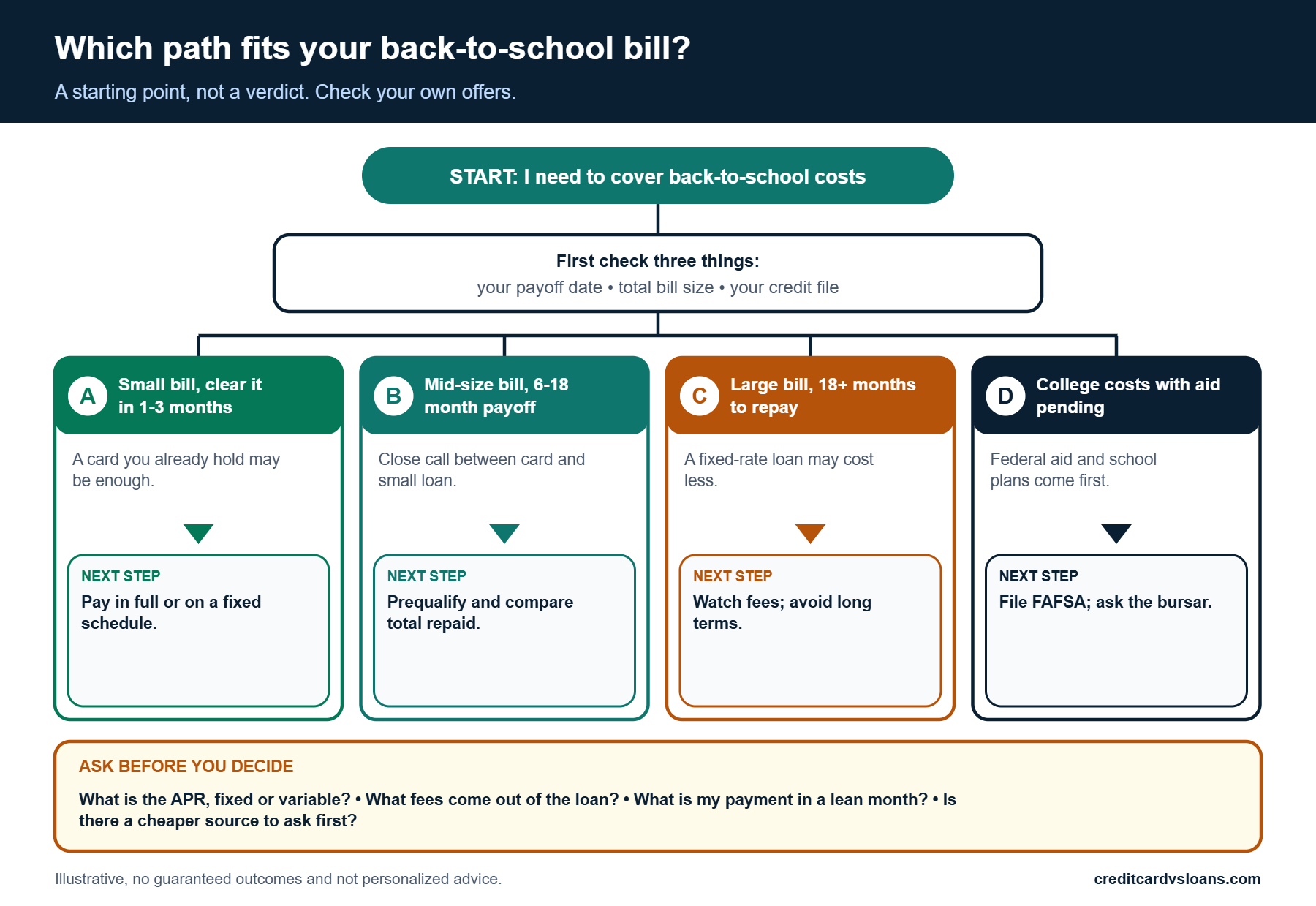
If the bill is under roughly a month’s take-home pay and you can clear it within two or three statements, a card you already hold is usually enough, provided you pay in full or on a fixed schedule. If the bill is several thousand dollars and your realistic payoff is a year or more, a fixed-rate personal loan typically costs less in interest than the same balance on a card at the averages shown earlier, once any fee is counted.
The dividing line is not a dollar amount. It is the length of time you expect to be in debt, multiplied by the gap between the two APRs you’ve actually been offered.
Thin credit, strong credit and the shared-cost case
A borrower with a thin credit file may not get a loan offer at a competitive rate, which can make a modest-limit card the practical choice, used carefully. A borrower with a strong file may be offered a promotional 0% APR card, which belongs in the comparison as a third option.
When costs are shared between two households, such as co-parents or a student and a parent, decide up front who is responsible for the payment and what happens if one person can’t pay. Legal responsibility follows the account holders, not the family agreement.
| Situation | Often fits | Why | Watch out for |
|---|---|---|---|
| $300 of supplies, paid within two statements | Card you already have | No new inquiry; grace period may apply | Carrying the balance past the due date |
| $1,500 across clothes, fees and a device, 6 to 12 months to repay | Card with a fixed payment plan, or a small loan | Close call; compare real offers | Origination fee on a small loan |
| $5,000 or more, 18 to 36 months to repay | Fixed-rate personal loan | Fixed payoff date and a rate that may be lower than a card | Longer terms raise total interest |
| College costs where aid is pending | Federal aid and school plans first; short card bridge at most | Federal loans are fixed-rate and have repayment flexibility | Using a card as a long-term college loan |
| Strong credit and a bill you can clear within the promotional period | Compare a true 0% APR card | No interest if repaid in time | Deferred-interest look-alikes; the rate after the promotion |
Questions to Ask Before You Sign or Swipe
For a lender or card issuer
Ask what the APR is, whether it is fixed or variable, what fees apply, what happens after a missed payment, and whether early payoff costs anything. For a card, ask whether any promotional rate is a true zero-interest offer or a deferred-interest offer and what the rate will be after it ends.
Ask for the answers in writing, and keep the disclosure documents. The CFPB recommends comparing offers from several providers, and that advice holds here too.
For yourself
Can I name the date this will be paid off? What is the payment in my leanest month? Is there a cheaper source I haven’t asked yet? Would I still be comfortable with this debt if the school year brought another surprise cost?
If you can’t answer the first question, you aren’t ready to borrow. Build the payoff plan before the application, not after.
Your Decision Checklist and Next Steps
The comparison above is only useful if it ends in a decision you can carry out. Here is how to turn it into one this week.
Making the Call
A three-test decision rule
Run your options through three tests. First, the payoff test: can you repay within the time your plan assumes without missing other bills? Second, the cost test: compare total dollars repaid across offers, including fees. Third, the downside test: what happens in the worst realistic month, and is that survivable?
The option that passes all three is usually the right one, even if another option is cheaper by a small amount. A slightly more expensive plan you can finish beats a cheaper one you abandon.
What the bottom line looks like
For small bills you can clear fast, use a card you already have and pay it down on a fixed schedule. For larger bills that will take more than a year, prequalify for a fixed-rate loan and compare its total cost to the card. For college costs, look at federal aid and school payment plans before either one. Revisit the decision if a true 0% APR offer appears, and read it as carefully as any loan.
A Concrete Next-Step List
This week
- Itemize the bill and mark what is essential now versus later.
- Decide how much you can pay from cash or savings without leaving yourself exposed.
- Choose a payoff date and calculate the monthly amount needed to hit it by dividing the balance across the months, then adding interest estimates from your actual offers.
- Prequalify with two or three lenders if you are considering a loan, and compare APR, fees and total repaid.
- Ask your card issuer about the rate and any promotional offers on your existing cards.
If you want a second angle on the same decision, our guide on the best way to pay for back-to-school costs frames it as a decision framework, and the financing guide for back-to-school costs walks through the full plan.
Before you commit
- Read the final disclosure and confirm the APR, fee and payment schedule match the offer.
- Set up autopay for at least the minimum, and a calendar reminder for the larger payment you’ve planned.
- Write down the payoff date and check your progress after the first two payments.
- If your situation changes, call the lender before a payment is missed.
This article is general education and not individualized financial advice. Your own rates, fees and eligibility will differ, and a nonprofit credit counselor or your school’s financial aid office can look at your specific numbers.
- Credit Card vs. Personal Loan: Which Is Better for Borrowing?
- How to Finance Back-to-School Costs: Credit Cards, Loans and Lower-Cost Options
- Best Way to Pay for Back-to-School Costs: Compare Borrowing Options Before You Commit
- 0% APR Credit Card vs. Personal Loan for Back-to-School Spending: Which Wins?
- Student Credit Cards: How to Build Credit Without Overspending
- Federal Reserve: Federal Reserve G.19 Consumer Credit release (Q2 2026 interest rates) (Credit card and 24-month personal loan average rates)
- CFPB: What is a personal installment loan?
- CFPB: Choosing a loan that’s right for you (Federal vs. private loans, credit cards for college)
- CFPB: How to understand special promotional financing offers on credit cards
- eCFR: 12 CFR 1026.55 Limitations on increasing annual percentage rates, fees, and charges
- U.S. Department of Education: Interest rates for Federal Direct Loans first disbursed July 1, 2026 to June 30, 2027 (GENERAL-26-33)
- U.S. Department of Education: FY27 sequester-required changes to the Title IV programs (GENERAL-26-28) (Direct Loan origination fees)
- IRS: Education credits: AOTC and LLC
Last updated: October 22, 2026. Rates, fees and lender rules change; verify current terms before acting.
The information on creditcardvsloans.com is provided for general educational and informational purposes only. It is not financial, legal, tax, credit, accounting or investment advice, and reading it does not create an advisor-client, fiduciary or any other professional relationship. Nothing here is an offer, solicitation or recommendation to borrow, lend or apply for any product.
Credit scores, interest rates, fees, eligibility rules, lender policies and laws change frequently and vary by lender, location and individual circumstances. Examples, figures and scenarios are illustrative only, do not predict your results and do not guarantee approval, savings, a particular rate or a credit-score outcome. Always confirm current terms directly with the lender or issuer and read the full agreement before you apply or sign.
Although we aim for accuracy and use reputable sources, we make no representations or warranties, express or implied, about the completeness, accuracy, reliability or timeliness of the content. Content may be drafted with the assistance of automated tools, so errors or omissions may still occur. Links to third-party sites are provided for convenience; we don’t control and aren’t responsible for their content.
To the fullest extent permitted by law, creditcardvsloans.com and its owners, editors, authors, contributors and affiliates disclaim all liability for any loss, damage or expense arising directly or indirectly from your use of, or reliance on, this content. Before making financial decisions, consult a licensed professional, such as a qualified financial advisor, attorney, tax professional or nonprofit credit counselor, who can consider your complete situation.