The smartest way to approach how to finance back to school is to work from the cheapest source of money to the most expensive: reduce the bill, pay what you can from cash flow and savings, use grants and federal aid where they apply, and only then reach for a credit card or personal loan. The order matters because each step down the ladder usually costs more per dollar.
Back-to-school financing means different things in different households. For a parent of a first grader, it is a few hundred dollars of supplies, shoes and fees. For a parent of a high school senior, it might be a laptop, testing fees and a deposit. For a college student, it can mean textbooks, housing deposits and a gap before aid arrives. This guide gives you a plan that scales across all of them.
Our angle here is the full financing plan, start to finish. If you only want a head-to-head of two products, see credit card vs. personal loan for back-to-school expenses. If you want a short decision framework, see the best way to pay for back-to-school costs.
- Itemize first. A financing plan is only as good as the number it is built on, and most households can shrink the bill before borrowing a dollar.
- For college costs, federal student aid comes before cards and personal loans. The CFPB advises against using credit cards to pay for college and calls Direct loans the better choice for most students.
- Cards and personal loans are a backup layer. They can bridge a timing gap or cover a bill that doesn’t fit your cash flow, but only with a payoff date.
- Rates and rules are time-sensitive. Verify current terms with the lender, the school and studentaid.gov before you commit.
- Illustrative numbers in this guide are hypothetical and are not offers.
Federal loan rates cited are for Direct Loans first disbursed July 1, 2026 through June 30, 2027. Card and personal loan averages are from the Federal Reserve’s G.19 release for second-quarter 2026. Rules and rates can change, and your own offers will differ.
How to Finance Back to School: The Plan in Five Steps
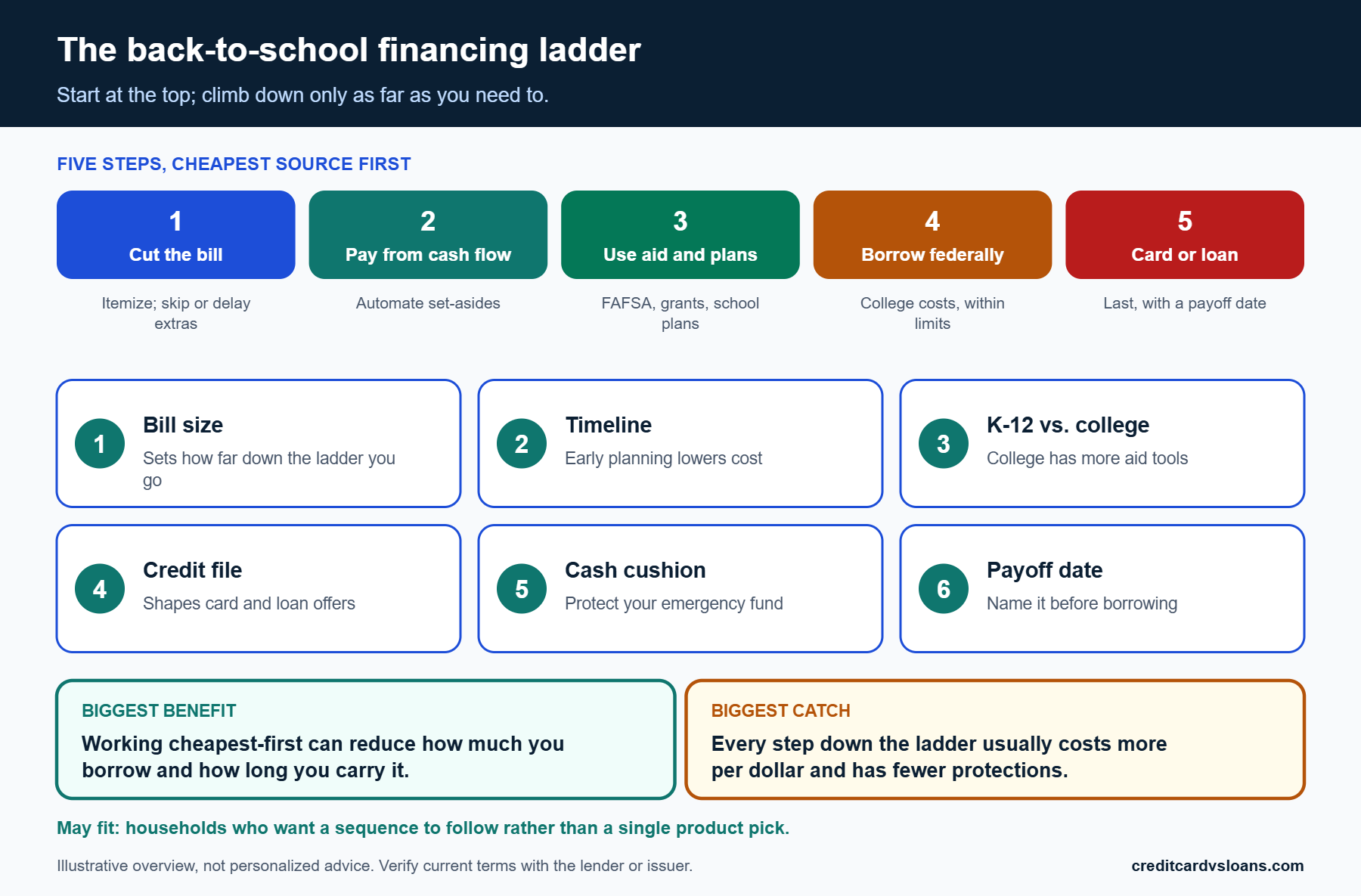
Think of this as a ladder. You start at the top with the options that cost the least, and you climb down only as far as you need to.
The Order of Operations
Cut, schedule, pay, aid, borrow
The sequence is simple. First, cut the bill by separating what is essential from what is optional. Second, schedule the purchases so that items you don’t need on day one wait until your cash flow can handle them. Third, pay what you can from income and savings. Fourth, use grants, scholarships, tax credits and federal aid where you qualify. Fifth, borrow the remainder on the most affordable terms you can find.
The CFPB’s guidance for students follows the same logic: start by cutting costs, applying for grants and scholarships, and considering part-time work or a tuition installment plan before borrowing, and then borrow in a specific order, beginning with federal Direct loans.
Why the order saves money
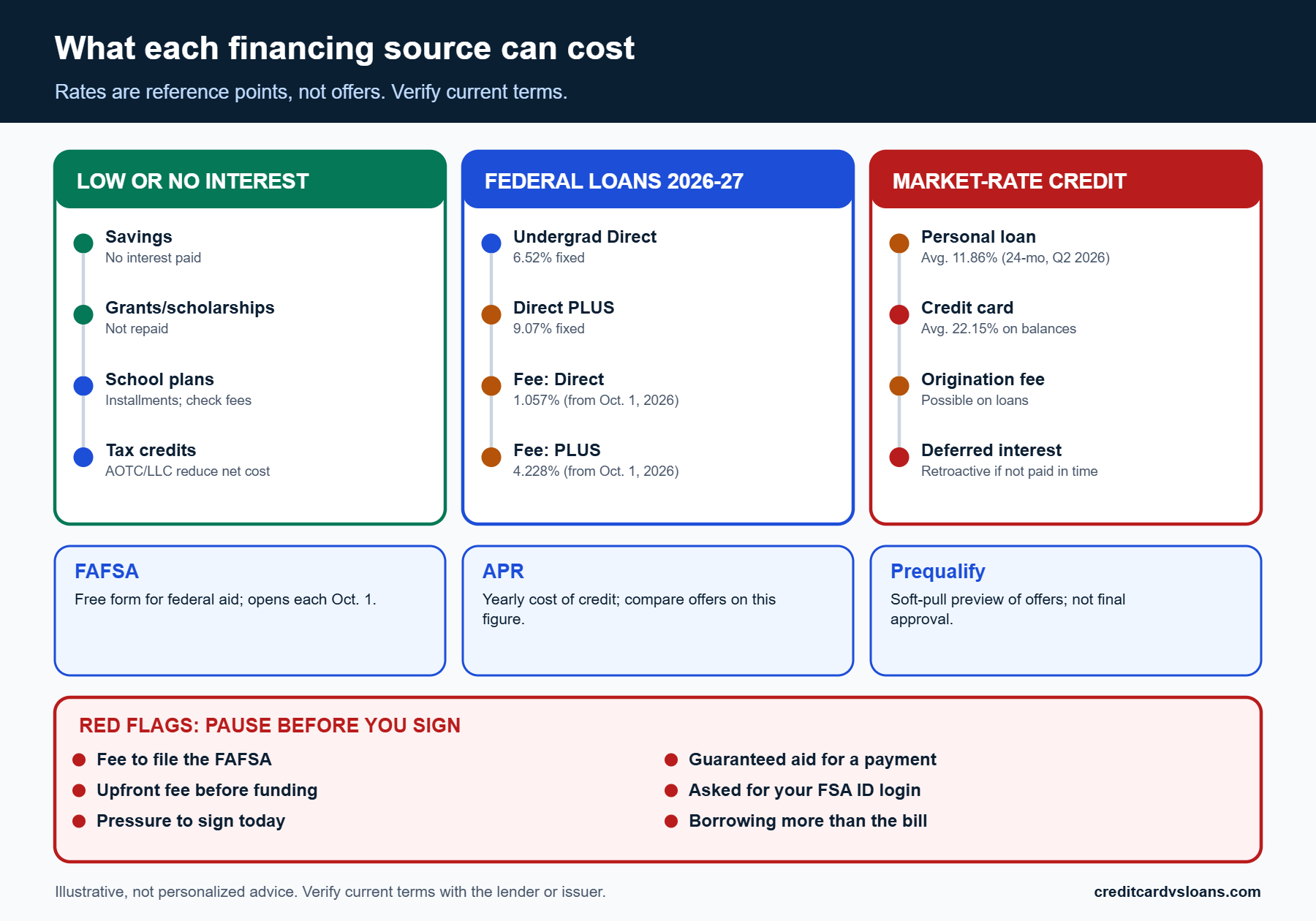
Each step down the ladder tends to carry a higher cost per dollar and fewer protections. Paying from savings costs the interest you could have earned. A federal Direct undergraduate loan first disbursed in the 2026-27 award year carries a fixed 6.52% rate. The Federal Reserve’s second-quarter 2026 data put the average rate on credit card accounts assessed interest at 22.15%, and the average on 24-month personal loans at 11.86%.
Those are averages and not offers, and a strong borrower may do better while a weaker one may do worse. But the shape of the ladder is stable: the lowest-cost money is usually the money you don’t have to borrow.
K-12 vs. College: What Changes
K-12 spending is smaller and more seasonal
K-12 back-to-school costs are usually modest, recurring and mostly necessary: supplies, clothing, fees, devices and sometimes activity costs. Federal student aid doesn’t apply, so the toolkit is your budget, school fee waivers, community supply drives and, if needed, short-term credit. The goal is to avoid carrying a balance past a few months.
Because the amounts are smaller, the risk is less about the size of the debt and more about habits: putting this year’s supplies on a card that still carries last year’s balance.
College spending is larger and has more tools
College costs include tuition, fees, housing, food, books, transportation and personal expenses, and they are usually large enough to require a plan. The tools are different too: the FAFSA, grants, scholarships, work-study, federal loans, school payment plans and tax credits. A card or personal loan is generally the last resort, not the first.
If you’re a parent weighing your own borrowing against a student’s, the right answer depends on rates, repayment flexibility and your own retirement timeline. We cover the risks of parent borrowing later in this guide.
Step One: Build the Real Number
You can’t finance a number you haven’t written down. Most households underestimate back-to-school costs because the spending spreads across several weeks and several accounts.
Itemizing the Bill
A K-12 cost list
Start with a list built from the school’s supply list, the district fee schedule and the wardrobe needs of each child. Sort every item into three groups: needed before the first day, needed within the first month, and nice to have. The last group almost never needs financing.
Include the unglamorous items: school photos, field trip fees, lunch accounts, sports physicals and replacement batteries or chargers for devices. Those small charges are what push a planned budget over the limit.
A college cost list
For college, start with the school’s published cost of attendance and its financial aid award letter, then add what the school doesn’t count. Think of a security deposit, first month’s rent, a bike or bus pass, a winter coat, moving costs and the cost of getting home for the holidays.
Compare the award letter line by line against the bill. Ask the financial aid office what is a grant, what is a loan and what must be repaid, because these can look similar on a summary page.
Cutting Before Borrowing
Used, borrowed and delayed
Many items don’t need to be new. Used textbooks, rental programs, library reserves and open educational resources can cut book costs. Hand-me-down clothing, school uniform swaps and secondhand electronics can trim K-12 costs. Waiting to buy a winter coat until after the first sales can reduce spending without any hardship.
Delay what you can delay, since a purchase deferred is a purchase you don’t have to finance.
Ask for the discount or the waiver
Schools frequently have fee waivers, reduced-price programs and emergency funds that aren’t widely advertised. Ask the front office, the guidance counselor or the bursar. Many colleges also have emergency aid, food pantries and textbook lending programs. A five-minute conversation can eliminate a cost entirely.
Keep a record of each request and the response. If a form is needed, submit it early, since some waivers have deadlines.
Step Two: Pay What You Can Without Borrowing
Every dollar you pay from your own resources is a dollar you don’t pay interest on. The question is how to do that without leaving yourself exposed.
Cash Flow and Savings
Spreading the bill across paychecks
If you start early, a few months of small set-asides can cover much of a K-12 bill without any borrowing. For example, hypothetically, a household that wants $1,200 ready by mid-August needs about $300 a month from May through August, or about $150 per paycheck on a twice-monthly schedule… a figure that is straightforward to compute but harder to maintain without automation. Setting up an automatic transfer into a separate savings account on payday makes the plan real.
If you’re reading this in late summer and the bill is already due, use the same logic in reverse: choose the portion you can pay now, finance the rest with a plan, and set the payments to end before the next big expense arrives.
When to use savings and when to protect them
An emergency fund exists for emergencies, such as a car repair or a lost shift, and draining it to pay for supplies can force you into worse borrowing later. A sensible compromise is to use savings for part of the bill, keep a minimum cushion, and finance the rest on a short fixed schedule.
There’s no universal cushion size. A household with one steady income and a mortgage may need more breathing room than a household with two incomes and low fixed costs. Decide what number lets you sleep at night, and treat it as off limits.
Federal Student Aid and Tax Benefits for College
The FAFSA and grants first
For college, the first form is the FAFSA, the Free Application for Federal Student Aid. The CFPB advises filing as soon as it opens on October 1 if you’re starting school the following year, since some aid is limited. Grants and scholarships don’t have to be repaid, so they come ahead of any loan in the plan.
Check the school’s own scholarship portal, your state’s aid programs and local organizations, and ask about renewal rules. A scholarship that disappears after the first year changes the financing math for years two through four.
Federal loans and education tax credits
Federal Direct loans are usually the better choice for most students, according to the CFPB, because they generally have lower fixed rates, don’t require a credit check or co-signer for most borrowers and offer more flexible repayment and pause options. The CFPB’s recommended order is Direct Subsidized, then Direct Unsubsidized, then Direct PLUS for parents or graduate students, and private loans last.
The IRS says the American Opportunity Tax Credit is worth up to $2,500 per eligible student and is partially refundable, for the first four years of postsecondary education, with modified adjusted gross income limits of under $90,000 for single filers and under $180,000 for joint filers. The Lifetime Learning Credit is worth up to $2,000 per return. Credits arrive when you file taxes, so they lower the final cost but don’t cover a bill that is due now.
Step Three: Compare What Each Source Costs
Once you’ve reduced the bill and used your resources, you may still have a gap. This is where you compare financing sources on cost, not convenience.
The Cost Ladder
Federal loan terms for 2026-27
For Direct Loans first disbursed July 1, 2026 through June 30, 2027, the U.S. Department of Education set fixed rates of 6.52% for undergraduate Direct Subsidized and Unsubsidized loans, 8.07% for graduate and professional Direct Unsubsidized loans and 9.07% for Direct PLUS loans. For loans first disbursed from October 1, 2026 through September 30, 2027, the origination fee is 1.057% on Direct Subsidized and Unsubsidized loans and 4.228% on Direct PLUS loans.
Hypothetically, a $5,000 undergraduate Direct loan would carry about $52 in fees, which are deducted before disbursement, while a $5,000 PLUS loan would carry about $211. Fees are one reason the net amount you receive can be lower than the amount you borrow.
Card and personal loan terms
Market-rate products price off your credit file. The Federal Reserve’s G.19 release for the second quarter of 2026 shows an average of 22.15% for credit card accounts assessed interest and 11.86% for 24-month personal loans. A promotional 0% APR card can undercut both, but only if you repay within the promotion, as we explain in our guide to 0% APR cards vs. personal loans for back-to-school spending.
The following table puts the ladder in one place.
| Source | Typical cost signal | Credit check? | Main catch |
|---|---|---|---|
| Savings and cash flow | No interest paid | No | Can drain your emergency cushion |
| Grants, scholarships, school plans | No interest, or modest enrollment fee | No | Deadlines, renewal rules |
| Federal Direct loans (undergraduate) | 6.52% fixed, 1.057% fee (2026-27) | Generally no | Borrowing limits; repaid after school |
| Parent PLUS loans | 9.07% fixed, 4.228% fee (2026-27) | Yes | Parent is liable; new caps apply |
| Personal loan | Bank average 11.86% (24-month, Q2 2026) | Yes | Possible origination fee; fixed payment |
| Credit card | Average 22.15% on balances (Q2 2026) | Yes | No payoff date; variable rate |
What the Total Cost Looks Like
Illustrative math on $5,000
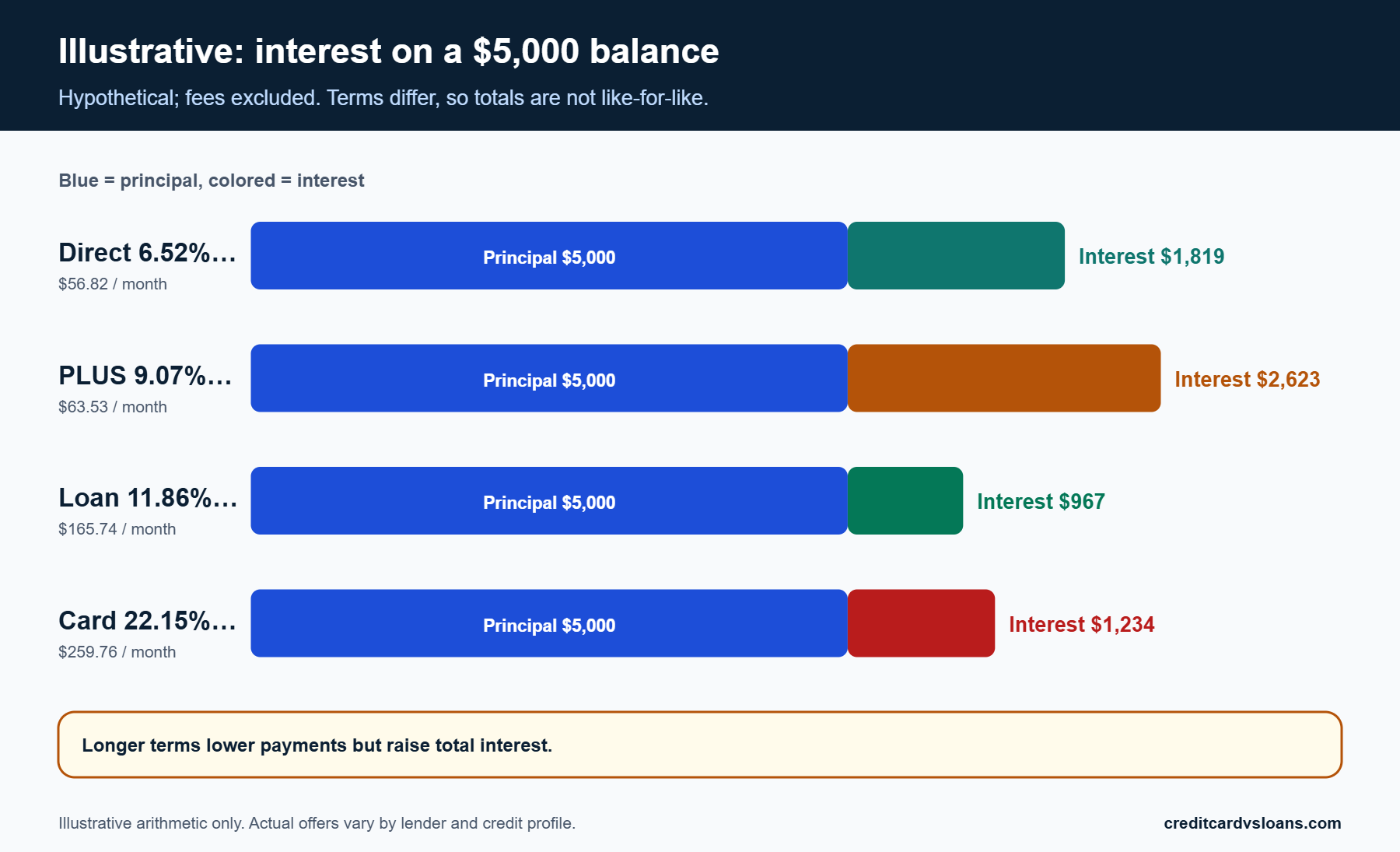
Interest rate alone doesn’t tell the story because the repayment period differs. Assuming a hypothetical $5,000 balance and ignoring fees, a federal undergraduate loan at 6.52% repaid over a 10-year term would have a payment of about $56.82 and total interest of about $1,819. A PLUS loan at 9.07% over 10 years would be about $63.53 a month and about $2,623 in interest. A 36-month personal loan at 11.86% would be about $165.74 a month and about $967 in interest, and a 24-month card repayment at 22.15% would be about $259.76 a month and about $1,234.
The lesson is that a long term lowers the payment but raises the total interest, which is why the federal loans can look expensive in total dollars even with the lowest rate. The 10-year term here is an assumption for illustration, and your repayment plan and term may differ.
Why payment and total cost tell different stories
If you borrow federally for college, you will have years to repay, but you will also pay interest for years. The sensible move is to borrow no more than you need, pay the interest as it accrues on unsubsidized loans when you can afford to, and revisit the payoff plan after graduation.
For smaller bills, the opposite is true. A short fixed payoff on a card or small loan can cost less in total interest than a long federal repayment, but it demands a much higher monthly payment. Match the term to your budget rather than to the lowest number on the page.
| Feature | Federal Direct loans | Private student loans |
|---|---|---|
| Rate type | Fixed for new loans | May be variable |
| Credit check or co-signer | Generally not required (except PLUS) | Most require a co-signer unless credit is strong |
| Repayment flexibility | More flexible and pause options | Generally less flexible |
| Borrowing limits | Annual and total limits | Can fill gaps beyond federal limits |
| Consequence of default | Wage, tax refund or benefit garnishment possible | Collections and legal action possible |
| CFPB suggested order | Use first | Use last, after shopping around |
Step Four: Use Cards and Personal Loans as a Backup Layer
Sometimes the gap is real, the aid isn’t enough and the bill is due. Cards and personal loans exist for that situation, and they work well when used with a payoff plan. They work badly when used as a substitute for one.
Credit Cards as a Bridge
Where a card fits the plan
A card fits best as a short bridge: covering a purchase now when you know money is coming soon, such as a financial aid refund, a paycheck or a confirmed tax refund. It also fits when a retailer’s offer or the card’s protections make it the safest way to pay. If you can pay the statement balance in full, a card costs nothing extra.
The CFPB’s college guidance cautions against using credit cards to pay for college because they are usually a much more expensive way to finance education and lack the flexible repayment terms and protections of federal student loans. That is a strong signal for tuition-sized balances, though a few hundred dollars of textbooks paid off in a month is a different case.
How to keep a bridge from becoming a trap
Write down the date the bridge ends and set a reminder. Choose a fixed monthly payment higher than the minimum, and automate it. Avoid adding new purchases to the balance, since each one resets the clock on your payoff plan.
If you’re considering a promotional rate, read whether it’s a true zero-interest offer or a deferred-interest offer. The CFPB explains that with deferred interest, interest accumulates during the promotion and is charged back to the purchase date if the full balance isn’t paid in time. For a comparison of genuine 0% offers against loans, see our 0% APR vs. personal loan guide for back-to-school spending.
Personal Loans as a Fixed Plan
Where a personal loan fits the plan
A personal loan makes sense when the gap is larger than you can clear in a few months and you want a fixed payment with a firm end date. The CFPB describes these as closed-end installment loans where the lender provides all the money up front and payments are usually the same throughout the loan. They are used for large purchases, unexpected expenses and consolidating debt.
Prequalify with several lenders, compare the APR and any origination fee, and borrow only the amount you’ve itemized. Our side-by-side analysis is in credit card vs. personal loan for back-to-school expenses, and the broader comparison is in credit card vs. personal loan: which is better for borrowing.
Where it doesn’t fit
A personal loan is usually a poor fit for small K-12 bills, because the fee and the paperwork can outweigh the benefit. It is also a poor fit if your income is uneven and a fixed payment would strain your budget in a lean month.
It is a poor fit for college costs if you haven’t yet used federal options. If you need more than federal limits provide, the CFPB advises shopping among private student lenders and comparing offers, since advertised low rates often go only to the best-qualified borrowers.
Step Five: Build a Repayment Plan You Can Keep
A financing plan isn’t finished until you know the monthly payments, the end dates and what happens if something changes. This step is where most plans succeed or fail.
Setting the Schedule
Work backward from the payoff date
Pick a payoff date that you can defend, and divide the balance by the number of months to find the base payment. Then add an allowance for interest based on your actual rate. If the payment is more than you can sustain, extend the date rather than abandon the plan, but understand that each added month raises total interest.
For a hypothetical $1,500 balance on a card at 22.15%, six months would mean about $266.40 a month and about $98 in interest, while twelve months would mean about $140.50 a month and about $186 in interest. Those numbers are illustrations, not quotes.
Align payments with the school calendar
Back-to-school costs often repeat each year, and so does the temptation to finance them again. If you can finish paying this year’s costs before next August, you start the new cycle clean. If you can’t, consider a smaller, more selective list next year.
For college students, align repayment with likely income events: summer work, aid refunds and tax refunds. Treat those as confirmed only once they’ve arrived.
| Month | Action | Cash paid | Card balance (approx.) |
|---|---|---|---|
| August | Pay $600 from savings; put $900 on the card | $600 | $900 |
| September | Pay $300 on the card | $300 | About $620 |
| October | Pay $300 on the card | $300 | About $330 |
| November | Pay the remainder | About $340 | $0 |
The sample schedule assumes the card charges roughly 22% APR and shows approximate balances; interest on this plan would be small, probably in the neighborhood of $30. The actual figure depends on statement dates and daily balances.
When Plans Go Off Track
Contact the lender early
If you can’t make a payment, contact the lender before the due date. The CFPB advises asking about deferment, forbearance or a payment plan, and notes that missed payments can lead lenders to use third-party debt collectors and report the missed payment to the three major credit bureaus.
For federal student loans, borrowers can contact their loan servicer to ask about repayment options. Details change, so check studentaid.gov for current programs.
Avoid fixing one debt with a worse one
It can be tempting to use a high-rate cash advance or a payday-style loan to cover a gap. Those products can be far more expensive than a card purchase. Before borrowing again, call the school, the card issuer or a nonprofit credit counselor and ask what hardship options exist.
The aim is to stop the spiral before it starts. One missed month handled early is a small problem. Three months of avoidance is a large one.
Risks, Red Flags and Family Borrowing
Financing back-to-school costs involves more than rates. Who signs the paperwork, who is legally responsible and who can be contacted if a payment is missed all matter.
Parent and Co-Signer Borrowing
What Parent PLUS borrowing means
A Direct PLUS loan to a parent is the parent’s legal debt, not the student’s. The loan requires a credit check, carries a higher rate and fee than undergraduate Direct loans (9.07% and 4.228% for the 2026-27 award year as cited above), and repayment is the parent’s responsibility. University financial aid offices report that beginning July 1, 2026, new Parent PLUS borrowing is limited to $20,000 per year and $65,000 per dependent student, with transition rules for existing borrowers. Confirm the current limits at studentaid.gov or with the school’s financial aid office.
Before borrowing, a parent should consider how a payment will fit alongside retirement saving and the household budget, since there is no loan for retirement.
Co-signing a private loan
The CFPB notes that most private student loans require a co-signer unless the borrower has solid credit. A co-signer is legally responsible if the borrower doesn’t pay, and the loan can affect the co-signer’s credit and ability to borrow.
If you are asked to co-sign, ask what the lender offers in a co-signer release, what happens in a death or disability, and how you will be notified of missed payments. Get the answers in writing.
Scams and Predatory Offers
Student aid and loan scams
Be skeptical of anyone who charges a fee to file the FAFSA, offers to guarantee aid for a payment, asks for your FSA ID or demands payment by gift card. The FAFSA is free to file, and your school’s financial aid office provides help at no charge. Never share login credentials with a third party.
The Department of Education and the FTC both provide scam-reporting channels, and your school can tell you where to report a suspicious solicitation.
Lenders with pressure tactics
Treat a lender that demands an upfront fee before funding, won’t disclose the APR, or pushes you to sign today as a red flag. Legitimate lenders disclose cost and terms before you commit. If a deal sounds unusually easy for someone with a thin credit file, slow down and verify the lender’s license with your state regulator.
An offer that promises to eliminate or guarantee your student aid, or that asks you to pay before you receive anything, deserves a pause and a call to your school’s financial aid office.
A Back-to-School Financing Calendar
Timing is a financing tool. The same bill costs less when it is planned months ahead and more when it lands on a single week in August.
Spring and Summer Preparation
For college-bound students
The FAFSA opens each October 1, according to the CFPB, so the earliest planning for fall happens the previous autumn. By spring, you should have award letters to compare, deadlines for housing deposits marked on a calendar and a list of outside scholarships to pursue. Summer is the time to confirm how aid will be disbursed, when tuition is due and whether the school offers an installment plan.
Ask the bursar’s office for the exact due dates and any late-payment fee. A plan that starts a month earlier can often avoid a late fee that would otherwise erase months of careful budgeting.
For K-12 families
For K-12, the school’s supply list usually appears in late summer, but many districts publish fee schedules and calendars earlier. Start a small monthly set-aside as soon as you know the number is coming, and watch for tax-free weekends or sales that your state may offer. Availability varies by state, so check your state’s department of revenue rather than assuming one exists.
Buying a few items each month beats buying everything at once, both for the budget and for the chance of catching a sale.
The First Weeks of the Term
Reconciling the bill with reality
Once classes start, the real costs appear: a required textbook the syllabus lists, a lab fee, a device that needs replacing. Keep a small buffer in the plan for these. If you didn’t, address them with the same ladder rather than defaulting to a card swipe.
Check your first aid disbursement against your award letter. If a refund is due after tuition and fees, decide in advance how much goes to the bill, how much to living costs and how much to paying down any short-term card balance.
Reviewing the plan after 30 days
A month in, review your spending against the plan. If a balance is larger than expected, adjust the payment rather than ignoring it. If you’re ahead of schedule, send the extra to the highest-rate balance.
A short monthly check, ten minutes at most, is what separates a financing plan from a financing hope.
Putting the Plan Together for Your Household
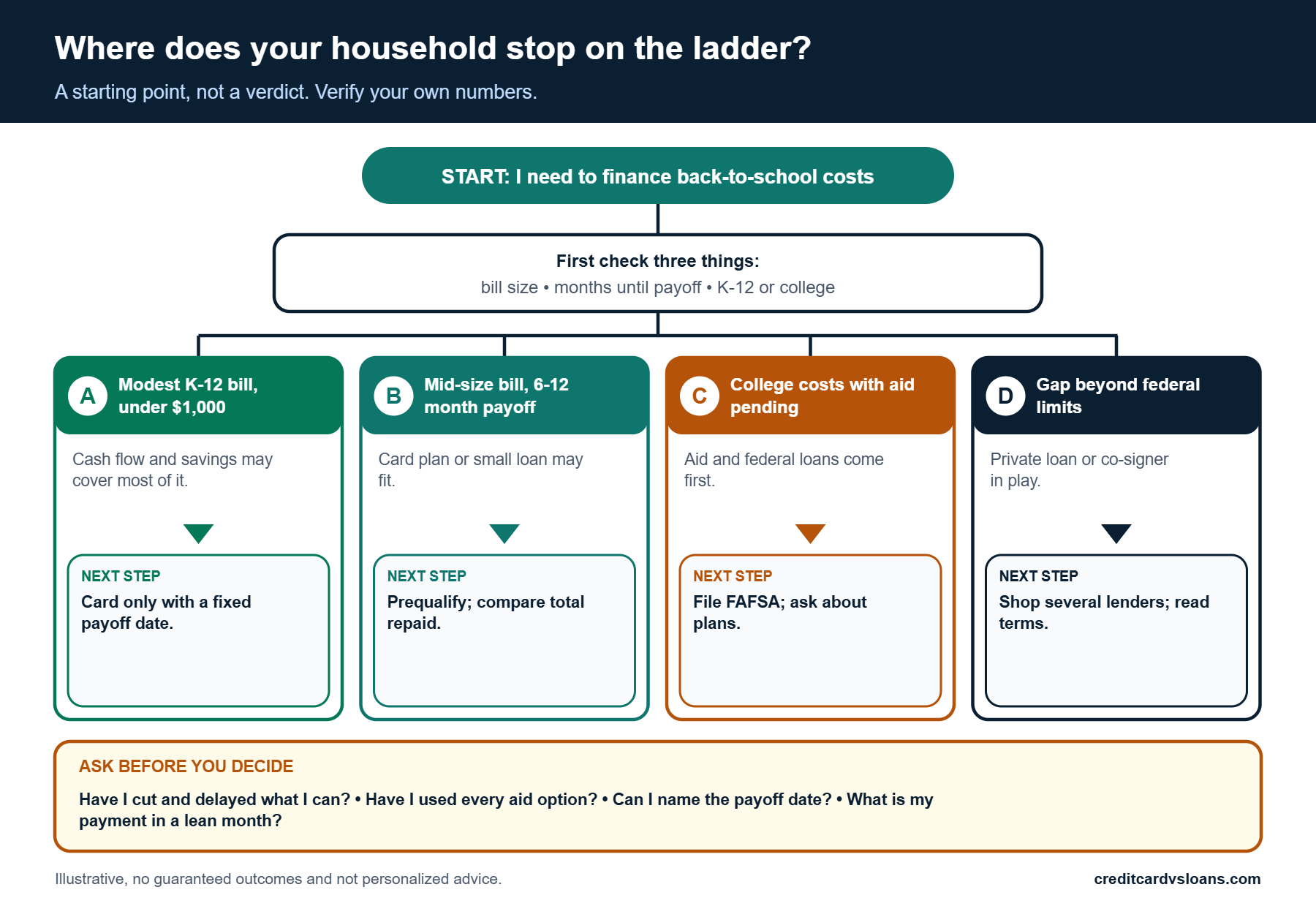
The ladder stays the same, but where you stop on it depends on your circumstances. The profiles below are hypothetical and meant to show how the same steps produce different plans.
Four Hypothetical Household Plans
The family with a modest K-12 bill
Imagine a household with two elementary-age children and a $900 bill spread over late July and August. The plan might be to pay $400 from savings, put the rest on an existing card, and automate $250 payments for the next two months. No new account is needed, no fee is paid and the debt ends in October. If that card already carries a balance, the plan may need to shift to a smaller purchase list or a short bridge from a lower-rate source.
The same logic applies to other surprise costs. Our guide on financing a veterinary emergency walks through the same cheapest-first ladder for a different kind of bill.
The family with a high school senior and a college freshman
Now imagine a larger, more complex bill: a laptop, application fees, a housing deposit and a first-semester gap. The plan might be to file the FAFSA early, apply for school and outside scholarships, set up the school’s tuition installment plan, accept federal loans only to the extent needed, and use a card only for textbook purchases that will be repaid from the aid refund. A parent considering PLUS borrowing should compare it with the student’s own federal options and with the household’s retirement timeline before committing.
In this scenario, the biggest risk is not the interest rate but the cumulative total across four years. Keep a running tally of what has been borrowed, by whom and at what rate.
Choosing Between Borrowing Tools
If you have a thin credit file
A thin credit file may limit your card and loan options and push rates higher. A student with no history should look first at federal aid, which generally does not depend on credit for undergraduate Direct loans, and consider a starter card only for small purchases paid in full. Our guide to student credit cards and building credit without overspending covers that route.
Avoid applying to several lenders without prequalifying. Each hard pull has a small effect, and a pile of denials can sap your options.
If you have a strong credit file
A strong file widens your options, including lower-rate personal loans and promotional 0% APR cards. Rate shop with soft pulls, and compare total dollars repaid. The CFPB suggests that when you shop for private loans, comparing offers within about two weeks limits the credit score impact of multiple applications.
Even with strong credit, the cheapest option is often the one you don’t need to borrow. Use the ladder in the same order, and treat credit availability as a backup, not a plan.
Your Back-to-School Financing Checklist
This final section turns the plan into actions. If you only do the first four, you’ll be ahead of most households.
Decide With Confidence
The questions that settle most cases
Have I itemized the bill and removed what I can? Have I used cash flow and savings without draining my cushion? Have I applied for every grant, scholarship, school plan and federal aid option available? Is there still a gap, and can I name the date I will close it? Those four answers decide whether you need a card, a loan, or nothing at all.
If you still need to choose between a card and a loan, the comparison in credit card vs. personal loan for back-to-school expenses gives the cost math, and the best way to pay for back-to-school costs gives a shorter decision framework.
Financing back to school well means working down the cost ladder: shrink the bill, pay what you can from cash flow, claim every grant, plan and federal option, and borrow the remainder on the lowest-cost terms with a firm payoff date. Cards and personal loans are tools for the last step, not the first.
What to avoid
Avoid financing optional purchases, carrying a card balance with no end date, borrowing more than the itemized bill, signing anything you haven’t read, and paying a fee for help that your school provides for free. Those are the five mistakes that do the most damage and take the least effort to prevent.
Your Next Steps
This week
- Write down the full bill, split into now, soon and later.
- Ask the school about fee waivers, installment plans and emergency funds.
- Set an automatic transfer for whatever you can pay from income.
- For college, confirm your FAFSA status and compare the award letter line by line.
Before you borrow
- Prequalify with at least two or three lenders, or review your existing card terms.
- Compare APR, fees and total dollars repaid for each option.
- Pick a payoff date, set a fixed payment and automate it.
- Keep every disclosure, and call the lender early if your situation changes.
This guide is general education, not personalized financial advice. A nonprofit credit counselor or your school’s financial aid office can review your actual numbers.
- Credit Card vs. Personal Loan for Back-to-School Spending: Which Is Better?
- Best Way to Pay for Back-to-School Costs: Compare Borrowing Options Before You Commit
- 0% APR Credit Card vs. Personal Loan for Back-to-School Spending: Which Wins?
- How to Finance a Veterinary Emergency: Credit Cards, Loans and Lower-Cost Options
- Credit Card vs. Personal Loan: Which Is Better for Borrowing?
- CFPB: Choosing a loan that’s right for you (Order of borrowing; credit cards for college)
- CFPB: What student loan option is best for me: federal or private?
- CFPB: What is a personal installment loan?
- CFPB: How to understand special promotional financing offers on credit cards
- Federal Reserve: Federal Reserve G.19 Consumer Credit release (Q2 2026 interest rates)
- U.S. Department of Education: Interest rates for Federal Direct Loans first disbursed July 1, 2026 to June 30, 2027 (GENERAL-26-33)
- U.S. Department of Education: FY27 sequester-required changes to the Title IV programs (GENERAL-26-28) (Direct Loan origination fees)
- IRS: Education credits: AOTC and LLC
Last updated: October 22, 2026. Rates, fees and lender rules change; verify current terms before acting.
The information on creditcardvsloans.com is provided for general educational and informational purposes only. It is not financial, legal, tax, credit, accounting or investment advice, and reading it does not create an advisor-client, fiduciary or any other professional relationship. Nothing here is an offer, solicitation or recommendation to borrow, lend or apply for any product.
Credit scores, interest rates, fees, eligibility rules, lender policies and laws change frequently and vary by lender, location and individual circumstances. Examples, figures and scenarios are illustrative only, do not predict your results and do not guarantee approval, savings, a particular rate or a credit-score outcome. Always confirm current terms directly with the lender or issuer and read the full agreement before you apply or sign.
Although we aim for accuracy and use reputable sources, we make no representations or warranties, express or implied, about the completeness, accuracy, reliability or timeliness of the content. Content may be drafted with the assistance of automated tools, so errors or omissions may still occur. Links to third-party sites are provided for convenience; we don’t control and aren’t responsible for their content.
To the fullest extent permitted by law, creditcardvsloans.com and its owners, editors, authors, contributors and affiliates disclaim all liability for any loss, damage or expense arising directly or indirectly from your use of, or reliance on, this content. Before making financial decisions, consult a licensed professional, such as a qualified financial advisor, attorney, tax professional or nonprofit credit counselor, who can consider your complete situation.