The best way to pay for college tuition gap costs, the balance left after scholarships, grants, savings and any federal aid, is usually to shrink the gap first and borrow the rest in a specific order: federal student loans before private credit, and school payment plans or small card balances only when you can clear them quickly. Every step down that ladder tends to trade lower protection for faster approval, so it helps to know where each rung sits before you commit.
A tuition gap often shows up late. A financial aid award arrives, the bill is due before a scholarship disburses, or a sibling’s costs change the family budget, and suddenly a few thousand dollars are missing from a bill that the school expects on a deadline. This guide is built for that moment. It covers the federal loan terms in effect for 2026-27, how school payment plans work according to the CFPB’s research, what private loans, personal loans and cards add, and how to compare them in dollars instead of in monthly payments.
It is general education, not personal advice, and it cannot tell you what you will be approved for. For household emergencies that arrive on a different clock, our guides on paying for a water heater replacement and paying a veterinary emergency bill cover the same tools under time pressure. Tuition is different because the bill is predictable, which means you can work the problem in order.
- Call the financial aid and bursar offices first. A gap sometimes closes through an aid review, a payment plan or a correctly timed disbursement, and those steps cost the least.
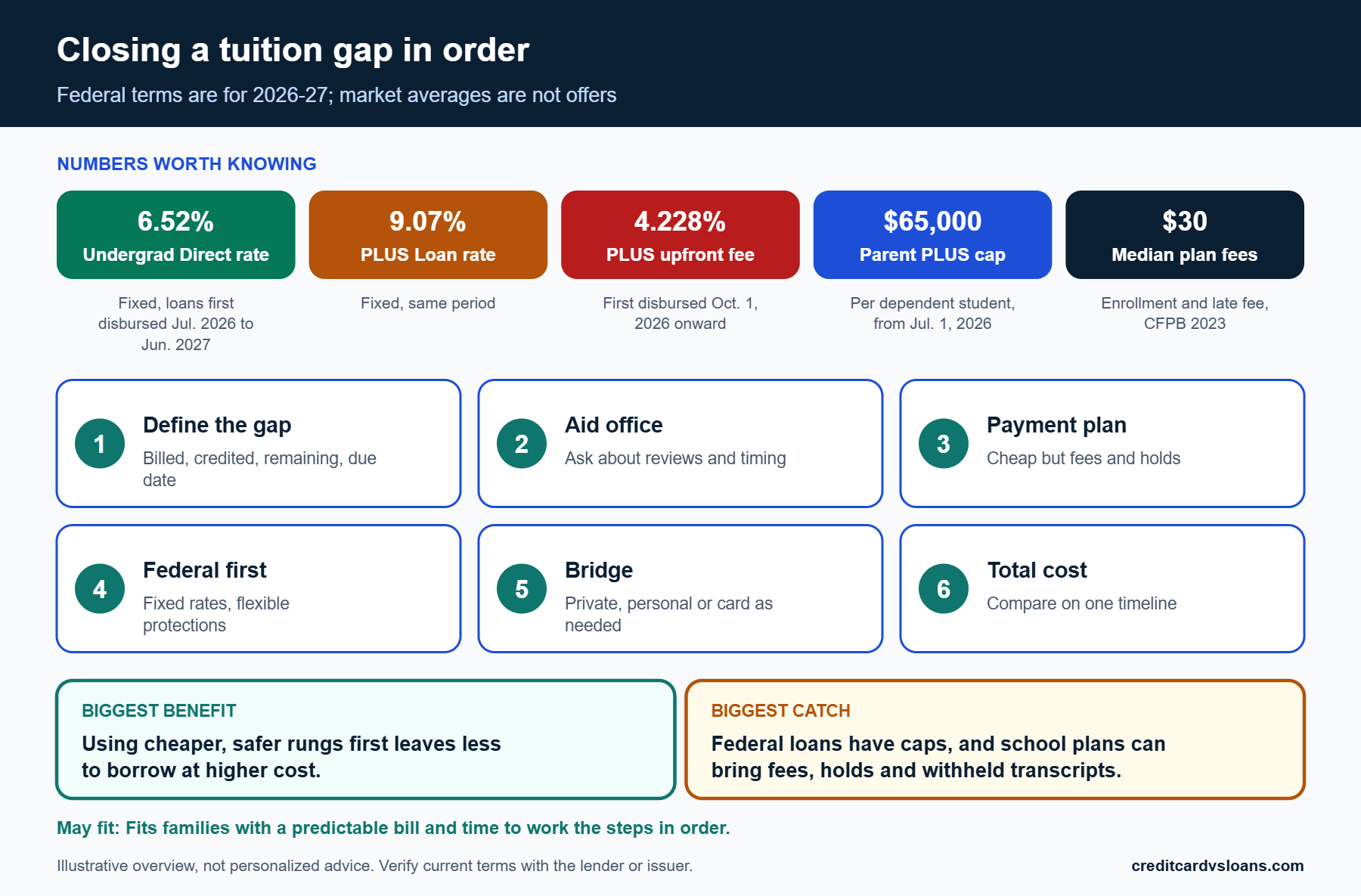
- For loans first disbursed July 1, 2026 through June 30, 2027, the fixed federal rate is 6.52% for undergraduate Direct Loans and 9.07% for PLUS Loans, and PLUS Loans carry a larger upfront fee.
- Starting July 1, 2026, Parent PLUS borrowing is limited to $20,000 per year and $65,000 in total per dependent student, and new Grad PLUS loans have ended for most borrowers.
- School payment plans are usually interest-free but not fee-free, and the CFPB found that missed payments can lead to late fees, holds and withheld transcripts.
- Private loans, personal loans and cards can bridge a gap quickly, but they cost more to carry and offer fewer repayment protections than federal loans.
- Compare the total repaid and the fees on the same timeline before you sign.
Federal rates and loan limits are from Department of Education announcements for the 2026-27 award year. Average market rates are from the Federal Reserve’s G.19 release of Oct. 7, 2026 (August 2026 data). They are national averages, not offers, and your school’s policies may differ.
Table of contents
The short answer: climb the ladder in order
What a tuition gap is, and why the order matters
Defining the gap before you finance it
Start by writing down three numbers from your school account: the amount billed, the amount of aid and payments already credited, and the remaining balance due on the deadline. Separate tuition and fees from housing, meals, books and transportation, because aid, loans and payment plans often treat these differently. A gap of $2,000 on tuition alone is a different problem from $2,000 missing from a bill that includes a housing deposit you could still change.
Ask the bursar’s office to confirm exactly what is due and what the consequences of paying late are, such as late fees, registration holds or removal from classes.
Why federal comes before private
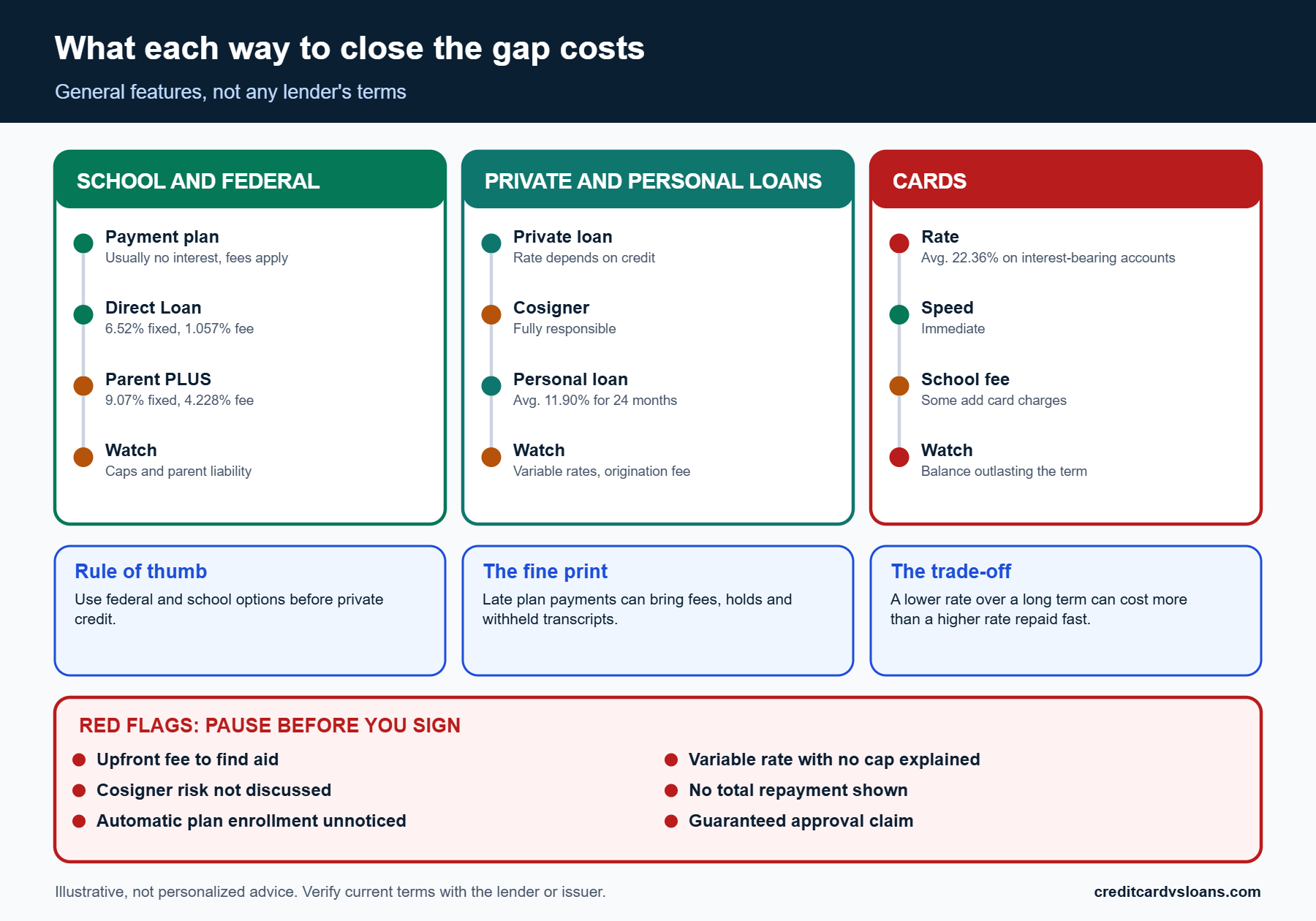
The CFPB advises borrowers to use federal student loan options before private loans, noting that all new federal student loans have fixed interest rates and that federal loans usually have more flexible protections if you have trouble repaying. Private loans may have variable rates that reset and change your payment. That is the core reason for the ladder: the first rungs cost less and protect more, even though they can be slower.
The order is not a rule for every family, but it is a sensible default unless a specific private offer clearly beats it on total cost and you understand what you give up.
The rungs, from least to most expensive risk
Rungs one to three: aid, school plans and federal loans
The first rung is reducing the gap: asking about aid, scholarships and timing. The second is the school’s own payment plan, which spreads the bill across installments, typically without interest but sometimes with an enrollment fee. The third is federal loans, either Direct Loans in the student’s name or PLUS Loans for parents, which come with fixed rates and set limits. Each is covered in detail below.
If the gap is small and your cash flow can handle installments, the second rung alone may solve it.
Rungs four to six: private loans, personal loans and cards
The remaining rungs are private education loans, personal loans and credit cards. They can be useful when federal options are exhausted or too slow, but rates depend on credit and income, a cosigner may be required, and a card charged at the average rate costs far more if the balance lingers. In the Federal Reserve’s G.19 release of Oct. 7, 2026, the average rate on card accounts assessed interest was 22.36% for August 2026, and the average 24-month personal loan rate was 11.90%.
Use these rungs for the smallest amount and the shortest time that works.
Shrinking the gap before you borrow
Questions that can lower the balance
Ask the financial aid office what has changed
Financial aid offices can answer questions that an article cannot: whether your award reflects a recent change in family income or circumstances, whether any institutional grants or scholarships remain unclaimed, and whether a late-disbursing award will arrive after the deadline. Ask what the process is for requesting a review, what documents are needed and how long it takes. Policies differ by school, and nothing in a request guarantees a change.
Ask for any decision in writing and note deadlines, since aid reviews often run on a short timeline.
Check the timing of what is already coming
Some gaps are timing gaps. A scholarship may be paid after the bill is due, or a federal loan may disburse weeks into the term. Ask the bursar whether a pending award can be credited against the bill or whether a short deferral is possible. A small timing gap handled with a payment plan can cost far less than a loan, so confirm what is pending and when it will be posted before borrowing for it.
If a hold or late fee looms, ask whether the school can place a temporary hold on the penalty while aid posts.
Reducing costs and using tax benefits
Costs you can change
Tuition itself is rarely negotiable, but the rest of the bill may be. Housing and meal plan choices, the number of credits taken in a term, textbook sources and fees for optional services can sometimes be changed. Reducing the gap by even a few hundred dollars shortens repayment on whatever you do borrow. Our guide to the best way to pay for back-to-school costs covers the supplies and incidentals that often surround tuition.
Do not trim anything that would delay graduation, since extra terms usually cost more than the savings.
The American opportunity tax credit
The IRS describes the American opportunity tax credit as worth up to $2,500 per eligible student: 100% of the first $2,000 of qualified expenses plus 25% of the next $2,000. The IRS page says the credit is partially refundable at 40%, is available for four years per eligible student, and lists modified adjusted gross income limits below $90,000, or $180,000 for married couples filing jointly. A credit arrives when you file, so it does not close a gap due this month, but it may affect what you plan to borrow for later terms.
Eligibility depends on the student, the school and your tax situation, so confirm with the IRS or a tax professional.
Federal loans for 2026-27: rates, fees and limits
The terms in plain numbers
Interest rates and fees
According to the Department of Education’s announcement for loans first disbursed between July 1, 2026 and June 30, 2027, the fixed rate is 6.52% for Direct Subsidized and Unsubsidized Loans for undergraduates, 8.07% for Direct Unsubsidized Loans for graduate and professional students, and 9.07% for Direct PLUS Loans for parents and for graduate or professional students. For loans first disbursed on or after Oct. 1, 2026 and before Oct. 1, 2027, the department lists upfront fees of 1.057% for Subsidized and Unsubsidized Loans and 4.228% for PLUS Loans. Loans disbursed earlier in the award year may carry a different fee, so check your award notice.
The fee is deducted from each disbursement, so you receive less than you borrow while repaying the full amount.
Annual and aggregate limits
Federal Student Aid’s loan limits FAQ shows that undergraduate Direct Loan limits are unchanged: for dependent students, $5,500 in the first year, $6,500 in the second and $7,500 in the third year and beyond, with a $31,000 aggregate; for independent students, $9,500, $10,500 and $12,500, with a $57,500 aggregate. The subsidized portion within those totals is $3,500, $4,500 and $5,500, up to $23,000 in total. The FAQ notes that the independent-student limits can also apply to dependent students whose parents cannot obtain a Parent PLUS Loan, so ask the financial aid office whether that applies to you.
These limits are why a gap can persist even after you accept all the federal loans offered.
| Loan type | Borrower | Fixed rate | Upfront fee (first disbursed Oct. 1, 2026 to Sept. 30, 2027) |
|---|---|---|---|
| Direct Subsidized or Unsubsidized | Undergraduate student | 6.52% | 1.057% |
| Direct Unsubsidized | Graduate or professional student | 8.07% | 1.057% |
| Direct PLUS (Parent PLUS) | Parent of a dependent undergraduate | 9.07% | 4.228% |
What changed on July 1, 2026
Parent PLUS limits
The Federal Student Aid FAQ states that, effective July 1, 2026, Parent PLUS borrowing for new borrowers is limited to $20,000 per year per dependent student and $65,000 in total per dependent student, regardless of amounts repaid or discharged, and also capped at the cost of attendance minus other aid. The $65,000 cap includes Parent PLUS borrowing for that student at other schools. Existing borrowers and students with interim exceptions may be treated differently, so ask the financial aid office which rules apply to you.
If your family planned to cover a large gap with Parent PLUS, check these caps before building the plan around it.
Grad PLUS
The same FAQ states that Grad PLUS loans have been eliminated under the new limits for graduate, professional and certain health profession students, with an interim exception for some students who already had loans. Graduate students facing a gap now rely on the Direct Unsubsidized limits, school resources and, if needed, private credit. The CFPB notes that graduate students might consider a private loan instead of a federal one only in narrow circumstances, such as strong job prospects, a very high credit score, substantially lower private rates and a plan to repay within a few years, and only after using up the Direct options.
If you are a graduate student, ask your school how the transition applies to you.
What each way of closing the gap costs
Comparing the options side by side
The comparison table
| Option | Cost signal | Speed | What to watch |
|---|---|---|---|
| School payment plan | Usually no interest; enrollment and late fees apply | Same day to a few days | Fees, holds and automatic enrollment |
| Direct Loan (student) | 6.52% undergrad fixed, 1.057% fee | Weeks, tied to aid process | Annual limits; interest accrues on unsubsidized |
| Parent PLUS | 9.07% fixed, 4.228% fee | Weeks | Parent liability; new caps |
| Private student loan | Varies with credit; may be variable | Days to weeks | Cosigner often needed; fewer protections |
| Personal loan | Average 11.90% for 24 months (Aug. 2026) | Same day to days | Origination fee; no education protections |
| Credit card | Average 22.36% on interest-bearing accounts (Aug. 2026) | Immediate | High rates; possible school card fees |
What the table shows
The lowest-cost options are the slowest or the most limited, and the fastest are the most expensive per dollar if balances linger. Federal loans combine low fixed rates and flexible repayment protections with annual caps. Parent PLUS has higher cost and parent liability. Cards are immediate but best treated as a short bridge. The averages are context rather than predictions, since individual offers vary with credit and the lender.
The right choice depends on how large the remaining gap is after the cheaper rungs.
Putting numbers on it
A hypothetical $6,000 gap
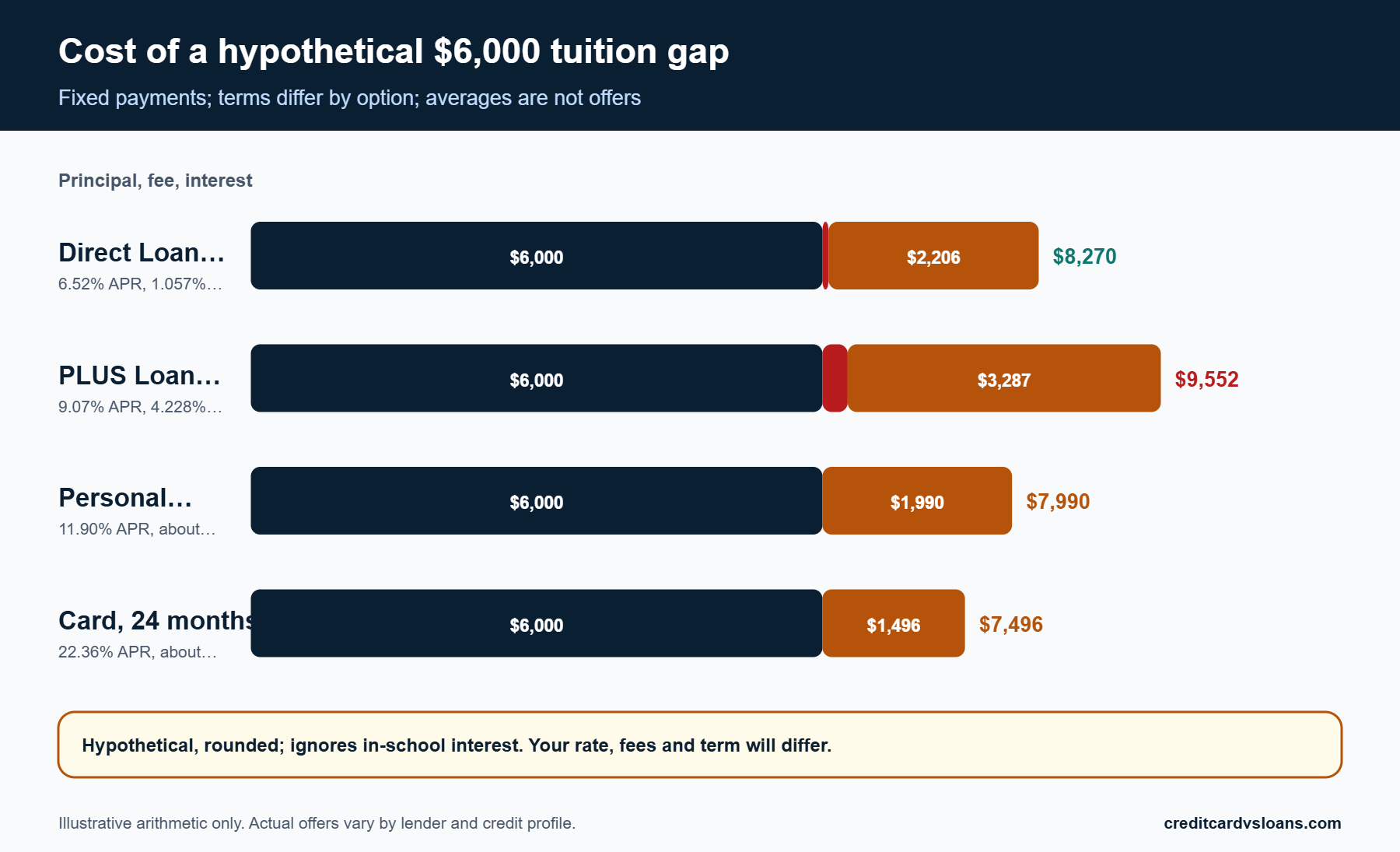
Consider an illustrative $6,000 net amount needed, with the same cash received in each case. A Direct loan at 6.52% with a 1.057% fee requires borrowing about $6,064; over a hypothetical 10-year term that is about $69 a month, about $64 in fees and about $2,206 in interest. A PLUS loan at 9.07% with a 4.228% fee requires borrowing about $6,265, about $80 a month, about $265 in fees and about $3,287 in interest. A 60-month personal loan at the 11.90% average costs about $133 a month and about $1,990 in interest before any fee, and a card at 22.36% repaid over 24 months costs about $312 a month and about $1,496 in interest.
These figures are hypothetical and rounded. They ignore interest that accrues while a student is in school and use a standard amortization formula.
Why term length changes the ranking
The federal loan has the lowest rate, but over ten years it can still cost more than a card repaid in two, because interest accumulates for longer. The lesson is not that cards beat federal loans, since a payment of about $312 a month may be impossible for a student, but that term and rate must be compared together. A borrower who can prepay a federal loan may reduce interest sharply, and a card balance repaid quickly may cost less than a personal loan carried for five years.
Ask every lender for the total repayment amount and compare on the same timeline.
Fees: why you borrow more than you receive
Upfront fees change the amount you must borrow to cover a gap. Because the federal fee is deducted from each disbursement, covering a $6,000 gap with a PLUS Loan at a 4.228% fee means borrowing about $6,265, and interest then accrues on the larger amount. The same logic applies to an origination fee on a personal or private loan: a fee of a few percent on a multi-thousand-dollar loan can add hundreds of dollars, even when the advertised rate looks low.
Always ask for the amount you will actually receive, the amount you will owe and the APR, which folds many fees into one comparable yearly figure. If a lender quotes only the interest rate, request the full disclosure before comparing, because an apples-to-apples comparison needs the same timeline and the same net amount.
School payment plans: cheap, but not risk-free
What the CFPB found
How plans typically work
The CFPB’s September 2023 report on tuition payment plans describes them as arrangements in which the school lets students pay in installments, effectively acting as a lender even when the plan is marketed as an alternative to a loan. The report found that nearly all colleges offer some form of plan, that most observed plans cover a single academic term with three to six installments, and that plans are typically interest-free but charge fees. It cites an industry estimate that 2.9 to 3.9 million students use one each term.
That makes a payment plan the most common first response to a gap, and often a sensible one.
The fees to expect
Among plans that disclosed fees, the report found a median enrollment fee of $30 and an average of $37, a median late fee of $30 and an average of $46, and a median returned-payment fee of $30. About 80% of plans charged a late fee, a returned payment fee or both, and card payments can add a transaction fee. For a $525 plan with four installments, the report calculated total fees ranging from about $69 to $399 depending on the school and any missed payments.
Those numbers are small next to interest on a large loan, but they add up if payments are missed.
| Feature | What the CFPB reported | What it means for you |
|---|---|---|
| Interest | Typically none | Total cost is mostly fees |
| Enrollment fee | Median $30, average $37 where disclosed | Ask whether it is refundable |
| Late fee | Median $30, average $46; some far higher | Automate payments |
| Transcript holds | At least one in three schools withhold transcripts for past-due tuition | Can block transfers and job applications |
| Collection costs | Some schools add up to 50% of the unpaid balance | Contact the school before a plan defaults |
| Contract terms | Some plans include arbitration or class action waivers | Read the agreement |
Using a plan wisely
Know the consequences before you enroll
The report notes that students may be automatically enrolled in a plan after missing a deadline or when federal aid disburses late, and that consequences for default can include registration holds, removal from classes and loss of housing or other campus privileges. Ask the bursar what happens if you miss an installment, whether a grace period applies and whether the plan can be changed if aid arrives later. Estimated APRs for some plans in the report ranged from about 2% to 237% once fees were counted, so a plan is not automatically cheap.
Request the full schedule and fee list in writing before you agree.
When a plan beats borrowing
If the gap can be covered by your income over the term, a payment plan with a modest enrollment fee is usually cheaper than a loan. It also avoids a credit application. The danger is overcommitting: a plan with four installments in four months means a high monthly payment, so make sure your cash flow, not just the total, fits. If it does not, a longer-term product may be safer despite the higher total cost.
The same cash-flow check applies to any short-term financing, including the structures discussed in our freelance equipment guide.
Private loans, personal loans and cards: the bridge options
Private education loans
How they differ from federal loans
Private education loans are made by banks, credit unions and other lenders, and approval and rates depend on credit and income, which is why many student borrowers need a cosigner. The CFPB notes that private loans may have variable rates that reset and change payments, and that federal loans usually offer more flexible protections when you have trouble repaying. Terms vary by lender, so compare the APR range, fees, repayment start date and any cosigner release policy.
A cosigner is fully responsible for the debt, so the family decision should be made with that in mind.
Questions to ask a private lender
Ask whether the rate is fixed or variable, what the APR is with and without autopay discounts, whether interest accrues while you are in school, whether there are fees, what hardship options exist and how a cosigner can be released. Compare offers using the same repayment term. If the lender will not give you a total repayment estimate, move on.
Use prequalification to see a rate range with a soft pull, and avoid applying to many lenders at once.
Personal loans and credit cards
When a personal loan might fit
A personal loan can fund a short-term gap quickly, with a fixed payment and no education-specific protections. The Federal Reserve reported an average 24-month personal loan rate of 11.90% at commercial banks for August 2026, but your offer may differ and may include an origination fee. Because personal loans are not designed for education, they typically lack the deferment or income-driven options that federal loans offer. Use them only when the payment is comfortable and the timeline is short.
Check the amount you receive after fees, since the gap must be covered in full.
Cards and school payment fees
Paying tuition by card can earn rewards but is often the most expensive way to carry a balance, since the Federal Reserve’s average rate on card accounts assessed interest was 22.36% for August 2026. The CFPB’s report also notes that card payments to schools may incur transaction fees, so check whether your school adds a convenience charge. A card makes sense only for a small amount you can clear soon. If a balance lingers, the comparison between consolidating options in our balance transfer versus personal loan guide can help you decide what to do next.
Never put tuition on a card on the assumption that financial aid will arrive in time unless you have confirmation of when it posts.
Credit checks, cosigners and what approval depends on
Who is borrowing, and what is checked
Student borrowers versus parent borrowers
Federal Direct Loans for undergraduates generally do not depend on a credit check in the way private loans do, while PLUS Loans involve a review of the borrower’s credit history. A student with a thin credit file may find that federal loans are the most accessible product, while private lenders look for income and credit and may require a cosigner. Parents borrowing in their own names put their own credit, and their retirement timeline, behind the loan.
Parents should weigh how much they can repay if the student’s plans change, since the debt is theirs, not the student’s.
Prequalify without a hard pull when possible
Many private and personal loan lenders let you see estimated rates with a soft pull, a credit check that does not affect your score, before you submit a full application that typically uses a hard pull. Comparing two or three prequalified offers, an activity called rate shopping, lets you see differences in APR, fees and terms. A prequalification is not an approval, and the final terms can change after the lender verifies your information.
Keep applications within a short window and avoid opening unrelated accounts at the same time.
Credit effects and the cosigner question
What borrowing can do to your credit
New loans can add inquiries and new accounts, and a large card balance raises utilization, the share of your revolving credit limit in use. These effects differ by person and tend to fade as you pay on time. On-time payments on a loan can help build a record over time, while missed payments can be reported and can do lasting damage. No lender can promise a particular score outcome.
A student with little credit history may find that a well-managed account helps in the long run, but only if payments are made on schedule.
Cosigner responsibilities
A cosigner is legally responsible for the full balance, not just a share, and the loan appears on the cosigner’s credit report. If the student misses payments, the cosigner’s credit can be affected. Ask whether the lender offers a cosigner release after a series of on-time payments and what the criteria are. Discuss as a family what happens if circumstances change, and put expectations in writing for your own records.
If a cosigner is not comfortable with the risk, a smaller loan or a school plan may be a better fit.
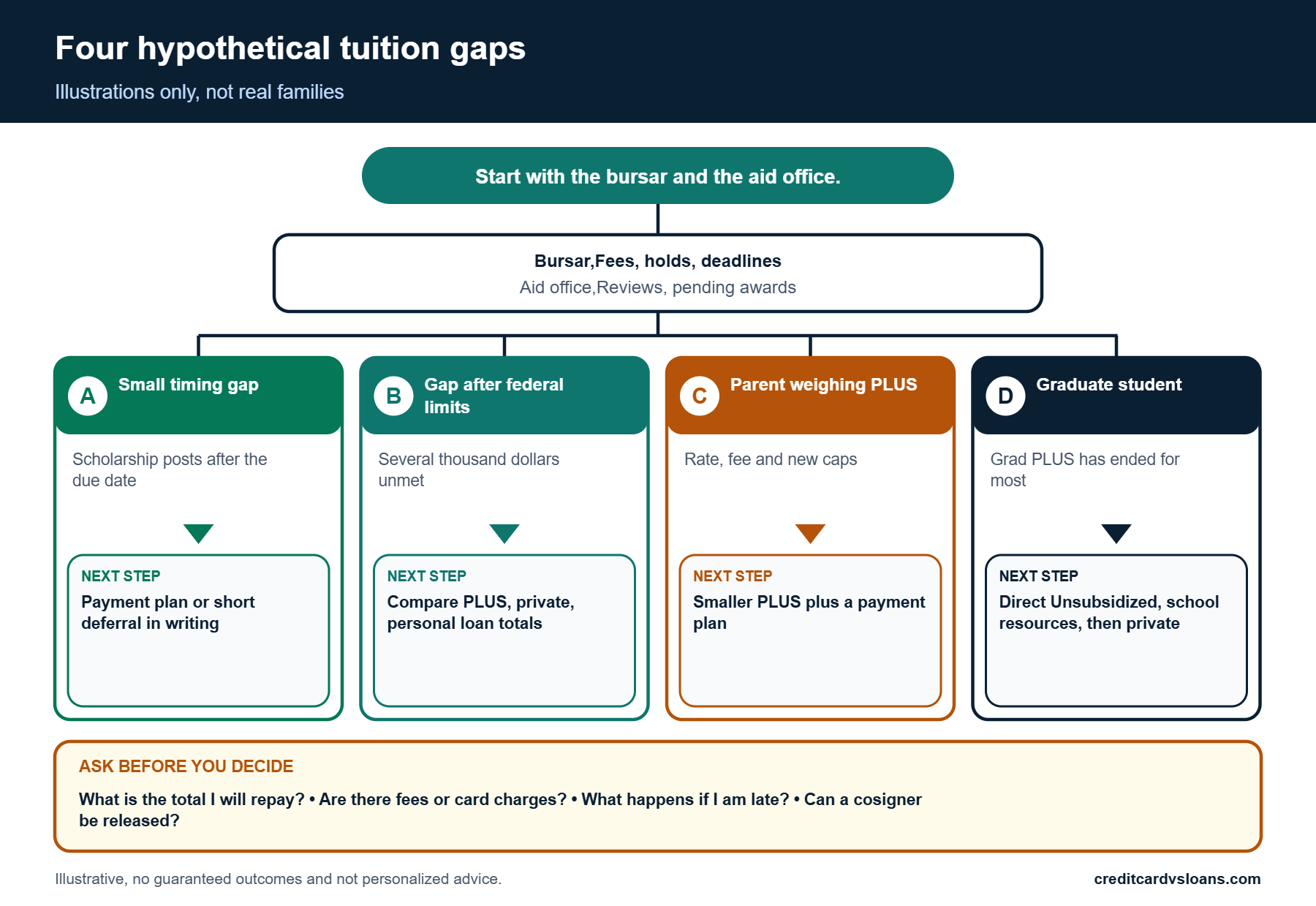
Four hypothetical situations
These are illustrations, not real families, and they show how the same tools lead to different choices.
Student-led gaps
A small timing gap of a few hundred dollars
A student is $800 short because a scholarship posts three weeks after the bill is due. A school payment plan with a modest enrollment fee, or a short deferral, likely costs far less than a loan. The student asks the bursar for written confirmation of the scholarship amount and posting date, and sets up automatic payments so a late fee does not cause a hold.
The decision rule is to pick the cheapest short-term bridge that does not create a hold.
A gap of several thousand dollars after federal limits
A student has accepted all available Direct Loans and still has a $6,000 gap. The options now include a Parent PLUS Loan if a parent is willing and eligible, a private loan with a cosigner, a personal loan or an extended payment plan. The student and parent compare the total repayment amount, fees and consequences for each, with a focus on the shortest term the budget can carry.
Taking a smaller amount now and revisiting next term may be better than borrowing for the entire year at once.
Parent-led and graduate gaps
A parent considering PLUS
A parent considering a PLUS Loan weighs a 9.07% fixed rate and a 4.228% fee against a private loan whose rate depends on credit, as well as the new $20,000 annual and $65,000 aggregate caps. The parent also asks what repayment protections apply and what happens if the family’s income changes. The parent might decide on a smaller PLUS amount supplemented by a payment plan.
The family should write down who is responsible for payments, so the arrangement is clear.
A graduate student facing a gap
With Grad PLUS no longer available to most new borrowers, a graduate student looks first at Direct Unsubsidized limits and the school’s own resources. A private loan may be considered after federal options are used, and the CFPB notes that this fits only a narrow set of borrowers with strong job prospects, high credit scores and short repayment plans. The student asks the aid office about assistantships, employer benefits and payment plans.
A graduate student should compare total repayment, not just the monthly payment, since longer terms raise interest.
In each of these situations the same rule applies: close the smallest gap with the cheapest tool that does not create new penalties, and borrow only after the aid office, bursar and federal options have been checked. The household that does this in order usually ends up with a smaller balance and clearer terms than one that grabs the first approval.
Your tuition gap checklist and next steps
A sequence you can follow this week
The checklist
- Write down the amount billed, the aid credited, the remaining balance and the deadline.
- Ask the financial aid office about review options, pending awards and timing.
- Ask the bursar about payment plans, fees, grace periods and the consequences of a late payment.
- Confirm which federal loans you have accepted and what the annual limits leave unmet.
- If a parent will borrow, check PLUS terms, fees and the new annual and aggregate caps.
- Prequalify with private or personal loan lenders only for the amount that is still missing.
- Compare the total repayment amount, fees and term in one table.
- Avoid cards for anything you cannot clear quickly, and check for school card fees.
Working through the list in order usually uncovers the cheapest option first.
What to keep on file
Keep your award letter, bursar statement, payment plan agreement and any emails confirming deadlines or holds. If you borrow, keep the loan agreement and the disclosure that lists the APR, fees and total repayment amount. These documents help if a payment is misapplied or a hold appears in error, and they help at tax time if you claim an education credit.
A short log of calls and names is useful if something needs to be escalated.
Looking ahead to the next term
Plan the gap before it appears
A gap in one term often repeats the next. Start the aid process early, ask for a cost estimate for the full year and decide whether the family will fund the difference through savings, income, work, a payment plan or borrowing. Updating the numbers each term keeps the gap from growing unnoticed, and it keeps you from stacking borrowed money on borrowed money.
If costs outpace what the household can sustain, discuss alternatives such as fewer credits, a lower-cost term or a transfer plan with the school.
When repayment becomes difficult
Contact the school or lender before you miss a payment. Federal loans offer repayment options for borrowers who have trouble paying, while private lenders, personal loan lenders and card issuers have their own hardship programs, if any. Document everything and read revised terms before agreeing. Be cautious about companies that charge upfront fees to fix student debt, and use the CFPB and studentaid.gov to see what is free.
The earlier you ask, the more options typically remain.
Mistakes that make a gap more expensive
Borrowing the full year at once
Taking out an amount that covers every possible cost for the whole year can leave you paying interest on money you did not need. Borrow for the term in front of you, review your budget after the first month and adjust. For federal loans, you can usually accept less than the amount offered, and unused funds can often be returned, so ask the aid office how to reduce a loan.
Returning unneeded funds promptly generally limits the interest and fees you pay.
Letting a small gap become a hold
A gap of a few hundred dollars can trigger a late fee and a registration hold that blocks next term’s classes. That is a bigger problem than the balance itself. If you cannot pay on time, contact the bursar before the deadline, ask about the plan options and get any extension confirmed in writing. A one-line email the day before the deadline can prevent weeks of difficulty.
Holds are easiest to prevent and hardest to fix after they appear.
Free places to get help
Offices and tools that cost nothing
Your school’s financial aid and bursar offices are free and are the best place to start. The Department of Education’s studentaid.gov site explains federal loan types, limits and repayment, and the CFPB’s paying-for-college tools explain how to compare offers. A nonprofit credit counselor can also help you organize a budget. Be cautious about any company that charges upfront fees to find aid or fix student debt.
Use these resources before paying anyone for help.
Questions to bring to a call
Prepare your numbers: the amount due, the date, the aid you expect, the loans accepted and your monthly budget. Ask what options exist, what each costs, what deadlines apply and what happens if circumstances change. Write down the answers and the name of the person you spoke with. A prepared call usually takes ten minutes and can save considerably more than that in fees.
Follow up by email so the conversation is documented.
Common questions
Is it better to borrow in the student’s name or the parent’s?
It depends on rates, limits, credit and who will repay. Student federal loans carry lower rates and fees than PLUS but are capped; a parent loan may fill a gap at higher cost and puts the repayment obligation on the parent. Private loans in either name depend on credit. The decision should include how repayment will work if the student and parent disagree or if circumstances change.
Talk through the arrangement in advance and keep records.
Can I wait and pay the gap next term?
Sometimes, but schools usually require the balance to be paid or covered by a plan to avoid holds that block registration or transcripts. Ask the bursar what is possible and get any arrangement in writing. Waiting without an agreement can bring late fees and holds, which can cost more than the interest on a short loan.
A written agreement protects you if staff change or records are updated.
Shrink the gap first, use a school payment plan for timing gaps, and use federal loans before private credit. Borrow only what remains, on the shortest term your budget can carry, and compare the total repaid and the fees rather than the monthly payment. Parents should check the new Parent PLUS caps before building a plan around them.
- Best Way to Pay for Water Heater Replacement: Compare Borrowing Options Before You Commit
- Best Way to Pay for Back-to-School Costs: Compare Borrowing Options Before You Commit
- Best Way to Pay for Freelance Equipment: Compare Borrowing Options Before You Commit
- Best Way to Pay for a Veterinary Emergency: Compare Borrowing Options Before You Commit
- Balance Transfer Card vs. Personal Loan: Best Way to Pay Off Debt?
- U.S. Department of Education: Interest Rates for Federal Direct Loans First Disbursed Between July 1, 2026 and June 30, 2027 (GENERAL-26-33) (Fixed rates for 2026-27)
- U.S. Department of Education: FY27 Sequester-Required Changes to the Title IV Student Aid Programs (GENERAL-26-28) (Direct Loan fees for first disbursements on or after Oct. 1, 2026)
- Federal Student Aid: Frequently Asked Questions: Loan Limits (Parent PLUS limits, Grad PLUS and undergraduate Direct Loan limits)
- CFPB: Tuition Payment Plans in Higher Education (Fees, holds and risks of school payment plans, Sept. 2023)
- CFPB: What student loan option is best for me: federal student loans or private student loans?
- IRS: Education Credits: AOTC (American opportunity tax credit amounts and limits)
- Federal Reserve: Federal Reserve G.19 Consumer Credit release, Oct. 7, 2026 (Average credit card and 24-month personal loan rates, August 2026)
Last updated: October 22, 2026. Rates, fees and lender rules change; verify current terms before acting.
The information on creditcardvsloans.com is provided for general educational and informational purposes only. It is not financial, legal, tax, credit, accounting or investment advice, and reading it does not create an advisor-client, fiduciary or any other professional relationship. Nothing here is an offer, solicitation or recommendation to borrow, lend or apply for any product.
Credit scores, interest rates, fees, eligibility rules, lender policies and laws change frequently and vary by lender, location and individual circumstances. Examples, figures and scenarios are illustrative only, do not predict your results and do not guarantee approval, savings, a particular rate or a credit-score outcome. Always confirm current terms directly with the lender or issuer and read the full agreement before you apply or sign.
Although we aim for accuracy and use reputable sources, we make no representations or warranties, express or implied, about the completeness, accuracy, reliability or timeliness of the content. Content may be drafted with the assistance of automated tools, so errors or omissions may still occur. Links to third-party sites are provided for convenience; we don’t control and aren’t responsible for their content.
To the fullest extent permitted by law, creditcardvsloans.com and its owners, editors, authors, contributors and affiliates disclaim all liability for any loss, damage or expense arising directly or indirectly from your use of, or reliance on, this content. Before making financial decisions, consult a licensed professional, such as a qualified financial advisor, attorney, tax professional or nonprofit credit counselor, who can consider your complete situation.