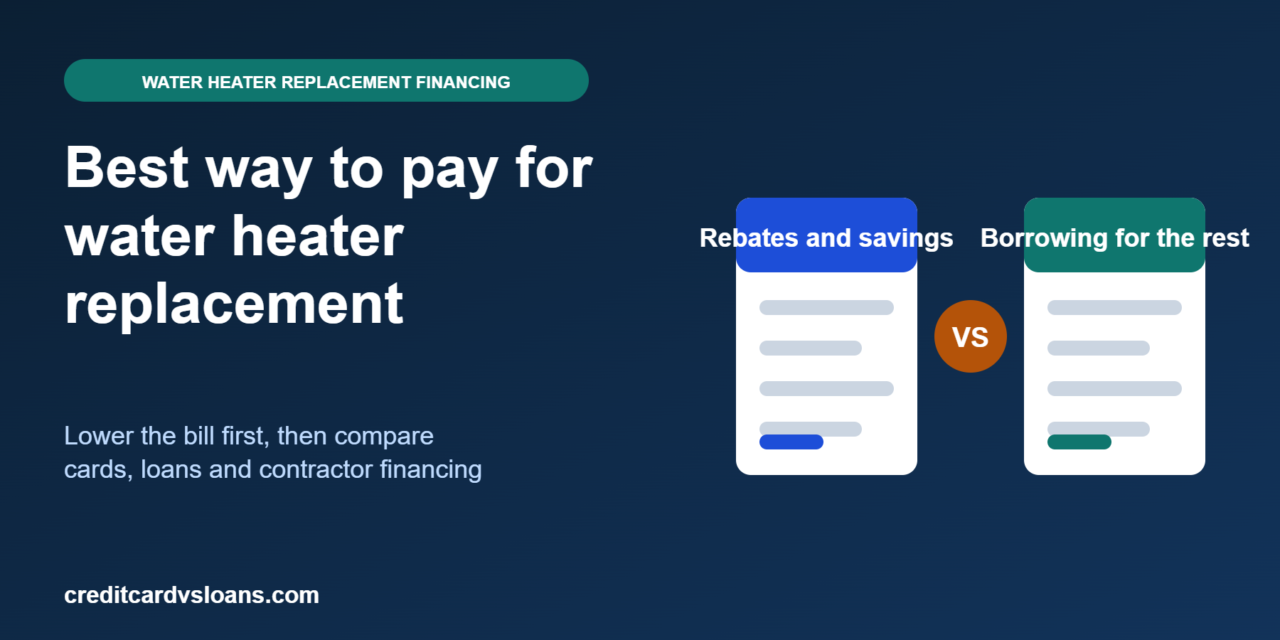
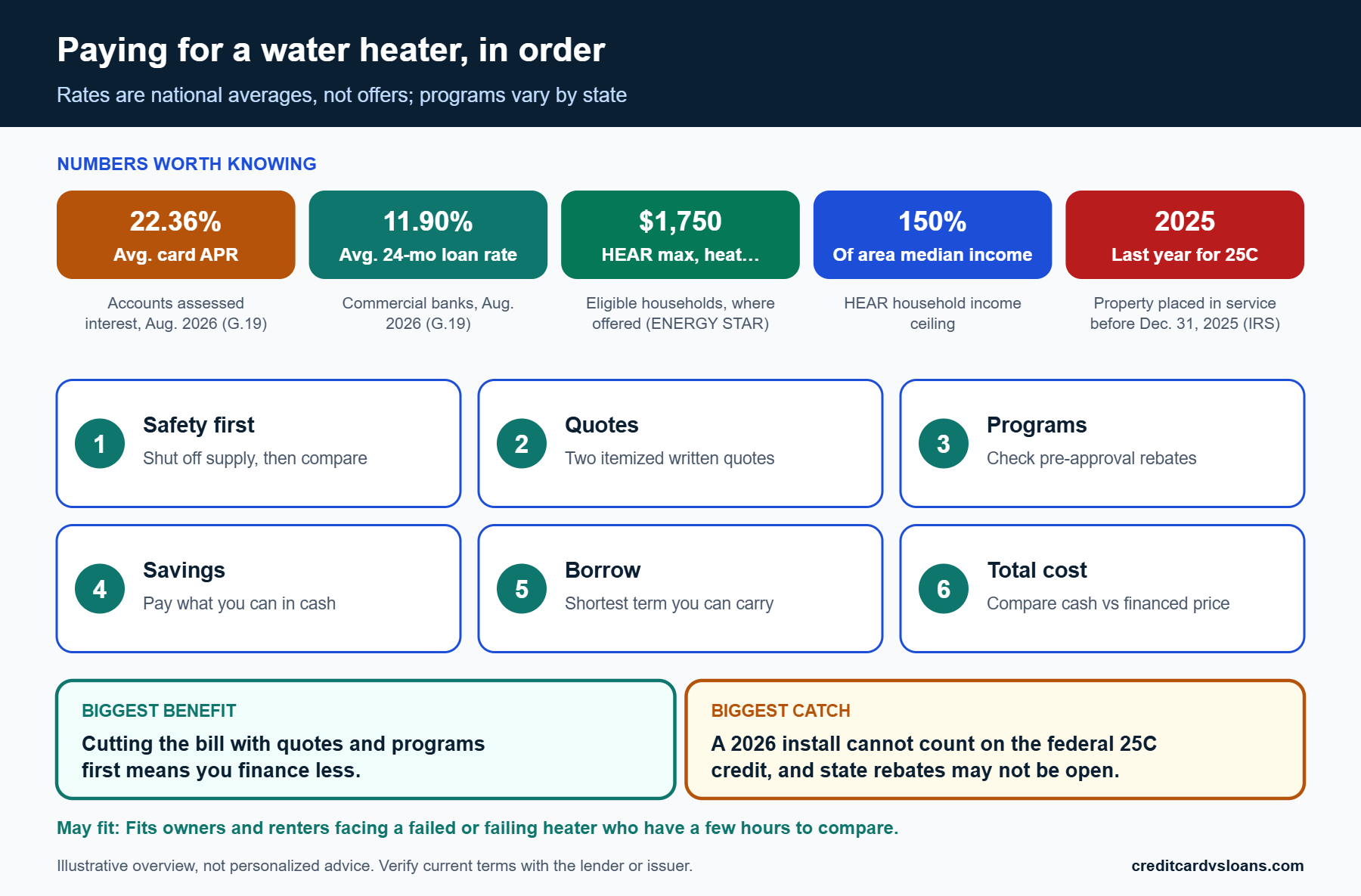
The best way to pay for water heater replacement is usually the cheapest money you can arrange before the plumber is booked: a rebate or program that lowers the bill, savings for part of it, and then the shortest-term borrowing you can carry for the rest. A water heater rarely fails at a convenient time, but even a no-hot-water morning usually leaves room for an hour of comparison that can change the total cost.
Replacement cost is more than the tank. It typically includes the unit, labor, permits where required, haul-away of the old heater and sometimes upgrades to venting, gas lines, electrical service or drain pans. Which type you choose, a storage tank, a tankless unit or a heat pump water heater, changes both the price and the help available. That is why this guide starts with the bill and the programs that can shrink it before turning to cards, loans, contractor financing and home equity.
This article is general education, not personal advice, and it cannot tell you what you will be approved for. Planned purchases such as back-to-school spending and freelance equipment give you weeks to compare; a failed heater gives you days. The steps below are meant to make those days count.
- Get at least two written quotes that list the unit, labor, permits and haul-away separately; the financing decision depends on the real total.
- The federal 25C home energy tax credit covers property placed in service through Dec. 31, 2025, so a 2026 replacement should not be planned around it.
- State-run Home Electrification and Appliance Rebates can cut the cost of a heat pump water heater for eligible households, but each state decides what it offers.
- Contractor-arranged financing can be convenient; always compare the cash price with the financed price.
- A home equity line of credit can carry lower rates than cards but puts your home behind the debt.
- For any borrowed amount, compare the total repaid, not just the monthly payment.
Rate figures are from the Federal Reserve’s G.19 release of Oct. 7, 2026 (August 2026 data) and are national averages, not quotes. Program details come from IRS and ENERGY STAR pages reviewed in October 2026 and may change by state and over time.
The short answer: three situations, three starting points
Start with what kind of deadline you have
The heater is dead or leaking now
A heater that is leaking or has failed completely creates urgency, and urgency is when expensive choices get made. If water is leaking, shut off the water supply and the power or gas to the unit as the manufacturer directs, then call a licensed plumber. Once the immediate danger is handled, you usually still have a few hours to get a second quote and to ask about financing before you sign. Ask each contractor for a written estimate with line items.
The best protection against a rushed decision is a simple script: ask for the total price, the cash price, any financing fees and the earliest installation date.
The heater works but is aging
If your heater is old but running, you have the most leverage. You can compare unit types, apply for programs that need pre-approval, and save toward the cost before the failure arrives. Many rebate programs require approval before you buy, so waiting for a failure can cost you an incentive. Ask an installer about the age shown on the unit’s label and what signs of wear to watch for, such as rust-colored water or sediment noise, without treating any single sign as proof.
A planned replacement is the one situation where saving first and borrowing little is realistic.
Safety comes before the money question
Before comparing prices, make sure the home is safe. If you smell gas, leave the building and call your gas utility or emergency services from outside, and do not operate switches or flames. If a unit is leaking onto electrical components or the floor is wet around a gas or electric heater, shut off the supply as directed and keep everyone clear. Financing is a decision you can make an hour later; safety cannot wait.
Once the situation is stable, the money steps below apply.
Owner, renter or landlord: who pays?
If you rent
In many places, a landlord is responsible for providing hot water as part of a habitable home, but the rules vary by state and city and by lease terms. Before you pay for a replacement yourself, notify the landlord in writing, keep a copy and check your local tenant resources or housing agency. Paying out of pocket without an agreement can be difficult to recover.
If you do pay, get a written agreement about reimbursement or rent credit first.
If you own the home
As an owner, the cost is yours, and so is the benefit: you choose the unit, the installer and the financing. That makes owners eligible for more programs but also means you carry the whole bill. Homeowners insurance generally covers sudden damage from a burst or leak but typically does not pay to replace a worn-out appliance, though policies differ, so ask your insurer if water damage is involved.
Photograph any damage before cleanup and keep the old unit’s information for the claim or rebate.
Repair, replace or upgrade: what the bill is made of
Deciding whether replacement is necessary
When a repair may make sense
Some failures are cheap to fix, such as a heating element on an electric tank or a thermostat or igniter on a gas unit. A quote for repair that costs a small fraction of replacement may be worth taking if the tank is otherwise sound. A leaking tank itself generally cannot be repaired and needs replacement. Ask the technician to explain what failed, what a repair would cost, how long the unit might last afterward and whether the warranty is still active.
A repair on a very old unit may only postpone the replacement, so ask what the installer expects.
When replacement is the better value
If the tank is leaking, the unit is well past its expected life, or repair costs are approaching a meaningful share of replacement, replacing can be more sensible than paying twice. Replacement is also the moment to consider whether a different type of heater suits your home, since a larger or more efficient unit may change the installation. Compare the total installed cost, not just the sticker price of the unit.
Avoid choosing the cheapest unit if it lacks the capacity your household needs.
Where the money goes
Cost components to ask about
| Line item | What to ask | Why it affects financing |
|---|---|---|
| Unit | Type, capacity, efficiency rating, warranty length | The price may differ by type and by rebate eligibility |
| Labor | Hourly or flat, and what is included | Often a large share of the total |
| Permits and inspection | Required locally? Who pulls them? | Missing permits can complicate resale or insurance |
| Venting, gas, electrical or plumbing changes | Needed for this unit type? | Can add to the bill after the quote |
| Haul-away and disposal | Included? | Small, but easy to miss |
| Financing or dealer fees | Is the financed price higher than cash? | Fees can be built into the price |
Why quotes can differ so much
Two quotes for the same job can vary because the contractors assume different units, include different upgrades or price financing differently. Ask each to quote the same unit type and capacity, and to state what could change the price once work begins. A quote that is far lower may omit permits or haul-away, while one that is far higher may include a premium unit you did not request. Written quotes make the comparison fair.
If one contractor pushes you to decide on the spot, treat that as a reason to get another quote, not to sign.
Programs and credits that can lower what you finance
Federal tax credit: what changed
The 25C credit and its end date
The IRS describes the Energy Efficient Home Improvement Credit as covering qualifying property placed in service on or after Jan. 1, 2023, and before Dec. 31, 2025. For water heaters, the IRS page describes gas, propane or oil water heaters meeting a high efficiency tier as eligible for up to $600 per item, and heat pump water heaters falling under a category capped at $2,000 per year, at 30% of qualified expenses. Those figures describe the credit as it applied through 2025.
Because the credit’s dates end with 2025, a heater installed in 2026 should not be financed on the assumption of a federal credit. If you have questions about a 2025 installation, ask a tax professional.
Why this matters for financing
People who read older articles may expect a tax credit to offset the cost. A credit would arrive only after you file your return, and it would not reduce the amount you must pay or borrow today. In 2026, the practical lesson is to build the budget on the actual price and treat any unexpected tax benefit as a surprise rather than a plan. If a contractor or salesperson mentions a federal credit for a 2026 installation, ask for the IRS source and confirm it with a tax professional.
That caution applies to any pitch that makes a purchase sound cheaper than the quote shows.
State-run rebates and local programs
Home Electrification and Appliance Rebates
ENERGY STAR describes the Home Electrification and Appliance Rebates (HEAR) program as funding efficient electrification projects for lower-income households, defined as households with income below 150% of area median income. Rebates are applied as point-of-sale discounts, and for appliance purchases the page states up to 100% of cost is covered for households below 80% of area median income and no more than 50% for households between 80% and 150%. For a heat pump water heater the maximum is $1,750, and ENERGY STAR certification is required.
The page also says states may restrict eligibility and are not required to offer rebates for every technology or household type, so check your state energy office to see whether and when a program is open.
Utility, municipal and nonprofit help
Some electric and gas utilities, cities and community organizations run rebates or low-income assistance for water heaters, and the offers change. Ask your installer whether they participate in any programs, and check your utility’s website and your state energy office. Many rebates require pre-approval, specific equipment models or a licensed installer, and funds can run out. Do not buy first and ask later.
Keep your quotes, invoices and model numbers, since programs often require them.
What each payment route costs for a water heater
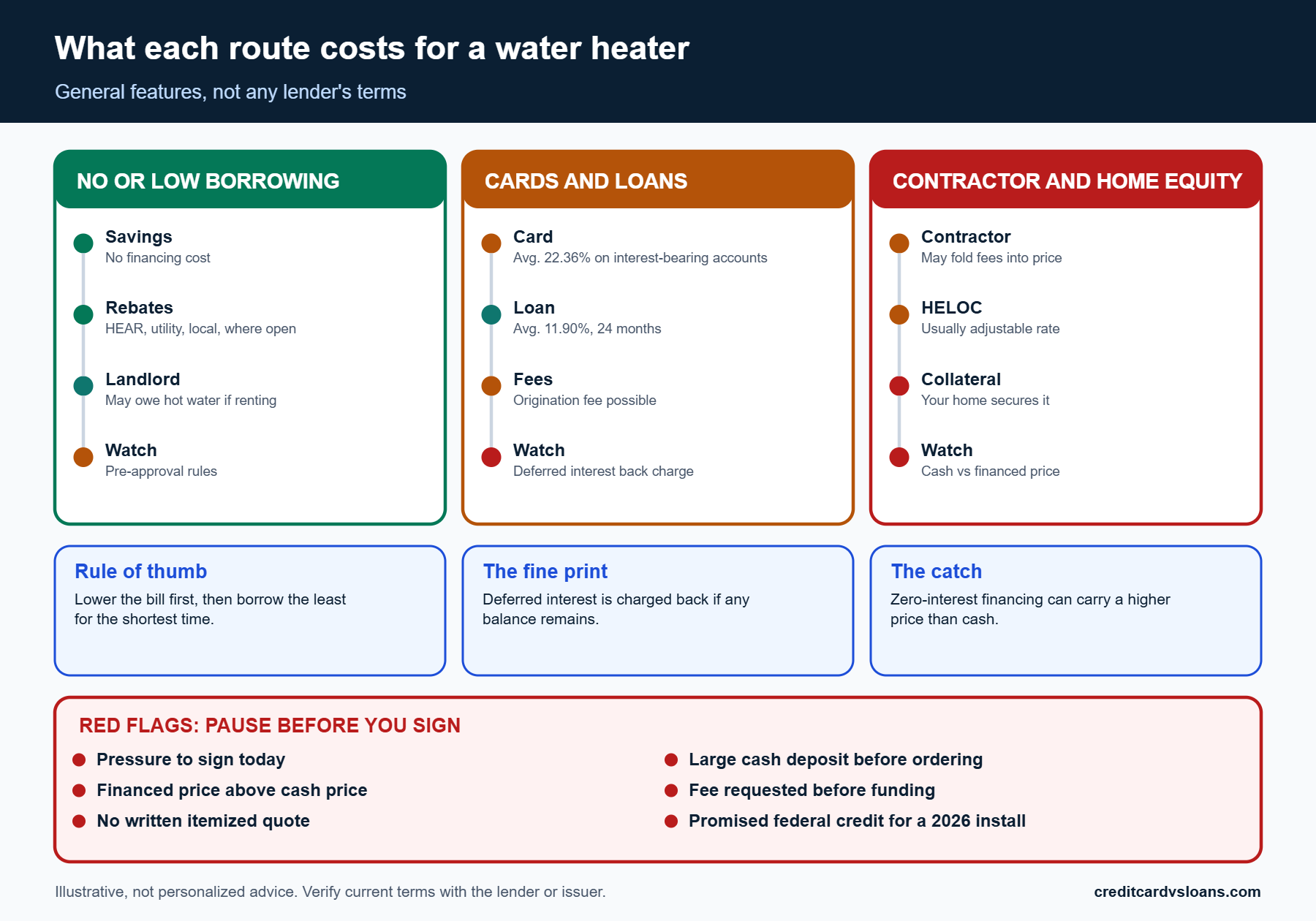
After rebates and savings, the remaining question is how to cover what is left. The routes below differ in speed, cost and risk. All rates are national averages for context, not offers.
The routes side by side
Comparison table
| Route | Cost signal | Speed | Main risk |
|---|---|---|---|
| Savings | No financing cost | Immediate | Leaves less cushion |
| Existing credit card | Average 22.36% on accounts assessed interest (Aug. 2026) | Immediate | Expensive if carried |
| Promotional or deferred-interest card or plan | 0% only if paid in full in time | Minutes to days | Back interest if any balance remains |
| Personal loan | Average 11.90% for 24 months (Aug. 2026), plus any fees | Same day to several days | Origination fee and approval risk |
| Contractor-arranged financing | Varies; may be built into the price | Often at signing | Cash price versus financed price |
| Home equity line of credit | Variable rate, set by lender | Usually weeks | Your home secures the debt |
Reading the table for a mid-sized job
For a job in the low thousands, the realistic contenders are savings plus a card or loan, and a promotional offer if you are certain of the payoff. A home equity line is slower and usually more than the situation needs. If your credit is thin, contractor financing may be easier to obtain, but compare its total with a loan you can prequalify for.
Whichever route, ask for the total repayment amount in writing.
What it costs in dollars
A hypothetical $2,500 replacement
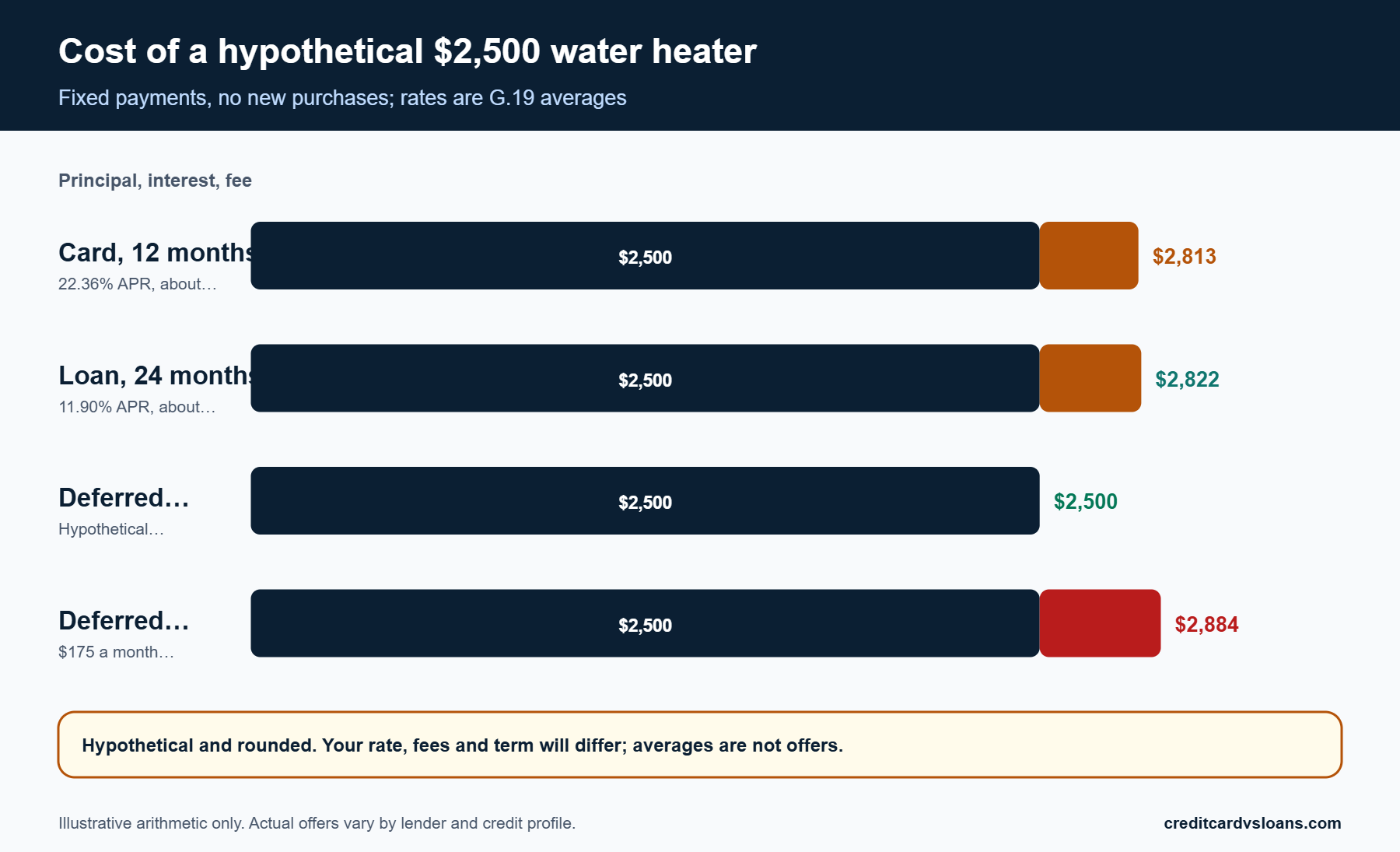
Take an illustrative $2,500 balance with no new purchases. On a card at the 22.36% average, repaying in 12 months costs about $234 a month and roughly $313 in interest. A 24-month loan at the 11.90% average costs about $118 a month and about $322 in interest, before any origination fee. The lower payment on the loan comes from the longer term, and the interest totals end up about the same.
The figures are hypothetical, rounded and computed with a standard amortization formula; your rate, fees and term will differ.
The deferred-interest cliff
Now consider a hypothetical 12-month deferred-interest offer at a 25% rate. If you pay the balance in full by month 12, no interest is charged. If you pay $175 a month, you will have paid $2,100 and still owe $400 in principal, plus roughly $384 of back interest, about $784 in total. The CFPB explains that deferred interest is charged back to the purchase date when any promotional balance remains, and its own $400 example shows $165 owed where a true zero-interest offer would leave $100.
The approximate figures here are our illustration of the same mechanism, not a quote.
What an origination fee does to the numbers
Many personal loans deduct an origination fee from the amount you receive, so you borrow more than you get. In the same hypothetical, a 5% fee means borrowing about $2,632 to net $2,500. At 11.90% over 24 months that is about $124 a month, roughly $339 in interest and about $132 in fees, for about $470 in total cost. That is higher than the roughly $313 of interest on the 12-month card payoff, even though the loan rate is about half as large, because the loan runs twice as long and carries a fee.
The takeaway is not that cards beat loans. A card is cheaper here only because you pay it off in a year, and a fee-free loan or a shorter loan could change the ranking. Always compare the total repaid on the same timeline, and ask whether the lender charges a fee before you accept.
If you can pay back in six months or less, even the card may be the cheapest route, which is why the repayment timeline matters more than the label on the product.
Contractor-arranged financing: reading the offer
How these offers work
Who is actually lending
When an installer offers financing, the credit is usually provided by a third-party lender or a store-style card issuer, not by the contractor. The application, rate, fees and consequences of a missed payment are set by that lender. Ask for the lender’s name and the full terms, and read the agreement before signing. A quick tablet approval at the kitchen table is still a credit application.
Ask whether applying involves a hard pull and whether you can see the terms before it is submitted.
Cash price versus financed price
Some contractors quote a lower price for cash or card payment than for financed jobs because the lender charges a fee that is folded into the price. Ask for both numbers. If the financed price is higher, the difference is part of your cost even when the stated interest rate is low or zero. Compare the financed total with a prequalified personal loan or your own card for the same job.
A zero-interest label does not mean the price is the same as the cash price.
Promotions and their conditions
Same-as-cash and deferred-interest terms
Promotions described as “same as cash” or “no interest if paid in full” are often deferred-interest plans. The CFPB notes that the length of the promotion can vary with the purchase amount and that minimum payments usually do not clear the balance in time. The standard rate after the promotion is typically higher than the promotional rate. Divide the total by the number of months and treat that figure as your real payment, not the minimum shown on the statement.
Set an alert for the final statement before the deadline.
Questions to ask before you sign
Ask: What is the APR if the promotion ends? Is interest deferred or waived? Is there an application, origination or dealer fee? What is the late fee? Is there a prepayment penalty? What is the total of all payments? If a salesperson cannot answer in writing, the answer is likely less favorable than the pitch. If you prefer to avoid the offer, you can often pay the contractor by another method.
The same comparison logic applies to a lump-sum purchase of any size, as in our walkthrough of financing back-to-school costs.
Timing, permits and the paperwork behind the price
Install timing and wait times
Same-day or next-day installation is often possible for common tank models, while tankless or heat pump units, or jobs that need new venting, wiring or gas work, can take longer. Ask each contractor when the unit is in stock and when the crew can start, since a longer wait may mean arranging temporary hot water. A lower quote that takes two weeks may not be cheaper if the delay creates its own costs.
If a program requires pre-approval, factor that waiting time into your plan.
Permits, code and who is responsible
Many places require a permit and inspection for water heater replacement, and local codes may call for specific safety devices, venting or drain pans. Ask the contractor whether they pull the permit and whether the quote includes inspection. Unpermitted work can create problems for insurance claims and home sales, and it may affect eligibility for rebates that require documentation.
Keep the permit and final inspection records with your other home files.
Home equity: when borrowing against the house enters the picture
What a HELOC is
The CFPB’s basic description
The CFPB describes a home equity line of credit as borrowing against the equity in your home, much like a credit card: you can draw money more than once up to a maximum, and payments replenish the available credit. It notes that a HELOC is a second mortgage if you already have a mortgage, so you must pay it in addition to your first mortgage, and that HELOCs usually have adjustable interest rates, so payments can change.
The rate, fees, draw period and repayment terms vary by lender, so read the disclosures.
Where it can fit and where it rarely does
A HELOC may be considered by owners with significant equity who are replacing a heater as part of a larger project. For a single appliance, opening a line can be slower than the job requires and may involve costs of its own. The most important difference from a card or personal loan is collateral: if you cannot repay, the lender can pursue the home as security. That risk is why many people reserve home equity for larger, well-planned projects.
The CFPB suggests speaking with a HUD-approved housing counselor if you are having trouble with your mortgage.
Comparing the secured and unsecured routes
Trade-offs in plain terms
| Feature | HELOC | Personal loan or card |
|---|---|---|
| Collateral | Your home | None for most unsecured products |
| Rate type | Usually adjustable | Loans are often fixed; cards usually variable |
| Timeline | Often weeks | Minutes to days |
| Best suited to | Larger, planned projects | One-off repair with a clear payoff plan |
| Main danger | Default can put the home at risk | Higher rate on cards; fees on loans |
A rule of thumb for owners
If you can clear the balance in a year or two, the extra risk of borrowing against your house is hard to justify for a water heater. If you cannot, ask whether the project, the timeline and your equity justify the added risk, and talk with a housing counselor or trusted advisor before using home equity. Our comparison of a balance transfer card versus a personal loan shows how to think about moving a balance once a card has carried it for a while.
Never borrow against your home for convenience when a short-term alternative would work.
Credit, approval and speed when the water is already cold
What lenders look at
Prequalify when you can
Many lenders show an estimated rate after a soft pull, a credit check that does not affect your score. A final application usually involves a hard pull. If you have a day, prequalifying with two or three lenders is a quick way to see whether a personal loan beats the card you already hold. Treat any estimate as a preview, since the final offer depends on a full review of your credit, income and debts.
No lender or article can promise approval, so have a backup plan ready.
If your credit file is thin or recently damaged
A thin credit file or past delinquencies can narrow options and raise costs. In that case, consider a credit union, a smaller loan, a co-borrower or contractor financing, but compare the total cost of each. Pay particular attention to products that advertise easy approval with high fees; if a lender asks for money before releasing a loan, treat that as a red flag. Local community action agencies and state energy offices sometimes know of help that does not depend on credit.
Weigh the cost of waiting against the cost of a high-fee product before deciding.
Effects on your credit
Short-term and longer-term
A new account can lead to a hard inquiry and a lower average account age, and a large card balance raises utilization, the share of your revolving credit limit in use. These effects vary by person and tend to fade if you pay on time. A fixed-term loan used to pay down a card can change utilization, but it also adds a new account and a new payment. Outcomes are not predictable, so avoid decisions based on an expected score change.
The most reliable habit is paying on time every month.
When a payment becomes hard
Call the lender early if you expect to miss a payment. Some offer hardship arrangements, though availability differs. Document what you agree to, and compare the revised terms to the original, since a lower payment can mean a higher total cost. Do not ignore a bill: the CFPB’s guidance on debt collection says avoiding a collector rarely stops contact and that talking through your situation is a better first step.
Avoid paying a company that promises to erase your debt for an upfront fee.
Four hypothetical households and how their choices differ
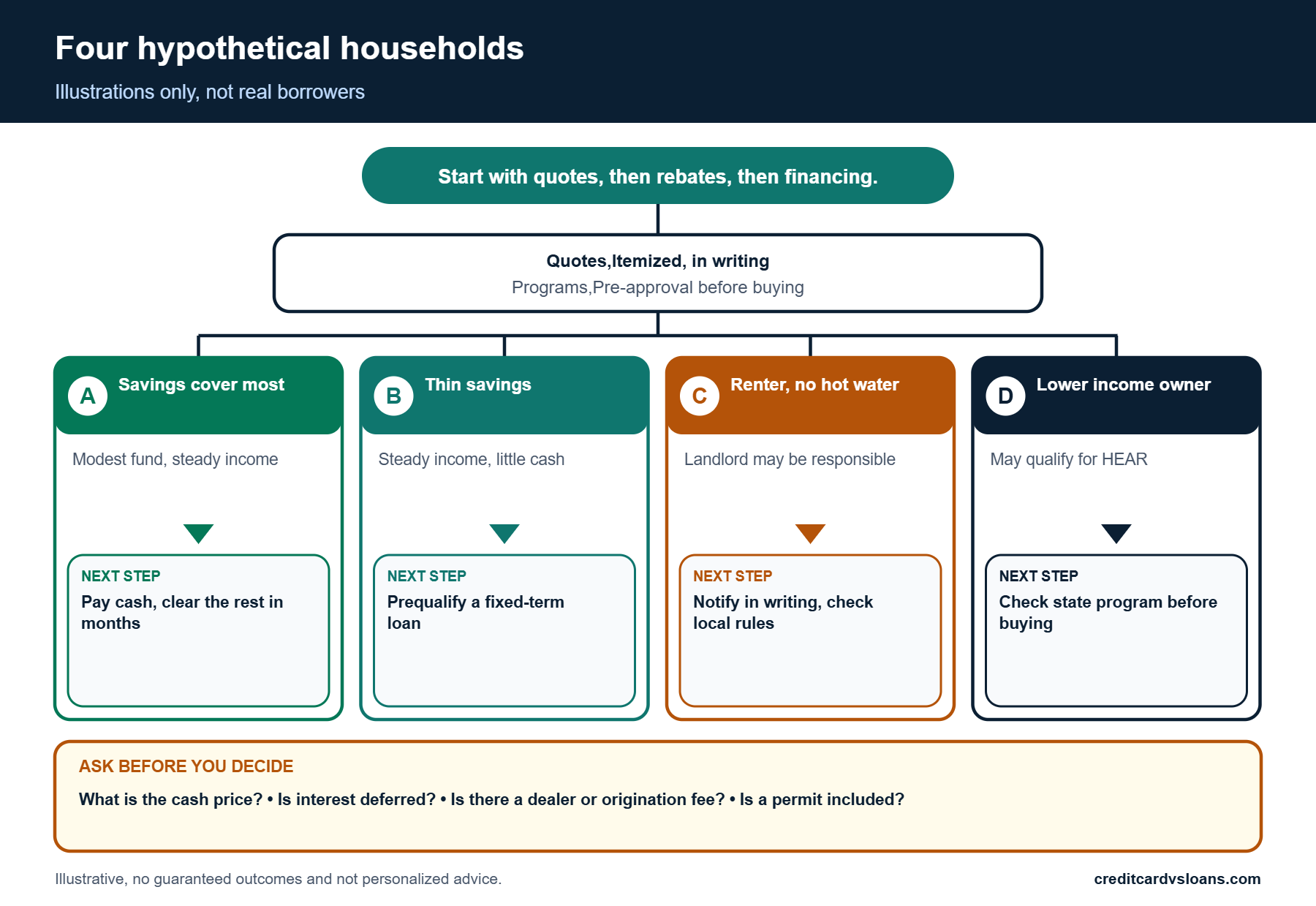
These are illustrations, not real people. They show how the same job leads to different financing choices.
Owners with different cushions
Savings cover most of the cost
An owner with a modest emergency fund can pay most of the bill in cash and put the remainder on a card to clear in a few months. The trade-off is the thinner cushion afterward, so the owner might choose to finance a larger share and keep a reserve. Either choice can be reasonable; the point is to decide on purpose and to avoid paying card rates for a long time.
After the job, rebuilding the fund becomes the next goal.
Savings are thin, income is steady
An owner with little savings but steady income may do well with a fixed-term personal loan whose payment fits the budget, provided the origination fee and total cost are reasonable. Prequalifying with several lenders and choosing the shortest term the budget supports minimizes interest. The same owner might also check state and utility programs, which sometimes reduce the amount that needs financing.
A contractor’s financing is worth comparing but should not be the only quote considered.
An owner with equity and a bigger project
Imagine an owner replacing the heater alongside other work, such as plumbing updates or a bathroom renovation. Here a home equity line may deserve a look, because the total project is large enough to justify its setup and its risks. The owner would compare the variable rate, fees and repayment terms with a fixed-rate loan and would plan to repay on a schedule rather than let the balance linger. The heater alone would not justify that step.
Keeping the smaller, urgent purchase separate from the larger project can also keep the decisions clear.
Renters and lower-income households
A renter in a unit without hot water
A renter should notify the landlord promptly in writing, as the landlord is often responsible for hot water, though local rules and lease terms differ. Check local tenant resources before paying for any replacement personally. If a landlord refuses and you decide to pay, get an agreement in writing about reimbursement or rent credit, and consult a local tenant organization for advice.
Keep copies of all messages and receipts.
A lower-income owner who may qualify for rebates
A household below 150% of area median income may qualify for a HEAR rebate toward an ENERGY STAR heat pump water heater where the state runs the program. The rebate can cover up to 100% of cost for households below 80% of area median income, up to a $1,750 maximum for this appliance, according to ENERGY STAR. Programs vary and may have waiting lists, so check eligibility before buying and keep the hot-water emergency in mind.
If the program is unavailable, the next step is the lowest-cost financing route with a payment that fits the budget.
Your water heater payment checklist and next steps
Before you sign anything
A checklist you can use in the driveway
- Get two written quotes with the unit, labor, permits, upgrades and haul-away itemized.
- Ask each contractor for the cash price and any financed price.
- Check your state energy office and utility for rebates that require pre-approval.
- Decide how much you can pay from savings without losing your cushion.
- Prequalify for a personal loan if you need to borrow a larger amount.
- If you use a promotion, divide the price by the promotional months and automate that payment.
- Avoid cash advances and home equity borrowing unless the numbers clearly justify them.
- Keep invoices, model numbers and permits for warranty, rebate and tax records.
The order matters: lower the bill first, then decide how to pay what is left.
Questions to ask the installer
Ask which unit sizes suit your household, whether the installation requires a permit, how long the work takes, what the labor warranty covers and what happens if the new unit fails early. Ask about disposal of the old heater and whether any local program requires proof of installation. Request that all of this be written on the invoice.
A good installer expects these questions and answers them plainly.
After the new heater is in
Build a replacement fund for the next appliance
Water heaters, furnaces, roofs and refrigerators all wear out eventually. A small monthly deposit into a separate account, even $20 or $30, turns the next surprise into a withdrawal rather than a loan. Compare that with the interest cost of financing the same amount; a fund is not free, but it avoids fees and deadlines.
The effort of building a fund is easier if payments to it start the month your heater payoff ends.
Consider a maintenance routine
Ask your installer or the manufacturer’s documentation about recommended maintenance, such as flushing a tank or checking an anode rod, and follow the instructions for your model. Routine care can help a unit work as intended, but results vary by model and water quality, and no routine can promise a particular lifespan. Keep the warranty paperwork where you can find it.
Photographing the label with the model and serial numbers saves time when you call about a claim.
Records for warranty, rebates and resale
Create one folder, paper or digital, for the contract, invoice, permit, model and serial numbers, warranty card, financing agreement and any rebate paperwork. Registration deadlines for manufacturer warranties can be short, and rebate programs may ask for proof of purchase long after the job. If you sell the home, these records show the work was done properly and can answer an inspector’s questions.
Take a few photos of the finished installation and the data label while you are at it.
Common questions
Is it better to wait and save when the heater still works?
If the heater is working, saving first can reduce or eliminate borrowing, and gives time to check for rebates that need pre-approval. The risk is a failure at a bad time, so waiting works best with an honest look at the unit’s condition. Ask an installer for an assessment, and keep a quote on file so you can act quickly if needed.
A short wait is not always worth it if the unit is already leaking.
Can I use a home warranty or insurance?
Some home warranty plans and some insurance riders cover appliance repair or replacement, subject to deductibles, exclusions and limits. Standard homeowners insurance generally covers sudden damage, but it typically does not pay to replace an appliance that has simply worn out. Check your documents before you pay, and make the claim before authorizing work if the policy requires it.
Ask for the coverage terms in writing.
More questions people ask
Should I choose a tankless or heat pump unit to save on bills?
Different types can use less energy than a standard tank, but the savings depend on your household’s hot water use, local energy prices and installation costs, and they are not guaranteed. A unit that costs more to install can still be worthwhile if rebates reduce the price, but financing a higher price at a high rate can cancel the benefit. Compare the total installed cost, the financing cost and the manufacturer’s efficiency information, and consider asking for an estimate of annual operating cost from the installer.
Treat claims of exact savings with caution unless they are tied to your home’s actual use.
How large a deposit is normal, and is it safe to pay one?
Deposit practices vary by contractor and by job. A deposit to order equipment may be reasonable, but a large payment up front before work starts deserves caution. Verify that the contractor is licensed where required, check reviews from sources you trust, ask for a written contract and consider paying by credit card, which can offer dispute rights that cash does not, subject to the issuer’s rules. If a contractor demands cash only or a large payment before ordering anything, get another quote.
Keep your contract, receipts and proof of payment in one folder.
Can I negotiate the price or the payment method?
Often, yes. You can ask whether the contractor will match a competing written quote, whether paying by check or bank transfer lowers the price, and whether a cash price applies. Politely ask for the line items, because items that are optional can be removed or substituted. Negotiation works best when you have comparison quotes in hand and are ready to walk away.
A fair contractor will explain the difference between quotes rather than dismiss the question.
Lower the bill with quotes and programs, pay what you can from savings, and borrow the rest on the shortest term your budget can carry. Compare cash and financed prices, treat promotions as deadlines, and keep your home out of the picture unless the project and the numbers justify it. For more on choosing between a card and a loan for a mid-sized expense, the planning steps in our vet emergency guide show the same trade-offs under time pressure.
- Best Way to Pay for Freelance Equipment: Compare Borrowing Options Before You Commit
- Best Way to Pay for a Veterinary Emergency: Compare Borrowing Options Before You Commit
- Best Way to Pay for Back-to-School Costs: Compare Borrowing Options Before You Commit
- Balance Transfer Card vs. Personal Loan: Best Way to Pay Off Debt?
- How to Finance Back-to-School Costs: Credit Cards, Loans and Lower-Cost Options
- Federal Reserve: Federal Reserve G.19 Consumer Credit release, Oct. 7, 2026 (Average credit card and 24-month personal loan rates, August 2026)
- IRS: Energy Efficient Home Improvement Credit (Qualifying dates and water heater credit amounts)
- ENERGY STAR: Home Electrification and Appliance Rebates (HEAR) program (Eligibility, rebate shares and heat pump water heater maximum)
- CFPB: How to understand special promotional financing offers on credit cards (Deferred interest explanation and $400 example)
- CFPB: What is a HELOC? (Home equity line of credit basics)
- CFPB: Debt collection tools and options when you cannot pay
Last updated: October 22, 2026. Rates, fees and lender rules change; verify current terms before acting.
The information on creditcardvsloans.com is provided for general educational and informational purposes only. It is not financial, legal, tax, credit, accounting or investment advice, and reading it does not create an advisor-client, fiduciary or any other professional relationship. Nothing here is an offer, solicitation or recommendation to borrow, lend or apply for any product.
Credit scores, interest rates, fees, eligibility rules, lender policies and laws change frequently and vary by lender, location and individual circumstances. Examples, figures and scenarios are illustrative only, do not predict your results and do not guarantee approval, savings, a particular rate or a credit-score outcome. Always confirm current terms directly with the lender or issuer and read the full agreement before you apply or sign.
Although we aim for accuracy and use reputable sources, we make no representations or warranties, express or implied, about the completeness, accuracy, reliability or timeliness of the content. Content may be drafted with the assistance of automated tools, so errors or omissions may still occur. Links to third-party sites are provided for convenience; we don’t control and aren’t responsible for their content.
To the fullest extent permitted by law, creditcardvsloans.com and its owners, editors, authors, contributors and affiliates disclaim all liability for any loss, damage or expense arising directly or indirectly from your use of, or reliance on, this content. Before making financial decisions, consult a licensed professional, such as a qualified financial advisor, attorney, tax professional or nonprofit credit counselor, who can consider your complete situation.