The best way to pay for freelance equipment purchases is usually the one that matches how the gear earns its keep: cash or a short card payoff for items that pay for themselves quickly, a fixed-term loan for larger purchases, and a lease or vendor plan only after you have seen the total cost in writing. Freelancers have a twist that salaried borrowers do not, which is income that arrives unevenly and a tax return that may decide both what lenders see and what you can deduct.
A new laptop, camera body, microphone, drawing tablet, studio lighting or specialty software license can be the difference between taking on a bigger client and turning one down. The problem is that equipment is often needed before the work it pays for arrives. This guide focuses on that timing gap: how to separate business and personal use, what the tax rules in IRS materials mean for the decision, how lenders view self-employment income, and how to size a payment so one slow month does not become a credit problem.
It does not recommend any lender or product, and it cannot tell you whether you will be approved or what your tax result will be. For an emergency purchase made under time pressure, see our separate piece on paying a veterinary emergency bill, which shows how the same tools work when speed dominates. Equipment is different because you usually have days or weeks to compare.
- Decide first whether the purchase is a business expense, a personal one or mixed. That answer affects records, taxes and which financing even makes sense.
- A tax deduction lowers a tax bill; it does not pay for the equipment. Plan the financing as if the deduction were a possible bonus, not the funding source.
- Self-employed borrowers are usually asked for tax returns or bank statements, so your reported net income, not your gross billings, often drives the offer.
- A smaller payment over a longer term can multiply interest; choose the shortest term your leanest month can carry.
- 0% and deferred-interest offers help only if you will really clear the balance before the deadline.
Rates cited are from the Federal Reserve’s G.19 release of Oct. 7, 2026 (August 2026 data) and are national averages, not quotes. Tax figures come from IRS publications as of October 2026. Confirm current rules with a tax professional or the IRS before filing.
The short answer: pay for the equipment the way it earns money
Two questions that narrow the field
Will it generate income within a few months?
Gear that lets you take a paid project right away, such as a replacement laptop for a broken one, can often be paid down from the revenue it creates. In that case a short card payoff or a savings draw may be the cheapest route, because you are borrowing for weeks rather than years. Equipment that improves quality but has no direct paying client behind it, such as a nicer lens, is a closer call, and a longer loan for something that might not raise income deserves skepticism.
Write down which project or client the purchase supports. If you cannot name one, treat the purchase as discretionary and wait.
How large is it compared with your steadiest income?
Freelance income can swing by season, so compare the payment to your leanest recent month, not your average. A payment that equals a small share of a slow month is manageable; one that uses most of it is a risk. The Federal Reserve’s 2025 household survey found that 63% of adults would cover a $400 emergency expense with cash or its equivalent, which is a reminder that many households, self-employed or not, run with limited slack.
If the equipment would eat your slack, a staged purchase may be wiser than one large outlay.
The four financing families
Cash, card, loan or lease
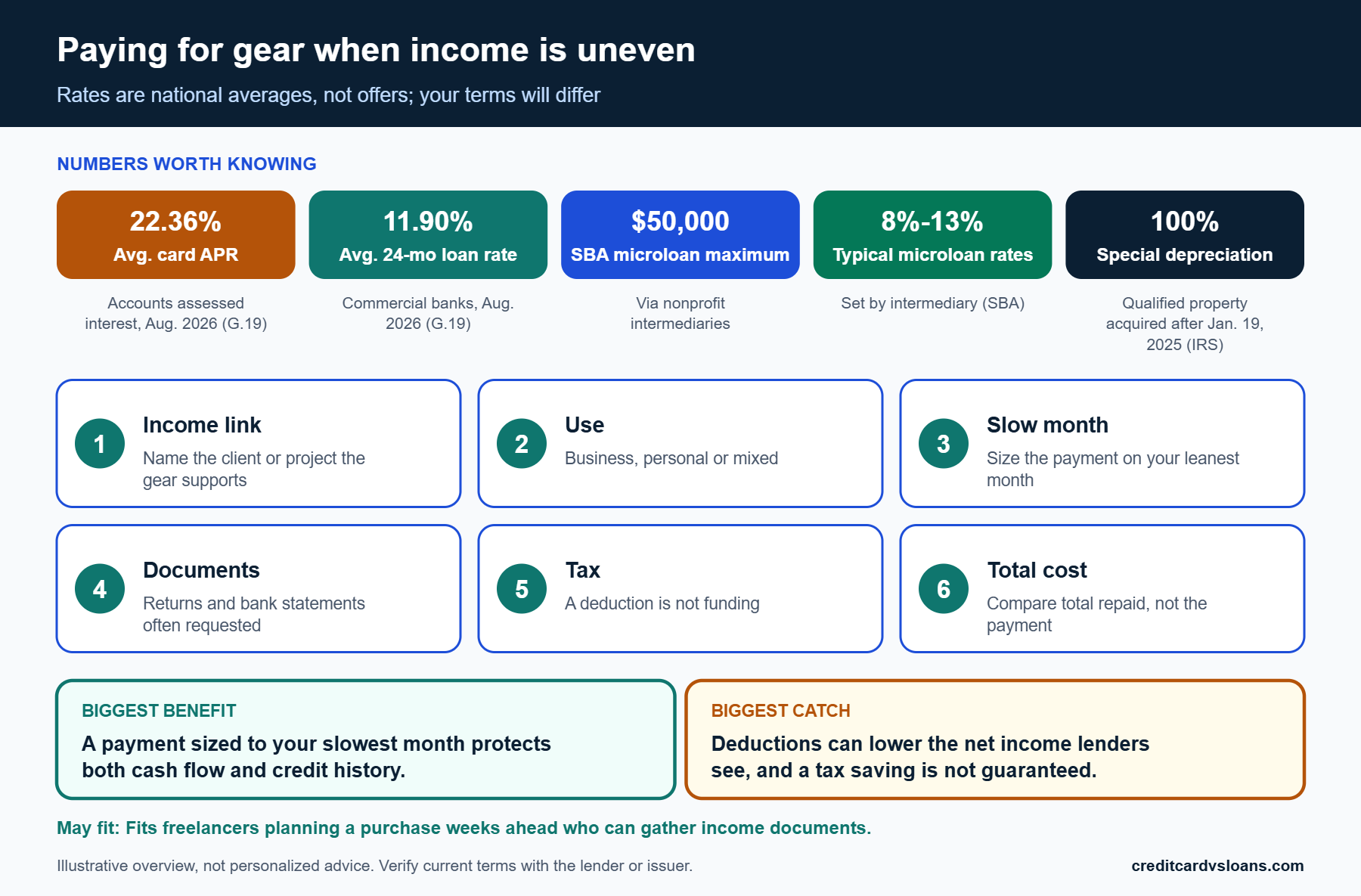
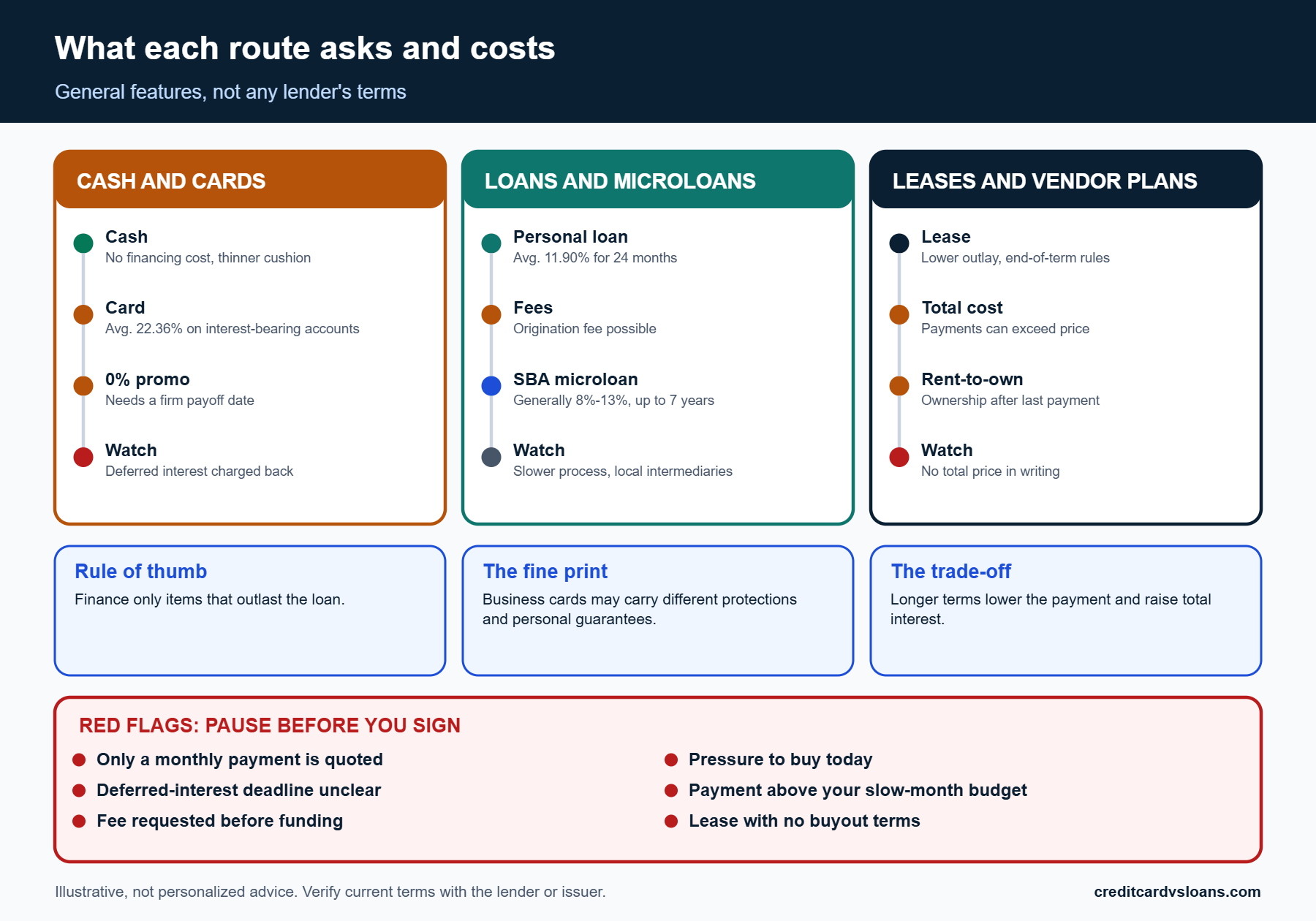
Cash has no financing cost but reduces your cushion. A credit card is flexible and immediate, and the Federal Reserve reported an average rate of 22.36% on card accounts assessed interest in August 2026. A personal loan has a fixed payment and, per the same release, an average 24-month rate of 11.90% at commercial banks. Leases and vendor plans spread the cost over time but come with their own terms, and ownership may not transfer at the end.
Each of these families is explored below, with the freelance-specific catches.
Where the choice usually tips
For items you will use for years and can repay within a year, the cheapest path is often savings plus a short card or loan balance. For larger purchases that you will repay over two years or more, a fixed-term loan usually limits the total cost compared with a card carried at a high rate, provided fees are modest. Choosing between those two is the core of our guide on whether a credit card or a personal loan is better for borrowing.
Leases make sense when you expect to upgrade often and do not need to own the equipment.
Business, personal or mixed: why the answer matters
Keeping the money trail clean
Separate accounts make everything easier
Using one card or bank account for business spending and another for personal life makes it much easier to document what was bought for work. Lenders reviewing self-employment often ask for bank statements, and a clean business account shows consistent deposits. Records also matter for taxes, because the IRS looks to whether property is used in a trade or business, and your documentation is how you show it.
Even if you operate as a sole proprietor with no separate legal entity, a dedicated account or card is a low-cost way to build a record.
Mixed-use equipment needs a rule
A laptop that you use for client work and for family streaming is mixed use. Tax treatment can depend on the business-use share, and the records you keep should reflect a reasonable method for estimating it. A tax professional can tell you what applies to your item and your situation. For financing purposes, remember that a lender will generally treat the loan as personal debt unless it is a true business loan, regardless of how you use the equipment.
That affects who is liable if income dries up: usually you personally.
What the IRS says about recovering equipment costs
Section 179 and special depreciation, in plain terms
IRS Tax Topic 704 explains that business owners can generally recover the cost of qualifying property through depreciation, and can elect to deduct certain costs under section 179 in the year the property is placed in service, up to a dollar limit and subject to a cap based on taxable income from the active conduct of a trade or business. IRS Publication 946 lists a 2026 section 179 maximum of $2,560,000, a limit far above what most freelancers spend. The practical constraint for a freelancer is usually the income cap, not the dollar limit.
The same IRS topic page describes a 100% special depreciation allowance for qualified property acquired and placed in service after January 19, 2025, which is taken after any section 179 deduction.
Why a deduction is not financing
A deduction reduces taxable income; it does not hand you cash when you buy. If you spend $3,000 on equipment and the deduction lowers your tax by some portion of that, you still need to pay the full price first and wait until your return is filed or your estimated payments are adjusted. The tax benefit depends on your income, your filing status and your other deductions, so it is a possible reduction, not a given.
Do not size a loan around a tax saving you have not confirmed, and avoid buying equipment you do not need simply to create a deduction.
Buy now, wait or lease: timing the purchase
Is this the right moment to buy?
Needs versus upgrades
Equipment decisions fall into two groups. A needed replacement, such as a laptop that no longer boots, has a deadline. An upgrade, such as a faster processor or a second monitor, has a return you can estimate. For needs, the question is how to finance with the least damage. For upgrades, the better question is whether the extra productivity covers the cost, and whether waiting a few months to pay mostly in cash changes the answer.
A simple test is the payback period: divide the cost by the extra monthly income it could realistically produce. If the answer is longer than your repayment term, the purchase is being financed faster than it pays back.
Buying used or refurbished
Used or refurbished equipment can reduce the amount you need to finance, but warranties, return windows and condition vary by seller. Ask what the warranty covers, how long it lasts and who handles repairs. Cheaper gear that fails during a client job can cost more than it saved, so weigh how critical reliability is for your work before leaning on price alone.
Whatever you buy, keep the receipt and serial numbers with your business records.
Leasing and rent-to-own
How equipment leases generally work
A lease lets you use equipment for a set period in exchange for regular payments, often with an option to buy, return or upgrade at the end. Leases can lower the up-front outlay, but the total of payments may exceed the purchase price, and the end-of-term terms matter a great deal. Ask what the buyout price is, whether there are early termination fees, and who pays for repairs and insurance.
A lease is easier to justify for equipment that becomes outdated quickly than for items you expect to use for years.
Rent-to-own and checkout pay-over-time plans
Rent-to-own and similar plans can seem convenient, and some are attractive, but the total paid can be notably higher than the cash price, and ownership transfers only after the last payment. Because disclosure practices differ, compare the stated total cost with the cash price and with a card or loan. The stated per-payment amount is not the useful number; the total is.
If you cannot find the total in writing before you commit, treat that as a red flag.
What each way of paying freelance equipment costs
Costs depend on the rate, any fees and how long the balance lasts. The table compares the main routes for a freelancer using general features, not any specific lender’s terms.
Comparing the options
The freelancer’s comparison table
| Option | Cost signal | Credit and income checks | Fit for freelancers |
|---|---|---|---|
| Savings or cash | No financing cost | None | Best when the cushion stays intact |
| Existing card | Average 22.36% on accounts assessed interest (Aug. 2026) | None new | Works for quick payoff; costly if carried |
| 0% or deferred-interest card or plan | 0% only if rules are met | New application, hard pull | Needs a firm payoff plan; deferred interest can be charged back |
| Personal loan | Average 11.90% for 24 months (Aug. 2026); fees vary | Credit and income documents | Predictable payment; check fees |
| Equipment lease | Total payments can exceed purchase price | Varies by lessor | Useful when gear ages fast |
| SBA microloan via intermediary | Generally 8% to 13%, varies by intermediary | Set by the nonprofit intermediary | Possible for business equipment; slower process |
What the table leaves out
It leaves out your own offer. A freelancer with a strong credit history and stable reported income may see far better terms than the averages, while someone with a thin credit file may see worse. It also leaves out the value of flexibility: a card lets you pay extra in a good month, while a lease may not. Use the table to decide what to price, then get real quotes.
The cost of time
A hypothetical $4,000 equipment purchase
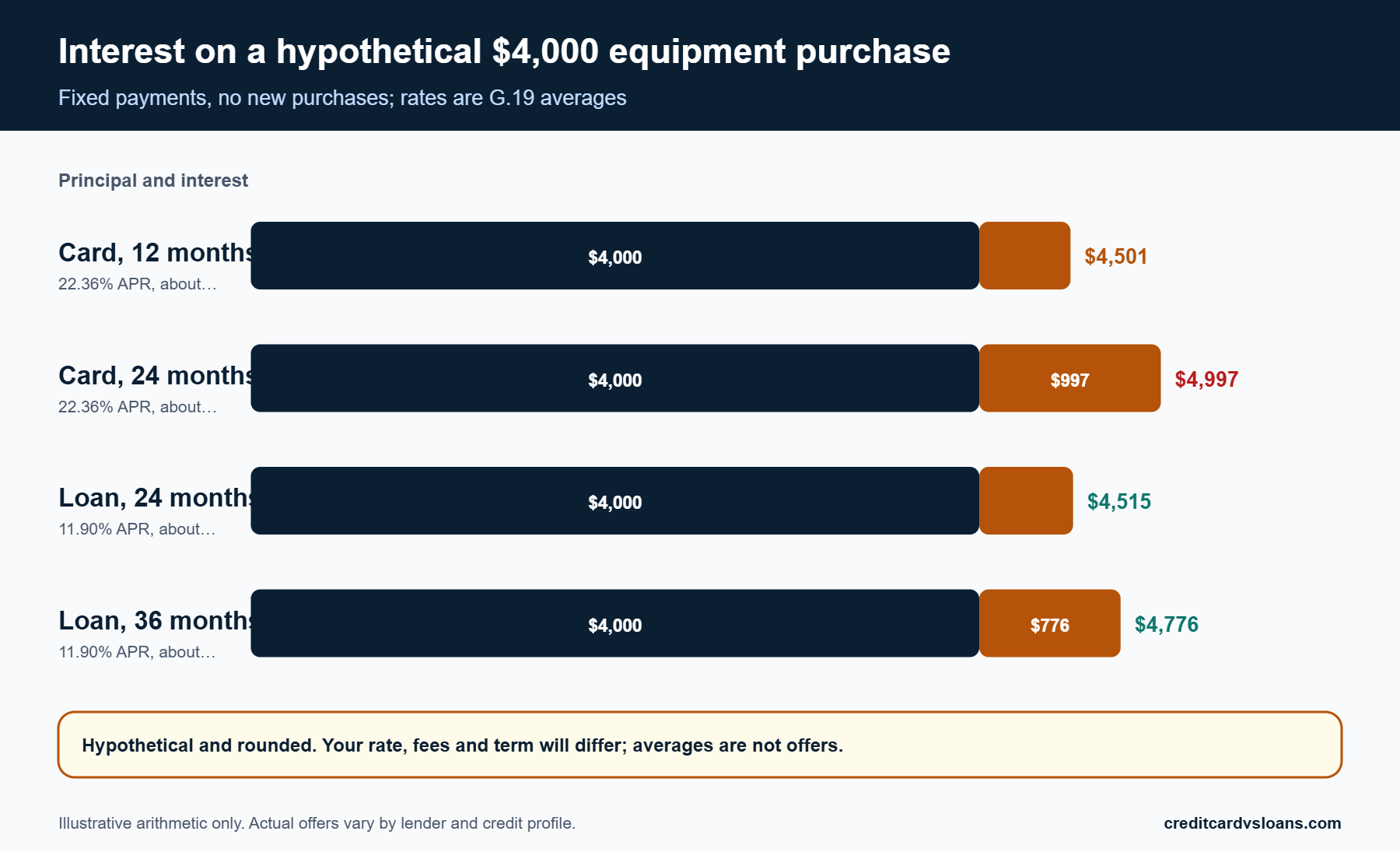
Consider an illustrative $4,000 purchase with fixed payments. On a card at the 22.36% average, repaying in 12 months costs about $375 a month and about $501 in interest. Stretching to 24 months drops the payment to about $208 but nearly doubles the interest to about $997. A 24-month loan at 11.90% costs about $188 a month and about $515 in interest, and a 36-month loan at the same rate lowers the payment to about $133 but raises interest to about $776, before any fees.
These examples are hypothetical, rounded and based on standard amortization; your rate and fees will differ.
The trade-off between payment and total cost
Every extra year of repayment usually lowers the monthly payment and raises the total cost. For a freelancer, the lower payment can be a legitimate protection against a slow quarter. The sensible approach is to choose a term that your leanest month could carry, then prepay in strong months if the lender permits it. Check whether prepayment is allowed without a penalty and whether the lender applies extra payments to principal.
The comparison logic in our 0% APR card versus personal loan guide for furniture applies equally to equipment, because both are durable purchases you will keep using after the payments end.
Qualifying when your income is irregular
How lenders read self-employment income
Net income, not billings, is usually the number that counts
Lenders commonly ask self-employed applicants for tax returns, bank statements or both, and the figure that tends to matter is net income after expenses. That can surprise freelancers whose deductions are large: a legitimate write-off lowers taxes but can also lower the income a lender sees. Requirements differ by lender, and some use bank deposits or a longer income history, so ask what documents are needed before you apply.
If you are close to filing taxes or have a new business with limited history, ask a lender whether it considers alternative documentation.
Prequalify to avoid unnecessary hard pulls
Many lenders offer a prequalification step that uses a soft pull, which does not affect your credit score, and shows an estimated rate. A full application typically involves a hard pull, which is recorded on your report. Comparing two or three prequalified offers is a form of rate shopping, and it usually costs less than applying everywhere. A prequalified estimate is not an approval, and the final terms can differ.
When you do apply, keep applications within a short window and avoid opening several unrelated accounts around the same time.
Business credit, personal credit and where liability lands
Business cards and personal guarantees
Small business credit cards and loans are often available to sole proprietors, and they may be approved based on your personal credit. Many lenders require a personal guarantee, which means you are responsible for repayment even if the business has no money. Consumer protections that apply to personal credit cards can work differently for business cards, so read the cardholder agreement for rates, fees, liability and dispute terms instead of assuming they match a personal card.
Ask the issuer whether the account reports to your personal credit file, since that affects your utilization and your score.
SBA microloans as a slower, lower-rate possibility
The U.S. Small Business Administration’s microloan program lends through nonprofit intermediaries. According to the SBA, loans go up to $50,000, the average is about $13,000, and proceeds can be used for working capital, supplies, furniture, fixtures, machinery and equipment, but not to pay existing debts or buy real estate. Repayment terms run up to seven years, and interest rates generally fall between 8% and 13%, set by the intermediary. Each intermediary makes its own credit decisions.
The process can be slower than a card or online loan, so it fits planned purchases better than urgent ones.
| Product | Who is usually liable | Common paperwork | Watch for |
|---|---|---|---|
| Personal card or loan | You personally | Credit check, income proof | Treated as personal debt even for business use |
| Business card | Often you, through a personal guarantee | Business details, personal credit | Protections may differ from consumer cards |
| Equipment lease | Per lease terms | Financial statements or returns | End-of-lease terms and fees |
| SBA microloan | Set by the intermediary | Business plan, financial documents | Longer timeline, local availability |
The pattern across the table is that the more paperwork a product demands, the more likely it is to carry a lower rate or a longer term, and the less likely it is to arrive the same day. Freelancers who plan equipment purchases a month or two ahead can use that to their advantage by gathering two years of returns, recent bank statements and a short summary of current clients before they need the money. Having the documents ready also shortens the time between approval and funding, which matters if a project deadline is driving the purchase.
Vendor offers, 0% deals and checkout financing
Reading a promotion before you take it
0% purchase offers and the exit plan
A card with a 0% introductory rate on purchases can make an equipment purchase interest-free for a set period, but the standard rate applies to whatever remains afterward, and a purchase fee or application hard pull may apply. The math works when you divide the price by the promotional months and can afford that payment. It fails when income dips and the balance outlasts the offer. Our comparison of the best way to pay for back-to-school costs looks at the same structure for seasonal spending.
Set the payoff date in your calendar and automate a payment equal to the price divided by the promotional months.
Deferred interest at the register
Store and vendor cards sometimes advertise “no interest if paid in full.” According to the CFPB, in a deferred interest promotion the interest is not waived: if any promotional balance remains when the period ends, interest may be charged back to the purchase date. In the CFPB’s example of a $400 purchase at a 25% deferred rate with $25 monthly payments, $100 of principal remained after 12 months along with $65 of deferred interest, so $165 was owed.
A freelancer with lumpy income is especially exposed to the one-short-payment problem, so build in a margin.
Questions to ask the vendor
Fees and total price
Ask for the cash price, the financed price and the total of all payments side by side. Some vendors price equipment higher when you finance, or add set-up, delivery or documentation charges. Ask whether the financing is provided by the vendor or a third-party lender, because the lender’s terms are what you are agreeing to. If the monthly figure is the only number offered, request the total.
Compare the vendor’s offer with a prequalified loan or your existing card for the same purchase.
What happens if the equipment fails or returns
Find out how returns, warranty claims and repairs work if you are financing the item. A defective item does not generally cancel a loan from a third-party lender, and you may still owe payments while a dispute is resolved. If you paid by credit card, card dispute procedures may help, and the process differs by issuer and card type. Keep all receipts and correspondence.
When a deal seems urgent, remember that equipment sales recur and an urgent deadline is often a sales tool.
Credit, insurance and risk: what protects you if work slows
What financing does to your credit profile
Inquiries, new accounts and utilization
Financing equipment typically touches several parts of your credit profile at once. A hard inquiry is recorded when you apply, a new account lowers the average age of your accounts, and a large card balance raises utilization, the share of your revolving credit limit that is in use. These effects can be temporary and differ with your overall history, so there is no reliable number to expect. If you plan to apply for a mortgage or another large loan soon, consider timing the equipment purchase around it.
A fixed-term loan adds an installment account rather than revolving utilization, which some borrowers find easier to manage.
On-time payments are the part you control
Payment history is the factor you influence most directly. Automatic payments for at least the minimum protect against an accidental miss, and a reminder a few days before the due date helps if you pay manually. Keep a calendar of due dates across cards, loans and leases, especially if several fall in the same week. Setting due dates just after typical client payment dates can make that routine easier.
Late payments can be reported and can stay on your credit reports for years, so protecting the habit is worth some effort.
Insuring and protecting the equipment you finance
Loss, theft and damage
If you finance a camera kit or laptop and it is stolen or damaged, you still owe the loan or lease payments. Check whether your homeowners or renters policy covers business equipment, since many policies limit coverage for property used in a business, and ask about a separate rider or business policy if the equipment is valuable. Leases often require you to insure the equipment, so read that clause before signing.
Photograph your serial numbers and keep receipts in a safe place, because claims move faster with documentation.
A cushion for the slow stretch
The most useful protection against a financing problem is a small reserve. Even one or two payments set aside in a separate account can bridge a late client payment or a seasonal dip. If the equipment purchase would drain your reserve, that is a signal to buy less, buy used or wait. It is also a reason to prefer a lender that allows hardship arrangements, though availability varies, so ask before you sign.
Think of the reserve as part of the purchase price, not an optional extra.
Building a payment plan around lumpy income
Sizing the payment
Use your slowest realistic month
List your last twelve months of net deposits, circle the lowest two or three, and subtract fixed costs such as rent, insurance, software subscriptions and tax set-asides. What remains is the most you could reasonably commit to a payment. If the financing payment exceeds that amount, you are relying on good months to avoid missing a payment, and a missed payment can be reported to the credit bureaus.
The aim is a payment that feels boring in a slow month, not one that only works in a record month.
Keep tax money separate
Self-employed workers often owe estimated taxes during the year, and the money can disappear if it is mixed with spending money. Setting a share of each payment aside in a separate account helps ensure that equipment payments do not compete with tax obligations. Ask a tax professional how much to set aside, because the right share depends on your income and location.
A financing payment funded by money that was really meant for taxes only moves the problem to April.
Making repayment flexible
Choose products that allow extra payments
Flexibility is valuable when income swings. Cards generally accept payments of any size above the minimum, and many loans allow extra principal payments without a penalty, but terms vary. Ask whether a loan has a prepayment charge, whether a payment can be skipped or deferred in a hardship, and whether the due date can be moved to match when clients typically pay you.
Aligning due dates with your invoices can reduce late payments more than a slightly lower rate would.
Know what to do if a client pays late
If a large invoice is delayed, contact the lender before the due date. Some offer short extensions or temporary arrangements, though availability differs. If balances start to climb on several cards, a combination of strategies may help; our guide to credit card debt consolidation by credit profile explains when consolidating makes sense and when it does not.
Document any hardship agreement in writing and keep making whatever payment you can.
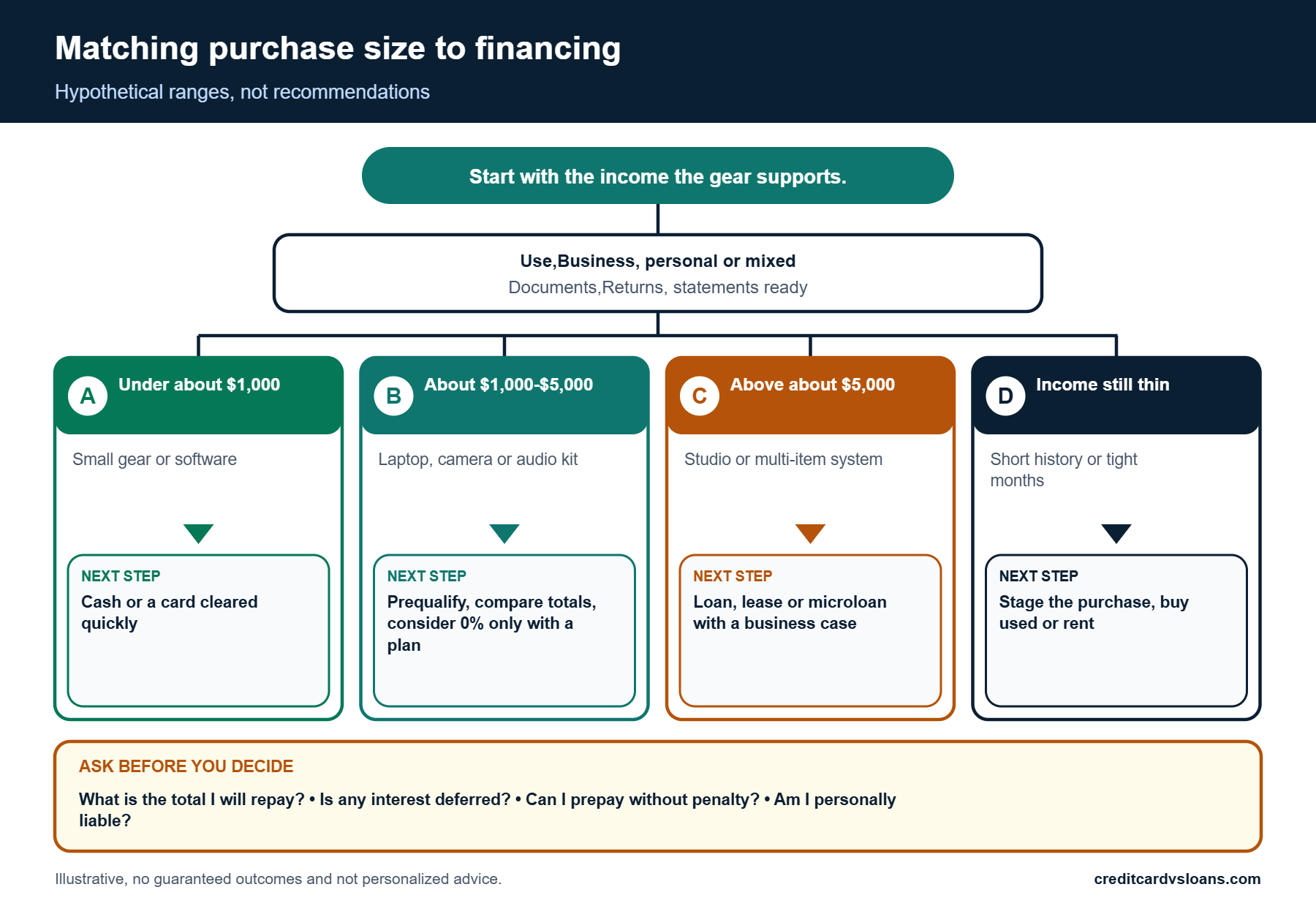
Three purchase sizes, three different approaches
These hypothetical profiles illustrate how the same tools apply at different price points; they are not real freelancers.
Matching the tool to the price
Under about $1,000
For smaller items, such as a keyboard, headset or software license, financing rarely adds up. Paying from cash flow or putting the item on a card you can clear within a statement cycle or two usually costs little in interest. A new loan for a small purchase can cost more in fees and paperwork than the interest saved, so check for an origination fee before considering it.
Use a card only if you will pay it off quickly and have a plan for the money.
Roughly $1,000 to $5,000
This mid-range is where terms matter most. A hypothetical $4,000 purchase can cost around $500 in interest at the card average over 12 months or around $515 on a 24-month loan at the 11.90% average, so the difference lies in fees, term and your own offer. Prequalifying with a couple of lenders and comparing the total repayment amount is worthwhile. A 0% promotion can win if you will pay it off in time.
Avoid stretching the term only to reduce the payment unless your cash flow truly requires it.
The larger purchases
Above about $5,000
Larger purchases, such as a full studio or a camera system, may call for a loan, a lease or an SBA microloan. Weigh the business case carefully: how long will the equipment last, what will it earn and what happens if work slows. Consider buying in stages, starting with the item that earns the most, and let revenue fund the next piece.
A written business case, even a one-page estimate of income and costs, helps you and any lender evaluate the purchase.
When a partial purchase makes sense
Sometimes the smartest financing is not buying everything at once. Renting a specialty item for a single project, borrowing equipment from a collaborator or purchasing a used model can bridge the gap until income supports a better version. These choices are not glamorous, but they limit debt and keep options open if your client mix changes.
Revisit the plan after each project and adjust.
| Purchase size | Typical first choice | Backup choice | Main caution |
|---|---|---|---|
| Under about $1,000 | Cash or a card cleared quickly | Savings | Do not carry the balance at card rates |
| About $1,000 to $5,000 | Prequalified loan or 0% card you can clear | Lease or vendor plan | Fees and deferred interest |
| Above about $5,000 | Loan, lease or microloan with a business case | Stage the purchase | Payment must survive a slow quarter |
Your equipment financing checklist and next steps
Before you commit
The pre-purchase checklist
- Name the client, project or income the equipment supports.
- Decide whether the use is business, personal or mixed, and set up separate payment methods.
- Compare the cash price, financed price and total of all payments.
- Prequalify with two or three lenders if you plan to borrow, and compare APR and fees.
- Choose a payment that your slowest month can carry, and set up automatic payments.
- Mark any promotional deadline and plan to pay in full a few days early.
- Keep receipts, invoices and financing documents together for tax time.
Doing these steps in order takes less time than it sounds and usually surfaces the cheapest path.
Questions for your tax professional
Ask whether the purchase qualifies as business property, how to treat mixed use, how section 179 or special depreciation would apply and whether loan interest or lease payments are treated differently. IRS Tax Topic 704 and Publication 946 describe the general rules, but your return depends on your facts. The answers may change whether you buy this year or next.
Ask before you buy, not after the equipment is on a financing plan.
Common questions
Should I put equipment on a personal or a business card?
It depends on what each offers. A business card can keep records tidy, but protections and reporting may differ from a personal card, and you may be personally liable either way. A personal card may offer clearer consumer protections but mixes business and personal spending. Whichever you choose, read the agreement and keep business purchases traceable.
If you already carry a balance on either card, a new purchase at the same rate adds to it.
Is a long loan term ever the right call?
It can be, when a lower payment protects you from missing one. The cost is more interest overall. A reasonable middle path is to take the longer term for safety and plan to prepay when cash flow allows, as long as the lender does not penalize it. Compare the total cost across terms before deciding, as the hypothetical $4,000 example above showed.
Your slowest month, not your best, should set the term.
What if I am turned down?
Ask for the reasons, review your credit reports for errors, and consider a smaller purchase, a used item, a co-signer or a credit union. Avoid applying to many lenders at once. A decline now does not rule out approval later as your income history lengthens. For planned seasonal spending, the same step-by-step approach used in our guide to financing back-to-school costs applies: shop early, compare totals and avoid last-minute borrowing.
Waiting a few months to build records is sometimes cheaper than borrowing on poor terms.
Mistakes that raise the cost
Financing the wrong things
Borrowing for software subscriptions, supplies that you will use up quickly or equipment you do not yet need can leave you paying for something after its value has gone. As a rule of thumb, finance only items that will last longer than the loan, and pay for short-lived items from cash flow. The longer a purchase lasts relative to its repayment term, the safer the debt is.
Review recurring subscriptions regularly, since they can look small but add up across a year.
Mixing up speed and savings
Same-day funding or instant checkout approval is convenient, but convenience is often priced into the rate or the fees. If you can wait a week to compare two or three offers, you may save a meaningful amount on a mid-sized purchase. If you cannot wait, set a limit on how much you will borrow and revisit the plan once the urgent project is delivered.
When in doubt, ask for the total repayment amount in writing and compare it with a cash price.
A 30-day plan for a planned purchase
Weeks one and two: gather and compare
Start by pulling together the documents lenders usually ask self-employed applicants for: recent tax returns, a few months of bank statements and a note listing your regular clients. Then price the equipment from at least two sellers, including refurbished options where it makes sense. Use prequalification tools to collect two or three estimated loan offers, and check your existing card rate and available credit. Put every number in one table: cash price, financed price, rate, fees, term, monthly payment and total repaid.
Seeing the options side by side often makes the answer obvious, and it takes less than an evening.
Weeks three and four: decide and set up the guardrails
Choose the option with the lowest total cost that your slowest month can carry. Before you buy, set up an automatic payment, mark any promotional deadline in your calendar, and move the tax set-aside into its own account. After the purchase, file the receipt, serial number and financing agreement with your business records, and add the item to your equipment list for tax time. Then revisit the numbers after the first two payments to confirm the plan is working as expected.
If the plan feels tight after two payments, consider paying down faster while the balance is small.
Pick the cheapest financing that your slowest month can support, and treat any tax benefit as a possible bonus, not the funding source. Small items belong on cash or a card you clear fast; mid-sized purchases deserve a prequalified comparison; larger ones deserve a business case and a plan for a slow quarter.
- Best Way to Pay for Back-to-School Costs: Compare Borrowing Options Before You Commit
- Best Way to Pay for a Veterinary Emergency: Compare Borrowing Options Before You Commit
- How to Finance Back-to-School Costs: Credit Cards, Loans and Lower-Cost Options
- Credit Card Debt Consolidation: Best Options by Credit Profile
- 0% APR Credit Card vs. Personal Loan for Furniture: Which Wins?
- Federal Reserve: Federal Reserve G.19 Consumer Credit release, Oct. 7, 2026 (Average credit card and 24-month personal loan rates, August 2026)
- Federal Reserve: Report on the Economic Well-Being of U.S. Households in 2025: unexpected expenses
- IRS: Tax Topic 704, Depreciation (Section 179 and special depreciation allowance)
- IRS: Publication 946, How To Depreciate Property (Section 179 dollar limit and phase-out)
- SBA: Microloans (Loan size, uses, terms and intermediaries)
- CFPB: How to understand special promotional financing offers on credit cards (Deferred interest explanation and $400 example)
Last updated: October 22, 2026. Rates, fees and lender rules change; verify current terms before acting.
The information on creditcardvsloans.com is provided for general educational and informational purposes only. It is not financial, legal, tax, credit, accounting or investment advice, and reading it does not create an advisor-client, fiduciary or any other professional relationship. Nothing here is an offer, solicitation or recommendation to borrow, lend or apply for any product.
Credit scores, interest rates, fees, eligibility rules, lender policies and laws change frequently and vary by lender, location and individual circumstances. Examples, figures and scenarios are illustrative only, do not predict your results and do not guarantee approval, savings, a particular rate or a credit-score outcome. Always confirm current terms directly with the lender or issuer and read the full agreement before you apply or sign.
Although we aim for accuracy and use reputable sources, we make no representations or warranties, express or implied, about the completeness, accuracy, reliability or timeliness of the content. Content may be drafted with the assistance of automated tools, so errors or omissions may still occur. Links to third-party sites are provided for convenience; we don’t control and aren’t responsible for their content.
To the fullest extent permitted by law, creditcardvsloans.com and its owners, editors, authors, contributors and affiliates disclaim all liability for any loss, damage or expense arising directly or indirectly from your use of, or reliance on, this content. Before making financial decisions, consult a licensed professional, such as a qualified financial advisor, attorney, tax professional or nonprofit credit counselor, who can consider your complete situation.