The best way to pay for holiday expenses is usually the option that lets you repay the whole amount quickly, at the lowest total cost, without borrowing again in January. For most households that means cash or savings first, a card you already have paid off within the billing cycle second, and a fixed-term loan or promotional card only when the amount is too big for either.
Holiday spending is an odd borrowing problem. It is predictable, it has a hard deadline, and it is entirely optional in size, which means you have more control over it than over a car repair or a medical bill. That control is exactly why it pays to compare your options before you swipe, apply or tap “pay later” at checkout.
This guide is a decision framework, not a ranking. You will see how cash flow, credit cards, 0% promotional offers, personal loans, buy now, pay later and credit union loans stack up on cost, credit impact, repayment structure and risk. a step-by-step financing plan is a different job from this comparison, and the same facts applied to a work purchase are in our guide to paying for freelance equipment.
- Interest charged on a holiday balance is a cost you can usually shrink by shortening the repayment time, not only by finding a lower rate.
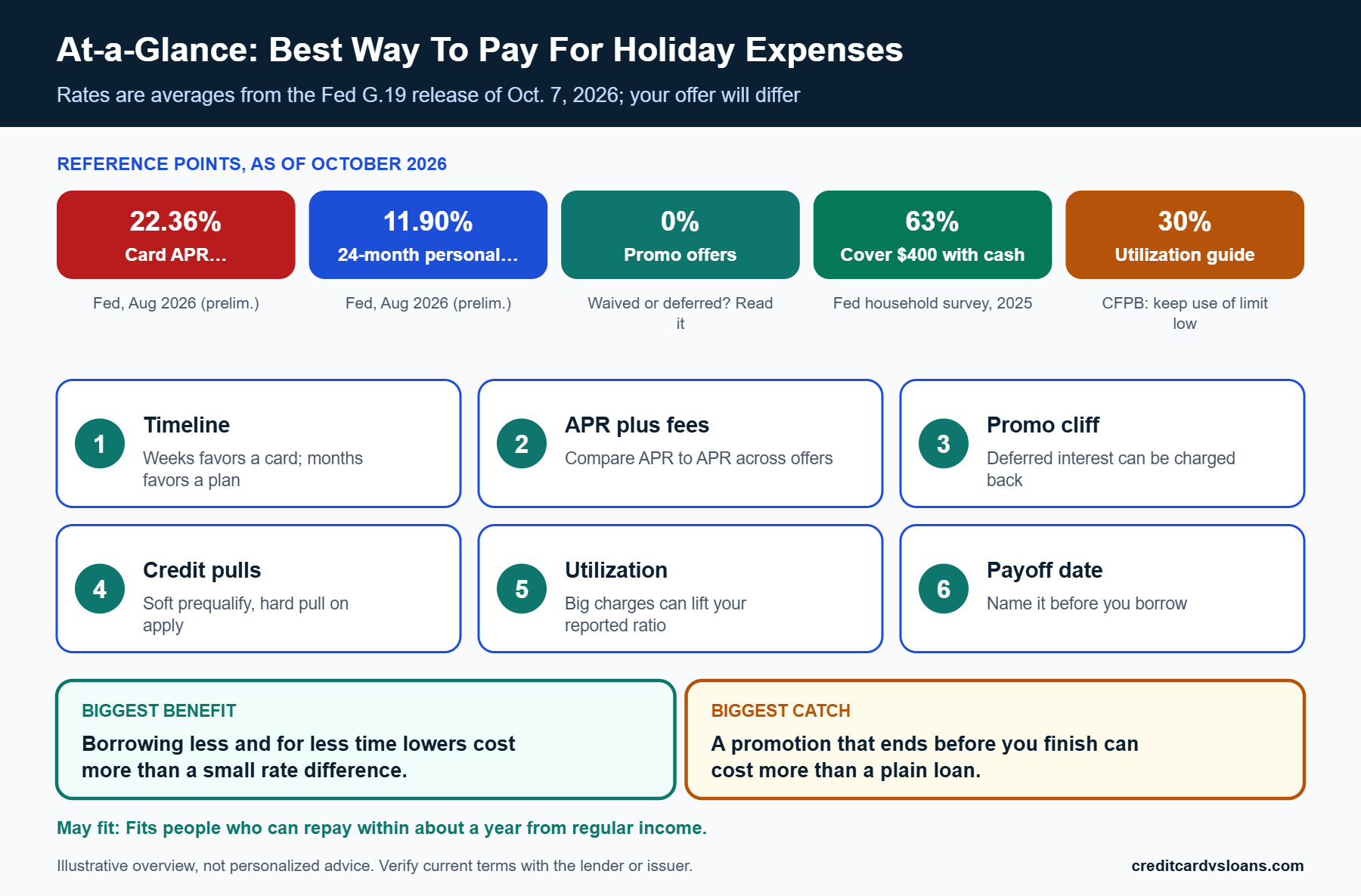
- As of the Federal Reserve’s G.19 release of Oct. 7, 2026, the average rate on credit card accounts assessed interest was 22.36% (August 2026, preliminary), and the average 24-month personal loan rate at commercial banks was 11.90%.
- A 0% promotional offer can be the cheapest borrowing available, but only if you can clear the balance before the promotion ends and read whether interest is waived or deferred.
- Lender fees, such as an origination fee, are part of the real cost and show up in the APR, so compare APR to APR.
- If a purchase would still be on your statement next holiday season, the plan needs a smaller budget more than it needs a better loan.
Rate figures are dated to the Federal Reserve’s G.19 release of Oct. 7, 2026. Offers change often, so treat every number here as a reference point and use the terms on your own offer for the actual decision.
Table of contents
The Short Answer: Which Option Fits Which Holiday Budget
How to read the options before you commit
The one question that sorts everything
Before comparing any product, ask how many months it will take you to pay this off from your normal income. Not your income at the end of a bonus, not a refund you hope for, but the monthly slack you actually have after rent, utilities, food and minimum payments.
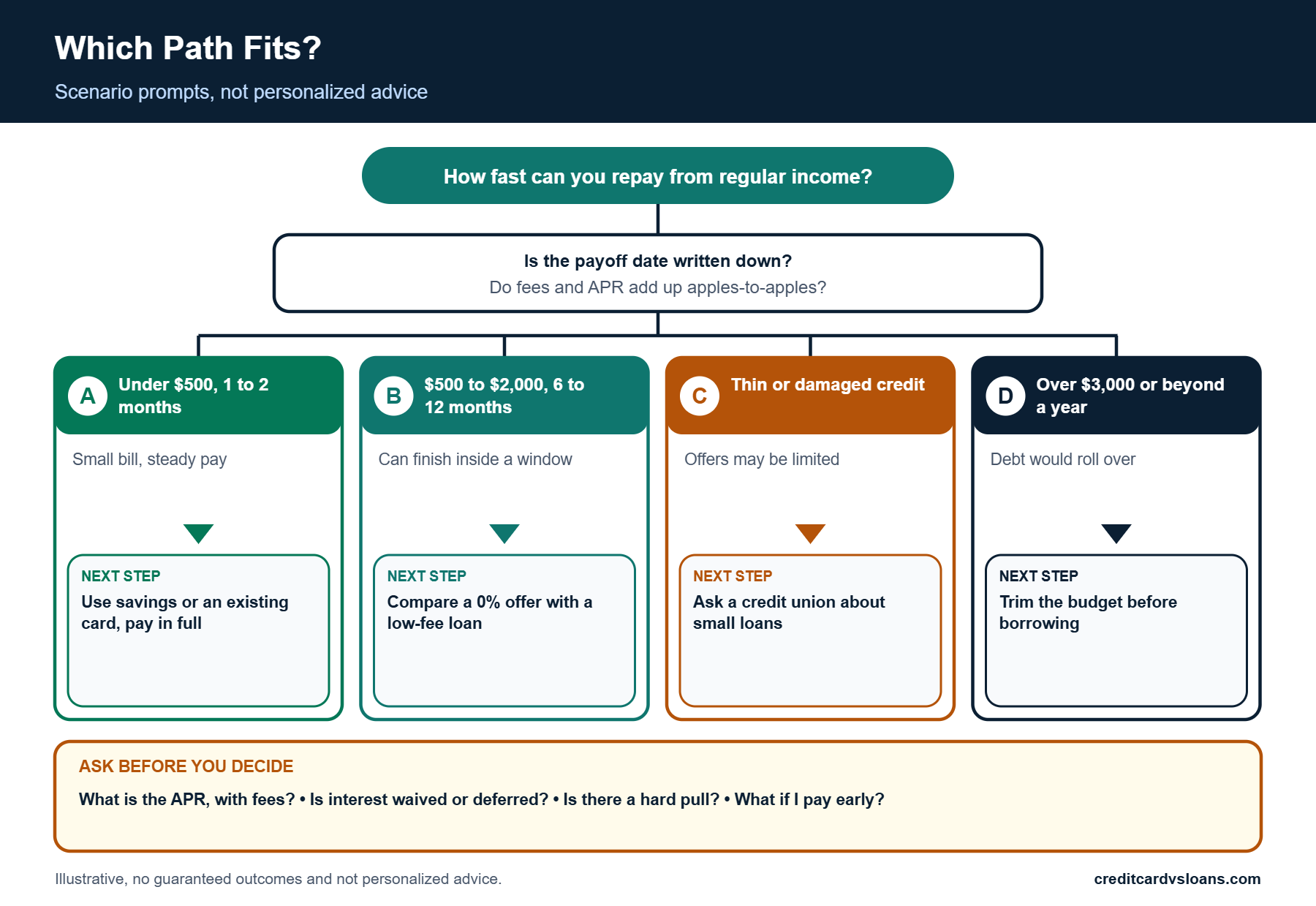
If the honest answer is one or two months, the best way to pay for holiday expenses is probably a card you already have, paid before the due date so no interest is charged. If it is three to twelve months, a promotional offer or a fixed-rate loan may be worth comparing. If it is longer than a year, the better move is nearly always to shrink the spending rather than stretch the payments.
Why holiday spending is a different kind of borrowing
Most financing guides assume the expense is unavoidable. A cracked windshield or a failed water heater, like the situations in our guide to paying for a water heater replacement, has to be solved. Holiday spending, by contrast, is flexible, so the cheapest financing is often a smaller list.
It also arrives in clusters: travel booked in the fall, gifts in November and December, hosting costs in the final week. Several small charges on several accounts are easy to lose track of, which is why a single written total matters before you choose a product.
A quick decision shortcut
If you can pay within one or two billing cycles
Use the lowest-friction tool that does not charge interest. According to the CFPB, on most cards you can avoid interest on purchases by paying your balance in full each month by the due date. That makes an existing card the simplest answer for amounts you can clear quickly, with the added advantage that you avoid a new application.
The catch is discipline: a card gives you no repayment schedule of its own, and a balance carried even one month starts accruing interest at the card’s regular rate. If you have carried a balance recently, you may not have a grace period on new purchases, so read your statement before assuming you do.
If you need more than a few months
Past a quarter or two, the structure of the repayment matters as much as the rate. A fixed-term loan gives you a payment and an end date. A promotional card gives you a window with a cliff at the end. A regular card gives you neither, only a minimum payment that is built to keep the account open rather than to clear the debt.
That is the reason the comparison in the next section looks at structure, not only price. A product with a slightly higher APR and a firm payoff date can leave you better off than a cheaper-looking one that quietly drifts into the new year.
Best Way to Pay for Holiday Expenses: The Options Side by Side
Pay-as-you-go options
Savings and a holiday sinking fund
A sinking fund is a small amount set aside each month for a known future expense. Setting aside $50 a month starting in January produces $600 by December without a single finance charge. It is the one option on this page with no cost, no credit check and no repayment risk.
If you are reading this in late October, a full year of saving is not available, but a partial fund still shrinks the amount you need to borrow. The Federal Reserve’s report on household economic well-being in 2025 found that 63% of adults would cover a hypothetical $400 emergency expense with cash or its equivalent, so a good share of households have little cushion to spare, which is a reason to protect what you do have rather than drain it for gifts.
Trimming and timing the spend
Cutting the total is the only option that lowers cost and risk at once. A written gift list with a cap per person, a shared-meal approach to hosting, or moving some gifts to after-holiday sales can take hundreds of dollars off the number you need to finance.
Timing also helps with cash flow. Charges made right after a statement closes give you the longest stretch before a payment is due, and spreading purchases across two billing cycles means each statement stays manageable. None of this is a trick; it is simply using the calendar so you borrow less, for less time.
Borrowing options in plain terms
A card you already have
An existing credit card is the fastest and usually the cheapest borrowing tool if you repay promptly. There is no new hard pull, because you are not applying for credit, and you may earn rewards on purchases you were going to make anyway.
The trade-off is the rate if you do not repay on time. At the Federal Reserve’s reported August 2026 average of 22.36% on accounts assessed interest, a $2,000 balance costs about $37 in interest for a single month. Carry it for a year and the cost grows quickly, as the worked examples later in this guide show.
A new promotional card
Some cards advertise a 0% introductory APR on purchases for a set number of months. The CFPB explains that these offers come in different forms, and the difference matters: with a true 0% promotion, interest only starts on what remains after the period ends, while with a deferred-interest promotion, interest can be charged back to the purchase date if any balance remains.
Approval is not certain, a hard pull is part of the process, and the card’s standard rate after the promotion is usually high. It is a tool for people who are confident they can finish repaying inside the window, not a way to buy time.
A fixed-rate personal loan
A personal loan gives you a lump sum with a fixed payment and a set number of months. The Federal Reserve’s G.19 release of Oct. 7, 2026 reported an average 24-month personal loan rate of 11.90% at commercial banks, though your own offer depends on your credit and the lender, and some lenders charge an origination fee.
For a holiday expense, a loan is hard to justify at small amounts because fees and minimum loan sizes can erase the advantage over a card. It can make sense for a larger, planned total, such as multi-person travel, when the fixed end date is itself the benefit.
| Option | Who it may fit | Main advantage | Main drawback | Primary cost driver |
|---|---|---|---|---|
| Savings or sinking fund | Anyone with time before the spending starts | No interest, no application | Needs lead time | Opportunity cost only |
| Existing card, paid in full | People who can clear the bill by the due date | No interest if paid in full on time | Rate is high if you carry a balance | Card APR |
| 0% promotional card | People with a firm payoff plan inside the window | Can be the lowest-cost borrowing | Cliff or retroactive interest at the end | Transfer or promo fees, post-promo APR |
| Fixed-rate personal loan | Larger, planned totals | Set payment and payoff date | Possible origination fee, hard pull | APR and fees |
| Buy now, pay later | Single purchases with a clear schedule | Simple split payments | Late fees, easy to stack several | Late fees, overdrafts |
| Credit union small loan | Members who need a few hundred dollars | Rules limit rates and fees on some products | Membership and terms vary | Rate cap and application fee |
How Each Option Can Affect Your Credit and Approval Odds
Applications, inquiries and soft versus hard pulls
When a new application costs you something
The CFPB notes that when you apply for a credit card or line of credit, the issuer reviews your credit report to see how often and how recently you have applied, and that this can lower your score. A hard pull is that kind of review tied to an application, and it appears on your credit report.
An existing card involves no new application, which is another reason it is hard to beat for short-term holiday spending. If you do apply for something new, make it one application for one purpose, not a handful in a week.
How prequalifying helps you compare
Many lenders let you prequalify, which generally means checking likely terms with a soft pull that is not a full application. Prequalified numbers are estimates, not offers, so they are best used for rate shopping across several lenders before you choose one to formally apply with.
Not every lender uses a soft pull for prequalification, so read the screen before you submit. If the page says that submitting will run a hard inquiry, treat it as a real application.
Utilization, payment history and what lenders look at
Balances against limits
According to the CFPB, scoring models look at how close you are to your credit limits, and experts advise keeping your use of credit to no more than 30 percent of your total credit limit. A large holiday charge on a card with a small limit can push that ratio up fast, and a high reported balance can weigh on your utilization even if you plan to pay it off in full after the statement posts.
If your holiday total would take a card above that level, spreading charges across more than one card or paying part of the balance mid-cycle can keep reported utilization lower. This is an area where a small thing, like paying before the statement closes, changes what the credit bureaus see.
Payment history and recent credit activity
The CFPB says repayment history is the number-one factor in most credit scores, and recent applications can signal a need for credit. A missed payment on a promotional card or a loan can cost you more in score damage and fees than the whole holiday budget was worth.
For anyone with a thin credit file or recent late payments, approval for the cheapest products can be harder. Rather than applying anyway, it helps to compare options without a hard pull first, and for those with weaker credit, our guide to paying for a college tuition gap walks through the same trade-offs on a bigger bill.
What Each Option Costs: APR, Fees and Repayment Structure
Reading the real cost of borrowing
APR versus interest rate
The CFPB describes the interest rate as the price of borrowing and the APR as the interest rate plus the lender’s additional fees, such as origination charges. When you compare offers, compare APR to APR, not an APR on one and a bare interest rate on another.
That matters most with personal loans, where a lender can advertise a low rate and add a fee that is taken from the loan proceeds. A holiday loan of $2,000 with a 5% fee leaves you with $1,900 in hand, which is why the worked example below borrows slightly more to net the full $2,000.
What the Federal Reserve’s data shows as of October 2026
The Federal Reserve’s G.19 release of Oct. 7, 2026 shows, for commercial banks, an average credit card rate of 21.19% on all accounts and 22.36% on accounts assessed interest in August 2026 (preliminary), and 11.90% on 24-month personal loans. The gap between the two figures is roughly ten percentage points, but averages hide a wide range, and your own rate may be above or below them.
It is also worth noticing the difference between the two card figures. The lower number includes accounts that pay in full and never pay interest, which is a quiet reminder that paying on time is itself a financing strategy.
Worked examples (hypothetical)
A $2,000 holiday bill repaid over 12 months
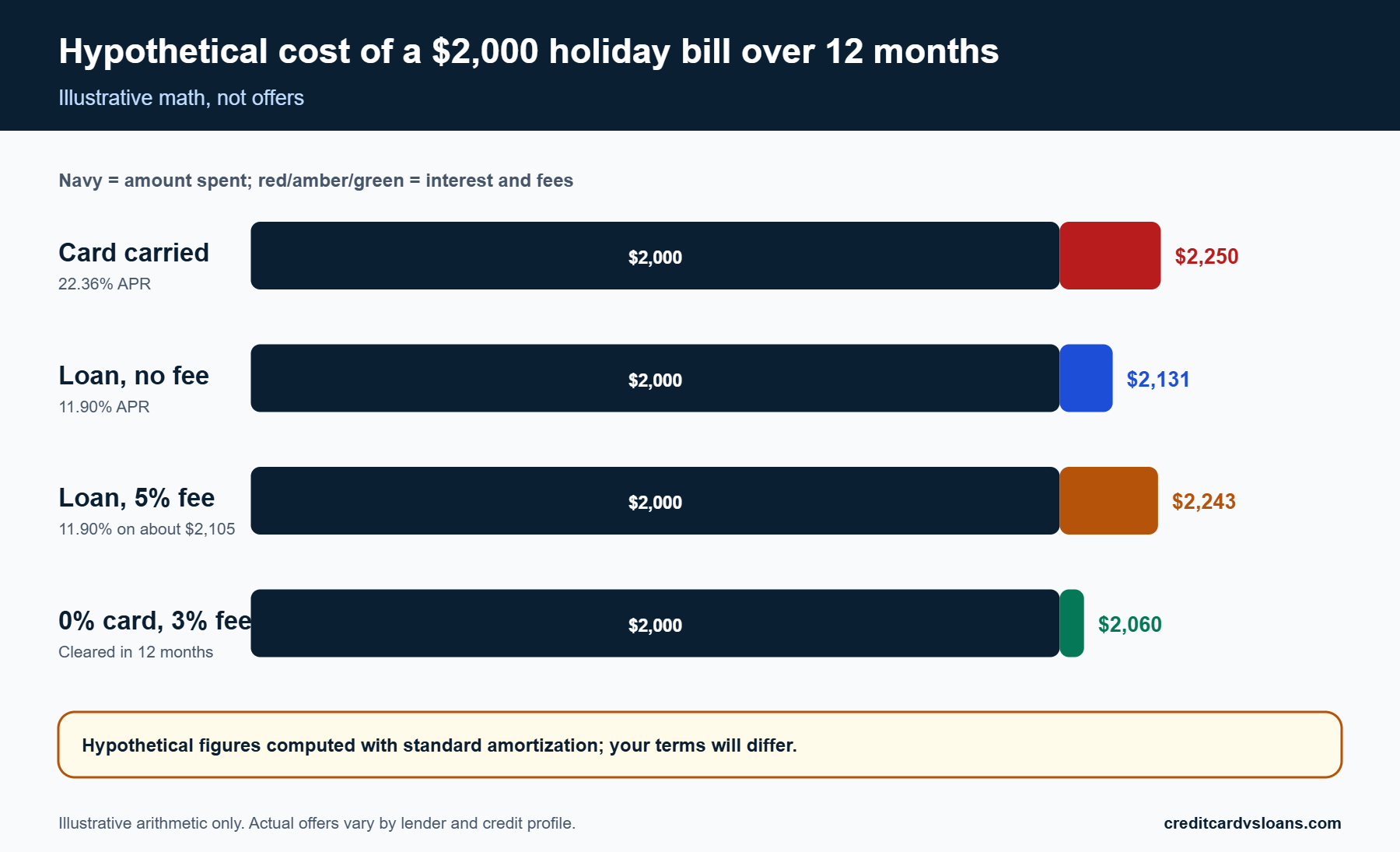
These are illustrative numbers computed with standard amortization, not offers. Paying $2,000 over 12 months at 22.36% costs about $250 in interest, with payments near $188 a month. At 11.90% over 12 months, a loan costs about $131 in interest, with payments near $178.
Now add fees. If a lender charges a hypothetical 5% origination fee and you borrow about $2,105 to net $2,000, the 12-month cost at 11.90% is roughly $243. A hypothetical 0% card with a 3% fee costs $60 for the same 12 months, which is cheaper, as long as the balance is cleared inside the window.
| Option (illustrative) | APR or rate type | Fees | Monthly payment | Total interest and fees | Credit and risk notes |
|---|---|---|---|---|---|
| Regular card carried | 22.36% (Fed average, accounts assessed interest) | None assumed | About $188 | About $250 | No new inquiry; utilization rises |
| Personal loan, no fee | 11.90% (Fed 24-month average) | None assumed | About $178 | About $131 | Hard pull; installment account |
| Personal loan, 5% fee | 11.90% on about $2,105 | About $105 withheld | About $187 | About $243 | Hard pull; compare APR to APR |
| 0% card, 3% fee | 0% for 12 months | $60 | About $172 with fee | $60 | Balance left at month 12 faces the standard rate |
The $243 loan figure counts the fee as part of the cost and the payment of about $187 is on the larger loan amount. Payments in all rows are rounded.
When the promotional card wins and when it does not
A 0% offer wins when three things are true at once: you are approved, you pay a small or zero fee, and you can finish within the promotional months with room to spare. Miss any one of them and the cost can swing the other way.
It loses when the offer is a deferred-interest promotion and a small balance is left behind. In the simplified model for a $2,000 purchase paid in twelve equal payments at 22.36% with the final payment missed, the interest charged back to the purchase date works out to roughly $240, even though only about $167 was unpaid. The CFPB’s guidance is to pay well before the deadline and ask the issuer to apply extra payments to the deferred balance.
Risks That Can Turn a Holiday Splurge into Long-Term Debt
Promotional offers and the cliff at the end
Deferred interest versus a true 0% period
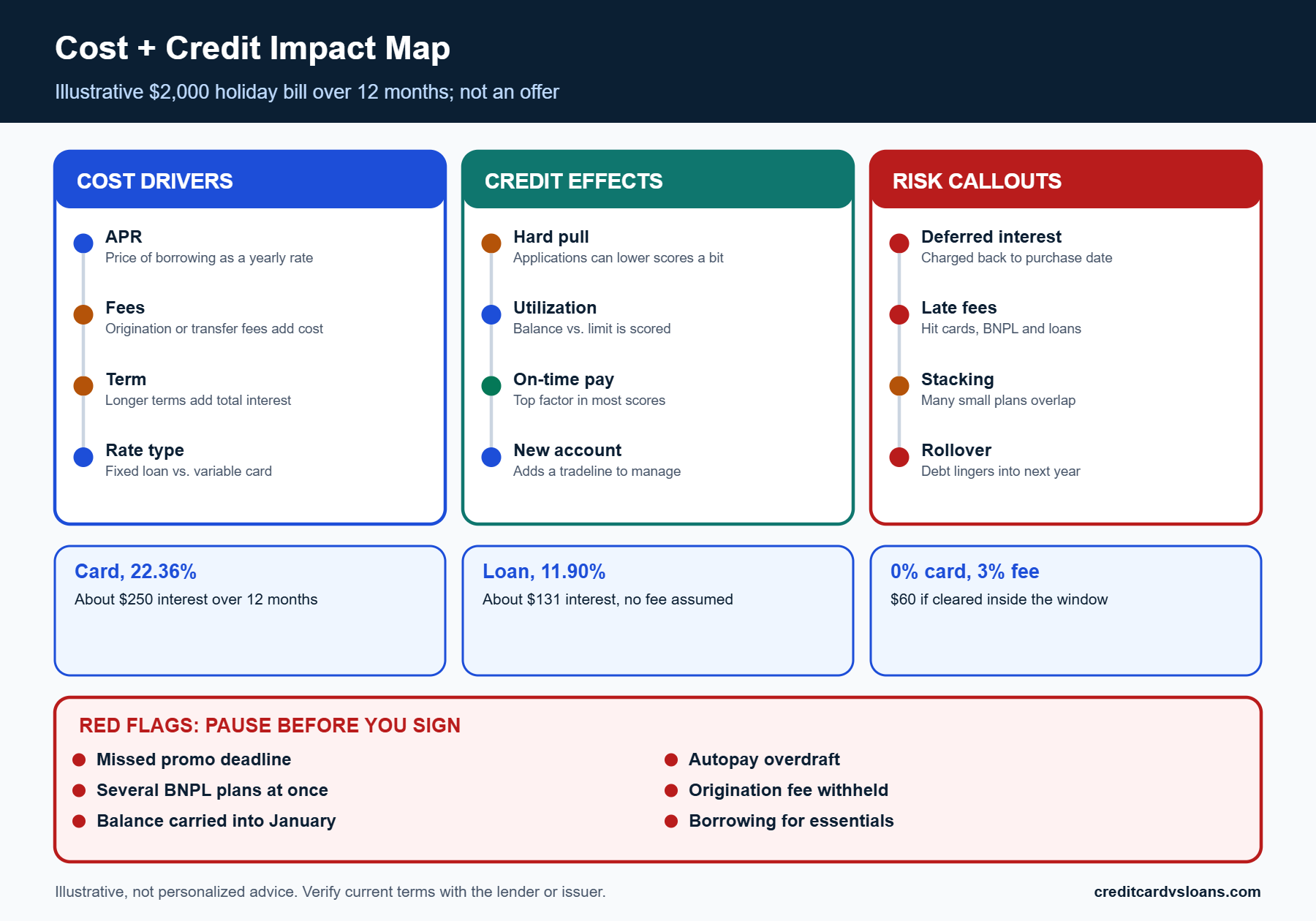
The CFPB explains that with a deferred-interest promotion, if a balance remains at the end of the period, or if your minimum payment is more than 60 days late, interest is charged for each month back to the original purchase date. A true 0% offer does not work that way, which is why the offer’s fine print is the first thing to read.
Look for words like “no interest if paid in full” versus “0% intro APR.” The first phrase often signals deferred interest, and the second usually means interest only begins on what is left after the period ends. If the language is unclear, ask the issuer directly before you buy.
Minimum payments will not finish the job
The CFPB cautions that on a deferred-interest purchase, minimum payments usually will not clear the balance before the period ends. The same logic applies to any promotional balance: the minimum is calculated to keep the account in good standing, not to match your promotion’s deadline.
A workable approach is to divide the purchase by the number of promotional months, subtract one or two months as a buffer, and pay that amount automatically. If a $2,000 holiday purchase sits on a 12-month offer, paying about $200 a month finishes it with a month to spare.
Rolling holiday debt into next year
The January-to-December loop
The most common failure mode is not the first holiday balance, it is the second. A balance left from last year shrinks your room for this year, so you borrow more, and the cycle repeats. The Federal Reserve’s report on household economic well-being in 2025 notes that the share of adults who would cover a $400 expense with cash or its equivalent has stayed at 63% for several years, a reminder that many households run with little slack.
To break the loop, name an end date for this year’s debt before you take it on. If you cannot name one that falls before next October, reduce the spending target until you can.
When the cost of borrowing exceeds the value of the gift
A $100 gift paid for with a card at 22.36% and repaid in twelve equal monthly payments costs roughly $12 more in interest in this simple illustration. That might be acceptable once; across a hundred gifts it becomes a budget line of its own. The real test is whether you would still buy the item if the price tag included the interest.
If the answer is no, choose a lower-cost option, make a gift in kind, or postpone part of the spending to January sales. None of these is a sacrifice of the holiday’s purpose, and each keeps your debt capacity available for a real emergency like the one covered in our vet emergency borrowing guide.
Buy Now, Pay Later and Other Shortcuts
Buy now, pay later in the holiday season
What the CFPB says about fees and credit reporting
The CFPB says buy now, pay later loans generally have fees, though many charge no interest, and that most charge late fees for missed payments. If you set automatic repayment from a debit card or bank account, your bank may charge overdraft or non-sufficient funds fees when the balance cannot cover a payment.
The bureau also notes that if you do not repay, your account may go to a debt collector, and missed or late payments reported to the credit reporting companies could hurt your credit history and scores. Each lender sets its own policies, so the terms on one checkout are not the terms on the next.
The stacking problem
One pay-in-four plan is easy to track. Six of them, across five stores, each with its own due date, are not. The Federal Reserve’s 2025 report found that 16% of adults used buy now, pay later, and 11% of users had a payment trigger an overdraft or non-sufficient funds fee.
If you use BNPL for a holiday purchase, list every plan with its due dates in one place, and avoid adding a plan that would put two or more payments due in the same week. Used for a single purchase you were going to make anyway, it can be a clean tool. Used as a way to buy more than your budget supports, it is a loan in disguise.
Store cards and credit union alternatives
Store cards: the discount versus the rate
Retail store cards often advertise a first-purchase discount. The CFPB has published research on the high cost of retail credit cards, and the practical point for shoppers is simple: a hypothetical 15% discount on a purchase you could not pay off quickly can be lost many times over in interest.
If you do open one, treat the discount as a one-time perk, pay the balance in full by the due date, and do not let the card become a permanent borrowing line. For a broader look at card-based financing, see our guide on paying for back-to-school costs, where the same math applies.
Credit union small-dollar loans
Federal credit unions can offer payday alternative loans, known as PALs. Under National Credit Union Administration rules published in 2019, a PAL II loan can be up to $2,000, with terms of one to twelve months, an interest rate ceiling of about 28%, and an application fee capped at $20. The rules apply to federal credit unions, and a borrower generally needs to be a member to apply.
For a few hundred dollars over a few months, a PAL may cost less than the fees and rates on a high-cost short-term loan, though not every credit union offers one and the terms vary. Ask your credit union directly rather than assuming it does.
Matching an Option to Your Situation
A scenario guide
Three common holiday budgets
The table below turns the framework into a quick lookup. It does not predict what any lender will offer you, and every option listed still depends on your credit, income and the specific terms you receive. Use it to decide which option to investigate first, not which to accept.
| Borrower scenario | Option to investigate first | Why | What to confirm | When to avoid it |
|---|---|---|---|---|
| Under $500, can repay within two months | Existing card or savings | No new application, no interest if paid in full | Whether you have a grace period right now | If you are already carrying a balance on that card |
| $500 to $2,000, can repay in 6 to 12 months | 0% promotional card or low-fee loan | Fixed window or fixed payment | Deferred versus true 0%, fees, post-promo APR | If you are unsure you can finish inside the window |
| A few hundred dollars, thin or damaged credit | Credit union small loan | Rules cap rates and application fees on PALs | Membership, availability, term | If the loan would roll over or be renewed |
| Several single purchases at different stores | BNPL for one, not many | Clear schedule per purchase | Late fees, autopay source, due dates | If plans would overlap or exceed your cushion |
| Over $3,000, repayment beyond a year | Reduce the spending first | Holiday debt this size tends to roll into next year | Whether the purchase is flexible | If the plan relies on a future bonus or refund |
What changes if your credit is limited
Borrowers with limited credit history or recent late payments usually see higher rates, smaller offers or declines on promotional cards and personal loans. In that case, the order of preference shifts toward the no-credit-check options: savings, a smaller budget, and a credit union that looks at more than your score.
If you are considering a loan aimed at borrowers with weaker credit, be extra careful: the costs and risks are different, and the holiday timeline rarely justifies them. Compare at least two or three offers by APR before you commit, as the CFPB recommends.
Red flags that mean borrowing is the wrong tool
The purchase has no end date
If you cannot say when the money will be repaid, you are using debt to pay for ongoing spending, not a one-time event. Holiday spending that depends on the next paycheck, the next refund or the next sale is a sign the budget itself needs adjusting.
A good test is writing the payoff date next to the purchase total on paper. If you hesitate, that is a signal to borrow less or not at all.
You would be paying one debt with another
Borrowing to cover holiday spending while you are behind on rent, utilities or existing minimums puts the basics at risk for the sake of gifts. The expensive part of that choice is not the interest, it is the fees, collections and credit damage that follow a missed payment.
If your essentials are already stretched, the better step is a conversation with your creditors or a nonprofit credit counselor, not a new credit line. The holiday can be smaller. The late fees, once incurred, cannot be smaller.
Travel, Hosting and Other Big-Ticket Holiday Costs
When the bill is larger than gifts
Travel booked months ahead
Airfare and lodging are often the largest single holiday items, and they are usually paid weeks before you travel. That timing helps: if you book on an existing card and then set aside a fixed monthly amount until the statement date, you are effectively self-financing with no interest.
Check the cancellation and refund terms before paying with any financing product. If a flight is canceled and the refund goes to a loan you are still repaying, you have to sort out the timing yourself. Cards often provide more straightforward dispute options than installment products, which is worth confirming in your own cardholder agreement.
Hosting and food costs that creep
Hosting costs rarely arrive as one large charge. Groceries, decorations and extra utilities show up across weeks, which makes them easy to underestimate and hard to match to a financing plan.
Because they are small and frequent, they are best paid from your regular checking account or a dedicated envelope or sub-account. Financing a grocery run for a holiday dinner at a double-digit APR is a sign the overall budget was set too high.
Giving and charitable asks
Gifts to people versus gifts to causes
Year-end giving requests multiply in November and December, and it is easy to commit to more than you planned on a card. Decide the total for charitable giving before you see the requests, and pay for it from the same funds as other discretionary spending.
If you are ever pressed to give or pay immediately, slow down. Real organizations will accept a donation next week, and a request that needs payment in a hurry, by gift card or wire, deserves a second look.
Helping family members financially
Helping a relative cover their holiday costs can feel like a duty, and it can quietly become the biggest line in your budget. Borrowing to give or lend money to someone else adds a layer of risk, because the repayment duty stays with you no matter what happens to the person you helped.
If you do choose to help, treat the amount as a gift you can afford, not a loan you expect to be repaid, and fund it from savings rather than new debt where possible.
Questions to Settle Before You Choose
Questions for the lender or card issuer
Cost and terms
Write the answers down before you accept. What is the APR, and is it fixed or variable? Is there an origination, transfer or annual fee, and is it taken from the amount I receive? If the offer is promotional, is interest waived or deferred, and what is the rate after the period ends?
Ask what happens if you pay early, and whether any prepayment fee applies. The CFPB’s page on personal installment loans lists fees such as origination fees, documentation fees, optional insurance and late fees as common, and recommends checking the loan disclosures and comparing offers from multiple lenders.
Credit reporting and hardship options
Ask whether the lender checks your credit with a soft or hard pull at the prequalification stage, and whether it reports missed payments to the credit bureaus. Also ask what help is available if you lose income, such as a payment date change or a short-term hardship plan.
A lender’s answer is useful even when it is unflattering. If the representative cannot explain the fees in plain terms, that is a reason to choose another option.
Questions for yourself
The honest budget check
Could I pay this entire amount tomorrow if I had to? If not, what would I give up to make the monthly payment? Do I have an emergency cushion that stays untouched while I repay this? Have I counted the payment against my January and February bills, which are often tighter than December?
If the answer to the cushion question is no, consider reducing the holiday total before choosing a product. Debt on top of no cushion is where a cash crunch becomes a credit problem.
The next-year check
Will this purchase still be on my statement when next holiday season starts? If so, I am paying for two holidays at once. Write a payoff date on your calendar and set an automatic payment at least slightly above the minimum.
Then set up next year’s sinking fund now, even if it starts with a tiny amount. A $25 monthly contribution beginning in January produces $300 by December, enough to keep next year’s holiday off your credit card.
Conclusion: Choosing and Next Steps
The decision in a few sentences
Match the tool to the timeline
If you can repay in a month or two, use savings or a card you already have and pay in full. If repayment will take several months, compare a promotional offer and a fixed-rate loan on total cost, fees and the consequences of a missed deadline. If it will take more than a year, cut the budget, because no financing option fixes a holiday you cannot afford.
Across all of them, a lower APR matters less than a shorter repayment period and a clear end date. The cheapest holiday debt is the debt you finish before the next one starts.
Keep the framework, not the product
Rates and offers change, so the durable part of this guide is the questions, not the numbers. Compare APR to APR, read how any promotion ends, and count the full cost, including fees, before you commit.
If you also have a work or business purchase on the list, the freelance equipment guide applies the same comparison to a purchase that may earn income.
Your next-step list
This week
- Write one total for all holiday spending, including travel, hosting and giving.
- Subtract what you can cover from savings and the next two paychecks.
- Check your current card statements for balances, due dates and whether you have a grace period.
- If you still have a gap, prequalify with two or three lenders using soft pulls, and compare the APR, fees and total cost.
Before you borrow
- Write the payoff date next to the total, and confirm the monthly payment fits your January budget.
- Read the promotion terms for deferred interest and the rate after the window.
- Automate the payment so a missed due date does not trigger a late fee or retroactive interest.
- Set a reminder to review the balance monthly until it reaches zero.
- Best Way to Pay for Water Heater Replacement: Compare Borrowing Options Before You Commit
- Best Way to Pay for a College Tuition Gap: Compare Borrowing Options Before You Commit
- Best Way to Pay for Freelance Equipment: Compare Borrowing Options Before You Commit
- Best Way to Pay for Back-to-School Costs: Compare Borrowing Options Before You Commit
- Best Way to Pay for a Veterinary Emergency: Compare Borrowing Options Before You Commit
- Best Way to Pay for a Security Deposit: Compare Borrowing Options Before You Commit
- Federal Reserve: Federal Reserve G.19 Consumer Credit, release of Oct. 7, 2026 (Credit card and 24-month personal loan rates, August 2026 (preliminary))
- Federal Reserve: Economic Well-Being of U.S. Households in 2025 (May 2026)
- CFPB: I got a credit card promising no interest for a purchase if I pay in full within 12 months. How does this work?
- CFPB: What is the difference between a loan interest rate and the APR?
- CFPB: Do personal installment loans have fees?
- CFPB: How do I get and keep a good credit score?
- CFPB: When can a credit card company look at my credit reports?
- CFPB: Do Buy Now, Pay Later (BNPL) loans have fees?
- NCUA / Federal Register: Payday Alternative Loans (final rule)
Last updated: October 22, 2026. Rates, fees and lender rules change; verify current terms before acting.
The information on creditcardvsloans.com is provided for general educational and informational purposes only. It is not financial, legal, tax, credit, accounting or investment advice, and reading it does not create an advisor-client, fiduciary or any other professional relationship. Nothing here is an offer, solicitation or recommendation to borrow, lend or apply for any product.
Credit scores, interest rates, fees, eligibility rules, lender policies and laws change frequently and vary by lender, location and individual circumstances. Examples, figures and scenarios are illustrative only, do not predict your results and do not guarantee approval, savings, a particular rate or a credit-score outcome. Always confirm current terms directly with the lender or issuer and read the full agreement before you apply or sign.
Although we aim for accuracy and use reputable sources, we make no representations or warranties, express or implied, about the completeness, accuracy, reliability or timeliness of the content. Content may be drafted with the assistance of automated tools, so errors or omissions may still occur. Links to third-party sites are provided for convenience; we don’t control and aren’t responsible for their content.
To the fullest extent permitted by law, creditcardvsloans.com and its owners, editors, authors, contributors and affiliates disclaim all liability for any loss, damage or expense arising directly or indirectly from your use of, or reliance on, this content. Before making financial decisions, consult a licensed professional, such as a qualified financial advisor, attorney, tax professional or nonprofit credit counselor, who can consider your complete situation.