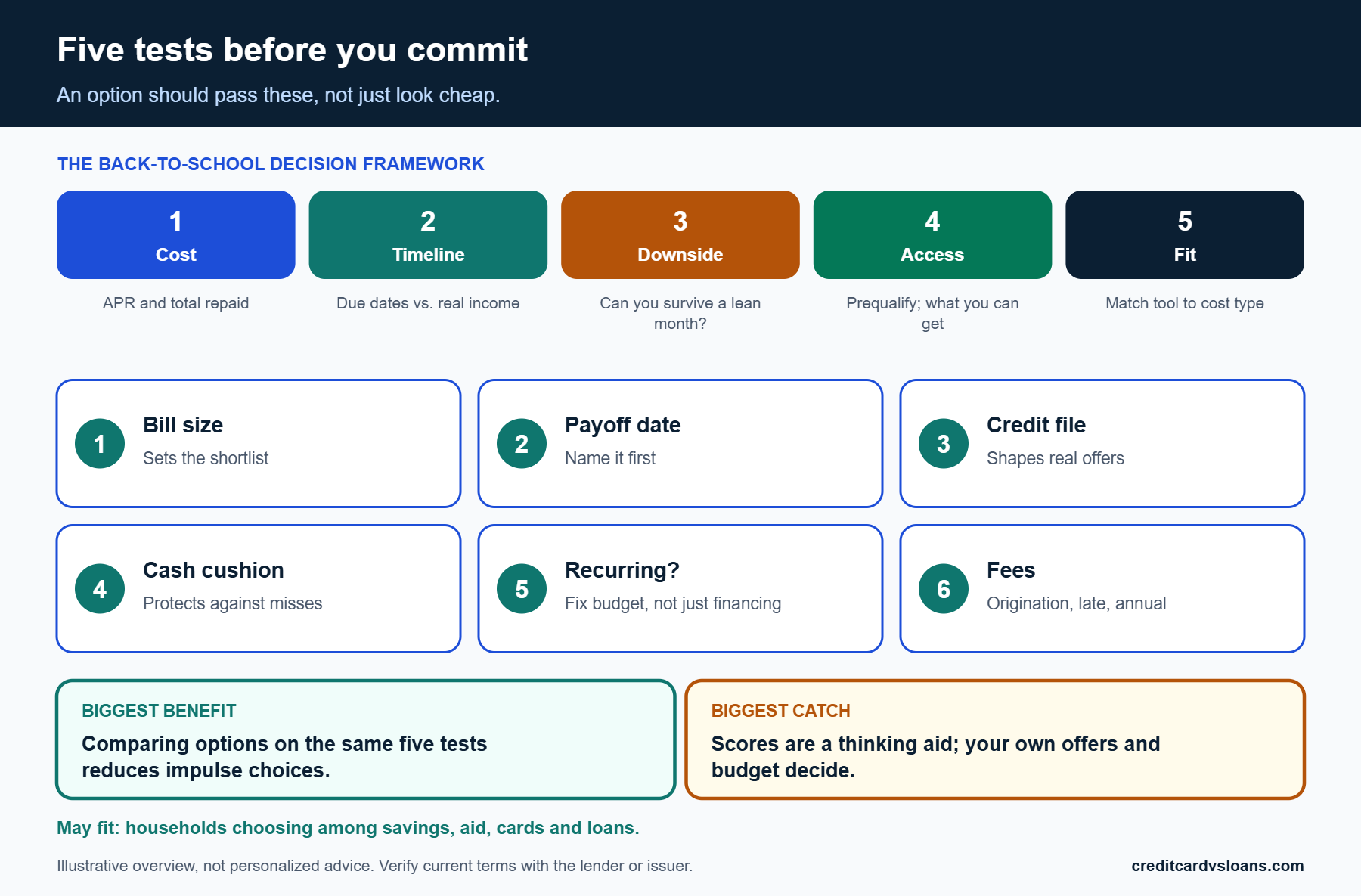
The best way to pay for back to school isn’t one product; it’s the option that passes five tests for your household: cost, timeline, downside protection, access and fit for what you’re buying. This guide gives you those five tests as a decision framework, so you can compare a savings draw, a school payment plan, federal aid, a credit card and a personal loan on the same footing before you commit.
Plenty of articles hand you a ranked list and leave you to hope your situation matches. That rarely works for back-to-school spending, because the bill might be $250 of supplies for one family and $12,000 of tuition and housing for another. A framework travels better than a ranking.
Think of this page as the decision layer. If you want the full step-by-step plan, see how to finance back-to-school costs. If you want the detailed card-versus-loan math, see credit card vs. personal loan for back-to-school expenses. If a promotional offer is in play, see 0% APR vs. personal loan for back-to-school spending.
- Run every option through five tests: cost, timeline, downside protection, access and fit. An option that fails the timeline or downside test is usually wrong even if it’s cheap on paper.
- Money you don’t borrow is the cheapest money. Cutting the bill, delaying purchases and using savings, grants and school plans come before any credit product.
- Federal Reserve data for the second quarter of 2026 show average rates of 22.15% on card accounts assessed interest and 11.86% on 24-month personal loans. Your own offers will vary.
- For college costs, the CFPB points students to federal Direct loans before private loans and advises against using credit cards to pay for college.
- The decision is reversible only until you sign or swipe. Spend one hour comparing offers in writing first.
Averages cited are from the Federal Reserve’s G.19 release (second-quarter 2026 data). Federal loan rates are for loans first disbursed July 1, 2026 through June 30, 2027. All dollar examples are hypothetical.
The Best Way to Pay for Back to School Depends on Three Answers
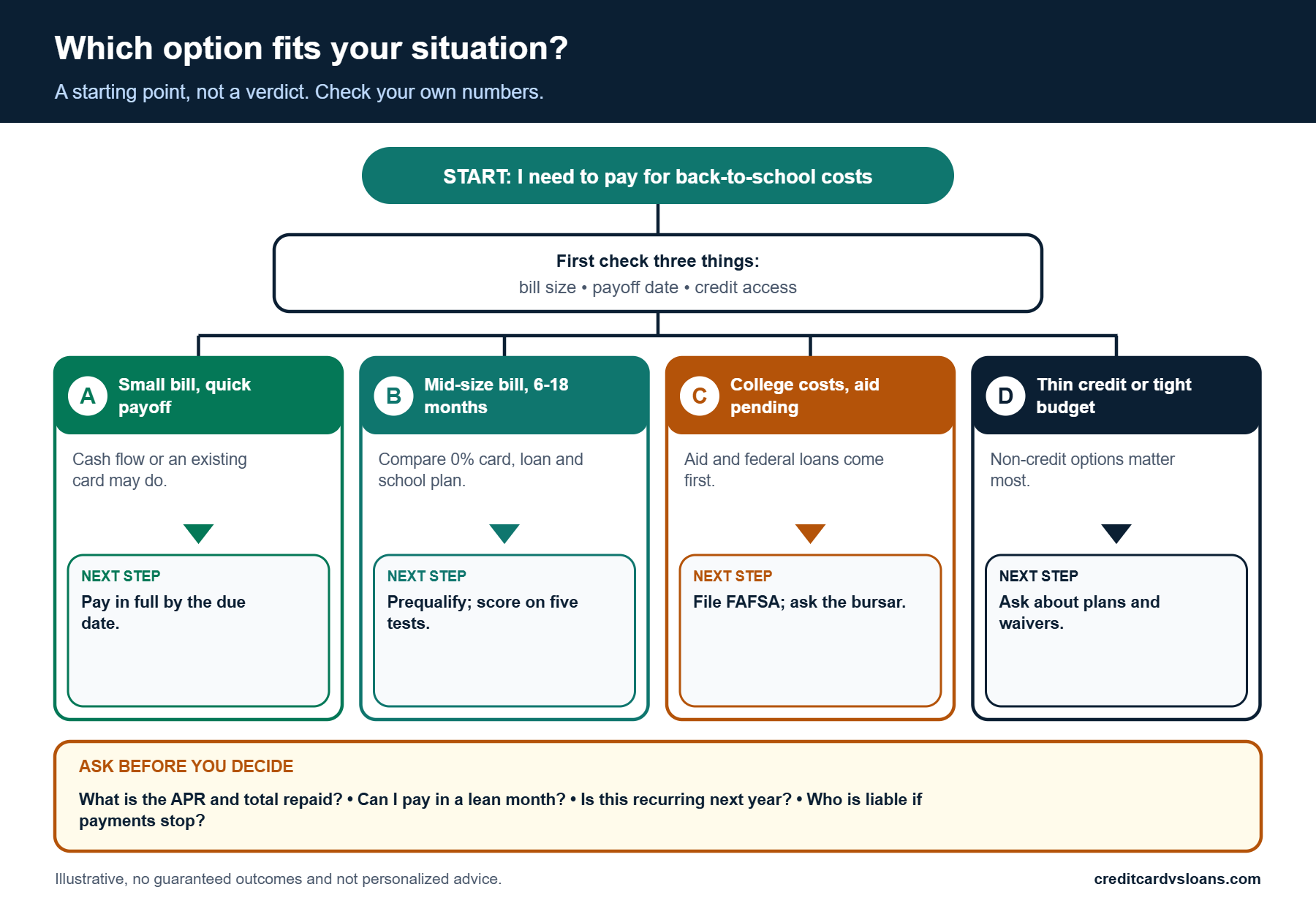
Before you score any option, answer three questions honestly. They determine which parts of the framework matter most.
How Big Is the Bill and How Fast Can You Clear It?
Size sets the shortlist
Under a few hundred dollars, the shortlist is usually cash flow, savings or a card you already have. From a few hundred to a few thousand, a card payoff plan, a school payment plan or a small personal loan enter the picture. Beyond that, especially for college, federal aid and tuition payment plans become the foundation, and a card or personal loan covers only what’s left.
Write the number down, then split it into what’s needed now and what can wait. The now-number is what you need to finance today.
Speed sets the structure
If you can clear the bill in one to three months, structure matters little because interest has little time to accumulate. If it will take a year or more, the structure of the debt, including rate, fees and whether the payment is fixed, becomes the main driver of cost.
Name a realistic payoff date before you look at offers. Everything else in the framework is easier once you know it.
What Does Your Credit and Cash-Flow Position Allow?
Access: what you can actually get
Lenders weigh your credit reports and scores, income and existing debts. The CFPB lists these among the factors that set personal installment loan terms, along with loan amount and length. A strong profile may open lower rates and promotional offers, while a thin credit file may limit you to smaller limits or higher rates. For students building a first file, our guide to student credit cards explains the starting options.
Don’t assume what you’ll be offered. Use prequalification tools, which typically use a soft pull, and compare real numbers.
Cushion: what you can absorb if something goes wrong
Cash-flow cushion is the difference between a plan that bends and one that breaks. A household with two months of expenses saved can absorb a missed shift; a household living paycheck to paycheck cannot. The more fragile your cash flow, the more you should favor options with smaller required payments or hardship flexibility, even if they cost a bit more.
That is not a license to ignore cost. It’s a reminder that the cheapest plan you can’t sustain is the most expensive plan of all.
Test One: What Does the Money Cost?
Cost is the first test but not the only one. Judge it by total dollars repaid and by APR, not by the monthly payment.
Rates, Fees and the Price of Time
Comparing the headline numbers
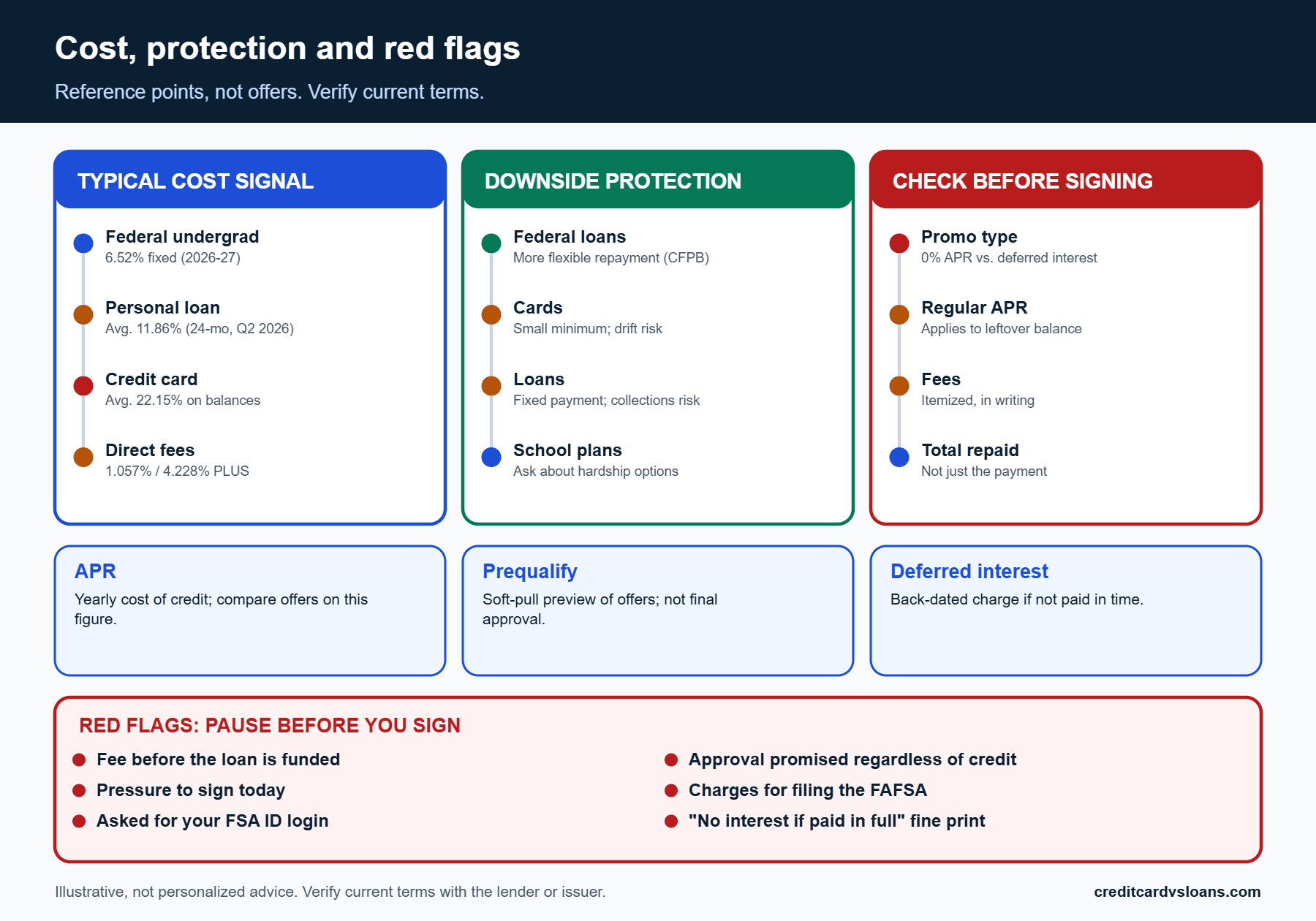
The annual percentage rate is the cost of credit expressed as a yearly rate, and it’s the most useful single yardstick for comparing borrowing offers because it folds in required fees on loans. According to the Federal Reserve’s G.19 release for the second quarter of 2026, the average rate on credit card accounts assessed interest was 22.15%, and the average rate on 24-month personal loans was 11.86%. For Direct undergraduate loans first disbursed July 1, 2026 through June 30, 2027, the fixed rate is 6.52%, and Direct PLUS loans are 9.07%.
These figures are reference points, not offers. They show the shape of the market: federal loans usually cost less per year than market-rate loans, which usually cost less than cards that carry a balance.
The fees hiding behind the rate
For loans first disbursed from October 1, 2026 through September 30, 2027, the Department of Education lists origination fees of 1.057% on Direct Subsidized and Unsubsidized loans and 4.228% on Direct PLUS loans. Personal loans may charge their own origination fees, and cards may charge annual or late fees. A fee turns a low rate into a higher effective cost, particularly on small or short-term loans.
Ask every lender for the APR and an itemized list of fees. If they can’t or won’t provide them, that answers the cost question.
Total Repaid, Not Monthly Payment
A hypothetical $2,000 bill under five structures
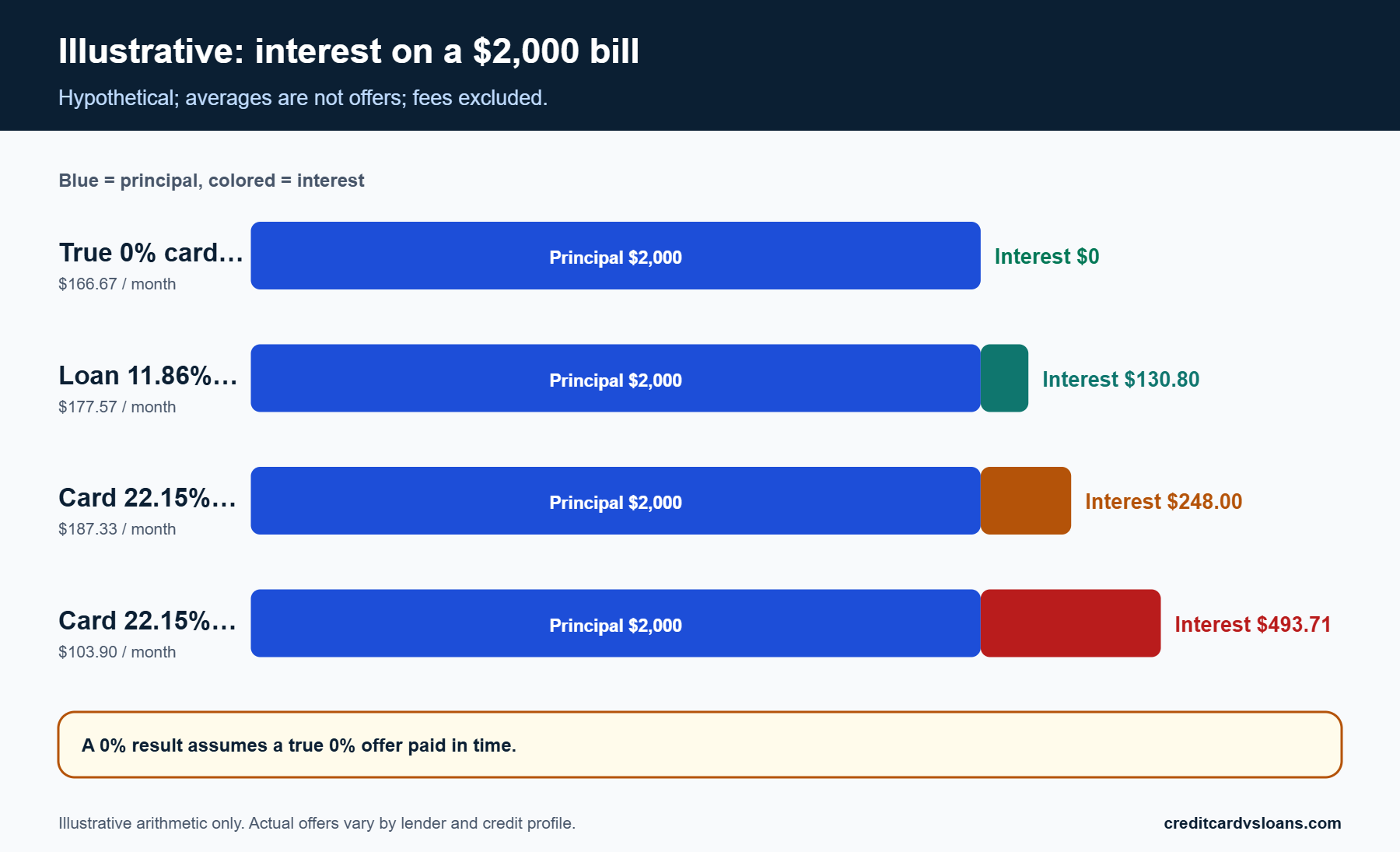
The table below compares a hypothetical $2,000 bill under different structures, using the Federal Reserve averages as stand-ins for market rates. It excludes fees and uses fixed payments with no new spending.
| Structure | Monthly payment | Total interest | What it tells you |
|---|---|---|---|
| Savings or cash flow | Varies | $0 | Cheapest, if your cushion survives |
| True 0% card, paid in 12 months | $166.67 | $0 | Cheapest credit, if you finish in time |
| Personal loan, 11.86%, 12 months | $177.57 | $130.80 | Fixed payoff date |
| Personal loan, 11.86%, 24 months | $94.02 | $256.39 | Lower payment, higher total |
| Card, 22.15%, 12 months | $187.33 | $248.00 | Costs about twice the 12-month loan |
| Card, 22.15%, 24 months | $103.90 | $493.71 | Drift is expensive |
How to use the table
Look at the interest column first, then ask whether the payment column is survivable in your leanest month. The 24-month loan has the smallest payment of the borrowed options, but it costs about twice the interest of the 12-month version.
The table doesn’t say a loan beats a card in every case. A card paid off in three months costs less than either 12-month version. It says that the length of time you hold debt is the most controllable part of its cost.
Test Two: Does the Timeline Work?
A cheap option that ends at the wrong time is a bad option. The timeline test asks when you’ll have the money to pay and when each product expects it.
Matching Debt Length to Income Events
When your money arrives
Map out the dates on which you expect income, aid refunds, tax refunds, gifts or bonuses, and mark which are confirmed and which are hoped-for. Confirmed money can anchor a payoff date; hoped-for money can’t. A card bridge that depends on a refund you haven’t been promised is a gamble.
The IRS describes the American Opportunity Tax Credit as worth up to $2,500 per eligible student and partially refundable, claimed when you file a return. That reduces the net cost, but it doesn’t arrive until you file, so it shouldn’t be the source of your first payment.
When each product expects its money
A card expects a minimum payment within weeks. A personal loan expects its first payment about a month after funding. Federal Direct loans for students generally do not require payment while the student is enrolled, though interest may accrue on unsubsidized loans, and the CFPB suggests considering paying that interest as it accrues. A school payment plan expects installments on the school’s calendar.
Line up those dates against your income. A product with a due date a week before payday is a problem you can avoid by shifting the due date or choosing a different product.
The Seasonal Cluster Problem
Late-summer costs and fall obligations
Back-to-school costs often arrive at the same time as other seasonal bills: summer childcare, vacation costs and heating or cooling. If your finances are tight in August, a payment that starts in September might land in an even tighter month.
Some lenders and issuers allow you to choose a due date, and some loans allow a delayed first payment. Ask, and compare the added interest of any deferral.
Repeating costs next year
Back-to-school costs recur annually. A plan that clears this year’s bill in 18 months overlaps with next year’s bill and leaves you carrying two cycles of debt. If the same costs will return, aim for a payoff before next summer, or reduce the bill so it can be paid from cash flow next year.
For college students, remember that each year brings its own cost of attendance. Keep a running total of what has been borrowed across years, and by whom.
Test Three: What Is Your Downside Protection?
The third test asks what happens when plans fail. Products differ most in how they treat you in a bad month.
Flexibility When Money Gets Tight
Cards, loans and federal loans compared
A card has a small minimum payment, so a lean month is survivable, but a balance that barely shrinks stays expensive. A personal loan has a fixed payment, so a lean month is a problem, but a loan forces progress. The CFPB notes that federal student loans generally offer more flexible repayment and pause options than private loans, and that private loans are usually less flexible.
No product removes risk. The question is which risk you are better prepared to handle: the drift of a flexible balance or the pressure of a fixed payment.
| Option | If you miss a payment | Flexibility in a lean month | Main safeguard |
|---|---|---|---|
| Savings or cash flow | Not applicable | High | Keep an emergency cushion |
| School payment plan | Late fee or enrollment hold possible; ask the school | Varies by school | Ask about hardship options early |
| Federal Direct loan | Delinquency and eventual default can bring garnishment | More flexible repayment and pause options (CFPB) | Contact the servicer early |
| Personal loan | Late fee, collections and credit reporting possible | Fixed payment | Ask about hardship plans before a miss |
| Credit card | Late fee; rate may rise after 60 days past due | Small minimum payment | Autopay at least the minimum |
Federal protections on credit cards
Under 12 CFR 1026.55(b)(4), an issuer may raise an annual percentage rate if it hasn’t received the required minimum payment within 60 days after the due date, and the higher rate must end after six consecutive on-time minimum payments. Under 1026.55(b)(1), a temporary rate period must last at least six months and be disclosed before it begins for the issuer to raise the rate afterward.
Those rules set a floor, not a ceiling on risk. A late fee and credit reporting consequences can apply long before the 60-day mark.
If a Payment Is Missed
What to do before the due date
The CFPB advises contacting your lender right away if you can’t make a payment and asking about deferment, forbearance or a payment plan. It also warns that missed payments can lead lenders to use third-party debt collectors and report missed payments to the three major credit bureaus.
The earlier the call, the more options usually exist. Most lenders prefer a modified plan to a delinquent account.
Refunds, disputes and purchase problems
If a purchase goes wrong, paying by card can offer dispute options that a cash or debit payment may not, but the rules depend on the situation and the timing. The CFPB’s website explains how to dispute card charges. For tuition and fees paid directly to a school, ask about the refund policy and deadlines before paying, and keep records of every payment.
If a school bills you for something you believe is an error, resolve it with the bursar’s office in writing before any late fees accrue.
Test Four: Can You Actually Get It?
An option that looks perfect on paper but isn’t available to you isn’t an option. The access test is about eligibility, not preference.
Credit-Based and Non-Credit-Based Options
Options that don’t depend on your credit score
Savings, school payment plans, scholarships and grants, and federal Direct loans for undergraduate students generally don’t depend on a credit check, according to the CFPB, which notes that federal Direct loans don’t require a credit check or co-signer except for PLUS loans. These are the first places to look if your credit file is thin or damaged.
School payment plans vary: some charge an enrollment fee, some charge nothing, and some have strict deadlines. Ask the bursar for the exact terms in writing.
Options that depend on your credit file
Cards, personal loans, PLUS loans and most private student loans all involve credit decisions. The CFPB notes that most private student loans require a co-signer unless the borrower has solid credit. A co-signer takes legal responsibility for the debt, which should be discussed openly in advance.
If a family member offers to co-sign or lend money informally, put the terms in writing: amount, repayment dates and what happens if payments are missed. Informal loans cause quiet damage to relationships when expectations differ.
Improving Your Odds Without Making Promises
Prequalify rather than guess
Many lenders and issuers offer prequalification that uses a soft pull, which doesn’t affect your credit score. It shows an estimated rate range and sometimes a limit, though it isn’t a final approval. Use it to narrow the field before applying anywhere that will do a hard pull.
When you do apply, cluster your applications over a short window. The CFPB’s student loan guidance suggests comparing offers within about two weeks to limit the credit score impact of multiple applications. Scoring models differ, so treat that as a general principle rather than a rule you can count on.
Check your reports for errors
Before you apply, review your credit reports for errors. Federal law gives you the right to a free report from each nationwide credit bureau through the official site, AnnualCreditReport.com, and errors can be disputed with the bureau. An error that lowers your offers is worth fixing before you shop.
Don’t pay anyone who promises to erase accurate negative information. Accurate information can’t be removed simply because it’s inconvenient.
Test Five: Does It Fit What You’re Buying?
The fifth test matches the financing tool to the kind of cost. A tool that works for tuition may be a poor match for a backpack, and the reverse is also true.
Matching Tools to Cost Types
Recurring small costs and one-time large costs
Recurring small costs, such as supplies, lunch accounts and activity fees, belong in the monthly budget. Financing them on credit is a sign the budget needs adjusting, and it creates a pattern that repeats each year. One-time large costs, such as a laptop, a housing deposit or a tuition bill, are better candidates for financing, because they exceed what a single month can absorb.
The key question is whether the cost will recur. If it will, the real fix is structural: a smaller list, a sinking fund or a different school option.
| Cost type | Often fits | Often a poor fit | Why |
|---|---|---|---|
| Supplies, clothing, small fees | Cash flow; card paid within 1-3 statements | Personal loan; long card balance | Small amounts; fees can outweigh benefits |
| Laptop or device | Savings plus short card plan; store plan if truly 0% | Deferred-interest store offers | Mid-size cost with a clear payoff date |
| Tuition and fees | Aid, school payment plan, federal loans | Credit card balance carried long-term | CFPB advises against cards for college |
| Housing deposit, moving | Savings, short bridge | Open-ended revolving balance | One-time cost; money may be refunded later |
| Gap beyond federal limits | Compare private lenders and co-signer terms | Accepting the first offer | Shop several providers |
College costs and the federal order
For college, the CFPB’s suggested order is Direct Subsidized loans first, then Direct Unsubsidized, then PLUS loans for parents or graduate students, and private loans last. The agency says federal Direct loans are usually the better choice for most students, and that credit cards are usually a much more expensive way to finance education.
That doesn’t make federal loans free. Annual and total borrowing limits apply, defaulting can lead to garnishment of wages, tax refunds or benefits, and borrowing should be limited to what the plan needs. Our guide on financing back-to-school costs shows where federal loans sit in the full ladder.
Special Situations
Parents borrowing for a child
A Direct PLUS loan to a parent is the parent’s debt, requires a credit check and, for the 2026-27 award year, carries a 9.07% fixed rate and a 4.228% origination fee. University financial aid offices report that beginning July 1, 2026, new Parent PLUS borrowing is limited to $20,000 per year and $65,000 per dependent student, with transition rules for existing borrowers. Confirm the limits at studentaid.gov.
Before borrowing, consider whether the student can borrow more in their own name under federal limits, whether grants or a payment plan could replace part of the loan and how a payment would fit alongside retirement saving.
Students building credit
Some students are tempted to charge school costs to a first credit card to build a credit history. A card can help build history if the balance is paid in full each month, but financing a semester on one is expensive and risky. Our guide to student credit cards and building credit without overspending covers how to use a starter card for small, controlled purchases.
Building credit is a side effect of responsible use, not a reason to borrow.
Scoring Your Options: A Worked Example
Here is how to apply the framework to a hypothetical household. It is an illustration of the method, not a recommendation for any particular family.
Setting Up the Scorecard
The five tests as a simple score
Give each option a score from 1 (poor) to 5 (strong) on each of the five tests, then add them up. Weight a test more heavily if it matters most to you, such as downside protection for a fragile budget. The score is a thinking aid, not a formula to follow blindly. If an option scores a 1 on any test that you consider disqualifying, drop it regardless of the total.
Write down your reasons next to each score. Doing so exposes assumptions, such as believing a refund will arrive on time.
A hypothetical household
Imagine a household facing a $2,400 bill: $900 for a laptop and supplies due in August, and $1,500 for a first-semester gap due in September. They have $600 in savings they’re willing to use, steady income, a good credit file and a card with enough room. They want to be debt-free within 12 months.
They would use the $600 from savings, leaving $1,800 to finance over 12 months. Using the Table 1 pattern, a card at 22.15% would cost about $223 in interest on $1,800 over 12 months, while a loan at 11.86% would cost about $118. A true 0% card with a 12-month promotion and a $150 monthly payment would cost nothing if they qualified and paid on time.
| Test | Existing card at 22.15% | 12-month personal loan at 11.86% | True 0% card, 12 months |
|---|---|---|---|
| Cost | 2 | 4 | 5 |
| Timeline fit | 3 | 5 | 5 |
| Downside protection | 4 | 3 | 3 |
| Access | 5 | 4 | 3 |
| Fit for the cost | 4 | 3 | 4 |
| Total | 18 | 19 | 20 |
The scores are close, which is typical. The framework helps you see why: the 0% card is cheapest but harder to get and less forgiving, the loan is predictable, and the existing card is easy but costly if the balance lingers. If the household doubts its ability to finish a 12-month promotion, the loan’s total could be the better pick despite the lower score.
Stress-Testing the Winner
Rerun the scorecard with a bad month
Once you have a leading option, test it against a realistic setback: a reduced paycheck, an unplanned car repair or a surprise school fee. Ask what the required payment would be in that month and what you would give up to make it. If the answer is groceries or rent, the option fails the downside test regardless of its cost score.
Then rerun the scorecard with the bad month in mind. An option that scored a 5 on cost may fall to a 2 on downside protection, and that shift can change the ranking. The point is to discover this on paper rather than in October.
Test the plan against the calendar
Lay the payment dates for every option on a monthly calendar next to your pay dates and other fixed bills. Look for weeks where several obligations stack up, such as rent, insurance and a new loan payment all due within days of each other. A due date that collides with a thin week is a fixable problem if you catch it early, because many lenders and issuers will move a date on request.
Also check what the plan assumes about the first two months, when most plans fail. If the plan needs a refund, a bonus or a relative’s help to work, flag it as a risk and decide what you would do if that money arrived late.
Ask what changes the answer
Write down the two or three facts that, if they changed, would change your decision. For example: if the promotional card offer comes with a limit below $1,800, the loan wins; if the loan carries a 5% origination fee, its cost advantage narrows to a few dollars; if the school offers an interest-free installment plan, neither product is needed.
Hypothetically, a 5% origination fee on a 12-month loan to net $2,000 would push the finance cost from about $131 to about $243, which is close to the cost of the card over the same 12 months. Small facts can reverse a ranking, so confirm them before you decide.
Reviewing the Decision After the First 90 Days
Choosing is half the work. The other half is checking that the plan is doing what you expected and adjusting early when it isn’t.
The 30-60-90 Day Check
What to confirm at 30 days
At 30 days, confirm that the first payment posted correctly, that the balance on the statement matches your records and that no unexpected fees appeared. Check that autopay is pulling the amount you intended and not just the minimum. If you used a card, verify that purchases were charged at the rate you were promised.
Catching a setup error at 30 days costs a phone call. Catching it at 12 months can cost hundreds of dollars.
What to confirm at 60 and 90 days
At 60 and 90 days, compare the remaining balance with your planned payoff schedule. If you’re ahead, consider directing extra money to the balance. If you’re behind, find out why: was the plan too aggressive, or did an unplanned expense interfere? Adjust the payment or the timeline now, not at the deadline.
If your financial aid or income changed, revisit the whole plan. A larger refund or a new job can shorten the payoff; a lost shift can lengthen it, and the sooner you know, the more choices you have.
When to Change Course
Signs the plan needs a reset
Warning signs include making only minimum payments, adding new purchases to the same balance, using one credit line to pay another and avoiding opening statements. Any of these suggests the plan is drifting, and the fix is usually structural: a smaller bill next year, a fixed-term loan to replace a revolving balance or a conversation with a nonprofit credit counselor.
The CFPB advises contacting your lender right away if you can’t make a payment, and asking about deferment, forbearance or a payment plan. Early contact keeps options open.
Using windfalls wisely
If a tax refund, a refunded deposit or a financial aid adjustment arrives, resist the urge to treat it as free money. Compare the interest rate on your highest-cost balance with what the windfall could do elsewhere. Paying down a card balance at an average rate above 20% usually beats leaving the money idle, though an emergency fund is worth topping up first if it is thin.
Ask your lender whether extra payments are applied to principal, and confirm there is no fee for paying early. The answer determines whether an early payoff saves you the interest you expect.
Learning for next year
After the term settles, take twenty minutes to record what you spent, what you financed, what it cost and what surprised you. That record becomes next year’s starting point, with a more accurate bill and a head start on saving for the costs that recur.
Families who repeat this review often find that the second year is cheaper than the first, not because prices fell but because the plan got better.
Red Flags and Common Mistakes
A framework is only as good as the information it’s fed. These are the points where bad information, pressure or habit most often corrupt the decision.
Offers That Should Slow You Down
Promotions that hide the real cost
The CFPB has warned that deferred-interest promotions charge interest retroactively from the purchase date if the full balance isn’t paid on time, and that store cards offering them often carry rates around 25 percent. A banner reading no interest if paid in full deserves a second read. In the CFPB’s own example, a $400 purchase paid at $25 a month left $100 owed on a zero-interest card but $165 on a deferred-interest card.
Ask which type the offer is, what the regular APR is and what happens on the day after the promotion ends. If the answer is unclear, treat the offer as deferred interest.
Fees and pressure before funding
Legitimate lenders disclose rates, fees and terms in writing before you commit. Treat these as red flags: a fee demanded before the loan is funded, a promise of approval regardless of credit, pressure to sign immediately, a request for gift cards or wire transfers, and any refusal to state the APR. Check a lender’s license with your state regulator, and if something feels off, walk away.
The same caution applies to financial aid. The FAFSA is free to file, and your school’s aid office helps at no charge. Anyone charging for either deserves scrutiny.
Never share your FSA ID, online banking login or one-time passcodes with anyone who offers to arrange aid or credit for you. Real lenders and schools don’t need them to give you information about your own options.
Mistakes That Quietly Raise the Cost
Borrowing more than the bill
Lump-sum loans and generous card limits both make it easy to borrow more than you need. Every extra dollar accrues interest for the full term. Borrow the itemized amount, add a small buffer if you must and stop there.
If you receive a financial aid refund larger than your actual costs, consider whether returning part of it to the loan lender is possible. Ask the financial aid office; options depend on the loan type.
Ignoring the second year
A plan that works this year can break next year if costs recur and the old balance remains. Build the second year into the first year’s plan, especially when borrowing federally for college, where annual and total limits apply.
A short written plan, even a half page, that lists this year’s financing, next year’s expected costs and the date by which the old balance will be gone makes the pattern visible.
Your Decision Checklist and Next Steps
You now have the five tests, a worked example and a list of red flags. Here is how to finish the decision.
Reaching a Decision
The short version of the framework
Cost: compare APR and total repaid. Timeline: line up due dates with income you can count on. Downside: choose the option whose failure mode you can handle. Access: use prequalification to learn what you can actually get. Fit: match the tool to the cost type. If one option wins three or more tests and doesn’t fail any disqualifying one, it’s probably your answer.
For deeper dives on specific choices, see credit card vs. personal loan for back-to-school expenses, 0% APR vs. personal loan for back-to-school spending and the general credit card vs. personal loan comparison.
The best way to pay for back to school is the option that passes your cost, timeline, downside, access and fit tests, usually starting with money you don’t have to borrow, then school plans and federal aid, then a card or loan with a firm payoff date. If you can’t explain how and when a balance will be repaid, don’t borrow yet.
When to pause and get help
If the numbers don’t work under any scenario, the answer may not be a better product but a smaller bill, a different timeline or outside help. A school financial aid office, a nonprofit credit counselor or a community assistance program can review your specifics. Asking early costs nothing and often opens options you didn’t know existed.
If you’re already behind on other debts, address those first or at the same time, since adding school debt on top of delinquent accounts compounds the risk.
Your Next Steps
Within a day
- List every back-to-school cost and mark what’s needed now, soon or later.
- Decide how much you can pay from cash flow or savings without draining your cushion.
- Ask the school about payment plans, waivers and aid options.
Within a week
- Prequalify with two or three lenders, or review your current card terms.
- Score each option on the five tests and write down your reasons.
- Pick a payoff date, set a fixed payment and set up autopay.
- Save every disclosure and calendar the dates that matter.
This guide is general education and not individualized financial advice. Your own rates, fees and eligibility will differ, and a nonprofit credit counselor or your school’s financial aid office can review your actual numbers.
- How to Finance Back-to-School Costs: Credit Cards, Loans and Lower-Cost Options
- Credit Card vs. Personal Loan for Back-to-School Spending: Which Is Better?
- Student Credit Cards: How to Build Credit Without Overspending
- 0% APR Credit Card vs. Personal Loan for Back-to-School Spending: Which Wins?
- Credit Card vs. Personal Loan: Which Is Better for Borrowing?
- CFPB: Choosing a loan that’s right for you (Order of borrowing; credit cards for college)
- CFPB: What student loan option is best for me: federal or private?
- CFPB: What is a personal installment loan?
- CFPB: How to understand special promotional financing offers on credit cards
- CFPB: CFPB encourages retail credit card companies to consider more transparent promotions
- eCFR: 12 CFR 1026.55 Limitations on increasing annual percentage rates, fees, and charges
- Federal Reserve: Federal Reserve G.19 Consumer Credit release (Q2 2026 interest rates)
- U.S. Department of Education: Interest rates for Federal Direct Loans first disbursed July 1, 2026 to June 30, 2027 (GENERAL-26-33)
- U.S. Department of Education: FY27 sequester-required changes to the Title IV programs (GENERAL-26-28) (Direct Loan origination fees)
- IRS: Education credits: AOTC and LLC
Last updated: October 22, 2026. Rates, fees and lender rules change; verify current terms before acting.
The information on creditcardvsloans.com is provided for general educational and informational purposes only. It is not financial, legal, tax, credit, accounting or investment advice, and reading it does not create an advisor-client, fiduciary or any other professional relationship. Nothing here is an offer, solicitation or recommendation to borrow, lend or apply for any product.
Credit scores, interest rates, fees, eligibility rules, lender policies and laws change frequently and vary by lender, location and individual circumstances. Examples, figures and scenarios are illustrative only, do not predict your results and do not guarantee approval, savings, a particular rate or a credit-score outcome. Always confirm current terms directly with the lender or issuer and read the full agreement before you apply or sign.
Although we aim for accuracy and use reputable sources, we make no representations or warranties, express or implied, about the completeness, accuracy, reliability or timeliness of the content. Content may be drafted with the assistance of automated tools, so errors or omissions may still occur. Links to third-party sites are provided for convenience; we don’t control and aren’t responsible for their content.
To the fullest extent permitted by law, creditcardvsloans.com and its owners, editors, authors, contributors and affiliates disclaim all liability for any loss, damage or expense arising directly or indirectly from your use of, or reliance on, this content. Before making financial decisions, consult a licensed professional, such as a qualified financial advisor, attorney, tax professional or nonprofit credit counselor, who can consider your complete situation.