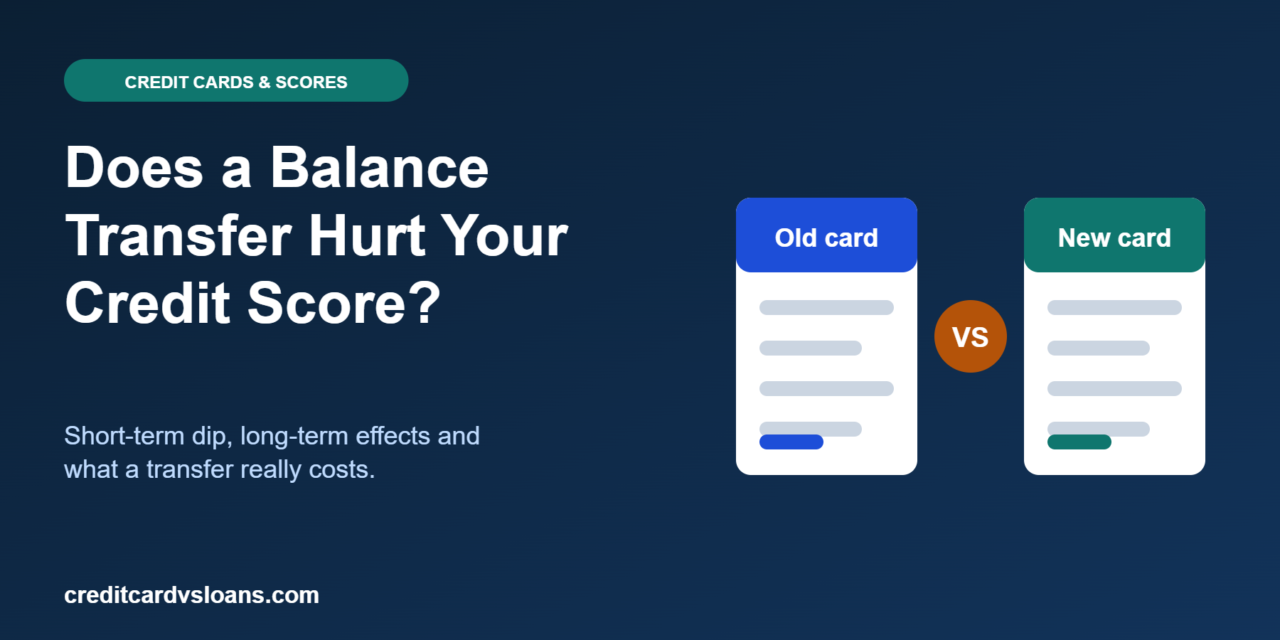
Does a balance transfer hurt your credit? Often a little at first and sometimes not at all, and over the long run it can help if the move lets you pay down debt and you keep every payment on time. A balance transfer usually involves a hard inquiry and a new account, which can cause a small, short-lived dip. Whether the longer-term picture improves depends on what you do with the new card and the old ones.
The honest answer is that a balance transfer is a tool, and the credit effect depends on how it is used. Moving debt to a card with a high enough limit may lower your utilization. Moving it to a card with a limit that is too small can raise it. Paying off the transferred balance can strengthen your file. Running up the cards you just emptied can undo the benefit and then some.
This guide is about the question in the title: what happens to your credit in the short term and the long term, and what can turn a neutral or helpful move into a harmful one. If you want the mechanics of the score itself, including which factors move and what score issuers look for, see our companion guide on the credit score needed for a balance transfer card. This article is general education, not a prediction of your score.
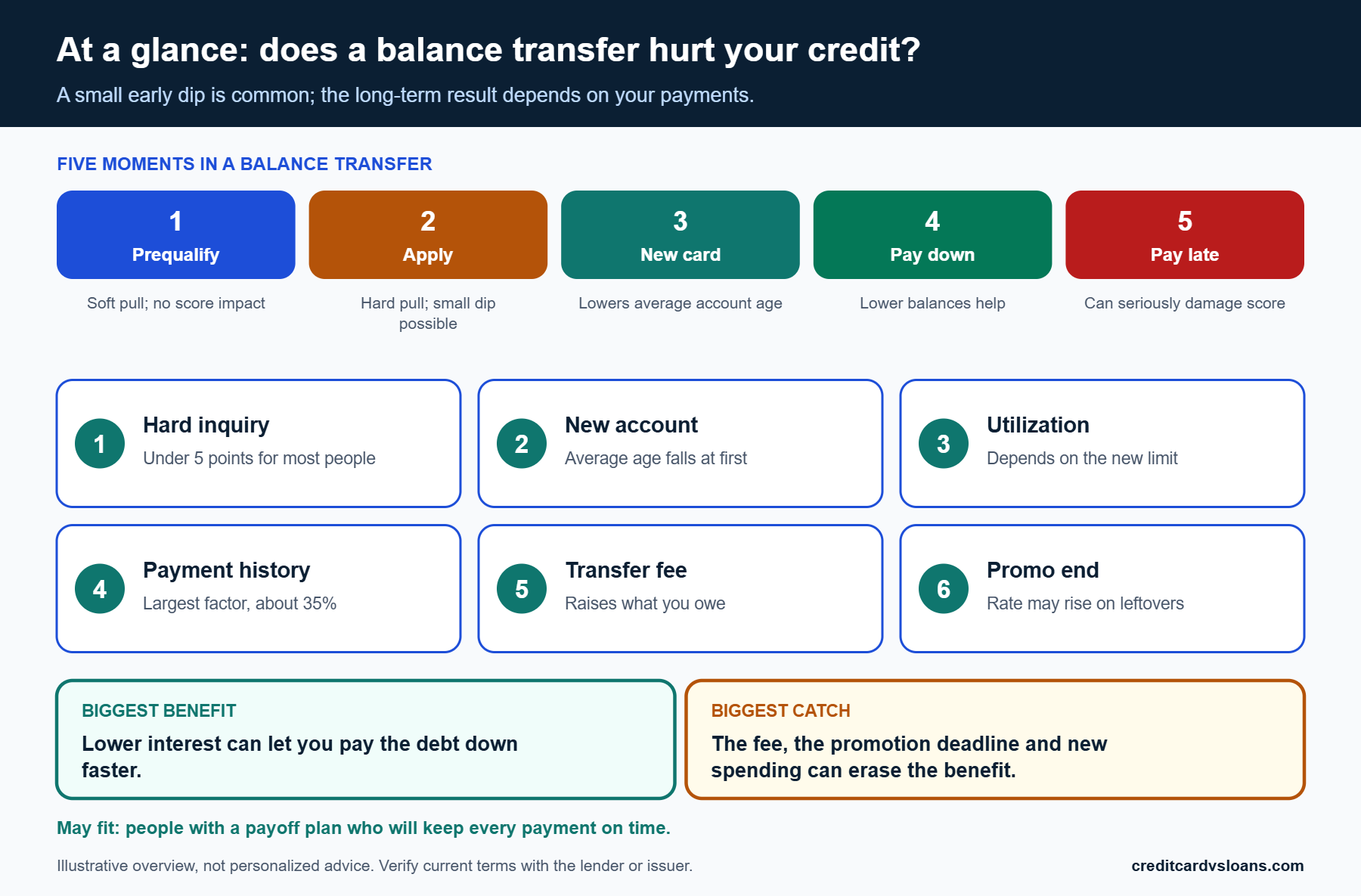
- Short term: the application usually adds a hard inquiry, which FICO says costs fewer than five points for most people, and a new account that lowers your average account age.
- Long term: paying the transferred balance down on time can help, and a lower rate can make that easier. Missing payments can do serious damage.
- The fee does not directly affect your FICO Score, but it raises the balance you must repay.
- Promotional rates last for a limited time, and the rate on what remains can jump when the offer ends.
- Being more than 60 days late can let an issuer raise your rate on all balances, including the transferred one, per the CFPB.
Rate figures come from the Federal Reserve’s G.19 release of October 7, 2026. Credit scoring details come from FICO and CFPB pages reviewed in October 2026. Offers, fees and promotional periods vary by issuer and change often, so read the current terms before you apply.
The short answer: short-term dip, long-term outcome depends on you
What usually happens in the first weeks
A hard inquiry and a new account
To open a balance transfer card, you generally submit a full credit card application, which usually triggers a hard inquiry. FICO says one additional hard inquiry will decrease your FICO Scores by fewer than five points for most people. The inquiry counts in the score for 12 months and can stay on your report for up to two years.
The card also appears as a new account. That lowers your average age of accounts, which is part of length of credit history, about 15% of a FICO Score. FICO’s guidance says the effect usually isn’t huge and the average rises again over time, though opening several accounts in quick succession can hurt more. Our guide to applying for a credit card and your credit covers these effects in more detail.
Utilization can move either way
When you move a balance, your overall utilization may not change at all if the new limit simply adds credit and the old balance moves over, but the per-card ratio can change a lot. FICO’s own example: a $4,000 balance transferred to a card with a $5,000 limit is 80% utilization on that card, which could hurt, while the same balance on a $10,000 limit is 40%, which could help.
The catch is that you typically don’t learn your limit until you are approved. That uncertainty is the main reason a balance transfer can have a different short-term effect from the one you expected.
What tends to matter over months and years
Payment history is the heavyweight
FICO says payment history is about 35% of a typical score, the largest single factor. Every on-time payment on the new card and on your other accounts adds to a positive record, while a late payment that gets reported can outweigh everything else discussed here. The CFPB also warns that being more than 60 days late can let an issuer raise your interest rate on all balances, including a transferred one.
That makes autopay for at least the minimum a sensible habit. It is the simplest way to protect the factor that matters most.
Whether the debt actually goes down
The point of a balance transfer is usually to pay less interest so more of each payment goes to the balance. If it works, your balances fall, your utilization improves and your debt load shrinks, all of which tend to be viewed favorably. If the balance sits unchanged until the promotional period ends, you may have paid a fee for little benefit.
A rule of thumb: judge a balance transfer by whether you can realistically pay off most or all of the balance before the promotional rate ends, not by the credit score effect alone.
A balance transfer tends to work best for people who can pay on time every month, have a clear payoff plan and won’t use the emptied cards for new debt. If that sounds like you, the credit effect is often a small price for the interest savings.
The short-term credit effects, step by step
From application to first statement
Prequalify first, then apply once
Many issuers offer prequalification tools that use a soft pull, which FICO says does not impact your score. A prequalification result is not an approval, but it can help you avoid hard inquiries for offers you are unlikely to get. Keep in mind that FICO’s rate-shopping treatment covers mortgage, auto and student loan inquiries, so assume each card application counts separately.
The safest approach is to narrow the list with soft pulls, compare terms apples-to-apples and submit a single full application for the offer that best fits.
The transfer itself does not add a second inquiry
Once the card is approved, requesting the transfer is typically a servicing request, not a new application. The inquiry happened when you applied. Some issuers let you request transfers at the time of application, others after approval, and processing can take days or weeks. Keep paying at least the minimum on the old card until you see the transfer post.
A missed payment on the old card during processing can lead to a late fee and a late-payment mark, so it is worth confirming the balance before you stop paying.
The first statement cycles
The new card’s balance and its own ratio
After the transfer posts, your new card carries the moved balance. If the issuer reports that balance at your statement date, the per-card ratio on the new card reflects it. In FICO’s example, $4,000 on a $6,000 limit is roughly 67%. That is high on that card even though the old card now shows zero.
Overall utilization is the other number. If your old card had a $5,000 limit and a $4,000 balance, and the new card has a $6,000 limit, total limits are $11,000 and the overall ratio is about 36% (the same $4,000 over $11,000), compared with 80% before. The overall figure improves while one card looks heavy.
The old card: keep it open or not?
After the transfer, the old card will show a zero balance. Closing it removes its limit from your total and can raise your overall ratio, as the CFPB notes in its guidance on closing cards. In the example above, closing the $5,000 card would leave $4,000 over $6,000, or about 67% overall. Our guide to closing a credit card and your credit score explains when closing makes sense.
The bigger risk is behavioral. A freshly emptied card is tempting, and charging it up again can leave you with debt on both cards. If that is a concern, keep the card but remove it from your wallet and digital wallets, and consider a small recurring charge on autopay.
| Credit factor | Short term (first months) | Longer term | Direction |
|---|---|---|---|
| Hard inquiry (part of new credit, 10%) | Fewer than five points for most people, per FICO | Counts in score for 12 months, stays on report up to 2 years | Small, fades |
| New account (length of history, 15%) | Lowers average account age | Average recovers as the account ages | Small, fades |
| Utilization (amounts owed, 30%) | Depends on the new limit; per-card ratio can be high | Falls as the balance is paid down | Either way at first |
| Payment history (35%) | No change unless you miss a payment | On-time payments build a positive record | Helpful if on time |
| Transfer fee | Raises the balance you owe | Not described by FICO as a score factor | Cost, not a direct score factor |
The long-term picture: how a balance transfer can help or hurt
Ways it can help your credit
Lower interest means faster paydown
A promotional rate lowers the cost of carrying the balance, so a larger share of each payment reduces what you owe. As your balance falls, so does your utilization. Over a few billing cycles, that can make your file look less stretched, provided you don’t add new debt elsewhere.
The CFPB says promotional rates are often zero or low but last for a limited time. That clock is the opportunity: the borrower who has a payoff plan sized to the promotional period gets the most from it.
One manageable payment, one clear plan
For some people, moving several balances onto one card simplifies the picture. One due date and one balance are easier to track, and fewer mistakes mean fewer missed payments. A simpler setup does not shrink the debt, but it can make good habits easier.
If you are moving several balances, check that the new limit is big enough to take them. Issuers may approve a transfer of less than you asked, leaving a balance behind on the old card. The leftover balance still carries its old rate.
Ways it can hurt
Refilling the old cards
The most common way a balance transfer backfires is also the simplest. The old card shows a zero balance, the household budget hasn’t changed and the card gets used again. Now there are two balances: the transferred one and the new one. Utilization rises and the debt grows.
The CFPB makes a similar point about consolidation loans generally: it won’t help if spending still exceeds income. Finding out why the debt built up is part of the plan.
Late payments and the end of the promotion
Being more than 60 days late can let an issuer raise your rate on all balances, including the transferred one, according to the CFPB. A missed payment that is reported as 30 days late can also damage your score. And when the promotional period ends, the rate on any remaining balance may rise, increasing your payment.
The CFPB adds that new purchases on the same card may not get a grace period, so they can accrue interest until the full balance, including the transferred amount, is paid. Using the new card for everyday spending during the promotion is therefore a risk.
If you are transferring a balance to buy time because you can’t pay the minimums, the balance transfer is probably not the right fix. Contact your issuer about hardship options or speak with a nonprofit credit counselor first.
What a balance transfer costs: fees, promotional APRs and break-even
Fees and the math of savings
The balance transfer fee
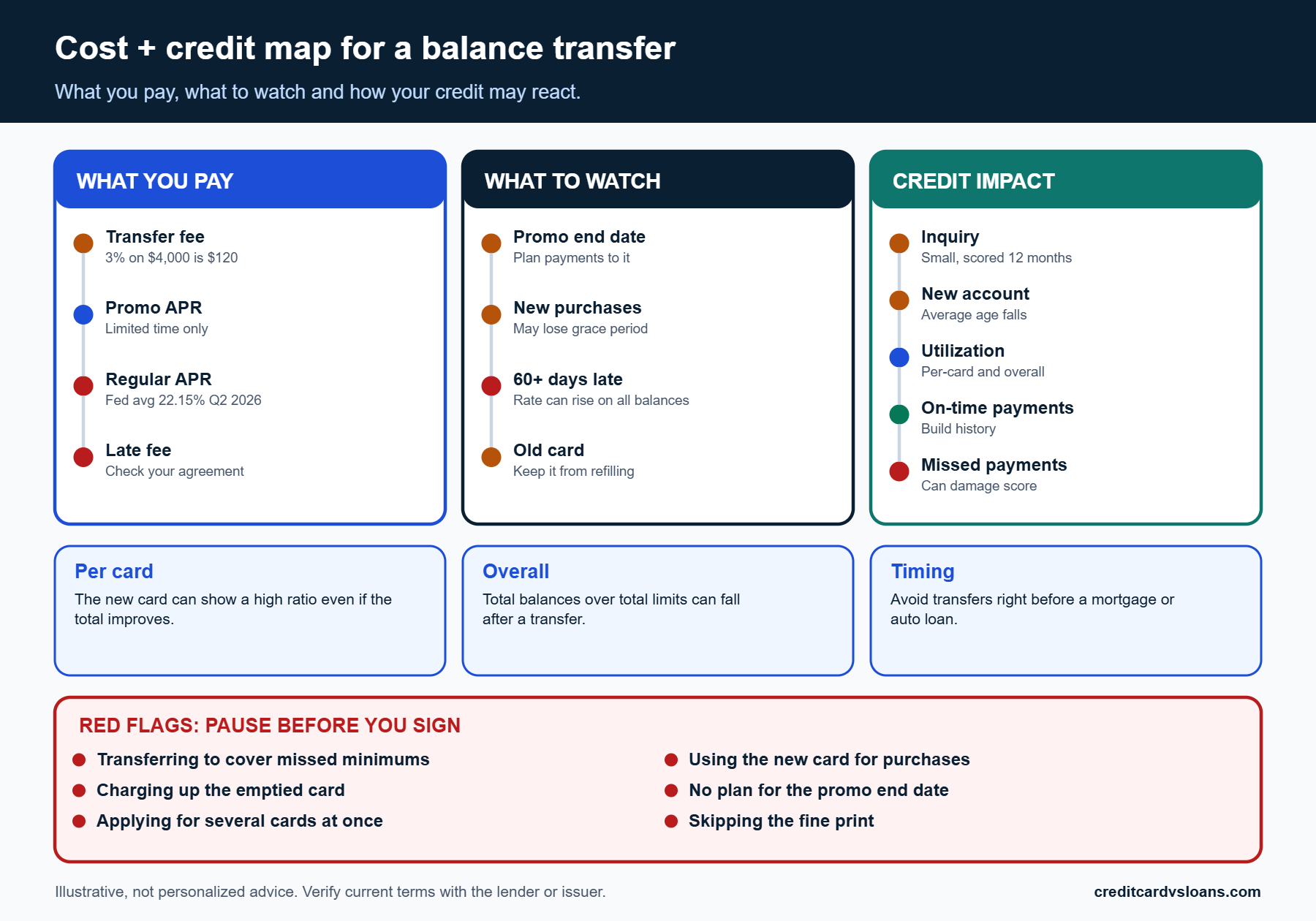
The CFPB says a balance transfer fee is a fee charged to transfer an outstanding balance to a different credit card, and that card companies are permitted to charge one even on a zero percent offer. Its debt consolidation guidance says to expect a fee that is usually a percentage of the amount transferred or a fixed amount, whichever is higher. Fees differ by issuer and offer, so read the terms.
FICO’s example uses a 3% fee, which turns a $4,000 transfer into a $4,120 balance to repay. That is the number to plan around. The fee is a cost you pay upfront in exchange for a lower rate.
A hypothetical break-even example
The Federal Reserve’s G.19 release of October 7, 2026 reported 22.15% as the average interest rate on credit card plans for accounts assessed interest in the second quarter of 2026. Suppose your existing card charges that rate on a $4,000 balance and you pay it off with equal monthly payments over 12 months. The payment is about $374.67, and total interest is about $496.
Now suppose you transfer the $4,000 to a card with a 0% promotional rate for 12 months and a 3% fee ($120). To clear $4,120 in 12 months, you would pay about $343.33 per month. The fee is $120, so the hypothetical saving is roughly $376 versus staying put. At a 5% fee ($200, or $350 per month), the saving is about $296. These figures are illustrations, not offers.
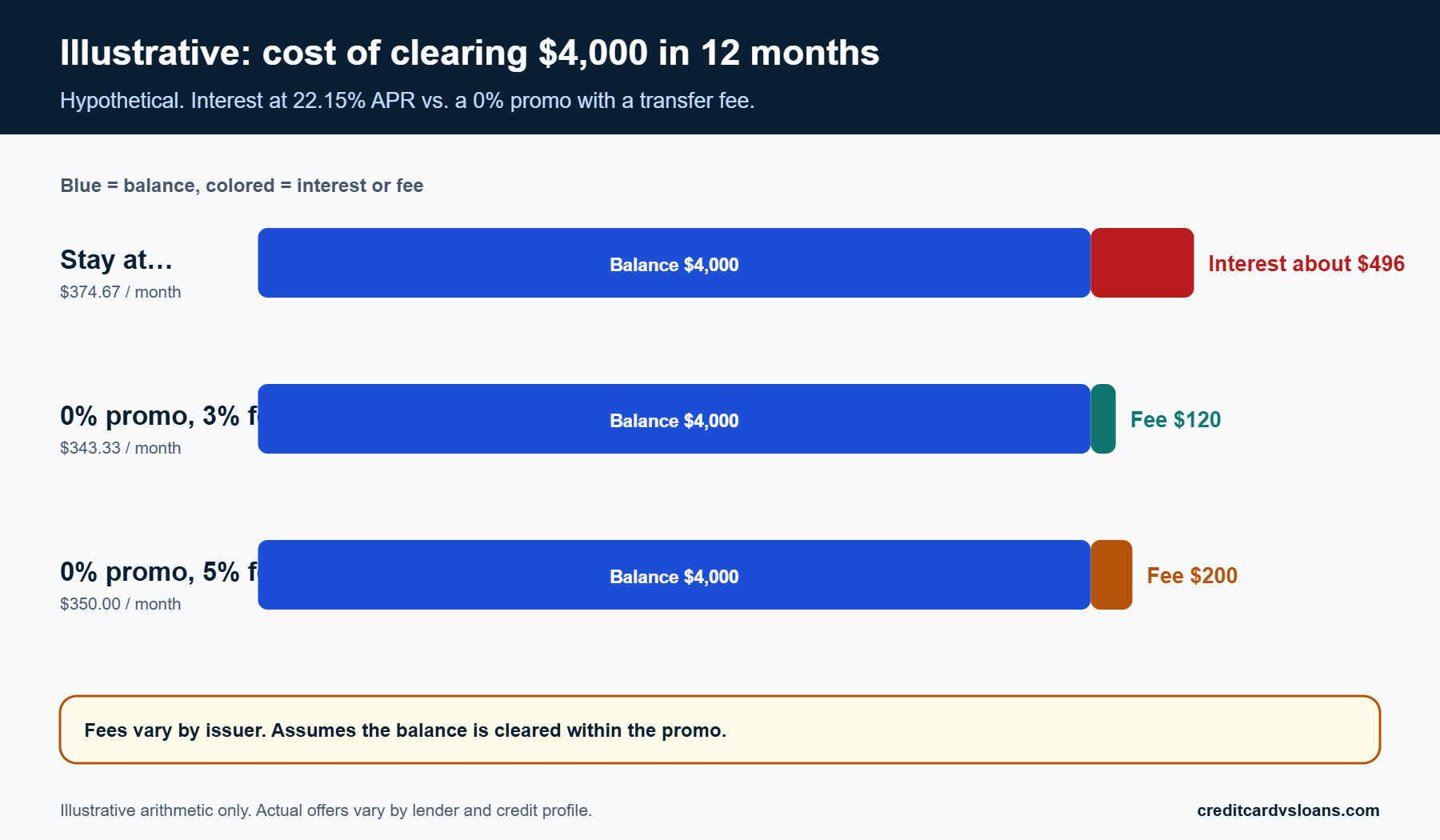
| Option | Monthly payment | Interest or fee | Total cost vs. $4,000 |
|---|---|---|---|
| Stay on a 22.15% APR card | $374.67 | About $496 interest | About $496 |
| Transfer: 0% for 12 months, 3% fee | $343.33 | $120 fee | $120 |
| Transfer: 0% for 12 months, 5% fee | $350.00 | $200 fee | $200 |
When the promotion ends
What happens to leftover balances
The savings above assume you clear the balance before the promotion ends. If you don’t, the rest is charged the card’s regular rate going forward. Suppose you instead paid $200 per month for 12 months on the $4,120 balance, leaving $1,720. At 22.15% over another 12 months with equal payments, that remainder would cost about $213 in interest, on top of the $120 fee.
The result is still lower than staying put in this example, but the margin shrinks, and it disappears if the regular rate is higher or the promotional period is shorter. Test the offer against your actual payment ability.
Fine print that changes the math
Read the terms for the length of the promotional period, whether the period starts at account opening or at the transfer date, the post-promotion rate, and whether new purchases get a grace period. The CFPB notes that the promotional rate for most balance transfers lasts for a limited time and that your rate may rise afterward.
Also check whether deferred-interest terms apply. Those are different from a true 0% rate: interest can be charged retroactively if the balance isn’t cleared in time. For true balance transfer offers this is less common, but confirm it in writing.
Timing: when a balance transfer is most likely to cost you
Before a major application
Mortgage, auto loan or rental
The short-term effects of a balance transfer, a recent inquiry, a new account and a per-card ratio that may be high, are small, but they come at a moment when lenders look closely at your file. If you plan to apply for a mortgage or an auto loan in the next few months, ask the lender whether they’d prefer you wait. A few points can matter at a pricing threshold, though most people are not near one.
If you can wait, the best sequence is usually to finish the major application first, then do the balance transfer. If you can’t wait because the interest is hurting you, the savings may outweigh a small, temporary dip. That is a trade-off to make with the numbers in front of you.
When your score may not qualify you at all
Balance transfer offers with the best promotional terms generally go to applicants with good credit, and the CFPB notes that if debt problems have hurt your credit score, you probably won’t qualify for low rates on a balance transfer or consolidation loan. The specifics, including which score tier issuers look for, are covered in our guide to the score needed for a balance transfer card.
If you apply and are denied, the denial still leaves a hard inquiry on your report. That is why prequalification matters so much here: it can show your odds with a soft pull.
Protecting your credit during and after the move
Make the first payment easy
Set up autopay for at least the minimum payment on the new card, and mark the due date on your calendar. Keep making payments on the old card until the transfer posts. A missed payment during the changeover is the most avoidable way to hurt your credit in this process.
After the transfer posts, plan to pay more than the minimum. The minimum is set by the issuer and may be far below what is needed to clear the balance before the promotional rate ends.
Keep an eye on both balances
For the first few months, check both cards each month. Verify the transfer amount, the fee, the promotional end date and the balance. Pull your free credit reports at AnnualCreditReport.com, where the FTC says you can check each bureau’s report weekly, and confirm the new account and the old one appear correctly.
If you see a mistake, such as a balance that still shows on the old card after the transfer posted, dispute it with both the bureau and the issuer.
| Risk | Why it matters | What to do |
|---|---|---|
| High per-card utilization on the new card | One card near its limit can look risky | Pay down quickly; ask about the limit before transferring |
| Missed or late payment | Largest score factor; 60+ days late can raise the rate on all balances | Autopay the minimum; pay more than the minimum |
| New purchases on the transfer card | May lose the grace period and accrue interest | Use another method for purchases |
| Refilling the old card | Doubles the debt | Remove the card from digital wallets; set alerts |
| Promotional period ends with a balance | Regular rate applies to the rest | Divide the balance by the number of months; pay that amount |
A worked example with your own numbers
Map the limits before you move anything
Here is a hypothetical household. Card X has a $5,000 limit and a $3,000 balance, which is 60%. Card Y has a $3,000 limit and a $1,000 balance, which is about 33%. Together, that is $4,000 owed against $8,000 in limits, or 50% overall. Now suppose the household moves Card X’s $3,000 to a new card with a 3% fee, so the new balance is $3,090.
If the new card’s limit is $6,000, it sits at 51.5%, Card X drops to 0%, Card Y stays near 33% and the overall ratio becomes $4,090 over $14,000, about 29.2%. If the new limit is only $3,500, the new card is at about 88.3% and the overall ratio is $4,090 over $11,500, about 35.6%. The overall figure improves in both cases, but the per-card ratio on the new card can look uncomfortable.
Turn the promotional period into a monthly number
The second step is to divide the new balance by the number of promotional months. For $3,090 over 12 months, that is $257.50 per month. Over 15 months, it is $206 per month. If either figure would strain your budget, the plan needs adjusting before you apply, not after, because the minimum payment the issuer sets may be much lower than your target.
It helps to write the payoff date on a calendar and set a recurring transfer from your bank account for the target amount. That removes the need to remember each month, and it makes a missed target visible early. The numbers here are illustrations, not offers, and real fees, limits and promotional lengths vary.
Alternatives and when a balance transfer is the wrong tool
Other ways to restructure card debt
A personal or consolidation loan
A fixed-rate loan has a set payment and payoff date, which some people prefer to a promotional card with a ticking clock. It also adds a hard inquiry and a new installment account, and it may carry an origination fee. Our guide to a 0% APR card versus a personal loan compares the costs, and our debt consolidation loan score guide covers what lenders look for.
The CFPB warns that a lower monthly payment from a longer term can cost more overall once fees and interest are counted. Compare total cost, not just the payment, on an apples-to-apples basis.
Working with creditors or a counselor
The CFPB suggests asking your creditors for lower payments, waived fees, a lower rate or a due date that fits your pay schedule. Many issuers have hardship programs. A nonprofit credit counselor can also review your budget and discuss options, including debt management plans.
Be careful with companies that advertise consolidation but operate as debt settlement firms. The CFPB says some charge upfront fees and tell you to stop paying creditors, which it describes as risky.
When to skip the transfer
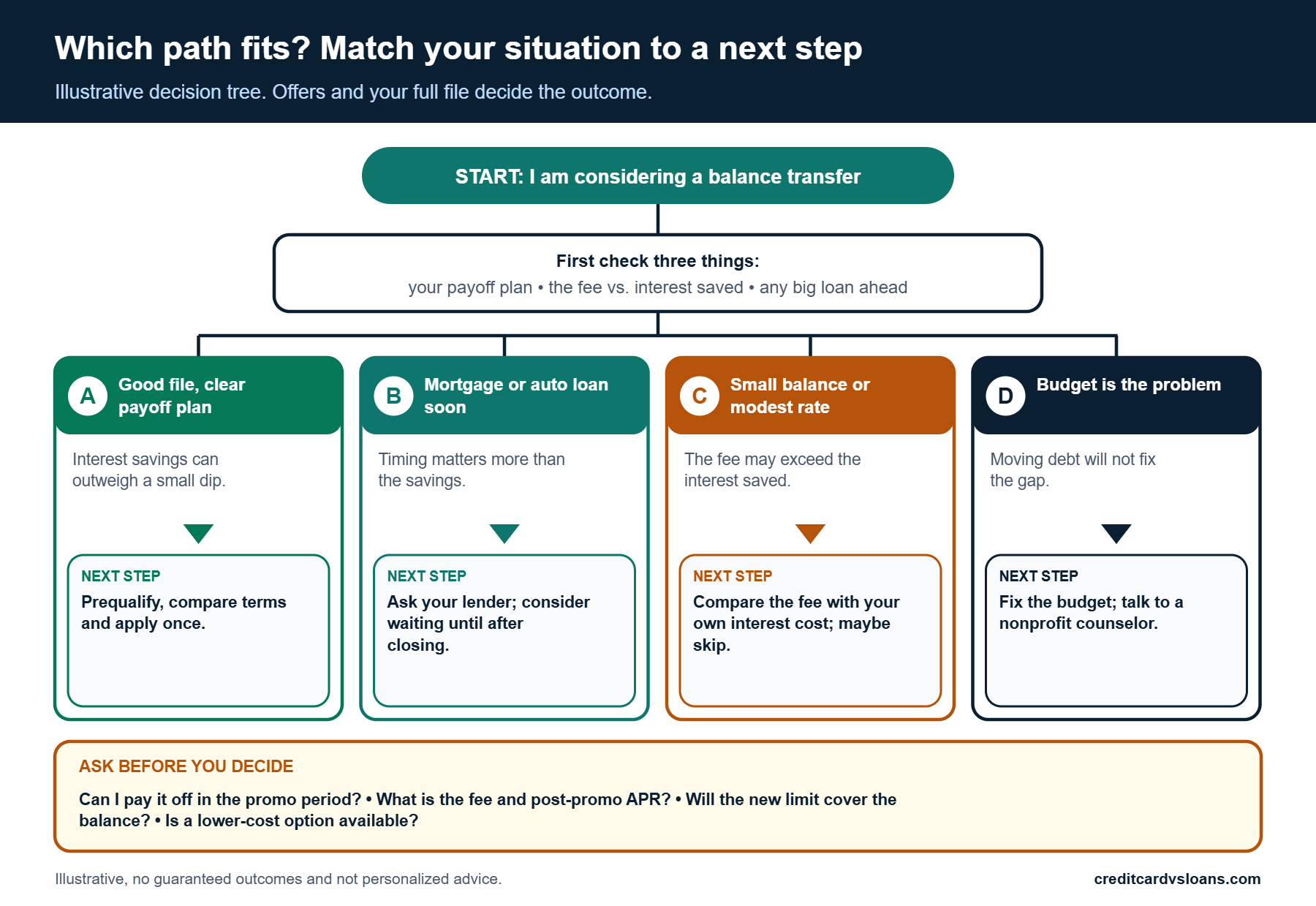
The budget is the problem
If your spending regularly exceeds your income, moving the balance changes where the debt sits, not why it exists. A transfer may buy time, but without a budget fix it tends to repeat. The CFPB’s advice to find out why the debt built up applies directly.
In that case, start with the budget. Track a month of spending, find what can change and decide how much you can put toward the debt each month. Then see whether a transfer improves the numbers.
The savings are too small
If your balance is small, your current rate is modest or you will pay it off in a couple of months anyway, the fee and the inquiry may cost more than the interest you would save. Run the numbers: compare the fee with the interest you would pay over the time it takes you to clear the balance.
For a quick check, multiply your balance by your APR and by the fraction of a year you expect to carry it. If that interest is less than the fee, the transfer likely doesn’t pay.
Which approach fits your situation
Cases where a transfer is often reasonable
A clear plan and room to pay
If you have a balance you can pay off within the promotional period and a budget that supports the payment, the interest savings can outweigh the fee and a small score dip. Make sure your new limit will take the balance, and plan the monthly payment before you apply.
It also helps if you are not about to apply for a mortgage or other major credit, so the short-term effects have time to fade.
High-rate balances on a good file
A person with several balances at high rates and a solid history of on-time payments is the standard candidate. The savings can be large relative to the fee, and the long-term credit effect tends to be neutral or positive as balances fall.
That person should still apply once, prequalify first and read the terms. No result is guaranteed, and the issuer’s decision depends on its own criteria.
Cases where waiting or choosing another route is wiser
A mortgage or major loan is close
If you are close to applying for a mortgage, the better move may be to hold off, lower balances with regular payments and revisit the transfer afterward. The inquiry and the new account are small effects, but there is little upside to adding them right before an application.
Discuss it with your loan officer, who may have a specific view of what lenders in your situation prefer.
A score that makes approval unlikely
If your score is in a range where good offers are unlikely, an application may only add an inquiry. Work on the basics first, such as paying on time, lowering balances and fixing report errors. Our guide to credit card utilization explains the lever that tends to move fastest.
In the meantime, consider a nonprofit counselor or a hardship plan with your current issuer.
Your checklist and the bottom line
A practical checklist
Before you apply
- List your balances, rates and limits, and decide how much you can pay each month.
- Prequalify with soft pulls if available, then choose one offer.
- Read the fee, the promotional period, the post-promotion rate and the purchase terms.
- Compare the fee with the interest you would save, using your own numbers.
- Avoid applying right before a mortgage or auto loan.
After the transfer
- Keep paying the old card until the transfer posts.
- Set autopay and pay more than the minimum.
- Keep new purchases off the transfer card unless the terms give a grace period.
- Decide whether to keep the old card open and put it out of reach.
- Check your reports and statements for errors.
The bottom line
How to decide
A balance transfer can cause a small, temporary dip through the inquiry and the new account, and its effect on utilization depends on the new limit. Over the long run, a transfer that helps you pay the debt down on time can help your credit, while one that tempts you to borrow more can hurt it.
Judge a balance transfer on the interest you save and your ability to pay on time. Treat the credit score effect as a small, mostly temporary side effect.
Where to go next
For the score mechanics and the score range issuers look for, read our balance transfer credit score guide. For the cost comparison with a loan, see 0% APR card versus personal loan and the back-to-school version. For the ratio that drives much of the effect, see credit card utilization.
Whatever you choose, watch your reports for a few months and judge the move by the debt you pay off.
Quick answers to common follow-ups
Does the balance transfer fee hurt my credit score?
FICO’s discussion of balance transfers does not say the fee itself affects your scores. The fee does raise the balance you owe, so it indirectly affects utilization on the new card and the amount you need to repay. Treat it as a cost to weigh against the interest saved.
If you pay the fee and the balance grows past what the limit comfortably holds, the per-card ratio can become the issue.
Will my score drop when the transfer posts?
The inquiry and the new account usually show up when the card is opened, not when the transfer posts. A movement in utilization may appear when the issuers report the new balances, which is often at the next statement date. Your score might change at either point, or not noticeably at all.
Scores from different providers update on different schedules, so what you see in an app may lag your reports.
Can I do more than one balance transfer?
You can, but each new card means another application, another inquiry and another new account, which compounds the short-term effects, especially on a thin file. FICO notes that opening several accounts in quick succession can hurt more. Moving a balance from one promotional card to another every year is a strategy some people use, but it is a costly one if fees repeat, and it depends on being approved each time.
If you find yourself repeating transfers, the underlying balance is not shrinking. That is the signal to revisit the budget or talk to a counselor.
What if I’m approved for a lower limit than I need?
It happens. Issuers set the limit, and it may be lower than the balance you wanted to move. Some will transfer only up to the limit, leaving the rest on the old card at its regular rate. Before you request the transfer, check the credit line in your approval and ask the issuer whether the fee counts against the limit.
If the limit is too small to make the transfer worthwhile, you can decline to transfer and use the card in the usual way, or ask about a limit increase. Weigh whether an increase request involves a hard pull before you ask.
Can I move a balance between cards at the same bank?
Many issuers do not allow transfers between their own cards, though policies vary, so read the offer’s terms. If you are weighing a transfer, the terms of the specific offer control, including which balances are eligible, the fee, the promotional period and the grace period on purchases.
When the terms are unclear, call the issuer and ask for the answer in writing, or find it in the cardholder agreement. The CFPB’s credit card guides explain the key terms you should look for.
How long should I wait before applying for other credit?
There is no official waiting period, and neither FICO nor the CFPB sets one. A practical rule of thumb is to let the new account and the inquiry settle for a few months before another application, especially if a mortgage or auto loan is on the horizon. Inquiries count in FICO Scores for 12 months, so the effect of stacking several applications inside a year can add up.
If you do need to apply again soon, prequalify with soft pulls first and keep your balances low. Then check your reports a few weeks after each application to confirm everything looks right.
What this guide cannot tell you
Your result depends on your file
This guide describes how balance transfers generally interact with credit scoring. It cannot tell you how many points a particular transfer will cost or add for you, because that depends on your reports, the scoring model and the issuer. Two people can do the same transfer and see different results.
The reliable way to know is to track your reports and scores before and after, and to judge the move by the interest saved and the balance paid down. Small, temporary changes in a score are not a reason to avoid a plan that saves real money.
When to get help
If you are considering a transfer because the minimums are hard to meet, or because you have been using cards for essentials, take a step back. A nonprofit credit counselor can review your budget and talk through options. Check an agency’s fees and avoid any company that charges large upfront fees or tells you to stop paying creditors.
The CFPB and the FTC both publish free guides on debt help and scams, and reading one takes only a few minutes.
- What Credit Score Do You Need for a Balance Transfer Card?
- Credit Utilization: How Card Balances Affect Your Credit Score
- 0% APR Credit Card vs. Personal Loan for Back-to-School Spending: Which Wins?
- 0% APR Credit Card vs. Personal Loan: Which Is Cheaper?
- What Credit Score Do You Need for a Debt Consolidation Loan?
- CFPB: What is a balance transfer fee? Can a balance transfer fee be charged on a zero percent interest rate offer?
- CFPB: What do I need to know about consolidating my credit card debt?
- CFPB: Does it hurt my credit to close a credit card?
- FICO: Balance transfers and your credit (Inquiry, new account, utilization and fee examples)
- FICO: What’s in my FICO Scores? (Factor weights)
- FICO: How to Rate Shop and Minimize the Impact to Your FICO Scores
- FICO: How long do hard inquiries stay on your credit report?
- FTC: Free Credit Reports
- Federal Reserve: Consumer Credit – G.19 (October 7, 2026) (Credit card plan interest rates, Q2 2026)
Last updated: October 22, 2026. Rates, fees and lender rules change; verify current terms before acting.
The information on creditcardvsloans.com is provided for general educational and informational purposes only. It is not financial, legal, tax, credit, accounting or investment advice, and reading it does not create an advisor-client, fiduciary or any other professional relationship. Nothing here is an offer, solicitation or recommendation to borrow, lend or apply for any product.
Credit scores, interest rates, fees, eligibility rules, lender policies and laws change frequently and vary by lender, location and individual circumstances. Examples, figures and scenarios are illustrative only, do not predict your results and do not guarantee approval, savings, a particular rate or a credit-score outcome. Always confirm current terms directly with the lender or issuer and read the full agreement before you apply or sign.
Although we aim for accuracy and use reputable sources, we make no representations or warranties, express or implied, about the completeness, accuracy, reliability or timeliness of the content. Content may be drafted with the assistance of automated tools, so errors or omissions may still occur. Links to third-party sites are provided for convenience; we don’t control and aren’t responsible for their content.
To the fullest extent permitted by law, creditcardvsloans.com and its owners, editors, authors, contributors and affiliates disclaim all liability for any loss, damage or expense arising directly or indirectly from your use of, or reliance on, this content. Before making financial decisions, consult a licensed professional, such as a qualified financial advisor, attorney, tax professional or nonprofit credit counselor, who can consider your complete situation.