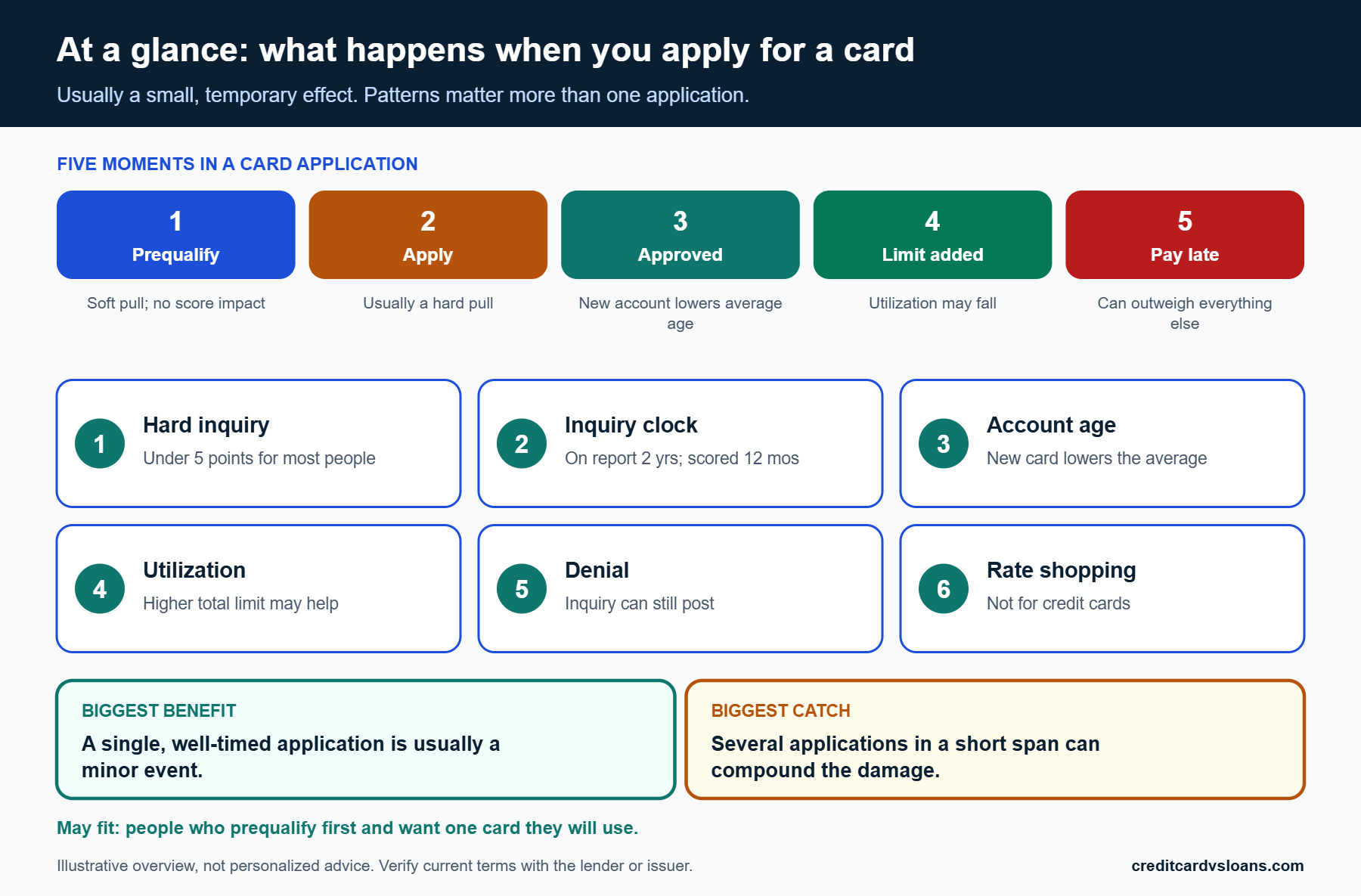
Does applying for a credit card hurt credit? Usually only a little and only for a while. A full application typically triggers a hard inquiry, which FICO says costs most people fewer than five points, and the new account can also nudge your average account age down. Prequalification checks are generally a soft pull and do not affect your score.
The bigger risks come from patterns, not from a single application: several applications in a short stretch, a new card you cannot manage, or an application right before a mortgage or auto loan. A single, well-timed application for a card you will use responsibly is usually a minor event, and the new credit line may even lower your utilization over time.
This guide separates the effects that are well documented from the ones that depend on your file. It covers what lenders check, how long inquiries count, what happens to your average account age and utilization, what a denial does and how to apply in a way that limits the downside. It is general education, not a prediction of your score.
- A credit card application usually creates a hard inquiry; for most people, FICO says one additional hard inquiry costs fewer than five points.
- Hard inquiries stay on your report for up to two years, but FICO Scores consider only the last 12 months.
- Checking your own reports, pre-approved offers and many prequalification tools use soft inquiries that do not affect your score.
- FICO’s rate-shopping treatment applies to mortgage, auto and student loan inquiries, so assume each credit card application counts separately.
- A new card can lower your average account age and, depending on the limit, can raise or lower utilization.
- Being denied can still leave a hard inquiry on your report, so prequalify first when you can.
Scoring details come from FICO and CFPB pages reviewed in October 2026. Credit scoring models and issuer practices change, and scores vary by model. Always confirm the type of credit check with the issuer before you apply.
The short answer: what happens to your credit when you apply
The three things that can change
A hard inquiry
When you submit a full application, the issuer typically requests your credit report so it can decide whether to approve you and at what limit and rate. That request is called a hard inquiry, and it is recorded on your report. The card issuer needs your permission, which you usually give by agreeing to a disclosure when you apply.
FICO says that for most people, one additional hard inquiry takes fewer than five points off a FICO Score. FICO also notes that inquiries are only part of the new credit category, which is 10% of the score. In other words, a single inquiry is a small factor inside a small category.
A new account on your report
If you are approved and open the card, it shows up as a new account. New accounts matter in two ways. They lower your average age of accounts, which is part of length of credit history, about 15% of a FICO Score according to FICO. They also add credit limit, which can change your utilization.
FICO’s guidance on new accounts says the age effect usually isn’t huge and the average rises again over time, but opening several accounts in quick succession can hurt more, particularly for people with short credit histories. Which way utilization moves depends on your balances, a point covered in our guide to credit card utilization.
How big is the effect, really?
A small, usually temporary dip
For many people with established credit, the combined effect of one inquiry and one new account is modest. Scores can move a few points down at first and recover as the account ages and the inquiry ages out of scoring. Some people see no visible change. That is consistent with FICO’s description of the effect as small, but no one can tell you your exact number in advance.
The effect is not necessarily the same for everyone. A person with a long, clean file has a lot of other information that outweighs the inquiry. A person with a thin file, meaning few accounts or a short history, can see a larger relative effect because each factor carries more weight.
When the effect matters more
Timing is the main reason a small effect becomes a problem. If you are about to apply for a mortgage, an auto loan or an apartment, a lower score or a recent account can influence the terms you are offered. A few points can matter at a pricing threshold, though lender cutoffs differ and you may be nowhere near one.
Several applications compound the effect. FICO says that several inquiries in a short span, especially after declined applications, can compound the damage. If you have been declined, the answer is usually to wait and fix the reason, not to apply again right away.
Applying for a card is not a mark against you in any moral sense. Lenders see hard inquiries all the time. What they look for is how many there are, how recent they are and what else your file shows, such as on-time payments and manageable balances.
Soft pulls and hard pulls: what actually triggers an inquiry
Credit checks that do not affect your score
Soft inquiries you will run into
FICO describes soft inquiries as credit checks that do not impact your score. Its examples include checking your own report through AnnualCreditReport.com or myFICO, pre-approved credit card offers and employment background checks. A soft inquiry may show on a copy of your own report but is not used in scoring.
Because soft pulls don’t affect your score, they are the safest way to explore options. Many issuers offer prequalification tools that use a soft pull to show whether you are likely to qualify, and sometimes an estimated limit or rate range. Ask the issuer whether its tool uses a soft pull before you enter personal information.
What prequalification can and cannot tell you
Prequalifying is not the same as being approved. A prequalification result is a preliminary read based on limited information, and the final decision usually comes after a full application with a hard pull, where the issuer can verify income and check for changes since the soft pull. Terms can differ from what you saw.
That is why we say prequalification can narrow your list, not guarantee an outcome. Use it to avoid applications you are unlikely to win, not as a promise. The “prequalify” tools can also be marketing, so read the disclosures about how your data will be used.
Credit checks that can lower your score slightly
Hard inquiries you authorize
A hard inquiry occurs when a lender checks your credit because you applied for credit. Credit cards, personal loans, auto loans, mortgages and many other applications generally trigger one. Some limit increase requests do as well, and some lenders also run a hard pull when you ask to change a product, so ask first.
The table below sorts common situations. It is a general guide, since practices vary by lender, and the answer to “which type of pull is this?” is one you can ask before you proceed.
| Situation | Usual type of check | Score impact |
|---|---|---|
| Checking your own reports at AnnualCreditReport.com | Soft | None, per FICO |
| Pre-approved offers you receive in the mail or email | Soft | None, per FICO |
| Prequalification tool on an issuer’s site | Usually soft; confirm before entering data | Generally none |
| Submitting a full credit card application | Usually hard | Small; fewer than five points for most people per FICO |
| Employment background check | Soft | None, per FICO |
| Requesting a credit limit increase | Varies by issuer | Ask before agreeing |
Why issuers use hard pulls
A hard inquiry is how a lender gets the full detail it needs for an underwriting decision. It lets the issuer see your account list, balances, limits and payment history, and it lets the lender verify that the person applying matches the file. The issuer, not you, decides which scoring model and which bureau to use.
Many issuers pull from one bureau, but which one can depend on your state and the lender. If you are comparing offers, don’t assume the same bureau will be used each time. That is another reason one score is never the whole story.
Pre-approved offers and unfamiliar inquiries
A pre-approved or prescreened offer in the mail is a soft pull on your file by the issuer, and as FICO notes, such offers do not affect your score. They are still not a guarantee. The final decision usually depends on the full application, and the terms you see in the mailer can differ from the terms you receive. Read the fine print on the back of the offer, which describes the criteria the issuer used.
If you see a hard inquiry on your report from a company you didn’t apply to, take it seriously. It could be an error, or someone may have used your information to apply for credit. Contact the company, dispute the entry with the bureau, and consider placing a fraud alert or freeze. The FTC publishes step-by-step guidance at consumer.ftc.gov on what to do after identity theft.
Beyond the inquiry: new account age, utilization and credit mix
Average age of accounts
How a new card changes the average
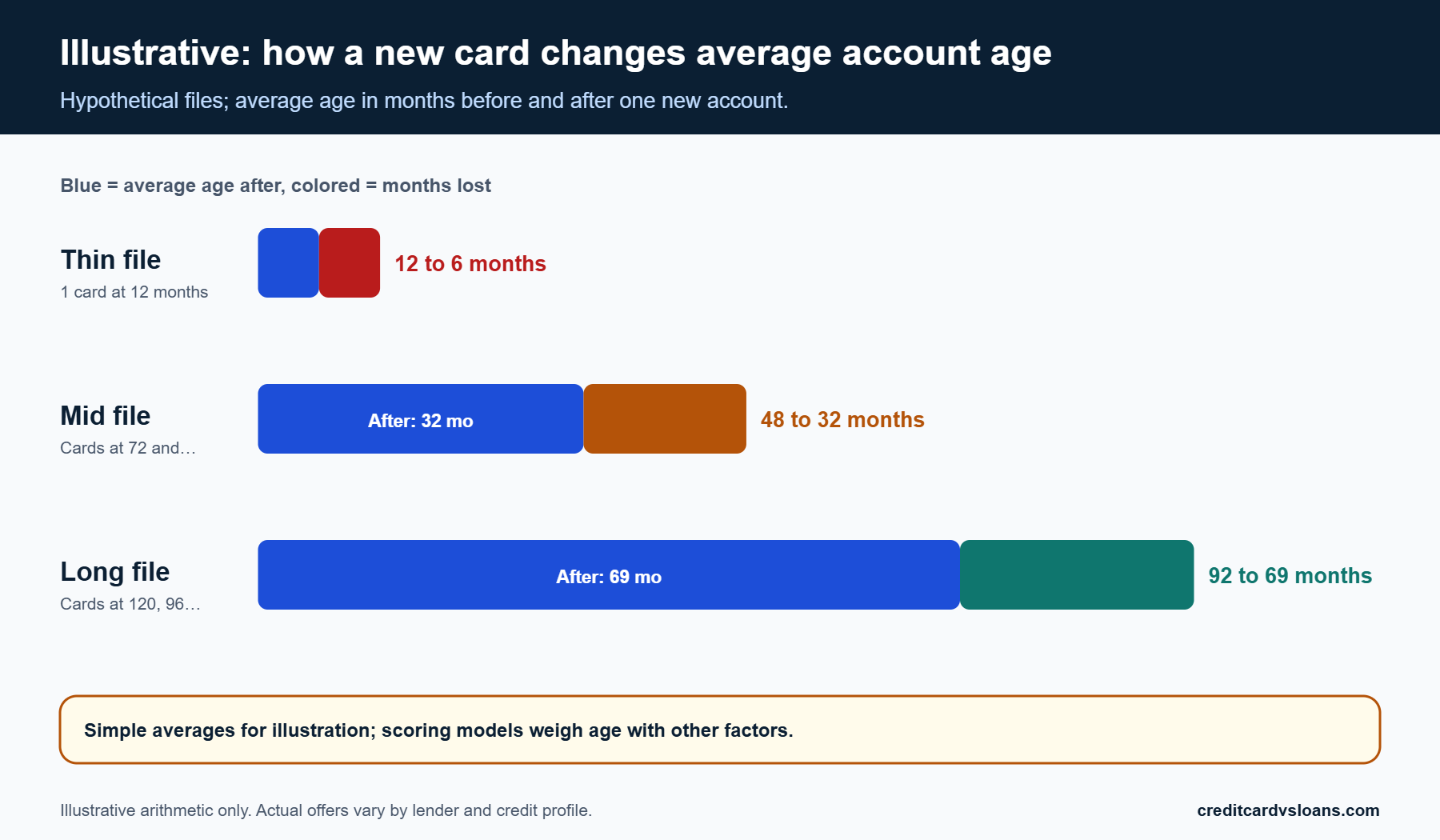
Length of credit history is about 15% of a FICO Score, and the factors include the age of your oldest account, your newest account and the average age of your accounts. When a new account opens, it enters the average at age zero. The effect is largest when you have few accounts.
A hypothetical example: you have two cards, one open for 72 months and one for 24 months, so the average age is 48 months. Add a brand-new card and the average becomes (72 + 24 + 0) / 3 = 32 months. With a thin file of one 12-month-old card, a new card cuts the average from 12 months to 6.
Why it recovers
The effect is not permanent. As the new account ages, the average rises, and FICO notes that this impact usually isn’t huge and recovers if you don’t open more new accounts. Your oldest account’s age is unaffected by a new card, and that single factor often matters more than the average.
A good reason to think twice about opening many accounts in a short period is that each one restarts the clock. Spreading applications out gives each account time to age before the next arrives.
Utilization and limits
A new limit can lower your ratio
Opening a card with a new credit limit adds to your total available credit. If your balances stay the same, your overall utilization falls. As a hypothetical example, imagine $2,000 in balances across cards with $10,000 in total limits, a 20% ratio. A new card with a $5,000 limit and no balance brings total limits to $15,000, and the ratio to about 13.3%.
That is the upside, and it is real in many scoring models. But it only helps if you leave the new card alone or use it lightly. If you spend up to the limit, you have increased your debt and may have raised your ratio.
The catch: you don’t know the limit in advance
The limit you get is the issuer’s decision, and you typically learn it after approval. FICO’s own balance transfer example shows how much that matters: the same $4,000 balance is 80% on a $5,000 limit and 40% on a $10,000 limit. Applying for a card to fix a utilization problem therefore comes with uncertainty.
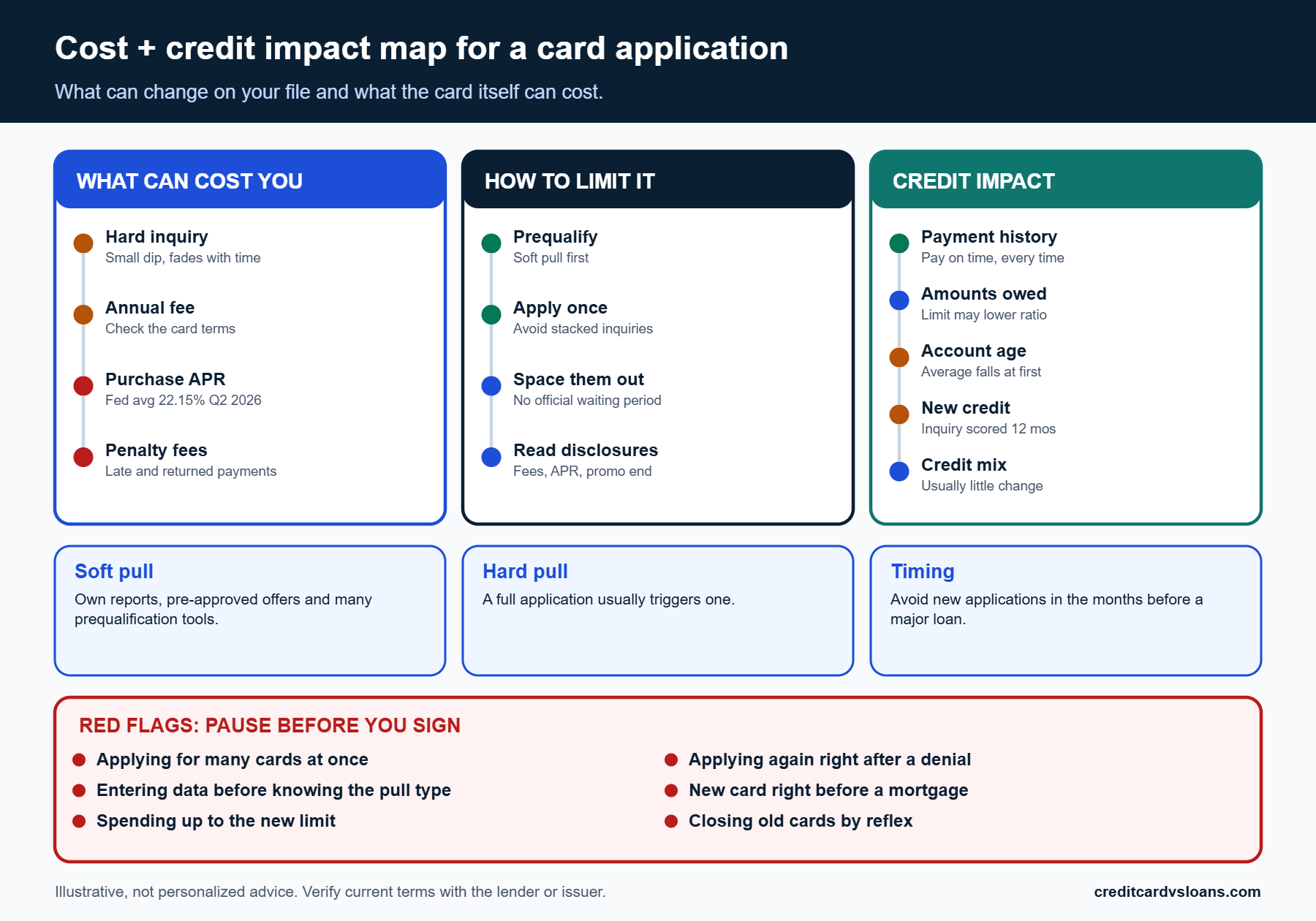
Fees and interest are another catch. An annual fee, a high APR or a deferred-interest promotion can cost more than the score benefit is worth. Evaluate the card on its terms first and the score effect second.
Credit mix and approval odds
Credit mix is a small factor
FICO puts credit mix at 10% of a score and notes that you don’t need one of each type of account. If you already have a card or two, another card adds little new information about your ability to handle different kinds of credit. If you have only installment loans, such as a student loan or auto loan, a first card can broaden your mix, but that benefit is modest next to payment history and utilization.
The right way to use this fact is as a reason not to apply for a card purely to improve your mix. The effect is small, the inquiry is real, and the right card is the one that fits how you actually pay.
What issuers weigh when you apply
Issuers look at more than a score. They typically consider income, existing debts, the number of recent accounts and inquiries, and the details of your history. These criteria are the issuer’s own and are not published, so two issuers can reach different decisions on the same file. That is one reason prequalification tools are useful: they approximate the issuer’s screen without the hard pull.
It also means a denial from one issuer does not predict the result at another. It does suggest checking your file for the cause before trying again.
| Scoring factor (FICO weight) | What can happen | Direction |
|---|---|---|
| Payment history (35%) | No direct change; depends on paying the new card on time | Neutral at first |
| Amounts owed (30%) | Total limits rise; ratio falls if balances stay flat | Often helpful, if not overspent |
| Length of history (15%) | Average account age falls; oldest account unchanged | Small, temporary |
| New credit (10%) | Hard inquiry and new account recorded | Small, fades over time |
| Credit mix (10%) | Little change if you already have cards | Usually neutral |
How long a hard inquiry counts, and what a denial does
The 12-month and 24-month clocks
Scoring window versus report window
FICO says hard inquiries can remain on a credit report for up to two years, but FICO Scores consider only the inquiries from the last 12 months. So an inquiry from 14 months ago may still show on your report, and a lender looking at the full file may see it, but your FICO Score is not counting it.
That distinction explains why two different people can describe different timelines. One is talking about what is visible on the report, and the other is talking about the scoring window. Other scoring models may handle timing differently, and FICO’s page is specific to FICO Scores.
What lenders see versus what scores use
A person reviewing your file, such as an underwriter on a mortgage, may notice multiple recent inquiries and ask about them even if their effect on a score is modest. That is part of why timing matters before a large loan: the score is one input, and the underlying file is another.
If you see an inquiry you don’t recognize, treat it as a red flag. It could be a mistake or a sign of identity theft. The FTC explains how to dispute errors with both the bureau and the company that reported the information, and you can place a fraud alert if you suspect someone is using your identity.
If you are denied
A denial can still leave an inquiry
Being turned down does not erase the hard pull. The inquiry is made when the issuer checks your credit, not when it approves you. FICO says that several inquiries in a short span after declined applications can compound the damage, so the cycle of applying, being declined and applying elsewhere is the one to avoid.
If you were denied, pause before applying again. Find out why, and fix what you can, whether it is a high balance, a recent late payment, too many recent accounts or a mistake on your report.
Use the adverse action notice
When credit is denied or offered on worse terms based on information in a credit report, the lender generally must give you a notice that names the bureau it used. The FTC says you are entitled to an extra free report if you received an adverse action notice, and you must request it within 60 days. It is a useful moment to look for errors that may have contributed to the decision.
Read the stated reasons carefully. They tend to be specific enough to guide your next step, for example high balances relative to limits, which links back to how credit card utilization works.
Applying for several cards: timing, rate shopping and spacing
Why cards are not treated like mortgage shopping
The rate-shopping rule has limits
You may have heard that multiple inquiries within a short window count as one. That is true for certain loan types. FICO says that special rate-shopping treatment applies to mortgage, auto loan and student loan inquiries, with a 45-day window for newer FICO Score versions and a 14-day window for older versions. FICO also advises keeping rate shopping to a short time frame because some lenders still use older versions.
The page does not extend this treatment to credit cards, so the safe assumption is that each credit card application counts as its own inquiry. If you are comparing cards, prequalify with soft pulls first, then submit as few full applications as you can.
A hypothetical cluster of applications
Imagine someone applies for four cards in a month, hoping at least one will approve. That can produce four inquiries and, if all four approve, four new accounts that pull the average age down at once. Even if each inquiry costs under five points on its own, the combined effect and the pattern of seeking credit can look riskier to a lender, especially on a thin file.
The better approach is sequential: apply for the card that best fits your needs, see the result, and wait before the next. Our guide to building credit with a student card explains why a first card is a deliberate choice, not a numbers game.
How much spacing is enough?
No official waiting period, but a pattern
Neither FICO nor the CFPB sets an official number of months between applications. Because inquiries count in FICO Scores for 12 months and the new-credit category is 10% of the score, a practical rule of thumb is to avoid stacking applications inside the same year without a reason. Issuers also have their own internal rules about how many recent accounts or inquiries they accept, and these are not published.
If an application is declined, the denial letter usually gives reasons. That is more useful than guessing at a waiting period.
Planning around a large purchase
If you expect to apply for a mortgage or auto loan, think about the sequence. A new card opened shortly before can change your average account age and add an inquiry. A new card that you pay off immediately and then close might also change your utilization picture, which is the subject of our guide to closing a credit card.
The simple rule of thumb: don’t open new credit in the months before a major loan application unless you have a clear need, and ask your loan officer what they would prefer you do. Lenders vary, and a short conversation can save a surprise.
How to limit the damage when you do apply
Before you apply
Check your reports and your own readiness
Start by pulling your free credit reports at AnnualCreditReport.com. The FTC says each of the three bureaus currently lets you check your report from each weekly for free. Look for errors, accounts you don’t recognize and balances or limits that are wrong. Fix mistakes before applying, since they can lower your odds and affect the terms you see.
Then check your own budget. A card is a form of borrowing even if you plan to pay in full. If you carry a balance, a higher limit does not fix the problem, and our guide to credit card utilization explains why paying down is the stronger move.
Prequalify, then apply once
Use prequalification tools that run soft pulls to narrow down which cards you might qualify for. Compare the APR range, fees and rewards or benefits on an apples-to-apples basis, and make a short list. Submit a full application only for the card you are most likely to use responsibly.
Check the issuer’s disclosure about the type of pull. If it says hard inquiry, accept that a small dip is possible and make sure the card is worth it.
| Approach | What it does | The catch |
|---|---|---|
| Prequalify first with soft pulls | Narrows choices without touching your score | Not a guarantee; final terms can differ |
| Apply for one card at a time | Limits hard inquiries and new accounts | Takes patience |
| Wait after a denial | Avoids stacked inquiries | Delays the credit you wanted |
| Apply months before a big loan, not weeks | Gives the account time to age | Needs planning ahead |
| Apply for several cards in one month | Possible approval of at least one | Stacked inquiries and new accounts; a risk signal |
After you are approved
Use the card in a way that supports your score
Pay on time, every time. Payment history is the largest FICO factor at 35%, and nothing else you do with a new card matters if you miss payments. Set up autopay for at least the minimum, and consider paying the full statement balance when you can to avoid interest.
Keep the balance low relative to the new limit. A new card used lightly and paid in full is the scenario in which the utilization benefit and the age recovery both work in your favor.
Watch fees and promotional terms
Read the card’s rate and fee disclosures: the APR, any annual fee, penalty fees and what happens when a promotional period ends. Under Regulation Z, as summarized by the CFPB, a card issuer generally may not raise a rate on existing balances except in specific situations, such as the end of a disclosed promotional period of at least six months, a variable-rate index increase, or a delinquency of more than 60 days. The rules are detailed, and the regulation is updated from time to time, so check the current text on consumerfinance.gov before relying on them.
If the card is part of a plan to move debt, see our guide to the credit score needed for a balance transfer card for what issuers look for.
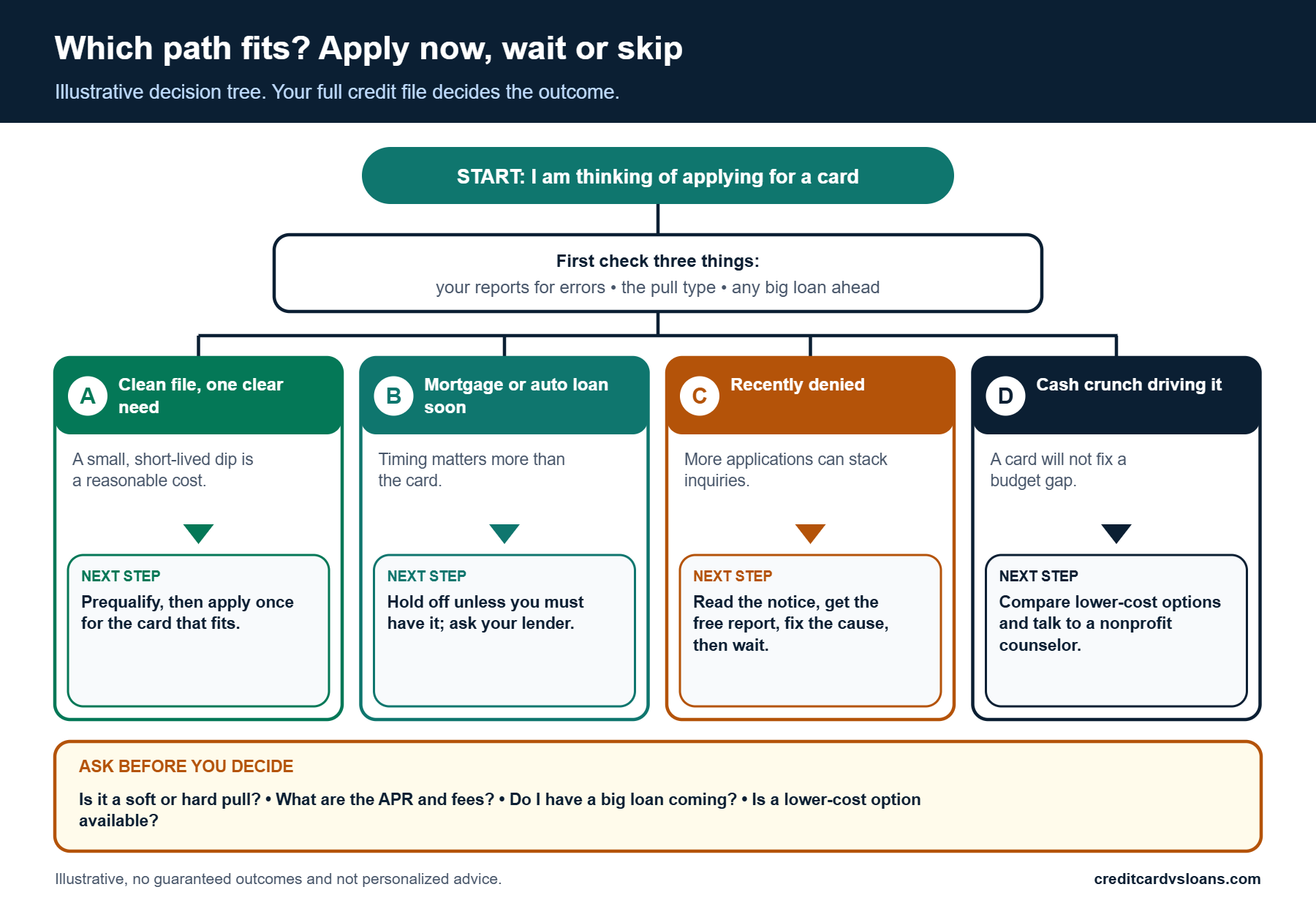
Who should apply now, wait or skip
Situations where applying may make sense
You have a plan and a clean file
If you pay your bills on time, your balances are modest and you need a card for a specific reason, such as building a first history, replacing a card with poor terms or earning something you would use anyway, the small, short-lived score effect is usually acceptable. The card should fit your habits. A rewards card that pushes you to spend more than you otherwise would does not pay for itself.
In this case, the hard inquiry is a minor cost. Plan the timing, avoid piling on other applications and keep an eye on your reports after the card posts.
You want a better-terms replacement
Some people apply for a new card to replace one with an annual fee or poor terms. Before closing the old card, remember the CFPB’s point that closing a card can raise your utilization ratio and lower your score. Keeping an old, no-fee account open can preserve the age and the limit, as discussed in our guide to closing a card.
If the old card has an annual fee, ask the issuer about converting it to a no-fee version before closing it. That option is up to the issuer, but asking costs nothing.
Situations where waiting is wiser
Big loan on the horizon
If you plan to apply for a mortgage or car loan soon, hold off on new card applications unless you must have the credit. Each additional inquiry and a lower average age are small individually, but at a pricing threshold they can matter. Ask the lender what they recommend.
The same goes for renting an apartment, where a landlord may check your report. A recent cluster of inquiries can raise questions even if the score is fine.
Recent denials or cash crunch
If you were recently declined, or you are facing a cash crunch that makes you want a card to bridge a gap, slow down. A new card does not fix a budget gap, and the interest at typical card rates adds up. The Federal Reserve’s G.19 release of October 7, 2026 reported 22.15% as the average interest rate on credit card plans for accounts assessed interest in the second quarter of 2026.
If you need to cover an emergency, compare the true cost of a card against lower-cost options, including asking creditors about payment plans and speaking with a nonprofit credit counselor.
Your checklist and the bottom line
A practical checklist
Before you apply
- Pull your free credit reports at AnnualCreditReport.com and fix any errors first.
- Identify the reason you want the card and the one product that fits it.
- Prequalify with soft pulls if the issuer offers it, and confirm the pull type in writing or in the disclosure.
- Read the APR, fees and promotional terms before submitting anything.
- Avoid applications in the months before a mortgage, auto loan or rental application.
After you apply
- If approved, set up autopay and keep the balance low relative to the limit.
- If denied, read the notice, pull the extra free report you are entitled to, and wait before reapplying.
- Check your reports in a few weeks to confirm the account and inquiry look right.
- Avoid closing your older cards just because a new one arrived, unless fees or terms justify it.
The bottom line
How to decide
Does applying for a credit card hurt credit? For most people with established credit, the answer is: slightly and temporarily. The inquiry is small, the new-account effect fades as the card ages, and a higher limit can help your utilization. The problems come from repeated applications, bad timing and cards you cannot manage.
Prequalify with soft pulls, apply once for a card you will actually use, and keep your balance low. The score effect of one application is usually small compared with what you do afterward.
Where to go next
To understand the ratio that a new limit changes, read our guide to credit card utilization. If you are weighing a move that involves a new card and a balance, see our balance transfer score guide and how a personal loan can affect your credit score.
Whatever you decide, treat the outcome as a conversation with your own credit file. Check your reports, read your notices and give each change a few months to settle before judging it.
Quick answers to common follow-ups
Will a hard inquiry ever come off early?
Accurate inquiries age off on their own schedule: they can remain on your report for up to two years, per FICO. You generally cannot remove an accurate inquiry just because you would like to, but you can dispute one that is wrong or that you never authorized. The FTC explains how to dispute errors with both the bureau and the company that supplied the information.
It is easy to fall for a service that promises to clean up your report for a fee. Be skeptical of anyone claiming they can erase accurate information, and read the FTC and CFPB guidance on credit repair before paying anyone.
Does a retail or store card application work differently?
A store card is still a credit card, and applying generally involves a credit check. The discount offered at the register is a marketing feature, not a different process. Store cards often come with lower limits and higher APRs, so a single purchase can produce a high utilization ratio on that card, and the score effect of a new account is the same as for any other.
Before accepting an at-register offer, ask whether it is a hard pull and read the APR. A one-time discount rarely outweighs a high-interest card you may carry for months.
Should I wait until my score is higher?
Sometimes. If you are close to a threshold that matters, such as a pricing tier on a mortgage, waiting to pay down balances and let accounts age can be worth it. If you simply need a card, a modest score is not necessarily a reason to delay, but expect less favorable terms, and consider whether a secured option or a student card might be a better fit. No one can promise an approval at any score, and each issuer sets its own standards.
A practical approach is to check your reports, fix errors, lower balances and then prequalify. The prequalification result tells you more than a guess about your score does.
What this guide cannot tell you
The real effect depends on your file
The general rules above are well supported, but the exact change from your application depends on your reports, your scoring model and what else is happening in your file. Two people can apply for the same card on the same day and see different outcomes. Treat any point estimate, including FICO’s “fewer than five points,” as a typical figure for most people and not a promise.
If you are close to a major financial decision, such as a home purchase, a short conversation with a lender or a HUD-approved housing counselor can help you decide what to do with new credit in the meantime.
When to talk to a professional
If you are applying for cards because other credit is maxed out or because bills are going unpaid, the next step is not another application. A nonprofit credit counselor can look at your whole budget and discuss options. Check the agency’s fees and credentials, and avoid companies that charge large upfront fees for debt relief.
The CFPB and the FTC both publish consumer guides on choosing a credit counselor and spotting scams, and they are free to read.
- FICO: What’s in my FICO Scores? (Factor weights and new credit)
- FICO: How to Rate Shop and Minimize the Impact to Your FICO Scores (Inquiry impact and rate-shopping windows)
- FICO: How long do hard inquiries stay on your credit report? (Soft vs hard inquiries)
- FICO: Balance transfers and your credit (New account and utilization examples)
- CFPB: Does it hurt my credit to close a credit card?
- CFPB: 12 CFR 1026.55 Limitations on increasing annual percentage rates, fees, and charges (Archived Jan. 1 – Apr. 8, 2026 version; check current text)
- FTC: Free Credit Reports
- Federal Reserve: Consumer Credit – G.19 (October 7, 2026) (Credit card plan interest rates, Q2 2026)
Last updated: October 22, 2026. Rates, fees and lender rules change; verify current terms before acting.
The information on creditcardvsloans.com is provided for general educational and informational purposes only. It is not financial, legal, tax, credit, accounting or investment advice, and reading it does not create an advisor-client, fiduciary or any other professional relationship. Nothing here is an offer, solicitation or recommendation to borrow, lend or apply for any product.
Credit scores, interest rates, fees, eligibility rules, lender policies and laws change frequently and vary by lender, location and individual circumstances. Examples, figures and scenarios are illustrative only, do not predict your results and do not guarantee approval, savings, a particular rate or a credit-score outcome. Always confirm current terms directly with the lender or issuer and read the full agreement before you apply or sign.
Although we aim for accuracy and use reputable sources, we make no representations or warranties, express or implied, about the completeness, accuracy, reliability or timeliness of the content. Content may be drafted with the assistance of automated tools, so errors or omissions may still occur. Links to third-party sites are provided for convenience; we don’t control and aren’t responsible for their content.
To the fullest extent permitted by law, creditcardvsloans.com and its owners, editors, authors, contributors and affiliates disclaim all liability for any loss, damage or expense arising directly or indirectly from your use of, or reliance on, this content. Before making financial decisions, consult a licensed professional, such as a qualified financial advisor, attorney, tax professional or nonprofit credit counselor, who can consider your complete situation.