Closing a credit card can hurt your credit score, but it does not always, and the size of the effect depends on what else is in your file. The CFPB says closing a card can raise your credit utilization ratio and lower your score, and that the change may be temporary or minor. The impact is usually largest when the card has a big limit, a long history or a clean payment record you would rather keep.
That does not mean you should never close a card. The same CFPB guidance lists good reasons to do it: annual fees or poor terms that outweigh the benefits, a card that makes it easier to run up debt you can’t repay, or no plans to apply for new credit soon. The decision is a trade-off between a possible small score effect and the real costs of keeping a card you don’t want.
This guide explains how closing a card interacts with each part of your score, what happens to the account on your credit report, what to try before you close, and how to close in a way that limits the downside. It is general education, not a prediction of how many points you would gain or lose.
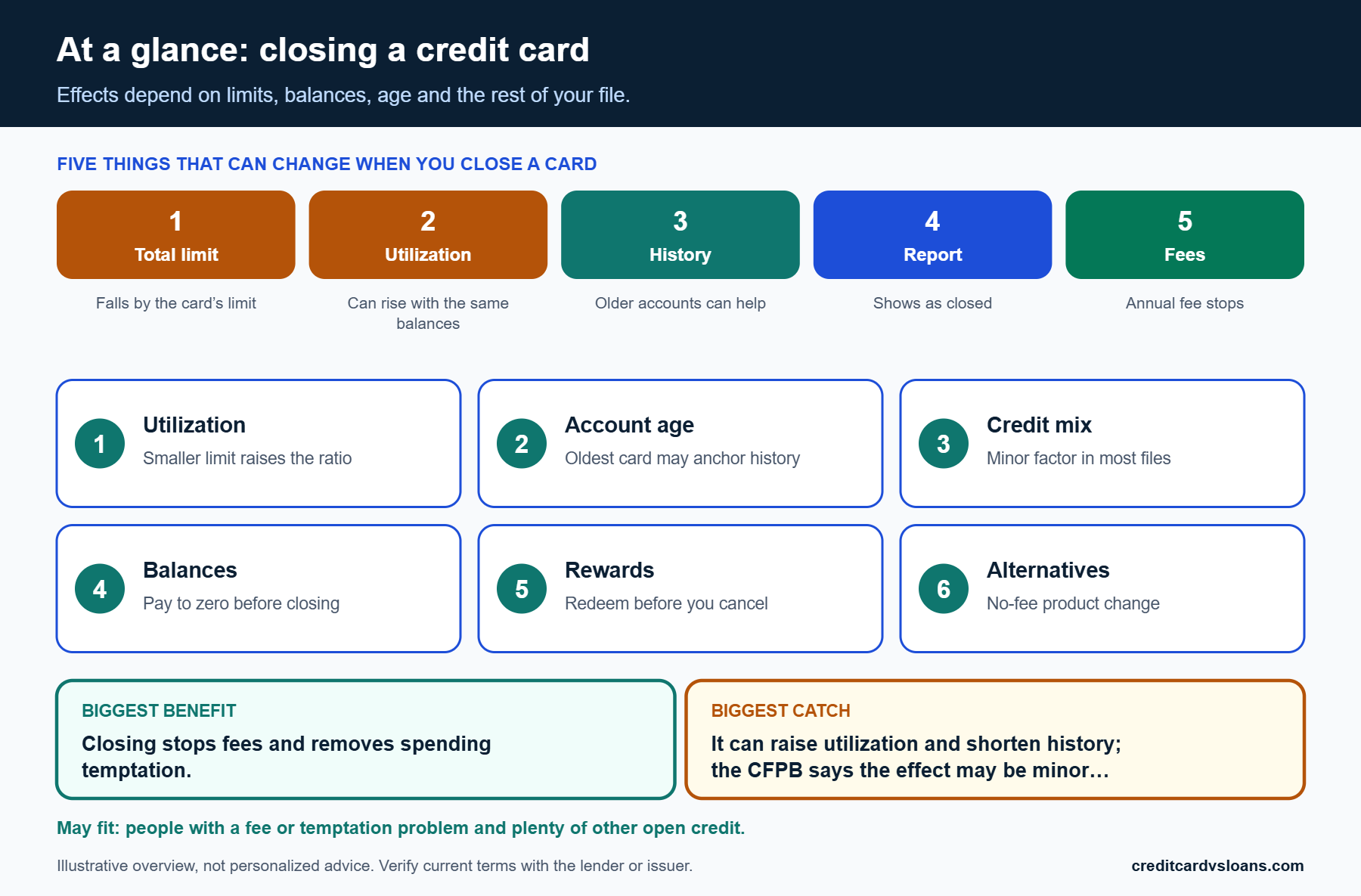
- Closing a card removes its credit limit from your total, which can raise your utilization ratio even if your balances don’t change.
- Older cards with good payment histories can help your score, which is why closing your oldest card deserves extra thought.
- The effect on your score may be minor or temporary, and it depends on your other accounts, balances and history.
- Reasons to close include an annual fee that outweighs the benefits, spending temptation or a card you will never use.
- Asking your issuer to switch you to a no-fee card can keep the account and the limit without the cost.
Scoring details come from CFPB and FICO pages reviewed in October 2026. Scoring models differ, and your issuer’s policies, such as inactivity closures, can change. Check your card agreement and credit reports before acting.
The short answer: does closing a credit card hurt your credit score?
What the CFPB says
It depends, and the main mechanism is utilization
The CFPB’s answer to this question is that closing a card may hurt your score, depending on your situation. Its explanation centers on the credit utilization ratio, which compares what you owe with your total available credit. When you close a card, its limit no longer counts toward your total, so the same balances represent a bigger share of what is left.
The CFPB also notes that the change in your score may be temporary or minor, and that the full impact depends on other factors in your credit profile. That is an important qualifier. A person with several open cards, low balances and a long history may barely notice the closure, while someone with two cards and a large balance on one could see a bigger swing.
Older cards with good histories carry weight
The CFPB also says that keeping an older account with a positive payment history open may help you maintain a higher score. This ties into the length of credit history, which FICO puts at about 15% of a FICO Score and describes as including the age of your oldest account, newest account and average account age.
The CFPB page does not go deep on exactly how closed accounts are treated in age calculations, and neither of the sources we reviewed does. Because bureaus and scoring models can differ, it is safest to assume that closing your oldest account could matter more over time than closing a recent one, and to look at your own reports to see how the account is listed.
Why the answer varies from person to person
The same closure, two different files
Consider a hypothetical person with a single $2,000-limit starter card and a second, newer card with a $10,000 limit. Closing the starter card barely changes total available credit, since it was a small share, but it may be the account that anchors their history. Now consider someone with a large limit on a ten-year-old card and several small newer ones. Closing the big card removes most of their available credit at once.
Neither case is a certain loss. The point is that three variables interact: how big the limit is, how old the account is and how much you currently owe. You can estimate the first two by looking at your reports, and the third by looking at your statements.
A closure is not a mark against you
A card you closed yourself is not a negative item. A closed account in good standing is not the same as a delinquency or a default. The CFPB notes that negative information can generally be reported for seven years, but a closed account with a clean payment history is not negative information, and the CFPB says that positive payment history may be reported even after an account is closed.
The difference between closing a card voluntarily and having an issuer close it for inactivity is covered later in this guide, since the practical effects on your score are similar even though the cause is different.
Do not assume closing a card improves your score. The CFPB specifically warns against the assumption that closing a card will raise it. Close because the card no longer serves you, not because you expect a score boost.
How closing a card changes each part of your score
Amounts owed: the utilization effect
The arithmetic of a smaller total limit
Utilization is figured by dividing balances by limits. Remove a limit from the bottom of the fraction and the percentage rises. As a hypothetical example, suppose you have two cards with $5,000 limits each, and a $1,500 balance on one of them. Your overall utilization is $1,500 divided by $10,000, or 15%. If you close the card with the zero balance, your total limit falls to $5,000 and your utilization becomes 30%.
Nothing about your spending changed. The score effect, if there is one, comes entirely from the denominator shrinking. FICO describes amounts owed as about 30% of a typical score, so a change in this ratio can be one of the more noticeable parts of a closure.
Per-card ratios can matter too
The overall ratio is not the only one. FICO’s guidance on balance transfers mentions both the overall ratio and the ratio on each card. If you close a card and your remaining balances are concentrated on a card with a smaller limit, that card’s individual ratio could become high even if the overall figure stays moderate.
That is a good reason to pay down balances before closing anything. If the card you plan to close carries a balance, you will need to pay it off anyway, and paying it first removes the question of where the balance goes. Our guide to credit card utilization covers how to read and lower these ratios.
History and mix: the age effect
Account age and the oldest account
Length of credit history is about 15% of a FICO Score. It includes the age of your oldest account, the age of your newest account, the average age of your accounts, how long specific accounts have been open and how long it has been since certain accounts were used. If the card you are closing is your oldest, you may eventually lose the anchor of your history, so think about whether another card is just as old.
The practical timing is uncertain. We could not find a primary source that spells out how and when closed accounts stop counting in each scoring model, so we avoid giving a number of years. What the CFPB does say is that older accounts with good histories can help. If you have a choice between closing a recent card and an old one, the recent one is usually the safer pick.
Credit mix is usually a minor factor
Credit mix is about 10% of a FICO Score, and FICO notes you don’t need one of every type of account. If you have other cards and loans, closing one card is unlikely to change your mix much. If the card is your only revolving account, closing it removes revolving credit from your file entirely, which could matter for your mix and make it harder to build history later.
That last point deserves attention if you have a thin file, meaning you have few accounts or a short history. For example, a student with one card should think carefully before closing it, as discussed in our guide to building credit with a student card. With nothing else to replace it, closing may leave you with little active history.
Three hypothetical households
The starter file with one card
Imagine a young adult with a single card, a $1,500 limit, a $300 balance and two years of history. That is 20% utilization on the only revolving account. If this person closes the card, there is no revolving account left to report, which removes the ratio entirely but also removes the only active history the person has. The usual guidance for a thin file is to keep the account open, use it lightly and pay in full.
The same logic applies to anyone whose closed card would leave them with only installment loans or no open accounts. A file with nothing active is harder for a lender to evaluate, which can be a disadvantage when you need credit later.
The established file with four cards
Now consider someone with four cards whose limits are $10,000, $6,000, $4,000 and $2,000, a total of $22,000, and $2,200 in total balances, or 10% overall. The newest card, the $2,000 one, charges an annual fee. Closing it leaves $20,000 in limits and an 11% ratio, a small change. If they instead closed the oldest $10,000 card, limits would fall to $12,000 and utilization would be about 18.3%, a bigger move.
The lesson is that which card you close often matters more than whether you close one. If you must close a card, a recent one with a small limit is typically the lower-impact choice for utilization, though you should also think about age.
The household carrying a balance
Finally, a hypothetical household has two cards: one with an $8,000 limit and a $6,000 balance, and one with a $4,000 limit and no balance. Overall utilization is $6,000 divided by $12,000, or 50%. Closing the empty card leaves $6,000 divided by $8,000, or 75%, and the remaining card is nearly maxed out.
For this household, the more useful step is paying down the balance, not closing anything. Interest on the $6,000 at the Federal Reserve’s reported average of 22.15% for accounts assessed interest would be roughly $1,329 over a year if the balance stayed flat, a simple approximation that ignores compounding and payments.
Keeping versus closing: what each choice really costs
The costs of keeping a card open
Annual fees and poor terms
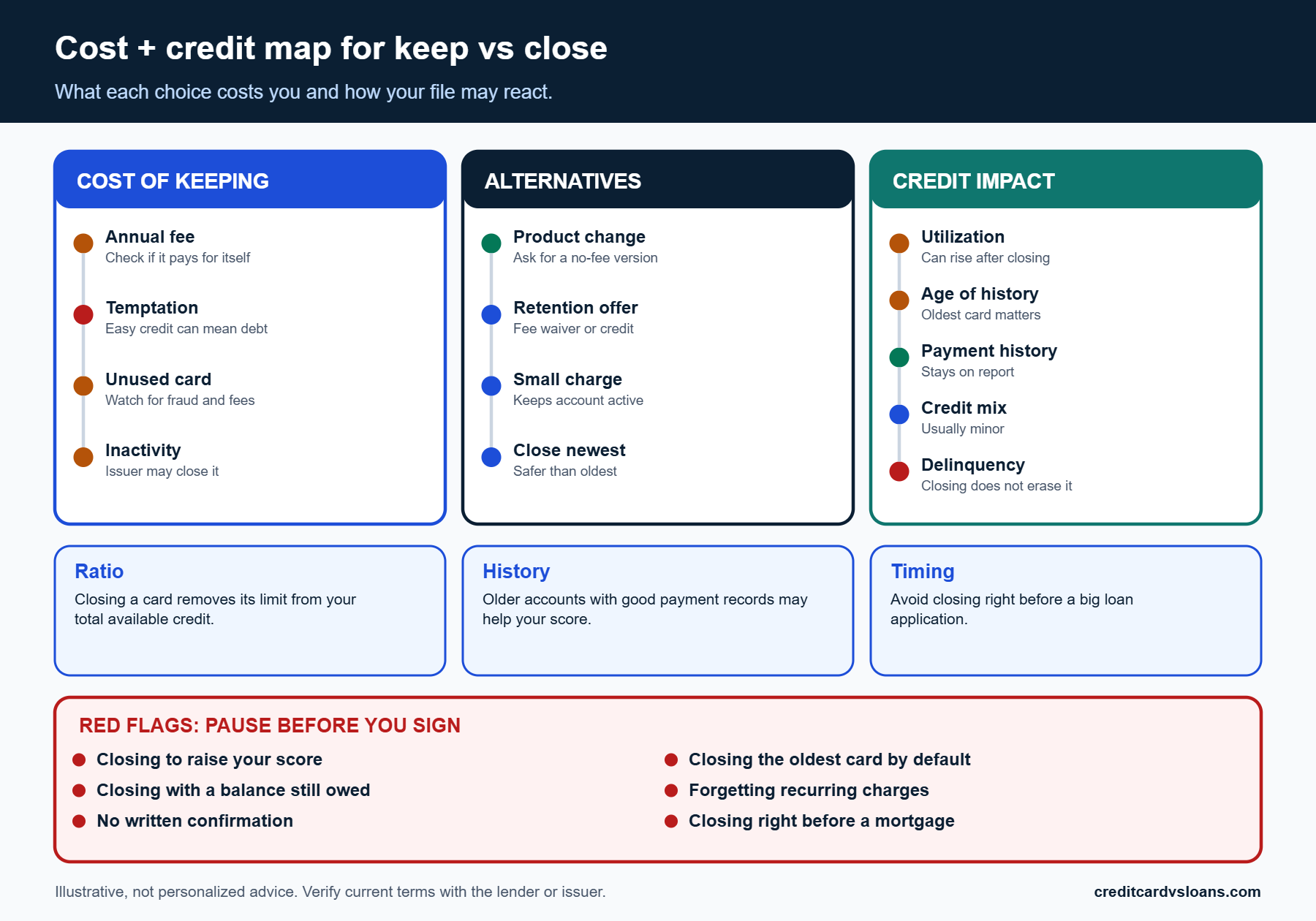
If a card charges an annual fee and you aren’t getting value from it, paying that fee every year for the sake of a credit score is rarely a good deal. The CFPB names annual fees or unfavorable terms outweighing benefits as one good reason to close. As a hypothetical illustration, a $95 annual fee costs $475 over five years, and a small, uncertain utilization benefit may not justify that.
Before you close, though, check whether the issuer offers a no-fee version of the card. That choice can keep the account open and the history intact without the fee, and it is an easy call to make. The details depend on the issuer.
Spending temptation and security
The CFPB also says closing can be sound if a card tempts you into debt you can’t repay. This is a real and personal cost. If having easy credit available makes it harder to stick to a budget, a lower score might be an acceptable price for fewer chances to overspend.
If you keep an unused card open, the CFPB advises watching your statements for signs of identity theft and for unexpected fees. An unused account can be a quiet target, and a fee you don’t notice is money lost. Set alerts or check monthly.
The costs of closing a card
Lost limit, lost history, lost flexibility
On the other side of the ledger, closing costs you the limit and possibly a long history. You also lose a cushion. If you face an emergency or a cash crunch, a card with unused room can help, though it is no substitute for savings. Our guide to credit card utilization explains how a smaller total limit affects the ratio.
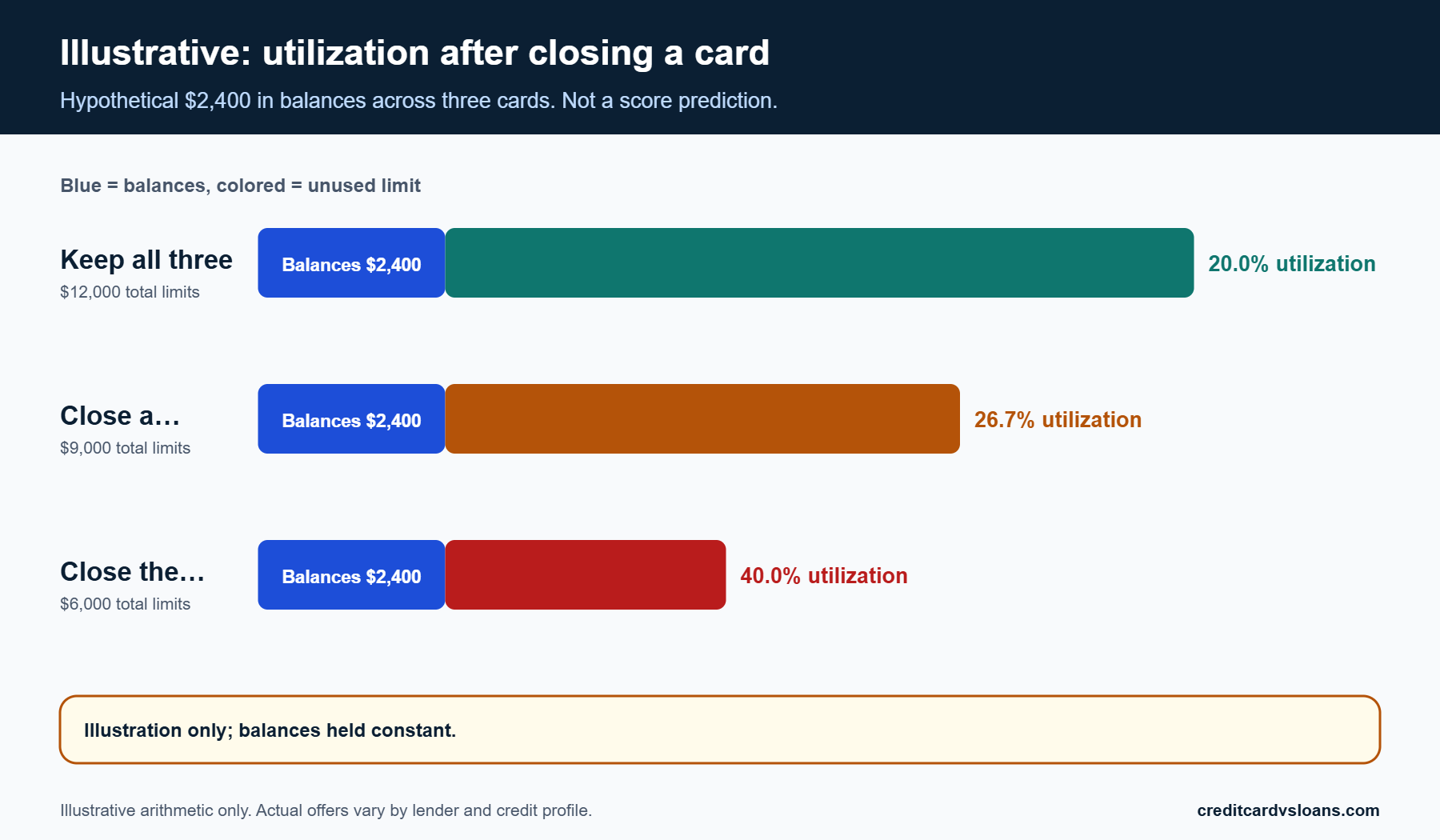
A hypothetical table of three closure choices shows the shape of the trade-off. The numbers assume the same $2,400 in total balances across the cards and no changes to spending.
| Scenario | Total limits | Overall utilization | Read |
|---|---|---|---|
| Keep all three cards ($6,000 + $3,000 + $3,000) | $12,000 | 20.0% | Baseline |
| Close a $3,000 card | $9,000 | 26.7% | Moderate rise |
| Close the $6,000 card | $6,000 | 40.0% | Larger rise; per-card ratios worth checking |
Rewards, credits and cleanup tasks
Closing a card can mean forfeiting unredeemed rewards, statement credits or benefits tied to the card, depending on the terms. Redeem points or cash back first if the card allows it, and check any recurring bills or subscriptions that charge the card so a missed payment doesn’t create a late fee or a service interruption elsewhere.
It also pays to confirm what happens to any pending returns or refunds posting to the account after closure. If the account is closed, a refund may be issued by check, and timing varies. Keep your records until the account has settled.
| Option | Effect on limit and history | Cost | Often fits |
|---|---|---|---|
| Keep it open and use it lightly | Keeps limit and age | None if no fee | No-fee older cards |
| Ask for a product change to a no-fee card | Often keeps the account and history | Depends on issuer; ask about hard pulls | Cards with annual fees you no longer value |
| Keep it open but don’t carry it | Keeps limit and age | Risk of inactivity closure or missed fees | Cards you want available for emergencies |
| Close it | Removes limit; history effects vary | Possible small score dip | Fee cards with no alternative, or spending temptation |
What happens to a closed card on your credit report
Closed in good standing
The account stays visible, labeled closed
When you close a card, it does not vanish from your credit reports. It typically stays on your file, marked as closed, along with its payment history. The CFPB says that positive payment history may be reported even after an account is closed, so a clean record can keep working in your favor to some degree.
The sources we reviewed do not give a single timeline for how long a closed account in good standing stays on a report or how each scoring model weighs it as time passes. Bureaus have their own practices. If this matters to you, look at the account on your free reports and watch what happens over the following months.
Who closed it can be listed
Reports commonly note whether the account was closed by the consumer or by the credit grantor. That distinction does not change the closed status, but a lender reviewing your file may notice it. Closing at your own request, with a zero balance, is a neutral event. An issuer closing an account because of nonpayment is not neutral at all.
It is worth checking that the account is reported accurately after you close it. If the status is wrong or the account shows a balance you already paid, dispute it with both the bureau and the issuer. The FTC describes how in its materials on credit report errors.
Closed with a balance or with problems
A balance does not go away
Closing a card does not erase what you owe. You remain responsible for the balance, and interest generally continues to accrue under the card’s terms. Some issuers also change the way payments are applied or lock the account to new purchases once it is closed, but the debt itself is still yours. The card agreement describes what happens, and the specifics vary.
The simplest approach is to pay the balance to zero before closing, or to have a plan and a payment schedule if you can’t. A closed card with a revolving balance can keep your utilization high since the balance still counts while the limit may not.
Negative information has its own clock
If the card had late payments or went to collections, closing it does not reset that history. The CFPB says most negative information can generally be reported for seven years, with bankruptcies up to ten years and some exceptions for certain high-value credit, insurance and job applications. Closing a card with negative marks does not help or hurt that timeline.
In that situation, the question is not whether to close, but how to deal with the debt. Our guide to how a personal loan can affect your credit score discusses one route some people consider for consolidating balances, with the trade-offs.
When the issuer closes the card instead of you
Inactivity and limit cuts
Why unused cards can be closed
Card agreements generally allow an issuer to close an account or reduce a limit, and some issuers do so when a card has been inactive for a long stretch. The rules and timelines are set by the issuer and described in the agreement, so they vary. If you are keeping an old card mainly for its age and limit, check the agreement and the issuer’s website for any inactivity language.
The effect on your score is similar to closing the card yourself: the limit leaves your total, and the account moves to a closed status. The difference is that you did not choose the timing, and you may not have had a chance to pay down other balances first.
Keeping a card active without much effort
If you want to keep an unused card open, a common approach is to put one small recurring charge on it, such as a subscription you already pay for, and set up autopay for the full statement balance. That keeps the account active and avoids interest, as long as the autopay runs reliably. It is a practical routine, not a guarantee that the issuer will never close the account.
Whatever you choose, keep an eye on the account. The CFPB advises watching statements on an unused card for identity theft and unexpected fees, and a quick monthly look takes only minutes.
If your own limit is lowered or the account is closed for nonpayment
Limit reductions work like partial closures
A reduced limit affects utilization the same way a partial closure does. If your limit drops from $8,000 to $4,000 while your balance stays at $2,000, your ratio goes from 25% to 50% without any change in your spending. Issuers can do this for reasons that include changes in your risk profile or their own policies. You can ask for the reason and, in some cases, for reconsideration.
If a limit cut leaves you near the limit, pay down that card first, and look at whether other cards have room. Our guide to credit card utilization covers how to read the per-card and overall ratios.
Closure for delinquency is a different story
If an issuer closes a card because you fell behind, the negative payment information is the main problem, not the closure. That information can generally be reported for seven years, per the CFPB. In that situation, contact the issuer about hardship options and consider a nonprofit credit counselor. Closing other cards will not fix a delinquency.
Be wary of anyone who promises to remove accurate negative items for a fee. The FTC warns about credit repair scams, and the CFPB and FTC both publish free guidance on disputing real errors yourself.
Alternatives to closing, and how to close the right way
Options to consider first
Ask about a product change
If the reason you want to close is the annual fee, ask whether the issuer will convert the card to a version without a fee. When this is available, the account number and history typically stay the same in practice, though terms differ by issuer, and you should confirm whether the change involves a credit check and whether the APR or rewards change. Get the new terms in writing.
The trade-off is that the replacement card may have fewer benefits. That can be perfectly fine if the point of the card is the age and limit, not the rewards.
Ask for a retention offer or just keep it quiet
Some issuers will offer a fee waiver, statement credit or reduced fee to keep you. It never hurts to ask politely, and the answer tells you whether the card has more value to you than the fee. If the offer is not worth it, you can close with a clear conscience.
Alternatively, if the card has no fee and no temptation attached, simply leaving it in a drawer with a small recurring charge may be the lowest-effort path. It keeps your limit and history, as long as you stay alert to fraud and fees.
If you decide to close it
Prepare the account
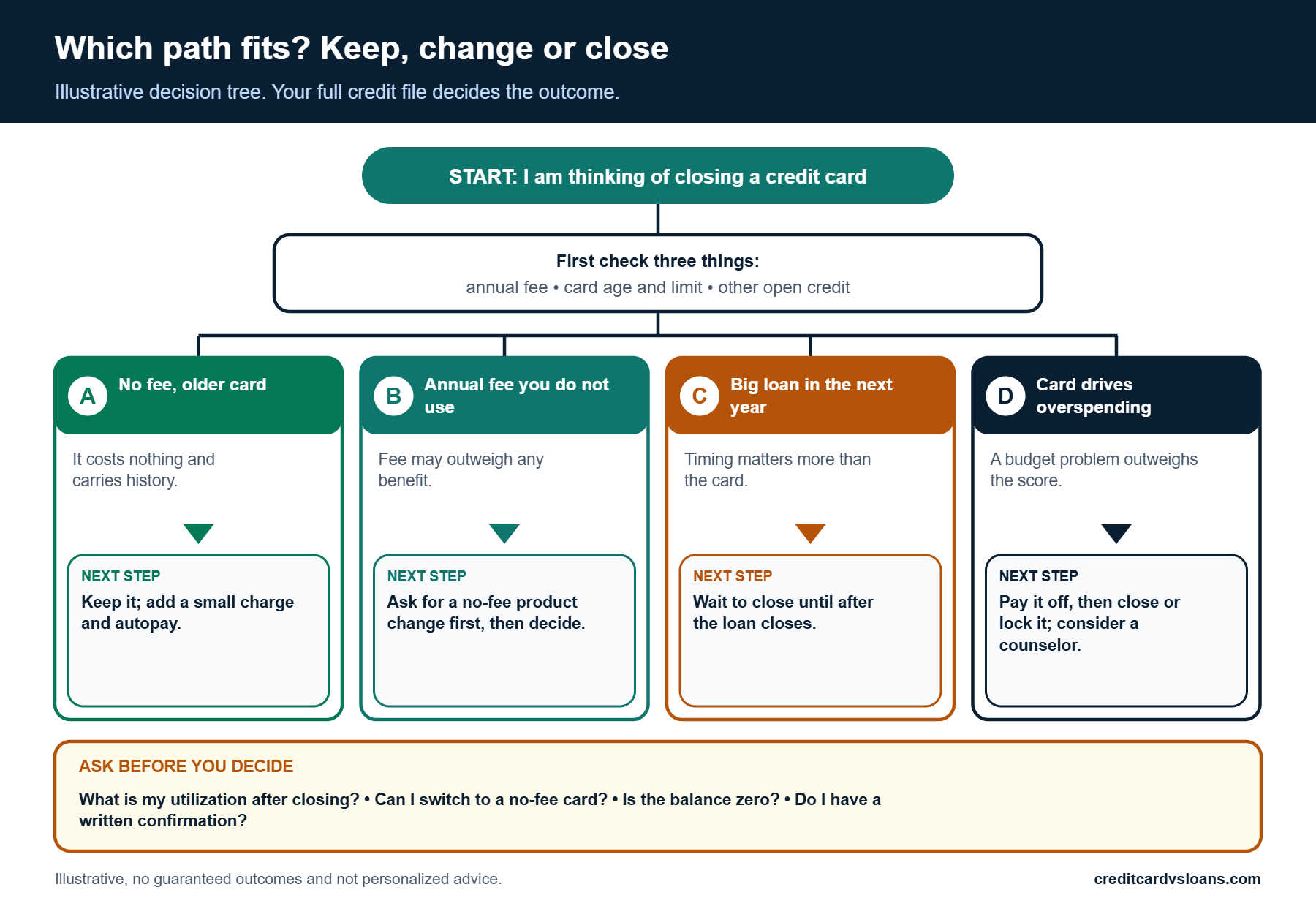
Pay the balance to zero if you can. Redeem rewards first, move any recurring charges to another card, and note any pending returns or disputes. Confirm that your autopay on other bills still points to a working payment method. Check your other cards’ balances and limits and estimate the new ratios.
If you are planning a major loan application, such as a mortgage, consider waiting to close the card until after the loan closes. Lenders pull your reports at application, and a temporary jump in utilization is the kind of thing worth avoiding at that moment.
Close it cleanly and confirm
Ask the issuer to close the account at your request, and get written confirmation, such as a letter or a message in your online account, that states the account is closed with a zero balance and that you closed it. Keep it with your records.
A few weeks later, pull your free credit reports at AnnualCreditReport.com. The FTC says you can check each bureau’s report weekly for free. Confirm that the account is shown as closed at your request and that the balance and history are accurate. If not, dispute the error with both the bureau and the issuer.
| Step | Why it matters | The catch |
|---|---|---|
| Pay the balance to zero | Avoids interest on a closed account | Needs available cash |
| Redeem rewards | Avoids forfeiting value | Rules differ by program |
| Move recurring charges | Prevents failed payments and fees | Easy to forget a subscription |
| Check other cards’ limits and balances | Shows the new utilization | Per-card ratios may differ from the overall |
| Get written confirmation | Proof of a consumer-initiated closure | Takes a few minutes |
| Review your reports in a few weeks | Catches reporting errors | Reports update on the bureaus’ schedules |
Which choice fits your situation
Cases where keeping is usually wiser
An older, no-fee card with a good record
This is the clearest case for keeping. The card costs nothing, it carries your history and its limit lowers your ratio. The CFPB’s observation about older accounts with positive payment history applies most directly here. A small recurring charge and autopay keep it active.
The only reasons to close are spending temptation or a security concern that you can’t manage with alerts. If neither applies, there is not much to gain.
A thin file or a big loan ahead
If you have only a few accounts, each one is a larger share of your file, and closing one has a bigger relative impact. If you are planning a mortgage or auto loan in the next year or so, the same logic applies: avoid changes that could temporarily push utilization up or shorten history right before the application.
Our guide to applying for a credit card and your credit covers the opposite side of the timing question, the effects of opening new accounts.
Cases where closing can make sense
High fee, low value
If the card carries an annual fee that you no longer recoup, and the issuer will not move you to a no-fee product, closing is a reasonable choice. Plan ahead: pay down other balances, keep a reserve of open credit elsewhere, and time the closure away from any major application.
A modest, temporary score dip is a cost you can often absorb, especially if you have other open cards with plenty of room.
A card that drives debt
If you tend to carry a balance on a card and can’t seem to pay it off, closing it for new purchases, or moving the balance to a lower-cost option, may serve you better than keeping it for the sake of a score. If you are weighing a move, see what happens to your credit score after taking out a personal loan and how a personal loan can affect your credit score for an alternative way to restructure card debt.
Protecting your finances comes first. A score can be rebuilt, but a growing high-interest balance gets more expensive every month.
Your checklist and the bottom line
A practical checklist
Before you decide
- List each card’s limit, balance, age and annual fee.
- Compute your overall utilization now and after the closure you are considering.
- Ask the issuer about a no-fee product change or retention offer.
- Check whether any big loan or rental application is coming in the next year.
- Pull your free reports at AnnualCreditReport.com and confirm limits and open dates.
If you close
- Pay the balance, redeem rewards and move recurring charges.
- Choose the newer or no-benefit card over your oldest account if you have a choice.
- Get written confirmation that you closed the account.
- Recheck your reports a few weeks later and dispute any errors.
The bottom line
How to decide
Does closing a credit card hurt your credit score? It can, mainly by shrinking your available credit and raising your utilization, and sometimes by shortening your history over time. The CFPB says the effect may be temporary or minor. The question is whether the card still earns its place in your wallet.
Keep a free, older card in good standing when you can. Close a card when the fee or the temptation outweighs a small, usually temporary score effect, and close it in a way that limits the damage.
Where to go next
To see how the ratio changes with your own numbers, read our credit card utilization guide. If a new card is on your mind, see whether applying hurts your credit. If you are comparing ways to handle card debt, start with how a personal loan can affect your credit score.
After you act, check your reports and give the change a few months to settle before drawing conclusions. A single data point rarely tells the whole story.
Quick answers to common follow-ups
Should I close a card I never use?
If the card has no fee and no temptation, there is usually little reason to close it. Its limit helps your ratio, and its age may help your history. If it has a fee you don’t want to pay, ask about a no-fee version first. If the issuer won’t offer one, closing is reasonable.
If you do keep it, treat it like any account: check statements and keep your contact information current so you don’t miss a notice that could affect the account.
Is it better to close a card or let the issuer close it?
The score effect is generally similar, since the limit leaves your total either way. The advantage of closing it yourself is control: you pick the timing, pay down other balances first and get written confirmation. Waiting for an issuer closure leaves you at the mercy of the issuer’s schedule.
If you are unsure, the cost of keeping a free card open is usually small, so most people only act when there is a reason.
How long until my score recovers after a closure?
No one can say, because recovery depends on what changed. If utilization rose, paying down balances can lower it again, and the effect can improve at the next reporting cycle. If the change was in history, time and new on-time payments on your other accounts matter. The CFPB describes the effect as potentially temporary or minor, but it does not give a timeline, and we could not find a primary source that does.
Your best check is your own reports and scores over a few months. Compare them to your baseline from before the closure.
Does it matter if I close a card with rewards or points?
It can. Rewards programs differ, and some forfeit unredeemed points or cash back when an account closes, while others let you transfer or redeem them for a short period. Read the program terms or ask the issuer before closing, and redeem anything of value first. A few minutes of reading can be worth more than the score effect you were worried about.
If the rewards are tied to a travel or bank relationship, ask whether closing the card affects other accounts with the same institution. Some benefits are bundled, and the terms are written in the account agreements.
What if I closed a card and now regret it?
You can apply for a new card, but that is a new application with an inquiry, as explained in our guide to applying for a credit card, and it will not restore the old account’s age. Some issuers will reopen a recently closed account on request, though policies vary and are not guaranteed. It is reasonable to ask politely if the closure was recent.
In most cases the better path is to keep other cards open, keep balances low and let time work. A single closure rarely defines a credit file.
What this guide cannot tell you
Your reports are the real test
The examples here are hypothetical, and they hold everything else constant, which real life rarely does. Your score depends on your whole file, the scoring model in use and your issuers’ reporting. A closure that costs one person a few points might make no visible difference to another.
The most reliable step is to look at your own numbers: your limits, your balances, the age of each account and your free reports. Make the decision on your costs and goals, and treat any score change as a side effect.
When to get a second opinion
If you are weighing a closure alongside a major decision, such as a home purchase, consider talking to the lender or a HUD-approved housing counselor about timing. If you are closing cards because you are overwhelmed by debt, a nonprofit credit counselor can review the full picture. Compare fees, read agreements and avoid any company that promises to erase accurate items from your report.
- CFPB: Does it hurt my credit to close a credit card?
- CFPB: Should I close my credit card?
- CFPB: How long does negative information remain on my credit report?
- FICO: What’s in my FICO Scores? (Factor weights and length of history)
- FICO: How FICO Scores look at credit card limits
- FICO: Balance transfers and your credit (Per-card and overall utilization)
- FTC: Free Credit Reports
Last updated: October 22, 2026. Rates, fees and lender rules change; verify current terms before acting.
The information on creditcardvsloans.com is provided for general educational and informational purposes only. It is not financial, legal, tax, credit, accounting or investment advice, and reading it does not create an advisor-client, fiduciary or any other professional relationship. Nothing here is an offer, solicitation or recommendation to borrow, lend or apply for any product.
Credit scores, interest rates, fees, eligibility rules, lender policies and laws change frequently and vary by lender, location and individual circumstances. Examples, figures and scenarios are illustrative only, do not predict your results and do not guarantee approval, savings, a particular rate or a credit-score outcome. Always confirm current terms directly with the lender or issuer and read the full agreement before you apply or sign.
Although we aim for accuracy and use reputable sources, we make no representations or warranties, express or implied, about the completeness, accuracy, reliability or timeliness of the content. Content may be drafted with the assistance of automated tools, so errors or omissions may still occur. Links to third-party sites are provided for convenience; we don’t control and aren’t responsible for their content.
To the fullest extent permitted by law, creditcardvsloans.com and its owners, editors, authors, contributors and affiliates disclaim all liability for any loss, damage or expense arising directly or indirectly from your use of, or reliance on, this content. Before making financial decisions, consult a licensed professional, such as a qualified financial advisor, attorney, tax professional or nonprofit credit counselor, who can consider your complete situation.