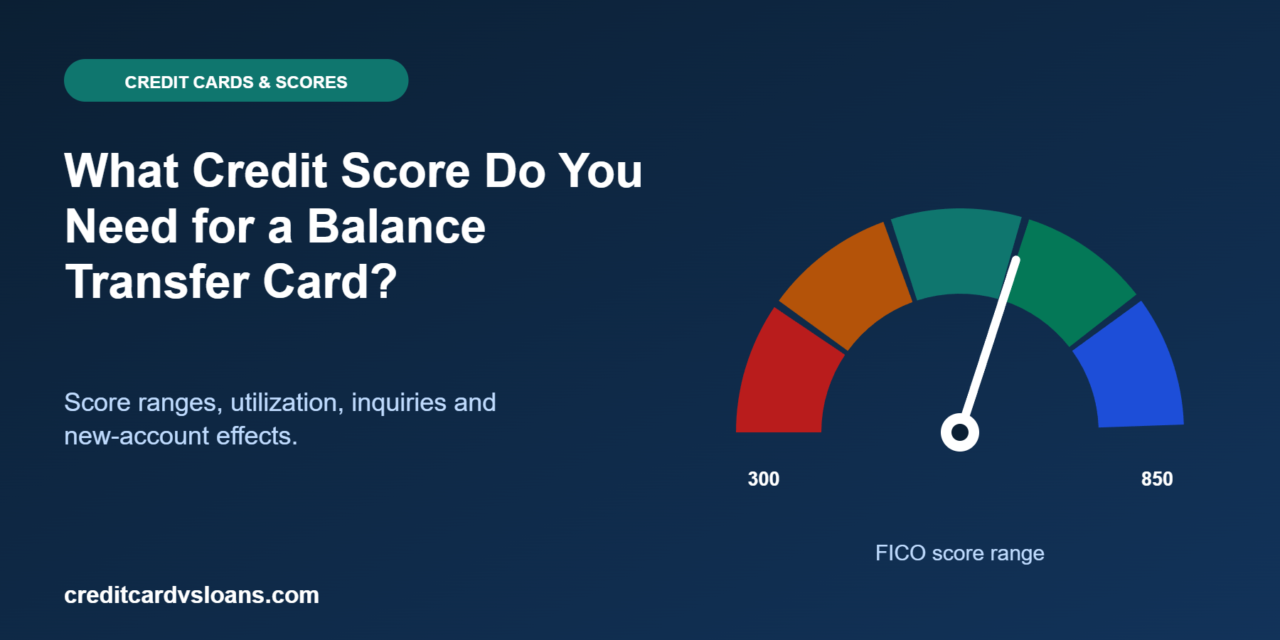
There is no published minimum balance transfer credit score, because issuers set their own approval standards and rarely disclose cutoffs. In general, the offers with the longest promotional periods and the lowest fees are aimed at applicants with good credit or better, which FICO defines as 670 and up. Lower scores can still get approved in some cases, usually with a smaller limit, a shorter promotion or a higher fee.
What matters just as much as the number is how the transfer itself moves your score. Three mechanics do most of the work: your utilization ratios on the new card and across all your cards, the hard inquiry from the application, and the new account’s effect on your average account age. Understanding them helps you judge both whether you are likely to qualify and what the move might do to your file.
This guide is about those score mechanics and score ranges. If you mainly want to know whether a transfer is good or bad for your credit over time, read our guide on whether a balance transfer hurts your credit, which covers the short-term and long-term picture. Everything here is general education, not a prediction of your score or an approval.
- Issuers don’t publish minimum scores for balance transfer cards, and the CFPB notes that if debt problems have hurt your score, you probably won’t qualify for low rates on a balance transfer.
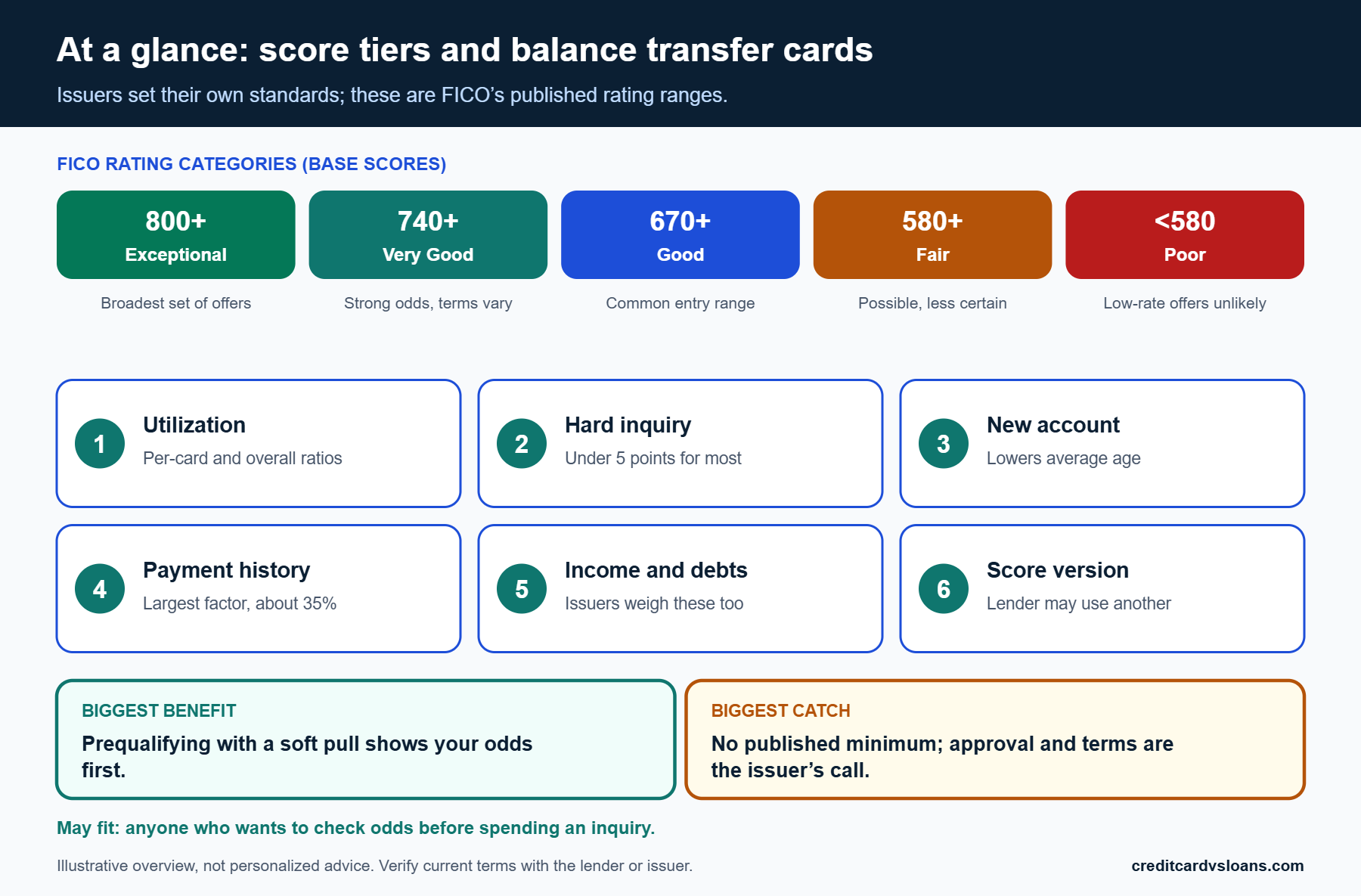
- FICO groups scores as Poor (below 580), Fair (580-669), Good (670-739), Very Good (740-799) and Exceptional (800+). Lenders may use different versions of scores than the ones you see.
- The application usually adds a hard inquiry, which FICO says costs fewer than five points for most people.
- Per-card and overall utilization can move in opposite directions, and you typically don’t know your new limit until you’re approved.
- A new account lowers your average account age, an effect FICO says usually isn’t huge and fades with time.
Score ranges and mechanics come from FICO and CFPB pages reviewed in October 2026. Rate figures come from the Federal Reserve’s G.19 release of October 7, 2026. Issuer standards and offers change often, and none of them are guaranteed to any applicant.
The short answer: what score do you need for a balance transfer card?
Why no one can give you a single number
Issuers keep their own standards
Card issuers decide approvals using their own models, which look at your credit reports, income, existing debts and recent activity, not only a three-digit score. They also decide the credit limit, the promotional period and the fee, which means two applicants with the same score can receive different outcomes. Because those standards are not published, any single minimum quoted online is an estimate.
The CFPB offers one useful signal. In its guidance on consolidating card debt, it says that if debt problems have hurt your credit score, you probably won’t qualify for low rates on a balance transfer, a consolidation loan or a home equity loan. That is a direction, not a threshold.
The score you see may not be the one used
FICO notes that lenders don’t all use the same score. Your lender may use a different FICO version than the ones sold on myFICO, or another type of credit score altogether. FICO also says it has industry-specific scores because credit card issuers and auto lenders evaluate creditworthiness differently.
That means a score from a free app or your bank may differ from what a particular issuer pulls. Treat your own score as a rough guide to a range, not a precise pass or fail.
Reading the score ranges
FICO’s five rating categories
FICO’s base scores run from 300 to 850 and fall into five categories: Poor is below 580, Fair is 580 to 669, Good is 670 to 739, Very Good is 740 to 799 and Exceptional is 800 and above. Many promotional offers are marketed to people at Good or above, but that is an observation about marketing, not a rule published by the issuers.
The table below shows how to think about each tier in practical terms. It is a general guide to likely experiences, not a promise of any outcome.
| FICO category | Score range | What it may mean for a balance transfer |
|---|---|---|
| Exceptional | 800 and above | Broadest set of offers is likely in play; terms still vary by issuer |
| Very Good | 740 to 799 | Strong odds with many mainstream offers; limits and terms vary |
| Good | 670 to 739 | Often the entry range for competitive promotional offers; approval is not assured |
| Fair | 580 to 669 | Approval is possible but less likely; limit may be small, fee or APR higher |
| Poor | Below 580 | Low-rate transfer offers are unlikely, per the CFPB’s general guidance; consider other routes |
What the ranges do not tell you
A score summarizes your file. It does not show the details issuers care about, such as how recently you opened accounts, whether you carry high balances, or whether you recently missed a payment. A person with a 700 score and a maxed-out card may get a different answer from a person with a 700 score and low balances.
That is why prequalification matters. Many issuers show whether you’re likely to qualify using a soft pull, which FICO says does not affect your score, and some show an estimated limit range before you commit to a hard inquiry.
A prequalification result is not an approval, and the final terms can differ from what the tool showed. Treat it as a way to avoid applications you are unlikely to win, not as a guarantee.
Utilization mechanics: how a transfer moves your ratios
Per-card and overall utilization
Two ratios, two stories
FICO says amounts owed is about 30% of a typical score, and utilization is calculated per account by dividing the balance by the limit. Its balance transfer guidance notes that the overall ratio, total balances over total limits, and the ratio on each individual card can both matter. A transfer changes both at once.
The overall ratio can fall when a new limit adds to your total available credit. The new card’s own ratio, however, starts out high because the moved balance sits on a limit you did not have before. FICO’s example: a $4,000 balance on a $5,000 limit is 80%, which could hurt, while on a $10,000 limit it’s 40%, which could help.
A worked hypothetical
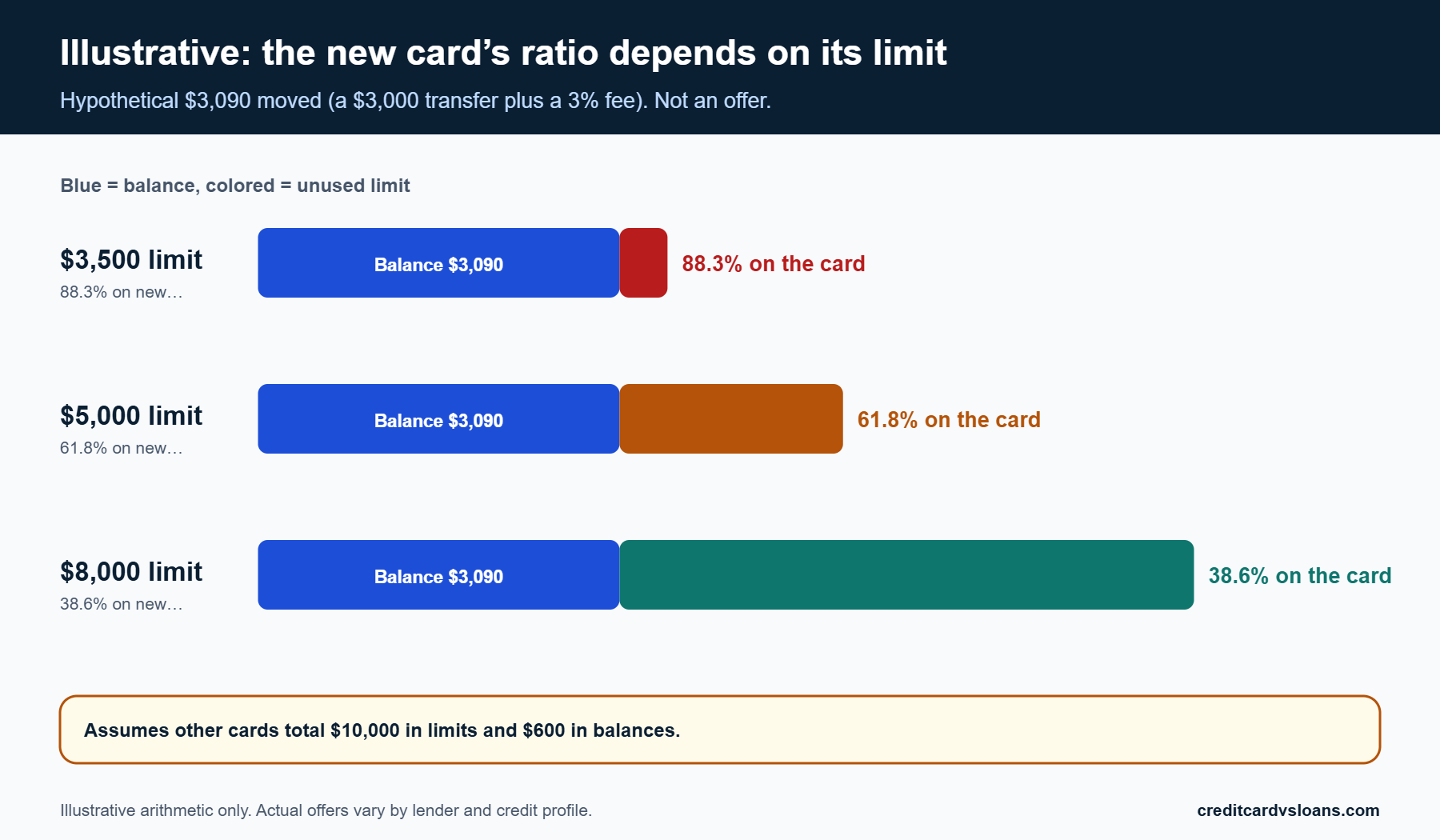
Suppose Card A has a $6,000 limit and a $3,600 balance (60%), and Card B has a $4,000 limit and no balance. Overall utilization is $3,600 over $10,000, or 36%. You apply for a new card and move $3,000 with a 3% fee ($90), so the new card carries $3,090 and Card A drops to $600 (10%).
If the new limit is $3,500, the new card is at about 88.3% and the overall ratio is $3,690 over $13,500, about 27.3%. If the limit is $5,000, the new card is at about 61.8% and the overall ratio is about 24.6%. If it is $8,000, the new card is at about 38.6% and the overall ratio is about 20.5%. The overall ratio improves in all three cases, but the new card’s own ratio swings a lot.
The limit lottery and the fee
You learn the limit after you apply
The new limit is the issuer’s decision, and you typically see it only after approval. That means the utilization result of a transfer is uncertain at the time you apply. FICO’s point is that the same balance can help or hurt depending on the limit, which you do not control.
A prequalification tool that shows an estimated limit range can reduce the surprise. If the limit that arrives is too small to hold the balance, the issuer may transfer less than you asked, leaving the remainder at the old card’s rate.
The fee raises the balance
The CFPB says card companies may charge a balance transfer fee even on a zero percent offer. In FICO’s example, a 3% fee on a $4,000 transfer produces a $4,120 balance. FICO’s page does not describe the fee itself as a scoring factor, but the larger balance means a higher ratio on the new card and more to repay.
That is one reason to size the transfer to the limit. Moving a balance that fills the limit to the brim leaves no room for the fee, and a card at or near its limit is the kind of per-card ratio that can weigh on a score.
Inquiry and new-account mechanics
The hard inquiry from the application
Size and duration
A balance transfer card requires a full application, which typically produces a hard inquiry. FICO says that for most people one additional hard inquiry costs fewer than five points, that FICO Scores consider inquiries for 12 months, and that inquiries can stay on your report for up to 24 months. New credit overall is about 10% of a FICO Score, and inquiries are only part of that category.
These are typical figures. Someone with a long, clean file may see little change, while someone with a thin file or several recent inquiries may see a larger relative effect. No one can predict the exact change in advance.
Soft pulls and rate shopping
Soft inquiries, such as checking your own report or a prequalification tool, do not affect your score, per FICO. FICO’s rate-shopping treatment, which can count multiple inquiries in a window as one, applies to mortgage, auto and student loan inquiries. It does not extend to credit cards, so the safe assumption is that each card application counts on its own.
This is the main reason to prequalify first. A well-chosen single application keeps the inquiry count low and gives you the best chance of an outcome you can use.
The new account and your average age
How the average moves
Length of credit history is about 15% of a FICO Score and includes the age of your oldest account, newest account and average account age. A new card enters the average at age zero. As a hypothetical example, imagine three cards open for 84, 36 and 12 months, an average of 44 months. Adding a new account makes the average (84 + 36 + 12 + 0) / 4 = 33 months.
FICO’s own guidance says the effect usually isn’t huge and that the average rises again over time, although opening several accounts in quick succession can hurt more. Your oldest account is unaffected by the new card, which is why it matters not to close it casually.
Why the old card’s fate matters
After the transfer, the old card has a zero or lower balance, and it’s tempting to close it. The CFPB says closing a card can raise your utilization ratio and lower your score, and that keeping an older account with positive history may help maintain a higher score. Our guide to credit card utilization explains how the ratio works.
The trade-off is behavioral. If you cannot trust yourself not to refill the card, closing it may be worth a small score effect. If you can, keeping it open preserves the limit and the history.
| Mechanic | What changes | Typical size or direction | How to limit it |
|---|---|---|---|
| Hard inquiry | Recorded when you apply | Fewer than 5 points for most people, per FICO | Prequalify with soft pulls; apply once |
| New account | Average account age falls | Small; recovers over time | Avoid opening several accounts at once |
| Per-card utilization | New card starts with the moved balance | Depends on the new limit | Size the transfer to the limit; pay down quickly |
| Overall utilization | Total limits rise; balances may be unchanged | Often improves | Keep old cards open if you can stay disciplined |
| Payment history | No change unless you miss a payment | Helpful if on time | Autopay at least the minimum |
Eligibility and cost: what issuers weigh and what a transfer costs
What issuers look at besides the score
Income, debts and recent activity
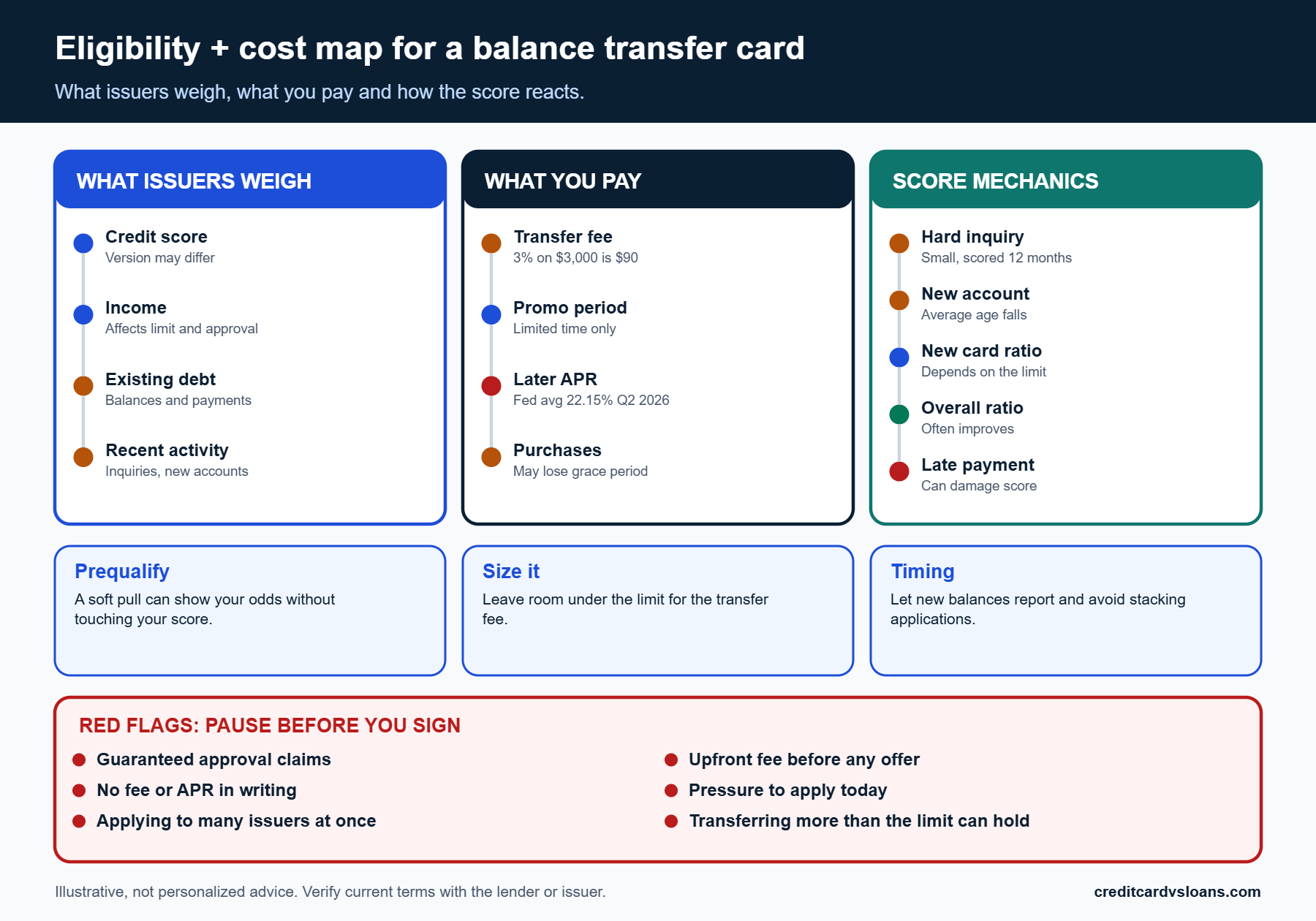
Issuers weigh your reported income, existing debt and recent credit activity along with your score. Some also consider whether you carry large balances on many cards, the number of recent inquiries and how long you’ve had credit. These criteria are not published and differ by issuer.
The practical consequence is that a denial from one issuer does not predict the result at another. It is worth reading the denial notice, which tends to list the main reasons, before applying elsewhere.
Ability to pay
Under federal rules implementing the CARD Act, card issuers must consider a consumer’s ability to make the required minimum payments before opening an account or increasing a limit. That is a general rule summarized from Regulation Z, and the specifics are in the regulation, so check the current text on consumerfinance.gov if it matters to you.
This is one reason income matters. A strong score with little reported income can still lead to a smaller limit than you hoped for, which brings us back to the per-card utilization problem.
Reading a denial notice
If an issuer declines your application or offers worse terms than advertised based on information in a credit report, you should receive a notice explaining the decision. The FTC says you are entitled to an extra free credit report if you received an adverse action notice, and you must request it within 60 days. Use it to look for errors and to see which factors weighed against you.
Common reasons include high balances relative to limits, too many recent inquiries or accounts and a short history. Each of those points to a different fix, so read the stated reasons before you apply anywhere else.
What the transfer costs
Fees, promotional rate and the rate after
The CFPB says a balance transfer fee is charged to transfer an outstanding balance to a different card and can be charged on a zero percent offer. Its consolidation guidance says to expect a fee that is usually a percentage of the amount transferred or a fixed amount, whichever is higher, and that the promotional rate lasts for a limited time, after which the rate may rise.
The Federal Reserve’s G.19 release of October 7, 2026 reported an average interest rate of 22.15% on credit card plans for accounts assessed interest in the second quarter of 2026. Your post-promotion rate may be lower or higher; it depends on the card and your credit profile.
An illustrative payoff plan
Using the earlier hypothetical, a $3,000 transfer with a 3% fee leaves a $3,090 balance on the new card. To clear it within a 12-month promotional period, you would pay $257.50 per month. Over 15 months it would be $206 per month. The fee is $90 in either case.
If you left the $3,000 on a 22.15% card and paid it off in 12 equal payments, the interest would be roughly $372, so the hypothetical saving is on the order of $282. These are rounded illustrations, not offers, and your real numbers depend on your terms.
Multiply your balance by your APR and by the fraction of a year you expect to carry it. If that interest is smaller than the transfer fee, the transfer probably does not pay for itself.
| Term | Why it matters | Where to look |
|---|---|---|
| Transfer fee | Raises the balance you owe | Offer terms and cardholder agreement |
| Promotional period | Sets your payoff deadline | Offer terms; ask when the clock starts |
| Rate after the promotion | Applies to what remains | Offer terms |
| Grace period on purchases | May be lost while a balance is carried | Cardholder agreement |
| Credit limit | Drives the per-card ratio | Approval notice |
Why your score may differ from what the issuer sees
Versions, bureaus and timing
Different models, different numbers
FICO has updated its scores over time, and all FICO Score products on myFICO include FICO Score 8 and may include other versions. Your lender may use a different version or a different type of score entirely. Credit card issuers in particular may use industry-specific versions, which FICO says exist because card issuers and auto lenders evaluate creditworthiness differently.
VantageScore is another scoring system that some lenders and apps use. The practical lesson is the same: the number on your screen may not be the number the issuer sees, and the gap can be several points either way.
Different bureaus, different files
Your credit reports at Equifax, Experian and TransUnion can hold slightly different information because not every lender reports to every bureau. The FTC says to review all three reports for that reason. An issuer may pull one bureau or more than one, so an error on a single report can matter.
Pull your free reports at AnnualCreditReport.com, which the FTC identifies as the only authorized site for the free reports, and check that balances, limits and account statuses are accurate before you apply.
Timing your application
Let reporting catch up
Scores reflect what lenders have reported, and reporting happens on each issuer’s schedule. If you’ve just paid down a balance, your score may not show it until the next report. If you are close to a tier boundary, waiting for the updated balances to appear can make a difference, though no one can promise a result.
This is the same idea as the statement-date timing covered in our guide to credit card utilization: the balance that gets reported is what the model sees.
Avoid stacking other applications
Each additional application adds an inquiry and, if approved, a new account. If you are planning a balance transfer, hold off on other applications in the months around it. This also helps if you are applying for a mortgage or auto loan, since the lender will look at recent activity.
Our guide to whether applying for a credit card hurts your credit goes deeper on inquiry timing and how to apply with less impact.
Free scores and what they are good for
Many banks and apps show a free score. These are useful for spotting trends, such as whether your number is rising after you pay down balances. They are less useful for predicting a specific approval, because the model, the bureau and the timing may differ from what an issuer uses. The FTC warns about imposter sites that claim to offer free reports or scores, and says AnnualCreditReport.com and the bureaus won’t email or call asking for your Social Security number.
Use free scores as a gauge and your reports as the source of truth. If the two disagree, the reports tell you why.
If your score is below the range: ways to improve your odds
Moves that tend to help
Lower balances and fix errors
If your utilization is high, paying down balances is the fastest lever and it reduces your interest costs at the same time. Check your reports for errors, such as wrong limits, accounts that aren’t yours or payments marked late in error. Dispute errors with both the bureau and the company that reported them, as the FTC advises.
Keep paying every account on time. Payment history is the largest FICO factor at about 35%, and a stretch of on-time payments is the most durable improvement.
Prequalify and match the offer to your tier
Use soft-pull prequalification tools to see which offers you’re likely to qualify for before applying. If your score is in the Fair range, you may see smaller limits or shorter promotional periods. An offer with a shorter promotion that you can pay off is better than a longer one you might not win.
It is also reasonable to ask whether the issuer has a lower-limit product that suits you. A small limit means you might not be able to move your whole balance, which changes the math.
Alternatives if a transfer card is out of reach
Ask your current issuer
The CFPB suggests asking creditors for lower payments, waived fees, a lower rate or a due date that fits your pay schedule. Many issuers have hardship programs. It costs nothing to ask, and a lower rate on your existing card might close part of the gap.
If you carry balances across several cards, consider which card has the highest rate and direct extra payments there first.
Loans and counseling
A fixed-rate personal or consolidation loan is another way to restructure card debt, with its own inquiry, fees and credit effects. See our comparison of a 0% APR card and a personal loan and the back-to-school version for the cost comparison. A nonprofit credit counselor can also review your whole situation and discuss a debt management plan.
Be careful of companies that advertise debt relief with large upfront fees. The CFPB says some advertised consolidation services are actually debt settlement companies that may tell you to stop paying creditors, which it describes as risky.
Pitfalls when you are short of the range
Don’t chase approval with multiple applications
It can be tempting to apply at several issuers in a row hoping one says yes. FICO’s guidance says several inquiries in a short span after declined applications can compound the damage, and rate-shopping treatment does not cover credit cards. Each denial still leaves an inquiry. A single, well-chosen application after prequalifying is a better plan.
If you do get a series of denials, pause, read each notice and work on the reasons. A few months of lower balances and on-time payments can change the picture more than a fifth application.
Beware offers that sound too good
People with lower scores are a target for deceptive offers. Be wary of anyone who guarantees approval, asks for an upfront fee before you receive any credit, or won’t put the fee and APR in writing. The CFPB also warns about advertised consolidation services that turn out to be debt settlement companies, which can charge upfront fees and tell you to stop paying your creditors.
A legitimate card offer shows its terms before you apply and does not require payment to be considered. If something feels off, walk away and check the issuer’s name and contact details independently.
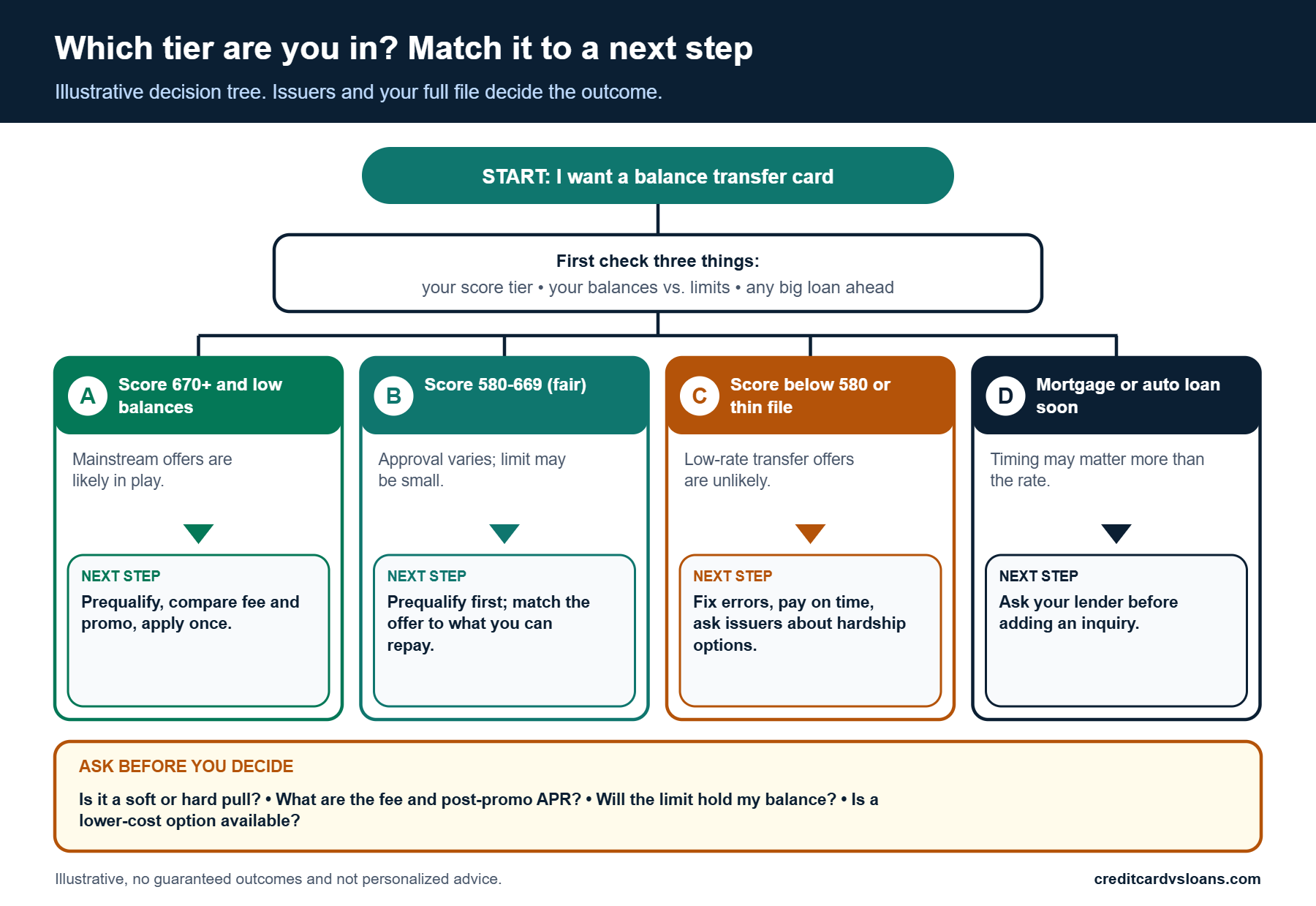
Which tier are you in? Matching your situation to a next step
Higher-score situations
Good to Exceptional (670 and up)
If your score is in the Good range or above and your balances are manageable, you are in the group most often targeted by competitive promotional offers. Prequalify, compare the fee, promotional period and post-promotion rate on an apples-to-apples basis, and apply for one.
Even at higher scores, the per-card ratio on the new card deserves attention. A high score does not guarantee a high limit, and the transfer can still land at a high ratio on the new card.
Big loan ahead
If you plan to apply for a mortgage or auto loan, think about sequencing. A new card adds an inquiry and a new account. For some borrowers, the best timing is after the big loan closes. Ask your lender. If the interest on your current balances is costly, the savings may justify moving first.
Our companion guide, does a balance transfer hurt your credit, covers the short- and long-term picture in more detail.
Lower-score situations
Fair (580 to 669)
Approval may be possible but less certain, and the terms are likely to be less generous. Be sure to read the fee and the post-promotion rate carefully. If you apply and are declined, the inquiry still posts. Prequalify first, and consider whether strengthening your file for a few months would change the result.
Make a plan to pay down balances, keep every payment on time and check for report errors. Then revisit the offers.
Poor (below 580) or a thin file
Low-rate transfer offers are unlikely, per the CFPB’s general guidance. Focus on the basics: stop adding to balances, make every payment, ask your issuers about hardship options and consider a nonprofit counselor. If you have a thin file, our guide to building credit with a student card explains a gradual approach.
Avoid offers that promise guaranteed approval or ask for an upfront fee. Those are red flags.
Your checklist and the bottom line
A practical checklist
Before you apply
- Pull your free reports at AnnualCreditReport.com and correct errors.
- Note your balances, limits and per-card ratios.
- Prequalify with soft pulls and compare offers on fee, promotional period and post-promotion rate.
- Decide the monthly payment that would clear the transferred balance before the promotion ends.
- Avoid other applications in the surrounding months, especially before a mortgage.
After you are approved
- Check the limit and size the transfer to leave room for the fee.
- Keep paying the old card until the transfer posts.
- Set autopay and pay more than the minimum.
- Keep the old card open if you can stay disciplined, or have a plan if you close it.
- Recheck your reports in a few weeks.
The bottom line
How to decide
The balance transfer credit score you need is not a fixed number. Good credit, meaning 670 or higher on the FICO scale, is the range most competitive offers are aimed at, but issuers set their own standards. Whatever your tier, the transfer itself will usually add an inquiry, a new account and a utilization shift that depends on the limit.
Prequalify first, apply once and size the transfer to the limit you receive. Judge the move by the interest you save and your ability to pay on time, not by the score effect alone.
Where to go next
If you want the short- and long-term view of whether a transfer helps or hurts, read does a balance transfer hurt your credit. For the ratio mechanics, see credit card utilization. For the inquiry side, see whether applying for a credit card hurts your credit, and for cost comparisons see 0% APR card versus personal loan.
After you act, check your reports and give the changes a few months to settle before judging the result.
Quick answers to common follow-ups
Can I get a balance transfer card with a score in the 600s?
It’s possible, but there is no guarantee, and no published minimum exists. The result depends on the issuer, your income and debts, and your recent activity. Expect that an offer may come with a lower limit or a shorter promotional period. Prequalify to see your odds, and read the terms before you apply.
If you’re declined, read the notice. The FTC says you may be entitled to an extra free report after an adverse action notice, which you must request within 60 days.
Will paying off the transferred balance raise my score?
Paying down balances lowers utilization, which is part of the amounts-owed category, about 30% of a FICO Score. That generally helps, but no one can promise a specific change. The benefit is clearest when the balance on the new card falls, the old card stays near zero and you keep paying on time.
Scores reflect what is reported, so the change may appear after the next reporting date.
Is it better to transfer to a new card or use a loan?
It depends on the amount, the time you need and the fees. A card works well when you can pay the balance before the promotion ends. A loan works well when you need a longer, fixed schedule. Compare total cost, not just the monthly payment, and see the linked cost comparison guide for a closer look.
Both options involve an application and an inquiry, so avoid doing both at once.
How long should I wait before reapplying after a denial?
There is no official waiting period. A practical approach is to wait until something concrete has changed, such as lower balances, a corrected report error or a few months of on-time payments, before applying again. Inquiries count in FICO Scores for 12 months, so repeated applications inside that window add up.
Prequalification can tell you whether your odds have improved without adding an inquiry. Use it before every new application.
Does the promotional period start when I’m approved or when I transfer?
It depends on the offer. Some promotions run from account opening and others from the transfer date, and some require the transfer to be made within a set number of days to qualify for the promotional rate. The terms spell this out, and the answer changes your payoff plan, so read it before you apply and ask the issuer if it isn’t clear.
Mark the end date on a calendar the day you’re approved, and work backward to set your monthly payment target.
Should I tell the issuer about my existing debts?
Report your income and obligations accurately on the application. Misstating income or debts can cause problems, and issuers generally verify what they can. Accuracy also protects you from taking on a limit or payment you can’t manage.
If you aren’t sure what counts as income on the form, read the instructions on the application or ask the issuer before you submit.
What happens to my score if the promotion ends and I still owe?
The score effect comes from the balance and the payments, not from the end of the promotion itself. If the remaining balance stays on the card and you keep paying on time, your payment history stays positive, though the interest at the regular rate will cost more and the per-card ratio stays elevated until you pay it down.
Before the promotion ends, check the post-promotion rate and decide whether to pay the rest in a lump sum, keep paying on a schedule or look at a lower-cost alternative, always comparing total costs.
What this guide cannot tell you
Your approval is the issuer’s decision
Nothing here guarantees approval, a limit or a rate. Issuers decide based on their own models and your full file. The tiers and numbers are general guides drawn from FICO’s published ranges and the CFPB’s general guidance.
The reliable way to learn your odds is to prequalify, which uses a soft pull. The reliable way to judge the outcome is to track your reports and balances over several months.
Get help if the debt is the problem
If your debt is growing or the minimums are hard to meet, a nonprofit credit counselor can review your situation. Look for transparent fees, avoid companies that demand large upfront payments and read every agreement before you sign.
The CFPB and the FTC publish free guides on choosing counselors and recognizing scams, and they are worth reading first.
- FICO: What is a FICO Score? (Score ranges and rating categories)
- FICO: What’s in my FICO Scores? (Factor weights)
- FICO: Balance transfers and your credit (Inquiry, new account and utilization examples)
- FICO: How to Rate Shop and Minimize the Impact to Your FICO Scores
- FICO: How long do hard inquiries stay on your credit report?
- CFPB: What do I need to know about consolidating my credit card debt?
- CFPB: What is a balance transfer fee?
- CFPB: Does it hurt my credit to close a credit card?
- FTC: Free Credit Reports
- Federal Reserve: Consumer Credit – G.19 (October 7, 2026) (Credit card plan interest rates, Q2 2026)
Last updated: October 22, 2026. Rates, fees and lender rules change; verify current terms before acting.
The information on creditcardvsloans.com is provided for general educational and informational purposes only. It is not financial, legal, tax, credit, accounting or investment advice, and reading it does not create an advisor-client, fiduciary or any other professional relationship. Nothing here is an offer, solicitation or recommendation to borrow, lend or apply for any product.
Credit scores, interest rates, fees, eligibility rules, lender policies and laws change frequently and vary by lender, location and individual circumstances. Examples, figures and scenarios are illustrative only, do not predict your results and do not guarantee approval, savings, a particular rate or a credit-score outcome. Always confirm current terms directly with the lender or issuer and read the full agreement before you apply or sign.
Although we aim for accuracy and use reputable sources, we make no representations or warranties, express or implied, about the completeness, accuracy, reliability or timeliness of the content. Content may be drafted with the assistance of automated tools, so errors or omissions may still occur. Links to third-party sites are provided for convenience; we don’t control and aren’t responsible for their content.
To the fullest extent permitted by law, creditcardvsloans.com and its owners, editors, authors, contributors and affiliates disclaim all liability for any loss, damage or expense arising directly or indirectly from your use of, or reliance on, this content. Before making financial decisions, consult a licensed professional, such as a qualified financial advisor, attorney, tax professional or nonprofit credit counselor, who can consider your complete situation.