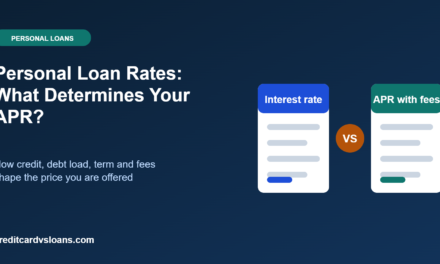
The personal loan APR vs interest rate difference comes down to this: the interest rate is the yearly price of the money you borrow, while the annual percentage rate (APR) is a broader yearly figure that also builds in certain fees, most often the origination fee. When a loan has no such fees, the two numbers can be the same. When it does, the APR will be higher, and the APR is the number to use for comparing offers.
That sounds simple, but lenders advertise both numbers, often in different places, and a low interest rate can sit next to a high APR without anyone pointing it out. This guide shows how each number is built, works through hypothetical examples with the math, and explains what APR still leaves out so you do not treat it as the whole story.
- The interest rate is the cost of borrowing the principal. The APR combines that interest with certain fees into one yearly rate.
- Compare APR to APR, never an APR to an interest rate, and then check the total of payments in dollars.
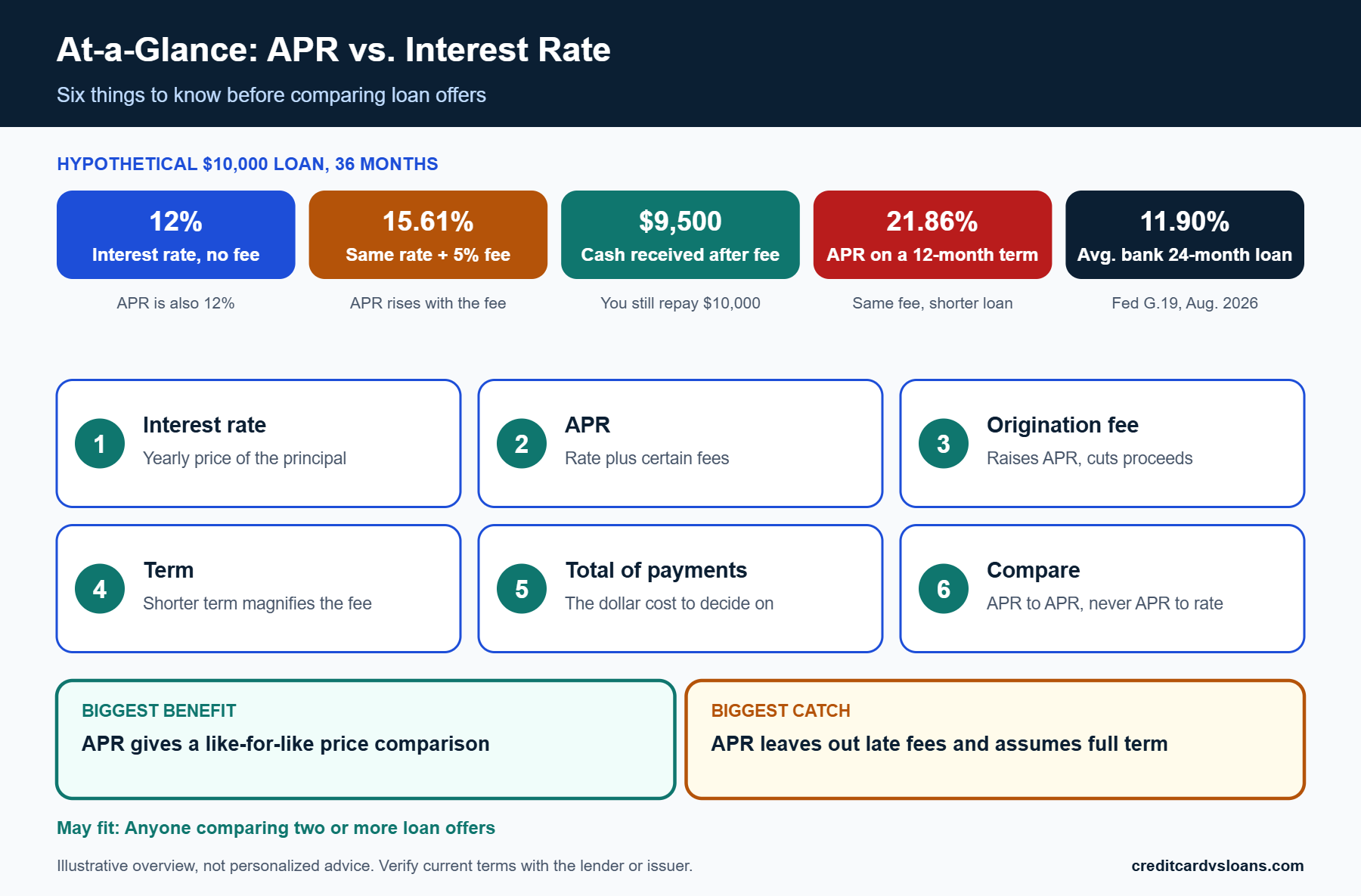
- An origination fee taken out of your proceeds raises the APR, and the effect is larger on shorter loans.
- APR does not include every cost, such as late fees, and it assumes you keep the loan for the full term.
- A lower interest rate does not always mean a cheaper loan once fees are counted.
Market figures come from the Federal Reserve’s G.19 consumer credit release of October 7, 2026. Examples are hypothetical and rounded, and your offer will depend on the lender, your credit profile and your state.
Table of contents
Personal Loan APR vs. Interest Rate: The Short Answer
The One-Sentence Difference
What the interest rate measures
The interest rate is the percentage a lender charges you each year to borrow the principal, the amount you actually owe. It drives the interest portion of every monthly payment. On a fixed-rate personal loan, it stays the same for the whole term, so the payment does too.
The interest rate says nothing about the other charges attached to getting the loan. A lender can quote a modest interest rate and still collect meaningful fees up front, and you would not see them in that figure at all.
What the APR measures
The APR is the cost of credit expressed as a yearly rate. It starts with the interest and adds certain finance charges, such as an origination fee, so it reflects more of what you pay for the credit. The Consumer Financial Protection Bureau (CFPB) describes it as combining the interest rate with fees the lender charges, and advises comparing APRs to APRs rather than to interest rates.
Because the Truth in Lending Act requires lenders to disclose an APR on covered loans, it gives you a common yardstick across lenders. It is the closest thing to an apples-to-apples price tag that comes with a loan offer.
Why the Two Numbers Differ
Fees are the main gap
The gap between the two figures is mostly fees. If a lender charges a 5% origination fee, that cost is spread across the loan’s term in the APR calculation, which pushes the APR above the interest rate. The larger the fee, and the shorter the term, the wider the gap.
That is why borrowers with lower credit tiers often see the biggest difference. Lenders that charge higher origination fees to riskier borrowers can show an APR well above the interest rate, as the examples later in this guide illustrate.
When the two are the same
If a loan has no origination fee or other finance charges that count toward the APR, the APR and the interest rate will be equal. Some lenders advertise no-fee personal loans for that reason, and in those cases the quoted rate and APR match.
Even then, read the fine print. A lender may build its costs into a higher interest rate instead of a fee, which means you pay the same money in a different place. The APR is what lets you see through that choice.
| Feature | Interest rate | APR |
|---|---|---|
| What it measures | Yearly cost of the principal | Yearly cost of credit, including certain fees |
| Includes origination fee? | No | Yes, when it is a finance charge |
| Best used for | Understanding the interest part of a payment | Comparing offers across lenders |
| Where you see it | Rate quotes and marketing | Required loan disclosure |
| Main limitation | Hides fees | Does not capture every cost or early payoff |
How a Personal Loan APR Is Built
What Counts Toward the APR
Charges that are part of the finance charge
Under Regulation Z, which implements the Truth in Lending Act, the finance charge is the cost of consumer credit as a dollar amount. It includes interest, and also charges such as service or transaction fees, loan fees and points, and fees for investigation or credit reports when those are charged as a condition of the credit. It also includes premiums for certain credit insurance and debt cancellation products, subject to conditions.
The APR is built from the finance charge, the amount financed and the payment schedule. In practice, that means an origination fee that the lender deducts from your proceeds is typically part of the finance charge, and it raises the APR.
Charges that are generally left out
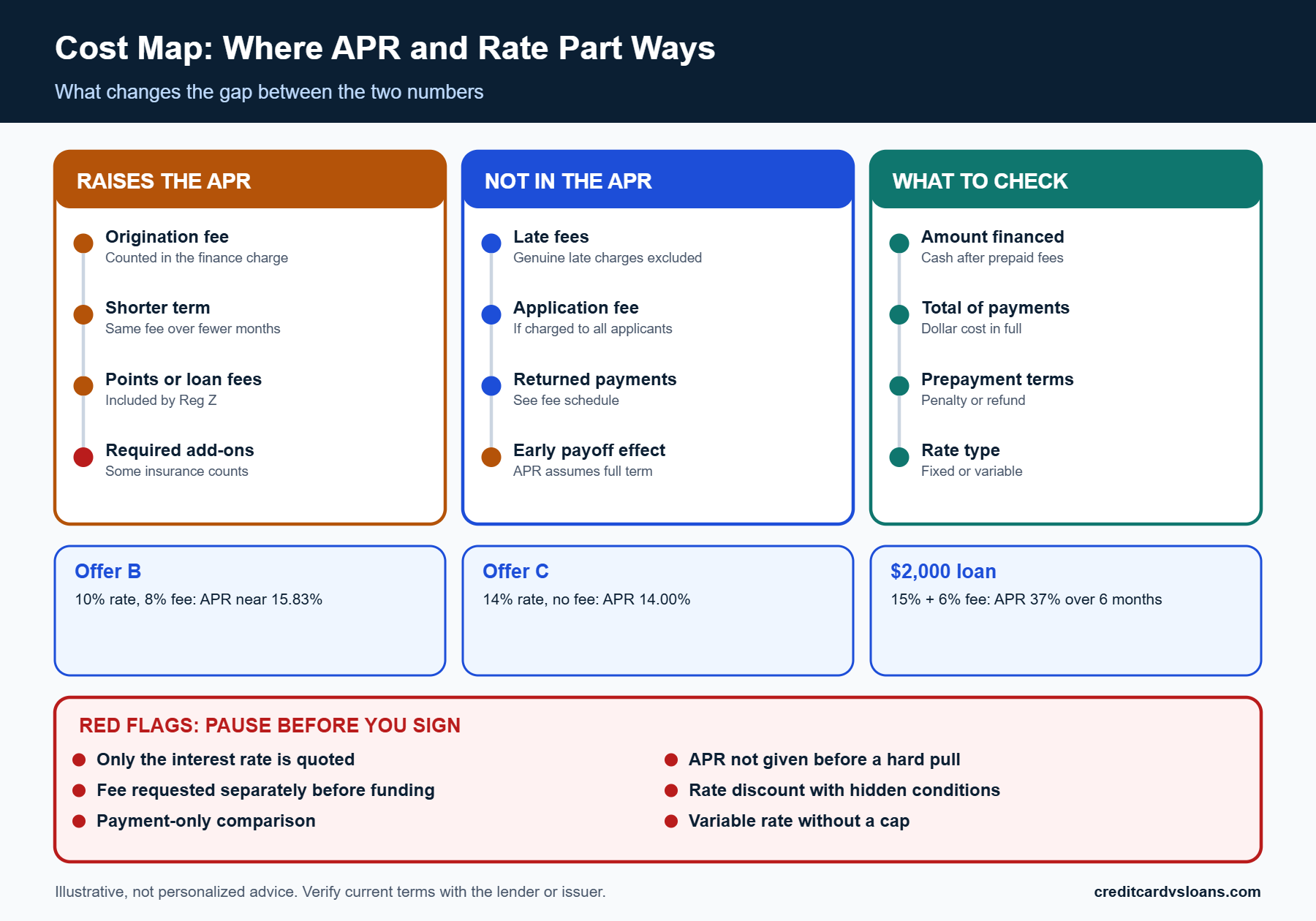
Some charges are excluded from the finance charge. Regulation Z excludes application fees that are charged to all applicants, whether or not credit is extended, and actual, unanticipated late fees. Insurance and debt cancellation premiums can be excluded when the coverage is optional and the required written disclosures and consent are in place.
That is why an APR can look clean while a late fee or an optional add-on still shows up in your costs. Always read the fee schedule in the agreement, not just the headline APR.
Amount Financed and the Total of Payments
Why proceeds can be smaller than the loan amount
For closed-end loans, lenders must disclose the amount financed, the finance charge, the APR and the total of payments. The amount financed is the credit you actually receive after prepaid finance charges are subtracted. If a lender deducts a fee from the loan, the amount financed is lower than the loan amount on the first page of the offer.
This matters when you need a specific amount. If you need $10,000 in hand and the lender takes a 5% fee out of proceeds, you may need to ask for a larger loan, which in turn raises the interest you pay.
How to read the disclosure box
The disclosure shows the finance charge as a dollar figure, the APR as a yearly rate, the total of payments, and the payment schedule, along with any late-payment charge and whether a prepayment charge applies. Put the dollar figures side by side. The total of payments minus the amount financed is the real cost of the loan if you keep it to term.
A good habit is to ask for the disclosure for each offer you are seriously considering before you share more personal information. For a wider comparison method, see how to compare personal loan offers on APR, fees, term and funding.
Worked Examples: Same Loan, Different Fee Structures
When Fees Move the APR
A $10,000 loan with and without an origination fee
Take a hypothetical $10,000 loan at a 12% interest rate over 36 months. The payment is about $332.14 and total interest is about $1,957.15. With no fee, the APR is 12%. Add a 5% origination fee ($500) taken out of the proceeds, and you receive $9,500 while still repaying the full $10,000, so the APR rises to about 15.61%.
The interest rate did not change, but the effective yearly cost rose by more than three and a half percentage points. The cost of credit becomes $2,457.15 when you add the fee to the interest, which is the number the APR is trying to express.
How the term changes the effect of the same fee
Fees weigh more heavily when the loan is short. Keep the same hypothetical 12% rate and 5% fee. Over 12 months, the APR is about 21.86%. Over 24 months, about 17.23%. Over 36 months, about 15.61%. Over 60 months, about 14.28%.
The longer term lowers the APR but not the total cost. At 60 months, the payment drops to about $222.44, but interest is about $3,346.67 plus the $500 fee. A lower APR from a longer term is not the same as a cheaper loan, so check the total of payments as well.
When a Lower Rate Is Not the Cheaper Loan
Three hypothetical offers for $10,000
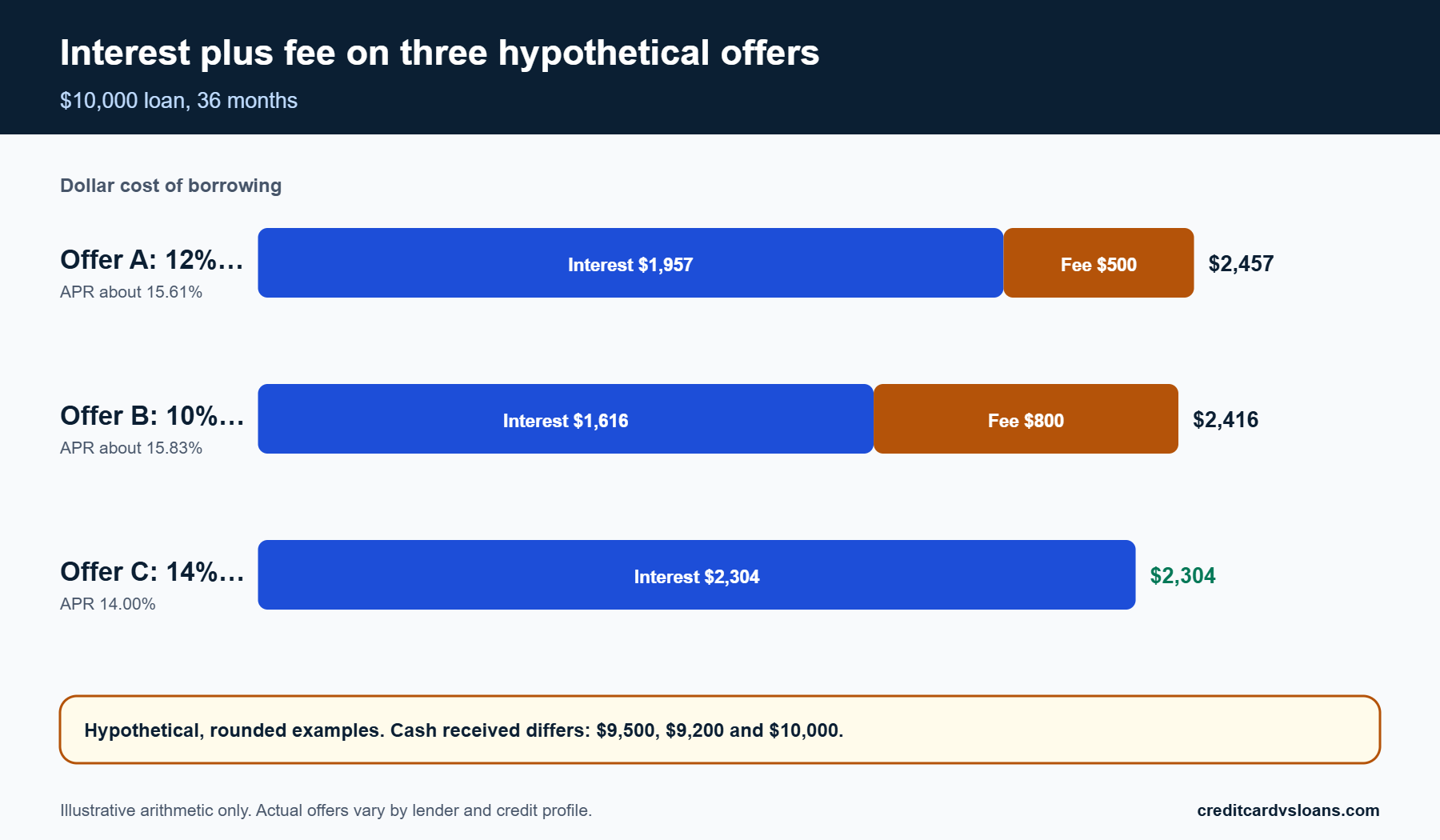
Suppose a borrower prequalifies for three hypothetical 36-month offers. Offer A has a 12% rate and a 5% fee. Offer B has a 10% rate and an 8% fee. Offer C has a 14% rate and no fee. Offer B has the lowest interest rate but the highest APR of the three, at about 15.83%, compared with 15.61% for A and 14.00% for C.
Here is how the dollars compare. Offer C costs about $2,303.95 in interest and has no fee. Offer B costs about $1,616.19 in interest plus an $800 fee, for $2,416.19. Offer A costs about $1,957.15 plus $500, for $2,457.15. Offers A and B also deliver less cash ($9,500 and $9,200), so the APR comparison is the fair one.
| Offer | Interest rate | Fee | Cash received | Monthly payment | APR | Interest plus fee |
|---|---|---|---|---|---|---|
| A | 12% | 5% ($500) | $9,500 | $332.14 | 15.61% | $2,457.15 |
| B | 10% | 8% ($800) | $9,200 | $322.67 | 15.83% | $2,416.19 |
| C | 14% | None | $10,000 | $341.78 | 14.00% | $2,303.95 |
Monthly payment is not the full story
Offer B has the lowest payment at $322.67, which makes it look attractive on a monthly budget basis. But you receive $800 less cash than Offer C, and the APR tells you that Offer B costs more per dollar you actually get.
If you are comparing a payment to a bill you must cover, look at the cash you receive. In some cases, a borrower may need to take a larger loan from Offer B or A to end up with $10,000 in hand, which raises both payment and interest. Use the APR to rank, then the dollar figures to decide whether you can live with the payment.
These are hypothetical, rounded examples to show the structure. A real APR is calculated from the exact payment dates and amounts on your disclosure, so the figure on your offer may differ slightly from any illustration here.
Short Loans, Early Payoff and Refinancing
Small and Short Loans
A $2,000 loan at three different terms
Fees hit small and short loans hardest. Take a hypothetical $2,000 loan at a 15% interest rate with a 6% origination fee ($120). Over 6 months, the payment is about $348.07 and the APR is about 37.07%. Over 12 months, the payment is about $180.52 and the APR is about 27.00%. Over 24 months, the payment is about $96.97 and the APR is about 21.40%.
The same interest rate produces three very different APRs because the fee is the same dollar amount spread over a shorter or longer period. If you only looked at the 15% rate, you would not see the difference.
A lower rate with a fee versus a higher rate without one
Compare that 12-month, 15% offer with a 6% fee to a hypothetical no-fee 12-month offer at 18%. The first has a payment of about $180.52 and costs about $286.20 in interest plus fee. The second has a payment of about $183.36 and costs about $200.32 in interest. The 18% loan is the cheaper one, and it also puts the full $2,000 in your account.
This is the clearest case for the rule of thumb: the loan with the lower stated rate is not always the lower-cost loan. The APR, 27.00% versus 18.00%, shows it at a glance.
Early Payoff and Refinancing
What paying off early does to the fee math
Return to the hypothetical $10,000, 12%, 36-month loan with a 5% fee. If you pay it off after 12 payments, you will have paid about $3,986 in payments, and the remaining balance is about $7,056. The interest paid over that year is about $1,042, and the $500 fee is already spent.
Your cost for borrowing for one year is therefore about $1,542, on proceeds of $9,500. That is higher per year than the APR on the disclosure suggests, because the APR assumed three years of use. Paying early still saves interest compared with keeping the loan, but the fee makes early payoff less of a bargain than it would be on a no-fee loan.
Refinancing with a new fee
When you refinance a loan, a new fee can apply on the new balance. Suppose a borrower has a hypothetical $5,000, 36-month loan option at 20% with no fee, costing about $1,689.45 in interest, and another at 17% with a 6% fee ($300), costing about $1,417.49 in interest plus the fee for about $1,717.49. The lower-rate offer has an APR near 21.49%, which is above the 20% of the no-fee loan.
The lesson applies to refinancing as much as to a first loan. A lower rate is only an improvement if the APR is also lower and you will keep the loan long enough for the savings to outweigh the fee.
What APR Does Not Tell You
Assumptions Built Into the APR
It assumes you keep the loan to term
The APR spreads the cost of fees across the full scheduled term. If you pay the loan off early, the interest stops growing, but a non-refundable fee has already been paid, so the cost per year of borrowing is higher than the APR suggested. In the hypothetical 12% loan above, the balance after 12 payments would be about $7,055.84, and the $500 fee would already be a sunk cost.
Ask the lender whether any part of the fee is refunded if you pay off early, and whether there is a prepayment penalty. Regulation Z requires the disclosure to state whether a prepayment charge may be imposed, so the answer should be on the paperwork.
Costs that sit outside the APR
Several costs may not appear in the APR. A late fee, for example, is typically excluded from the finance charge when it is a genuine, unanticipated late payment charge. Returned-payment fees and charges for optional services can also sit outside. They are real money if they apply to you.
The loan agreement will list them. Compare the fee schedule across lenders in the same way you compare APRs, especially if your budget is tight enough that a late payment is a realistic risk. Our guide to personal loans for bad credit covers how these costs stack up for higher-risk borrowers.
Fixed Rates, Variable Rates and How Interest Accrues
Fixed versus variable
Most personal loans carry a fixed interest rate, so the payment and the APR do not change after you sign. If a loan has a variable rate, the APR on the disclosure reflects the rate at the time, and later payments can move with an index, so the number on the page is not a guarantee of what you will pay.
If a lender offers a variable rate, ask how often it can change, whether there is a cap, and what your highest possible payment would be. Regulation Z requires disclosure of the payment schedule and, where payments can vary, the largest and smallest payments.
Simple interest and the front-loading of interest
Interest on an installment loan is charged on the remaining principal, so the early payments are interest-heavy. On the hypothetical $10,000 loan at 12%, the first month’s interest is about $100 of the $332.14 payment, which leaves about $232.14 to reduce principal. Each month the interest portion shrinks a little and the principal portion grows.
That pattern is why extra payments early in the loan save the most interest, and why paying off a loan early still helps even if a fee has been paid. Check that the lender applies extra payments to principal and does not simply move your next due date.
Where to Find Both Numbers Before You Commit
Prequalification Versus the Final Disclosure
What a prequalified quote shows
Many lenders let you check your rate with a soft credit pull, which does not affect your credit score and is not seen by other lenders as a hard inquiry. The quote typically shows an estimated rate or APR range, a loan amount and a term, and may mention a fee range.
Treat this as an estimate. Your final offer can change once the lender verifies your income and runs a hard pull. The point of prequalifying is to narrow the field, not to lock in a price.
What the final offer must show
Before you sign, the lender’s closed-end credit disclosure should state the amount financed, finance charge, APR, total of payments and payment schedule. This is the document to compare, not the marketing page, and you can ask for it before you accept.
If the APR on the final disclosure is higher than what you were quoted, ask why, and be prepared to walk away. For more on comparing final offers on term and funding as well as cost, read how to compare personal loan offers.
Questions to Ask a Lender
The rate, the fee and the APR
Ask for three numbers together: the interest rate, any origination or other fees (and whether they come out of the proceeds), and the APR. If you only get two of the three, you can usually work out the third by comparing them, but it is easier and safer to ask.
Ask also whether the APR depends on conditions such as enrolling in automatic payments or using the loan to pay creditors directly, and what happens to the APR if you stop meeting the condition.
How to read an advertisement
Advertised APRs are often shown as a range with the words “as low as.” The lowest figure is usually reserved for the strongest credit profiles, so a borrower with a lower score may see a number near the top of the range or above it. State law and lender policy may cap APRs, but caps vary and are not universal.
Look for the representative example in the fine print, which usually shows a sample loan amount, term, APR and payment. Use it as a reference, but rely on your own disclosure to decide.
Reading a Sample Disclosure Line by Line
Walking Through the Boxes
From the amount financed to the total of payments
Imagine the disclosure for hypothetical Offer A in Table 2. The amount financed would be about $9,500, because the $500 fee is taken from the $10,000. The finance charge, the dollar cost of the credit, would be about $2,457, made up of about $1,957 in interest and the $500 fee. The APR would be about 15.61%, and the total of payments would be about $11,957.
Check the arithmetic yourself: the total of payments minus the amount financed should equal the finance charge. If it does not, ask the lender to explain, because a mismatch can mean a fee you did not know about or a typo on the document.
Payment schedule, late charge and prepayment
The payment schedule should show the number of payments, the amount of each and the due dates. The late-payment charge should be disclosed as a dollar amount or percentage, and the document should say whether a prepayment charge applies or whether you would be entitled to a refund of any part of the finance charge.
These lines affect your real cost even when they do not change the APR, so read them before you sign and keep a copy of the signed disclosure.
Spotting Mismatches
When the cash you receive is lower than expected
If the amount financed is less than the amount you were promised, a fee has been deducted. That is allowed if it is disclosed, but you should not be surprised. If you need a specific amount, ask the lender to size the loan so that the amount financed meets your need.
Be wary of any request to pay a fee separately before funding. Fees that are part of the loan appear on the disclosure and are typically taken from proceeds or added to the balance, not requested up front from you in a separate payment.
When the APR looks off
If the APR on the disclosure is much higher than the quote, look for a fee or a changed term. If it is lower than you would expect from the rate and fee, ask for the explanation. APR rules allow small tolerances, but a large gap is worth a call to the lender or your state regulator.
You can also file a complaint with the CFPB if a lender will not provide clear disclosures. Having the numbers in writing is the best protection you have as a borrower.
How Rate, APR and Your Credit Profile Connect
Why Your Quote Differs From the Advertisement
Risk-based pricing
Lenders price each applicant based on the risk they see, which means two people can apply for the same loan and get different interest rates and fees. Credit history, income, existing debt, loan amount and term all matter. A larger fee for a riskier profile pushes the APR further above the interest rate.
For a closer look at the drivers behind your rate, read what determines your personal loan APR.
Requirements that shape the tier
Eligibility rules such as minimum income, maximum debt-to-income ratio and credit history decide which pricing tier you qualify for, if any. If your credit is rough, you may qualify only for tiers with higher fees, which is when the APR and the interest rate diverge most.
Our guides on personal loan requirements and personal loans for bad credit explain what lenders look at and how to compare more costly offers with safer alternatives.
Comparing Without Hurting Your Credit
Soft pulls first, hard pull last
Comparing offers through soft-pull prequalification lets you see rates and fees from several lenders without a hard inquiry on your credit report. A hard pull generally occurs when you formally apply for the loan you pick, and scoring models often treat clusters of similar inquiries made close together as a single event for rate shopping, though the window varies by model.
Keep your comparisons within a short period, and apply for only the offer you plan to take.
Comparing a loan with the debt it replaces
If the loan would pay off credit cards, compare the loan’s APR with the APR on each card, and add any fee. A lower interest rate that comes with a large origination fee might not be cheaper. The question is whether the total of payments on the new loan, plus the fee, is less than what you would pay on the old debt over the same period.
The step-by-step approach is in when a personal loan for debt consolidation can save money.
Market Context: What the Federal Reserve Data Shows
Benchmarks for Personal Loans and Credit Cards
Bank personal loan and credit card rates
In its G.19 consumer credit release of October 7, 2026, the Federal Reserve reported commercial bank rates for August 2026: an average of 11.90% for 24-month personal loans, 21.19% for credit card plans across all accounts, and 22.36% for accounts assessed interest. The Fed notes that its personal loan figure comes from banks’ most common rates for that product, so it reflects a typical bank customer.
Regulation Z defines the rates in that release as APRs, which means they are the same kind of number you will see on a loan disclosure. That makes them a reasonable reference point, but not a quote for your situation.
Why a card APR and a loan APR still differ
A credit card APR is a rate on a revolving balance that can change and does not have a fixed end date, while a personal loan APR applies to a fixed amount repaid over a set term and can include an origination fee. Comparing the two numbers directly is a useful first step, but the real cost depends on how long you carry the balance and what fees apply.
If you are comparing a loan with the cards it would pay off, use the same time horizon for both, and include the fee on the loan. Otherwise a lower number on paper may not translate to a lower cost.
Using Benchmarks Responsibly
Averages are not offers
An average blends many borrowers, including those with excellent credit. If your quote is higher than the average, it does not mean something is wrong, only that the lender sees more risk or the offer includes fees. If your quote is lower, confirm that it is not a teaser that changes or an APR that depends on a condition.
Use the average to ask better questions: why is my APR above this level, and what could bring it down? Possible answers include a shorter term, a smaller amount, a co-borrower or a stronger payment history.
Rates are a snapshot
Rates move with the Federal Reserve’s policy decisions and with lenders’ own pricing, so a figure from one month may not hold the next. Always get a current quote and disclosure rather than relying on a number from an article, including this one.
When you see a rate in the news, check the date and the product. A 24-month bank loan, a 60-month online loan and a credit union loan can each have different pricing for the same borrower.
Common Mistakes When Comparing APR and Interest Rate
Comparison Errors
Comparing an APR with an interest rate
The most common error is putting one lender’s APR next to another lender’s interest rate. The CFPB cautions against comparing APRs to interest rates, because one includes fees and the other does not. A 9% interest rate with a large fee can be costlier than a 12% APR with no fee.
If a lender gives you only the interest rate, ask for the APR. If the APR is not available until a hard pull, find out whether it is estimated or final, and compare final to final.
Shopping by monthly payment
A low monthly payment feels like a good deal, but it can come from a longer term or a lower amount financed. In Table 2, the lowest payment belonged to the offer with the highest APR. A payment is a budget number, not a price.
Rank offers by APR for the same amount and term, then check whether the payment fits your budget. If the cheapest offer has a payment you cannot afford, look at a smaller loan rather than a longer term with a higher total.
Marketing Traps
Ranges and “as low as” claims
Headline rates reflect the best case. A borrower with a good score and low debt may get the lowest rate, while others pay more. The prequalification tool is the fair way to see where you land. Avoid applying based on the advertised minimum.
Some ads show only the interest rate in large type and the APR in small type. Look for the APR and the total of payments.
Discounts that depend on conditions
Some lenders offer a rate discount for autopay or for sending funds directly to creditors. Check whether the quoted APR includes that discount and what happens if you lose it. A discount of a fraction of a percentage point may be worth having, but not if it comes with a larger fee.
Read the agreement for the terms of any discount, and set up payments in a way that you can keep up even in a tight month.
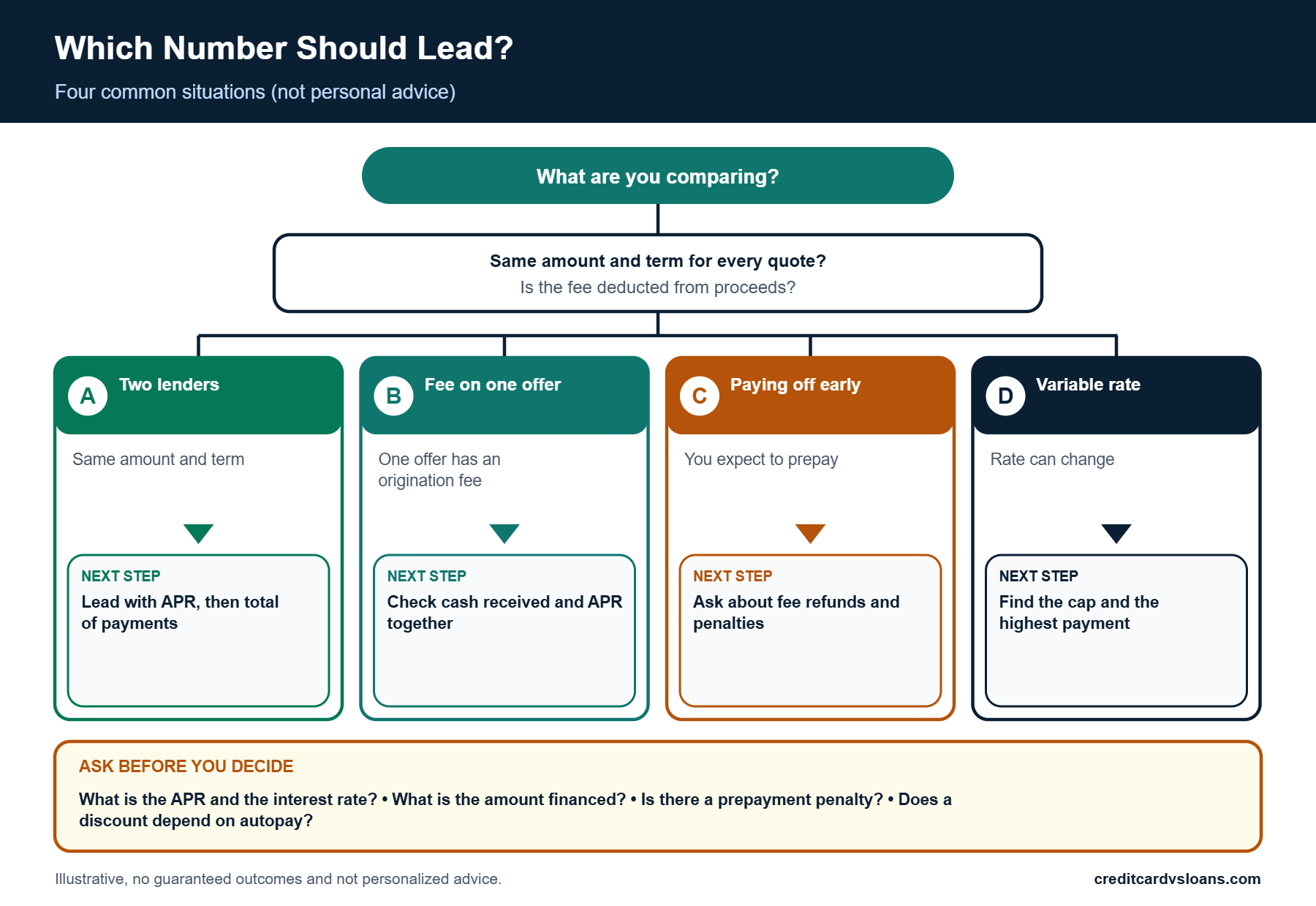
Decision Checklist and Next Steps
Choosing Between Offers
A decision matrix
This matrix shows how to think about the APR and interest rate in several common situations. It is a framework, not personal advice.
| Situation | Number to lead with | Why | What to verify | When to be cautious |
|---|---|---|---|---|
| Comparing two lenders | APR | Includes fees on both | Same amount and term | If APR depends on a condition you may lose |
| Offer has an origination fee | APR and cash received | Fee reduces proceeds | Amount financed on the disclosure | If you need an exact amount in hand |
| Planning to pay off early | Total cost and fee refund terms | APR assumes full term | Prepayment penalty and fee refunds | If the fee is non-refundable |
| Consolidating card debt | APR versus each card’s APR | Like-for-like comparison | Total of payments versus the debt | If balances will grow again |
| Variable-rate offer | Highest possible payment | APR can change | Cap and adjustment schedule | If a higher payment would strain your budget |
When the interest rate is the right number
The interest rate is useful when you want to understand how much of each payment goes to interest, or when you are comparing two loans with the same fee and term. It is also the number that drives how fast your balance falls if you make extra payments.
For choosing among lenders, however, the APR and the total of payments are the better tools.
Your Next-Step List
Before you accept an offer
- Ask each lender for the interest rate, the origination fee, the APR and the total of payments.
- Use the same loan amount and term for every quote.
- Check how much cash you will receive after fees.
- Ask about prepayment penalties and fee refunds.
- Check whether any rate discount depends on conditions.
- Confirm the late-payment fee and when it applies.
- Compare the monthly payment with your budget in a tight month.
Frequently asked questions
Is a lower interest rate always better? No. If the loan carries a large fee, a lower interest rate can still produce a higher APR and a higher total cost. Compare APRs and the dollar cost of interest plus fees.
Can the APR be lower than the interest rate? For a typical personal loan with fees, the APR is equal to or higher than the interest rate. If you see a lower APR, ask the lender to explain how it was calculated, because the disclosure should reflect the finance charge. The bottom line: use the APR to compare, the interest rate to understand your payment, and the total of payments to decide what you can live with. Personal loan rates and comparing personal loan offers pick up from here.
More Questions Borrowers Ask
Does the APR change if my credit changes?
On a fixed-rate loan, the APR on your signed disclosure does not change because your credit score changes later. What can change is the offer you would get on a new loan. If your credit improves meaningfully after a year or two of on-time payments, you might qualify for a lower rate elsewhere, but refinancing can bring a new fee, so run the same APR and total-of-payments comparison before you switch.
Nobody can promise that a better score will lead to a better offer. Lenders also look at income and debt, which can move in either direction.
Where each cost shows up
It helps to know where to look for each cost on your paperwork. The table below summarizes how common charges relate to the interest rate, the APR and the total of payments.
| Cost | In the interest rate? | In the APR? | Where to find it |
|---|---|---|---|
| Interest | Yes | Yes | Rate and payment schedule |
| Origination fee | No | Usually yes | Amount financed and finance charge |
| Late fee | No | Generally not | Late-payment charge on the disclosure |
| Application fee charged to all applicants | No | Generally not | Fee schedule |
| Optional insurance or add-ons | No | Depends on conditions | Itemization and signed election |
| Prepayment penalty | No | Not counted | Prepayment line on the disclosure |
If Something Looks Wrong
Questions to raise with the lender first
If the numbers on your paperwork do not match what you were told, ask the lender in writing to explain the difference and to send a corrected disclosure if needed. Keep a record of the date, the person you spoke to and what was said.
Do not make a payment or agree to extra fees to resolve a disclosure question, and do not send money to a third party who contacts you about the loan. Legitimate lenders handle fees through the loan documents.
Where to file a complaint
If the lender does not respond, you can submit a complaint to the CFPB online or by calling (855) 411-2372, or contact your state attorney general or banking regulator. State law can add protections or limits on what a lender may charge, and the regulator can tell you what applies where you live.
You can also ask a nonprofit credit counselor or legal aid attorney to review a loan agreement before you sign, which can be worth doing for a large loan or a high-APR offer.
- CFPB: What is the difference between a loan interest rate and the APR?
- eCFR: 12 CFR 1026.4 Finance charge
- eCFR: 12 CFR 1026.18 Content of disclosures
- Federal Reserve: G.19 Consumer Credit, release of October 7, 2026
- myFICO: What is in your credit score
Last updated: October 22, 2026. Rates, fees and lender rules change; verify current terms before acting.
The information on creditcardvsloans.com is provided for general educational and informational purposes only. It is not financial, legal, tax, credit, accounting or investment advice, and reading it does not create an advisor-client, fiduciary or any other professional relationship. Nothing here is an offer, solicitation or recommendation to borrow, lend or apply for any product.
Credit scores, interest rates, fees, eligibility rules, lender policies and laws change frequently and vary by lender, location and individual circumstances. Examples, figures and scenarios are illustrative only, do not predict your results and do not guarantee approval, savings, a particular rate or a credit-score outcome. Always confirm current terms directly with the lender or issuer and read the full agreement before you apply or sign.
Although we aim for accuracy and use reputable sources, we make no representations or warranties, express or implied, about the completeness, accuracy, reliability or timeliness of the content. Content may be drafted with the assistance of automated tools, so errors or omissions may still occur. Links to third-party sites are provided for convenience; we don’t control and aren’t responsible for their content.
To the fullest extent permitted by law, creditcardvsloans.com and its owners, editors, authors, contributors and affiliates disclaim all liability for any loss, damage or expense arising directly or indirectly from your use of, or reliance on, this content. Before making financial decisions, consult a licensed professional, such as a qualified financial advisor, attorney, tax professional or nonprofit credit counselor, who can consider your complete situation.