Personal loan rates are not one number. The annual percentage rate (APR) you are offered is a price lender sets after weighing your credit history, your income and existing debts, the size and length of the loan, and what the lender charges to make it. That is why the same loan amount can come with very different rates for two applicants on the same day.
This guide explains each of those drivers in plain English, shows what the Federal Reserve’s latest published data says about typical bank rates, and walks through illustrative math so you can see how a few percentage points and a few fees change what you actually pay. It does not predict the rate you will get, because no article can. It gives you a way to read an offer, compare it with others, and decide whether to go ahead.
A quick word on scope: other guides on this site go deeper on adjacent questions. If you want to know what lenders look for on an application, see personal loan requirements. If you already have offers in hand, how to compare personal loan offers covers APR, fees, term and funding side by side. This page stays focused on one question: what moves the rate.
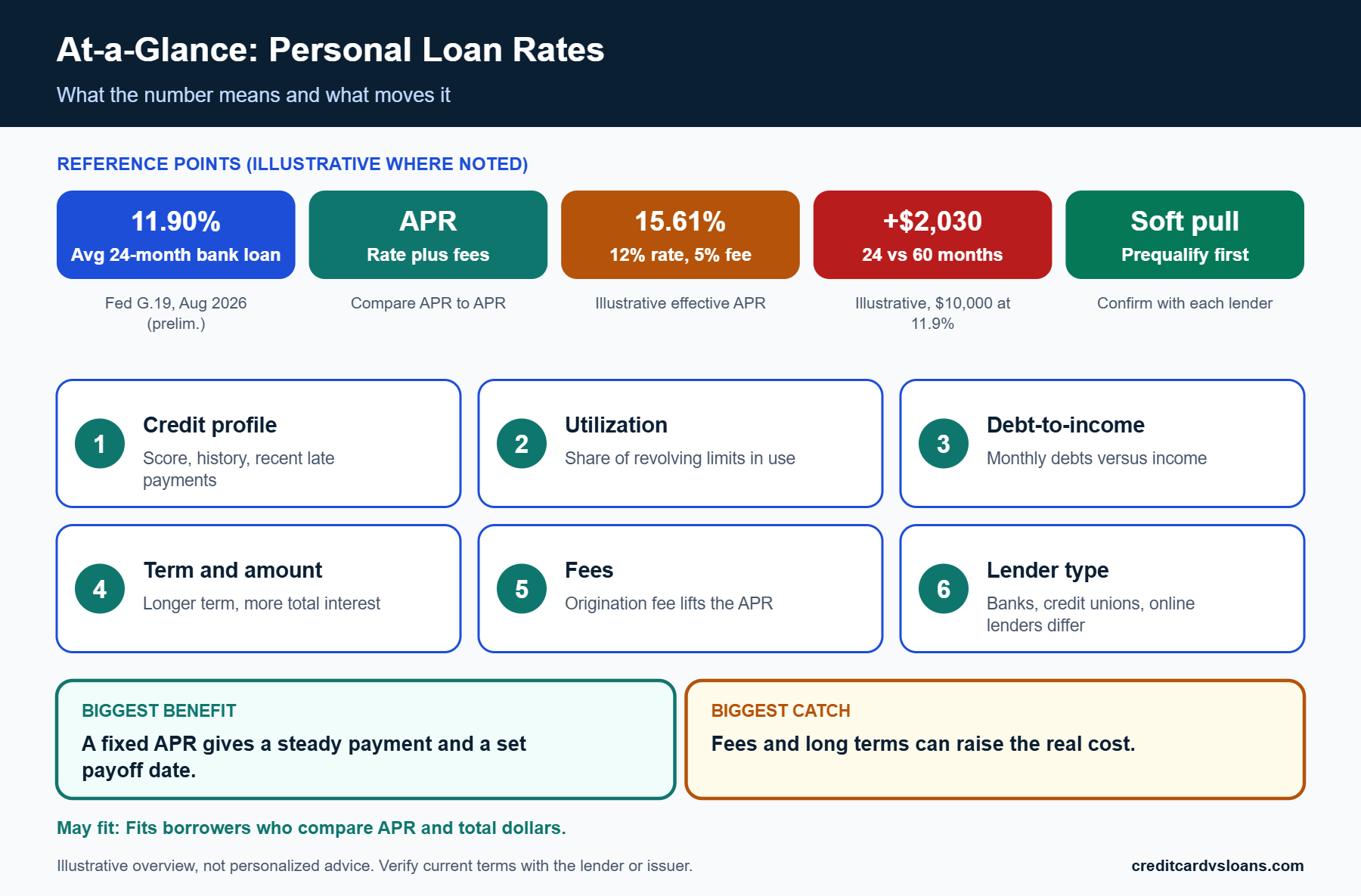
- Your APR is the lender’s price for the risk of lending to you, plus the cost of making the loan. Credit profile, debt load, term, amount and fees all feed into it.
- Compare APR to APR. The CFPB explains that APR combines the interest rate with fees such as origination charges, so it is the more consistent yardstick than the interest rate alone.
- As of the Federal Reserve’s G.19 release of October 7, 2026, the average rate on a 24-month personal loan at commercial banks was 11.90% for August 2026 (preliminary). That is an average, not a quote for you.
- A longer term usually lowers the monthly payment but raises total interest. A fee taken out of your proceeds raises your effective cost even when the stated interest rate stays the same.
- Prequalifying with a soft pull, when a lender offers it, lets you see estimated terms before a hard pull appears on your credit report.
Market figures in this article come from the Federal Reserve’s G.19 consumer credit release dated October 7, 2026 and the H.15 release dated October 21, 2026. Rates change, and lender offers change faster, so treat every number here as a reference point and check the terms on your own offer.
Table of contents
Personal Loan Rates in Plain English: The Short Answer
What a personal loan rate actually measures
A rate is a price for time, risk and cost
When a lender hands you money today and expects it back over months or years, the rate pays for three things. The first is time: the lender could have used that money elsewhere. The second is risk: some borrowers will fall behind or stop paying, and the lender prices that possibility into everyone’s rate. The third is cost: underwriting, servicing, marketing and funding all have to be covered.
That is why a rate is better understood as a bundle than as a single dial. A lender that sees low risk and wants your business may price close to its funding cost. A lender that sees more uncertainty will charge more, or may decline. The CFPB describes this as risk-based pricing: a lender gives a borrower less favorable terms, usually a higher interest rate, because it sees that borrower as a bigger risk.
Rate, APR and total cost are three different things
The interest rate is what you pay for borrowing the money. The APR folds in certain upfront charges, so it is the yearly cost of credit as a percentage. The total cost is a dollar figure: everything you pay over the life of the loan minus what you received. A loan can have a modest rate, a higher APR because of an origination fee, and a total cost that depends heavily on how long you take to repay.
The next sections show where each of these shows up on a loan offer. For now, hold one rule of thumb: the number that feels smallest is not always the number that costs least.
A simple way to keep the three apart is to ask three questions of any offer. What is the yearly price once fees are included? That is the APR. How many dollars will leave my account in total? That is the total of payments. Can I carry the monthly amount in a lean month? That is the budget test. An offer has to pass all three, and a lender can help you with the first two only if you ask for the numbers in writing.
Why two borrowers see different personal loan rates
Same loan amount, different risk profile
Picture two hypothetical applicants asking for the same amount over the same term. One has a long credit history, low balances on revolving accounts and steady income. The other has a thin credit file, a few recent late payments and a high share of income already committed to debt. A lender pricing for risk will quote the first applicant a lower APR in most cases, and may decline the second or quote a much higher one.
Neither applicant is being singled out. Lenders use models that compare an application with the track record of borrowers who looked similar in the past. Your offer reflects where you land in that comparison, not a judgment about you personally.
Same borrower, different lenders
Even one borrower can see a wide spread across lenders. Banks, credit unions and online lenders fund themselves differently, target different customers and weigh the same information differently. The CFPB notes that lenders are not required to offer you their best rate, and that shopping and comparing offers from several lenders can reduce your costs.
The catch is that each lender’s offer may bundle the rate with different fees and terms. A low advertised rate that comes with a large origination fee can cost more than a slightly higher rate with no fee. That is why this guide keeps returning to APR and total dollars rather than the headline rate.
The main drivers at a glance
Factors you can influence before you apply
Some pricing drivers respond to your actions, though rarely overnight. Paying revolving balances down, keeping payments on time, avoiding unnecessary new credit applications, correcting errors on your credit reports and choosing a shorter term or smaller amount can all change what a lender sees or what it is being asked to price. None of these produces a guaranteed result, and the effect on any one offer varies by lender.
The fastest lever is often the loan itself. Borrowing less, or choosing a term you can afford at a higher monthly payment, changes the dollar cost immediately. Credit-profile changes take longer because they depend on when accounts report to the bureaus.
It also helps to decide what you are optimizing for before you collect offers. Some borrowers want the lowest total cost, which points to a shorter term. Others need the lowest required payment, which points to a longer term and a plan to prepay when possible. Knowing which camp you are in keeps a lender’s framing from choosing for you, and it makes the comparison tables later in this guide easier to apply to your own situation.
Factors that sit outside your control
Some drivers are market-wide. The Federal Reserve’s policy rate sets the backdrop for what banks pay to fund loans, and the economy shapes how lenders judge default risk. As of the Federal Open Market Committee’s most recent action listed on the Fed’s site (September 17, 2026), the federal funds target range was 3.75 to 4.00 percent. The effective federal funds rate was 3.88 percent on October 20, 2026, according to the H.15 release of October 21, 2026.
You cannot change those numbers, but you can time your decision with them in mind, and you can recognize that a rate you were quoted months ago may not be available today. For a broader look at the current environment, see the October 2026 rate outlook for credit cards and personal loans.
Who benefits from understanding rates, and who should pause
When a personal loan can make sense
A fixed-rate installment loan can fit a borrower who has a defined, one-time expense, wants a predictable payment, and has a plan that fits the budget. Replacing high-rate revolving debt with a lower-rate fixed loan is one common use, though whether it saves money depends on the APR, the fees and the repayment term. The decision framework is covered in personal loan for debt consolidation.
The table below summarizes the key terms you will meet while reading offers, who each loan feature tends to suit, and what pushes the cost up or down.
| Term or feature | May suit | Main advantage | Main drawback | Primary cost drivers |
|---|---|---|---|---|
| Fixed-rate installment loan | Borrowers who want a steady payment and a clear payoff date | Payment does not change during the term | Less flexible than a revolving line if needs change | Credit profile, term, amount, fees |
| Short term (for example 24 months) | Borrowers with room in the monthly budget | Lower total interest for the same APR | Higher monthly payment | Term length, APR |
| Long term (for example 60 months) | Borrowers who need a lower monthly payment | Smaller payment | More total interest and a longer commitment | Term length, APR |
| Origination fee deducted from proceeds | Borrowers who can accept less cash at funding | Sometimes pairs with a lower stated rate | Raises APR above the interest rate | Fee percentage, loan amount |
| Prequalification with a soft pull | Borrowers who are rate shopping | Shows estimated terms before a hard pull | Estimate only; final terms can differ | Information you provide, lender model |
When the rate is a reason to wait
If the APR on offer is far above what you can sustain, or if the monthly payment would leave no breathing room after rent, food, insurance and other fixed costs, the rate is telling you something. Waiting a few months to pay down balances, build a longer on-time record or save toward part of the expense can change both the offer and the need.
Borrowers facing an urgent cash crunch have a harder choice. In that case the priority is to avoid products that make the problem worse, such as loans with large upfront fees, rollover features or payments you cannot meet. The risks section later in this guide lists the red flags to watch for.
What Personal Loan Rates Look Like Right Now: Federal Reserve Benchmarks
What the Federal Reserve’s G.19 release shows
The August 2026 reading for 24-month bank personal loans
The Federal Reserve’s G.19 consumer credit release, dated October 7, 2026, reports a commercial bank interest rate on 24-month personal loans. The most recent reading is for August 2026, marked preliminary: 11.90 percent. The second-quarter 2026 figure, now revised, is 11.86 percent, and the first-quarter 2026 figure is 11.36 percent. The Fed describes these as annual percentage rates under Regulation Z.
Put plainly, a typical commercial bank personal loan on a two-year term carried an APR near 12 percent in the Fed’s latest snapshot. That is a useful anchor for judging whether an offer sits far above or far below the market average, but it says nothing about where a particular borrower will land.
How the figure is built, and why it is not your rate
The Fed states that the personal loan rates in this release are simple, unweighted averages of each reporting bank’s most common rate during the first calendar week of the middle month of each quarter. Two consequences follow. First, a bank’s most common rate is not the same as the rate each customer receives, so borrowers with stronger or weaker profiles will see lower or higher numbers. Second, the figure covers commercial banks only, so credit unions and online lenders can price differently.
Use the number as a market reference, not as a promise. If an offer is dramatically higher, ask what in your application is driving the price. If it is dramatically lower, check the fees and the fine print.
| Period | APR (percent) | What it tells you |
|---|---|---|
| 2021 (annual) | 9.38 | Lowest annual figure shown in the release |
| 2022 (annual) | 9.87 | Modest rise from 2021 |
| 2023 (annual) | 11.87 | Sharp step up as borrowing costs rose |
| 2024 (annual) | 12.27 | Highest annual figure shown |
| 2025 (annual) | 11.50 | Slightly below 2024 |
| 2025 Q4 | 11.63 | Quarterly reading |
| 2026 Q1 | 11.36 | Quarterly reading |
| 2026 Q2 (revised) | 11.86 | Quarterly reading |
| August 2026 (preliminary) | 11.90 | Latest reading in the October 7, 2026 release |
Other benchmarks that sit behind lender pricing
The federal funds rate and the prime rate
Personal loan APRs are not pegged to a published index the way some variable-rate products are, but the broader rate environment still filters through to lender funding costs. The Fed’s H.15 release of October 21, 2026 lists an effective federal funds rate of 3.88 percent and a bank prime loan rate of 7.00 percent, both as of October 20, 2026. The most recent Federal Open Market Committee action listed on the Fed’s site is dated September 17, 2026, with a target range of 3.75 to 4.00 percent.
When the prime rate moves, variable-rate products such as many credit card plans move with it. A fixed-rate personal loan, once funded, does not. That is one reason borrowers sometimes use a fixed loan to lock in a payment, a topic covered in the rate outlook brief.
Credit card rates as a reference point
The same G.19 release reports credit card rates. For August 2026 (preliminary), the rate across all credit card accounts was 21.19 percent, and the rate on accounts assessed interest was 22.36 percent. The Fed defines the second measure as total finance charges divided by total average daily balances for accounts that were assessed finance charges.
The gap between roughly 12 percent on a 24-month bank personal loan and roughly 22 percent on card balances that carry interest is the reason many borrowers consider a personal loan in the first place. It is not a rule that a loan will cost less for you. Your offer, your fees and your repayment term decide that, and the sections on fees and alternatives below show how to test it.
Personal Loan Rates APR vs. Interest Rate: How to Read Your Offer
What goes into the APR
The interest rate and the charges that travel with it
The CFPB explains that the interest rate is what you pay a lender for borrowing money on top of the amount you borrowed, while the APR combines the interest rate with extra charges the lender imposes, such as origination charges and other fees due when the loan is made. Both are shown as percentages, but they measure different things.
For a personal loan with no upfront fee, the APR and the interest rate can be very close. When an origination fee is deducted from your proceeds, the APR rises above the interest rate because you pay interest on the full face amount while receiving less in hand. A later section works through that effect with numbers.
What the APR does not capture
APR is a standardized yearly measure, which makes it the right tool for comparing offers, but it has limits. It does not tell you the dollar cost, which also depends on how long you take to repay. It does not include charges that only apply if something happens, such as a late payment. And a prepayment penalty, if there is one, appears as a separate disclosure rather than inside the APR.
That is why a careful comparison uses three numbers together: APR for the yearly price, the finance charge or total interest for the dollar price, and the monthly payment for budget fit. Comparing offers side by side walks through that routine in detail.
Reading the disclosure on an offer
The closed-end credit box, item by item
For closed-end consumer loans, Regulation Z (12 CFR 1026.18) requires lenders to disclose a set of standard items. Among them: the amount financed, which is the net credit extended to you after prepaid finance charges are subtracted; the finance charge, the total dollar cost of the credit; the annual percentage rate; the total of payments; and the payment schedule, including the number, amounts and timing of payments.
The regulation also calls for disclosure of any late-payment charge and a clear statement about whether prepaying triggers a penalty or a rebate. A positive statement is required, so silence on the subject is not the same as no penalty. If you cannot find these items on your offer, ask the lender where they appear before you sign.
Spotting mismatches that signal hidden cost
A few quick comparisons can reveal whether fees are doing the work behind a friendly rate. If the amount financed is lower than the loan amount you requested, the difference is likely a fee taken from the proceeds. If the APR is noticeably higher than the interest rate, the gap is telling you the same thing. If the total of payments is much larger than the amount financed, the term or rate is driving the cost.
None of these is automatically a bad sign, since an origination fee can come with a lower rate. The point is to see the trade-off in writing, then decide whether it fits your plan. Terms vary by lender, so check your own disclosure rather than assuming it matches an advertisement.
What Determines Your APR, Part One: Your Credit Profile
Credit score and credit history
How a score shapes the price you are offered
A credit score compresses a credit report into a single number that lenders use as a quick read on repayment risk. The CFPB states that a higher credit score generally earns lower rates, and that is the broad pattern across personal lending. What the score does not do is fix the price. Lenders layer their own models, income checks and risk appetite on top, so two lenders can look at the same score and quote different APRs.
Scores also come in different versions. The score a lender pulls may not match the one you see in a free app, and the gap can be a few points or more depending on the model and the date of the data. If your score sits near a lender’s cutoff, that gap can matter, so it helps to ask which score and which bureau a lender uses. For how scores relate to approval at specific levels, see the guides on a personal loan with a 600 credit score and a personal loan with a 700 credit score.
Length of history and thin credit files
Score is only part of the picture. A lender also looks at how long you have used credit, what kinds of accounts you have managed and how they have performed. A borrower with a thin credit file, meaning few accounts or a short history, gives a lender less evidence to price against. Sparse data tends to translate into higher quoted rates or tighter limits, not because the borrower did anything wrong but because the lender has less to go on.
If you are in this position, a longer on-time record helps over time, and some lenders look at additional signals such as income and employment stability. Terms vary by lender, so a thin file is a reason to compare more offers, not a reason to take the first one.
Utilization, inquiries and recent behavior
Revolving balances and utilization
Utilization is the share of your available revolving credit you are currently using. If you carry a $4,000 balance across cards with a combined $10,000 limit, your utilization is 40 percent. High utilization signals that you lean heavily on credit, and lenders treat it as a risk factor. Because a card balance is measured every month, utilization can improve relatively quickly after balances are paid down, which makes it one of the more responsive parts of a credit profile.
This is also why debt consolidation can interact with your score in two directions. Paying off cards with a loan can lower utilization, but opening a new account adds a hard pull and a new installment balance. The net effect varies from person to person, and no outcome is certain.
Late payments, collections and new credit
Recent missed payments weigh heavily because they are the closest thing to direct evidence of repayment trouble. Collections accounts, charge-offs and public-record items sit in the same category. A lender sees a recent late payment differently from one that is several years old and followed by a clean record.
New credit matters too. Each application can add a hard inquiry, and several new accounts in a short window can suggest that a borrower is stretched. That does not mean you should avoid shopping for a loan. It means you should shop in an organized way, which is covered in the rate shopping section below.
What your reports show that a score does not
Errors and accounts you may not recognize
Credit reports can contain mistakes: an account that is not yours, a payment marked late that was on time, or a balance that is out of date. Any of these can push a score down and an offer up. Reviewing your reports before you apply gives you time to dispute errors through the bureau and the company that furnished the information, which can take weeks to resolve.
The CFPB publishes guidance on how to request your reports and file disputes. Starting that process before rate shopping, rather than after an unexpectedly high offer, avoids a stressful scramble.
When a lender sends a risk-based pricing notice
If a lender uses your credit report to offer you less favorable terms than other borrowers, the CFPB says you should receive a risk-based pricing notice explaining that negative information in your report is the reason. Treat that notice as a roadmap. It points to the items that moved your price, which tells you where to focus before you apply elsewhere or try again later.
The notice does not say which lender would have offered you more or less, and it does not guarantee that fixing an item will change a future quote. It does give you a concrete next step grounded in your own report rather than guesswork.
What Determines Your APR, Part Two: Income, Debt Load and Loan Structure
Income and the debt you already carry
Debt-to-income ratio in practice
Debt-to-income ratio, often shortened to DTI, compares your monthly debt payments with your gross monthly income. Lenders use it to judge whether you can absorb a new payment. Consider a hypothetical borrower with $3,000 in gross monthly income and $900 in monthly debt payments, a 30 percent ratio. A new loan with a $331.67 payment, such as the 36-month, $10,000 loan at 11.9 percent shown later in this guide, would bring total monthly debt to about $1,231.67, or roughly 41 percent. That is illustrative math, not a lender threshold.
Each lender sets its own comfort range, and the same ratio can lead to approval at one lender and a higher rate or decline at another. A high ratio before the new loan tends to push pricing up because the cushion for surprises is thinner.
Income stability and documentation
Beyond the amount of income, lenders care about how steady it is and how well it can be shown. Salaried workers with a clear history often move through verification quickly. Self-employed borrowers and those with variable pay may be asked for tax returns, bank statements or other documents, and may see more conservative pricing because the income is harder to project.
If your income recently changed, say a new job or a raise, the application may reflect that only after it has been documented. Having pay stubs, tax records or statements ready speeds the process and reduces the chance that a lender defaults to a cautious estimate. The personal loan requirements guide lists what lenders commonly request.
How the loan itself is structured
Amount and term
Term has a double effect on cost. A longer term typically lowers the monthly payment, which can help an approval, but it increases the total interest paid. Some lenders also price longer terms higher because there is more time for something to go wrong. A shorter term raises the payment and cuts total interest for a given APR.
Loan amount matters as well. Very small loans can carry higher percentage fees because lenders have fixed costs, and very large loans mean more risk exposure for the lender. Asking for only what you need, rather than rounding up, is usually the cheaper path. The cost table later in this guide shows how much term alone changes the dollars.
Fixed or variable rate, and secured or unsecured
Most personal loans are fixed-rate installment loans: the rate and payment stay the same until payoff. Variable-rate versions exist, and their payments can rise if the underlying index rises, which makes budgeting harder. Read the disclosure to see which kind you are being offered.
Most personal loans are also unsecured, meaning no collateral backs them. A lender that offers a secured loan, tied to a savings balance or another asset, may be able to offer a lower rate because it has something to recover if you stop paying. The trade-off is that you could lose the asset if you default, so the lower rate comes with a different kind of risk. Availability varies by lender.
Optional features that can nudge the price
Autopay discounts and direct-pay arrangements
Some lenders reduce the rate for borrowers who enroll in automatic payments, and some offer direct payment to creditors when the loan is used to pay off other debts. Whether a discount exists, how large it is and what happens if you drop autopay later all depend on the lender. Ask whether the quoted APR already includes any discount, since an offer that only holds while autopay is active is a different offer from one that does not.
Autopay can also guard against missed payments, which carry their own costs. If you choose it, keep enough in the account to avoid overdraft fees.
Co-borrowers and joint applications
Adding a co-borrower with a stronger credit profile or higher income can sometimes improve the pricing or the chance of approval, because the lender evaluates two incomes and two credit histories. The trade-off is serious: both people are legally responsible for the debt, and the loan can affect both credit reports.
That means a joint application is a relationship and budgeting decision as much as a pricing one. Before you ask someone to join, make sure they understand they will be on the hook if payments stop. Policies on joint applications differ, so check each lender’s rules.
Lender Type and Pricing Model: Why Offers Differ Before You Apply
Banks, credit unions and online lenders
Different funding, different customers, different prices
Banks, credit unions and online lenders all make personal loans, but they fund themselves differently and aim at different customers. A bank may price its personal loans partly around relationships, such as an existing checking account. A credit union is member-owned and typically requires you to qualify for membership. Online lenders often compete on speed and on how much of the process happens on a screen.
These differences can show up in rates, fees, minimum credit profiles and funding speed, but there is no reliable rule that one type is always cheaper. The Federal Reserve’s G.19 figure covers commercial banks only, so it cannot tell you how credit unions or online lenders compare in a given month. The honest answer is to get quotes from more than one type.
What to compare beyond the rate
Look at origination fees, late fees, whether there is a prepayment penalty, how soon funds arrive, whether the lender reports payments to the credit bureaus, and what hardship options exist if your income drops. A lender with a slightly higher APR but flexible terms and no fees may suit one borrower better than a lower-APR lender with strict conditions.
Also check that the lender is properly registered or chartered. State regulators and the FTC both advise confirming a lender’s registration before sharing personal information, which matters especially for lenders you found through an ad.
Prequalification, soft pulls and final offers
What prequalification shows you
Many lenders let you check estimated terms before a full application. Some do this with a soft credit pull, which is visible to you but not typically counted the way a hard pull is. Others require a hard pull at an early stage. Policies vary, so read the notice on the page and confirm before you submit your information.
Prequalification is useful because it lets you compare estimated APRs, terms and fees across several lenders without stacking up inquiries. It is not an approval and it is not a rate lock. Treat the numbers as a reasonable preview, not a contract.
Why the final offer can differ from the estimate
The final offer is based on a complete application, verified income and a full credit review. If the verified information differs from what you entered, or if your credit file changed in the days since the estimate, the APR, amount or approval can change. A lender may also adjust terms if you ask for a different amount or term at the final stage.
To avoid surprises, enter accurate information up front and keep the documents you will need handy. If the final offer is worse than the estimate, ask the lender what changed. The answer is useful whether or not you accept.
Risk-based pricing in practice
How lenders place applicants into tiers
Most lenders sort applicants into pricing tiers using score ranges, income, DTI and other inputs, then attach a rate range to each tier. Falling just inside or outside a tier boundary can change the APR noticeably, which is why a small difference in your profile sometimes shows up as a large difference in the quote.
Tier boundaries are not published in a standard way and differ by lender, so there is no public table that tells you the exact cutoffs. What you can do is look at the rate range a lender advertises, then understand that where you land inside that range depends on your profile.
Asking questions that clarify the quote
If an offer seems high, ask which factors drove the rate and whether a different term or amount would change it. Ask whether a co-borrower or collateral would be considered and whether autopay lowers the APR. Lenders are not obligated to give you their lowest rate, as the CFPB points out, but asking is free and sometimes reveals options that were not on the first screen.
If you receive a risk-based pricing notice, read it. It identifies the credit report items that affected your terms, which is information you can act on.
Fees and Total Cost: Where Personal Loan Rates Become Real Dollars
Fees that sit on top of the rate
Origination fees
An origination fee is a charge for processing the loan, usually a percentage of the amount borrowed, and it is often deducted from the proceeds before the money reaches you. If you borrow $10,000 and the lender charges a 5 percent origination fee deducted at funding, you receive $9,500 but repay based on $10,000. The fee is part of the finance charge and is why the APR comes out higher than the interest rate.
Fee levels, and whether there is a fee at all, vary by lender and often by borrower profile. Because the fee is taken from the proceeds, make sure the amount you actually receive covers the expense you borrowed for. Otherwise you may need to ask for a larger loan, which raises the payment.
Late, returned-payment and prepayment charges
Other charges depend on what happens after funding. Late fees apply if you miss a due date. Returned-payment fees can apply if a payment bounces. And some loans charge a fee if you pay off early. Regulation Z requires closed-end lenders to disclose any late-payment charge and to say clearly whether prepayment triggers a penalty or a rebate, so these items should be spelled out in your paperwork.
A prepayment penalty matters most if you expect to pay the loan off early, for example with a bonus or tax refund. If it exists, ask exactly when it applies and how it is calculated. Many borrowers prefer loans without one, but terms vary, so check your own disclosure.
Term and APR in dollars
What the same loan costs at different APRs and terms
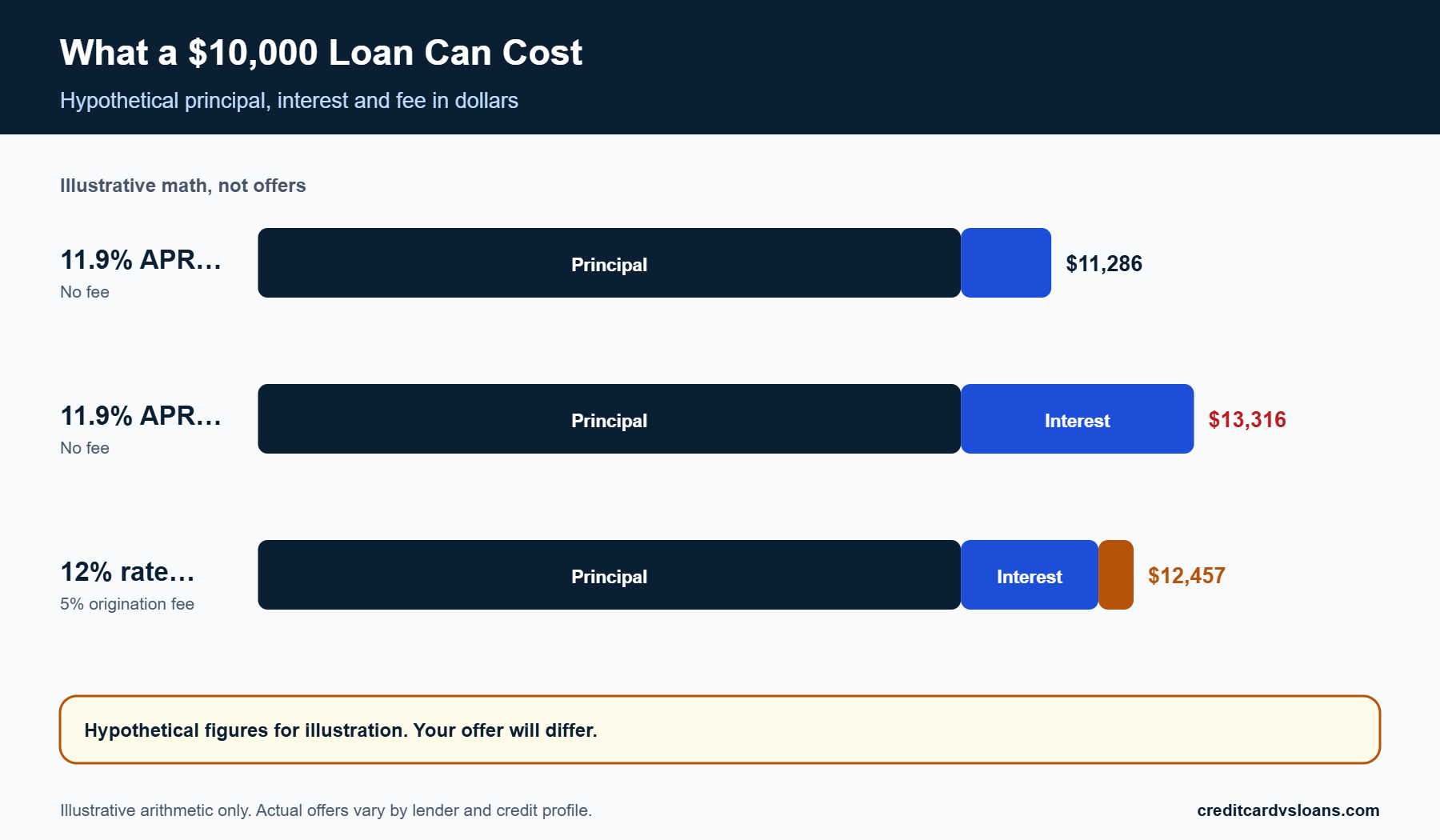
The table below uses a hypothetical $10,000 loan with no fees and standard monthly amortization. The APR values were chosen to show a range of outcomes, including 11.9 percent, which is close to the Fed’s August 2026 average for 24-month bank personal loans. These are illustrations, not offers, and the figures were computed with the standard payment formula.
| APR | 24 months | 36 months | 60 months |
|---|---|---|---|
| 8.0% | $452.27 payment; $854.55 interest | $313.36 payment; $1,281.09 interest | $202.76 payment; $2,165.84 interest |
| 11.9% | $470.27 payment; $1,286.43 interest | $331.67 payment; $1,939.96 interest | $221.94 payment; $3,316.37 interest |
| 18.0% | $499.24 payment; $1,981.78 interest | $361.52 payment; $3,014.86 interest | $253.93 payment; $5,236.06 interest |
| 24.0% | $528.71 payment; $2,689.06 interest | $392.33 payment; $4,123.83 interest | $287.68 payment; $7,260.78 interest |
Read across a row and you see the cost of stretching the term; read down a column and you see the cost of a higher APR. At 11.9 percent, moving from 24 to 60 months cuts the payment by about $248 a month but adds roughly $2,030 in interest. At 24 percent over 60 months, interest alone is larger than 70 percent of the amount borrowed.
The shorter-term trade-off
A shorter term is the cleanest way to reduce interest cost, but only if the payment fits your budget without strain. A payment you cannot make reliably invites late fees and credit damage, which defeats the purpose. The right question is not which term is cheapest in the abstract but which is the shortest term you can sustain with some breathing room.
If cash flow is tight, a longer term with a plan to prepay when you can, and a lender that does not penalize prepayment, offers a way to keep the required payment low while still reducing interest when your situation improves.
How a fee changes the effective APR
A worked example with an origination fee
Take a hypothetical $10,000 loan at a 12 percent interest rate over 36 months. The monthly payment is $332.14 and total interest is $1,957.15. Now add an origination fee deducted from the proceeds. The payment stays at $332.14, but you receive less cash, so the effective APR rises, as the table shows.
| Origination fee | Cash you receive | Monthly payment | Interest plus fee | Effective APR |
|---|---|---|---|---|
| 0% | $10,000 | $332.14 | $1,957.15 | 12.00% |
| 1% | $9,900 | $332.14 | $2,057.15 | 12.70% |
| 3% | $9,700 | $332.14 | $2,257.15 | 14.13% |
| 5% | $9,500 | $332.14 | $2,457.15 | 15.61% |
| 8% | $9,200 | $332.14 | $2,757.15 | 17.90% |
The payment does not change, which is why a fee can hide in plain sight. The effective APR is what rises. At a 5 percent fee, a 12 percent interest rate behaves like a loan with an APR of about 15.6 percent.
A lower rate with a fee versus a higher rate without one
Fees complicate shopping because they move cost in a direction the rate does not show. A lender advertising a 10 percent rate with a 6 percent origination fee may cost more over a short term than a lender at 13 percent with no fee. Which is cheaper depends on the term and on whether you might pay the loan off early, since the fee is paid up front and is not refunded in the same way interest is saved.
The way through is to compare the APR and the total dollars on the disclosure, not the rate in the ad. If two offers have the same APR but different structures, favor the one whose monthly payment, payoff flexibility and fees best match your plan.
Personal Loan Rates and Your Credit Score: What Happens When You Apply and After You Borrow
What happens to your credit when you apply
Hard inquiries and the rate shopping window
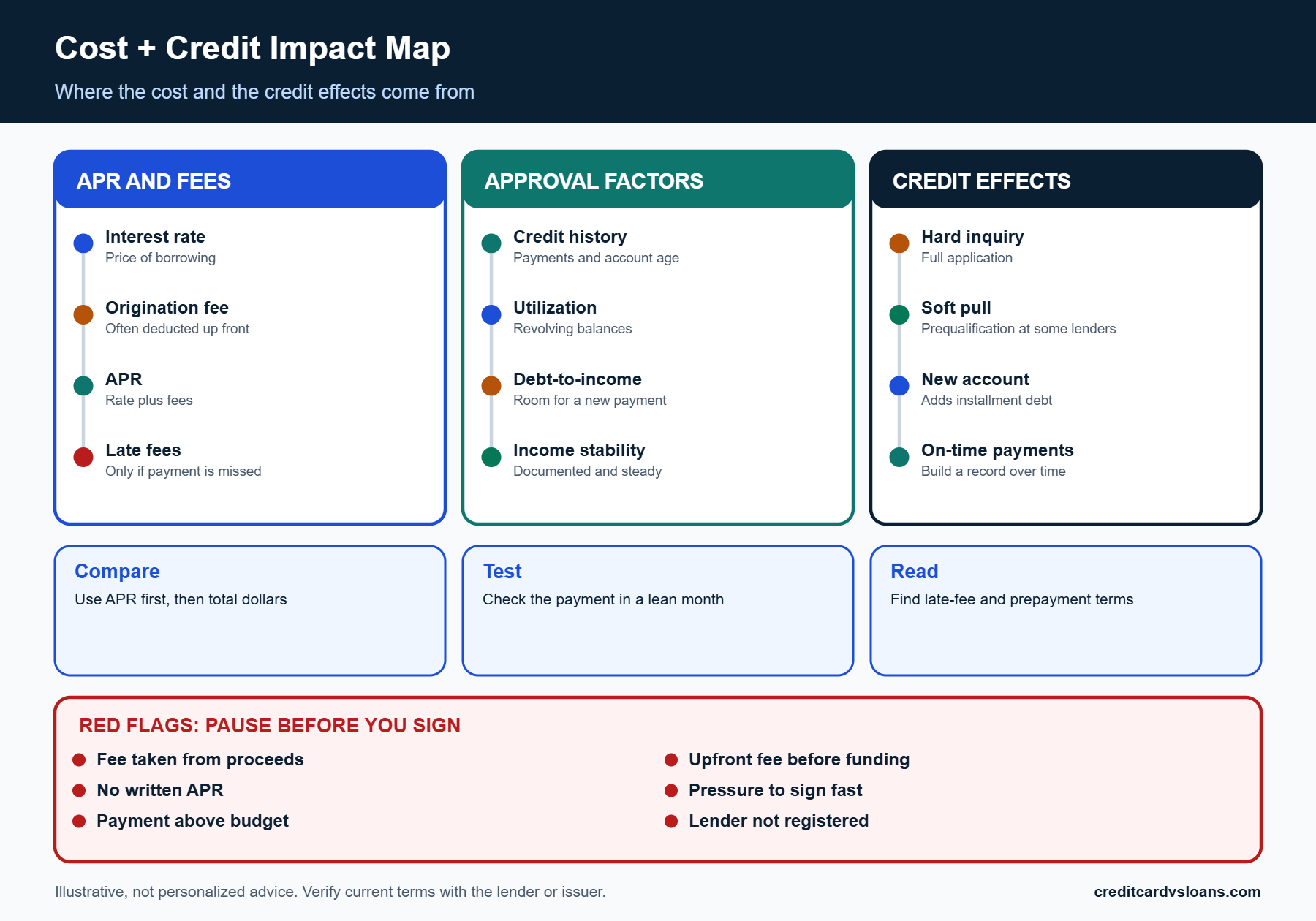
When you submit a full application, the lender typically pulls your credit report, which creates a hard inquiry. The CFPB says a single lender inquiry has little effect on your score. It also explains that scoring models usually treat several inquiries made within a short window as one when you are comparison shopping for the same type of loan, with windows described as roughly 14 to 45 days depending on the model.
The CFPB’s examples of loans that get this treatment name student, auto and mortgage loans. Whether a given scoring model groups personal loan inquiries the same way is not something you can assume, so the safer habit is to compare offers using prequalification first and to submit full applications only to the lender or two you are serious about. When you are ready to compare, keep the window tight.
Soft pulls and why they matter for rate shopping
A soft pull, such as an estimate-only prequalification check or a check of your own report, is not a credit application and does not affect scores in the way a hard inquiry can. That is why prequalification is so useful for early shopping: you can see estimated APRs from several lenders without leaving a trail of hard pulls.
The catch is that not every lender uses a soft pull at this stage, and some switch to a hard pull once you choose an offer. Look for wording on the form. If it is unclear, ask before you proceed. Terms and practices vary by lender.
What happens after you borrow
New account, utilization and mix
Once a loan is funded, it appears on your credit reports as a new installment account. In the first months, a new account can lower the average age of your accounts and add to your total debt. If you used the proceeds to pay off credit cards, revolving utilization may fall, which lenders and scoring models generally view favorably. The combined effect on your score differs from person to person, and it can move in either direction.
Keep the paid-off cards open and unused if you can do so safely, since running balances back up on the same cards after consolidating leaves you with both the loan and new card debt. The debt consolidation guide covers that risk in more detail.
On-time payments, missed payments and future borrowing
Over the life of the loan, consistent on-time payments build a record that future lenders can see. Missed payments do the opposite, and a late payment reported to the bureaus can stay on your reports for years. That is why choosing a payment you can sustain matters more than squeezing out the lowest possible rate.
The loan also affects your DTI for any future application, such as a mortgage or auto loan. If you expect to apply for other credit soon, consider how the new payment will look to the next lender. This is a good reason to borrow only what you need and to prefer a payment that leaves room in your monthly budget.
Personal Loan Rates Compared With Credit Cards and Other Borrowing Options
Personal loan versus card balances and promotional offers
Installment versus revolving credit
A personal loan is installment credit: a fixed amount, a fixed schedule and a defined end date. A credit card is revolving credit: a limit you can borrow against repeatedly, with a minimum payment that changes with your balance. The Federal Reserve’s G.19 release for August 2026 (preliminary) shows 22.36 percent on credit card accounts that were assessed interest, compared with 11.90 percent on 24-month bank personal loans. Those are averages for different products and borrowers, but they explain why people compare the two.
The structural difference matters as much as the rate. A loan forces payoff on a schedule. A card lets you stretch repayment indefinitely at the card’s rate. If you struggle to pay down revolving balances, the schedule can be a benefit. If your income is variable, the flexibility of a card may be worth something, though only if you pay balances down.
Promotional APR cards and balance transfers
Some cards offer a promotional APR for a limited period, which can make them cheaper than a personal loan if you can pay the balance off before the promotion ends. The catch is what happens afterward. Once the promotional period ends, the standard APR applies to any remaining balance, and fees such as a balance transfer fee can offset part of the savings. Read the terms to see how long the promotion lasts and what rate follows.
Whether a promotional card is available to you depends on your credit profile and the issuer. If you are weighing both products, compare the total dollars: fees plus interest over the period you realistically need to pay the balance off.
Other borrowing routes to weigh
Secured borrowing and borrowing against assets
Home equity loans and lines of credit, and loans secured by savings or a vehicle, can carry lower rates than unsecured personal loans because collateral backs them. The trade-off is the asset at stake. Defaulting on a loan secured by your home can put the home at risk, a consequence that does not apply to an unsecured loan. Closing costs, appraisal fees and longer timelines also apply to some of these products.
Secured options are worth a look when the rate gap is meaningful and you are confident in your ability to repay. They are not worth it if the payment would strain your budget, since the downside is much larger.
Nonprofit counseling, payment plans and family loans
Sometimes the cheapest option is not a new loan. A payment plan with the creditor, a hardship arrangement, or a debt management plan through a nonprofit credit counselor may reduce what you owe each month without adding a new account. The FTC suggests considering free or low-cost nonprofit credit counseling when you are dealing with debt trouble.
Borrowing from family can be less expensive, but it carries relationship risk. If you go that route, write down the amount, the schedule and what happens if a payment is missed. Clarity protects both sides.
| Option | Rate type | Typical fees to check | Repayment pattern | Credit inquiry | Utilization / DTI effect | Risk flags |
|---|---|---|---|---|---|---|
| Fixed-rate personal loan | Fixed APR in most cases | Origination fee, late fee, possible prepayment charge | Equal payments to a payoff date | Soft pull to prequalify at some lenders; hard pull at application | Adds an installment payment to DTI; may lower card utilization if it pays off cards | Fee deducted from proceeds; long terms raise total interest |
| Credit card with a balance | Variable APR | Interest, late fees, possible annual fee | Minimum payment; no fixed end | Hard pull for a new card | Balances raise utilization | Interest compounds if only minimums are paid |
| Promotional APR or balance transfer card | Introductory rate, then standard APR | Balance transfer fee, late fee | Revolving; payoff before promotion ends | Hard pull for a new card | Moves balance; new limit can lower utilization | Remaining balance reprices when promotion ends |
| Home equity loan or line | Fixed or variable, depending on product | Closing or appraisal costs may apply | Installment or revolving draw period | Hard pull | Adds secured debt | Home is collateral |
| Creditor payment plan or nonprofit counseling | Varies | Program fees may apply; ask up front | Negotiated schedule | Often none for the plan itself | Depends on how accounts are reported | Confirm the organization is nonprofit and registered |
Risks and Red Flags When Shopping for Personal Loan Rates
Budget and cost risks
Payment shock and overcommitment
The most common problem with personal loans is not the rate. It is the payment. A loan that looks affordable when the budget is calm can become heavy after an unexpected expense, a reduction in hours or a rise in other costs. Before you accept an offer, test the payment against a tighter month, not an average one, and consider whether you could keep paying if your income dipped.
Remember that the payment is fixed. If income falls, the lender does not adjust automatically. Contact the lender early if you see trouble coming, since options are typically better before a payment is missed than after.
Re-borrowing and loan cycles
Another risk shows up after the first loan. If the loan pays off card balances and the cards fill up again, the borrower ends up with both debts. Taking a second loan to cover the first, perhaps with new origination fees, repeats the cost without solving the underlying gap between income and spending.
A realistic plan for the cards, such as lowering the limit, removing saved payment details from shopping sites, or setting a spending cap, is part of the decision to borrow. Without it, the interest savings can disappear quickly.
Scams and predatory features
Advance-fee loan scams
The FTC warns that advance-fee loan scams promise a loan or credit regardless of your history and then demand an upfront fee, often described as processing, insurance or an application cost. Once you pay, no loan arrives. Scammers often ask for hard-to-recover payment methods such as wire transfers, cryptocurrency or gift cards. The FTC notes that legitimate lenders check your credit and finances before giving firm terms and will not guarantee a loan because you paid a fee.
If you paid a scammer, report it at ReportFraud.ftc.gov. If a lender asks for payment before releasing funds, treat that as a stop sign.
Other red flags in an offer
Be cautious when a lender will not state the APR or provide written terms before you commit, pressures you to sign immediately, refuses to explain fees, or contacts you unprompted about a loan you never applied for. The FTC has also warned about unexpected calls about loans people did not apply for. Check your state regulator or attorney general to confirm that a lender is registered, and search for complaints about the company.
Good offers survive scrutiny. If the lender discourages you from taking time, reading the disclosure or comparing, that is a reason to step back.
If you fall behind on payments
Talk to the lender before the due date passes
Lenders often have more flexibility before a payment is missed. Some offer short deferrals, modified schedules or temporary reductions, though availability depends on the lender and your circumstances. Ask what is possible, get any agreement in writing, and confirm how it will be reported to the credit bureaus.
Do not ignore the problem. Silence tends to lead to late fees, reporting of delinquency and eventually collection activity, all of which raise the cost of the loan and make future borrowing harder.
What delinquency can cost
A late payment can trigger a late fee, a negative mark on your credit reports and, if it continues, collection efforts. Each of those makes future credit more expensive, which feeds back into the risk-based pricing described earlier. State laws about collection and remedies vary, so consult your state regulator or the CFPB for guidance specific to your situation.
The better path is to build a buffer before borrowing. A small cushion in the account that covers a payment or two gives you time to adjust if something changes.
Rate Shopping Without Wasting Your Credit: A Step-by-Step Approach
Before you collect offers
Define the need and the payment you can sustain
Start with the purpose and the amount. What exactly are you paying for, and what is the smallest amount that covers it? Then work backward from your budget: list fixed monthly costs, subtract them from take-home pay, and decide what payment you could carry for the full term even in a lean month. That number, not the highest payment a lender will approve, is your ceiling.
With a ceiling in hand, Table 3 earlier in this guide shows roughly what term and APR combinations fit. If a $10,000 loan at 18 percent needs a $361.52 payment for 36 months and your ceiling is $300, you know before you apply that you need a longer term, a smaller amount or a different plan.
Review your reports and gather documents
Pull your credit reports and look for errors, unfamiliar accounts and balances that are out of date. Disputing mistakes before you shop can improve the profile lenders see. Gather recent pay stubs, tax records or bank statements, and make sure your identifying information and address match across documents.
Having this ready shortens the time between offer and funding, which helps if you have a deadline. It also reduces the chance that incomplete information leads a lender to price you conservatively. The requirements guide has a fuller list of what lenders ask for.
While you collect offers
Prequalify with several lenders in a short stretch
Choose a handful of lenders across types, such as a bank where you already have an account, a credit union you qualify to join and an online lender, and check for estimated terms. Use the lenders’ prequalification tools where available and confirm that they use a soft pull. Compressing this into a few days keeps your information consistent and your credit file stable, so quotes are comparable.
Avoid submitting full applications to everyone. Each full application can add a hard inquiry, and while scoring models often group inquiries for the same loan type made in a short window, you cannot count on that for every model or product.
Record offers apples-to-apples
For each offer, write down the amount financed, the APR, the interest rate, the origination fee, the term, the monthly payment, the total of payments, any late and prepayment charges, and the expected funding date. A simple table of these items makes differences visible in a few minutes.
Check the amount financed against what you requested. If it is lower, the difference is a fee. Compare APR to APR, as the CFPB advises, then look at total dollars. If two offers tie on APR, the one with the smaller fee or the more flexible payoff terms usually deserves a second look. The offer-comparison guide expands on this process.
After offers arrive
Test the leading offer against a tight month
Take the offer that looks best on paper and run it against your budget in a tough month. Would you still make the payment if a car repair came due? If not, either lower the amount, extend the term while keeping the right to prepay, or reconsider borrowing.
Also consider the cost of waiting. If your profile is likely to improve within a few months, perhaps because a balance is nearly paid down or a late payment is aging, patience may change the offer. If the need is immediate, make sure the loan you pick does not create a bigger problem later.
Submit the application and read the final disclosure
When you are ready, submit a full application to your chosen lender. Review the final disclosure line by line. Confirm the APR, finance charge, amount financed, total of payments and payment schedule match your expectations, and look for the late-fee and prepayment statements Regulation Z requires.
If anything differs from the offer you were shown, ask why before signing. You can walk away from an offer that no longer fits. You cannot easily undo one you have signed.
Which Path Fits? Borrower Scenarios and a Decision Matrix
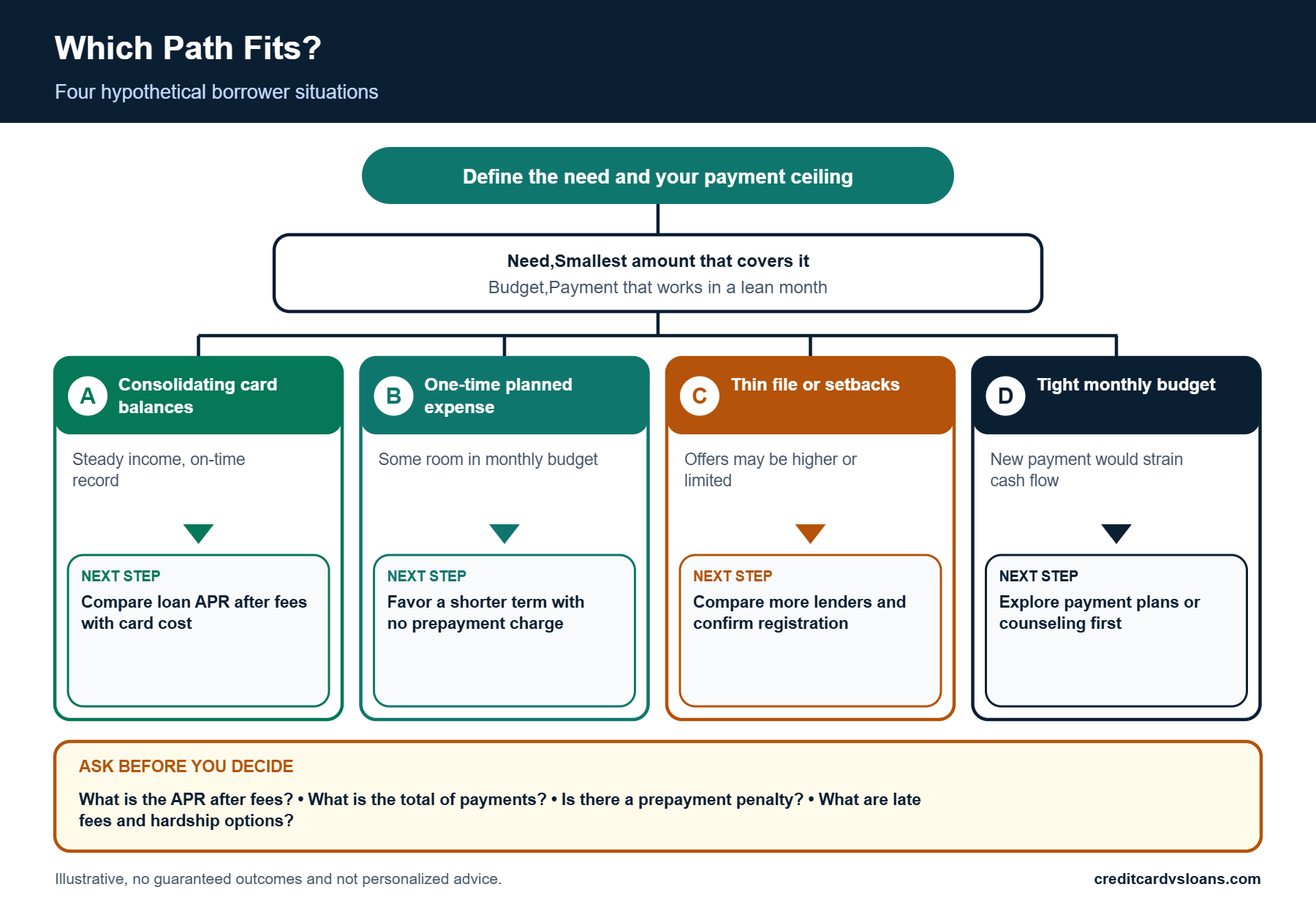
Four hypothetical borrower situations
Scenario A: consolidating card balances with steady income
This hypothetical borrower carries balances on several cards and has stable income and a record of on-time payments. A fixed-rate personal loan whose APR is clearly below the cards’ rates, with a modest or no fee, may reduce interest and simplify payments. Savings are not certain: they depend on the offer, the fee and whether the cards stay paid down. See personal loan for debt consolidation for the full test.
What to verify: the APR after fees, the total of payments compared with the cards’ payoff pace, and whether the lender pays creditors directly. When to avoid: if the borrower expects to run the cards back up.
Scenario B: a one-time expense with room in the budget
Here the borrower needs funds for a planned, one-time cost and has some cushion in monthly cash flow. A shorter-term loan can keep total interest lower, and a lender without a prepayment penalty gives room to pay ahead if extra money arrives. The borrower may also consider whether saving for part of the cost first would reduce the amount financed.
What to verify: the amount financed after fees, the funding timeline and the payment against a tight month. When to avoid: if the purchase is optional and the payment would crowd out savings.
Scenario C: thin file or recent credit setbacks
This borrower has limited history or recent late payments, so offers may be pricier or limited. It is worth comparing more lenders, checking credit unions, considering a smaller amount, and looking at whether a co-borrower or a secured option exists. Reading about a personal loan with a 600 credit score gives a realistic picture of the range.
What to verify: that the rate is one you can sustain, that the lender is registered, and that fees are clear. When to avoid: any offer that requires an upfront fee to release funds.
Scenario D: a tight budget where the payment is the issue
If a new payment would leave no breathing room, the right answer may not be a loan. Options such as a creditor payment plan, nonprofit counseling or reducing the amount needed deserve a close look first. A longer-term loan can lower the payment, but the extra interest and the commitment need honest weighing.
What to verify: your realistic monthly cushion and the total cost of a longer term. When to avoid: borrowing to cover recurring shortfalls without addressing the cause.
A decision matrix to use when you compare
How to use the matrix
Find the row closest to your situation and read across. The matrix does not tell you what to do. It lists the option to investigate, the reason it may fit, what to verify on the offer and when to avoid it. Your own numbers and the lender’s actual disclosure are what settle the decision.
| Borrower scenario | Option to investigate | Why it may fit | What to verify | When to avoid it |
|---|---|---|---|---|
| Card balances, steady income | Fixed-rate loan with APR below card rates | Fixed payment and payoff date | APR after fees; total of payments | If cards will refill |
| One-time planned expense | Shorter-term loan, no prepayment charge | Lower total interest | Amount financed after fee; payment in a tight month | If cost is optional and budget is thin |
| Thin file or recent setbacks | Several lenders including credit unions; co-borrower or secured option | Pricing varies more between lenders | Registration, fees, true APR | Any upfront fee before funding |
| Tight monthly budget | Creditor plan or nonprofit counseling first | May lower payments without a new account | Program fees; how accounts are reported | Borrowing to cover recurring shortfalls |
| Can repay within promotional window | Promotional APR card | May cost less if paid off in time | Transfer fee; rate after promotion | If payoff will run past the promotion |
| Expect to pay off early | Loan with no prepayment penalty | Keeps flexibility | Prepayment statement in disclosure | If a penalty applies |
When to avoid borrowing for now
There are situations where the best move is to hold off. If the only offers you see carry APRs or fees that would push the loan beyond what you can repay comfortably, if the purpose is not essential, or if your credit profile is likely to improve soon, waiting can change the numbers. So can lowering the amount needed.
That is not an easy call when money is tight, but it is better than signing a loan that magnifies the problem. Whatever you decide, make the decision on APR, fees and payment, not on the speed of funding or the persuasiveness of an ad.
Before You Sign: Questions to Ask and Records to Keep
Questions for the lender
Cost questions that make the APR concrete
Start with the numbers on the page and ask the lender to confirm each one in writing. What is the APR, and is it fixed? What is the interest rate, and what origination fee is deducted from the proceeds? What is the amount financed, the finance charge and the total of payments? Is the quoted APR dependent on autopay or any other condition, and what happens if I stop using it?
Then ask about the costs that only appear later. What is the late fee and when does it apply? Is there a charge for a returned payment? Is there any prepayment penalty, and if so, when does it apply and how is it calculated? A lender that answers clearly and matches the written disclosure is easier to trust than one that deflects.
Flexibility questions that matter if life changes
Ask what the lender can do if your income drops: whether there are hardship programs, how to request a payment date change, and whether partial prepayments are applied to principal. Ask how payments are reported to the credit bureaus, since on-time reporting is how a loan helps build a record.
Also ask how quickly funds are sent and whether the lender can pay other creditors directly if you are consolidating. The answers do not need to be perfect. They need to be clear enough that you can plan around them.
Checks on your side
Budget, timing and the lean-month test
Before you sign, confirm that the payment fits a lean month, not just an average one. Confirm the first due date and set a reminder or autopay with a cushion in the account. If you are paying off cards, decide in advance what will happen to the cards: close, freeze, or keep open with a spending limit.
It also helps to decide what you will do if you come into extra money. If the loan has no prepayment penalty, paying a little extra toward principal each month can cut interest and shorten the term. If it does have one, check how it works before you plan on that.
Records worth keeping
Save the signed agreement, the final disclosure, the payment schedule and any email or chat confirmations of promises the lender made. Keep proof of each payment. If something goes wrong, such as a misapplied payment or a dispute over fees, documentation makes the conversation faster and the outcome more reliable.
Review your credit reports a month or two after funding to confirm the new account appears accurately. If something looks wrong, dispute it early. State regulators and the CFPB offer guidance on complaints if a lender does not resolve a problem.
Questions Borrowers Ask About Personal Loan Rates
Timing and structure
Will rates fall if I wait?
Nobody can say, and this guide does not try to. The Federal Reserve’s G.19 data show how much the average 24-month bank personal loan rate has moved across recent years, from 9.38 percent in 2021 to 12.27 percent in 2024 and 11.90 percent for August 2026 (preliminary). That history shows that rates can stay elevated for a long time, but it does not forecast the next move.
A better way to decide is to ask what waiting costs and what it could change. If the expense is urgent, waiting may cost more in late fees, interest on other debt or lost opportunities. If the need is flexible, a few months might let you pay down balances or build a longer on-time record, which changes the offer you receive regardless of what the market does.
Is a fixed APR always the safer choice?
For most borrowers a fixed rate is easier to budget because the payment stays the same. Fixed is not automatically cheaper, though. A variable-rate loan might start lower and could rise if the underlying index rises, which is a real risk if your budget is tight. If you do consider variable pricing, ask how often the rate can change, what limits apply and how a rise would affect your payment.
For a short loan you plan to repay quickly, the difference between fixed and variable may be small. For a longer loan, certainty usually carries more value. The disclosure should say which kind you are being offered, and you should not sign until it is clear.
Does the reason for the loan change the rate?
Sometimes. Some lenders restrict what proceeds can be used for, some price certain purposes differently, and some offer to pay creditors directly when the loan is for debt consolidation. Others treat all uses the same. The rate you are quoted may also depend on whether the lender sees the purpose as lowering your overall risk, such as replacing high-rate revolving debt.
The practical step is to state your purpose honestly on the application and ask whether it affects pricing or eligibility. Using proceeds for something other than the stated purpose can create problems under the loan agreement, so read what the contract says about use of funds.
Offers, advertising and state rules
Why was my rate higher than the advertised one?
Advertised rates are often shown as a range or as a starting point available only to borrowers with the strongest profiles. Your quote falls somewhere inside the lender’s range based on your credit, income, debt load, term and amount. A quote above the advertised starting point is not a sign of an error. It is the pricing system working as designed.
If the gap is large, ask what would move you toward the low end. The answer may be a shorter term, a smaller amount, a co-borrower or simply a stronger credit profile, and sometimes the lender will tell you plainly that the advertised rate was never within reach. That information helps you decide whether to look elsewhere.
How long does an offer last?
Offers typically come with an expiration window, and the terms can change if your credit or income information changes, or if the lender adjusts its pricing. Funding timelines also differ, from same-day or next-day at some online lenders to longer at others. If you are on a deadline, confirm both the expiration date and the expected funding time before you commit.
Do not let an expiring offer pressure you into skipping the disclosure. A legitimate offer can be extended, repriced or replaced, and a lender that pushes you to decide in minutes is giving you a reason to slow down.
Do state laws change what a lender can charge?
They can. Rules on maximum rates, fees and permitted lender types vary by state, and some lenders operate under different legal structures depending on where they are based or chartered. This guide does not cover state-by-state limits, and you should not assume a rule you read about in one state applies in yours.
Your state attorney general or banking regulator can tell you what applies where you live and whether a particular lender is registered. The CFPB also publishes consumer guidance and accepts complaints if a lender does not follow the rules.
The Bottom Line on Personal Loan Rates: A Decision Path and Next Steps
A decision rule you can reuse
The sequence that keeps you out of trouble
Reduce the decision to a short sequence. First, define the need and the maximum payment you can sustain. Second, collect estimated offers from several lenders using soft pulls where they are available. Third, compare APR to APR, then total dollars, then the details that only matter later, such as prepayment and hardship terms. Fourth, test the leading offer against a lean month. Fifth, read the final disclosure before you sign.
This sequence works whether rates are rising, falling or flat, because it keeps the focus on what you control: the amount, the term, the fees you accept and the lender you choose. It also holds up against market changes, since you are comparing live offers rather than relying on a rate you saw weeks ago.
What a reasonable offer tends to look like
No single number defines a good offer, but a reasonable one usually has an APR that you understand and can trace to the interest rate and fees, a payment that fits your budget with room to spare, clear disclosure of late and prepayment terms, and a lender whose registration and complaint record check out. As a reference point only, the Fed’s G.19 release of October 7, 2026 put the average 24-month commercial bank personal loan rate at 11.90 percent for August 2026 (preliminary). Offers well above that deserve questions about what is driving the price, and offers well below it deserve questions about fees.
Personal loan rates reflect your credit profile, your debt load, the loan structure and the lender’s fees, so the rate you see is the result of choices you can partly influence. Compare APR to APR, convert every offer into total dollars, and pick the payment you can carry in a lean month. If the numbers do not work, waiting or choosing a different route is a legitimate answer.
Concrete next steps
A short list to work through this week
- Write down the amount you need and the highest monthly payment you could sustain for the full term.
- Pull your credit reports and note any errors or unfamiliar accounts to dispute.
- Choose three to five lenders across banks, credit unions and online lenders, and prequalify with those that use a soft pull.
- Record APR, rate, fee, amount financed, term, payment and total of payments for each offer.
- Check each offer for late-fee terms and any prepayment statement.
- Run your leading option against a lean month and a smaller loan amount.
- Apply to one lender, then compare the final disclosure with the estimate before you sign.
If you want to read more before you apply, the guides on personal loan requirements, comparing offers and rates at a 700 credit score cover the next questions in depth.
When to revisit the decision
Revisit your plan if a lender’s final offer differs materially from the estimate, if your income or expenses change, or if you see signs of a scam. Revisit it too if market rates move significantly. The Federal Reserve publishes the G.19 consumer credit release monthly, generally on the fifth business day, and the October 2026 rate outlook explains how to read those updates.
Finally, remember that this guide is general information. Your own offer, your own budget and your own lender’s disclosure are what matter. When something is unclear, ask the lender to explain it in writing, or contact your state regulator or the CFPB.
- Personal Loan Requirements: What Lenders Look For
- How to Compare Personal Loan Offers: APR, Fees, Term and Funding
- Personal Loan for Debt Consolidation: When It Can Save Money
- Personal Loan With a 600 Credit Score: Rates, Approval and Alternatives
- Credit Card and Personal Loan Rate Outlook: October 2026 Borrower Brief
- Personal Loan With a 700 Credit Score: How Much Better Can Rates Get?
- Federal Reserve: G.19 Consumer Credit (release of October 7, 2026) (Commercial bank 24-month personal loan and credit card interest rates)
- Federal Reserve: H.15 Selected Interest Rates (release of October 21, 2026) (Federal funds and bank prime loan rates)
- Federal Reserve: Open Market Operations and FOMC policy actions (Federal funds target range)
- CFPB: What is the difference between a loan interest rate and the APR?
- CFPB: What is risk-based pricing?
- CFPB: What kind of credit inquiry has no effect on my credit score?
- CFPB: 12 CFR 1026.18 Content of disclosures (Regulation Z) (Closed-end credit disclosures)
- FTC: What To Know About Advance-Fee Loans
Last updated: October 22, 2026. Rates, fees and lender rules change; verify current terms before acting.
The information on creditcardvsloans.com is provided for general educational and informational purposes only. It is not financial, legal, tax, credit, accounting or investment advice, and reading it does not create an advisor-client, fiduciary or any other professional relationship. Nothing here is an offer, solicitation or recommendation to borrow, lend or apply for any product.
Credit scores, interest rates, fees, eligibility rules, lender policies and laws change frequently and vary by lender, location and individual circumstances. Examples, figures and scenarios are illustrative only, do not predict your results and do not guarantee approval, savings, a particular rate or a credit-score outcome. Always confirm current terms directly with the lender or issuer and read the full agreement before you apply or sign.
Although we aim for accuracy and use reputable sources, we make no representations or warranties, express or implied, about the completeness, accuracy, reliability or timeliness of the content. Content may be drafted with the assistance of automated tools, so errors or omissions may still occur. Links to third-party sites are provided for convenience; we don’t control and aren’t responsible for their content.
To the fullest extent permitted by law, creditcardvsloans.com and its owners, editors, authors, contributors and affiliates disclaim all liability for any loss, damage or expense arising directly or indirectly from your use of, or reliance on, this content. Before making financial decisions, consult a licensed professional, such as a qualified financial advisor, attorney, tax professional or nonprofit credit counselor, who can consider your complete situation.