The credit score needed for 0 apr card offers is not set by any law or published industry standard: issuers choose their own approval criteria, and the strongest promotional offers tend to be aimed at applicants in the Good tier or higher. Treat that as a planning target rather than a cutoff, because your income, existing debts, utilization and recent applications can move an application either way.
This guide is about strategy. It shows how the score tiers line up with realistic expectations, how to find out where you stand before an issuer does, how prequalification and soft pulls can narrow your choices without costing you points, and what to do if your score falls short of the tier you are aiming for. For a deeper look at the individual approval factors, such as income and ability to pay, the companion guide on 0% APR approval factors goes through them one by one.
A 0% APR card charges no interest on purchases, balance transfers or both during a promotional period. What happens afterward, and whether the card suits you at all, depends on a payoff plan more than on the three-digit score.
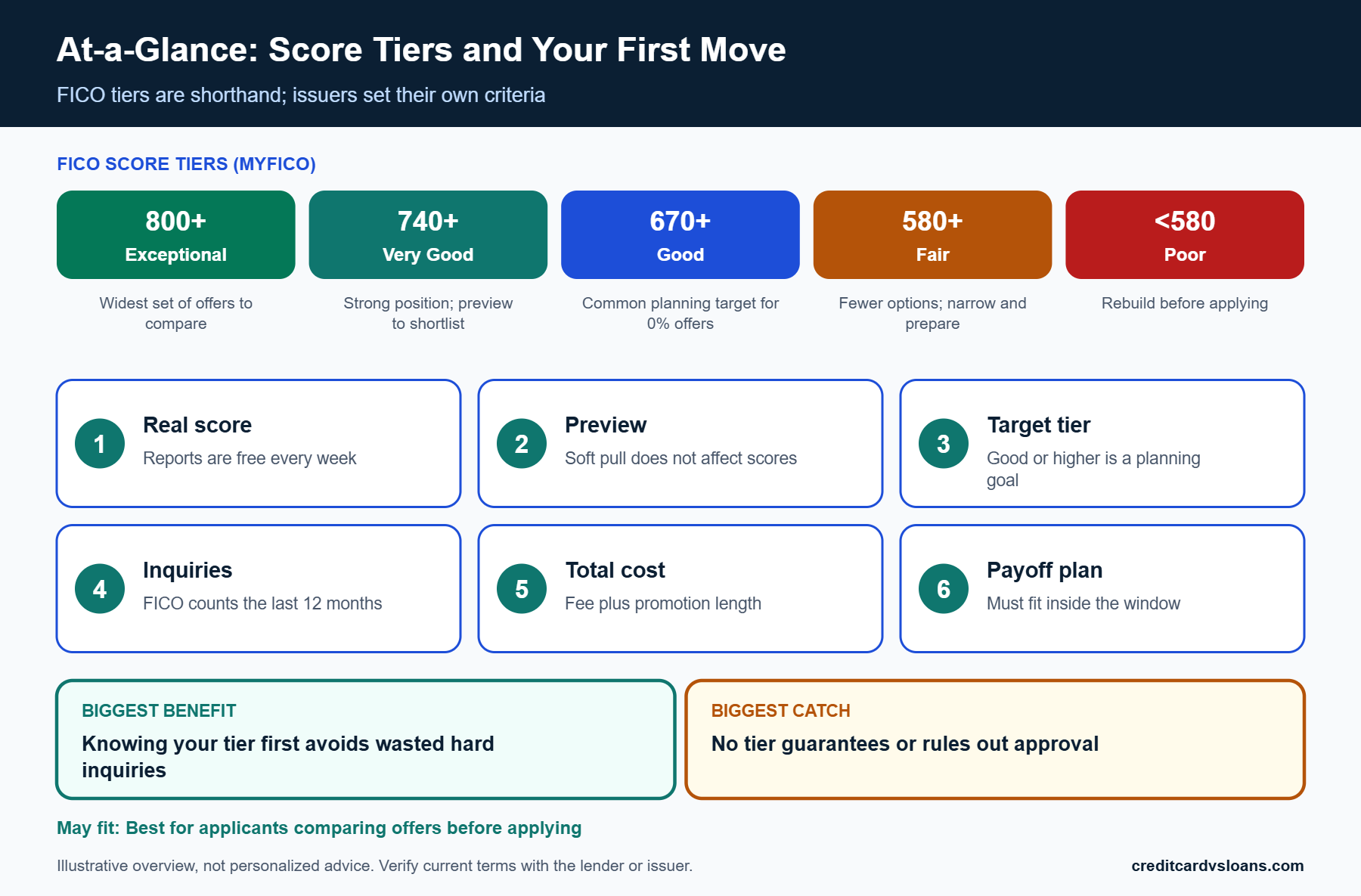
- FICO groups scores into five tiers: below 580 Poor, 580 to 669 Fair, 670 to 739 Good, 740 to 799 Very Good, and 800 and above Exceptional. Issuers are not bound to these labels.
- You have many credit scores. The CFPB says they differ by scoring model, loan type, data source and calculation date, so your score is a close guide, not the exact number an issuer will use.
- Prequalification or a soft-pull preview, where an issuer offers one, lets you check likely fit without the hard inquiry that comes with a full application.
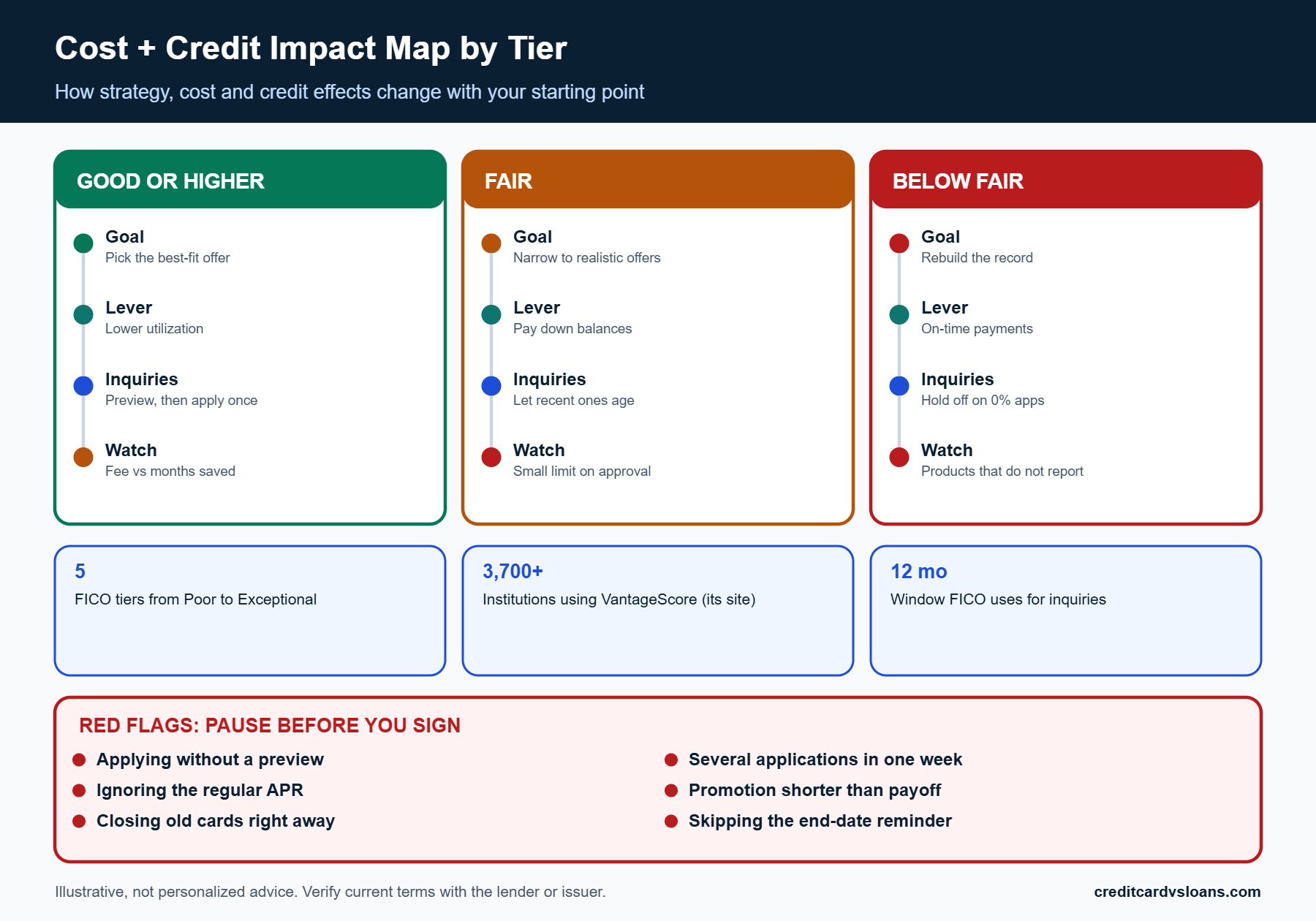
- If you are below your target tier, the usual levers are lowering balances, correcting report errors, paying on time and spacing out applications. None comes with a promised result.
- Choosing the target tier is half the job. The other half is picking a promotion length and fee that fit the time you need to pay the balance.
Score tiers and factor weights are from myFICO, and the average card APR cited below comes from the Federal Reserve’s G.19 release of October 7, 2026. Offers, fees and issuer criteria change, so check the terms on the offer you are considering.
Table of contents
Credit Score Needed for 0 APR Card: The Tiers at a Glance
Reading the score tiers
The five FICO tiers
On the 300 to 850 FICO scale, myFICO lists Poor as below 580, Fair as 580 to 669, Good as 670 to 739, Very Good as 740 to 799 and Exceptional as 800 and above. The CFPB confirms that most scores fall between 300 and 850. These bands are useful shorthand for how much room you have, but they are descriptive labels, not approval rules.
A score near the bottom of a tier behaves very differently from one near the top. Someone at 672 and someone at 738 are both Good, yet the first is two points from Fair while the second is two points from Very Good. When a decision hinges on a few points, the rest of the file usually settles it.
VantageScore and other models
FICO is not the only model. VantageScore says more than 3,700 institutions use its scores for products such as credit cards, auto loans, personal loans and mortgages. FICO also makes industry-specific versions, and notes that your lender may use a different FICO Score than the one you can see yourself.
The practical result: if you look up a score from a free service, you may be seeing a different model than the one your issuer pulls. Use your number to place yourself in a tier, then add a mental cushion for the model gap.
Picking a target tier
Aiming for Good or higher
Because a promotional rate costs the issuer interest income, it is reasonable to expect the most generous 0% offers, meaning the longest promotions and the lowest fees, to be built for applicants with stronger credit profiles. The CFPB says a higher score generally makes approval easier and can lead to better rates and terms. That makes Good or higher a sensible planning target for a premium promotional offer, while recognizing there is no published rule that says so.
If you are already there, your job shifts from qualifying to comparing: promotion length, transfer fee, regular APR and whether the offer is true 0% or deferred interest.
Why “recommended score” is marketing language
Card pages often include a suggested credit range. Read it as a description of the audience the product was designed for. It does not tell you the issuer’s decision rules, and it is not a promise either way. People with scores below the suggested range are sometimes approved, and people above it are sometimes declined.
That is why the next sections focus on what you can verify and control: your real scores, the preview tools, and the order in which you apply.
| FICO tier | Score range | Reasonable expectation | First move |
|---|---|---|---|
| Exceptional | 800 and above | Widest set of offers to compare | Compare fees, promotion length and regular APR |
| Very Good | 740 to 799 | Strong position for promotional offers | Use soft-pull previews to shortlist |
| Good | 670 to 739 | Competitive for many offers; terms vary | Lower utilization before applying |
| Fair | 580 to 669 | Fewer promotional options; smaller limits possible | Narrow to realistic offers; fix what you can |
| Poor | Below 580 | 0% offers may be out of reach for now | Rebuild with a reporting starter product |
The expectation column describes patterns to plan around. Your outcome depends on the issuer and your full file.
Find Your Real Number Before You Apply
Where to look
Reports are free; scores come separately
The FTC says each of the three nationwide bureaus offers a free report every week at AnnualCreditReport.com, and that federal law also entitles you to a free report from each bureau every 12 months. Reports show your accounts and history, not necessarily a score. The CFPB points to ways to access your credit scores for free, and some issuers and banks include a score with the account, so check what yours offers.
Begin with the reports, since errors there flow into every score. If you see an account that is not yours or a payment marked late that you paid on time, contact both the bureau and the company that supplied the information, as the FTC advises.
Which score to track
Pick one source and track the same score over time so you can see direction. Do not compare a score from one service this month with a different model next month and conclude something changed. If your issuer offers a free FICO Score, that is a natural benchmark for card applications, since card issuers often use FICO-based models.
That last point is a general pattern, not a rule for every issuer, so treat your tracked score as a guide.
Matching your number to the tier
Edge-of-tier cases
If you are close to a tier boundary, assume your score as seen by the issuer could fall on either side. In that zone, the factors beneath the score decide the outcome, particularly utilization, which you can change quickly, and recent inquiries, which you can avoid adding to.
A modest wait to lower balances and let a recent inquiry age is often a better strategy than applying immediately and learning from a decline. FICO scores consider inquiries from the last 12 months, though they stay on the report for two years.
Differences across bureaus
Each bureau compiles its own report, and not every lender reports to all three. As a result, your scores can differ by bureau. An issuer may pull one bureau or several, so it helps to know your range across all three rather than a single number.
If one bureau looks weaker, find out why: a missing account or an error on one file can pull that score down without reflecting your behavior.
Prequalification and Soft-Pull Previews
How previews work
Soft versus hard, in plain terms
The CFPB explains that hard inquiries usually occur when a lender reviews your credit after you apply, and they can affect your score. Soft inquiries, which include prescreened offers, your own report requests and some account reviews, do not affect your scores. A prequalification or preview tool that is based on a soft inquiry therefore lets you test your fit without that cost.
Not every issuer offers one, and the wording differs: “see if you’re prequalified,” “check your odds” and “preapproved” can mean different things. Read the fine print on the page to see whether a hard inquiry follows if you proceed.
What a preview can and cannot tell you
A preview is an indication based on limited information. It generally does not account for everything the issuer will review on a full application, and it is not a commitment to approve you. Federal rules also require issuers to consider ability to pay before opening a card account, so the final review looks at your income or assets and obligations as well.
Use a preview to rule offers out more than to rule them in. If a preview says you are unlikely to qualify, that is a useful reason to skip the application.
Using previews in a sequence
Build a shortlist first
Check two or three issuers that offer soft-pull tools, record the promotional length, transfer fee and regular APR on each, and rank them on total cost for your own payoff timeline. Then apply to the best match, not to all of them.
A written shortlist also makes it easier to see an apples-to-apples comparison. Without one, it is easy to be drawn toward the longest headline promotion even when its fee makes it more expensive for a short payoff.
When to skip the preview and wait
If a preview suggests you are close but not there, waiting a month or two while you lower balances usually costs less than a hard inquiry on a coin-flip application. If a preview is unavailable and your score sits near the bottom of your target tier, think carefully before applying blind.
You are looking for a point at which the odds are in your favor and you have a plan, not a moment of maximum optimism.
Preview pitfalls to avoid
Treating a preview as an approval
The most common misunderstanding is reading “you may be prequalified” as “you are approved.” Even where the language is encouraging, the issuer still reviews the complete application, including the income and obligation information that federal rules require it to consider. A preview that looked promising can still end in a decline or in a smaller limit than you expected.
Keep your plan flexible until the decision arrives. Do not move money, cancel another product or commit to a purchase on the assumption that the 0% card is a done deal.
Previewing too widely
Soft inquiries do not affect your scores, but they are not free of consequences. Each tool asks for personal information, and it is easy to end up with a pile of offers that are hard to compare. Limit yourself to a few issuers whose products you would actually accept.
Also watch for the moment a preview turns into an application. If a page asks you to confirm and submit, that is usually the point where a hard inquiry can be triggered, so read the disclosure first.
Application Strategy by Score Tier
If you are in the Good tier or higher
Prepare the file
With a stronger score, the biggest remaining levers are utilization and the number of recent applications. Pay down revolving balances where you can and avoid opening anything else for a stretch. Confirm that your income and obligations are up to date on the application, since the issuer must consider them under 12 CFR 1026.51.
This is also when to set autopay for minimums on every account so a missed due date cannot interrupt the plan.
Compare on total cost, not headline length
Among offers you are likely to qualify for, add the transfer fee to the balance, divide by the months you need, and compare. A fee that looks small as a percentage can be a meaningful dollar amount on a large balance, and a 0% period that runs past your payoff date adds nothing.
The Federal Reserve’s G.19 release of October 7, 2026 shows an average rate of 22.15% on credit card accounts assessed interest in the second quarter of 2026, which is the type of rate that applies once a promotion ends, so confirm the regular APR before you accept.
If you are in the Fair tier
Narrow to realistic offers
In this band, outcomes vary the most, which is why the strategy leans on previews and patience. Look for offers whose published guidance includes your tier, use soft-pull tools, and apply once. Expect that approval, if it comes, may carry a lower limit than the balance you want to move.
Plan for that by deciding in advance what you will do with a partial limit: move the most expensive balance first, or decline and choose a different tool.
Move the number with fast levers
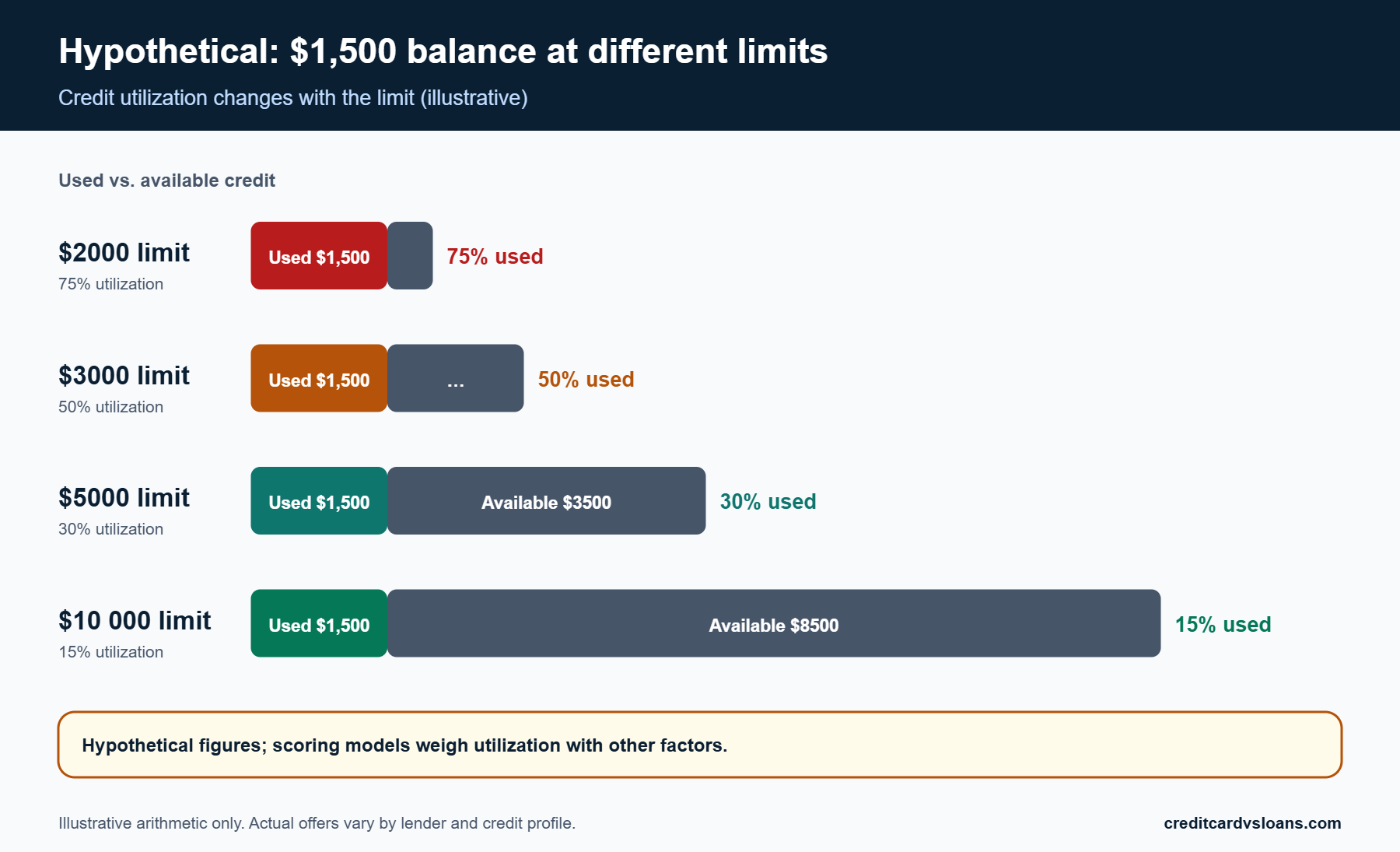
Utilization is the quickest lever, and payment history is the heaviest. As a hypothetical, a $1,500 balance against a $2,000 limit is 75% utilization, which drops to 30% against a $5,000 limit. Paying a balance down raises headroom the same way a higher limit would.
If you are below Fair
Rebuild before you reach for a promotion
The CFPB lists a secured card, a credit builder loan and a small retail card as ways to start or rebuild a record, with payments reported to the three nationwide bureaus. Paying on time, every time, is what builds credit, and products that do not report, such as debit and prepaid cards, will not help.
This path is slower, but it addresses the cause. A 0% offer a year from now with a stronger record usually beats a decline today and an extra hard inquiry.
Consider whether a different product fits
If the aim is to lower the cost of existing debt, a fixed-rate personal loan may be reachable at a lower tier than a promotional card, with its own score requirements and fees. For that threshold, see the guide to credit scores for personal loans.
Compare the total cost, including any origination fee, instead of assuming that a card with a 0% promotion is automatically cheaper.
| Starting point | Main goal | Fastest lever | Credit inquiry plan | Risk flag |
|---|---|---|---|---|
| Good or higher | Choose the best-fit offer | Lower utilization | Preview, then one application | Promotion shorter than payoff |
| Fair, near Good | Cross the boundary or narrow offers | Pay down balances | Wait for inquiries to age | Small limit on approval |
| Fair, thin file | Build history | Reporting starter account | Avoid new applications for now | Too many starter products |
| Below Fair | Rebuild first | On-time payments and error fixes | No 0% applications yet | Applying while score is low |
Special cases that change the plan
Joint applicants, cosigners and applicants under 21
Under 12 CFR 1026.51(b), an issuer generally may not open a card account for someone under 21 unless there is a written application and either information showing the applicant can make the payments independently, or a signed agreement from a cosigner, guarantor or joint applicant aged 21 or older who accepts liability and has the ability to pay. If you are under 21, your own income and the issuer’s cosigner policy matter more than the tier you land in.
If you add a cosigner or joint applicant of any age, remember that the account involves their credit and their liability too. That is a real commitment that deserves a direct conversation before anyone signs.
Thin files and recent immigrants to the system
Someone with only a short record, whether because they are young or new to credit, may have a solid score on a few accounts but little history behind it. Length of credit history is 15% of a FICO Score, and an issuer has less to go on. In that situation a starter product that reports to the bureaus is often a more realistic first step than a promotional card.
If you have credit history from outside the U.S. or limited records, ask the issuer how it evaluates applicants with a short U.S. file before you apply.
What to Do If Your Score Is Below the Tier You Want
Fix what is fixable
Errors, balances and recent lates
Start with the reports: look for accounts that are not yours, wrong balances and payments recorded as late. Then address balances, since amounts owed carry 30% of a FICO Score according to myFICO. Finally, protect the payment record going forward, because payment history is 35% and the strongest predictor of future repayment.
Fixes that rely on the reports being accurate can move quickly. Fixes that rely on time, such as aging a recent late payment, cannot be rushed.
Keep older accounts in view
Length of credit history is 15% of a FICO Score, which makes older accounts valuable. Before you close an unused card in a push to simplify, read this explanation of how closing a credit card can affect your score, since a closed account can change both your history and your utilization.
The decision depends on annual fees and your overall limits, so weigh them before acting.
Build a track record the issuer can see
Starter products that report
A secured card uses a deposit as your limit. A credit builder loan holds your borrowed money in savings while you repay in installments, usually over 6 to 24 months, according to the CFPB. A retail card may offer a low limit that makes a large balance harder to build. Each one reports your on-time payments, which is the point.
Check fees and confirm reporting to all three bureaus before you open one.
How long to wait before the next try
There is no fixed waiting period that works for everyone. A reasonable plan is to set a review date after several months of clean payments and lower balances, pull your reports again, and compare the tier you reach to your target.
If you reach it, use a preview. If not, repeat the cycle rather than applying out of impatience.
Timing and Sequencing Your Applications
The inquiry window
How long an application stays relevant
myFICO says FICO Scores consider inquiries from the last 12 months, while the inquiries themselves stay on your credit report for two years. So the scoring effect of one application fades well before the entry disappears, but a person reviewing your report can still see it.
If you recently applied for other credit, particularly a mortgage or auto loan, think about the order. Large loans may matter more to you than a promotional card, and the card can usually wait.
Avoiding clusters
New credit is 10% of a FICO Score, and myFICO notes that opening several accounts in a short period is seen as riskier, especially for people with short histories. Applying to three cards in a week can look like credit seeking under pressure, and it can lower your odds with the next issuer.
One application, a pause to see the decision and the effect on your file, and then a second only if needed is a calmer approach.
Applying now versus waiting
When waiting is worth it
Waiting helps when the main obstacle is something that improves on its own: a recent inquiry aging, a balance you are paying down, or a late payment receding. In those cases, a few months can move you into a stronger position without any extra cost.
It does not help when the obstacle is a thin file that needs a new account to start building, or when the interest you are paying in the meantime outweighs the benefit of waiting.
When applying now makes sense
Applying now makes sense when you meet your target tier, a preview looks promising, your utilization is low, and the balance is the kind that a promotion could clear. At that point, delays cost interest on the existing debt.
The question to settle is how much interest the delay would cost against the risk of a decline. Your current APR on the balance is the number that decides that.
After Approval: Matching the Promotion to Your Payoff
The promotion is the easy part
Intro APR versus a lower ongoing rate
A 0% promotion is temporary, and the rate that follows can be high. For some people, a card with a lower ongoing rate and no promotion is the better long-term tool. This comparison of a 0% intro APR and a low ongoing APR explains how to choose between them depending on how long you will carry a balance.
If you are confident you can clear the balance within the window, the promotion wins. If the payoff could stretch, the ongoing rate matters more.
The balance transfer trap
Moving a balance does not remove it. The risk is that the old cards reopen as available credit and the debt reappears alongside the transferred amount. This guide to using 0% balance transfer cards without a debt trap walks through the habits that keep a transfer from becoming a second round of borrowing.
The CFPB also notes that missing a payment on a deferred-interest plan by more than 60 days can end the promotional treatment, so autopay on the minimum is a basic safeguard.
Reading the Schumer box
The numbers to compare
The Schumer box is the standardized table of rates and fees on a card offer. For a 0% card, look at the promotional APR and how long it lasts, the purchase and transfer APRs, the transfer fee, annual fee and late-payment terms. Put them in a row beside each shortlisted card.
If the box is not visible on the page you are viewing, look for a link labeled terms or rates and fees before you apply.
True 0% or deferred interest
The CFPB distinguishes a true 0% intro APR, where no interest accrues and interest begins only on what remains, from deferred interest, where interest builds in the background and may be charged back if the promotional balance is not paid in full. Wording such as “no interest if paid in full” signals the second type.
Deferred interest appears in some promotional offers, so confirm which type yours is before you apply.
Budgeting the payoff before you commit
Turn the promotion into a monthly number
Add the balance you plan to move and any transfer fee, then divide by the number of full billing cycles in the promotion. As a hypothetical, a $3,000 balance with a 12-month promotion needs $250 a month before any fee, and more once a fee is added. If that figure is higher than your budget can hold, a longer promotion or a smaller transfer is worth a look.
Build in a cushion of a month or two. Statement dates, posting delays and the first partial cycle can shorten the real window, and a promotion that ends while a small balance remains is the most avoidable way to pay interest.
Decide what happens to your other cards
Moving a balance frees up the limit on the card you paid off. Before you transfer, decide whether those cards stay in a drawer, are used for budgeted purchases that you pay in full, or are closed. Each choice affects utilization and history differently, and the point is to avoid rebuilding the old balance on top of the new one.
If you are tempted to spend on the freed-up limit, a simple fix is to remove saved card details from shopping accounts and set a spending alert.
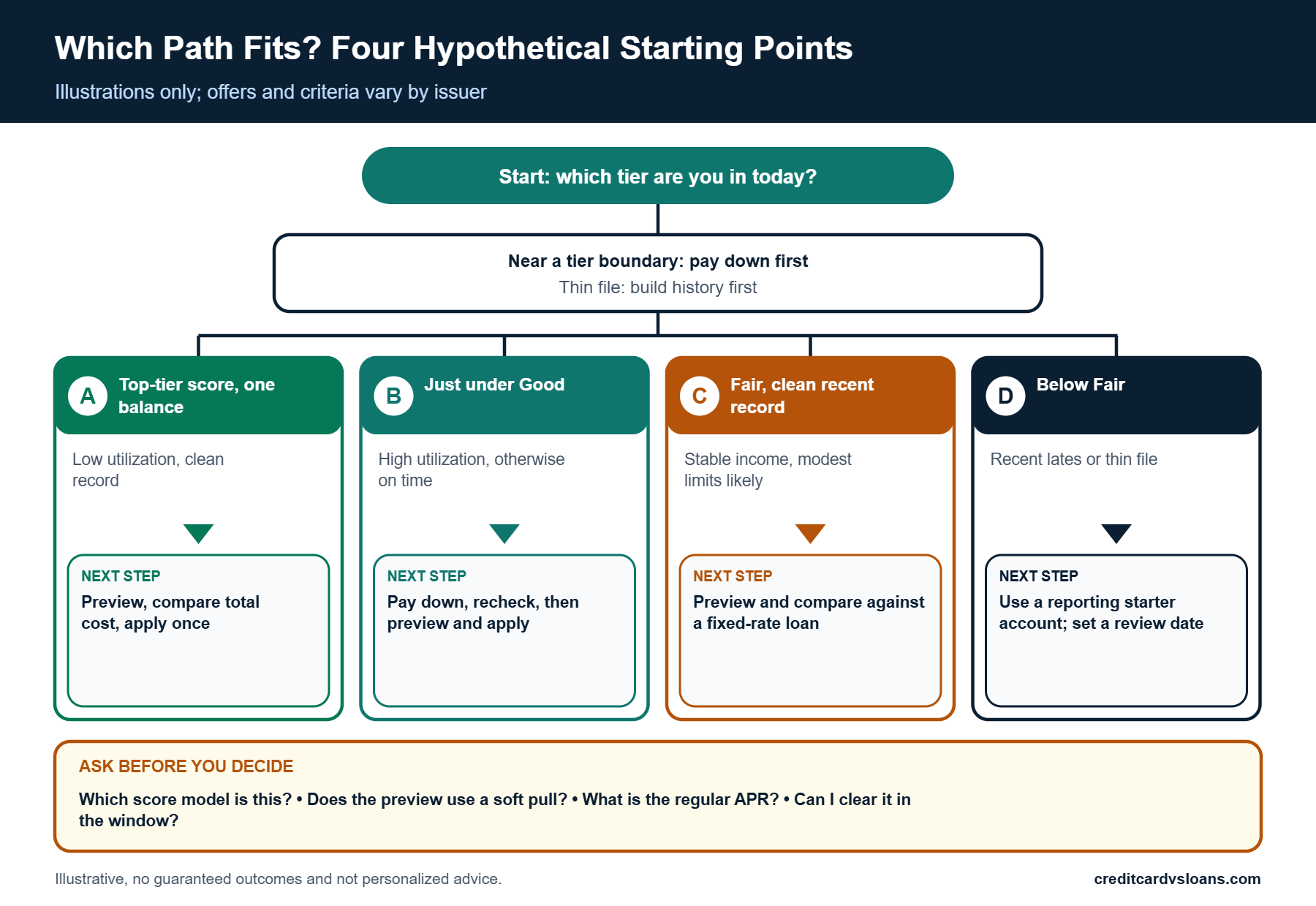
Which Path Fits? Hypothetical Profiles by Tier
Four illustrative starting points
Profile A: top-tier score, one balance
A hypothetical applicant in a high tier with low utilization can use previews to shortlist offers, compare total cost and apply once. The main risk is choosing a long promotion with a large fee when a shorter one would do.
Next step: compute the payoff payment needed per month and compare it across two or three offers.
Profile B: just under Good
A hypothetical applicant a few points below Good, with high utilization, can often shift the picture by paying down balances before applying. Waiting for the next statement to reflect a lower balance is a common approach.
Next step: pay down, recheck, preview, then apply once.
Two more starting points
Profile C: Fair with a clean recent record
This hypothetical applicant may see fewer 0% offers and smaller limits. A preview helps avoid declines, and a backup such as a fixed-rate loan keeps the plan alive if the limit is too small.
Next step: compare the card route to a loan, using total cost.
Profile D: below Fair
A hypothetical applicant in this range is usually better served by rebuilding first. A reporting starter product, on-time payments and lower balances set up a stronger application later.
Next step: choose a starter product, set autopay and set a review date.
| Scenario | Option to investigate | Why | What to verify | When to avoid it |
|---|---|---|---|---|
| High tier, large balance | 0% card with a long promotion | Likely to be competitive | Fee versus months saved | If payoff may run past the promotion |
| Near Good boundary | Pay down, then preview | Utilization can move quickly | New balances on your reports | If you cannot wait |
| Fair, stable income | Preview plus a loan comparison | Limit may be small | Origination fee and rate | If you would apply to many issuers |
| Below Fair | Starter product, rebuild | Reporting history helps | Reports to all three bureaus | Products with high fees and no reporting |
Bottom Line and Your Pre-Application Checklist
The decision in plain terms
What to carry forward
Aim for the Good tier or higher if you want the widest set of 0% offers, check your real scores first, use soft-pull previews to shortlist, and apply once. If you are below your target, fix what is fixable and rebuild rather than collecting hard inquiries.
No score guarantees approval and no tier rules it out, so the useful question is how to put your file in its best realistic shape before you apply. That is mostly about lowering balances, paying on time and spacing out applications.
What to carry away about cost
The promotion saves interest only if you can pay the balance within it. Compare total cost including fees, confirm whether the promotion is true 0%, and know the regular APR before you accept. For the factors beyond the score, see the guide to approval factors for 0% APR cards.
Your checklist
Steps before you apply
- Pull your three free reports at AnnualCreditReport.com and correct errors.
- Check your score from a consistent source and place yourself in a tier, allowing for model differences.
- Pay down the highest-utilization card if you can, and set autopay on all minimums.
- Use soft-pull previews to build a shortlist of two or three offers.
- Compare fee, promotion length and regular APR, and confirm true 0% versus deferred interest.
- Work out the monthly payment that clears the balance before the promotion ends.
If the answer is not yet
If you are below your target, set a review date, choose one rebuilding step and revisit. Do not apply to every issuer at once. A calm sequence tends to cost less than a rush.
Questions worth settling first
Will prequalifying lower my score?
Where a tool uses a soft inquiry, the CFPB says soft inquiries do not affect your scores. The wording matters, though: some pages move from a preview to a full application, which can trigger a hard inquiry. Read the screen before you click continue.
If the page does not say which type of inquiry it uses, look in the terms or ask the issuer before proceeding.
Is a higher limit always better?
A higher limit lowers utilization on a given balance, which tends to help scores, but a limit is also room to borrow more. If a larger limit would tempt you to spend beyond your plan, the lower utilization is not worth the risk. Decide how you will use the card before you see the limit.
The simplest rule of thumb is to treat the 0% card as a payoff tool and keep it out of everyday spending.
How does a new card affect my score right away?
A new account adds a hard inquiry and a young account, and can add available credit. The net effect varies with your file. If you want a closer look at that question, the approval factors guide explains how utilization and new credit interact, and the series covers the effect of opening an account in more detail.
Plan for a small, temporary dip as a possibility and focus on the long-term record, which is built by on-time payments.
Mistakes that cost applicants points and money
Applying in a panic
Applications made the day a card is maxed out or a bill arrives tend to skip the groundwork: the report check, the preview, the fee math. A short pause often costs nothing and can prevent a decline or a poor fit. If cash is genuinely short, contact the lender holding the current balance about hardship options before opening anything new.
A panic application is also more likely to be paired with other credit requests, which stack inquiries in the same short window.
Ignoring the regular APR
It is natural to focus on the 0% headline. But the rate that applies when the promotion ends is the number that determines the cost of any leftover balance, and the Federal Reserve’s G.19 release of October 7, 2026 puts the average at 22.15% for accounts assessed interest in the second quarter of 2026. Your rate may differ, so check your offer.
If the regular APR on a card looks high relative to alternatives, a shorter promotion with a lower ongoing rate may fit better.
Closing accounts right after approval
Some people close old cards once a new one opens, hoping to keep things tidy. That can reduce available credit and shorten the average age of accounts, which affects utilization and history. Decide based on fees and your overall limits rather than habit.
If an old card has no annual fee, keeping it open with a small recurring charge paid in full is a common way to keep the history in place.
Using the new card for everything
A promotional card used for new purchases as well as a transferred balance creates two balances that may carry different rates and different payoff deadlines. It is easy to lose track of which is which, and payments above the minimum may go first to the balance with the higher rate. Keep the card dedicated to its purpose.
Write the promotion end date in your calendar and set a reminder two months before it.
Skipping the reminder
Promotional periods end on a date set by the issuer, and it is rarely the date you remember. Put the end date, the last full statement before it and the monthly payment you need into a calendar entry on the day you are approved. A reminder costs nothing, while a missed date can mean interest on whatever balance remains.
If the plan changes, for example because of a job change or an unexpected bill, contact the issuer early to ask what options exist rather than hoping the date passes quietly.
- CFPB: What is a credit score?
- CFPB: What is a hard inquiry?
- CFPB: What are some ways to start or rebuild a good credit history?
- CFPB: How to understand special promotional financing offers on credit cards
- eCFR: 12 CFR 1026.51 Ability to pay
- FTC: Free credit reports
- Federal Reserve: Consumer credit – G.19 (Release of October 7, 2026)
- myFICO: What is a FICO Score?
- myFICO: What’s in my FICO Scores?
- VantageScore: VantageScore for consumers
Last updated: October 22, 2026. Rates, fees and lender rules change; verify current terms before acting.
The information on creditcardvsloans.com is provided for general educational and informational purposes only. It is not financial, legal, tax, credit, accounting or investment advice, and reading it does not create an advisor-client, fiduciary or any other professional relationship. Nothing here is an offer, solicitation or recommendation to borrow, lend or apply for any product.
Credit scores, interest rates, fees, eligibility rules, lender policies and laws change frequently and vary by lender, location and individual circumstances. Examples, figures and scenarios are illustrative only, do not predict your results and do not guarantee approval, savings, a particular rate or a credit-score outcome. Always confirm current terms directly with the lender or issuer and read the full agreement before you apply or sign.
Although we aim for accuracy and use reputable sources, we make no representations or warranties, express or implied, about the completeness, accuracy, reliability or timeliness of the content. Content may be drafted with the assistance of automated tools, so errors or omissions may still occur. Links to third-party sites are provided for convenience; we don’t control and aren’t responsible for their content.
To the fullest extent permitted by law, creditcardvsloans.com and its owners, editors, authors, contributors and affiliates disclaim all liability for any loss, damage or expense arising directly or indirectly from your use of, or reliance on, this content. Before making financial decisions, consult a licensed professional, such as a qualified financial advisor, attorney, tax professional or nonprofit credit counselor, who can consider your complete situation.