A rewards credit card pays you a small percentage of what you spend, either as cash back or in a points or miles currency, but it only comes out ahead if the rewards you earn are larger than the interest and fees the card can add. That one comparison explains most of what is confusing about every rewards credit card on the market.
This guide is about the machinery underneath the marketing: where the rewards come from, how a card turns a purchase into a reward, what a point is actually worth when you cash it in, and what can quietly change after you have signed up. It does not rank issuers or recommend a specific product. The goal is to make the mechanics clear enough that any offer you meet will make sense.
One thing before the details. Rewards are an add-on to a credit card, and a credit card is a loan you can repay in full each month or stretch over time. The reward is a percentage of spending; the interest is a percentage of a balance. Which one is bigger for you depends almost entirely on whether you carry a balance.
- A reward is a rebate on spending, usually well under 5 cents per dollar; the card’s interest rate is typically a far larger number, so a revolving balance can erase rewards quickly.
- Cash back, points and miles are three different currencies. Cash back has a fixed face value; points and miles are worth whatever the program lets you redeem them for.
- Earning is only half the story. Redemption rules, expiration, forfeiture and program changes decide how much of what you earn you actually keep.
- A card with an annual fee has to earn that fee back before it earns you anything, so the fee belongs in your math from day one.
- Applying for a card is a hard pull, and a new account can change your utilization and average account age; rewards never change how the credit bureaus treat the account.
Market figures below come from CFPB publications dated 2024 and from the Federal Reserve’s G.19 consumer credit release of Sept. 8, 2026. Card terms change often, so treat every number here as context and read the current terms on any offer you consider.
Table of contents
Rewards credit cards in one answer
What a rewards credit card actually is
A normal credit card with a rebate layer
Strip the branding away and a rewards credit card is a revolving line of credit with a rule attached: for each dollar you spend, the issuer credits you something back. Everything else is standard credit card plumbing, including a purchase APR, a billing cycle, a minimum payment, and a grace period if you pay in full.
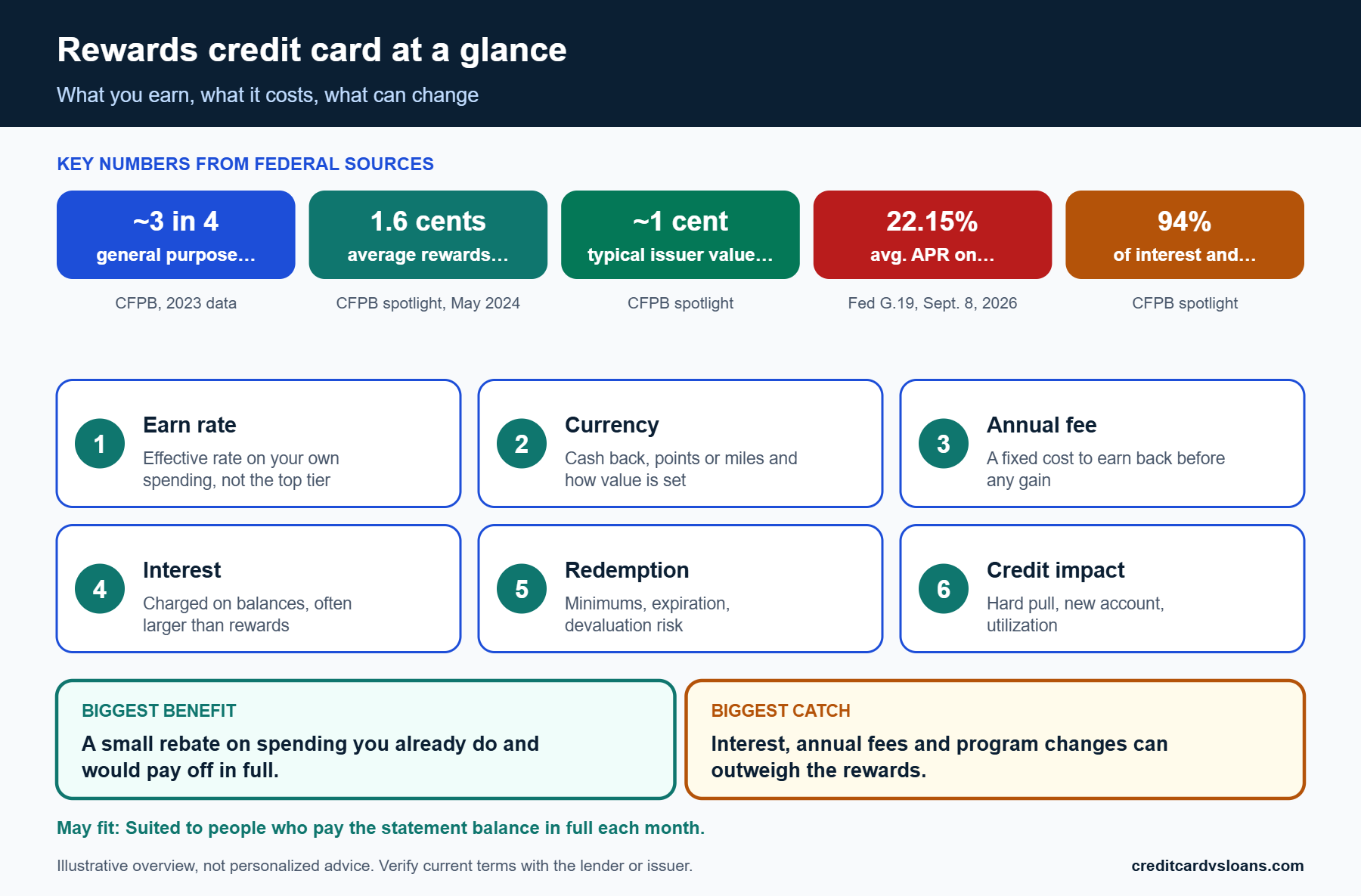
The CFPB’s May 2024 issue spotlight on credit card rewards reported that about three in four general purpose credit card accounts are rewards cards, based on data from its 2023 market report. In other words, rewards are no longer a niche feature. They are close to the default product, which is why understanding them matters even if you never plan to chase them.
Where the money for rewards comes from
Rewards are not free money from the issuer. In general, they are paid for out of the revenue a card produces, which includes fees that merchants pay when you swipe, annual fees, and the interest and late fees that cardholders pay. The CFPB spotlight points to a revealing split: it reported that people who revolve a balance pay about 94 percent of total interest and fees but capture less than 30 percent of rewards benefits.
That does not make rewards a trap. It means the economics tilt toward people who pay in full, and it means that if you carry a balance, you are probably the one funding other people’s rewards.
The three questions that decide whether a card is worth it
How much do you really earn?
Start with the earn rate, but convert it to cents per dollar and apply it to your own spending, not the maximum category. A 5 percent rate that applies to 10 percent of your budget, with a cap, is worth less than a flat 1.5 percent that applies to everything. The CFPB reported that average rewards value across major issuers’ general purpose cards rose from 1.4 cents per dollar spent in 2019 to 1.6 cents in 2022, which is a useful reality check on what typical earning looks like in practice.
What does it cost to keep?
List every recurring cost: annual fee, interest if you ever carry a balance, foreign transaction fees if you travel, and late fees if a due date slips. The Federal Reserve reported in its G.19 release of Sept. 8, 2026 that the average interest rate on credit card accounts assessed interest was 22.15 percent in the second quarter of 2026 (20.94 percent across all accounts). At that level, a balance of just a few hundred dollars can cost more in a year than a modest rewards rate returns.
How easily can you get the reward out?
A reward you cannot use is worth nothing. Check the redemption options, minimum redemption amounts, expiration rules and whether the program can change the value of points you already hold. We cover those in detail below. For now, remember that cash back is the simplest to redeem and points can range from simple to very restrictive depending on the program.
A rewards credit card is a good fit when you pay the full statement balance every month and the earn rate on your real spending exceeds any annual fee. It becomes an expensive product when you carry a revolving balance, because interest is charged on a much larger base than the rewards are earned on.
Cash back, points and miles: three different currencies
Cash back: a reward with a fixed face value
How cash back is credited
Cash back is the simplest reward because one unit equals one cent. If a card pays 1.5 percent and you spend $1,000 in a month, you accrue $15. The CFPB’s issue spotlight describes cash back as a reward with an explicit dollar value that can typically be redeemed as a statement credit, a deposit into a bank account or another cash equivalent.
The details sit in the terms. Some programs pay out automatically at a threshold, some make you request a redemption, and some let you choose between a statement credit and a deposit. Statement credits reduce your balance, but programs differ on whether they also satisfy the minimum payment due, so read how your issuer treats them before you rely on one to cover a bill.
Where cash back falls short
The tradeoff for simplicity is a lower ceiling. Cash back cannot be transferred to an airline or hotel partner, so you cannot turn it into the occasional high-value redemption that some points holders aim for. It also still comes with the usual strings: a minimum redemption amount at some issuers, a possible loss of rewards if the account is closed, and category caps on bonus tiers.
The CFPB spotlight quotes a complaint from a consumer whose issuer refused to pay out a balance of about $20 because of a $25 minimum. A single complaint does not describe the market, but it shows why the redemption minimum is worth reading before you commit.
Points and miles: flexible currencies with moving values
What a point is
A point is a proprietary currency created by the issuer. According to the CFPB spotlight, points can be redeemed as cash back, converted to miles through transfer partners, or exchanged for merchandise, gift cards, travel, charitable donations, a 529 college savings plan, purchase credits or investments. The spotlight also notes that major issuers typically value a point at about one cent when redeemed for cash back.
That one-cent anchor is useful, but it is only a default. When a program offers redemptions that pay more than a cent per point, the extra value comes from the specific award, the timing and your own willingness to do the work of finding it. Redemptions into merchandise or gift cards often pay less than a cent, so the option you pick matters as much as the card itself.
What a mile is and why it varies
A mile is an airline-branded currency credited to a loyalty account and redeemed at a price the airline sets. Co-branded cards earn miles directly, while general points can often convert to miles at a ratio the issuer defines. Because airlines control award pricing, the same number of miles can buy very different amounts of travel depending on the route, the date and the cabin.
The CFPB spotlight cites a 2015 Department of Transportation Inspector General review of two major airlines in which 99 percent of round-trip flights had award seats available, but only 13 percent of holiday-week flights offered a seat at the lowest award level. That dataset is old, so it is not a current availability measure, but it illustrates the central risk with miles: the headline price is rarely the price you can actually book.
| Currency | How value is set | Typical ways to redeem | What to check first |
|---|---|---|---|
| Cash back | Fixed: 1 cent per cent earned | Statement credit, deposit, check or cash equivalent | Minimum redemption, auto-payout rules, what happens at account closure |
| Issuer points | Set by the program; often about 1 cent as cash back, variable elsewhere | Cash back, travel portal, gift cards, transfers to partners | Value per point for each option, program change rights, expiration |
| Airline or hotel miles and points | Set by the airline or hotel, can change with dates and demand | Award flights or stays with that brand or its alliance | Award availability, taxes and fees on awards, blackout dates |
| Store or brand credit | Usable only at one retailer or group | Discounts or credit at that retailer | Expiration, restrictions, the card’s APR |
How rewards are earned and how they are redeemed
Earn structures: what the headline rate hides
Flat-rate versus bonus-category earning
A flat-rate card pays the same percentage on everything, which makes it predictable and easy to compare. A tiered or category card pays more on selected spending, such as groceries or dining, and less on the rest. The headline rate on a category card applies only to the slice of your spending that fits the category, so the effective rate is a weighted average of the tiers.
To estimate that average, multiply each tier’s rate by the share of your spending in that tier and add them up. A card that pays 3 percent on 20 percent of spending and 1 percent on the other 80 percent has an effective rate of 1.4 percent. That is the number to compare against a flat card, not the 3 percent in the ad.
Caps, rotating categories and activation
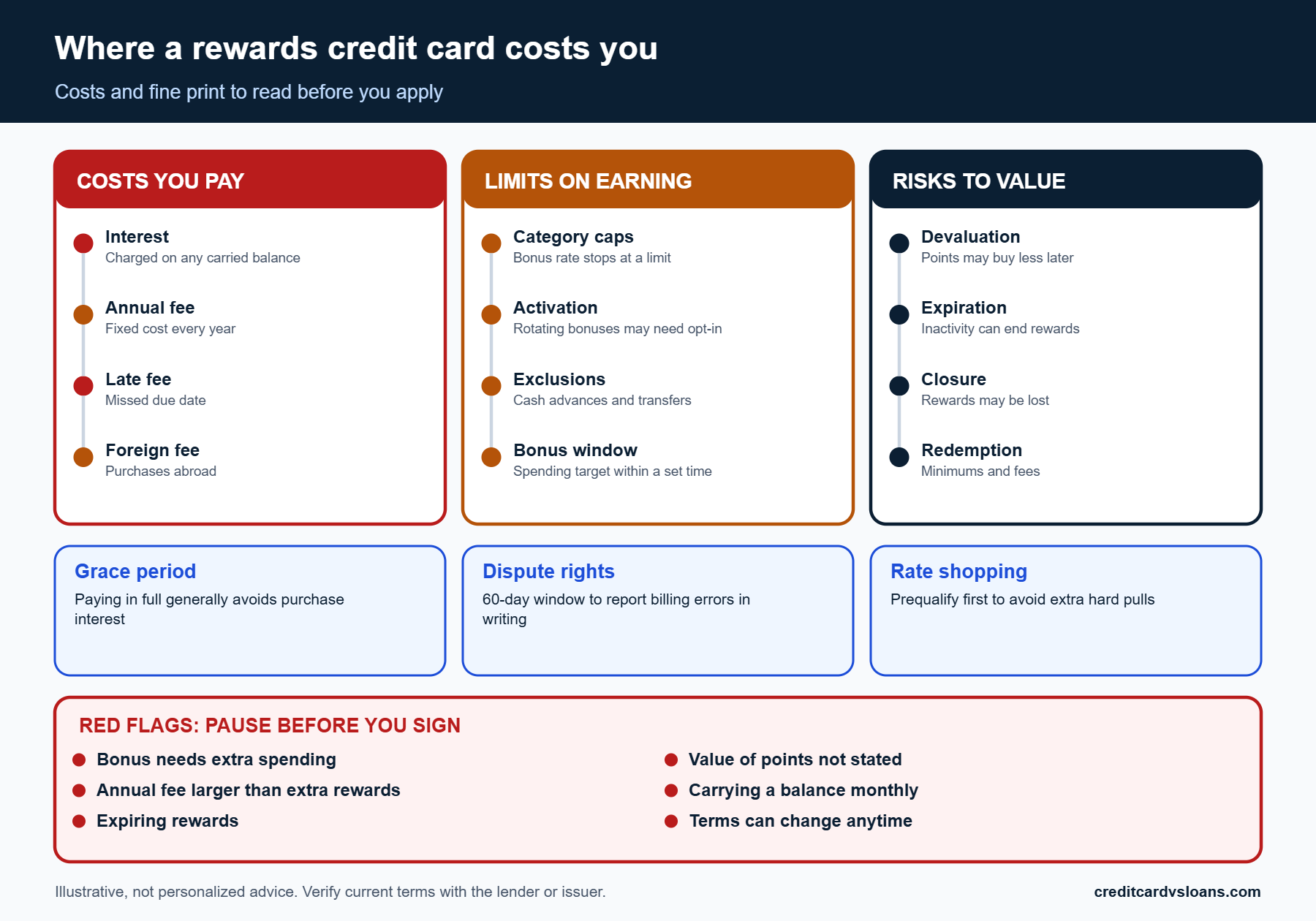
Many bonus tiers have limits. A cap might cover a quarterly or annual spending amount, after which the earn rate falls to the base rate. Rotating-category cards change the bonus category every quarter and often require you to activate it. If you forget to activate, you earn the base rate, and a bonus you never receive is not a bonus.
When you review a card, write down the cap, the reset period and any activation requirement beside the rate. A bonus tier with a small cap is a different product from one with no cap, even when both advertise the same percentage.
Redemption: turning a balance into something you can use
Choosing the redemption that matches your habits
The same pile of points can be worth different amounts depending on how you spend it. Cash back redemptions are simple and usually near one cent per point. Travel portals and gift cards can pay more or less than that, and transfers to airline or hotel partners can pay more only when the specific award is priced well.
The practical rule of thumb is to price a redemption before you commit. Compare the points cost with the cash price of the same item, divide, and see how many cents you are getting for each point. If that number is lower than the cash back option, the cash option wins.
Sign-up bonuses and spending requirements
Sign-up bonuses are real money, but they come with conditions. The CFPB spotlight reported that sign-up bonuses account for almost one in ten dollars of rewards overall, and closer to one in five for consumers with below-prime credit scores, using data from the Bureau’s 2023 market report. It also reported that about one in four consumers eligible for a promotional bonus failed to meet its requirements in 2022.
That pattern is a warning. A bonus that requires a large amount of spending in a short window can push you to spend more than you planned, and spending more than you planned is how a rewards card turns into a balance. Only count a sign-up bonus if you would have made the qualifying purchases anyway.
| Earn structure | How it works | Works best for | Question to ask |
|---|---|---|---|
| Flat rate | Same percentage on all purchases | Spending spread across many categories | Is there an annual fee that offsets the rate? |
| Tiered categories | Higher rate in set categories, base rate elsewhere | Concentrated spending in covered categories | What share of my real budget is in those categories? |
| Rotating categories | Bonus categories change by quarter | People who track and activate offers | What is the quarterly cap, and do I need to activate? |
| Sign-up bonus | One-time reward after meeting a spending requirement | People who would spend the amount anyway | How long is the window and when is the bonus paid? |
What a rewards credit card really costs
Interest: the cost that can erase the reward
Why carrying a balance changes the math
Rewards accrue on spending. Interest accrues on what you owe. Those are two very different bases, and the second one is usually much bigger when a balance revolves from month to month. The CFPB’s grace period guidance explains that if you pay the full balance by the due date you generally are not charged interest on purchases, but if you carry a balance you lose the grace period and new purchases start accruing interest from the day you make them.
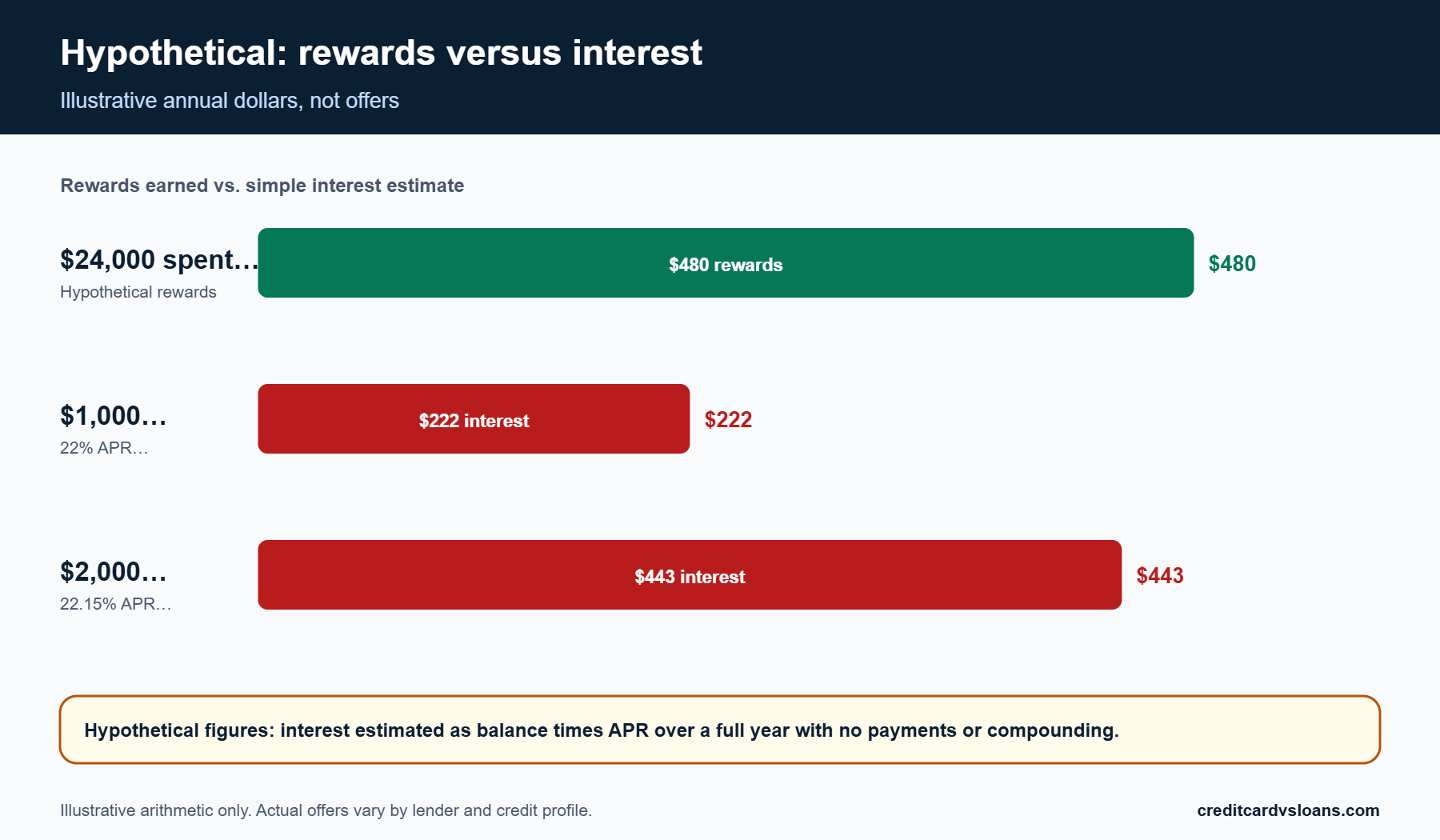
The Federal Reserve’s G.19 release of Sept. 8, 2026 put the average interest rate on accounts assessed interest at 22.15 percent for the second quarter of 2026. Using that as a rough yardstick, a simple annual estimate on a $2,000 balance held all year is about $443 in interest. That is roughly the entire reward a household earns on $22,000 of spending at 2 percent, which is why the order of operations matters: pay the card down before you chase more rewards.
The CFPB’s evidence on who benefits
The CFPB spotlight on rewards reported that cardholders who revolve a balance account for about 94 percent of total interest and fees yet receive less than 30 percent of rewards benefits, and that consumers with near-prime and subprime scores typically pay more in interest and fees on a rewards card than they would on a non-rewards card, even after counting the rewards earned. The finding rests on research that the Bureau cited, and it does not mean every revolving borrower loses.
It does mean the burden of proof sits with you. If you expect to carry a balance for any meaningful part of the year, a card with a lower interest rate or an offer built for balances may serve you better. If that sounds like you, our guide to 0% balance transfer cards and the debt trap to avoid explains why a promotional rate and a rewards card solve different problems.
Fees: what appears on the terms page
Annual fees and the break-even test
An annual fee is a fixed cost you pay whether or not you use the card. To decide whether a fee earns its keep, subtract the rewards you would have earned on a no-fee flat card from the rewards you will earn on the fee card, then compare the difference to the fee. If the difference is smaller than the fee, the fee card is costing you money.
Here is a hypothetical to make the test concrete. Suppose a fee card earns an effective 2.5 percent and a no-fee card earns 1.5 percent on $20,000 of annual spending. The fee card earns $500 and the no-fee card $300, so the fee card pulls ahead by $200 before the fee. A $95 annual fee still leaves $105 of advantage; a $250 fee would leave a $50 shortfall. The numbers are illustrative; your own spending decides the result.
Late, foreign and other fees
Late fees, returned-payment fees, foreign transaction fees and cash advance fees do not earn rewards, and they can quickly outweigh them. Cash advances generally accrue interest from the transaction date with no grace period, according to the CFPB. Many rewards programs also exclude cash advances, balance transfers and similar transactions from earning, so check the exclusions list.
Before you apply, find the table of rates and fees in the card’s terms and read each line. The disclosures are standardized so that you can compare offers apples-to-apples, but only if you actually read them.
| Cost | When it applies | How it compares to rewards | How to limit it |
|---|---|---|---|
| Purchase interest | Any month you do not pay the statement balance in full | Often larger than the reward earned on the same spending | Pay in full; use autopay for at least the minimum |
| Annual fee | Every year the account is open | Must be earned back before rewards add value | Run the break-even test on your own spending |
| Late fee | Payment missed after the due date | Can cost more than a month of rewards | Set autopay and calendar reminders |
| Foreign transaction fee | Purchases processed outside the U.S. | Can cancel a travel bonus | Check the card’s fee line before you travel |
| Cash advance fee | Cash withdrawals and cash-like transactions | No rewards and interest starts at once | Avoid using a credit card for cash |
A promotional bonus or a high earn rate can make a card look cheaper than it is. The cost that matters is the one that appears on your own statements: interest charged, fees paid and rewards actually redeemed, over a full year.
How rewards cards interact with your credit profile
Credit score impact: what changes and what does not
Applying and opening the account
Applying for a rewards credit card usually triggers a hard pull, a credit inquiry that can appear on your report and may lower scores slightly for a short time. Some issuers let you prequalify with a soft pull, which does not affect your credit, but the offer you see is not a final approval. A new account also lowers the average age of your accounts, which is one of the factors scoring models consider.
None of these effects is unique to rewards cards. They are how any new credit account behaves. Rewards themselves never appear on your credit report, and earning more of them does not improve a score.
Utilization and payment history
Two behaviors dominate how a card affects your credit over time. Payment history is the record of whether you pay on time, and utilization is the share of your credit limit that you are using, usually measured on the statement balance. Because rewards encourage spending, they can push utilization up if you let the balance sit on the card, so many people pay before the statement closes if they want to keep reported utilization low.
If you are new to credit, our guide to student credit cards and building credit without overspending explains why a plain card used lightly can be a better starting point than a rewards product.
Requirements: who is likely to qualify
Credit profile and income
Issuers set their own thresholds, and they are not published as a single score. Rewards cards with richer earn rates or premium benefits tend to be offered to people with stronger credit histories, while starter and secured cards serve thin credit file applicants. The CFPB’s spotlight noted that smaller issuers rarely offer airline or hotel redemptions, which is one reason that premium travel features cluster at the largest issuers.
Issuers also weigh your income and existing debt payments, which is why those numbers appear on an application. If an application is denied, the notice you receive will usually explain the main reasons, and you can pull your credit reports to check them for errors.
What to prepare before you apply
Gather your income, housing costs and a recent copy of your credit reports from the official source before applying. Rate shopping among several cards with hard pulls in a short window can add up, so use prequalify tools first when they are offered and apply only when you have compared the terms.
If your goal is paying down existing balances rather than earning rewards, a different tool probably fits better. Our guide to credit card debt consolidation options by credit profile covers that decision directly, and consolidation with bad credit looks at realistic paths when approval is harder.
| Factor | What happens with a rewards card | What you can control |
|---|---|---|
| Hard pull | Inquiry when you apply; effect is typically small and temporary | Prequalify first and avoid applying for several cards at once |
| Average account age | A new account lowers the average | Keep old accounts open when they have no fee |
| Utilization | Higher spending can raise the reported balance | Pay before the statement date or keep balances low |
| Payment history | Late payments can be reported and cost you fees | Use autopay and reminders |
| Rewards balance | Not reported to the bureaus | Nothing to manage here for credit purposes |
Rewards credit card risks and the rules around them
Risks that live inside the program
Devaluation: when the same points buy less
Points are only worth what the program says they are worth, and programs can change. The CFPB’s Circular 2024-07, published Dec. 18, 2024, says that lowering the value of rewards a consumer has already earned can be unfair or deceptive, and may resemble a bait-and-switch when the card was marketed on a particular value. The circular adds that fine print reserving the right to change the program does not necessarily cure the problem.
A circular is a statement of how the agency views existing law, and it does not itself create new rights. For you as a cardholder, the practical lesson is simpler: do not hoard a large pile of points for years on the assumption that their value will hold still. Rewards are safest when you use them on a regular schedule.
Expiration, forfeiture and account closure
The CFPB spotlight reported that every quarter about 4 percent of accountholders lose access to at least some of their rewards, and that issuers forfeit, expire or revoke hundreds of millions of dollars in earned rewards each year, based on the Bureau’s 2023 report. Most programs with rewards have expiration policies, commonly tied to inactivity, and the definitions vary.
Closing an account, missing payments or violating program terms can cost you the balance you earned. Before you close a card, redeem or transfer what you can, and read the terms for what happens to unredeemed rewards. If a card is closed by the issuer, ask in writing about your options.
Rules and recourse when something goes wrong
What the CFPB has said about hard-to-redeem rewards
The same circular says that revoking rewards on the basis of vague terms such as abuse or gaming, or on events outside the cardholder’s control, may be unfair or deceptive, and that system failures that cause points to be lost during redemption can create liability for the operator. The CFPB spotlight also reported more than 1,200 rewards-related complaints in 2023, more than 70 percent above pre-pandemic levels.
These are agency positions and complaint counts, not predictions about your card. They are useful because they tell you which problems to watch for: unexplained changes in value, redemptions that fail and rewards that vanish when an account closes.
Disputes and billing errors
If a charge is wrong, the Fair Credit Billing Act process applies, and the FTC explains that you should send your written dispute so the issuer receives it within 60 days of the first bill that shows the error. The issuer must acknowledge within 30 days and resolve within 90 days, and while it investigates you generally can withhold the disputed amount.
That protection comes from how credit cards work, not from the rewards program. It is one of the reasons many people prefer to put large purchases on a credit card rather than a debit card, provided they can pay the balance in full when the statement arrives.
If an offer asks you to spend more than you normally would to earn a bonus, or hides the value of points behind a conversion you cannot find in the terms, treat it as a warning sign and compare it with a flat cash back card before applying.
Pros, cons and how to compare rewards offers
The honest list of pros and cons
What rewards cards do well
For someone who pays in full, a rewards card turns spending you were going to do anyway into a modest rebate. Credit cards also come with dispute rights, convenient digital payments and a monthly statement that records your spending. A flat cash back card is easy to understand, and a points card can add value for people who value flexibility and know how to redeem.
Rewards can also complement a plan to build credit. A card used lightly and paid in full builds payment history, and the rebate is a small bonus on top.
Where rewards cards disappoint
The same structure that makes rewards attractive can nudge you to spend more. Higher interest rates are common on cards that advertise rewards, annual fees can erase small rebates, and complicated point systems can leave you with a balance of points you never redeem. The CFPB reported that rewards appear on the front page of sampled card offers more than 94 percent of the time, compared with 28 percent for the APR, which suggests the marketing emphasis is on the reward rather than the cost.
The fix is not to avoid rewards. It is to compare the whole offer, including the part that is printed in smaller type.
A repeatable way to compare two offers
Convert everything to a yearly dollar figure
Write down your annual spending in each category from your own statements. Multiply by each card’s effective earn rate, add any sign-up bonus only if you would meet it without extra spending, then subtract the annual fee. Do this for two or three cards and compare the dollar figures rather than the headline percentages.
Add the cost of carrying a balance only if you ever do. If you have a revolving balance now, the comparison that matters is between the interest rate and the reward, and the answer will usually favor paying down the balance first.
Test the assumptions
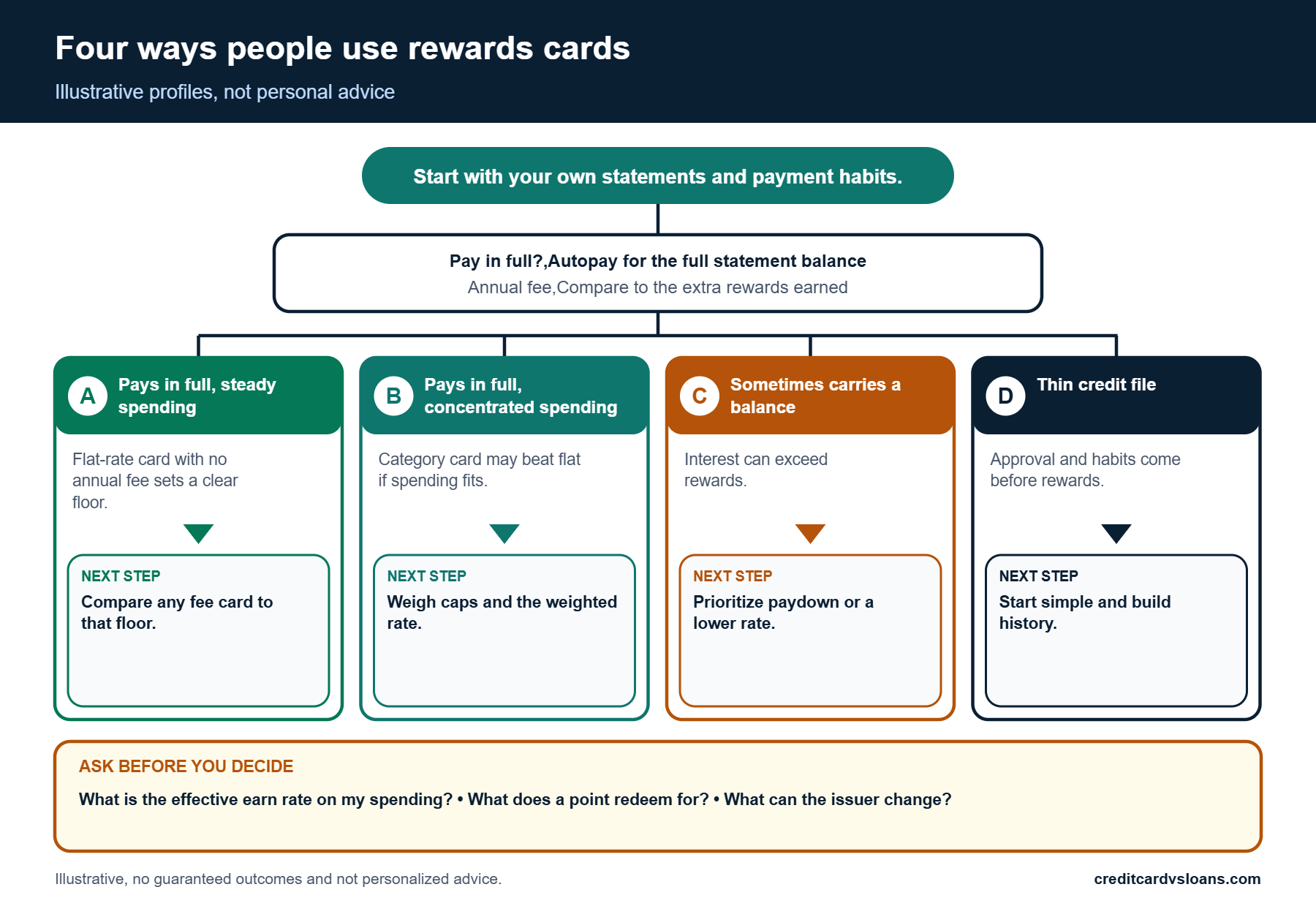
A comparison is only as good as its inputs. Ask what happens if your spending is 20 percent lower, if you stop using a bonus category, or if the value of a point falls. A card that still looks fine under those cases is sturdier than one that works only under the best assumptions.
The same worksheet works for flat-rate cards, points cards and store cards, as long as you fill in every line from your own statements.
| Line | Card X (no fee) | Card Y (annual fee) |
|---|---|---|
| Annual spending assumed | $20,000 | $20,000 |
| Effective earn rate | 1.5% | 2.5% |
| Rewards earned | $300 | $500 |
| Annual fee | $0 | $95 (hypothetical) |
| Net before interest | $300 | $405 |
| Interest if a $1,000 balance is carried all year at 22% (simple estimate) | $220 | $220 |
Alternatives to a rewards credit card
When a different kind of card fits better
Low-interest and promotional-rate cards
If you expect to carry a balance, a card with a low ongoing rate or a promotional APR on purchases or transfers can be cheaper than any rewards structure. A promotional rate is temporary, and the standard rate applies after it ends, so the plan has to include a way to pay the balance down before the offer expires. Our guide to 0% balance transfer cards explains how to read those terms and what can turn a pause on interest into a trap.
These cards typically offer fewer rewards or none. That is the trade-off: you give up the rebate to pay less for borrowing, which is the right call when the balance is the bigger problem than the lack of a rebate.
Starter, student and secured cards
People with a thin credit file may find that a starter or student card is the realistic path to a first account, and some of those cards include modest rewards. The goal in the first year is on-time payments and low utilization, not maximum earning. Our walkthrough of student credit cards and how to build credit without overspending covers the habits that matter most at this stage.
Once your credit has a few months of clean history, you can revisit whether a richer rewards product makes sense. Moving too quickly into a card with an annual fee tends to reward the issuer more than you.
When borrowing rather than a card is the question
Using a loan instead of revolving rewards debt
If you are already carrying card debt, a fixed-rate loan can replace revolving interest with a set payment schedule and an end date. Whether that is cheaper depends on the rate you qualify for, any origination fee and how disciplined you are about not running the cards back up. Our overview of credit card debt consolidation options by credit profile lays out the comparisons, and consolidation when credit is damaged covers the harder cases.
Rewards earned on a card you are paying interest on are a poor reason to keep that balance. In general, interest costs more than rewards return unless the balance is small and short-lived.
Business spending and personal cards
Business owners often wonder whether to run expenses through a personal rewards card. Mixing personal and business spending can complicate bookkeeping, and rewards rules differ for business cards. Our comparison of a business credit card versus a business loan shows how cash flow, timing and cost compare when the money is for a company rather than a household.
If you do use a personal card for occasional business purchases, keep records and check the issuer’s terms. For tax questions about how rewards are treated, ask a tax professional or check IRS guidance, because the answer depends on how the reward is earned.
Decision checklist and next steps
Match the product to your situation
If you pay in full every month
You are the cardholder that rewards are designed for. Prefer a simple structure first: a flat-rate card with no annual fee sets a floor for your earnings, and every fancier card has to beat that floor on your own spending. Add category or points complexity only if your numbers show a clear gain after fees.
Redeem on a schedule, keep an eye on the terms for changes and avoid letting a large rewards balance pile up in a program you rarely use.
If you sometimes carry a balance
Treat interest as the first priority. Pay down the revolving balance, consider a lower-rate or promotional option, and keep rewards cards for spending you can repay quickly. Even a short stretch at a rate near the 22.15 percent average the Fed reported for accounts assessed interest can cost more than a year of modest rewards.
If you cannot pay the balance down soon, speak to a nonprofit credit counselor before adding another card.
Your next steps
A short pre-application checklist
- Write down your monthly spending by category from your statements.
- Estimate the effective earn rate for two or three cards and subtract any annual fee.
- Confirm the redemption options, minimums and expiration rules.
- Check the purchase APR, late fee and foreign transaction fee in the terms.
- Prequalify with a soft pull where offered before you submit a full application.
- Decide in advance how you will pay: autopay for the full statement balance is the simplest safeguard.
Where to go next
If you are weighing a card against a debt payoff plan, start with debt consolidation options, and if you are new to credit, revisit the student card guide. Whatever you choose, read the current terms before you apply, because the numbers in this guide are context and not an offer.
Rewards work best as a small bonus on spending you can pay off every month. Choose the simplest structure that beats a flat no-fee card on your own numbers, keep an eye on the terms, and put interest and fees ahead of points in your decision.
- 0% Balance Transfer Credit Cards: How to Use Them Without a Debt Trap
- Student Credit Cards: How to Build Credit Without Overspending
- Credit Card Debt Consolidation With Bad Credit: Realistic Options
- Credit Card Debt Consolidation: Best Options by Credit Profile
- Business Credit Card vs. Business Loan: Which Fits Your Cash Flow?
- CFPB: Credit card rewards: Issue spotlight (May 2024)
- CFPB: Consumer Financial Protection Circular 2024-07: Design, marketing, and administration of credit card rewards programs
- CFPB: CFPB takes action on bait-and-switch credit card rewards tactics
- CFPB: What is a grace period?
- Federal Reserve: Consumer Credit – G.19 (release of Sept. 8, 2026)
- FTC: Using credit cards and disputing charges
Last updated: October 22, 2026. Rates, fees and lender rules change; verify current terms before acting.
The information on creditcardvsloans.com is provided for general educational and informational purposes only. It is not financial, legal, tax, credit, accounting or investment advice, and reading it does not create an advisor-client, fiduciary or any other professional relationship. Nothing here is an offer, solicitation or recommendation to borrow, lend or apply for any product.
Credit scores, interest rates, fees, eligibility rules, lender policies and laws change frequently and vary by lender, location and individual circumstances. Examples, figures and scenarios are illustrative only, do not predict your results and do not guarantee approval, savings, a particular rate or a credit-score outcome. Always confirm current terms directly with the lender or issuer and read the full agreement before you apply or sign.
Although we aim for accuracy and use reputable sources, we make no representations or warranties, express or implied, about the completeness, accuracy, reliability or timeliness of the content. Content may be drafted with the assistance of automated tools, so errors or omissions may still occur. Links to third-party sites are provided for convenience; we don’t control and aren’t responsible for their content.
To the fullest extent permitted by law, creditcardvsloans.com and its owners, editors, authors, contributors and affiliates disclaim all liability for any loss, damage or expense arising directly or indirectly from your use of, or reliance on, this content. Before making financial decisions, consult a licensed professional, such as a qualified financial advisor, attorney, tax professional or nonprofit credit counselor, who can consider your complete situation.