The balance transfer credit score impact is easiest to understand one scoring factor at a time. A transfer touches all five FICO categories in different ways: it adds a hard inquiry and a new account, changes how much of your available credit you are using, and puts a new payment on your calendar. Whether the net effect is up, down or flat depends on the numbers in your file, not on the transfer itself.
This guide takes the mechanics view. For each factor, it explains what the transfer changes, how big that factor is in FICO scoring, and which parts you control. If you prefer a month-by-month walkthrough of what to expect, see what happens to your credit score after a balance transfer; for the plain question of harm, does a balance transfer hurt your credit gives the short answer.
Nothing here predicts a specific score change. Scoring models differ, lenders use different versions, and your file is unique.
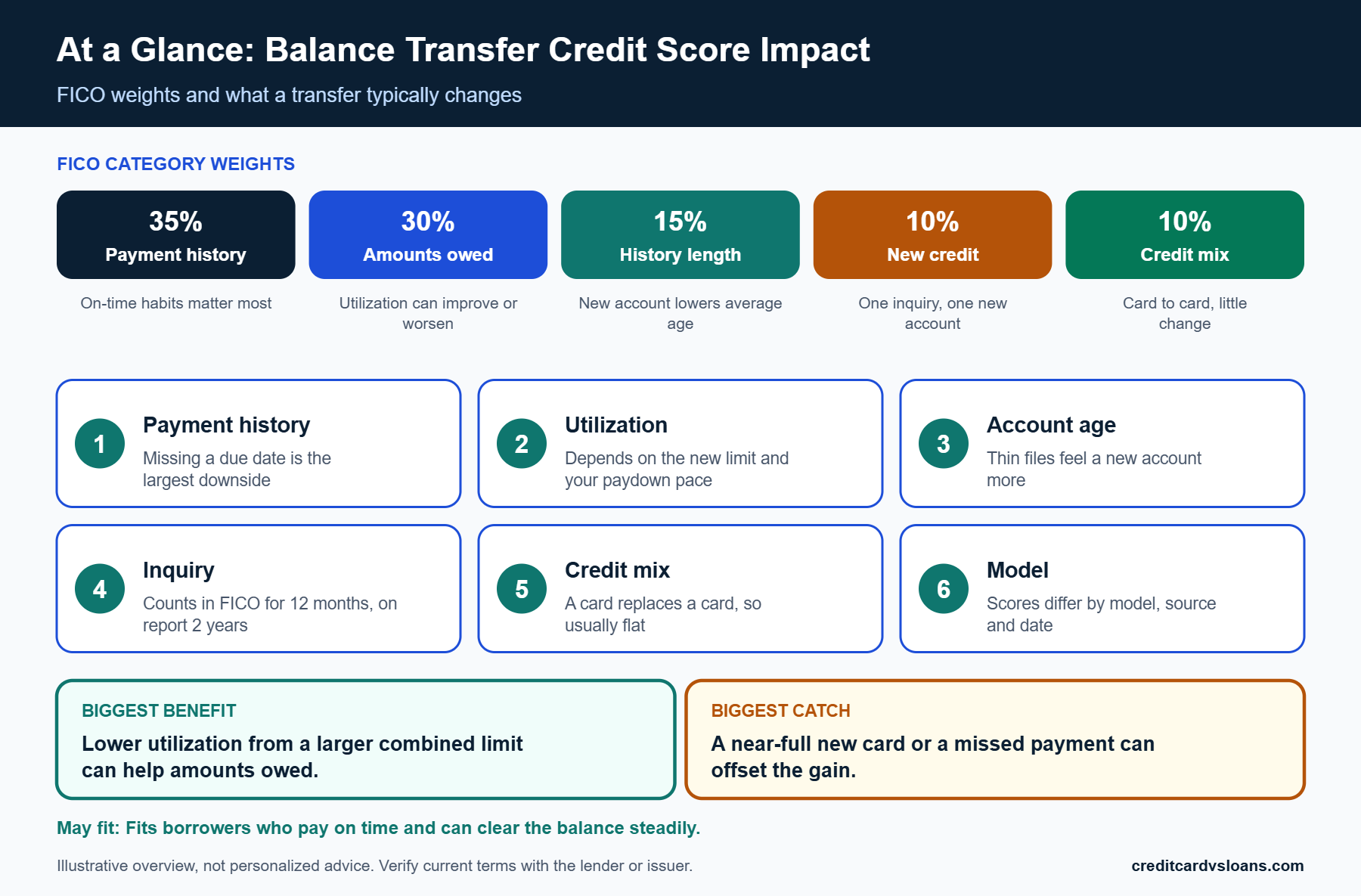
- FICO weights five categories: payment history 35%, amounts owed 30%, length of credit history 15%, new credit 10% and credit mix 10%.
- A transfer can improve amounts owed if it lowers utilization, but it also touches new credit and length of history in ways that tend to hurt slightly at first.
- Credit mix rarely changes, since a card replaces a card.
- Payment history is where a transfer can do the most harm if a due date is missed.
- Per-card and overall utilization can tell different stories after a transfer, so look at both.
- These are general mechanics; the actual change in your score depends on your whole file and the model used.
Rate context comes from the Federal Reserve G.19 release of October 7, 2026 (August 2026 data). Card terms change frequently, so confirm fees and promotional periods with the issuer.
Balance transfer credit score impact: how the five factors line up
The scoring weights and where a transfer touches them
What FICO says each category covers
According to myFICO, payment history is 35% of a FICO Score, amounts owed 30%, length of credit history 15%, new credit 10% and credit mix 10%. The weights are general: myFICO notes they can matter differently from person to person. FICO scores are also based only on credit report data, so income and similar details are not part of the score.
A balance transfer interacts with four of these five directly. Credit mix is usually the exception, because most transfers swap one revolving balance for another.
Why the factor view is useful
Treating the score as one number hides the trade-offs. A transfer might help one category and nick another in the same month, which explains why two people with similar balances can see opposite results. Looking at the factors separately lets you decide which parts you can influence.
The rest of this guide follows the weights from largest to smallest where it makes sense, with the cost section in the middle.
What a transfer cannot change
The things that stay the same
A transfer does not erase past late payments, collections or other negative items. The CFPB says most negative information can be reported for seven years, and it does not shorten that period when you move a balance. It also does not change your income, which FICO does not include in scores.
It also does not remove the debt: it moves it. That is why the amount-owed and payment-history sections matter more than the inquiry.
Table 1: the mechanics at a glance
Table 1 maps each category to what a transfer typically changes. Use it as a quick reference while reading the sections below.
| Category (FICO weight) | What a transfer touches | Typical direction at first | What you control |
|---|---|---|---|
| Payment history (35%) | A new account and possibly several due dates | Neutral if every payment is on time | Autopay and reminders |
| Amounts owed (30%) | Utilization per card and overall | Can improve or worsen depending on the new limit | How much you move and how fast you pay |
| Length of history (15%) | Adds a young account, lowers average age | Small dip, larger on thin files | Whether you close old cards |
| New credit (10%) | One hard inquiry and one new account | Small dip that fades | How many applications you make |
| Credit mix (10%) | Card replaces card, so little change | Usually flat | Limited |
Amounts owed (30%): where a transfer can help most
Utilization after the move
A hypothetical single-card example
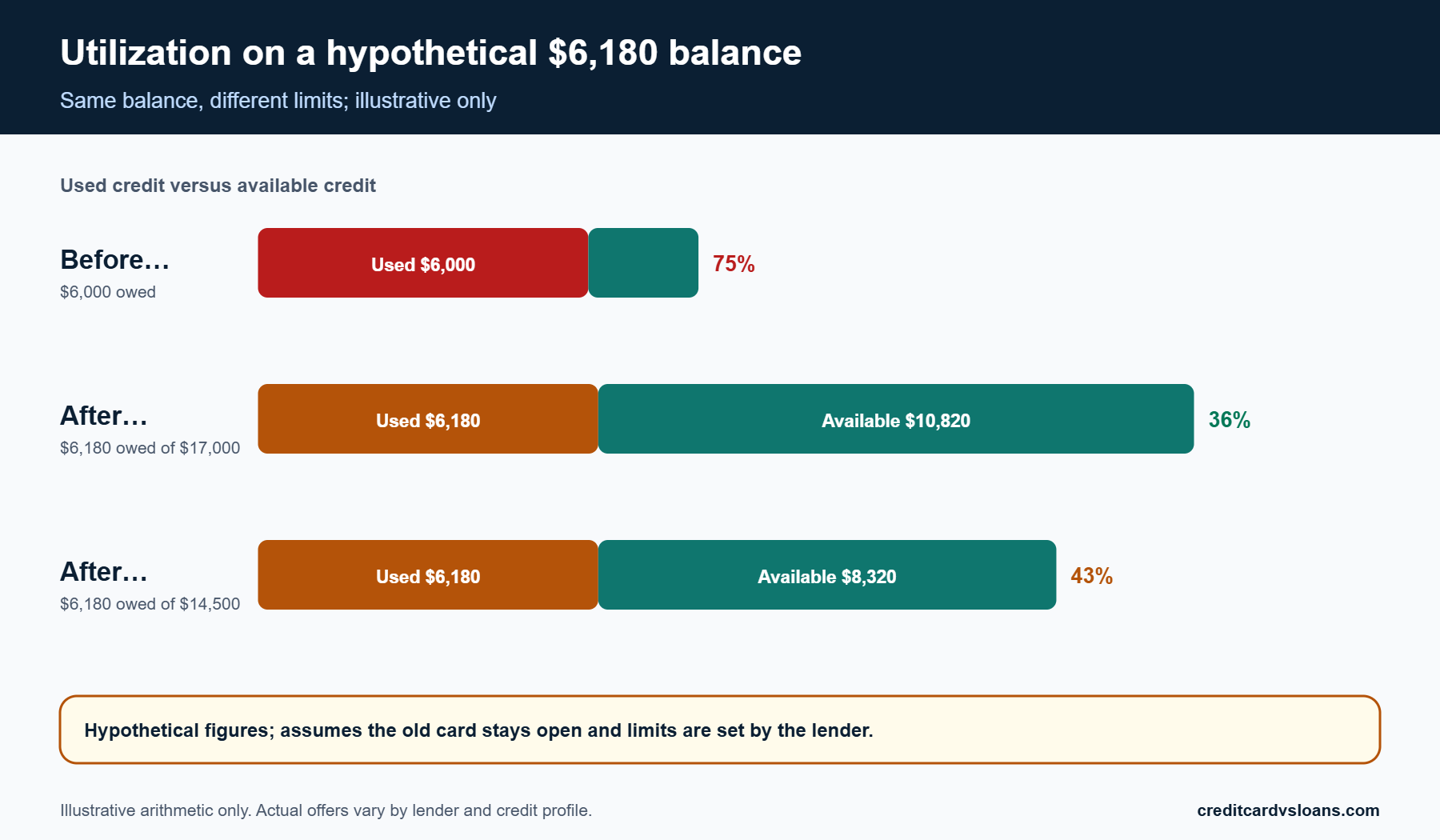
Here is an illustration, not a real borrower. Suppose one card has an $8,000 limit and a $6,000 balance, which is 75% utilization. You are approved for a new card with a $9,000 limit and move the $6,000, paying a hypothetical 3% fee of $180, so the new balance is $6,180.
Now the new card shows about 69% utilization, the old card shows 0%, and overall utilization across both cards is about 36% ($6,180 of $17,000). The old card’s limit still counts as available credit as long as it stays open.
When the new limit is small
If the same $6,180 landed on a $6,500 limit, the new card would sit at about 95% and overall utilization would be about 43% ($6,180 of $14,500). Overall utilization improved from 75% to 43%, but one card is nearly full.
Because scoring models can look at both overall and per-card utilization, a small limit blunts the benefit. The limit is the lender’s decision, so check the approved limit before you finalize how much to move.
How paydown changes the picture
Paying a fixed amount each month
Continuing the hypothetical, paying $515 a month on the $6,180 new balance ends at zero after 12 payments. At the $9,000 limit, the new card would show roughly 51% after three payments, 34% after six and 17% after nine. Overall utilization across both cards would drop faster, to about 27%, 18% and 9% at the same points.
These percentages are arithmetic, not predictions of score points. How many points a given drop is worth depends on the scoring model and the rest of your file.
Revolving versus installment balances
Utilization is a measure of revolving credit, such as credit cards. A balance transfer keeps the debt revolving, whereas converting card debt to an installment loan removes it from the utilization calculation, though the loan still counts as debt owed. The debt consolidation scenarios guide explains how that path behaves.
For readers comparing the two, the key distinction is that a card transfer changes where revolving debt sits, and a loan changes what kind of debt it is.
Payment history (35%): the factor with the most to lose
New due dates and where mistakes happen
Minimums on old cards
During the transfer window the old card can still show a balance until the creditor receives the money. Keep paying at least the minimum on every old card until it shows zero. A missed minimum on a card you thought was paid off still counts as a missed payment.
Autopay for the minimum on every involved card is a cheap safeguard.
The new card’s first statement
Many people miss the first bill on a new card because it arrives by email or a new app and nothing prompts them to pay. Set up your online account and autopay before the first statement closes. The CFPB warns that more than 60 days late can allow the issuer to raise the interest rate on all balances, including the transferred amount.
That penalty risk turns a single oversight into both a cost problem and a scoring problem.
How much one late payment matters
Severity and recency
myFICO says a few late payments are not an automatic score killer and that a generally strong history can outweigh one or two late credit card payments. It also says how overdue the account is, how much is owed and how recent the delinquency is all matter, and that newer negative items count more than older ones.
So the impact of a miss is not a fixed number of points. It is bigger for a thin file, a larger past-due amount or a very recent miss.
Recovering after a miss
myFICO notes that scores can improve over time as on-time payments accumulate after a late payment. Getting current right away, and then staying current, matters more than trying to find a trick. If you are already behind on other accounts, it can be worth pausing before adding new credit and getting current first.
This is the factor where the cost of carelessness is highest and the fix is boring: calendar reminders and autopay.
Cost: what the transfer fee and APR do to the score math
Fees and rates in illustrative numbers
The fee
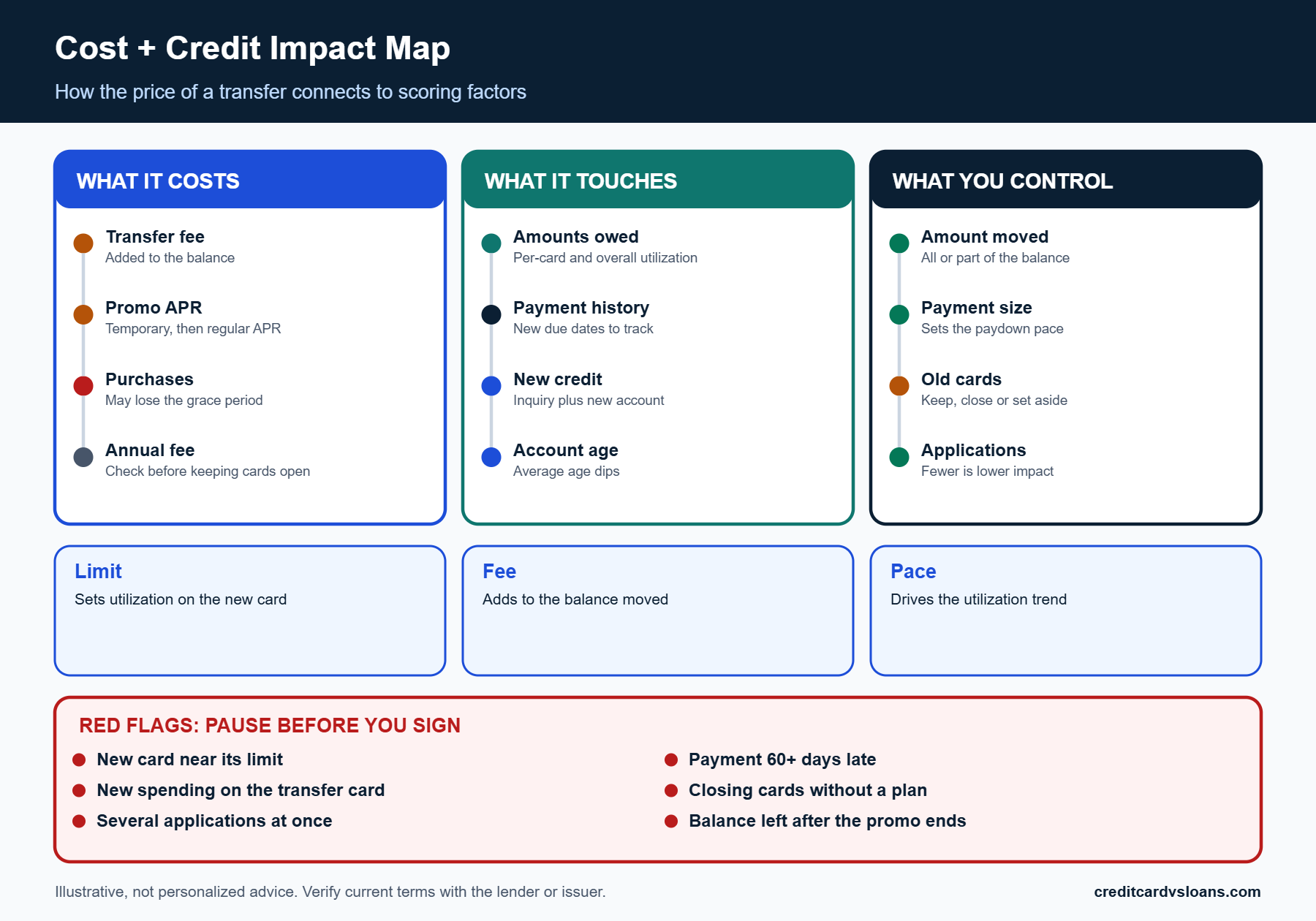
The CFPB says you will probably owe a balance transfer fee, typically a percentage of the amount transferred or a flat amount, whichever is greater. Fee levels differ by issuer and offer. The fee is added to what you owe, which is why the earlier example moved $6,000 and ended with a $6,180 balance.
For scoring, the fee is a small upward nudge to amounts owed. For your budget, it is the up-front price of the promotional rate.
The rate after the promotional period
The CFPB notes that the low rate usually lasts only a limited time and the rate on the card may rise afterward, which raises your payment. For market context, the Federal Reserve’s G.19 release of October 7, 2026 reported an average rate of 22.36% on credit card accounts assessed interest in August 2026, and 21.19% across all accounts. These are market averages, not an offer.
Hypothetically, $6,000 paid at $515 a month at 22.36% APR takes about 14 months and costs roughly $828 in interest. The transfer path, with a 3% fee and a 0% promotional APR lasting at least 12 months, would cost $180 and finish in 12 payments.
Why cost belongs in a credit-score article
Interest slows the paydown that moves your score
Every dollar of interest is a dollar that does not reduce your balance. Over a year, lower interest means a faster fall in utilization for the same monthly payment, which is the route by which a transfer can influence amounts owed in a favorable direction.
That is a mechanical link, not a promise: the score effect depends on the scoring model and on everything else in your file.
What the fee cannot buy
Paying a fee does not buy any credit benefit. The fee does not improve your file; the paydown does. If a transfer lets you pay down meaningfully faster, the fee may be worth it. If you would pay about the same either way, the fee is mostly a cost.
Table 2 sets out the comparison in the hypothetical.
| Item | Keep balance on existing card (22.36% APR) | Transfer (3% fee, 0% promotional APR, 12+ months) |
|---|---|---|
| Starting balance | $6,000 | $6,180 including the $180 fee |
| Months to payoff | About 14 | 12 |
| Interest paid | About $828 | $0 if paid off inside the promotion |
| Hard inquiry | No new inquiry | One for the new card |
| Per-card utilization (hypothetical $9,000 limit) | 75% on the old card at the start | About 69% at the start, falling with payments |
| Overall utilization | 75% | About 36% at the start |
| Main risk | Slower paydown | Missed payment, new spending, a small limit, or a balance left at the end of the promotion |
Eligibility factors that interact with the score
What lenders check beyond the number
A lender deciding on a transfer card looks at your credit report and score, but also at income, existing obligations and the information on your application. A higher score generally helps you qualify for better terms, as the CFPB notes, but approval and terms vary by lender. The personal loan credit impact guide covers how the same inputs matter for installment products.
You cannot see the lender’s exact criteria, which is why prequalification, where offered, is useful.
Why the approved limit matters so much
The approved limit determines the utilization percentage on the new card. A lender may approve a limit that is smaller than the balance you hoped to move. If the offer will not hold the full balance, you can move part and pay down the rest, or reconsider.
Keep in mind that a larger limit invites larger balances. A limit is only helpful if you treat it as a ceiling, not a target.
Length of credit history (15%): the quiet drag from a new account
What the factor measures
Three age measures
myFICO says length of credit history looks at the age of your oldest account, the age of your newest account and the average age of all your accounts, plus how long specific accounts have been open. It states that a longer credit history will always have a positive effect on FICO Scores. A brand-new transfer card lowers the average age and becomes your newest account.
Your report shows all three measures, so you can check how much room you have.
Why a thin file feels it more
If you have two accounts averaging 10 years, adding a third account (age zero) lowers the average to about 6.7 years. If you have ten accounts averaging 10 years, the same new account lowers it to about 9.1 years. The arithmetic is simple, and the bigger the file, the smaller the dent.
This is a hypothetical to show direction. Scoring models treat account age in their own ways.
What happens when you close the old card
Closed accounts still count for a while
Experian explains that closed accounts in good standing can remain on your reports for up to 10 years and keep counting toward account age until they fall off. After that, they no longer affect the score. So closing the old card right after the transfer does not immediately shorten your history.
The bigger near-term effect of closing is on available credit, not on age.
The utilization side of closing
Experian’s example is that a $1,500 balance on $10,000 of total limits is 15%, and closing a $3,000-limit card raises that to 21%. In the hypothetical here, closing the old $8,000 card after the transfer would cut total limits from $17,000 to $9,000, and a $6,180 balance would then be about 69% of the total.
Closing a paid-off card is a real decision with a real trade-off. If the card has no annual fee and you can avoid using it, keeping it open protects the limit.
New credit (10%) and credit mix (10%): the smaller factors
The hard inquiry and new account
What the data says
myFICO describes new credit as 10% of a FICO Score, says inquiries stay on your report for two years, and says FICO scores only consider inquiries from the last 12 months. It also says inquiries usually have a small impact and many types are ignored entirely, and that the score allows for rate shopping, without specifying a window.
The CFPB confirms hard inquiries generally occur when you apply for credit and can lower your scores, while soft inquiries, such as checking your own report or prescreened offers, do not.
Behavior that makes it worse
Applying for several cards in a short span creates several hard inquiries and several young accounts. myFICO advises against opening many accounts in a short period, particularly with a short history. A single, deliberate application is the lower-impact approach.
Using prequalification tools that run soft pulls can narrow your choices before any hard inquiry.
Credit mix and why it barely moves
Card to card
myFICO describes credit mix as the variety of credit types, such as credit cards, retail accounts, installment loans, finance company accounts and mortgages, and says you do not need one of each. A balance transfer replaces one card with another, so your mix stays about the same.
Credit mix tends to matter more when you add a different type, such as an installment loan, which is part of what the debt consolidation scenarios guide looks at.
What not to do for mix
Do not open a type of account just for mix. myFICO notes that this factor is usually less influential, and the cost of an unneeded account, in fees, interest and temptation, is easy to underestimate.
If your plan is to pay off card debt, the mix factor is a footnote, not a strategy.
A hypothetical year, factor by factor
Setting up the example
The assumptions
To see the mechanics together, return to the illustration used above: an old card with an $8,000 limit and a $6,000 balance, and a new card with a $9,000 limit that receives the $6,000 plus a $180 fee. You pay $515 a month, with no new spending on either card and no missed payments. All of this is hypothetical, and the figures show arithmetic, not predicted score points.
The question is what each factor would look like along the way, assuming nothing else in the file changes.
Month one
In the first reporting cycle, payment history shows a new account with one on-time payment. Amounts owed reflects a $6,180 balance on a $9,000 limit (about 69%) and a zero balance on the old card, so overall utilization is about 36%. Length of history shows a new account lowering the average. New credit shows one recent inquiry and one new account.
Three of the four factors that can move at first are neutral to slightly negative, and one, amounts owed, is positive. That is the typical shape of the early weeks.
The path through the year
Months three through nine
Table 4 shows how the numbers evolve in this example. By month six, the new card is about 34% utilized and the overall figure is about 18%. By month nine, they are about 17% and 9%.
During these months, payment history gains a track record, amounts owed improves with each payment, and the inquiry stays on the report but continues to age toward the point where FICO no longer counts it.
| After payment | New card balance | New card utilization ($9,000 limit) | Overall utilization ($17,000 total limits) |
|---|---|---|---|
| Start | $6,180 | About 69% | About 36% |
| Month 3 | $4,635 | About 51% | About 27% |
| Month 6 | $3,090 | About 34% | About 18% |
| Month 9 | $1,545 | About 17% | About 9% |
| Month 12 | $0 | 0% | 0% |
Month twelve and after
At month twelve, the new card is paid off in this example. Payment history has a year of on-time payments, amounts owed is at its lowest, and the inquiry is past the 12-month window that FICO uses, according to myFICO. The new account is now a year old and slowly improving the average age.
If the same borrower had paid only minimums, the picture would be different: higher balances, more interest and a long road to zero. That contrast is why the paydown plan matters more than the transfer.
A monthly routine for tracking each factor
What to review
Once a month
Pull the same score from the same source and record it along with three numbers from your report: the new card’s balance and limit, the old card’s balance, and the date of the last payment. Over a few months, patterns appear that a single score cannot show.
If a score drops while utilization falls, look for a cause elsewhere: a new inquiry, a closed account or a late payment on another account.
Before the promotional period ends
A few weeks before the end date, check the remaining balance, the regular APR and your plan for the last payments. If the balance cannot be cleared, decide whether to ask the issuer about options, move to a different structure, or accept the regular rate while you continue paying down.
This is also a good time to reassess the old cards, with the utilization effect of closing in mind.
Warning signs to act on
Signs in the numbers
A rising balance on the old cards, a new card that stays above about 90% of its limit, or minimums-only payments for several months are all signals that the plan is slipping. They do not mean failure, but they are cheaper to address early.
Consider revisiting the spending plan, or the alternatives in the personal loan credit impact guide, if the numbers trend the wrong way.
Signs in the paperwork
Look for statements you did not expect, interest charged earlier than planned, or a notice about a rate change. The CFPB notes that purchases on the transfer card may have no grace period, and that a payment more than 60 days late can raise the rate on all balances.
If anything looks off, contact the issuer promptly and keep a record of the conversation.
Why the same transfer can produce different results
Models, bureaus and timing
There is no single score
The CFPB says you do not have just one credit score: scores vary based on the scoring model, the data source and when the score is calculated. Most scores fall between 300 and 850. The score a card issuer uses to decide your application may not be the same as the one on your banking app.
So if you see a different change from a friend who did a similar transfer, that is not necessarily a sign that something went wrong.
Reporting dates and snapshots
Each score is a snapshot of the data on file at that moment. A balance that was reported before your payment, or a limit that has not been updated yet, can make utilization look worse or better than your current situation. Looking at the same score source on the same day each month reduces that noise.
If an account looks wrong on your report, you can dispute it with the bureau, and keep records of your payments in the meantime.
What to look at on your own report
Balances, limits and statuses
On your report, check that the old card shows a zero or reduced balance, that the new card shows the right limit and balance, and that every account is marked current. Limits matter because a missing or incorrect limit can inflate utilization for scoring purposes.
Reports are free to review and, per FICO and the CFPB, checking your own report does not affect your scores.
The dates that matter
Note the open date of the new account, the date of the inquiry and the date of the last reported balance. With those three, you can tell whether a score change is from the inquiry, the new account or the balance, which makes the mechanics in this guide concrete rather than abstract.
Common misunderstandings about the balance transfer credit score impact
Myths about inquiries and closing accounts
Myth: one inquiry ruins a score
myFICO says inquiries usually have a small impact, and that FICO scores only consider those from the last 12 months. A single application for a well-chosen card is a modest event for most files. The pattern to avoid is many applications in a short window.
That said, a thin file or other recent new accounts can make the effect more noticeable, so context matters.
Myth: closing the old card is required or always good
Nothing about a transfer requires closing the original card. Experian notes that closing reduces available credit and can raise utilization. Some people close cards to remove the temptation, which is a behavioral choice with a credit cost, not a rule.
If you decide to keep it open, consider lowering the card’s risk by removing saved payment details from shopping accounts.
Myths about balances and payments
Myth: a transfer pays off the debt
A transfer moves the debt to a different card with different terms. The amount owed does not decline until you make payments. If you treat the transfer as the finish line, interest can return when the promotional period ends, as the CFPB notes.
The score gain, if there is one, follows from the paydown, not from the move itself.
Myth: a zero balance on the old card means that card should be ignored
Keep paying minimums on old cards until balances actually post as zero, and keep an eye on statements for stray fees or interest. A forgotten statement balance that goes unpaid can become a late payment, with the scoring consequences described in the payment history section.
After the old card is at zero, treat it as a reserve you do not use, or close it deliberately.
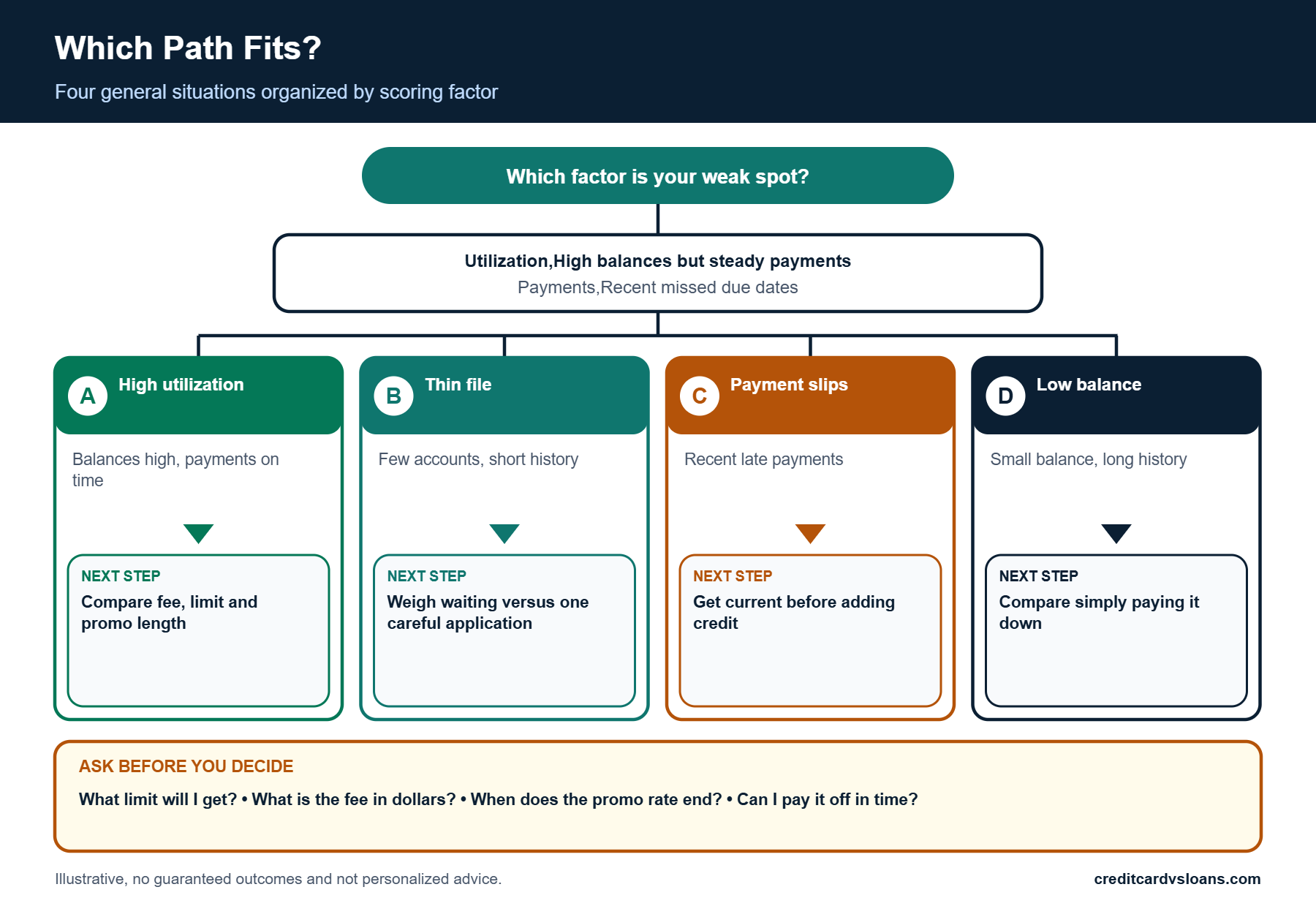
Which path fits? Scenarios by mechanics
Matching your situation to the factor that matters most
Utilization is high and payments are steady
If your utilization is high but you pay on time, the amounts-owed factor is where a transfer is most likely to help, provided the new limit is large enough and the paydown plan is realistic. Compare the fee and the promotional period against how fast you can pay.
The credit utilization guide explains how utilization works across cards, and it is worth reading before you choose how much to move.
Payments are shaky
If you have recently missed payments, payment history is the factor to fix first. A transfer does not change that factor, and a new account without a stable payment routine could add risk. Prioritize reliable payments, then revisit.
Fixed-payment options, which do not give you a revolving limit to spend again, may fit some borrowers better, as the personal loan guide describes.
Comparing alternatives by factor
Loan consolidation
A debt consolidation loan also involves a hard inquiry and a new account but adds an installment account and removes card balances from utilization. The consolidation scenarios guide covers what happens to a score under different behaviors.
The choice often comes down to the payment structure and the total cost, not just the credit effect.
Doing nothing
For some borrowers, paying down the existing card aggressively is a valid choice, with no inquiry, no new account and no fee. It is slower and may cost more interest, but it keeps the file simple. The right answer depends on your rate, your budget and your discipline.
Table 3 sums up the decision logic.
| Situation | Factor most affected | Option to look at | What to verify | When to avoid it |
|---|---|---|---|---|
| High utilization, on-time payments | Amounts owed | Balance transfer with a large enough limit | Fee, promotional length, limit, rate after promotion | If the new limit would leave the card near full |
| Thin credit file | Length of history | Wait or choose one carefully chosen application | Number of accounts and their ages | If several applications are planned |
| Recent late payments | Payment history | Get current, then compare options | Your report accuracy | If a missed payment could happen again |
| Balance too large to pay in a promotion | Cost and amounts owed | Fixed-term loan or counseling | APR, fees, how the account is reported | If payments would strain the budget |
| Low balance, long history | New credit | Pay down the existing card | Interest versus fee | A transfer may add little |
Questions that come up about the mechanics
Scoring questions
Does paying off the old card early help?
Paying down balances reduces utilization, which can help the amounts-owed factor. Whether it moves your score depends on how the model weighs it. There is no fixed number of points attached to a given payment.
Do I need to keep the new card forever?
No, but closing it has the same utilization and account-age considerations as closing any card, and a card with no annual fee and a zero balance can quietly support your available credit. Compare the annual fee, if any, with the benefit.
Practical questions
What if I cannot pay it off before the promotion ends?
Plan ahead: the balance will start accruing interest at the card’s regular rate. You can ask the issuer about options, compare a fixed-term product, or consider the timeline guide for the months after a transfer to see what to expect. Do not wait until the last statement to decide.
Can I transfer again later?
It is possible in some cases, but each transfer typically has its own fee and creates a new inquiry and a new account. Check whether a repeated pattern is helping you pay down debt or simply moving it.
Special situations
What if I already carry balances on several cards?
With several cards, the per-card picture can differ a lot from the overall one. A transfer can bring the highest-utilization card to zero and leave others untouched, which helps one measure more than another. It can be worth listing each card’s balance, limit and APR side by side, and deciding which balances are worth moving.
The cards with the highest APRs are usually the ones where moving a balance saves the most interest, but the fee, the limit and any penalty terms on the new card all enter the calculation. Because scoring models differ on per-card and overall utilization, avoid assuming one strategy will maximize every score.
What if my score is already high?
A strong score generally means the inquiry and new account have less room to matter, and the main question becomes cost. If your utilization is low and your history is long, the score effect of a transfer is likely small either way. The decision then comes down to interest savings, fees and whether the new card is worth managing.
If your score is high because of a long, clean history, protect that by not closing your oldest account casually. Experian notes that closed accounts in good standing can remain on reports for up to 10 years, but they eventually fall off, and then they no longer help.
Conclusion and next steps
Reading the balance transfer credit score impact by factor
The short version
A balance transfer touches payment history, amounts owed, length of history and new credit. It can help amounts owed if it lowers utilization, can dip new credit and age briefly, and can hurt payment history if a due date slips. The final effect depends on your file, the model and your behavior.
What to do with that
Focus on the two things you control the most: paying on time and paying down the balance. The smaller categories matter, but they are rarely the reason a transfer succeeds or fails.
A concrete next-step list
Before you apply
- Review your credit reports for errors and note your current limits and balances.
- Prequalify where possible, and compare fee, promotional length and the rate after it ends.
- Work out the monthly payment that clears the fee-inclusive balance in the promotional window.
- Decide in advance what you will do with the old cards.
After the transfer
- Set autopay for at least the minimum on every card involved.
- Keep new purchases off the transfer card.
- Review your report in a month to confirm balances and limits.
- Plan the last payment before the promotional rate ends.
- CFPB: What is a credit score?
- CFPB: What is a hard inquiry?
- CFPB: What is a balance transfer?
- CFPB: How long does negative information remain on my credit report?
- myFICO: What is in your credit score?
- myFICO: New credit and your FICO Score
- myFICO: Length of credit history and your FICO Score
- myFICO: Payment history and your FICO Score
- Federal Reserve: Consumer Credit – G.19 (Release of October 7, 2026 (August 2026 data))
- Experian: How long do closed accounts stay on your credit report?
Last updated: October 22, 2026. Rates, fees and lender rules change; verify current terms before acting.
The information on creditcardvsloans.com is provided for general educational and informational purposes only. It is not financial, legal, tax, credit, accounting or investment advice, and reading it does not create an advisor-client, fiduciary or any other professional relationship. Nothing here is an offer, solicitation or recommendation to borrow, lend or apply for any product.
Credit scores, interest rates, fees, eligibility rules, lender policies and laws change frequently and vary by lender, location and individual circumstances. Examples, figures and scenarios are illustrative only, do not predict your results and do not guarantee approval, savings, a particular rate or a credit-score outcome. Always confirm current terms directly with the lender or issuer and read the full agreement before you apply or sign.
Although we aim for accuracy and use reputable sources, we make no representations or warranties, express or implied, about the completeness, accuracy, reliability or timeliness of the content. Content may be drafted with the assistance of automated tools, so errors or omissions may still occur. Links to third-party sites are provided for convenience; we don’t control and aren’t responsible for their content.
To the fullest extent permitted by law, creditcardvsloans.com and its owners, editors, authors, contributors and affiliates disclaim all liability for any loss, damage or expense arising directly or indirectly from your use of, or reliance on, this content. Before making financial decisions, consult a licensed professional, such as a qualified financial advisor, attorney, tax professional or nonprofit credit counselor, who can consider your complete situation.