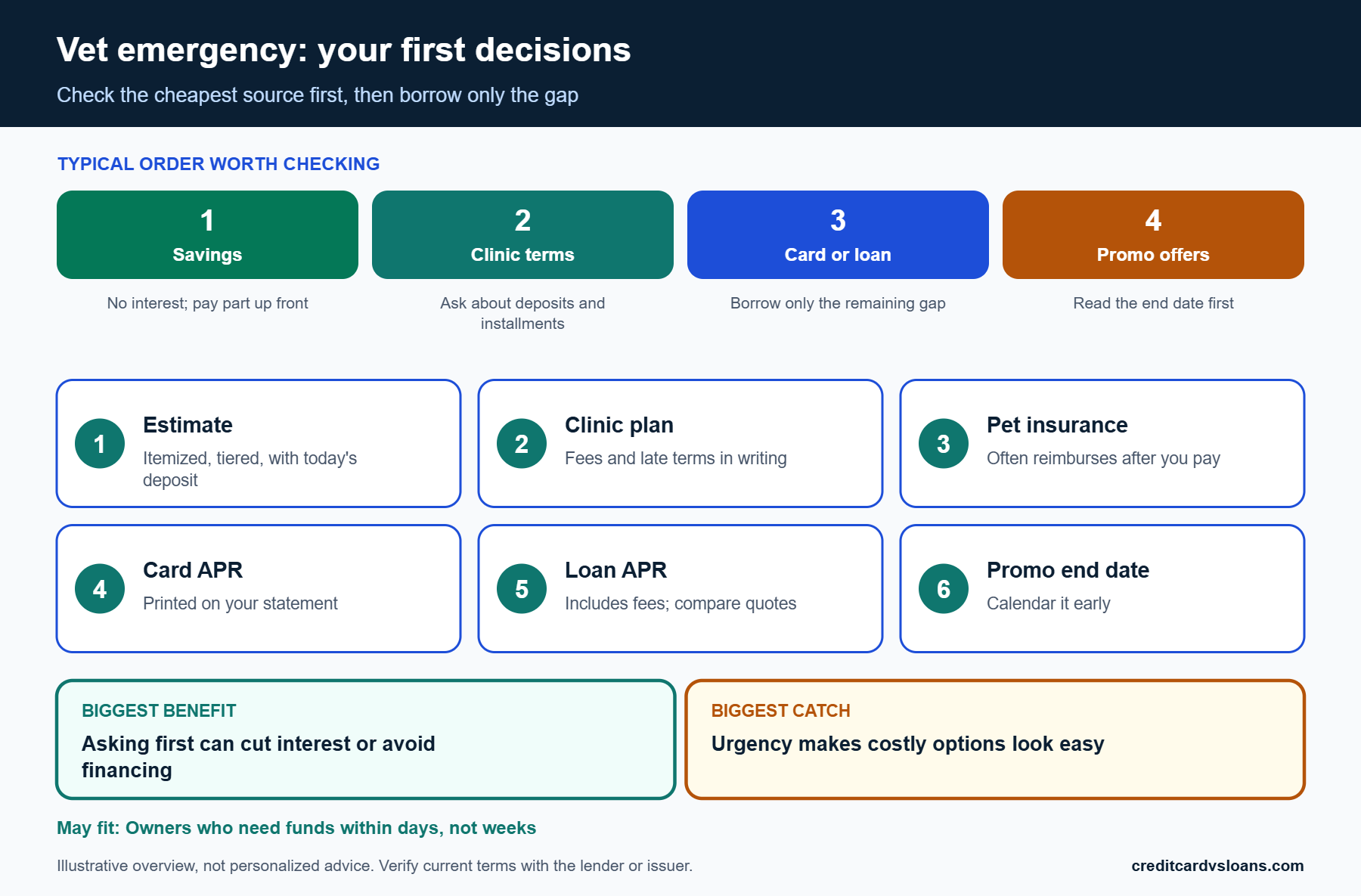
The best way to finance a vet emergency is usually the cheapest source you can reach quickly and repay on a schedule you can actually keep: savings first, then a clinic payment arrangement, then a low-rate credit option, and only then a high-cost product. If you are staring at an estimate right now, the order of operations matters more than the product name.
A veterinary emergency is a strange financial moment. You are making a medical decision for someone you love, often at night, with an estimate that may be thousands of dollars and a clinic that wants payment or a deposit before treatment continues. Fast decisions tend to be expensive decisions, which is why this guide walks through the options in the order they are worth checking.
This article stays on one question: how to cover an unexpected animal-care bill without turning it into a long-term debt problem. For the broader comparison of the two main borrowing tools, see our credit card vs. personal loan guide. For agreement fine print, see the loan agreement red flags checklist.
- Ask the clinic for an itemized estimate, treatment options at different price points, and whether it offers an in-house payment arrangement before you apply for any credit.
- A credit card can be the fastest tool, but carrying a balance is expensive. The Federal Reserve reported an average rate of 22.36% on card accounts assessed interest in August 2026 (preliminary), and your own rate may be higher or lower.
- Clinic-promoted financing with a deferred interest promotion can cost far more than it looks if any balance remains when the promotion ends. The CFPB has documented this pattern in medical financing generally.
- A fixed-rate personal loan can make sense for a larger bill you need more than a year to repay, but origination fees and funding speed vary by lender.
- Never let urgency push you into signing something you have not read. Check the APR, fees, promotional end date and what happens after a missed payment.
Rate figures in this article are national averages from the Federal Reserve’s G.19 release of October 7, 2026, and they are not offers. Clinic programs, lender terms and nonprofit grant funds change often, so confirm details directly before relying on them.
How to Finance a Vet Emergency: The Short Answer
A simple order of operations
Start with the cheapest money you can reach
Cash you already have costs nothing in interest, so it comes first, even if using it feels uncomfortable. If your emergency fund is meant for exactly this kind of surprise, using it is the plan working, not failing. Rebuilding it afterward at a pace you can manage is a better outcome than a balance that charges you every month.
If cash does not cover the whole bill, use it for part of it. Every dollar you pay up front is a dollar that cannot accrue interest, and a smaller financed amount widens your options and shrinks your payment.
Then ask for time before you ask for credit
Many clinics will discuss a deposit plus a payment schedule, and some work with third-party financing companies. Policies vary widely by practice, so ask directly and politely: what is the minimum due today, and can the rest be arranged in installments? An arrangement with the clinic itself may carry no interest, though you should ask whether it does and what happens if a payment is late.
Asking costs nothing and does not obligate you. Get the terms in writing before you agree, even if the front desk describes them as informal.
When credit is the right tool
Cards win on speed, loans win on structure
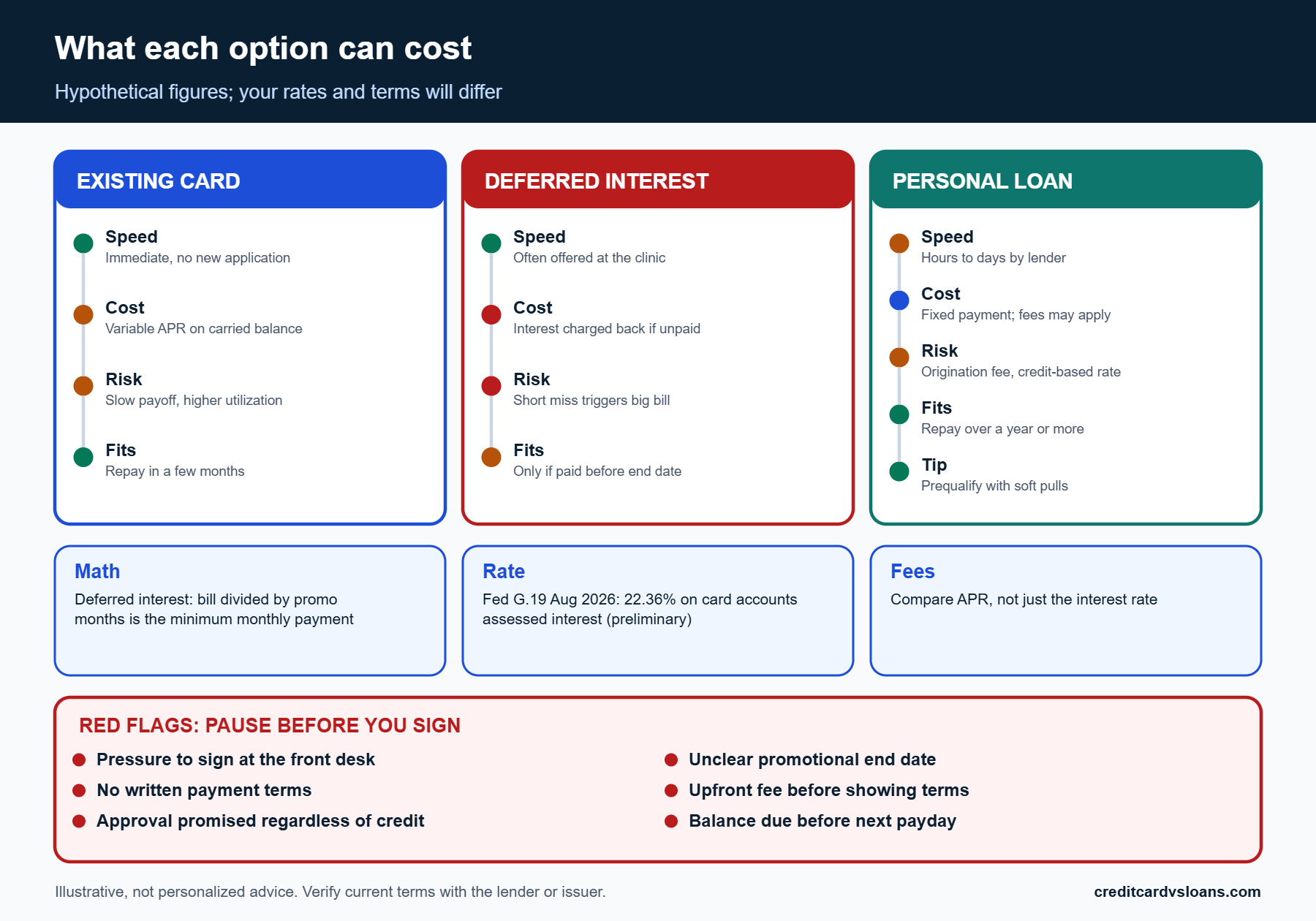
A credit card you already hold can pay a clinic within minutes, which matters when treatment cannot wait. The catch is that revolving debt has no built-in finish line. A fixed-rate installment loan has a set payment and end date, which helps if the bill is large, though funding may take a day or more depending on the lender.
The rule of thumb: if you can repay in a few months, an existing card at a standard rate is often workable. If repayment will take a year or longer, compare an installment loan or a genuine low-rate option against the card rate. We lay out the full trade-off in the credit card vs. personal loan comparison.
When a promotional offer helps and when it hurts
A true 0% introductory APR can be the cheapest way to finance a bill if you can pay it off before the promotion ends. A deferred interest offer looks similar but works differently: interest is tracked in the background and added to your bill if the balance is not paid in full on time. That distinction is the single most expensive thing to misunderstand, and a later section explains it with numbers. For a side-by-side look at a standard 0% card against a loan, see 0% APR credit card vs. personal loan.
If you cannot say with confidence that you can clear the full balance before the promotion ends, treat the offer as a high-rate loan with a trapdoor.
Before You Borrow: The First 60 Minutes
Get the facts about the bill
Ask for an itemized, tiered estimate
An emergency estimate often bundles diagnostics, stabilization, hospitalization and surgery. Ask for it itemized, and ask which items are needed now versus which can be decided after the animal is stable. Veterinarians can often describe more than one treatment path, from the most comprehensive to a more conservative plan, and the right one depends on the animal’s condition, your goals and your budget.
This is not about cutting corners on care. It is about understanding which decisions have a deadline and which do not, so you borrow only for what is needed.
Separate the deposit from the total
Clinics frequently ask for a deposit before beginning treatment, and the deposit is often a fraction of the full estimate. Knowing the deposit lets you cover that piece from savings or an existing card and buy time to arrange the rest. Ask what happens if the actual bill comes in lower or higher than the estimate, and when you will be told about changes.
Write down the number you are being asked to pay today. It is easy to lose track of that figure when everything feels urgent.
Decide what you can truly afford to repay
Work backward from a monthly number
Before comparing products, decide the most you can put toward this debt each month without missing rent, utilities or other minimums. That number, not the product’s headline rate, determines which option is realistic. A payment you cannot sustain creates late fees and credit damage on top of the original bill.
Be honest about irregular income and other obligations. If the monthly figure is small, a longer term lowers the payment but raises total interest, so look at both numbers.
Know what you are not required to do
You are not required to accept the first financing option the clinic puts in front of you. You can leave the front desk, step outside, and compare. If the clinic pressures you to sign a financing application on the spot, that is a red flag worth noticing. The CFPB notes that some patients using medical credit products said they did not realize they had opened a credit line, so read before you sign, and ask for a copy.
If you are being asked to authorize a credit application, confirm whether it involves a hard pull or a soft pull. A hard pull can affect your credit reports, while prequalifying with a soft pull generally does not.
Urgency is the lever that makes expensive financing profitable for lenders. A five-minute pause to read the APR, the promotional end date and the late-payment terms is the most valuable thing you can do in the first hour.
Lower-Cost Options to Check Before You Use Credit
Help from the clinic and your own network
In-house payment arrangements
Some practices let clients split a bill into a few installments, often with a large share due at the start. Whether a clinic does this, what it charges, and how it handles a missed payment differ from practice to practice, so there is no safe assumption. Ask for the terms, including any fees, and ask whether the practice reports unpaid balances to a collection agency.
An interest-free arrangement with a short schedule can beat any credit product. If the clinic offers one and your budget can handle the payments, compare it first against everything else in this guide.
Family, friends and informal loans
Borrowing from someone you trust can be the cheapest and most flexible route, and it can also strain relationships if expectations are fuzzy. If you go this way, agree on the amount, the monthly payment and what happens if you fall behind, and put it in a short written note. Clear terms protect the relationship as much as the money.
Keep the amount modest relative to what the lender can comfortably lose. A smaller informal loan paired with a clinic arrangement is often easier to repay than one large favor.
Assistance programs and insurance
Charitable and local assistance
Some animal welfare organizations, local humane societies, breed groups and veterinary schools run funds or reduced-cost programs for emergency care. Eligibility rules, funding levels and whether any money is available at a given moment are uneven, and many programs are limited to specific conditions or income levels. Call your clinic, ask whether staff know of local resources, and search for programs in your area.
Treat these as worth a few phone calls rather than a plan you depend on. Applications can take time that a true emergency does not allow, so pursue them in parallel with a financing backup.
Pet insurance and what it does and does not do
If you already have a pet insurance policy, call the insurer as early as you can. Many policies reimburse you after you pay the clinic, which means you may still need to cover the bill up front and wait for a claim to be processed. Deductibles, reimbursement percentages, annual limits, waiting periods and exclusions for pre-existing conditions differ by policy, so read yours rather than assuming.
If you do not have a policy, buying one after an emergency generally will not cover the condition that just occurred. It may be worth considering for the future, once the immediate bill is handled.
The CFPB’s guidance on medical bills for people lists checking financial assistance and negotiating the bill as steps before financing. Those programs are built around human health care and do not map neatly to veterinary bills, but the habit of asking before borrowing transfers well.
What Each Financing Option Really Costs
Credit cards you already have
The standard-rate card
A general-purpose credit card is the fastest source of funds for most people. The Federal Reserve’s G.19 release of October 7, 2026 reported an average rate of 22.36% on credit card accounts assessed interest in August 2026 (preliminary), and 21.19% averaged across all accounts. These are bank-reported averages, not what any specific cardholder will be offered, and your own APR is printed on your statement.
At that kind of rate, interest on a carried balance adds up month by month. Our guide to how card balances affect your credit score explains the second cost of a large balance: a higher utilization ratio on your report.
The illustrative cost of carrying a bill on a card
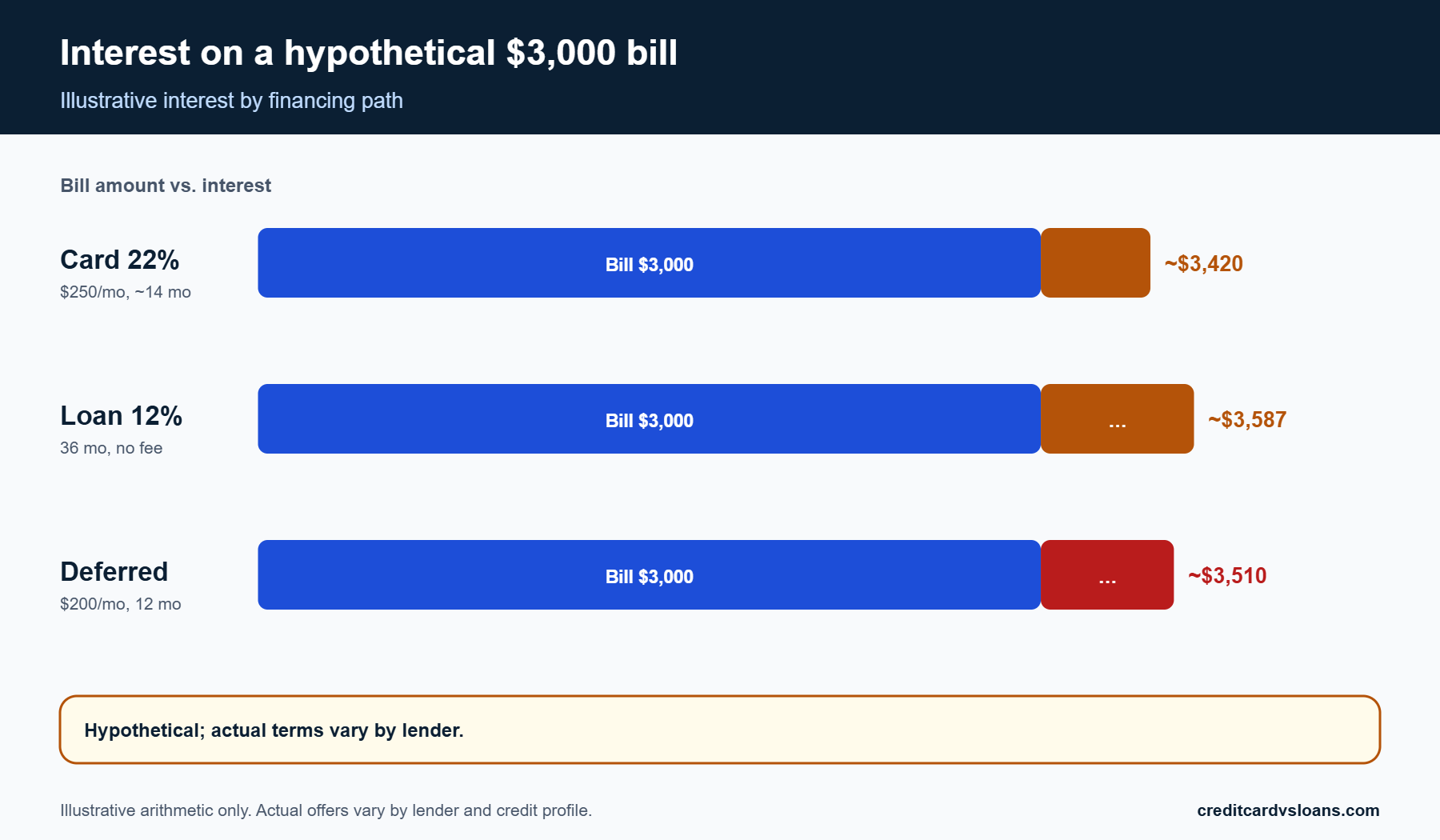
As a hypothetical, suppose you put a $3,000 bill on a card charging 22% APR and pay $250 a month with no new purchases. It would take roughly 14 months to clear and cost on the order of $420 in interest. Pay $150 a month instead and the same debt takes far longer and costs far more, because most of each payment goes to interest at first.
This is an illustration, not a quote, and your result depends on your actual APR, how your issuer calculates interest and whether you add new charges. The point is the direction: smaller payments stretch the timeline and increase the total cost.
Clinic-promoted and medical-style financing
What the CFPB found about medical credit cards
The CFPB’s May 2023 report on medical credit cards and financing plans examined products offered to patients through provider offices. It found that many carry deferred interest promotions of six to eighteen months, and that the typical APR on medical credit cards in the report was 26.99%, compared with an average of roughly 16 percent for general-purpose cards at the time of the study. It also reported that about $1 billion in deferred interest was paid on healthcare charges between 2018 and 2020.
That report concerned human health care, and it did not provide a veterinary-specific share of purchases. Still, some of the same card programs and installment lenders it describes advertise to veterinary practices, and the mechanics of deferred interest are identical regardless of who the patient is.
How deferred interest actually works
The CFPB explains that with a deferred interest plan, interest is not waived but postponed. If the balance is not paid in full by the end of the promotional period, or if you pay more than 60 days late, you can owe the interest from the original purchase date. The CFPB also notes that minimum payments usually will not clear the balance in time, so you have to calculate a higher monthly payment yourself.
The practical math is simple: divide the bill by the number of promotional months and pay at least that much every month, ideally with some cushion. Table 1 shows why the gap between paying that amount and falling slightly short is so large.
| Scenario | Monthly payment | Balance at month 12 | Approximate interest charged |
|---|---|---|---|
| Pay in full by month 12 | $250 | $0 | $0 |
| Pay $200 a month | $200 | $600 | About $510 added back |
| Pay only a small minimum | Varies | Most of the bill | Interest from day one, up to the full amount deferred |
The $510 figure is a simplified illustration that applies the monthly rate to the declining balance without compounding, so an issuer’s actual charge can differ. Notice that falling $50 a month short leaves a modest balance but triggers a bill for interest on the original, larger amounts.
| Question | Why it matters |
|---|---|
| Is this deferred interest or a true 0% APR? | Deferred interest can be charged back to the purchase date |
| When exactly does the promotion end? | The end date may differ from your normal due date |
| What is the APR after the promotion? | It sets the cost of any balance left over |
| Is there a hard pull or a soft pull? | A hard pull can affect your credit reports |
| What fees apply, and who pays them? | Late, origination or processing fees change the true cost |
| Can I pay early without a penalty? | Early payoff is how you avoid interest |
Personal Loans, Fees and Fast-Money Products
Personal loans and other short-term products
Fixed-rate personal loans
A personal loan pays out a lump sum that you repay in equal installments over a set term. The Federal Reserve’s G.19 reported an average rate of 11.90% on 24-month personal loans at commercial banks in August 2026 (preliminary). That is a bank-reported average for a specific loan type, and what you are offered depends on your credit profile, income, the lender and the amount. Some lenders charge an origination fee, which is deducted from the proceeds or added to the balance, so compare the APR rather than the interest rate alone.
For a hypothetical $3,000 loan at 12% APR over 36 months, the payment would be about $99.64 and total interest roughly $587. Spreading the same bill over a longer term lowers the monthly payment but increases total cost. For rate ranges by credit tier and prequalifying steps, see what credit score you need for a personal loan.
Payday loans, cash advances and other fast money
The CFPB tells borrowers considering payday loans to understand the fees, ask whether they truly need the loan and plan how they will repay it. It also advises using the APR to compare loans. Short-term, high-cost products can turn a one-time emergency into a recurring cycle if the full balance is due before your next paycheck can cover it.
Cash advances on a credit card have their own terms, which are set in your cardholder agreement and often include a fee and interest that starts immediately. We cannot give a typical figure because it varies by issuer, so check your agreement before using one. See predatory lending warning signs for features that should make you stop.
| Option | Speed | Cost pattern | Main risk | Usually fits when |
|---|---|---|---|---|
| Savings | Immediate | No interest | Draining your buffer | You can rebuild it in a few months |
| Clinic payment arrangement | Same day if offered | Often no interest; confirm | Availability and late-fee terms vary | You can repay within weeks or a few months |
| Existing credit card | Immediate | Variable APR on carried balance | Slow payoff, higher utilization | You can repay in a few months |
| New 0% APR card | Days to approve | No interest in the intro period if paid on time | Approval not guaranteed; rate jumps afterward | You can clear it within the promotion |
| Deferred interest plan | Often at the clinic | Retroactive interest if not paid in full | Interest charged back to purchase date | You are certain you can pay by the end date |
| Personal loan | Hours to days | Fixed payment; fees may apply | Origination fees, rate depends on credit | You need a year or more to repay |
| Payday or title-style loans | Fast | High cost | Repeat borrowing cycles | Rarely the right fit |
Fees, timing and fine print
Origination fees, late fees and the true APR
The interest rate and the APR are not the same number. The APR folds in certain upfront costs, such as an origination fee, which makes it the better yardstick when you compare loans. A hypothetical $3,000 loan with a 5% origination fee costs $150 before the first payment, which is why a lender advertising a low rate can still be more expensive than a competitor with a slightly higher rate and no fee.
For cards, look for late fees, annual fees and whether the promotional rate applies to new purchases or only to balance transfers. A new card opened just for a vet bill should be judged on the whole fee schedule, not only the headline promotion.
Funding speed versus total cost
Speed has a price. The fastest options, an existing card or a payment product offered at the front desk, tend to be the ones with the least rate shopping behind them. If the clinic can accept a deposit now and the balance in a few days, you may gain the time to prequalify with a few lenders and compare. Even one or two quotes can reveal a meaningful difference in APR.
When you rate shop, use soft-pull prequalification where lenders offer it, and be wary of any lender that demands a fee before showing you terms.
Common Mistakes When Paying for Emergency Pet Care
Mistakes that raise the cost
Signing before reading the promotional terms
The most expensive mistake is agreeing to a financing application at the front desk without seeing the promotional end date, the post-promotion APR and the rule that triggers retroactive interest. A friendly explanation from a busy staff member is not a substitute for the written terms. Ask for the disclosure, read the fee and rate sections, and take a photo of it if you cannot get a copy.
If something in the paperwork contradicts what you were told, believe the paperwork and ask for a correction before you proceed.
Choosing the lowest monthly payment automatically
A low monthly payment is attractive when money is tight, but it is not the same as a low cost. Stretching a balance over a longer term typically raises total interest, and on a deferred interest plan a payment below the required level can trigger a large charge at the end. Compare the total you will pay, not only the monthly figure.
The rule of thumb: pick the highest payment you can sustain comfortably, then make extra payments in good months.
Mistakes that raise the risk
Borrowing more than the bill
It can be tempting to take a larger loan for a cushion, but you pay interest on every dollar. Borrow the amount you need now and, if complications arise, revisit your options then. Some lenders offer fixed loan amounts that exceed the bill, so check whether you can choose a smaller figure.
If you do receive extra proceeds, consider using the excess to pay down the balance early rather than leaving it idle, provided the loan has no prepayment penalty.
Letting a missed payment slide
One late payment can bring a fee, a higher rate or the loss of a promotional offer, and a payment more than 60 days late can trigger deferred interest under the terms the CFPB describes. If you see trouble coming, contact the lender or clinic before the due date. Many will discuss options earlier than they will after you have missed a payment, although outcomes are not guaranteed.
Set autopay for at least the minimum and keep a small buffer in the account to avoid overdraft problems.
How Borrowing for a Vet Bill Affects Your Credit and Budget
Credit report effects
Applications, balances and payment history
A formal application for a card or loan usually triggers a hard pull, which can cause a small, temporary dip in some scoring models. A larger bill on a card raises your utilization, the share of your available limit in use, which is a commonly weighed factor. Late payments are generally the most damaging item of all, which is why a payment you can sustain matters more than a rock-bottom rate you cannot.
No product can promise a particular score outcome. How your reports respond depends on your starting profile, so treat any specific prediction with caution.
Medical-style financing is not always treated like medical debt
The CFPB notes that federal reporting limits for medical bills do not cover medical credit cards and similar financing products, so missed payments on them can appear on your credit report. Veterinary bills are not human medical debt, and the rules for each differ by state and by creditor, so do not assume special protections apply. Ask the clinic or lender how unpaid balances are handled before you sign.
If an account is reported inaccurately, you can dispute it with the credit bureaus. The CFPB’s consumer guidance explains the process, and your state attorney general or consumer protection office can help with state-specific questions.
Fitting repayment into your budget
Protect your essentials first
Housing, utilities, food, transportation and minimum payments on existing debts come ahead of a voluntary payoff plan. If a repayment schedule would make you late on those, choose a longer term, a smaller financed amount or a different source. The cost of missing rent or a car payment can exceed the savings from a shorter loan.
Build a small cushion into your plan. A payment that works only if nothing else goes wrong is fragile, and a second surprise can derail it.
A realistic payoff plan
Choose the amount you can pay every month, set up autopay for at least the minimum so you are never late, and add extra whenever you can. If you chose a card, avoid new purchases on it until the balance is gone, since new charges can extend the timeline. If you chose a deferred interest plan, put the promotion end date in your calendar a few months early.
When you finish, consider directing the old monthly payment into savings. A modest dedicated pet-care fund, even a small one, can reduce how much you must borrow the next time.
Scenarios: Matching the Option to the Situation
Smaller and mid-sized bills
A bill you can repay within a few months
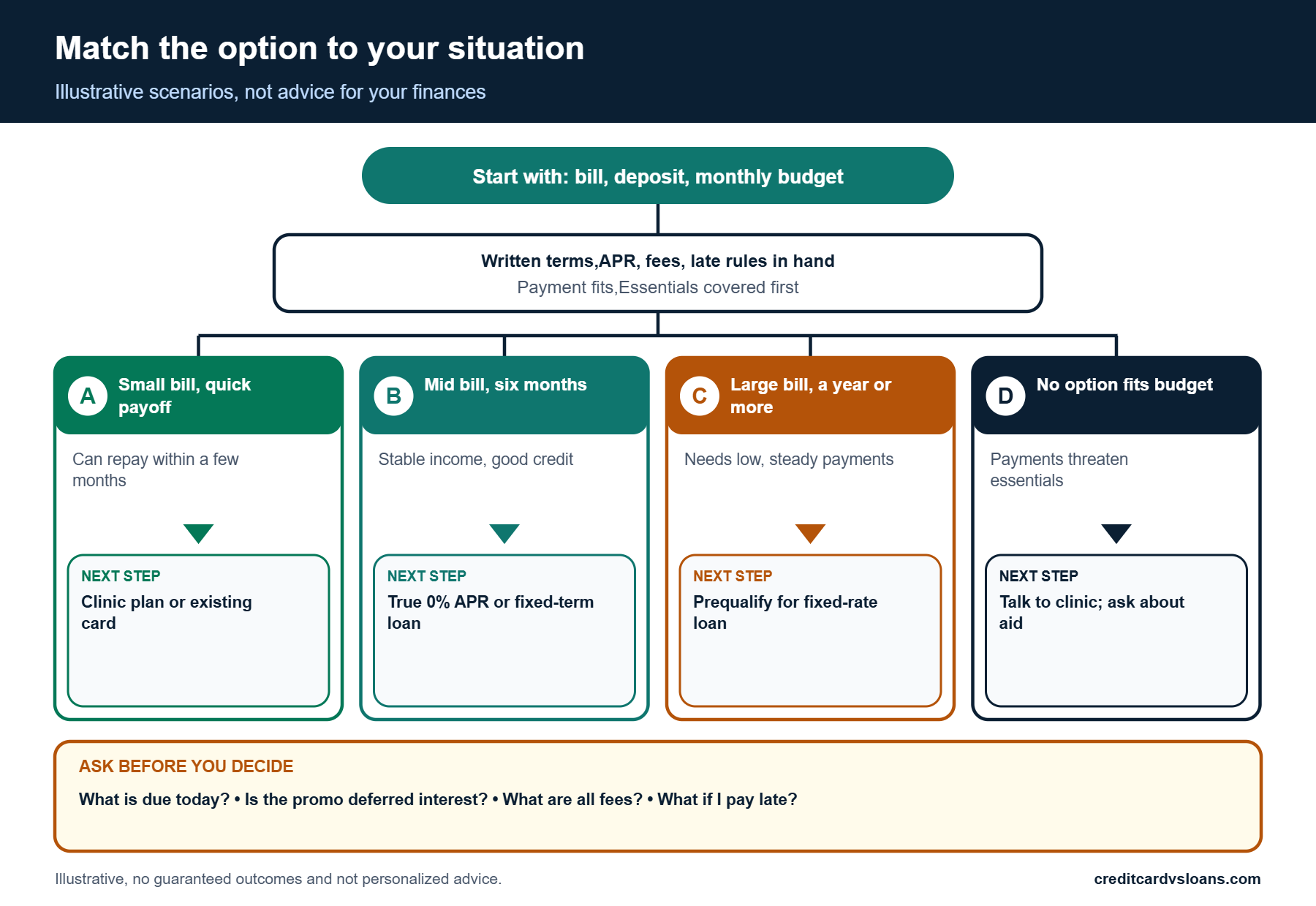
Suppose a clinic estimates $1,200 and you can pay $300 a month. A payment arrangement, if available, or an existing card is often the simplest path. Even at a typical card rate, interest on a balance cleared in about four months is limited, though it is not zero. This is an illustration, so your numbers will differ.
If you have a card with a promotional rate, it may be cheaper still, but only if the promotion truly applies to new purchases and you understand its end date.
A bill that needs half a year
For a $2,500 bill with room for about $420 a month, a true 0% APR card could work if you qualify and can pay it off during the promotion. A deferred interest plan could also fit, but only if you set the payment at or above one-sixth of the bill each month and never miss. If either is uncertain, a short-term fixed loan keeps the payment predictable. Compare options using the 0% APR vs. personal loan guide.
Large bills and tight finances
A bill that takes a year or more to repay
For a $6,000 estimate that you can repay at roughly $200 to $300 a month, the length of repayment starts to dominate the cost. A fixed-rate loan from a bank or credit union, repaid on a set schedule, usually offers more predictability than carrying a card balance. Prequalify with several lenders using soft pulls, compare the APR and fees, and read the agreement against the red flag checklist.
Also ask the clinic whether the treatment plan can be phased, and whether any part of the work can be deferred without risk to the animal.
When no option looks affordable
If every option leaves you unable to meet the payments, say so to the clinic and ask what choices exist. Some owners decide on a more conservative plan, and veterinarians can discuss prognosis and quality of life candidly. These are painful conversations, and taking time to have them is part of making a responsible decision, not a failure.
Avoid borrowing in a way that threatens your housing or other basic needs. Ask about assistance programs, and consider speaking with a nonprofit credit counselor if you are already stretched, being careful to avoid debt relief offers with upfront fees or guarantees.
Special situations
When you have a thin credit file or damaged credit
If your credit history is short or you have recent missed payments, approval for a low-rate loan or a 0% card may be harder, and offers that do appear can carry higher costs. In that case, an in-house clinic arrangement, a smaller financed amount, a credit union loan or a cosigned option may be worth exploring, with the usual caution about cosigner risk. Be especially careful with offers that promise approval regardless of credit.
The CFPB report found that people with lower credit scores were more likely to incur deferred interest, so the stakes of misreading a promotion are higher in that situation.
When the emergency is for an animal you share care of
If a bill involves a pet shared with a roommate, partner or family member, agree on who pays what before financing, and avoid opening credit in one person’s name for a shared expense without a written understanding. Debt follows the account holder, not the pet.
The same applies to service animals, rescue fosters and working animals, where a sponsoring organization may have its own funding process. Check with it first.
Your Checklist and Next Steps
Questions owners often ask
Will asking about cost make me look uncaring?
No. Veterinary teams discuss cost every day, and a clear picture of your budget helps them recommend a realistic plan. Asking for a tiered estimate is routine and respectful of everyone’s time.
You can say it simply: here is what I can pay today, here is what I can manage monthly, what are my options? That framing gets better answers than waiting until the bill arrives.
Should I wait to see whether the first bill is the final bill?
Emergency costs can grow with hospitalization days, repeat testing or complications. Ask for the likely range, not only the opening figure, and ask when you will be updated. Borrow for the amount you know you need, and revisit your plan if the estimate changes rather than financing a worst case in advance.
A decision checklist
Questions to answer before you pay
Work through these in order. Each one removes a choice, and the last one that survives is usually the right fit.
- What is the itemized estimate, and what is due today?
- How much can I pay from savings without leaving myself exposed?
- Does the clinic offer a payment arrangement, and what are its fees and late terms?
- Do I have pet insurance, and have I called the insurer?
- What monthly payment can I sustain without missing essentials?
- If I use a promotion, is it a true 0% APR or deferred interest, and when does it end?
- What are the APR, fees and penalties for each option I am considering?
What to read before you sign anything
Find the APR, the origination or processing fees, the payment schedule, the late-payment terms and any prepayment rule. For a promotional offer, find the end date and the rate that applies afterward. If the document is long, ask for a copy to review, and consider asking a trusted person to read it with you.
If any term is unclear, ask the lender or clinic to explain it in writing. A refusal to explain is itself information.
After the bill is paid
Rebuild a pet-care cushion
Once the balance is gone, redirect the payment you were making into a dedicated savings account, even at a modest amount. A cushion in the low four figures will not cover every emergency, but it can cover a deposit, a diagnostic workup or a first night of hospitalization, which shrinks any amount you must finance. Automate the transfer so it happens before you can spend the money elsewhere.
If you are considering pet insurance, read the waiting periods, exclusions and reimbursement terms carefully, and compare the annual premium against what you would realistically set aside yourself.
Review the credit file and the paperwork
A few months after payoff, check your credit reports for accurate balances and closed accounts, using the free reports available at AnnualCreditReport.com. Keep copies of payoff letters and the final statement. If you used a promotional product, confirm that no interest was charged back, and ask the lender to correct it if it was charged in error.
Disputes are easier to resolve with documents in hand, so file the paperwork somewhere you can find it.
Where to go from here
A short plan for the next week
- Confirm the estimate and the deposit, then pay what you can from savings.
- Ask the clinic about in-house terms and call your insurer if you have a policy.
- Prequalify for a loan or compare card options only if a gap remains.
- Set autopay and calendar reminders for any promotion end date.
- Plan how you will rebuild a small pet-care fund once the bill is paid.
The bottom line
There is no single best product for a vet emergency. The right choice is the cheapest one that you can obtain in time and repay on a schedule you can keep, and that usually means paying what you can from savings, asking the clinic for terms, and borrowing only the gap. For a wider comparison, read credit card vs. personal loan: which is better for borrowing.
Do not let urgency choose your financing. Pay what you can, get the terms in writing, and treat any promotional offer as a loan with a deadline until you know you can beat it.
- How to Finance Back-to-School Costs: Credit Cards, Loans and Lower-Cost Options
- Credit Card vs. Personal Loan: Which Is Better for Borrowing?
- Personal Loan Agreement Red Flags to Check Before Signing
- Predatory Lending: Warning Signs in Personal Loans and Debt Relief Offers
- Best Way to Pay for Back-to-School Costs: Compare Borrowing Options Before You Commit
- CFPB: Medical Credit Cards and Financing Plans (research report, May 2023) (Deferred interest, typical APRs and complaint patterns in provider-offered financing)
- CFPB: What is a deferred interest promotion?
- CFPB: What should I know about medical credit cards and payment plans for medical bills?
- CFPB: Payday loans
- Federal Reserve: Consumer Credit – G.19 (release of October 7, 2026) (August 2026 (preliminary) credit card and 24-month personal loan rates)
Last updated: October 22, 2026. Rates, fees and lender rules change; verify current terms before acting.
The information on creditcardvsloans.com is provided for general educational and informational purposes only. It is not financial, legal, tax, credit, accounting or investment advice, and reading it does not create an advisor-client, fiduciary or any other professional relationship. Nothing here is an offer, solicitation or recommendation to borrow, lend or apply for any product.
Credit scores, interest rates, fees, eligibility rules, lender policies and laws change frequently and vary by lender, location and individual circumstances. Examples, figures and scenarios are illustrative only, do not predict your results and do not guarantee approval, savings, a particular rate or a credit-score outcome. Always confirm current terms directly with the lender or issuer and read the full agreement before you apply or sign.
Although we aim for accuracy and use reputable sources, we make no representations or warranties, express or implied, about the completeness, accuracy, reliability or timeliness of the content. Content may be drafted with the assistance of automated tools, so errors or omissions may still occur. Links to third-party sites are provided for convenience; we don’t control and aren’t responsible for their content.
To the fullest extent permitted by law, creditcardvsloans.com and its owners, editors, authors, contributors and affiliates disclaim all liability for any loss, damage or expense arising directly or indirectly from your use of, or reliance on, this content. Before making financial decisions, consult a licensed professional, such as a qualified financial advisor, attorney, tax professional or nonprofit credit counselor, who can consider your complete situation.