How to finance holiday expenses comes down to an order of operations: cover what you can from cash flow first, borrow only the leftover gap, and use the cheapest borrowing tool that fits your timeline. That sequence, rather than any single card or loan, is what keeps a December bill from becoming a spring problem.
This guide is a step-by-step plan. It assumes you already know you will need some outside money for the season and want to line up the sources in a sensible order, with a repayment schedule attached before you spend. If you are still deciding between product types and want a side-by-side evaluation, our separate side-by-side comparison of holiday payment options is built for that.
Everything here is general information. It cannot account for your income, your credit file or your lender’s actual terms, so the numbers are labeled hypothetical where they illustrate an idea and sourced where they describe the market.
- Work the plan in order: set the total, cover what you can without borrowing, borrow only the gap, schedule repayment, then protect your credit while you pay.
- As of the Federal Reserve’s G.19 release of Oct. 7, 2026, card accounts assessed interest averaged 22.36% (August 2026, preliminary) and 24-month bank personal loans averaged 11.90%, so the tool you pick for the gap changes the cost.
- Shrinking the gap by even a few hundred dollars usually saves more than switching to a slightly cheaper product.
- Write the payoff date before the first purchase. If it falls after next October, reduce the plan.
- A 0% promotion is only cheap if the balance is cleared inside the window and the fine print is understood.
Market figures are dated to the Federal Reserve’s G.19 release of Oct. 7, 2026. Terms on your own offers matter more than averages, so use these numbers as a yardstick only.
Table of contents
How to Finance Holiday Expenses: The Cheapest-First Order
The ladder in one view
Rungs from cheapest to most expensive
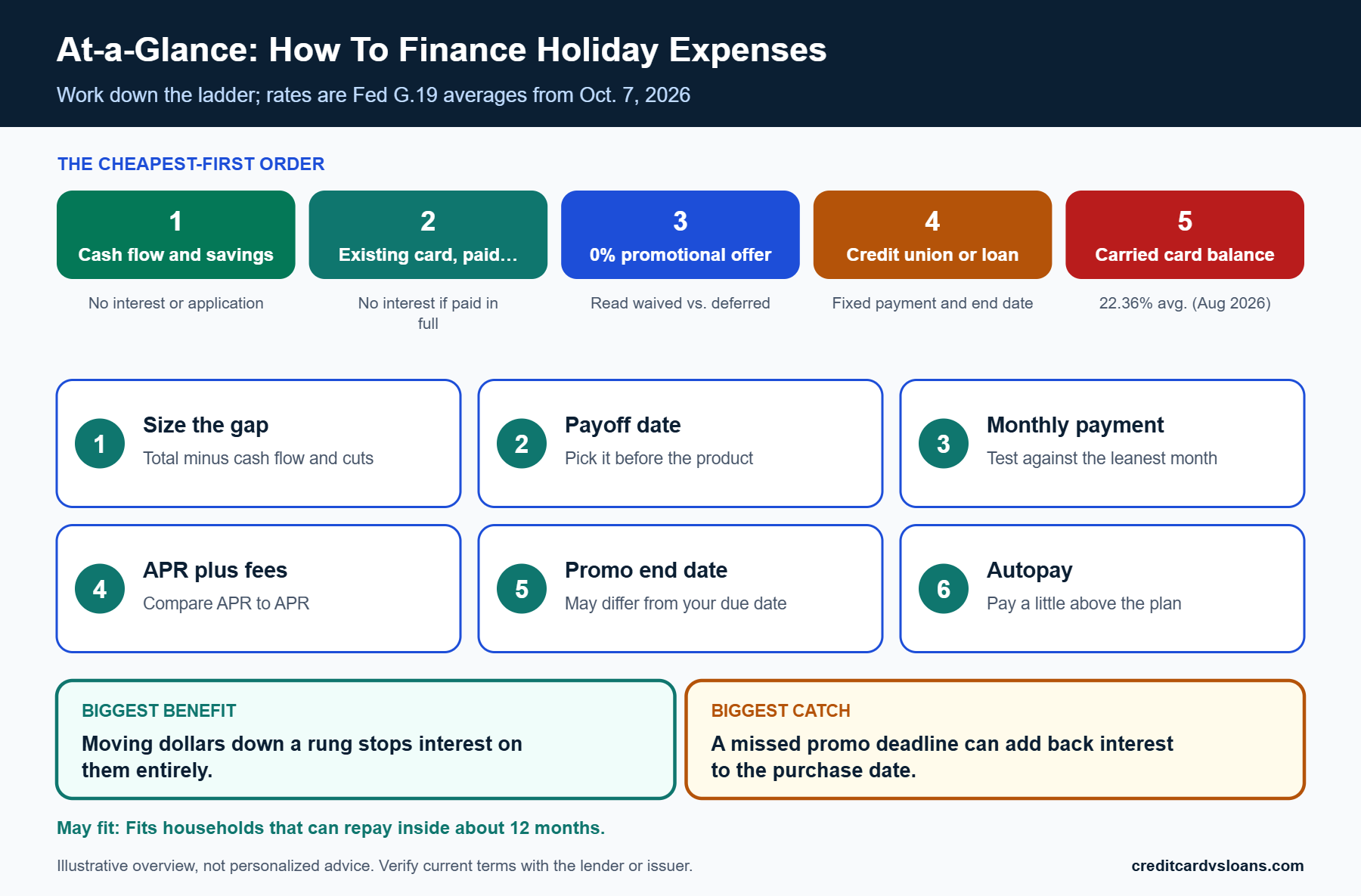
Think of financing as a ladder. At the bottom, the cheapest rung is money you already have: savings, income over the next few paychecks and spending you choose not to do. The next rung is a card you already hold, paid in full inside the billing cycle. Above that sit promotional 0% offers, then credit union or personal loans, and at the top, the expensive tools: carried card balances, high-fee short-term products and stacked pay-later plans.
You do not have to climb all the way. Many households can finish the season on the first two rungs. The point of the ladder is to make sure you do not skip a cheaper rung because a higher one was easier to click.
Why order matters more than the product
A well-chosen loan used for the wrong amount is more expensive than a mediocre card used for the right one. Every dollar that you move down a rung, for example by paying $300 from savings rather than financing it, is a dollar that stops accruing interest and fees altogether.
That is why the first three steps in this plan are about the size of the gap, and only step three is about the borrowing product itself. The details of comparing products against each other are covered in our decision framework for holiday payment options, so this guide stays on sequencing.
What you need before step one
A written total, not a mental one
Write down the holiday total as a single number with a short list under it. The act of writing helps because mental totals leave out the small items, such as shipping, wrapping, travel snacks and hosting groceries, which add up to real money by December.
Keep the list in a note or spreadsheet you can update as you spend. You will use it again in the repayment step, when you match the gap to a monthly payment.
A payoff date you can defend
Pick a payoff date before you choose a product. For most households, February or March is a reasonable target for holiday debt because it clears before tax-season decisions and summer travel. If the honest date is later than that, your first move should be to cut the total, not to find a longer-term loan.
A payoff date also sets your monthly payment. Divide the gap by the number of months, then decide whether the payment is something your January budget can carry without borrowing again.
Step 1: Put a Real Number on the Season
Build the list
Categories people forget
Gifts are the obvious category. The categories that cause surprises are travel (including bags, gas and pet care), food and hosting, seasonal clothing or decorations, cards and postage, school or work gifts, charitable giving, and the small costs of events like parties and exchanges.
Walk through last year’s bank and card statements for November and December. Real charges are a better guide than memory, and they often show a total $200 to $500 above what people expected to spend. Use last year’s actual total as a starting point and adjust from there.
Set caps by category, not just by total
A single total number is easy to blow through. Splitting it into category caps, such as a cap per person for gifts and a fixed amount for hosting, gives you early warning when one category runs over and gives you something specific to trade off against.
Caps also help when you are comparing financing: a smaller, firmer budget is often the difference between a plan that fits a 0% window and one that does not.
Decide the borrowing ceiling
A rule of thumb for the monthly payment
Before you look at any offer, decide the most you can add to your monthly obligations without squeezing essentials. There is no universal percentage that fits every household, so let your own bills set the limit: rent or mortgage, utilities, food, transportation, existing debt payments and savings contributions.
Multiply your comfortable monthly payment by the number of months until your payoff date. That product is your borrowing ceiling for the season. If the gap is larger than the ceiling, the plan does not work as drawn.
Use January’s budget, not December’s
December often has seasonal income, such as a bonus or extra hours, while January has insurance renewals, annual fees, and utility bills that peaked in the cold. A payment that looks small in December can feel heavy when January’s bills land on top of it.
Test the plan against the leanest month between now and your payoff date. If the payment fits there, it will probably fit everywhere. The Federal Reserve’s household survey for 2025 found that 63% of adults would cover a $400 emergency with cash or its equivalent, so keep some buffer in the plan for the unplanned.
Step 2: Cover What You Can Without Borrowing
Cash-flow sources to count first
Savings and the next two paychecks
Start with any money already earmarked for the season, then add what the next two or three paychecks can cover after fixed bills. This is the cheapest financing you will ever find, with no interest, no application and no payoff risk.
Be careful not to drain your emergency cushion for gifts. A rule that works for many households is to leave an untouched floor in savings, in an amount you choose, so that a car repair or a medical copay in January does not turn into new card debt.
Selling, side income and seasonal work
Items you no longer use can often be sold for part of their value, and a few extra shifts or a short side project in November can add several hundred dollars. These sources are uncertain, so count only what is already in hand or scheduled, and treat the rest as a bonus that reduces the gap later.
If you count on extra income that does not arrive, the gap you planned to borrow grows after the fact. Writing “confirmed” and “hoped for” in two columns keeps you honest about which is which.
Spending cuts that cost nothing to finance
Cap and substitute
A per-person cap can be paired with substitutions that keep the meaning of the gift but lower the price, such as a shared experience, a handmade item or a group gift. Reducing a list of twelve gifts by a third can eliminate the need to borrow altogether.
Most families who try a lower-cost approach find that a few conversations are enough to reset expectations. The conversation costs nothing, while the interest on the gap would.
Shift the timing
Some purchases do not need to happen before the holiday. Winter clothing, decorations and non-urgent household items often go on sale in January, and travel booked outside peak days can cost less.
Moving a purchase after the holiday does two things: it reduces your borrowing now, and it spreads spending across two budget months rather than stacking it into one.
| Rung | What it is | Typical advantage | Main drawback | Main cost driver |
|---|---|---|---|---|
| 1. Cash flow and savings | Money you already have or will earn soon | No interest or application | Limits your cushion | Opportunity cost |
| 2. Existing card, paid in cycle | Purchases cleared by the due date | No new inquiry, no interest if paid in full | Easy to carry a balance | Card APR if not cleared |
| 3. 0% promotional card | Introductory APR for a set period | Can be the cheapest borrowing | Deferred interest or high post-promo APR | Fees and the post-promo rate |
| 4. Credit union or personal loan | Fixed payment and term | Predictable payoff date | Possible fee, hard pull | APR and origination fee |
| 5. Carried card balance | Minimum payments on a standard card | Flexible | Highest ongoing cost | Card APR and time |
Step 3: Borrow Only the Gap, Cheapest Tool First
The borrowing ladder, rung by rung
Rung one: the card you already have
For a gap that you can clear in one or two statements, an existing card is the first stop. The CFPB notes that on most cards you can avoid interest on purchases by paying your balance in full each month by the due date, so the real cost can be zero.
Check whether you have a grace period right now. If you carried a balance last month, new purchases may start accruing interest immediately, which changes the math entirely. Your statement or the issuer’s app will say.
Rung two: a 0% promotional offer
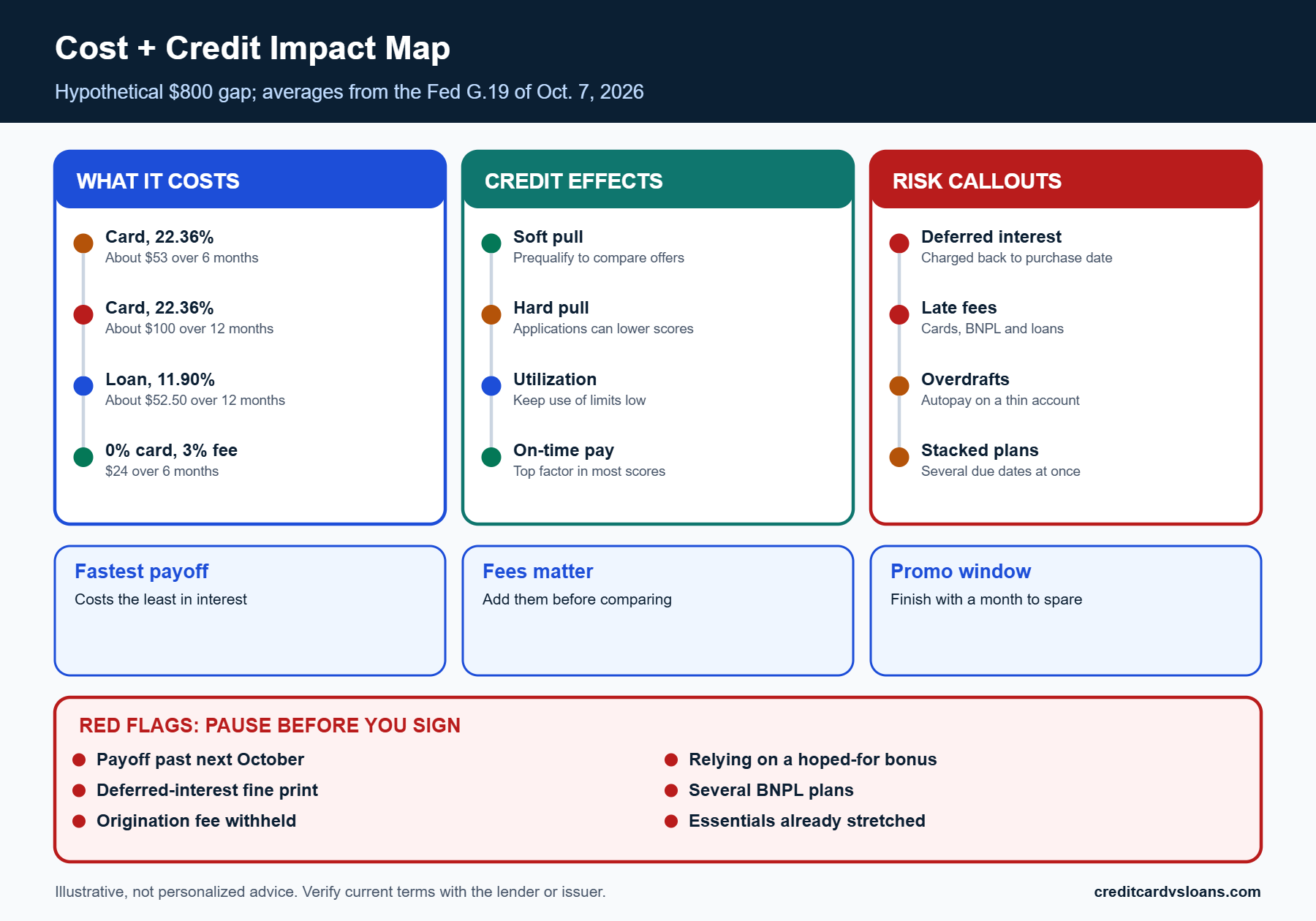
If the gap is too large for a quick payoff and your credit is in good shape, a 0% introductory APR on purchases can bridge several months for little or no interest. The CFPB explains that with deferred-interest promotions, a balance remaining at the end, or a minimum payment more than 60 days late, can trigger interest charged back to the purchase date.
Read whether the offer is truly 0% or deferred. Add any fee, divide the amount by the number of months minus a buffer, and make sure the payoff date lands before the promotion ends. A hard pull is part of the application, so apply once and apply only if the numbers work.
Rung three: a credit union or personal loan
When the gap needs more than a promotion allows, a fixed-rate loan gives you a payment and an end date. The Federal Reserve’s G.19 release of Oct. 7, 2026 reported an average 24-month personal loan rate of 11.90% at commercial banks. Individual offers differ, and the CFPB advises comparing offers from multiple lenders and reading the disclosures for fees.
For smaller gaps, federal credit unions may offer payday alternative loans of up to $2,000 for one to twelve months, with an application fee capped at $20 under NCUA rules. Availability varies, so ask your credit union.
What the gap costs (hypothetical)
An $800 gap, four ways
Suppose a household has a $1,800 holiday plan. They cover $600 from savings and income, trim $400 from the list, and need to finance $800. These are illustrative figures computed with standard amortization, not offers.
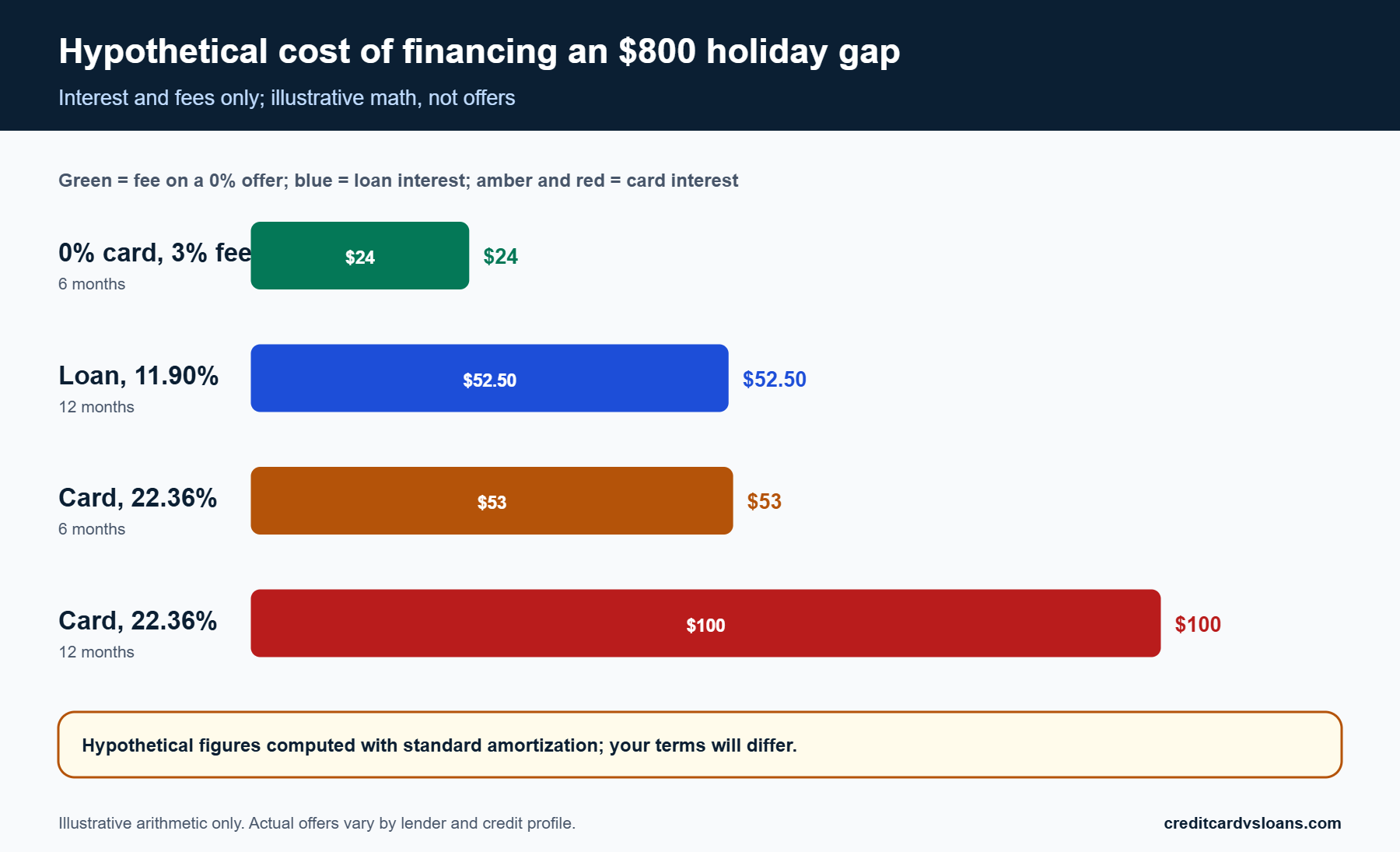
At 22.36% on a card, repaying $800 in six months costs about $53 in interest, with payments near $142. Stretched to twelve months, it costs about $100. An 11.90% loan over twelve months costs about $52.50, with payments near $71. A 0% card over six months with a hypothetical 3% fee costs $24, with payments of about $137.
| Option (illustrative) | APR or rate type | Repayment pattern | Monthly payment | Interest and fees | Credit and risk notes |
|---|---|---|---|---|---|
| 0% card, 3% fee | 0% for 6 months | 6 equal payments | About $137 | $24 | Hard pull; balance left at month 6 faces the standard rate |
| Loan, no fee | 11.90% (Fed 24-month average) | 12 equal payments | About $71 | About $52.50 | Hard pull; fixed end date |
| Card, paid fast | 22.36% (Fed average) | 6 equal payments | About $142 | About $53 | No new inquiry; utilization rises |
| Card, paid slowly | 22.36% (Fed average) | 12 equal payments | About $75 | About $100 | Cost doubles with time |
How fees and timing can reorder the ladder
The ladder is a starting point, not a law. A loan with a hypothetical 6% origination fee can cost more than a card paid off in four months. A 0% card with a large fee can cost more than a low-rate credit union loan on a very small balance.
The way to settle it is to add up interest and fees for the specific payoff schedule you will actually follow. The CFPB describes APR as the interest rate plus the lender’s additional fees, so comparing APR to APR is a reliable shortcut, as long as the terms are similar.
Step 4: Build the Repayment Schedule Before You Swipe
Turn the offer into a monthly figure
Divide, then add a buffer
Take the amount you plan to finance and divide it by the number of months you want to be done in, not the number of months the lender allows. For the $800 gap, finishing in five months on a six-month promotion means a payment of about $160, which leaves a month for surprises.
The buffer matters because promotional rules are strict. The CFPB advises aiming to finish well before the deadline so that a processing delay or a forgotten payment does not trigger interest. A payment of a little more than the arithmetic minimum is cheap insurance.
Automate with a margin
Set up an automatic payment from your checking account for the planned amount, and keep a small cushion in that account so an unexpected charge does not trigger an overdraft. A fee on top of a late payment can undo the savings from a promotion.
Also add a calendar reminder for the date the promotional period ends, which the CFPB notes may differ from your regular due date. Check your statement for the end date and note it where you will see it.
Protect your credit while you repay
Keep utilization in view
The CFPB says scoring models look at how close you are to your credit limits, and that experts advise keeping your use of credit to no more than 30 percent of your total limit. A big holiday charge on one card can push that ratio up, so consider splitting purchases across cards or making a mid-cycle payment.
The effect of a high balance on your scores generally fades as you pay it down, but if you plan to apply for a mortgage or an auto loan in the next several months, time your holiday borrowing carefully and keep the balance as low as you can.
Pay on time, every time
Repayment history is the top factor in most credit scores, according to the CFPB. A single late payment can result in a late fee, the loss of a promotional rate and a mark on your credit report, all from one missed date.
If you suspect a payment will be late, contact the lender before the due date. Many lenders can adjust the due date or offer short-term hardship terms, and the conversation costs far less than the penalty.
Step 5: Guard Against the Add-Ons
Pay-later plans and store cards
Keep a single list of every plan
The CFPB says buy now, pay later loans generally have fees, most charge late fees, and automatic repayments can trigger overdraft fees at your bank if the account balance falls short. Terms differ by lender, so each plan must be read on its own.
If you use more than one, put every plan, amount and due date on one list. Treat those payments as part of your repayment schedule, not as small side items, because several small payments landing in the same week can exceed what you planned for the gap.
Store card discounts and what they hide
A one-time discount at checkout can look like the cheapest financing you will find, but the card’s ongoing rate may be among the highest you hold. Open one only if you would pay the balance in full by the due date, and consider the effect of another hard pull and another account on your credit file.
The same logic applies to promotional financing offers at a retailer: ask whether interest is waived or deferred, and what the rate is when the offer ends. Our guide to financing back-to-school costs covers the same retailer-offer trap with a different shopping season.
Rewards and cash back
Rewards only help if the balance is cleared
Cash back or points on holiday spending can be real value, but only when the balance is paid in full each month. If you pay interest, even a few months of it at a typical card APR can exceed the rewards earned on the same purchases.
It is fine to use a rewards card for planned holiday spending you will pay off promptly. It is not a reason to spend more or to finance more, because the rewards rate is far lower than the interest rate on a carried balance.
Do not let points set the budget
Bonus categories and holiday promotions can nudge spending upward. A good guardrail is to set your budget by category first, then choose the card that earns the most within it, instead of letting an offer pick the category.
If you notice the total creeping above the plan because of an incentive, pause and review the list. The savings from a promotion are only real when the underlying purchase was already in the plan.
When the Plan Slips: Repair Options
Before a payment is missed
Call the lender early
Contact the lender or card issuer before the due date if you expect a problem. Ask about moving the due date, a one-time payment arrangement or a hardship program. Lenders differ in what they offer, and a call before the deadline is more effective than a call after.
Keep notes on who you spoke with, the date and what was agreed, and ask for the arrangement in writing or in your online account when possible.
Redirect January spending
If the plan is running behind, look for the first two or three lines in the budget that can be trimmed for a few months: subscriptions, takeout, optional travel. Redirect that money to the holiday balance until it is back on schedule.
Small, deliberate changes for a short time are better than a missed payment that triggers fees. The purpose of the repair is to protect the payoff date, so measure it by the date, not by the discomfort.
After a missed payment or failed promotion
What deferred interest can do
If a deferred-interest balance is not cleared in time, the CFPB says interest is charged for each month back to the original purchase date. In the simplified model for a $2,000 purchase repaid in twelve equal payments at 22.36% where the last payment is missed, that back interest works out to roughly $240.
If this happens, ask the issuer about your options, pay the remaining balance as fast as you can and stop adding to the card. The additional charges accrue at the card’s standard rate.
When to talk to a credit counselor
If you are using new debt to pay existing debt, or the holiday balance sits alongside other overdue accounts, a nonprofit credit counseling agency can review your whole picture and explain options. Ask about fees before enrolling, and be wary of any service that promises to erase debt for an upfront payment.
If cash is tight for a bigger reason, such as an urgent home repair, see our guide to paying for a water heater replacement for how the same trade-offs look when the expense cannot wait.
Three Ways to Run the Same Plan
Scenario walk-throughs (hypothetical)
Mostly savings with a small gap
A household sets a $1,200 holiday budget, has $700 saved for it, and expects about $300 from the next two paychecks after fixed bills. The $200 gap goes on an existing card, and the plan is to pay it off in the first statement after the holiday.
No application is needed, no fee applies, and interest is avoided if the balance is paid by the due date. The check on this plan is whether the household has a grace period on that card today. If so, step three ends on the first rung.
A larger gap with a promotional card
Another household plans $2,500, covers $800 from savings and income, and trims $200 from the list. The remaining $1,500 is above what one statement can clear, but the household’s credit is in good shape and they can pay about $270 a month.
A 0% purchase offer for 6 months or longer is worth a look. At $270 a month, the balance is gone in about six months, so the household needs a promotional window of at least that long. With a hypothetical 3% fee ($45), the cost is $45 for the whole plan, compared with roughly $99 in interest for the same six-month schedule on a card at 22.36%.
A fixed loan when the gap needs a longer runway
A third household has a $3,000 travel-heavy plan and can set aside about $270 a month. After savings and cuts, a $2,000 gap remains and the household would need around eight months to repay it. A promotional window may not stretch that far, so a fixed-rate loan could fit better.
At 11.90% over twelve months, the hypothetical cost on $2,000 is about $131 with payments near $178, while 22.36% on a card over the same period would run about $250. The loan costs less and gives a fixed date, but it only wins if the offered APR, including fees, is actually near the market averages.
| Borrower scenario | Option to investigate first | Why | What to confirm | When to avoid it |
|---|---|---|---|---|
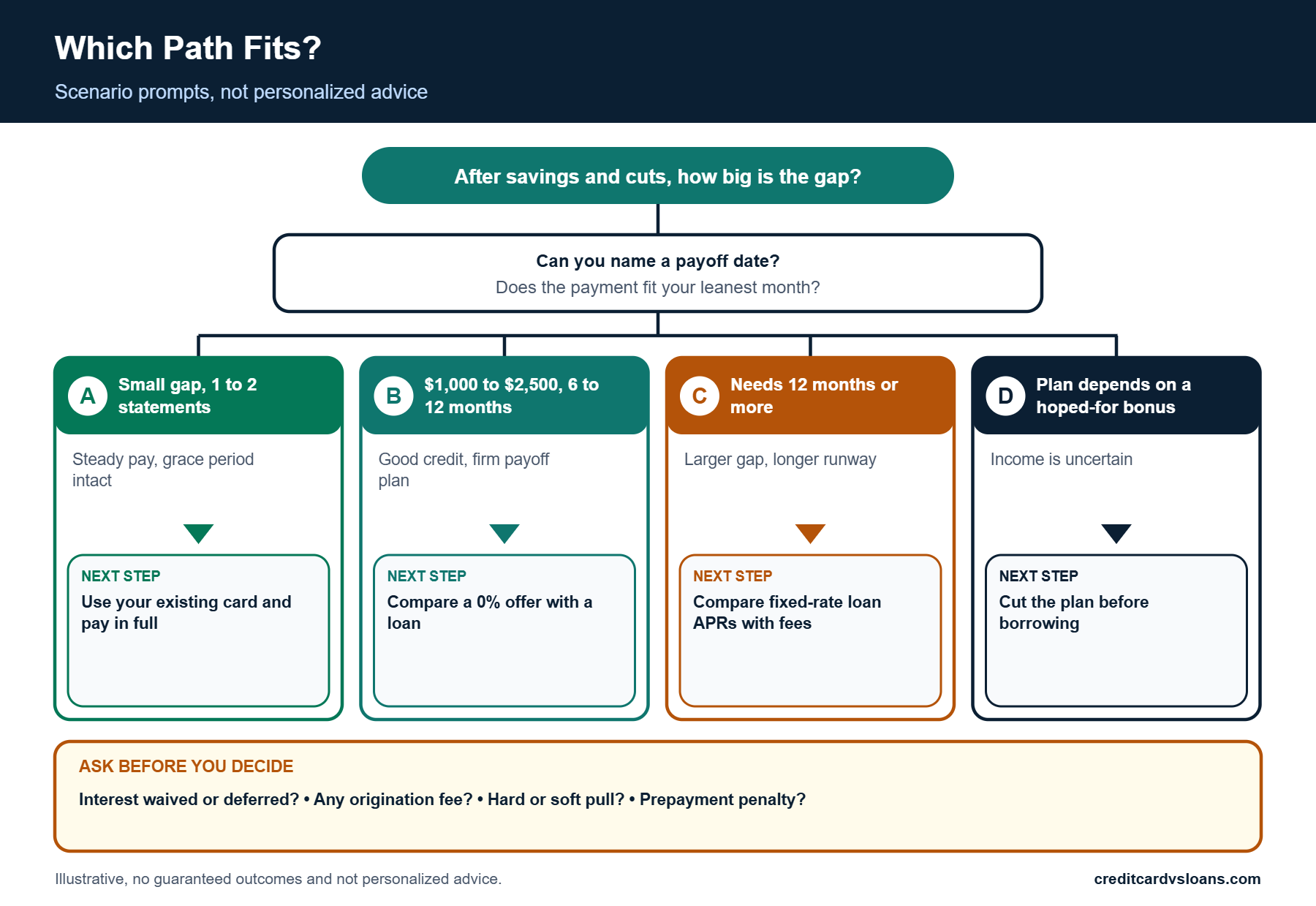
| Small gap, clear in 1 to 2 statements | Existing card | No new application; interest avoided if paid in full | That you still have a grace period | If you already carry a balance |
| Gap of $1,000 to $2,500, payoff in 6 to 12 months | 0% purchase offer | Interest waived inside the window | True 0% or deferred, fee, post-promo APR | If you may not finish in time |
| Gap needing 12 months or more | Fixed-rate loan or credit union loan | Fixed payment and end date | APR with fees, prepayment terms | If the origination fee is high for the amount |
| Small gap, limited credit | Credit union small loan | Federal credit union PAL rules cap rates and fees | Membership and whether it is offered | If it would be renewed repeatedly |
| Gap relies on a hoped-for bonus | Cut the plan first | Uncertain income raises payoff risk | What is confirmed versus hoped for | Any plan that needs the bonus to work |
When the plan says not to borrow
The payoff date lands after next October
If the plan only works with repayment stretching into next holiday season, the arithmetic is telling you something. Reducing the plan by the amount needed to bring the payoff date inside the year is usually less costly than carrying a balance into the next one.
It may feel like a loss in December, but it avoids a pattern in which each season starts with last season’s debt still on the books.
Essentials are already stretched
If rent, utilities, food or existing minimums are not comfortably covered, new debt for gifts adds risk where you can least afford it. The price of a late fee or a lost promotional rate is high compared with the value of any single gift.
In that situation, the cheapest-first plan stops at step two: cover what you can without borrowing, and let the rest wait.
Adjusting the plan for irregular pay
Gig, commission and seasonal income
If your income swings from month to month, build the repayment schedule around your lowest recent month, not your average. A payment that works only in the best months turns into a missed payment in the worst ones, and a promotional deadline gives you no flexibility to catch up later.
One workable method is to pay a fixed minimum plan amount every month and then add extra in strong months. The extra goes straight against the balance, which shortens the payoff date and builds the buffer that the CFPB recommends when a promotion has a hard end date.
Two incomes with different pay dates
Households with two earners often have paychecks that land on different days. Match the due date of the holiday payment to the earlier of the two pay dates, or ask the lender to move the due date if that option exists. A payment due the day before a paycheck is a common source of overdraft fees.
It also helps to decide in advance which earner’s pay covers the holiday balance, so the payment does not fall between two people each assuming the other has it handled.
Your Holiday Financing Checklist
Before you borrow
Numbers and terms
- One written total for the season, with category caps.
- Savings and confirmed income applied first; the gap is the leftover.
- A payoff date and a monthly payment that fits the leanest month.
- APR, fees, term and post-promotion rate written down for each option.
- Soft-pull prequalification before any hard-pull application.
Questions for the lender
Ask whether interest is waived or deferred, whether there is an origination or balance transfer fee, whether a prepayment penalty applies, and whether on-time payments are reported to the credit bureaus. The CFPB also suggests comparing offers from multiple lenders.
Get the answers in writing or from the official disclosure, not from memory of a phone call.
After you borrow
The repayment routine
- Autopay for the planned amount, plus a margin.
- A calendar reminder for the promotional end date.
- A monthly check that the balance is on track.
- No new charges on the promotional card unless they are in the plan.
The reset for next year
Once the balance hits zero, start next year’s holiday fund immediately, even with a small amount. Twenty-five dollars a month for twelve months builds a $300 head start, which is a gap you will not have to finance.
Common Complications and How to Handle Them
If you already carry a balance
Pay down first, or add the holiday on top?
If a card already has a balance from earlier in the year, new holiday purchases on that card may not have a grace period, so interest can start on them immediately. In that case, putting holiday spending on a different card, or on savings, can keep the new spending interest-free while you work down the old balance.
Whichever card you use, prioritize paying the older, higher-rate balance as quickly as you can, and keep the holiday plan small enough that it does not add to the total you owe.
Consolidating before the season
Some people move existing balances to a 0% offer before spending more. That can lower interest, but transfer fees, promotion terms and a hard pull all apply, and a consolidation that pushes a card close to its limit can hurt your utilization, which the CFPB cautions about. A consolidation plan deserves its own comparison of total cost, separate from the holiday plan.
Do not combine the two into one number. Treat the old balance and the holiday gap as separate debts, each with its own payoff date. The same separation helps in other seasonal or emergency spending, as in our guide to financing a veterinary emergency or the college tuition gap guide, where a new bill lands on top of existing debt.
If other sources of money are tempting
Retirement accounts and paycheck advances
Withdrawing from a retirement account or taking an advance on a paycheck can look like free money, but the costs show up elsewhere: possible taxes and penalties on early withdrawals depending on the account and your age, or a short repayment window that causes a gap in the next paycheck. The IRS and your plan administrator can explain the rules for your specific account.
As a rule of thumb, a source that damages your long-term savings or your next paycheck is more costly than it looks, even when the up-front price is zero.
Borrowing from family or friends
A loan from a relative can be cheap in interest and expensive in other ways. Agree on the amount, the repayment dates and what happens if you are late, and write it down. Clear terms protect the relationship as much as the money.
If the answer to “when will I pay this back?” is uncertain, treat the money as a gift request instead and decide whether you are comfortable asking on those terms.
Conclusion and Next Steps
The plan in a paragraph
Order, size, tool, schedule
To finance the holidays without a hangover, put a real number on the season, cover what you can without borrowing, borrow only the gap with the cheapest tool that fits your timeline, and set the repayment schedule before the first purchase. Each step reduces the cost of the next.
The product you choose matters less than the size of the gap and the date on which it disappears.
What to keep from this guide
Averages and offers change, so keep the method: compare APR to APR, understand how any promotion ends, and count fees as part of the price. For a broader product-by-product comparison, see our decision framework for holiday payment options.
Next steps
This week
- Write the holiday total and the category caps.
- List savings and confirmed income, and subtract them from the total.
- Check your card statements for grace periods and balances.
Before any application
- Prequalify with soft pulls where offered.
- Compare total cost for the exact payoff schedule you will follow.
- Choose one product, apply once, and set up autopay and a reminder.
- How to Finance Back-to-School Costs: Credit Cards, Loans and Lower-Cost Options
- How to Finance a Veterinary Emergency: Credit Cards, Loans and Lower-Cost Options
- Best Way to Pay for Holiday Expenses: Compare Borrowing Options Before You Commit
- Best Way to Pay for a College Tuition Gap: Compare Borrowing Options Before You Commit
- Best Way to Pay for Water Heater Replacement: Compare Borrowing Options Before You Commit
- Federal Reserve: Federal Reserve G.19 Consumer Credit, release of Oct. 7, 2026 (Credit card and 24-month personal loan rates, August 2026 (preliminary))
- Federal Reserve: Economic Well-Being of U.S. Households in 2025 (May 2026)
- CFPB: I got a credit card promising no interest for a purchase if I pay in full within 12 months. How does this work?
- CFPB: What is the difference between a loan interest rate and the APR?
- CFPB: Do personal installment loans have fees?
- CFPB: How do I get and keep a good credit score?
- CFPB: What is a credit card interest rate? What does APR mean?
- CFPB: Do Buy Now, Pay Later (BNPL) loans have fees?
- NCUA / Federal Register: Payday Alternative Loans (final rule)
Last updated: October 22, 2026. Rates, fees and lender rules change; verify current terms before acting.
The information on creditcardvsloans.com is provided for general educational and informational purposes only. It is not financial, legal, tax, credit, accounting or investment advice, and reading it does not create an advisor-client, fiduciary or any other professional relationship. Nothing here is an offer, solicitation or recommendation to borrow, lend or apply for any product.
Credit scores, interest rates, fees, eligibility rules, lender policies and laws change frequently and vary by lender, location and individual circumstances. Examples, figures and scenarios are illustrative only, do not predict your results and do not guarantee approval, savings, a particular rate or a credit-score outcome. Always confirm current terms directly with the lender or issuer and read the full agreement before you apply or sign.
Although we aim for accuracy and use reputable sources, we make no representations or warranties, express or implied, about the completeness, accuracy, reliability or timeliness of the content. Content may be drafted with the assistance of automated tools, so errors or omissions may still occur. Links to third-party sites are provided for convenience; we don’t control and aren’t responsible for their content.
To the fullest extent permitted by law, creditcardvsloans.com and its owners, editors, authors, contributors and affiliates disclaim all liability for any loss, damage or expense arising directly or indirectly from your use of, or reliance on, this content. Before making financial decisions, consult a licensed professional, such as a qualified financial advisor, attorney, tax professional or nonprofit credit counselor, who can consider your complete situation.