Credit card utilization is the share of your available card credit that you are using, and it is one of the few parts of your credit score you can change quickly. Lower reported balances relative to your limits are generally viewed as lower risk, while high balances can pull a score down even when every payment is on time.
Utilization is part of the “amounts owed” category, which FICO says makes up about 30% of a typical score. Unlike payment history, it has no long memory in most scoring models: what counts is largely what your credit reports show now. That is why a balance you pay down can matter within a billing cycle or two, and why a balance you let creep up can hurt without any missed payment.
This guide explains how the ratio is figured, why the date your issuer reports matters, what a sensible target looks like, and how to lower the number without making a worse move in the process. It is general education, not a prediction of your score. Your credit reports, scoring model and lender all affect the real outcome.
- Utilization is your revolving balance divided by your credit limit, figured for each card and across all cards together.
- It sits inside the “amounts owed” category, about 30% of a typical FICO Score, so it can move your score even if you never miss a payment.
- Issuers usually report your balance once a month, so the balance on your statement date can matter more than the balance on your due date.
- Scoring models do not publish a magic cutoff. Lower is generally better, and the commonly repeated 30% figure is a rule of thumb, not a rule.
- Closing cards, opening cards and moving balances all change the ratio, sometimes in ways people do not expect.
Rate figures come from the Federal Reserve’s G.19 release of October 7, 2026. Scoring details come from FICO and CFPB pages reviewed in October 2026. Scoring models and issuer reporting practices change, so check your own card agreement and credit reports.
The short answer: what credit card utilization is and why it matters
The ratio in plain English
The basic formula
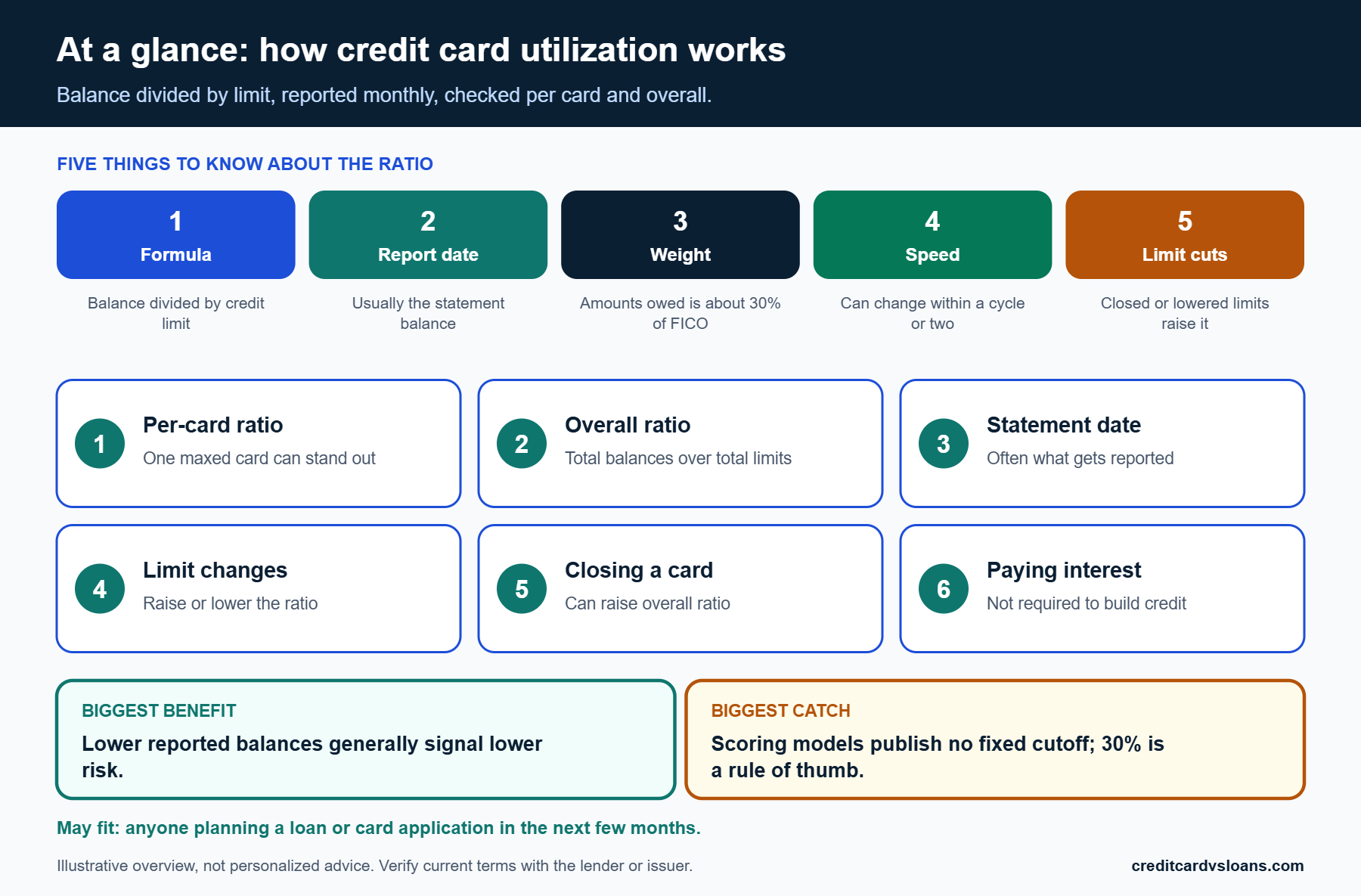
Credit card utilization, sometimes called a credit utilization ratio or rate, compares what you owe on revolving accounts with what you are allowed to borrow on them. FICO describes the calculation at the account level: divide the outstanding balance by the credit limit. In FICO’s example, a $10,000 balance on a $20,000 limit is 50% utilization.
A revolving balance is debt that can carry from month to month, such as a credit card balance. Installment loans like a personal loan or auto loan do not have a limit in the same way, so they are treated differently, which is why this article focuses on cards.
Per card and overall
Scoring models can look at utilization in more than one way. FICO’s guidance on balance transfers notes that both the overall ratio, meaning total card balances divided by total limits, and the ratio on each individual card can come into play. A single maxed-out card can therefore look risky even when your overall ratio is modest.
Here is a hypothetical example. Card A has a $5,000 limit and a $2,000 balance, so it is at 40%. Card B has a $10,000 limit and a $500 balance, so it is at 5%. Together that is $2,500 owed against $15,000 of limits, or about 16.7% overall. The overall number looks comfortable, while Card A alone looks heavier.
Why a ratio and not a dollar amount
The same $2,000 balance means different things on different limits. On a $2,500 limit it is 80% of what you can borrow, which suggests you are leaning hard on credit. On a $20,000 limit it is 10%. Scoring models use the ratio because it captures how stretched a borrower looks, not just how much they owe.
FICO says utilization is “extremely predictive of future repayment risk” and that higher utilization is associated with a greater chance of default within two years. That is the logic behind the factor: it is a risk signal, not a judgment about your character.
Where utilization sits in your score
The weight of the amounts-owed category
According to FICO, the five main scoring factors carry these general weights: payment history 35%, amounts owed 30%, length of credit history 15%, new credit 10% and credit mix 10%. FICO adds that the weights are general and can vary from person to person, so treat the percentages as a map, not a formula for your own file.
Amounts owed covers more than utilization. It also reflects total debt and, for installment loans, how much of the original balance remains. Even so, revolving utilization is one of the most visible and most changeable pieces of that category.
Why it can change fast
Payment history can take years to repair after a serious delinquency, and the CFPB notes that most negative information can generally be reported for seven years. Utilization is different. When your balance drops and the issuer reports the lower figure, the ratio your reports show can improve at the next reporting cycle.
The catch is that speed works both ways. A large purchase, a holiday month or a temporary cash crunch can push a reported balance up, and the score can dip until the balance falls again. That dip is usually a reversible signal, not permanent damage, but it can matter if you are about to apply for a mortgage, auto loan or new card.
Paying your bill on time does not by itself guarantee a low utilization figure. If your issuer reports a high balance on the statement date and you pay in full by the due date, the high balance can still be what scoring models see.
How credit card utilization is calculated and reported
What goes into the numbers
Balances come from your issuer’s reports
Credit scores are built from your credit reports, and credit reports are built from data your lenders send to the bureaus, typically once a month. The balance on your report is therefore a snapshot from a particular date, not a live reading of what you owe today. Most issuers report the balance as of the statement closing date, although practices differ, so confirm with your issuer.
This is why you can see your score move even though nothing about your habits changed. If the statement date falls right after a big month of spending, that balance is what gets sent, regardless of whether you plan to pay it off in full.
Limits matter as much as balances
FICO states that it does not score your credit limit by itself. It uses the limit to compute the utilization rate, which feeds the amounts-owed category. That means a limit change, up or down, changes your ratio even if your spending stays flat.
A hypothetical illustration: with a $2,000 balance and a $5,000 limit, utilization is 40%. If the issuer later raises the limit to $8,000 and your balance stays at $2,000, utilization drops to 25%. If the issuer lowers the limit to $3,000, it rises to about 67%. Issuers can change limits, and the card agreement explains when they may do so.
Statement date, due date and the reporting gap
Why the statement closing date matters
Your statement closing date is the day your billing cycle ends and your balance for that cycle is totaled. Your due date typically falls a few weeks later. If your issuer reports the statement balance to the bureaus, then paying in full on the due date keeps you out of interest but does not change the figure that was already reported.
Check your statement or online account for the closing date, and ask the issuer when it reports to the bureaus. Reporting dates are the issuer’s choice and can differ from card to card, so do not assume they match.
A hypothetical timing example
Suppose a card has a $6,000 limit, a statement that closes on the 15th and a $1,800 balance building up before that date. Reported as is, utilization on that card is 30%. If the cardholder pays $1,200 on the 12th, only $600 remains at the close, and the reported ratio is 10%.
Nothing about the cardholder’s finances changed except when the payment landed. This is a legitimate way to manage the number, and it costs nothing extra. It does not replace the need to pay the full statement balance by the due date if you want to avoid interest, which is a separate issue covered below.
How much does credit card utilization matter, and what is a good ratio?
There is no official cutoff
Where the 30% figure comes from
You will often see advice to keep utilization under 30%. As a rule of thumb it is reasonable, but we could not find a primary-source statement from FICO or the CFPB that sets 30% as a threshold, and scoring models generally do not publish bright lines. Treat it as a practical waypoint, not a pass-fail mark.
Because the models weigh many factors at once, the same ratio can be neutral for one person and damaging for another. A borrower with a long history of on-time payments and several open accounts is in a different position from someone with a thin credit file, meaning very little history for the models to analyze.
Lower is generally better, but zero is not required
Generally, lower reported utilization signals lower risk. That does not mean you need to avoid using your cards. A small balance reported on one card alongside on-time payments is a normal pattern for active, responsible card use. Some people assume carrying a balance from month to month helps their score. It does not need to, and it costs interest.
The CFPB and FICO materials we reviewed do not say that you must carry a balance to build credit. Paying the statement in full while letting a small balance report is a common approach, and it avoids interest charges when your card has a grace period, which your agreement should spell out.
What changes the importance of utilization for you
Thin files and recent history
If you have only one or two cards and little history, utilization can carry more weight in practice because there is less other information to offset it. This is common for students and young adults building credit. For a full walk-through, see building credit with a student credit card.
A short history also means one reported spike stands out. Keeping balances modest relative to a small starting limit is often the hardest part of early credit building, because the limit may be only a few hundred dollars.
Before a big application
Timing matters most when you are about to apply for a mortgage, auto loan or new card. Lenders pull your reports and scores at the time of application, so a temporarily high balance can cost you at the worst moment. Planning to bring balances down one or two statement cycles earlier is a reasonable step.
Utilization also interacts with other events. Applying for credit adds an inquiry, covered in our guide to whether applying for a credit card hurts your credit, and opening a new account can change your average account age. Looking at utilization alone gives an incomplete picture.
Different scores, different answers
There is no single credit score. FICO and VantageScore each publish multiple versions, and lenders choose which one to use for a given product. Two models can treat the same utilization figure a little differently, and the scores you see on a free app may not be the ones a lender pulls. That is one reason a score can move by a different number of points than you expected.
What stays consistent across models is the direction: all else equal, a lower reported ratio is viewed more favorably than a higher one. Use that direction as your guide, and avoid chasing a specific point change that no one can promise.
| Total reported balance | Overall utilization | How it generally reads |
|---|---|---|
| $0 | 0% | No balance reported; fine, though some people prefer a small reported balance on one card |
| $1,000 | 10% | Low; generally viewed favorably |
| $3,000 | 30% | Common rule-of-thumb waypoint, not an official line |
| $5,000 | 50% | Moderate to high; may weigh on a score |
| $9,000 | 90% | Very high; a typical red flag for scoring models and lenders |
What carrying a balance costs: interest and utilization together
The interest side of a high balance
What card rates look like right now
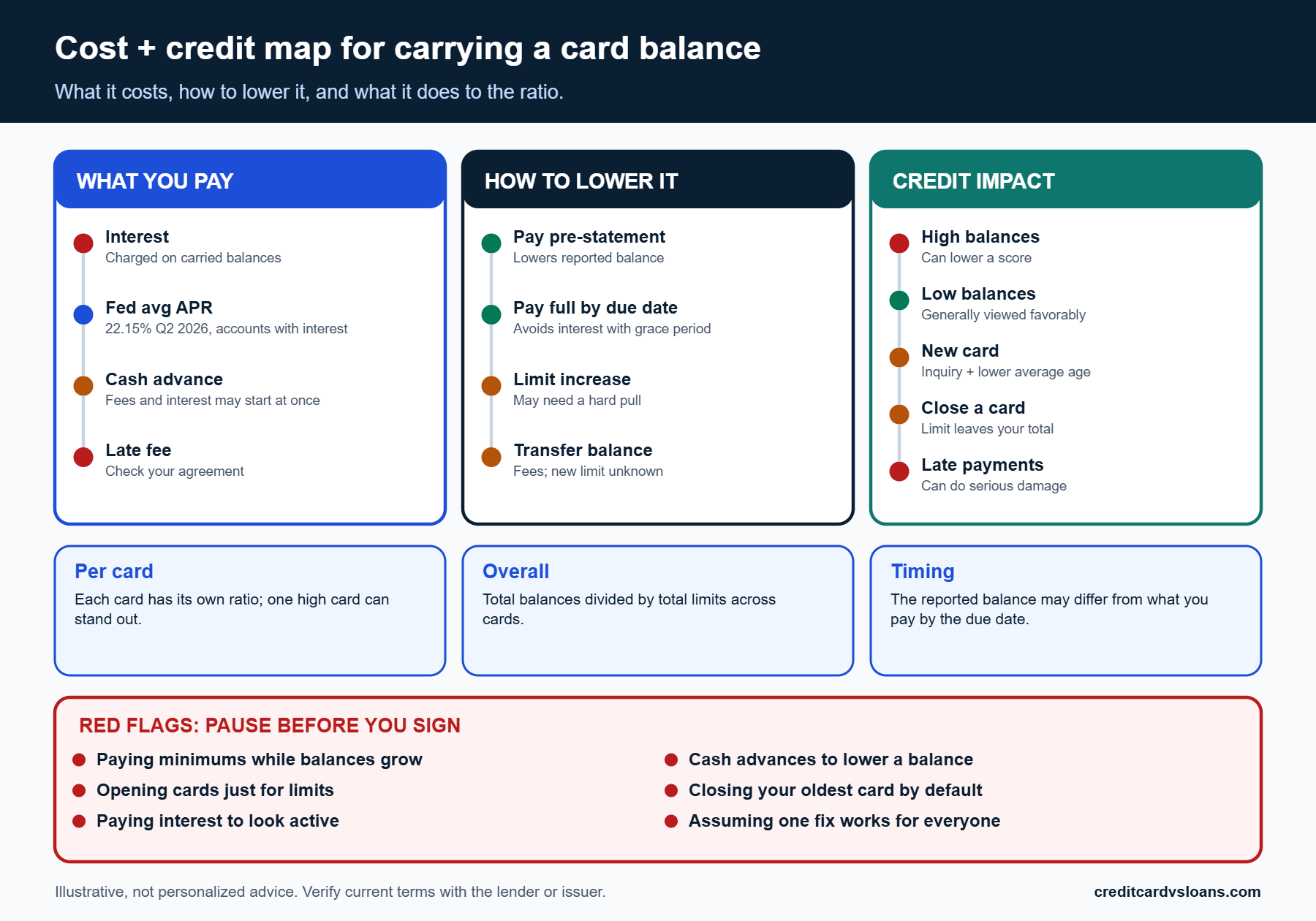
The Federal Reserve’s G.19 consumer credit release of October 7, 2026 reported that the interest rate on commercial bank credit card plans for accounts assessed interest was 22.15% in the second quarter of 2026, and 20.94% across all accounts, including those that pay in full. The first number is the more relevant one if you carry a balance, since it reflects cardholders who are actually being charged interest. Your own APR could be lower or higher depending on the issuer and your credit profile.
Because the APR is quoted per year but charged on a daily or monthly basis, a balance that sits for months grows at a rate that is hard to see on any single statement. That is one reason people underestimate the cost of a revolving balance.
An illustrative interest comparison
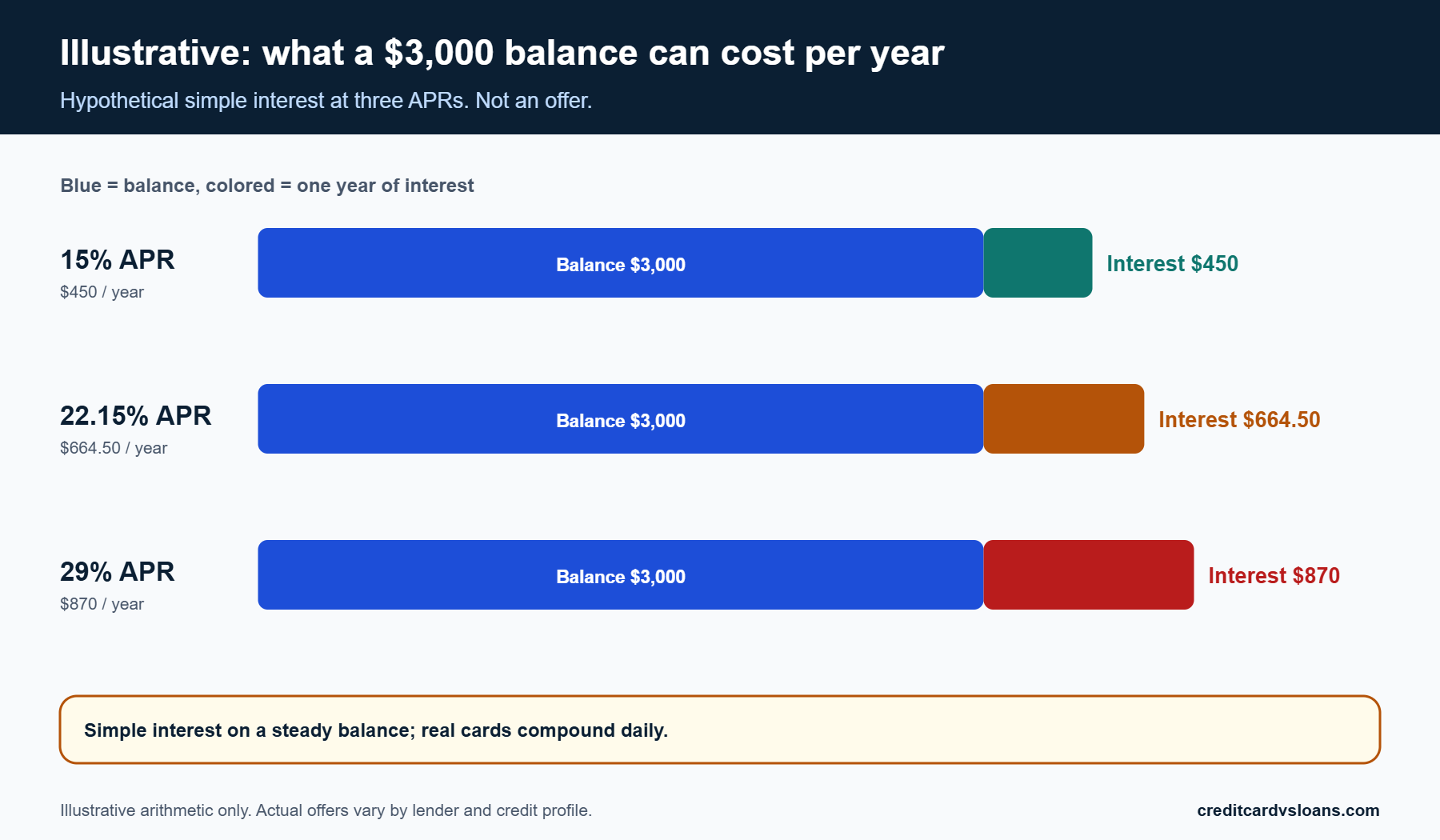
The table below is a simplified, hypothetical look at what a balance held steady for a full year would cost at three APRs. It uses simple annual interest, so it understates the effect of compounding. Actual card interest is typically calculated on a daily balance, so your real cost could be somewhat higher, and it will be lower if you pay the balance down during the year.
| Balance held for 12 months | At 15% APR | At 22.15% APR | At 29% APR |
|---|---|---|---|
| $1,000 | $150.00 | $221.50 | $290.00 |
| $3,000 | $450.00 | $664.50 | $870.00 |
| $6,000 | $900.00 | $1,329.00 | $1,740.00 |
The score side of a high balance
Two costs, one cause
A high revolving balance usually costs you twice. First, you pay interest on it. Second, it raises the utilization ratio, which can pull down your score and make future borrowing more expensive. The two effects reinforce each other: a lower score can lead to higher offered rates on later applications, which makes any new balance costlier.
That does not mean utilization is the only lever. Payment history is the largest category in FICO’s weights at 35%, so an on-time record is the foundation. Utilization is the part that can sit on top of an otherwise clean record and still make a score look weaker than your habits deserve.
Paying interest to improve a ratio is a poor trade
One mistaken belief is that carrying a small balance helps your score. There is a kernel of truth: a card that reports a small balance may look more active than one that reports zero. But you do not need to pay interest to get that benefit. If your card has a grace period, you can charge a small amount, let the statement report it, and pay the statement in full by the due date.
The fine print matters here. Grace periods usually apply only when you paid the prior statement in full. If you carry a balance, new purchases may start accruing interest immediately. Read your card agreement and the CFPB’s explanations of how card interest works before relying on this.
The grace period and the statement-balance trap
Many people assume that paying the statement balance on time always means no interest, and that is often true when you have a grace period. The trap is that a grace period generally depends on having paid the previous statement in full. Once a balance carries over, new purchases may begin accruing interest from the purchase date, and you may owe more than the statement shows to fully clear the account.
If you have recently carried a balance, ask your issuer what it takes to restore the grace period, or look at your agreement’s description. Paying a larger amount than the statement balance, once, can sometimes reset things, but it varies by issuer, so confirm before relying on it.
If you are paying only the minimum and your reported utilization keeps rising, the issue is probably not timing. It is a debt problem, and a balance transfer, consolidation or credit counseling conversation may help more than any statement-date trick.
If you are thinking of moving a balance to a lower-rate card, see whether a balance transfer hurts your credit for the short- and long-term effects.
How to lower credit card utilization step by step
Change the balance
Pay down before the statement closes
The most direct fix is also the simplest: reduce the balance that gets reported. If you can, make a payment a few days before your statement closing date rather than waiting for the due date. This lowers the figure your issuer sends to the bureaus without changing how much you spend.
Some people make several smaller payments during the month. That works too, as long as the lowest balance is what ends up on the statement date. Keep paying the full statement balance by the due date if you want to avoid interest, since the pre-statement payment does not substitute for the on-time payment.
Pay the card that is doing the most damage
If you have several balances, a rule of thumb is to look first at any card near its limit, because per-card utilization can matter as well as the overall figure. Separately, from a pure cost standpoint, the card with the highest APR costs the most to carry. The two lists are not always the same card, so decide which goal is more pressing.
A hypothetical example: Card A has $2,000 on a $2,500 limit at 29% APR, and Card B has $1,500 on a $10,000 limit at 18% APR. Card A is both near its limit and the most expensive, so it is the clear first target. When the cards point in different directions, the lower interest cost is usually the stronger tie-breaker unless an application is coming soon.
Change the limit or the structure
Ask for a limit increase carefully
A higher limit lowers utilization if your balance stays the same. In the earlier example, raising a $5,000 limit to $8,000 with a $2,000 balance cuts the ratio from 40% to 25%. The catch is that some issuers run a hard inquiry on a limit-increase request, and a larger limit can make overspending easier. Ask the issuer whether the request uses a hard or soft pull before you agree.
A limit increase helps only if your spending does not rise with it. If it does, you have simply raised the ceiling on the same problem.
Think twice before closing cards or moving balances
Closing a card removes its limit from your total, which can push overall utilization up, a point the CFPB makes directly. Our guide to closing a credit card and your credit score covers when closing makes sense. Likewise, moving a balance to a new card changes the per-card and overall ratios at the same time, for better or worse, depending on the new limit.
FICO’s own example shows the mechanics: a $4,000 balance moved to a card with a $5,000 limit lands at 80% on that card, while the same balance on a $10,000 limit is 40%. You do not know the new limit until you are approved, so a transfer can disappoint.
Utilization myths and moves that backfire
Myths that cost people money
“I need to carry a balance to build credit”
This is the most expensive myth in consumer credit. Scoring models look at whether you pay on time and how much of your limit your reports show you using. Neither requires you to pay interest. Paying the full statement balance while a modest balance reports is consistent with building a positive history, and it avoids finance charges when your card offers a grace period.
If you are building credit for the first time, a single card used lightly and paid in full is a common starting point. For specifics on first cards, see our student credit card guide, which covers limits, fees and habits for a thin file.
“Utilization has a permanent effect”
Unlike a missed payment, which can stay on your reports for years, utilization reflects the balances your accounts show now. When balances fall and are reported, the ratio can improve at the next update. That does not mean every dip disappears instantly, since scoring models and issuers update on their own schedules. But the effect is generally temporary, which is useful news if you are recovering from a heavy few months.
The flip side is that an excellent score built on low utilization can slip if balances rise again. It is a current-condition measure, not a trophy you keep.
Moves that can backfire
Opening cards only to raise your total limit
More available credit can lower the ratio, but each application generally creates a hard inquiry and a new account that lowers your average age of accounts. FICO says one additional hard inquiry usually costs fewer than five points for most people, and that inquiries count in the score for 12 months while remaining on the report for up to 24. A single card is usually a small effect. Several in a short stretch is a different story, as covered in our guide to credit card applications.
Opening a card also tempts new spending. If a new limit becomes a new balance, you have added debt without improving the ratio.
Cash advances and “parking” balances
Moving money around to make a reported number look good can create real costs. Cash advances typically carry fees and often begin accruing interest immediately, though terms vary by card. Paying one card with another just shifts the balance. If you are considering moving debt for a lower rate, evaluate the transfer fee and the promotional APR terms first, as explained in our balance transfer credit impact guide.
The test for any tactic is simple: does it lower what you actually owe or the interest you pay? If it only changes the reported number temporarily, it is not a plan.
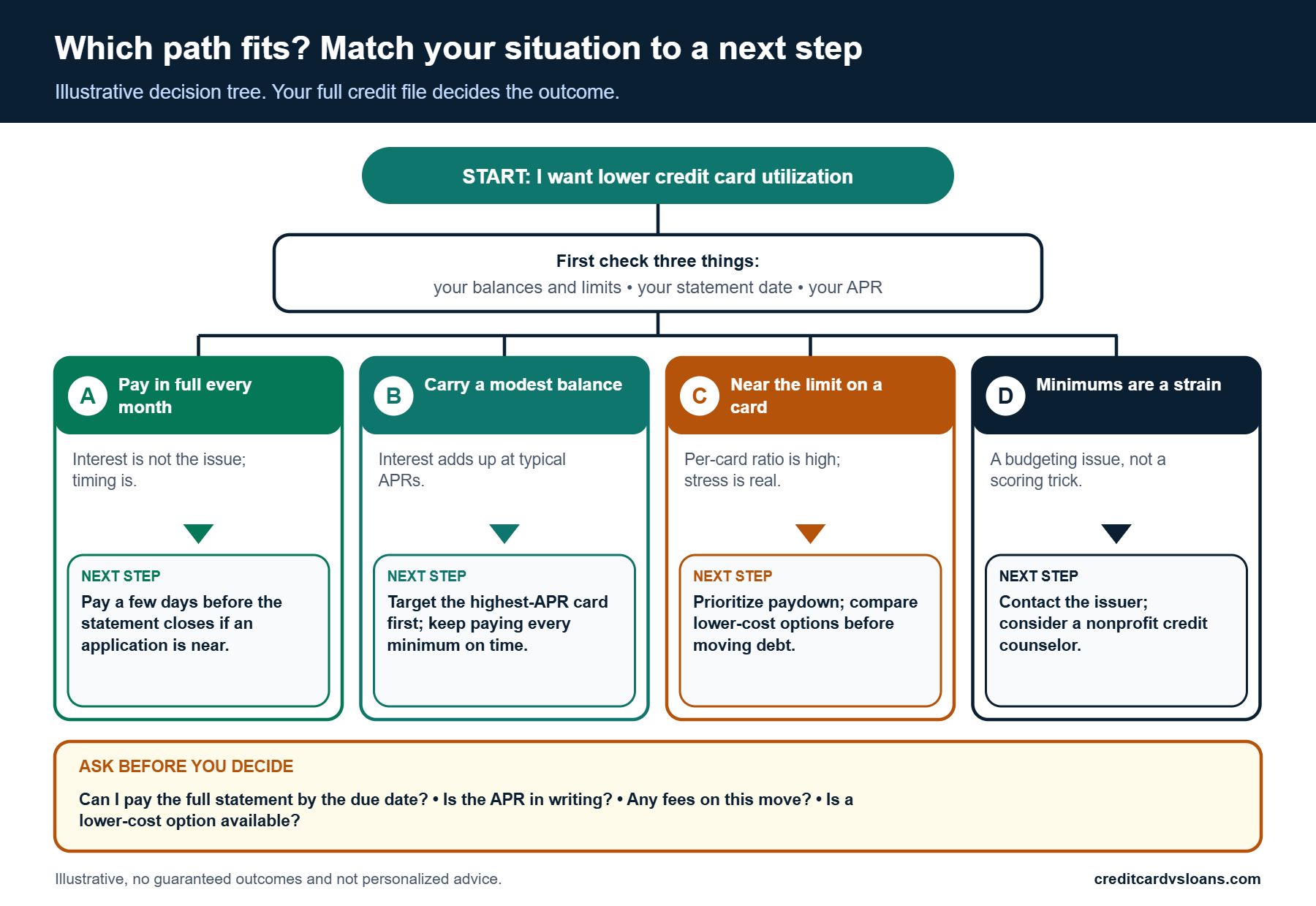
Which approach fits your situation
If you pay your cards in full each month
Your task is mostly timing
If you pay in full, you are not paying interest, and the main question is what balance gets reported. If your statement date lands right after a heavy spending stretch, your reported utilization can look high even though you owe nothing by the due date. A mid-cycle payment can fix the optics.
For most people in this group, the effort is optional unless a loan or card application is close. If you are not applying for anything soon, the reported figure matters less.
Spread large purchases thoughtfully
If you are planning a large purchase, you can use a payment before the statement closes, or split the charge across two cards when both can be paid off promptly. Keep per-card ratios in mind as well as the overall figure, because one card at a high percentage can stand out even when others are empty.
Be careful not to chase rewards at the expense of discipline. A purchase you cannot pay off within the grace period turns into debt at the going rate.
If you carry a balance from month to month
Interest is the bigger problem
If you carry a balance, utilization is a symptom. The more urgent cost is the interest, which at the Federal Reserve’s reported 22.15% average for accounts assessed interest adds up quickly. Direct extra dollars to the highest-cost balance while paying the minimums on the others, and consider whether a lower-rate option exists.
Comparing a promotional card and a personal loan is an apples-to-apples exercise that depends on fees, term and the rate after the promotion ends. Our 0% APR card versus personal loan comparison walks through it, and our guide to how a personal loan affects your credit score explains the credit side of consolidating.
When to ask for help
If minimum payments are straining your budget, a nonprofit credit counseling agency can review your situation and discuss options such as a debt management plan. Look for agencies that are transparent about fees. The CFPB and the FTC both publish guidance on choosing a counselor and avoiding debt-relief scams, and it is worth reading before you pay anyone.
| Approach | Typical speed | Cost or risk | Best fit |
|---|---|---|---|
| Pay down before the statement closes | Next reporting cycle | No extra cost; requires cash on hand | People who pay in full and want a lower reported figure |
| Pay off the highest-APR balance first | Gradual | Saves the most interest | People carrying balances on several cards |
| Request a limit increase | Days to weeks | May involve a hard pull; can encourage overspending | Steady users with stable income and no plan to borrow more |
| Open a new card | Weeks | Hard inquiry, lower average account age, new-spending temptation | Rarely the first move |
| Balance transfer or consolidation loan | Varies | Fees, limit uncertainty, promotional rate expiry | People with a clear payoff plan; see the credit impact guide |
Your checklist and the bottom line
A practical checklist
Before your next statement closes
- Find your statement closing date and due date for each card.
- Check each card’s balance and limit, then compute the per-card and overall ratios.
- Decide whether a payment before the closing date makes sense for any card near its limit.
- Confirm you can still pay the full statement by the due date if you want to avoid interest.
- Pull your free credit reports at AnnualCreditReport.com, the only site authorized to fill the free-report requests, and check that limits and balances are listed correctly.
The FTC says all three bureaus currently let you check your report from each weekly at no cost, so there is no reason to guess what your files show.
Over the next few months
- Aim to keep reported balances low relative to limits, and treat any specific percentage as a waypoint.
- Avoid new applications in the months before a major loan application unless you need the credit.
- Keep older cards open if they are free and you will not be tempted to overspend, as the CFPB notes, since closing cards can raise the ratio.
- If you carry a balance, make a payoff plan with a date, and compare lower-cost options on an apples-to-apples basis.
The bottom line
How to decide
Credit card utilization is a fast-moving, mostly reversible part of your score, and it rewards two habits: reporting low balances relative to limits, and not paying interest to do it. If you pay in full, timing is the tool. If you carry a balance, the real goal is paying it down, and the score improvement is a side effect.
No one can promise how many points a given change will produce. Your score depends on your full file, the scoring model and the lender, so use these tactics to improve your position, not to predict a number.
Keep reported balances low, pay on time, and avoid solving a balance problem with tactics that add fees, inquiries or new debt.
Where to go next
If you are considering closing a card, read how closing a card affects your credit score first. If you are weighing a new card, see whether applying for a credit card hurts your credit. If you are comparing ways to restructure debt, start with how a personal loan can affect your credit score.
When your numbers are stable, revisit your reports every few months. Small checks catch reporting errors early, and an error in a limit or balance can distort your utilization without any change in your behavior.
Quick answers to common follow-ups
How soon will a lower balance show up in my score?
It depends on when your issuer reports. If a card reports on the statement closing date, a payment made before that date can appear in the next report, and your score may reflect it after the bureaus update. If you pay after the statement closes, the lower balance may not show until the following cycle. There is no fixed number of days that applies to every card, so look at how your own statements and reports line up.
Different score providers also refresh on their own schedules, so the number you see in an app may lag your actual reports by days or weeks.
Do store cards and credit union cards count too?
Revolving accounts that are reported to the credit bureaus can contribute to utilization, whether they come from a bank, a credit union or a retailer. Retail cards often have low limits, which means even a modest balance can produce a high ratio on that card. If you carry store-card balances, check the per-card figures too, not just the overall total.
Whether a specific lender reports to all three bureaus varies, so your reports from AnnualCreditReport.com are the only reliable way to see what is being counted.
Should I check my score or my credit report?
Start with the reports. Reports show the balances, limits and payment status that models use, and errors there can distort utilization. The FTC advises getting free reports only through AnnualCreditReport.com and warns about imposter sites. A score is useful as a rough gauge, but reports tell you why.
Checking your own reports is a soft inquiry and does not affect your FICO Score, according to FICO. If you spot a wrong limit or a balance that doesn’t match your statement, dispute it with both the bureau and the lender, as the FTC advises.
What general guidance cannot tell you
Your own file is the only real test
Everything above describes how utilization generally works. It cannot tell you how many points a particular balance change will produce for you, because that depends on your whole credit file, the scoring model a lender picks and how your issuers report. Two people with the same ratio can see different results, and a change that looks large on paper may barely register.
A sensible way to use this information is as a checklist of levers, then watch how your reports and scores respond over a few cycles. Keep notes on the date you paid, the statement date and the balance that reported. After two or three cycles you will know how your issuers behave, which is more useful than any average.
Signs you need more than a utilization fix
If you are using cards to cover essentials, if you are skipping payments on other bills to keep card payments current, or if the balance grows even when you stop spending, utilization is not the core problem. The core problem is a gap between income and obligations, and no reporting trick closes that gap.
In that situation, talk to your issuer about hardship options, and consider a nonprofit credit counselor who can review your whole budget. The CFPB and the FTC both warn about companies that charge large upfront fees for debt relief, so compare offers carefully and read every agreement before signing.
- FICO: What’s in my FICO Scores? (Factor weights and amounts owed)
- FICO: How FICO Scores look at credit card limits (Utilization calculation and risk)
- FICO: Balance transfers and your credit (Per-card and overall utilization example)
- FICO: How long do hard inquiries stay on your credit report?
- CFPB: Does it hurt my credit to close a credit card?
- CFPB: How long does negative information remain on my credit report?
- FTC: Free Credit Reports
- Federal Reserve: Consumer Credit – G.19 (October 7, 2026) (Credit card plan interest rates, Q2 2026)
Last updated: October 22, 2026. Rates, fees and lender rules change; verify current terms before acting.
The information on creditcardvsloans.com is provided for general educational and informational purposes only. It is not financial, legal, tax, credit, accounting or investment advice, and reading it does not create an advisor-client, fiduciary or any other professional relationship. Nothing here is an offer, solicitation or recommendation to borrow, lend or apply for any product.
Credit scores, interest rates, fees, eligibility rules, lender policies and laws change frequently and vary by lender, location and individual circumstances. Examples, figures and scenarios are illustrative only, do not predict your results and do not guarantee approval, savings, a particular rate or a credit-score outcome. Always confirm current terms directly with the lender or issuer and read the full agreement before you apply or sign.
Although we aim for accuracy and use reputable sources, we make no representations or warranties, express or implied, about the completeness, accuracy, reliability or timeliness of the content. Content may be drafted with the assistance of automated tools, so errors or omissions may still occur. Links to third-party sites are provided for convenience; we don’t control and aren’t responsible for their content.
To the fullest extent permitted by law, creditcardvsloans.com and its owners, editors, authors, contributors and affiliates disclaim all liability for any loss, damage or expense arising directly or indirectly from your use of, or reliance on, this content. Before making financial decisions, consult a licensed professional, such as a qualified financial advisor, attorney, tax professional or nonprofit credit counselor, who can consider your complete situation.