Personal loans for bad credit exist, but they usually cost more than the loans advertised to borrowers with strong scores, and the price gap can be large enough to turn a short-term fix into a long-term problem. If you have a low score, a thin credit file or a recent late payment, you can still get quotes, but you should read the annual percentage rate (APR), the fees and the total repayment amount before you accept anything.
This guide explains how lenders price these loans, what they look at besides your score, what a realistic cost looks like, how the loan can help or hurt your credit, and which lower-cost options deserve a look first. It is written for decision support, not as advice about your specific finances, and it will not promise any approval, rate or score outcome because those depend on the lender and your full credit file.
The central trade-off is simple. A fixed-payment installment loan can bring predictability and a defined payoff date, but a high APR, an upfront fee and a long term can multiply the amount you repay. The sections below show the math with clearly labeled hypothetical examples so you can compare offers apples-to-apples.
- “Bad credit” has no single cutoff. Each lender sets its own tiers, so the same file can get very different quotes from different lenders.
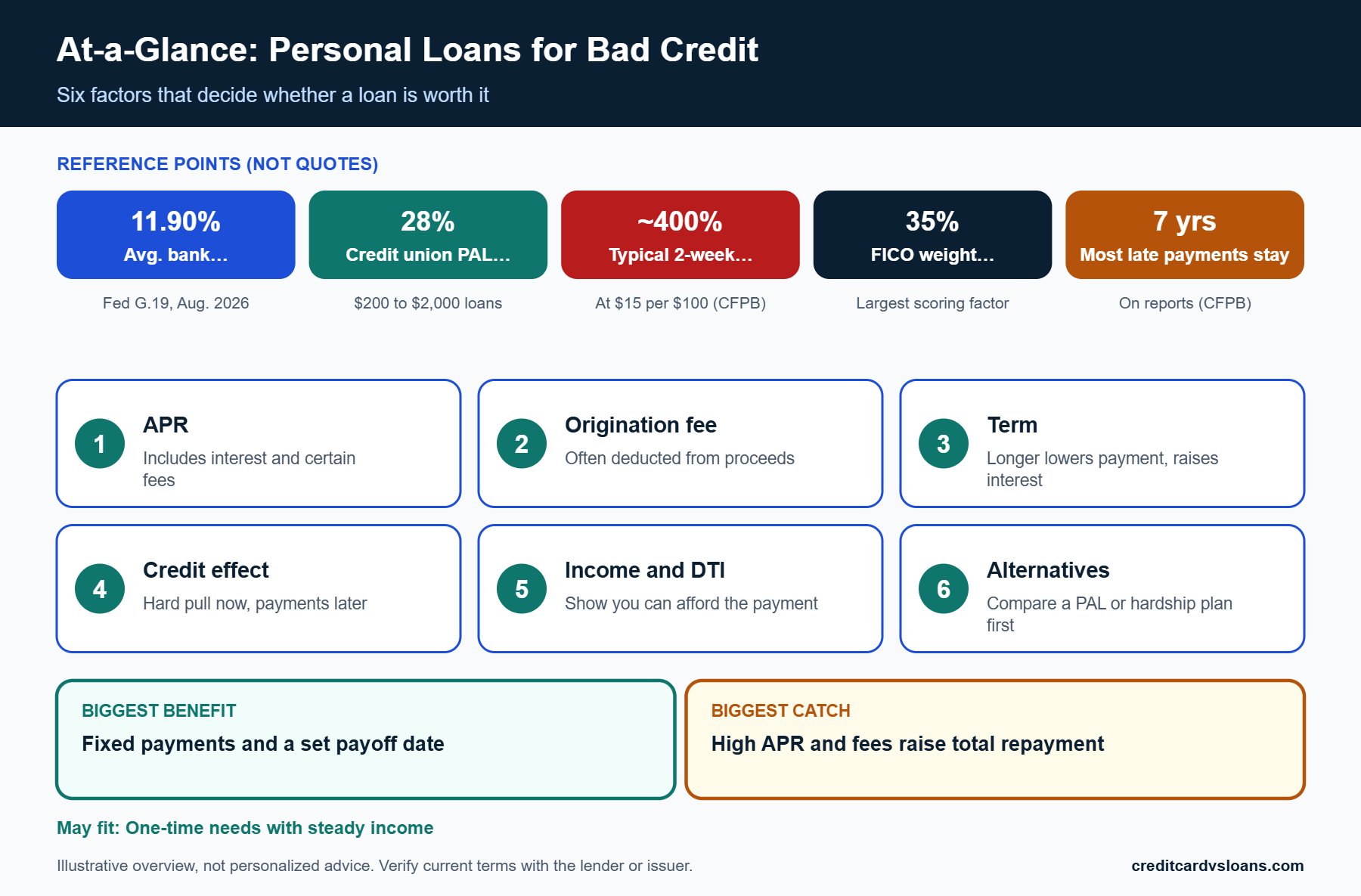
- Compare the APR, which includes certain fees, and the total of payments, not just the monthly payment.
- An origination fee is usually taken out of the money you receive, so you repay more than you get.
- Credit union payday alternative loans, secured options, a co-borrower, and talking to your current creditors are worth comparing before a high-APR loan.
- Any company that demands a fee before you receive a loan, or promises approval no matter what, is a red flag.
Market figures in this article come from the Federal Reserve’s G.19 consumer credit release of October 7, 2026, and from federal rules as published in October 2026. Your own offer will differ, so treat every example as a way to understand the structure of the cost, not as a quote.
Table of contents
Personal Loans for Bad Credit: The Short Answer
What These Loans Are and Who They Tend to Fit
What lenders mean by bad credit
There is no federal definition of bad credit for lending. Scoring models such as FICO and VantageScore label ranges (for example “poor” or “fair”), but each lender decides where its own cutoffs sit and which products it offers below them. A score that gets declined at one lender may qualify for a higher-priced tier at another.
Lenders also look at more than the number. A recent bankruptcy, a collection account, a string of 30-day late payments, or a very thin file can matter as much as the score itself. That is why the same borrower can see quotes that differ by many percentage points, and why shopping several lenders matters more here than in almost any other part of borrowing.
What the product usually looks like
Most personal loans are unsecured installment loans: you receive a lump sum, repay it in equal monthly payments over a set term, and owe nothing further once the balance reaches zero. Because no collateral backs the loan, lenders price the risk of non-payment into the APR, and for lower-score borrowers that risk premium is substantial.
Some lenders for this segment offer secured versions backed by a savings balance or a vehicle, or let you add a co-signer or co-borrower. Those structures can lower the rate, but they also put your collateral or another person’s credit at stake, which we cover later. For the rate drivers, see what determines your personal loan APR.
When a Bad Credit Loan Can Make Sense and When It Probably Does Not
Situations where it may fit
A fixed-rate installment loan may be worth comparing when you have a one-time, necessary expense, a stable income that comfortably covers the payment, and no cheaper source of money. Examples include an emergency repair that protects your ability to work, or replacing several high-rate balances with one lower-cost payment, if the numbers truly improve.
It tends to fit better when the loan is small relative to your income, the term is short enough to limit interest, and you have already compared at least one credit union or secured alternative. The decision usually comes down to whether the total cost is lower than the cost of the problem you are solving.
Situations where it probably backfires
It often backfires when the loan covers a recurring shortfall rather than a one-time cost. If your budget is already short every month, adding a fixed payment can push you into late fees, a second loan, or a collections account, and those outcomes can lower your score further.
It also tends to go badly when the APR is high enough that the interest rivals the amount borrowed, when a large origination fee shrinks the funds you actually receive, or when the purpose is discretionary spending that could wait. If the need is seasonal spending, our guide to financing holiday expenses compares lower-cost routes.
| Item | What it usually means | Who it may fit | Main drawback |
|---|---|---|---|
| Loan type | Unsecured installment loan with fixed monthly payments | Borrowers with steady income and a one-time need | Rate reflects higher default risk |
| Cost drivers | APR, origination fee, term length | Those who compared several offers | Fees can be deducted from proceeds |
| Credit effect | Hard pull, new account, payment history going forward | Borrowers who can pay on time every month | A missed payment can lower your score further |
| Alternatives | Credit union PALs, secured loan, co-borrower, hardship plan | Borrowers who can wait a few days to compare | Membership, collateral or another person’s credit may be involved |
How Lenders Price Personal Loans for Bad Credit
APR, Interest Rate and the Origination Fee
Why the APR is the number to compare
The interest rate is the price of the money you borrow. The APR, or annual percentage rate, expresses the cost of credit as a yearly rate and generally folds in certain fees charged to get the loan. Under Regulation Z, which implements the Truth in Lending Act, the finance charge includes items such as interest and loan fees, and lenders must disclose the APR, the finance charge, the amount financed and the total of payments for closed-end loans.
That is why a loan with a lower interest rate and a large fee can carry a higher APR than a loan with a slightly higher rate and no fee. When you compare offers, put the APRs next to each other, then check the total of payments.
How an origination fee works in practice
An origination fee is a charge for processing the loan, often quoted as a percentage of the amount borrowed. Many lenders subtract it from the funds you receive, so a hypothetical $5,000 loan with an 8% fee ($400) would deposit about $4,600 into your account while you still owe and pay interest on the full $5,000.
That detail matters when you have a specific bill to pay. If you need $5,000 in hand, you may have to borrow more than $5,000 to cover the fee, which raises the interest you pay. Ask every lender whether the fee is added to the balance or deducted from proceeds, and whether it varies with your credit tier.
What the Market Numbers Say
Benchmarks from the Federal Reserve
The Federal Reserve’s G.19 consumer credit release, published October 7, 2026, reports commercial bank rates for August 2026. It shows an average of 11.90% for 24-month personal loans, and 21.19% for credit card plans across all accounts, rising to 22.36% for accounts that were actually assessed interest. The Fed derives the personal loan figure from the most common rate that banks report, so it reflects typical bank customers rather than borrowers with damaged credit.
Use these numbers as a reference point, not a prediction. If a quote for you is far above them, that gap is the price of risk the lender sees in your file, and it is a reason to compare offers and alternatives before you sign.
Why your quote may sit well above the averages
Lenders use risk-based pricing: the higher the chance of default they estimate, the higher the APR and the more fees they may add. Income, existing debt, recent delinquencies, the amount requested and the term all feed into that estimate, which is why two borrowers with similar scores can still see different rates.
Rates for lower-score borrowers can run much higher than the bank averages above, and some lenders cap APRs while others do not. State law also affects what lenders may charge, so rules vary by state. For a fuller look at the rate drivers, read personal loan rates and what moves your APR, and use your state regulator’s website for local limits.
Eligibility and Requirements When Your Credit Is Rough
What Lenders Look at Beyond the Score
Income, employment and debt-to-income ratio
Lenders want evidence that you can make the monthly payment. They typically ask about income and employment, and many calculate your debt-to-income ratio (DTI), which compares your monthly debt payments with your gross monthly income. A lower DTI generally signals more room to take on a new payment.
For a lower-score borrower, strong income documentation can offset some risk. Pay stubs, tax returns, bank statements, or benefit award letters may all count, depending on the lender. The detailed checklist is in personal loan requirements and what lenders look for.
Recent payment history and public records
Recent late payments, collections and charge-offs usually matter more than older problems. The Consumer Financial Protection Bureau (CFPB) explains that most negative information can stay on a credit report for seven years, with bankruptcies able to stay up to ten, and the weight lenders give it generally fades as the record ages.
FICO says payment history is the largest scoring category, at 35% of a FICO Score, followed by amounts owed at 30%, length of credit history at 15%, new credit at 10% and credit mix at 10%. If your trouble is recent, a lender may price you into a higher tier; if it is older and you have been current since, you may see better terms. For how the middle of the range is treated, see our guide to a personal loan with a 650 credit score.
Documents, Soft Pulls and Prequalifying
Use a soft pull to see offers first
Many lenders let you prequalify, which means they estimate your rate with a soft pull that is not visible to other lenders and does not require a full application. Prequalifying with several lenders lets you see APR ranges and fee structures before any hard pull happens.
A hard pull usually follows when you formally apply, and scoring models often treat multiple inquiries for the same type of loan within a short window as one for rate shopping, though the window and rules differ by model. We cover this in whether rate shopping for a personal loan hurts your credit.
Paperwork, verification and funding timelines
Expect to provide identification, proof of address, proof of income and bank account details. Lenders may verify employment, request extra documents, or ask you to confirm details by phone. Delays here can stretch a quick approval into several days.
Funding time varies by lender and bank, from the same day to about a week. If you need the money for a deadline, ask for the realistic funding date in writing before you pay any fee, and be wary of anyone who asks for payment before the loan is made.
What a Bad Credit Personal Loan Really Costs
Illustrative Cost at Different APRs
The same $5,000 loan at five different APRs
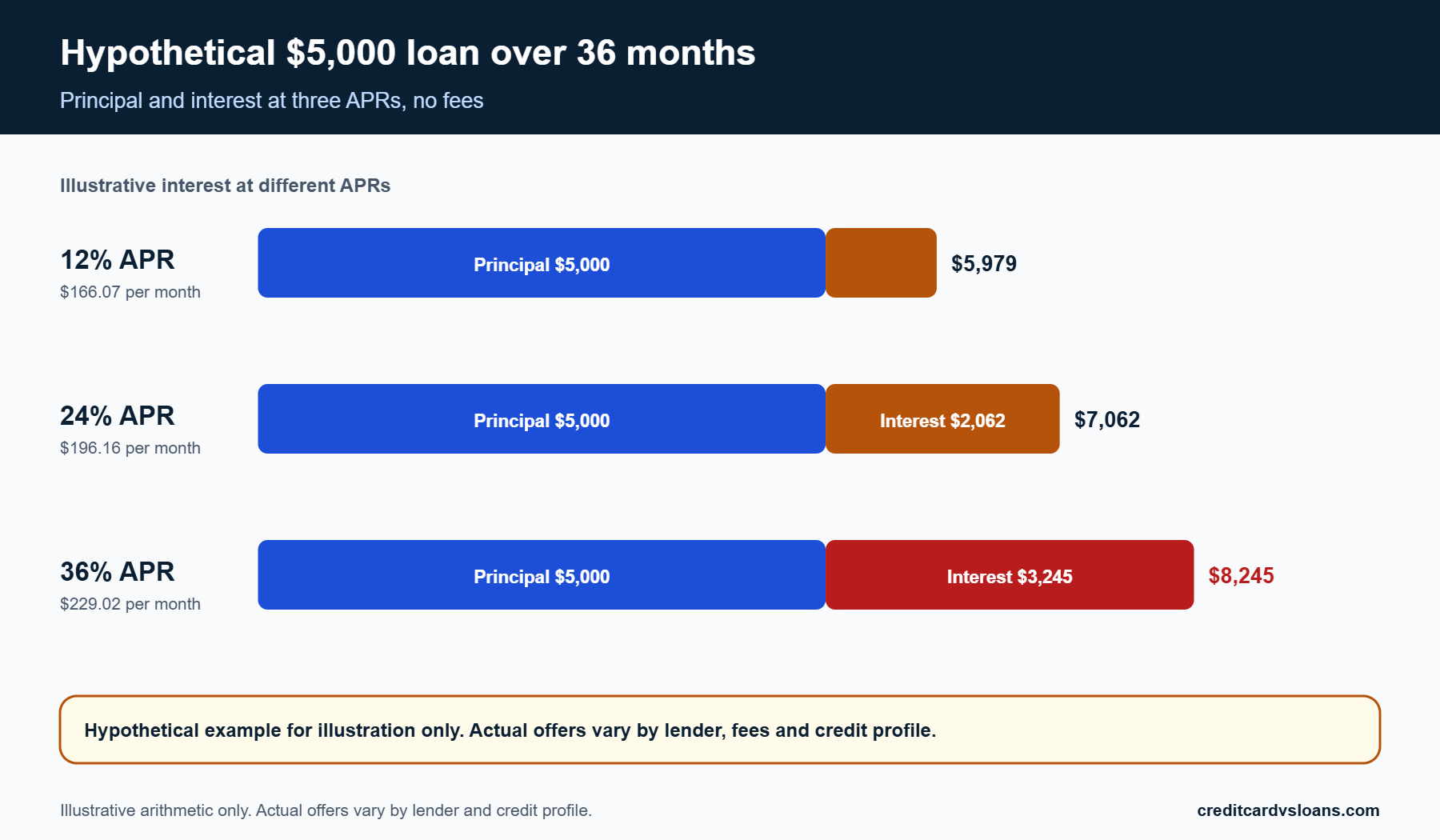
The table below uses a hypothetical $5,000 loan repaid in equal monthly payments over 36 months, with no fees, at five illustrative APRs. These are not quotes. They simply show how fast interest grows as the rate rises, so you can judge whether a given offer is in a range you can afford.
The jump from 12% to 36% adds more than $2,200 in interest on the same amount borrowed over the same time. A payment that looks manageable at $229 a month hides a total repayment of about $8,245 on a $5,000 loan.
| APR | Monthly payment | Total interest | Total repaid | Risk flag |
|---|---|---|---|---|
| 12% | $166.07 | $978.58 | $5,978.58 | Lower cost, less typical for rough credit |
| 18% | $180.76 | $1,507.43 | $6,507.43 | Moderate |
| 24% | $196.16 | $2,061.91 | $7,061.91 | Interest is about 41% of the amount borrowed |
| 28% | $206.82 | $2,445.45 | $7,445.45 | Interest is nearly half the amount borrowed |
| 36% | $229.02 | $3,244.68 | $8,244.68 | Interest is about 65% of the amount borrowed |
How the term changes the total bill
A longer term lowers the monthly payment but raises total interest. Using the same hypothetical $5,000 at 24% APR, a 12-month term has a payment of about $472.80 and total interest of about $673.58, while 24 months is $264.36 and $1,344.53, 36 months is $196.16 and $2,061.91, 48 months is $163.01 and $2,824.44, and 60 months is $143.84 and $3,630.39.
The rule of thumb is to choose the shortest term whose payment you can pay on time even in a tight month. If a lender steers you toward the longest term because the payment looks smaller, ask for the total of payments for both and compare them directly.
How Fees Change the True Price
The same 24% rate with an 8% origination fee
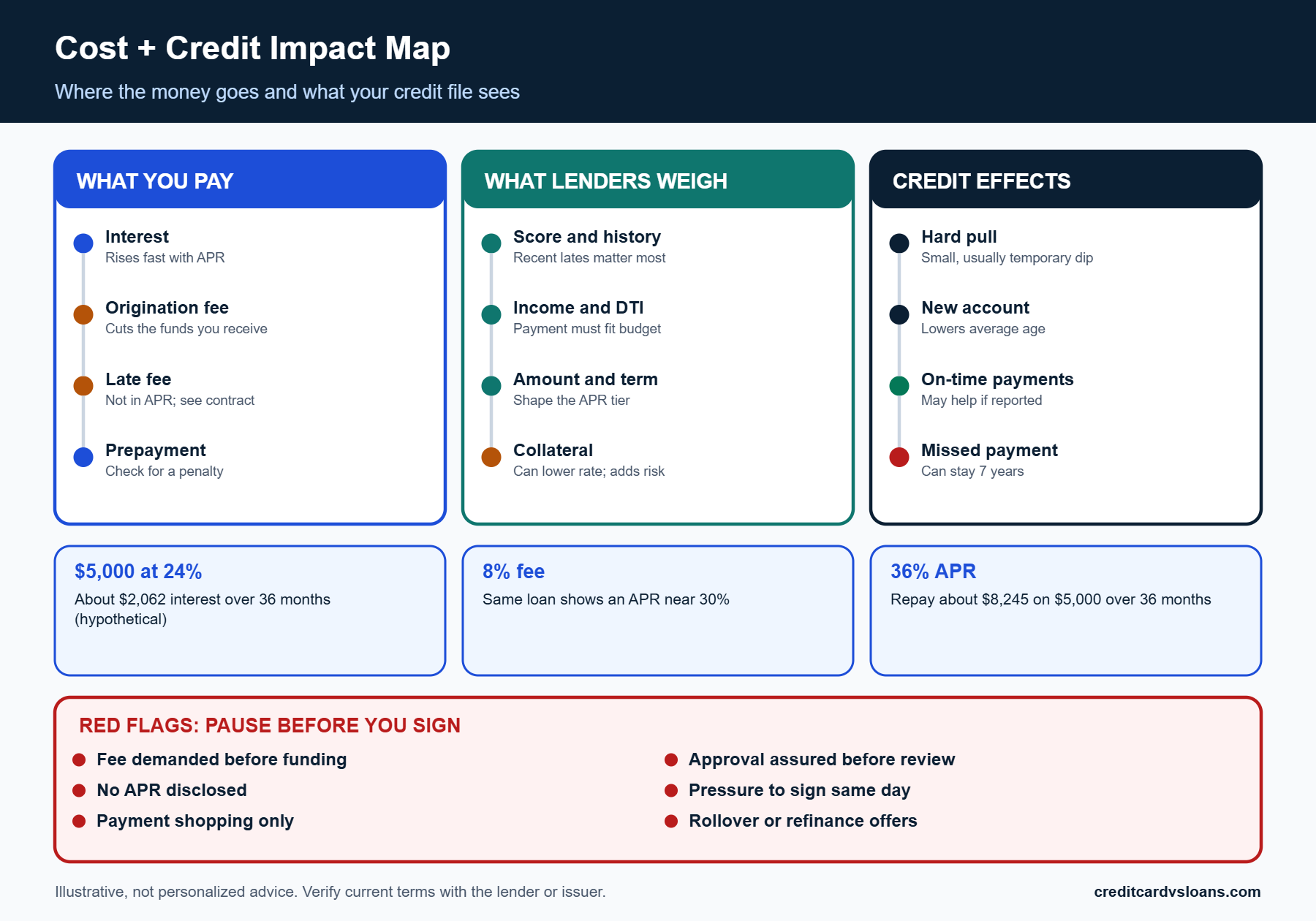
Fees are where a quoted rate and the real cost drift apart. Take the same hypothetical $5,000 loan at a 24% interest rate for 36 months with an 8% origination fee deducted from the proceeds. You receive $4,600, you still make payments of about $196.16 on the full $5,000, and the effective APR works out to roughly 30.35% rather than 24%.
The dollar cost is about $2,461.91, which is the $2,061.91 in interest plus the $400 fee. A lender may present the 24% as the headline number, but the APR is the figure that captures the fee, which is why Regulation Z requires it to be disclosed.
Other charges to look for in the contract
Late fees, returned-payment fees, and fees for paying by phone or by certain methods all vary by lender and state. Regulation Z treats an actual late fee as outside the finance charge, so it will not show up in the APR, which means you have to find it in the fee section of the agreement.
Also look for a prepayment penalty, which some loans charge if you pay off early, and for any mandatory add-ons such as credit insurance or debt-cancellation products. Add-ons can raise the finance charge and may be optional, so read the disclosure and say no to extras you did not ask for.
How a Bad Credit Personal Loan Can Affect Your Credit
Short-Term Effects
Hard pull and a new account
Applying for the loan usually triggers a hard pull, and a new account lowers the average age of your accounts. Both can cause a small, usually temporary dip in some scores, and new credit makes up about 10% of a FICO Score.
How large the dip is depends on your file. People with long, clean histories often see small changes, while people with thin files may see a bigger swing because one new item is a larger share of the data. No one can promise the size of the change in advance.
Utilization and credit mix
If you use the loan to pay off credit card balances, your revolving utilization (the share of card limits you are using) can fall, and scoring models often view lower utilization favorably. The trade-off is that the cards then have room to be run up again, which can leave you with the loan payment and new card debt.
An installment loan can also add to credit mix, but mix is only about 10% of a FICO Score, so it is rarely a good reason to borrow. If consolidation is your goal, read when a debt consolidation loan can save money before you decide.
Long-Term Effects
On-time payments over time
Because payment history is the largest scoring category, steady on-time payments on the loan can help your credit profile over time if the lender reports to the bureaus. Ask whether the lender reports to all three nationwide credit bureaus, since a lender that reports to none gives you no credit benefit for good behavior.
That benefit is a possibility, not a promise. The effect depends on the rest of your file and on the scoring model, and a loan is a costly way to build credit when a secured card or credit-builder product may cost less.
What a missed payment can do
The downside is sharper than the upside. A payment that is reported 30 or more days late is a negative mark that can stay on your report for seven years, according to the CFPB, and it can lower your score and your chances of lower rates later.
Lenders may also charge late fees, send the account to collections, or sue after a long period of non-payment. If you think a payment may be at risk, contact the lender before the due date, because options narrow once an account is delinquent.
Risks and Red Flags to Avoid
Scams and Look-Alike Products
Upfront fees and assured approval
The Federal Trade Commission (FTC) has long warned about advance-fee loan scams that target people with poor credit. Typical signs include a demand for payment before any money is delivered, a promise of approval regardless of credit history, and requests for bank account details or a Social Security number from a company you do not know.
The FTC notes that it is illegal for telemarketers to require payment before a promised loan or credit is delivered, and that legitimate lenders do not promise approval before you apply. If a company asks for a fee, a gift card or a wire transfer to release a loan, stop and report it to the FTC and your state attorney general.
Payday and title loans dressed up as personal loans
Short-term payday loans are a different and often far costlier product. The CFPB says lenders typically charge $10 to $30 per $100 borrowed, and that $15 per $100 on a two-week loan works out to an APR of almost 400 percent. Rolling the loan over adds another fee while the original amount is still owed.
If an offer is due in a lump sum in a couple of weeks, involves access to your bank account through a postdated check or electronic withdrawal, or is secured by your car title, you are looking at a different category of risk than a fixed-payment installment loan. Compare it with the options in the next section first.
Contract Traps
Payment-only shopping and refinance loops
The most common trap is shopping by monthly payment. A lender can lower the payment by stretching the term, which hides a higher total cost, or by rolling an old loan into a new one with another fee. Each refinance can add an origination fee on money you have already been paying interest on.
Ask for the amount financed, the finance charge, the APR and the total of payments in writing, and compare those across lenders. If you cannot get those numbers before you commit, treat that as a reason to walk away.
Collateral, co-signers and automatic payments
Secured loans can offer lower rates, but you may lose the collateral if you default. A co-signer or co-borrower can improve your terms, but the co-signer is legally responsible for the debt, and a missed payment affects their credit too. Be honest with anyone you ask about those stakes.
Automatic payments from your bank account are convenient and can protect against missed due dates, but a low balance can trigger overdraft or returned-payment fees on top of the loan’s late fee. Set the draft date a few days after payday and keep a small buffer.
Walk away if a lender asks for a fee before the loan is funded, will not disclose the APR before you commit, pressures you to sign the same day, or refuses to put the total of payments in writing.
Safer Options to Compare Before You Borrow
Lower-Cost Lenders and Structures
Credit union payday alternative loans
Federal credit unions can offer payday alternative loans, or PALs, under National Credit Union Administration (NCUA) rules. A PALs I loan runs from $200 to $1,000 for one to six months, and a PALs II loan can be up to $2,000 for one to 12 months. The application fee is capped at $20, the loan must be fully amortized, and rollovers are generally not allowed.
The rate can be up to 10 percentage points above the NCUA Board’s ceiling. NCUA extended an 18% ceiling for most federal credit union loans through September 10, 2027, so the PAL ceiling works out to 28%, which is still high but far below the near-400% APR that a typical two-week payday loan implies. You generally need to be a credit union member, and PALs I requires at least one month of membership. Terms at state-chartered credit unions can differ.
Secured loans, co-borrowers and smaller amounts
A loan secured by a savings balance, sometimes called a share-secured loan, can carry a lower rate because the lender holds the collateral. The catch is that the money is tied up, and you could lose it if you stop paying. A co-borrower with stronger credit may also improve the rate, but that person shares full legal responsibility.
Borrowing less is the simplest lever. If you can cover part of the cost from savings or by negotiating a payment plan, the smaller loan carries less interest and a smaller fee. Ask each lender whether a lower amount or shorter term changes your APR tier.
| Option | How it works | Cost points to check | Trade-off |
|---|---|---|---|
| Credit union PAL | Small installment loan from a federal credit union, $200 to $2,000 | APR ceiling of 28% as of the NCUA ceiling through Sept. 10, 2027; application fee up to $20 | Membership needed; small amounts only |
| Share-secured loan | Loan backed by your own savings at the lender | Rate, and whether the deposit keeps earning interest | Funds are locked until repayment |
| Co-borrower loan | Another person with stronger credit joins the loan | Rate improvement versus your own offer | Co-borrower is fully liable |
| Hardship plan with a current creditor | Lower payment, waived fees or a payment pause | Whether interest still accrues; credit reporting | Not always offered |
| Nonprofit credit counseling | Budget review and possible debt management plan | Written fee quote for setup and monthly fees | Plans can last four years or more and may limit new credit |
Ways to Avoid or Reduce the Borrowing
Talk to the creditor you already owe
If the problem is a bill you cannot pay on time, contact that creditor before taking on a new loan. The CFPB advises asking for an extended repayment plan, which spreads payments into smaller installments over a longer period, and says a credit counselor or legal aid attorney can help if no plan is offered. Lenders may also waive some fees or adjust payments.
Whether you can get a plan depends on the lender and, in some cases, state law, and a plan may carry a fee, so check the cost in writing. Even so, it often beats paying a new lender’s origination fee to cover the same bill.
Nonprofit credit counseling and what to ask
The FTC says reputable credit counselors review your whole financial picture and, if appropriate, set up a debt management plan in which you make one monthly deposit and the organization pays your unsecured creditors. Creditors may lower interest rates or waive fees, but you should confirm that with each one.
Nonprofit status does not guarantee low fees. Ask for a specific fee quote in writing, avoid anyone who offers only a plan before reviewing your finances, and be wary of anyone who promises to remove accurate negative items from your credit report, which cannot lawfully be done. Under the Telemarketing Sales Rule, debt relief sellers cannot charge before they deliver results.
Four Hypothetical Borrowers: How the Math Plays Out
Smaller Needs
A $1,500 repair bill
Consider a hypothetical borrower who needs $1,500 for a car repair. A credit union PALs II loan at the 28% ceiling over 12 months would have a payment of about $144.76 and interest of about $237.11, plus an application fee of up to $20. A $1,500 loan at 36% over 24 months has a lower payment of about $88.57, but interest of about $625.71, more than two and a half times as much.
The lower monthly payment is the attraction, and it is also the trap. If the budget can handle $144.76 for a year, the shorter loan costs far less. If it cannot, the answer may be a payment arrangement with the repair shop or another creditor rather than the longer, costlier loan.
A $3,000 expense and the term trap
Take a hypothetical $3,000 loan at 24%. Over 24 months the payment is about $158.61 and total interest is about $806.72. Stretched to 48 months, the payment falls to about $97.81 but interest climbs to about $1,694.66, more than double. The extra $61 a month of relief costs about $888 in additional interest.
Sometimes the longer term is the only way to keep the payment affordable, and that is a legitimate choice. The point is to make it on purpose, with the total cost in view, and to check whether prepayment is penalty-free so you can pay it down faster when money allows.
Larger Needs
A $12,000 consolidation attempt
Suppose a hypothetical borrower wants to consolidate $12,000 of debt. At 22% over 36 months the payment is about $458.29 and interest about $4,498.28. At 30% over 48 months the payment is about $432.07, which looks like relief, but interest rises to about $8,739.45. The lower payment hides about $4,241 in extra interest.
Whether consolidation helps depends on the APR you pay now compared with the new one, the fee, and whether you will stop adding to the old balances. Our guide on using a personal loan for debt consolidation walks through that comparison in detail.
When no offer beats what you have
If every quote has an APR at or above your current debt, a new loan will not lower your cost, and it may add an origination fee and a hard pull. In that case a hardship plan, a payment arrangement or nonprofit credit counseling may do more good than a new loan.
It also helps to know your own line. Many borrowers set a limit for total repayment, for example no more than a fixed multiple of the amount borrowed, and decline any offer above it. A rule like that keeps urgency from making the choice for you.
How to Compare Bad Credit Offers Apples-to-Apples
Read the Loan Disclosure Line by Line
The four numbers that matter
For closed-end loans, federal rules require the lender to disclose the amount financed, the finance charge, the APR and the total of payments, along with the payment schedule and any late-payment charge. The amount financed is the credit you actually receive after prepaid finance charges; the finance charge is the dollar cost of the credit; the total of payments is everything you will have paid if you make every scheduled payment.
Put those four numbers for each offer into a simple list. If the amount financed is lower than the amount you asked for, a fee was taken out. If the total of payments is much higher than the amount financed, you can see the real price in dollars.
Funding, reporting and prepayment terms
Beyond the cost, check the funding timeline, whether the lender reports payments to the credit bureaus, whether you can change the due date, and whether paying early is penalty-free. If you can afford to pay extra later, a loan without a prepayment penalty gives you a way to cut interest.
For a fuller checklist, including term and funding differences, use the personal loan requirements guide to understand what each lender asks for and compare quotes the same day, so rate changes do not skew your comparison.
A Repeatable Comparison Routine
Get three quotes on the same terms
Request quotes for the same amount and the same term from at least three sources, ideally including a credit union and an online lender, all through soft-pull prequalification. Note the APR range each lender shows and what could move you to the top or bottom of that range.
Then ask for the official disclosure on any offer you are seriously considering. A prequalified rate is an estimate. The disclosure you receive before signing is the number that matters.
Set walk-away rules before you apply
Decide in advance what would make you decline: for example, an APR above a limit you set, a total repayment that exceeds a share of your income, or a fee deducted from proceeds that leaves you short of the amount you need. Rules written ahead of time are harder to talk yourself out of in the moment.
If every offer fails your rules, that is useful information, not a failure. It may mean waiting, borrowing less, or using one of the options above is the cost-saving move.
Decision Checklist and Next Steps
Match Your Situation to a Path
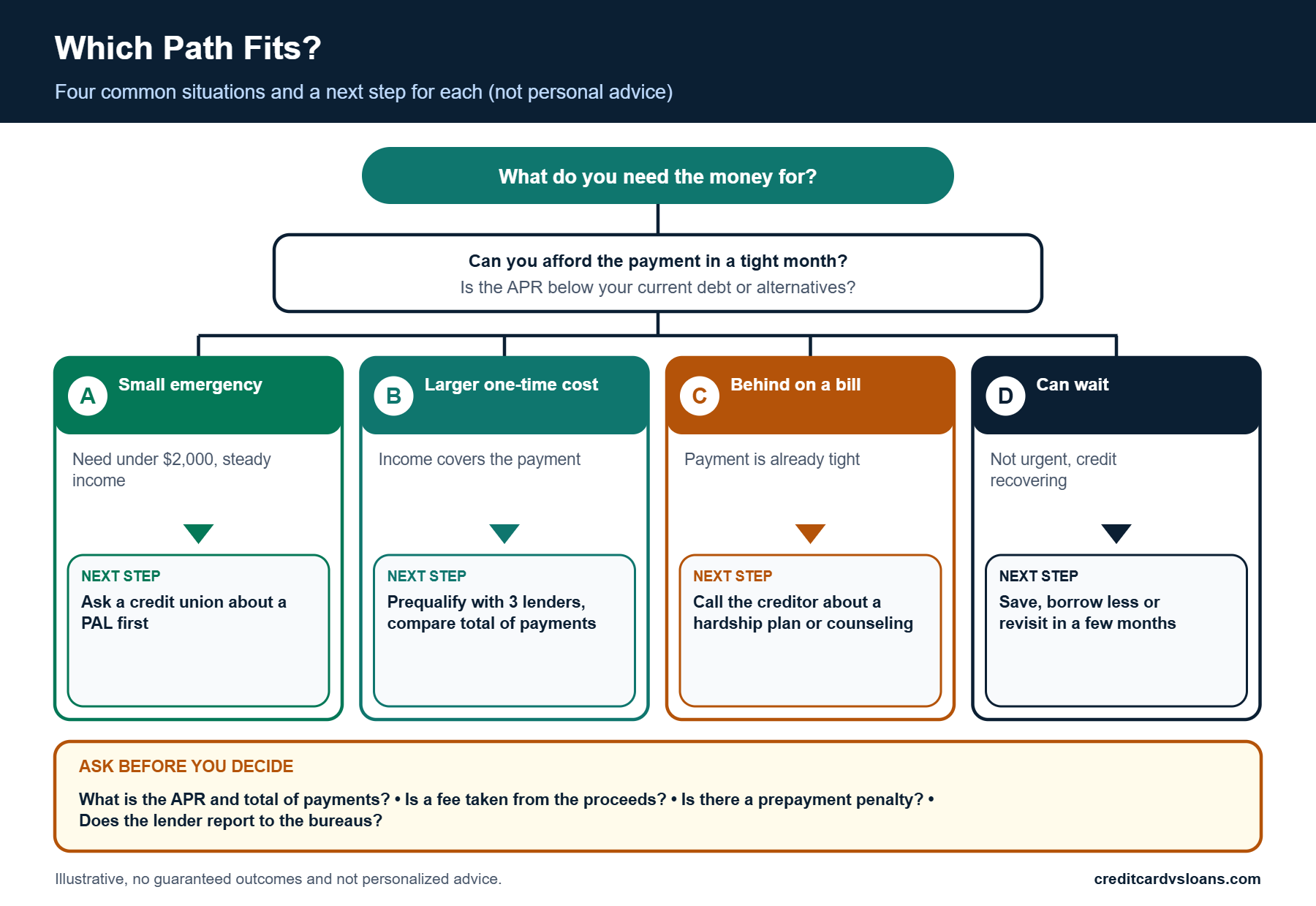
A decision matrix for common situations
The matrix below shows which option may be worth investigating first in several common situations. It is a framework for thinking, not personal advice, and your own finances may point somewhere else.
| Borrower scenario | Option to investigate | Why | What to check | When to avoid |
|---|---|---|---|---|
| Small emergency expense under $2,000 | Credit union PAL | Capped fee and rate, structured repayment | Membership rules, funding speed | If you cannot make the monthly payment |
| Larger one-time expense, steady income | Prequalified installment loan from several lenders | Fixed payments and a clear end date | APR, fee, total of payments | If the APR makes total repayment unaffordable |
| Behind on an existing bill | Hardship plan or payment arrangement | May avoid new fees and a hard pull | Interest, credit reporting, written terms | If the plan costs more than it saves |
| Several credit card balances | Consolidation only if the APR is lower | One payment, possibly less interest | Fee effect on the APR, new card spending | If the card balances will grow again |
| Spending that can wait | Save first or borrow less | Avoids interest entirely | Time pressure is the lender’s, not yours | If delay creates a real cost |
When waiting is the better move
If the need is not urgent and your credit is recovering from a recent event, waiting several months while you make on-time payments can change the offers you see. Even a modest improvement can move you into a lower pricing tier at some lenders, though no outcome is certain.
Waiting is also wise when every quote has an APR you would not choose if you had other options. A hard no from your own rules is a legitimate answer.
Your Next-Step List
Before you apply
- Write down exactly how much you need and by when, and whether a smaller amount would work.
- Check your credit reports for errors and see which items are driving the problem.
- Prequalify with at least three lenders, including a credit union, and keep the same amount and term.
- Collect the amount financed, finance charge, APR and total of payments for each offer.
- Confirm the fee, how it is paid, the late-payment charge, and any prepayment penalty.
- Test the monthly payment against your budget for a tight month, not an average one.
- Decline any offer that asks for payment before funding or promises approval without review.
If you already have a loan you cannot afford
Contact the lender before you miss a payment and ask what hardship, extension or payment-date options exist. Get any agreement in writing, and check whether interest keeps accruing and how the account will be reported. A nonprofit credit counselor can help you decide whether a plan fits.
The bottom line: personal loans for bad credit can be a legitimate tool for a one-time, necessary expense when the APR, fee and total repayment fit your budget, but they are rarely the first place to look. Compare a credit union loan, a secured option, and a conversation with your current creditors first, and treat any offer that hides its total cost as a no. Personal loan rates explains what moves an APR, and rate shopping and your credit explains how to compare offers without piling up inquiries.
Short Answers to Common Questions
Will a bad credit personal loan raise my score?
It might help over time if you pay on time and the lender reports to the credit bureaus, but no lender or article can promise a score change. The hard pull and new account can cause a small dip at first, and one late payment can undo months of progress. If your main goal is to build credit, compare a secured card or credit-builder product, which may cost less than interest on a loan.
If the goal is to fund a specific need, judge the loan on its cost and fit for that need, and treat any credit benefit as a bonus rather than the reason to borrow.
What about loans with no credit check?
Offers that advertise no credit check are worth extra caution. Some are payday or title loans, whose costs the CFPB describes as very high, and some are outright scams. A lender that skips the credit check may still verify income and bank access, and it usually prices the risk into a steep APR or fees.
Ask for the APR, the total of payments and the due dates in writing. If the lender will not provide them, or asks for an upfront fee to release the money, step away.
What Happens If the Payments Stop Fitting
Can a lender take money from my paycheck?
For an unsecured personal loan, the FTC explains that a debt collector generally must sue and win a court order before taking money from your paycheck or bank account, and many federal benefits are generally protected from garnishment. State rules differ, and a secured loan can allow the lender to take the collateral under the contract.
If you are sued, respond by the deadline in the court papers. Ignoring a lawsuit can cost you the chance to contest the claim. Your state attorney general or a legal aid office can explain local rules.
Where can I get help or report a problem?
You can file a complaint about a lender with the CFPB, call (855) 411-2372, or contact your state attorney general or banking regulator. Servicemembers can also reach out to a Judge Advocate General (JAG) legal assistance office. Nonprofit credit counselors and legal aid attorneys can explain your options if you are already behind.
Acting early gives you more choices. Lenders can often do more before an account is seriously delinquent than after it goes to collections.
- CFPB: What is the difference between a loan interest rate and the APR?
- eCFR: 12 CFR 1026.4 Finance charge
- eCFR: 12 CFR 1026.18 Content of disclosures
- Federal Reserve: G.19 Consumer Credit, release of October 7, 2026
- eCFR: 12 CFR 701.21 Loans to members and lines of credit to members (payday alternative loans)
- NCUA: NCUA Board extends loan interest rate ceiling
- CFPB: What are the costs and fees for a payday loan?
- CFPB: What can I do if I cannot repay my payday loan?
- CFPB: How long does negative information stay on my credit report?
- FTC: FTC and States Launch Another Crackdown on Advance Fee Loan Scams
- FTC: Fiscal Fitness: Choosing a Credit Counselor
- myFICO: What is in your credit score
Last updated: October 22, 2026. Rates, fees and lender rules change; verify current terms before acting.
The information on creditcardvsloans.com is provided for general educational and informational purposes only. It is not financial, legal, tax, credit, accounting or investment advice, and reading it does not create an advisor-client, fiduciary or any other professional relationship. Nothing here is an offer, solicitation or recommendation to borrow, lend or apply for any product.
Credit scores, interest rates, fees, eligibility rules, lender policies and laws change frequently and vary by lender, location and individual circumstances. Examples, figures and scenarios are illustrative only, do not predict your results and do not guarantee approval, savings, a particular rate or a credit-score outcome. Always confirm current terms directly with the lender or issuer and read the full agreement before you apply or sign.
Although we aim for accuracy and use reputable sources, we make no representations or warranties, express or implied, about the completeness, accuracy, reliability or timeliness of the content. Content may be drafted with the assistance of automated tools, so errors or omissions may still occur. Links to third-party sites are provided for convenience; we don’t control and aren’t responsible for their content.
To the fullest extent permitted by law, creditcardvsloans.com and its owners, editors, authors, contributors and affiliates disclaim all liability for any loss, damage or expense arising directly or indirectly from your use of, or reliance on, this content. Before making financial decisions, consult a licensed professional, such as a qualified financial advisor, attorney, tax professional or nonprofit credit counselor, who can consider your complete situation.