A personal loan for debt consolidation can save money when its interest plus fees come in clearly below what your existing debts would cost at the same monthly payment, and the break-even point is easy to find with a few numbers: your current rates, the loan’s rate, its fee and its term. This guide focuses on that math, so you can see how far a loan’s rate can rise or how large its fee can get before the savings disappear.
The idea is different from simply asking whether a loan is a good idea. A loan can be a sensible product and still be the wrong one for your particular debts. Break-even thinking replaces that vague judgment with a number: at what rate, fee and term does this loan stop beating what I have now?
All dollar figures below are hypothetical and computed with standard amortization math. Market figures come from the Federal Reserve and carry a date stamp. Lender offers vary, so treat the examples as a way to learn the logic, then apply it to the offers you actually receive.
- Savings come from three levers: the gap between your current rates and the loan rate, the size of any fee and the length of the term.
- Compare the loan and your current debts at the same monthly payment; otherwise the result mostly reflects who is paying more per month.
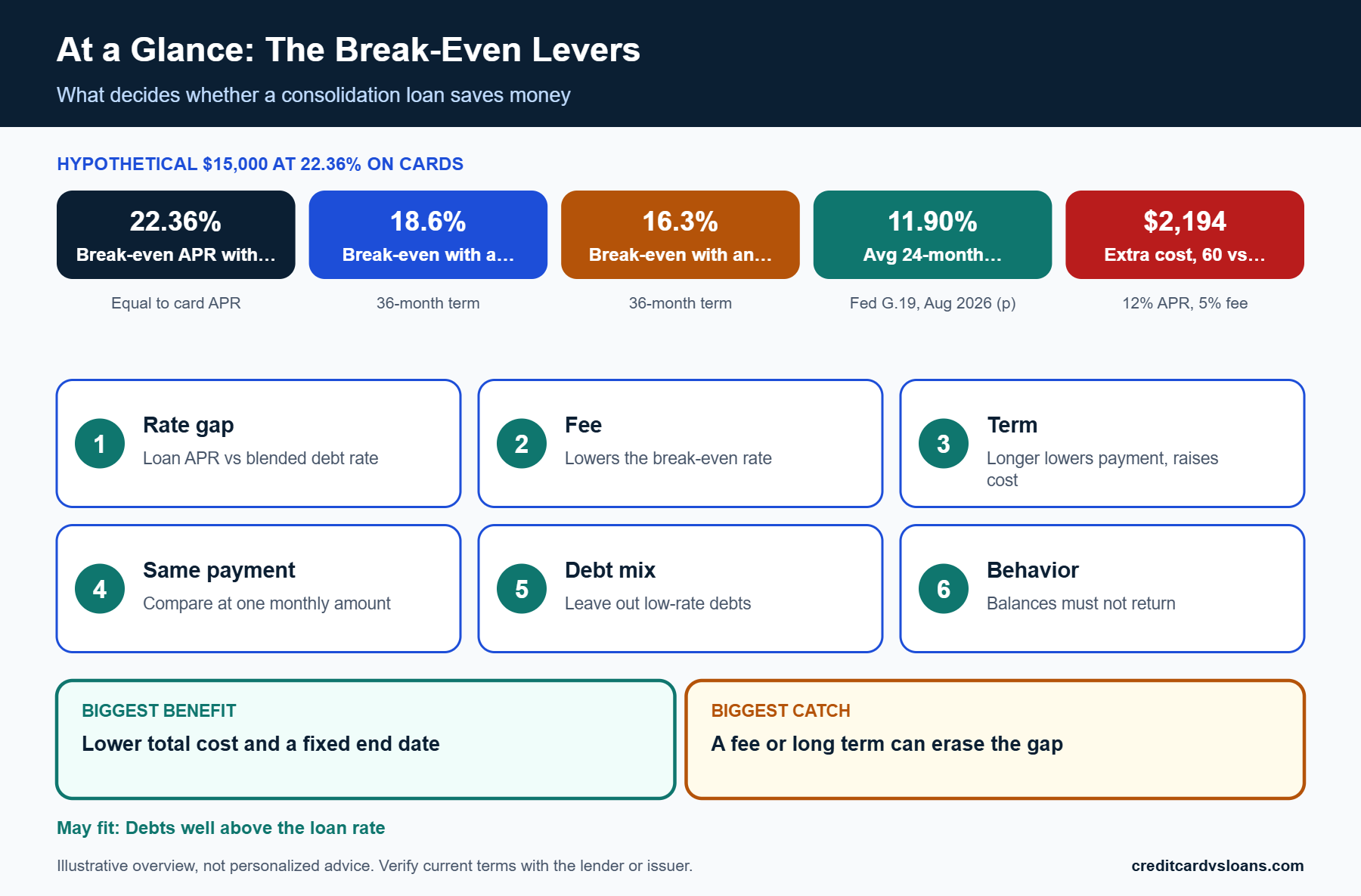
- In our example, a 5% fee on a 36-month loan moves the break-even loan rate from about 22.4% down to about 18.6%.
- Stretching the term can cut the payment while raising the total cost sharply, so a lower payment is not proof of savings.
- Low-rate debts often do not belong in a consolidation loan, because folding them in can raise their cost.
Market figures are from the Federal Reserve’s G.19 consumer credit release of October 7, 2026, which reports commercial bank rates through August 2026 (preliminary). Treat every rate and fee in the examples as an assumption, and confirm the terms in your own offer.
Personal Loan for Debt Consolidation: The Break-Even Idea in Plain Terms
What “saving money” actually means
Totals at the same payment
A fair comparison asks two questions: what would my current debts cost in total if I kept paying a certain amount each month, and what would the loan cost if I made that same payment? The difference is the savings. It sounds obvious, but it is easy to get wrong, because a loan with a higher payment clears debt faster, and some of its apparent advantage comes from the larger payment rather than from a better rate.
The cleanest approach is to set the payment equal in both columns. In this guide, the comparison always uses the loan’s payment as the payment on the existing debts. If you want the broader decision framework, see our guide on whether to use a personal loan to pay off credit cards.
Three levers decide the result
The loan’s savings depend on the rate gap, the fee and the term. A bigger gap between what you pay now and the loan rate raises savings. A larger origination fee lowers them, because you pay it up front and borrow more. A longer term lowers the payment but raises the total interest, so it can eat savings even when the rate is good.
Table 1 summarizes how each lever works and what to look for in an offer.
| Lever | Helps when | Hurts when | What to check |
|---|---|---|---|
| Rate gap | Loan APR is well below your debt rates | Loan APR is near or above your rates | Blended rate of the debts you would pay off |
| Origination fee | Zero or small | Large, taken from proceeds | Whether the fee reduces the money you receive |
| Term | Short enough to limit interest | Stretched to lower the payment | Total cost at two or three terms |
| Payment size | Affordable and fixed | So low that it extends the debt | Payment relative to your budget |
Which debts belong in the loan
Include the expensive ones
Credit cards are the usual targets because their rates tend to be high. As of the Federal Reserve’s G.19 release of October 7, 2026, the average rate on credit card accounts assessed interest was 22.36% in August 2026 (preliminary), while the average 24-month personal loan rate was 11.90%. Those are averages, not offers, but the gap is where the savings come from. Store cards and other high-rate balances can also be good candidates.
Work out the rate on each debt and rank them. The ones above the loan’s effective rate are the ones the loan can improve.
Think twice about the rest
If a debt carries a rate below the loan’s effective rate, paying it with the loan raises its cost. A low-rate car loan or a federal student loan generally should stay out of a consolidation loan unless there is a reason beyond the rate. The FTC notes that federal student loans come with free repayment and forgiveness programs through StudentAid.gov, which a private loan would not replicate.
Also be cautious about secured debt. The FTC warns that consolidation loans secured by your home put the home at risk if you fall behind, and that fees and points can make them expensive.
How Personal Loans for Debt Consolidation Are Priced
Rate, APR and fees
The stated rate versus the effective cost
A loan’s stated rate is only part of its price. When an origination fee is deducted from the proceeds, you pay interest on money you never receive. In our example, a 36-month loan with a 12% stated rate and a 5% fee has an effective borrowing cost of about 15.6% on the net proceeds. At 3% the effective cost is about 14.1%, and at 8% it is about 17.9%.
Over a longer term the fee matters less per year but still adds up in dollars. On a 60-month loan at 12%, the same 5% fee has an effective cost of about 14.3%. Comparing offers on effective cost, or on total dollars paid, keeps the fee from hiding in a footnote. Our guide on the credit score you need for a personal loan explains how profile affects the rate you are quoted.
What the Federal Reserve numbers tell you and what they do not
The Fed’s figures are averages across banks and borrowers, and the personal loan figure refers to 24-month loans. They show that loan rates have been lower than card rates, which is the premise of consolidation. They do not tell you what you will be quoted, and they do not include fees.
Use them as a sanity check: if an offer is far above the average loan rate, ask why, and make sure the savings still hold after the fee.
What changes your price
Profile, income and existing debts
Lenders typically look at your credit report, income and employment and monthly debt obligations. FICO’s published weights show payment history at 35% and amounts owed at 30% of a FICO Score, so recent late payments and high card utilization both affect the offers you may see. Each lender sets its own cutoffs, which is why quotes differ.
Prequalification tools that use soft pulls let you see estimated rates without a hard inquiry. Use them across several lenders, then apply where the numbers look best.
Secured versus unsecured
Most consolidation loans advertised to card borrowers are unsecured. Secured loans, which use a home or car as collateral, often have lower rates and much higher stakes. The CFPB cautions that borrowing against your home can lower your rate but puts the home at risk, can involve high closing costs and may leave less equity for emergencies.
For this guide, all examples are unsecured. If a secured option is on the table, treat the risk as part of the price.
The Break-Even Math Behind a Personal Loan for Debt Consolidation
Break-even rate with and without a fee
How to read a break-even rate
The break-even rate is the loan APR at which the loan’s total cost, interest plus fees, equals what your cards would cost at the same monthly payment. Below it, the loan saves money; above it, the cards win. Take a hypothetical $15,000 in card debt at the Federal Reserve’s 22.36% average and assume the loan pays at 36 months. With no fee, the break-even loan rate is simply the card rate, 22.36%, because the payment and the rate line up exactly.
Add a fee and the break-even falls. With a 3% fee it is about 20.1%; with a 5% fee, about 18.6%; with an 8% fee, about 16.3%. In other words, an 8% fee costs you roughly six points of rate at a 36-month term. Table 2 shows the full set for 36 and 60 months.
| Origination fee | Break-even APR, 36-month loan | Break-even APR, 60-month loan | Reading |
|---|---|---|---|
| 0% | 22.36% | 22.36% | Loan wins at any lower rate |
| 3% | About 20.1% | About 20.9% | Modest fee, modest cushion lost |
| 5% | About 18.6% | About 19.9% | Rate must be clearly below the cards |
| 8% | About 16.3% | About 18.4% | Fee consumes most of the advantage |
Savings at different loan rates
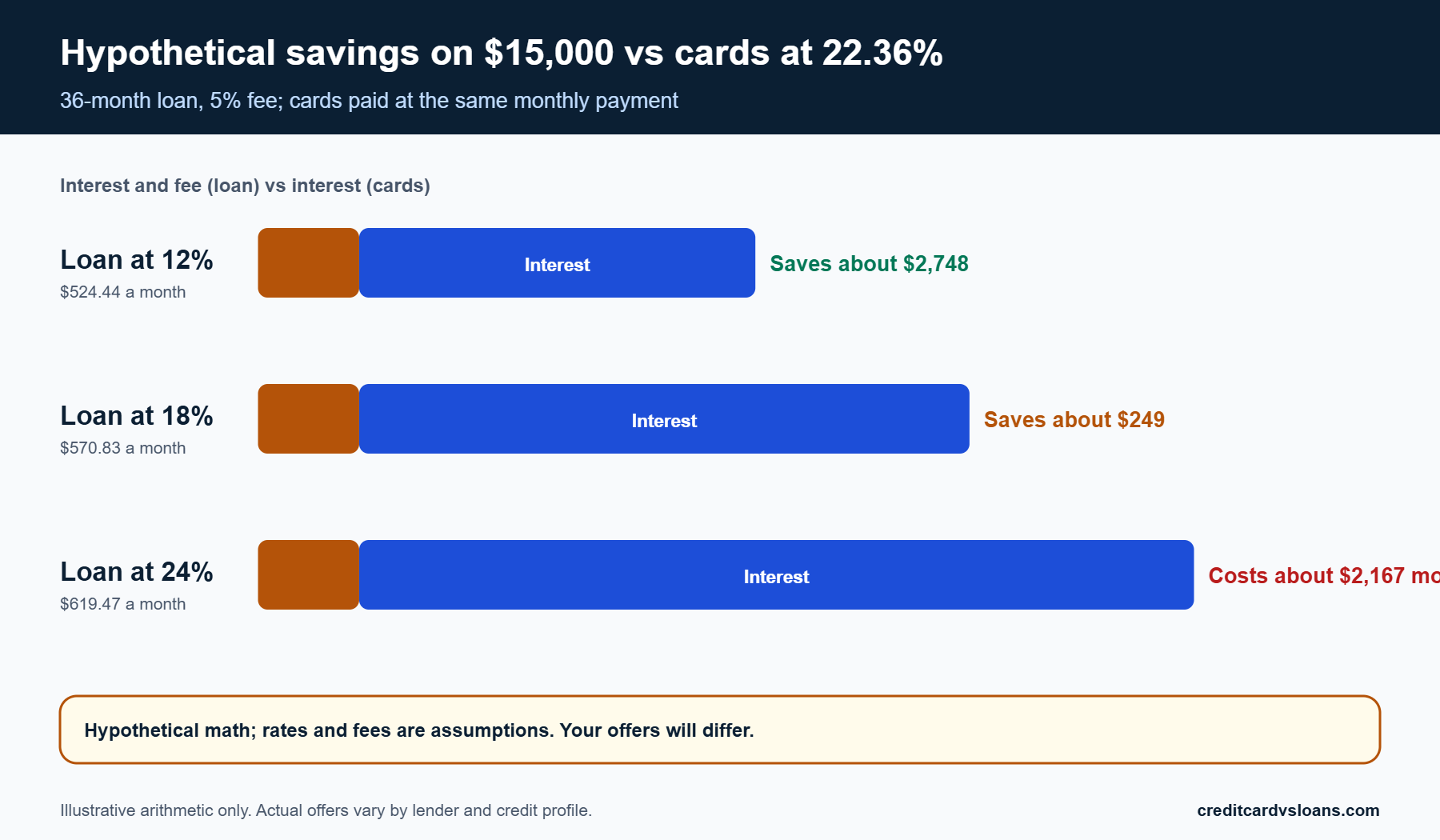
Table 3 fixes the fee at 5% and the term at 36 months, then varies the loan APR. For each rate, the monthly payment becomes the payment on the cards, and the table compares total costs. Interest and fee are combined for the loan.
| Loan APR | Monthly payment | Loan interest plus fee | Cards at that payment | Savings (loss) |
|---|---|---|---|---|
| 9% | $502.10 | $3,076 | 45 months, $7,123 | $4,047 |
| 12% | $524.44 | $3,880 | 42 months, $6,627 | $2,748 |
| 15% | $547.35 | $4,705 | 39 months, $6,189 | $1,485 |
| 18% | $570.83 | $5,550 | 37 months, $5,799 | $249 |
| 21% | $594.87 | $6,415 | 35 months, $5,449 | ($966) |
| 24% | $619.47 | $7,301 | 33 months, $5,134 | ($2,167) |
| 28% | $653.11 | $8,512 | 31 months, $4,760 | ($3,752) |
The savings fall by roughly $1,200 to $1,300 for every three points of loan APR in this range, and they turn negative between 18% and 21%. That crossover is the break-even in Table 2, seen from another angle. A rate that sounds good in isolation, say 21% against a 22% card, can still cost more once the fee is counted.
Where the savings come from
Rate savings and discipline savings
It helps to separate two things. Part of any savings is rate savings: you pay less interest per dollar of balance. The rest is structure: a fixed payment and a fixed end date can make you pay off the debt on schedule, where a card’s flexible minimum may let it drift. Break-even math captures only the first part, and only when payments are equal.
That is why a loan can feel helpful even when the arithmetic is close. If the structure keeps you on track, the loan is doing real work. If you would pay the same amount to the cards without it, it is not.
What the baseline should be
Your baseline is whatever you would actually do without the loan, not the minimum payment. If you currently pay $400 a month, the baseline is $400, and a loan with a $524 payment is comparing different commitments. Run the comparison at the loan’s payment, as above, and also at your current payment, since the second answer tells you whether you can afford the loan at all.
Both views matter. A loan that saves money at the same payment but requires a higher payment than your budget supports is not a plan. For the card-versus-card alternative, see our comparison of a balance transfer card and a personal loan.
When a Personal Loan for Debt Consolidation Stops Saving Money
Stretching the term
The payment drops, the cost rises
Take the same $15,000 at a 12% rate with a 5% fee. Table 4 shows how the term alters the payment and the cost. The fee is the same $789 at each term.
| Term | Monthly payment | Origination fee | Interest | Interest plus fee |
|---|---|---|---|---|
| 24 months | $743.27 | $789 | $2,049 | $2,838 |
| 36 months | $524.44 | $789 | $3,090 | $3,880 |
| 60 months | $351.23 | $789 | $5,284 | $6,074 |
Moving from 36 to 60 months cuts the payment by about $173 but adds roughly $2,194 in cost. Whether that is worth it depends on your cash flow. If the longer term is what keeps you current on every bill, it may be worth the price. If it is simply more comfortable, you are paying for comfort.
Prepaying to claw the savings back
Some borrowers take a longer term for flexibility and then pay extra when they can. That works only if the loan has no prepayment penalty and applies extra payments to principal. Even then, the fee is already paid and does not come back. At 12% and a 60-month term, paying $524 a month instead of $351 brings the payoff close to the 36-month schedule, but the fee has not shrunk.
Ask the lender about prepayment before you sign. A loan that lets you choose your pace is more valuable than one with the same rate that locks you into a long schedule.
Debts that should not ride along
Low-rate balances
Suppose $5,000 of your $15,000 sits on a card at 6% promotional or a loan at 6%. Folding it into a loan at an effective 14% raises its cost, and the savings on the other $10,000 have to pay for that. Run the break-even on the debts you would actually include, using their blended rate, not the whole stack.
The same logic applies to any debt with special terms, such as a deferred-interest period, a hardship rate or a federal program with built-in protections.
Debts you cannot easily replace
The FTC notes that federal student loans have free repayment and forgiveness programs. A private consolidation loan would not carry these. Consolidating those debts into a personal loan means giving up protections, and the savings in interest may not be worth it.
If you are unsure, ask the servicer what you would lose, or talk to a nonprofit counselor. The decision is not reversible once the loan funds.
Credit Score and Cash Flow Effects of a Personal Loan for Debt Consolidation
What can happen to the score
Inquiry, new account and utilization
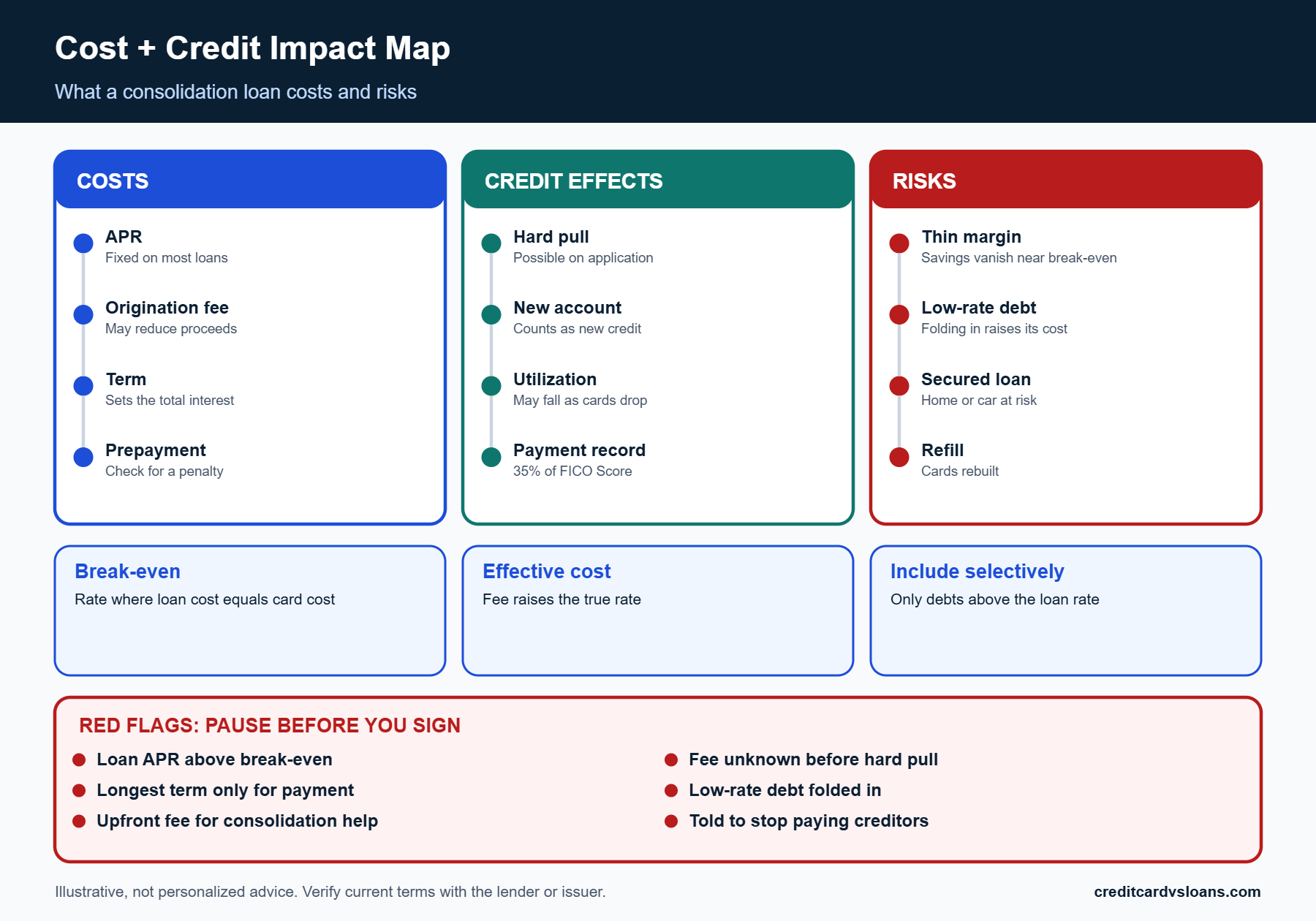
A full application can add a hard inquiry, and the new account counts as new credit, which carries 10% of a FICO Score. FICO counts inquiries from the past 12 months. At the same time, paying card balances down can lower revolving utilization, and amounts owed carries 30% of the score. The net effect differs from person to person, and nobody can promise a particular change.
The practical point is timing. If you plan to apply for a mortgage or auto loan soon, ask yourself whether a new account now helps or complicates that application.
On-time payments over the long run
Payment history is the largest FICO factor at 35%. A consolidation loan that you pay on time builds that record month after month. A single missed payment on a fixed-term loan can damage it. Autopay at the required amount, with a small cushion in the account, is a cheap safeguard.
Keep the old cards open if you can resist using them. That preserves account age and available credit, both of which support a healthier profile.
Cash flow and debt load
Compare the new payment with what you pay now
List your current monthly minimums on the debts you plan to pay off, then compare their total with the loan payment. If the loan payment is higher, you are committing more cash each month, which may shorten the payoff but could strain your budget. If it is lower, find out why: a lower rate, a longer term, or both.
Whichever way it goes, the loan payment is fixed, while the minimums on cards fall as balances fall. That difference matters if your income varies.
Lenders also look at how a new payment fits with your income, often described as a debt-to-income ratio. A consolidation loan can improve that picture if it lowers your total monthly obligations, and worsen it if it raises them. If a big application, such as a mortgage, is coming, ask the lender how it will view the new loan so that the savings you gain here do not cost you there.
Keep an emergency cushion
If every spare dollar goes to the loan and you have no savings, an unexpected bill will end up on a card. A small cash cushion protects the plan. The CFPB’s advice to look at why you are in debt applies: consolidation helps most when the budget has room, and it does not address overspending.
Set a modest savings target alongside the loan payment, even a small automatic transfer, and increase it as you gain breathing room.
Alternatives and Hybrids to Weigh Against a Personal Loan
Cards and loans together
A 0% transfer for part of the balance
If you qualify for a transfer card with a promotional period, you can move what the limit allows and use a loan for the rest. The CFPB lists the main risks of transfers: a transfer fee, a rate increase when the promotion ends and loss of a grace period on new purchases. Our guide on balance transfer fees versus interest shows when a fee is worth paying.
The hybrid works when the promotional period is long enough for the transferred part to be cleared and the loan covers the rest at a reasonable rate. It fails when the transferred balance is not cleared by the reset.
Head-to-head comparisons
For a side-by-side of the two main routes, the consolidation loan versus balance transfer guide and the transfer card versus personal loan comparison use break-even logic from different angles. Read one to calibrate the other; both assume you have actual offers to compare.
If you do not yet have offers, prequalify first. The numbers in your offers turn this entire article from theory into a decision.
Plans and negotiation
Nonprofit debt management plans
The CFPB describes credit counseling agencies as usually nonprofit, offering budgeting help and debt management plans that can lower your payments, interest and fees. The FTC notes plans often take 48 months or more and may require you to stop using credit. Ask for fees in writing and confirm that your creditors have accepted the plan before you pay the agency.
A plan can beat a loan when your profile limits loan offers to high rates, because the plan negotiates with your creditors rather than relying on a new lender’s pricing.
Asking your issuers for terms
The CFPB suggests asking creditors to lower payments, waive fees, reduce your rate or move your due date. A reduced rate on a card changes the break-even, because the loan then has to beat a lower number. Get any agreement in writing.
It costs a phone call and may change which route is cheapest, so make the call before you compare offers, not after.
A Step-by-Step Savings Check for Any Loan Offer
The sequence
Gather your inputs
For each debt you would pay off, write the balance and APR. Compute the blended rate by weighting each rate by its balance. Decide the monthly payment you would make without a loan. Then collect the loan’s APR, fee, term, monthly payment and whether the fee comes out of the proceeds.
If the lender will not state the fee before a hard pull, move to another lender. A clear fee disclosure is a basic requirement for a fair comparison.
Compare and decide
Compute what your debts would cost at the loan’s payment and compare with the loan’s interest plus fee. Check the result against the break-even tables in this guide. If the loan wins by a comfortable margin and the term is sensible, it passes. If it wins by a thin margin, weigh the structure benefit against the risk of paying fees for little gain.
Write down the margin you need before you look at offers. For some people that is a few hundred dollars; for others it is several times that. Knowing your threshold keeps the decision honest.
A mixed-debt case study
Two plans for the same $15,000
Suppose a borrower owes $10,000 on cards at 24% and $5,000 on a 36-month installment loan at 6%, which has a $152.11 payment and about $476 of interest remaining. The blended rate is 18%. Plan X uses a 36-month personal loan at 12% with a 5% fee to pay everything off: a $15,789 loan, a $524.44 payment and a cost of about $3,880 in interest and fees. Plan Y uses the same loan terms for the cards only: a $10,526 loan, a $349.62 payment and about $2,586 in interest and fees, while the 6% loan continues as before.
Plan Y’s combined cost is about $3,062, counting the remaining interest on the 6% loan, against about $3,880 for Plan X. Including the cheap debt costs roughly $817 more and raises the total payment by about $23 a month. All rates and fees here are assumptions.
What the case teaches
The lesson is to include only the debts the loan improves. Compared with leaving both debts alone and paying $349.62 a month on the cards, which takes about 43 months and roughly $4,985 in interest, Plan Y saves in the neighborhood of $2,400 in total cost. Plan X saves about $1,580. Both beat the status quo, but one beats it by more.
Running the break-even on the whole stack can hide this. Run it on each debt, or at least on the group of debts above the loan’s effective rate, before deciding what goes into the loan.
A quick way to practice is to take Table 3 as a template. Replace the $15,000 with your own total, replace 22.36% with the blended rate of the debts you would include and replace the loan rates with the offers you hold. The pattern will look similar: savings that shrink steadily as the loan rate rises and turn negative once the rate and fee together pass your debts’ cost. The exact crossover is the number that matters for you.
Red flags in the offer
Fees and pressure
Be cautious of offers that demand fees before delivering a loan, hide the origination fee until the end or press you to sign quickly. The CFPB warns that some companies advertising consolidation are actually debt settlement firms that charge upfront fees and tell you to stop paying creditors. That is a different and riskier product.
A legitimate lender pays off your debts or gives you the proceeds under clear terms. It does not ask you to stop paying anyone.
Offers that look too good
The CFPB advises being wary of consolidation offers that seem too good to be true. Teaser rates that reset higher, payments that look low because of a long term and fees that appear late in the process are common ways an offer looks better than it is.
Ask for the all-in cost over the full term and compare it with the break-even tables above.
Choosing Your Path: A Decision Matrix
Matching your numbers to a direction
The matrix
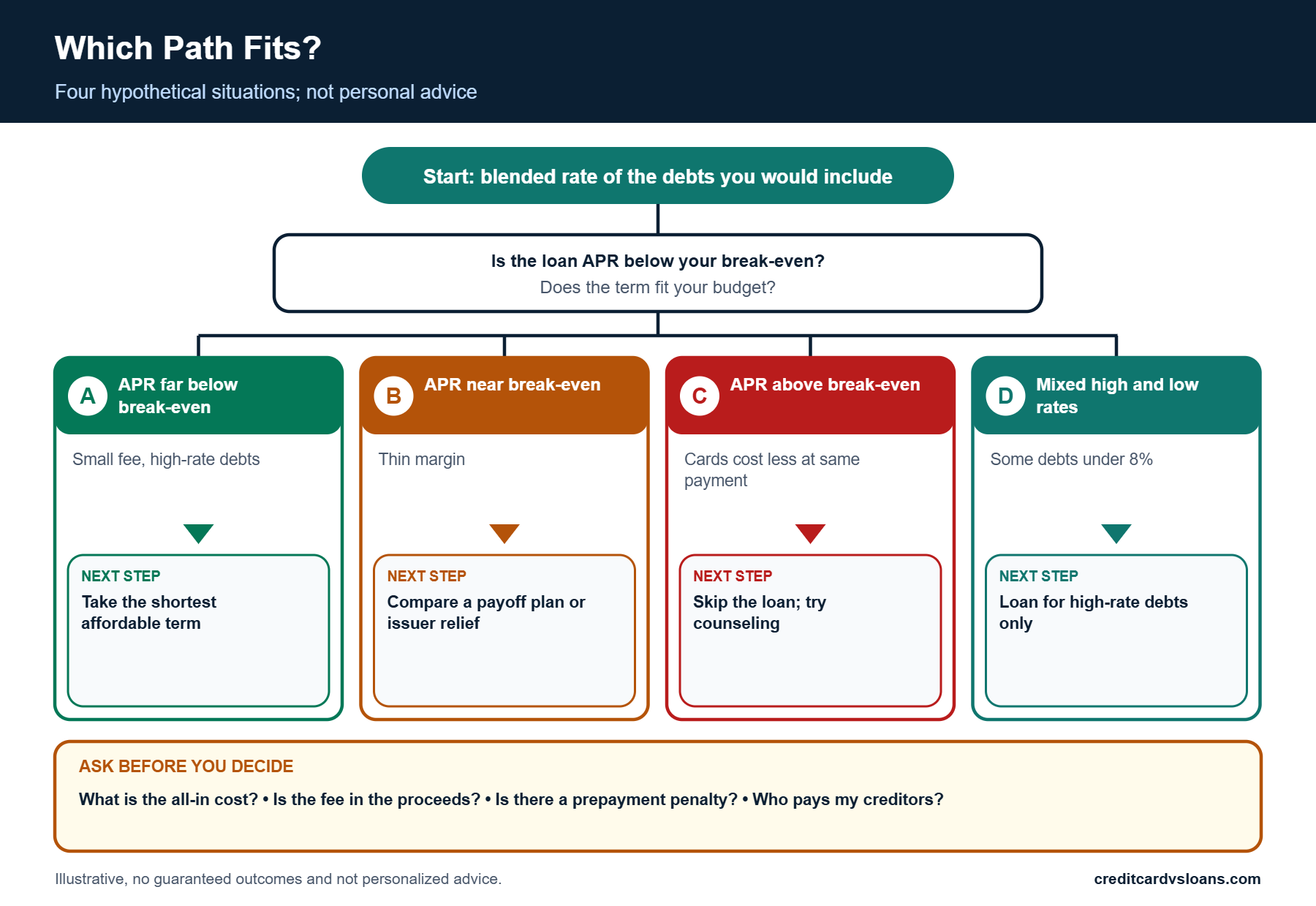
Table 5 links common situations to a direction, using the break-even ideas in this guide. It is a research aid, not advice for your finances.
| Your situation | Direction to investigate | Why | What to verify | When to avoid it |
|---|---|---|---|---|
| Loan APR is well below your blended debt rate, fee is small | Take the loan, shortest affordable term | Large margin above break-even | Fee, prepayment terms, direct payoff | If you will re-borrow on the cards |
| Loan APR is within a few points of the break-even | Compare a payoff plan | Thin margin | Total cost at the same payment | If structure is the only benefit |
| Loan APR is above the break-even | Skip the loan | Cards cost less at the same payment | Whether another route lowers your rate | Almost always |
| Some debts have low rates | Loan for the high-rate debts only | Avoids raising low-rate costs | Blended rate of included debts | If a low-rate debt would be folded in |
| Need a lower payment to stay current | Longer term, with a plan to prepay | Payment relief has a cost | Prepayment penalty, total cost | If a nonprofit plan would be cheaper |
Using the matrix well
Most real situations sit between rows. Use the matrix to decide which two options to price, then run the break-even on both. The cheapest on paper is not always the best fit, so weigh the risk of missed payments, the cushion you keep and how confident you are about your spending.
When the numbers are close, take the path with fewer ways to go wrong.
Questions to ask before you sign
For the lender
Ask for the APR, fee, term, payment and whether the fee comes from proceeds. Ask about prepayment, late fees and whether the lender pays your creditors directly. Request all of it in writing and read the agreement before you accept.
If anything in the final agreement differs from what you were quoted, stop and ask why before signing.
For yourself
Ask what will change in your spending so the balances do not return, what you will do if income drops and how you will know within 90 days whether the plan is working. A loan can reduce your interest, but only your plan can reduce your balances.
Writing your answers down makes the plan concrete, and it gives you something to check later.
Your Decision and Next Steps for a Personal Loan for Debt Consolidation
Turning the break-even into action
Set your own threshold first
Before you collect offers, decide what savings would make a loan worth the effort and the credit activity. Some people want at least a few hundred dollars; others want a margin large enough to cover the risk of a missed payment. Writing the number down prevents a slick offer from moving the goalposts.
Then decide the longest term you are willing to accept and the highest fee you would tolerate. Those three limits turn the break-even tables into a screening tool: any offer outside them is out before you look at its marketing.
Collect two or three comparable offers
Use prequalification tools that rely on soft pulls where available, and ask each lender for the APR, fee, term and payment in the same format. Compute the cost of your current debts at each loan’s payment and compare. If you want the broader decision framework alongside the math, the guide on whether to use a personal loan to pay off credit cards adds the behavior and cash-cushion checks.
Take the offers away from the sales conversation and work through them alone. Pressure to decide today is a reason to slow down.
After you accept an offer
Execute the payoff cleanly
Confirm that the lender pays your creditors directly or pay them yourself the day the funds arrive. Watch for statements showing zero balances and for any interest that posted between the loan’s funding and the payoff. Keep paying each old account until the payoff is confirmed.
Set the loan to autopay at the required amount, and make sure the account has a small buffer on the due date.
Review at 90 days
Put a reminder on your calendar. At the review, confirm that payments are posting, the old balances are still at zero, your credit reports are accurate and your spending has not slipped. If the plan is drifting, adjust early, because the options narrow when payments are missed.
If the review shows you are ahead of schedule, consider whether extra payments make sense. Confirm there is no prepayment penalty and that extra amounts go to principal.
Keep a simple record of the decision. Write down the offers you compared, the break-even you calculated and why you chose the one you did. If a lender changes terms, or if you reconsider in a year, the record shows what you knew then and lets you check whether the plan delivered what it promised. It also helps if you later weigh a refinance, since you will already have a baseline.
Questions that come up after the math
What if my break-even looks close?
A close result means the savings are small relative to the cost of being wrong. In that case the structure benefit has to carry the decision: will a fixed payment and a fixed end date make you more likely to finish? If so, a small saving may be enough. If not, a payoff plan on the cards you have, a nonprofit plan or a lower rate negotiated with your issuers may serve you better.
The test is always the same: would you pay less overall, and would you finish sooner or more reliably?
It also helps to remember that consolidation is not a one-time chance. If your offers are poor today because your credit is recovering, a few months of on-time payments and lower card balances may change what lenders offer, and you can run the same break-even then. Waiting is not always cheaper, but it is sometimes a reasonable choice if the current offers fail the math.
What if rates change while I am shopping?
Rates on offers can change between a quote and a final agreement. Lenders set their own rates, and market rates move. If your final offer is higher than your quote, rerun the break-even before accepting. A rate that was comfortably below the break-even may now be marginal.
Use the Federal Reserve’s G.19 release for the broader trend, but remember that the figure in your offer is the one that decides your cost.
A personal loan for debt consolidation saves money when its rate, fee and term keep the total cost clearly below what your debts would cost at the same payment. Find your break-even, include only the debts the loan improves, choose the shortest term you can afford, and walk away from offers that fail the math.
- List each debt with its balance and APR, and compute the blended rate for the ones you would include.
- Set a minimum savings threshold, a maximum fee and a longest acceptable term.
- Prequalify with soft pulls and record APR, fee, term and payment for two or three lenders.
- Compute your debts at each loan’s payment and compare with the loan’s interest plus fee.
- Leave out low-rate and protected debts unless there is a clear reason to include them.
- Accept only an offer that passes, set autopay and review the plan after 90 days.
- Should You Use a Personal Loan to Pay Off Credit Cards?
- Balance Transfer Card vs. Personal Loan: Best Way to Pay Off Debt?
- Balance Transfer Fee vs. Interest: When Paying a Fee Can Still Save Money
- Debt Consolidation Loan vs. Balance Transfer Card: Which Saves More?
- What Credit Score Do You Need for a Personal Loan?
- CFPB: What do I need to know about consolidating my credit card debt?
- CFPB: What is the difference between credit counseling and debt settlement, debt consolidation, or credit repair?
- FTC: How To Get Out of Debt
- Federal Reserve: Consumer Credit – G.19 (release of October 7, 2026)
- myFICO: What’s in your credit score?
Last updated: October 22, 2026. Rates, fees and lender rules change; verify current terms before acting.
The information on creditcardvsloans.com is provided for general educational and informational purposes only. It is not financial, legal, tax, credit, accounting or investment advice, and reading it does not create an advisor-client, fiduciary or any other professional relationship. Nothing here is an offer, solicitation or recommendation to borrow, lend or apply for any product.
Credit scores, interest rates, fees, eligibility rules, lender policies and laws change frequently and vary by lender, location and individual circumstances. Examples, figures and scenarios are illustrative only, do not predict your results and do not guarantee approval, savings, a particular rate or a credit-score outcome. Always confirm current terms directly with the lender or issuer and read the full agreement before you apply or sign.
Although we aim for accuracy and use reputable sources, we make no representations or warranties, express or implied, about the completeness, accuracy, reliability or timeliness of the content. Content may be drafted with the assistance of automated tools, so errors or omissions may still occur. Links to third-party sites are provided for convenience; we don’t control and aren’t responsible for their content.
To the fullest extent permitted by law, creditcardvsloans.com and its owners, editors, authors, contributors and affiliates disclaim all liability for any loss, damage or expense arising directly or indirectly from your use of, or reliance on, this content. Before making financial decisions, consult a licensed professional, such as a qualified financial advisor, attorney, tax professional or nonprofit credit counselor, who can consider your complete situation.