The personal loan credit score impact is usually a short dip followed by a slow, conditional recovery: a hard inquiry and a brand-new account can nudge your score down at first, while a record of on-time payments and (sometimes) lower credit card balances can work in your favor later. Nothing about it is automatic, though. Missed payments, a loan you can barely afford, or a pile of new credit applications can push a score the other way, and no lender or article can promise how your particular score will move.
This guide walks through the mechanics: which parts of a loan show up on your credit reports, which parts of the scoring formula they touch, and what that means for your decision. It is built around the five FICO score categories because those are the pieces a loan actually moves. If you want a month-by-month view of what tends to show up after funding, we cover that separately in our timeline of what happens to your score after a personal loan. If your real question is whether to borrow purely to build credit, see our guide on taking out a personal loan just to build credit.
One framing point before we start. A credit score is a summary of what is on your credit reports, and different scoring models weigh that information differently. The Consumer Financial Protection Bureau (CFPB) notes that there are many different credit scores and that the one a lender sees may differ from the one you see elsewhere. So when this article says a factor “can” help or hurt, read it as a direction, not a prediction of points.
- Expect a small early dip, not a collapse. A hard inquiry and a new account are the first things to show up, and FICO says one extra hard inquiry lowers a score by fewer than five points for most people.
- Payment history is the big lever. FICO weights it at roughly 35% of a score, so a loan you pay on time is positive over the long run and a missed payment is the single most damaging thing that can happen.
- Paying off cards with a loan can help utilization, but only if the cards stay low. Run the balances back up and you have the loan payment and the card debt.
- Prequalifying is not the same as applying. Many lenders let you check an offer with a soft pull, which does not affect your scores. Confirm that before you enter your details.
- Do not borrow to chase a score. Interest is a certain cost; the score benefit is not.
Score-factor weights come from myFICO's published description of the FICO Score. Inquiry rules come from the CFPB and myFICO. The 24-month personal loan rate cited later comes from the Federal Reserve's G.19 consumer credit release of October 7, 2026. Lender rules and scoring versions change, so treat any threshold as a starting point and check current terms.
The short answer: personal loan credit score impact, stage by stage
What usually happens, in order
The application stage
When you formally apply for a loan, the lender typically requests your credit report. The CFPB describes this as a hard inquiry: it is usually made when you apply for credit, it can lower your score because most models consider how recently and how often you apply, and it can be seen by other lenders who later pull your report. This is the first and usually the smallest effect.
By contrast, prequalification is often a soft pull. The CFPB lists prescreening, account reviews, and your own requests for your reports as soft inquiries that do not affect your scores. Because practices differ by lender, the rule of thumb is simple: ask before you submit, and look for wording such as “checking your rate will not affect your credit score” in the lender's own disclosure.
The funding and first-payment stage
Once the loan is approved and funded, a new installment account appears on your reports with a balance, a payment amount, and a status. That brings two changes at once. Your average account age drops because a zero-month-old account joins the mix, and your total debt rises, which is the "amounts owed" side of the formula. Both are usually modest, and both are part of why the score can sit slightly lower in the first months.
The positive side starts with the first on-time payment reported by the lender. Lenders usually report monthly, so the history builds one month at a time. Nothing about this is quick, which is why anyone borrowing mainly for the score should be skeptical of a promise of fast results.
What the score does not see
Your income and your budget
Credit scores are built from credit report data. They do not include your salary, savings, rent, or what else you owe outside the credit system. That matters because a loan can look fine to a scoring model and still be a poor fit for your budget. A payment that is affordable on paper but leaves no breathing room is how a perfectly good score turns into a missed payment.
Lenders, however, do look at income. The CFPB defines debt-to-income ratio (DTI) as your total monthly debt payments divided by your gross monthly income, and it notes that different loan products and lenders set different limits. DTI can affect whether you are approved and at what price, even though it is not a part of the score itself.
Whether the loan was a good idea
A score also cannot tell whether the interest rate was reasonable, whether fees were hidden in the agreement, or whether the borrowing solved a real problem. A high-cost loan paid on time can look as good on a credit report as an inexpensive one. For the question of what approval standards look like, see our guide to the credit score you need for a personal loan.
That is the central trade-off to keep in mind throughout this article: the credit effect is one input, the total cost and the monthly payment are the others, and the cost is the only one you can calculate in advance.
| Stage | What shows up | Usual direction for your score |
|---|---|---|
| Prequalify | Often a soft pull, only you can see it | No effect on scores, per the CFPB |
| Formal application | Hard inquiry | Small, temporary dip possible |
| Funding | New installment account and balance | Lower average age and higher total debt |
| On-time payments | Monthly positive payment history | Can strengthen the file over time |
| Late or missed payment | Delinquency on the account | Can cause serious damage |
| Payoff | Account reported as paid and closed | Varies by profile; see the payoff section |
If you only have time to remember one line from this section, remember this: the first month brings small negatives that fade, and the long-term outcome depends mostly on whether every payment is on time.
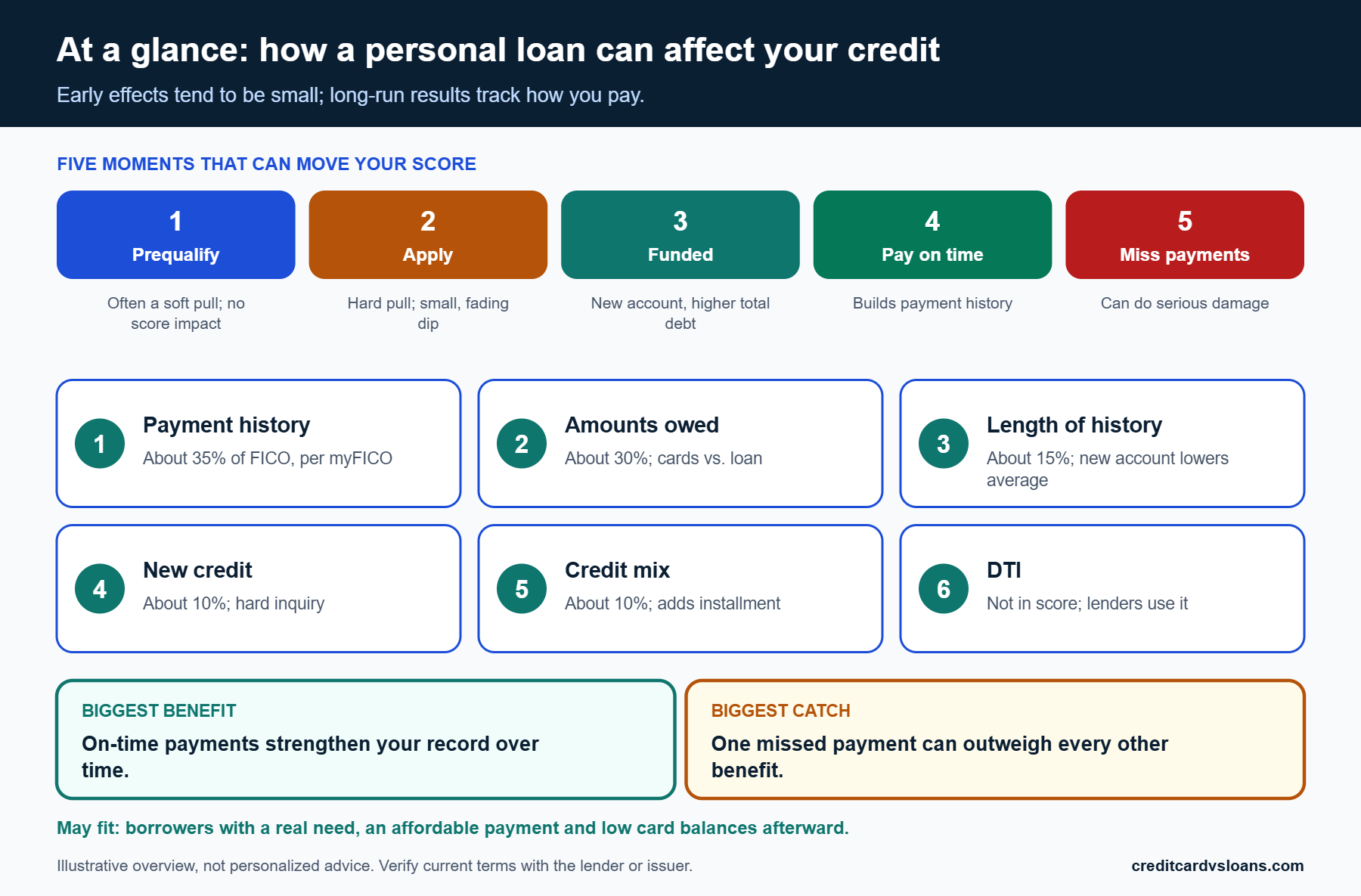
Personal loan credit score impact through the FICO factors
Payment history: the largest piece
Why on-time payments matter most
According to myFICO, payment history makes up about 35% of the FICO Score, the largest single category. It looks at whether you have paid past and current accounts on time. A personal loan gives you a fixed monthly due date and a fixed amount, which is a tidy way to build a record, as long as the payment is manageable.
The flip side is equally clear. A payment reported 30 or more days late is the kind of event scoring models treat harshly, and lenders generally report it to the bureaus. Under the Fair Credit Reporting Act (15 U.S.C. 1681c), most adverse items can be reported for up to seven years, measured from set dates in the statute, so a single serious delinquency has a long tail.
Making on-time payment automatic
The CFPB's own advice for building and keeping a good score is to use automatic payments or reminders and, if you do fall behind, to get current quickly. For a loan, autopay from a checking account is the easiest control, but only if the account reliably has the money on the due date. Many lenders offer a due-date change or a small rate reduction for autopay, so ask, but treat any discount as a lender-specific feature and not a given.
Before you sign, test the payment against your worst normal month, not your average month. If your income swings, build a one-month cushion before the first payment is due. That single habit prevents more credit damage than any other tip in this article.
Amounts owed: utilization and total debt
How a loan changes the "amounts owed" picture
The amounts-owed category is about 30% of the FICO Score, per myFICO. It looks at total debt and how much of your available revolving credit you are using. A personal loan is installment debt, so it adds to total debt but does not add to revolving utilization, the share of your credit card limits that is in use.
That is why a loan used to pay off cards can change the picture so much. Moving a balance from a card at 80% of its limit into a loan can reduce reported utilization sharply. We explain the mechanics in depth in our guide to credit card utilization, so here we only note the key conditions: the cards must actually be paid to a low balance, and they must stay low afterward.
The catch: running cards back up
The CFPB's guidance suggests keeping credit use under 30% of your total limit and says you do not need to carry a balance to build a good score. A consolidation loan only helps if that guideline holds after the payoff. If the cards fill up again, you now owe the loan and the new card balances, utilization is high again, and DTI is worse than where you started.
A practical guard is to leave the old cards open but out of reach: remove saved card numbers from shopping sites, and set a low alert threshold in your banking app. Whether to close an old card is a separate decision with its own trade-offs, because closing it removes its limit from your utilization math.
| Category (myFICO weight) | What a personal loan can do | What you control |
|---|---|---|
| Payment history (35%) | Adds a stream of on-time or late payments | Autopay, cushion, affordable payment size |
| Amounts owed (30%) | Adds installment debt; may lower card utilization | Keep paid-off cards low |
| Length of history (15%) | New account lowers average age | Keep older accounts open and in good standing |
| New credit (10%) | Hard inquiry and a new account | Limit hard-pull applications; prequalify first |
| Credit mix (10%) | Adds an installment account to a card-only file | Do not borrow just for mix |
Notice that two of the five categories lean slightly negative at the start, two are neutral to positive, and one (payment history) can go either way. That is why early results are mixed and long-term results depend on behavior.
New credit, account age and credit mix: the smaller levers
Inquiries and new accounts
How big is a hard inquiry, really?
myFICO says that for most people one additional hard inquiry lowers a FICO Score by less than five points. Inquiries can stay on your report for up to two years, but FICO Scores consider only the last 12 months. The CFPB similarly says hard inquiries can lower your score because most models look at how recently and how often you apply.
The takeaway is proportion. One inquiry is a small, fading effect. Six inquiries in a month, especially across different kinds of credit, tells a model (and a human underwriter) that you may be seeking money urgently, and that pattern is worth avoiding.
Rate shopping: what the rules cover and what they do not
Many borrowers have heard that several inquiries within a short window count as one. According to myFICO, that special rate-shopping treatment applies to three types of inquiries: mortgage, auto loan, and student loan. The window is 45 days for newer FICO versions and 14 days for older ones. Credit card applications do not get that treatment.
Personal loans are not on that list in myFICO's description. So, to be cautious, do not assume that submitting five formal personal loan applications will be merged into one inquiry. The safer routine is to compare lenders through soft-pull prequalification, then submit a formal application with the one or two you actually prefer. If a model does group them, you lose nothing; if it does not, you have avoided a pile of inquiries.
Account age and credit mix
Why a new loan lowers average age
Length of credit history is about 15% of the FICO Score, per myFICO, and it considers the age of your oldest, newest, and average accounts. A new loan is, by definition, your newest account, and adding it pulls your average down. If you have a long history of cards and loans, the effect on the average is small. If you have only one or two accounts, a new loan changes the average more.
The practical response is not to avoid every new account, but to avoid closing your oldest ones around the same time. Keeping an older card open (with a low balance and no annual fee that bothers you) keeps your oldest-account age intact while the new account matures.
Credit mix: a real factor, a poor reason to borrow
Credit mix accounts for about 10% of the FICO Score and looks at the variety of credit you hold, such as credit cards, installment loans, retail accounts, finance company accounts and mortgages. If your file is only credit cards, a first installment loan adds variety. That is a legitimate, if small, potential benefit.
But 10% is a modest slice, and it is shared across several account types. Paying interest for years to improve a minor factor is rarely sensible, which is the core argument in our look at borrowing mainly to build credit. If you are borrowing for a real need anyway, mix is a pleasant side effect. It should never be the reason.
Small effects stack. A hard inquiry, a lower average age and a higher total debt can arrive in the same month. If you are weeks away from applying for a mortgage or auto loan, the timing of a personal loan matters more than the size of any single factor. Ask the lender who will hold that bigger loan how they view recent new accounts.
What the loan costs versus what it may do for your score
The real price tag
Interest, APR and the origination fee
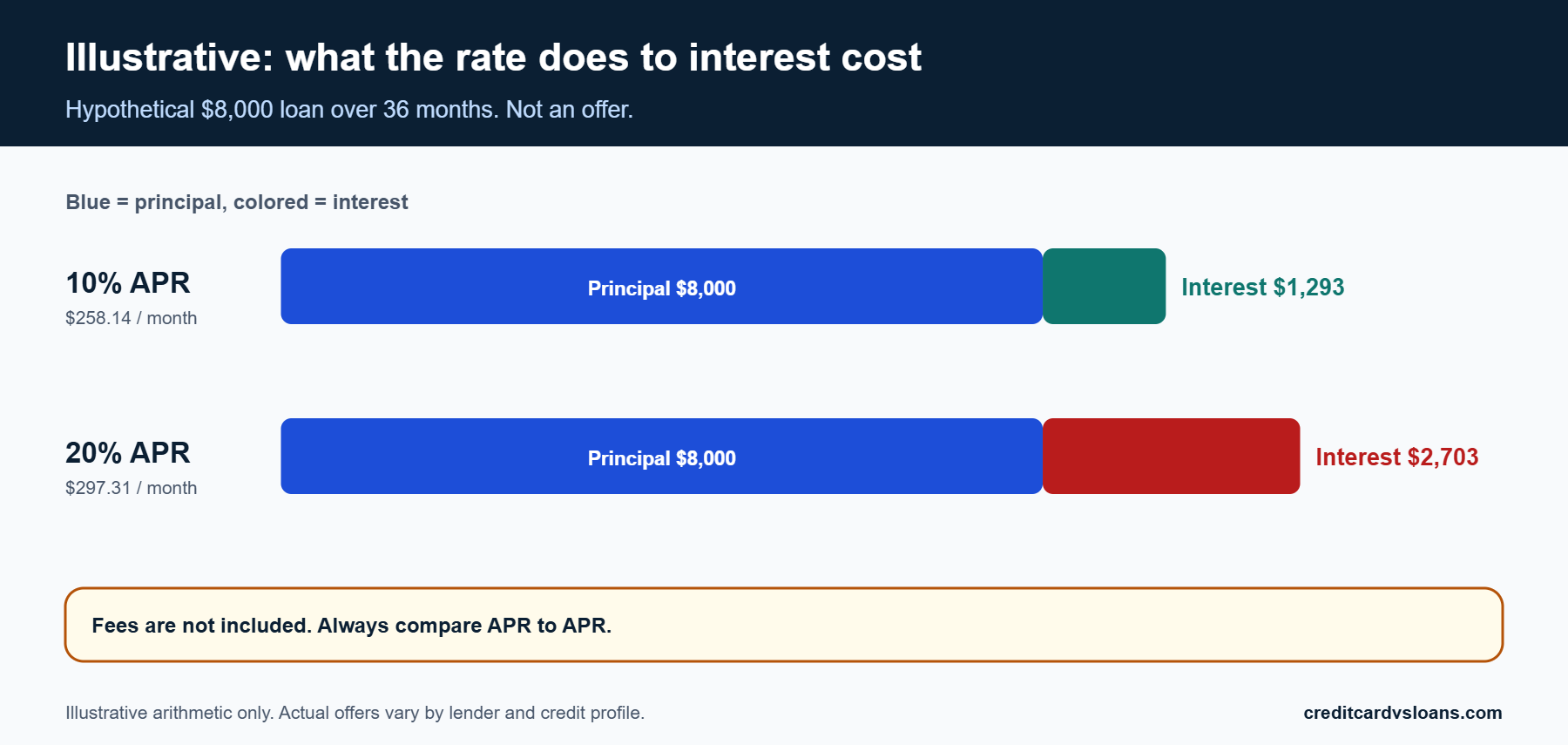
The annual percentage rate (APR) is the number to compare because it folds certain fees into the yearly cost, while the interest rate alone does not. An origination fee, a one-time charge that some lenders deduct from the loan proceeds, can mean you receive less cash than you borrowed while still owing the full amount. Always ask for the APR, the fee in dollars, and the exact amount that will land in your account.
For a sense of the market, the Federal Reserve's G.19 consumer credit release of October 7, 2026 reported a 24-month personal loan rate at commercial banks of 11.90 percent for August 2026 (preliminary, not seasonally adjusted). That is an average across banks, not a quote you should expect; your own offer depends on your credit, income and the lender. The Fed figure is useful mainly as a sanity check against offers that look far above it.
Why a longer term can cost more than the score gain is worth
A longer term lowers the monthly payment, which can reduce the chance of a missed payment. It also increases total interest. The chart below uses a hypothetical $8,000 loan to show how much the rate matters at a fixed 36-month term. Those numbers are illustrations, not offers, and fees are not included.
The payment structure and score risk
Fixed payment, fixed term
Most personal loans are installment loans: a fixed amount each month over a fixed term. That predictability is a benefit for budgeting and for the payment-history category, because there is no minimum payment that changes with the balance. It also means there is no flexibility. A card lets you pay the minimum in a tight month; a loan does not.
If your income is uneven, ask the lender whether it offers a hardship option or a due-date change, and get the answer in writing before you sign. Do not assume one exists.
Prepayment and what payoff does to the file
Paying a loan off early saves interest if there is no prepayment penalty, so ask whether there is one. On the credit side, a paid-off installment account typically shows as closed and paid as agreed. Because scoring models differ, the effect on a given score at payoff can be flat or a small dip, even though paying off debt is a sound financial move. We explain this counterintuitive moment in our post-loan timeline.
The rule of thumb here is to let the financial decision lead. Prepay if you save meaningful interest and your emergency cushion is intact. Do not keep a loan open just to hold a score steady.
| Item | Certain or uncertain? | What to do about it |
|---|---|---|
| Interest and fees | Certain, in writing | Compare APR to APR across offers |
| Monthly payment | Certain, fixed | Test it against your worst normal month |
| Hard inquiry dip | Likely small, temporary | Prequalify first, apply once |
| Score improvement later | Not certain | Never count on it when deciding |
| Lower card utilization | Depends on your behavior | Keep cards low after payoff |
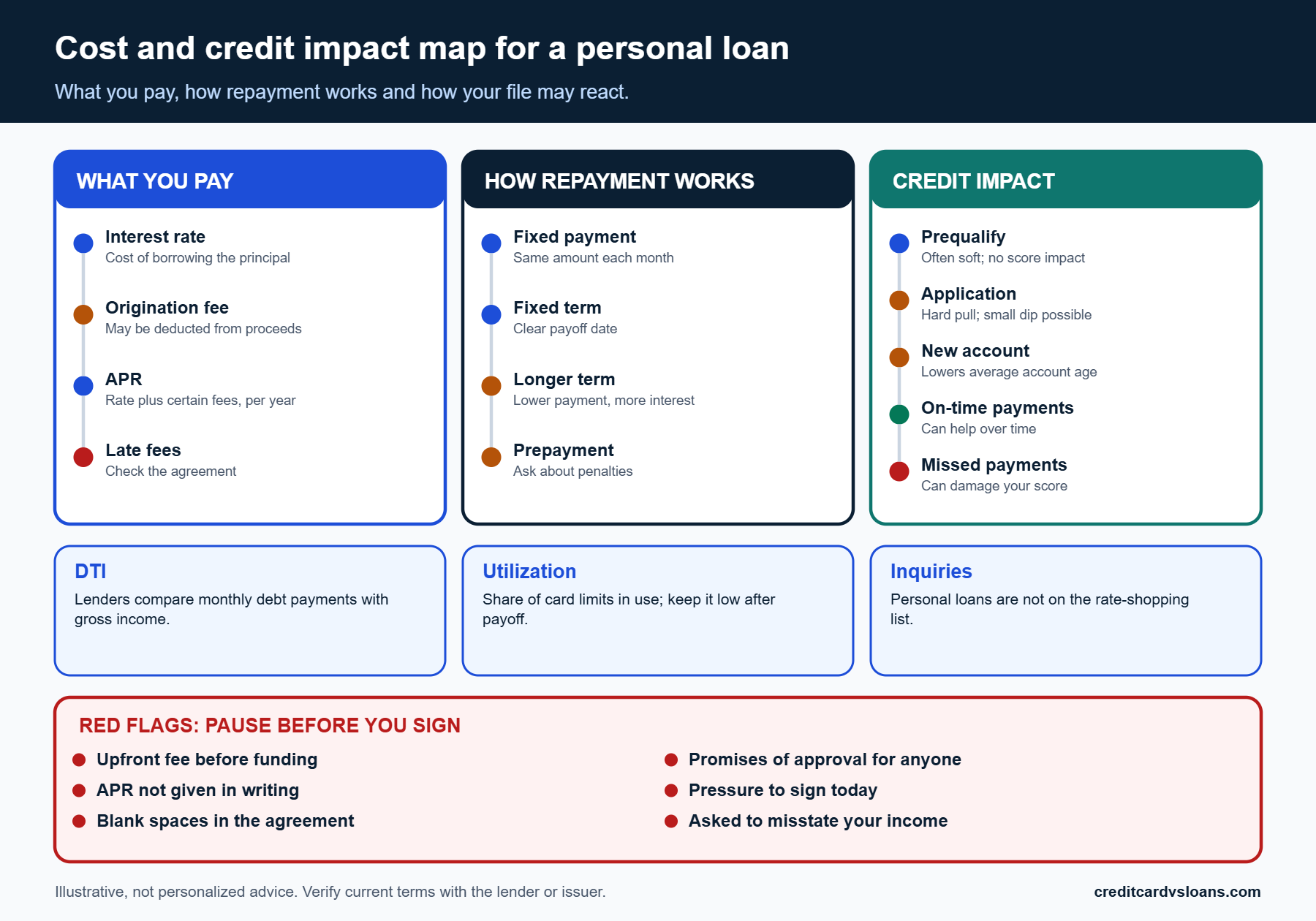
Common situations and how the credit effect differs
Debt consolidation with a personal loan
When the utilization drop is the main event
The scenario most people have in mind is paying off several credit cards with one loan. Here the personal loan credit score impact is dominated by what happens to utilization. If your card balances were high relative to limits, moving them into a loan can lower reported utilization quickly, and the amounts-owed category may improve as a result. The loan itself brings the small negatives described above (inquiry, new account), but the shift in utilization can outweigh them for some borrowers. Others see little change. It depends on your starting point.
The loan has to be a cheaper or simpler way to repay, not just a different way to owe. Compare the loan's APR with what you are paying on the cards, including any balance-transfer alternative. Our guide on credit score needs for a debt consolidation loan covers approval and pricing for this specific use.
When consolidation backfires
Consolidation backfires when the root problem is spending that exceeds income. The cards are cleared, the loan is in place, and within a year the cards are full again. At that point your score has the same high utilization plus a loan payment that crowds your budget, and the odds of a missed payment rise.
Before you consolidate, write down what created the balances. If it was a one-time event, such as a medical bill or a car repair, consolidation can be a clean reset. If it was a monthly gap between income and expenses, the loan will not fix the gap. A nonprofit credit counselor can help you see the difference; the FTC suggests asking a credit union, university or military personal financial manager about nonprofit credit counseling programs.
Thin files and fair credit
If you have little credit history
A thin credit file, meaning few accounts or a short history, behaves differently because each new event carries more weight. A first installment loan can add a payment history that did not exist and can diversify a card-only file. The same file is also more sensitive to a hard inquiry and to a new account lowering a small average age.
The CFPB's own tips for people new to credit or rebuilding point to secured credit cards and credit-builder loans before regular loans, because those are designed for the purpose and typically have lower amounts at stake. We compare the options for a first account in our guide to student credit cards, and the full argument for and against borrowing to build is in the personal-loan-to-build-credit article.
If your score is fair or below
With fair credit, the offer you receive may carry a high APR or an origination fee, and the monthly payment is where the risk concentrates. The score effect is the same set of factors, but the cost of a missed payment is higher because the account is already priced for risk.
Check your reports before applying. The FTC points consumers to AnnualCreditReport.com for free reports and says that mistakes should be disputed in writing with the credit bureau and with the business that reported the information. An error corrected before you apply can change your options more than any strategy about timing.
| Situation | Factor most likely to dominate | Main risk |
|---|---|---|
| Consolidating high card balances | Utilization (amounts owed) | Re-running the cards up |
| Financing a one-time expense with a good file | Payment history | Payment strain on the budget |
| Thin file or first installment loan | Account age and mix | Paying interest for a small benefit |
| Fair credit with a high-APR offer | Cost and payment history | A missed payment on an expensive loan |
Mistakes that turn a loan into a score problem
Payment and budget mistakes
Borrowing the maximum you are offered
An approval amount reflects what the lender is willing to extend, not what is wise for you. Borrowing the maximum raises the payment, the interest cost, and the total debt in your file, all at once. A smaller loan with a shorter term often costs less overall and leaves room if income dips.
A rule of thumb that is easy to apply: choose the smallest amount that solves the problem, then confirm the payment still leaves a month of breathing room in your budget. If it does not, the loan is too big for the situation.
Ignoring the first-payment date
New loans sometimes have a first due date that arrives sooner than people expect, and a payment missed in the first weeks is reported like any other. Put the due date in a calendar the day the loan funds, set up autopay, and confirm the first payment actually leaves your account.
If you receive the loan by direct deposit and the lender takes the first payment automatically, make sure the checking account has funds. A returned payment can bring a fee and, if it goes unnoticed, a late mark.
Offer and application mistakes
Applying everywhere at once
The pattern to avoid is the scattershot formal application. Each one can add a hard inquiry, and since personal loans are not among the loan types myFICO lists for rate-shopping treatment, you cannot count on them being grouped. Prequalify broadly with soft pulls, then apply formally only where the offer is competitive.
Also avoid applying for new credit cards at the same time. How card applications interact with the score is a separate subject; see our article on whether applying for a credit card hurts your credit.
Accepting an offer with warning signs
Offers that demand fees before funding, claim approval regardless of your credit, or press you to sign immediately are red flags. The FTC's guidance on credit repair says companies may not charge you before they have helped you, may not ask you to lie on applications, and cannot remove correct negative information. The same skeptical lens applies to loan offers that sound too easy. Our guide to predatory lending warning signs goes through the specifics.
Any lender or "credit fixer" who asks for an upfront fee, promises to erase accurate negative items, or tells you to misstate your income is describing something the FTC has warned about. Walk away and do not provide your Social Security number or bank login.
Questions that come up after the basics
Reporting and timing questions
Does it matter which bureau the lender reports to?
It can. The CFPB explains that a score can vary based on the credit reporting company that supplied the information, the scoring model, the type of loan product, and the date it was calculated. If a lender reports your loan to only one or two bureaus, the account will help or hurt only the files where it appears, and a lender that checks a different bureau will not see it.
Ask each lender directly which bureaus it reports to, and verify by looking at your own reports a couple of months after funding. If you are relying on the loan to show a record of payments, a loan that is not reported is simply a loan.
How long do the effects last?
The inquiry has the shortest life: it can remain on your report for up to two years, but FICO Scores consider only the last 12 months, according to myFICO. The new account's effect on average age fades as the account ages and as you add other accounts. Payment history is the long one: positive payments stay as part of the account record, and late payments can generally be reported for seven years under the Fair Credit Reporting Act.
That asymmetry is worth remembering. A small negative fades in months, while a serious delinquency is a multi-year problem. It is the clearest reason to size the loan conservatively.
Questions about your own checks
Does looking at my score or report cost me anything?
No. The CFPB lists your own requests for your reports among soft inquiries that do not affect your credit scores, and it states that requesting your reports will not hurt your score. Checking is safe, and checking before you apply is wise.
Be careful with the sites you use. Free reports are available through AnnualCreditReport.com, as the FTC notes; be wary of any service that asks for a card number to show you a report you are entitled to for free.
What if my offer looks worse than I expected?
Do not rush to fix it with another formal application. Look at the report for errors, check whether utilization on your cards is unusually high at the moment (paying cards down before the next application can change the picture), and wait for the statement dates to update. Your options may change within a couple of billing cycles.
If the offer is the best available and the loan is needed, use the smallest amount and the shortest term you can afford. If it is optional, waiting costs nothing.
Before you apply: a sequence that protects your score
Prepare your file
Pull your reports and fix errors first
Start with your credit reports from all three bureaus. The CFPB advises checking them at least once a year and says requesting your own reports will not hurt your score. Look for accounts you do not recognize, wrong balances, payments marked late that were on time, and duplicate collection entries.
If you find an error, the CFPB explains that you can dispute it with the credit reporting company and separately with the furnisher, the business that supplied the information. It says furnishers generally must investigate and respond within 30 days of receiving your dispute. Keep copies of everything you send. Fixing an inaccurate negative item can matter more than any application timing trick.
Know your DTI and your cushion
Add up your monthly debt payments, divide by your gross monthly income, and you have the DTI the CFPB describes. Then add the proposed loan payment and recalculate by hand. If the number rises sharply, expect pricing or approval to be affected, and expect your budget to feel it too.
Separately, count your cash cushion. A loan paid from a budget with no slack is the setup most likely to produce a late payment. If you cannot cover the payment through a bad month, consider a smaller loan, a longer term with no prepayment penalty, or a different approach.
Compare offers apples-to-apples
Use soft-pull tools first
Use prequalification to see estimated terms from several lenders without a formal application. Confirm on each lender's page that the check is a soft pull. Prequalified terms are estimates and can change at formal underwriting, so treat them as a screening step.
Write down for each offer: APR, term, monthly payment, origination fee in dollars, net cash received, prepayment penalty (yes or no), and whether the lender reports to all three bureaus. That last item matters if you are counting on the loan to build history, because a loan that is not reported to the bureaus builds nothing.
Choose the offer on total cost and affordability
Pick the offer with the lowest total cost that you can pay comfortably, not the offer with the lowest monthly payment. If two offers are close, favor the shorter term or the one with the more transparent fee disclosure. Do not let the score argument tip a close call toward the more expensive loan.
If you need more help comparing loan types, see our personal loan score and approval guide. For the stretch after funding, the post-loan timeline describes what you may notice and when.
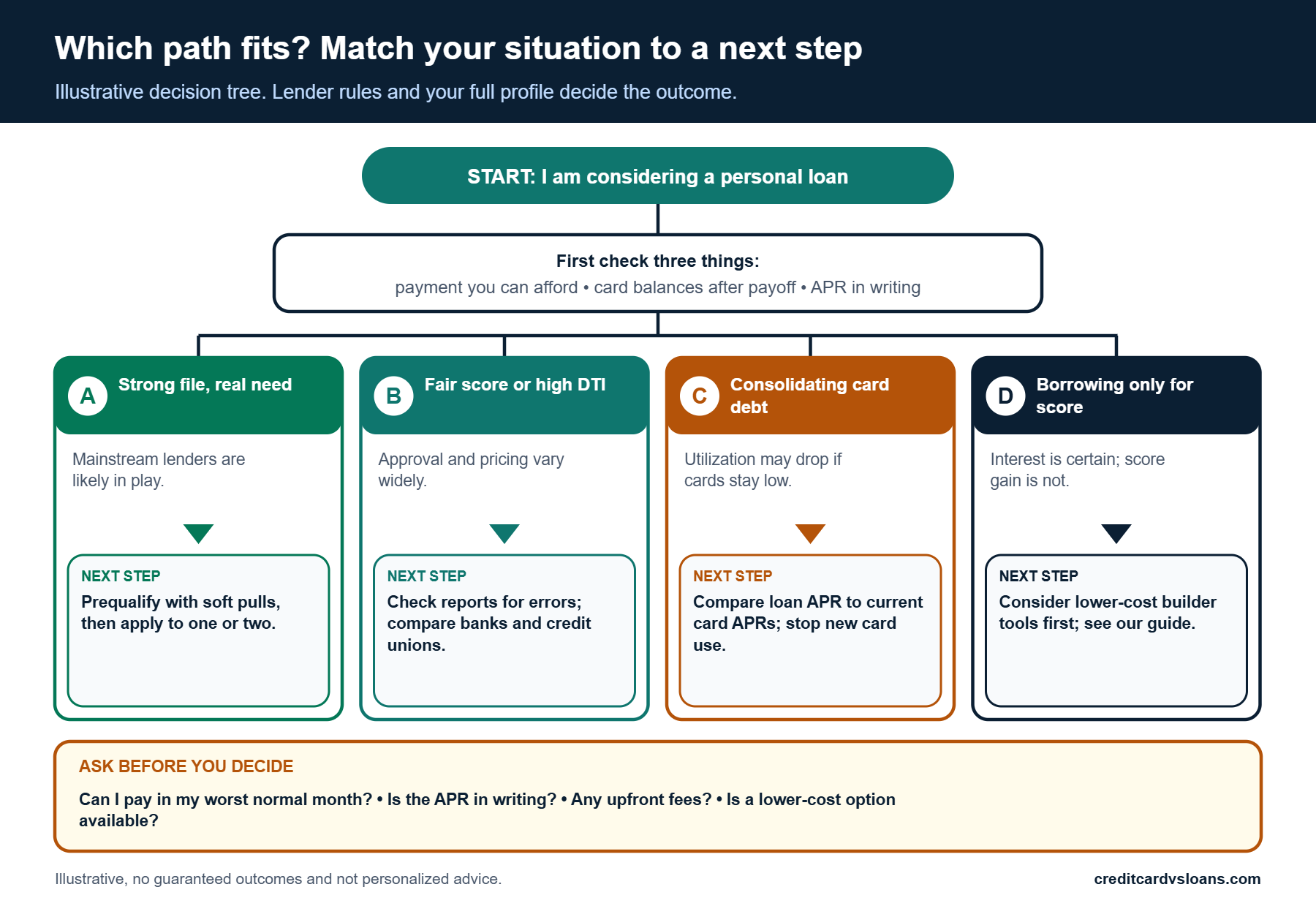
Decision checklist and next steps
How to decide
Questions that settle most cases
Four questions settle most decisions. Can you pay the loan on time in your worst normal month? Is the APR in writing and competitive against the alternatives you have actually checked? Does the loan solve a real problem, such as high-rate card debt, rather than a want? And will you leave the cards low after payoff, if consolidation is the point?
If the answer to any is no, the score is the wrong lens. Fix that part first, then revisit the loan.
Where the personal loan credit score impact belongs in the decision
The personal loan credit score impact should be a tiebreaker and a risk check, not a reason to borrow. The early negatives are small and tend to fade. The long-run positives depend on on-time payment, which is a function of affordability. The one outcome you can count on is the cost of interest and fees.
When the loan is necessary and affordable, a good record of payments is a reasonable thing to expect it to support. When it is optional, the same score benefit can usually be obtained more cheaply through other tools.
Expect a small dip and then a result that mostly reflects how you pay. Borrow for the need, not the score, compare APR to APR, and make the payment automatic.
Your next steps
A short action list
- Pull your three credit reports and dispute any errors in writing.
- Calculate your DTI before and after the proposed payment, by hand with a pencil or a spreadsheet.
- Prequalify with several lenders using soft pulls only, and record APR, fees and net cash for each.
- Apply formally to one or two lenders at most, and avoid other new credit in the same weeks.
- Set up autopay and a due-date reminder the day the loan funds.
- Check your reports again in a few months to confirm the lender is reporting accurately.
This sequence works the same way whether your goal is consolidating card debt or financing a single purchase.
When to pause instead
Pause if you are about to apply for a mortgage or auto loan, if you cannot document stable income, or if the only offers you can get carry fees you cannot explain. Waiting a few months while you pay down card balances and correct reports can change your options considerably.
If you are already struggling with payments, talk with a nonprofit credit counselor before taking on new debt. A conversation costs far less than a default.
- CFPB: What is a credit inquiry? (Hard vs. soft inquiries)
- myFICO: What is in your FICO Score (Score factor weights)
- myFICO: How long do hard inquiries stay on your credit report?
- myFICO: How to rate shop and minimize the impact to your FICO Scores (Rate-shopping treatment by loan type)
- CFPB: How do I get and keep a good credit score?
- CFPB: What is the difference between a credit report and a credit score?
- CFPB: How do I dispute an error on my credit report?
- CFPB: What is a debt-to-income ratio?
- Federal Reserve: Consumer Credit – G.19 (Oct. 7, 2026 release)
- FTC: Spot the scams when fixing your credit (Jan. 7, 2026)
- Fair Credit Reporting Act: 15 U.S.C. 1681c – Requirements relating to information contained in consumer reports (Reporting periods)
Last updated: October 22, 2026. Rates, fees and lender rules change; verify current terms before acting.
The information on creditcardvsloans.com is provided for general educational and informational purposes only. It is not financial, legal, tax, credit, accounting or investment advice, and reading it does not create an advisor-client, fiduciary or any other professional relationship. Nothing here is an offer, solicitation or recommendation to borrow, lend or apply for any product.
Credit scores, interest rates, fees, eligibility rules, lender policies and laws change frequently and vary by lender, location and individual circumstances. Examples, figures and scenarios are illustrative only, do not predict your results and do not guarantee approval, savings, a particular rate or a credit-score outcome. Always confirm current terms directly with the lender or issuer and read the full agreement before you apply or sign.
Although we aim for accuracy and use reputable sources, we make no representations or warranties, express or implied, about the completeness, accuracy, reliability or timeliness of the content. Content may be drafted with the assistance of automated tools, so errors or omissions may still occur. Links to third-party sites are provided for convenience; we don’t control and aren’t responsible for their content.
To the fullest extent permitted by law, creditcardvsloans.com and its owners, editors, authors, contributors and affiliates disclaim all liability for any loss, damage or expense arising directly or indirectly from your use of, or reliance on, this content. Before making financial decisions, consult a licensed professional, such as a qualified financial advisor, attorney, tax professional or nonprofit credit counselor, who can consider your complete situation.