Using a personal loan to pay off credit cards makes sense when the loan’s all-in cost, including any origination fee, is clearly lower than what your cards would cost at the same monthly payment, and when you have a plan to stop the cards from filling back up. If either piece is missing, the loan can turn a manageable problem into a longer and more expensive one.
This guide is built around a decision test rather than a product tour. Instead of describing every kind of consolidation, it asks five questions that sort the good uses of a personal loan from the bad ones, then shows the arithmetic behind each answer. If you want a deeper look at the break-even math or at what lenders look for, the sibling guides linked throughout go further.
Every dollar figure in the examples is hypothetical and computed with standard amortization math. Market figures come from the Federal Reserve and are date-stamped. Your own offers will differ, so use the structure of the test, not the specific numbers, as your guide.
- The core test is simple: would the loan cost less than your cards if you made the same monthly payment on each?
- Origination fees and long terms are the two ways a lower rate can still cost more.
- A loan that clears your cards does not help if the cards refill; the behavior plan matters as much as the rate.
- Averages are not offers. Federal Reserve data shows a wide gap between average card and loan rates, but your gap depends on your profile.
- If the numbers do not pass, a nonprofit plan, a transfer card or a structured payoff may serve you better.
Market figures are from the Federal Reserve’s G.19 consumer credit release of October 7, 2026, which reports commercial bank rates through August 2026 (preliminary). Always confirm the terms in your own offer.
Should You Use a Personal Loan to Pay Off Credit Cards? The Five-Question Test
Questions one to three: rate, payment and cards
Does the loan beat the cards at the same payment?
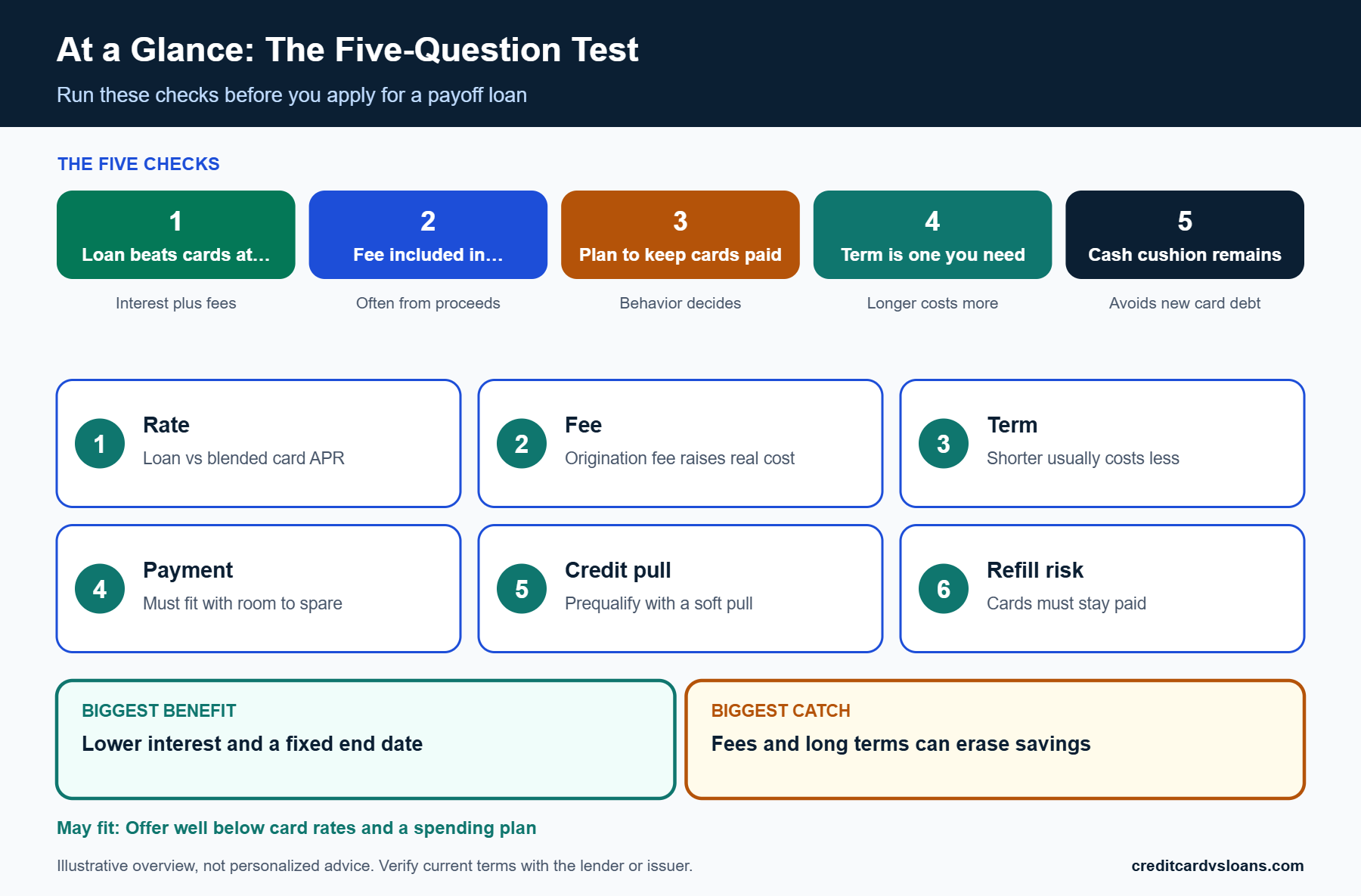
Take the monthly payment the loan would require and ask what your cards would cost if you paid that same amount. This is the apples-to-apples comparison, because paying more on any debt shortens it. If the loan’s cost, including interest and fees, is clearly lower, the first test passes. If it is about equal or higher, it fails, whatever the headline rate says.
The test needs three numbers from each side: the rate, the fees and the payoff time. Our worked examples later in this guide show how to produce them.
Is the fee priced in, and can you carry the payment?
Many personal loans take an origination fee out of the proceeds, so you borrow more than you receive. Include it in the cost. Then check that the payment fits your budget with room to spare, because a fixed payment you cannot make is worse than a flexible card payment you can.
Question three is behavioral: after the cards are paid, what keeps them from refilling? If you do not have a good answer, the loan is a risk even at an excellent rate.
It helps to run the test twice: once with the offer you want and once with the offer you would get if your income dipped. A loan that passes only when everything goes well is fragile. A loan that still works with a little slack is far more likely to be paid on schedule.
Questions four and five: term and cushion
Is the term short enough that you are not paying for comfort?
A longer term lowers the payment and raises the total cost. That can be reasonable if you need breathing room, but it should be a choice you make with eyes open, not an accident. Ask what the same loan would cost at a shorter term and whether you could handle that payment.
Some borrowers use a longer term and plan to prepay when they can, which works only if the loan has no prepayment penalty. Check before you rely on it.
Do you keep an emergency cushion?
If using every dollar to pay down cards leaves you with no cash for a surprise bill, the surprise will land on a card. Keeping a small cash cushion, even a modest one, can protect the plan. The CFPB’s advice to look at why you are in debt points to the same issue: consolidation works best when your budget has room.
A cushion does not need to be large to be useful; the point is that one flat tire should not undo months of progress.
When the answer is usually yes, usually no and it depends
Signals for each answer
The loan usually makes sense when you qualify for a rate well below your card APRs, any fee is modest, you can afford a payment that retires the balance in a few years and you have stopped adding to the cards. It usually does not when your offer rate is near your card rate, the fee is large, the term is long and the monthly payment would only be lower because it stretches out the debt.
Everything in between depends on your numbers, which is where Table 1 helps.
| Question | A pass looks like | A fail looks like | How to check |
|---|---|---|---|
| 1. Does the loan beat the cards at the same payment? | Lower interest plus fees, clearly | Equal or higher | Compute both costs at one payment |
| 2. Is the fee included? | Total cost uses the borrowed amount | Only the APR was compared | Ask if the fee comes out of proceeds |
| 3. Will the cards stay paid? | Written budget and a card rule | No plan for spending | Track spending for a month |
| 4. Is the term sensible? | Payoff in a few years | Long term only for a lower payment | Price a shorter term |
| 5. Is there a cushion? | Some cash set aside | Zero margin | Count months of essential bills saved |
Using the table as a pre-flight check
Print or copy Table 1 and fill it in with your own numbers before you apply. A single clear fail on question one or three is usually reason enough to pause. Fails on four or five are fixable with a different term or a small savings goal.
If your profile is a worry, the guides on the credit score needed for a personal loan and a personal loan with a 600 credit score describe what offers can look like at different levels.
How a Personal Loan to Pay Off Credit Cards Actually Works
The mechanics from application to payoff
Application, approval and disbursement
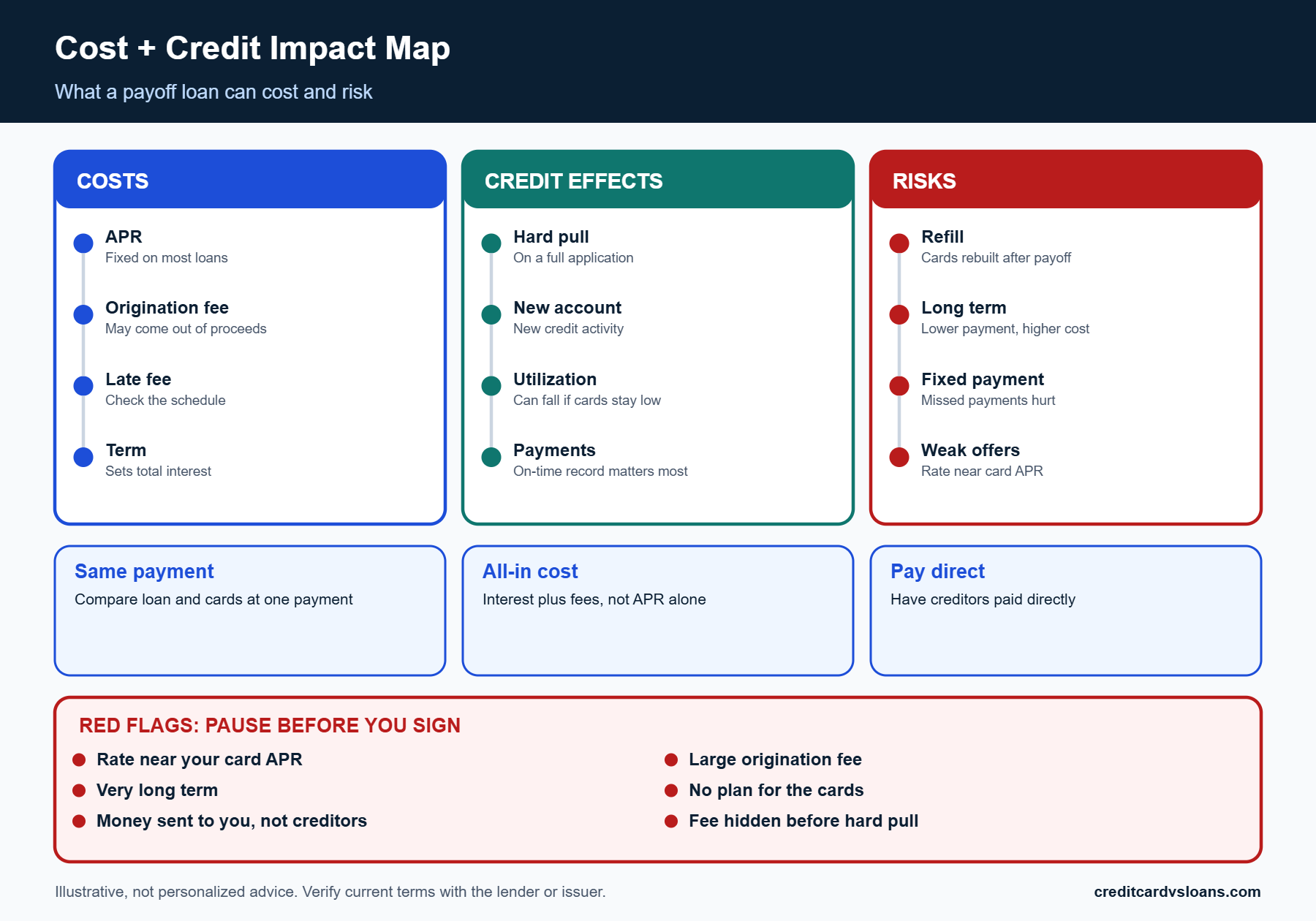
You apply, the lender reviews your income, debts and credit report, and if approved you receive an offer with the rate, fee, term and payment. Some lenders let you prequalify first with a soft pull, which does not affect your score, and a full application typically uses a hard pull. After you accept, the lender either sends the money to you or pays your card issuers directly.
Direct payment to creditors is helpful because it removes the temptation to use the money for something else. If the lender sends the money to you, pay the cards the same day.
What stays fixed and what does not
Most personal loans for this purpose have a fixed rate, a fixed term and a fixed payment, so you know your payoff date. Credit cards, by contrast, usually have variable rates and flexible minimums. That predictability is a real benefit, and so is the end date, but it also means a missed payment hurts: late fees and credit report damage follow.
The CFPB notes that a lower payment on a consolidation loan often reflects a longer repayment period, which can cost more overall. Read the term as carefully as the rate.
Some lenders also offer an autopay discount or charge a late fee after a short grace period, and these small terms add up over a multi-year loan. Ask for the fee schedule, not just the rate, and write down the due date so that it fits your pay cycle. A due date a few days after payday is easier to meet than one just before it.
Reading market averages without being fooled
What the Federal Reserve data shows
As of the Federal Reserve’s G.19 release of October 7, 2026, commercial banks’ average rate on credit card accounts assessed interest was 22.36% in August 2026 (preliminary), and the average rate on a 24-month personal loan was 11.90%. These figures are averages across many borrowers and are measured differently from product to product, so they are context, not predictions.
The gap is why the loan strategy exists. A borrower who qualifies for something near the loan average can save a lot of interest. The same gap is also why borrowers with weaker profiles get tempted by loans that are not actually cheaper.
Why your gap may be smaller than the average gap
Average card rates include many accounts, and your cards may be higher or lower. Average loan rates reflect borrowers across the profile range, and your offer reflects only you. If you are quoted a rate near your card rate, plus a fee, the savings disappear, as Table 2 later shows.
That is why the test works on your own numbers. Averages tell you the strategy is plausible; only your offers tell you if it works for you. Our guides on a personal loan with a 620 credit score and a personal loan with a 580 credit score describe how offers can differ at lower score levels.
The Cost Test: Interest, Fees and Term for a Personal Loan to Pay Off Credit Cards
Break-even on rate and fee
A worked example with a $12,000 balance
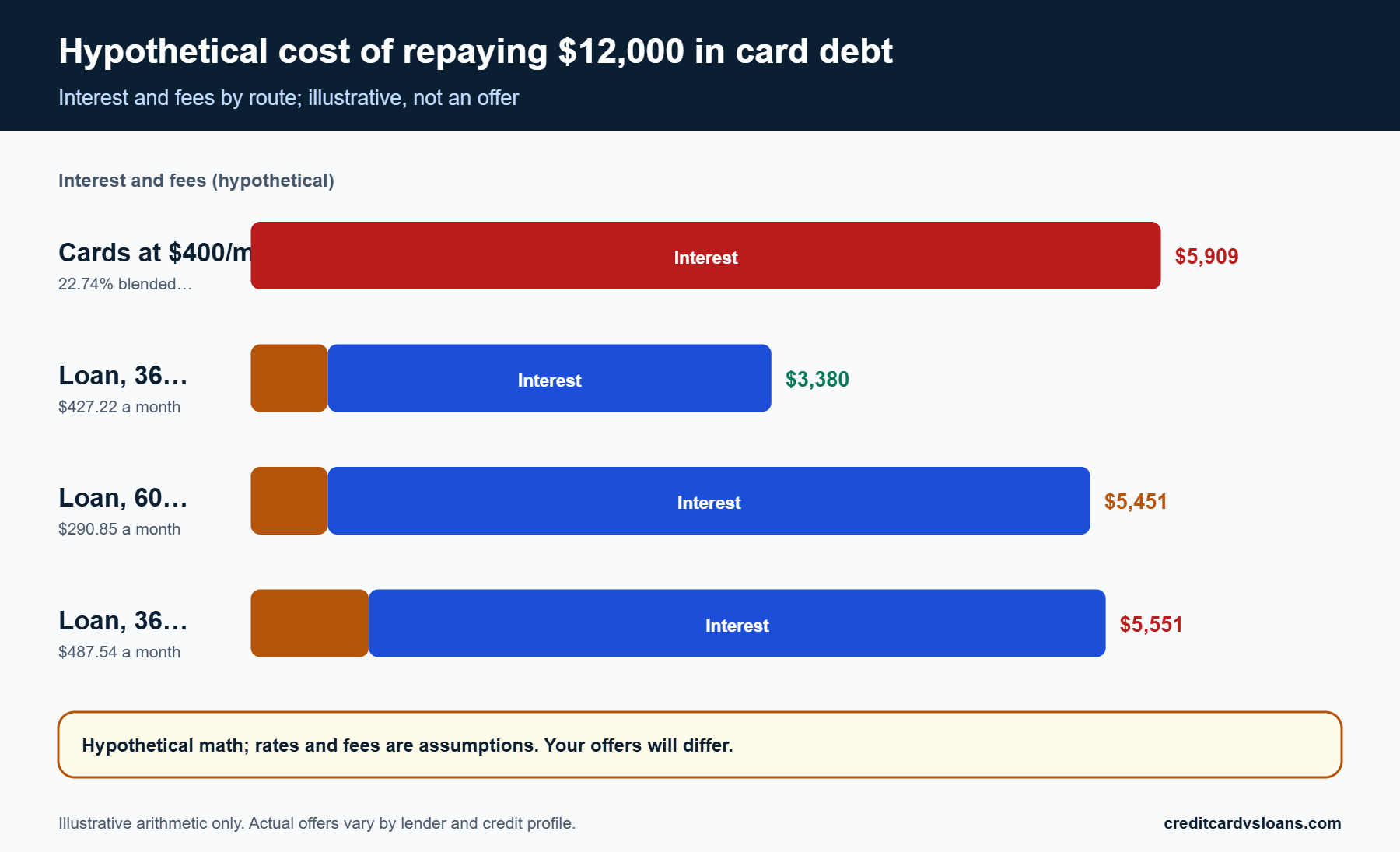
Imagine a hypothetical borrower with $12,000 spread across three cards: $5,000 at 24.99%, $4,000 at 21.99% and $3,000 at 19.99%. The blended rate is 22.74%. Paying $400 a month, the cards take about 45 months and cost roughly $5,909 in interest.
Now suppose a 36-month loan at 14% with a 4% origination fee. To receive $12,000, the borrower has to borrow $12,500, which includes a $500 fee. The payment is $427.22 and the interest is about $2,880, for a total cost of about $3,380. Paying that same $427.22 on the cards would take about 41 months and cost roughly $5,294. In this example the loan comes out ahead by about $1,914. The rate and fee are assumptions, not an offer.
What the fee does to the effective rate
A fee makes a loan more expensive than its stated rate suggests. In the example above, a 14% rate with a 4% fee is equivalent to an effective borrowing cost of roughly 16.9% on the money you actually receive, because you pay interest on the $500 you never see. The shorter the loan, the more a fee matters per year of borrowing.
When you compare offers, convert each to the same basis: interest plus fees over the full term, at the same monthly payment as your alternative. That makes a no-fee loan at a slightly higher rate and a fee-bearing loan at a lower rate directly comparable.
One more point on the fee: it does not shrink if you pay the loan off early, so a fee-bearing loan is a better fit for a balance you plan to hold for the full term. If you expect to pay the balance off quickly, a no-fee product, even at a slightly higher rate, can end up cheaper. Run both versions through the same-payment test and let the result decide.
The term trap
The same rate at three terms
Term changes the cost far more than most people expect. Table 2 uses the same hypothetical $12,000 and prices the loan at 14% with a 4% fee at three terms, plus one higher-rate case. For each, it also shows what the cards would cost at the same monthly payment.
| Loan option (illustrative) | Monthly payment | Loan interest plus fee | Cards at that payment | Difference |
|---|---|---|---|---|
| 24 months, 14%, 4% fee | $600.16 | $2,404 | 26 months, $3,227 interest | Loan saves about $823 |
| 36 months, 14%, 4% fee | $427.22 | $3,380 | 41 months, $5,294 interest | Loan saves about $1,914 |
| 60 months, 14%, 4% fee | $290.85 | $5,451 | 82 months, $11,590 interest | Loan saves about $6,139 against that slower card path, but costs $2,071 more than the 36-month loan |
| 36 months, 22%, 6% fee | $487.54 | $5,551 | 34 months, $4,315 interest | Loan costs about $1,236 more |
What the table teaches
The first three rows show the same loan getting steadily more expensive as the term stretches. The 60-month row looks like a bargain against the slower card path, but it is the most expensive way to use the loan. The last row shows that a rate close to the card rate, plus a fee, can lose to the cards at the same payment.
So the loan question is really two questions: is this rate and fee good enough, and is this term the right one? Answering the first without the second is how people end up overpaying. A shorter term, if you can handle the payment, usually costs less.
If you are tempted by the lowest payment on the menu, ask a harder question: what would you do with the money you save each month? If the answer is that it goes to the cards or to an emergency fund, the longer term is a deliberate tool. If the honest answer is that it would be spent, the shorter term protects you from yourself.
Credit Score and Credit Access: What Changes When the Cards Hit Zero
How the score can respond
The application and the new account
A full loan application can produce a hard inquiry, and a new account counts as new credit. FICO assigns 10% of a score to new credit and counts inquiries from the past 12 months. For many borrowers the effect is modest and short-lived, but it can matter more for those with thin files or several recent applications.
This is a good reason to prequalify with soft pulls and then submit one or two full applications, not many. Our guide on taking out a personal loan just to build credit explains why opening debt for the sake of a score usually backfires.
Utilization and payment history
Amounts owed is 30% of a FICO Score, and it includes how much of your available revolving credit you are using. If the loan pays your cards down to zero and you leave them open, revolving utilization on those cards drops sharply, which can help. If balances return, the benefit is gone.
Payment history is the largest factor at 35%. The loan gives you a new account that either builds a record of on-time payments or adds late marks. Autopay for at least the required amount is a simple safeguard. Neither effect comes with a promise about the size of a score change.
Access to credit afterward
Open cards and available credit
After the payoff, your cards still have limits. That available credit is a safety net and a temptation. Some borrowers keep one card for emergencies and put the others out of reach. Some ask issuers to lower limits. Whichever you choose, understand that a lower limit can raise utilization on the cards you keep.
Keeping older cards open also preserves account age, which supports the length-of-history factor, so closing the oldest cards is usually the less attractive way to avoid temptation.
How the loan shows up on future applications
The new loan adds a monthly obligation to your reports, which lenders consider in future applications such as a mortgage or auto loan. A lower revolving balance helps; a new installment payment is a new commitment. If a large purchase is on the horizon, factor the timing in before you take a loan.
Ask lenders how they would see the new loan relative to your income. A fixed payment that you pay on time is a positive; one that strains your budget is a risk to everything else.
The Behavior Risk: When the Loan Does Not Solve the Problem
The refill arithmetic
What happens when cards run back up
Suppose the hypothetical borrower uses the 36-month loan to clear the cards and then, over the next year, charges $6,000 back onto them. At the same blended 22.74%, paying $250 a month on that new balance takes about 33 months and costs roughly $2,079 in interest. During the first year the borrower is paying the $427.22 loan payment and funding new card spending at the same time.
Total debt now is the remaining loan balance plus $6,000 on cards. After 12 payments on the loan, about $8,898 remains. The borrower owes roughly $14,900, more than the original $12,000, and consolidation has made the position worse, not better.
Why refills happen
Often it is not carelessness. If spending was already above income, nothing about a loan changes the monthly gap. Medical bills, car repairs and irregular income all land on whatever credit is available. The CFPB recommends working out why you are in debt before choosing a solution, because the cause decides whether any fix holds.
If a recurring expense or an income shortfall created the balances, address it directly: a budget review, a conversation with a nonprofit counselor, or a change in income if possible. Without that, the loan is a delay, not a solution.
Pay attention to the first warning sign, which is usually a card balance that grows two months in a row. At that point, revisit the budget rather than waiting for the balance to become a problem. Early adjustments, such as trimming one category or pausing a subscription, cost far less than the ones you make after the balance doubles.
Guardrails that help
Build a card rule before the loan arrives
Write down what the cards are for. Many people keep one card for true emergencies and stop using the rest. Others use a debit card for daily spending for several months. Choose a rule you can follow, and make it specific: “no card purchases except emergencies” is easier to keep than “spend less.”
Setting low spending alerts and removing saved card numbers from shopping accounts also add helpful friction.
Pay creditors directly and automate
If the lender offers to pay your creditors directly, accept. If not, pay each card in full on the day the funds arrive and confirm that the balances show as paid. Then set the loan to autopay at the required amount from your checking account.
Confirm the account balance covers the payment on the due date, since a failed autopay can trigger fees and a late mark. A small buffer in the account is a cheap defense.
Alternatives to a Personal Loan to Pay Off Credit Cards
Other consolidation routes
A 0% transfer card
A balance transfer card offers a promotional rate, often 0%, for a set period. The CFPB lists the things to watch for: a transfer fee, a rate increase when the promotion ends and the loss of a grace period on new purchases. A transfer can beat a loan when you can clear the balance inside the promotion, and lose when you cannot.
Approval, limits and the fee all depend on your profile, and the strongest offers usually go to the strongest borrowers. Compare the total cost, including what is left at the reset, against the loan’s total cost at a realistic payment.
A nonprofit debt management plan
Credit counseling agencies, usually nonprofits, can set up a debt management plan in which you make one monthly payment to the agency, and it pays your creditors, often at reduced interest. The FTC notes that these plans often take 48 months or more and may require you to stop using credit, and the CFPB advises getting fees in writing and confirming creditor acceptance before you pay.
A plan can be a better fit than a loan when your credit profile limits loan offers to high rates. It does not create a new loan or require a hard pull, though terms vary by agency.
Consider whether the plan fits your timeline. If you are planning a major purchase or a move within a year, the monthly obligation of a plan or a loan will affect how much flexibility you have. Choose the route that leaves you able to handle what is coming, not only the route that is cheapest on paper.
Do-it-yourself options
Ask your issuers for help
The CFPB suggests asking creditors whether they will lower payments, waive fees, reduce your rate or change your due date. Issuers are not required to agree, but the request costs nothing. Be specific about what you can pay, and get any agreement in writing before you change your payment.
If you are struggling to make payments, call before you miss one, because options are usually broader earlier than later.
Pay the cards down on a plan
A structured payoff on your current cards avoids fees and new accounts. The two classic orders are highest rate first, which minimizes interest, and smallest balance first, which can build momentum. With balances like the example’s, even $100 extra each month shortens the timeline and cuts interest.
The right choice depends on how wide your rate differences are and on whether quick wins keep you going. If a loan cannot clearly beat this plan, the plan is the better option.
Profile Checkpoints Before You Apply
What lenders look at
Score, income and existing debts
Lenders typically review your credit report and score, your income and employment, and your existing debts relative to income. Different lenders weigh these differently, and each sets its own cutoffs. A useful overview of how score ranges tend to affect offers is in our guide on the credit score you need for a personal loan.
FICO’s published weights, with payment history at 35% and amounts owed at 30%, explain why recent late payments and high card balances matter so much to the offers you see.
Prequalification and rate shopping
Prequalification tools can show estimated terms with a soft pull. Use them across several lenders, compare the estimates using the same payment test and then apply for the one or two that look best. This is called rate shopping, and doing it in a short, focused window keeps hard inquiries to a minimum.
Treat an estimate as an estimate. The final offer can differ after full verification, so confirm that the terms in the final offer still pass the test.
If your profile is weaker
Expect narrower and costlier offers
With a lower score, offers tend to be fewer and more expensive, and the same-payment test fails more often. Our guides to a personal loan with a 620 credit score, a personal loan with a 600 score and a personal loan with a 580 score describe what to expect and what to ask.
If the test fails, consider the alternatives above before accepting a loan priced near your card rates.
Do not take a loan only to improve a score
Some people ask whether a loan could rebuild credit while also consolidating. A loan with a sensible rate that you can afford can help your payment history, but a loan you do not need or cannot afford can do the opposite. Debt is not a free way to build credit; it only helps if you pay it on time and it fits your budget.
Our guide on using a loan to build credit covers that decision in detail.
A Decision Matrix for Using a Personal Loan to Pay Off Credit Cards
Matching situations to answers
The matrix
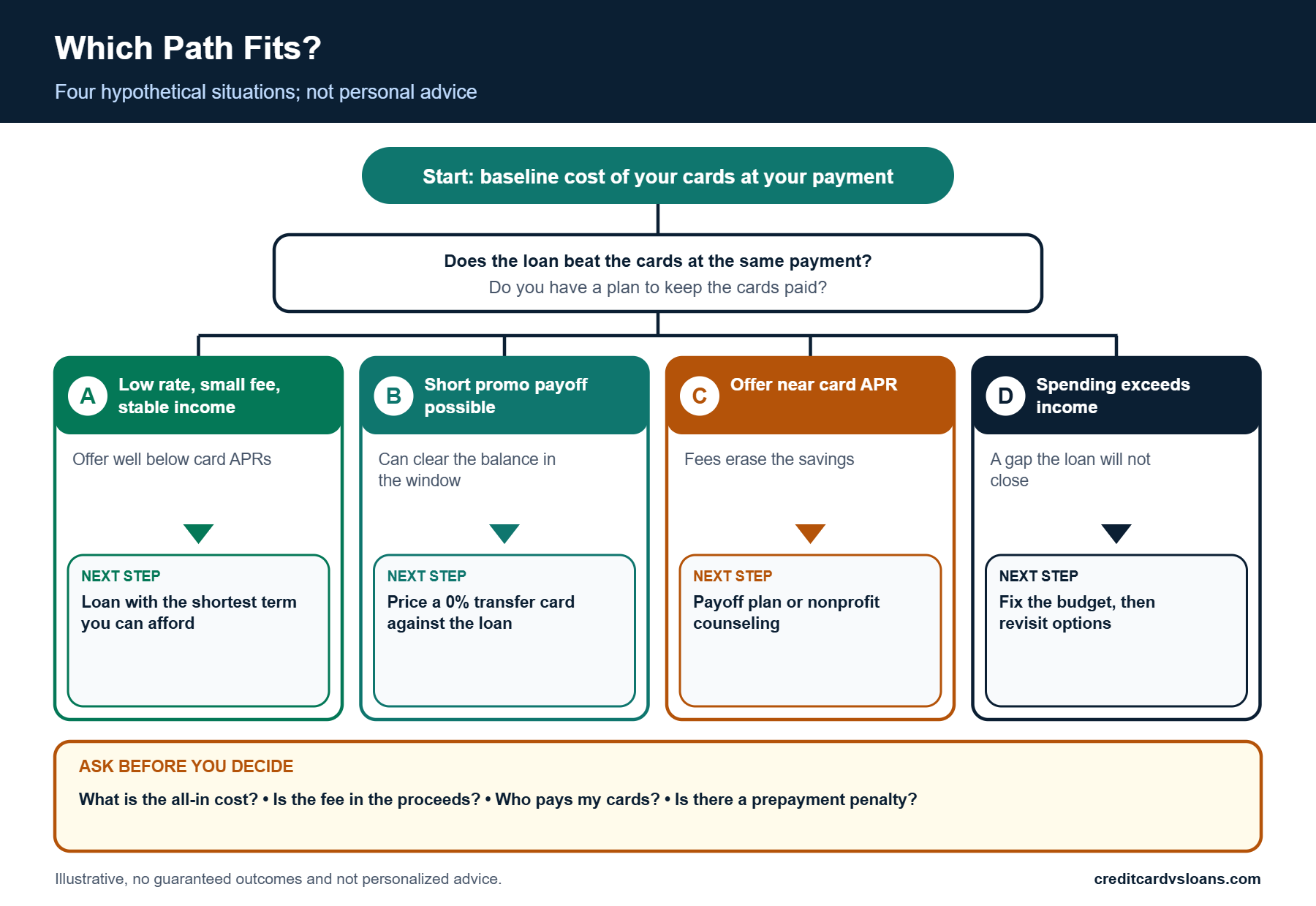
Table 3 pairs common situations with a likely direction. It is a research guide, not advice for your finances.
| Situation | Direction to investigate | Why | What to verify | When to avoid it |
|---|---|---|---|---|
| Offer rate well below card APRs, small fee, stable income | Loan, shortest term you can afford | Passes the same-payment test | Fee, prepayment terms, direct payment option | If the cards will refill |
| Offer rate close to card APRs | Payoff plan or counseling | Fees can erase savings | Total cost at the same payment | Almost always |
| Cash flow tight, long term needed | Compare a plan or a longer loan | Payment relief has a price | Total cost of the longer term | If the term outlasts your need |
| Can repay within a promo window | 0% transfer card | May cost less than any loan | Fee, limit, post-promo APR | If you cannot clear it in time |
| Spending exceeds income | Fix the budget first | The loan does not close the gap | A month of tracked spending | Until the gap is closed |
Applying it to yourself
Find the row closest to your situation, then fill in your own numbers. If you sit between rows, price both routes using the same payment and compare the total cost. A day of comparison usually beats a quick decision.
When you are unsure, a nonprofit credit counselor can give you a second view at low or no cost, and the CFPB lists questions worth asking any agency.
A final check on every row: write down the specific number that would change your mind, such as a rate above which you would skip the loan, or a payment above which you would pick a longer term. Setting that line before you see offers makes it easier to hold when a persuasive salesperson is on the phone.
Questions to ask any lender
Cost and terms
Ask for the APR, the origination fee and whether it is taken from proceeds, the term, the payment, any late fee and whether there is a prepayment penalty. Ask whether the lender can pay your cards directly and how long that takes.
Request the terms in writing before a hard pull where possible, and read the full loan agreement before signing.
Fit and flexibility
Ask what happens if you lose income, whether hardship programs exist and whether you can change your due date. Not every lender offers these, but knowing the answer in advance helps you decide whether the payment is safe for your situation.
Keep the offer documents. If anything changes between the quote and the loan, you want the original to compare.
Your Decision and Next Steps
Turning the test into a decision
Run the numbers in this order
Start with your baseline: the cards’ balances, rates and the monthly amount you can reliably pay. Compute how long and how much the cards cost at that payment. Then collect at least two prequalified loan offers and compute the loan’s interest plus fees at its required payment. Finally, compute the cards at that same payment and compare.
If the loan is clearly cheaper and the term does not outlast your need, the personal loan to pay off credit cards passes the cost test. If it is a close call, the simpler option, usually paying down what you have, deserves a fair hearing.
Table 4 turns the sequence into a worksheet you can fill in with your own figures.
| Step | What to record | Where it comes from | Warning sign |
|---|---|---|---|
| 1. Card baseline | Balance, APR and payment for each card | Latest statements | A balance that is not shrinking |
| 2. Baseline cost | Months to payoff and total interest at your payment | Your own arithmetic or the statement payoff estimate | A payoff date many years out |
| 3. Loan offers | APR, fee, term, payment from two or more lenders | Prequalification screens or written offers | Fee not shown until a hard pull |
| 4. Same-payment cost | Cards at each loan payment | Step 1 balances at the loan’s payment | Loan cost above card cost |
| 5. Behavior plan | Written rule for each card and a cushion goal | Your budget | No rule at all |
Settle the behavior plan before you sign
Decide what happens to each card, how you will cover surprise expenses and what you will do if balances start to grow. Write the plan down, and share it with someone who will ask how it is going. A few minutes now removes a lot of risk later.
If the plan is vague, delay the loan until it is not. The loan will still be available next month, and the delay costs little compared with a failed consolidation.
After the loan is in place
Protect the first ninety days
Check that the old cards show zero balances, that the loan payment posted on schedule and that no unexpected fees appeared. Review your credit reports for the new account and any errors. You can get your reports and dispute mistakes for free.
Put a reminder on your calendar for 90 days out. Review your spending against your budget and ask whether any card balance has crept back.
Consider extra payments with care
If your budget allows extra payments, confirm there is no prepayment penalty and that the lender applies extra amounts to principal. Extra payments shorten the loan and cut interest, but only after you have set aside a cushion for emergencies. Paying the loan early while carrying card balances elsewhere is usually the wrong order.
If you pay extra, keep a record of the confirmation and check the next statement to verify the principal dropped as expected.
Common follow-up questions
Should I pay off all my cards or just the high-rate ones?
It depends on the loan offer and on the rates involved. Paying the highest-rate cards first captures most of the savings, and a partial payoff leaves you with a smaller loan. If a card has a low or promotional rate, it may make sense to leave it alone.
Work out each card’s rate and decide whether the loan’s effective rate is lower than that card’s rate. If it is not, keep that card out of the loan.
What if I cannot get approved for the amount I need?
Lenders may approve a smaller amount than you request, based on income and existing debts. Use that amount on the highest-rate cards and keep paying down the rest on a plan. You can also ask whether a co-borrower is allowed, though a co-borrower takes on the full responsibility for the debt.
If offers are limited or expensive, consider a nonprofit plan or a payoff strategy first. Avoid any company that asks for money before delivering help, the FTC warns, or that tells you to stop paying your creditors.
A personal loan to pay off credit cards is worth using when it clearly beats your cards at the same monthly payment, the term is one you actually need and your spending is under control. If any of those three fails, the loan may cost more or leave you with double the debt.
- List each card’s balance, rate and your realistic monthly payment.
- Prequalify with soft pulls and record rate, fee, term and payment.
- Compute the cards at each loan’s payment and compare total costs.
- Choose the shortest term you can afford and ask about prepayment terms.
- Pay cards directly or the same day, then set autopay for the loan.
- Set a card-use rule and review the plan after 90 days.
- CFPB: What do I need to know about consolidating my credit card debt?
- CFPB: What is the difference between credit counseling and debt settlement, debt consolidation, or credit repair?
- CFPB: What is credit counseling?
- FTC: How To Get Out of Debt
- Federal Reserve: Consumer Credit – G.19 (release of October 7, 2026)
- myFICO: What’s in your credit score?
Last updated: October 22, 2026. Rates, fees and lender rules change; verify current terms before acting.
The information on creditcardvsloans.com is provided for general educational and informational purposes only. It is not financial, legal, tax, credit, accounting or investment advice, and reading it does not create an advisor-client, fiduciary or any other professional relationship. Nothing here is an offer, solicitation or recommendation to borrow, lend or apply for any product.
Credit scores, interest rates, fees, eligibility rules, lender policies and laws change frequently and vary by lender, location and individual circumstances. Examples, figures and scenarios are illustrative only, do not predict your results and do not guarantee approval, savings, a particular rate or a credit-score outcome. Always confirm current terms directly with the lender or issuer and read the full agreement before you apply or sign.
Although we aim for accuracy and use reputable sources, we make no representations or warranties, express or implied, about the completeness, accuracy, reliability or timeliness of the content. Content may be drafted with the assistance of automated tools, so errors or omissions may still occur. Links to third-party sites are provided for convenience; we don’t control and aren’t responsible for their content.
To the fullest extent permitted by law, creditcardvsloans.com and its owners, editors, authors, contributors and affiliates disclaim all liability for any loss, damage or expense arising directly or indirectly from your use of, or reliance on, this content. Before making financial decisions, consult a licensed professional, such as a qualified financial advisor, attorney, tax professional or nonprofit credit counselor, who can consider your complete situation.