The best way to pay for vet emergency bills is usually the cheapest option you can lock in before the treatment decision is made: a payment arrangement with the clinic, money you already have, or a card or loan whose total cost you have seen in writing. Speed matters at 2 a.m., but speed is also the thing lenders and clinic-linked financing programs tend to charge for.
This guide is built for the first hours of a pet emergency, when you are standing in a lobby with an estimate in your hand and a decision to make. It is deliberately different from our broader walkthrough on financing a veterinary emergency from start to finish. Here the focus is narrower: which payment method fits which size of bill, which questions to ask the clinic before you sign anything, and which common offers carry costs that are easy to miss under stress.
Nothing here is personal financial advice, and you know your own budget, your pet and your family better than any article can. The goal is to make sure the money decision does not get made by default, because the first financing option placed in front of you is rarely the only one.
- Ask for an itemized estimate and a staged treatment plan first. The size of the bill you finance is often negotiable in ways the interest rate is not.
- For a bill you can clear in a few months, a payment arrangement with the clinic or a card you can pay off quickly usually costs less than a new loan with fees.
- “No interest if paid in full” offers can be deferred interest. If one dollar is left at the end, interest may be charged back to the purchase date.
- Cash advances on a card and short-term high-cost products are the expensive end of the range, even though they are fast.
- Whatever you choose, compare the total you will repay, not the monthly payment alone.
Average rate figures below come from the Federal Reserve’s G.19 consumer credit release of Oct. 7, 2026 (August 2026 data). They are averages across banks, not offers you will necessarily receive. Your own rate depends on your credit profile and the lender.
The short answer: match the payment method to the bill
A simple way to sort your options
Start with how big the bill is relative to your cash
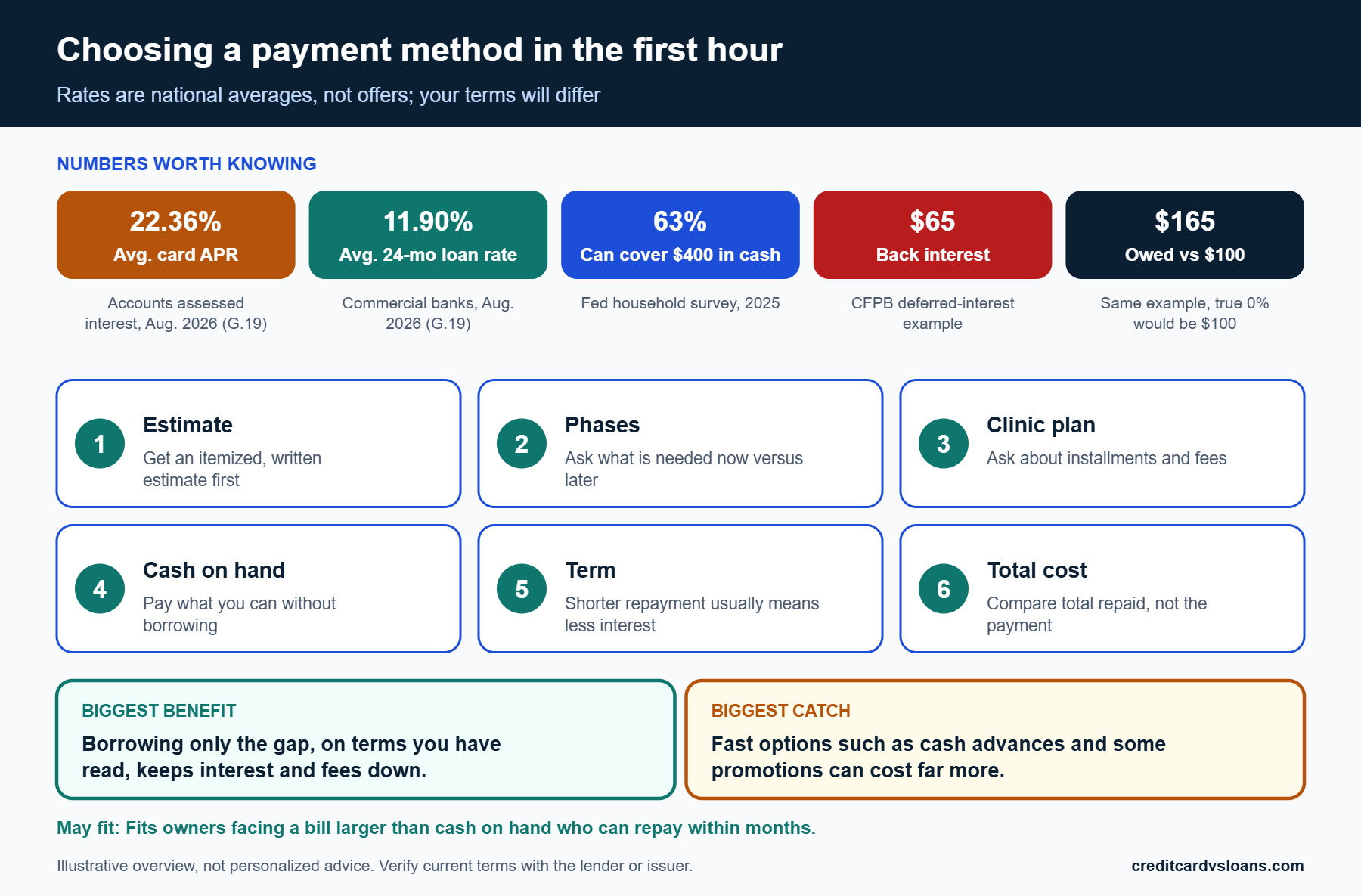
The Federal Reserve’s 2025 household survey, published in May 2026, found that 63% of adults said they would cover a hypothetical $400 emergency expense using cash or its equivalent. That also means a meaningful share of households would need another route for even a modest surprise, and veterinary emergencies often run well past $400. The first sorting question is therefore not “which lender” but “how much of this can I cover without borrowing, and how fast?”
If the bill is within reach of savings plus a few weeks of cash flow, a clinic payment arrangement or a split payment across a card you can clear quickly is typically the cheapest path. If it is several months of take-home pay, borrowing terms start to matter a lot more.
Then ask how fast you can realistically repay
Repayment speed is the lever that changes cost most. A balance cleared in two or three months barely accrues interest on almost any product, while the same balance carried for two years can cost hundreds of dollars more. Before comparing offers, write down a monthly amount you could pay without missing rent or groceries, and use it as the filter: any option that needs a larger payment than that is not a fit, however attractive the rate.
The four paths most owners end up choosing from
Pay through the clinic or a plan tied to it
Some practices let you spread a bill across scheduled payments, often with a deposit up front. Others point you to a third-party financing program. The first is usually a direct agreement with the clinic; the second is a credit product with its own application, terms and possible promotional interest rules. Ask which one you are being offered and get the terms in writing.
Use a credit card you already have
A card is fast, needs no new application and may offer purchase protections, but the typical interest rate is high. In the Federal Reserve’s G.19 release of Oct. 7, 2026, the average rate on credit card accounts assessed interest was 22.36% for August 2026. A card works best when you can repay in a few months, or when a promotional offer genuinely fits your timeline.
Take a personal loan
A personal loan has a fixed payment and end date, which many people find easier to plan around. The same G.19 release put the average 24-month personal loan rate at commercial banks at 11.90% for August 2026, though your offer may be higher or lower and may include an origination fee. Funding can take from the same day to several days, so confirm timing before you count on it. Our guide to choosing between a credit card and a personal loan explains the trade-off in detail.
Avoid the fastest, costliest options when you can
Credit card cash advances, payday-style products and title loans are quick but expensive, and the fine print can be harsh. The CFPB notes that card companies often charge a different, sometimes higher, rate for cash than for purchases, and the grace period usually applies only to new purchases. If you feel pushed toward one of these, pause and ask the clinic what else is possible first.
Before you borrow: what the vet bill is actually made of
Read the estimate like a budget, not a verdict
Ask for an itemized, written estimate
Emergency estimates often bundle exam fees, diagnostics such as imaging and bloodwork, hospitalization, medications and procedures into a single range. Ask the front desk to itemize it and to explain which items are required for the first decision and which are optional or can happen later. A written estimate also gives you something concrete to bring to a lender, an assistance program or a family member.
Estimates are estimates. Ask what happens if the real cost exceeds the high end, and who will call you before additional charges are added.
Separate stabilization from the full treatment plan
Many emergencies have a first phase aimed at stabilizing the animal and a second phase that treats the underlying cause. Ask the veterinarian what the first phase costs, what the second phase involves and whether there are realistic options at different price points, sometimes called a spectrum-of-care conversation. This is a medical judgment for the veterinarian, not something a finance article can tell you, but asking the question is entirely reasonable and clinicians hear it regularly.
Financing only the first phase can also avoid borrowing for care you may later decide to change.
Know what you are agreeing to pay today
Deposits, holds and payment at time of service
Many clinics ask for a deposit or full payment at the time of service, and practices differ widely on what they require before treatment starts. Ask exactly what is due now, what is due at discharge and whether a deposit is refundable if the plan changes. If you pay a deposit by card, you are borrowing on that card from the first dollar, so factor the rate in.
What happens if a bill goes unpaid
Unpaid bills can go to collections, and the CFPB’s guidance on debt collection says that ignoring a collector rarely makes the contact stop; talking to the collector about your situation is a better first step. The practical lesson is to contact the clinic’s billing office early if you cannot meet a payment. Billing staff often have more flexibility before an account is past due than after.
A short, honest conversation about what you can pay each month is usually more productive than waiting for a collection notice.
Options that may avoid new debt altogether
Lower-cost routes worth asking about first
A direct payment arrangement with the practice
Ask the billing office whether the clinic offers its own installment arrangement, what the schedule would be, whether there is any interest or fee, and what happens after a missed payment. Policies vary by practice, and some do not offer any. If an arrangement is available, compare it with a card or loan on total cost: an interest-free schedule with a modest administrative fee can be cheaper than almost any borrowing product, but only if you can hold to the schedule.
Get the terms in writing, including the due dates and the total you will have paid at the end.
Assistance programs and teaching hospitals
Some nonprofit funds, humane societies and breed or condition-specific charities offer grants or reduced-fee help for veterinary care, and some veterinary school teaching hospitals and community clinics price services differently from private emergency hospitals. Eligibility rules, funding limits and wait times differ, and many funds have narrow criteria, so treat these as possibilities to check quickly rather than a plan to rely on. A clinic’s staff or your regular veterinarian may know which local programs exist.
Be wary of anyone who asks for an upfront fee to “qualify” you for assistance.
Money you may already have access to
Pet insurance and what it does and does not do
If you already have a pet insurance policy, call the insurer before treatment if time allows. Many policies reimburse you after you pay the clinic, rather than paying the clinic directly, which means you may still need a way to cover the bill up front. Waiting periods, deductibles, annual limits and exclusions for pre-existing conditions are common, and terms differ by policy, so check yours instead of assuming coverage.
If you do not have a policy, buying one after an emergency typically will not cover the condition that prompted it.
Savings, family help and crowdfunding
Using savings for a pet emergency is exactly what an emergency fund is for, though it is fair to weigh how much cushion you want left. A loan from a relative can be cheaper than any commercial product, and it works best with a written repayment plan so it does not strain the relationship. Crowdfunding sometimes works for people with a wide network, but it is unpredictable, can take time and may charge processing fees, so it is a supplement rather than a plan.
When the emergency is happening now, a partial payment from savings plus a smaller borrowed amount can reduce the interest you pay.
What each way of paying costs
Costs come from three places: the interest rate, any upfront fees, and how long you take to repay. The table below compares the main options on those factors for a typical vet emergency, using general features rather than any specific lender’s terms.
Side-by-side: how the main options compare
The comparison table
| Option | Typical speed | Main cost driver | Biggest catch |
|---|---|---|---|
| Clinic payment arrangement | Same day if offered | Fees, if any | Not every practice offers one; missed payments may bring fees |
| Existing credit card | Immediate | Interest rate (average 22.36% on accounts assessed interest, Aug. 2026) | Balances carried for months get expensive |
| New 0% or deferred-interest offer | Minutes to days | Whether you repay in full during the promotion | Deferred interest can be charged back to day one |
| Personal loan | Same day to several days | APR plus any origination fee (average 24-month rate 11.90%, Aug. 2026) | Fees reduce the amount you receive; funding may lag |
| Card cash advance | Immediate | Often a higher rate and a fee, with no grace period | Usually the costliest way to use a card |
| Assistance fund or grant | Varies, often slow | Typically none | Narrow eligibility and limited funds |
How to read the table
Notice that the fastest options are not the cheapest and the cheapest options are not always available. A realistic plan often combines two: for instance, paying part of the bill from savings or a clinic arrangement and borrowing only the remainder. The averages in the table are context, not predictions. Your card’s actual rate is on your statement, and a loan offer shows its APR before you accept.
Putting numbers on it
A hypothetical $3,500 bill
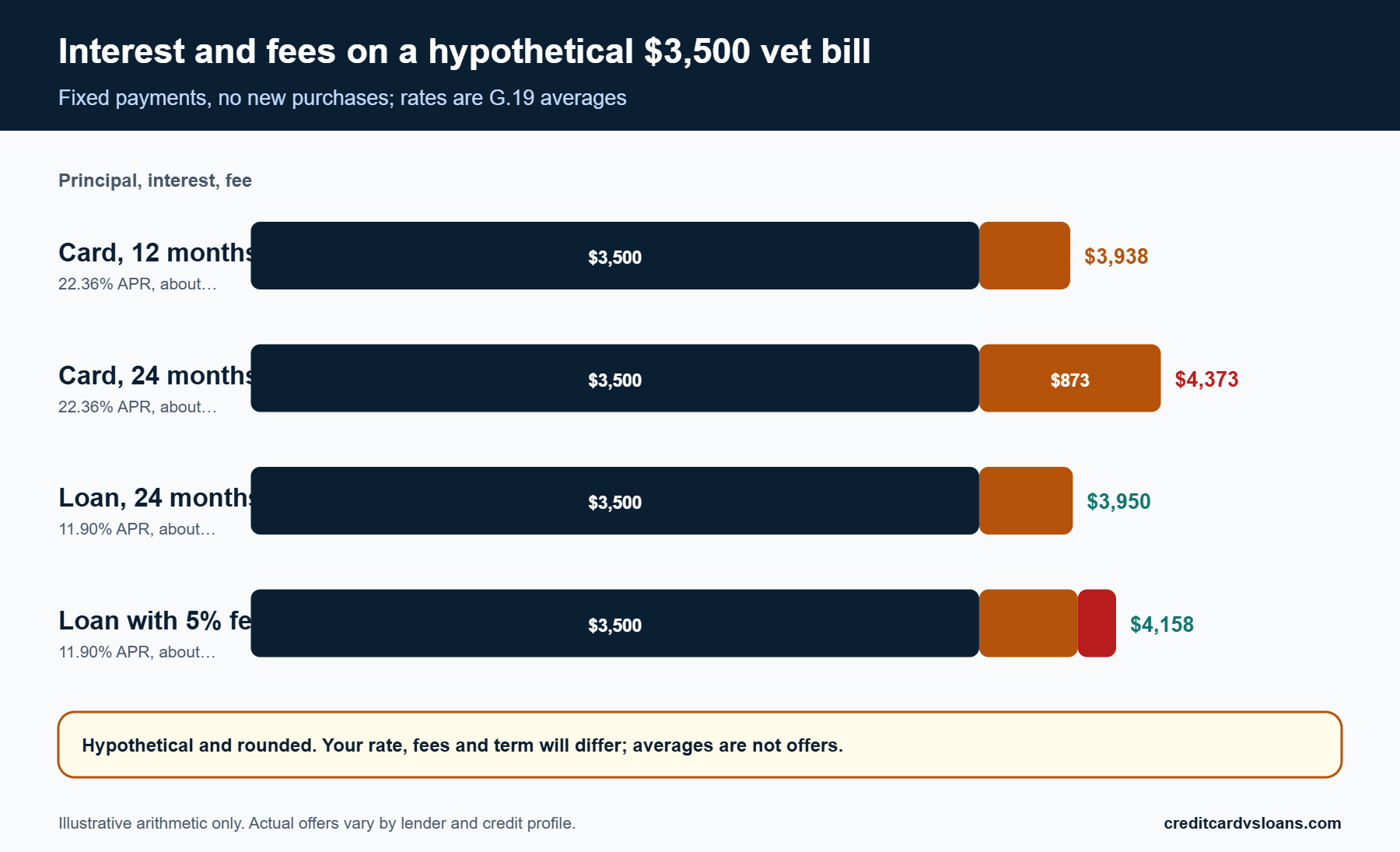
To make the trade-offs concrete, consider an illustrative $3,500 bill, with no new purchases and fixed monthly payments. At the 22.36% average card rate, repaying over 12 months means about $328 a month and roughly $438 in interest. Stretching the same card balance across 24 months lowers the payment to about $182 but raises interest to roughly $873. A 24-month personal loan at the 11.90% average rate would be about $165 a month with about $450 in interest, before any fees.
These figures are hypothetical and rounded, using the standard amortization formula, and your own rates will differ.
What fees do to the comparison
An origination fee is usually deducted from the loan proceeds, so you borrow more than you receive. In the same hypothetical, a 5% origination fee means borrowing about $3,684 to net $3,500; at 11.90% over 24 months, that is roughly $173 a month, about $474 in interest and about $184 in fees. The total cost of about $658 is higher than the card at 12 months in this example, even though the loan rate is half as large. Fees and term length can matter as much as the headline rate, which is why comparing a 0% APR card with a personal loan only works when you look at the full cost of each.
The lesson is not that cards beat loans, but that the total cost depends on rate, fee and repayment time together.
Approval, speed and your credit when time is short
How lenders decide, and how fast they can move
Prequalify first when you can
Many lenders let you prequalify, which typically means a soft pull, a credit check that does not affect your credit score, to preview whether you might be approved and at what terms. Prequalification is not an approval, and the final offer can differ once the lender runs a hard pull, the fuller check that is recorded on your credit report. If you have even an hour, checking two or three prequalification screens lets you compare actual terms, an activity often called rate shopping, instead of accepting the first.
In a true emergency you may not have that hour. In that case, a card you already hold avoids the application step entirely.
What lenders look at
Lenders generally weigh credit history, income, existing debt payments and, for some products, your employment situation. A thin credit file, meaning a short or sparse history, can narrow the offers available or raise the rate. Requirements differ by lender, and no article can tell you whether you will be approved, so treat any quick “likely approved” message as a preview rather than a promise.
If you are turned down, ask the lender for the reasons. A denial notice generally has to tell you the main factors, which can point you toward a fix or a different type of product.
What borrowing can do to your credit
Short-term effects to expect
Applying for new credit can lead to a hard inquiry, and a new account lowers the average age of your accounts. A large balance on a card raises your utilization, the share of your revolving credit limit that is in use, which scoring models commonly weigh. Each of these effects can be temporary and depends on your overall profile, so there is no single number to expect.
Because effects vary, the sensible approach is to avoid applying for several products at once out of panic, and to check one option at a time using soft-pull tools where they exist.
Longer-term effects depend on how you repay
Paying on time every month is what builds a record over time, whichever product you use. Missed payments can be reported to the credit bureaus and can do lasting damage. A fixed-term loan can reduce card utilization if it replaces revolving debt, but it also adds a new account and a new payment, and results differ from person to person. If a balance becomes hard to manage later, the planning questions in our guide to credit card debt consolidation by credit profile are a useful next stop.
| Question | Why it matters | Where to find it |
|---|---|---|
| What is the APR, not just the monthly payment? | APR folds interest and many fees into one comparable yearly rate | Loan offer or card disclosure box |
| Is there an origination or other upfront fee? | Fees reduce the money you receive but not what you owe | Loan agreement and offer summary |
| Is interest deferred or truly waived? | Deferred interest can be charged back to the first day | Promotional terms and cardholder agreement |
| What is the total repayment amount? | Lets you compare options apples-to-apples | Ask the lender or clinic to write it down |
| What happens if a payment is late? | Late fees and penalty rates can raise the cost fast | Terms and conditions |
| Is there a prepayment penalty? | Affects whether you can clear the debt early | Loan agreement |
Traps that are easy to miss in an emergency
Promotions that sound free
How deferred interest works
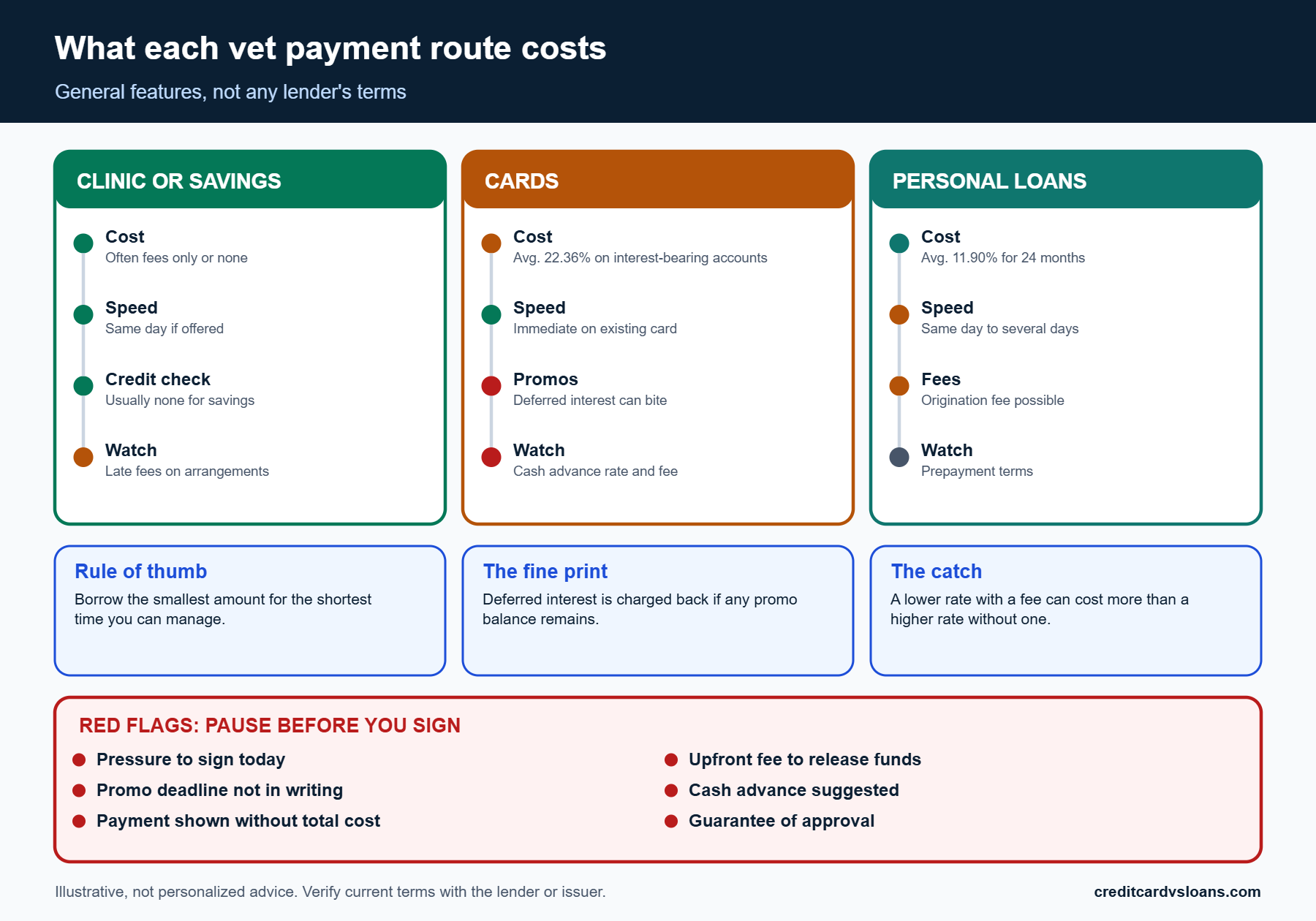
Some clinic-linked or retail-style credit cards advertise “no interest if paid in full” within a set period. The CFPB explains that with these offers interest is not waived, only deferred: if the promotional balance is not fully paid by the end of the period, interest can be charged back to the purchase date. Minimum payments usually are not enough to clear the balance in time, and the promotional length can depend on the purchase amount.
That does not make the offers bad. It makes them unforgiving, which matters if your income is uneven.
The CFPB example, in numbers
The CFPB illustrates the risk with a $400 purchase, a 25% deferred interest rate and $25 monthly payments over a 12-month promotion. After 12 payments the borrower has paid $300, leaving $100 of principal, but $65 of deferred interest has built up, so $165 is owed. A true zero-interest promotion would leave just $100 owing. The example is the CFPB’s, and it scales: on a larger bill, the deferred amount can be far bigger.
If you take one of these offers, set a calendar reminder for the last statement before the deadline and pay the balance in full a few days early.
| Feature | Deferred interest | True 0% promotion |
|---|---|---|
| If paid in full by the deadline | No interest charged | No interest charged |
| If $100 remains after 12 months | $100 plus $65 in back interest = $165 owed | $100 owed; interest applies only going forward |
| Main danger | One shortfall triggers interest on the whole original amount | Higher standard rate after the promotion ends |
| What to check | Exact deadline and payoff amount | Whether a balance transfer or purchase fee applies |
Fast money with a high price tag
Cash advances and cash-like products
Using a credit card to withdraw cash or buy something treated as cash is rarely the best fit for a clinic bill. The CFPB notes that card companies often charge one rate for purchases and a different rate for cash, and that a grace period generally applies only to new purchases. Many cardholder agreements also add a cash advance fee. If the clinic accepts a normal card payment, a regular purchase is usually cheaper than a cash advance.
Check your own agreement for the cash rate, the fee and whether interest begins on the transaction date.
Payday, title and similar short-term loans
Short-term, high-cost loans can carry very steep effective rates and short repayment windows, and some require access to your bank account or the title to your car. Rules differ by state, and some states restrict or prohibit certain products. Your state regulator or the CFPB can tell you what applies where you live. If a lender asks for a fee before releasing a loan, treat that as a red flag.
When the choice is between a high-cost fast product and a short delay with a clinic or relative, the delay is often worth a phone call or two.
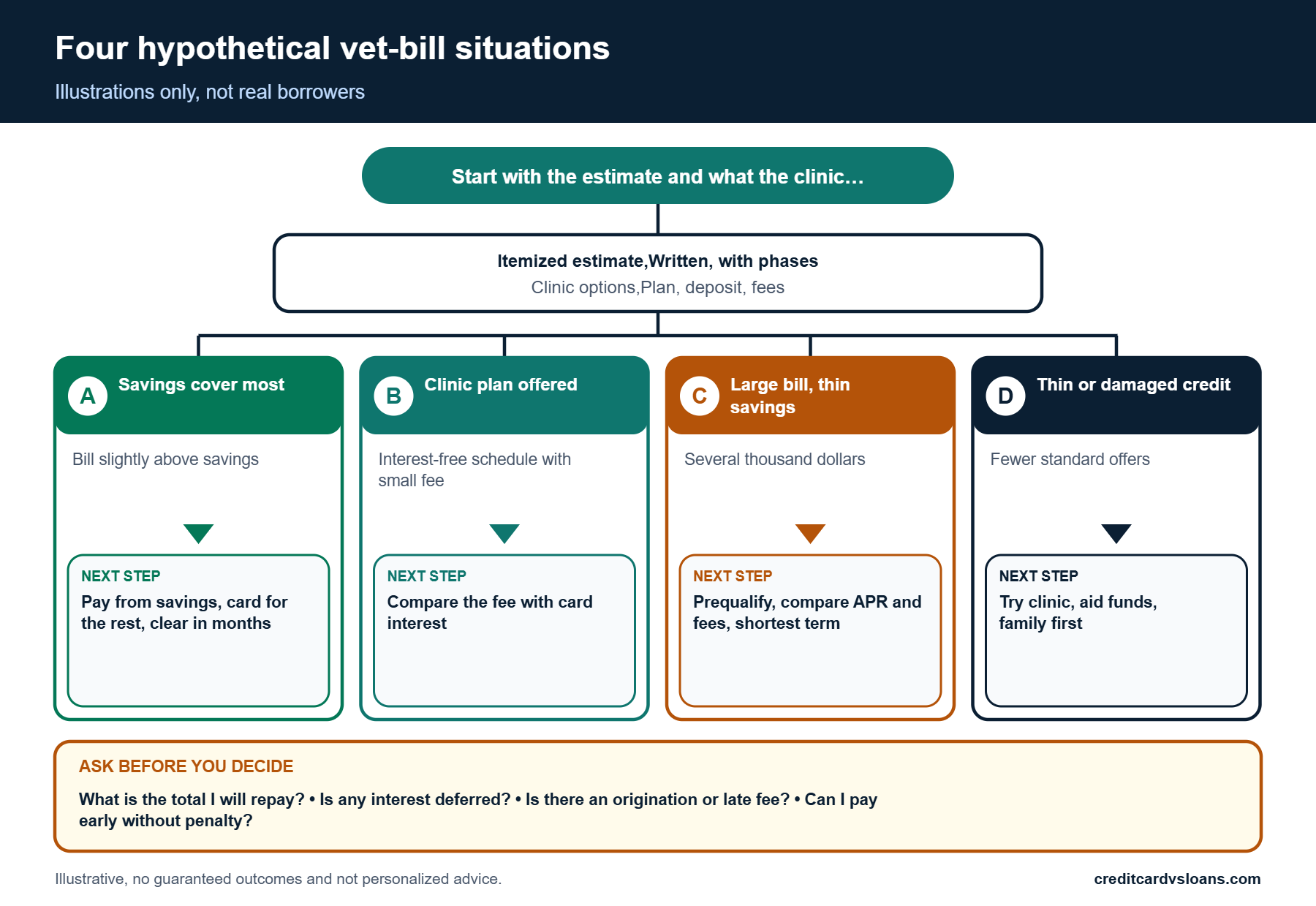
Three hypothetical situations, three different answers
These scenarios are illustrations, not real people, and the right answer for you depends on your own numbers. They are meant to show how the same bill leads to different choices.
When the bill is manageable
Savings cover most of it
Imagine a $1,800 bill and $1,200 in accessible savings. Paying the $1,200 from savings and putting $600 on an existing card, repaid within three months, may cost only a small amount of interest, and it avoids a new application. The trade-off is a thinner cushion afterward, which is a legitimate reason to ask the clinic about an arrangement for part of the balance instead.
The decision rule here is to borrow the smallest amount for the shortest time you can manage.
A clinic arrangement is available
If the same clinic offers an interest-free schedule with a small fee, compare the fee with the interest you would pay on a card for the same period. A fee of a few dollars per installment may or may not beat a card, depending on the amount and timeline. The arrangement also has a hidden benefit, which is that it caps your exposure: you know the total up front.
Confirm what a missed payment would trigger before agreeing.
When the bill is large and savings are thin
The $3,500 to $6,000 range
At this size, the monthly payment is where most budgets feel pressure, and a fixed-term personal loan can make the payment predictable. The risk is paying origination fees and a longer term than needed. Prequalifying with a couple of lenders, comparing APR and fees together, and choosing the shortest term the budget allows tends to be the practical path, with a card used only for the portion you can clear quickly.
Read the whole loan agreement, including any prepayment terms, before accepting.
When your credit file is thin or damaged
If your credit is limited, offers may carry higher rates or fees, and some products marketed to people in your situation are costly. Look first at options that do not depend on credit: a clinic arrangement, an assistance fund, a family loan, or a smaller treatment phase. If you do apply for credit, a credit union may be worth checking, since member-owned institutions sometimes offer different terms, though that varies. Do not borrow more than you need just because a lender offers it.
Whichever route you choose, confirm the total repayment amount in writing.
When the emergency is only the first bill
Follow-up care changes the math
Rechecks, medications and aftercare
The emergency visit is frequently not the last invoice. Rechecks, prescriptions, special diets, bandage changes, rehabilitation or a visit to a specialist can add costs over the following weeks. If you finance only the headline number, the follow-up costs land on a card or on your budget with no plan attached. Ask the veterinarian for a realistic outline of what aftercare looks like and what it might cost, even as a range.
That outline lets you decide whether to borrow slightly more now, at one set of terms, rather than adding small charges at card rates later.
Chronic conditions and ongoing treatment
Some emergencies reveal a long-term condition that needs regular medication or monitoring. A loan or promotional card designed for a single lump sum may not fit a recurring monthly cost. In that case it can make more sense to finance only the acute event and handle the ongoing portion through the monthly budget, an insurance policy that covers ongoing conditions if you can still get one, or an arrangement with the practice.
Keep the two pieces separate on paper so you can see whether the monthly total is sustainable.
Keeping track of what you owe
One list for every vet-related balance
It is easy to lose track when a bill is split across a card, a clinic arrangement, a relative and a pharmacy. List each balance, its monthly payment, its rate or fee and any promotional deadline. Seeing everything in one place tells you which debt to pay down first: usually the one with the highest rate, unless a deferred-interest deadline is approaching, in which case that deadline comes first.
Update the list monthly until the last balance is cleared.
Tax and benefits questions to ask a professional
Some people ask whether pet care costs are deductible or can be paid with health account funds. For most households, pet medical expenses for a personal pet are not treated like human medical expenses, and the rules can differ for working or service animals or in a business setting. Because your situation may be different, confirm with a tax professional or the IRS rather than assuming a deduction or benefit will be available.
Do not plan your repayment around a tax benefit you have not confirmed.
Keeping the repayment from becoming a second emergency
Build the repayment around your real cash flow
Pick a payment you can keep even in a tight month
A repayment plan that works only in a good month is a risk. Look at your lowest-income month of the last year, subtract fixed bills, and see what would be left. If the payment would crowd out essentials in that month, choose a longer term or a smaller borrowed amount, and then plan to pay extra when you can. Extra principal payments reduce interest on most fixed loans and cards, provided there is no prepayment penalty.
Automatic payments at the minimum due date protect your payment history, while manual extra payments let you accelerate when cash allows.
Protect yourself from a repeat
One emergency often exposes how thin the cushion was. Once the balance is paid down, many households find it easier to build a small pet-care fund, even $25 or $50 a month, than to hope the next surprise never comes. Pet insurance is another tool, but whether it is worth the premium depends on your pet, your budget and the policy’s exclusions. Compare it to self-insuring with savings rather than assuming one is always better.
The aim is to ensure the next emergency does not require the same scramble.
If the payments become hard to make
Contact the lender before you miss a payment
Lenders and card issuers sometimes have hardship programs, reduced payment plans or date changes for borrowers who ask early, though availability varies and terms differ. Calling before a missed payment generally gives you more options than calling after. Write down what you were told, ask for it in writing and read the revised terms before agreeing, since a lower payment can mean more total interest.
Know when a different structure makes sense
If a vet balance lands on top of other card debt, combining them under one structure may or may not lower your cost. Compare the new rate, fees and term against what you pay now, and look at how long each path takes to finish. The comparison in our guide to the best way to pay for back-to-school costs shows how to weigh a planned expense against fees and rates, and the same arithmetic applies here.
Do not roll high-rate debt into a longer term simply to get a lower payment without checking the total.
Your decision checklist and next steps
The decision in one pass
If you only have a few minutes
Work through this order: first, get a written estimate and ask about a staged plan. Second, ask what the clinic itself can offer. Third, decide how much you can pay from cash without leaving yourself exposed. Fourth, borrow only the remainder, choosing the shortest term you can afford, and avoid cash advances and short-term high-cost loans unless every other door is closed. Finally, save the paperwork showing the total you agreed to repay.
If one option feels rushed or confusing, that is a reason to ask for the terms in writing, not a reason to sign.
If you have a day or two
With a little more time, prequalify with two or three lenders using soft-pull tools, compare the APR and total repayment amount side by side, and check whether your insurer or a local assistance program can contribute. A longer search can reveal differences of hundreds of dollars on a mid-sized bill, though the right trade-off still depends on your timeline. The structured comparison in the card versus personal loan guide can help you decide which kind of product suits your situation.
Keep records of every quote, since they help in negotiating with the next lender.
Next steps
A concrete action list
- Request an itemized written estimate and ask what is needed now versus what can wait.
- Ask the clinic about payment arrangements, deposits and accepted financing.
- Check pet insurance, savings and assistance programs for any contribution.
- Prequalify with lenders using soft pulls, if you have time.
- Compare APR, fees, term and total repayment in one table.
- Avoid cash advances and short-term high-cost loans where possible.
- Set a repayment amount you could keep in your leanest month, with auto-pay on.
- If you choose a deferred-interest offer, mark the payoff deadline and pay early.
Sources of help
If a lender or debt collector treats you unfairly, the CFPB takes complaints at consumerfinance.gov, and your state attorney general or banking regulator is another resource. For a broader look at the same decision, our general guide to financing a veterinary emergency covers extra scenarios. Whatever you choose, borrow deliberately, keep copies of what you agreed to and remember that the cheapest option is the one with the lowest total cost you can reliably repay.
Questions owners often ask after the first call
Can the bill itself be negotiated?
Sometimes, though not always. Emergency hospitals generally set their prices and may have limited room to change them, but you can still ask whether any services can be sequenced differently, whether a deposit can be smaller, or whether a payment schedule is possible. Being polite, specific and honest about what you can pay each month tends to get further than asking for a general discount. If you are referred to a specialist, ask the referring practice whether a lower-cost route exists.
Keep the conversation on what you can afford, since billing staff usually do not set clinical recommendations.
Will the clinic treat my pet if I cannot pay right away?
This depends on the practice and the circumstances. Policies on deposits, payment at time of service and stabilizing care before payment vary, and no general rule applies everywhere. The useful move is to say plainly at the outset what you can pay now and what you are exploring, so the staff can tell you what is possible. Do not assume the answer without asking, and do not wait until discharge to raise it.
If the first clinic cannot work with you, ask whether they can suggest another provider or a program.
Is a smaller treatment plan a bad choice?
Choosing a plan you can afford is a legitimate decision that many owners face. Whether a lower-cost plan is medically appropriate is a question for the veterinarian, who can describe the likely outcomes and the risks of each path. The financial side of the decision is separate: a plan you can fund without a punishing loan is better for the household than one that creates a second crisis.
Ask the veterinarian to explain clearly, without pressure, what each option means for your pet.
If something goes wrong with the financing
If you are denied
A denial does not mean the end of your options. Ask the lender for the reasons, check your credit reports for errors using the free reports federal law provides, and consider a co-borrower or a credit union. Do not apply to many lenders in rapid succession; each hard inquiry is recorded, and the effect on a score varies by profile. Meanwhile, return to the lower-cost routes: the clinic, assistance programs and family help.
Your options may look different in a few weeks, but the pet’s care cannot always wait, so use the clinic’s timeline.
If you suspect a mistake or unfair treatment
Review every statement. If a charge looks wrong, contact the card issuer or lender promptly and keep records. If a lender, collector or financing provider does not respond fairly, file a complaint with the CFPB or your state regulator. Watch for any program that demands an upfront fee, promises guaranteed outcomes or pressures you to decide on the spot, since those are common features of scams that target people in urgent situations.
A calm, written record of what happened and when is the most useful thing to bring to any complaint.
Get the estimate in writing, use the cheapest money you can reach first, and borrow only the gap on terms you have read. A clinic arrangement or a short card payoff often beats a new loan for smaller bills; a fixed-term loan with a payment you can sustain may suit larger ones. Speed is worth paying for only when the price is visible.
- Best Way to Pay for Back-to-School Costs: Compare Borrowing Options Before You Commit
- How to Finance a Veterinary Emergency: Credit Cards, Loans and Lower-Cost Options
- How to Finance Back-to-School Costs: Credit Cards, Loans and Lower-Cost Options
- Credit Card vs. Personal Loan: Which Is Better for Borrowing?
- 0% APR Credit Card vs. Personal Loan for Back-to-School Spending: Which Wins?
- Federal Reserve: Federal Reserve G.19 Consumer Credit release, Oct. 7, 2026 (Average credit card and 24-month personal loan rates, August 2026)
- Federal Reserve: Report on the Economic Well-Being of U.S. Households in 2025: unexpected expenses (Share of adults covering a $400 expense with cash or equivalent)
- CFPB: How to understand special promotional financing offers on credit cards (Deferred interest explanation and $400 example)
- CFPB: How does my credit card company calculate the amount of interest I owe? (Purchase versus cash rates and grace periods)
- CFPB: Debt collection tools and options when you cannot pay
Last updated: October 22, 2026. Rates, fees and lender rules change; verify current terms before acting.
The information on creditcardvsloans.com is provided for general educational and informational purposes only. It is not financial, legal, tax, credit, accounting or investment advice, and reading it does not create an advisor-client, fiduciary or any other professional relationship. Nothing here is an offer, solicitation or recommendation to borrow, lend or apply for any product.
Credit scores, interest rates, fees, eligibility rules, lender policies and laws change frequently and vary by lender, location and individual circumstances. Examples, figures and scenarios are illustrative only, do not predict your results and do not guarantee approval, savings, a particular rate or a credit-score outcome. Always confirm current terms directly with the lender or issuer and read the full agreement before you apply or sign.
Although we aim for accuracy and use reputable sources, we make no representations or warranties, express or implied, about the completeness, accuracy, reliability or timeliness of the content. Content may be drafted with the assistance of automated tools, so errors or omissions may still occur. Links to third-party sites are provided for convenience; we don’t control and aren’t responsible for their content.
To the fullest extent permitted by law, creditcardvsloans.com and its owners, editors, authors, contributors and affiliates disclaim all liability for any loss, damage or expense arising directly or indirectly from your use of, or reliance on, this content. Before making financial decisions, consult a licensed professional, such as a qualified financial advisor, attorney, tax professional or nonprofit credit counselor, who can consider your complete situation.